![[Sir Marc Isambard Brunel.]](img-thumbnail/jpegs/47314.jpg)
[Sir Marc Isambard Brunel.]
Painted by S. Drummond A.R.A. Engraved by J. Carter.
London. Published October 7th 1846. by Fred. Gwynne (late Colnaghi & Co.) Printseller and Publisher to the Royal Family, 23 Cockspur Street, Charing Cross.
Proof mezzotint on india, with Brunel's pencil signature on a pasted label under a typed lable. 545 x 405mm (21½ x 16").
Portrait of Sir Marc Isambard Brunel [1769 - 1849], civil engineer, engraved from the portrait by Drummond (London, National Portrait Gallery). Brunel is surrounded by objects alluding to his profession and achievements, including a miner's lamp, cotton-winding machine and a model of a lighthouse. On the right is the Thames Tunnel: the portrait was painted c.1835, half-way through its construction. This mezzotint was published in 1846, three years after the tunnel was opened to the public. By this time Brunel's career was over, having been almost totally paralysed on his right side by a stroke in 1845. Ex: Collection of The Hon. C. Lennox-Boyd.
[Ref: 47314] £550.00
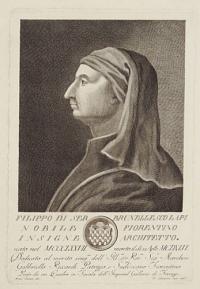
Filippo di Ser Brunellesco Lapi Nobile Fiorentino Insigne Architetto. nato nel MCCCLXXVII morto il di 15/ Ap~le MCDXLVI. Dedicato al merito sign.re dell Ill:mo e Rev:mo Sig:re Marchese Gabbriello Riccardi Patrizio, e Suddecano Fiorentino. Presso da un Quadro in Tavola dell'Imperial Galleria di Firenze.
Franc.o Sacconi del: F: Allegrini inci: 1765.
Engraving. 300 x 200mm (11¾ x 7¾"), with very large margins. Old ink numeral in margin.
Filippo Brunelleschi (1377-1446), Florentine designer and architect of the Renaissance, recognised as the first modern engineer, planner and sole construction supervisor. His dome for Santa Maria del Fiore, Florence's cathedral, is the largest brick dome in the world.
[Ref: 40513] £180.00
(£216.00 incl.VAT)
![[A woman confronted by a ghostly samurai]](img-thumbnail/jpegs/51808.jpg)
[A woman confronted by a ghostly samurai]
Max Brunning [pencil signature].
[German, n.d., c.1935.]
Rare etching, printed in colours, on chine collé. 255 x 190mm (10 x 7½"), very large margins.
A young woman in her scanty night attire raises her candle to see a snarling samurai, his katana unsheathed, towering above her. Max Brunning (1888-1968) published mainly erotica, but also a portraits of Adolf Hitler and a pair of a Hitler Youth boy & Bund Deutsche Mädel girl.
[Ref: 51808] £260.00
(£312.00 incl.VAT)
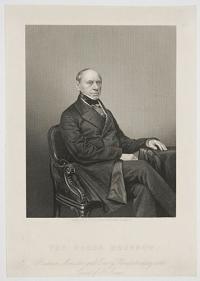
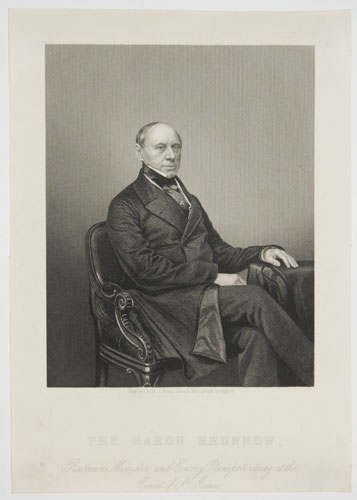
The Baron Brunnow, Russian Minister and Envoy Plenipotentiary at the Court of St James.
Engraved by D.J. Pound from a Photograph by Mayall.
[n.d., c.1859.]
Stipple. Sheet 305 x 215mm (12 x 8½"). Trimmed.
Philipp Graf von Brunnow (1797-1875), Russian ambassador in London (1840-54, including the start of the Crimean War), Frankfurt (1855), Berlin (1856), and again London (1858-74). This portrait, from a photograph by John Jabez Edwin Mayall, was taken for a carte-de-visite; this print was published for the 'Illustrated News of the World'.
[Ref: 33298] £80.00
(£96.00 incl.VAT)
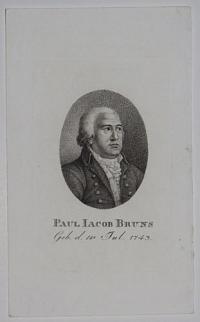
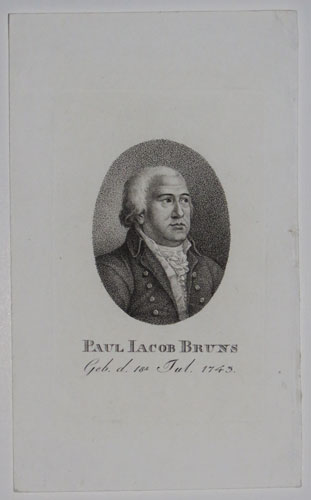
Paul Iacob Bruns. Geb. d.18.t Jul. 1743.
[n.d c.1780.]
Stipple. Plate 128 x 83mm. 5 x 3¼".
Paul Jakob Bruns (1743-1814) was a German Lutheran theologian, orientalist, literary historian, librarian and professor at the University of Helmstedt and Halle. In addition to the field of Old Testament textual critiques, Bruns published numerous works on topics of geography, law and general literary history.
[Ref: 26011] £60.00
(£72.00 incl.VAT)
![[Glorious First of June] To the Memory of the Brave Cap.t John Harvey, the Officers and Crew who fell in the Action,](img-thumbnail/jpegs/57473.jpg)
[Glorious First of June] To the Memory of the Brave Cap.t John Harvey, the Officers and Crew who fell in the Action, and to the Surviving Officers and Crew of His Majesty's Ship the Brunswick, This Print Representing the Brunswick after breaking the Enemy's Line, as second astern to Admiral Earl Howe on the first of June 1794 Grappled to, and engaging Le Vengeur with her starboard guns, and totally dismasting L'Achille in an attempt to board on the larboard Quarter is Respectfully inscribed by Nicholas Pocock.
Painted by Nicholas Pocock. Engraved by R.Pollard.
London. Published Feb.y 16th 1796 by Nich.s Pocock, Great George Street, Westminster.
Coloured aquatint. 480 x 650mm (19 x 25½"), on Whatman paper with very large margins. Tear touching bottom plate mark taped. Paper cockled and lightly toned.
A large and fine Battle scene with excellent colour. The 'Battle of the Glorious First of June', fought between the Royal Navy under Admiral Earl Howe and a French fleet of 26 ships of the line under Rear-Admiral Villaret-Joyeuse, protecting a convoy of grain ships from America bound for a desperate France. Although the British won the exchange, the grain convoy escaped intact. Parker: 102 T
[Ref: 57473] £720.00
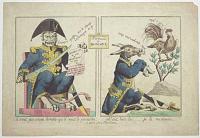
Portraits de Brunswick. Il n'est pass aussi terrible qu'il veut le paraître. Ah! c'est bien lui ... je le reconnois.
à paris chéz Martinet [n.d., 1806].
Coloured etching. 175 x 260mm (7 x 10¼"). Slight surface soiling.
A pair of contrasting caricature portraits of Charles William Ferdinand (1735-1806), Duke of Brunswick-Lüneburg, a general in the Prussian army. In the first he is depicted as a lion, in uniform with an unsheathed sword, holding the Brunswick Manifesto of 1792, in which he threatened dire consequences if the French royal family were harmed. In the second he is a donkey begging the French cockeral for mercy, referring to the Prussian defeat at the Battle of Jena–Auerstedt on 14 October 1806. Mortally wounded at the battle, the Duke died a month later. BM 1868,0808.7497.
[Ref: 64123] £320.00
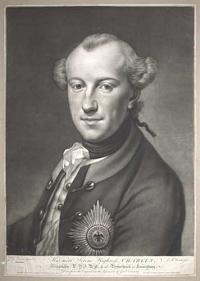
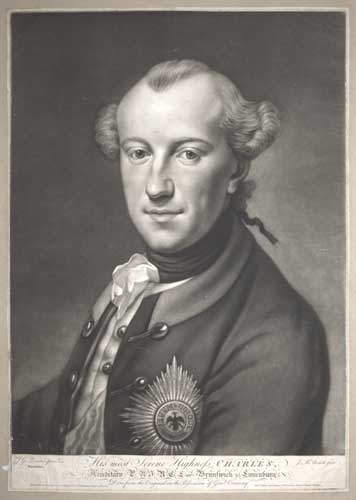
His most Serene Highness Charles Hereditary Prince of Brunswick & Lunenburg. Done from the Original in the Possession of Gen,,l Conway
J.G. Ziesenis pinx.t Hanover. J. Mc.Ardell fecit.
Publish'd by J.M.cArdell according to Act of Parliament Jan.y 20.th 1764, and Sold at the Corner of Henrietta Street, Covent Garden.
Mezzotint. 515 x 360mm (20¼ x 14¼"). Thread margins with nicks in edges, mounted on album paper.
Charles II, Duke of Brunswick-Luneberg (1735-1806), nephew of Friedrich II of Prussia. In 1764 he married Augusta, daughter of Frederick, Prince of Wales, and in 1780 succeeded his father as Duke of Brunswick. His 'Brunswick manifesto' threatening France and ordering the restoring of monarchy (25 July 1792), led to the fall of the Tuileries and the imprisonment of the royal family. Later that year Charles led the Austro-Prussian army against the French revolutionaries but lost at Valmy. He died in battle at Auerstedt in 1806. Engraved after the portrait by Johann Georg Ziesenis (1716-1776), Danish painter who became court artist to George II in Hannover in 1760. CS 32, ii of ii. Goodwin 111, ii of ii. Ex: collection of The Hon. Christopher Lennox-Boyd.
[Ref: 68373] £420.00
![[Ferdinand Albrecht, Duke of Brunswick-Bevern.]](img-thumbnail/jpegs/35758.jpg)
[Ferdinand Albrecht, Duke of Brunswick-Bevern.]
[Adreas Paul Multz.]
[n.d., c.1680.]
Mezzotint, very rare with German Collector's Mark verso. 390 x 530mm (15¼ x 21"). Trimmed. Damage to edges.
Three quarter length portrait of Ferdinand Albrecht, Duke of Brunswick (1636-1697) with text by Johann Christoph Arnschwanger below. Ex: Collection the Hon. Christopher Lennox-Boyd.
[Ref: 35758] £260.00
(£312.00 incl.VAT)

Carolus George Augustus, Erfprins van Brunswyk Wolfenbuttel .&.&.&.
[engraved by Charles Howard Hodges, c.1800]
Mezzotint with very large margins, rare; platemark 430 x 310mm (17 x 12¼"). Creasing.
Prince Charles George Augustus of Brunswick-Wolfenbüttel (1766-1806), son of Princess Augusta Charlotte, Duchess of Brunswick-Wolfenbüttel. Ex collection of the late Hon. C. Lennox-Boyd; Lugt L.1272 Not in CS.
[Ref: 34032] £220.00
(£264.00 incl.VAT)
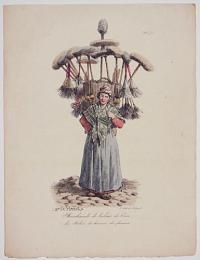
Marchande de balais de Cuir, des balais des houissoirs, des plumeaux. No. 71.
Carle Vernet. S. lith de Delpech.
[Paris, n.d., c.1820.]
Coloured lithograph. Printed area 300 x 140mm (11¾ x 5½").
A woman selling brushes and dusters, which are arranged like a peacock's fan from her backback. One of a series, 'Cris de Paris', depicting Parisian street vendors, lithographed by François Séraphin Delpech (1778-1825) after Antoine Charles Horace (Carle) Vernet (1758-1836).
[Ref: 33219] £60.00
(£72.00 incl.VAT)
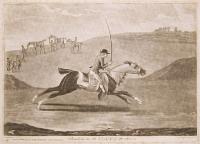
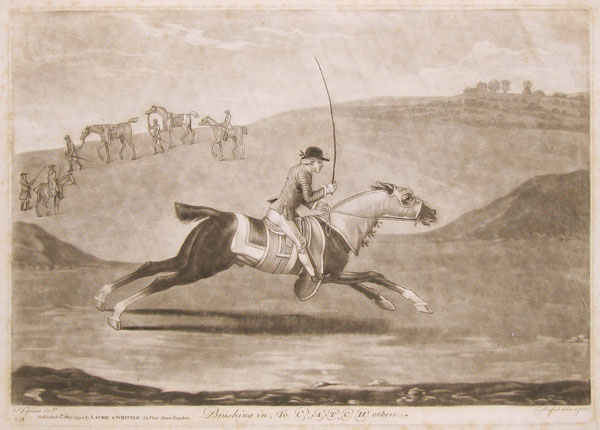
Brushing in, To Catch others.
J. Seymour inv.t.. T. Burford delin et fecit.
Published 12th May, 1794 by Laurie & Whittle, 53, Fleet Street London.
Mezzotint. 250 x 350mm. Short printer's crease, some foxing.
Ex: Collection of The Hon. C. Lennox-Boyd.
[Ref: 5467] £320.00
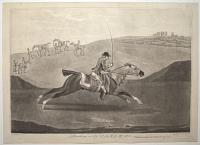
Brushing In, To Catch others.
J. Seymour inv.t. T. Burford delin et fecit.
Published according to Act of Parliament June 1755.
Mezzotint, 18th century watermark. 250 x 350mm (9¾ x 13¾"), with very large margins.
A Jockey on horseback galloping to right, the horse wearing a head-cover. Siltzer: 247.
[Ref: 54673] £360.00
![[Brushmaker] Brossier. Bürstenbinder](img-thumbnail/jpegs/36603.jpg)
[Brushmaker] Brossier. Bürstenbinder
[after Jean-Frédéric Wentzel] Lith. C. Fasoli et Ohlman à Stras.sbg.
[n.d., c.1845.]
Lithograph with fine hand colour heightened with gum arabic, rare with large margins. Printed area 200 x 250mm (8 x 9¾").
A brushmaker's workshop.
[Ref: 36603] £120.00
(£144.00 incl.VAT)

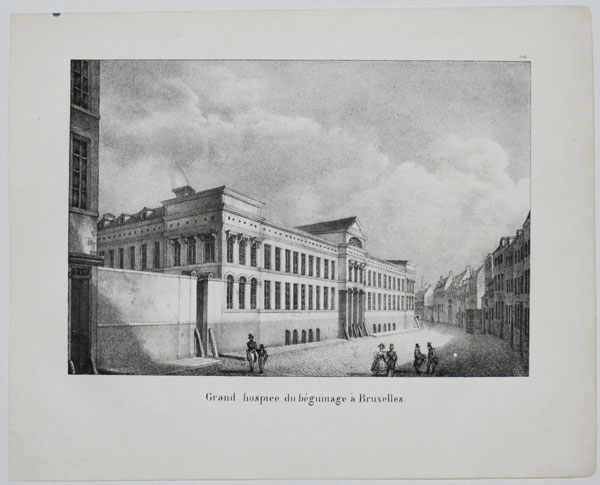
Grand hospice du béguinage à Bruxelles.
[n.d., c.1830.]
Lithograph. Sheet: 220 x 270mm (8¾ x 10½''), with large margins.
A view of the Grand hospice de béguinage in Brussels, now know as the Hospice Pachéco which was built between 1824 and 1827.
[Ref: 48215] £120.00
(£144.00 incl.VAT)
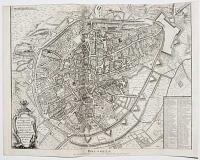
Brussels. Brussels. a large and beautiful City in the Dutchy of Brabant, subject to ye Queen of Hungary, Subject to the Queen of Hungary, and ye Seat of her chief Governor for these Parts.
I. Basire Sculp.
For Mr Tindal's Continuation of Mr Rapin's History of England. [London, James & Paul Knapton, 1751.]
Engraved map. 385 x 480mm (15¼ x 18¾"). Very fine impression with original binding folds, trimmed at top, as issued.
A plan of Brussels after the War of the Spanish Succession (1701-14), when it was transferred from Spanish control to the Austrian Hapsburgs. Nicholas Tindal (1687-1774), at one time Chaplain to Greenwich Hospital, first published a translation of Frenchman Paul de Rapin's 'History of England' in 1727, running to thirteen volumes; in 1732 it was enlarged with his own notes and maps. This map was published in 'A summary of Mr Rapin de Thoyras's History of England, and Mr Tindal's Continuation, from the Invasion of Julius Caesar, to the End of the Reign of King George I. Illustrated With Medals, Plans of Battles, Towns, and Sieges', 1751.
[Ref: 28250] £320.00
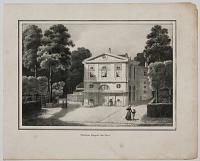
Théatre Royal du Parc.
[n.d., c.1840.]
Lithograph. Sheet 220 x 275mm (8¾ x 10¾").
A view of the front of the Théatre Royal du Parc, Brussels, built in 1783 by the Bultos brothers, before the remodelling work of 1844. The brothers' intention was to create a 'Vauxhall Gardens', with shops, cafes, ballroom and stage.
[Ref: 49987] £60.00
(£72.00 incl.VAT)
![Recitator Acerbus [ink mss.]](img-thumbnail/jpegs/11531.jpg)
Recitator Acerbus [ink mss.]
[Dated 1739 in pencil above.]
Etching, 280 x 190mm. 11 x 7½". Trimmed to plate right and left.
A rather grotesque figure walking in profile reading from a sheet of paper. In the background a winged horse or ass kicks over a barrel of beer, which spills its contents. The impression in the BM annotated in ink 'Mr. Bryan of Bury' and 'Kent pinxit'. By an unknown etcher. BM Satires: 2349, see 1850,0810.138.
[Ref: 11531] £230.00
(£276.00 incl.VAT)
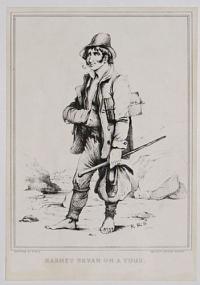
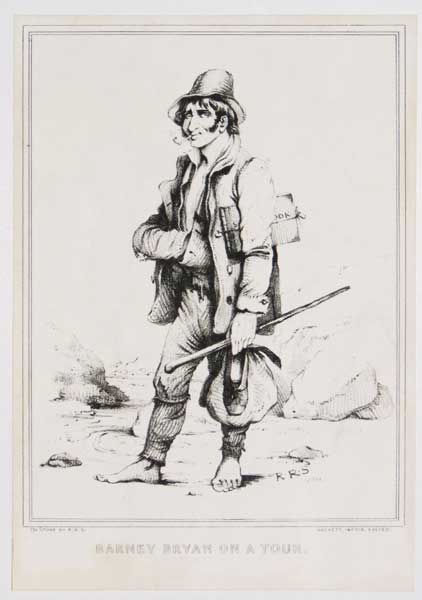
Barney Bryan on a Tour.
On Stone by R. R. S.
Hacket, Imprim, Exeter. [n.d., c.1835.]
Lithograph, rare. Sheet size: 185 x 130mm (7¼ x 5"). Trimmed.
A figure with bare feet stands, smoking a pipe, directed to the left, holding his shoes, a small bag and a stick in his left hand, with a book under his arm titled 'S[ketch]book'. From a series of twenty-five humorous lithographs by Robert Richard Scanlan (1801 - 1876),' Barney Bryan's Sketch Book', printed in Exeter by J. Hackett.
[Ref: 36328] £120.00
(£144.00 incl.VAT)
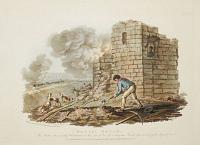
Daniel Bryan, The Sailor who so nobly Volunteered at the risk of his life to bury the French General during the Siege of Acre.
Sketched on the Spot by F.B. Spilsbury & Drawn by Dan.l Orme. T. Vivares sc.t
Edw.d Orme Excu.t Sold & Published March 25th 1803 by Edw.d Orme Printseller to His Majesty & the the Royal Family, 59 Bond Street, London.
Coloured aquatint, platemark 300 x 395mm (11¾ x 15½"), with very large margins. Printed on Whatman paper with 1801 watermark. Very fine.
British soldier burying a French general killed during the Siege of Acre in 1799, an unsuccessful French attach on the city of Acre (now Akko, modern Israel) during Napoleon's invasion of Egypt and Syria. Plate from 'Picturesque Scenery in the Holy Land and Syria', a volume of prints after drawings by Francis B. Spilsbury, a naval surgeon and amateur artist who made the drawings while on board HMS Le Tigre during campaigns in 1799 and 1800. The source watercolour by Spilsbury is in the V & A Museum. Abbey 381.6
[Ref: 46517] £260.00
(£312.00 incl.VAT)

Mrs. Bryan and Children.
Engraved by W. Nutter from a Miniature of the same size Painted by Saml. Shelley.
London, Published Septemr. 29th; 1797 by G. Kearsley 46 Fleet Street.
Stipple printed in brown ink, title in open letters. 290 x 245mm (11½ x 9¾"). Two horizontal creases; tear into plate upper right.
Margaret Bryan (1790 - 1815; fl.), schoolmistress and natural philosopher, with her two daughters. They are shown amidst the scientific instruments Bryan would have used. She taught astronomy and natural philosophy to girls at her school in Blackheath, London, at a time when education for ladies was largely self-taught. She also wrote elementary, practical books that gave a general grounding in astronomy and physics. After Samuel Shelley (1756 - 1808). Frontispiece to the sitter's 'A Compendious System of Astronomy' (1797). From the Norman Blackburn Collection. Wellcome Library no. 544393i
[Ref: 18216] £190.00
(£228.00 incl.VAT)
![[Margaret Bryant] Mrs. Bryan and Children.](img-thumbnail/jpegs/60744.jpg)
[Margaret Bryant] Mrs. Bryan and Children.
Engraved by W. Nutter from a Miniature of the same size Painted by Sam.l Shelley.
London, Published Septem.r 29th; 1797 by G. Kearsley 46 Fleet Street.
Stipple. 265 x 200mm (10½ x 7¾"). Trimmed within plate.
Margaret Bryan (1790 - 1815; fl.), schoolmistress and natural philosopher, with her two daughters. They are shown amidst the scientific instruments Bryan would have used. She taught astronomy and natural philosophy to girls at her school in Blackheath, London, at a time when education for ladies was largely self-taught. She also wrote elementary, practical books that gave a general grounding in astronomy and physics. Engraved by Samuel Shelley (1756-1808) as the frontispiece to the sitter's 'A Compendious System of Astronomy' (1797).
[Ref: 60744] £260.00
(£312.00 incl.VAT)
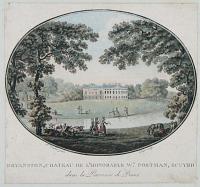
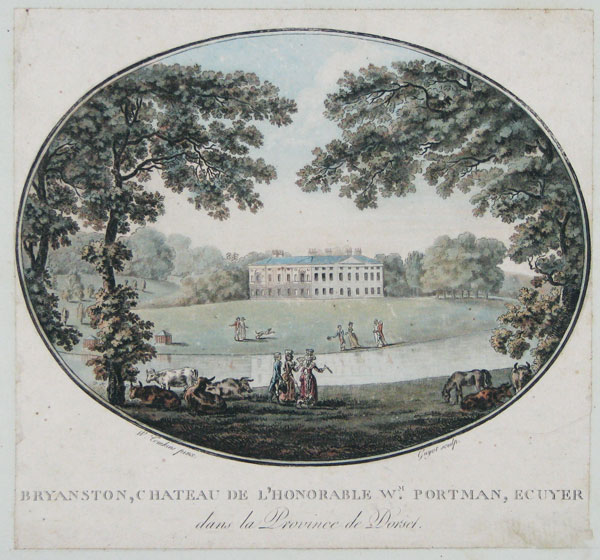
Bryanston, Chateau de l'Honorable W.m Portman, Ecuyer dans la Province de Dorset.
W. Tomkins pinx. Guyot sculp.
[n.d. c.1780.]
Aquatint with etched outline, very fine, printed in colour. 178 x 190mm. 7 x 7½". Cut.
The palatial country house in Dorset, with the River Stour in the foreground; now the famous public school.
[Ref: 21677] £350.00

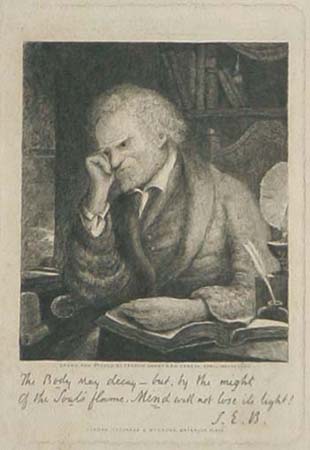
The Body May decay_ but, by the might of theSoul's flame, Mind will not lose its light!. S.E.B.
Drawn and Etched by Francis Danby A.R.A. Geneva April MDCCCXXXIV
London, Cochrane & McCrone, Waterloo Place.
Etching. 110 x 155mm.
Sir Samuel Egerton Brydges Bart. Genealogist. [1762-1837]. Lived in the Canterbury area of Kent and was Educated at Queen's College, Cambridge until about 1820 and then moved to Geneva where he died.
[Ref: 1489] £350.00
![[Encounter of the Carousing Bubble Lords and Menacing Poverty.]](img-thumbnail/jpegs/48475.jpg)
[Encounter of the Carousing Bubble Lords and Menacing Poverty.] Stryd tuszen de smullende bubbel heeren, en de aanstaande armoede.
[1720.]
Engraving, 18th century watermark. Plate: 370 x 400mm (14½ x 15¾'') very large margins. Crease as normal.
A Dutch satirical print commenting on the financial bubbles of 1720. In the image two figures, formed of bubbles fight with one another while egged on by men and women covered in comodities like fish and sausages and bread.
[Ref: 48475] £260.00
(£312.00 incl.VAT)
![[South Sea Bubble] The Bubblers Mirrour; or Englands Folly.](img-thumbnail/jpegs/58856.jpg)
[South Sea Bubble] The Bubblers Mirrour; or Englands Folly.
Printed for Carington Bowles next ye Chapter House in St Pauls Ch. Yard, London [n.d., c.1766].
Mezzotint image with etched surround. Sheet 350 x 250mm (13¾ x 9¾"). Trimmed into printed border, laid on modern card.
A weeping man holds up an empty money bag. A satire on financial bubbles, primarily the South Sea Bubble (the text under the portrait describes the man as a South Sea investor), but also listing other schemes and giving some of the inflated prices they reached from the subscription price. For example: stockings, rising to £30 from £2 10s; 'Manuring of Land' ('They'll never make corn cheap, or horse dung dear'); 'Bleaching of Hair'; Royal Assurance & London Assurance; 'Insurances against ye Venereal Desease'; and the Pennsylvania Company, rising from £5 5s to £40! This satire was first published by Thomas Bowles in 1720; this example was published by his nephew soon after Carington took over the business in 1766. Apparently the satire was extremely popular: the firm of Bowles & Carver were still issuing it at the end of the century. BM: 1621.
[Ref: 58856] £380.00
![[South Sea Bubble] The Bubblers Mirrour; or Englands Folly.](img-thumbnail/jpegs/33210.jpg)
[South Sea Bubble] The Bubblers Mirrour; or Englands Folly.
Printed for Carington Bowles next ye Chapter House in St Pauls Ch. Yard, London [n.d., c.1766].
Mezzotint image with etched surround. Image 355 x 250mm (14 x 9¾"). Framed. Unexamined out of frame.
A weeping man holds up an empty money bag. A satire on financial bubbles, primarily the South Sea Bubble (the text under the portrait describes the man as a South Sea investor), but also listing other schemes and giving some of the inflated prices they reached from the subscription price. For example: stockings, rising to £30 from £2 10s; 'Manuring of Land' ('They'll never make corn cheap, or horse dung dear'); 'Bleaching of Hair'; Royal Assurance & London Assurance; 'Insurances against ye Venereal Desease'; and the Pennsylvania Company, rising from £5 5s to £40! This satire was first published by Thomas Bowles in 1720; this example was published by his nephew soon after Carington took over the business in 1766. Apparently the satire was extremely popular: the firm of Bowles & Carver were still issuing it at the end of the century. BM: 1621.
[Ref: 33210] £790.00
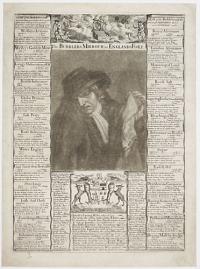
The Bubblers Mirrour: or Englands Folly.
Printed for Bowles & Carver 69, St. Pauls Church Yd. London. [n.d., c.1800.]
Engraved broadside with central mezzotint and etched vignettes. 350 x 250mm (13¾ x 9¾"); large margins. Some repaired tears in margins.
A weeping man holds up an empty money bag. A satire on financial bubbles, primarily the South Sea Bubble (the text under the portrait describes the man as a South Sea investor), but also listing other schemes and giving some of the inflated prices they reached from the subscription price. For example: stockings, rising to £30 from £2 10s; 'Manuring of Land' ('They'll never make corn cheap, or horse dung dear') ; 'Bleaching of Hair'; Royal Assurance & London Assurance; 'Insurances against ye Venereal Desease'; and the Pennsylvania Company, rising from £5 5s to £40! This plate was first issued by Thomas Bowles in 1720; this impression from a re-worked and re-issued state - on wove not laid paper - by his successor Henry Carington Bowles (1724 - 1793) and Samuel Carver, with whom Bowles traded between 1793 and 1832. BM Satires: 1621. State iii of iii.
[Ref: 40699] £420.00
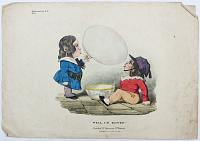
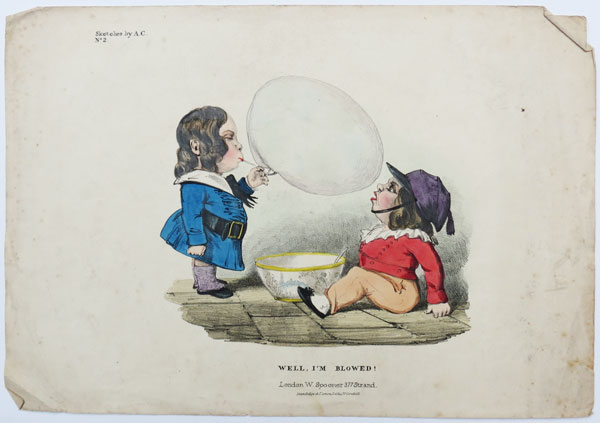
Well, I'm Blowed'. Sketches by A.C. No. 2.
London W Spooner [n.d. c.1840].
Coloured lithograph. 220 x 330mm (8½ x 13") large margins. Tear in bottom edge taped.
One boy admires another's massive soap bubble.
[Ref: 41824] £120.00
(£144.00 incl.VAT)
![[Putti Blowing Bubbles.]](img-thumbnail/jpegs/48015.jpg)
[Putti Blowing Bubbles.]
[After Hendrik Goltzius.]
[n.d., c.1800.]
Etching. Plate: 150 x 110mm (6 x 4¼''). Small margins
A scene, probably by Capt. Baillie, showing a putti blowing bubbles from a long pipe. A reverse copy of a 1594 engraving by Henrik Goltzius.
[Ref: 48015] £80.00
(£96.00 incl.VAT)
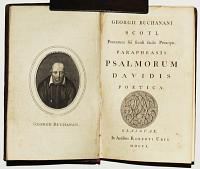
Georgii Buchani Scoti Poetarum sui seculi facile Principis Paraphrasis Psalmorum Davidis poetica.
Glasguae: In Aedibus Roberti Urie MDCCL [1750].
16mo, contemporary full calf gilt; engraved frontis. portrait; pp. (iv)+311, Latin text. Front hinge strained; old ink mss. ownership inscription on preliminary dated 1814, with a copy of a Buchanan psalm in the same hand on final blank. Squashed fly on page 310.
The psalms of George Buchanan (1506-82), a Scottish Lutheran historian and humanist scholar, tutor to King James VI (and I).
[Ref: 49531] £160.00
![[Moonlight in the Bullers of Buchan] - on verso in ink.](img-thumbnail/jpegs/14961.jpg)
[Moonlight in the Bullers of Buchan] - on verso in ink.
[n.d. c.1880.]
Fine lithograph with added hand-colour, mounted on board as issued. Sheet 312 x 452mm. 12¼ x 17¾".
Bullers of Buchan, south of Peterhead in Buchan, Aberdeenshire, Scotland. A collapsed sea cave forming an almost circular chasm (the "pot").
[Ref: 14961] £180.00
(£216.00 incl.VAT)
![[Cavern the Bullers of Buchan.]](img-thumbnail/jpegs/14963.jpg)
[Cavern the Bullers of Buchan.]
Rare lithograph with added hand-colour, mounted on board as issued, titled in ink on reverse. Sheet 328 x 470mm (13 x 18½").
Bullers of Buchan, south of Peterhead in Buchan, Aberdeenshire, Scotland. A collapsed sea cave forming an almost circular chasm (the "pot").
[Ref: 14963] £180.00
(£216.00 incl.VAT)
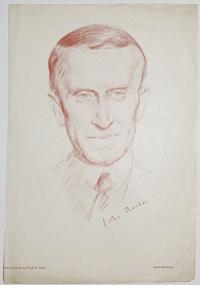
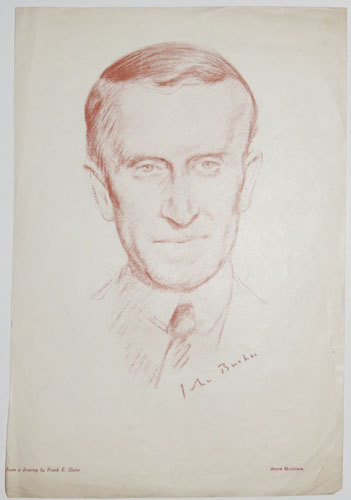
John Buchan.
From a drawing by Frank E. Slater.
[n.d., c.1920.]
Sheet: 285 x 195mm (11 x 8"). Trimmed, creasing.
A portrait of Scottish novelist and historian John Buchan (1875-1940) who served as Governer General of Canada.
[Ref: 45808] £45.00
(£54.00 incl.VAT)
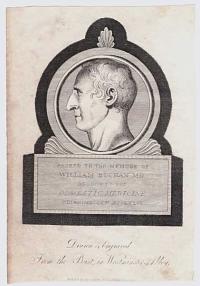
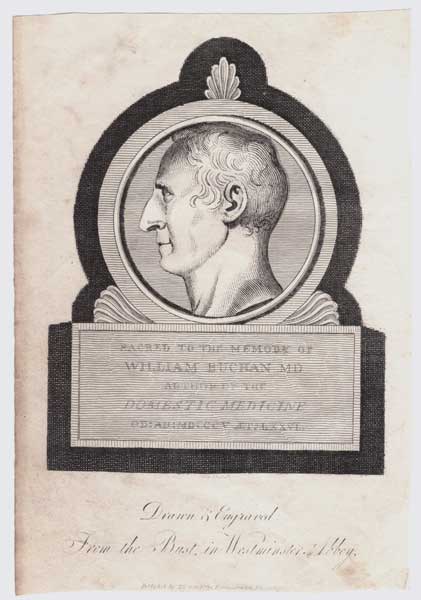
Sacred to the Memory of William Buchan M.D. Author of the Domestic Medicine. Ob: Ad: MDCCCV Aet: LXXVI.
Published by Thomas Kelly, Paternoster Row, 1809.
Etching, sheet 175 x 120mm (7 x 4¾") Trimmed inside platemark.
William Buchan (1729-1805), physician and author. His 'Domestic Medicine, or the Family Physician' was published in 1769, and rapidly sold out of its first edition of 5000 copies. Before the twentieth century, no single health guide matched the popularity of 'Domestic Medicine', which by that time had gone through at least 142 English language editions (it was particularly popular in the US), and translations into several major European languages. In later life he published several other minor works. W. 464.
[Ref: 60861] £50.00
(£60.00 incl.VAT)
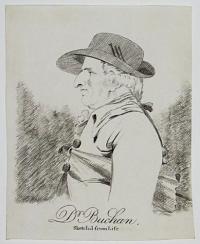
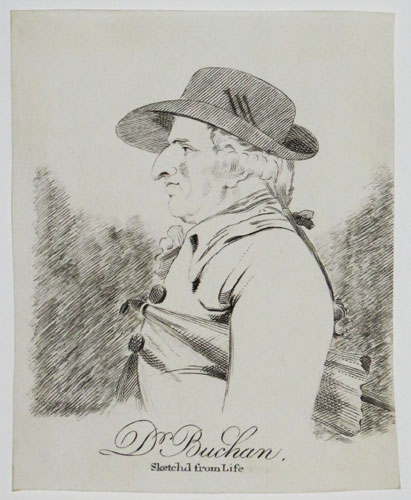
D.r Buchan, Sketch'd from Life.
[n.d., c.1800.]
Engraving, rare. Sheet: 140 x 110mm (5½ x 4¼'').
A profile portrait of Scottish physician William Buchan (1729-1805) author of 'Domestic Medicine'.
[Ref: 48401] £60.00
(£72.00 incl.VAT)
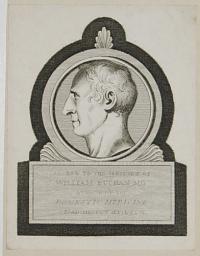
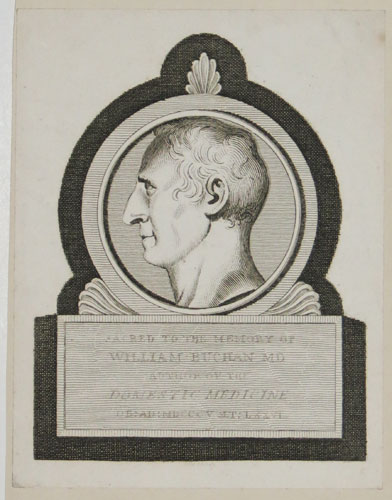
Sacred to the Memory of William Buchan M.D. Author of the Domestic Medicine. Ob: Ad: MDCCCV Aet: LXXVI.
[Anon, c.1805.]
[Published by Thomas Kelly, Paternoster Row, 1809.]
Etching, sheet 150 x 115mm (6 x 4½"). Trimmed inside platemark, losing publication line; laid on backing sheet.
William Buchan (1729-1805), physician and author. His 'Domestic Medicine, or the Family Physician' was published in 1769, and rapidly sold out of its first edition of 5000 copies. Before the twentieth century, no single health guide matched the popularity of 'Domestic Medicine', which by that time had gone through at least 142 English language editions (it was particularly popular in the US), and translations into several major European languages. In later life he published several other minor works. Not in O'D. W. 464.
[Ref: 35277] £75.00
(£90.00 incl.VAT)
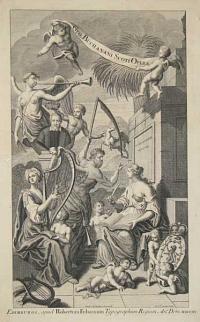
Geo. Buchanani Scoti Opera.
Andr Johnston Excud. M. Vdr. Gucht Sculp.
Edimburgi, apud Robertum Fribarnum Typographum Regium Ano. Dom. MDCCXV. [Edinburgh: Robert Freebairn, 1715.]
Engraved titlepage to 'Georgii Buchanani ... opera omnia, ad optimorum codicum fidem summo studio recognita & castigata [Works]...' by George Buchanan. 350 x 210mm, 13¾ x 8¼". Worm hole to left edge of plate.
Allegorical and classical figures with putti surround the bust of George Buchanan (1506 - 1582), Scottish historian, scholar and poet. The composition includes a harp, lyre and trumpets; the royal arms of Scotland lower right. Educated at the Universities of St Andrews and Paris, Buchanan taught in Paris until his return to Scotland in 1536. Condemned as a heretic, he was imprisoned in the castle of St Andrews before escaping into exile in France in 1539. He held professorships at Bordeaux and Paris, and later at Coimbra, Portugal, where he was put on trial for heresy in 1550-01. He returned to Scotland in 1561 and tutored Mary, Queen of Scots. Initially loyal to the Queen, he later testified against her at her trial for the assassination of her husband, Lord Darnley. He became principal of St Leonard's College in St Andrews in 1566. His most substantial work, Rerum Scoticarum Historia, a history of Scotland, was published in Latin in 1582. British Library: 000513218.
[Ref: 13597] £140.00
(£168.00 incl.VAT)
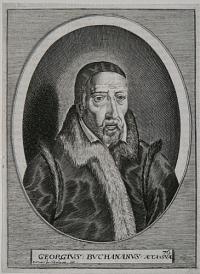
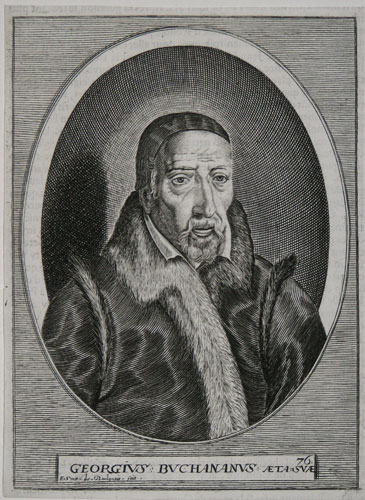
Georgius Buchananus: Aeta: suae 76.
Esme de Boulonois fecit.
[n.d. c.1682.]
Engraving. 188 x 140mm. 7½ x 5½".
Published in Isaac Bullart's 'Académie des Sciences et des Arts'. George Buchanan (1506-1582) was a Scottish historian and humanist scholar. He was part of the monarchomach movement, which consisted of Huguenot theorists who opposed absolute monarchy. Monarchomachs were people who opposed absolutism, believing that sovereignty belonged to the people, but the irony here was that "the people" for monarchomachs in fact only meant to refer to the bourgeoisie and nobility, never the popular masses. Buchanan was a key figure in developing the monarchomach theories in Scotland. Similar to Erasmus, Buchanan had the same ideas about the Catholic church, and was persecuted like all Lutherans in 1539, however he managed to effect his escape, and fled to London and then onto Paris. It was here where faced with further persecution, he accepted an invitation by Andre de Gouveia to take on the post of professor of Latin at the College of Guienne at Bordeaux.
[Ref: 17104] £50.00
(£60.00 incl.VAT)
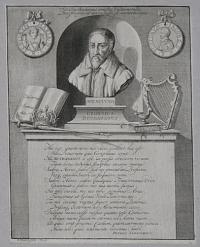
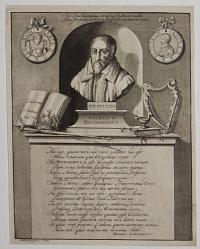
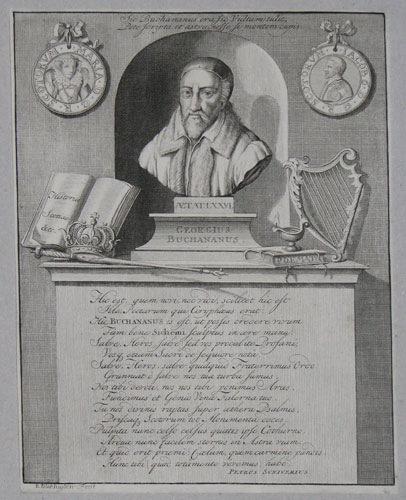
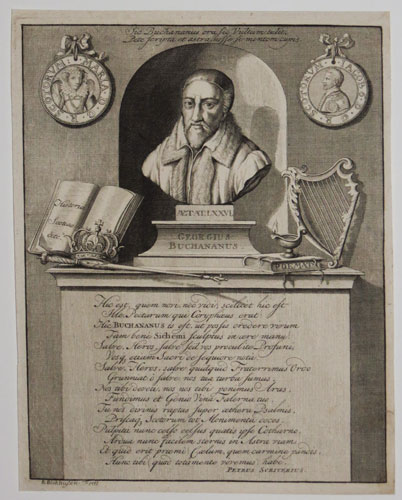
Georgius Buchananus. Aetat: LXXVI.
R: Blokhuysen Fecit.
[n.d., c.1710.]
Rare. Engraved frontispiece/dedication, sheet 210 x 165mm. 8¼ x 6½". Trimmed to plate.
Bust in an alcove of George Buchanan (1506 - 1582), Scottish historian, scholar and poet; 16 lines of tribute in Latin by the author Pieter Shrijver to pedestal below, profiles of Mary Queen of Scots and James VI right and left. Educated at the Universities of St Andrews and Paris, Buchanan taught in Paris until his return to Scotland in 1536. Condemned as a heretic, he was imprisoned in the castle of St Andrews before escaping into exile in France in 1539. He held professorships at Bordeaux and Paris, and later at Coimbra, Portugal, where he was put on trial for heresy in 1550-01. He returned to Scotland in 1561 and tutored Mary, Queen of Scots. Initially loyal to the Queen, he later testified against her at her trial for the assassination of her husband, Lord Darnley. He became principal of St Leonard's College in St Andrews in 1566. His most substantial work, Rerum Scoticarum Historia (lower left of bust), a history of Scotland, was published in Latin in 1582.
[Ref: 13155] £140.00
(£168.00 incl.VAT)
Georgius Buchanus.
R. Blokhÿsen Fecit.
[n.d., c.1750.]
Engraving, rare. Collectors mark of George Usslaub. Plate: 215 x 165mm (8½ x 6½''). Trimmed.
A portrait bust of Scottish historian and humanist scholar George Buchanan (1506-1582).
[Ref: 48686] £180.00
(£216.00 incl.VAT)
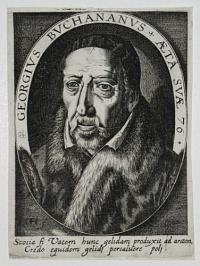
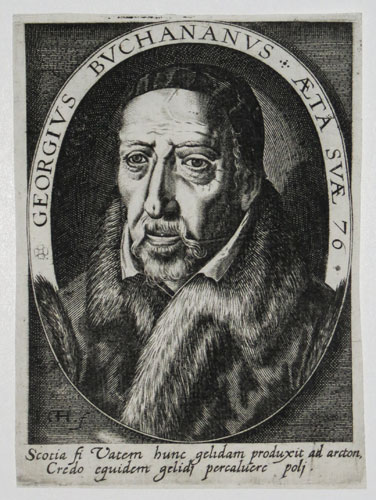
Georgius Buchananus Aeta Suae 76. Scotia fi Vatern hunc gelidam produxit ad arcton, Credo equidem gelidj percaluere polj.
I CH f.
[n.d. c.1669.]
Engraving. 120 x 89mm. 4¾ x 3½".
George Buchanan (1506-1582) was a Scottish historian and humanist scholar. He was part of the monarchomach movement, which consisted of Huguenot theorists who opposed absolute monarchy. Monarchomachs were people who opposed absolutism, believing that sovereignty belonged to the people, but the irony here was that "the people" for monarchomachs in fact only meant to refer to the bourgeoisie and nobility, never the popular masses. Buchanan was a key figure in developing the monarchomach theories in Scotland. Similar to Erasmus, Buchanan had the same ideas about the Catholic church, and was persecuted like all Lutherans in 1539, however he managed to effect his escape, and fled to London and then onto Paris. It was here where faced with further persecution, he accepted an invitation by Andre de Gouveia to take on the post of professor of Latin at the College of Guienne at Bordeaux. Portrait from: 'Bibliotheca Chalcographica, hoc est Virtute et eruditione clarorum Virorum Imagines' by Jean Jacques Boissard. The work with 100 portraits was first published under the title 'Icones virorum illustrium' in 1597-98.
[Ref: 24622] £120.00
(£144.00 incl.VAT)
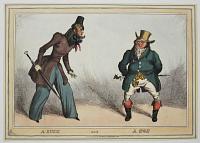
A Buck and a Doe
[Paul Pry monogram] Esq Del
London, Published by Tho.s McLean 26 Haymarket, 1827
Hand-coloured etching. Sheet: 255 x 365mm (10 x 14¼''). Trimmed and tipped into album sheet.
Two contrasting men, exemplifying different fashions and physiognomies. The printmaker William Heath (1794-1840) used the pseudonym Paul Pry (taken from the name of a character in John Poole's 1825 comedy, and used to describe a very inquisitive person) between 1827-9, and rather than signing his name he used the 'Paul Pry' monogram seen here, a small man holding a walking stick. However this figure began to be copied by other caricaturists (including Sharpshooter ) and so Heath reverted to his own name.
[Ref: 50799] £230.00
(£276.00 incl.VAT)
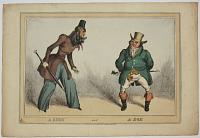
A Buck and a Doe
[Paul Pry monogram] Esq Del
London, Published by Tho.s McLean 26 Haymarket, 1827
Etching with hand-colouring, platemark 265 x 375mm (10½ x 14¾"), with very large margins. Trimmed inside platemark; unidentified collector's stamp verso.
Two contrasting men, exemplifying different fashions and physiognomies. The printmaker William Heath (1794-1840) used the pseudonym Paul Pry (taken from the name of a character in John Poole's 1825 comedy, and used to describe a very inquisitive person) between 1827-9, and rather than signing his name he used the 'Paul Pry' monogram seen here, a small man holding a walking stick. However this figure began to be copied by other caricaturists (including Sharpshooter ) and so Heath reverted to his own name.
[Ref: 40370] £260.00
(£312.00 incl.VAT)
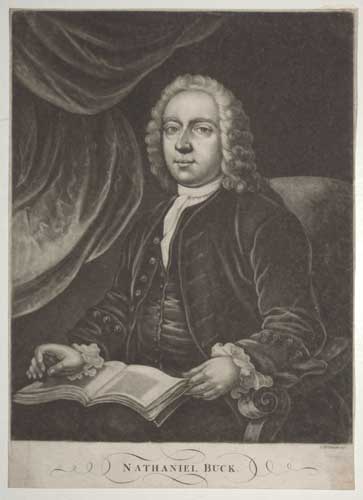
![[Nathaniel Buck.]](img-thumbnail/jpegs/68360.jpg)
[Nathaniel Buck.]
[engraved by James McArdell]
[n.d., c.1765.] [But later]
Mezzotint, unfinished proof. 325 x 225mm (12¾" x 8¾).
A half-length portrait of engraver and topographical draughtsman, Nathaniel Buck (died after 1759), best known for 'Buck's Antiquities' (1712-53), and a series of large prospects of English cities, both with his brother Samuel. This plate was one of McArdell's last, being unfinished when he died in 1765. It was completed and published by Laurie & Whittle in 1794. CS: 33, state iof ii. Whitman 113. Ex: Collection of The Hon. C. Lennox-Boyd.
[Ref: 68360] £360.00
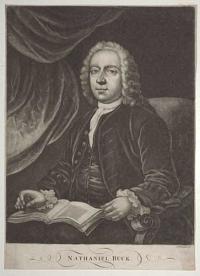
Nathaniel Buck.
J. M.cArdell fec.t.
Published 12th May 1794 by Laurie & Whittle, Fleet Street, London.
Mezzotint. Sheet 315 x 225mm (12½ x 8¾"). Trimmed into plate at bottom, losing publication line, thread margins elsewhere.
Engraver and topographical draughtsman, publisher (with his brother Samuel) of 'Buck's Antiquities', 1712-53, and a series of large panoramas of English cities. This plate was one of McArdell's last, being unfinished when he died in 1765. CS: 33, state ii of ii. Goodwin 113. Ex: Collection of The Hon. C. Lennox-Boyd.
[Ref: 68361] £230.00
(£276.00 incl.VAT)
![[John Smith, alias Buckhorse.]](img-thumbnail/jpegs/50610.jpg)
[John Smith, alias Buckhorse.]
[after Daniel Dodd.]
Published by J. McGowan, Great Windmill Street, 1825 [but 1826].
Stipple. 160 x 100mm (6¼ x 4"), with large margins.
Half-length portrait of John Smith, a.k.a. Buckhorse (boxer, fl.1720-50), adapted from the portrait by Daniel Dodd. He earned his nickname riding for the Duke of Queensberry, the inveterate gambler. In later life, for a few shillings Buckhorse would allow people to punch him in the head as hard as they could, so such a blow became known as a 'Buckhorse'. Probably as a result of these blows, a common expression of the period was 'as ugly as Buckhorse'. From John Badcock's 'The Fancy; or The True Sportsman's Guide: Being Authentic Memoirs of the Lives, Actions, Prowess, and Battles of the Leading Pugilists, from the Days of Figg and Broughton, to the Championship of Ward. By an Operator'.
[Ref: 50610] £130.00
(£156.00 incl.VAT)
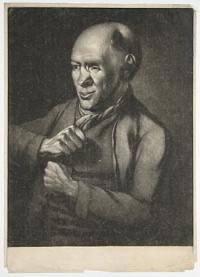
Buckhorse.
[after Daniel Dodd.]
[n.d, c.1760.]
A very scarce mezzotint, proof before letters. 355 x 250mm (14 x 10").
John Smith, alias Buckhorse, boxer, fl.1720-50. 'Memoirs of the Noted Buckhorse' is the earliest known autobiography of an English boxer. CS: ENA 142; NPG D9151. Ex: Collection of The Hon. C. Lennox-Boyd.
[Ref: 1834] £480.00
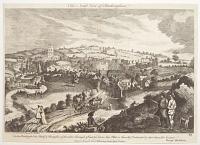
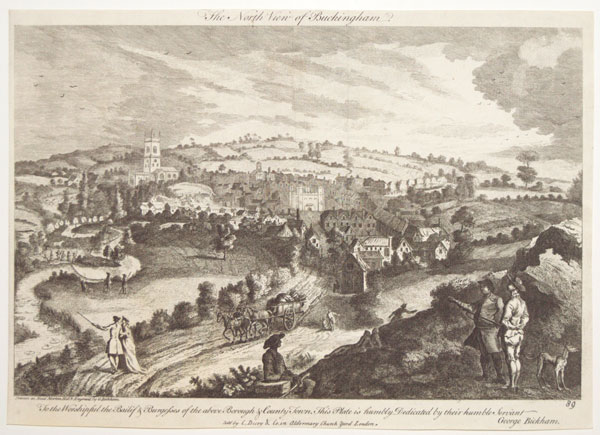
The North View of Buckingham. To the Worshipful the Bailif & Burgesses of the above Borough & County Town, This Plate is humbly Dedicated by their humble Servant, George Bickham. 89.
Drawn on Maid Morton Hill & Engrav'd by G. Bickham.
Sold by C. Dicey & Co, in Aldermary Church Yard London [n.d., c. 1780].
Engraving. Sheet 260 x 365mm (10¼ x 14¼"). Trimmed within plate. Slight central crease.
A view of Buckingham, engraved by Bickham c.1750 and re-issued by Cluer Dicey, who is best known as the last publisher of John Speed's county maps of 1611.
[Ref: 54738] £260.00
(£312.00 incl.VAT)

The Brave Capt.n Tyrrell, in the Buckingham of 66 guns, 472 Men, Defeating the Florisant, 74 Gun, 700 Men, Aigrette, 38 Guns, 350 Men, Atalante, 28 Guns, 350 Men, three French Ships of War, on the 3 of Nov.r 1758, that were Convoying Dutch Ships with Provisions to Martininico. London, Engrav'd for Harrison's edition of Rapin.
Swain Pinx.t [but Richard Paton]. Goldar Sculp.t.
Publish'd as the Act directs, July 28 1786.
Engraving. 220 x 330mm (8¾ x 13"), with very large margins. Trimmed intto plate at top, repaired tear through title at top.
A sea battle in the West Indies, fought during the Seven Years' War (1756-63), with a single British ship taking on and defeating three French vessels. Richard Tyrell (1716?-1766, later Rear-Admiral) spent most of his naval career in the West Indies. Resigning his commission in 1766 he died of fever on his return to England and was buried at sea. A memorial was erected in Westminster Abbey. Although the painter is named as Swaine, it is in fact Richard Paton. This is a smaller version of the engraving by Canot published in 1750
[Ref: 45636] £130.00
(£156.00 incl.VAT)
![[Sir Marc Isambard Brunel.]](jpegs/47314.jpg)

![[A woman confronted by a ghostly samurai]](jpegs/51808.jpg)
![[Glorious First of June] To the Memory of the Brave Cap.t John Harvey, the Officers and Crew who fell in the Action,](jpegs/57473.jpg)

![[Ferdinand Albrecht, Duke of Brunswick-Bevern.]](jpegs/35758.jpg)



![[Brushmaker] Brossier. Bürstenbinder](jpegs/36603.jpg)


![Recitator Acerbus [ink mss.]](jpegs/11531.jpg)


![[Margaret Bryant] Mrs. Bryan and Children.](jpegs/60744.jpg)
![[Encounter of the Carousing Bubble Lords and Menacing Poverty.]](jpegs/48475.jpg)
![[South Sea Bubble] The Bubblers Mirrour; or Englands Folly.](jpegs/58856.jpg)
![[South Sea Bubble] The Bubblers Mirrour; or Englands Folly.](jpegs/33210.jpg)

![[Putti Blowing Bubbles.]](jpegs/48015.jpg)

![[Moonlight in the Bullers of Buchan] - on verso in ink.](jpegs/14961.jpg)
![[Cavern the Bullers of Buchan.]](jpegs/14963.jpg)



![[Nathaniel Buck.]](jpegs/68360.jpg)
![[John Smith, alias Buckhorse.]](jpegs/50610.jpg)