![Brighton Pavilion. View of the Steyne Front. [Old ink mss.]](img-thumbnail/jpegs/21553.jpg)
Brighton Pavilion. View of the Steyne Front. [Old ink mss.] [Perspective view of the Steine Front.]
[G.F. Robinson Del.t. T.Sutherland Acqua.t.]
[John Nash Esq.r and Sold by Ackermann, 101, Strand, London, April, 1824.]
Aquatint printed in colours and hand finished, trimmed and mounted on brown card, as issued, again laid on later board. Image 200 x 320mm, 8 x 12½". Pinholes in card corners, soiling of card edges, number label bottom right.
View of the front of the Royal Pavilion at Brighton, as re-designed by John Nash between 1815-1822. Although the exterior was in the Indo-Saracenic style the interiors were in the most extravagant chinoiserie style ever executed in the British Isles. From John Nash's 'The Royal Pavilion at Brighton', published by Nash at the command of George IV. The title in square brackets above is taken from the Index of Subjects. Abbey: Scenery, 62; Ford: Images of Brighton, 436.
[Ref: 21553] £280.00
(£336.00 incl.VAT)
![Brighton Pavilion. North Wing of the West Front. The Private Apartments of his Majesty George IV. [Old ink mss.]](img-thumbnail/jpegs/21554.jpg)
Brighton Pavilion. North Wing of the West Front. The Private Apartments of his Majesty George IV. [Old ink mss.] [The King's Private Apartment.]
[Cha.s Moore, del.t. T.Sutherland Acqua.t.]
[John Nash Esq.r and Sold by Ackermann, 101, Strand, London, April, 1824.]
Aquatint printed in colours and hand finished, trimmed and mounted on brown card, as issued, again laid on later board. Image 200 x 320mm, 8 x 12½". Pinholes in card corners, soiling of card edges, number label bottom right.
View of the rear of the Royal Pavilion at Brighton, as re-designed by John Nash between 1815-1822. Although the exterior was in the Indo-Saracenic style the interiors were in the most extravagant chinoiserie style ever executed in the British Isles. From John Nash's 'The Royal Pavilion at Brighton', published by Nash at the command of George IV. The title in square brackets above is taken from the Index of Subjects. Abbey: Scenery, 62; Ford: Images of Brighton, 442.
[Ref: 21554] £280.00
(£336.00 incl.VAT)
![Brighton Pavilion. North Front of the Stables. Brighton Pavilion. The Riding Stables [Old ink mss.]](img-thumbnail/jpegs/21556.jpg)
Brighton Pavilion. North Front of the Stables. Brighton Pavilion. The Riding Stables [Old ink mss.] [Stables towards Church Street. Riding House]
[A. Pugin, Del.t. T.Sutherland Aqua.t. [&] Augs. Pugin Del.t. M.Dubourg Sculp.t ]
[John Nash Esq.r and Sold by Ackermann, 101, Strand, London, March 1, [& July 1] 1824 ]
Two aquatints printed in colours and hand finished, trimmed and mounted on brown card together, as issued, again laid on later board. Images 110 x 180mm, 4¼ x 7" & 110 x 190, 4¼ x 7½". Pinholes in card corners, soiling of card edges, number label bottom right.
The exterior of the Stables from Church Street and the interior of the Riding House of the Royal Pavilion at Brighton, built 1803-8, before the main buildings were re-designed by John Nash between 1815-1822. Designed by William Porden in an Indian style, the building provided stabling for sixty horses. The Stables now form part of the Dome arts venue; the Riding School became the Brighton Corn Exchange. From John Nash's 'The Royal Pavilion at Brighton', published by Nash at the command of George IV. The title in square brackets above is taken from the Index of Subjects. Abbey: Scenery, 62; Ford: Images of Brighton, 460 & 461.
[Ref: 21556] £250.00
(£300.00 incl.VAT)
![[Perspective View of the Stable Building.]](img-thumbnail/jpegs/21558.jpg)
[Perspective View of the Stable Building.]
[A. Pugin, Del.t. T.Sutherland Aqua.t.
[John Nash Esq.r and Sold by Ackermann, 101, Strand, London, 1824.]
Aquatint printed in colours and hand finished, trimmed and mounted on brown card, as issued. Image 190 x 330mm, 7½ x 13". Card spotted.
The Stables as seen from the Royal Pavilion at Brighton, built 1803-8 to provided stabling for sixty horses, completed before the main buildings of the Pavilion were re-designed by John Nash between 1815-1822. Designed by William Porden in an Indian style, the main feature was a vast 24-metre glass dome which many detractors predicted would collapse as soon as the scaffolding was removed. It survived and is now part of the Dome arts venue. From John Nash's 'The Royal Pavilion at Brighton', published by Nash at the command of George IV. The title in square brackets above is taken from the Index of Subjects. Abbey: Scenery, 62; Ford: Images of Brighton, 458.
[Ref: 21558] £280.00
(£336.00 incl.VAT)
![[Dining Room, Royal Pavilion, Brighton.]](img-thumbnail/jpegs/21572.jpg)
[Dining Room, Royal Pavilion, Brighton.]
H. Repton Esq.r del.t. J.C. Stadler, sculp.
[London: Boydell, Longmans, et al, c.1822.]
Coloured aquatint. 185 x 260mm, 7¼ x 10¼", on paper watermarked 'Turkey Mill'. Paper lightly toned, time stained..
The only interior view from Humphrey Repton's 'Designs for the Pavillion at Brighton'. Originally published 1808, this example comes from the 1822 second edition, issued on the completion of the rebuilding according to the designs of Repton's rival, John Nash. Abbey: Scenery, 57; Ford: Images of Brighton, 419.
[Ref: 21572] £95.00
(£114.00 incl.VAT)
![[The East Front, Royal Pavilion, Brighton.]](img-thumbnail/jpegs/21575.jpg)
[The East Front, Royal Pavilion, Brighton.]
[n.d., c.1820.]
Copper engraving. Sheet 230 x 330mm, 9 x 13". Trimmed to printed border. Glue residue on reverse.
View of the front of the Royal Pavilion at Brighton, as re-designed by John Nash between 1815-1822. Although the exterior was in the Indo-Saracenic style the interiors were in the most extravagant chinoiserie style ever executed in the British Isles. Not traced in Ford's Images of Brighton.
[Ref: 21575] £160.00
(£192.00 incl.VAT)

The Pavilion at Brighton, the Marine Palace of his Majesty, George IVth.
Engraved by T.Sutherland.
Drawn and Published by J. Cordwell, at his Repository, 20 Great East Street, Brighton, 1821.
Aquatint printed in colours and hand finished, cut and laid on album paper. Sheet 235 x 305mm, 9¼ x 12".
View of the front of the Royal Pavilion at Brighton, as re-designed by John Nash between 1815-1822. Although the exterior was in the Indo-Saracenic style the interiors were in the most extravagant chinoiserie style ever executed in the British Isles. In the foreground is the traffic on the Steine; above the title the rooms are identified, marking the Kitchen, drawing rooms, the Round Salon and the Music Room. Ford: Images of Brighton, 491.
[Ref: 21576] £160.00
(£192.00 incl.VAT)
![[Brighton Pavilion.]](img-thumbnail/jpegs/25546.jpg)
[Brighton Pavilion.] [&] George Baxter, Designer and Engraver on Wood, 37, High Street, Lewes. Emblematic Ornaments for Invoices, Coats of Arms, Fac-similes, &c. engraved on Wood. N.B. Sketches of Gentleman's Seats, Landscapes, Relics of Antiquity, Buildings, Machinery, Cattle, &c. accurately drawn for engraving.
[n.d. c.1827.]
Wood engraving and tradecard. Engraving 103 x 152mm. 4 x 6". Printer's crease on wood engraving.
Elevation of the front of the Royal Pavilion at Brighton, as re-designed by John Nash between 1815-1822. Although the exterior was in the Indo-Saracenic style the interiors were in the most extravagant chinoiserie style ever executed in the British Isles. From Baxter's 'Stranger in Brighton', 1826; and his 'Select Sketches in Brighton', 1827. Ford: 502 [Images of Brighton].
[Ref: 25546] £160.00
(£192.00 incl.VAT)
view all images for this item
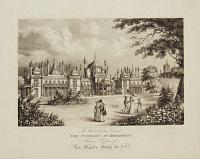
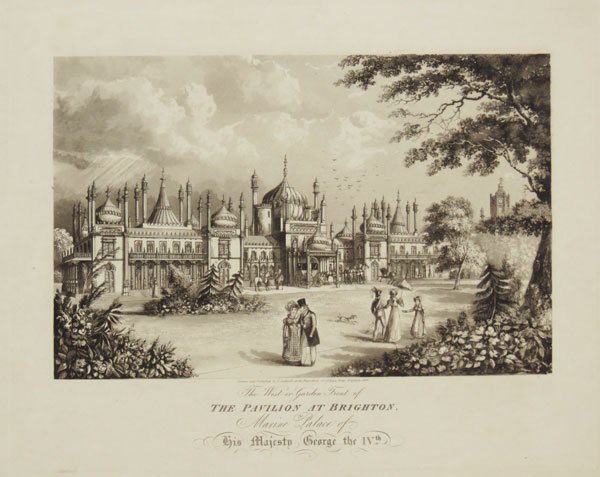
The West or Garden Front of The Pavilion at Brighton, the Marine Palace of his Majesty, George IVth.
[Engraved by T.Sutherland.]
Drawn and Published by J. Cordwell, at his Repository, 20 Great East Street, Brighton, 1824.
Aquatint, fine impression. 290 x 350mm (11½ x 13¾"), with very large margins.
View of the back entrance of the Royal Pavilion at Brighton, as re-designed by John Nash between 1815-1822. Although the exterior was in the Indo-Saracenic style the interiors were in the most extravagant chinoiserie style ever executed in the British Isles. This example lacks the engraver's name. Ford: Images of Brighton, 538.
[Ref: 44556] £180.00
(£216.00 incl.VAT)
![[Six 'Sea Side Sketches']](img-thumbnail/jpegs/50448.jpg)
[Six 'Sea Side Sketches']
[Various publishers, c.1870.]
Six steel engravings, each c. 100 x 115mm (4 x 4½"), trimmed and laid on album paper with three other prints.
Satires relating to bathing at Brighton. Publishers include ''J.S. & Co.'', ''Newman & Co.'' & ''Kershaw & Son''.
[Ref: 50448] £90.00
(£108.00 incl.VAT)
![[Six 'Sea Side Sketches']](img-thumbnail/jpegs/50449.jpg)
[Six 'Sea Side Sketches']
[Various publishers, c.1870.]
Six steel engravings, each c. 100 x 115mm (4 x 4½"), trimmed and laid on album paper with three other prints.
Satires relating to bathing at Brighton. Publishers include ''J.S. & Co.'' & ''Kershaw & Son''.
[Ref: 50449] £90.00
(£108.00 incl.VAT)
![[Seven 'Sea Side Sketches']](img-thumbnail/jpegs/50450.jpg)
[Seven 'Sea Side Sketches']
[Various publishers, c.1870.]
Seven steel engravings, each c. 100 x 115mm (4 x 4½"), trimmed and laid on album paper with two other prints.
Satires relating to bathing at Brighton. Publishers include ''J.S. & Co.'', ''Newman & Co.'' & ''Kershaw & Son''.
[Ref: 50450] £90.00
(£108.00 incl.VAT)
![[Six 'Sea Side Sketches']](img-thumbnail/jpegs/50451.jpg)
[Six 'Sea Side Sketches']
[Various publishers, c.1870.]
Six steel engravings, each c. 100 x 115mm (4 x 4½"), trimmed and laid on album paper with three other prints.
Satires relating to bathing at Brighton. Publishers include ''J.S. & Co.'' & ''Kershaw & Son''.
[Ref: 50451] £90.00
(£108.00 incl.VAT)
![[Six 'Sea Side Sketches']](img-thumbnail/jpegs/50452.jpg)
[Six 'Sea Side Sketches']
[Various publishers, c.1870.]
Six steel engravings, each c. 100 x 115mm (4 x 4½"), trimmed and laid on album paper with four other prints.
Satires relating to bathing at Brighton. Publishers include ''J.S. & Co.'' & ''Kershaw & Son''.
[Ref: 50452] £90.00
(£108.00 incl.VAT)
![[Six 'Sea Side Sketches']](img-thumbnail/jpegs/50453.jpg)
[Six 'Sea Side Sketches']
[Various publishers, c.1870.]
Six steel engravings, each c. 100 x 115mm (4 x 4½"), trimmed and laid on album paper with three other prints.
Satires relating to bathing at Brighton. Publishers include ''J.S. & Co.'' & ''Kershaw & Son''.
[Ref: 50453] £90.00
(£108.00 incl.VAT)
![[The Pavilion and Steyne at Brighton with the Promenade]](img-thumbnail/jpegs/58809.jpg)
[The Pavilion and Steyne at Brighton with the Promenade]
[Etched by Frank Holford after a view by Charles T. Cracklow and figures by William Marshall Craig.]
[n.d., 1889.]
Etching. 215 x 360mm (8½ x 14¼").
A view of the Royal Pavilion and Steyne, with the Promenade filled with the people that made Brighton the most fashionable resort of the period, with George, Prince of Wales, and Martha Gunn, the famous Brighton 'Dipper', named under the image. According to a pencil note on the reverse this was 'Etched by Frank Holford 1889 from Pictures in the Pavilion Brighton', although a second hand clarifies that it is copied from the aquatint after Cracklow and Craig. A painter called Frank Holford is said to have been churchwarden of St Michael, Brighton. See Ford: Images of Brighton n.396 for the original.
[Ref: 58809] £90.00
(£108.00 incl.VAT)
![[Italianate Landscape.]](img-thumbnail/jpegs/65559.jpg)
[Italianate Landscape.] 14.
P. Bril pinxit. Nieulant fecit.
Mariette Excudit cum privil. Regis [n.d. c.1650].
Etching. 240 x 320mm (9½ x 12½"), large margins. Some toning and staining.
An Italianate landscape with buildings either side of a river with a ruined bridge. Plate 14 of a series of thirty-six plates showing Italian landscapes after Paul Bril by Willem van Nieulandt.
[Ref: 65559] £260.00
(£312.00 incl.VAT)
![[The Brindle Will Case.]](img-thumbnail/jpegs/40951.jpg)
[The Brindle Will Case.]
[1840-3.]
Letterpress broadside, 1p. ALS, newspaper clippings, ink & wash sketch of Brindle Church. Laid on album paper, edges of sketch rubbed.
The broadside is 'Lines on the Death of William Heatley, Esq., of Brindle Lodge'. His will was contested by his two nieces, leading to a court case, a subsequent libel case and an attempt to recover unpaid legal fees. The letter is an eviction notice, signed by the nieces and Thomas Eastwood, the husband of one niece.
[Ref: 40951] £140.00
(£168.00 incl.VAT)
view all images for this item
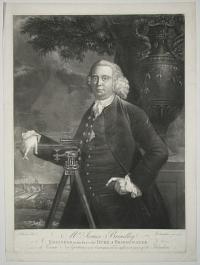
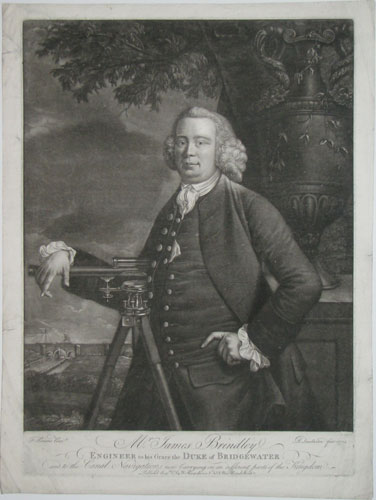
Mr James Brindley Engineer to his Grace the Duke of Bridgewater and to the Canal Navigations now Carrying on in different parts of the Kingdom.
F. Parsons Pinxt. R. Dunkarton fecit 1773.
[c.1820.]
Mezzotint, 455 x 330mm. 18 x 13".
James Brindley (1716 - 1772), early civil engineer and canal builder, famous for the Bridgwater Canal and the viaduct where the canal went above a river (background to left). His right arm rests on a telescope. A later impression from the plate first published 1770, on wove paper, probably from the two volume folio 'Woodburn’s Gallery of rare Portraits, consisting of original plates, by Cecil, Deloram, Droeshout, Elstracke, Faithorne, ... &c' 1816. After Francis Parsons (1763 - 1804). British Library: 003970702.
[Ref: 11734] £280.00
(£336.00 incl.VAT)
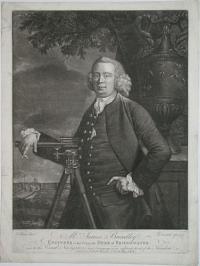
Mr James Brindley Engineer to his Grace the Duke of Bridgewater and to the Canal Navigations now Carrying on in different parts of the Kingdom.
F. Parsons Pinxt. R. Dunkarton fecit 1773.
Publish'd Augst: 2d. by W. Shropshire, No: 158, New Bond Street.
Mezzotint, 455 x 330mm. 18 x 13". Vertical crease through image; closed marginal tears.
James Brindley (1716 - 1772), early civil engineer and canal builder, famous for the Bridgwater Canal and the viaduct where the canal went above a river (background to left). His right arm rests on a telescope; large urn over his left shoulder.
First published 1770 for the two volume folio 'Woodburn’s Gallery of rare Portraits, consisting of original plates, by Cecil, Deloram, Droeshout, Elstracke, Faithorne, ... &c'.
After Francis Parsons (1763 - 1804). British Library: 003970702.
[Ref: 16221] £260.00
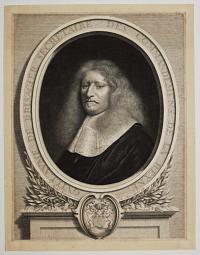
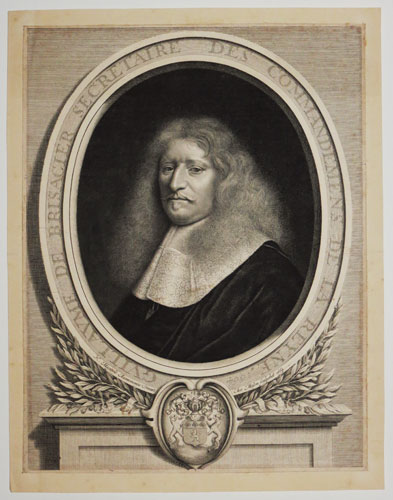
Guillaume de Brisacier Secretaire des Commandemens de la Reyne 1664.
N. Mignard Auenionensis Pinxit. Ant. Masson sculpebat 1664.
Engraving. Sheet: 350 x 270mm (13¾ x 10½''). Trimmed and tipped into album sheet.
A portrait of French statesman Guillaume de Briscier.
[Ref: 49921] £130.00
(£156.00 incl.VAT)

Brisbane.
McGready, Thomson & Niven, Glasgow [n.d. 1878].
Tinted lithograph. Sheet 210 x 290mm (8¼ x 11½"), large margins.
A view of the European settlement at Brisbane. From David Blair's 'The History of Australasia', the first such history to be published.
[Ref: 62384] £75.00
(£90.00 incl.VAT)
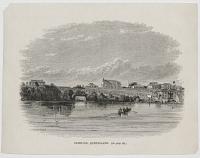
Brisbane, Queensland. (See page 145.)
[n.d. c.1865.]
Wood engraving. 133 x 172mm. 5¼ x 6¾".
A view which 'zooms toward the row of buildings along the William St riverbank including the old Military Barracks (at left), St Johns Church of England (before being twinned by 1868) and Evangelical Church (the Telegraph Office in 1861) with the two-storey Government Office of 1862 (at right). Queens Wharf Rd angles down to the old Commissariat Stores, South Brisbane ferry landing and the wharf itself where many immigrants landed in the early days, preceded by the convicts' (Rod Fisher, 'Boosting Brisbane: Imprinting the Colonial Capital of Queensland'). Engraving from a British newspaper by William Dickes (1815-1892). In the National Library of Australia.
[Ref: 24576] £120.00
(£144.00 incl.VAT)
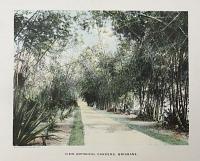
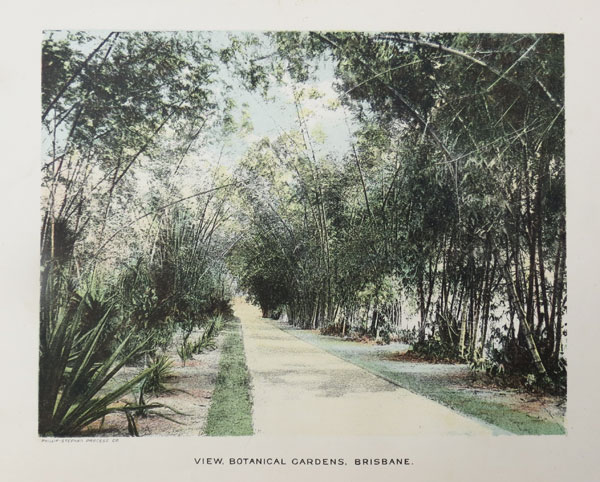
View, Botanical Gardens, Brisbane.
Phillip-Stephan Process Co [c.1880]
Chromolithograph, printed area 220 x 160mm (8½ x 6¼").
From a book of Australian views.
[Ref: 44025] £30.00
(£36.00 incl.VAT)
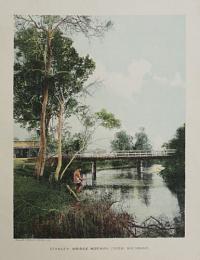
Stanley Bridge, Norman Creek, Brisbane.
Phillip-Stephan Process Co [c.1880]
Chromolithograph, printed area 220 x 160mm (8½ x 6¼").
A man fishing in Norman Creek, a small tributary of the Brisbane River. From a book of Australian views.
[Ref: 44023] £50.00
(£60.00 incl.VAT)
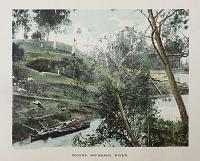
Goodna, Brisbane River.
Phillip-Stephan Process Co [c.1884]
Chromolithograph, printed area 220 x 160mm (8½ x 6¼").
Goodna in Queensland, Australia, by the Brisbane River between Brisbane and Ipswich. From a book of Australian views.
[Ref: 44028] £45.00
(£54.00 incl.VAT)
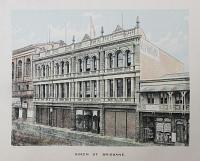
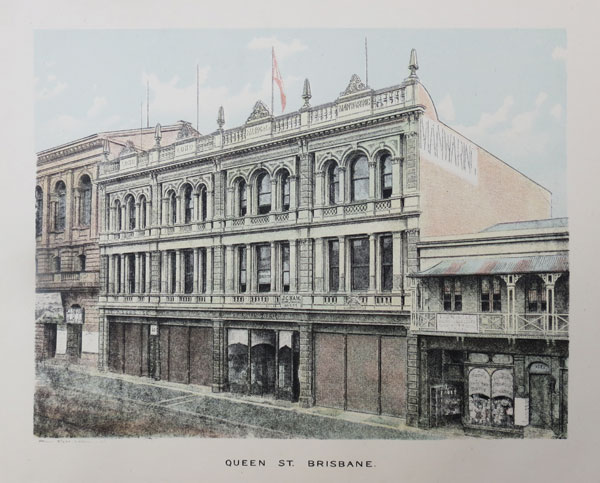
Queen St. Brisbane.
Phillip-Stephan Process Co [c.1880]
Chromolithograph, printed area 220 x 160mm (8½ x 6¼").
Brisbane street view, showing various identifiable shops and offices. From a book of Australian views.
[Ref: 44026] £50.00
(£60.00 incl.VAT)
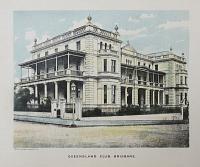
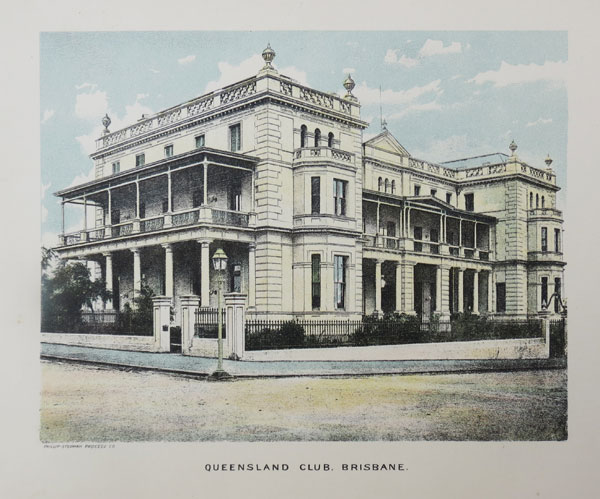
Queen St. Brisbane.
Phillip-Stephan Process Co [c.1884]
Chromolithograph, printed area 220 x 160mm (8½ x 6¼").
The elegant premises of the Queensland Club in Brisbane, at the corner of Alice and George Streets. The building was completed in 1884 and is continues to serve the purpose for which it was built. From a book of Australian views.
[Ref: 44027] £70.00
(£84.00 incl.VAT)
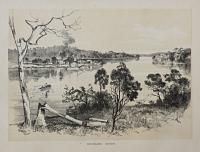
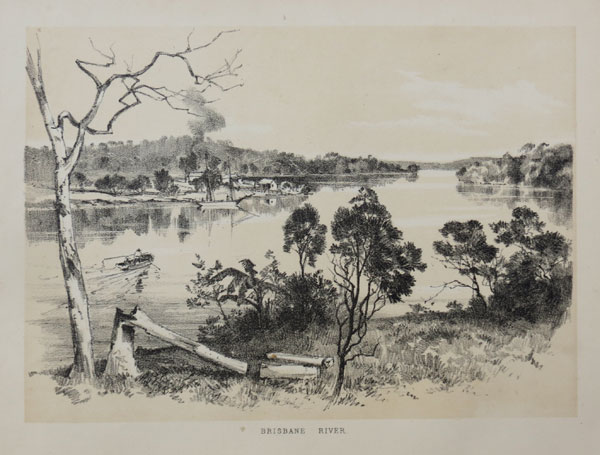
Brisbane River.
[Anon., c.1880]
Chromolithograph, printed area 170 x 225mm (6¾ x 8¾").
From a book of Australian views.
[Ref: 44022] £50.00
(£60.00 incl.VAT)

Brisley Races Wednesday, June 3rd, 1846. A Sweepstakes Of 10s. each, with Five Sovereigns added, For Horses of All Ages;
J. Philo, Printer, Swaffham. [1846.]
Letterpress broadside advertising a race meeting, with wood engraved vignette of a race; sheet 485 x 250mm, 19 x 9¾". Crease through lower left corner; generally good condition.
A very scarce, perhaps unrecorded, bill poster, locally published in Norfolk to advertise a race meeting in the village of Brisley; involving thoroughbred racers, hunters, ponies and donkeys. A very attractive piece of popular printing, illustrated with an image of horses racing past crowds and stands. Provenance: from a scrap album compiled c.1840 - 1880 by Alfred Towgood of Riverside, a paper mill owner at St. Neots, Huntingdon. He was also a Lieutenant in the Duke of Manchester's Light Horse.
[Ref: 16456] £360.00
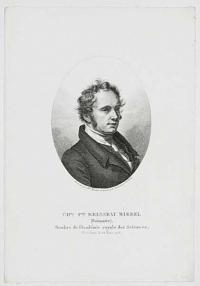
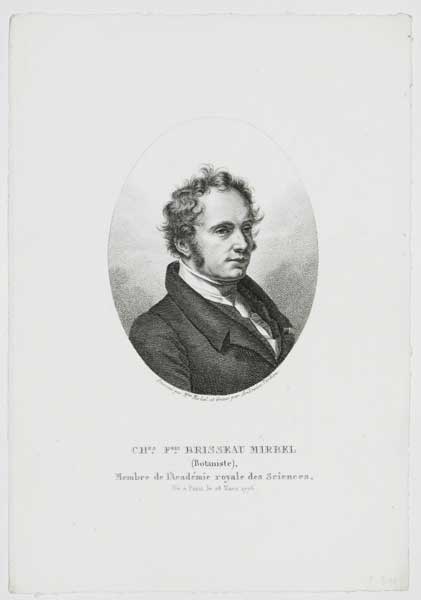
Ch.es F.ois Brisseau Mirbel (Botanist), Membre de l’Académie royale des Sciences. Né à Paris le 28 Mars 1776.
Dessiné par M.me Mirbel et Gravé par Ambroise Tardieu.
[n.d. c.1830.]
Stipple. 213 x 150mm (8½ x 6"). Cut to platemark.
Charles-Francois Brisseau de Mirbel (1776-1854) the French botanist and politician. He was a founder of the science of plant cytology. In 1802, he published his treatise 'Traite d'anatomie et de physiologie vegetale', which established his position as a founder, also, of plant histology and plant physiology in France. He obtained the post of superintendent of the gardens of Napoleon's Chateau de Malmaison, and in 1808 he joined the French Academy of Sciences to then become the chair of the botany department of the Sorbonne. W: 2013-2.
[Ref: 29628] £60.00
(£72.00 incl.VAT)
![["Justice to Dreyfus"]](img-thumbnail/jpegs/63676.jpg)
["Justice to Dreyfus"]
GUTH 98 [Jean Baptiste Guth]. Vincent Brooks, Day & Son Lt.d Lith.
[Vanity Fair. Oct.r 6.th 1898]
Chromolithograph proof, sheet 385 x 260mm (15¼ x 10¼"), large margins.
Full length caricature portrait of French statesman, Eugène Henri Brisson (1835-1912), Prime Minister of France for a period in 1885-1886 and again in 1898. He leans against a draughtsman table with a smoking cigarette in hand. For a lettered version see reference: 18035.
[Ref: 63676] £60.00
(£72.00 incl.VAT)
!["Justice to Dreyfus". [In ink below:] (M. Henri Brisson.)](img-thumbnail/jpegs/18035.jpg)
"Justice to Dreyfus". [In ink below:] (M. Henri Brisson.) Vanity Fair.
Guth 98 [engraved in image.]
Octr. 6th. 1898. Vincent Brooks, Day & Son Ltd. Lith.
Chromolithograph. 398 x 266mm. 15¾ x 10½".
Eugène Henri Brisson (1835-1912) was a French statesman, Prime Minister of France for a period in 1885 until 1886 and again in 1898. He was a member of the extreme Left, he did however propose amnesty for the condemned but it was voted down. He was also a prominent figure in exposing the Panama scandals. In June of 1898 he formed a cabinet when the country was violently excited over the Dreyfus affair. The Dreyfus affair was a political scandal that divided France in the 1890s and the early 1900s. It involved the conviction for treason of Captain Alfred Dreyfus (1859-1935), a French artillery officer of Alsatian Jewish descent, who was sentenced to life for allegedly having communicated French military secrets to the German Embassy in Paris. For proof see reference: 63676
[Ref: 18035] £95.00
(£114.00 incl.VAT)

View of the City of Bristol, from Clifton Wood. With the effect of the Fires which took place during the Riots on the Night of the 30th, of October, 1831. [In title area underneath specific buildings:] County Gaol. Bishop's Palace. Queen Square. Toll Houses. City Gaol.
Drawn from Nature & on Stone by S. Jackson.
Printed by C. Hullmandel. [n.d. c.1832.]
Lithograph. 268 x 310mm. 10½ x 12¼". Trimmed on three sides. Very slight nick on left.
The Bristol Riots of 1831 took place after the House of Lords rejected the second Reform Bill, which aimed to improve the 'rotten boroughs' standards and to give Britain's fast growing industrial towns greater representation in the House of Commons. The riots continued for three days during which the palace of Robert Gray the Bishop of Bristol, the Maniosn House, and private homes and property were looted and destroyed, along with the demolition of much of the gaol. Work on the Clifton Suspension Bridge was halted and Isambard Kingdom Brunel was sworn in as a special constable.
[Ref: 20072] £220.00
(£264.00 incl.VAT)
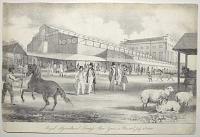
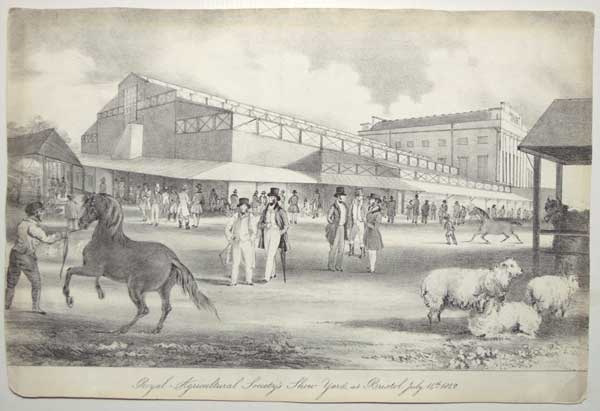
Royal Agricultural Society's Show Yard, at Bristol. July 14th 1842.
[c.1842.]
Lithograph. Sheet 265 x 400mm (10½ x 15¾"). Trimmed into image on three sides, crease reinforced. Damaged bottom left, but very rare.
Gentlemen farmers in the yard, with horses and sheep, before a cast-iron building.
[Ref: 62278] £230.00
(£276.00 incl.VAT)
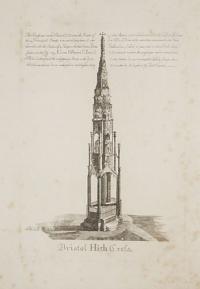
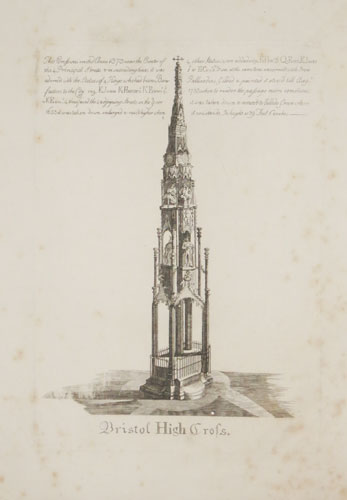
Bristol High Cross.
[J. Seago.][n.d., c.1790.]
Engraving. Plate: 260 x 180mm (10¼ x 7"). Light foxing and small hole in bottom of engraved area.
A print of Bristol High Cross which was erected in the centre of Bristol market in 1373; it was moved to various locations in Bristol until it was finally moved to Stourhead in 1780.
[Ref: 45399] £70.00
(£84.00 incl.VAT)
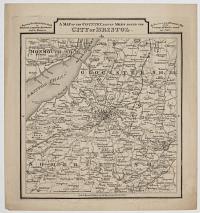
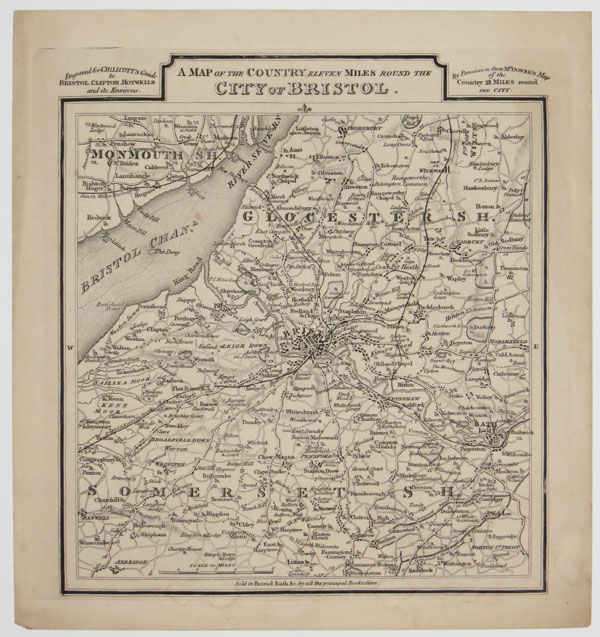
A Map of the Country Eleven Miles Round the City of Bristol.
Engraved for Chillcott's Guide to Bristol, Clifton, Hotwells and its Environs. By Permission from M.r Donne's Map of the Country 21 Miles round the City.
Sold in Bristol, Bath, &c. by all the principal Booksellers. [n.d., c.1805.]
Map. Plate: 240 x 230mm (9½ x 9''). Small margins
A detailed map showing the towns and villages surrounding Bristol.
[Ref: 48053] £130.00
![[Avon] Looking Down the Avon to the Black Rock and Cook's Folly.](img-thumbnail/jpegs/57719.jpg)
[Avon] Looking Down the Avon to the Black Rock and Cook's Folly. The Hotwell House. The Black Rock _ View Looking Up the Avon. Looking Up the Avon from Without the West Wall of the Down.
on Stone by L. Haghe. W. Day lithog. 17 Gate Str.t.
Pub.d by S. & J. Fuller, Temple of Fancy, 34 Rathbone Place & by O.C. Lane Clifton [n.d., c.1835].
Four lithographs on chine collé, laid on original printed backing sheet with a 'Minerva Head' blindstamp. Total printed area 285 x 380mm (11¼ x 15") very large margins. Some marking.
Very rare as a complete sheet. Four matching views of the Avon near Bristol, usually found separated.
[Ref: 57719] £260.00
(£312.00 incl.VAT)
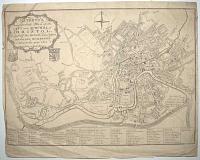
Mathews's New & Correct Plan of the City and Suburbs of Bristol. including the Hotwells and Clifton and the new Buildings down to the year 1815 taken from actual Survey.
[c.1815.]
Engraved map, on verso in ink "Rich Champney". 330 x 460mm (13 x 18"). Tears taped, creasing.
A map of Bristol with a 54-point key, originally published in 'The New History, Survey and Description of the City and Suburbs of Bristol' in 1794. This example has the date changed and the arms of the city and merchants of Bristol added.
[Ref: 56095] £260.00
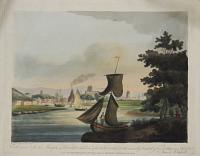
To the most Noble the Marquis of Worcester, this View of the City of Bristol is humbly Inscribed by His Lordships most Obed.t Serv.ts T. Jones & J. Hassell.
Drawn & Engraved by J. Hassell
London, Pub.d March 2d 1795 by T. Jones No.23 Clarges Street, and J Hassell, No.2 Castle Street, Leicester Square.
Very fine & rare coloured aquatint, platemark 275 x 345mm (10¾ x 13½"). Very large margins. Bit dusty on left margin.
Fine view along the river Avon towards Bristol.
[Ref: 37020] £280.00
(£336.00 incl.VAT)

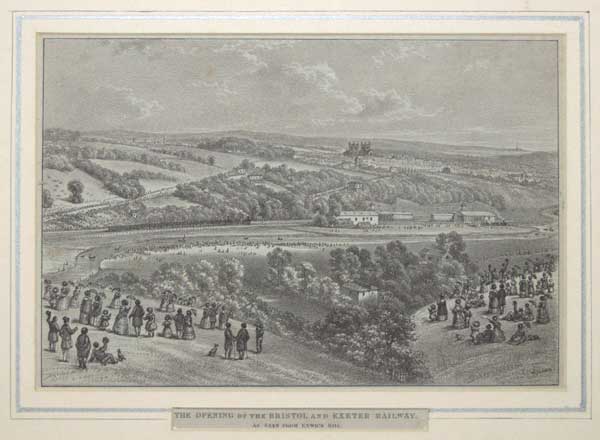
The Opening of the Bristol & Exeter Railway. As Seen from Exwick Hill.
W. Hake.
[n.d., 1844.]
Lithograph. Printed area 185 x 250mm (7¼ x 9¾"). Trimmed around image, title excised and stuck on mount.
A view looking down on Exeter St Davids Station, the terminus of the Bristol & Exeter Railway, on its opening in 1844. The city can be seen behind. Not in Abbey.
[Ref: 56782] £280.00
(£336.00 incl.VAT)
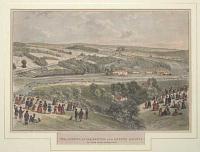
The Opening of the Bristol & Exeter Railway. As Seen from Exwick Hill.
W. Hake.
[n.d., 1844.]
Scarce lithograph with hand colour. Printed area 185 x 250mm (7¼ x 9¾"). Trimmed around image.
A view looking down on Exeter St Davids Station, the terminus of the Bristol & Exeter Railway, on its opening in 1844. The city can be seen behind. Not in Abbey.
[Ref: 56781] £380.00
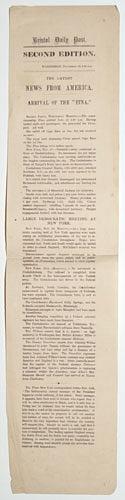
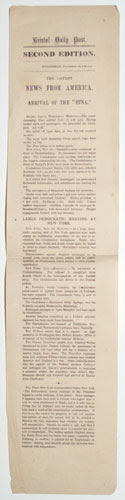
Bristol Daily Post. Second Edition. Wednesday, December 10, 9.45 a.m. The Latest News from America. - Arrival of the ''Etna''.
[Bristol, 1862.]
Letterpress broadside. Sheet 460 x 105mm (18 x 4¼"). Folded horizontally.
A news sheet, noting the arrival of the screw steamship Etna, but mostly concerned with events of the second year of the American Civil War, including: a failed Confederate attempt to retake New Bern, North Carolina, on November 25th; Union general Ambrose Burnside's movements in the week before Fredericksburg, December 11-15th; and the pursuit of the CSS Alabama, the British-built Confederate warship. The Bristol Daily Post ran from January 1860 to January 1878, when it was incorporated with the Bristol Mercury.
[Ref: 52614] £130.00
(£156.00 incl.VAT)
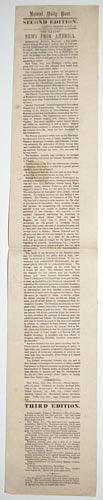
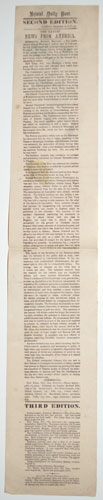
Bristol Daily Post. Second Edition. Tuesday, December 16, 10.15 a.m. The Latest News from America.
[Bristol, 1862.]
Letterpress broadside. Sheet 605 x 110mm (23¾ x 4¼"). Folded horizontally, small tear in right margin. Small brown stain above the fold.
A news sheet, mostly concerned with events of the second year of the American Civil War, including: Confederate general Stonewall Jackson joining Robert E. Lee in the defence of Fredericksburg and Union general Ulysses S. Grant's advances in Vicksburg, Mississippi. Also reported is a meeting of the New York Chamber of Commerce, in which sending a ship of grain to relieve Lancashire is discussed, necessitated by the Lancashire Cotton Famine and two poor European grain harvests. The Bristol Daily Post ran from January 1860 to January 1878, when it was incorporated with the Bristol Mercury.
[Ref: 52615] £130.00
(£156.00 incl.VAT)
![[Satire of the Bristol Election of 1837.] The Weird Three.](img-thumbnail/jpegs/68747.jpg)
[Satire of the Bristol Election of 1837.] The Weird Three.
Bagshaw fecit.
Monday, Printer, White's Ruins [n.d., c.1838].
Broadside, etching and letterpress. Sheet 450 x 285mm (17¾ x 11¼"). Trimmed into plate at top, creasing, surface soiling at bottom left.
A broadside presenting Tories attempting to overturn the 1837 Bristol election results as MacBeth's Three Witches around a cauldron, with papers marked 'Perjury', 'Lies', 'Slander' and 'More Perjury' When Liberal Francis Henry FitzHardinge Berkeley (1794-1870) was elected MP for Bristol, three petitioners (Bush Cookson & Payne, on behalf of the defeated Tory candidate William Fripp) accused him of extensive bribery and treating, as well as corruption, using his role as a trustee of the Anchor Society to obtain votes. A committee of the House of Commons was appointed to hear the case assembled in February, 1838, but after three days the petition was abandoned. Individual actions were brought against three other trustees and were all acquitted. In bringing the charges a woman was found guilty of perjury and the editor of the Bristol Journal was sued for libel and lost. Berkeley held his seat until his death in 1870.
[Ref: 68747] £160.00
(£192.00 incl.VAT)
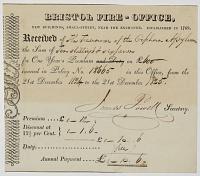
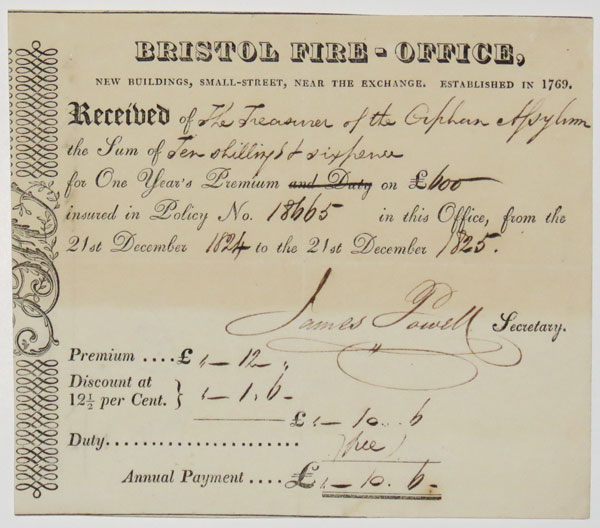
Bristol Fire-Office, New Buildings, Small-Street, near the Exchange. Established in 1769. Received of [The Treasurer of the Orphan Asylum] the Sum of [Ten Shillings & sixpence] for One Year's Premium on [£600] insured in Policy No. [18665] in this Office, from the 21st December [1824] to the 21st December [1825]. [James Powell] Secretary.
[1824]
Engraved receipt, filled in with ink mss. Sheet 130 x 150mm (5¼ x 6").
[Ref: 40915] £85.00
(£102.00 incl.VAT)
![[Crest of Bristol Fire Office]](img-thumbnail/jpegs/40872.jpg)
[Crest of Bristol Fire Office]
[c.1770]
Engraving, platemark 105 x 180mm (4 x 7"). Thread margins.
[Ref: 40872] £160.00
(£192.00 incl.VAT)
![[Crest of Bristol Fire Office.]](img-thumbnail/jpegs/40873.jpg)
[Crest of Bristol Fire Office.]
Johnson sc. [c.1840]
Engraving, sheet 120 x 190mm (4¾ x 7½"). Creases.
[Ref: 40873] £45.00
(£54.00 incl.VAT)
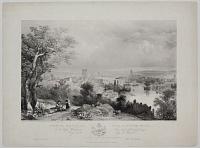
View of Bristol from Clifton Wood. To the Right Worshipful John Kerle Haberfield Esq.re Mayor of the City of Bristol. This View is most respectfully dedicated by The Publisher.
Drawn by S.C. Jones from a Painting by W. Muller in the possession of George Jones Esq.re On Stone by L. Haghe. Day & Haghe Lith.rs to the Queen.
Published by George Davey 1 Broard S.t Bristol. [n.d. c.1850.]
Lithograph with large margins. 280 x 380mm (11 x 15").
View of Bristol from a hillside, with a couple and two children conversing on a path in foreground at left, and three goats seen nearby at centre.
[Ref: 34730] £160.00
(£192.00 incl.VAT)

Bristol Grammar School. Founded by Robert Thorne, 1536. Re-Established January 1848.
Lander sc. Exchange.
[c.1850.]
Engraving. Sheet 135 x 200mm (5¼ x 8"). Trimmed close to design.
The name and crest of the school, probably published soon after the school was reopened after a four-year hiatus in 1848.
[Ref: 40938] £65.00
(£78.00 incl.VAT)
![Brighton Pavilion. View of the Steyne Front. [Old ink mss.]](jpegs/21553.jpg)
![Brighton Pavilion. North Wing of the West Front. The Private Apartments of his Majesty George IV. [Old ink mss.]](jpegs/21554.jpg)
![Brighton Pavilion. North Front of the Stables. Brighton Pavilion. The Riding Stables [Old ink mss.]](jpegs/21556.jpg)
![[Perspective View of the Stable Building.]](jpegs/21558.jpg)
![[Dining Room, Royal Pavilion, Brighton.]](jpegs/21572.jpg)
![[The East Front, Royal Pavilion, Brighton.]](jpegs/21575.jpg)

![[Brighton Pavilion.]](jpegs/25546.jpg)
![[Six 'Sea Side Sketches']](jpegs/50448.jpg)
![[Six 'Sea Side Sketches']](jpegs/50449.jpg)
![[Seven 'Sea Side Sketches']](jpegs/50450.jpg)
![[Six 'Sea Side Sketches']](jpegs/50451.jpg)
![[Six 'Sea Side Sketches']](jpegs/50452.jpg)
![[Six 'Sea Side Sketches']](jpegs/50453.jpg)
![[The Pavilion and Steyne at Brighton with the Promenade]](jpegs/58809.jpg)
![[Italianate Landscape.]](jpegs/65559.jpg)
![[The Brindle Will Case.]](jpegs/40951.jpg)






![["Justice to Dreyfus"]](jpegs/63676.jpg)
!["Justice to Dreyfus". [In ink below:] (M. Henri Brisson.)](jpegs/18035.jpg)

![[Avon] Looking Down the Avon to the Black Rock and Cook's Folly.](jpegs/57719.jpg)



![[Satire of the Bristol Election of 1837.] The Weird Three.](jpegs/68747.jpg)
![[Crest of Bristol Fire Office]](jpegs/40872.jpg)
![[Crest of Bristol Fire Office.]](jpegs/40873.jpg)