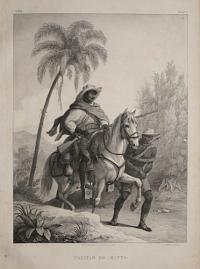
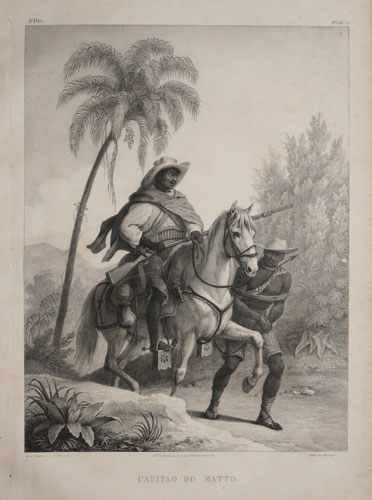
Capitao do matto
Dess d'ap nat. par Rugendas Lith. par Zwinger
Lith. de Engelmann, rue du Faub Montmartre No.6 a Paris [1827-35]
Lithograph, printed area 405 x 280mm (16 x 11").
A 'capitão do mato', an employee of a factory or plantation charged with recovering runaway slaves. Plate from 'Voyage pittoresque au Brésil' (1827-35), a volume of lithographs after drawings by Johann Moritz Rugendas (1802-58). Rugendas, who came from a family including several notable artists, travelled to Brazil in 1821 as draughtsman with the Russian diplomat Baron de Langsdorff’s scientific expedition. However, Rugendas left the expedition, discovering Brazil for himself and returning to Europe in 1825 with the extraordinary collection of drawings which provided the material for 'Voyage pittoresque'. Encouraged by the German scientist and explorer Alexander von Humboldt, Rugendas returned to Latin America in 1831, living until 1845 in Mexico and Chile with shorter stays in Argentina, Peru, Bolivia, and Uruguay, and drawing and painting prolifically throughout this time. He returned to Bavaria, where nearly 3000 drawings and paintings were acquired by the local government, but he then went back to live in Brazil between 1845 and 1846.
[Ref: 45578] £260.00
(£312.00 incl.VAT)
![[Corcovado mountain and the Catete neighbourhood, Rio de Janeiro]](img-thumbnail/jpegs/45557.jpg)
[Corcovado mountain and the Catete neighbourhood, Rio de Janeiro] Vue de la montagne de Corecovado et du faubourg de Cadete, prise de la Carrière
Dess d'ap nat. par Rugendas Deroi del.
Lith. de Engelmann, rue du faub Montmartre No.6 [1827-35]
Lithograph, printed area 280 x 365mm (11 x 14½").
View of mountains in Rio de Janeiro including Corcovado (now distinguished by the famous 'Christ the Redeemer' statue), with the neighbourhood of Catete in the middle-ground. Slaves working in a quarry in foreground. Plate from 'Voyage pittoresque au Brésil' (1827-35), a volume of lithographs after drawings by Johann Moritz Rugendas (1802-58). Rugendas, who came from a family including several notable artists, travelled to Brazil in 1821 as draughtsman with the Russian diplomat Baron de Langsdorff’s scientific expedition. However, Rugendas left the expedition, discovering Brazil for himself and returning to Europe in 1825 with the extraordinary collection of drawings which provided the material for 'Voyage pittoresque'. Encouraged by the German scientist and explorer Alexander von Humboldt, Rugendas returned to Latin America in 1831, living until 1845 in Mexico and Chile with shorter stays in Argentina, Peru, Bolivia, and Uruguay, and drawing and painting prolifically throughout this time. He returned to Bavaria, where nearly 3000 drawings and paintings were acquired by the local government, but he then went back to live in Brazil between 1845 and 1846.
[Ref: 45557] £260.00
(£312.00 incl.VAT)

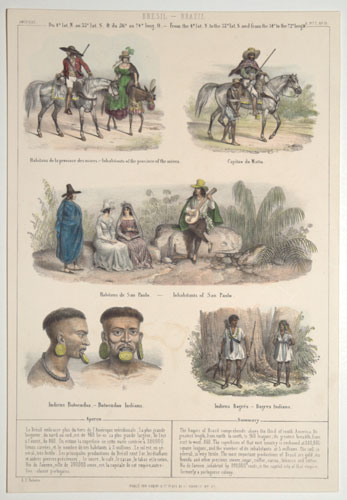
Bresil - Brazil. Amérique. V. Pitt. No.19.
A. St. Aulaire.
Publié par Aubert, Place de la Bourse, 29. [n.d. c.1830.]
Coloured lithograph. 285 x 196mm (11¼ x 7¾").
Images of Brazilian costume: inhabitants of the province of mines; Captain of Matto; inhabitants of San Paulo; Botocudos Indians; Bogres Indians. A summary paragraph describing the land, population and resources.
[Ref: 52460] £130.00
(£156.00 incl.VAT)
![[Fields by the das Velhas river in the state of Minas Gerais, Brazil]](img-thumbnail/jpegs/45562.jpg)
[Fields by the das Velhas river in the state of Minas Gerais, Brazil] Campos sur les bords du rio das velhas. dans la province de Minaes Geraes.
Bonington del. fig. par V. Adam. dess d'ap nat. par Rugendas
Lith. de Engelmann, Rue Louis-le-Grand No 27 a Paris
Lithograph, printed area 285 x 345mm (11¼ x 13½").
Landscape in Minas Gerais, Brazil, with hunting in foreground. Plate from 'Voyage pittoresque au Brésil' (1827-35), a volume of lithographs after drawings by Johann Moritz Rugendas (1802-58). Rugendas, who came from a family including several notable artists, travelled to Brazil in 1821 as draughtsman with the Russian diplomat Baron de Langsdorff’s scientific expedition. However, Rugendas left the expedition, discovering Brazil for himself and returning to Europe in 1825 with the extraordinary collection of drawings which provided the material for 'Voyage pittoresque'. Encouraged by the German scientist and explorer Alexander von Humboldt, Rugendas returned to Latin America in 1831, living until 1845 in Mexico and Chile with shorter stays in Argentina, Peru, Bolivia, and Uruguay, and drawing and painting prolifically throughout this time. He returned to Bavaria, where nearly 3000 drawings and paintings were acquired by the local government, but he then went back to live in Brazil between 1845 and 1846. This particular plate is of added interest owing to the involvement of the landscape painter Richard Parkes Bonington (1802-28) as a draughtsman. Bonington lived in Paris for part of his short career, sharing a studio with Delacroix, and despite his death from tuberculosis at the age of 25, his work has consistently been held in high esteem.
[Ref: 45562] £280.00
(£336.00 incl.VAT)
![[Inhomirim river in the state of Rio de Janeiro]](img-thumbnail/jpegs/45563.jpg)
[Inhomirim river in the state of Rio de Janeiro] Rio Jnhomerim, dans la Baie de Rio de Janeiro
Villeneuve del. fig. par V. Adam. dess d'ap nat. par Rugendas
Lith. de Engelmann, Rue Louis-le-Grand No 27 a Paris
Lithograph, printed area 295 x 340mm (11¾ x 13½").
Landscape in the state of Rio de Janeiro, with hunters shooting crocodile in foreground. Plate from 'Voyage pittoresque au Brésil' (1827-35), a volume of lithographs after drawings by Johann Moritz Rugendas (1802-58). Rugendas, who came from a family including several notable artists, travelled to Brazil in 1821 as draughtsman with the Russian diplomat Baron de Langsdorff’s scientific expedition. However, Rugendas left the expedition, discovering Brazil for himself and returning to Europe in 1825 with the extraordinary collection of drawings which provided the material for 'Voyage pittoresque'. Encouraged by the German scientist and explorer Alexander von Humboldt, Rugendas returned to Latin America in 1831, living until 1845 in Mexico and Chile with shorter stays in Argentina, Peru, Bolivia, and Uruguay, and drawing and painting prolifically throughout this time. He returned to Bavaria, where nearly 3000 drawings and paintings were acquired by the local government, but he then went back to live in Brazil between 1845 and 1846. This particular plate is of added interest owing to the involvement of the landscape painter Richard Parkes Bonington (1802-28) as a draughtsman. Bonington lived in Paris for part of his short career, sharing a studio with Delacroix, and despite his death from tuberculosis at the age of 25, his work has consistently been held in high esteem.
[Ref: 45563] £320.00
![[View taken from the Monastery of St Benedict, Rio de Janeiro]](img-thumbnail/jpegs/45553.jpg)
[View taken from the Monastery of St Benedict, Rio de Janeiro] Vue prise devant l'élise de San-Bendo à Rio Janeiro
V. Adam del.t Dess d'ap nat. par Rugendas
Lith. de Engelmann, rue du F. Montmartre No.6 [1827-35]
Lithograph, printed area 250 x 320mm (9¾ x 12½").
View showing the Rio de Janeiro coastline, taken from the Mosteiro de São Bento (Monastery of St Benedict). Plate from 'Voyage pittoresque au Brésil' (1827-35), a volume of lithographs after drawings by Johann Moritz Rugendas (1802-58). Rugendas, who came from a family including several notable artists, travelled to Brazil in 1821 as draughtsman with the Russian diplomat Baron de Langsdorff’s scientific expedition. However, Rugendas left the expedition, discovering Brazil for himself and returning to Europe in 1825 with the extraordinary collection of drawings which provided the material for 'Voyage pittoresque'. Encouraged by the German scientist and explorer Alexander von Humboldt, Rugendas returned to Latin America in 1831, living until 1845 in Mexico and Chile with shorter stays in Argentina, Peru, Bolivia, and Uruguay, and drawing and painting prolifically throughout this time. He returned to Bavaria, where nearly 3000 drawings and paintings were acquired by the local government, but he then went back to live in Brazil between 1845 and 1846.
[Ref: 45553] £230.00
(£276.00 incl.VAT)
![Olinda. [& plate of lizards, snakes, millepede and scorpion]](img-thumbnail/jpegs/58633.jpg)
Olinda. [& plate of lizards, snakes, millepede and scorpion]
[London: Awnsham & John Churchill, 1732.]
Engraved map and view, printed back to back. Each c.130 x 165mm (5 x 6½"), set in text, very large margins
A plan of Olinda, a city in Brazil, during its occupation by the Dutch under John Maurice, Prince of Nassau-Siegen. On the reverse is an illustration of various creatures of the region. With a letterpress description From the account of Johann Nieuhof, as published in 'Churchill's Collection of Voyages'.
[Ref: 58633] £140.00
(£168.00 incl.VAT)
view all images for this item
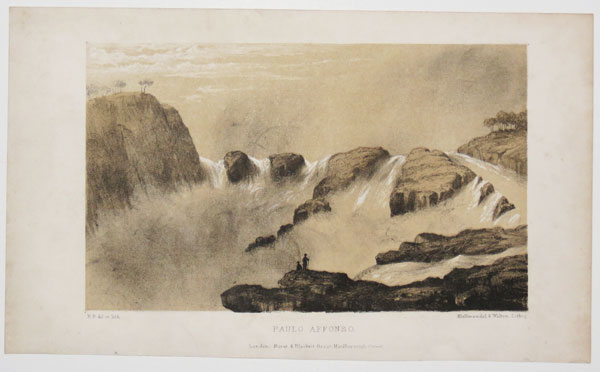
Paulo Affonso.
R.Elwes del et lith. Hullmandel & Walton, Lithog.
London: Hurst & Blackett Great Marlborough Street [c.1854]
Lithograph and tintstone, printed area 125 x 180mm (4½ x 7").
Spectacular view of the São Francisco River where it passes through the city of Paulo Afonso in the state of Bahia, Brazil by Robert Elwes (1819-1878) a Victorian traveller. See 45595
[Ref: 45593] £90.00
(£108.00 incl.VAT)
![[Brazil] Obsidio Et Expugnatio Portus Calvi.](img-thumbnail/jpegs/41266.jpg)
[Brazil] Obsidio Et Expugnatio Portus Calvi.
[London: John Ogilby, c.1670.]
Coloured engraving. 270 x 335mm (10½ x 13¼").
The fort at Porto Calvo, controlling the passage of the Manguaba River in the Alagoas region, the frontline of Portuguese-Dutch hostilities in the early 1630s. From John Ogilby’s 'America: Being the Latest, and Most Accurate Description of the New World' an English translation of Arnoldus Montanus’ 'Die Nieuwe en onbekende Weereld'.
[Ref: 41266] £180.00
(£216.00 incl.VAT)

Porto do Estrella.
Dess d'ap nat. par Rugendas V. Adam del.
Lith. de Engelmann, rue du F. Montmartre No.6 [n.d., 1827-35]
Lithograph. Sheet 270 x 335mm. Trimmed into image on three sides.
A view on the quay of Porto Estrela, with boats being loaded from a mule train. From 'Voyage pittoresque au Brésil' (1827-35), a volume of lithographs after drawings by Johann Moritz Rugendas (1802-58). Rugendas, who came from a family including several notable artists, travelled to Brazil in 1821 as draughtsman with the Russian diplomat Baron de Langsdorff's scientific expedition. However, Rugendas left the expedition, discovering Brazil for himself and returning to Europe in 1825 with the extraordinary collection of drawings which provided the material for 'Voyage pittoresque'. Encouraged by the German scientist and explorer Alexander von Humboldt, Rugendas returned to Latin America in 1831, living until 1845 in Mexico and Chile with shorter stays in Argentina, Peru, Bolivia, and Uruguay, and drawing and painting prolifically throughout this time. He returned to Bavaria, where nearly 3000 drawings and paintings were acquired by the local government, but he then went back to live in Brazil between 1845 and 1846.
[Ref: 63339] £240.00
(£288.00 incl.VAT)
![[Military and slaves on boats, Rio de Janeiro coastline]](img-thumbnail/jpegs/45554.jpg)
[Military and slaves on boats, Rio de Janeiro coastline] Braia dos Mineiros à Rio-Janeiro
V. Adam del.t Dess d'ap nat. par Rugendas
Lith. de Engelmann, rue du F. Montmartre No.6 [1827-35]
Lithograph, printed area 260 x 330mm (10¼ x 13").
Stretch of Rio de Janeiro coastline formerly known as the 'Praia dos Mineiros'. Plate from 'Voyage pittoresque au Brésil' (1827-35), a volume of lithographs after drawings by Johann Moritz Rugendas (1802-58). Rugendas, who came from a family including several notable artists, travelled to Brazil in 1821 as draughtsman with the Russian diplomat Baron de Langsdorff’s scientific expedition. However, Rugendas left the expedition, discovering Brazil for himself and returning to Europe in 1825 with the extraordinary collection of drawings which provided the material for 'Voyage pittoresque'. Encouraged by the German scientist and explorer Alexander von Humboldt, Rugendas returned to Latin America in 1831, living until 1845 in Mexico and Chile with shorter stays in Argentina, Peru, Bolivia, and Uruguay, and drawing and painting prolifically throughout this time. He returned to Bavaria, where nearly 3000 drawings and paintings were acquired by the local government, but he then went back to live in Brazil between 1845 and 1846.
[Ref: 45554] £230.00
(£276.00 incl.VAT)
![[Praia Rodrigues, near Rio de Janeiro]](img-thumbnail/jpegs/59894.jpg)
[Praia Rodrigues, near Rio de Janeiro] Praya Rodriguez. Près de Rio de Janeiro.
Villeneuve del. fig. par V. Adam. dess d'ap nat. par Rugendas
Lith. de Engelmann, Rue Louis-le-Grand No 27 a Paris
Lithograph with hand colour. Printed area 295 x 340mm (11¾ x 13½") very large margins.
Landscape in the state of Rio de Janeiro, with hunters in foreground. Plate from 'Voyage pittoresque au Brésil' (1827-35), a volume of lithographs after drawings by Johann Moritz Rugendas (1802-58). Rugendas, who came from a family including several notable artists, travelled to Brazil in 1821 as draughtsman with the Russian diplomat Baron de Langsdorff's scientific expedition. However, Rugendas left the expedition, discovering Brazil for himself and returning to Europe in 1825 with the extraordinary collection of drawings which provided the material for 'Voyage pittoresque'. Encouraged by the German scientist and explorer Alexander von Humboldt, Rugendas returned to Latin America in 1831, living until 1845 in Mexico and Chile with shorter stays in Argentina, Peru, Bolivia, and Uruguay, and drawing and painting prolifically throughout this time. He returned to Bavaria, where nearly 3000 drawings and paintings were acquired by the local government, but he then went back to live in Brazil between 1845 and 1846. This particular plate is of added interest owing to the involvement of the landscape painter Richard Parkes Bonington (1802-28) as a draughtsman. Bonington lived in Paris for part of his short career, sharing a studio with Delacroix, and despite his death from tuberculosis at the age of 25, his work has consistently been held in high esteem. See Ref: 45564 for uncoloured version.
[Ref: 59894] £320.00
![[Praia Rodrigues, near Rio de Janeiro]](img-thumbnail/jpegs/45564.jpg)
[Praia Rodrigues, near Rio de Janeiro] Praya Rodriguez. Près de Rio de Janeiro
Villeneuve del. fig. par V. Adam. dess d'ap nat. par Rugendas
Lith. de Engelmann, Rue Louis-le-Grand No 27 a Paris
Lithograph, printed area 295 x 340mm (11¾ x 13½").
Landscape in the state of Rio de Janeiro, with hunters in foreground. Plate from 'Voyage pittoresque au Brésil' (1827-35), a volume of lithographs after drawings by Johann Moritz Rugendas (1802-58). Rugendas, who came from a family including several notable artists, travelled to Brazil in 1821 as draughtsman with the Russian diplomat Baron de Langsdorff’s scientific expedition. However, Rugendas left the expedition, discovering Brazil for himself and returning to Europe in 1825 with the extraordinary collection of drawings which provided the material for 'Voyage pittoresque'. Encouraged by the German scientist and explorer Alexander von Humboldt, Rugendas returned to Latin America in 1831, living until 1845 in Mexico and Chile with shorter stays in Argentina, Peru, Bolivia, and Uruguay, and drawing and painting prolifically throughout this time. He returned to Bavaria, where nearly 3000 drawings and paintings were acquired by the local government, but he then went back to live in Brazil between 1845 and 1846. This particular plate is of added interest owing to the involvement of the landscape painter Richard Parkes Bonington (1802-28) as a draughtsman. Bonington lived in Paris for part of his short career, sharing a studio with Delacroix, and despite his death from tuberculosis at the age of 25, his work has consistently been held in high esteem.
[Ref: 45564] £320.00
![[Recife] The Recief.](img-thumbnail/jpegs/58634.jpg)
[Recife] The Recief.
[London: Awnsham & John Churchill, 1732.]
Engraved map. 135 x 165mm (5¼ x 6½"), set in text, very large margins
A plan of Recife a city in Brazil, during its occupation by the Dutch under John Maurice, Prince of Nassau-Siegenw, with a letterpress description From the account of Johann Nieuhof, originally published 1682 by Jacob van Meurs, but here reissued in 'Churchill's Collection of Voyages'.
[Ref: 58634] £140.00
(£168.00 incl.VAT)
![[San Sebastian quarter, Rio de Janeiro]](img-thumbnail/jpegs/39663.jpg)
[San Sebastian quarter, Rio de Janeiro]
Fumagalli f
[Milan: Antonio Fortunato Stella, 1816-27.]
Hand-coloured aquatint; publisher's blindstamp. Plate 180 x 240mm (7 x 9½"), very large margins.
Street scene in Rio de Janeiro, Brazil, with sedan chairs. Published in Giulio Ferrario's 'Le Costume Ancien et Moderne ou Histoire du gouvernement, de la milice, de la religion, des arts, sciences et usages de tous les peuples anciens et modernes d'après les monuments de l'antiquité et accompagné de dessins analogues au sujet par le Docteur Jules Ferrario'.
[Ref: 39663] £130.00
(£156.00 incl.VAT)
![[View of Rio de Janeiro from the harbour]](img-thumbnail/jpegs/45560.jpg)
[View of Rio de Janeiro from the harbour] Vue de Rio-Janeiro. prise de la Rade.
Dess d'ap nat. par Rugendas Sabatier del.
Lith. de Engelmann, rue du faub Montmartre No.6 [1827-35]
Lithograph, printed area 300 x 405mm (11¾ x 16").
Plate from 'Voyage pittoresque au Brésil' (1827-35), a volume of lithographs after drawings by Johann Moritz Rugendas (1802-58). Rugendas, who came from a family including several notable artists, travelled to Brazil in 1821 as draughtsman with the Russian diplomat Baron de Langsdorff's scientific expedition. However, Rugendas left the expedition, discovering Brazil for himself and returning to Europe in 1825 with the extraordinary collection of drawings which provided the material for 'Voyage pittoresque'. Encouraged by the German scientist and explorer Alexander von Humboldt, Rugendas returned to Latin America in 1831, living until 1845 in Mexico and Chile with shorter stays in Argentina, Peru, Bolivia, and Uruguay, and drawing and painting prolifically throughout this time. He returned to Bavaria, where nearly 3000 drawings and paintings were acquired by the local government, but he then went back to live in Brazil between 1845 and 1846.
[Ref: 45560] £450.00
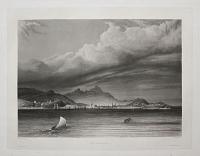
Rio-Janeiro.
Lauvergne del. Himely sc.
de Sainson Edit. N. Rémond imp. [n.d. c.1835.]
Aquatint on chine collé. 290 x 380mm (11½ x 15").
A view looking towards Rio de Janeiro, Brazil from the Guanabara Bay. From 'Voygage autour du monde par les mers de l'Inde et de la Chine de la corvette de sa Majeste La Favorite execute pendant les annees 1830, 1831, 1832 sous le commandement de M. Laplace'.
[Ref: 23754] £350.00
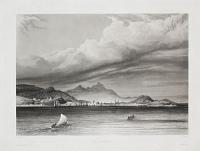
Rio-Janeiro.
Lauvergne del. Himely sc.
de Sainson Edit. [Paris: Imprimerie Royale, 1833-1835.]
Aquatint on india paper, rare, with very large margins; 290 x 380mm. 11½ x 15".
A view looking towards Rio de Janeiro, Brazil, from the Guanabara Bay. From 'Voyage autour du monde par les mers de l'Inde et de la Chine de la corvette de sa Majeste La Favorite execute pendant les annees 1830, 1831, 1832 sous le commandement de M. Laplace...' (5 vols). See BNF FRBNF33995730. See BM Anthropology Library KU4 [LAP-] V.1-5.
[Ref: 27819] £650.00
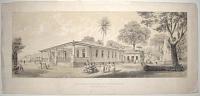
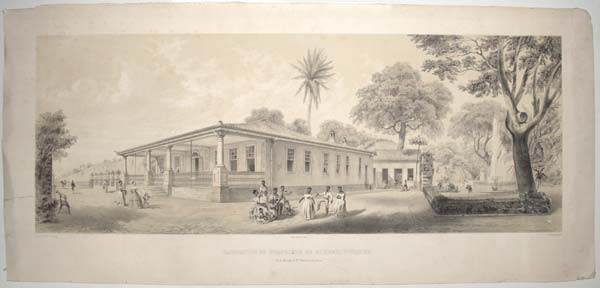
Habitation et Propriété de M.r Henri Fournier Sur la Montagne de S.ta Thereza à Rio Janeiro.
Dessiné par Mr N. Desmons.Lith. par A. Guesdon.
Imp. Lemercier, Pris. [n.d., 1855.]
Rare tinted lithograph. Sheet. 395 x 850mm (15½ x 33½"). Extensive tear, repaired, cracking, surface abrasion, laid on archival paper. Damaged.
A Brazilian fazenda (plantation) building, with some of the black workers dancing outside. Iluchar Desmons (b.1803) settled in Rio de Janeiro in 1840. In 1855 he published ''Panoramas de la Ville de Rio de Janeiro'', with thirteen lithographs. He often signed his plates with 'N Desmons'.
[Ref: 54161] £450.00
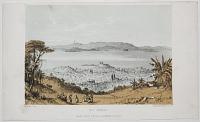
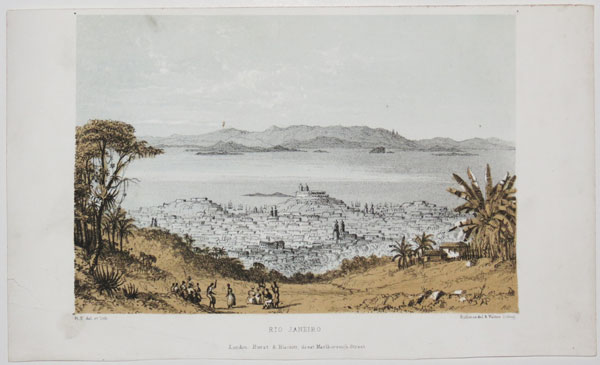
Rio Janeiro.
R.Elwes del et lith. Hullmandel & Walton, Lithog.
London: Hurst & Blackett Great Marlborough Street [c.1854]
Lithograph printed in colour, printed area 125 x 180mm (5 x 7").
Rio de Janeiro, the second most populous city in Brazil and the national capital until 1960, when the capital was moved to the new city of Brasília nearer to the centre of the country by Robert Elwes (1819-1878) a Victorian traveller.
[Ref: 45597] £160.00
(£192.00 incl.VAT)
![[View of Rio de Janeiro from the Carioca aqueduct]](img-thumbnail/jpegs/45559.jpg)
[View of Rio de Janeiro from the Carioca aqueduct] Vue de Rio-Janeiro. prise de l'Acqueduc.
Dess d'ap nat. par Rugendas Villeneuve del. fig. par V. Adam
Lith. de Engelmann, rue du faub Montmartre No.6 [1827-35]
Lithograph, printed area 280 x 355mm (11 x 14").
View of Rio de Janeiro with leisurely hunting party in foreground. Plate from 'Voyage pittoresque au Brésil' (1827-35), a volume of lithographs after drawings by Johann Moritz Rugendas (1802-58). Rugendas, who came from a family including several notable artists, travelled to Brazil in 1821 as draughtsman with the Russian diplomat Baron de Langsdorff’s scientific expedition. However, Rugendas left the expedition, discovering Brazil for himself and returning to Europe in 1825 with the extraordinary collection of drawings which provided the material for 'Voyage pittoresque'. Encouraged by the German scientist and explorer Alexander von Humboldt, Rugendas returned to Latin America in 1831, living until 1845 in Mexico and Chile with shorter stays in Argentina, Peru, Bolivia, and Uruguay, and drawing and painting prolifically throughout this time. He returned to Bavaria, where nearly 3000 drawings and paintings were acquired by the local government, but he then went back to live in Brazil between 1845 and 1846.
[Ref: 45559] £360.00
![[Entrance to the Rio de Janeiro harbour]](img-thumbnail/jpegs/45561.jpg)
[Entrance to the Rio de Janeiro harbour] Entrée de la rade de Rio-Janeiro.
Dess d'ap nat. par Rugendas Bonington del.
Lith. de Engelmann, rue du faub Montmartre No.6 [1827-35]
Lithograph, printed area 260 x 340mm (10¼ x 13½").
Plate from 'Voyage pittoresque au Brésil' (1827-35), a volume of lithographs after drawings by Johann Moritz Rugendas (1802-58). Rugendas, who came from a family including several notable artists, travelled to Brazil in 1821 as draughtsman with the Russian diplomat Baron de Langsdorff’s scientific expedition. However, Rugendas left the expedition, discovering Brazil for himself and returning to Europe in 1825 with the extraordinary collection of drawings which provided the material for 'Voyage pittoresque'. Encouraged by the German scientist and explorer Alexander von Humboldt, Rugendas returned to Latin America in 1831, living until 1845 in Mexico and Chile with shorter stays in Argentina, Peru, Bolivia, and Uruguay, and drawing and painting prolifically throughout this time. He returned to Bavaria, where nearly 3000 drawings and paintings were acquired by the local government, but he then went back to live in Brazil between 1845 and 1846. This particular plate is of added interest owing to the involvement of the landscape painter Richard Parkes Bonington (1802-28) as a draughtsman. Bonington lived in Paris for part of his short career, sharing a studio with Delacroix, and despite his death from tuberculosis at the age of 25, his work has consistently been held in high esteem.
[Ref: 45561] £360.00
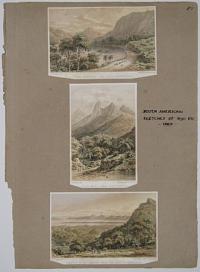
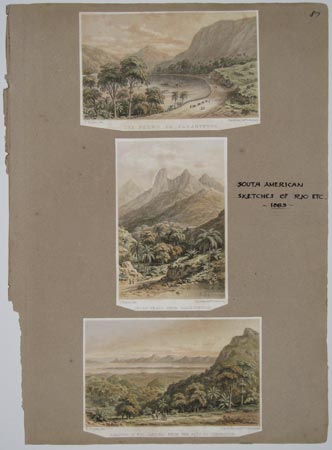
The Pedro de Parahybuna. Organ Peaks from Theresopolis. Harbour of Rio Janeiro from the Alto do Imperador.
T. Picken, lith.
[n.n. c.1863] Day & Son, Lithrs. to the Queen.
Three coloured lithographs on album paper. Plate: 100 x 150mm. 4" x 6". [&] 145 x 94mm. 5¾" x 3¾". [&] 100 x 150mm. 4" x 6". Cut.
Three views of rural Brazil. Not in Abbey.
[Ref: 8918] £230.00
(£276.00 incl.VAT)

Rio-Janeiro.
L. Scott. A.H. Payne sc.
John Tallis & Company, London & New York [n.d., c.1847.]
Steel engraving. Sheet 180 x 265mm (7 x 10½").
A distant view of Rio de Janeiro from the sea, with Sugarloaf Mount on the left.
[Ref: 63016] £60.00
(£72.00 incl.VAT)
![[Brazil] Harbour of Rio Janeiro, with the Benedictine Monastery, part of the City and the Ship Duff.](img-thumbnail/jpegs/67133.jpg)
[Brazil] Harbour of Rio Janeiro, with the Benedictine Monastery, part of the City and the Ship Duff.
M.A. Rooker del.t from a sketch by W. Wilson. J. Landseer direxit.
Published bt T. Chapman, Fleet Street, Feb.y 1, 1799.
Rare etching. Sheet 235 x 295mm (9¼ x 11½"). Trimmed within plate.
A view of the Abbey of Our Lady of Montserrat (known as the Mosteiro de São Bento), founded 1590, from the sea. From William Wilson's 'A Missionary Voyage to the Southern Pacific Ocean'.
[Ref: 67133] £180.00
(£216.00 incl.VAT)
![[View of Rio de Janeiro from the Carioca aqueduct]](img-thumbnail/jpegs/59893.jpg)
[View of Rio de Janeiro from the Carioca aqueduct] Vue de Rio-Janeiro. prise de l'Acqueduc.
Dess d'ap nat. par Rugendas Villeneuve del. fig. par V. Adam.
Lith. de Engelmann, rue du faub Montmartre No.6 [1827-35]
Lithograph with hand colour. Printed area 280 x 355mm (11 x 14"), very large margins.
View of Rio de Janeiro with leisurely hunting party in foreground. Plate from 'Voyage pittoresque au Brésil' (1827-35), a volume of lithographs after drawings by Johann Moritz Rugendas (1802-58). Rugendas, who came from a family including several notable artists, travelled to Brazil in 1821 as draughtsman with the Russian diplomat Baron de Langsdorff's scientific expedition. However, Rugendas left the expedition, discovering Brazil for himself and returning to Europe in 1825 with the extraordinary collection of drawings which provided the material for 'Voyage pittoresque'. Encouraged by the German scientist and explorer Alexander von Humboldt, Rugendas returned to Latin America in 1831, living until 1845 in Mexico and Chile with shorter stays in Argentina, Peru, Bolivia, and Uruguay, and drawing and painting prolifically throughout this time. He returned to Bavaria, where nearly 3000 drawings and paintings were acquired by the local government, but he then went back to live in Brazil between 1845 and 1846.
[Ref: 59893] £360.00

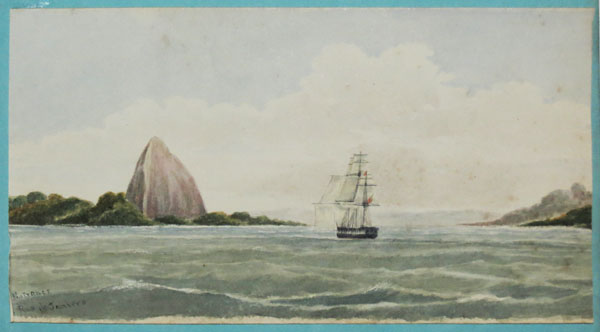
Entrance Rio de Janiero.
[by Lieutenant Nightingale, R.M.]
]n.d., c.1850.]
Ink and watercolour. Sheet 120 x 220mm (4¾ x 8¾").
H.M.S. Fox approaching Rio de Janeiro, with Sugarloaf Mountain.
[Ref: 49015] £450.00

Brésil. 77. Vue de Rio Janeiro, prise du Couvent de S.te Thérèse.
J. Arnout del. Lepetit sc.
26, Brésil, Lemaitre dir. [Paris Firmin Didot freres et Cie 1837.]
Engraving. 136 x 216mm. 5¼ x 8½".
A view of Rio de Janeiro from Santa, the hilltop district upon which sits the Convent of Santa Theresa of Avila, which was founded in 1750 by sisters Jacinta and Francisca Rodrigues Ayres. From Ferdinand Denis's "L'Univers. Histoire et Description de Tous les Peuples. Bresil, ... Colombie et Guyanes".
[Ref: 26081] £90.00
(£108.00 incl.VAT)

Mangueiras. Suburbs of Rio De Janeiro. (For some years occupied by the British Legation).
W. Gore Ouseley Del. J. Needham Lith.
Printed at 10 St. Martins Lane. [London: Thomas McLean. n.d., 1852.]
Rare tinted lithograph with hand colour. Printed area 280 x 215mm. (11 x 8½"). Light foxing.
A view of Mangueiras, Brazil. From William Gore Ouseley's 'Views in South America, from original drawings made in Brazil'. The fine views (including views of Bahia, Buenos Aires, and Rio de Janeiro) were selected for publication by Queen Victoria, from Ouseley's original watercolours, which he had brought back to England having served for several years as a diplomat in South America. NOT IN ABBEY; Tooley, English books with colour plates, 356. Borba de Moraes, p.643.
[Ref: 31647] £690.00
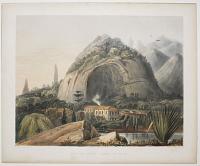
Serra dos Orgaos. Cabeça do Fraile.
W. Gore Ouseley Del. J. Needham Lith.
Printed at 10 St. Martins Lane. [London: Thomas McLean. n.d., 1852.]
Rare tinted lithograph with hand colour. Sheet 375 x 450mm (14¾ x 17¾") with very wide margins.
A view of George Marsh's farm, under a giant rock in the Serra dos Órgãos, near Rio de Janeiro. A plate from 'Views in South America, from original drawings made in Brazil', by Sir William Gore Ousley, a British diplomat who served in various roles in Washington, D.C., Rio de Janeiro and Buenos Aires. On his return to England (according to Borba de Moraes), ''he wished to publish a collection of drawings and watercolours of Brazil and the Rio de la Plata. The selection was made by Queen Victoria. This rare and valued album contains very pictureque lithographs''. NOT IN ABBEY; Tooley, English books with colour plates, 356. Borba de Moraes, p.643.
[Ref: 52569] £480.00
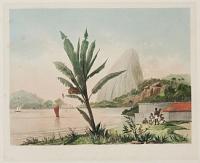
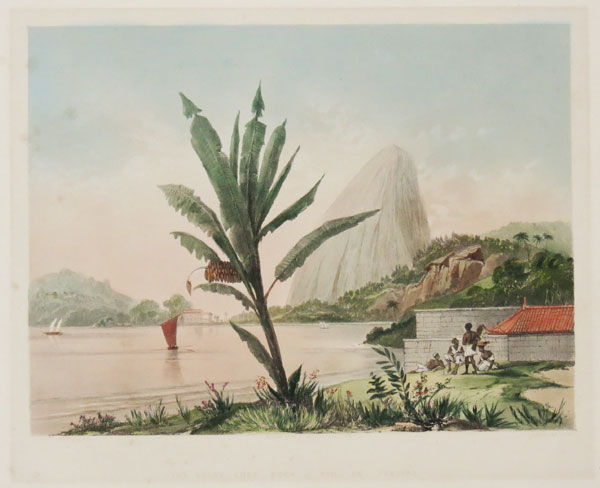
The Sugar Loaf Rock _ Rio de Janeiro.
W. Gore Ouseley Del. J. Needham Lith.
Printed at 10 St. Martins Lane. [London: Thomas McLean. n.d., 1852.]
Rare tinted lithograph with hand colour. Printed area 225 x 300mm (8¾ x 12¾"). Slight foxing.
A pictureque view of Sugarloaf Mountain, Rio de Janeiro, Brazil, at the mouth of Guanabara Bay. A plate from 'Views in South America, from original drawings made in Brazil', by Sir William Gore Ousley, a British diplomat who served in various roles in Washington, D.C., Rio de Janeiro and Buenos Aires. On his return to England (according to Borba de Moraes), ''he wished to publish a collection of drawings and watercolours of Brazil and the Rio de la Plata. The selection was made by Queen Victoria. This rare and valued album contains very pictureque lithographs''. NOT IN ABBEY; Tooley, English books with colour plates, 356. Borba de Moraes, p.643.
[Ref: 39382] £580.00
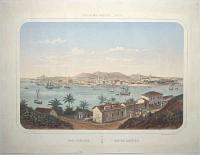
Rio-Janeiro. Rio de Janeiro. Ports de Mer D'Amerique _ Bresil.
Dessiné d'après nature et Lithog. par Deroy.
[Paris: L. Turgis, c.1860.]
Coloured lithograph with fine hand colour. Sheet 440 x 575mm (17¼ x 22¾"), large margins.
A view of Rio de Janeiro from the east side of the harbour, by Isidore Laurent Deroy (1797 - 1886).
[Ref: 59591] £650.00

Ruined Chapel of San Gonsalvo. Rio Vermelho, Bahia.
W. Gore Ouseley Del. J. Needham Lith.
Printed at 10 St. Martins Lane. [London: Thomas McLean. n.d., 1852.]
Rare tinted lithograph with very fine hand colour. Sheet 485 x 370mm (19 x 14½").
A view of Salvador de Bahia, Brazil, from 'Views in South America, from original drawings made in Brazil', by Sir William Gore Ousley, a British diplomat who served in various roles in Washington, D.C., Rio de Janeiro and Buenos Aires. On his return to England (according to Borba de Moraes), ''he wished to publish a collection of drawings and watercolours of Brazil and the Rio de la Plata. The selection was made by Queen Victoria. This rare and valued album contains very pictureque lithographs''. NOT IN ABBEY; Tooley, English books with colour plates, 356. Borba de Moraes, p.643.
[Ref: 52580] £450.00
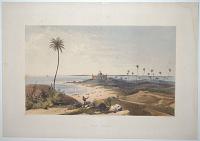
Near Bahia.
W. Gore Ouseley Del. J. Needham Lith.
Printed at 10 St. Martins Lane. [London: Thomas McLean. n.d., 1852.]
Rare tinted lithograph with very fine hand colour. Sheet 290 x 420mm (11½ x 16½"). Slight foxing, damp stain in margin top right.
A view of Salvador de Bahia, Brazil, from 'Views in South America, from original drawings made in Brazil', by Sir William Gore Ousley, a British diplomat who served in various roles in Washington, D.C., Rio de Janeiro and Buenos Aires. On his return to England (according to Borba de Moraes), ''he wished to publish a collection of drawings and watercolours of Brazil and the Rio de la Plata. The selection was made by Queen Victoria. This rare and valued album contains very pictureque lithographs''. NOT IN ABBEY; Tooley, English books with colour plates, 356. Borba de Moraes, p.643.
[Ref: 52581] £380.00
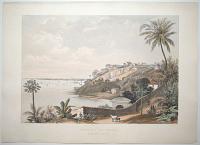
Victoria Hill and Cemetery, Harbour of Bahia.
W. Gore Ouseley Del. J. Needham Lith.
Printed at 10 St. Martins Lane. [London: Thomas McLean. n.d., 1852.]
Rare tinted lithograph with hand colour. Sheet 360 x 505mm (14¼ x 20") with very wide margins.
A view of Salvador de Bahia, Brazil, from 'Views in South America, from original drawings made in Brazil', by Sir William Gore Ousley, a British diplomat who served in various roles in Washington, D.C., Rio de Janeiro and Buenos Aires. On his return to England (according to Borba de Moraes), ''he wished to publish a collection of drawings and watercolours of Brazil and the Rio de la Plata. The selection was made by Queen Victoria. This rare and valued album contains very pictureque lithographs''. NOT IN ABBEY; Tooley, English books with colour plates, 356. Borba de Moraes, p.643.
[Ref: 52570] £480.00

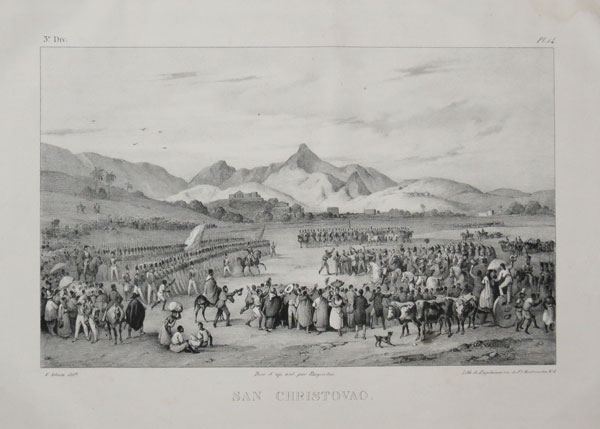
San Christovao.
V. Adam del.t Dess d'ap nat. par Rugendas.
Lith. de Engelmann, rue du F. Montmartre No.6 [n.d., 1827-35].
Lithograph, printed area 220 x 300mm (8¾ x 11¾").
A military parade in the district of São Cristóvão in the north of Rio de Janeiro. Plate from 'Voyage pittoresque au Brésil' (1827-35), a volume of lithographs after drawings by Johann Moritz Rugendas (1802-58). Rugendas, who came from a family including several notable artists, travelled to Brazil in 1821 as draughtsman with the Russian diplomat Baron de Langsdorff's scientific expedition. However, Rugendas left the expedition, discovering Brazil for himself and returning to Europe in 1825 with the extraordinary collection of drawings which provided the material for 'Voyage pittoresque'. Encouraged by the German scientist and explorer Alexander von Humboldt, Rugendas returned to Latin America in 1831, living until 1845 in Mexico and Chile with shorter stays in Argentina, Peru, Bolivia, and Uruguay, and drawing and painting prolifically throughout this time. He returned to Bavaria, where nearly 3000 drawings and paintings were acquired by the local government, but he then went back to live in Brazil between 1845 and 1846.
[Ref: 45551] £230.00
(£276.00 incl.VAT)

San Christovao.
V. Adam del.t Dess d'ap nat. par Rugendas.
Lith. de Engelmann, rue du F. Montmartre No.6 [n.d., 1827-35]
Lithograph. Sheet 205 x 295mm (8 x 11½"). Trimmed to image on three sides, losing plate numbers.
A military parade in the district of São Cristóvão in the north of Rio de Janeiro. Plate from 'Voyage pittoresque au Brésil' (1827-35), a volume of lithographs after drawings by Johann Moritz Rugendas (1802-58). Rugendas, who came from a family including several notable artists, travelled to Brazil in 1821 as draughtsman with the Russian diplomat Baron de Langsdorff's scientific expedition. However, Rugendas left the expedition, discovering Brazil for himself and returning to Europe in 1825 with the extraordinary collection of drawings which provided the material for 'Voyage pittoresque'. Encouraged by the German scientist and explorer Alexander von Humboldt, Rugendas returned to Latin America in 1831, living until 1845 in Mexico and Chile with shorter stays in Argentina, Peru, Bolivia, and Uruguay, and drawing and painting prolifically throughout this time. He returned to Bavaria, where nearly 3000 drawings and paintings were acquired by the local government, but he went back to live in Brazil between 1845 and 1846.
[Ref: 63338] £160.00
(£192.00 incl.VAT)
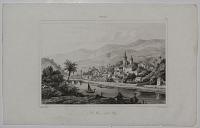
Brésil. 74. St. Joan del Rey.
Vanderburch del. H. Lalaisse Sc.
[Paris Firmin Didot freres et Cie 1837.]
Engraving. 140 x 222mm. 5½ x 8¾".
São João del-Rei, Brazil, seen on the banks of the Lenheiro River, with the old Rosario Stone Bridge. From Ferdinand Denis's "L'Univers. Histoire et Description de Tous les Peuples. Bresil, ... Colombie et Guyanes".
[Ref: 26083] £70.00
(£84.00 incl.VAT)
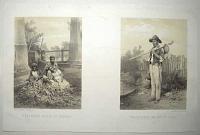
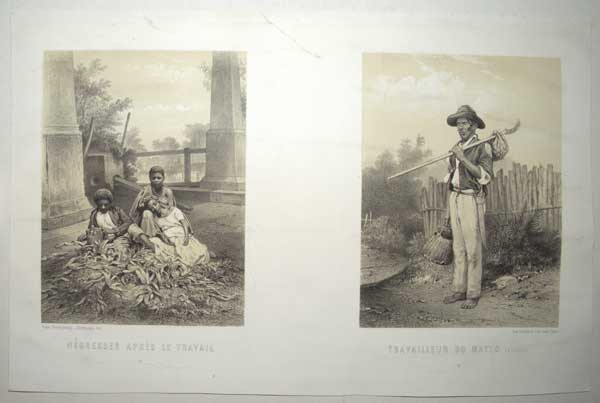
Nègresses après le Travail. Travailleur do Matto (Fòrêt).
Victor Frond photog _ Chapagne lith. Imp Lemercier r. de Seine Paris.
[n.d., c.1859.]
Two tinted lithographs on one sheet. Sheet 270 x 410mm (10½ x 16"). Repaired tear between images.
Two images: on the left three black women slaves rest after harvestring maize; on the right a man stands with a bundle tied to his hoe. The images are based on photographs by Jean-Victor Frond (1821-81), a French photographer and painter who owned a studio in Rio de Janeiro 1858-62, and published in ''Brazil Pittoresco", a four volume study of Brazilian life by Charles Ribeyrolles.
[Ref: 56605] £220.00
(£264.00 incl.VAT)
![[Transport of a convoy of black slaves]](img-thumbnail/jpegs/45569.jpg)
[Transport of a convoy of black slaves] Transport d'un convoi de nègres
Dess d'ap nat. par Rugendas Deroi del.
Lith. de Engelmann, rue du Faub Montmartre No.6 a Paris [1827-35]
Lithograph, printed area 195 x 270mm (7½ x 10¾").
Plate from 'Voyage pittoresque au Brésil' (1827-35), a volume of lithographs after drawings by Johann Moritz Rugendas (1802-58). Rugendas, who came from a family including several notable artists, travelled to Brazil in 1821 as draughtsman with the Russian diplomat Baron de Langsdorff’s scientific expedition. However, Rugendas left the expedition, discovering Brazil for himself and returning to Europe in 1825 with the extraordinary collection of drawings which provided the material for 'Voyage pittoresque'. Encouraged by the German scientist and explorer Alexander von Humboldt, Rugendas returned to Latin America in 1831, living until 1845 in Mexico and Chile with shorter stays in Argentina, Peru, Bolivia, and Uruguay, and drawing and painting prolifically throughout this time. He returned to Bavaria, where nearly 3000 drawings and paintings were acquired by the local government, but he then went back to live in Brazil between 1845 and 1846.
[Ref: 45569] £260.00
(£312.00 incl.VAT)
![[Negro market]](img-thumbnail/jpegs/45567.jpg)
[Negro market] Marché aux Nègres.
Dess d'ap nat. par Rugendas Deroi del.
Lith. de Engelmann, rue du Faub Montmartre No.6 a Paris [1827-35]
Lithograph, printed area 220 x 285mm (8½ x 11¼").
Plate from 'Voyage pittoresque au Brésil' (1827-35), a volume of lithographs after drawings by Johann Moritz Rugendas (1802-58). Rugendas, who came from a family including several notable artists, travelled to Brazil in 1821 as draughtsman with the Russian diplomat Baron de Langsdorff's scientific expedition. However, Rugendas left the expedition, discovering Brazil for himself and returning to Europe in 1825 with the extraordinary collection of drawings which provided the material for 'Voyage pittoresque'. Encouraged by the German scientist and explorer Alexander von Humboldt, Rugendas returned to Latin America in 1831, living until 1845 in Mexico and Chile with shorter stays in Argentina, Peru, Bolivia, and Uruguay, and drawing and painting prolifically throughout this time. He returned to Bavaria, where nearly 3000 drawings and paintings were acquired by the local government, but he then went back to live in Brazil between 1845 and 1846.
[Ref: 45567] £360.00
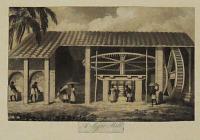
A Sugar Mill.
[London: Longman, Rees, Orme & Brown, 1816.]
Aquatint. Sheet 110 x 160mm (4¼ x 6¼"). Trimmed into image and around title. Laid on card.
The mill wheel, worked by negro slaves. From Henry Koster's 'Travels in Brazil'.
[Ref: 45629] £65.00
(£78.00 incl.VAT)
![[Sugar mill]](img-thumbnail/jpegs/45576.jpg)
[Sugar mill] Moulin à sucre.
Dess d'ap nat. par Rugendas Arnout et Deroi del.
Lith. de Engelmann, rue du Faub Montmartre No.6 a Paris [1827-35]
Lithograph, printed area 225 x 280mm (8¾ x 11").
Slaves transport lengths of sugar cane to a mill. Plate from 'Voyage pittoresque au Brésil' (1827-35), a volume of lithographs after drawings by Johann Moritz Rugendas (1802-58). Rugendas, who came from a family including several notable artists, travelled to Brazil in 1821 as draughtsman with the Russian diplomat Baron de Langsdorff’s scientific expedition. However, Rugendas left the expedition, discovering Brazil for himself and returning to Europe in 1825 with the extraordinary collection of drawings which provided the material for 'Voyage pittoresque'. Encouraged by the German scientist and explorer Alexander von Humboldt, Rugendas returned to Latin America in 1831, living until 1845 in Mexico and Chile with shorter stays in Argentina, Peru, Bolivia, and Uruguay, and drawing and painting prolifically throughout this time. He returned to Bavaria, where nearly 3000 drawings and paintings were acquired by the local government, but he then went back to live in Brazil between 1845 and 1846.
[Ref: 45576] £360.00
![Neger und Negerin von der Plantage. 23. [Brazil?]](img-thumbnail/jpegs/56555.jpg)
Neger und Negerin von der Plantage. 23. [Brazil?]
Lith v. Honegger. Fahnlein de.
[Zurich: Schulthess, 1824.]
Lithograph. Printed area 240 x 160mm (9½ x 6¼").
Portrait of a pair of plantation workers, holding their tools.
[Ref: 56555] £140.00
(£168.00 incl.VAT)

'Bread give me Bread' _ Pa. 20 Pratt's Poem of the 'Poor' or Cottage Pictures.
P.J. De Loutherbourg inv. et del. Anth.y Cardon sculp.t.
Published by the Author, Feb.y 1. 1803.
Stipple with etching, rare with very large margins; 180 x 115mm (7 x 4½").
Two beggar children with the allegorical figure of Charity giving comfort, playing a lyre. Ex: Collection of the Hon. Christopher Lennox-Boyd.
[Ref: 34178] £130.00
(£156.00 incl.VAT)
![[The Breakfast Table.]](img-thumbnail/jpegs/56664.jpg)
[The Breakfast Table.]
D. Wilkie R.A. Etched by C.W. Marr.
London, Nov. 24, 1823, Published by J. Young, Upper Charlotte Street, Fitzroy Square, and Hurst, Robinson & Co 90 Cheapside.
Etchin on chine collé. 290 x 230mm (11½ x 9"), very large margins.
An etching after David Wilkie's painting 'The Breakfast Table', with an old couple and a young man sitting at a round breakfast table. A maid pours hot water into a teapot.
[Ref: 56664] £70.00
(£84.00 incl.VAT)
![Breakfast. Symptons of Drowsiness. [&] Dinner. Symptoms of Eating and Drinking.](img-thumbnail/jpegs/54540.jpg)
Breakfast. Symptons of Drowsiness. [&] Dinner. Symptoms of Eating and Drinking.
H. Bunbury Esq.r Delin.t. W. Dickinson Execudit.
Published April 21, 1803 by Jn.o Harris No.3 Sweetings Alley, Cornhill, & 8 Old Broad Street, London.
Pair of stipples. 350 x 450mm (13¾ x 17¾") very wide margins left & right (marginal tears). 'Breakfast' trimmed to plate at top, 'Dinner' with loss of margin to plate at bottom.
The 'Breakfast' shows sportsmen in a bare breakfast parlour; the 'Dinner' shows five men and two ladies seated at a more opulent dinner-table. These plates would have been originally published by Dickinson in the 1780s. See BM Satires 8537 & 8538 for 1794 editions.
[Ref: 54540] £480.00
view all images for this item

The Breakfast. Symptoms of Drowsiness.
W.H. Bunbury Del [c.1770].
Etching with hand-colouring, platemark 250 x 350mm (9¾ x 13¾"), with large margins.
Copy of a stipple engraving after Henry Bunbury, published by William Dickinson and John Jeffreys. Bunbury was an amateur printmaker who subsequently enjoyed a successful career as a designer for printsellers. 'Prints by Bunbury an his imitators were conspicuously 'polite' and appealed, like novels, 'To the Fashionable World and Polite circles'.
[Ref: 47646] £130.00
(£156.00 incl.VAT)
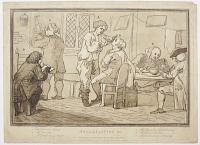
Breakfasting &c.
Hogarth Delin.t R.d Livesay Fecit
Publish'd Nov.r 27 1781 by R.d Livesay at Mrs Hogarths Leicester Fields.
Aquatint and etching, platemark 250 x 345mm (9¾ x 13½"). Small margins. Bit time stained.
In 1732 William Hogarth, with a group of friends including the artist Samuel Scott and lawyer and writer Ebenezer Forrest, undertook a five-day tour of the Thames and Medway estuaries. Forrest wrote an account of the trip and Hogarth and others made drawings to illustrate it (these are now in the British Museum). In 1781, after Hogarth's death, Richard Livesay engraved the plates and published them, together with Forrest's account, as 'Account of what seemed most remarkable in the five days' peregrination of … Tothall, Scott, Hogarth, Thornhill, and F.' (1782). The figures in this scene are all identified by a key- Hogarth, as in his well-known picture 'The Calais Gate', is crouched on the left, 'drawing this drawing'.
[Ref: 43923] £160.00
(£192.00 incl.VAT)
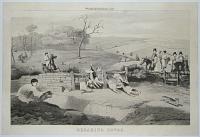
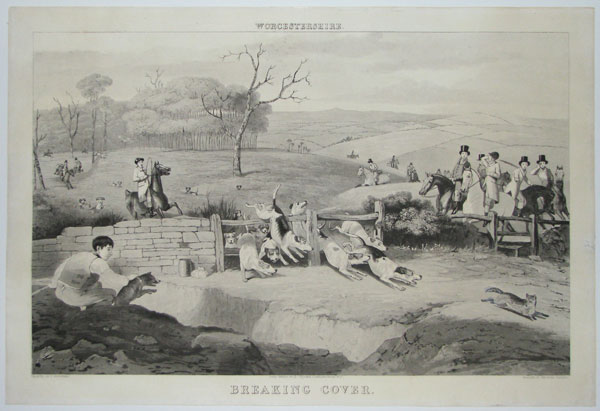
Worcestershire. Breaking Cover.
Painted by T. Woodward. Engraved by Theodore Fielding.
London, Published 1826 by J. Brooker, 5, Southampton Row, Russell Sq.r
Aquatint, very fine. 408 x 603mm. 16 x 23¾".
The fox breaks cover and is chased by the hounds and horses. A man with his dog sits by the side of the road holding-back his excited dog. Plate 1 from the set of very rare Worcestershire Hunt aquatints. Ex Collection: Norman Blackburn. Siltzer: Pg 315.
[Ref: 20754] £480.00
![[Corcovado mountain and the Catete neighbourhood, Rio de Janeiro]](jpegs/45557.jpg)
![[Fields by the das Velhas river in the state of Minas Gerais, Brazil]](jpegs/45562.jpg)
![[Inhomirim river in the state of Rio de Janeiro]](jpegs/45563.jpg)
![[View taken from the Monastery of St Benedict, Rio de Janeiro]](jpegs/45553.jpg)
![Olinda. [& plate of lizards, snakes, millepede and scorpion]](jpegs/58633.jpg)
![[Brazil] Obsidio Et Expugnatio Portus Calvi.](jpegs/41266.jpg)

![[Military and slaves on boats, Rio de Janeiro coastline]](jpegs/45554.jpg)
![[Praia Rodrigues, near Rio de Janeiro]](jpegs/59894.jpg)
![[Praia Rodrigues, near Rio de Janeiro]](jpegs/45564.jpg)
![[Recife] The Recief.](jpegs/58634.jpg)
![[San Sebastian quarter, Rio de Janeiro]](jpegs/39663.jpg)
![[View of Rio de Janeiro from the harbour]](jpegs/45560.jpg)


![[View of Rio de Janeiro from the Carioca aqueduct]](jpegs/45559.jpg)
![[Entrance to the Rio de Janeiro harbour]](jpegs/45561.jpg)

![[Brazil] Harbour of Rio Janeiro, with the Benedictine Monastery, part of the City and the Ship Duff.](jpegs/67133.jpg)
![[View of Rio de Janeiro from the Carioca aqueduct]](jpegs/59893.jpg)






![[Transport of a convoy of black slaves]](jpegs/45569.jpg)
![[Negro market]](jpegs/45567.jpg)

![[Sugar mill]](jpegs/45576.jpg)
![Neger und Negerin von der Plantage. 23. [Brazil?]](jpegs/56555.jpg)

![[The Breakfast Table.]](jpegs/56664.jpg)
![Breakfast. Symptons of Drowsiness. [&] Dinner. Symptoms of Eating and Drinking.](jpegs/54540.jpg)