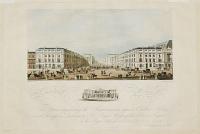
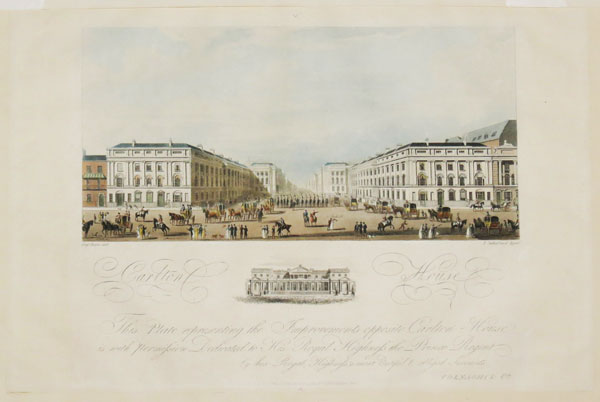
Carlton House. This Plate representing the Improvements opposite Carlton House is with Permission Dedicated to His Royal Highness the Prince Regent by his Royal Highness's most dutiful & obliged Servants. Colnaghi & Co.
Augt. Pugin delt. T. Sutherland Aquat.
London. Pubd. May 1.1817 by Colnaghi & Co. 25 Cockspur Street.
Fine coloured aquatint; 305 x 406mm (12 x 16"), on J. Whatman paper. Trimmed to plate, mounted in album sheet.
The view north from Carlton House, on Pall Mall, an early 18th century house reconstructed at enormous cost by the Prince of Wales (later George IV) over a thiry year period. The house was the scene of extraordinary receptions and balls. This print was made during the Regency, before the Regent ascended to the throne and decided that the house was not fine enough for his new elevated standing. The house was demolished and replaced by a terrace of houses (Carlton House Terrace). Collage: p5425141.
[Ref: 51125] £330.00

Waterloo Place, Pall Mall, and the Colonnade of the Kings Theatre, Opera-House.
Published 21st Jan.y 1818 by Ja.s Whittle & Rich.d H. Laurie, No. 53 Fleet Street London.
Coloured engraving. 285 x 430mm, 11¼ x 17". .
The newly-built junction of Lower Regent Street and Pall Mall.
[Ref: 17745] £260.00
(£312.00 incl.VAT)

The Prince of Orange at the Battle of Waterloo, distributing, at the moment, to the brave Troops the Orders he then wore.
J. A. Atkinson Del.t. M. Dubourg Sculp.t.
Published & Sold, Aug.t. 20, 1815 by EDW.D. ORME, Publisher to his Majesty & H.R.H the Regent, Bond Street, corner of Brook Street, London.
Fine coloured aquatint with large margins. Plate: 330 x 250mm (13 x 9¾").
Battle scene in which The Prince of Orange, mounted hands out his medals to foot soldiers in the midst of the battle. Dead and wounded men and horses lie on the ground and ranks of charging cavalrymen lead an attack in the distance.
[Ref: 33575] £160.00
(£192.00 incl.VAT)
![No. 27. [Waterman to a Coach Stand.]](img-thumbnail/jpegs/28716.jpg)
No. 27. [Waterman to a Coach Stand.]
[Drawn & engraved by William Henry Pyne.]
Published by William Miller, Albemarle Street Jan.y 1. 1805.
Hand coloured etching with aquatint. Sheet 340 x 250mm (13¼ x 10").
A man carrying two buckets of water to horses harnessed to their coaches. The print was published in 'The Costume of Great Britain', a work notable for portraying British life on the eve of the Industrial Revolution. Abbey Life 430.
[Ref: 28716] £70.00
(£84.00 incl.VAT)
![[At the Watermill.]](img-thumbnail/jpegs/23851.jpg)
[At the Watermill.] 9.
TB [monogram lower left: Thomas Barker of Bath.]
[Bath, D. Redman, 1814.]
Pen lithograph. 310 x 240mm. 12¼ x 9½". Foxing and paper toning.
Two young girls play at the edge of a stream and watermill. From "Thirty Two Lithographic Impression from Pen Drawings of Landscape Scenery", 1814. Views around Bath, Wales, the Lake District and elsewhere.
[Ref: 23851] £140.00
(£168.00 incl.VAT)
![[Watermill.]](img-thumbnail/jpegs/16927.jpg)
[Watermill.]
T.Bullen Cato. [pencil signature.]
[n.d., c.1900.]
Etching, signed by the artist. 200 x 255mm, 8 x 10".
A watermill, probably in Norfolk, a haunt of the artist.
[Ref: 16927] £60.00
(£72.00 incl.VAT)

Warren's Waterproof Composition. Boots, Shoes, Harness, and all sorts of Leather, dressed with this Composition, strengthened and rendered to Rian, Snow, and every kind of Dampness; if rubbed well into the Soles of Boots and Shoes they will wear full double their usual time. And sold throughout the kingdom in bottles at One Shilling each. Full Directions for Use given with each bottle. If an elegant brilliant Gloss is required, Use Warren's Blacking, as it is perfectly free from those pernicious Acids, used in other Blackings, which open the Pores and destroy the Leather. Prepared by Robert Warren 30 Strand.
[n.d. c.1820.]
Letterpress and engraving. 228 x 115mm. 9 x4½".
An advertisement for Warren's strengthening and waterproofing of soles of boots and shoes, and every kind of leather.
[Ref: 18344] £85.00
(£102.00 incl.VAT)
![Billy Waters et al] 30 Extraordinary Characters &c. Described in the Work.](img-thumbnail/jpegs/36314.jpg)
Billy Waters et al] 30 Extraordinary Characters &c. Described in the Work.
[n.d. c.1860.]
Stipple. Sheet size: 190 x 266mm (7½ x 10½"). Trimmed to image. Creased as normal.
A collection of thirty freaks and figures, both shunned and celebrated by contemporary society, including: Masaniello, the Neapolitan fisherman who supposedly led an uprising against the Spanish Habsburg rule in Naples in 1647; Billy Waters, one of many black beggars in early 19th-century London; Bampfylde Moore Carws (1693-1759), the English rogue, vagabond and imposter, who claimed to be King of the Beggars; Count Joseph Boruwlaski, the Polish dwarf who fell in love with Durham; Sir Thomas Parkyns (1662-1741), the noted wrestler, seen here clenching his fists, and the author of a book on Cornish Hugg wrestling; Samuel Horsey, who claimed that the surgeon Mr Abernethy cut off his legs without any explanation, who can be seen sliding along Charing Cross; and Lord Rokeby (1712-1800), the English eccentric nobleman who preferred a watery environment to a dry one. Key below identifying the figures, and images of natural phenomena (a water spout, volcanic eruption etc) around the edges. A copy in the John Johnson Collection.
[Ref: 36314] £190.00
(£228.00 incl.VAT)
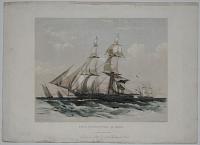
H.M.B. Waterwitch, 10 Guns.
H. John Vernon, del et lith. Day & Haghe, Lith.rs to the Queen.
A. Hinton, Portsmouth. [n.d. c.1850.]
Hand-coloured lithograph. 275 x 381mm. 10¾ x 15".
HMS Waterwitch (1834) was purchased into service in 1835 from Lord Belfast and was fitted out as a 10-gun brig. In 1835 set sail for Africa and was involved in combatting the Slave Trade, based around Sierra Leone. NMM: PAF8063.
[Ref: 20860] £270.00
(£324.00 incl.VAT)

H.M. Brig Waterwitch.
T.J.J.
[n.d., c.1840.]
Ink and watercolour sketch. Sheet 150 x 230mm (6 x 9").
Waterwitch, built by Joseph White of Cowes for Lord Belfast in 1832, sold to the Navy in 1834 and sold by them in 1861.
[Ref: 45633] £230.00
(£276.00 incl.VAT)

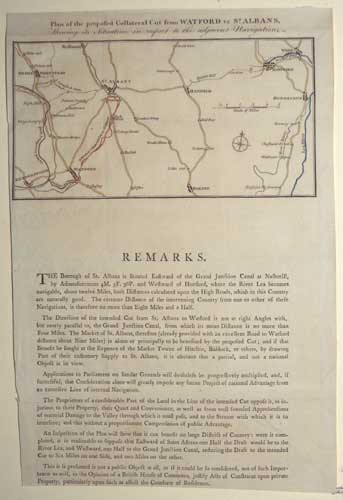
Plan of the proposed Collateral Cut from Watford to St Albans, Shewing the situation in respect to the adjacent Navigations.
[n.d., c.1800.]
Rare engraving with letterpress. Sheet 285 x 195mm (11¼ x 7¾"). Trimmed close to text.
A proposal to improve the River Vers to allow navigation from St Albans to the Grand Junction Canal.
[Ref: 57339] £180.00
![Watford Grammar School [in pencil to the right.]](img-thumbnail/jpegs/22574.jpg)
Watford Grammar School [in pencil to the right.]
Etched by Wallace Hester [in pencil to the left.]
[Etched in plate to the left:] WH. 13.
Etching with 'Remarque Proof' stamp. Plate 203 x 261mm. 8 x 10¼". Later impression.
The front of Watford Grammar School for Boys, in Watford, Hertfordshire. The school descends from a Free School founded as a charity school for boys and girls by Elizabeth Fuller in 1704.
[Ref: 22574] £70.00
(£84.00 incl.VAT)
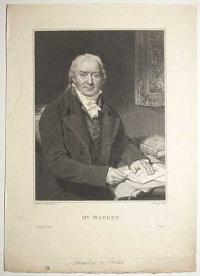
Mr. Wathen. Proof.
A.J. Oliver A.R.A. Pinx.t. T. Bragg Sculp.t.
Private Plate. [n.d., c.1810.]
Rare engraving, proof on chine collé. Sheet 265 x 200mm (10½ x 7¾"). Trimmed into plate on three sides.
James Wathen (c.1751-1828), traveller and artist. He went on walking excursions in all parts of Great Britain and Ireland, contributing topographical descriptions & sketches to the ‘Gentleman's Magazine,’ under the sobriquet of 'Jemmy Sketch'. In 1811 he accompanied Captain James Prendergast in his ship the Hope on a voyage to India and China, in which he visited Madras, Penang, Canton, Macao, the Cape of Good Hope, and St. Helena. In 1814 he published an account of his travels, under the title ‘Journal of a Voyage to India and China’ (London, 1814, 2 vols. 4to), illustrated with twenty-four coloured prints from his own drawings. After Archer James Oliver ARA (1774-1842). O'Donoghue: p.414.
[Ref: 56621] £160.00
(£192.00 incl.VAT)
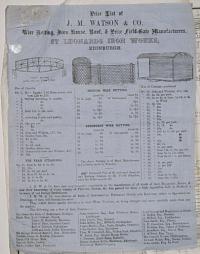
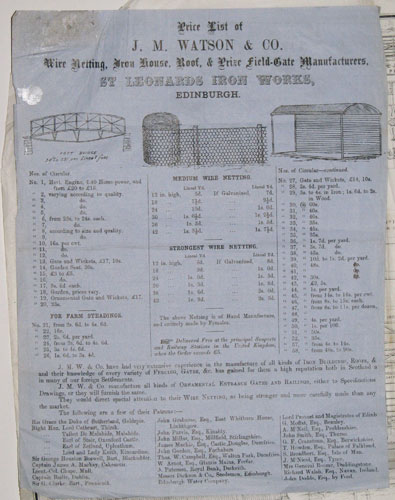
James M. Watson & Co. Iron & Wire Fence Manufacturers, Plain & Ornamental Gates & Railings, St. Leonard's Works, Edinburgh.
Martin & Hood, Lith, 8, Gt. Newport St. London [n.d., c.1860].
Two printed broadsides on wax paper, with lithography and letterpress; manufacturer's sheet of numbered designs presented with corresponding handbill Price List (blue paper). Affixed together with glue to upper left corners. Sheet 555 x 430mm. 21¾ x 17" (handbill 275 x 210mm). Folds as usual; extremities a little tatty.
[Ref: 22268] £120.00
(£144.00 incl.VAT)
view all images for this item
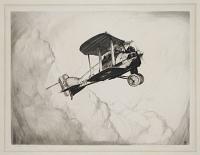
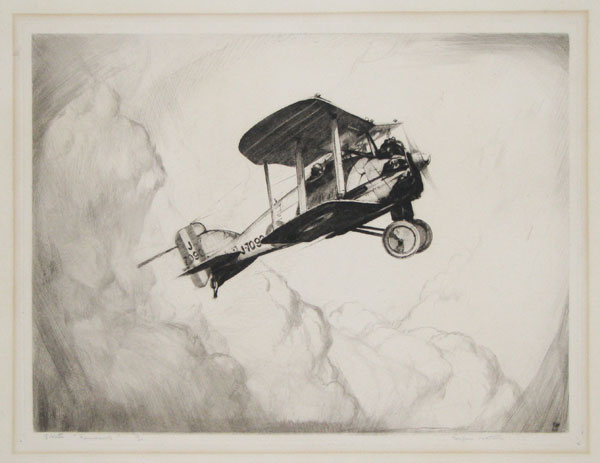
Gloster "Gamecock"
Geoffrey Watson [signed in pencil]
Numbered 16/30 [c.1931]
Etching, 260 x 340mm. 10¼ x 13¼".
Etching by Geoffrey Watson, who produced a series of prints showing aircraft in flight. The Gloster Gamecock, an RAF biplane, first flew in 1925. It was also used by the Finnish air force.
[Ref: 14906] £480.00

Gloster SS19
Geoffrey Watson [signed in pencil]
1931. Numbered 16/30
Etching, 260 x 340mm. 10¼ x 13¼".
Etching by Geoffrey Watson, who produced a series of prints showing aircraft in flight. The Gloster SS. 19, also known as the Gauntlet, entered RAF service in the 1930s and saw combat in Finland in 1939-40.
[Ref: 14905] £480.00
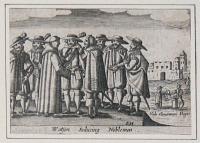
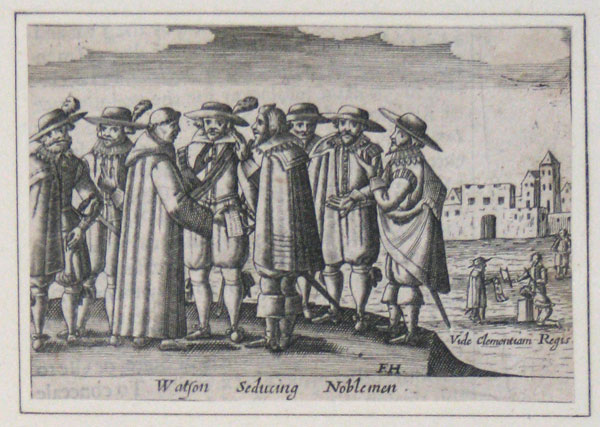
Watson seducing Noblemen.
F.H. [F. Hulsius sc.]
[From 'A Thankfull Remembrance of Gods Mercie' London: Printed by Aug. Math[ewes] for Robert Mylbourne and Humphrey Robinson, 1630.]
Engraving 73 x 108mm. Trimmed and laid on album paper.
William Watson, a Catholic priest, blessing a group of gentlemen involved in a plot against James I; in the backgound, one of them, Sir Griffin Markham, is pardoned at the point of execution. 1627. Hulsius or Friedrich von Hulsen (printmaker 1580 - 1665) Engraver; said to have been born in Middelburg, c. 1580. Son of Levis van Hulsen, mathematician and book-publisher in Ghent, and brother of Esaias van Hulsen. About 1592 the family moved to Nuremberg; in 1602 to Frankfurt where Frederik was probably a pupil of J T de Bry, and afterwards managed the family publishing house. 1627, in London briefly, where most of his work was connected with protestant propaganda. While in London he is most associated with book illustration as with these and others for George Carleton, 'A Thankfull Remembrance of Gods Mercy'. BM Satires 13 (cf.).
[Ref: 12298] £120.00
(£144.00 incl.VAT)
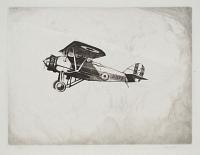
Siskin IIIa.
Geoffrey Watson [signed in pencil]
Etching, 260 x 340mm. 10¼ x 13¼". Slight line across sky.
Etching by Geoffrey Watson, who produced a series of prints showing aircraft in flight. The Armstrong Whitworth Siskin, one of the first RAF fighters designed after World War I. They were used by RAF squadrons between 1924 and 1932. First RAF air display took place at Hendon in July 1920.
[Ref: 14828] £350.00
![[St. Etienne du Mont, Paris. Interior.]](img-thumbnail/jpegs/18220.jpg)
[St. Etienne du Mont, Paris. Interior.]
Charles J. Watson 1906
Etching, 205 x 230mm. (8 x 9"). Outside of frame 530 x 440mm (21 x 17¼"). Pencil signature bottom left. Unexamined out of frame.
Atmospheric view of the spiralling staircases of the famous church of St.-Etienne-du-Mont in Paris. The church contains the shrine of St. Geneviève, patron saint of Paris, and contains the tombs of Blaise Pascal and Jean Racine. Jean-Paul Marat is buried in the church's cemetery. Etched by Charles John Watson (1846-1927). Born in Norwich, Watson was a member of the Royal Society of Painter-Etchers and Engravers, and chief Founder and first President of the Norwich Art Circle. After leaving Norwich to move to London in 1888, he exhibited successfully at Robert Dunthorne's Gallery in Vigo Street. 'Catalogue of the Etched and Engraved work of Charles J. Watson, R.E.' cat. 159. For this reference book see ref. 10362. For other material relating to Watson' exhibitions at Robert Dunthorne's galler
[Ref: 18220] £160.00
(£192.00 incl.VAT)
![[Sir Brook Watson.]](img-thumbnail/jpegs/59983.jpg)
[Sir Brook Watson.] 35.
JS f. [James Sayers.]
Pub.d by Ja.s Bretherton 31.st March 1788.
Etching, 175 x 115mm (7 x 4½") with large margins. Tape stains on outer margins.
Portrait of Sir Brook Watson, 1st Baronet (1735 - 1807), bending forward, his wooden leg concealed behind a bench, and holding out a document with a pendent seal inscribed 'Pension for Services'. Watson was a British merchant, soldier, and later Lord Mayor of London. At 14 years old, he was attacked by a shark resulting in the loss of his right leg below the knee. BM Satires 7290.
[Ref: 59983] £80.00
(£96.00 incl.VAT)

Charles Watson Esq.r Vice Admiral of the White.
T. Hudson pinx.t. E. Fisher sculp.t.
[n.d., c.1770.]
Mezzotint with large margins. Platemark: 380 x 280mm (15 x 11"). Very fine impression. Small stain in left margin.
A portrait of Vice Admiral Charles Watson (1714 - 1757), an officer of the Royal Navy, who served briefly as colonial governor of Newfoundland. Watson's quick rise through the ranks is thought to be attributed from his uncle, Sir Charles Wager, who was first lord of the admiralty. Three-quarter length standing to the left, Watson is wearing naval uniform with large, decorated cuffs and a wig tied at the nape. He is seen holding a telescope diagonally before him with his right hand, with his left on his sword-hilt. The sea and a battery are in the background. Ex collection of Christopher Lennox-Boyd. Chaloner Smith: 59.
[Ref: 36553] £330.00
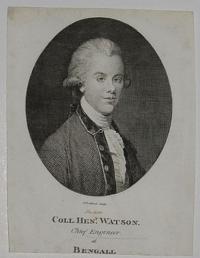
The Late Coll. Hen.y Watson. Chief Engineer of Bengal.
T. Prattent Sculp.
[n.d. c.800.]
Etching and stipple. 128 x 100mm. 5 x 4". Trimmed and laid on card.
Col. Henry Watson (1737-1786), Chief Engineer to the Company, established Bengal's first dockyard in Khidirpur. He is linked with Fort William and brought about many improvements in Calcutta, including the layout of surrounding Esplanade.
[Ref: 26037] £65.00
(£78.00 incl.VAT)

Richard Watson Bishop of Landaff.
Painted by George Romney. Engraved by I. Jones Engraver Extraordinary to His R.H. the Prince of Wales, and Principal Engraver to His R.H. the Duke of York.
Published as the Act directs May 29.th 1793, by I. Jones Engraver No.74 Great Portland Street.
Very fine mezzotint with large margins, and collector's marks, A Anderson Weston. Image area 495 x 349mm (19½ x 13¾").
Portrait standing three-quarter length to right with his left hand on stick, eyes to front, wearing dark hat and walking dress, landscape behind. Richard Watson, Bishop of Llandaff (1737-1816), and author of several religious and political works; chemist. Ex Collection: Earl of Bute. Horne: 129. CS: 80. Lugt: 65.
[Ref: 29143] £420.00
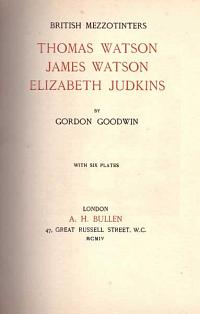
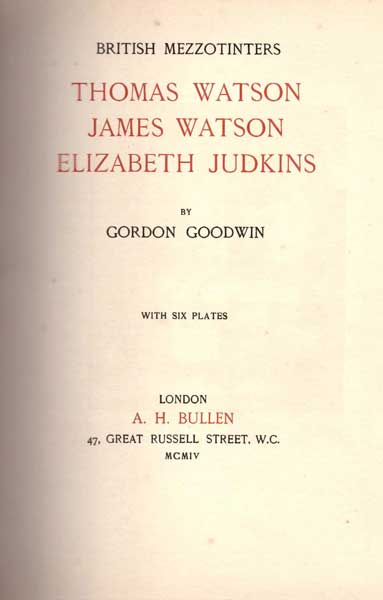
British Mezzotinters. Thomas Watson, James Watson, Elizabeth Judkins with six plates
by Gordon Goodwin.
London A.H.Bullen. 47, Great Russell Street, W.C. MCMIV [1904].
Book: 4to (251 x 193mm). Cloth binding with title stamped on spine in gilt. pp. v-viii + 232. Illustrated with six b/w plates. Ex Libris M. Sainsbury. Binding rubbed and scuffed. Some sporadic spotting.
An illustrated catalogue of the mezzotints by Thomas & James Watson, and Elizabeth Judkins.
[Ref: 10340] £90.00
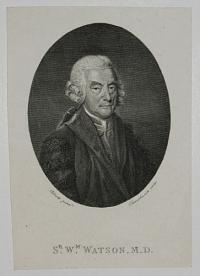
Sr. Wm. Watson, M.D.
Abbott pinx.t Thornthwaite sculp.
[n.d. c.1780.]
Engraving. 140 x 101mm. 5½ x 4".
Sir William Watson (1715-1787) was a British physician, botanist and natural scientist, best remembered for his work on electricty. He did much to introduce Linnaeus' system of classification into Britain and was one of the earliest experimenters on electricity, being to investigate the passage of electricity through a rarefied gas. His experiments in 1747 to determine the velocity of electricity are of particular interest. The general belief at that time was that electricity was faster than sound, but no accurate test had as yet been devised to measure the velocity of a current. Watson eventually decided not to pursue his electrical experiments concentrating instead upon his medical career, but he continued to support others in presenting evidence to the Royal Society and became a champion of Benajmin Franklin. W: 3127-2.
[Ref: 24621] £70.00
(£84.00 incl.VAT)
![[Charles Watson-Wentworth] The Right Noble Charles Marquis of Rockingham, &c. &c.](img-thumbnail/jpegs/62704.jpg)
[Charles Watson-Wentworth] The Right Noble Charles Marquis of Rockingham, &c. &c. 1.
[engraved by Richard Houston after Benjamin Wilson.]
Printed for R. Sayer, Map & Printseller at the Golden Buck, near Sergeants Inn Fleet Street, London [n.d., c.1760].
Rare mezzotint. Sheet 350 x 250mm (13¾ x 9¾"). Trimmed into image on three sides, into plate at bottom, some creasing in bottom left corner.
Three quarter length portrait of Charles Watson-Wentworth (1730-82), 2nd Marquis of Rockingham, standing in profile to the left. Rockingham was a British Whig statesman, most notable for his two terms as Prime Minister, in 1765-6 and 1782. For this third state a Garter star has been added to his jacket. CS 104, state iii of iii.
[Ref: 62704] £260.00
(£312.00 incl.VAT)
![[Charles Watson-Wentworth] [The Right Noble Charles Marquis of Rockingham,](img-thumbnail/jpegs/68323.jpg)
[Charles Watson-Wentworth] [The Right Noble Charles Marquis of Rockingham, Earl of Malton and of Wath and Harowden, Lord Lieutenant and Custos Rotulorum of the West Riding of the County of York and Custos Rotulorum of the North Riding of the said County and Vice Admiral of all the Maritime Parts thereof and F.R.S.]
[Painted by B. Wilson. R. Houston Sculp.]
[Sold by R. Houston near Drummond's, Charing Cross.] [n.d., c.1760].
Rare mezzotint, proof before letters. 390 x 275mm (15¼ x 10¾"). Repaired tears, creasing. Small margins. Title area uncleaned.
Three quarter length portrait of Charles Watson-Wentworth (1730-82), 2nd Marquis of Rockingham, standing in profile to the left. Rockingham was a British Whig statesman, most notable for his two terms as Prime Minister, in 1765-6 and 1782. CS 104, state i of iii. Ex: collection of The Hon. Christopher Lennox-Boyd.
[Ref: 68323] £280.00
(£336.00 incl.VAT)
![[Charles Watson Wentworth, Marquis of Rockingham.]](img-thumbnail/jpegs/59997.jpg)
[Charles Watson Wentworth, Marquis of Rockingham.] 1.
JS. [James Sayers.]
Published 17.th June 1782 by C. Bretherton.
Etching, 175 x 110mm (7 x 4¼") with large margins. Tape stains on outer margins.
Portrait of Charles Watson-Wentworth, 2nd Marquis of Rockingham (1730 - 1782), standing in profile to the left. Rockingham was a British Whig statesman, most notable for his two terms as Prime Minister of Great Britain, in 1765-6 and 1782. BM Satires 6069.
[Ref: 59997] £80.00
(£96.00 incl.VAT)
![[James Watt and the Steam Engine.]](img-thumbnail/jpegs/54952.jpg)
[James Watt and the Steam Engine.]
Painted by James Eckford Lander. Engraved by James Scott.
London. Published by Henry Graves & Compy. Novr. 12th 1860: Printsellers to the Queen _ 6 Pall Mall.
Scarce mixed method engraving. Sheet 395 x 620mm (15½ x 24½"). Trimmed, losing title, a few repairs at top.
Watt conducting an experiment in his laboratory. The original painting by James Eckford Lauder (not Lander as here, 1811-69) is in the Scottish National Gallery.
[Ref: 54952] £880.00
![[James Watt.]](img-thumbnail/jpegs/57847.jpg)
[James Watt.]
S.M. Litten [pencil signature].
Published 1922 by The Museum Galleries, 26, Museum, London, W.C. Copyright.
Mezzotint on chine collé, printed in colours, signed by the engraver, publisher's blind stamp lower left. 335 x 270mm (13¼ x 10¾"), large margins, with a letterpress biography.
Seated portrait of James Watt (1736-1819), Scottish inventor whose improvements to the steam engine in 1776 was fundamental to the changes brought by the Industrial Revolution. The original oil, painted by Carl Fredrik von Breda in 1779, in now in the National Portrait Gallery (NPG 186a).
[Ref: 57847] £75.00
(£90.00 incl.VAT)
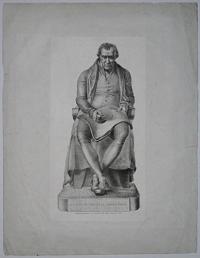
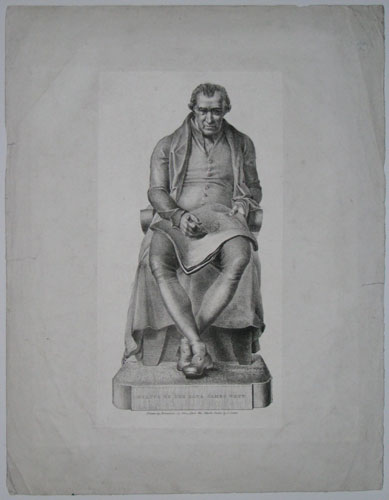
Statue of the Late James Watt.
F. Chantrey RA. Drawn by Permission, on Stone from the Marble Statue, by I. Zeitter.
[n.d., c.1820s.]
Lithograph on india paper, scarce, india 320 x 165mm. 12½ x 6½".
James Watt Memorial: In 1825 a very large white marble statue was erected in St Paul’s chapel in Westminster Abbey in memory of James Watt, civil engineer. It was made by Sir Francis Chantrey and cost over £6,000. The introduction of this colossal monument into the little chapel meant that the pedestal had to be divided into three pieces and was dragged in over the medieval tomb of Sir Lewis Robessart, destroying the ancient coffin lid. The statue only just went through the door and the floor gave way under its weight and disclosed “rows upon rows of gilded coffins” beneath. Had the area not been planked over the workmen and the statue would have fallen in. The epitaph was by Lord Brougham and read: “Not to perpetuate a name which must endure while the peaceful arts flourish, but to shew that mankind have learned to know those who best deserve their gratitude. The King, His Ministers, and many of the Nobles and Commoners of the Realm raised this monument to JAMES WATT who, directing the force of an original Genius, early exercised in philosophic research, to the improvement of the Steam Engine, enlarged the resources of his Country, increased the power of Man, and rose to an eminent place among the most illustrious followers of science and the real benefactors of the World. Born at Greenock MDCCXXXVI Died at Heathfield in Staffordshire MDCCCXIX.” In 1960 the statue was removed from the Abbey and a bronzed plaster bust was given in its place by the Institution of Mechanical Engineers. The bust stands on the window ledge in the north choir aisle and a memorial stone was inserted in the floor of St Paul’s chapel to mark the site of the statue, with the same inscription as above carved on it. The Chantrey statue is now at the Scottish National Portrait Gallery.
[Ref: 21981] £220.00
(£264.00 incl.VAT)
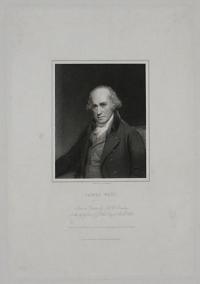
James Watt.
Engraved by C. E. Wagstaff. From a picture by Sir W. Beechey in the possesion of J. Watt Esq. of Aston Hall.
London. Published by Charles Knight, Pall Mall East. [n.d., c.1845].
Stipple with etching. Laid on India paper. Proof. Platemark: 290 x 192mm (11½ x 7½"). Very large margins.
Portrait of engineer James Watt (1736 - 1819). A mechanical engineer who trained as a mathematical instrument-maker, James Watt invented the condensing steam-engine in 1765. He took Matthew Boulton as his partner in 1775, and developed an improved version of this engine which revolutionised industry and immortalised Watt's name, inaccurately but effectively, as the 'inventor of the steam-engine'. From Watt Collection Sotheby.
[Ref: 32616] £70.00
(£84.00 incl.VAT)
![Your Obedient Sert James Watt [facsimile singature].](img-thumbnail/jpegs/66132.jpg)
Your Obedient Sert James Watt [facsimile singature].
Painted by John Mc. Donald. Engraved by John Le Conte. Printed by A. Mc.Glashon.
Edinburgh. Published. May 1858. By William H. Vannan, Printseller & Published, 46 Home Street.
Mezzotint on chine collé. 570 x 410mm (22½ x 16"), large margins. Six wormholes top margin outside platemark.
A seated portrait of Scottish inventor James Watt (1736-1819), before a window with a factory behind. The design of one of his engines is at his feet. W: 3128. Ex: collection of The Hon. Christopher Lennox-Boyd.
[Ref: 66132] £320.00
![Your Obedient Sert James Watt [facsimile singature].](img-thumbnail/jpegs/3783.jpg)
Your Obedient Sert James Watt [facsimile singature].
Painted by John Mc. Donald. Engraved by John Le Conte.
Edinburgh. Published. May 1858. By William H. Vannan, Printseller & Published, 46 Home Street. 1st. Class Proof. Printed by A.Mc.Glashon.
Mezzotint. 505 x 365mm (20 x 14¼").
James Watt (19 January 1736 - 19 August 1819) was a Scottish inventor and engineer whose improvements to the steam engine were fundamental to the changes wrought by the Industrial Revolution. W: 3128
[Ref: 3783] £320.00
![James Watt [facsimile signature.]](img-thumbnail/jpegs/15388.jpg)
James Watt [facsimile signature.]
E. Finden, sculpt.
[n.d., c.1835.]
Stipple on india laid paper, 280 x 225mm. 11 x 9".
James Watt (1736 - 1819), engineer, a profile view of the sculptured bust by Sir Francis Chantrey (1782 - 1841). A mechanical engineer who trained as a mathematical instrument-maker, James Watt invented the condensing steam-engine in 1765. He took Matthew Boulton as his partner in 1775, and developed an improved version of this engine which revolutionised industry and immortalised Watt's name, inaccurately but effectively, as the 'inventor of the steam-engine'. Inscribed 'Proof' lower left. Wellcome: 3128-12.
[Ref: 15388] £60.00
(£72.00 incl.VAT)
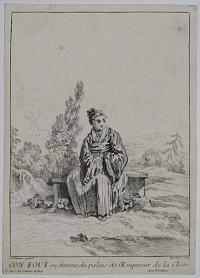
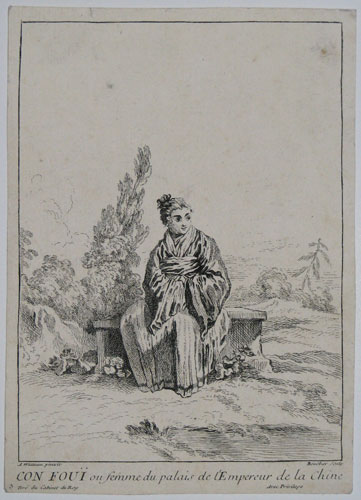
Con Fouï ou femme du palais de l'Empereur de la Chine.
A. Watteau pinxit. Boucher Sculp.
Tire du Cabinet du Roy Avec Privilege. [Paris, n.d., c.1731.]
Etching, sheet 215 x 155mm, 8½ x 6". Trimmed within plate.
A woman from the Chinese Imperial Palace: she sits on a stone bench in a landscape, in robes, head turned to the right. After Antoine Watteau ( 1684 - 1721), from the 'Recueil Jullienne' series, plate 240 to 'L'Oeuvre d'Antoine Watteau Peintre du Roy'. Jean de Jullienne (1686 - 1766) was a Parisian collector and patron of the arts who owned some 450 drawings by Watteau, and had them engraved. Also plate 5 from a subset 'Diverses Figures Chinoises et Tartares' formed by the twelve plates etched by François Boucher (1703 - 1770), published as a set on its own.
[Ref: 19620] £260.00
(£312.00 incl.VAT)
![[Untitled ornament design.]](img-thumbnail/jpegs/19616.jpg)
[Untitled ornament design.]
A. Watteau inv. Huquier Sculp.
a Paris chez la Veuve de F. Chereau rüe St. Jacque aux deux pilliers d'Or avec privillege du Roy. [n.d., c.1730.]
Etching, 260 x 235mm, 10¼ x 9¼". Sheet trimmed; a crease through upper right corner.
A heart-shaped cartouche design with two entwined flower wreaths surmounting a wreath of heart-shaped leaves, with two of them pierced by arrows. Vines and foliage to parts of frame. After Antoine Watteau ( 1684 - 1721), from the 'Recueil Jullienne' series, plate 188 to 'L'Oeuvre d'Antoine Watteau Peintre du Roy'. Jean de Jullienne (1686 - 1766) was a Parisian collector and patron of the arts who owned some 450 drawings by Watteau, and had them engraved.
[Ref: 19616] £260.00
(£312.00 incl.VAT)
![[Idyllic scene] From a Picture by Watteau in the possession of M.r Canton.](img-thumbnail/jpegs/65314.jpg)
[Idyllic scene] From a Picture by Watteau in the possession of M.r Canton.
J. Pye Sculp.
Published Jan: 1.st 1774 by J. Boydell Engraver in Cheapside London.
Engraving. Sheet 170 x 190mm (6¾ x 7½"). Trimmed within plate on three sides.
A group of young people gather around a statue in an Italianate parkland, one playing a guitar.
[Ref: 65314] £130.00
(£156.00 incl.VAT)
![[Pair of trophies]](img-thumbnail/jpegs/63749.jpg)
[Pair of trophies] H. 3.
A. Watteau, inv.
I.G. Merz exc. A.V. [Augsburg, n.d., c.1750.]
Etching. 145 x 245mm (5¾ x 9¾"), with very large margins Old ink numeral in margin.
Two decorative trophies after Jean-Antoine Watteau, from 'Neu inventierte Siegs und Ehren Zeichen'.
[Ref: 63749] £60.00
(£72.00 incl.VAT)
![[Pair of trophies]](img-thumbnail/jpegs/63750.jpg)
[Pair of trophies] H. 5.
A. Watteau, inv.
I.G. Merz exc. A.V. [Augsburg, n.d., c.1750.]
Etching. 145 x 245mm (5¾ x 9¾"), with very large margins. Old ink numeral in margin.
Two decorative trophies, one representing the arts & sciences, the other preforming arts, after Jean-Antoine Watteau, from 'Neu inventierte Siegs und Ehren Zeichen'.
[Ref: 63750] £60.00
(£72.00 incl.VAT)
![[Pair of trophies]](img-thumbnail/jpegs/63751.jpg)
[Pair of trophies] H. 6.
A. Watteau, inv.
I.G. Merz exc. A.V. [Augsburg, n.d., c.1750.]
Etching. 145 x 245mm (5¾ x 9¾"), with very large margins. Old ink numeral in margin.
Two decorative trophies, one with bagpipes, the other with weapons, after Jean-Antoine Watteau, from 'Neu inventierte Siegs und Ehren Zeichen'.
[Ref: 63751] £60.00
(£72.00 incl.VAT)

Neu inventierte Siegs und Ehren Zeichen. Anderer Theil. Second Livre de Trophée. N.º 8. H.
A. Watteau, inv.
Joh. Georg Merz exc. A.V. [Augsburg, n.d., c.1750.]
Etching. 145 x 245mm (5¾ x 9¾"), large margins. Old ink numeral in margin.
A maritime-themed title illustration to a book of trophies after Jean-Antoine Watteau, paired with an image of a trophy including a set of bagpipes.
[Ref: 63740] £120.00
(£144.00 incl.VAT)
G.F.Watts Reminiscences "What is, is, - and one should not desire to make it seem to be other" G.F.Watts.
by Mrs. Russell Barrington. Author of "The Reality of the Spiritual Life," "Lena's Picture," "Helen's Ordeal," "A Retrospect," etc.
London. George Allen, 156, Charing Cross Road, 1905.
Book: 4to (241 x 174mm). Cloth binding with gilt title on spine and 'G.F.Watts' in gilt on front cover, plus gilt patterning. 210 textual pages plus illustrations. Binding worn. Some sporadic spotting.
An illustrated narrative of the life and work of G.F. Watts.
[Ref: 10451] £50.00
![[George Frederick Watts.]](img-thumbnail/jpegs/24133.jpg)
[George Frederick Watts.]
London, Published Dec.r 1.st 1887 by Robert Dunthorne, at The Rembrandt Head in Vigo Street, W.
Photogravure on chine collé. 330 x 247mm (13 x 9¾").
After a self-portrait. George Frederic Watts (1817-1904) was a popular English Victorian painter and sculptor associated with the Symbolist movement. He intended to form part of an epic symbolic cycle called the "House of Life", in which the emotions and aspirations of life would all be represented in an universal symbolic language. See Ref: 23409 [unique proof mezzotint on chine collé touched by Watts with his initials bottom right]; Ref: 23410 [proof mezzotint on chine collé]; both are larger impressions.
[Ref: 24133] £130.00
(£156.00 incl.VAT)
![[George Frederick Watts.]](img-thumbnail/jpegs/23409.jpg)
[George Frederick Watts.]
[Charles William Campbell after George Frederrick Watts.]
[n.d., c.1885]
Unique proof mezzotint on chine collé touched by Watts with his initials bottom right, platemark 500 x 365mm (19½ x 14¼"). Paper missing top right, resulting in creasing to chine collé; foxing in margins.
Extremely rare touched proof of Charles William Campbell's engraving from the 1664 half-length self-portrait by George Frederick Watts (London, Tate Gallery). Watts has made correction to the print himself, and initialled the print in the lower right. One of the few prints by Campbell (1855-87), who studied mezzotint engraving with Hubert Herkomer. His total 'oeuvre' consisted of twelve finished and seven unfinished plates. For another impression see ref. 23410.
[Ref: 23409] £2,500.00
![[George Frederick Watts]](img-thumbnail/jpegs/23410.jpg)
[George Frederick Watts]
[Charles William Campbell after George Frederrick Watts]
[n.d., c.1885]
Proof mezzotint on chine collé. 500 x 365mm (19½ x 14¼"). Full margins.
A half-length self-portrait by painter and sculptor George Frederick Watts (1817-1904), painted in 1864 and now in the Tate Gallery. One of the few prints by Campbell (1855-87), who studied mezzotint engraving with Hubert Herkomer. His total 'oeuvre' consisted of twelve finished and seven unfinished plates. For a proof touched by Watts himself see ref. 23409
[Ref: 23410] £450.00
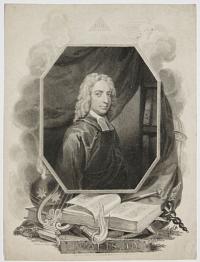
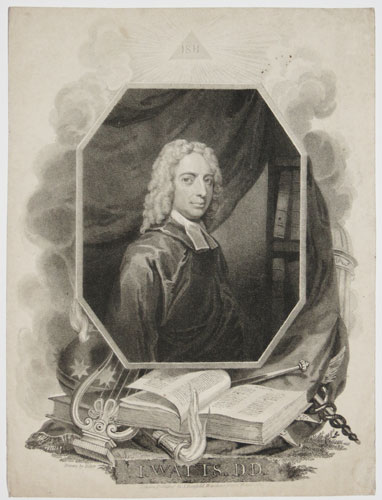
I. Watts. D.D.
Drawn by Hilton.
London, Published by J. Barfield, Wardour Street, March 1 1810.
Stipple. 279 x 209mm. 11 x 8¼". Slightly time stained.
Isaac Watts (1674-1748) was an English hymnwriter, theologian and logician. He was recognised as the "Father of English Hymnody". NPG: D19430.
[Ref: 24633] £70.00
(£84.00 incl.VAT)

Isaac Watts D.D.
[Anon, pub. W. Richardson 1803]
Mixed-method, sheet 145 x 100mm (5¾ x 4"). Trimmed inside platemark; laid on backing sheet.
Isaac Watts (1674-1748), Independent minister and writer. Watt's most lasting impact was as a poet (in which capacity his abilities were recognized by Samuel Johnson) and hymn-writer. The success of Watts' hymns and psalms was partly due to the Methodists, as John Wesley included many of them (with modifications) in his first hymnbook, in 1737. Watts' 'Divine Songs' were imitated and parodied by, amongst others, William Blake (''Songs of Innocence', 1789) and Lewis Carroll ('Alice in Wonderland', 1865). O'D 13
[Ref: 35272] £65.00
(£78.00 incl.VAT)
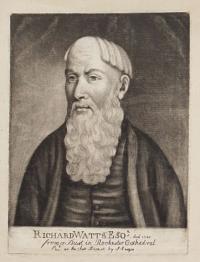
Richard Watts Esq.r died 1580 from a Bust in Rochester Cathedral.
Pub.d as the Act Directs by J. Seago. [n.d., c.1790.]
Fine mezzotint. Plate: 150 x 110mm (6 x 4¼"), with large margins.
A portrait of Richard Watts (1529-1579) who served as M.P. for Rochester.
[Ref: 46326] £140.00
(£168.00 incl.VAT)
![The Waveney below St. Olaves [pencil].](img-thumbnail/jpegs/62563.jpg)
The Waveney below St. Olaves [pencil].
W.P. Robins 1921 [pencil].
Etching, signed and dated by the artist in pencil. 145 x 295mm (5¾ x 11½"), large margins. Faint mount burn.
A view of from the bank of the Waveney, the river that divides Norfolk from Suffolk, with a windmill. William Palmer Robins (1882-1959), member of the Royal Society of Painters, Etchers and Engravers, and the Chicago Society of Etchers.
[Ref: 62563] £130.00
(£156.00 incl.VAT)


![No. 27. [Waterman to a Coach Stand.]](jpegs/28716.jpg)
![[At the Watermill.]](jpegs/23851.jpg)
![[Watermill.]](jpegs/16927.jpg)

![Billy Waters et al] 30 Extraordinary Characters &c. Described in the Work.](jpegs/36314.jpg)


![Watford Grammar School [in pencil to the right.]](jpegs/22574.jpg)



![[St. Etienne du Mont, Paris. Interior.]](jpegs/18220.jpg)
![[Sir Brook Watson.]](jpegs/59983.jpg)



![[Charles Watson-Wentworth] The Right Noble Charles Marquis of Rockingham, &c. &c.](jpegs/62704.jpg)
![[Charles Watson-Wentworth] [The Right Noble Charles Marquis of Rockingham,](jpegs/68323.jpg)
![[Charles Watson Wentworth, Marquis of Rockingham.]](jpegs/59997.jpg)
![[James Watt and the Steam Engine.]](jpegs/54952.jpg)
![[James Watt.]](jpegs/57847.jpg)

![Your Obedient Sert James Watt [facsimile singature].](jpegs/66132.jpg)
![Your Obedient Sert James Watt [facsimile singature].](jpegs/3783.jpg)
![James Watt [facsimile signature.]](jpegs/15388.jpg)
![[Untitled ornament design.]](jpegs/19616.jpg)
![[Idyllic scene] From a Picture by Watteau in the possession of M.r Canton.](jpegs/65314.jpg)
![[Pair of trophies]](jpegs/63749.jpg)
![[Pair of trophies]](jpegs/63750.jpg)
![[Pair of trophies]](jpegs/63751.jpg)

![[George Frederick Watts.]](jpegs/24133.jpg)
![[George Frederick Watts.]](jpegs/23409.jpg)
![[George Frederick Watts]](jpegs/23410.jpg)


![The Waveney below St. Olaves [pencil].](jpegs/62563.jpg)