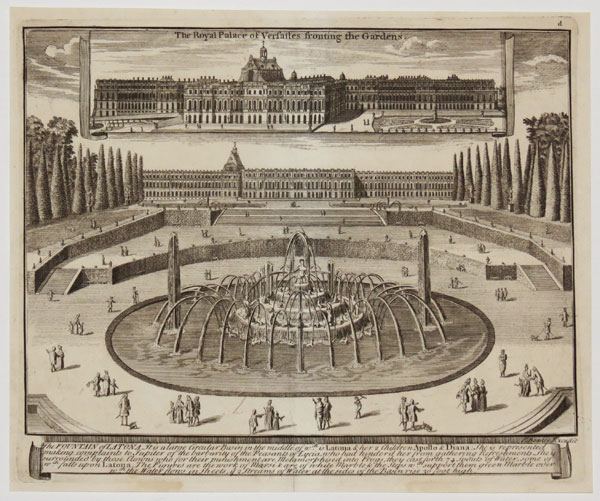
d. The Royal Palace of Versailles fronting the Gardens. The Fountain of Latona. It is a large Circular Basin in the middle of w.ch is Latona & her 2 Children Apollo & Diana: She is represented making complaints to Jupiter of the barbarity of the Peasants of Lycia, who had hinder’d her from gathering Refreshments. She is surrounded by those Clowns who for their punishment are Metamorphised into Frogs, they cast forth 74 Spouts of Water, some of w.ch falls upon Latona. The Figures are the work of Marsi & are of white Marble & the Steps w.ch support them green Marble over w.ch the Water flows in Sheets, ye 2 Streams of Water at the sides of the Basin rise 30 foot high.
J. Bowles Excudit.
[London. Printed & Sold by John Bowles Print & Map Seller at Mercers Hall in Cheapside, 1726.]
Engraving with small margins, paper watermarked. Plate 222 x 272mm (8¾ x10¾"). Fold, some staining along lower edge.
The front facade of the Palace of Versailles. The Latona Fountain. Inspired by Ovid’s Metamorphoses, the Latona fountain illustrates the legend of Apollo’s mother and Diana protecting her children against the insults of the peasants of Lycia, and calling on Jupiter to avenge them. He heard their plea and transformed them into frogs and lizards. The central marble group sculpted by the Marsy brothers represents Latona and her children. The group was originally placed on a rock in 1670. It was surrounded by six frogs emerging partly from the water, and twenty-four others around the fountain on the lawn. The goddess then looked towards the Château. This arrangement was modified by Jules Hardouin-Mansart between 1687 and 1689. The rock was replaced on a concentric marble base and the Latona group henceforth gazes towards the Grand Canal. The Latona fountain is prolonged by a parterre holding the two lizard pools. From "Versailles Illustrated, or Divers Views of the Several Parts of the Royal Palace of Versailles; as likewise of all the Fountains, Groves, Parterras, ye Labyrinth & other ye most Beautiful Parts of the Gardens, Wherein are represented whatever is remarkable whether Statues, Groups of Figures, Water Fall, Pleasure Houses, &c. Drawn on the Spot by the Order & with the Approbation of the French King".
[Ref: 28545] £90.00
(£108.00 incl.VAT)
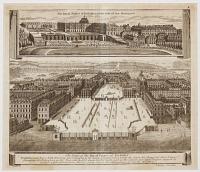
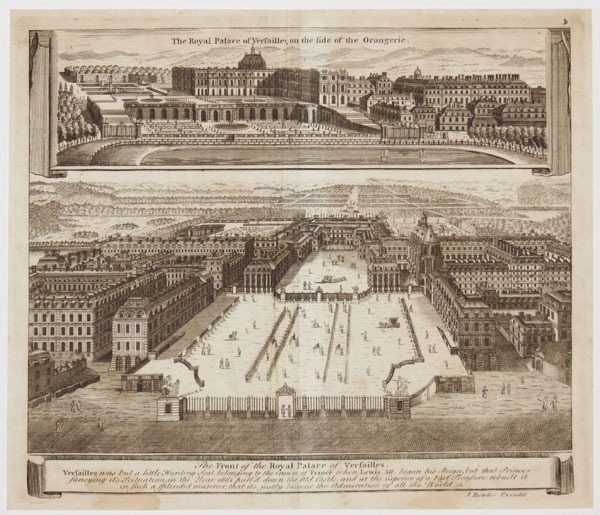
b. The Royal Palace of Versailles, on the side of the Orangerie. The Front of the Royal Palace of Versailles. Versailles was but a little Hunting Seat belonging to the Crown of France when Lewis XII began his Reign, but that Prince fancying its Situation in the year 1661 pull’d down the Old Castle, and at the Expence of a Vast Treasure rebuilt it in such a Splendid manner, that it’s justly became the Admiration of all the World.
J. Bowles Excudit.
[London. Printed & Sold by John Bowles Print & Map Seller at Mercers Hall in Cheapside, 1726.]
Engraving with small margins. Plate 233 x 272mm (9¼ x10¾"). Fold, some staining along lower edge.
The Orangerie; built by Jules Hardouin-Mansart between 1684 and 1686 to replace the small orangery built by Le Vau in 1663, it consists of a central vaulted gallery 150 metres long, prolonged by two side galleries located under the stairways of the Cent-Marches. The building is lit by large windows. The Orangerie Parterre covers no less than three hectares. In the reign of Louis XIV it was decorated with sculptures now kept in the musée du Louvre. Consisting of six sections of lawn and a circular pool, in the summer it features 1,055 trees in boxes, including palm trees, oleanders, pomegranate trees, eugenias and orange trees that spend the winter inside the building. The Palace of Versailles; the site began as Louis XIII’s hunting lodge before his son Louis XIV transformed and expanded it, moving the court and government of France to Versailles in 1682. Each of the three French kings who lived there until the French Revolution added improvements to make it more beautiful. From "Versailles Illustrated, or Divers Views of the Several Parts of the Royal Palace of Versailles; as likewise of all the Fountains, Groves, Parterras, ye Labyrinth & other ye most Beautiful Parts of the Gardens, Wherein are represented whatever is remarkable whether Statues, Groups of Figures, Water Fall, Pleasure Houses, &c. Drawn on the Spot by the Order & with the Approbation of the French King".
[Ref: 28547] £95.00
(£114.00 incl.VAT)
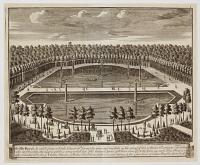
f. The Isle Royal, so call’d from a little Island w.ch formerly was in ye middle of the great Pond of Water w.ch contains 780 Feet in length &160 in breadth, the nearer pond is some what less. The largest Spout of Water rises 47 Feet, & the lesser 44 each. This Place is not only considerable for ye 2 large Basins of Water, but likewise for several Statues, & for 2 fine Vases of white Marble done by Le Fevre & Legeret.
[London. Printed & Sold by John Bowles Print & Map Seller at Mercers Hall in Cheapside, 1726.]
Engraving with small margins, paper watermarked. Plate 222 x 272mm (8¾ x10¾"). Fold.
The large ornamental lake called Cupid's Island or the Royal Island (1674) on which were test scale models of warships. Completely neglected during the Revolutionary years, it was redesigned on the order of Louis XVIII in 1817, when the architect Dufour laid out the King’s Garden, an enclosed garden laid out in the English style, planted with superb tree species most of which, unfortunately, were blown down in the great storm of 1999. All that remains today is the original layout of the Mirror fountain. From "Versailles Illustrated, or Divers Views of the Several Parts of the Royal Palace of Versailles; as likewise of all the Fountains, Groves, Parterras, ye Labyrinth & other ye most Beautiful Parts of the Gardens, Wherein are represented whatever is remarkable whether Statues, Groups of Figures, Water Fall, Pleasure Houses, &c. Drawn on the Spot by the Order & with the Approbation of the French King".
[Ref: 28543] £80.00
(£96.00 incl.VAT)
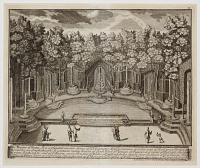
m. The Theater of Water. It is a pleasant circular Grove of 156 feet Diameter. Half ye entrance of it has seats of Turf, green Portico’s & resembles an Amphiteahter. It contains many Basins of Rock Work w.th Groups of Figures in ye midst of y:in of little Children at play, Bathing, &x. out of ye Basins arise Streams of Water w.ch falling down again, flow in Sheets over ye Basins. The 3 ally’s of Water have a surprising Effet, for out of ym there projects spouts of Water, w.ch vary four times w.th a great deal of Art.
[London. Printed & Sold by John Bowles Print & Map Seller at Mercers Hall in Cheapside, 1726.]
Engraving with small margins. Plate 222 x 272mm (8¾ x10¾"). Fold.
The Green Round Grove. The Water Theatre was laid out between 1671 and 1674 by Le Nôtre, backed up by the hydraulics engineers Francine and Denis, while the fountains were designed by Le Brun. It consisted of a large almost round area with two semicircular amphitheatres with tiers of seats and separated by an oblong pool divided into two levels of water. The semicircular stage was framed by three triangular cascades falling in tiers, adorned with varied seashells and numerous water spouts. At the top and the bottom of the cascades were fountains decorated with lead sculptures. In 1677, the amphitheatres seating the spectators were surrounded by 18 round rocaille pools, each with a spout of water reaching up to arcades of greenery planted between 1680 and 1688. During the replanting ordered by Louis XVI in 1775, the very damaged Water Theatre was destroyed and the grove was replaced by the Round green (“Rond-vert”). "Versailles Illustrated, or Divers Views of the Several Parts of the Royal Palace of Versailles; as likewise of all the Fountains, Groves, Parterras, ye Labyrinth & other ye most Beautiful Parts of the Gardens, Wherein are represented whatever is remarkable whether Statues, Groups of Figures, Water Fall, Pleasure Houses, &c. Drawn on the Spot by the Order & with the Approbation of the French King".
[Ref: 28536] £80.00
(£96.00 incl.VAT)
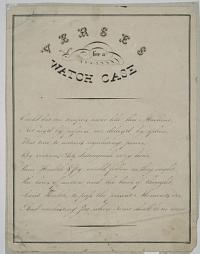
Verses for a Watch Case. Could but our tempers move like this Machine, Not urg’d by passion, nor delay’d by spleen; But true to nature's regulating power, By virtuous Acts distinguish every hour. Then Health & Joy would follow as they ought, The laws of motion and the laws of thought; Sweet Health, to pass the present Moments o'er, And everlasting Joy, when Time shall be no more.
[n.d. c.1727.]
Manuscript, 242 x 188mm. 9½ 7½". Laid down on album sheet. Crease and some smudging.
John Byrom (1692-1763) was an English poet and the inventor of a revolutionary system of shorthand. In 1742, His Majesty George II secured him as the sole right of publishing for a certain term of years the art and method of shorthand. His system was published posthumously as "The Universal English Shorthand". This particular poem was later used as example for Byrom's shorthand.
[Ref: 18389] £160.00
(£192.00 incl.VAT)

A Copy of Verses for the Year 1847, Humbly Presented to the Worthy Inhabitants of the Borough fo High Wycomb, by J. Cooper & W. Venables, Night Police. Prologue... On St.Luke... On St. Andrew... On St. Thomas... On Christmas Eve... On Christmas Day... On St. Stephen... On St. John... On The New Year... On the Queen... On the Times... To My Masters and Mistresses... To the Young Men... To the Maids... Epilogue.
London: Printed by John Vandenburgh Quick, 5, Weston Place, King's Cross. (First printed, 1721.)
Engraving and letterpress. 571 x 438mm. 22½ x 17¼". Horizontal crease and part tear.
Religious verses accompanied by twelve little religious scenes.
[Ref: 15274] £140.00
(£168.00 incl.VAT)
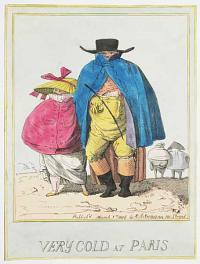
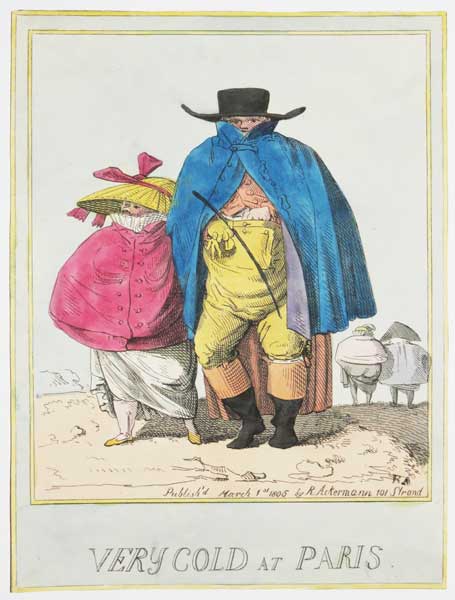
Very Cold at Paris.
Publish'd March 1st 1806 by R. Ackermann 101 Strand.
Hand-coloured etching. Sheet: 300 x 225mm (11¾ x 9''). Trimmed within plate, damage and very small hole in image. Remains of album sheet verso.
A caricature portrait of two figures, probably English, in Paris, shown with their coats pulled up around their faces. Perhaps a copy of a French print. BM Satire 10649.
[Ref: 50782] £160.00
(£192.00 incl.VAT)
![Quite Well! [&] Very Ill!](img-thumbnail/jpegs/31479.jpg)
Quite Well! [&] Very Ill!
London Published by J.L. Marks, 17 Artillery Street, Bishopsgate. [n.d., c.1830.]
Pair of coloured aquatints mounted on one blue Regency album sheet. Each c. 170 x 145mm (6¾ x 5¾"). Trimmed.
Two men raising drinks.
[Ref: 31479] £160.00
(£192.00 incl.VAT)
view all images for this item
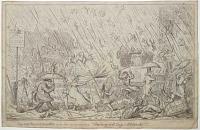
Very unpleasant Weather, or the old saying verified ''Raining Cats, Dogs & Pitchforks.''!!!
Cruikshank fecit.
Pub.d April 27 1820 by G.Humphrey 27 St James's Street London.
Etching. Sheet 245 x 375mm (9¾ x 14¾"). Trimmed to printed border, partly pasted on album paper.
A heavy slanting downpour composed of cats, dogs, and pitchforks descends on a road filled with pedestrians, causing chaos. BM Satires 14084; Cohn 2074.
[Ref: 60963] £180.00
(£216.00 incl.VAT)

Very Wet! N.o 21.
London Published by J.L. Marks, 17 Artillery Street, Bishopsgate. [n.d., c.1825.]
Coloured aquatint, sheet 195 x 155mm (7¾ x 6"). Trimmed.
A weather caricature: a woman with an inefffectual umbrella walks in a windy downpour.
[Ref: 58438] £65.00
(£78.00 incl.VAT)

Madame Very Restaurateur. Palais Royal Paris. La Belle Liminaudiere au Caffee de Mille Collone, Palais Royale Paris.
Rowlandson Scul. J.N. [John Nixon]
[London, Thomas Tegg, 1814 but later.]
Coloured etching. 350 x 250mm (13¾ x 9¾").
Two scenes of Parisian high life on one plate: above is Madame Very, the foremost restaurateur of the period; below is Madame Romain, who presided over the Café des Mille Colonnes, renowned for its gilt columns and mirrors. Usually the two scenes are found separately. John Nixon visited Paris in 1814 after the fall of Napoleon. BM Satires 12409 & 12410.
[Ref: 41132] £320.00
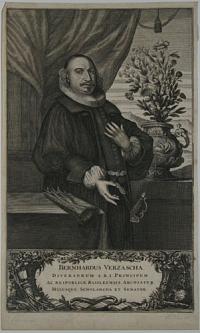
Bernhardus Verzascha, Diversorum S.R.I. Pincipum Ac Reipublicae Basileensis. Archiater Huiusque Scholarcha et Senator.
[in pencil outside the image] Merian de. Kilian sc.
[n.d. c.1700.]
Copper engraving, very scarce, 335 x 203mm. 13¼ x 8".
Bernard Verzascha (1627-1680) Swiss medic. Wellcome: 9395i
[Ref: 15064] £140.00
(£168.00 incl.VAT)
![[Andreas van Wesel] Andreas Vesalius.](img-thumbnail/jpegs/40004.jpg)
[Andreas van Wesel] Andreas Vesalius.
Esme de Boulonois, fecit.
[n.d., 1682.]
Engraving. Sheet size: 185 x 135mm (7¼ x 5½"). Trimmed inside plate. Laid on backing sheet.
A portrait of the anatomist Andreas van Wesel (1514-64), Latinised as Andreas Vesalius, author of the highly influential 'De humani corporis fabrica'. Published in Isaac Bullart's 'Académie des Sciences et des Arts'. He is often considered to be the founder of modern human anatomy. Starting his study in Paris where he later moved to Padua for his doctorate. Upon completion in 1537 he was immediately offered the chair of surgery and anatomy. He took his studies further by understanding the correlation between surgery and anatomy, by performing dissections himself and producing detailed charts for his students. Vesalius' pamphlet on blood letting , for the treatment of various illnesses, underlined the importance of understanding the structure of the body in medicine. After many years he chose to take up medical practice and he became physician to the Imperial Court of Emperor Charles V and in 1555 took service with Charles' son, Philip II of Spain. In 1564 he left to tour the Holy Land but died in October on the island of Zakynthos during the journey home. Wellcome: 3051/9.
[Ref: 40004] £95.00
(£114.00 incl.VAT)
![Wm. V Fitz - Gerald [facsimile signature]](img-thumbnail/jpegs/8309.jpg)
Wm. V Fitz - Gerald [facsimile signature] The Right Honble. W. R. Vesey Fitz-Gerald. Engraved from the original picture presented to him by the inhabitants of Horsham and others, on his departure from England to assume the Governorship of Bombay.
Painted by John Lucas. Engraved by Saml. Bellin.
London Published by Thomas Mc.Lean, 7 Haymarket, and Thomas Jull, Horsham, Decb. 12th. 1867.
Mixed-method engraving. 492 x 386mm. 19" 1/3 x 15¼".
Sir William Robert Seymour Vesey-FitzGerald, GCSI, GCIE PC (1818 - 28 June 1885) was a British politician and Member of Parliament for Horsham. FitzGerald was an illegitimate child of William Vesey-FitzGerald, 2nd Baron FitzGerald and Vesey. He studied at both Christ Church, Oxford and Oriel College, Oxford, graduating with a degree in Classics in 1837. FitzGerald was elected member for Horsham in 1848, but was unseated on petition. In 1852 he was once again elected for Horsham and was able to hold the seat until 1865. During this time he served as Under Secretary for Foreign Affairs. In 1866, he was appointed as Governor of Bombay and was elevated to the Privy Council of the United Kingdom and made a Knight Commander of the Order of the Star of India and Knight Grand Commander of the Order of the Indian Empire. On his return to Britain, he again served Horsham as MP from 1874 to 1875. In 1875 he was appointed Chief Charity Commissioner. AP: 42. LP: 25. PSA.
[Ref: 8309] £120.00
(£144.00 incl.VAT)
![[William Vesey Fitzgerald]](img-thumbnail/jpegs/8313.jpg)
[William Vesey Fitzgerald]
[Painted by John Lucas. Engraved by Saml. Bellin.]
[London Published by Thomas Mc.Lean, 7 Haymarket, and Thomas Jull, Horsham, Decb. 12th. 1867.]
Mixed-method engraving on india. Proof before all letters. 521 x 407mm. 20½" x 16".
Sir William Robert Seymour Vesey-FitzGerald, GCSI, GCIE PC (1818 - 28 June 1885) was a British politician and Member of Parliament for Horsham. FitzGerald was an illegitimate child of William Vesey-FitzGerald, 2nd Baron FitzGerald and Vesey. He studied at both Christ Church, Oxford and Oriel College, Oxford, graduating with a degree in Classics in 1837. FitzGerald was elected member for Horsham in 1848, but was unseated on petition. In 1852 he was once again elected for Horsham and was able to hold the seat until 1865. During this time he served as Under Secretary for Foreign Affairs. In 1866, he was appointed as Governor of Bombay and was elevated to the Privy Council of the United Kingdom and made a Knight Commander of the Order of the Star of India and Knight Grand Commander of the Order of the Indian Empire. On his return to Britain, he again served Horsham as MP from 1874 to 1875. In 1875 he was appointed Chief Charity Commissioner AP: 42. LP: 25. PSA.
[Ref: 8313] £120.00
(£144.00 incl.VAT)
![[William Vesey-Fitzgerald.]](img-thumbnail/jpegs/37336.jpg)
[William Vesey-Fitzgerald.]
[Charles J. Tomkins.]
London Published Feb.y 1885 by Henry Graves & Co. the Proprietors. Publishers to H.M the Queen and T.R.H. the Prince & Princess of Wales. 6 Pall Mall.
Mezzotint. Very rare. 'Printsellers Assosiation' blind stamp in lower right corner.Sheet size: 415 x 310mm (16¼ x 12¼"). Trimmed inside platemark.
A portrait of William Gerald Seymour Vesey-Fitzgerald (1841 - 1910), half-length, seated, directed to the right, facing the viewer, his left hand placed inside his jacket, holding papers with his right. Vesy-Fitzgerald was a political ADC to the Secretary of State for India. AP.25 P.25. B.L.I. 25.
[Ref: 37336] £230.00
(£276.00 incl.VAT)
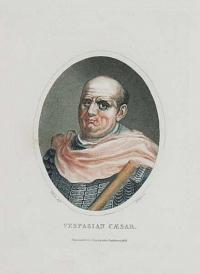
Vespasian Cæsar.
Titian del.t. J.Pass sc.
Engraved for the Encyclopedia Londinensis, 1826.
Colour printed stipple with engraving. 180 x 135mm, 7 x 5¾".
Oval portrait of Titus Flavius Caesar Vespasianus Augustus (9-79), after Titian. He was the Roman general in charge of Claudius's invasion of Britain in AD 43 and the suppression of the Great Jewish Revolt of AD 66–70. After the assassination of Nero in 68, the throne was seized by Galba, who was murdered by Otho, who was defeated by Vitellius, in turn defeated by Vespasian. When the Senate proclaimed Vespanian Emperor in December AD 69 he was the fourth emperor in a year. The 'Encyclopedia Londonensis' was published from 1796 to 1829, compiled by John Wilkes, edited by John Jones.
[Ref: 18552] £80.00
(£96.00 incl.VAT)
![[Vespasian.] Imp. Caes. Vespasian. Aug. P. M. Tr. P. P. P. Cos. III.](img-thumbnail/jpegs/49698.jpg)
[Vespasian.] Imp. Caes. Vespasian. Aug. P. M. Tr. P. P. P. Cos. III.
[Wolfgang Kilian.][After Raffaello Schiaminossi.]
[n.d., c.1620.]
Engraving. Sheet: 205 x 130mm (8 x 5''). Trimmed and laid on album sheet.
A portrait of Vespasian from a series of thirteen busts of Roman Emperors engraved by Wolfgang Kilian (1581-1662) after Raffaello Schiaminossi.
[Ref: 49698] £120.00
(£144.00 incl.VAT)
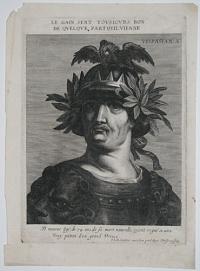
Vespasian. X. Le gain sent toujours bon de quelque part q'uil Vienne.
F.L.D. Ciartres excudit Cum privegio Regis Christianiss.
Copper engraving. 280 x 200mm, 11 x 8".
Vespasian, the tenth Roman emperor, by François Langlois (1589-1647), called Ciartres.
[Ref: 19850] £140.00
(£168.00 incl.VAT)
![[Vespasian.] Imp. T. Caes. Vespas. Aug. P. M. Tr. P. P. P.](img-thumbnail/jpegs/49700.jpg)
[Vespasian.] Imp. T. Caes. Vespas. Aug. P. M. Tr. P. P. P. Felix imperio, felix breuitate regendi...
[Wolfgang Kilian.][After Raffaello Schiaminossi.]
[n.d., c.1620.]
Engraving. Sheet: 205 x 130mm (8 x 5''). Trimmed and laid on album sheet, stained.
A portrait of Vespasian from a series of thirteen busts of Roman Emperors engraved by Wolfgang Kilian (1581-1662) after Raffaello Schiaminossi.
[Ref: 49700] £70.00
(£84.00 incl.VAT)
![[Vespertina Quies.]](img-thumbnail/jpegs/59622.jpg)
[Vespertina Quies.]
[Etched by Émile Boilvin after Edward Burne-Jones]
Copyright 1897 by Mess.rs Arthur Tooth & Son, Publishers, 5 & 6 Haymarket, London, 295. Fifth Avenue New York, & Mess.rs Stiefbold & Co Berlin, Printed by Mess.rs A. Salmon & Ardail, Paris.
Etching on vellum, signed by Boilvin in pencil. Limited edition of 275 signed proofs. Printed area 395 x 255mm (15½ x 10"), with very large margins. Ink stamp in image corner bottom left.
'Evening Quiet': a woman leans against a balustrade, pensively playing with a ring on her finger, a pose reminiscent of Italian Renaissance portraits. We believe this is a pre publication proof as it does not have the Printsellers' Stamp. It comes from a collection of Solvin proofs (Paris) The model for the oil (pained 1893 and now in the Tate, N05176) is belived to be Elizabeth Keene.
[Ref: 59622] £1,500.00
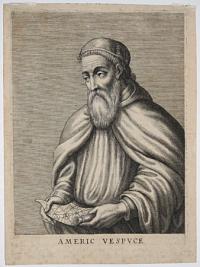
Americ Vespuce.
[n.d., c.1680.]
Engraving. 180 x 135mm.
Amerigo Vespucci (1454-1512), Italian merchant, explorer and cartographer. His two voyages to the east coast of South America between 1499 and 1502 led him to postulate that the Americas were a new landmass, not the East Indies as Columbus believed. From the Blackburn Collection.
[Ref: 400] £130.00
(£156.00 incl.VAT)
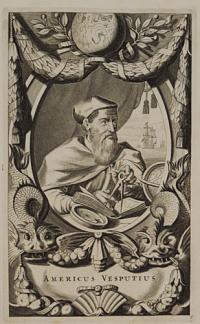
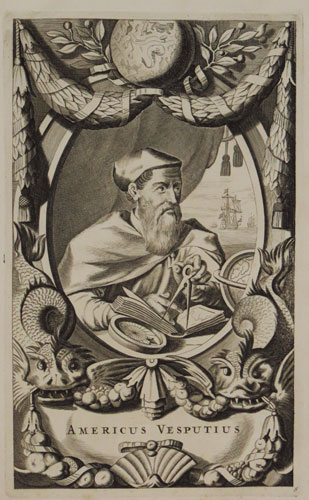
Americus Vesputius.
[Pieter van der Aa.]
[n.d., c.1710.]
Fine engraving. Platemark: 285 x 170mm (11¼ x 6¾"). Very large margins.
A half length portrait of Italian explorer, financier, navigator and cartographer Amerigo Vespucci (1454 - 1512), seated at a table with an open atlas, a globe, and a compass. Within an oval decorated with sea monsters. The continent of America was named after Vespucci, who played a prominent role in exploring the New World. Plate 8 from the scarce series of historical portraits, 'Principum et illustrium quorundam virorum. Qui in Europa alibique terrarum, qua fama, qua eruditione celebres fuerunt, verae imagines', published Pieter van der Aa (1659 - 1733) c.1710.
[Ref: 39273] £320.00

Americo Vespucci. geb. im J. 1451 zu Florenz, gest. im J. 1514.
L. Hess sc.
[German.] [n.d. c.1810.]
Engraving with large margins. Plate 140 x 89mm (5½ x 3½").
Amerigo Vespucci (1454-1512) the Italian merchant, explorer and cartographer. His two voyages to the east coast of South America between 1499 and 1502 led him to postulate that the Americas were a new landmass, not the East Indies as Columbus believed. The Americas are generally believed to have derived their name from the feminised Latin version of his first name. The portrait was published in 'Allgemeine Geographische Ephemeriden' (Universal Geographical Ephemerides (i.e. encyclopedia) by Friedrich Bertuch et al.
[Ref: 29753] £50.00
(£60.00 incl.VAT)
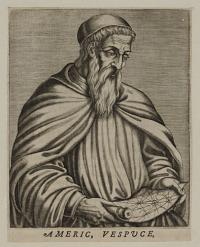
Americ, Vespuce.
[n.d. c.1780.]
Engraving. 184 x 146mm. 7¼ x 5¾". Cut and laid on sheet.
Amerigo Vespucci (1454-1512) holding a scroll map open on his lap. He was an Italian merchant, explorer and cartographer. His two voyages to the east coast of South America between 1499 and 1502 led him to postulate that the Americas were a new landmass, not the East Indies as Columbus believed.
[Ref: 24970] £140.00
(£168.00 incl.VAT)

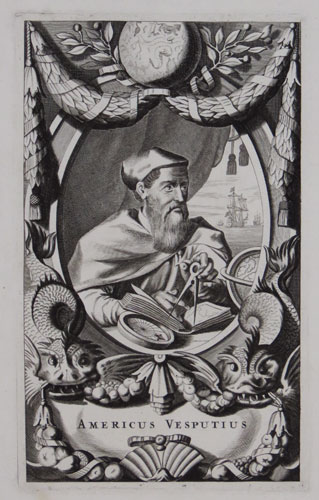
Americus Vesputius.
[Arnoldus Montanus.]
[Amsterdam, n.d. c.1671.]
Copper engraving with large margins. Plate 285 x 178mm. 11¼ z 7". Chip in paper lower left.
Portrait of Amerigo Vespucci, for whom America is named. He is seen here holding a set of calipers, atlas and compass, with a globe before him. A celestial globe appears above and a ship, presumably from his epocryphal voyage, over his shoulder. Amerigo Vespucci (1454-1512) was an Italian explorer, financier, navigator and cartographer. The Americas are generally believed to have derived their name from the feminised Latin version of his first name.
[Ref: 23984] £260.00
(£312.00 incl.VAT)
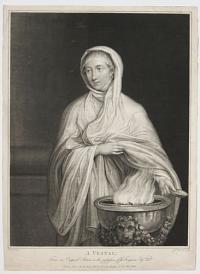
A Vestal. From an Original Picture in the possession of Ja.s Ferguson Esq.r M.P.
S. Woodforde del.t. S.W. Reynolds sculp.t.
London: Pub as the Act directs Feb.y 15. 1800, by M. Parr, No.52. Pall Mall.
Rare mezzotint with etching. 450 x 330mm (17¾ x 13"). Trimmed; crease through centre.
A Vestal Virgin, three-quarter length, standing behind an altar with burning fire, holding a small plate in her left hand; etched border around image. Whitman: 465, ii of ii..
[Ref: 27866] £280.00
(£336.00 incl.VAT)
![[A Vestal. From an Original Picture in the possession of Ja.s Ferguson Esq.r M.P.]](img-thumbnail/jpegs/68194.jpg)
[A Vestal. From an Original Picture in the possession of Ja.s Ferguson Esq.r M.P.]
S. Woodforde del.t. S.W. Reynolds sculp.t.
London: Pub as the Act directs Feb.y 15. 1800, by M. Parr, No.52. Pall Mall.
Rare mezzotint with etching, proof before title. Sheet 455 x 330mm (18 x 13"). Trimmed within plate.
A Vestal Virgin, three-quarter length, standing behind an altar with burning fire, holding a small plate in her left hand; etched border around image. Whitman: 465, i of ii. Ex: collection of The Hon. Christopher Lennox-Boyd.
[Ref: 68194] £240.00
(£288.00 incl.VAT)
![[A Vestal Virgin.]](img-thumbnail/jpegs/62773.jpg)
[A Vestal Virgin.]
B. Wilson delin. W.m Humphrey fecit.
[London: Robert Sayer, c.1770.]
Mezzotint, 18th century watermark, fine impression. 360 x 280mm (14¼ x 11"). Trimmed into plate at bottom, losing publication line. Very slight crease on right.
A young woman wearing a cloak and veil, holding a pitcher and looking back over her shoulder at an incense brazier;
[Ref: 62773] £260.00
(£312.00 incl.VAT)
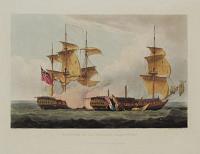
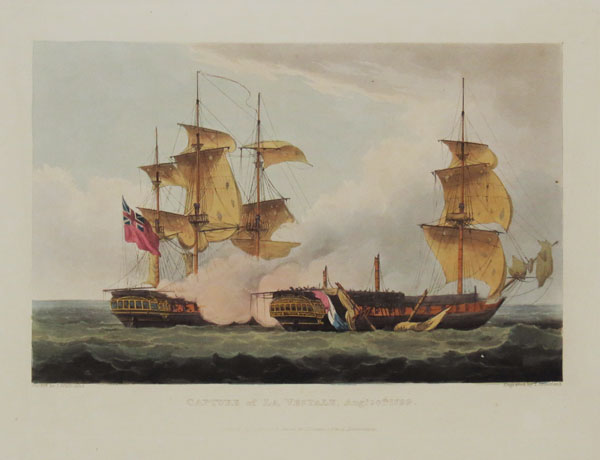
Capture of La Vestale, Aug.t.20.th. 1799.
Painted by T. Whitcombe. Engraved by T. Sutherland.
Published Aug.t. 1. 1816, at 48 Strand, for J. Jenkins's Naval Achievements.
Handcoloured aquatint. J. Whatman watermark 1831. Plate: 300 x 215mm, (11¾ x 8½"). Very large margins.
A naval scene showing the capture of La Vestale by Captain Charles Cunningham commander of the British frigate Clyde off the Cordovan Lighthouse at the mouth of the Gironde. From 'The Naval Achievements of Great Britain from the Year 1793-1817' by J.Jenkins. Parker: 146.
[Ref: 39017] £180.00
(£216.00 incl.VAT)

The Roman Vestal's Trial of Chastity.
[W.M. Craig del.][R. Cooper sculp.]
[Published & Sold Nov.r 1. 1807, by Edw.d Orme, 59. Bond Street, London.]
Rare stipple with etching, sheet 300 x 230mm (11¾ x 9"). Trimmed within plate, into printed border at top, and losing artist, engraver and publisher's names at bottom.
A Vestal priestess, Tuccia, standing in front of a shrine, holds out in front of her a pan full of water, which leaks through the bottom. Two women watch from the shrine. The Vestal Virgin Tuccia was accused of having breached her vow of chastity, but she proved her innocence by carrying water in a sieve. This apparent miracle saved her life. A pair to 'The Roman Vestals Punishment', Ref 67112.
[Ref: 60339] £140.00
(£168.00 incl.VAT)

The Roman Vestals Punishment.
W.M. Craig del. R. Cooper sculp.
Published & Sold Nov.r 1. 1807, by Edw.d Orme, 59. Bond Street, London.
Stipple with etching. Sheet 340 x 235mm (13¼ x 9¼"). Trimmed within plate.
A Vestal priestess being left imprisoned in a cavem with an urn and oil lamp. A man's legs can be seen climbing a ladder behind. A pair to 'The Roman Vestal's Trial of Chastity', ref 60339.
[Ref: 67112] £190.00
(£228.00 incl.VAT)
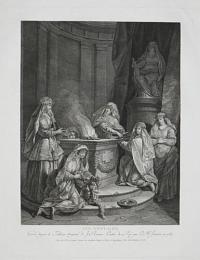
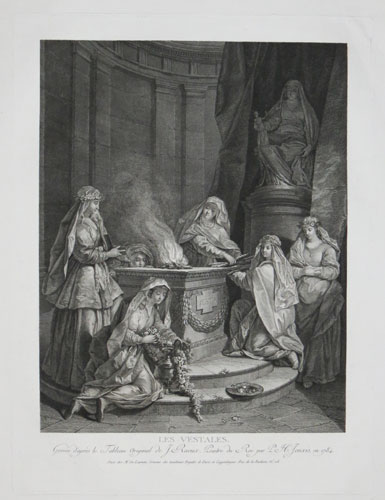
Les Vestales.
Gravée d'après le Tableau Original de J. Raoux, Peintre du Roi, par P.H. Jonxis en 1784.
A Paris chez Mr. De Launay, Graveur, des Academies Royales de Paris et Coppenhagen, Rue de la Bucherie No. 26.
Engraving with large margins; platemark 475 x 355mm (18½ x 13¾").
Six vestal virgins prepare an offering before a statue of Vesta, goddess of fire. In ancient Roman religion, the Vestals were priestesses who cultivated the sacred fire which was not allowed to be extinguished. The vestals were the subject of many pictures in the eighteenth century, which offered painters a way to depict an ethereal female beauty. Engraved after Jean Raoux (1677-1734), French painter of fancy pictures, by the Dutch engraver P.H. Jonxis (1757-1843), who worked in Utrecht and Paris.
[Ref: 31866] £320.00
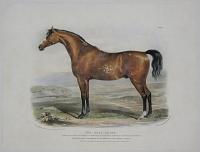
The Race Horse. Stallion, Vestris, 11 Years old, the Property of Mr. Hutchins of Cregane Castle._by Whalebone, out of Verennes, dam of Albert. Professor Low's Illustrations of the Breeds of the Domestic Animals.
Drawn by Mr. Nicholson, R.S.A., from a painting by Mr Shiels, R.S.A. Drawn on Stone and Printed by Fairland
Published December, 1840, by Longman, Orme, Brown, Green & Longmans, Paternoster Row, London.
Lithograph with hand-colouring, with large margins; printed area approx. 270 x 350mm (10½ x 13¾"). Rare.
Plate from Professor David Low's (1786-1859) 'The Breeds of the Domesticated Animals of the British Islands' (1842), which contained fifty-six lithographs after paintings by William Shiels (1783-1857). Low, professor of agriculture at Edinburgh university and the founder of an agricultural museum, commissioned Shiels to paint 100 scientifically accurate illustrations of domestic livestock for his collection. A selection of these paintings, many of which depict breeds now extinct, were selected by Low to illustrate his ideas on breeding and preservation of indigenous species. DNB
[Ref: 31941] £320.00
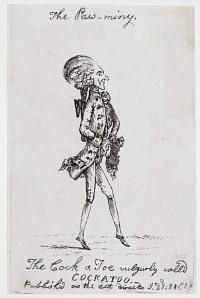
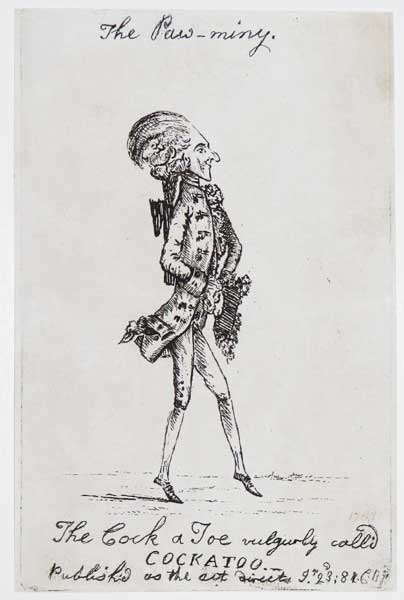
The Paw-miny. The Cock a Toe vulgurly call'd Cockatoo._
Publish'd as the act directs Jy. 23d; 81. C.B[retherton].J[unior].
Rare etching. sheet 165 x 110mm (6½ x 4¼"). Lacking upper margin; the rest very thin.
A slender man in profile delicately standing on tip-toe in the attitude of a dancing-master. His elbows are held out, he holds his hat. He is dressed like the Frenchman of caricature, with a high toupee wig. This seems to be a caricature of ballet dancer and dancing master Gaetano Apoline Balthazar Vestris (1729 - 1808); or possibly Mr. Fitzgerald. Charles Bretherton (c.1760 fl - 1783) was an engraver, etcher, watercolourist and publisher in London. He was the younger brother of James Bretherton, hence often signs as Bretherton junior. BM Satires 5886.
[Ref: 21309] £130.00
(£156.00 incl.VAT)

Madame Vestris, as Venus, in the Paphian Bower. (No.2."Fair Favorites.")
London_.Lithographed, Printed & Pubd.by G.E. Madeley 3, Wellington St. Strand. [n.d. c.1835.]
A rare lithograph. 381 x 285mm. 15 x 11¼". Tear to right hand side.
Lucia Elizabeth Vestris (1797-1856), actress whose contralto voice and attractive appearance helped her obtain many successful roles.
[Ref: 15714] £260.00
(£312.00 incl.VAT)
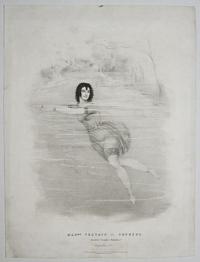
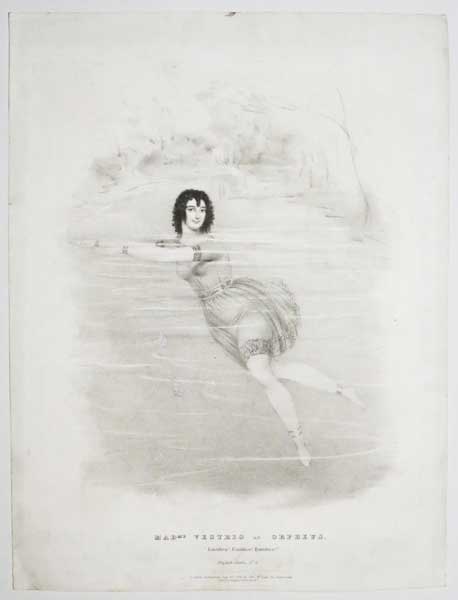
Mad.me Vestris as Orpheus.
Printed by Maguire, Lemercier & Co.
London: Published Aug. 28, 1832, by Tho.s McLean 26, Haymarket.
Lithograph on india, title on backing paper. Printed area 330 x 240mm (13 x 9½"). Surface soiling.
Lucia Elizabeth Vestris (1797-1856, granddaughter of engraver Francesco Bartolozzi) in the 'breeches' role of Orpheus in the pantomime 'Olympic Devils or Orpheus and Eurydice'. Orpheus is swimming across the River Styx, dressed in a brief costume, calling for Eurydice. A success, the play ran for 131 nights.
[Ref: 50675] £260.00
(£312.00 incl.VAT)

[The Younger Pliny Reproved. We went out into a small court belonging to the house which separated the sea from the buildings. As I was at that time But eighteen years of age, I know not whether I should call my behaviour in this dangerous juncture courage or rashness]
Ange[lica Kauffman pinx.t. Burke sculp.t.]
[London. Published Jan.y, 20th 1791 by Tho.s Macklin, Poets Gallery, Fleet Street.]
Rare stipple, printed in colour. Sheet 395 x 490mm (15½ x 19¼"). Trimmed to printed border top and bottom, losing all inscriptions, margins rebuilt, trimmed within plate at sides. Damaged.
Pliny the Younger (61 - c. 113), sits by his mother, writing his account of the eruption of Versuvius, which can be seen through the arch in the distance to the left. The elder Pliny berates his son for writing instead of helping, before dying leading a relief fleet across the Bay of Naples. Ex: collection of The Hon. Christopher Lennox-Boyd.
[Ref: 66967] £280.00
(£336.00 incl.VAT)
![Eruption du Mont Vesuve au Jour. [&] Eruption du Mont-Vesuve à la Nuit.](img-thumbnail/jpegs/54742.jpg)
Eruption du Mont Vesuve au Jour. [&] Eruption du Mont-Vesuve à la Nuit.
Gravé par P.L. Deboucourt d'après le dessin fait à Naples.
à Paris, chez Ch.les Bance, rue J.J. Rousseau, No 10, et Rue Porte, Près le Temple, No. 15 [n.d., 1813].
Fine pair of scarce aquatints. 220 x 275mm (8¾ x 10¾"). Trimmed close to plate top and bottom, some ink offset from text on 'Jour'.
Day and night scenes of the volcano Vesuvius erupting, from the Bay of Naples by Philibert Louis Debucourt (1755-1832). It is likely to be the eruption of 1794.
[Ref: 54742] £950.00
(£1140.00 incl.VAT)
view all images for this item
![[Panorama al fresco with fireworks] Botanic Garden. Mr David Smith the Curator, most respectfully announces [...] A Benefit on Friday Evening, Oct. 7,](img-thumbnail/jpegs/57169.jpg)
[Panorama al fresco with fireworks] Botanic Garden. Mr David Smith the Curator, most respectfully announces [...] A Benefit on Friday Evening, Oct. 7, on which Messrs. Southby & Adams have undertaken to produce one of the most Splendid Exhibitions That have yet taken place of the Grand Historical Spectacle, The Eruption of Vesuvius And the destruction of the Cities of Herculaneum & Pompeii. [...] The Eruption will take place at Eight o'Clock; but should the Weather be unfavourable, it will be postponed till Monday 10th.
M.C. Peck. Printer, Lowgate Hull.
1842 [old ink mss.]
Letterpress handbill. Sheet 340 x 205mm (13½ x 8"). A few small tears.
A hand bill for a show at Hull's Botanic Garden, with an exhibition of George Danson's immense protean view of the Eruption of Vesuvius: under normal light the painting showed a daytime view of the Bay of Naples but, at the appointed time, back-lighting changed the scene to night, with lava spewing into the air, accompanied by fireworks. George Danson (1799-1881) specialised in panoramas exhibited outside in pleasure gardens, usually first shown at Royal Surrey Zoological Gardens, Walworth. This ‘Vast Panorama Al Fresco of Mount Vesuvius’ (first exhibited 1837) was admired by J.M.W. Turner. The 'Southby' mentioned here is J. Southby (d.1865), a self-created ‘Chevalier’, who was the pyrotechnist. Southby created the firework display for the coronation of Queen Victoria in Hyde Park in 1838.
[Ref: 57169] £190.00
(£228.00 incl.VAT)
![[Vesuvius] Eruzione dell' anno 1817. Eruzione dell' anno 1821.](img-thumbnail/jpegs/60775.jpg)
[Vesuvius] Eruzione dell' anno 1817. Eruzione dell' anno 1821.
[c.1821?]
Two gouaches on one sheet, sheet 195 x 110mm (7¾ x 4¼").
Two night-time scenes of Vesuvius erupting, taken from across the bay.
[Ref: 60775] £260.00
(£312.00 incl.VAT)
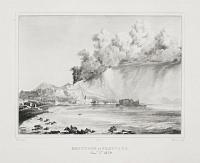
Eruption of Vesuvius, Jan.y 3.rd 1839,
Ms. Oates. Lit. W. Wenzel litog.
Rare lithograph, printed area 230 x 270mm (9 x 10½"). Very large margins.
Eruption of the Mount Vesuvius volcano near the Bay of Naples. Lithograph after Harriette Oates [fl. 1839] (née Rhodes), a topographical artist who made a series of views in Sicily and southern Italy in around 1839.
[Ref: 37110] £160.00
(£192.00 incl.VAT)
![[Vesuvius as it was in 1757]](img-thumbnail/jpegs/38318.jpg)
[Vesuvius as it was in 1757] Vue de Mont Vezuve tel quil etoit en 1757 / Dedié à Monsieur Blondel Dazanincourt [...]
Peint sur les lieux en 1757 par G. de la Croix eleve de Mr Vernet. N. le Mire Sculp 1762
[published by le Mire]
Engraving. 355 x 460mm (14 x 18"), with very large margins. Very slight crease upper right.
Moonlit landscape with fishermen drawing up nets, and Mount Vesuvius erupting in the background. After a painting made 'on the spot' by Charles-François Grenier de la Croix (1750-80, fl.), a pupil of landscape and marine painter Joseph Vernet (1714-89). The same view was engraved in mezzotint around the same time by the British printmaker John Dixon.
[Ref: 38318] £380.00
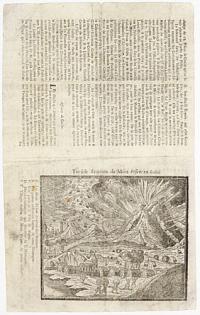
Terrible Eruption du Mont Vesuve en Italie.
Lörscher [in image]
Woodcut and letterpress folded to make 4pp., part of book; sheet 205 x 330mm (8 x 13"). Creases. Messy.
Eruption of the volcano Mount Vesuvius in the Bay of Naples. French engraving from a book apparently depicting and reporting on the eruption of 1767.
[Ref: 43365] £230.00
(£276.00 incl.VAT)
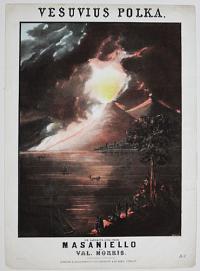
Vesuvius Polka. On Favorite Airs from Masaniello by Val. Morris.
London; R. Addison & Co. 210, Regent & 47 King Street. [n.d., c.1880.]
Coloured lithograph music sheet cover. Sheet 365 x 265mm (14½ x 10½"). Creasing.
A view of Vesuvius erupting, looking across the Bay of Naples. 'Masaniello' or 'La muette de Portici' is an opera based on the story of Masaniello (an abbreviation of Tommaso Aniello, 1622-47), an Italian fisherman who became leader of the revolt against the rule of Habsburg Spain in Naples in 1647.
[Ref: 48448] £130.00
(£156.00 incl.VAT)

Vue de Vevey.
J. Weibel fc.
1818.
Etching with fine hand colouring. Size: 209 x 280mm (8¼ x 11"). Trimmed around image and text.
A landscape scene of the town of Vevey, on the north shore of Lake Geneva, near Lausanne, Switzerland. Numerous figures can be seen on the path in the foreground, with the town in the background and sailing vessels on the lake in the distance. By Swiss landscape painter and printmaker, Samuel Jakob Weibel (1771 - 1846).
[Ref: 31919] £160.00
(£192.00 incl.VAT)

Costruzione della Nuova Emilia presso Barbadoro nel Campigliese.
G. Angiolini dis: dal vero il 23 Febbraio 1831 e litog.
Firenzi I: e R: Laboratorio 1834.
Lithograph on india, very scarce. 390 x 530mm ( 15¼ x 21"). Tears in margins,slight foxing.
A scarce view of road-building in northern Italy, apparently upgrading the Via Æmilia, the Roman road between Rimini and Piacenza. The modern 'State Road 9' follows the ancient road's route.
[Ref: 28667] £320.00
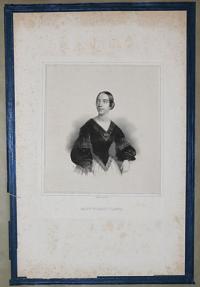
Mad.me Viardot-Garcia.
Imp. Lemercier à Paris. [n.d. c.1845.]
Lithograph on album page. 490 x 305mm. 19¼ x 12". Foxed.
Pauline Viardot Garcia (1820-1910) was a leading French mezzo-soprano of the nineteenth century, pedagogue and composer of Spanish descent. She was close friends with the likes of Clara Schumann, George Sand, Hector Berlioz and Charles Gounod. Camille Saint-Saens dedicated 'Samson et Dalila' to her, and wanted her to sing the title role, which she declined on account of her age. She sang the title role of Gluck's opera "Orphee et Eurydice" at Theatre Lyrique in Paris in November 1859, directed by Hector Berlioz. She died in 1910 and her body is interred in the Montmartre Cemetry in Paris.
[Ref: 23665] £190.00
(£228.00 incl.VAT)
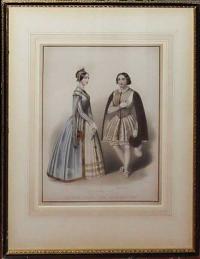
Mad.me Viardot Garcia. Mad.lle Alboni. Caso equal giammai scommetto. Act. 1. Sc. 9. Scene from ''Les Huguenots''.
J. Brandard Del et Lith.
M. & N. Hanhart, Chromo Lith [n.d., c.1850].
Chromolithograph. Framed, sight size 310 x 235mm (12 x 9¼") Unexamined out of frame.
A full-length double portrait of French soprano Pauline Viardot (1821-1910) as Valentine, and Italian contralto Maria Anna Marzia (Marietta) Alboni (1826-94) as the male page Urbain, in Giacomo Meyerbeer's grand opera.
[Ref: 68255] £190.00
(£228.00 incl.VAT)
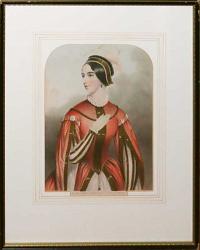
Madame Pauline Viardot-Garcia, in ''Les Huguenots''.
J. Brandard.
[n.d., c.1850.]
Coloured lithograph with gilt highlights. Framed, sight size 270 x 190mm (10¾ x 7½") Unexamined out of frame.
A three-quarter portrait of French soprano Pauline Viardot (1821-1910) in Giacomo Meyerbeer's grand opera ''Les Huguenots''.
[Ref: 68497] £180.00
(£216.00 incl.VAT)


![Quite Well! [&] Very Ill!](jpegs/31479.jpg)


![[Andreas van Wesel] Andreas Vesalius.](jpegs/40004.jpg)
![Wm. V Fitz - Gerald [facsimile signature]](jpegs/8309.jpg)
![[William Vesey Fitzgerald]](jpegs/8313.jpg)
![[William Vesey-Fitzgerald.]](jpegs/37336.jpg)

![[Vespasian.] Imp. Caes. Vespasian. Aug. P. M. Tr. P. P. P. Cos. III.](jpegs/49698.jpg)

![[Vespasian.] Imp. T. Caes. Vespas. Aug. P. M. Tr. P. P. P.](jpegs/49700.jpg)
![[Vespertina Quies.]](jpegs/59622.jpg)




![[A Vestal. From an Original Picture in the possession of Ja.s Ferguson Esq.r M.P.]](jpegs/68194.jpg)
![[A Vestal Virgin.]](jpegs/62773.jpg)





![Eruption du Mont Vesuve au Jour. [&] Eruption du Mont-Vesuve à la Nuit.](jpegs/54742.jpg)
![[Panorama al fresco with fireworks] Botanic Garden. Mr David Smith the Curator, most respectfully announces [...] A Benefit on Friday Evening, Oct. 7,](jpegs/57169.jpg)
![[Vesuvius] Eruzione dell' anno 1817. Eruzione dell' anno 1821.](jpegs/60775.jpg)

![[Vesuvius as it was in 1757]](jpegs/38318.jpg)