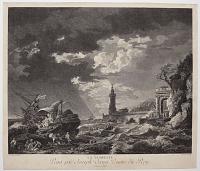
Le Rocher Dangereux. Gravé d'après le Tableau peint par F. Vernet, de deux pieds et demi de large sur un pied huit pouces de baur.
F. Vernet Pinx. P.F.Tardieu Sculp.
et se Vend à Paris Chez Cochin, aux Galeries du Louvre. [n.d., 1790.]
Engraving. Sheet 450 x 615mm (13½ x 24¼"). Small margins.
Boats struggling in a storm, beneath a cliff with a castle on top.
[Ref: 43452] £420.00
Tems de Orageux. Dédiée à Monsieur Vialy Peintre du Roi Par son Serviteur et ami Aliamet. Ce Tableau est tiré du Cabinet de Mr Vialy.
J. Vernet Pinxit. J. Aliamet dirrexit.
A Paris, chéz Alimet, Graveur du Roy, rue de Mathurins vis à vis celle des Maçons. [n.d., c.1760.]
Engraving. 350 x 455mm (13¾ x 18"), with wide margins.
A stormy seascape with a ruined tower on a headland, after Joseph Vernet.
[Ref: 38114] £230.00
(£276.00 incl.VAT)
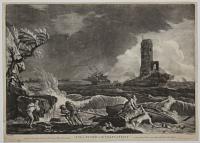
La Tempeste. Peint par Joseph Vernet Peintre du Roy.
J. Vernet Pinx. AD *** Sculp.
Se. vend. a. Paris.
Engraving. Sheet: 360 x 420mm (14 x 16½"). Trimmed within plate.
A nautical scene during a storm in which a group of shipwrecked sailors attempt to save sailors still stranded at sea. In the distance a lighting bolt streaks through the sky and another ship leans dangerously. Provenance: Edge Hall Library, Cheshire
[Ref: 46837] £160.00
(£192.00 incl.VAT)
A Sea Storm on the Coast of Italy.
Vernet Pinx.t. C. Corbutt fecit.
London, Printed for & Sold by Rob.t Sayer Map & Printseller at the Golden Buck near Serjeants Inn, Fleet Street [n.d., c.1776].
Mezzotint. 255 x 355mm (10 x 14"). Narrow margins, creasing, toning, a few repairs.
A ship in trouble of a rocky shore, men working to save sailors from the water, after Joseph Vernet (1714-89, father of Carle Vernet). The engraver's name is Charles Corbutt, of whom nothing can be traced other than his prints. It is generally believed that the name is a pseudonym used by Richard Houston and probably also by Richard Purcell. BM: 2010,7081.3227.
[Ref: 35846] £240.00
(£288.00 incl.VAT)

A Calm, with Fishermen, &c, on the Coast of Italy.
Vernet pinx.t.
London, Printed for & sold by Rob.t Sayer Map and Printseller at the Golden Buck near Serjeants Inn Fleet St. [n.d., c.1760].
Mezzotint with etching, 255 x 320mm (10 x 12½") on 18th century watermarked paper. Trimmed to image on three sides, into plate at bottom, laid on album paper.
A harbour with with a cliff arch with a tower above, and fishermen landing their catch. From a series of seascapes after Joseph Vernet (1714-89), father of Carle.
[Ref: 60182] £140.00
(£168.00 incl.VAT)
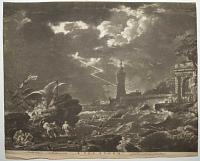
A Sea Storm.
[after Joseph Vernet.]
Printed for Jn.o Bowles [***] at the Black Horse in Cornhill, and Rob.t Sayer at the Buck in Fleet Street [n.d., c.1764].
Mezzotint. 250 x 320mm (9¾ x 12½"). Trimmed to image on three sides, into plate at bottom, laid on album paper.
A scene of a ship in trouble off a rocky shore, men working to save sailors from the water. Behind is an Italianate harbour with a lighthouse, with a lightning bolt crossing the sky. The removal of '& Son' from Bowles's address suggests this example was printed after Carington Bowles went independent in 1764. From a series of seascapes after Joseph Vernet (1714-89), father of Carle.
[Ref: 60181] £140.00
(£168.00 incl.VAT)

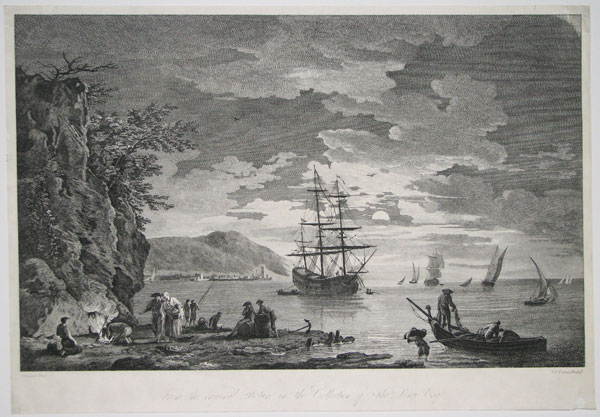
From the original Picture in the Collection of Tho.s Lewis Esq.r
J. Vernet Pinx.t. P.C. Canot Sculp.t.
[n.d. c.1780.]
Engraving. 342 x 496mm (13½ x 19½"). Laid on sheet, small tear where attached in lower right corner.
A serene setting of a coastal bay, a ship anchored and unloading; a town in the background. Sailing boats in the bay area; some sailors unloading a small dinghy to lower right. Fishermen by the cliff to the left; other sailors setting up camp by lighting a small fire.
[Ref: 19145] £180.00
(£216.00 incl.VAT)
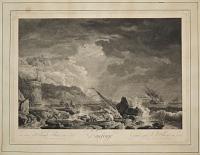
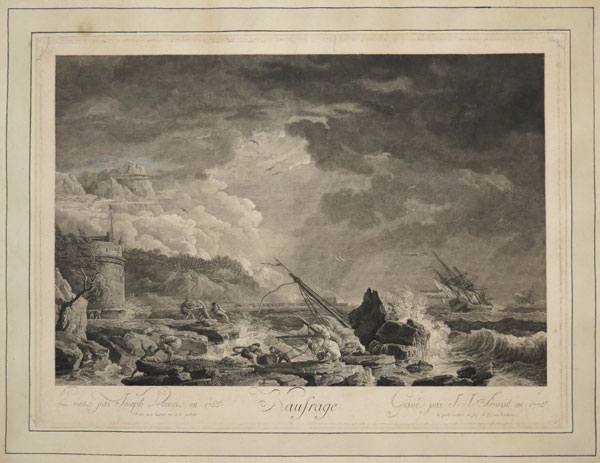
Naufrage.
Peint par Joseph Vernet en. 1755. Grave par J.J. Avril en. 1775.
A Paris chex l'auteur rue de la huchette la porte cochere en face de la rue Zacharie.
Copper engraving with small margins. Platemark: 590 x 440mm. (23¼ x 17¼"). Laid on 18th century sheet with hand-drawn border; damage to top corners.
Coastal landscape during a storm, after Joseph Vernet (1714 - 1789), with shipwreck scene in the foreground; fishermen are trying to drag the wreck while others support a woman. An infant lies on a rock, lower left, while two figures are mourning over the body. Large mountains surrounded by clouds in the distance.
[Ref: 28387] £320.00
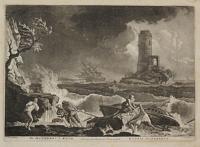
The Dangerous Rock / Ecueil Dangereux
J. Vernet pinx.t. J. Dixon fecit
Printed for John Bowles, at No. 13 in Cornhill
Mezzotint with very large margins, platemark 255 x 360mm (10 x 14"). Slight creasing.
Shipwreck with survivors clambering onto the rocks. One of many British prints from the dramatic landscapes of Joseph Vernet (1714-89). Ex: collection of the Late Hon. C. Lennox-Boyd.
[Ref: 36203] £320.00

M.r Grevil Verney.
M. Dahll pinx. R: Williams fec:
Sold by J Smith at ye Lyon & Crown in Russel Street Covent Garden. [n.d., c.1700.]
Fine mezzotint. 355 x 255mm (14 x 10"). Thread margins, damage in background at top left, laid on card.
Greville Verney (d. 1707), second son of John Verney of Compton Verney, holding a landscape print in one hand and pointing to a large world globe with the other. CS: 53. Ex: Collection of The Hon. C. Lennox-Boyd.
[Ref: 64569] £240.00
(£288.00 incl.VAT)

M.r Grevil Verney.
M. Dahll pinx. R: Williams fec:
Sold by J Smith at ye Lyon & Crown in Russel Street Covent Garden. [n.d., c.1700.]
Mezzotint. 355 x 255mm (14 x 10"), with large margins. Creasing in inscription area.
Greville Verney (d. 1707), second son of John Verney of Compton Verney, holding a landscape print in one hand and pointing to a large world globe with the other. CS: 53. Ex: Collection of The Hon. C. Lennox-Boyd.
[Ref: 64572] £380.00

M.r Grevil Verney.
M. Dahll pinx. R: Williams fec:
Sold by J Smith at ye Lyon & Crown in Russel Street Covent Garden. [n.d., c.1700.]
Mezzotint. 355 x 255mm (14 x 10"). Laid on album paper at edges.
Greville Verney (d. 1707), second son of John Verney of Compton Verney, holding a landscape print in one hand and pointing to a large world globe with the other. CS: 53. Ex: Collection of The Hon. C. Lennox-Boyd.
[Ref: 64573] £360.00
![[M.r Grevil Verney.]](img-thumbnail/jpegs/64571.jpg)
[M.r Grevil Verney.]
[M. Dahll pinx. R: Williams fec:]
[Sold by J Smith at ye Lyon & Crown in Russel Street Covent Garden.] [n.d., c.1700.]
Mezzotint, fine & rare proof before all letters, uncleaned title area. 355 x 255mm (14 x 10"). Small margins. Time staining.
Greville Verney (d. 1707), second son of John Verney of Compton Verney, holding a landscape print in one hand and pointing to a large world globe with the other. This proof state has no lettering on the globe surface; the horizon band has no letters or Zodiac symbols. CS: 53, only listing the published state. Ex: Collection of The Hon. C. Lennox-Boyd.
[Ref: 64571] £480.00
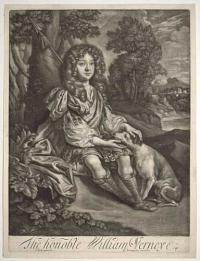
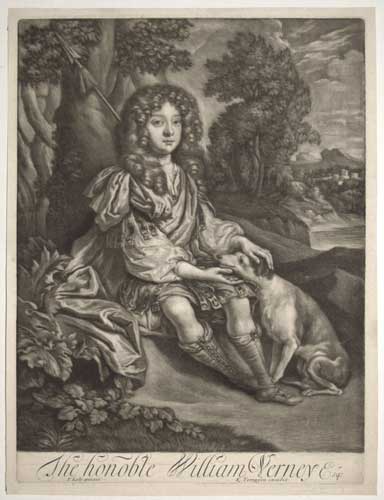
The honoble William Verney Esqr.
P. Lely pinxit.
R.Tompson excudit. [n.d. c.1690.]
Fine mezzotint, 17th century watermark, 335 x 250mm (13¼ x 9¾"), large margins.
A full-length portrait of William Verney (1668-83), son of Sir Grevill Verney ,as a boy sitting, wearing a long wig and Roman attire, gently stroking the head of a dog. Behind him are a spear and a tree, with a landscape featuring water, a mountain, and distant buildings to the right. CS48. Blackett-Ord & Turner T68 II of II. Ex: Collection of The Hon. Christopher Lennox-Boyd.
[Ref: 65082] £380.00

The honorable William Verney Esqr.
P. Lely pinxit.
R.Tompson excudit. [n.d. c.1690.]
Fine mezzotint, watermarked paper, 335 x 250mm (13¼ x 9¾"), large margins
A full-length portrait of William Verney (1668-83), son of Sir Grevill Verney ,as a boy sitting, wearing a long wig and Roman attire, gently stroking the head of a dog. Behind him are a spear and a tree, with a landscape featuring water, a mountain, and distant buildings to the right. CS48. Blackett-Ord T68 II of II. Ex: Collection of The Hon. Christopher Lennox-Boyd.
[Ref: 65083] £380.00

H.M.S. Vernon, 50 Guns
Drawn by H. John Vernon, Day & Hague, Lith.rs to the Queen.
A.Hinton, Portsmouth. ___Ackermann & Co. London
Tinted lithograph. Printed area 415 x 290mm. Small nicks in margins.
HMS Vernon was a fifty gun frigate,designed by Sir William Symonds, that saw active service in home waters, under Captain Sir F. A. Collier in the Dutch blockade 1832, the Americas and the East Indies between 1832 and 1848. She was then laid up in Chatham Dockyard, becoming a topledo school at Portsmouth 1876. Parker:1918.pg.91
[Ref: 6320] £260.00
(£312.00 incl.VAT)
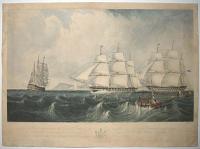
This print representing the East India Ship Vernon, Geo. Denny Commander, on her voyage out, fitted with a Steam Engine of 30 horse power, passing H.M. ships 'Edinburgh & Blenheim 74.s. beating down Channel on the 21st of September 1839 off Benbridge, Isle of Wight, is respectfully Inscribed to Richard Green, Esq.r of Blackwall, the owner and builder of the Vernon, John Lynn. Proof.
Painted and Published by J. Lynn, Marine Painter, 23, Polygon, Somers Town, London. Engraved by W.O. Geller. Printed by S.H. Hawkins.
[n.,d., c.1839.]
Aquatint, printed in colours and hand finished. Sheet 530 x 725mm (21 x 28½"). Trimmed to plate at sides, into image at top, losing c.50mm of sky), some cracking to edges, overall toning, new margin added at top, laid on archival paper.
Vernon, a 911 ton paddle steamer, off Bembridge. Built in 1839 for the Green Blackwall Line's London-Madras run, , her engines proved to be uneconomical and were removed. In 1867, after nearly thirty years carrying passengers to the colonies in the East, Vernon was sold to the Colony of New South Wales for a 'Public Industrial School', for problem children. Within a year 113 boys, some as young as three, were aboard, being given moral, nautical and industrial training, with some elementary schooling. In 1892 was sold for breaking to Mess.rs Rae and Surge for £180; taken to Balls Head Bay on the north of Sydney Bay, the ship was burned to the waterline the following year. Australian interest. Lynn's painting is in the National Maritime Museum, BHC3686.
[Ref: 54035] £350.00
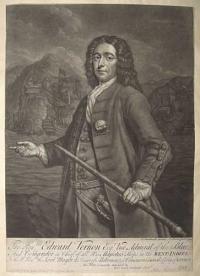
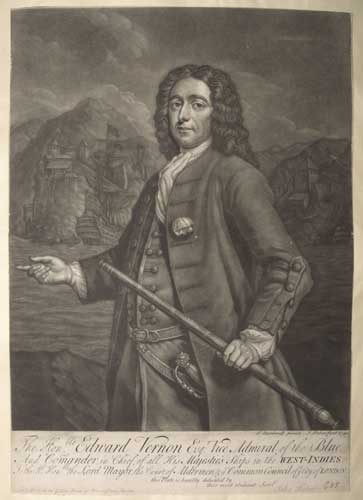
The Hon.ble Edward Vernon Esq.r: Vice Admiral of the Blue, And Comander in Chief of all HIs Majestie's Ships in the West-Indies. To the R.t Hon.ble Lord Mayor, the Court of Aldermen, & y.e Common Council of y.e City of London this Plate is humbly dedicated by their most obedient Serv.t John Faber.
T Bardwell pinxit. J. Faber fecit 1740.
Sold by Faber at the Golden Head in Bloomsbury Square.
Rare mezzotint, fine impression, print 355 x 250mm (14 x 9¾"). Trimmed within plate and glued to album sheet.
Three-quarter length portrait of Admiral Edward Vernon (1684-1757) wearing a sword, long coat, cravat and long dark wig, pointing to left with right hand, holding a long telescope in right hand. CS 363.
[Ref: 58816] £260.00
(£312.00 incl.VAT)
![[Vice Admiral S.r Edw.d Vernon.]](img-thumbnail/jpegs/5548.jpg)
[Vice Admiral S.r Edw.d Vernon.]
Painted by H.Singleton. Engraved by J.Jones, Engraver Extrasordinary to His R.H. the Prince of Wales and Principal Engraver to His R.H. the Duke of York.
Publish'd as the Act directs Sept.r 1, 1791 by J.Jones, No 75 Great Portland Street, Portland Place.
Mezzotint, proof before title. With engraved bookplate of the Vernon family and Vernon's signature ink pasted in the inscription area. 665 x 335mm. Some faint damp staining, mainly in margins, some creasing.
Sir Edward Vernon, commanded the fleet that took Pondicherry in 1778. Subsequently he was promoted to rear-admiral in 1779 and returned to England early in 1781. He saw no more active service, but was made a vice-admiral in 1787 and admiral in 1794, only to die a few weeks later. In 1785 he made a couple of balloon ascents from Tottenham Court Road, one reaching Horsham, the other Colchester. He was only a distant relative of his more famous namesake. Apparently Vernon's own copy of this full-length portrait. Ex: Collection of The Hon. C. Lennox-Boyd.
[Ref: 5548] £690.00
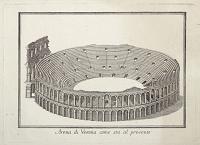
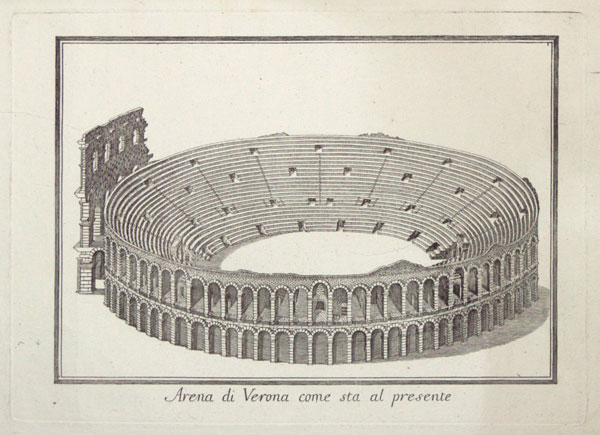
Arena di Verona come sta al presente.
[after Saverio Avesan.]
[n.d., c.1770.]
Engraving. 185 x 260mm (7¼ x 10¼") very large margins. Printer's crease entering plate, wear and tear in margins.
The ruins of Verona Arena, built AD 30.
[Ref: 57948] £130.00
(£156.00 incl.VAT)
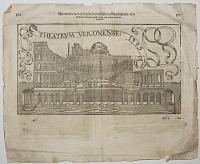
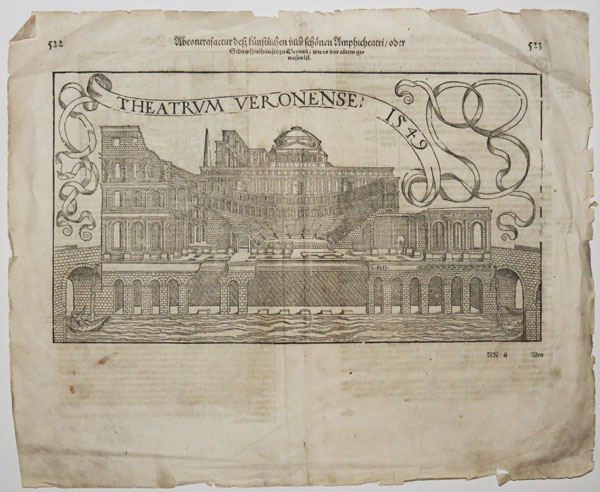
Theatrum Veronese: 1549.
[Sebastian Munster.]
[c.1550.]
Woodcut. Sheet: 350 x 430mm (13¾ x 17''). Central crease as normal, foxing, tears. Bit messy.
A view of the Roman amphitheatre at Verona from Sebastian Münster's (1488-1552) "Cosmographia". Münster's "Cosmographia" was the earliest German language description of the world and was republished in numerous editions and languages. The last German edition was published in 1628.
[Ref: 49370] £180.00
(£216.00 incl.VAT)
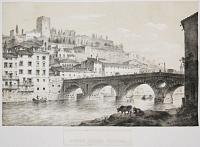
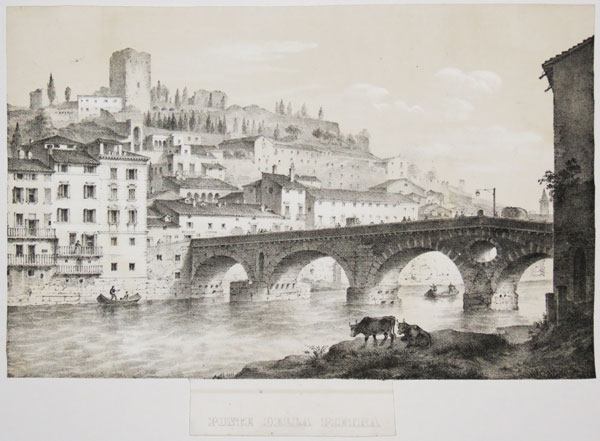
Ponte Della Pietra.
[n.d., c.1840].
Tinted lithograph. Sheet size: 180 x 285mm (7 x 11¼"). Trimmed to image and around title.
A view of the Ponte Pietra or 'Stone Bridge', once known as the Pons Marmoreus, a Roman arch bridge crossing the Adige River in Verona, Italy. The bridge was completed in 100 BC, and it originally flanked another Roman bridge, the Pons Postumius; both structures provided the city (on the right bank) with access to the Roman theatre on the east bank.
[Ref: 33370] £140.00
(£168.00 incl.VAT)
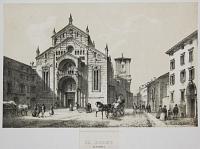
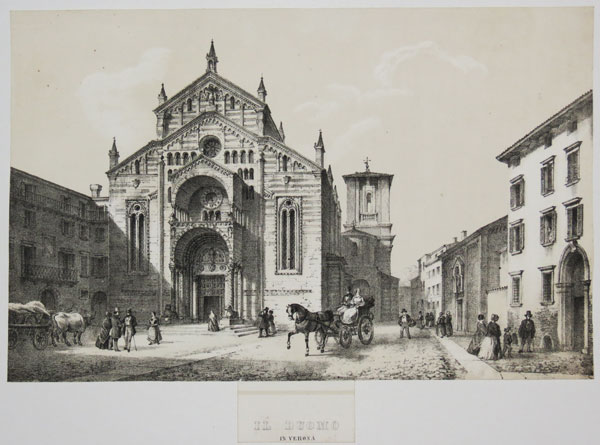
Il Duomo. In Verona.
[n.d., c.1840].
Tinted lithograph. Sheet size: 180 x 285mm (7 x 11¼"). Trimmed to image on 3 sides.
A view of Verona Cathedral, northern Italy, showing the Romanesque facade at the front, including details such as the two Griffins at the base of the pillars, the clock tower above, which was one of the world's first striking clocks, and the large circular gothic window at the top.
[Ref: 33372] £140.00
(£168.00 incl.VAT)
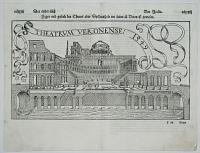
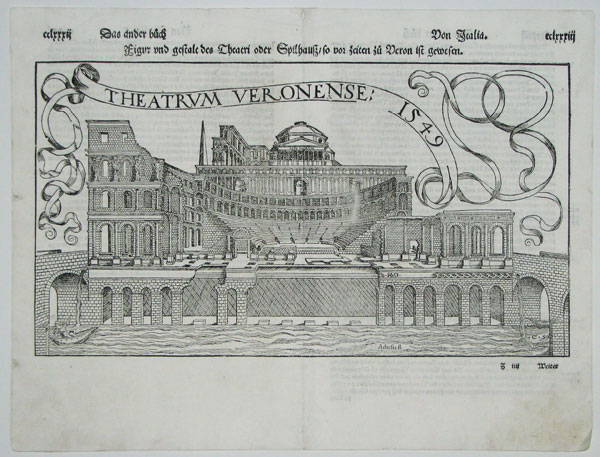
Theatrum Veronense: 1549.
[Hans Rudolf Manuel's monogram 'RMD' in image, on the facade at right. Monogram of the cutter 'C.S' also in image lower right.]
[Basel, Switzerland?, late 16th century, '1561' in pencil to verso.]
Woodcut on laid paper, folding double-page illustration to a German edition of Sebastian Münster's 'Cosmographia'. Sheet 300 x 395mm, 11¾ x 15½". Centre crease as usual.
This is a view of the grandiose Verona Arena (Arena di Verona), a Roman amphitheatre in Piazza Bra in Verona, Italy, which is internationally famous for the large-scale opera performances given there. It is one of the best preserved ancient structures of its kind. The theatre was built in the last quarter of the 1st century B.C., at the foot of the Hill of St. Peter on the banks of the Adige River. Captioned in German, German text to verso. Page numbers upper left and right. Sebastian Münster (1488 - 1552) was a cartographer and cosmographer, also professor of Hebrew at the University of Basel, whose Cosmographia of 1544 was the first German description of the world.
[Ref: 22523] £220.00
(£264.00 incl.VAT)
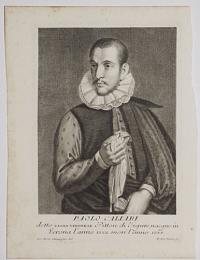
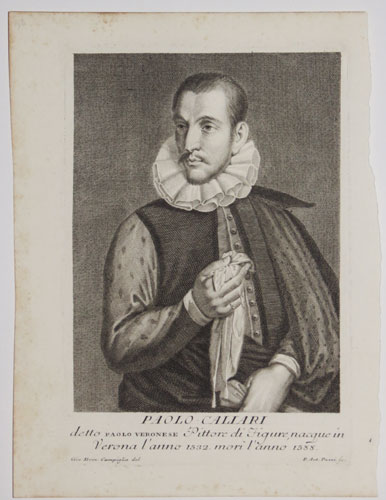
Paolo Caliari. detto Paolo Veronese Pittore di Figure, nacque in Verona l'anno 1532. Mori l'anno 1588.
Gio Dom. Campiglia del./ P.Ant, Pazzi fc.
[n.d., c.1766.]
Engraving. 175 x 260mm. (6¾ x 10¾"), with wide margins.
Veronese (Paolo Cagliari, 1532 - 1588) artist whose name derives from his birthplace in Verona. This portrait was part of A. F. Gori's monumental 'Museum Florentium', which set out to engrave all the portraits of painters, architects, sculptors and patrons of the arts in the major galleries of Florence. This vast undertaking was issued in parts, taking over thirty years (1731-1766) to complete.
[Ref: 29102] £140.00
(£168.00 incl.VAT)
![[Maria Anna Veronese] M.lle. Coraline.](img-thumbnail/jpegs/63171.jpg)
[Maria Anna Veronese] M.lle. Coraline.
Allais Pinxit. Vispré Sculp.
[n.d., c.1700s.]
Rare mezzotint. Sheet 195 x 145mm (7¾ x 5¾").
Portrait of Maria Anna Veronese (French: Marie Anne Véronèse) (died 1782) was a Franco/Italian actress active at the Comédie-Italienne in Paris. She became the mistress of Louis François Joseph, Prince of Conti, by whom she had two illegitimate children, born in 1761 and 1767. Nicknamed "Mademoiselle Coraline", Anna Veronese was the daughter of Italian Pantalone-actor Carlo Veronese and the sister of actress Giacoma Antonia Veronese (d. 1768). She debuted with her sister at the Comédie-Italienne in Paris in 1744. The Veronese sisters are considered two of the most notable interpreters of the soubrette-parts of the commedia dell'arte. They were known as Corallina (Coraline in French) and Camilla, respectively, after their standard parts. Anna was particularly known for her quick costume changes.
[Ref: 63171] £260.00
(£312.00 incl.VAT)

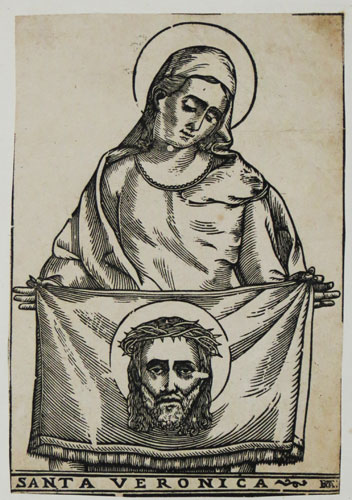
Santa Veronica.
B.T.A.
[n.d., c.1630.]
Rare woodcut. Sheet: 180 x 130mm (7¼ x 5¼''). Trimmed and laid on album sheet.
A portrait of Saint Veronica, a woman of Jerusalem who offered her veil to Jesus to mop his brow while carrying the cross. When he returned the veil to Veronica his face had miraculously been impressed upon it. A woodcut by the monogrammist BTA, probably for a Carmelite order in Venice in the first half of the 16th century.
[Ref: 49645] £240.00
(£288.00 incl.VAT)
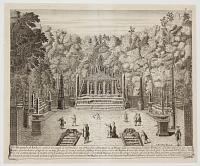
p. The Triumphal Arch so called because it resembles one. This fine structure is of Brass Gilt & contains 3 large Porticos. On the top of it are Seven Basins, from whence projects as many spouts of water which falling down flow over the Basins & into the the Shels on each side: between the Porticos there Projects 3 other spouts of water which falling down flow likewise over their Basins, & over the Steps which ascend to the Arch, & form a beautifull Cascade On either side going towards ye Arch is a Pyramid if water & near them several Buffets of water, Shels supported by Pedestals & streams of water arising out, w.ch have an inexpressible effect.
I. Bowles. Excud:
[London. Printed & Sold by John Bowles Print & Map Seller at Mercers Hall in Cheapside, 1726.]
Engraving with small margin. Plate 222 x 272mm (8¾ x10¾"). Fold.
A triumphal arch in the gardens of Versailles. This was built during the reign of Louis XIV and later replaced with a fountain in 1679. From "Versailles Illustrated, or Divers Views of the Several Parts of the Royal Palace of Versailles; as likewise of all the Fountains, Groves, Parterras, ye Labyrinth & other ye most Beautiful Parts of the Gardens, Wherein are represented whatever is remarkable whether Statues, Groups of Figures, Water Fall, Pleasure Houses, &c. Drawn on the Spot by the Order & with the Approbation of the French King".
[Ref: 28533] £80.00
(£96.00 incl.VAT)
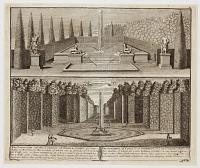
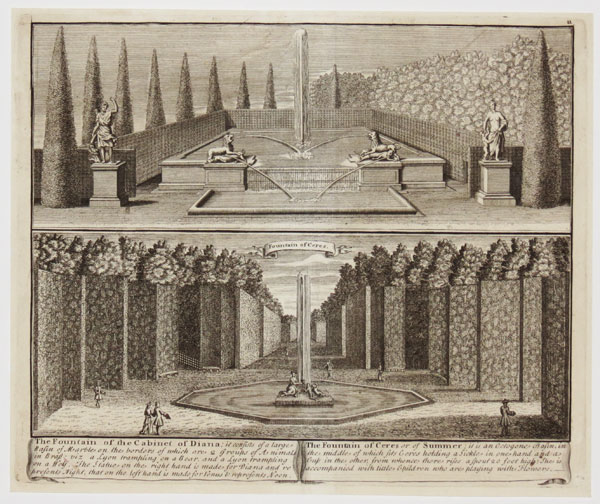
u. The Fountain of the Cabinet of Diana; it consists of a large Basin of Marble on the borders of which are 2 Groups of Animals in Brass; viz a Lyon trampling on a Bear, and a Lyon trampling on a Wolf. The Statue on the right hand is made for Diana, and represents Night, that on the left hand is made for Venus & represents Noon. Fountain of Ceres. The Fountain of Ceres or of Summer; it is an Octogone Basin, in the middle of which sits Ceres holding a Sickle in one hand and a Cup in the other, from whence there rises a spout 20 foot high; She is accompanied with little Children who are playing with Flowers.
[London. Printed & Sold by John Bowles Print & Map Seller at Mercers Hall in Cheapside, 1726.]
Engraving with small margins, paper watermarked. Plate 222 x 272mm (8¾ x10¾"). Folds and creasing.
The Fountain of the Cabinet of Diana, which appears to no longer exist, with representations of Venus and Diana; and the Ceres Fountain which was laid out between 1672 and 1679 by Thomas Regnaudin, after a drawing by Charles Le Brun. Ceres, the Roman goddess of harvests and corn, is seated on a bed of corn stalks, accompanied by cornflowers and roses. Symbolising summer, the fountain forms a set with those of Bacchus, Flora and Saturn who represent the three other seasons. From "Versailles Illustrated, or Divers Views of the Several Parts of the Royal Palace of Versailles; as likewise of all the Fountains, Groves, Parterras, ye Labyrinth & other ye most Beautiful Parts of the Gardens, Wherein are represented whatever is remarkable whether Statues, Groups of Figures, Water Fall, Pleasure Houses, &c. Drawn on the Spot by the Order & with the Approbation of the French King".
[Ref: 28529] £60.00
(£72.00 incl.VAT)
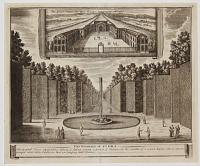
t. The Great Stables for the Kings manages Horses. The Fountain of Flora. The Goddess Flora representing Spring is sitting among a parcel of Flowers in the middle of a round Basin: She is accompanyed with little Children that are playing with Flowers.
[London. Printed & Sold by John Bowles Print & Map Seller at Mercers Hall in Cheapside, 1726.]
Engraving with small margins. Plate 222 x 272mm (8¾ x10¾"). Folds and creasing.
The great stables, designed by Jules Hardouin-Mansart, to shelter the King's 600 horses, equerries, stablemen, musicians and pageboys. The Flora Fountain, located at the crossroads of several Groves, including the Queen’s Grove, the fountain of Flora, Roman goddess of flowers, gardens and spring, symbolises the first season of the year. Sculpted by Tuby, she is represented with a crown of flowers in the centre of the fountain. From "Versailles Illustrated, or Divers Views of the Several Parts of the Royal Palace of Versailles; as likewise of all the Fountains, Groves, Parterras, ye Labyrinth & other ye most Beautiful Parts of the Gardens, Wherein are represented whatever is remarkable whether Statues, Groups of Figures, Water Fall, Pleasure Houses, &c. Drawn on the Spot by the Order & with the Approbation of the French King".
[Ref: 28530] £60.00
(£72.00 incl.VAT)
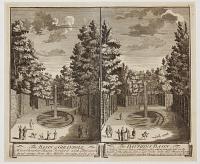
r. The Basin of Girandole. It is a Circular Basin border'd with Turf, and a Spout rising from the Middle twenty Seven feet. The Dauphins Basin. So called from a Statue of the Dauphin whic formerly was in the Middle of the Basin, but is now broke down, this Basin Resembles that of the Girandole, and has likewise a Spout rising twenty seven feet.
[London. Printed & Sold by John Bowles Print & Map Seller at Mercers Hall in Cheapside, 1726.]
Engraving with small margins, paper watermarked. Plate 222 x 272mm (8¾ x10¾"). Fold.
The Girandole Grove, a pendant to the Dauphin’s Grove, replaced old quincunxes in the south planted in the reign of Louis XVI. It has changed very little since it was installed, and is decorated with sculptures on tapering plinths commissioned by the Superintendent of Finance, Nicolas Fouquet, for his château in Vaux-le-Vicomte and executed in Rome based on models by Poussin. The Dauphin ‘s Grove, also known as “The Two Groves” along with the Girandole, is one of the very first designed by André Le Nôtre around 1660. At the end of the 17th century, the sculptor Théodon completed the series of sculptures dedicated to the seasons and mythological gods. From "Versailles Illustrated, or Divers Views of the Several Parts of the Royal Palace of Versailles; as likewise of all the Fountains, Groves, Parterras, ye Labyrinth & other ye most Beautiful Parts of the Gardens, Wherein are represented whatever is remarkable whether Statues, Groups of Figures, Water Fall, Pleasure Houses, &c. Drawn on the Spot by the Order & with the Approbation of the French King".
[Ref: 28531] £60.00
(£72.00 incl.VAT)

q. The Three Fountains. This is a beautifull Rural Grove in which the murmurs of the Fountains and the Cascades of Water; at the same time most agreeable entertain the Eyes and Ears, the large Spout at the end of the Grove rises 22 feet, and the Spouts in the Octogone Basin 170 feet. The Fountain of the Pyramid: so called from the resemblance it bears to a Pyramid, it consists of 4 Basins one above the other; the tower most of which 12 Feet in Diameter, under which are 4 Tritons who seem to be at play and running after one another, above them are several other Figures & Ornaments which support the other Basins.
I. Bowles. Excud.
[London. Printed & Sold by John Bowles Print & Map Seller at Mercers Hall in Cheapside, 1726.]
Engraving with small margins, paper watermarked. Plate 222 x 272mm (8¾ x10¾"). Fold.
The Grove of the Three Fountains. Designed by Le Nôtre in 1677, this grove is the only one mentioned on an old plan as “from the king’s thoughts”. It consists of three terraces each with a different fountain. Restored in 2005, it has recovered its magnificent composition and its jets of water desired by the king: in the lower fountain, the jets form a fleur-de-lys in the centre, vertical spouts and a vault of water, while above it is a column of water formed by 140 jets; moreover, it is this imposing column which supplies the lower fountains. Well hidden by the trellises, this grove had been laid out so that the king, aged 39, then suffering from gout, could reach it seated in a chair with castors and get up the grassy access ramps. The Pyramid Fountain. Executed by the sculptor François Girardon from a drawing by Charles Le Brun, the Pyramid in the centre of the fountain took three years to build. It consists of four superimposed lead bowls supported by lead tritons, dolphins and crayfish. From "Versailles Illustrated, or Divers Views of the Several Parts of the Royal Palace of Versailles; as likewise of all the Fountains, Groves, Parterras, ye Labyrinth & other ye most Beautiful Parts of the Gardens, Wherein are represented whatever is remarkable whether Statues, Groups of Figures, Water Fall, Pleasure Houses, &c. Drawn on the Spot by the Order & with the Approbation of the French King".
[Ref: 28532] £60.00
(£72.00 incl.VAT)

g. The Colonade. It is a Peristile or Circle of 32 Marble Columns of the Ionick Order, 12 of w.ch, are Red, 12 Blew & 8 colour’d like Violets. Their Bases & Capitols are of white Marble & the Spaces under ye Architrave are adorn’d w.th curious Ornam.nts & carv’d Work in Basso Relievo. Between ye Pillars ar 31 Basins of white Marble form each of w.ch there projects a Spout of Water 16 foot high w.ch falling into ye Basins spread over ym like so many Table Cloths. In ye midst of ye Peristile there is a Group of Figures representing e Rape of Proserpine and Pluto, supported by a beautiful Pedestal, & perfom’d by Girardon. The Diam.tr of ye Peristile is 123 foot & ye Circumference 369.
J. Bowles Excud.
[London. Printed & Sold by John Bowles Print & Map Seller at Mercers Hall in Cheapside, 1726.]
Engraving with small margins. Plate 222 x 272mm (8¾ x10¾"). Fold.
The Colonnade. Build from 1685 on by Jules Hardouin-Mansart, the Colonnade replaced a grove designed by Le Nôtre in 1679: the Springs Grove. A peristyle accompanies the 32 marble columns. The triangular tympani between the arcades are decorated with low relief carvings depicting children. The arch stones are adorned with heads of nymphs and naiads. The famous group in the centre on a circular marble base was executed between 1678 and 1699 by Girardon: Proserpine Ravished by Pluto. From "Versailles Illustrated, or Divers Views of the Several Parts of the Royal Palace of Versailles; as likewise of all the Fountains, Groves, Parterras, ye Labyrinth & other ye most Beautiful Parts of the Gardens, Wherein are represented whatever is remarkable whether Statues, Groups of Figures, Water Fall, Pleasure Houses, &c. Drawn on the Spot by the Order & with the Approbation of the French King".
[Ref: 28542] £80.00
(£96.00 incl.VAT)
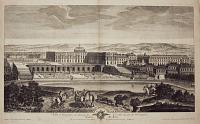
Vuë et Perspective de Château de Versailles du côté de l'Orangerie. Dédié Au Roy par son tres humble tres obeissant et tres fidéle Serviteur et Sujet, P. Menant.
Dessiné et Gravé d'apres le naturel par P. Menant.
Se vend chez P. Menant aux grandes Ecuries du Roy à Versailles. [n.d., c.17200.]
Engraving. 360 x 595mm (14¼ x 23½"). Tears in very large margins.
An elevated view of the Palace of Versailles, looking towards the Orangerie.
[Ref: 38182] £390.00
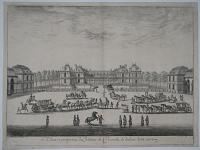
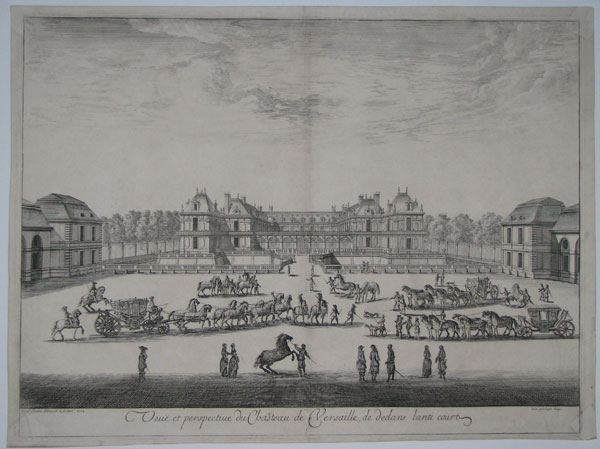
Veue et perspective du Chasteau de Versaille, de dedans lanti court.
Israel Silvestre delineavit et sculpsit. 1664.
Cum privilegio Regis. [n.d. c.1715.]
Copper engraving. Plate 375 x 495mm. 14¾ x 19½". Centre fold as normal.
The Palace of Versailles, Paris, France, with regal horse drawn carriages on the forecourt. From De Mortain's "Les Plans, Profils et Elevations de Versailles".
[Ref: 23295] £240.00
(£288.00 incl.VAT)
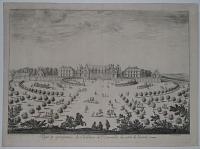
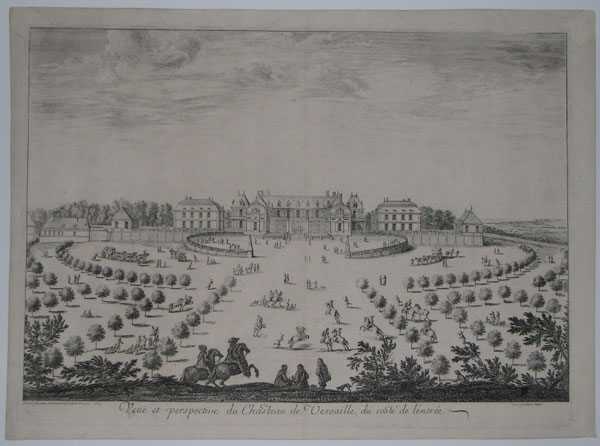
Veue et perspectuve du Chasteau de Versaille, du coste de l'entree.
Israel Silvestre, delineavit et Sculpsit Parisis 1664.
Cum privilegio Regis. [n.d. c.1715.]
Engraving. Plate 355 x 490mm. 14 x 19¼". Centre fold.
A view of the Palace of Versailles, Paris, France from the entrance. From De Mortain's "Les Plans, Profils et Elevations de Versailles".
[Ref: 23299] £280.00
(£336.00 incl.VAT)
![Bereau de Treillage du Labyrinthe a Versailles. [in sepia ink]](img-thumbnail/jpegs/62834.jpg)
Bereau de Treillage du Labyrinthe a Versailles. [in sepia ink]
[after Adam Perelle]
Paris chez N. Langlois rüe St Jacques à la Victoire avec Privilege.[in speia ink] [n.d. c.1700]
Hand coloured etching, plate 205 x 195mm (8¼ x 7¾"). Large margins.
A view most likely from "Receuille des plus belles veües des maisons royale de France," published by Langlois.
[Ref: 62834] £70.00
(£84.00 incl.VAT)

Interieure de la Chapelle Royale de Versailles.
[n.d., c.1760.]
Engraving. 220 x 205mm (8¾ x 8") very large margins. Crease left hand corner.
The interior of the chapel of the Palace of Versailles.
[Ref: 60918] £180.00
(£216.00 incl.VAT)

Un amour de bronze qui tire une flèche d'eau à Versailles.
de Lespine ex. Cum Privilegio Ordin: Hollandiae et West-Frisiae [n.d., 1717].
Engraving. 385 x 495mm (15¼ x 19½"). Folds, tears taped.
An illustration of the fountain featuring Cupid drawing his bow, the jet of water replacing his arrow. It was created by Louis Lerambert (1620-70) for the pool of the Parterre des Fleurs in the gardens of the Palace of Versailles.
[Ref: 62143] £280.00
(£336.00 incl.VAT)
![[Set of six views of Versailles.] Diverses Vues du Chateau de Versailles.](img-thumbnail/jpegs/38425.jpg)
[Set of six views of Versailles.] Diverses Vues du Chateau de Versailles. 1. Vuë prise de la grandes avenue entre les deux Ecuries. [&] 2. Vue des Ecuries de Versailles prise de la Seconde Grille. [&] 3. Vüe Particuliere de la Châpelle du Chateau de Versailles. [&] 4. Vue du Chateau de Versailles Prise du Côte de la Terrace vis à Vis la Chapelle. [&] 5. Vuë du Chateau et d'une partie de la Ville de Versailles du Côte de l'Estang. [&] 6. Vüe du Château de Versailles du Côte de l'Orangerie.
Dessiné et Gravé par J. Rigaud.
Avec Privilege du Roy. [Published by Rigaud c.1730.]
Set of six numbered engravings. Each 260 x 490mm (10¼ x 19¼"), very large margins.
A fine set of six views of the Palace of Versailles drawn and engraved by Jacques Rigaud (1681-1754). He depicts the huge complex of buildings as the centre of French society, with each scene filled with the participants in Louis XV's court as well as the workers who made it function. Rigaud spent twenty years on his vast 'The Royal Houses of France', which also included the châteaux of Marly, Fontainbleau, St Cloud and Meudon.
[Ref: 38425] £2,400.00
view all images for this item
![[Set of six views of Versailles.] Endroits Remarquables du Jardin et du Parc de Versailles.](img-thumbnail/jpegs/38427.jpg)
[Set of six views of Versailles.] Endroits Remarquables du Jardin et du Parc de Versailles. 7. Vuë de lde l'Orangerie de Versailles. [&] 8. Vuë du Bassin de Latone prise au bord de la Terrasse du Château. [&] 9. Vue de Bassin de Neptune dans le Jardins de Versailles. [&] 10. Vüe de Trianon dans le Parc de Versailles du Côté de l'Avenue. [&] 11. Vuë du Château de Trianon de Coté du Parterre. [&] 12. Vüe du Paÿsage et der la Maison Royalle de S.t Cir.
J. Rigaud In. Sculp.
Avec Privilege du Roy. [Published by Rigaud c.1730.]
Set of six numbered engravings. Each 260 x 490mm (10¼ x 19¼"), very large margins.
A fine set of six views of the buildings and features of the Palace of Versailles, drawn and engraved by Jacques Rigaud (1681-1754). He depicts Louis XV's court at rest in the sumptuous surroundings. The final view is from the park looking towards the Maison royale de Saint-Louis, the boarding school for girls set up by Louis XIV. Rigaud spent twenty years on his vast 'The Royal Houses of France', which also included the châteaux of Marly, Fontainbleau, St Cloud and Meudon.
[Ref: 38427] £2,400.00
view all images for this item
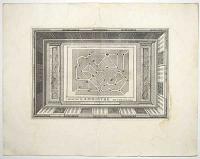
Plan du Labirinthe de Versailles.
A Liede, Chez Pierre Vander Aa, Marchand Libraire [n.d., 1728].
Engraved map with separately-engraved printed border. Total 220 x 330mm (8¾ x 13"), with large margins. Split in inner plate mark, damp stain in margin.
A plan of the hedge maze grown in the Gardens of Versailles, laid out 1672-7. The thirty-nine fountains, each representing one of the fables of Aesop, are numbered, unfortunately without a key. From Pieter van der Aa's monumental 66-volume 'Galerie Agréable du Monde', noted for the additional frame-like borders around each plate. It is said only one hundred copies were printed. See Ref: 26900
[Ref: 59196] £180.00

Plan General de la Ville Chateau Jardins et Parc de Versailles nouvellement levé sur les lieux.
AParis chez Jombert rue Dauphine [n.d., c.1740].
Engraved plan. 420 x 435mm (16½ x 17¼"). Damage at top with loss of printed area. Creases as normal.
A finely-engraved plan of Versailles, showing the positions of the house, ornamental gardens and parkland, with an extensive key.
[Ref: 63861] £220.00
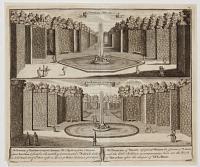
w. The Fountain of Bacchus. The Fountain of Bacchus represents Autumn, The Basin is of an Octogne figure Bacchus is seated in the middle of it surrounded wth Satirs he holds a cup in his hand of wch there arises a Spout of Water Nineteen foot high. The Fountain of Saturn. The Fountain of Saturn represents Winter the figures of Saturn and the little Children accompanying him are the Work of Girardon after the designs of Mr. Le Brun.
[London. Printed & Sold by John Bowles Print & Map Seller at Mercers Hall in Cheapside, 1726.]
Engraving with small margins. Plate 222 x 272mm (8¾ x10¾"). Folds and creasing, small chip to paper lower left.
Bacchus Fountain, also called the Autumn fountain, one of the four dedicated to the seasons and near the Royal Walk. Bacchus, a figure of Roman mythology, teaches the cultivation of the vine throughout the world. The god of wine and drunkenness, he symbolises the harvest and is surrounded by small satyrs, half child and half goat. [&] The Saturn fountain, located at the south end, was sculpted by Francois Girardon and symbolises the season of Winter. Saturn is seated on a throne in the centre, surrounded by small cupids, on an island studded with shellfish. From "Versailles Illustrated, or Divers Views of the Several Parts of the Royal Palace of Versailles; as likewise of all the Fountains, Groves, Parterras, ye Labyrinth & other ye most Beautiful Parts of the Gardens, Wherein are represented whatever is remarkable whether Statues, Groups of Figures, Water Fall, Pleasure Houses, &c. Drawn on the Spot by the Order & with the Approbation of the French King".
[Ref: 28528] £60.00
(£72.00 incl.VAT)
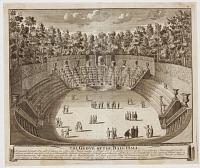
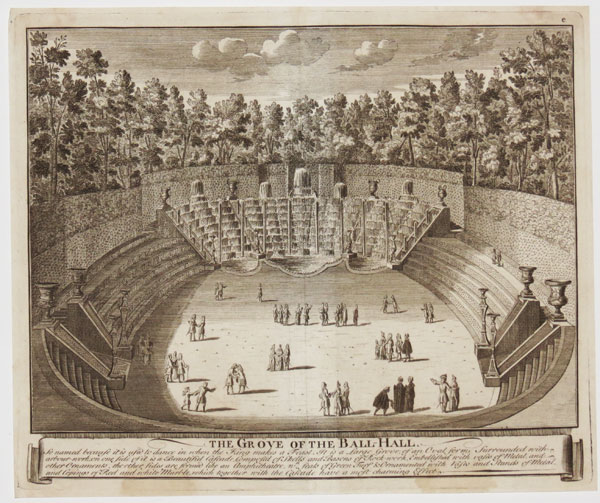
e. The Grove of the Ball-Hall. So named because it is used to dance in when the King makes a Feast. It is a Large Grove of an Oval form, Surrounded with arbour-work; on one Side of it is a Beautiful Cascade, Composed of Shells and Basons of Rock-work, Embellished with vases of Metal, and other Ornaments, the other Sides are formed like an Amphitheatre, w.th Seats of Green Turf & Ornamented with Vases and Strands of Metal, and Copings of Red and white Marble, which together with the Cascade have a most charming Effect.
[London. Printed & Sold by John Bowles Print & Map Seller at Mercers Hall in Cheapside, 1726.]
Engraving with small margins. Plate 222 x 272mm (8¾ x10¾"). Fold, some staining along lower edge.
The Ballroom. Laid out by André Le Nôtre between 1680 and 1683, the open-air Cascade Ballroom is also called the Rocaille Grove, because of the millstones and the sea shells brought back from the coasts of Africa and Madagascar over which the water pours down in a cascade. The marble “island” in the centre, easily accessible, was used for dancing, an art in which Louis XIV excelled. The musicians played above the cascade and, facing them, an amphitheatre with grassy rows of seats enabled the spectators to sit down. From "Versailles Illustrated, or Divers Views of the Several Parts of the Royal Palace of Versailles; as likewise of all the Fountains, Groves, Parterras, ye Labyrinth & other ye most Beautiful Parts of the Gardens, Wherein are represented whatever is remarkable whether Statues, Groups of Figures, Water Fall, Pleasure Houses, &c. Drawn on the Spot by the Order & with the Approbation of the French King".
[Ref: 28544] £80.00
(£96.00 incl.VAT)

n. The Baths of Apollo. So calld from 3 Groups of white marble, the middle most of which represents Apollo at the Apartment of Thetis attended, by the Nymphs of that Goddess who are platting his hair, washing his feet &c. the other two Groups are Compos'd of Tritons watering the Horses of the Sun; in the Group on the left hand the Carver has represented two Horses, one of which Rears up on end, & a Triton in order to hold him, lifts up his Brawny Arme with great force and spirit this Group is perform’d by Tuby and is Esteem’s a most Excellent piece of Work ye Canopy’s over these 3 Groups are Brass Gilt.
[London. Printed & Sold by John Bowles Print & Map Seller at Mercers Hall in Cheapside, 1726.]
Engraving with small margins. Plate 222 x 272mm (8¾ x10¾"). Fold.
The Grove of Apollo's Baths. This grove, formerly called the Marsh, was laid out during the reign of Louis XIV, between 1670 and 1673, at the request of Mme de Montespan, it is said. In 1704, Jules Hardouin-Mansart designed for this place a new grove intended to host the groups of the Sun Horses and Apollo served by the Nymphs. These groups were sculpted between 1664 and 1672 to adorn the famous Grotto of Tethys, and when the latter was destroyed to build the north wing of the Château, it was transferred to the Grove of the Domes. Hardouin-Mansart then designed this place to highlight these particularly remarkable works. In 1776, one year after the order given by Louis XVI to replant the park, the painter Hubert Robert was commissioned to produce a new layout. The grove which he imagined, completed in 1778, was laid out in the then fashionable style of English-Chinese gardens. This one has survived to our day. From "Versailles Illustrated, or Divers Views of the Several Parts of the Royal Palace of Versailles; as likewise of all the Fountains, Groves, Parterras, ye Labyrinth & other ye most Beautiful Parts of the Gardens, Wherein are represented whatever is remarkable whether Statues, Groups of Figures, Water Fall, Pleasure Houses, &c. Drawn on the Spot by the Order & with the Approbation of the French King".
[Ref: 28535] £80.00
(£96.00 incl.VAT)
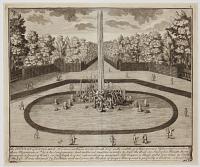
k. The Fountain of Enceladus. It is an oval Basin border’d with Turf, in the middle of it that Giant is represented cover’d w.th those Mountains w.ch he & his Companions had gathered together in order to Scale the Heavens. Out of his Mouth there proceeds a Spout of Water 70 foot high & of an extraordinary largeness. The Figure is Brass gilt & four times as big as the Life. It was design’d by Le Brun and cast from the Models of Gasper Marsy and is perfectly well done.
J. Bowles Excud.
[London. Printed & Sold by John Bowles Print & Map Seller at Mercers Hall in Cheapside, 1726.]
Engraving with small margins, paper watermarked. Plate 222 x 272mm (8¾ x10¾"). Fold.
The Encelade Grove. The Encelade Fountain was sculpted in lead by Gaspard Marsy between 1675 and 1677. The subject is taken from the myth of the fall of the Titans who were buried under the rocks of Mount Olympus which they tried to climb in defiance of the prohibition of Jupiter. The sculptor has depicted a giant half buried under the rocks and in the throes of death. From "Versailles Illustrated, or Divers Views of the Several Parts of the Royal Palace of Versailles; as likewise of all the Fountains, Groves, Parterras, ye Labyrinth & other ye most Beautiful Parts of the Gardens, Wherein are represented whatever is remarkable whether Statues, Groups of Figures, Water Fall, Pleasure Houses, &c. Drawn on the Spot by the Order & with the Approbation of the French King".
[Ref: 28538] £80.00
(£96.00 incl.VAT)

l. The Fountain of the Obelisk. The place where this mountain of Water is, was formerly call’d the Hall of Banquets, but is name & form are both now chang’d. This prodigious Spout of Water rises 75 foot high & is compos’d of 231 small Spouts closely joyn’d, on every side the Water flows over several Steps into a Canal that surrounds the Basin & very agreably forms 4 Cascades.
J. Bowles Excudit.
[London. Printed & Sold by John Bowles Print & Map Seller at Mercers Hall in Cheapside, 1726.]
Engraving with small margins, paper watermarked. Plate 222 x 272mm (8¾ x10¾"). Fold.
The Obelisk Grove. The Obelisk fountain was built by Jules Hardouin-Mansart in 1704, to replace the old Festive Room or Council Room, laid out by Le Nôtre in 1671. Decorative features and sculptures in moulded lead were used at the time to adorn the fountains of the garden of the Grand Trianon. From "Versailles Illustrated, or Divers Views of the Several Parts of the Royal Palace of Versailles; as likewise of all the Fountains, Groves, Parterras, ye Labyrinth & other ye most Beautiful Parts of the Gardens, Wherein are represented whatever is remarkable whether Statues, Groups of Figures, Water Fall, Pleasure Houses, &c. Drawn on the Spot by the Order & with the Approbation of the French King".
[Ref: 28537] £80.00
(£96.00 incl.VAT)
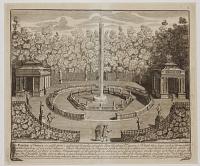
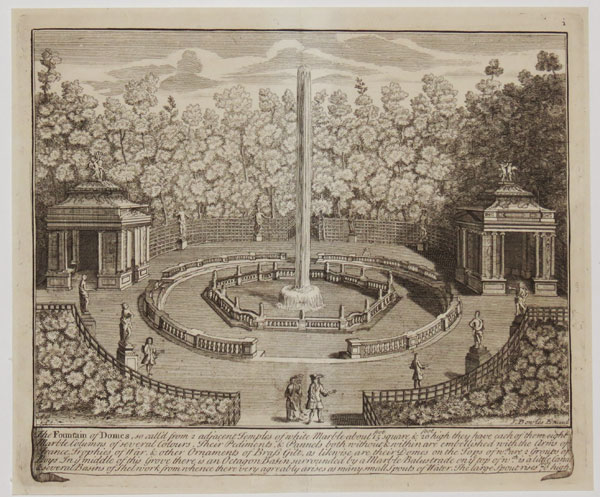
i. The Fountain of Dome, so call’d from 2 adjacent Temples of white Marble about 15 foot square & 20 foot high they have each of them eight Marble Columns of several Colours. Their Pediments & Pannels both without & within are embellished with the Arms of France, Trophies of War, & other Ornaments of Brass Gilt, as likewise are their Domes on the Tops of w.ch are 2 Groups of Boys. In ye middle of this Grove there is an Octagon Basin surrounded by a Marble Balustrade on yes top of w.ch is a little Canal & several Basins of Shelwork from whence there very agreably arises as many small Spouts of Water. The large Spout rises 70 foot high.
J. Bowles Excud.
[London. Printed & Sold by John Bowles Print & Map Seller at Mercers Hall in Cheapside, 1726.]
Engraving with small margins, paper watermarked. Plate 222 x 272mm (8¾ x10¾"). Fold.
The Grove of Domes. Very frequently redesigned, this grove changed its name with each new modification of its decor. Designed by Le Nôtre in 1675, it was then the Grove of Fame, in 1677-1678, owing to the statue of Fame in the centre of the fountain and which spouted a jet of water from its trumpet. Between 1684 and 1704, the groups from Apollo’s Baths were placed here, giving it its new name in this period: the Grove of Apollo’s Baths. But in 1677, Jules Hardouin-Mansart built two pavilions of white marble surmounted by domes, giving it is present name, although the two buildings were destroyed in 1820. From "Versailles Illustrated, or Divers Views of the Several Parts of the Royal Palace of Versailles; as likewise of all the Fountains, Groves, Parterras, ye Labyrinth & other ye most Beautiful Parts of the Gardens, Wherein are represented whatever is remarkable whether Statues, Groups of Figures, Water Fall, Pleasure Houses, &c. Drawn on the Spot by the Order & with the Approbation of the French King".
[Ref: 28540] £80.00
(£96.00 incl.VAT)

Le Labyrinte De Versailles.
Paris chez N. Langlois rüe St Jacques à la Victoire avec Privilege du Roy. [n.d. c.1700]
Engraving, plate 250 x 345mm (10 x 14½"), with margins. Repaired tears.
A map most likey from "Receuille des plus belles veües des maisons royale de France," published by Langlois. See Ref: 62862
[Ref: 62863] £130.00




![[M.r Grevil Verney.]](jpegs/64571.jpg)


![[Vice Admiral S.r Edw.d Vernon.]](jpegs/5548.jpg)
![[Maria Anna Veronese] M.lle. Coraline.](jpegs/63171.jpg)



![Bereau de Treillage du Labyrinthe a Versailles. [in sepia ink]](jpegs/62834.jpg)


![[Set of six views of Versailles.] Diverses Vues du Chateau de Versailles.](jpegs/38425.jpg)
![[Set of six views of Versailles.] Endroits Remarquables du Jardin et du Parc de Versailles.](jpegs/38427.jpg)