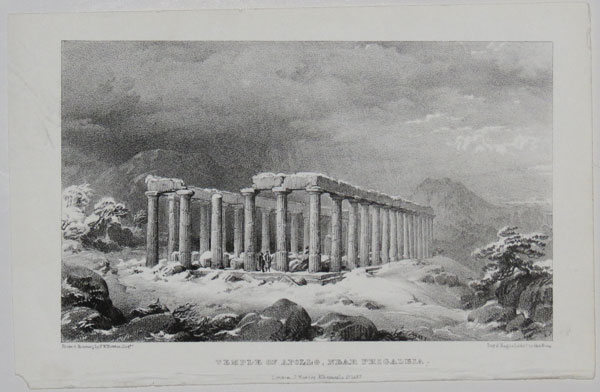
Temple of Apollo, near Phigaleia.
From a drawing by F.W. Newton Esq.re Day & Haghe Lith.rs to the King.
London, J. Murray, Albermarle St. 1837.
Lithograph. 120 x 190mm. 4¾ x 7½.
A snow scene. The Temple of Apollo Epicurios, at Phigaleia, in Arcadia, stands in a slight depression on the bare and wind-swept side of Mount Cotylion, above the valley of the river Neda. It was discovered towards the end of the eighteenth century, but on account of its remote position it was seldom visited before 1811. From "A Short Visit to The Ionian Islands, Athens, and the Morea. By Edward Giffard, Esq."
[Ref: 25646] £120.00
(£144.00 incl.VAT)
![[The Temple of Apollo]. Al Sig.r Luigi Pavon Amatore delle elle Arti.](img-thumbnail/jpegs/55087.jpg)
[The Temple of Apollo]. Al Sig.r Luigi Pavon Amatore delle elle Arti. Pietro Parboni D. D. D.
Claudio di Lorena inv. e dip. Nicola de Antoni impresse. Pietro Parboni incise. Nicola de Antoni vende in Roma, in Via del Corso No. 35.
Rome, [n.d. c.1800-1841].
Etching. 480 x 600mm (19 x 23¾"), with large margins. Near mint.
A scene from the myth of Cupid and Psyche; Psyche's father prays at the Temple of Apollo that she will find a suitable husband. After Claude Lorrain's (c.1600-1682) original painting 'The Father of Psyche sacrificing at the Temple of Apollo' (1662), painted for Angelo Albertoni, a Roman nobleman. From the Berkeley Collection, Spetchley Park.
[Ref: 55087] £380.00
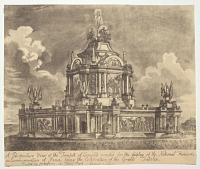
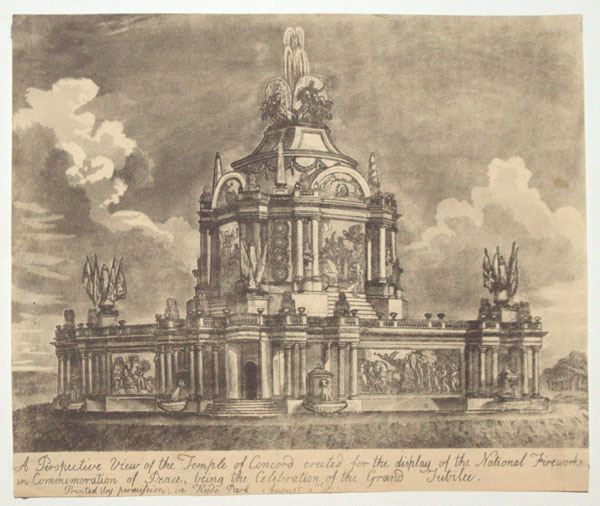
A Perspective View of the Temple of Concord erected for the display of the National Fireworks in Commemoration of Peace, being the Celebration of the Grand Jubilee.
Printed (by permission) in Hyde Park August 1st 1814.
Very rare aquatint with etching, sheet 240 x 280mm (9¼ x 11"). Trimmed within plate. Small brown stain in sky on right. Slightly faded.
A view of the Temple of Concord, The print depicts an architectural structure erected for the fireworks display held 1 August 1814 in Green Park, London, to celebrate the end of the Napoleonic Wars and the Jubilee of George III. The mastermind behind the Temple was Lieutenant Colonel Sir William Congreve (1772–1828), a rocket designer and Comptroller of the Royal Laboratory at Woolwich. Congreve designed the Temple with assistance from stage designers from the Theatre Royal and master engineers. It was an elaborate structure illuminated with colored lamps and decorated with gilding, festoons, and painted transparencies. Congreve had commissioned some of the nation’s best artists such as Thomas Stothard (1755 – 1834) to design and paint allegorical scenes on these ‘transparencies’, each tableau praising ‘the Triumph of England under the Regency’. When illuminated from inside it was made to revolve, so that spectators might view each side in turn.
[Ref: 57429] £240.00
(£288.00 incl.VAT)
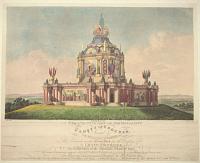
A Perspective View of the Revolving Temple of Concord Invented by Sir William Congreve Bar.t. And erected in the Green Park for the display of A Grand Firework, in Celebration of the Glorious Peace of 1814. The Design & Decorations made by Mess.rs Greenwood & Latilla of the Theatre Royal Drury Lane. The Allegorical Transparencies Designed by M.r Howard R.A, and painted by him; Mes.rs Smirke, Stothard , Woodforde, Dawe, Hilton and Genta _Sculptor M.r Chenu_ The Machinery by Mess.s Maudslay & C.o and Mr Drory.
J. Pain delin. R.W. Smart sculp. Aquatinted by I.Jeakes.
[n.d., c.1814]
Aquatint, watermark Ruse & Turney; sheet 330 x 415mm (13 x 16½"). Trimmed within plate and glued to backing sheet. Top corner torn. Tear through publication line repaired with tape. Creases.
A view of the Temple of Concord, The print depicts an architectural structure erected for the fireworks display held 1 August 1814 in Green Park, London, to celebrate the end of the Napoleonic Wars and the Jubilee of George III. The mastermind behind the Temple was Lieutenant Colonel Sir William Congreve (1772–1828), a rocket designer and Comptroller of the Royal Laboratory at Woolwich. Congreve designed the Temple with assistance from stage designers from the Theatre Royal and master engineers. It was an elaborate structure illuminated with colored lamps and decorated with gilding, festoons, and painted transparencies. Congreve had commissioned some of the nation’s best artists such as Thomas Stothard (1755 – 1834) to design and paint allegorical scenes on these ‘transparencies’, each tableau praising ‘the Triumph of England under the Regency’. When illuminated from inside it was made to revolve, so that spectators might view each side in turn.
[Ref: 57435] £180.00
(£216.00 incl.VAT)

Temple of Diana.
R.Brown Pinx.t. T.L Busby. Sculp.
Leigh & Son 421 Strand. [n.d. c.1830]
Very rare aquatint, with hand colour. Sheet 285 x 225mm (11¼ x 8¾" Glued to album sheet.
A view of a rotunda decorated with the goddess Diana and stag heads, situated in a wooded landscape. Richard Brown (c. 1770-1845) was a British architect, designer, draughtsman and engraver. Thomas Lord Busby (fl. 1804-1837) was a painter, etcher and humorous illustrator. Samuel Leigh was a bookseller and publisher in 19th century London working with his son James Mathews Leigh (1808 –60).
[Ref: 61119] £240.00
(£288.00 incl.VAT)

The Temple of Minerva. No 16 bottom right.
Claude Lorrain Pinx.t
London Published July 10.th 1787 by Rob.t Sayer 53 Fleet Street.
Engraving with large margins; paper watermarked. Plate 251 x 355mm (10 x 14").
Landscape after Claude Lorrain, from a set of landscapes. In the foreground, a donkey, followed by a boy and a dog, walking to the right; cows beyond resting on a river bank; in middle-distance on left a round temple and other buildings at the bottom of a rocky hill. From the Oettingen-Wallerstein Collection.
[Ref: 28370] £140.00
(£168.00 incl.VAT)

The Archbishop of Canterbury.
William Nicholson.
[London, 1899 by William Heinemann].
Lithographic reproduction of a hand-coloured woodcut. Printed area: 265 x 245mm. (10¼ x 9¾"). Foxing to edges; mounted on board as issued.
Portrait of Frederick Temple (1821 - 1902), Archbishop of Canterbury from 1896 until his death. From the folio of twelve portraits by William Nicholson published in 1899. Sir William Nicholson was a distinguished Edwardian portrait painter, poster designer and painter of still lifes. Colin Campbell, 'William Nicholson: The Graphic Works': 70B.
[Ref: 28323] £60.00
(£72.00 incl.VAT)
![Palmerston [signature facsimile.]](img-thumbnail/jpegs/27549.jpg)
Palmerston [signature facsimile.]
Leon Noel 1864. [signed on stone.] From a Photograph by W. Walker & Sons.
Imprime par Lemercier 57 r, de Seine Paris. London, Victor Delarue, 10 Chandos St. Strand, W.C.
Lithograph on india paper, sheet 400 x 295mm. 15¾ x 11¾". Some spotting.
Portrait of Henry John Temple, 3rd Viscount Palmerston (1784-1865), politician who served twice as Prime Minister. He was in government office almost continuously from 1807 until his death in 1865, beginning his parliamentary career as a Tory and concluding it as a Liberal. He served successively as: Secretary at War (1809-28); Foreign Secretary (1830-41 and 1846-51); Home Secretary (1853-5) and Prime Minister (1855-8 and 1859-65). He is best remembered for his direction of British foreign policy through a period when the United Kingdom was at the height of its colonial power. His vigorous policy of intervention, often controversial at the time, made him one of the greatest Victorian statesman and among the most powerful figures in European politics. After the photograph by Samuel Alexander Walker (1841-1922), son of William Walker. From Broadlands home of Palmerston family.
[Ref: 27549] £160.00
(£192.00 incl.VAT)

Lord Viscount Palmerston, K.G. First Lord of the Treasury. From the original Picture painted for the Harrow Library A.D. 1863.
Painted by F. Grant R.A. Engraved by F. Holl & G. Zobel.
London, Published September 11th 1865, by Henry Graves & Co. the Proprietors, Publishers to the Queen, 6 Pall Mall.
Mezzotint, title in open letters, 555 x 430mm. 21¾ x 17".
Portrait of Henry John Temple, 3rd Viscount Palmerston (1784-1865), politician who served twice as Prime Minister. He was in government office almost continuously from 1807 until his death in 1865, beginning his parliamentary career as a Tory and concluding it as a Liberal. He served successively as: Secretary at War (1809-28); Foreign Secretary (1830-41 and 1846-51); Home Secretary (1853-5) and Prime Minister (1855-8 and 1859-65). He is best remembered for his direction of British foreign policy through a period when the United Kingdom was at the height of its colonial power. His vigorous policy of intervention, often controversial at the time, made him one of the greatest Victorian statesman and among the most powerful figures in European politics. After Sir Francis Grant (1803-1878). NPG D39516. From Broadlands home of Palmerston family.
[Ref: 27550] £260.00
(£312.00 incl.VAT)
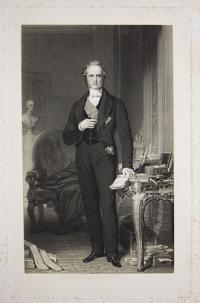
[The Rt Hon Viscount Palmerston, GCB MP &c &c &c. This Portrait is respectfully dedicated to the Committee, who presented to the Right Hon.ble the Viscount Palmeston, the Picture from which the plate was engraved.]
[Painted by John Partridge Esq.re. Engraved by Samuel Cousins Esq.re ARA.]
[London Published May 1st 1852 by Paul & Dominic Colnaghi & Co 13 & 14 Pall Mall East _ Publishers to Her Majesty.]
Mezzotint on chine collé, proof before letters. 515 x 800mm (20½ x 31½"). Spotting,
Full-length portrait of Henry John Temple, 3rd Viscount Palmerston (1784-1865), standing in his study, left hand resting on papers. The painting was executed c.1850, when Palmerston was Secretary of State for Foreign Affairs, five years before his first term as Prime Minister. After Palmerston's death his widow insisted on the face being replaced with one from an earlier portrait by Partridge, so this mezzotint is the only record of the original image. The painting is now in Parliament's art collection. Palmerston attanded St John's College, Cambridge (1803-6)
[Ref: 48486] £360.00
![[Richard Grenville Temple?] A Temple Macaroni.](img-thumbnail/jpegs/14172.jpg)
[Richard Grenville Temple?] A Temple Macaroni.
Pub by MDarly accorg. to Act Feby. 14th. 1772.
Etching, 170 x 125mm. 6¾ x 5".
A man looking to his right, probably Richard Grenville Temple, Earl Temple (1711 - 1779). His right hand is in his coat pocket, his left thrust in his waistcoat. He wears a looped hat, his hair or wig is in a long queue bound with black ribbon. He wears a sword, laced coat, ruffled shirt and cravat, low buckled shoes. A greyhound-type dog (whippet?) walks in front. From 'Caricatures, Macaronies & Characters by sundry ladies gentlemen artists &c.', in an album of caricatures published by Mary Darly dated January 1776. It seems that her husband Matthew made the plates. Numbered 'V.2' upper left and '11' upper right. BM Satires: 4994.
[Ref: 14172] £160.00
(£192.00 incl.VAT)
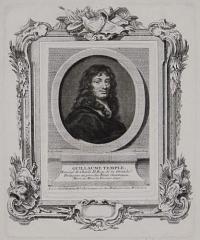
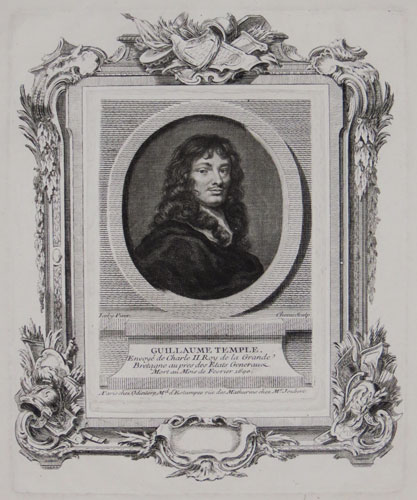
Guillaume Temple. Envoyé de Charles II. Roy de la Grand Bretagne au pres des Etats Generaux. Mort au Mois de Fevrier 1690.
Lely Pinx. Chenu Sculp.
AParis chez Odieuvre, M.d d'Estampes rüe des Mathurins chez Mr Joubert.
Engraving with borders, printed from two plates, with very large margins, total 235 x 190mm (9¼ x 7½").
Oval portrait of Sir William Temple (1628-99, not 1690 as title), within a separately-printed, frame-like border. As a diplomat he negotiated the marriage William of Orange and Princess Mary, and the Triple Alliance between England, Sweden & the United Provinces, 1668.
[Ref: 34965] £140.00
(£168.00 incl.VAT)
![[William Temple] Dominus Gulielmus Temple Eques Baronettus](img-thumbnail/jpegs/59416.jpg)
[William Temple] Dominus Gulielmus Temple Eques Baronettus Ser.mi et Pot.mi Mag. Britanniæ Regis ad Ord.s Fœd.ti Belgÿ Lagatus [...] 1679.
P. Lely Pinx. G. Vertue Sculp.
[n.d., 1720.]
Engraving. Sheet 270 x 160mm (10¾ x 6¼"). Trimmed within plate, mounted in album paper.
Oval portrait of Sir William Temple (1628-99), a diplomat who negotiated the marriage William of Orange and Princess Mary, and the Triple Alliance between England, Sweden & the United Provinces, 1668. Temple's secretary for most of the last decade of his life was the satirist Jonathan Swift: when Temple died Swift wrote 'He died at one o clock in the morning and with him all that was great and good among men'. Alexander: 298
[Ref: 59416] £140.00
(£168.00 incl.VAT)

Temptation. ~Had I a heart for Falshood fram'd I ne'er could injure you; For tho' your Tongue no promise claim'd, Your charms would make me true.
H. Ramberg invt delt. W.Ward Sculpsit.
Published 25th July 1794 by R.Laurie & J.Whittle, No 53, Fleet Street, London.
Stipple with roulette. 255 x 280mm.
The verse comes from Richard Brinsley Sheridan's comic opera 'The Duenna' (1777), considered one of the most successful operas ever staged in England and described by Byron as 'the best opera ever written'.
[Ref: 4767] £380.00
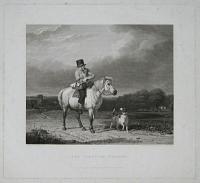
The Tempting Present.
Painted by T. Woodward. Engraved by W.R. Smith, the Figure by J.H. Robinson.
London, Published July 1, 1824 ny Hurst, Robinson & Co. 90, Cheapside & 8 Pall Mall.
A rare etching and engraving. Plate 322 x 356mm. 12¾ x 14¼".
A young man in rustic dress riding a horse and smiling towards the viewer from under his hat, holding a basket over his right arm, with a small dog trotting beside him to the right, on a country path with trees and a small tower in the background. Ex Norman Blackburn Collection.
[Ref: 18780] £180.00
(£216.00 incl.VAT)
![[Ten Trinity Square.] P.L.A. London. [in pencil.]](img-thumbnail/jpegs/43213.jpg)
[Ten Trinity Square.] P.L.A. London. [in pencil.]
Kenneth Ames [? pencil signature]
[Kenan Ltd, n.d., c.1922.]
Etching in original mount and gilt-lettered folio. Plate 175 x 250mm (7 x 9¾"). Scuffs to covers, faint mount burn around image.
A view of the former headquarters of the Port of London Authority on Tower Hill, probably at the time it was opened, by Prime Minister David Lloyd George, in 1922. At present there are plans to convert it into a Four Seasons Hotel. This print was published as a corporate Christmas card: the cover reads 'With the Compliments of the Season and Best Wishes for the New Year from Kenan Ltd. Reg 5653'
[Ref: 43213] £180.00
(£216.00 incl.VAT)
view all images for this item
![[Ten vignettes]](img-thumbnail/jpegs/67729.jpg)
[Ten vignettes]
C J Grant Invent [illegible].
[n.d. c.1833]
Lithograph, sheet 245 x 275mm (9¾ x 10¾). Trimmed. Stain top right.
Ten satirical vignettes with puns about daily life, politics and royalty. This print looks like a trimmed version of one of Grant's Frontispieces. See [Ref: 63983].
[Ref: 67729] £160.00
(£192.00 incl.VAT)
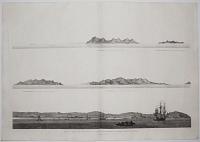
View of the City of Ten-Tchoo-Foo from the anchorage of the Hindostan in the Strait of Mi-A-Tau bearing South-west.
Ellis sculp.t.
London, Published April 12, 1796, by G.Nicol.
Engraving. 545 x 745mm (21½ x 29¼"), on paper watermarked 'J. Whatman 1794.' Central vertical fold as published.
Three views of the Shantung Peninsula. A panoramic view of the harbour and city of Ten-Tchoo-Foo is shown at the bottom. Cape Macartney, Staunton's Island and Cape Gower are illustrated above. Plate 7 from Sir George Staunton's 'An Authentic Account of an Embassy from the King of Great Britain to the Emperor of China', describing the expedition of Lord Macartney (1737 - 1806) as the first British ambassador to China. See item ref: 37515, 'Narrative of the British Embassy to China In the Years 1792, 1793 and 1794' for a detailed account of Æneas Anderson's voyage to China in the service of Lord Macartney, including a list of the retinue of Lord Macartney and a Glossary of Chinese words.
[Ref: 38153] £250.00
(£300.00 incl.VAT)
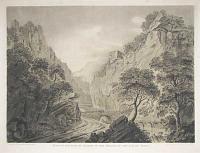
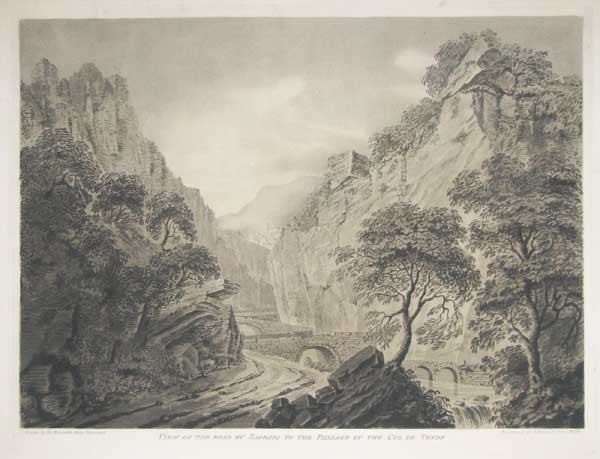
View of the Road by Saorgio to the Passage of the Col de Tende.
Drawn by Mary Countess Harcourt, Engraved by J. Hibbert, jun. Bath.
Fine & rare aquatint, printed in sepia. 365 x 480mm (14 x 19"), with very large margins. Laid on board. Edges of board chipped, print not affected.
View of a town on cliffs, seen from below, a winding road and river at left in the foreground. 1809-33. Department of Alpes-Maritimes region of Provence-Alpes-Cote d'Azur, while Col de Tende is a high mountain pass in the Alps, on the border of France and Italy. Mary, Countess Harcourt (1749 - 1833) Wife of William Harcourt, 3rd Earl Harcourt, and amateur painter.
[Ref: 68308] £380.00
![[Greek War of Independence.] Die Helden von Tenedos.](img-thumbnail/jpegs/29826.jpg)
[Greek War of Independence.] Die Helden von Tenedos.
[Etched by Wunder after Geissler?]
[Nuremberg?, c.1829.]
Etching with original hand colour. Sheet 170 x 205mm (6¾ x 8"). Trimmed.
A scene from Greek War of Independence (1821-29), with Constantine Canaris blowing up a Turkish warship using a fireship off Tenedos, a tactic he used several times.
[Ref: 29826] £220.00
(£264.00 incl.VAT)
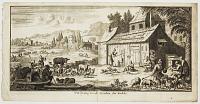
Uit-lesing vande Tienden der Kudde.
[Jan Luyken.]
[n.d., c.1683.]
Engraving. Plate: 145 x 295mm (5¾ x 11½'').
A print showing shepherds tending their flock. By Dutch printmaker Jan Luyken (1649-1712).
[Ref: 49658] £110.00
(£132.00 incl.VAT)
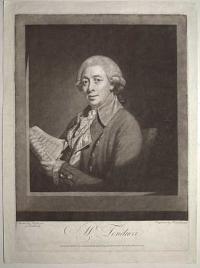
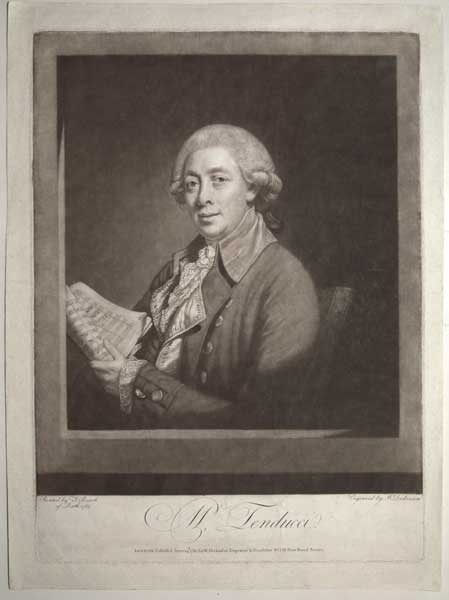
Mr. Tenducci.
Painted by T. Beach of Bath, 1782. Engraved by W. Dickinson.
London, Publish'd June 24th 1782 by W. Dickinson Engraver & Printseller No 158 New Bond Street.
Scarce mezzotint, 375 x 275mm (14¾ x 10¾"), with large margins. Rubbed.
Giusto Ferdinando Tenducci (c.1735-1790), Italian castrato and composer, holding sheet music. From 1758 to 1765 he was in London where he was heard at both the King's Theatre and the Royal Opera House, after which he spent most his time in London and Italy. He taught singing to Wolfgang Amadeus Mozart in Paris in 1777-1778, and Mozart, impressed with his teacher's singing abilities, wrote a concert aria for him. Engraved after a portrait by the Bath painter Thomas Beach (bap.1737-d.1806), now in a private collection. CS: 83 ii/ii.
[Ref: 61687] £480.00

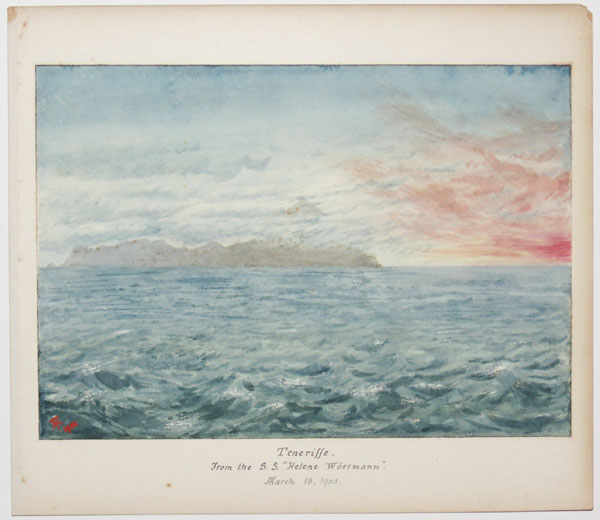
Teneriffe. From the S. S. ''Helene Wöermann''. March 18, 1900.
AHT. 1900. [Astley Herbert Terry.]
Signed watercolour. Sheet: 175 x 250mm (7 x 9¾''). Mounted on board.
A watercolour by Lieutenant Astley Herbert Terry (1866 - after 1937). The son of Major General Astley Fellows Terry, the artist served with both the Army Service Corps and the 60th Rifles. His posting to Sierra Leone coincides with the Second Boer War, so his duties would have been to provide for the troops en route to South Africa. He was promoted to major at the time of his departure, which was probably to the Cape: a 'Major Terry' of the 60th Rifles is recorded as participating in the war. In the 1911 census Terry was recorded as living in Kensington. In 1937 Colonel Astley Herbert Terry was installed as Commander of the Venerable Order of the Hospital of St John of Jerusalem, which is the last reference to him we can trace.
[Ref: 48111] £110.00
(£132.00 incl.VAT)
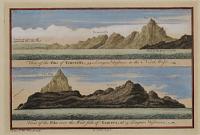
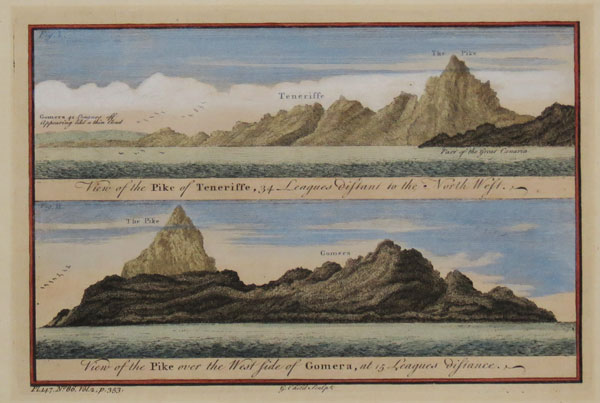
View of the Pike of Teneriffe, 34 Leagues distant to the North West. View of the Pike over the West Side of Gomera, at 15 Leagues distance.
Pl.147. No.86. Vol.2. p.353. G. Child Sculp.t
[n.d. c.1750.]
Hand-coloured engraving. Plate 157 x 232mm (6¼ x 9¼").
A view of the Pike of Tenerife, Canary Islands, with a view of the small island of La Gomera below
[Ref: 30743] £95.00
(£114.00 incl.VAT)
![[Two men.]](img-thumbnail/jpegs/30933.jpg)
[Two men.]
D. Tinners pinx. Jo. Smith ex.
[1805 but later.]
Mezzotint. 170 x 140mm (6¾ x 5½"). Mounted on album paper.
Two men, both wearing hats and plain coats, one holding a smoking pipe. Engraved by John Smith after David Teniers the Younger and published in Boydell's 'Collection of Portraits'. BM: 1876,1111.37.
[Ref: 30933] £120.00
(£144.00 incl.VAT)
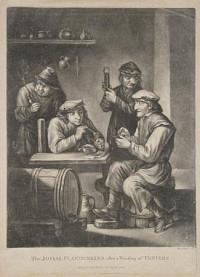
The Jovial Flanderkins, after a Painting of Teniers.
Brookshaw fecit
Printed for John Bowles, at No.13 in Cornhil [n.d., c.1780].
Mezzotint, 355 x 255mm. Paper age toned, some foxing, small repaired tear lower left margin.
Pipe smoking Flemish peasants after Teniers, by Richard Brookshaw, mezzotinter and draughtsman (1736 - c.1804).
[Ref: 7726] £220.00
(£264.00 incl.VAT)
![[Teniers's Kitchen or Allegory of the Four Elements.]](img-thumbnail/jpegs/40065.jpg)
[Teniers's Kitchen or Allegory of the Four Elements.]
Teniers Pinxit. J.B. Michell Sculp.t.
Published July 1.st 1777 by John Boydell, Engraver in Cheapside London.
Engraving. Proof before title. Platemark: 485 x 610mm (19 x 24"), with very large margins. Small tears in outer margins.
The interior of an opulent kitchen with several work stations, and a large fireplace with in background, beside which figures are carving, and cooking meat. A falconer stands to the right, as others sort fish to the left. A plethora of meat, fish and poultry is scattered around the room scattered in foreground Plate from 'The Houghton Gallery' The original painting was completed in 1646 and is in the Hermitage collection. The print was published and commissioned by John Boydell, the great London printmaker and seller. The painting was part of Sir Robert Walpole's collection and was soon thereafter sold to Catherine the Great (1779)
[Ref: 40065] £390.00
![[A drinking scene.]](img-thumbnail/jpegs/34655.jpg)
[A drinking scene.]
Mezzotint. 205 x 175mm (8 x 7"). Thread margins; Slight creasing.
A genre scene, probably after Flemish painter David Teniers the Younger (1610-1690), and published by Edward Cooper (active 1682-d.1725), the major London print publisher of the late 17th and early 18th centuries. Ex collection of the Hon. Christopher Lennox-Boyd.
[Ref: 34655] £220.00
(£264.00 incl.VAT)
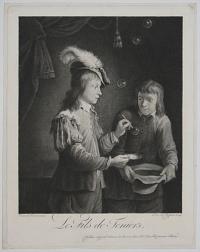
Le Fils de Teniers.
David Teniers pinx. L.A. Claessens Sculp.
Ce tableau original se trouve a Anvers chez Mr. Van Regemorter Peintre. [n.d. c.1792.] Bit later.
Stipple with small margins. Plate 350 x 272mm (13¾ x 10¾"). Faded collector's stamp verso.
Two boys having fun with bubbles. A well dressed boy holds a shell in his right hand, with his left hand he moves the blowpipe from which a soap bubble hangs. Next to him is a second boy who appears to be the same age. He tries to catch the soap bubbles with his hat. After David Teniers II (1610-1690), who used his son as a model in this image, and engraved by Lambert Antoine Claessens (1764 - 1834). In the Harvard Art Museums.
[Ref: 29930] £190.00
(£228.00 incl.VAT)
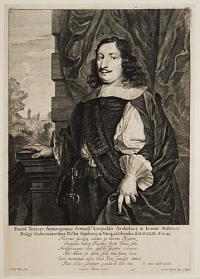
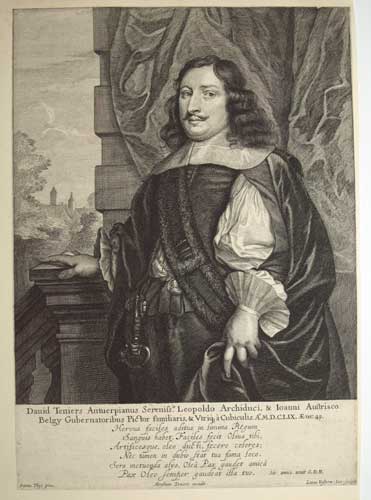
David Teniers Antuerpianus Sereniss.is Leopoldo Archiduci, & Ioanni Austriaco Belgy Gubernatoribus Pictor familiaris, & Vtriq a Cubiculis, A.o M.D.C.LIX Ætat: 49. Herous faciles aditus in limina Regum...
Petrus Thÿs pinx. Lucas Vosterm: Iun: Sculpsit.
Iacobus Peeters excudit [n.d., c.1660].
Engraving. 340 x 235mm (13½ x 9¼''). Hinged on left of sheet.
A portrait of the artist David Teniers the Younger (1610-1690). Frontis to 'Theatrum Pictorium'. In pencil on sheet "Spencer Churchill Book". First published 1659: this example is of the fourth state of four, published by Peeters rather than Abraham Teniers.
[Ref: 49453] £160.00
(£192.00 incl.VAT)
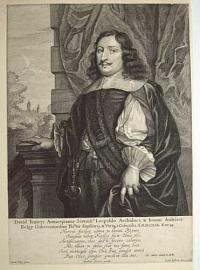
David Teniers Antuerpianus Sereniss.is Leopoldo Archiduci, & Ioanni Austriaco Belgy Gubernatoribus Pictor familiaris, & Vtriq a Cubiculis, A.o M.D.C.LIX Ætat: 49. Herous faciles aditus in limina Regum...
Petrus Thÿs pinx. Lucas Vosterm: Iun: Sculpsit.
Abraham Teniers excudit [n.d., 1659].
Engraving. Sheet 340 x 235mm (13½ x 9¼''). Trimmed within plate, mounted in album paper at sides.
A portrait of the artist David Teniers the Younger (1610-1690), published as the frontispiece to 'Theatrum Pictorium'. An example of the second state of four, the first published state.
[Ref: 62190] £230.00
(£276.00 incl.VAT)
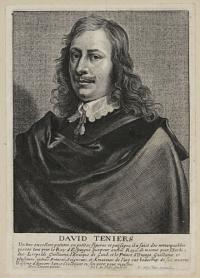
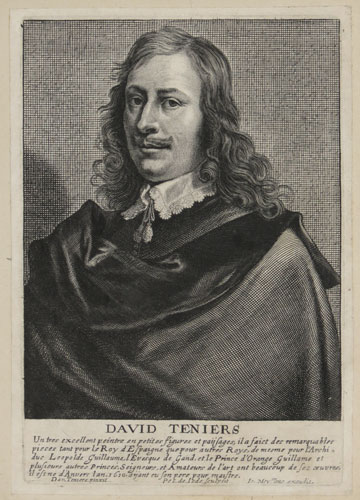
David Teniers. Un tres excellent peintre en petites figures et paijsages, il a faict des remarquables pieces tantpour le Roy d'Espaigne que pour autres Roys, de mesme pour l'Archiduc Leopolde Guillaume, l'Evesque de Gand, et le Prince d'Orange Guillame et plusieurs autres Princes Seigneurs, et Amateurs de l'art ont beaucoup de ses oeuvres, il est ne d'Anvers lan 1610 aijant eu son pere pour maistre.
Dav. Teniers pinxit. Pet. de Iode Sculpsit.
Io. Meyssens excudit. [n.d. c.1622.]
Engraving. Plate 170 x 114mm. 6¾ x 4½". Glued to backing sheet.
David Teniers the Younger (1610-1690), celebrated Flemish artist. The Archduke Leopold Wilhelm, who assumed the government of the Spanish Netherlands, being a great lover of art, employed Teniers not only as a painter but as keeper of the collection of pictures he was then forming. From Cornelis de Bie's "Het gulden cabinet vande edel vry schilder const".
[Ref: 24512] £65.00
(£78.00 incl.VAT)

David Teniers et sa Famille.
D. Teniers, pinx. Jac. Ph. Le Bas Sculp.
[AParis chez l'Auteur au bas de la rue de la Harpe] [n.d., c1747.]
Etching. 370 x 495mm (14½ x 19½"). Trimmed into inscription area, losing dedication and publication line, new margin added, remarque armorial replaced with manuscript. Some foxing.
Portrait of David Teniers and his family, sitting on a terrace, with the artist playing the cello, his wife holding a book, and his son singing.
[Ref: 54289] £240.00
(£288.00 incl.VAT)
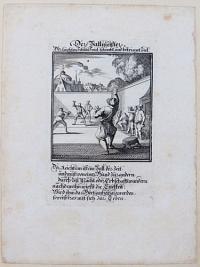
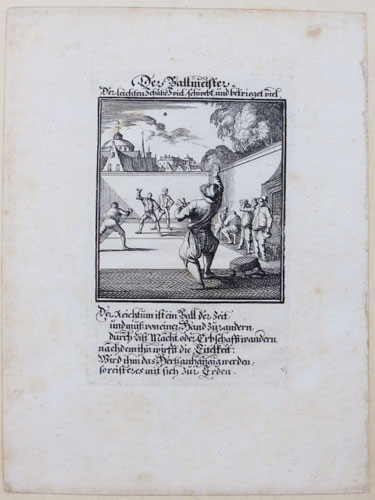
Der Ballmeister.
[Johann Christoph Weigel. 1699.]
Engraving. Plate: 85 x 135mm, (3¼ x 5¼"); large margins.
A rare view of a German Renaissance tennis game with a 'ballmeister' standing with his hands in the air ready to catch a ball thrown by an opponent, they all stand in a ball court. An illustration from 'Abbildung der Gemain-Nutzlichen Haupt-Stande' published by J. C. Weigel (1654-1725) in 1699.
[Ref: 39552] £360.00
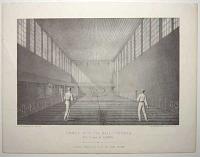
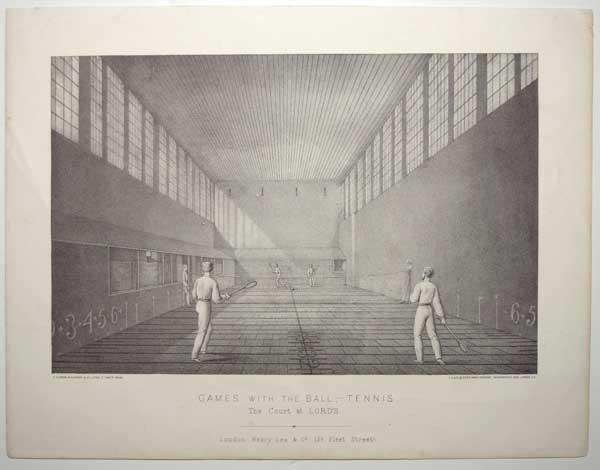
Games With The Ball - Tennis. The Court at Lord's.
R.S. Groom, Wilkinson & Co., Litho, St. Paul's Press. 3, 4 & 5, Queen's Head Passage, Paternoster Row, London, E.C.
London: Henry Lea & Co., 125, Fleet Street. [n.d., c.1860.]
Lithograph. Sheet 225 x 295mm. (9 x 11½").
A game in progress inside the real tennis court at Lord's. At the request of MCC members a tennis court was built in 1839, soon becoming the venue for major championship and exhibition games. From 'The Book of Field Sports and Library of Veterinary Knowledge' by Henry Downes Miles.
[Ref: 62120] £290.00
(£348.00 incl.VAT)
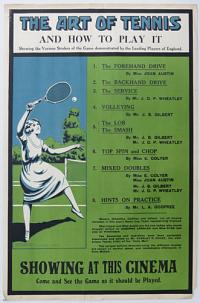
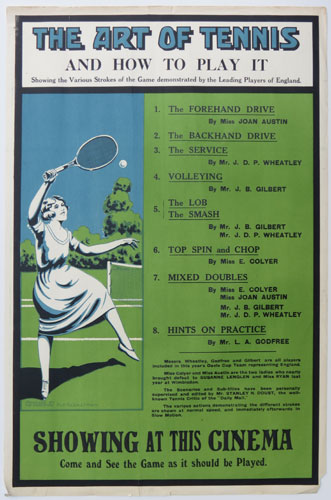
The Art of Tennis and How to Play it. - Showing the Various Strokes of the Game demonstrated by the Leading Players of England. Showing at this Cinema. Come and see the Game as it should be Played...The Scenarios and Sub-titles have been personally supervised and edited by Mr. Stanley N. Doust, the well-known Tennis Critic of the ''Daily Mail''. The Various actions demonstrating the different strokes are shown at normal speed, and immediately afterwards in Slow Motion.
Produced by the Parkstone Film Co. Ltd., Lytham. [n.d., 1925.]
Colour lithograph. 730 x 480mm (29 x 19"). A few small tears to edges.
A poster for a film demonstrating how to play tennis, starring a number of the leading players of the time: Joan Winifred Austin (1903-98), John David Patrick Wheatley (1899-1967), John Brian Gilbert (1887-1974), and Evelyn Lucy Colyer (1902-30). Joan Austin (sister of Bunny Austin, the last Brit to reach the reach the Men's final at Wimbledon before Andy Murray) was British Junior Girls Champion in 1921; in 1923 she and Evelyn Collier, known as 'The Babes', reached the Wimbledon doubles final but were beaten 6-3 6-1 by Suzanne Lenglen & Elizabeth Ryan.
[Ref: 48865] £250.00
(£300.00 incl.VAT)
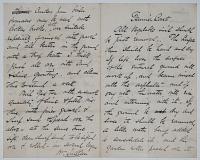
Tennis Court.
[n.d., c.1850]
Pen and ink mss, 200 x 255mm. 8 x 10".
Hand-written instructions for laying an asphalt tennis court. Very early and important document. Provenance: from a scrap album compiled c.1840 - 1880 by Alfred Towgood of Riverside, a paper mill owner at St. Neots, Huntingdon. He was also a Lieutenant in the Duke of Manchester.
[Ref: 16754] £250.00
(£300.00 incl.VAT)
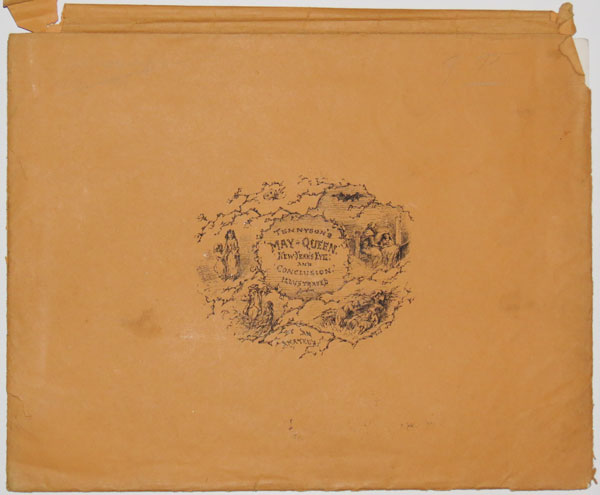
Tennyson's 'May Queen', 'New Year's Eve' and 'Conclusion'
Illustrated by an Amateur.
[n.d., c.1851.]
Lithographic title and five plates, each sheet 225 x 285m (9 x 11¼"), within envelope illustrated with the title, rare. Envelope worn.
Five scenes from Alfred, Lord Tennyson's poems, with a title featuring a medley of four further scenes. One scene is a group dancing around a maypole. All sheets are signed 'R.S.B.', one dated 1850, another 1851. Ex collection of the Hon Christopher Lennox-Boyd.
[Ref: 34203] £260.00
(£312.00 incl.VAT)
view all images for this item
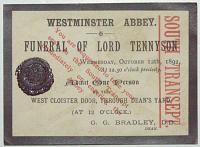
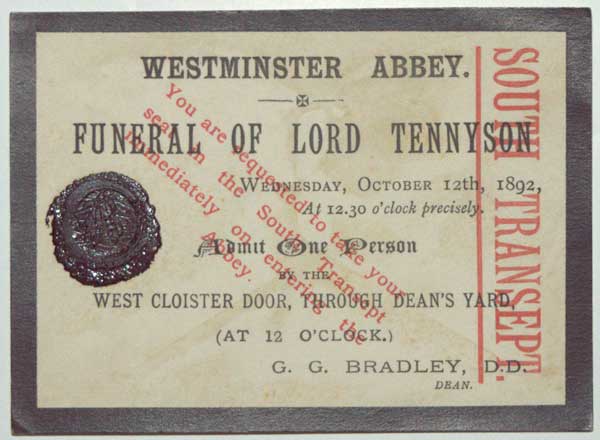
Westimster Abbey. Funeral of Lord Tennyson. Wednesday, October 12th, 1892, At 12.30 o'clock precisely. Admit One Person by the West Cloister Door, Through Dean's Yard, (at 12 O'Clock.) G.G. Bradley, D.D. Dean. South Transept. You are requested to take your seat in the South Transept immediately on entering the Abbey.
[1892.]
Printed invitation with black wax seal. Sheet 90 x 125mm (3½ x 5"). Some staining.
[Ref: 57592] £240.00
(£288.00 incl.VAT)
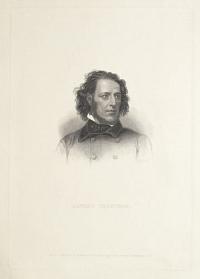
Alfred Tennyson.
W.H. Mote.
London Published by W. Kent& C.o late David Bogue, Fleet Street & Paternonster Row.
Stiple with engraving 8 x 5½ (205 x 140mm), with margins. Some creasing in the margins.
Head and shoulders portrait of a younger Alfred Tennyson (1809-1892), 1st Baron Tennyson, before his peerage in 1883, wearing a coat, a cravat tucked into a shirt, his hair loose; almost to his shoulders and a chinstrap beard. He served as poet laureate for most of Queen Victoria's reign and was one of the most popular poets of the Victorian age. His most well known poem is "The Charge of the Light Brigade".
[Ref: 54838] £90.00
(£108.00 incl.VAT)
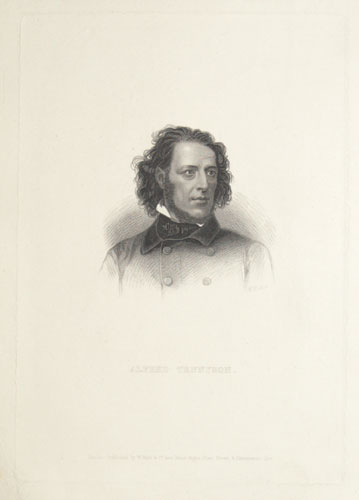
![Lord Tennyson. Poet-Laureate. 1851-1892. Tennyson [facsimile signature inside plate.]](img-thumbnail/jpegs/17374.jpg)
Lord Tennyson. Poet-Laureate. 1851-1892. Tennyson [facsimile signature inside plate.]
From a Photo by Permission of Barraud's, London. Artist's First Proof J.A.Vinter [facsimile signature.] Artist to the Queen. Copyright.
London, Published by W.H. Coaten. 83, Charlotte St. Fitzroy Sq.re W. [n.d. c.1870.]
Scarce Proof lithograph on india. Sheet 610 x 345mm. 14 x 13½". Soiling in margins. Tears into margin.
Alfred Tennyson, 1st Baron Tennyson (1809 - 1892), Poet Laureate. Tennyson was made a baron in 1883, the first writer to be so honoured. At this time he wrote a number of verse plays on historical themes such as Queen Mary (1875) and Becket (1884). The great poet was generally seen as being beyond criticism but Sir Henry Irving rudely complained that, 'Tennyson is a great poet, but he cannot write plays. What a pity he tries, they are the greatest rubbish!'
[Ref: 17374] £330.00
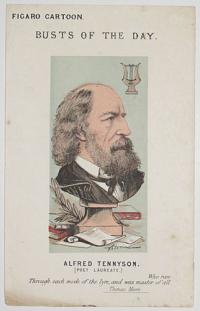
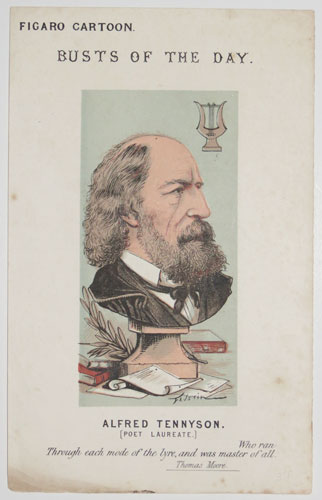
Alfred Tennyson. (Poet Laureate.) Figaro Cartoon. Busts of the Day.
Faustin.
[n.d., c.1860.]
Chromolithograph. Sheet: 135 x 220mm (15 x 9"). Some light foxing.
A portrait of Alfred Lord Tennyson (1809-1892) who served as poet laureate for most of Queen Victoria's reign and was one of the most popular poets of the Victorian age.
[Ref: 45804] £60.00
(£72.00 incl.VAT)
![[Alfred, Lord Tennyson.]](img-thumbnail/jpegs/13095.jpg)
[Alfred, Lord Tennyson.]
H.H. 79. Hubert Herkomer [pencil signature.]
[Goupil & Co., 1879.]
Etching printed in brown ink on watermarked laid paper, artist's remarque proof. From an edition limited to 25, numbered 'No 9' in pencil lower right. 590 x 440mm, 23¼ x 17¼". Very slight trace of age toning to paper; a fine impression.
Alfred Tennyson, 1st Baron Tennyson (1809 - 1892), Poet Laureate. Tennyson was made a baron in 1883, the first writer to be so honoured. At this time he wrote a number of verse plays on historical themes such as Queen Mary (1875) and Becket (1884). The great poet was generally seen as being beyond criticism but Sir Henry Irving rudely complained that, 'Tennyson is a great poet, but he cannot write plays. What a pity he tries, they are the greatest rubbish!' Remarque lower right of Tennyson's head directed to left, with slightly longer hair and beard. By Sir Hubert von Herkomer (1849 - 1914), painter, watercolourist, draughtsman and etcher of portraits, landscapes, genre subjects. In 1869 he began working as an artist for a newly-founded newspaper 'The Graphic'. Herkomer was also a pioneering film maker. He established a studio in Lululaund and directed a number of historical costume dramas, designed to be shown accompanied by his own music. Printseller's Association blindstamp lower left. Printseller's Association: pg.375.
[Ref: 13095] £350.00
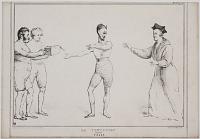
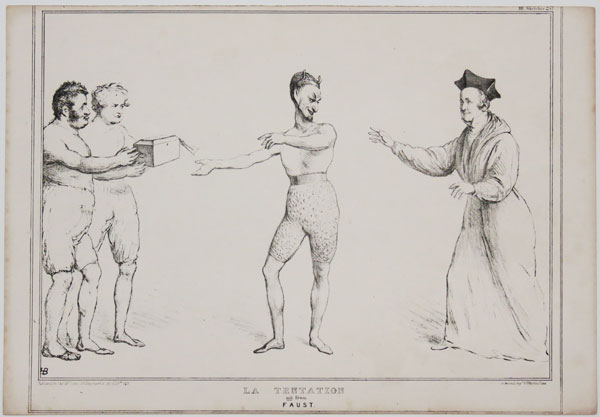
La Tentation not from Faust. HB Sketches 257.
HB [John Doyle]. A. Ducote's Lithography. 70 St. Martins Lane.
Published by Tho.s Mc.Lean, 26, Haymarket, April 29th 1833.
Lithograph. Size: 370 x 280mm. (14½ x 11").
Sir Robert Peel, in the character of Faust, is tempted by Mephistopheles to sell his soul to the Whigs, for the price of the office of First Lord of the Treasury.
[Ref: 31420] £70.00
(£84.00 incl.VAT)
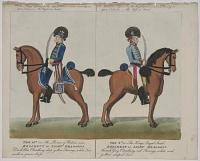
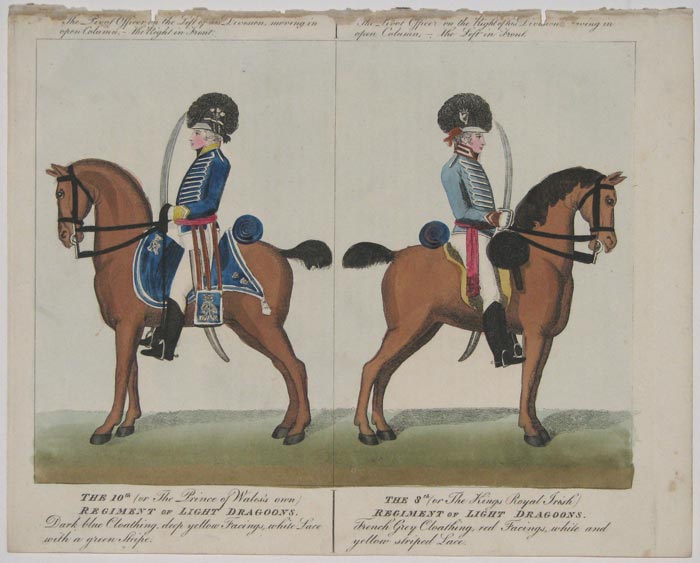
The 10th (or The Prince of Wales's own) Regiment of Light Dragoons. The 8th (or The King's Royal Irish) Regiment of Light Dragoons.
[Pub. by J. Carpenter & Co., Old Bond Street, Oct. 1800.]
Hand-coloured engraving, 225 x 165mm. 9 x 6½". 1798 watermark in paper. Trimmed; damage to text at top.
A military costume engraving, from a series published in the British Military Library or Journal. Ogilby 134.26
[Ref: 11168] £140.00
(£168.00 incl.VAT)
![[Two men seated at a table.]](img-thumbnail/jpegs/23133.jpg)
[Two men seated at a table.]
Terburg, Pinx. Van Somer, fec. [lower left of image.]
F. de Wit Exc. [lower centre of image.]
Mezzotint, scarce, 265 x 220mm (10½ x 8½"). Cut to image.
A man sits disconsolately at a table, absent-mindedly toying with his snuffbox, with a friend looking at him across the table and a standing figure holding a straw-covered wine bottle. Engraved by Dutch mezzotinter Jan van Somer (c.1645-99) after Gerard Ter Borch's 'Scene at an Inn' (c. 1648/50, private collection). Unusually, Van Somer also made another print of the same scene, but in reverse. It has been said of the painting from which this print derives that 'no painting in Ter Borch's oeuvre conveys with such overwhelming power the emotion of loneliness and despair'. The model for the seated figure on the right was a member of the Spanish delegation to Munster for the signing of the 1648 treaty which made the United Netherlands independent from Spain. The same sitter appears in Ter Borch's famous painting of the ratification of that treaty. Hollstein: 62; for the painting see 'Gerard ter Borch' (NGA, Washington, 2005, cat.15).
[Ref: 23133] £220.00
(£264.00 incl.VAT)

English Ambassador's Palace at Terapia.
A.N.del. I.Clark sc.
[Published by Mess.rs Longman, Hurst, Rees, Orme & Brown, Paternoster Row, 1818.]
Coloured aquatint, rare. Image area 101 x 165mm (4 x 6½"). Cut.
A view of the Ambassador's residence at Terapia, 'built on a little rocky promontory overhanging the "enchanted current" of the Bosphorus'. From Adam Neal, M.D. 'Travels through some parts of Germany, Poland, Moldavia and Turkey', London, 1818.
[Ref: 31165] £65.00
(£78.00 incl.VAT)
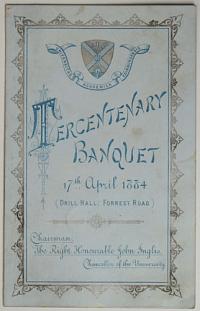
Tercentenary Banquet 17.th April 1884 (Drill Hall: Forrest Road). Chairman, The Right Honourable John Inglis. Chancellor of the University.
C. Stewart & Co. [1884.]
Progamme and menu; booklet. 182 x 115mm. 7¼ x 4½".
A booklet with the menu, toast list and the programme of music for the University of Edinburgh's tercentenary banquet.
[Ref: 21016] £50.00
(£60.00 incl.VAT)
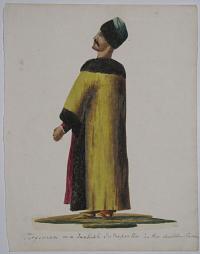
Tergeman or a Turkish Interpreter in the Austrian Service
[n.d. c.1830]
Watercolour and pen. Sheet 296 x 229mm. 11¾ x 9".
From the Collection of Gubbins and Gibbin's Family.
[Ref: 15278] £160.00
(£192.00 incl.VAT)

Isometrical Plan of Mr. Grainger's Proposed Concentration of the Termini of the Several Railways from London, Edinburgh, Carlisly, Shields and Sunderland, at a General Depot at Elswick.
Engraved by W. Collard.
T. Sopwith, C.E. [n.d. c.1840.]
A very rare and scarce engraving. Sheet 406 x 247mm. 16 x 9¾". Laid on separate sheet.
It was in 1839 that Mr. Richard Granger (1797-1861) the builder from Newcastle upon Tyne, known for taking on the task of building and developing Grainger Town, decided to buy the Elswick estate to the west of Newcastle with the intention of building a railway terminus. These plans never went ahead, as Grainger bankrupted himself in purchasing the land, and following his death, his debts were greater than his personal estate, so the sale of the land in the Elswick estate helped pay off these debts. Thomas Sopwith (1803-1879), also from Newcastle, was a miner and railway surveyor, writing his best-known book "Treatise on Isometrical Drawing".
[Ref: 16104] £360.00
![[The Temple of Apollo]. Al Sig.r Luigi Pavon Amatore delle elle Arti.](jpegs/55087.jpg)


![Palmerston [signature facsimile.]](jpegs/27549.jpg)


![[Richard Grenville Temple?] A Temple Macaroni.](jpegs/14172.jpg)
![[William Temple] Dominus Gulielmus Temple Eques Baronettus](jpegs/59416.jpg)


![[Ten Trinity Square.] P.L.A. London. [in pencil.]](jpegs/43213.jpg)
![[Ten vignettes]](jpegs/67729.jpg)

![[Greek War of Independence.] Die Helden von Tenedos.](jpegs/29826.jpg)

![[Two men.]](jpegs/30933.jpg)

![[Teniers's Kitchen or Allegory of the Four Elements.]](jpegs/40065.jpg)
![[A drinking scene.]](jpegs/34655.jpg)




![Lord Tennyson. Poet-Laureate. 1851-1892. Tennyson [facsimile signature inside plate.]](jpegs/17374.jpg)
![[Alfred, Lord Tennyson.]](jpegs/13095.jpg)
![[Two men seated at a table.]](jpegs/23133.jpg)