![[Fern Tree Valley, Mount Wellington.]](img-thumbnail/jpegs/22633.jpg)
[Fern Tree Valley, Mount Wellington.]
J.S. Prout [signed on stone.]
[Hobart, Tasmania: J.S. Prout, 1844.]
Rare sepia-tinted lithograph heightened in white, sheet 265 x 400mm. 10½ x 15¾". Trimmed to image.
Plate to the rare folio 'Tasmania Illustrated' by John Skinner Prout (1805 - 1876); the artist seated, sketching amongst the trees, his portfolio and hat in foreground. Published in two parts, the first with titlepage and twelve views on eleven plates, with six plates forming the second part. The nephew of the artist Samuel Prout, Prout was born in Plymouth in 1806. He travelled to Australia in the late 1830s and arrived in New South Wales in 1840. In 1844 Prout and his family moved to Hobart, the capital of Tasmania. On 14 June he announced a course of lectures 'on the cultivation of the fine arts, with practical illustrations'. They were well received and later in the year he published the first volume of Tasmania Illustrated, 'five grouped vignettes of Tasmanian scenes'. By the time the second volume appeared in 1846 Prout had toured the North of the island, where he was 'engaged by several gentlemen for the purpose of sketching their country seats, farms, and the country surrounding them'. He returned to England in 1848 and began exhibiting many of his Australian works in London.
The original watercolour can be found in the National Gallery of Victoria, Melbourne.
See Craig, Clifford The Engravers of Van Diemen's Land pp.61-63. Australian Dictionary of Biography: Hodgman, V. W., 'Prout, John Skinner (1805–1876)'. Plate 5. See State Library of Tasmania PRINT.RO
[Ref: 22633] £320.00
![[Hobart Town from the New Town road.]](img-thumbnail/jpegs/22634.jpg)
[Hobart Town from the New Town road.]
J.S. Prout [signed on stone.]
[Hobart, Tasmania: J.S. Prout, 1844.]
Rare sepia-tinted lithograph heightened in white, sheet 250 x 380mm. 9¾ x 15". Trimmed to image.
Fine prospect of Hobart. Plate to the rare folio 'Tasmania Illustrated' by John Skinner Prout (1805 - 1876). Published in two parts, the first with titlepage and twelve views on eleven plates, with six plates forming the second part. The nephew of the artist Samuel Prout, Prout was born in Plymouth in 1806. He travelled to Australia in the late 1830s and arrived in New South Wales in 1840. In 1844 Prout and his family moved to Hobart, the capital of Tasmania. On 14 June he announced a course of lectures 'on the cultivation of the fine arts, with practical illustrations'. They were well received and later in the year he published the first volume of Tasmania Illustrated, 'five grouped vignettes of Tasmanian scenes'. By the time the second volume appeared in 1846 Prout had toured the North of the island, where he was 'engaged by several gentlemen for the purpose of sketching their country seats, farms, and the country surrounding them'. He returned to England in 1848 and began exhibiting many of his Australian works in London. See Craig, Clifford The Engravers of Van Diemen's Land pp.61-63. See NLA 1383556. Australian Dictionary of Biography: Hodgman, V. W., 'Prout, John Skinner (1805–1876)'. See State Library of Tasmania P
[Ref: 22634] £320.00
![[Cape Raoul, V.D.L.]](img-thumbnail/jpegs/22622.jpg)
[Cape Raoul, V.D.L.]
J.S. Prout 1844 [signed and dated on stone.]
[Hobart, Tasmania: J.S. Prout, 1844.]
Rare sepia-tinted lithograph heightened in white, sheet 170 x 275mm. 6¾ x 10¾". Trimmed to image.
On the same plate as 'Cape Pillar & Tasman's Island' (see item 22625), in the rare folio 'Tasmania Illustrated' by John Skinner Prout (1805 - 1876). Published in two parts, the first with titlepage and twelve views on eleven plates, with six plates forming the second part. The nephew of the artist Samuel Prout, Prout was born in Plymouth in 1806. He travelled to Australia in the late 1830s and arrived in New South Wales in 1840. In 1844 Prout and his family moved to Hobart, the capital of Tasmania. On 14 June he announced a course of lectures 'on the cultivation of the fine arts, with practical illustrations'. They were well received and later in the year he published the first volume of Tasmania Illustrated, 'five grouped vignettes of Tasmanian scenes'. By the time the second volume appeared in 1846 Prout had toured the North of the island, where he was 'engaged by several gentlemen for the purpose of sketching their country seats, farms, and the country surrounding them'. He returned to England in 1848 and began exhibiting many of his Australian works in London. NLA 2906063. Australian Dictionary of Biography: Hodgman, V. W., 'Prout, John Skinner (1805–1876)'. Plate 7.
[Ref: 22622] £180.00
(£216.00 incl.VAT)
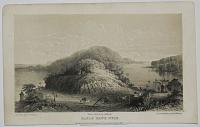
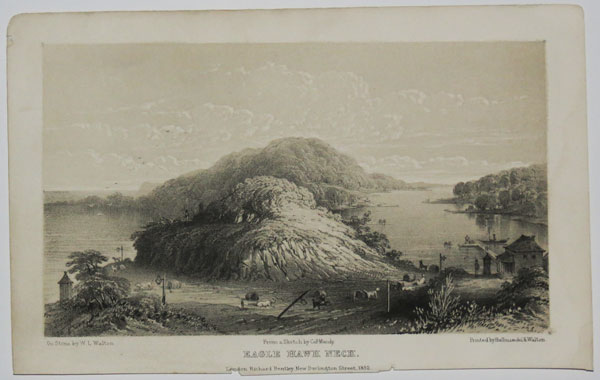
Eagle Hawk Neck.
On Stone by W.L. Walton. From a Sketch by Coll. Mundy. Printed by Hullmandel & Walton.
London: Richard Bentley, New Burlington Street, 1852.
Tinted lithograph, sheet 140 x 220mm (5½ x 8½").
Eagle Hawk Neck, the narrow isthmus connecting the Tasman Peninsula and Forestier Peninsula in south-east Tasmania. Plate from 'Our Antipodes' (1852) by Lieutenant-Colonel Godfrey Charles Mundy (1804-60), soldier and author. Following service in India, Mundy arrived in Australia in 1846 as deputy adjudant general of military forces in Australia, staying there until 1851. Abbey 562.11.
[Ref: 43381] £130.00
(£156.00 incl.VAT)
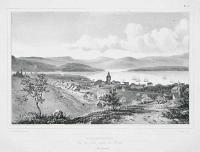
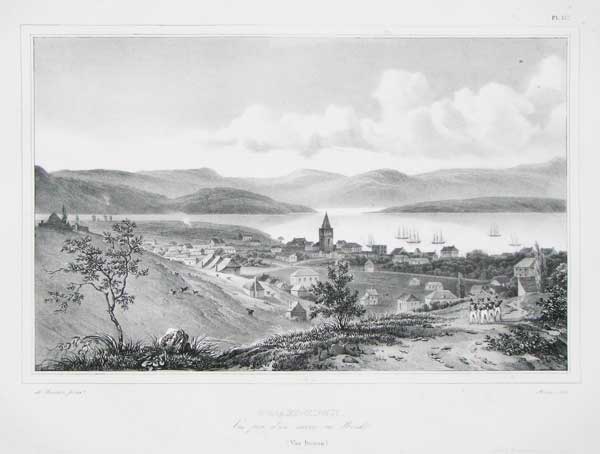
Hobart-Town. Vue prise d'un ravin au Nord. ( Van Diemen.)
de Sainson pinxt. Hostein Lith.
J. Tastu, Editeur. Lith. de Bichebois ainé. rue clery, 23. [Paris, 1833.]
Lithograph. Printed area 275 x 335mm, 11 x 13¼".
View looking down on the Derwent River Hobart Town and Harbour, Tasmania. From 'Voyage de la Corvette l'Astrolabe', the account of Jules Dumont D'Urville's important expedition to the South Seas between 1826 and 1829.
[Ref: 13493] £480.00
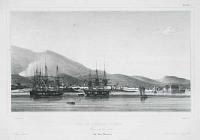
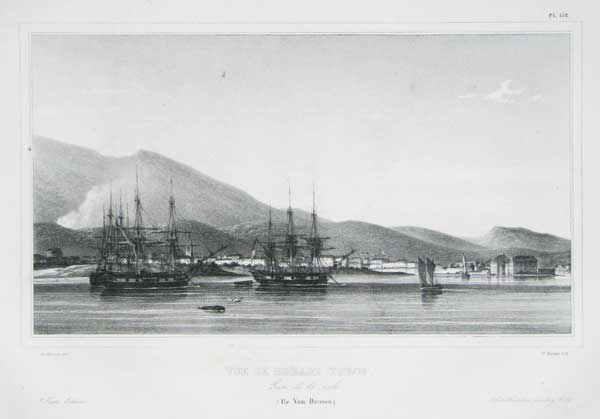
Vue de Hobart-Town. Prise de la rade (Ile Van Diemen].
de Sainson pinxt. St Aulaire Lith.
J. Tastu, Editeur. Lith. de Bichebois ainé. rue clery, 23. [Paris, 1833.]
Lithograph. Printed area 275 x 335mm, 11 x 13¼".
View of Hobart Showing the Harbour and Mt. Wellington. From 'Voyage de la Corvette l'Astrolabe', the account of Jules Dumont D'Urville's important expedition to the South Seas between 1826 and 1829.
[Ref: 13495] £550.00

Hobart-Town. Vue de côté des Casernes. Ile Van-Diemen.
de Sainson pinxt. Alexis Noël.
J. Tastu, Editeur. Lith. de Bichebois ainé. [Paris, 1833.]
Lithograph. Printed area 275 x 335mm, 11 x 13¼", with large margins. Foxing in edges.
View looking down on Hobart, Tasmania showing the barracks. From 'Voyage de la Corvette l'Astrolabe', the account of Jules Dumont D'Urville's important expedition to the South Seas between 1826 and 1829.
[Ref: 50946] £520.00
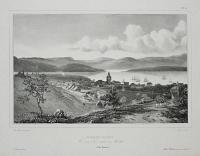
Hobart-Town. Vue prise d'un ravin au Nord. ( Van Diemen.)
de Sainson pinxt. Hostein Lith.
J. Tastu, Editeur. Lith. de Bichebois ainé. rue clery, 23. [Paris, 1833.]
Lithograph. Printed area 275 x 335mm, 11 x 13¼", with large margins.
View looking down on the Derwent River Hobart Town and Harbour, Tasmania. From 'Voyage de la Corvette l'Astrolabe', the account of Jules Dumont D'Urville's important expedition to the South Seas between 1826 and 1829.
[Ref: 50947] £480.00
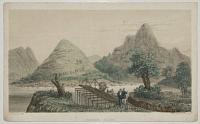
Shouten Island.
_Lake, Esq. delt.
Smith, Elder & Co., London. [n.d., 1856.]
Hand coloured lithograph, image 105 x 190mm. 4 x 7½".
Schouten Island in eastern Tasmania, Australia. The island lay within the territory of the Oyster Bay tribe of Tasmanian Aborigines. In 1642, while surveying the south-west coast of Tasmania, Abel Tasman named the island after a member of the Council of the Dutch East India Company. Plate to 'A residence in Tasmania: with a descriptive tour through the island from Macquarie Harbour to Circular Head by H. Butler Stoney'. National Library of Australia: 117601. Abbey Travel: 604, 7.
[Ref: 10786] £95.00
(£114.00 incl.VAT)

Embossed Tableaux. Tasso.
Dobbs, Bailey & Co. [n.d., c.1845.]
Embossed card with printed sepia in border. Sheet 255 x 275mm, 10 x 10¾". Spotted.
An embossed bust of Torquato Tasso (1544-95), Italian poet best known for his poem 'La Gerusalemme liberata' (Jerusalem Delivered), 1580. He died a few days before he was due to be crowned as the 'king of poets' by Pope Clement VIII. See Ref: 16705
[Ref: 16704] £110.00
(£132.00 incl.VAT)

Torquato Tasso. a Vienne chez Artaria.
P. Savart, Sculp.
[n.d. c.1790.]
Engraving. Plate 160 x 107mm. 6¼ x 4¼". Large margins.
Torquato Tasso (1544-1595) was an Italian poet of the 16th century, best known for his poem 'La Gerusalemme liberata'. He died a few days before he was due to be crowned as the 'king of poets' by Pope Clement VIII.
[Ref: 23237] £60.00
(£72.00 incl.VAT)

En gouterai-je?
L. Noël. Lithog: de F. Noël.
Publié par Giraldon-Boivinet et Comp.ie, M.de d'estampes, Commissionnaires, rue Pavée St André, N.º 5.
Coloured lithograph. Sheet 340 x 255mm (13½ x 10"). Some cockling of paper at top corners, dusty.
'Will I taste it?'. A man in an embroidered dressing gown and nightcap stirs a cup, with an uncorked medicine bottle on the table next to him.
[Ref: 62447] £140.00
(£168.00 incl.VAT)
![[Taste.]](img-thumbnail/jpegs/60167.jpg)
[Taste.]
[Engraved by Pieter Schenck after Andries Both.]
[n.d., c.1720.][Bit Later]
Mezzotint. 220 x 175mm (8¾ x 7"). Trimmed into plate at bottom, thread margins elsewhere.
A group of hungry peasants devour pancakes made by an elderly woman outside. A reversed copy of an etching by Jan Both, one of the 'Five Senses' after his brother Andries. BM: Sheepshanks.6683.
[Ref: 60167] £75.00
(£90.00 incl.VAT)
![[Taste. Feast of the Gods] Geschmack. Das Gustunal der Götter. Gustus. Convivium Deorum.](img-thumbnail/jpegs/57612.jpg)
[Taste. Feast of the Gods] Geschmack. Das Gustunal der Götter. Gustus. Convivium Deorum. Le Gout. Le Repas des Dieux. Il Gusto. Il Convivio dé Dei.
Lodovico Burnacim inv. del. Balthasar Sigmund Setlezky Sculpsit.
Negotium Academiæ Cæs. Francisceæ excudit Aug. Vind. Cum Gratoa et Privilegio Sac. Cæs. Majestatis [Augsburg, n.d., c.1760].
Engraving with hand colour. 295 x 430mm (11½ x 17") very large margins. Some creasing, worm hole in image.
A stage set, with the Olympian gods attending a banquet in a room with walls of smoke and decorated with dishes, served by satyrs. It was engraved by Balthasar Sigmund Setlezky (1695-1771) from one of the 25 stage sets designed by Lodovico Burnacini (1636-1707) for the opera 'Il Pomo d'Oro', by the Italian composer Antonio Cesti with a libretto by Francesco Sbarra, staged 1668.
[Ref: 57612] £290.00
(£348.00 incl.VAT)

Le Goût. Der Geschmack.
G. Spizel inv. et pinx.
Joh. Jac. Haid exc. A.V. [n.d., c.1750.]
Mezzotint. Sheet 405 x 280mm (16 x 11"). Trimmed into image on three sides, laid on archival paper. Repairs.
'Taste': a boy eating breakfast is handed a cup of coffee by a girl. Both are dressed as adults. Plate three of 'The Five Senses'.
[Ref: 66208] £390.00
![[The Devil's Tower, Yelabuga, Tatarstan, titled in Cyrillic.]](img-thumbnail/jpegs/63695.jpg)
[The Devil's Tower, Yelabuga, Tatarstan, titled in Cyrillic.]
[Ivan Ivanovich Shishkin.]
[1855.]
Lithograph. Sheet 300 x 220mm (11¾ x 8¾"). Long split taped, trimmed close at top, creasing and folds.
A sketch of a 12th century watchtower, a rare surviving building of the mediæval state of Volga Bulgaria, which was ended by the Mongol invasion in the 13th century. It shows the tower before extensive restoration by a local merchant in 1867, which including re-roofing it and preventing entry. The merchant's son was Ivan Ivanovich Shishkin (1832-98), a famous painter who drew this sketch. Underneath is a sketch map of the area.
[Ref: 63695] £70.00
(£84.00 incl.VAT)
![[Tate Gallery].](img-thumbnail/jpegs/5687.jpg)
[Tate Gallery].
Nathaniel Sparks [pencil].
[n.d. c.1912.]
Etching, signed by the artist. 340 x 165mm (13½ x 6½").
Nathaniel Sparks R.E. (1880-1956). The original Tate was called the National Gallery of British Art, situated on Millbank, Pimlico, London at the site of the former Millbank Prison, officially opened July 1897. Sir Henry Tate, sugar refiner, left his art collection to the nation, forming the basis for Tate Gallery.
[Ref: 5687] £240.00
(£288.00 incl.VAT)
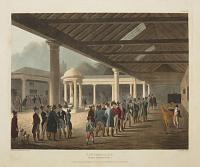
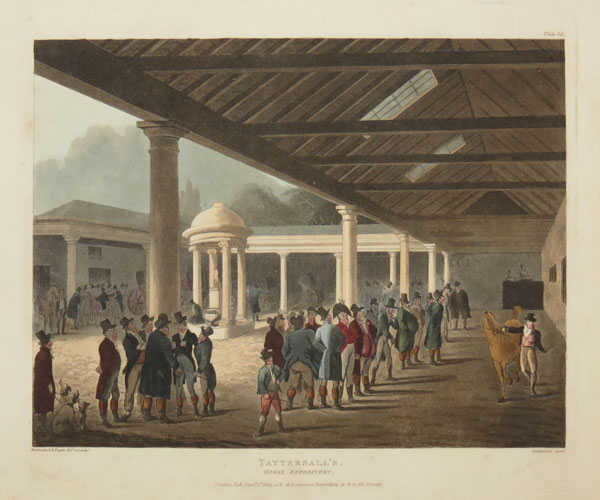
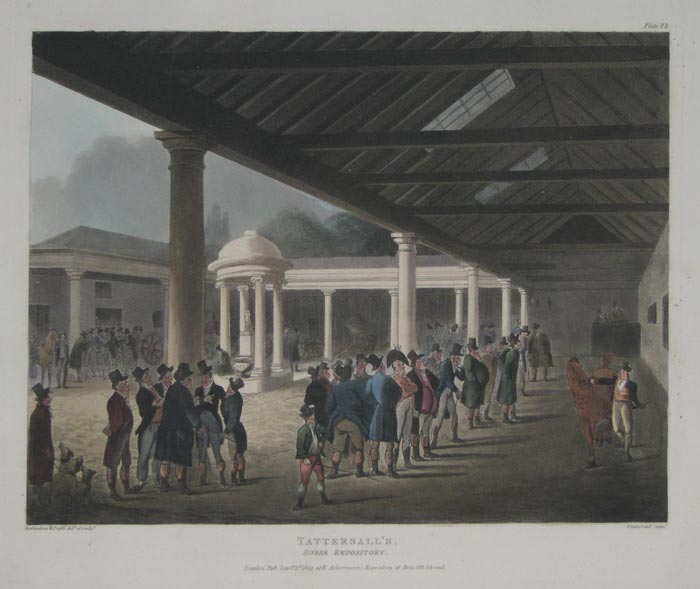
Tattersall's, Horse Repository.
Rowlandson & Pugin del.t et sculp.t. Sunderland aqua.t.
London Pub. Sept.r 1st 1809 at R. Ackermann's Repository of Arts 101 Strand.
Hand-coloured aquatint. Plate: 240 x 270mm (9½ x 10½") large margins.
A view of the central yard at Tattersall's auction house which sold horses and carriages. In the background several carriages are lined up, in the foreground a group of men are lined up inspecting a horse brought before them. A plate from Ackermann's 'Microcosm of London' (1808-9), a landmark publication in the documentation of London, bringing together two specialist artists, Thomas Rowlandson to design the figures and Augustus Pugin to provide the architectural draughtsmanship. The result was a series of scenes unprecedented in their combination of vivid activity and architectual accuracy. Abbey, Scenery: 212.
[Ref: 47218] £120.00
(£144.00 incl.VAT)
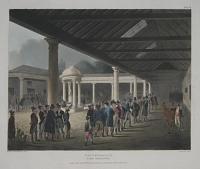
Tattersall's, Horse Repository.
Rowlandson & Pugin delt. et sculpt. Sunderland aquat.
London Pub. Septr. 1st. 1809, at R. Ackermann’s Repository of Arts 101 Strand.
Hand coloured aquatint, 235 x 270mm. 9¼ x 10½".
A horse is inspected by prospective buyers as it goes under the hammer at Tattersalls, to this day the main auctioneer of race horses in the United Kingdom. It was founded in 1766 by Richard Tattersall (1724 - 1795), who had been stud groom to the second Duke of Kingston. The first premises occupied were near Hyde Park Corner, in what was then the outskirts of London. Two "Subscription rooms" were reserved for members of the Jockey Club, and they became the rendezvous for sporting and betting men. Among the famous dispersal sales conducted by "Old Tatt" were those of the Duke of Kingston's stud in 1774 and of the stud of the Prince of Wales (afterwards George IV) in 1786. Plate to Volume III of Rudolph Ackermann's 'Microcosm of London', 3 vols., 1808-10. Numbered 'Plate 83.' upper right. Abbey, Scenery: 212, 83.
[Ref: 9868] £160.00
(£192.00 incl.VAT)
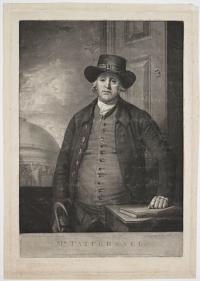
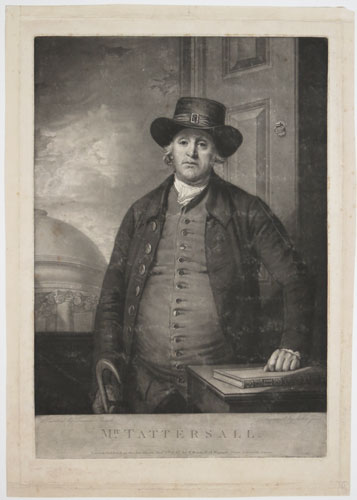
Mr. Tattersall.
Painted by Thomas Beach. Engraved by John Jones.
London, Publish'd as the Act directs, Decr. 8th 1787, by T. Beach, No. 54 Wigmore Street, Cavendish Square.
Mezzotint, rare, 505 x 350mm. 19¾ x 13¾". Few foxing marks, surface a little rubbed.
Imposing portrait of Richard Tattersall (1724 - 1795), horse dealer; his left hand resting on a 'Stud Book' on table at right, his right hand on a walking cane, wearing plain coat and hat with buckle. In 1766 he founded Tattersalls, to this day the main auctioneer of race horses in the United Kingdom. Tattersall had been stud groom to the second Duke of Kingston. The first premises occupied were near Hyde Park Corner, in what was then the outskirts of London. Two "Subscription rooms" were reserved for members of the Jockey Club, and they became the rendezvous for sporting and betting men. Among the famous dispersal sales conducted by "Old Tatt" were those of the Duke of Kingston's stud in 1774 and of the stud of the Prince of Wales (afterwards George IV) in 1786. After Thomas Beach (1738 - 1806). Chaloner Smith 71.
[Ref: 25964] £620.00
![Tattershall Castle [ms.]](img-thumbnail/jpegs/34508.jpg)
Tattershall Castle [ms.]
T. Girtin [ms]
Etching and aquatint with hand-colouring and large margins, J. Whatman 1816 watermark; platemark 215 x 305mm (8½ x 12"). Proof, before printed text 'Tattershall Castle- Lincolnshire. / From an original drawing in the possession of Wm. Brand Esq. of Boston. Nov 1 1812'.
Plate from John Hassell's 'Aqua Pictura. Illustrated by a series of original specimens from the works of...all the most approved modern water coloured draftsmen...' (1813). This volume was an ambitious project containing fifteen plates, each in four states, to illustrate the development of a watercolour from initial drawing to completed work. This print, finished with hand-colouring, replicates the original watercolour by Thomas Girtin. Girtin had died several years previously, but had drawn Tattershall Castle as the basis for an engraving in a series of views in Lincoln, in 1799. The engraver and publisher John Hassell (1767-1825) was also a drawing master, and like several other of his books, 'Aqua Pictura' was designed for educational purposes. Abbey Life 140.10
[Ref: 34508] £160.00
(£192.00 incl.VAT)

Ein tatuirter Mann aus Nukahiwa.
[Honegger.]
[Schinz, c.1845.]
Lithograph. 327 x 228mm (12¾ x 9").
Head and shoulder portrait of a tattooed man of Nuku Hiva, French Polynesia. From Heinrich Rudolf Schinz's "Naturgeschichte und Abbildungen des Menschen".
[Ref: 29505] £140.00
(£168.00 incl.VAT)

The Tavern in an Uproar; M.rs Bonniface shewing more Pluck than her ''good Man'' by backing her husband against Bob Hit-a-Body ripe for mischief; A case for the Phrenologists.
Designed & Etched by Theodore Lane.
[London: Knight & Lacey, and Pierce Egan, 1827.]
Coloured etching. 130 x 220mm (5 x 9"). Trimmed on three sides, hole in right edge, some staining, colour faded.
A scene of a tavern brawl, from ''Pierce Egan's Anecdotes of the Turf, the Chase, the Ring and the Stage''.
[Ref: 63955] £70.00
(£84.00 incl.VAT)
![[Tavern Scene.]](img-thumbnail/jpegs/12253.jpg)
[Tavern Scene.] From a Painting by D: Teniers, in the Collection of Sir James Lowther, Bar.t
Teniers pinx.t Wbaillie Sculp.t
Publish'd 23.d Dec.r 1771.
Mezzotint, 445 x 340mm. 17½ x 13¼". Later issue c.1800. Margins foxed.
Tavern scene with a card game taking place, after David Teniers II (1610-90), Engraved by Captain William Baillie (1723-1810). Baillie retired from the army in 1761 with the rank of Captain and thereafter devoted himself to printmaking and dealing. He specialised in imitating old-master drawings and prints, using a variety of printmaking techniques. Timothy Clayton and Anita McConnell, ‘Baillie, William (1723–1810)’, Oxford Dictionary of National Biography
[Ref: 12253] £280.00
(£336.00 incl.VAT)
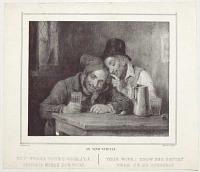
In Vino Veritas. Vot Femme Voyez-Vous, J'La Connais Mieux Que Vous. Your wife, I Know Her Better Than Ye Do Yourself.
F. Grenier [in image]. F. Grenzier del. Litho de Ch. Motte.
[n.d. c.1830's]
Scarce lithograph, sheet 200 x 230mm (8 x 9"). Embossed stamp of C Motte.
In wine, there is truth. A tavern scene. A man drunkenly admits to another that he has been with his wife.
[Ref: 61671] £260.00
(£312.00 incl.VAT)
![[Tavern scene.]](img-thumbnail/jpegs/12001.jpg)
[Tavern scene.]
[n.d., 1680.]
Mezzotint, 235 x 190mm. Very fine early proof.
Tavern scene reminiscent of Teniers and Ostade, with three men sitting at benches with a fourth standing and holding a jug. Collection J. H. Anderson.
[Ref: 12001] £420.00
![[Tavern scene.]](img-thumbnail/jpegs/18820.jpg)
[Tavern scene.] V, II. p: 182.
[n.d. c.1780.]
Engraving. Plate 127 x 82mm. 5 x 3¼".
A drinking scene inside a tavern. Men and women sitting and standing drinking into the night, one particular man standing near to the large fire, smokes a pipe whilst gazing across at a woman seated next to a magician. Behind the curtain another man tries to sleep. Ex Norman Blackburn Collection.
[Ref: 18820] £50.00
(£60.00 incl.VAT)
![[Interior of an inn, Dutch School.]](img-thumbnail/jpegs/21781.jpg)
[Interior of an inn, Dutch School.] From the Original Picture by Gd. Dou in the Possession of Wm. Baillie Esqr.
WBaillie fecit.
Publish'd 1st. Janry. 1774.
Mezzotint printed in brown and black, 355 x 250mm. 14 x 9¾". Small hole to title area. Repaired tear lower right.
Two soldiers in plumed hats at a table; the nearer of the two lighting his pipe from a candle, the other holding a piece of straw, tickling a woman under the nose, who sits sleeping beside them. A serving-woman enters the room at left, carrying a lamp and pitcher. After Gerard Dou (1613 - 1675), who worked in Rembrandt's studio as a young man and went on to become the first and most famous of the Leiden 'Fine' painters. Engraved by Captain William Baillie (1723-1810). Baillie retired from the army in 1761 with the rank of Captain and thereafter devoted himself to printmaking and dealing. He specialised in imitating old-master drawings and prints, using a variety of printmaking techniques. Clayton and McConnell, ‘Baillie, William (1723–1810)’. DNB.
[Ref: 21781] £230.00
(£276.00 incl.VAT)
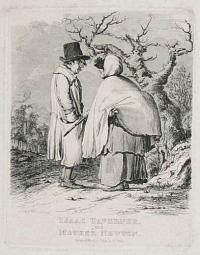
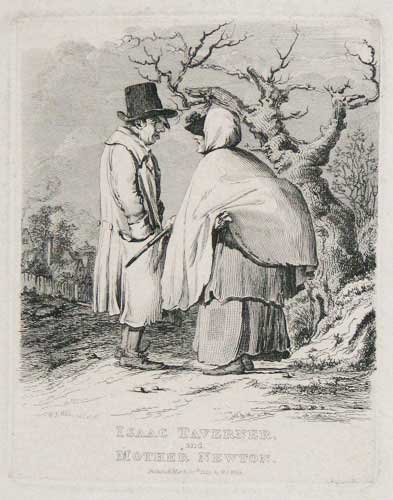
Isaac Taverner and Mother Newton.
W. J. White. delt. et sc.
Published, March 20th. 1819. by W. J. White.
Etching on india laid paper, 130 x 100mm. 5 x 4".
A rustic couple conversing beside a leafless tree in a rural landscape; cottages in the distance behind a fence to left. From "Sketches of characters consisting of whole length portraits with picturesque or topographical back-grounds, and distinct plates illustrative of the counties of Norfolk, Cambridgeshire and Middlesex to which are added, biographical and historical notices" by William Johnstone White (1804 - 1829; fl.), engraver, painter, print publisher and printseller.
[Ref: 19216] £45.00
(£54.00 incl.VAT)

Jean Baptiste Tavernier Escuier Baron D'Aubonne, Age de LXXIV Ans, 1679. De Paris, a Delly, du Couchant a l'Auroure,/ De fameux Voiageur courit plus d'une fois [...]
Joan Hainzelman ad vivum del et sculp cum privil Regis 1679
A Paris chez ted. hain sur le petit pont à l'echarpe blanche.
Engraving, sheet 240 x 180mm (9½ x 7"). Trimmed inside platemark and glued to backing sheet.
Jean Baptiste Tavernier (1605-1689) French adventurer and pioneer of trade with India, who published an account of his travels through Persia. He is best known for the discovery and sale of the 118-carat blue diamond that he subsequently sold to Louis XIV of France in 1668. Lost during the French Revolution it is believed that it was recut as the famous 'Hope Diamond'. Stated here as 'from the life' by the engraver Johann Hainzelman but elsewhere said to be after a portrait by Nicolas de Largillière.
[Ref: 34238] £140.00
(£168.00 incl.VAT)

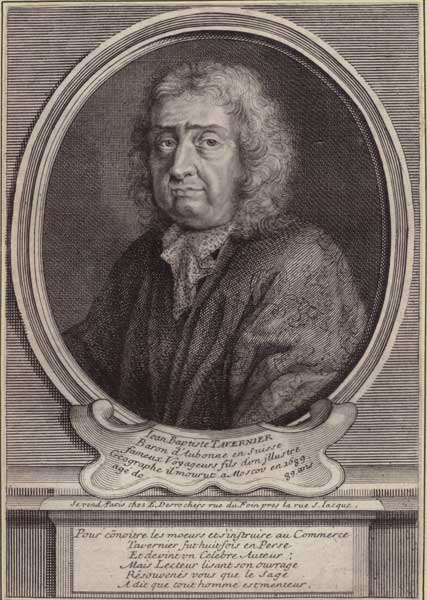
Jean Baptiste Tavernier. Baron d'Aubornne en Suisse, fameaux Voyageurs fils d;on illustre, Geographe il mourut a Moscov en 1689, age de 89 ans.
[n.d., c.1700.]
Engraving. 150 x 100mm (6 x 4"). Trimmed and backed onto album paper.
Portrait of Jean-Baptiste Tavernier (1605 - 1689), French gem merchant and traveler. Tavernier, a private individual and merchant, travelling at his own expense, covered, by his own account, 60,000 leagues in making six voyages to Persia and India between the years 1630 and 1668.
[Ref: 64141] £70.00
(£84.00 incl.VAT)

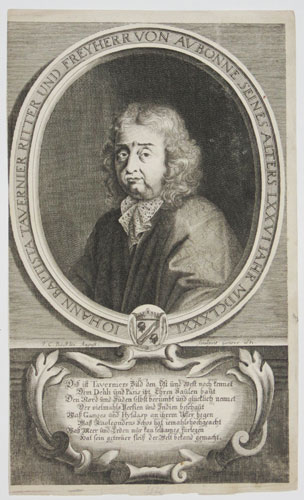
Johann Baptista Tavernier Ritter und Freyherr von Aubonne Seines Alters LXXVII Jahr MDCLXXXI.
J.C. Böcklin August: Sculpsit Geneve 1681.
Engraving. Printed on 17th century watermarked paper with Collector's mark verso, area 290 x 175mm (11½ x 7"). Trimmed into image on left.
Jean Baptiste Tavernier (1605-1689) a French traveller and pioneer of trade with India, who published an account of his travels through Persia. He is best known for the discovery and sale of the 118-carat blue diamond that he subsequently sold to Louis XIV of France in 1668. Lost during the French Revolution it is believed that it was recut as the famous 'Hope Diamond'. Collector's mark: L.3852 (unidentified stamp also found on prints in the Musée Lorrain, Nancy, and Boijmans van Beuningen, Rotterdam).
[Ref: 29722] £220.00
(£264.00 incl.VAT)

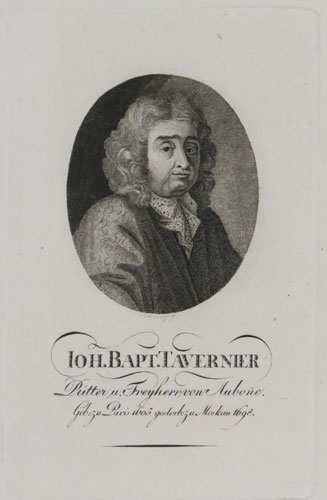
Ioh. Bapt. Tavernier. Ritter u. Freyherr von Aubone, Geb: zu Paris 1605 gestorb: zu Moskau 1698.
Westermayr f.
[German.] [n.d. c.1810.]
Stipple with large margins. Plate 140 x 89mm (5½ x 3½").
Jean-Baptiste Tavernier (1605-1698) the French diamond merchant, traveller and pioneer of diamond trade with India. He is best known for the discovery and sale of the 118-carat blue diamond that he subsequently sold to Louis XIV of France in 1668; this was stoel in 1792 and re-emerged in London as the Hope Diamond. He travelled a lot around the Middle East, in particular Persia. The portrait was published in 'Allgemeine Geographische Ephemeriden' (Universal Geographical Ephemerides (i.e. encyclopedia) by Friedrich Bertuch et al.
[Ref: 29752] £90.00
(£108.00 incl.VAT)

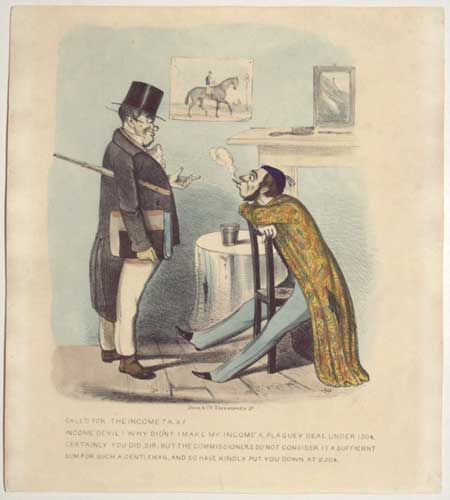
Call'd for the Income Tax? Income Devil! Why did'nt I make my income a plaguey deal under 150. Certainly you did, sire; but the commissioners do not consider it a sufficient sum for such a Gentleman, and so have kindly put you down at 250.
[n.d., c.1820.] Dean & Cº Threadneedle St.
Coloured lithograph. Sheet 255 x 230mm (10 x 9"). Trimmed.
A satirical scene depicting a man with a cigarette in his mouth, sat backwards on a chair. Stood in front of him is a taxman, holding a large book.
[Ref: 67221] £160.00
(£192.00 incl.VAT)
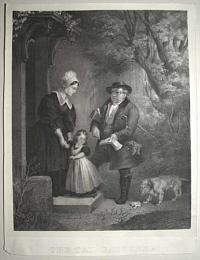
The Tax Gatherer.
[n.d., c.1840.]
Engraving on chine collé. Sheet 385 x 280mm (19 x 11"). Trimmed, crease on right hardly showing.
A tax gatherer stands at a cottage door, demanding money from a widow. His terrier dog looks menacingly at a small wheeled horse toy.
[Ref: 56529] £190.00
(£228.00 incl.VAT)
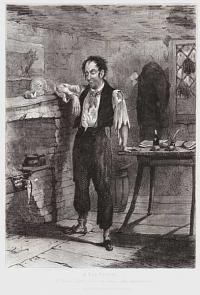
A Tax Payer. We do want Reform _ at any rate a change _ things cannot be worse.
London, July 1831. Published by Charles Tilt, 86 Fleet St.
Etching. Sheet 285 x 190mm (11¼ x 7½"). Trimmed close to image and around title.
A ragged man stands in a delapidated room.
[Ref: 62276] £190.00
(£228.00 incl.VAT)
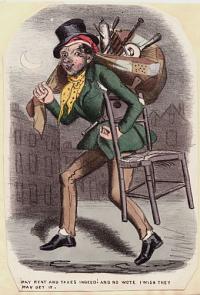
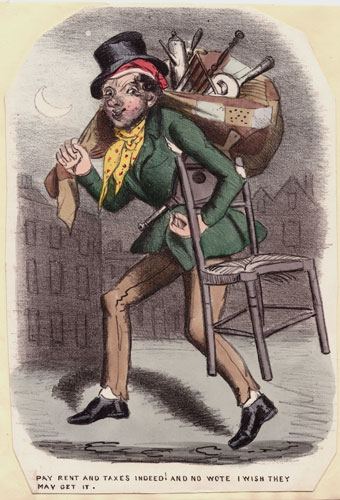
Pay Rent and Taxes Indeed! And no Wote. I Wish They May Get It.
[n.d., c.1840.]
Lithograph with hand colour. Sheet 210 x 140mm (8¼ x 5½"). Trimmed, corners snipped, laid on album paper.
A satirical portrait of a tinker, a bag of household items over his shoulder, and a bellows and chair under his arm.
[Ref: 57796] £80.00
(£96.00 incl.VAT)
![[The Empire's Cricketers: Famous Players and Their Characteristic Attitudes Executed in Crayon.]](img-thumbnail/jpegs/53846.jpg)
[The Empire's Cricketers: Famous Players and Their Characteristic Attitudes Executed in Crayon.]
[after Albert Chevallier Tayler, with biographies by George William Beldam.]
[London: the Fine Art Society, 1905.]
Folio, contemporary cloth gilt; 48 chromolithograph plates, each with a text page. One biography sheet supplied from another example; bookplate on front pastedown.
The full set of 48 portraits of prominent cricketers, including by W.G. Grace, by Albert Chevallier Tayler (1862-1925). Tayler took photographs of the cricketers in order to catch their poses, which he then reproduced in chalk. Using chromolithography these were then printed on olive/grey paper and issued in weekly instalments. His 48 chalk portraits were exhibited at the Fine Art Society when the set was completed in 1905.
[Ref: 53846] £1,400.00
view all images for this item
![[Rev. John James Tayler] Ever faithfully yours, J.J. Tayler [facsimile signature].](img-thumbnail/jpegs/66470.jpg)
[Rev. John James Tayler] Ever faithfully yours, J.J. Tayler [facsimile signature]. Subscribers Copy.
Painted by J.P. Knight, R.A. Engraved by T. Oldham Barlow, Victoria R.d Kensington.
[n.d., c.1867.]
Mezzotint on chine collé. Sheet 490 x 380mm (19¼ x 15"). Trimmed into plate, tear through signature.
Three-quarter seated portrait of Unitarian Minister John James Tayler (1797-1869), tutor at Manchester College. The oil, painted 1867, is in the collection of Harris Manchester College, University of Oxford. Ex: collection of The Hon. Christopher Lennox-Boyd.
[Ref: 66470] £260.00
(£312.00 incl.VAT)
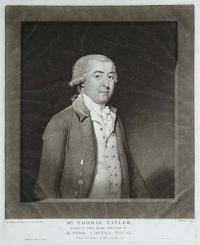
Mr. Thomas Tayler, Twenty Two Years Master Of Lloyds Coffee House. Died 6th. June 1796, aged 50.
W.R. Bigg A.R.A. pinxt. Gate St. Lins. Inn Fields. W. Ward sculp.
Publish'd Novr. 1st. 1796. as the Act directs.
Mezzotint. 355 x 285mm. Some evidence of rubbing to the mezzotint on what is otherwise a fine impression. Two small tears to right paper edge, well outside plate.
Thomas Tayler [1746 - 1796], Master of Lloyd's Coffee House. The coffee house that Edward Lloyd opened in 1687 near the Thames on Tower Street was a favourite haunt of men from the ships that moored at London's docks. The house was 'spacious, well built and inhabited by able tradesmen' according to a contemporary publication. It grew so popular that in 1691 Lloyd moved it to much larger and more luxurious quarters on Lombard Street. Nat Ward, a publican whom Alexander Pope accused of trading vile rhymes for tobacco, reported that the tables in the new house were 'very neat and shined with rubbing.' A staff of five served tea and sherbet as well as coffee. Lloyd's coffee house served from the start as the headquarters for marine underwriters, in large part because of its excellent mercantile and shipping connections. In 1771 seventy-nine of the underwriters who did business at Lloyd's subscribed £100 each and joined together in the Society of Lloyd's, an unincorporated group of individual entrepreneurs operating under a self-regulated code of behavior. These were the original Members of Lloyd's; later, members came to be known as 'Names.' The Names committed all their worldly possessions and all their financial capital to secure their promise to make good on their customers' losses. That commitment was one of the principal reasons for the rapid growth of business underwritten at Lloyd's over the years. In 1774 the 'Subscribers to Lloyd's' occupied new premises at the Royal Exchange at Cornhill. By the turn of the century the traditional club of marine underwriters had become an international market for insurance risks of almost every type. Lloyd's pre-eminence as a world centre for insurance had been established. CS: 83. Only state. Frankau: 288. Only state.
[Ref: 655] £490.00
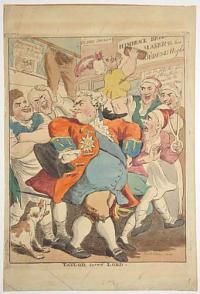
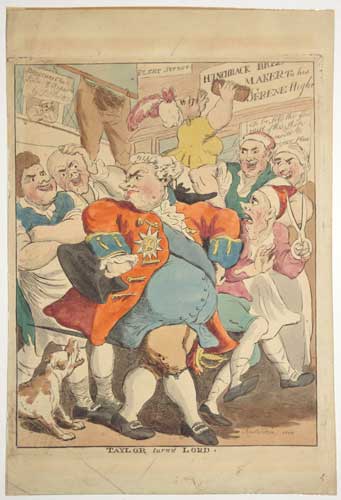
Taylor Turn'd Lord.
Rowlandson 1812.
[Thomas Tegg, c.1812.]
Coloured etching. 305 x 240mm (12 x 9½"). Trimmed to plate on left, crease, stains.
A tailor, over-dressed in court attire, moves his premises from Fleet Street to Grosvenor Place, having found royal patronage. His erstwhile neighbours laugh at his pretentions. Not in BM.
[Ref: 63396] £190.00
(£228.00 incl.VAT)
![[Top right sheet of Isaac Taylor's 'Dorset Shire'.]](img-thumbnail/jpegs/48925.jpg)
[Top right sheet of Isaac Taylor's 'Dorset Shire'.]
[Ross-on-Wye, 1765.]
Engraved map, one sheet of six. 590 x 470mm (23¼ x 18½"), very large margins. Central crease as normal. Uncut.
One sheet of the first large-scale map of Dorset. engraved by Isaac Taylor (1730-1807) from his own survey. It covers Cranborne, Blandford Forum, and Wimborne Minster in unprecedented detail, with vignettes of the 'Observatory at Horton and 'Shirborne Castle' in panels at the top.
[Ref: 48925] £320.00
![[Bottom right sheet of Isaac Taylor's 'Dorset Shire'.]](img-thumbnail/jpegs/48926.jpg)
[Bottom right sheet of Isaac Taylor's 'Dorset Shire'.]
[Ross-on-Wye, 1765.]
Engraved map, one sheet of six. 590 x 470mm (23¼ x 18½"), very large margins. Central crease as normal. & other central crease. Uncut.
One sheet of the first large-scale map of Dorset. engraved by Isaac Taylor (1730-1807) from his own survey. It covers Poole Harbour, Swanage, Studland, Corfe, Worth Matravers and Wareham in unprecedented detail, with the 'Characters' (key) bottom right.
[Ref: 48926] £520.00
![[Top central sheet of Isaac Taylor's 'Dorset Shire'.]](img-thumbnail/jpegs/48927.jpg)
[Top central sheet of Isaac Taylor's 'Dorset Shire'.]
[Ross-on-Wye, 1765.]
Engraved map, one sheet of six. 590 x 470mm (23¼ x 18½"), very large margins. Central crease as normal. Uncut.
One sheet of the first large-scale map of Dorset. engraved by Isaac Taylor (1730-1807) from his own survey. It covers Shaftesbury, Sherborne, and Cerne Abbas (marking the position of the 'Giant') in unprecedented detail, with a vignette of the 'Lullworth Castle' in a panel at the top.
[Ref: 48927] £420.00

Brook Taylor, L.L.D. & R.S.S. 1714.
R. Earlom [after Hans Hysing?].
[n.d., c.1780.]
Mezzotint with etching. 205 x 135mm (8 x 5¼"). Laid in album paper at edges.
An oval portrait of mathematician and barrister Brook Taylor (1685-1731). The original, in the collection of the Royal Scociety, is attributed to studio of Hans Hysing (1678–1753). CS 39A (a&c) i of i. Wellcome: 2888; Ex: collection of The Hon. Christopher Lennox-Boyd.
[Ref: 67596] £260.00
(£312.00 incl.VAT)

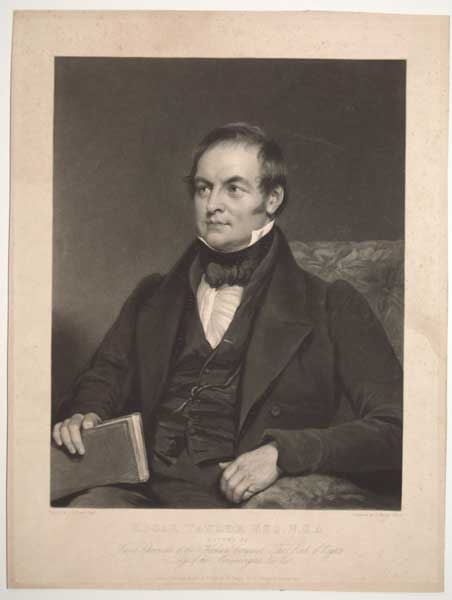
Edgar Taylor Esq. F.S.A. Author of Waces Chronicle of the Norman Conquest, The Book of Rights, Lays of the Minnesingers, &c. &c.
Painted by E.U. Eddis Esq.e. Engraved by C. Turner A.R.A.
London. Published August 10.th 1841 by M.r Turner No 50 Warren St. Fitzroy Squ.e.
Rare steel mezzotint, printed on chine collé. 390 x 290mm (15¼ x 11½"). Some staining. Cut to platemark.
Edgar Taylor (1793-1839), solicitor, author and translator. In 1823 he anonymously produced the first English version of Grimms' Fairy Tales, illustrated by George Cruikshank. Whitman 552, state ii of ii. Ex: Collection of The Hon. Christopher Lennox-Boyd, his state iii of iii.
[Ref: 65241] £260.00
(£312.00 incl.VAT)

Edgar Taylor Esq. F.S.A. Author of Waces Chronicle of the Norman Conquest, The Book of Rights, Lays of the Minnesingers, &c. &c.
Painted by E.U. Eddis Esq.e. Engraved by C. Turner A.R.A.
London. Published August 10th 1841 by Mr Turner No 50 Warren St. Fitzroy Squ.e.
Rare mezzotint. 390 x 290mm (15¼ x 11½"), very large margins. Damp stain in margin.
Edgar Taylor (1793-1839), solicitor, author and translator. In 1823 he anonymously produced the first English version of Grimms' Fairy Tales, illustrated by George Cruikshank. Whitman 552, state ii of ii.
[Ref: 42113] £260.00
(£312.00 incl.VAT)
![[Edward Taylor, Professor of Music in Gresham College. Sheriff of Norwich in 1820.]](img-thumbnail/jpegs/42112.jpg)
[Edward Taylor, Professor of Music in Gresham College. Sheriff of Norwich in 1820.] Proof B L.
Painted by R.S. Tait Esq. Engraved by H.E. Dawe.
Published by Charles Muskett, Norwich & by J.E. Nickolls, Wigmore Street, Cavendish Square, London. [n.d., c.1840.]
Mezzotint on india, proof before title. 355 x 260mm (14 x 10¼"), with very large margins.
Edward Taylor (1784-1863), a singer, lecturer & writer on music and Gresham Professor of Music. He translated many of Louis Spohr's operas from German to English. See NPG: D6932 for published state.
[Ref: 42112] £160.00
(£192.00 incl.VAT)
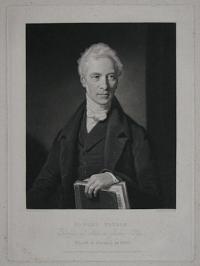
Edward Taylor, Professor of Music in Gresham College. Sheriff of Norwich in 1820.
Painted by R.S. Tait Esq. Engraved by H.E. Dawe.
Published by Charles Muskett, Norwich & by J.E. Nickolls, Wigmore Street, Cavendish Square, London. [n.d., c.1840.]
Mezzotint on india. Plate 356 x 260mm (14 x 10¼"). Fine impression.
Edward Taylor (1784-1863) was a lecturer and writer on music; Professor of music in Gresham College. NPG: D6932.
[Ref: 20091] £160.00
(£192.00 incl.VAT)
![[Jeremy Taylor.]](img-thumbnail/jpegs/67026.jpg)
[Jeremy Taylor.]
[possibly after Pierre Lombart.]
[n.d., c.1650.]
Engraving. 175 x 150mm (7 x 6"). Repaired tear. Folds and creasing through image as normal.
Portrait of Jeremy Taylor (1613 - 1667), a cleric in the Church of England who achieved fame as an author during the Protectorate of Oliver Cromwell. The print depicts Taylor in clerical dress standing on a pedestal on which is written "Mercurius Christianus" and holding a book in his right hand. behind is a landscape with the figure of Christ in the clouds, a ray of light reaching Taylor lettered, "Ad te quacunque vocas dulcissime Jesu" (To you, wheresover, speaks the most sweet Jesus"). In the lower right, a devil emerges from the mouth of hell holding a candle and offering a bag of money to Taylor. He is sometimes known as the "Shakespeare of Divines" for his poetic style of expression, and he is frequently cited as one of the greatest prose writers in the English language.
[Ref: 67026] £180.00
(£216.00 incl.VAT)
![[Fern Tree Valley, Mount Wellington.]](jpegs/22633.jpg)
![[Hobart Town from the New Town road.]](jpegs/22634.jpg)
![[Cape Raoul, V.D.L.]](jpegs/22622.jpg)


![[Taste.]](jpegs/60167.jpg)
![[Taste. Feast of the Gods] Geschmack. Das Gustunal der Götter. Gustus. Convivium Deorum.](jpegs/57612.jpg)

![[The Devil's Tower, Yelabuga, Tatarstan, titled in Cyrillic.]](jpegs/63695.jpg)
![[Tate Gallery].](jpegs/5687.jpg)
![Tattershall Castle [ms.]](jpegs/34508.jpg)


![[Tavern Scene.]](jpegs/12253.jpg)

![[Tavern scene.]](jpegs/12001.jpg)
![[Tavern scene.]](jpegs/18820.jpg)
![[Interior of an inn, Dutch School.]](jpegs/21781.jpg)



![[The Empire's Cricketers: Famous Players and Their Characteristic Attitudes Executed in Crayon.]](jpegs/53846.jpg)
![[Rev. John James Tayler] Ever faithfully yours, J.J. Tayler [facsimile signature].](jpegs/66470.jpg)

![[Top right sheet of Isaac Taylor's 'Dorset Shire'.]](jpegs/48925.jpg)
![[Bottom right sheet of Isaac Taylor's 'Dorset Shire'.]](jpegs/48926.jpg)
![[Top central sheet of Isaac Taylor's 'Dorset Shire'.]](jpegs/48927.jpg)


![[Edward Taylor, Professor of Music in Gresham College. Sheriff of Norwich in 1820.]](jpegs/42112.jpg)

![[Jeremy Taylor.]](jpegs/67026.jpg)