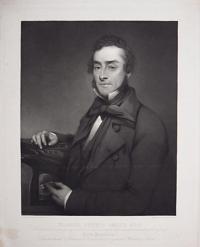
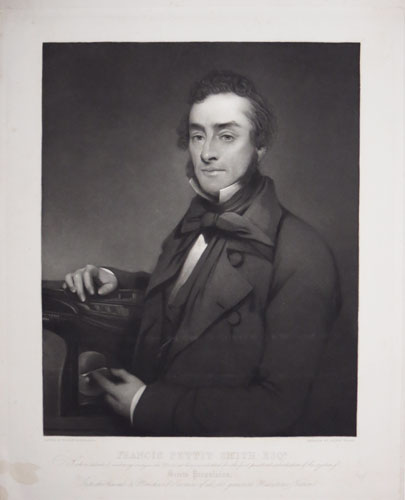
Francis Pettit Smith Esq.r To whose talent & untiring energies the World at large is indebted for the first, practical introduction of the system of Screw Propulsion, Into the Naval & Merchant Services of all its greatest Matatime Nations. Proof.
Painted by William Boxall A.R.A. [...] Engraved by Sydney Marks
[c.1860]
Rare open-letter proof mezzotint. Platemark 460 x 365mm (18 x 14¼"), large margins on two sides.
Sir Francis Pettit Smith (1808-74), inventor of the screw propellor. An enthusiastic builder of model boats as a boy, by 1835 Smith had built a model propelled by a screw, powered by a spring, which he believed would be more efficient than the paddle wheel then universally used by steamships. The following year Smith took out a patent for screw propulsion, and applied his technology to progressively larger vessels. The Admiralty persuaded Smith to build a large ship, the 'Archimedes' (the name is inscribed on the propellor visible in this portrait), but eventually declined to purchase it, leading to the failure of Smith's company. Smith's friends rallied around him, however, and secured him a civil-list pension and the post of director of the Patent Office museum. Smith was knighted in 1871. Fine mezzotint after the portrait by William Boxall now in the Science Museum.
[Ref: 47674] £350.00
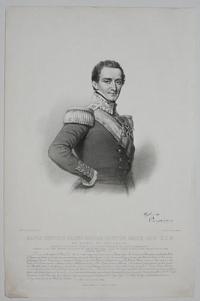
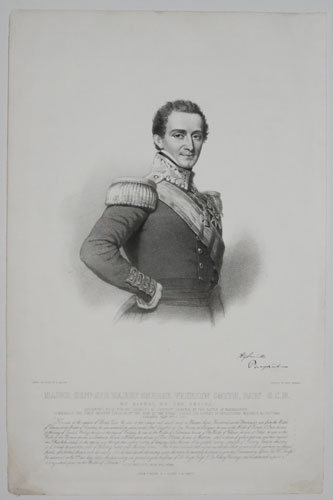
Major Gen.l Sir Harry George Wakelyn Smith, Bar.t G.C.B. of Aliwal on the Sutlej. Appointed K.C.B. for his services as Adjunct General at the Battle of Maharajpoor, Commanded the First Infantry Division of the Army of the Sutlej during the battles of Perozeshah, Moodkee &c. Dec.r 1845. Created Bar.t 9th Ap.l 1846.
Drawn on Stone by E. Dalton [Mrs Edwin Dalton, Magdalena Ross]. Printed by M. & N. Hanhart.
London Published by J. Hogarth 5, Hay-Market.
A very scarce lithograph, with facsimile signature. Printed area 420 x 300mm (16½ x 12").
Portrait of Sir Harry Smith (1787-1860), a soldier whose career spanned: the British invasions of the Río de la Plata in 1807, including the Battle of Montevideo; the Peninsular War from 1808 until the final battle, Toulouse in 1814; the War of 1812, including the Burning of Washington in 1814; the Battle of Waterloo, 1814; the Xhosa Wars in South Africa, 1834-6; the First Anglo-Sikh War of 1845-6; and South Africa again, fighting the Boers at the Battle of Boomplaats in 1848. During that last posting Ladysmith was named after his wife.
[Ref: 30231] £280.00
(£336.00 incl.VAT)
![[In pencil:] The Smith's Authors of the Rejected Addresses.](img-thumbnail/jpegs/34620.jpg)
[In pencil:] The Smith's Authors of the Rejected Addresses.
B. Holl.
[n.d. c.1830.]
Stipple and etching. 178 x 127mm (7 x 5").
James Smith (1775-1839) and Horace Smith (1779-1846), authors of the Rejected Addresses: Or, the New Theatrum Poetarum. Published in 1812, it was a book or parodies and is generally considered one of the most successful humorous books of the early nineteenth century, and "brought the craft of parody to maturity". See NPG: D6781.
[Ref: 34620] £70.00
(£84.00 incl.VAT)

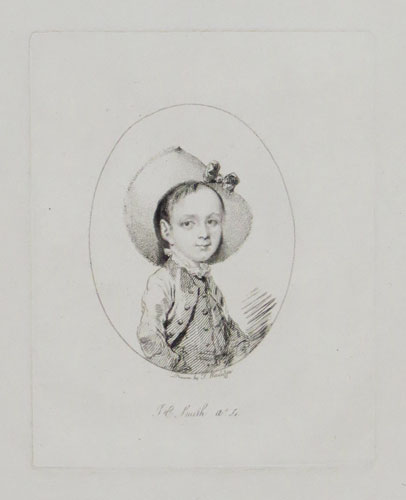
J.E. Smith a.t 4
Drawn by T. Worlidge.
[n.d., c.1765]
Etching, sheet 100 x 75mm (4 x 3"). Trimmed inside platemark; pinhole and glue stains.
Sir James Edward Smith (1759-1828), botanist, aged four. Etched after a drawing by Thomas Worlidge (1700-66) 'the English Rembrandt', by 'Mrs. D. Turner'. Smith was the first president of the Linnaean Society and his works included 'The English Flora' (1824-5). W2760
[Ref: 33050] £45.00
(£54.00 incl.VAT)
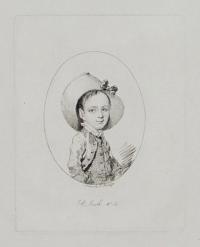
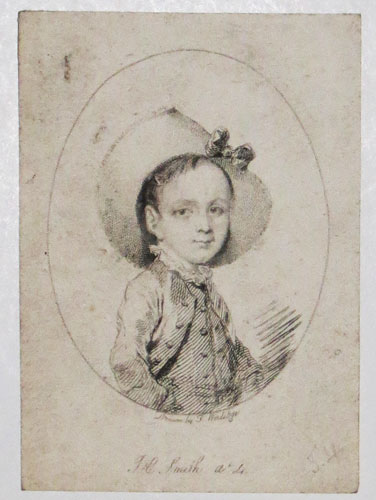
J.E. Smith. Aet. 4.
Drawn by T. Worlidge. [Engraved by Mary Turner.]
[n.d., c.1820.]
Stipple. Plate: 125 x 100mm (5 x 4''), with very large margins.
A portrait of a four year old James Edward Smith (1759-1828). Botanist Smith was one of the founding members of the Linnean Society.
[Ref: 49955] £50.00
(£60.00 incl.VAT)

Sir James Edward Smith M.D. F.R.S. &c. President of the Linnean Society. From a Drawing by W. Lane, and Engraved by F.C. Lewis, Dedicated with permission to Tho. Wm. Coke, Esq.r M.P. by his most ob.t & obliged humble Servant W. Lane
Published March 15th 1816 by W. Lane, 29 Luke Street, St. James's.
Soft-ground etching, very rare; sheet 580 x 380mm (22¾ x 15"). Trimmed to platemark. Bit messy in title area.
Sir James Edward Smith (1759-1828), botanist. Smith bought Linnaeus' collection after Joseph Banks declined, and founded the Linnean society in 1788. Smith published many botanical works, including 'The English Flora' (1824-8) and did much to popularise the subject through his lectures and writings.
[Ref: 44828] £280.00
(£336.00 incl.VAT)
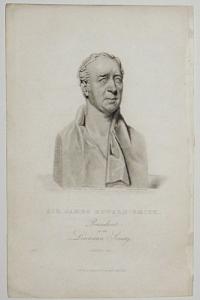
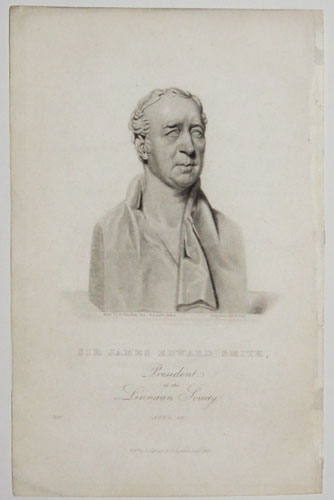
Sir James Edward Smith. President of the Linnean Society Aged 68.
Bust by F. Chantrey, R.A. H.B. Love, delin. Engraved by W. Say.
Pub.d by Longman & Co. London, Aug.t 1832.
Mezzotint. Sheet: 220 x 135mm (8¾ x 5¼'').
A portrait of English botanist and founder of the Linnean society Sir James Edward Smith (1759-1828).
[Ref: 49361] £60.00
(£72.00 incl.VAT)
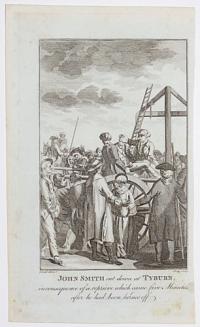
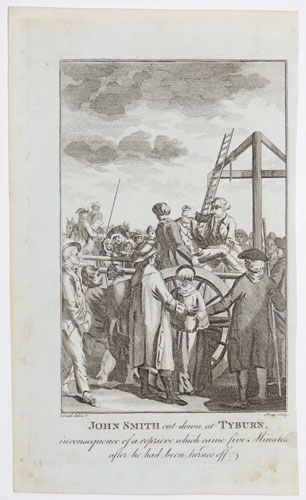
John Smith cut down at Tyburn, in consequence of a reprieve which came five Minutes after he had been turned off.
Dodd delin Page sculp [c.1770]
Engraving, platemark 210 x 120mm (8¼ x 4¾"). Trimmed.
John Smith (c.1661-1727), London housebreaker famed for evading execution on three occasions. This print shows him being cut down from the gallows in 1705 after a reprieve was granted. He was eventually transported to Virginia in 1727. Engraving published in the 'Tyburn Chronicle'.
[Ref: 46577] £75.00
(£90.00 incl.VAT)

Sir John Smith, Bar.t. F.R.S. L.L.D.
Painted by L.F. Abbot. Engraved by Barnard.
[n.d., c.1797.]
Mezzotint. 625 x 395mm (24½ x 15½"), large margins. Spotting, creasing in inscription area.
A full-length portrait of Sir John Smith (1744 – 1807), 1st Baronet, leaning against a tree with a book in his hand. Smith, of Sydling St Nicholas in Dorset, was High Sheriff of Dorset in 1772. CS 17. Russell 17, iv of iv. BM 2010,7081.2821, iv of vi.
[Ref: 66655] £280.00
(£336.00 incl.VAT)

Sir John Smith, Bar.t. F.R.S. L.L.D.
Painted by L.F. Abbot. Engraved by Barnard.
[n.d., c.1797.]
Mezzotint. 625 x 395mm (24½ x 15½"), large margins. Margins stained, spotting,
A full-length portrait of Sir John Smith (1744 – 1807), 1st Baronet, leaning against a tree with a book in his hand. Smith, of Sydling St Nicholas in Dorset, was High Sheriff of Dorset in 1772. CS 17. Russell 17, after state iv of iv. BM 2010,7081.2821, state v of vi.
[Ref: 66656] £320.00

Sir John Smith, Bar.t. F.R.S. L.L.D.
Painted by L.F. Abbot. Engraved by Barnard.
[n.d., c.1797.]
Mezzotint. 625 x 395mm (24½ x 15½"). Small margins.
A full-length portrait of Sir John Smith (1744 – 1807), 1st Baronet, leaning against a tree with a book in his hand. Smith, of Sydling St Nicholas in Dorset, was High Sheriff of Dorset in 1772. CS 17. Russell 17, state iii of iv. BM 2010,7081.2821, state iii of vi. Ex: collection of The Hon. Christopher Lennox-Boyd.
[Ref: 66657] £320.00
![[John Smith.]](img-thumbnail/jpegs/66931.jpg)
[John Smith.] The Portraictuer of Captayne John Smith, Admiral of New England.
[n.d., c.1790.]
Engraving 170 x 115mm (6¾ x 4½").
Portrait of John Smith (c.1579 - 1631), English soldier, explorer, colonial governor, admiral of New England, and author. He played an important role in the establishment of the colony at Jamestown, Virginia, the first permanent English settlement in North America, in the early 17th century.
[Ref: 66931] £95.00
(£114.00 incl.VAT)
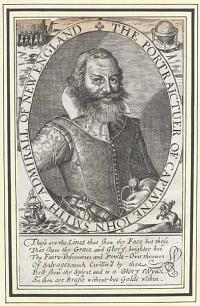
The Portraictuer of Captayne Iohn Smith / Admirall of New England. There are the Lines that Shew thy Face but those That shew thy Grace and Glory, brighter bee Thy Faire-Discoueries and Fowle-Overthrowes Of Salvages, much Civilliz'd by thee Best Shew they Spirit and to it Glory Wyn: So, though art Brasse without-but Golde within.
[Simon van de Passe.]
[n.d. c.1680.]
Engraving. Sheet 150 x 95mm (5¾ x 3¾"). Trimmed within plate, damage in image at top, laid on album paper.
Captain John Smith (1580-1631), soldier and adventurer who led the 1606 expedition to Virginia from Blackwall. He was largely responsible for the establishment of a trading settlement at Jamestown. During his stay in Virginia his life was saved by the Indian Pocahontas.
[Ref: 59877] £110.00
(£132.00 incl.VAT)
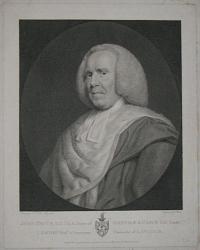
John Smith, D.D., F.S.A. Master of Gonvile & Caius Coll: Camb: Lowndn. Profr. Of Astronomy Chancellor of Lincoln.
Painted by Sir Joshua Reynolds. Engraved by Facius.
Published Feb: 1. 1797, by I. Deighton, Cambridge: & to be had at Messrs Facius No. 8 Macclesfield Street.
Stipple and engraving, open letters, 445 x 355mm. 17½ x 14". A fine impression.
Dr John Smith (1711 baptised - 1795), professor of astronomy at Cambridge, wearing wig and robes; within oval frame. After Sir Joshua Reynolds (1723 - 1792). Hamilton: pg.64, II. Welcome: 2761.
[Ref: 13888] £220.00
(£264.00 incl.VAT)
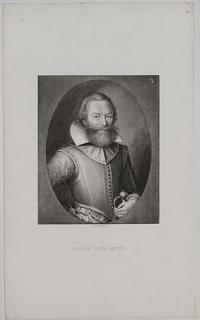
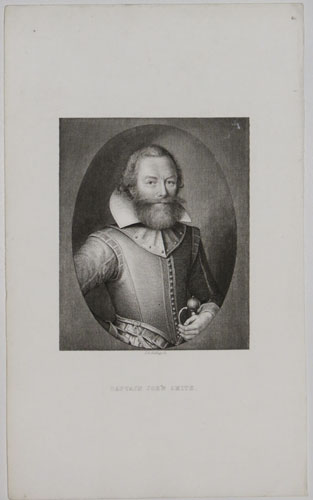
Captain John Smith.
J.G. Kellogg sc.
[n.d. c.1815.]
Engraving. 229 x 140mm. 9 x 5½".
Sir John Smith (c.1580-1631), the Admiral of New England, an English soldier, explorer and author. He was briefly governor of the Jamestown colony in Virginia. 19th century engraving derived from the early portrait by Simon de Passe.
[Ref: 27878] £60.00
(£72.00 incl.VAT)
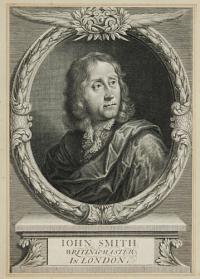
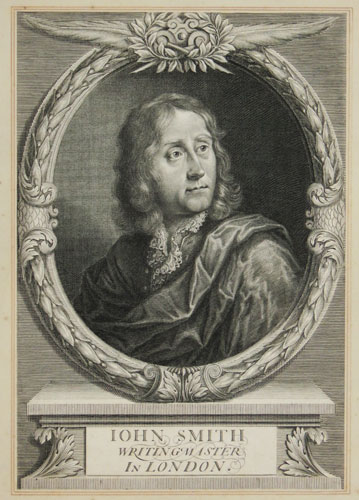
John Smith Writing Master In London
[After William Faithorne?, c.1690]
Engraving, sheet 290 x 200mm (11½ x 8"). Trimmed to image and glued to backing sheet.
'This print of Smith, which is finely engraved, was probably by Faithorne, which makes it the more remarkable that no particulars relative to him have reached us' (Noble and Granger, 'A Biographical History of England'). O'D 1 (only likeness). Ex: The Hon. Christopher Lennox-Boyd Collection.
[Ref: 38874] £220.00
(£264.00 incl.VAT)

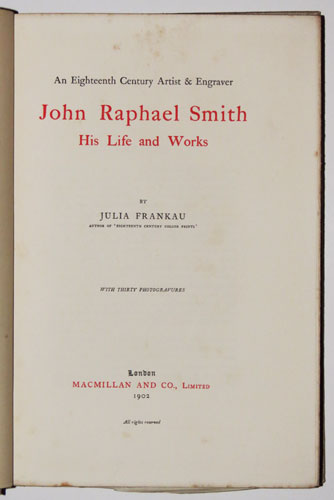
An Eighteenth Century Artist & Engraver. John Raphael Smith His Life and Works.
by Julia Frankau.
Published by Macmillan and Co., Limited. London. 1902.
Book. 4to (180 x 260mm). pp.vi-xiv + 259. Illustated with 30 b/w plates. Cream cloth binding with gilt title stamped on spine and front. Binding worn, some staining. Foxing on pages.
The definitive work on the paintings and mezzotints of British artist and engraver John Raphael Smith (1752-1812). Since updated by D' Oench. Ex: Collection the Hon. Christopher Lennox-Boyd.
[Ref: 36438] £65.00

An Eighteenth Century Artist & Engraver. John Raphael Smith His Life and Works with Thirty Photographs.
by Julia Frankau. Author of 'Eighteenth Century Colour Prints'
London. Macmillan and Co., Limited. 1902.
Book: 4to (255 x 171mm). pp. vi-xiv + 259. 30 b/w plates. Original cloth binding. Binding worn with some stains. Sporadic spotting.
An illustrated biographical collection of various examples of the work of John Raphael Smith.
[Ref: 10126] £85.00
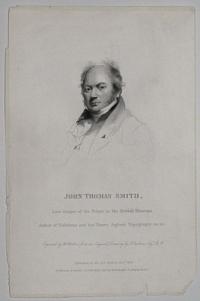
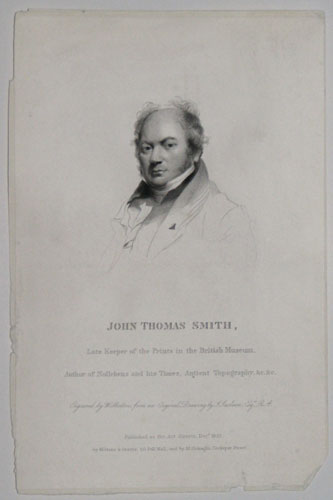
John Thomas Smith, Late Keeper of the Prints in the British Museum, Author of Nollekens and his Times, Antient Topography, &c.&c.
Engraved by W. Skelton, from an Original Drawing by J. Jackson, Esqr. R.A.
Published as the Act directs, Decr.1883. by Molteno & Graves, 20, Pall Mall, and by M. Colnaghi, Cockspur Street.
Engraving on india laid paper, india 225 x 150mm. 9 x 6". Trimmed to india, small crease lower left-hand corner.
Bust portrait of John Thomas Smith (1766 - 1833), draughtsman and antiquary. His published work focuses almost entirely on London and its environs, and he was unusual for his time in that he recorded all strata of society. A pupil of Joseph Nollekens and the mezzotint engraver John Keyse Sherwin, Smith began his career as engraver and topographical draughtsman. His first publication, Antiquities of London and its Environs (1800), was followed by his major work Antiquities of Westminster (1807). In 1816, Smith became the keeper of prints and drawings at the British Museum, a position he held for the rest of his life. After John Jackson (1778 - 1831).
[Ref: 19041] £70.00
(£84.00 incl.VAT)
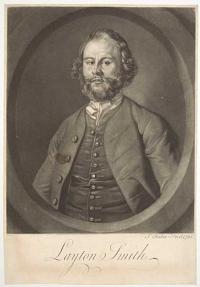
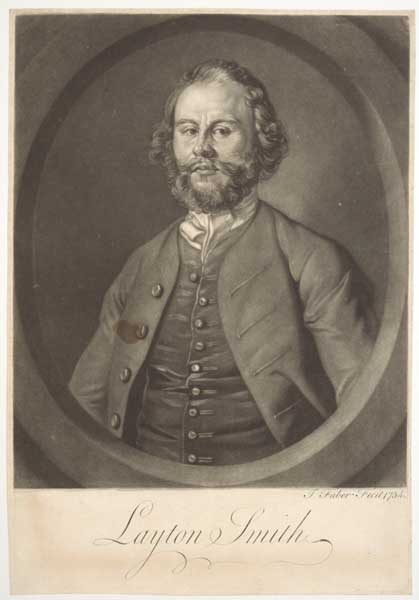
Layton Smith.
J. Faber Fecit 1754.
Mezzotint. Plate: 330 x 225mm (13 x 9"). Thread margins. Brown staining in middle
A portrait of Layton Smith who was imprisoned in Fleet Prison for debt, while there, he vowed never to cut his hair until his release though, unfortunately, he died there. CS 332. Ex: Collection of The Hon. C. Lennox-Boyd.
[Ref: 65882] £190.00
(£228.00 incl.VAT)
![Layton Smith. [&] Ink mss.](img-thumbnail/jpegs/65883.jpg)
Layton Smith. [&] Ink mss.
J. Faber Fecit 1754.
Mezzotint. Plate: 330 x 225mm (13 x 9"). Trimmed to plate and secured to backing sheet at top, with ink mss. Loss on right margin centre.
A portrait of Layton Smith who was imprisoned in Fleet Prison for debt, while there, he vowed never to cut his hair until his release though unfortunately, he died there. CS 332.
[Ref: 65883] £190.00
(£228.00 incl.VAT)
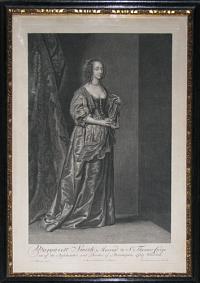
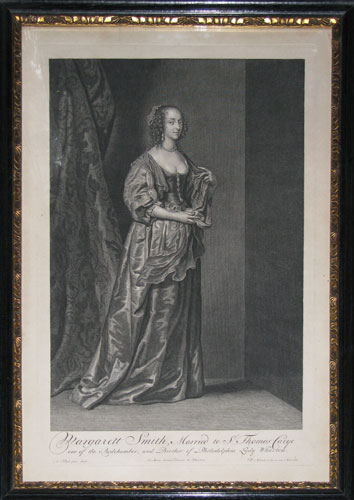
Margarett Smith, Married to Sr. Thomas Carye one of the Bedchamber, and Brother of Philadelphia Lady Wharton.
A. v. Dyck pinx. 1636. P. v. Gunst sculps. et exc. Amstelod.
Ex Museo Sereniss. Domini de Wharton. [n.d. c.1715.]
Framed engraving. Plate 520 x 330mm. 20½ x 13". Large margins.
Margaret Smith, full-length standing in a room with a curtain behind her. Lady Margaret Herbert (c.1608-1663) was daughter of the Master of Requests, Thomas Smith of Abingdon. She married Thomas Carey (d.1634) and remarried Sir Edward Herbert (c.1591-1658) following Carey's death.
[Ref: 21537] £280.00
(£336.00 incl.VAT)
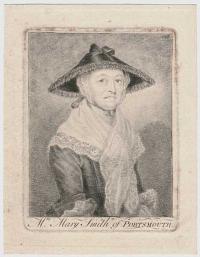
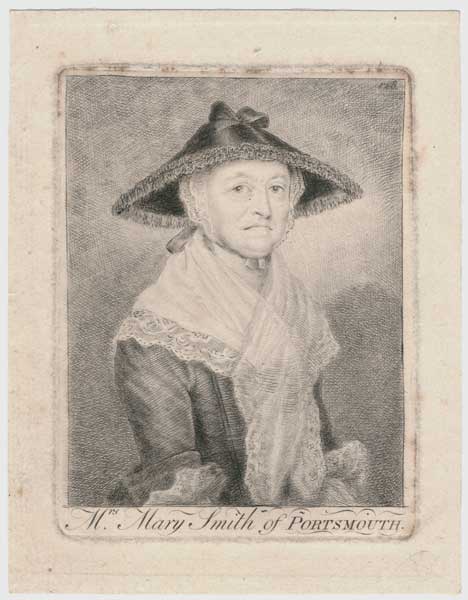
M.rs Mary Smith of Portsmouth.
[by Thomas Worlidge.]
[n.d., c.1750.]
Scarce etching. 115 x 90mm (4½ x 3½"), large margins. Some spotting.
A half-length portrait of an inn-keeper, who is wearing a cone-shaped dark bonnet over a frilled cap, a gown with gauze at the elbows and a white shawl trimmed with lace worn high over the throat and shoulders.
[Ref: 58687] £240.00
(£288.00 incl.VAT)
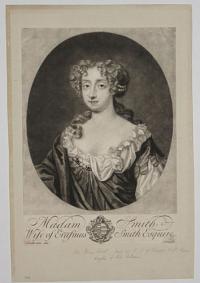
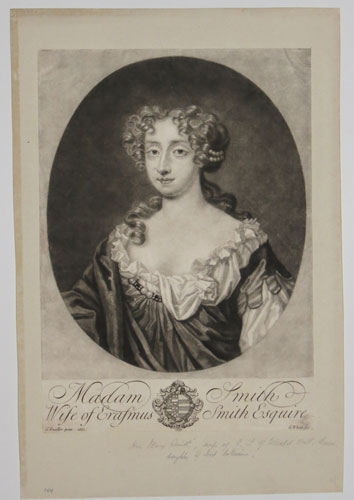
Madam Smith Wife of Erasmus Smith Esquire.
G. Kneller pinx. 1680. G. White fec.
[n.d. c.1740.]
Mezzotint 336 x 240mm. 13¼ x 9½". Trimmed to plate.
Portrait seen almost half length facing forward within oval frame, eyes to front, wearing loose dress and hair in curls. Hon. Mary Smith (1680 fl.), wife of Erasmus Smith (1611-1691) of Weald Hall, Essex, and daughter of 1st Lord Coleraine. CS: 44.
[Ref: 28103] £180.00
(£216.00 incl.VAT)
![[Master Smith] The Nabob.](img-thumbnail/jpegs/65985.jpg)
[Master Smith] The Nabob.
Painted by J. Hoppner Esq.r R.A. Portrait Painter to the His R.H. the Prince of Wales. Engraved by W.m Ward, Mezzotinto Engraver to His R.H. the Duke of York.
Published Jan.y 1st 1805 by the Engraver 24 Buckingham Place Fitzroy Square.
Fine & rare mezzotint. 480 x 330mm (19 x 13"). Trimmed to plate, backed with paper.
Portrait of Master Smith, son of Scottish painter Charles Smith (1749-1824), who worked in India 1783-7 & 1800-11. Frankau 263. CS 74. Ex: Collection of The Hon. C. Lennox-Boyd.
[Ref: 65985] £400.00
![[Master Smith] The Nabob.](img-thumbnail/jpegs/65987.jpg)
[Master Smith] The Nabob.
Painted by J. Hoppner Esq.r R.A. Portrait Painter to the His R.H. the Prince of Wales. Engraved by W.m Ward, Mezzotinto Engraver to His R.H. the Duke of York.
Published Jan.y 1st 1805 by the Engraver 24 Buckingham Place Fitzroy Square.
Fine & rare mezzotint. 480 x 330mm (19 x 13"). Trimmed to plate.
Portrait of Master Smith, son of Scottish painter Charles Smith (1749-1824), who worked in India 1783-7 & 1800-11. Frankau 263. CS 74. Ex: Collections of The Hon. C. Lennox-Boyd & Fritz Reiss (Lugt 2178).
[Ref: 65987] £360.00
!['Nabob' [in pencil.]](img-thumbnail/jpegs/3286.jpg)
'Nabob' [in pencil.]
'Painted by J. Hoppner Esqr. R.A. [Portrait Painter to the His R.H. the Prince of Wales]' 'Engraved by Wm Ward, Mezzotinto Engraver to His R.H. the Duke of York' in pencil.
[Published Jany 1st 1805 by the Engraver 24 Buckingham Place Fitzroy Square.]
Mezzotint, proof before letters. 480 x 330mm. Trimmed to plate, laid on board.
Portrait of Master Smith, son of Charles Smith (1749-1824) painter to the Great Mogul and celebrated for his portraits of Indian Women. Frankau:263. CS:74. Ex: Collection of The Hon. C. Lennox-Boyd.
[Ref: 3286] £260.00
(£312.00 incl.VAT)
![Mrs Sam.l Smith [ms lower right]](img-thumbnail/jpegs/46119.jpg)
Mrs Sam.l Smith [ms lower right]
A.E. Chalon R.A. pinxt M. Gauci del.
Printed by Engelmanns [c.1830]
Lithograph on india, rare, india dimensions 265 x 205mm (10½ x 8"). Foxing at bottom margin.
Portrait after Swiss artist Alfred Edward Chalon (1780-1860), Portrait Painter in Water-colours to Queen Victoria.
[Ref: 46119] £85.00
(£102.00 incl.VAT)
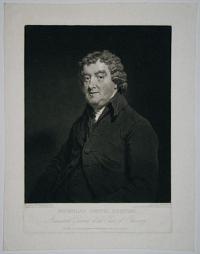
Nicholas Smith Esquire, Accountant General of the Court of Chancery.
Painted by W. Owen Esqr., R.A. Portrait Painter to his R.H. the Prince Regent. Engraved by Wm. Ward Engraver to their R.H. the Prince Regent & Duke of York.
Pubd. Nov. 21. 1812 by the Engraver 24 Buckingham Place Fitzroy Square.
Rich mezzotint, title in open letters, 350 x 250mm. 13¾ x 9¾". A fine amd rare impression, with full margins.
Portrait of Nicholas Smith (active 1802 - 1819), Barrister-at-law, and later Accountant-General in Chancery; wearing dark coat, vest and necktie, his hair short and curly. After William Owen (1769 - 1825). From the Encombe Collection, Lord Eldon. Chaloner Smith 75, II. NPG D41759.
[Ref: 21651] £190.00
(£228.00 incl.VAT)
![Richard Smith [facsimile signature]](img-thumbnail/jpegs/8288.jpg)
Richard Smith [facsimile signature] Deputy Provincial Grand Master of the Freemasons of the Province of Bristol.
N.C. Branwhite, delt. Edwd. Morton, lith.
[n.d. c.1800.]
Lithograph. 317 x 240mm. 12½" x 9½". A small mark in the title area
Richard Smith (1772 - 1843). Surgeon of the Bristol Royal Infirmary, established in 1826. Wrote 'Biographical Memoirs of the Bristol Infirmary'. Not in Wellcome.
[Ref: 8288] £130.00
(£156.00 incl.VAT)
![[Dr Samuel Smith] Mastigeus [in Greek letters.]](img-thumbnail/jpegs/38251.jpg)
[Dr Samuel Smith] Mastigeus [in Greek letters.] V.1. 13.
Pubd. according to Act of Parlt. July 1st. 1771 by MDarly 39 Strand.
Etching. 146 x 109mm (5¾ x 4¼").
A cleric seated at a round table with papers and quill. Representation of Dr Samuel Smith (d.1808), headmaster of Westminster School. BM Satires: 4680.
[Ref: 38251] £190.00
(£228.00 incl.VAT)
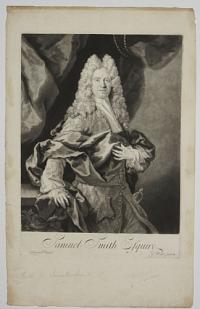
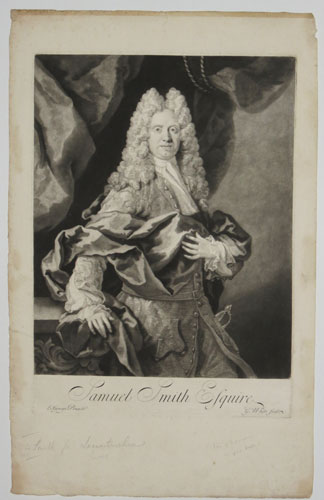
Samuel Smith Esquire.
E. Gouge Pinxit. G. White fecit.
[n.d. c.1740.]
Mezzotint with very large margins. Plate 345 x 247mm. 13½ x 9¾".
Portrait, three-quarter length standing directed to left, looking towards the viewer, right hand on the corner of a stone table to left, left hand at his breast, wearing a long coat, belt, sword, cravat, long white wig and a cloak around his back and drawn under left arm across his chest with one end held under right hand. Samuel Smith (d.1732), of Weald Hall, son of Erasmus Smith. See NPG: D9152. CS: 46.
[Ref: 28101] £230.00
(£276.00 incl.VAT)
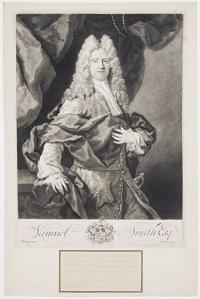
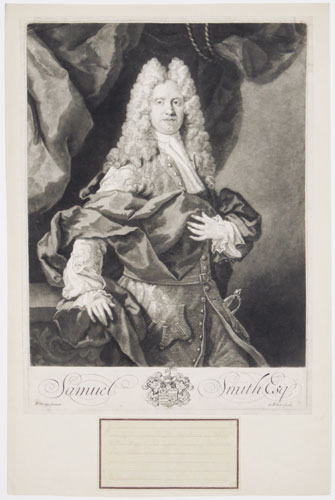
Samuel Smith Esquire.
E. Gouge Pinxit. G. White fecit.
[n.d. c.1740.]
Mezzotint, fine & rare; platemark 345 x 247mm (13½ x 9¾"). Glued to backing sheet in corners. Small margins.
Samuel Smith (d.1732), of Weald Hall, son of Erasmus Smith. Portrayed three-quarter length, wearing a long coat, belt, sword, cravat, long white wig and a cloak around his back and drawn under left arm across his chest with one end held under right hand. NPG D9152; CS 46; for a different state see ref. 28101.
[Ref: 43707] £170.00
(£204.00 incl.VAT)

Sir Sidney Smith.
Robert Ker Porter pinxt. W.Say sculpt.
London Published as the Act directs, June 19, 1802, John P. Thompson, Printseller to his Majesty and their Royal Highness's the Duke & Duchess of York. Gt.Newport Street, and No.51 Dean Street, Soho.
Coloured mezzotint. 630 x 440mm (24¾ x 17¼") Slight repair in image.
Sir William Sidney Smith KCB (21 June 1764 - 26 May 1840) fought in the American Revolutionary War, where he saw action in 1778 against the American frigate Raleigh. He also distinguished himself in the Battle of Cape St Vincent (1780), Battle of the Chesapeake (1781) and the Battle of the Saintes (1782). His subsequent career included important service during the Napoleonic Wars, notably in the defence and relief of Acre. Napoleon said of him "That man made me miss my destiny" concerning his defence of Acre.
[Ref: 4705] £850.00
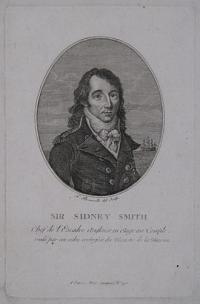
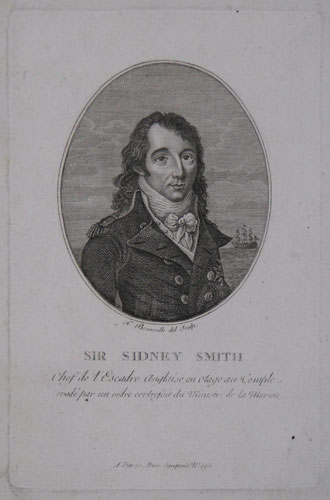
Sir Sidney Smith. Chef de l'Escadre Anglaise...[etc.]
F. Bonneville del Sculp.
A Paris, Rue Jacques, No.195. [n.d., c.1800.]
Stipple with etching, 200 x 130mm. 8 x 5".
Sir William Sidney Smith KCB (1764 - 1840), the British admiral of whom Napoleon Bonaparte said 'That man made me miss my destiny', having aided the Turks in their resistance to Napoleon in Egypt and the Levant. Quite an uncommon portrait.
[Ref: 13113] £85.00
(£102.00 incl.VAT)
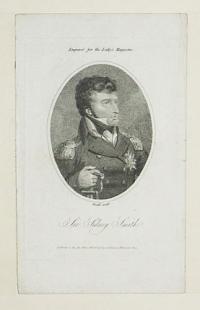
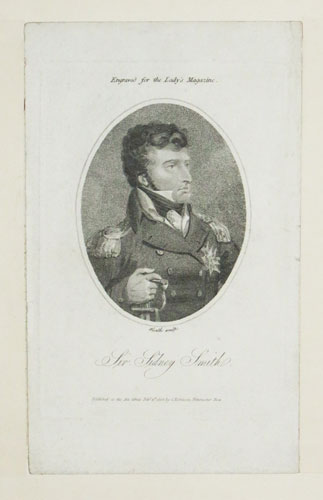
Sir Sidney Smith. Engraved for the Lady's Magazine.
Heath sculp.
Published as the Act directs Feb.y 1.st 1803, by G. Robinson, Paternoster Row.
Stipple. Plate: 160 x 110mm (6¼ x 4¼''). Tipped into album sheet; verso invite from Duke of Wellington to dinner.
A portrait of naval officer Sir Sidney Smith (1764-1840) who served in the American and French Revolutionary wars. Napoleon reminiscing later in his life, said of him: "That man made me miss my destiny".
[Ref: 49387] £75.00
(£90.00 incl.VAT)
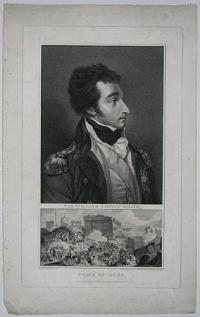
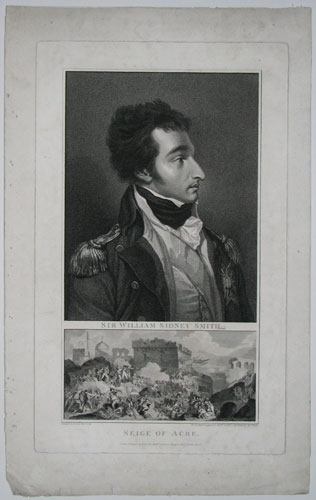
Sir William Sidney Smith. Seige Of Acre.
Painted by Robert Ker Porter. The Portrait Engraved by Anth.y Cardon__the Battle by Ja.s Mitan.
London, Published April 1804, by Anth.y Cardon, 31, Clipstone Street, Fitzroy Square.
Portrait, stipple with etching, and engraved battle scene from one plate. 439 x 266mm (17¼ x 10½"), with wide margins. Slight soiling.
Sir William Sidney Smith KCB (1764-1840), the admiral of whom Napoleon Bonaparte said 'That man made me miss my destiny', having aided the Turks in their resistance to Napoleon in Egypt and the Levant. The Siege of Acre of 1799 was an unsuccessful French siege of the Ottoman-defended, walled city of Acre (now Akko in modern Israel) and was the turning point of Napoleon's invasion of Egypt and Syria. A Royal Navy flotilla under Commodore William Sidney Smith helped to reinforce the Turkish defences and supplied the city with additional cannon manned by sailors and marines. The seige was eventually raised and Napoleon withdrew to Egypt.
[Ref: 21291] £110.00
(£132.00 incl.VAT)
![[Sir Sidney Smith.]](img-thumbnail/jpegs/68216.jpg)
[Sir Sidney Smith.]
[Robert Ker Porter pinxt. W. Say sculpt.]
[London Published as the Act directs, June 19, 1802, John P. Thompson, Printseller to his Majesty and their Royal Highness's the Duke & Duchess of York. Gt.Newport Street, and No.51 Dean Street, Soho.]
Mezzotint, rare proof before letters. 630 x 440mm (24¾ x 17¼"). Trimmed into plate at bottom, repaired tears in margins. Top margin messy.
A full-length portrait of Sir William Sidney Smith (1764-1840), in uniform, with a turk, flag and broken sword behind. A naval officer, Smith fought in the American Revolutionary War, where he saw action in 1778 against the American frigate Raleigh. He also distinguished himself in the Battle of Cape St Vincent (1780), Battle of the Chesapeake (1781) and the Battle of the Saintes (1782). His subsequent career included important service during the Napoleonic Wars, notably in the defence and relief of Acre. Napoleon said of him "That man made me miss my destiny", concerning his defence of Acre. Ex: collection of The Hon. Christopher Lennox-Boyd.
[Ref: 68216] £850.00
![Very truly yours Southwood Smith [facsimile handwriting].](img-thumbnail/jpegs/43392.jpg)
Very truly yours Southwood Smith [facsimile handwriting].
Miss M. Gillies. J.C. Armytage.
Published by Smith, Elder & Co., 65, Cornhill.
Stipple engraving on india. 210 x 130mm (8¼ x 5¼") very large margins. Backing paper spotted.
Thomas Southwood Smith (1788-1861), physician and sanitary reformer. Despite his belief in the miasma theory his reports on quarantine (1845), cholera (1850), yellow fever (1852), and on the results of sanitary improvement (1854) were of international importance. However he is best known for his highly controversial public dissection of Jeremy Bentham in 1832 and his correspondence with Charles Dickens.
[Ref: 43392] £60.00
(£72.00 incl.VAT)
![Very truly yours Southwood Smith [facsimile handwriting].](img-thumbnail/jpegs/43393.jpg)
Very truly yours Southwood Smith [facsimile handwriting].
Miss M. Gillies. J.C. Armytage.
Published by Smith, Elder & Co., 65, Cornhill.
Fine stipple engraving on steel. 210 x 130mm (8¼ x 5¼") large margins.
Thomas Southwood Smith (1788-1861), physician and sanitary reformer. Despite his belief in the miasma theory his reports on quarantine (1845), cholera (1850), yellow fever (1852), and on the results of sanitary improvement (1854) were of international importance. However he is best known for his highly controversial public dissection of Jeremy Bentham in 1832 and his correspondence with Charles Dickens, wrote the life & letters of Dickens.
[Ref: 43393] £60.00
(£72.00 incl.VAT)
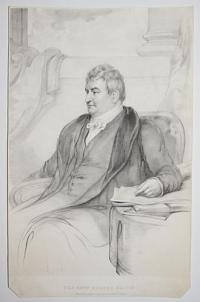
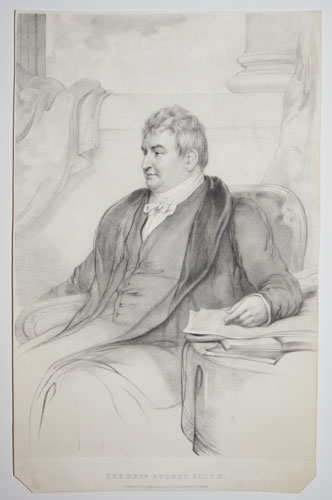
The Rev.d Sydney Smith.
Drawn on Stone by W. Sharp from the original Drawing by John Hayter [c.1830]
Lithograph on india, sheet 495 x 310mm (19½ x 12¼") Trimmed;
Sydney Smith (1771-1845), author and wit, an important contributor to the growth of libertarian thought in England, and (as G.K. Chesterton pointed out) the inventor of nonsense. O'D 2
[Ref: 46509] £180.00
(£216.00 incl.VAT)
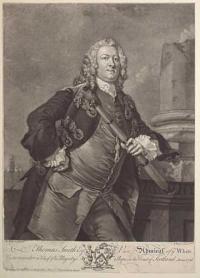
Thomas Smith Esq. Vice Admiral of ye White Commander in Chief to his Majesty's Ships on the Coast of Scotland. Anno 1746.
R. Wilson pinx.t. J. Faber fecit.
Price 2.s Sold by Faber at the Golden Head in Bloomsbury Square. [n.d. c.1750.]
Rare mezzotint. Sheet 355 x 255mm (14 x 10"). Trimmed to plate, tipped on album paper at corners on left. Damaged in title.
Thomas Smith (1707-1762), commodore governor of Newfoundland 1741/3 and admiral credited with the invention of the divisional system that remains in use on ships today. CS: 333 i of v.
[Ref: 56431] £220.00
(£264.00 incl.VAT)
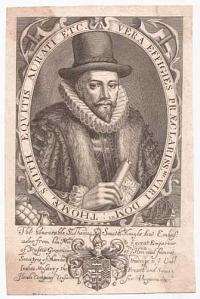
Thomae Smith equitis aurati etc. vera effigies Praeclariss.mi Viri Dom.ni. The honourable Sr Thomas Smith Knight, late Embasador from his Ma.stie to ye great Emperour of Russie, Gouernour of ye Hon:ble and famous Societyes of Marchanes tradinge to ye East- Indies, Mosscovy, the French and Somer Ilands Company, Tresurer for Virginia etc.
[After Simon de Pass.]
[n.d., c.1800.]
Engraving. Sheet 170 x 110mm (6¾ x 4¼"), on wove paper. Trimmed within plate, losing publication line?
Oval portrait of Sir Thomas Smythe or Smith (1558-1625), holding a map of Russia, sailing motifs in the borders. He was the first governor of the East India Company (1600) and was treasurer of the Virginia Company from 1609 to 1620. First published c.1617.
[Ref: 57650] £160.00
(£192.00 incl.VAT)

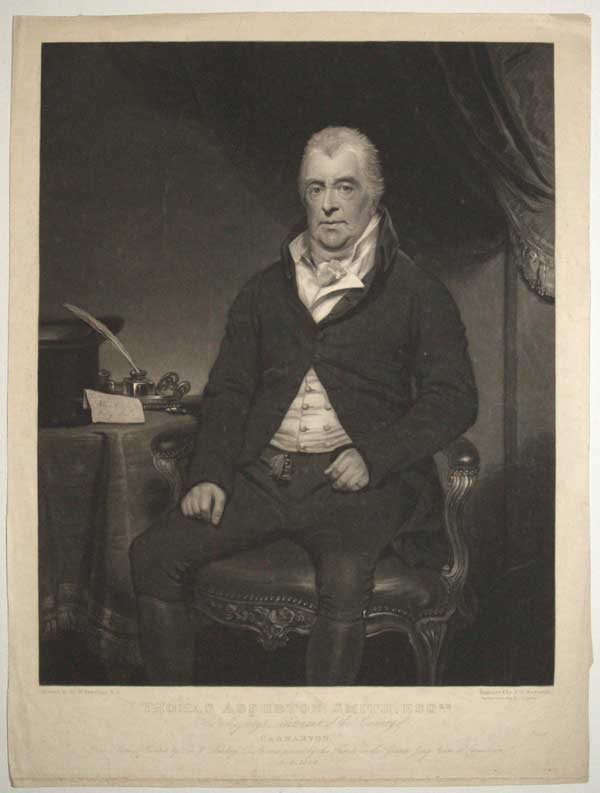
Thomas Assheton Smith, Esq.re His Majesty's Lieutenant of the County of Carnavon. From a Portrait Painted by Sir William Beechey, R.A. and placed by his Friends in the Grand Jury Room at Carnarvon. A.D. 1826. Proof.
Painted by Sir W. Beechey R.A. Engraved by S.W. Reynolds. Engraver to the King (and J.P. Quilley.)
[c.1826.]
Proof mezzotint. 520 x 400mm (20½ x 15¾"). Trimmed to plate on three sides.
Thomas Assheton Smith (the elder) (1752 -1828), landowner who induced Parliament to pass an act enclosing the common land of Llanddeiniolen parish, adding over 2,600 acres to his land holdings, from which he mined slate. Subsequent rioting was put down by a cavalry unit. A close friend of George Finch, 9th Earl of Winchilsea, Smith became one of cricket's main patrons following the establishment of Marylebone Cricket Club in 1787. This portrait was commissioned by Caernarfon Corporation, who paid Beechey £157.10s. It is now in National Museum Cardiff. Whitman: 268
[Ref: 56518] £260.00
(£312.00 incl.VAT)

Thomas Assheton Smith, Esq.re His Majesty's Lieutenant of the County of Carnavon. From a Portrait Painted by Sir William Beechey, R.A. and placed by his Friends in the Grand Jury Room at Carnarvon. A.D. 1826. Proof.
Painted by Sir W. Beechey R.A. Engraved by S.W. Reynolds. Engraver to the King (and J.P. Quilley.)
[c.1826.]
Proof mezzotint. 520 x 400mm (20½ x 15¾"), large margins. Tears and creasing in margins.
Thomas Assheton Smith (the elder, 1752 -1828), a landowner who induced Parliament to pass an act enclosing the common land of Llanddeiniolen parish, adding over 2,600 acres to his land holdings, from which he mined slate. Subsequent rioting was put down by a cavalry unit. A close friend of George Finch, 9th Earl of Winchilsea, Smith became one of cricket's main patrons following the establishment of Marylebone Cricket Club in 1787. This portrait was commissioned by Caernarfon Corporation, who paid Beechey £157.10s. It is now in National Museum Cardiff. Cricket interest. Whitman: 268. Ex: collection of The Hon. Christopher Lennox-Boyd.
[Ref: 66627] £260.00
(£312.00 incl.VAT)
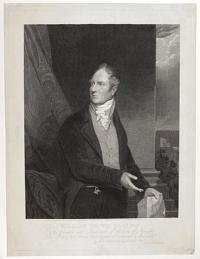
William Smith Esq.r M.P. To the Electors and Inhabitants of the City of Norwich This Plate of their Worthy Representative in Parliament is Inscribed by their obliged & very humble Serv.t W.C. Edwards.
Drawn and Engraved by W.C. Edwards, from a whole length picture painted by H. Thomson ESQ. R.A. in the Guildhall Norwich.
[n.d., c.1833.]
Engraving. Platemark: 430 x 330mm (17 x 13"). Small margins. Repaired damage to revese in left margin.
William Smith (1756-1835) was a politician of great power and change. He was a friend and close associate of William Wilberforce and was at the forefront of many campaigns for social justice and prison reform but most notably was his campaign for the abolition of slavery. He was Member of Parliament for Suffolk and Norwich for some years but it was in 1787 that he acted as the first to campaign for the abolition for the slave trade. In 1790 he supported Wilberforce in the slave trade debate and once the trade had been halted he helped Zachary Macaulay in 1823 found the ‘London Society for the Abolition of Slavery in our Colonies', thereby launching the next phase of the campaign to eradicate slavery. His involvement in the French Revolution was controversial, and he swiftly gained a reputation as a radical. He secretly arranged several meetings between William Pitt and Maret, Napoleon's foreign minister, in a desperate attempt to avoid war.
[Ref: 38732] £290.00
(£348.00 incl.VAT)
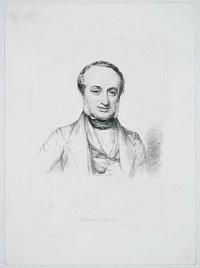
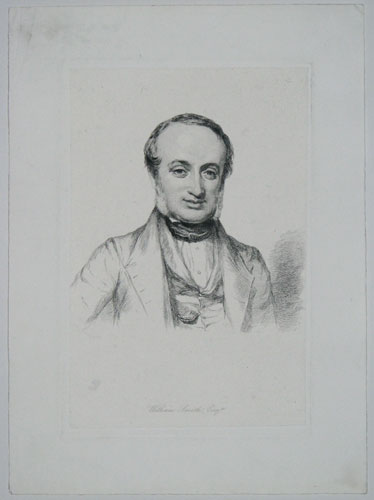
William Smith Esq.re
[n.d. c.1830.]
Etching on india. Plate 229 x 152mm. 9 x 6". Staining and foxing into the upper half of the paper.
William Smith (1808-1876) was a print-seller and antiquary. He started at Cambridge University but following his father's death, he and his brother succeeded to the business and he was obliged to abandon his studies. A year later in 1836 he purchased the collection of engravings formed by John Sheepshanks which were considered to be the most perfect in Europe, which he later sold to the British Museum. Among the collections which reached the Museum through his exertions were those of ‘Mr. Harding of Finchley’ in 1841, of Coningham in 1844 and 1845, selections from the Aylesford and Woodburn collections in 1847, and some etchings of the utmost rarity by Rembrandt, procured at Baron Verstolk's sale at Amsterdam in 1847. He took a prominent part in establishing the National Portrait Gallery, being appointed an original trustee, and chosen deputy chairman in 1858. He was also actively engaged in the management of the Art Union of London. He was elected a fellow of the Society of Antiquaries in 1852. His collections, which included many rare catalogues of galleries and exhibitions, with copious manuscript notes, he bequeathed to the library of the South Kensington Museum.
[Ref: 21478] £75.00
(£90.00 incl.VAT)

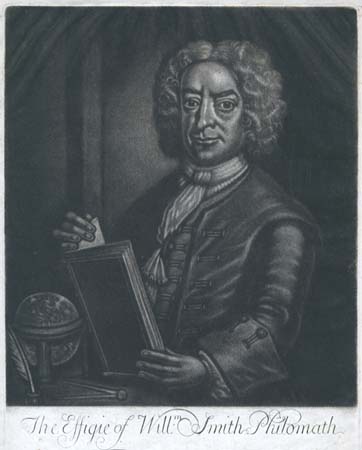
The Effigie of Will.m Smith Philomath. Observe the Man of Astrologic Skill who by his art turns Fortune at his wil ye tender fair, who would know fates decree, Inspect the Print, you'l know as well as he.
[n.d., c.1740.]
Mezzotint. 275 x 195mm (10¾ x 8½"). Slight cockling at the top of image.
A fortune-teller based in Coventry who lost his dog and, by offering a reward, made himself a laughing stock. CS: Unascribed II. 96.
[Ref: 368] £330.00
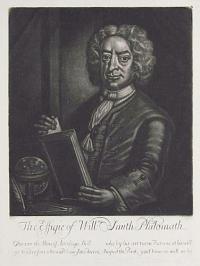
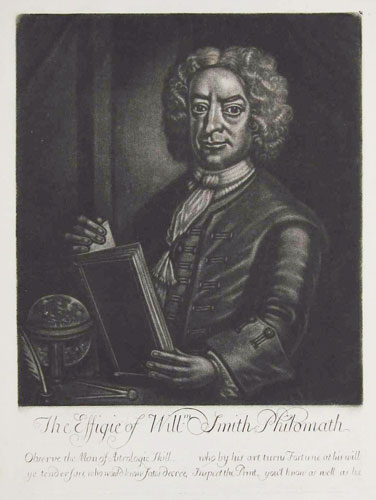
The Effigie of Will.m Smith Philomath. Observe the Man of Astrologic Skill who by his art turns Fortune at his will ye tender fair, who would know fates decree, Inspect the Print, you'l know as well as he.
[n.d., c.1740.]
Mezzotint. 275 x 195mm.
A fortune-teller based in Coventry who lost his dog and, by offering a reward, made himself a laughing stock. CS: Unascribed II 96. Ex: Collection of The Hon. C. Lennox-Boyd.
[Ref: 369] £350.00
![[William Smith.]](img-thumbnail/jpegs/20317.jpg)
[William Smith.]
Drawn and Engraved by W.C. Edwards from a whole length picture painted by H. Thompson, Esq. R.A. in the Guildhall, Norwich.
[n.d. c.1833.]
Engraving. Proof before letters. Plate 432 x 325mm. 17 x 12¾". Slight scratch in left margin just inside plate mark.
William Smith (1756-1835) was a politician of great power and change. He was a friend and close associate of William Wilberforce and was at the forefront of many campaigns for social justice and prison reform but most notably was his campaign for the abolition of slavery. He was Member of Parliament for Suffolk and Norwich for some years but it was in 1787 that he acted as the first to campaign for the abolition for the slave trade. In 1790 he supported Wilberforce in the slave trade debate and once the trade had been halted he helped Zachary Macaulay in 1823 found the ‘London Society for the Abolition of Slavery in our Colonies’, thereby launching the next phase of the campaign to eradicate slavery. His involvement in the French Revolution was controversial, and he swiftly gained a reputation as a radical. He secretly arranged several meetings between William Pitt and Maret, Napoleon’s foreign minister, in a desperate attempt to avoid war.
[Ref: 20317] £360.00
![[In pencil:] The Smith's Authors of the Rejected Addresses.](jpegs/34620.jpg)



![[John Smith.]](jpegs/66931.jpg)



![Layton Smith. [&] Ink mss.](jpegs/65883.jpg)
![[Master Smith] The Nabob.](jpegs/65985.jpg)
![[Master Smith] The Nabob.](jpegs/65987.jpg)
!['Nabob' [in pencil.]](jpegs/3286.jpg)
![Mrs Sam.l Smith [ms lower right]](jpegs/46119.jpg)

![Richard Smith [facsimile signature]](jpegs/8288.jpg)
![[Dr Samuel Smith] Mastigeus [in Greek letters.]](jpegs/38251.jpg)

![[Sir Sidney Smith.]](jpegs/68216.jpg)
![Very truly yours Southwood Smith [facsimile handwriting].](jpegs/43392.jpg)
![Very truly yours Southwood Smith [facsimile handwriting].](jpegs/43393.jpg)




![[William Smith.]](jpegs/20317.jpg)