![[The Classical ruins of Rome.]](img-thumbnail/jpegs/57511.jpg)
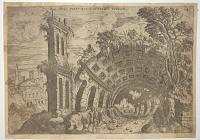
[The Classical ruins of Rome.]
[Antwerp, Hieronymus Cock n.d., c.1550.]
Engraving. 150 x 210mm (6 x 8¼"). Trimmed into image, laid on album paper.
Hieronymus Cock (c.1517-70) visited Rome in the late 1540s, inspiring him to start up his own publishing firm in Antwerp in 1548, which became the most important print publishing firm from outside Italy. After his death in 1570 the firm was continued by his widow (Volcxken Diercx) until her death in 1600, when many of the plates were acquired by Philips Galle. However this plate seems to have been acquired by the van Doetecum brothers, who published it in 'Operum Antiquorum Romanorum' in 1562, with Cock's name removed.
[Ref: 57511] £220.00
(£264.00 incl.VAT)
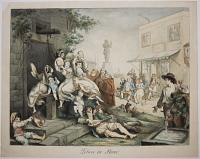
Leben in Rom.
Hein.ch inv.t: del.t et inct. Hannover 1797.
Etching with hand colour, fine & rare. 435 x 535mm (17 x 21"). Trimmed within the plate at the bottom.
'Life in Rome', satirising the attractions of the city to Grand Tourists. Four girls with open bodices sit on a swing suspended in a doorway, playing tamborines, with a group of monks and a man playing the lute lying beneath all enjoying the view. Across the road tourists sit outside a coffee shop and a man sells wine from barrels on his donkey.
[Ref: 48521] £750.00
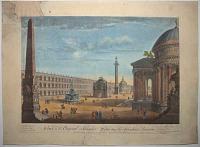
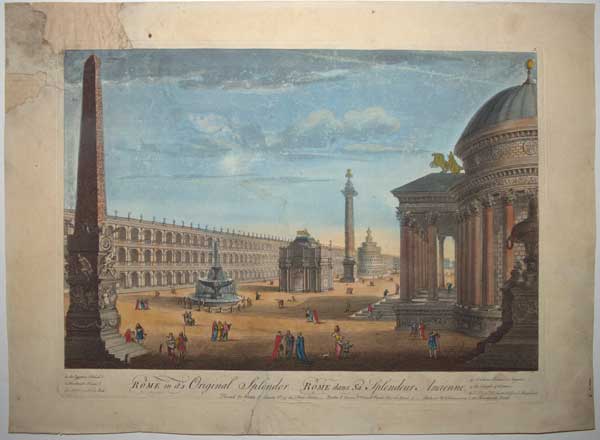
Rome in it's Original Splendor. Rome dans Sa Splendeur Ancienne. 1 An Egyptian Obelisk. 2 The Senate House. 3 A Triumphal Arch. 4 A Column Erected to Augustus. 5 The Temple of Fortune. 6 A Temple Dedicated to Jove ye Thunderer.
Printed for Whittle & Laurie N.º 53 Fleet Street _ Bowles & Carver N.º 69 S.t Pauls Church Yard. & _ Robert Wilkinson _ 125 Fenchurch Street.
Coloured engraving. 280 x 390mm (11 x 15¼"), large margins. Tear through title into plate repaired; top left corner extensively repaired, with mss. fill. Damaged.
An imaginary view of classical Rome. Ex: Collection of Edward Croft Murray
[Ref: 62133] £160.00
(£192.00 incl.VAT)
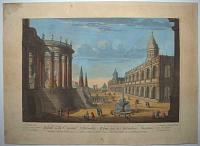
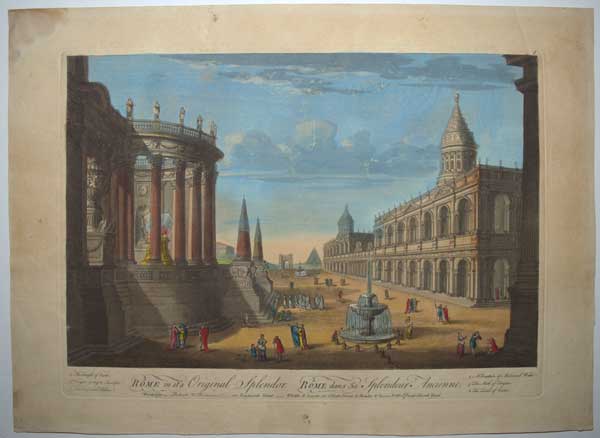
Rome in it's Original Splendor. Rome dans Sa Splendeur Ancienne. 1 the Temple of Vesta. 2 Virgins going to Sacrifice. 3 The Imperial Palace. 4 A Fountain of Medicinal Water. 5 The Arch of Trajan. 6 The Tomb of Cestus.
Printed for Robert Wilkinson _ 125 Fenchurch Street _ Whittle & Laurie 53 Fleet Street & Bowles & Carver N.º 69 S.t Pauls Church Yard.
Coloured engraving, J. Whatman 1816 watermark; 280 x 390mm (11 x 15¼"), with very large margins. Small tear in margin, some paper tone.
An imaginary view of classical Rome. Ex: Collection of Edward Croft Murray
[Ref: 62134] £320.00
![[The Colosseum, Rome] Colosseo.](img-thumbnail/jpegs/23521.jpg)
[The Colosseum, Rome] Colosseo.
[Anon.]
[Italian, n.d., c.1820s.]
Illustrated letter paper, unused, single sheet folded, so small 4to (260 x 195mm, 10¼ x 7¾"), watermarked wove paper. Generally good.
Before the advent of the postcard, these would have been sold to (grand) tourists so they could write to loved ones back home.
[Ref: 23521] £85.00
(£102.00 incl.VAT)
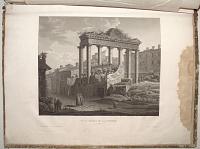
Monumens Antiques du Camp Vaccino, a Rome.
Junto Tarté del. Piringer sculp.
A Paris, chez Bance l'aine, Rue S.t Denis, no 214.
Large folio, original half calf; pp. ii + 6 numbered aquatints with etching, as called for. Original Binding distressed, sheets with damp staining outside very large margins.
Six views of the Roman Forum, called the Campo Vaccino because of the cows that grazed there, engraved by Benedikt Piringer.
[Ref: 56140] £980.00
view all images for this item
![[Rome] Urbis Romae Veteris ac Modernae Accurata Delineatio.](img-thumbnail/jpegs/62178.jpg)
[Rome] Urbis Romae Veteris ac Modernae Accurata Delineatio.
edita â Joh: Bapt: Homann S.C.M. Geographo Norimbergae. [n.d., c.1720].
Engraved map with original hand colour. 495 x 585mm (19½ x 23"). Wormhole and toning at centre fold, split at botton; tears in margin.
A detailed map of Ancient Rome decoratedwith figures representing the Catholic Church. Ex: Collection of Edward Croft Murray.
[Ref: 62178] £580.00
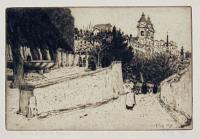
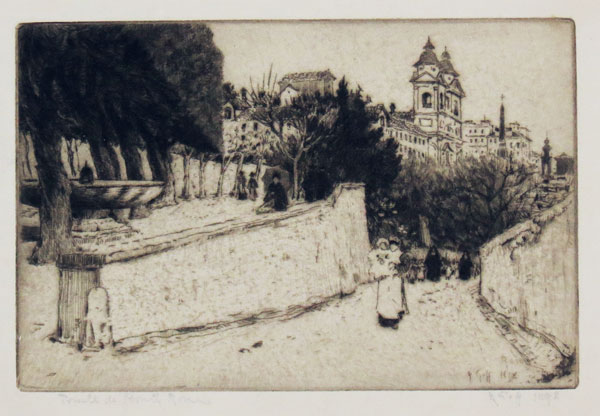
Trinita di Monte. Rome.
R. Goff [signed in pencil and within plate].
1892.
Etching. Platemark: 95 x 145mm (3¾ x 5¾").
A view of the church of the Santissima Trinità dei Monti, often called merely the Trinità dei Monti in Rome. It is best known for its commanding position above the Spanish Steps which lead down to the Piazza di Spagna. Robert Charles Goff (1837–1922) was a printmaker and painter who specialised in topographical scenes, strongly influenced by the work of James McNeill Whistler. Brighton and Hove Museum and Art Gallery hold a large collection of Goff's work.
[Ref: 38046] £75.00
(£90.00 incl.VAT)

Distant view of Rome from Tivoli. From a picture in the posession of Frederick Perkins Esq. Gems of Art _ Plate 12.
Painted by Gaspar Poussin [Gaspard Dughet]. Engraved in Steel by S.W. Reynolds, Engraver to the King.
[London. Published Dec 1. 1823: by W.B. Cooke, 9 Soho Square.]
Mezzotint on steel. 210 x 275mm (8¼ x 10¾), with very large margins Some spotting.
Engraving after a painting by Gaspar Dughet (1615-75), who often used the name of his brother-in-law and teacher, Nicolas Poussin. Along with Claude Lorrain, Dughet was one of the landscape painters whose works were best-known to British audiences in the 18th century. His landscapes, disseminated through prints such as this, were highly influential on the nascent English landscape school. From 'Gems of Art: Forming a Choice Collection Engraved from Pictures of Acknowledged Excellence, Beauty, & Variety, Painted by Esteemed Masters of All Ages and Countries'. Whitman 428a, but this state, with different plate number and lacking the publication line, not listed.
[Ref: 46349] £50.00
(£60.00 incl.VAT)
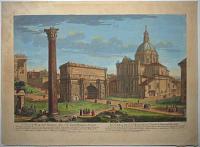
A View of S.t Martins Church, Also of the Arch of Septimus Severus, through which the Roman Generals marched in their triumphs to the Capitol.
Piranesi delin.t. Bowles Sculp.
Printed for Robert Wilkinson 58 Cornhill & Bowles & Carver, 69 St. Paul's Church Yard. [n.d. c.1800]
Engraving with hand colour. 275 x 425mm (10¾ x 16¾"), large margins.
A view of the Arch of Septimus Severus in the Roman Forum, still half-buried. To the left is the Colonna di Foca (Phocas); to the right is the Chiesa Santi Luca e Martina. A copy of Giovanni Battista Piranesi's ''Arco di Settimio Severo'', 1759. Ex: Collection of Edward Croft Murray.
[Ref: 62131] £320.00

Veduta del Condotto dell'Acqua Vergine situato alla Chiavica del Bufalo.
Rossini dis. e inc.
Roma 1822.
Etching. 370 x 455mm (14½ x 18"), with large margins, uncut.
The Acqua Vergine aquaduct was built by Marcus Agrippa in 19 BC, primarily to supply Agrippa's Baths. Said to have the purest water in Rome, it supplies the Trevi Fountain, fountains in Piazza Navona and di Spagna. The first state, before the plate number, issued unbound. From an early 19th century folder titled 'Roman Engravings. The Property of Major E.G.G. Rugdon[?]'.
[Ref: 51544] £400.00

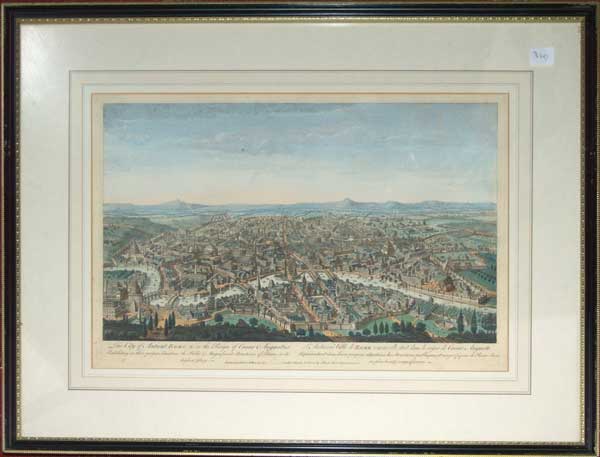
The City of Ancient Rome in the Reign of Caesar Augustus, Exhibiting in their proper Situations the Public & Magnificent Structures of Rome, in it's highestGlory. L'Antienne Ville De Rome comme elle etoit dans le reigne de Caesar Auguste...
Printed for Robert Wilkinson, 58 Cornhill, & Bowles & Carver, 69 St. Paul's Church Yard [n.d. c.1800].
Framed engraving with fine hand colouring , plate 275 x 425mm (10¾ x 16¾"). Frame size 480 x 630mm (19 x 24¾"). Some small dots in the sky. Unexamined out of frame.
A perspective view of Ancient Rome.
[Ref: 61283] £320.00
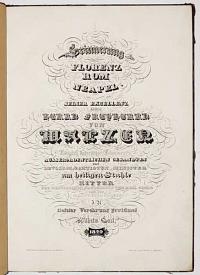
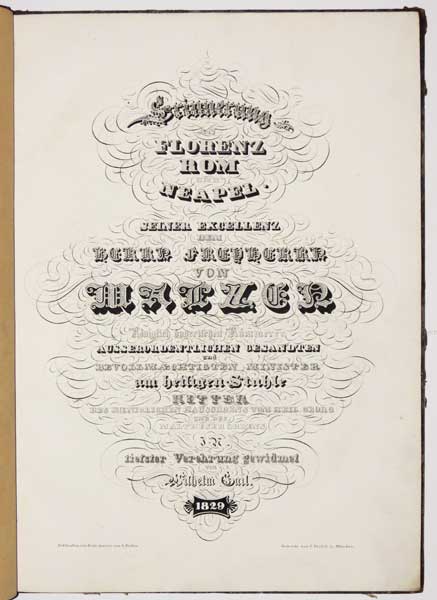
Erinnerung an Florenz, Rom und Neapel.
W. Gail, del.t.
Tiesster Verehrung Gewildnet von Wilhelm Gail. 1829.
Folio, ½ Morocco; gilt; marbled boards. Printed title, 6 parts each with ½ title and five lithographic plates. Very scarce with wrappers. Rubbed.
30 views of Rome, Florence and Naples. By Wilhelm Gail (1804-1890) a German painter of architecture. See Ref: 32003 for 6 plates from the volume.
[Ref: 32150] £2,500.00
view all images for this item
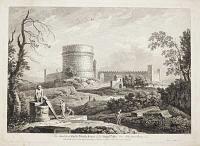
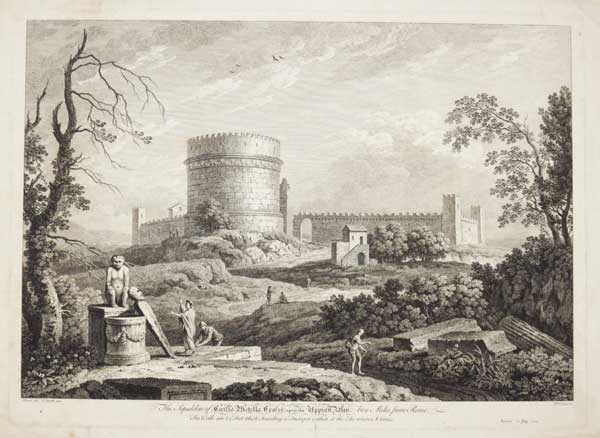
The Sepulchre of Cecilia Metella Crasi; upon the Appian Way, Two Miles from Rome. The Walls are 25 Feet thick, Sounding a Trumpet within it the Echo returns it 8 times.
Buisiri del: T. Smith pin: F. Vivares sc.
Publish'd 25 July 1746.
Fine engraving with etching. 550 x 400mm (21¾ x 15¾"), with large margins. Tears in the margins. Slight staining.
A view of the mausoleum of Cecilia Metella daughter of Quintus Caecilius Metellus Creticus, whose father served under Julius Ceasar, built in the 1st Century BC and located on one of the southern roads into Rome. The scene shows the ruins of the rotunda and walls, several figures examine the fragments of ancient architecture which line the route.
[Ref: 68304] £330.00
![[Aqua Julia] Veduta del Castello dell' Acqua Giulia. secondi lo scavo fatto in quest'anno 1822 nella Via Tiburtina.](img-thumbnail/jpegs/51560.jpg)
[Aqua Julia] Veduta del Castello dell' Acqua Giulia. secondi lo scavo fatto in quest'anno 1822 nella Via Tiburtina.
Rossini dis. e inc.
Roma 1822.
Etching. 350 x 450mm (13¾ x 17¾"), with large margins, uncut.
The ruins of a castle, probably built to protect the Aqua Julia, Rome's water supply. According to the title the building was being excavated at the time of the view. The first state, before the plate number, issued unbound. From an early 19th century folder titled 'Roman Engravings. The Property of Major E.G.G. Rugdon[?]'.
[Ref: 51560] £400.00
![[Arch of Dolabella] Veduta della Fornice de Consoli Dolabella, e Silano, investila dagli Archi Neroniani provenienti dal Condotto dell'Aqua Claudia.~](img-thumbnail/jpegs/51551.jpg)
[Arch of Dolabella] Veduta della Fornice de Consoli Dolabella, e Silano, investila dagli Archi Neroniani provenienti dal Condotto dell'Aqua Claudia.~
Rossini dis. e inc.
Roma 1821.
Etching. 460 x 390mm (18 x 15½"), with large margins, uncut. Crease at the top.
The Arch of Dolabella and Silanus, a rebuilding of one of the gates of the Servian Walls in 10 AD by the consuls P. Cornelius Dolabella and C. Junius Silanus. Nero's extension of the Acqua Claudia was built over the top of the arch. The first state, before the plate number, issued unbound. From an early 19th century folder titled 'Roman Engravings. The Property of Major E.G.G. Rugdon[?]'.
[Ref: 51551] £400.00
![[Arch of Drusus] Arco di Druso, e Porta Capena.](img-thumbnail/jpegs/51566.jpg)
[Arch of Drusus] Arco di Druso, e Porta Capena.
Rossini dis. e inc.
Roma 1820.
Etching. 390 x 460mm (15¼ x 18"), with large margins, uncut. Printer's creases just entering image.
A view of an arch at the beginning of the Appian Way known as the Arch of Drusus (for Nero Claudius Drusus, the conqueror of the Germans) but probably built later. Some years after construction the arch was utilised by the builders of the Aqua Antoniniana, a branch of the Aqua Marcia. Through the arch is the Porta Capena, a gate in the Servian wall. The first state, before the plate number, issued unbound. From an early 19th century folder titled 'Roman Engravings. The Property of Major E.G.G. Rugdon[?]'.
[Ref: 51566] £300.00
![[Arch of Drusus] Arco di Druso su del quale passava il Condotto Antoniano.](img-thumbnail/jpegs/51529.jpg)
[Arch of Drusus] Arco di Druso su del quale passava il Condotto Antoniano.
Rossini dis. e inc.
Roma 1819.
Etching. 455 x 355mm (18 x 14"), with large margins, uncut.
A view of an arch at the beginning of the Appian Way known as the Arch of Drusus (for Nero Claudius Drusus, the conqueror of the Germans) but probably built later. Some years after construction the arch was utilised by the builders of the Aqua Antoniniana, a branch of the Aqua Marcia. The first state, before the plate number, issued unbound. From an early 19th century folder titled 'Roman Engravings. The Property of Major E.G.G. Rugdon[?]'.
[Ref: 51529] £400.00
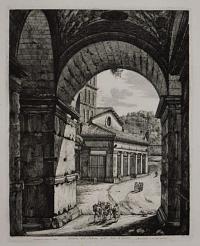
Veduta dell' Interno dell'Araco du Giano.
Rossini dis. e inc.
Roma 1820.
Etching. 475 x 375mm (18¾ x 14¾"), with large margins, uncut.
A view from under the so-called Arch of Janus, the only quadrifrons triumphal arch remaining in Rome, at the edge of the Forum Boarium (cattle market). The church is the seventh century San Giorgio in Velabro, founded on the spot that Romulus and Remus were found by the she-wolf. The first state, before the plate number, issued unbound. From an early 19th century folder titled 'Roman Engravings. The Property of Major E.G.G. Rugdon[?]'.
[Ref: 51531] £400.00
![[Arch of Septimius Severus] Veduta dell' Arco di Settimio.](img-thumbnail/jpegs/51485.jpg)
[Arch of Septimius Severus] Veduta dell' Arco di Settimio.
Rossini dis. e inc.
Roma 1820.
Etching. 370 x 570mm (14½ x 22½"), with very large, uncut margins.
A view of the Arch of Septimius Severus from the Forum, with the steps of the Capitoline Hill in the background. It is shown before the original street level was excavated by Carlo Fea in 1803, removing sediement washed into the Forum by floodwater. The first state, before the plate number, issued unbound. From an early 19th century folder titled 'Roman Engravings. The Property of Major E.G.G. Rugdon[?]'.
[Ref: 51485] £750.00
![[Arcus Argentariorum] Veduta dell'Arco di Settimio Severo nel Foro Boario.](img-thumbnail/jpegs/51564.jpg)
[Arcus Argentariorum] Veduta dell'Arco di Settimio Severo nel Foro Boario.
Rossini dis. e inc.
Roma 1821.
Etching. 405 x 485mm (15¾ x 19"), with large margins, uncut.
A view of the Arcus Argentariorum (Arch of the Moneychangers), a small arch in the Forum Boarium (the cattle Market). According to the inscription it was commissioned by the local money-changers and merchants in honour of emperor Septimus Severus and his family. It is now joined to the western wall of the seventh century church of San Giorgio al Velabro. This plate has one of the more dramatic scenes drawn by Bartolomeo Pinelli to add life to Rossini's architecture, a knife-fight. The first state, before the plate number, issued unbound. From an early 19th century folder titled 'Roman Engravings. The Property of Major E.G.G. Rugdon[?]'.
[Ref: 51564] £600.00
![[Arcus Neroniani.] Veduta dei Grandi Avanzi degli Aquedotti di Nerone _ vicino a Porte S. Giovanni.](img-thumbnail/jpegs/51545.jpg)
[Arcus Neroniani.] Veduta dei Grandi Avanzi degli Aquedotti di Nerone _ vicino a Porte S. Giovanni.
Rossini dis. e inc.
Roma 1823.
Etching. 435 x 540mm (17 x 21¼"), with large margins, uncut.
The Arcus Neroniani, an extension of the Acqua Claudia built by Nero to supply water to the Caelian Hill. The first state, before the plate number, issued unbound. From an early 19th century folder titled 'Roman Engravings. The Property of Major E.G.G. Rugdon[?]'.
[Ref: 51545] £400.00
![[The Aurelian Walls] Veduta della Mura di Roma, dalla parte interna della Città, vicino alla Porta Celimontana.](img-thumbnail/jpegs/51496.jpg)
[The Aurelian Walls] Veduta della Mura di Roma, dalla parte interna della Città, vicino alla Porta Celimontana.
Rossini dis. e inc.
Roma 1823.
Etching. 425 x 660mm (16¾ x 26"), with large, uncut margins.
A view of part of the Aurelian walls, which made use of the existing Aqua Claudia. This section is now in the Giardini di via Carlo Felice. The walls point towards the minor basilica Santa Croce in Gerusalemme. The first state, before the plate number, issued unbound. From an early 19th century folder titled 'Roman Engravings. The Property of Major E.G.G. Rugdon[?]'.
[Ref: 51496] £600.00
![[Basilica of Maxentius] Veduta Generale del gran Tempio della Pace.](img-thumbnail/jpegs/51520.jpg)
[Basilica of Maxentius] Veduta Generale del gran Tempio della Pace.
Rossini dis. e inc.
Roma 1822.
Etching. 440 x 660mm (17¼ x 26"), with large margins, uncut.
A view showing the octagonal ceiling coffers of the concrete barrel vaults of the Basilica of Maxentius and Constantine, the largest building in the Forum of Rome. Begun by Maxentius in 308 AD the building was completed in 312 by Constantine after he defeated Maxentius at Milvian Bridge. The first state, before the plate number, issued unbound. From an early 19th century folder titled 'Roman Engravings. The Property of Major E.G.G. Rugdon[?]'.
[Ref: 51520] £400.00
![[Basilica of Maxentius] Veduta D'una delle navate minori, della Tempio Pace.](img-thumbnail/jpegs/51555.jpg)
[Basilica of Maxentius] Veduta D'una delle navate minori, della Tempio Pace.
Rossini dis. e inc.
Roma 1819.
Etching. 560 x 455mm (22 x 18"), with large margins, uncut.
The interior of the Basilica of Maxentius and Constantine, showing the remaining north aisle with its brick walls and arches supporting the concrete vaults, with the octagonal ceiling coffers. Begun by Maxentius in 308 AD, the building was completed in 312 by Constantine after he defeated Maxentius at Milvian Bridge. It was the largest building in the Forum Romanum. The first state, before the plate number, issued unbound. From an early 19th century folder titled 'Roman Engravings. The Property of Major E.G.G. Rugdon[?]'.
[Ref: 51555] £600.00
![[Baths of Diocletian] Vestigi delle Terme di Dioclitiano Imperatore, in Roma.](img-thumbnail/jpegs/57523.jpg)
[Baths of Diocletian] Vestigi delle Terme di Dioclitiano Imperatore, in Roma. 5.
Perelle fecit.
Daman excudit [n.d., c.1650].
Etching, 245 x 315mm (8½ x 12½"). Small margins. Some slight creasing and wear.
The ruins of the Baths of Diocletian, drawn by either Gabriel Perelle (1604-77) or his sons Adam and Nicolas. From the Airlie collection, Cortachy Castle.
[Ref: 57523] £180.00
(£216.00 incl.VAT)
![[Baths of Diocletian] Veduta degl' Avanzi del secondo piano delle Terme Diocleziane.](img-thumbnail/jpegs/5181.jpg)
[Baths of Diocletian] Veduta degl' Avanzi del secondo piano delle Terme Diocleziane.
Rossini dis. e inc.
Roma 1823.
Etching. 540 x 390mm (23¾ x 15¼"), trimmed to the image.
The Baths of Diocletian were the largest of the public baths and were capable of accommodating 3,000 bathers at the same time. The tepidarium and the central hall are now the church of S. Maria degli Angeli, a side hall is the church of S. Bernardo.
[Ref: 5181] £240.00
(£288.00 incl.VAT)
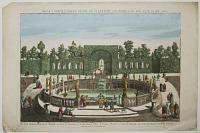
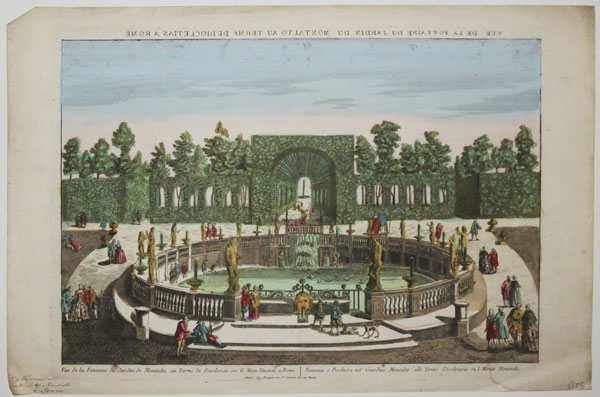
Vue de la Fontaine du Jardin de Montalte au Terme de Diocletian sur le Mont Viminal a Rome. Fontana e Pischiera nel Giardino Montalto alle Terme Diocletiane su l Monte Viminale.
AParis chez Pasquier rue St. Severin chez un Vitrier. [n.d., c.1770.]
Hand-coloured engraving. Plate: 290 x 415mm (11½ x 14¼''). Manuscript in margins.
A view of an ornate complex of fountains in the ancient Baths of Diocletian in Rome.
[Ref: 48366] £175.00
(£210.00 incl.VAT)
![[Baths of Diocletian] Veduta degl' Avanzi del secondo piano delle Terme Diocleziane.](img-thumbnail/jpegs/51567.jpg)
[Baths of Diocletian] Veduta degl' Avanzi del secondo piano delle Terme Diocleziane.
Rossini dis. e inc.
Roma 1823.
Etching. 540 x 390mm (23¾ x 15¼"), with large margins, uncut. Crease.
The Baths of Diocletian were the largest of the public baths and were capable of accommodating 3,000 bathers at the same time. The tepidarium and the central hall are now the church of S. Maria degli Angeli; a side hall is the church of S. Bernardo. The first state, before the plate number, issued unbound. From an early 19th century folder titled 'Roman Engravings. The Property of Major E.G.G. Rugdon[?]'.
[Ref: 51567] £300.00
Unfortunately this item is either sold or reserved. If you are interested in similar items and cannot find what you're looking for on our website, please consider filling in our interests form. If you register, we can also send you items that match your interests when the website is updated.
![[Capitoline Hill] Veduta di Fianco del Campidoglio di Roma.](img-thumbnail/jpegs/51484.jpg)
[Capitoline Hill] Veduta di Fianco del Campidoglio di Roma.
Rossini dis & inc.
Roma 1819.
Etching. 440 x 550mm (17¼ x 21¾"), with very large, uncut margins.
A side view of the Piazza del Campidoglio, designed by Michaelangelo in the 16th century, with one of the Dioscuri (Castor & Pollux), the two stone horsemen guarding the cordonata. The first state, before the plate number, issued unbound. From an early 19th century folder titled 'Roman Engravings. The Property of Major E.G.G. Rugdon[?]'.
[Ref: 51484] £900.00
![[Capitoline Hill] Veduta del Campidoglio Romano.](img-thumbnail/jpegs/51491.jpg)
[Capitoline Hill] Veduta del Campidoglio Romano.
Rossini dis. e inc.
Roma 1823.
Etching. 365 x 450mm (14½ x 17¾"), with very large uncut margins.
A view of the Capitoline Hill leading from Via del Teatro di Marcello to Piazza del Campidoglio, as designed by Michelangelo Buonarroti in 1536-46. At the top of the cordonata are the statues of the Dioscuri (Castor & Pollux, the Horse Tamers), with the façade of Palazzo Senatorio behind. The first state, before the plate number, issued unbound. From an early 19th century folder titled 'Roman Engravings. The Property of Major E.G.G. Rugdon[?]'.
[Ref: 51491] £900.00

Avanzo della Casa di Cola di Rienzo.
Rossini dis. e inc.
Roma 1820.
Etching. 370 x 465mm (17½ x 18¼"), with large margins, uncut. Some loss of margin top right.
The so-called 'Casa di Cola di Rienzo', a tower in the Piazza Trilussa erected between 1040-65 by a powerful Crescenzi family in the 10th century to control the wharves of Rome, built using material scavenged from classical ruins. There is no direct connection with Cola di Rienzi, a populist politician (1313-54) eventually murdered by a mob, merely that he was born in the area. The first state, before the plate number, issued unbound. From an early 19th century folder titled 'Roman Engravings. The Property of Major E.G.G. Rugdon[?]'.
[Ref: 51553] £600.00
![[Castel Sant'Angelo] Veduta della Gran Mole Adriana, e Ponte Elio, in oggi Ponte, e Castel S.t Angelo.](img-thumbnail/jpegs/51499.jpg)
[Castel Sant'Angelo] Veduta della Gran Mole Adriana, e Ponte Elio, in oggi Ponte, e Castel S.t Angelo.
Rossini dis. e inc.
Roma 1821.
Etching. 445 x 555mm (17¾ x 21¾"), with very large, uncut margins. Wear to edge of left margin.
A view from the banks of the Tiber looking up at the Aelian Bridge and the Mausoleum of Hadrian, both built by the emperor Hadrian between 134 - 139, and now known as the Ponte Sant'Angelo and Castel Sant'Angelo. The first state, before the plate number, issued unbound. From an early 19th century folder titled 'Roman Engravings. The Property of Major E.G.G. Rugdon[?]'.
[Ref: 51499] £900.00
![[Castel Sant'Angelo] Veduta Generale della gran Mole Adriana, e Ponte Elio _ in oggi Ponte e Castel S.Angelo.](img-thumbnail/jpegs/51490.jpg)
[Castel Sant'Angelo] Veduta Generale della gran Mole Adriana, e Ponte Elio _ in oggi Ponte e Castel S.Angelo.
Rossini dis. e inc.
Roma 1823.
Etching. 355 x 535mm (14 x 21"), with very large, uncut margins.
A general view looking along the Tiber to the Aelian Bridge and the Mausoleum of Hadrian, both built by the emperor Hadrian between 134 - 139, and now known as the Ponte Sant'Angelo and Castel Sant'Angelo. Behind the bridge is the dome of St Peter's Basilica in the Vatican. The first state, before the plate number, issued unbound. From an early 19th century folder titled 'Roman Engravings. The Property of Major E.G.G. Rugdon[?]'.
[Ref: 51490] £900.00
![[Colosseum] Veduta di porzione degli avanzi dell'Ambularco del piano terra nel Colosseo.](img-thumbnail/jpegs/51511.jpg)
[Colosseum] Veduta di porzione degli avanzi dell'Ambularco del piano terra nel Colosseo.
Rossini dis. e inc.
Roma 1821.
Etching. 465 x 395mm (18¼ x 15½"), with large margins, uncut.
A view of the interior spectator passageway with the vomitoria, the doors into the seating areas and out of the building. The first state, before the plate number, issued unbound. From an early 19th century folder titled 'Roman Engravings. The Property of Major E.G.G. Rugdon[?]'.
[Ref: 51511] £600.00
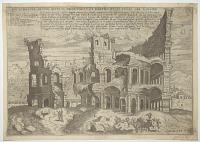
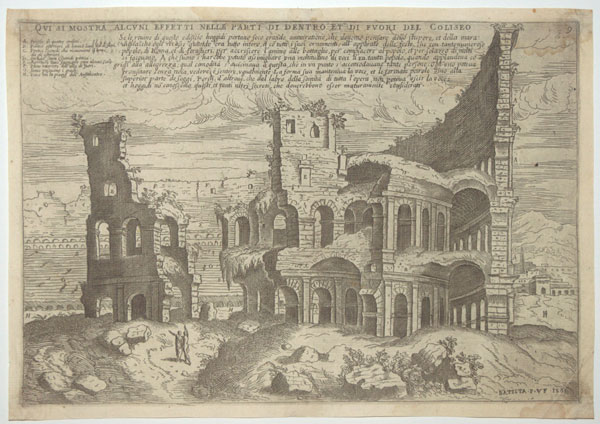
Qui si Mostra Alcuni Effetti nelle Parti de Dentro et di Fuori del Coliseo. 9.
Batista P. Ve 1581 [Battista Pittoni of Venice, after Heironymus Cock?].
[Venice: Francesco Ziletti?, c.1590.]
Engraving, drawing on reverse, 17th century watermark. 210 x 310mm (8¼ x 12¼"). Glue stains in corners. Small margins.
A view looking through the collapsed wall of the Colosseum into the interior. The plate was originally published in 'Discorsi sopra l'antichità di Roma di Vicenzo Scamozzi architetto vicentino, con XL tauole in rame' by Ziletti in 1582; this example has had the original Latin title replaced by an Italian title, description and key.
[Ref: 57507] £220.00
(£264.00 incl.VAT)
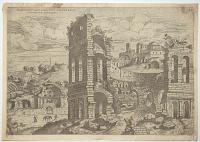
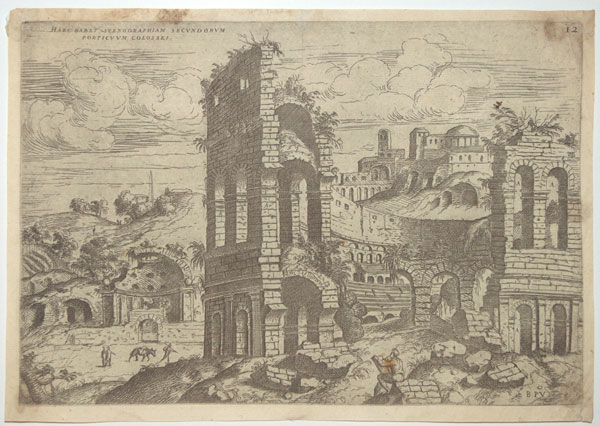
Haec Habet Scenofgraphiam Secondorum Porticuum Colossei. 12.
P. PV [Battista Pittoni of Venice, after Heironymus Cock?].
[Venice: Francesco Ziletti, 1582.]
Engraving, 17th century watermark. 210 x 3150mm (8¼ x 12½"). Glue stains in corners. Small margins.
A view looking through the collapsed wall of the Colosseum into the interior. Plate 12 of 'Discorsi sopra l'antichità di Roma di Vicenzo Scamozzi architetto vicentino, con XL tauole in rame'.
[Ref: 57508] £220.00
(£264.00 incl.VAT)
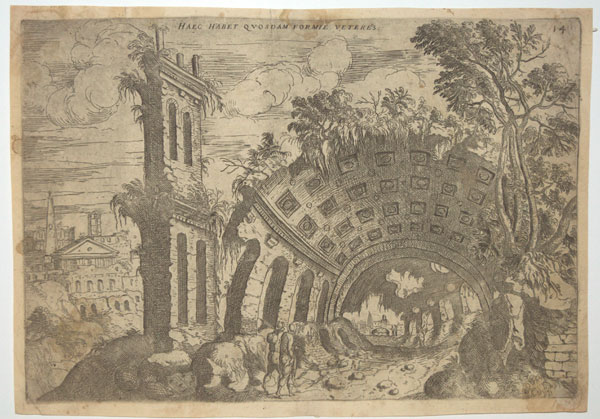
Haec Habet Quosdam Formie Veteres. 14.
[engraved by Battista Pittoni of Venice, after Heironymus Cock?].
[Venice: Francesco Ziletti, 1582.]
Engraving. 210 x 3150mm (8¼ x 12½"). Glue stains in corners. Slight tears top right. Very slight crease not visible from front.
The ruins of a coffered archway, with a track ruining through it. Plate 14 of 'Discorsi sopra l'antichità di Roma di Vicenzo Scamozzi architetto vicentino, con XL tauole in rame'.
[Ref: 57509] £220.00
(£264.00 incl.VAT)
![[Colosseum] Veduta degl'avanzi d'uno de principali ingressi del Colosseo.](img-thumbnail/jpegs/51510.jpg)
[Colosseum] Veduta degl'avanzi d'uno de principali ingressi del Colosseo.
Rossini dis. e inc.
Roma 1819.
Etching. 455 x 360mm (18 x 14¼"), with large margins, uncut.
An archway looking into the arena of the Colosseum. The first state, before the plate number, issued unbound. From an early 19th century folder titled 'Roman Engravings. The Property of Major E.G.G. Rugdon[?]'.
[Ref: 51510] £600.00
![[Colosseum] Veduta dell'altro principale Ingresso, del Colosseo.](img-thumbnail/jpegs/51512.jpg)
[Colosseum] Veduta dell'altro principale Ingresso, del Colosseo.
Rossini dis. e inc.
Roma 1821.
Etching. 540 x 385mm (21¼") x 15¼"), with large margins, uncut. Repaired tear in image.
One of the principal vomitoria of the Colosseum, looking out towards Temple of Venus and Roma, the largest temple in Rome, designed by Hadrian. The first state, before the plate number, issued unbound. From an early 19th century folder titled 'Roman Engravings. The Property of Major E.G.G. Rugdon[?]'.
[Ref: 51512] £600.00
![[Colosseum] Veduta del grande' interno dell'Anfiteatro Flavio, detto il Colosseo.](img-thumbnail/jpegs/51495.jpg)
[Colosseum] Veduta del grande' interno dell'Anfiteatro Flavio, detto il Colosseo.
Rossini dis. e inc.
Roma 1823.
Etching. 460 x 665mm (18 x 26¼"), with very large, uncut margins. Some wear to the top margin.
A general view of the vast interior of the Colosseum. Among the figures, drawn by Bartolomeo Pinelli to add life to Rossini's architecture, is a procession of monks. The first state, before the plate number, issued unbound. From an early 19th century folder titled 'Roman Engravings. The Property of Major E.G.G. Rugdon[?]'.
[Ref: 51495] £700.00
![[The Colosseum?]](img-thumbnail/jpegs/57510.jpg)
[The Colosseum?]
H Cock ex. [Antwerp, n.d., c.1550.]
Engraving, 16th century watermark. 150 x 210mm (6 x 8¼"). Trimmed into image, laid on album paper.
A long and curved barrel vault, probably part of the Colosseum. Hieronymus Cock (c.1517-70) vistited Rome in the late 1540s, inspiring him to start up his own publishing firm in Antwerp in 1548, which became the most important print publishing firm from outside Italy. After his death in 1570 the firm was continued by his widow (Volcxken Diercx) until her death in 1600, when many of the plates were acquired by Philips Galle. However this plate seems to have been acquired by the van Doetecum brothers, who published it in 'Operum Antiquorum Romanorum' in 1562, with Cock's name removed. See BM 1950,0211.111 for the van Doetecum issue.
[Ref: 57510] £220.00
(£264.00 incl.VAT)
![[Column of Marcus Aurelius] Veduta della Colonna Antonina, o sia Piazza Colonna.](img-thumbnail/jpegs/51481.jpg)
[Column of Marcus Aurelius] Veduta della Colonna Antonina, o sia Piazza Colonna.
Rossini dis. e inc.
Roma 1823.
Etching. 565 x 455mm (22¼ x 18"), with very large, uncut margins.
The Column of Marcus Aurelius Antoninus (emperor from 161 to 180) in Piazza Colonna, which has a spiral frieze depicting the emperor's wars on the Danube. In 1589 pope Sixtus V placed a bronze statue of the apostle St. Paul on top. The first state, before the plate number, issued unbound. From an early 19th century folder titled 'Roman Engravings. The Property of Major E.G.G. Rugdon[?]'.
[Ref: 51481] £750.00
![['Curia Hostilia'] Avanzi della Curia Ostilius sul Monte Celio.](img-thumbnail/jpegs/51521.jpg)
['Curia Hostilia'] Avanzi della Curia Ostilius sul Monte Celio.
Rossini dis. e inc.
Roma 1823.
Etching. 390 x 540mm (15½ x 21¼"), with large margins, uncut.
According to Rossini's title (one of the few in the image rather than underneath), these are the remains of the Curia Hostilia, an early Senate House built by Tullius Hostilius, the third king of Rome, on Monte Caelio. However it is more likely to be a substructure of the Temple of Claudius on the Caelian Hill. Through the gateway to the left is the Arch of Constantine. The first state, before the plate number, issued unbound. From an early 19th century folder titled 'Roman Engravings. The Property of Major E.G.G. Rugdon[?]'.
[Ref: 51521] £600.00
![[Domus Severiana] Veduta degli Avanzi della Casa Aurea di Nerone, sul Monte Palatino, Della porte riguardante il Circo Massimo.](img-thumbnail/jpegs/51557.jpg)
[Domus Severiana] Veduta degli Avanzi della Casa Aurea di Nerone, sul Monte Palatino, Della porte riguardante il Circo Massimo.
Rossini dis. e inc.
Roma 1823.
Etching. 390 x 540mm (15¼ x 21¼"), with large margins, uncut. Crease lower right.
The arches built to extend the Palatine Hill out for the construction of the Domus Severiana by Septimus Severus, which included a palace and baths. Rossini equates the building to the Domus Aurea ('Golden House'), the palace of entertainment built by Nero in AD 64 after the famous fire that destroyed much of Rome (when he 'fiddled'). The first state, before the plate number, issued unbound. From an early 19th century folder titled 'Roman Engravings. The Property of Major E.G.G. Rugdon[?]'.
[Ref: 51557] £400.00
![[Nuova pianta et alzata della citta di Roma...] 5.](img-thumbnail/jpegs/58690.jpg)
[Nuova pianta et alzata della citta di Roma...] 5.
[Diegniata et Intagliata da Gio. Battista Falda.]
[Rome: Giovanni Giacomo de Rossi 1676, but later.]
Engraved map, one sheet only (of twelve), 17th century watermark. 395 x 505mm (15½ x 19¾") very large margins. Damp stains. Central crease as normal.
Sheet 5 of a 12-sheet map of Rome by Giovanni Battista Falda da Valdugga (1648-78), an architect who drew and engraved views of Rome for the de Rossi family. It takes the form of a bird's-eye view, with buildings shown in perspective. Orientated with north to the left, this section shows the Colosseum, the Forum, Campidoglio, the Palatine Hill and the Baths of Trajan.
[Ref: 58690] £480.00
![[Nuova pianta et alzata della citta di Roma...] 11.](img-thumbnail/jpegs/58691.jpg)
[Nuova pianta et alzata della citta di Roma...] 11.
[Diegniata et Intagliata da Gio. Battista Falda.]
[Rome: Giovanni Giacomo de Rossi 1676, but later.]
Engraved map, one sheet only (of twelve), 17th century watermark. 395 x 505mm (15½ x 19¾"), very large margins. Central crease as normal.
Sheet 11 of a 12-sheet map of Rome by Giovanni Battista Falda da Valdugga (1648-78), an architect who drew and engraved views of Rome for the de Rossi family. It takes the form of a bird's-eye view, with buildings shown in perspective. As the map was orientated with north to the left, this section shows the Janiculum walls, built by Urban VIII in 1643, centred on the Porta San Pancrazio. Under the map is a panel containing nine views of churches, including the Basilicas of St Peter & St Paul.
[Ref: 58691] £320.00
![[Nuova pianta et alzata della citta di Roma...] 4.](img-thumbnail/jpegs/58689.jpg)
[Nuova pianta et alzata della citta di Roma...] 4.
[Diegniata et Intagliata da Gio. Battista Falda.]
[Rome: Giovanni Giacomo de Rossi 1676, but later.]
Engraved map, one sheet only (of twelve). 395 x 505mm (15½ x 19¾") very large margins Central crease as normal.
Sheet 4 of a 12-sheet map of Rome by Giovanni Battista Falda da Valdugga (1648-78), an architect who drew and engraved views of Rome for the de Rossi family. It takes the form of a bird's-eye view, with buildings shown in perspective. As the map was orientated with north to the left, this section shows the north edge of Rome, with the Porta Popolo on the Via Flamina, and the Piazza del Popolo and Piazza Barbarini. This sheet is decorated with a dedication to Pope Innocent XI, on a scroll held aloft by two cherubs.
[Ref: 58689] £350.00
![Nuova pianta et alzata della [citta di Roma...] 1.](img-thumbnail/jpegs/58688.jpg)
Nuova pianta et alzata della [citta di Roma...] 1.
[...] Diegniata et Intagliata da Gio. Battista [Falda.]
[Rome: Giovanni Giacomo de Rossi 1676, but later.]
Engraved map, one sheet only (of twelve). 395 x 505mm (15½ x 19¾") very large margins. Margin snipped bottom right.
The top left sheet of a 12-sheet map of Rome by Giovanni Battista Falda da Valdugga (1648-78), an architect who drew and engraved views of Rome for the de Rossi family. It takes the form of a bird's-eye view, with buildings shown in perspective. As the map was orientated with north to the left, this section shows the north east of Rome, with the Porta Viminale & Porta Collina in the Servian Walls, and the Via Salaria and Via Nomentana. This sheet is decorated with an ornate border on two sides, allegorical figures of the Papacy and Roman Law, and two cherubs holding up the papal mitre and arms.
[Ref: 58688] £220.00

Parte di Dentro del Palazzo di Farnese disegno di Michelangnolo Buonaruoti et il Restante di detto Architettura del Sangallo fabricato l'anno MDXXXXV.
Disegnato da Pietro ferrerio P.A.R.
[Rome: Giovanni Giacomo Rossi, c.1638.]
Etching. 240 x 350mm (9½ x 13¾"), 17th century watermark. Stains on top right. Small margins.
An elevation of the inner courtyard of the Palazzo Farnese, as designed by Michaelangelo and Antonio da Sangallo. It was drawn by architect Pietro Ferrerio (c.1600-54) for 'Palazzi di Roma', a series of 44 plates.
[Ref: 57516] £220.00
(£264.00 incl.VAT)
![[The Classical ruins of Rome.]](jpegs/57511.jpg)

![[The Colosseum, Rome] Colosseo.](jpegs/23521.jpg)

![[Rome] Urbis Romae Veteris ac Modernae Accurata Delineatio.](jpegs/62178.jpg)


![[Aqua Julia] Veduta del Castello dell' Acqua Giulia. secondi lo scavo fatto in quest'anno 1822 nella Via Tiburtina.](jpegs/51560.jpg)
![[Arch of Dolabella] Veduta della Fornice de Consoli Dolabella, e Silano, investila dagli Archi Neroniani provenienti dal Condotto dell'Aqua Claudia.~](jpegs/51551.jpg)
![[Arch of Drusus] Arco di Druso, e Porta Capena.](jpegs/51566.jpg)
![[Arch of Drusus] Arco di Druso su del quale passava il Condotto Antoniano.](jpegs/51529.jpg)

![[Arch of Septimius Severus] Veduta dell' Arco di Settimio.](jpegs/51485.jpg)
![[Arcus Argentariorum] Veduta dell'Arco di Settimio Severo nel Foro Boario.](jpegs/51564.jpg)
![[Arcus Neroniani.] Veduta dei Grandi Avanzi degli Aquedotti di Nerone _ vicino a Porte S. Giovanni.](jpegs/51545.jpg)
![[The Aurelian Walls] Veduta della Mura di Roma, dalla parte interna della Città, vicino alla Porta Celimontana.](jpegs/51496.jpg)
![[Basilica of Maxentius] Veduta Generale del gran Tempio della Pace.](jpegs/51520.jpg)
![[Basilica of Maxentius] Veduta D'una delle navate minori, della Tempio Pace.](jpegs/51555.jpg)
![[Baths of Diocletian] Vestigi delle Terme di Dioclitiano Imperatore, in Roma.](jpegs/57523.jpg)
![[Baths of Diocletian] Veduta degl' Avanzi del secondo piano delle Terme Diocleziane.](jpegs/5181.jpg)
![[Baths of Diocletian] Veduta degl' Avanzi del secondo piano delle Terme Diocleziane.](jpegs/51567.jpg)
![[Capitoline Hill] Veduta di Fianco del Campidoglio di Roma.](jpegs/51484.jpg)
![[Capitoline Hill] Veduta del Campidoglio Romano.](jpegs/51491.jpg)

![[Castel Sant'Angelo] Veduta della Gran Mole Adriana, e Ponte Elio, in oggi Ponte, e Castel S.t Angelo.](jpegs/51499.jpg)
![[Castel Sant'Angelo] Veduta Generale della gran Mole Adriana, e Ponte Elio _ in oggi Ponte e Castel S.Angelo.](jpegs/51490.jpg)
![[Colosseum] Veduta di porzione degli avanzi dell'Ambularco del piano terra nel Colosseo.](jpegs/51511.jpg)
![[Colosseum] Veduta degl'avanzi d'uno de principali ingressi del Colosseo.](jpegs/51510.jpg)
![[Colosseum] Veduta dell'altro principale Ingresso, del Colosseo.](jpegs/51512.jpg)
![[Colosseum] Veduta del grande' interno dell'Anfiteatro Flavio, detto il Colosseo.](jpegs/51495.jpg)
![[The Colosseum?]](jpegs/57510.jpg)
![[Column of Marcus Aurelius] Veduta della Colonna Antonina, o sia Piazza Colonna.](jpegs/51481.jpg)
![['Curia Hostilia'] Avanzi della Curia Ostilius sul Monte Celio.](jpegs/51521.jpg)
![[Domus Severiana] Veduta degli Avanzi della Casa Aurea di Nerone, sul Monte Palatino, Della porte riguardante il Circo Massimo.](jpegs/51557.jpg)
![[Nuova pianta et alzata della citta di Roma...] 5.](jpegs/58690.jpg)
![[Nuova pianta et alzata della citta di Roma...] 11.](jpegs/58691.jpg)
![[Nuova pianta et alzata della citta di Roma...] 4.](jpegs/58689.jpg)
![Nuova pianta et alzata della [citta di Roma...] 1.](jpegs/58688.jpg)