Roland.
[Armand Gustav Houbigant] [V. Dambrin?]
[n.d. c.1816]
Hand-coloured engraving, sheet 80 x 55mm (3¼ x 2¼"). Trimmed within plate.
From, 'Dames de France.' Armand Gustave Houbigant (1789–1862) designed a new series of playing cards around 1816, drawing on realistic portrayals of historical figures to free players from what he saw as the dull, standardized “portraits” then in use. The court cards depict members of the dynasties of Charlemagne, Saint Louis, Francis I, and Henry IV. Houbigant’s designs appeared in multiple editions of differing quality, including a special issue produced to mark the marriage of the Duke of Berry in 1820, 'Histoire de France,' published in Paris by V. Dambrin. These cards subsequently inspired numerous imitations and helped establish a new genre of playing cards based on historical costume. A playing card, ace or jack of spades, Roland (c.736-78) (Hroudland) stands in armour holding his shiled and legendary sword Durendal (Durandal) with a dog by his side. Ricky Jay Collection.
[Ref: 68151] £120.00
(£144.00 incl.VAT)
![[Battle of Roliça] The Attack on the French Corps Commanded by Gen.l Laboarde, on the 17th of Aug.t 1808.](img-thumbnail/jpegs/55767.jpg)
[Battle of Roliça] The Attack on the French Corps Commanded by Gen.l Laboarde, on the 17th of Aug.t 1808. Respecfully Dedicated to Lieutenant General Sir Brent Spencer KB: Second in command of the Army; by his most obed.t hum.ble Serv.t H.L'Eveque.
Drawn by H.L. Eveque. Engraved by J. Vendramini.
London: Pub.d Jam.y 1, 1813, for the Proprietors by Messr.s Colnaghi & Co, 23 Cockspur St.t.
Etching and stipple. 375 x 500mm (14¾ x 19¾") very large margins. Tear in right margin.
A view of the Battle of Roliça, the first battle fought by the British Army in the Peninsular War, with Arthur Wellesley defeating a Fench division under Henri François Delaborde, From a series 'Campaigns of the British Army in Portugal' after Henri L'Evêque (1769-1832).
[Ref: 55767] £260.00
(£312.00 incl.VAT)
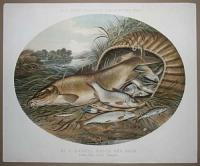
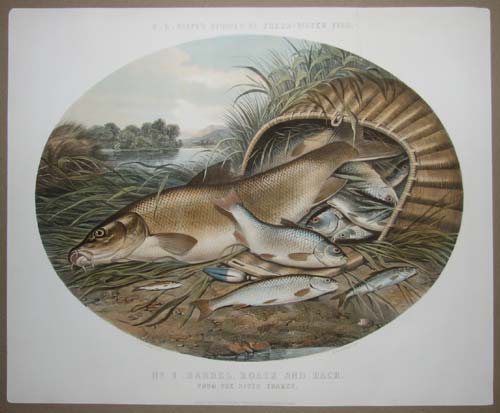
H. L. Rolfe's Studies of Fresh-Water Fish. No. 1 Barbel, Roach and Dace. From the River Thames.
J. West Giles. Lith. M. &. N. Hanhart, Impt.
London, Published 1st Novr. 1856, by Messrs. William Tegg & Co. 28 Queen Street, Cheapside.
Coloured Lithograph, oval dimensions 430 x 560. Repaired tear top right of title.
One from a set of six ovals that depict the freshwater fish of England's rivers. Rarely found untrimmed in good condition. Henry Leonidas Rolfe [1823-1881] was devoted to the depiction of angling subjects and was, unsurprisingly, a keen fisherman himself. A portrait of Rolfe on a river bank with his catch is in the Government Art Collection. See: 5058
[Ref: 5057] £950.00
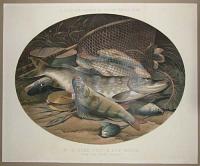
H. L. Rolfe's Studies of Fresh-Water Fish. No. 2 Pike, Perch, and Roach. From the River Loddon.
J. West Giles. Lith. M. &. N. Hanhart, Impt.
London, Published 1st Novr. 1856, by Messrs. William Tegg & Co. 28 Queen Street, Cheapside.
Coloured Lithograph, oval dimensions 430 x 560. Laid down
One from a set of six ovals that depict the freshwater fish of England's rivers. Rarely found untrimmed in good condition. Henry Leonidas Rolfe [1823-1881] was devoted to the depiction of angling subjects and was, unsurprisingly, a keen fisherman himself. A portrait of Rolfe on a river bank with his catch is in the Government Art Collection. See Ref: 5057
[Ref: 5058] £950.00

H. L. Rolfe's Studies of Fresh-Water Fish. No. 3 Salmon, and Trout. From the River Wye.
M. &. N. Hanhart, Lith.
London, Published 1st Novr. 1856, by Messrs. William Tegg & Co. 28 Queen Street, Cheapside.
Coloured lithograph, oval, dimensions 430 x 560.
One from a set of six ovals that depict the freshwater fish of England's rivers. Rarely found untrimmed in good condition. Henry Leonidas Rolfe [1823-1881] was devoted to the depiction of angling subjects and was, unsurprisingly, a keen fisherman himself. A portrait of Rolfe on a river bank with his catch is in the Government Art Collection. See Ref: 5057, 5058
[Ref: 5059] £1,250.00
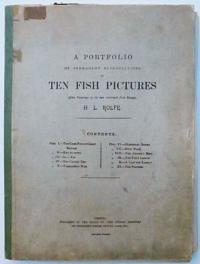
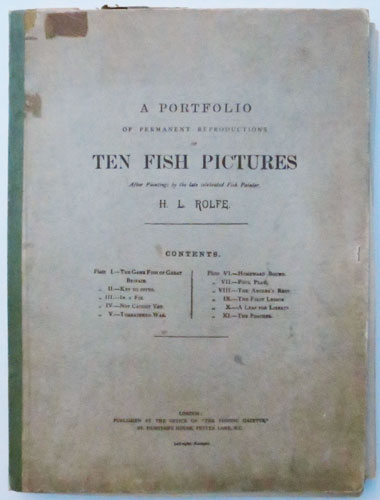
A Portfolio of Permanent Reproductions of Ten Fish Pictures.
After Paintings by the late celebrated Fish Painter H. L. Rolfe.
London: Published At The Office Of ''The Fishing Gazette,'' St. Dunstan's House, Fetter Lane, E.C. [n.d. c.1895.]
Rare portfolio, original printed boards, with 10 half-tone plates plus a keyplate, all trimmed to image and laid on printed boards as issued. 365 x 275mm (4½ x 10¾") A bit of wear to the covers and plates slightly time stained.
Plates: I The Game Fish of Great Britain, II Key To Ditto, III In A Fix, IV Not Caught Yet, V Threatened War, VI Homeward Bound, VII Foul Play, VIII The Anglers Rest, IX The First Lesson, X A Leap For Liberty, XI The Poacher. R.B Marston, editor of The Fishing Gazette, republished this from a series that had no publisher name and was undated called 'Piscatorial Studies by H.L Rolfe.' Having found the series through E Spencer Gough who had a letter printed in the March 17th 1888 edition of the Gazette in the hopes of finding out more information to procure one for a friend. The photographer was identified as W.T. Beach. Seeing an opportunity Marston accquired or borrowed from a correspondant and made 'A Portfolio Of Permanent Reproductions Of Ten Fish Pictures' and advertised it in the January 12th 1895 edition of the Gazette. Henry Rolfe (d. 1881) was a painter of fishing subjects and exhibited at the Royal Academy, British Institution, Royal Society of British Artists in Suffolk Street, Royal Glasgow Institute of the Fine Arts and the Royal Hibernian Academy of Arts in Dublin. From the collection of David Beazley, cover illustrated in his 'Images of Angling, p.140.
[Ref: 56241] £650.00
view all images for this item
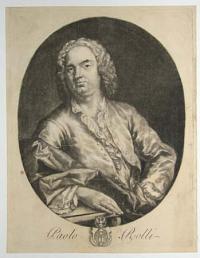
Paolo Rolli.
[n.d. c.1700].
Mezzotint engraving. 270 x 207mm. One prominent spot of foxing just to left of image.
Paolo Rolli was illustrious among the authors of Italian songs in the late 17th century. He was a member of the Academy of Arcadia, a literary academy founded in Rome during 1690.
[Ref: 348] £120.00
(£144.00 incl.VAT)
![[France] Carolus Rollin. Ant. Univ. Paris. Rector. Natus Lut. Paris. die 30 Jan. 1661. Obiit die 14 Sept 1741.](img-thumbnail/jpegs/28629.jpg)
[France] Carolus Rollin. Ant. Univ. Paris. Rector. Natus Lut. Paris. die 30 Jan. 1661. Obiit die 14 Sept 1741. Quid doctae ingenio, quid prosint moribus Artes Viva voce pruis, dein calamo exposui. Mox veterum adjunxi populoru exempla. Quirites Dum sequor, inceptum mors mihi rupit opus. Omnes Relligio accendit pictasque labores. Quam petii merces sit mihi magna Deus. D. Crevier.
to face the Title. G. Vertue Sculp.
Impensis I. & P. Knapton, Londini, 1754.
Engraving. 146 x 90mm (5¾ x 3½").
Charles Rollin (1661-1741), the French historian and educator. In 1684 he was made a master in the College du Plessis and then in 1694 he was made rector of the University of Paris.
[Ref: 28629] £50.00
(£60.00 incl.VAT)
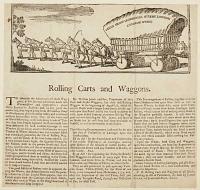
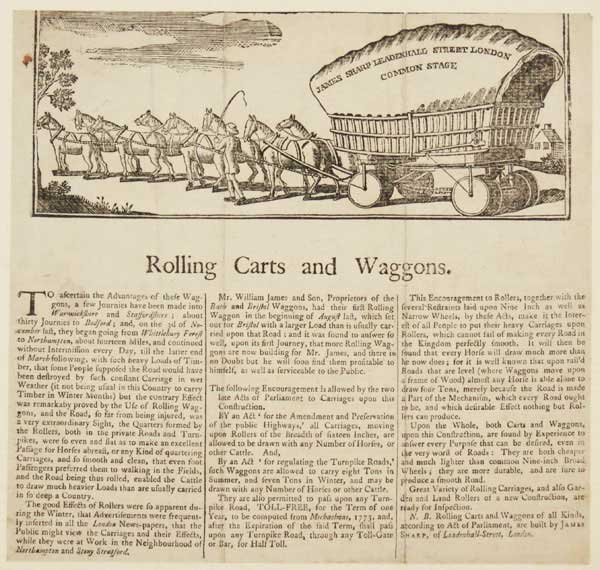
Rolling Carts and Waggons. [On coach Wagon: "James Sharp Leadenhall Street London Common Stage"]. To ascertain the Advantages of these Waggons, a few Journies have been made into Warwickshire and Staffordshire; about thirty Journies to Bedford; and, on the 3d of November last, they began going from Whittlebury Forest to Northampton, about fourteen Miles, and continued without Intermission every Day, till the latter end of March following, with such heavy Loads of Timber, that some People supposed the Road would have been destroyed by such constant Carriage in wet Weather...They are both cheaper and much lighter than common Nine-inch Broad Wheels; they are more durable, and are sure to produce a smooth Road. Great Variety of Rolling Carriages, and also Garden and Land Rollers of a new Construction, are ready for Inspection. N.B. Rolling Carts and Waggons of all Kinds, according to Act of Parliament, are built by James Sharp, of Leadenhall-Street, London.
[n.d. c.1773.]
Woodcut and letterpress. 202 x 210mm (8 x 8¼"). Laid on card, trimmed at top, creasing.
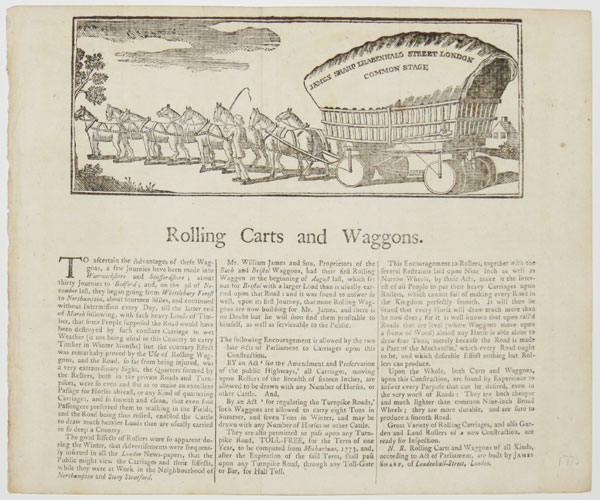
Letterpress handbill with a woodcut showing a large covered wagon on wide rollers rather than wheels, being pulled by a team of eight horses. The handbill extols the virtues of rolling wagons, namely that they can be used to transport heavy loads without damaging the road surface, particularly in wet conditions. It concludes by naming James Sharp of Leadenhall Street, London, as a supplier of rolling carts and wagons. James Sharp of Leadenhall Street, London, was an inventor but also a transport enthusiast. His "rolling carts and waggons" which he built in London were carried on broad rollers not conventional wheels. The obvious benefit was that they operated with advantage on muddy and poorly metalled roads, particularly of course in the winter. His advertisement catalogues the advantages, reports on road tests actually carried out, and happily names a carrier, Mr William James and Sons "Proprietors of the Bath and Bristol waggons" who had been successfully using a Sharp waggon on the Bristol road. Moreover, Sharp flags up the statutory benefits given to this form of transport by recent Acts of Parliament (heavier loads allowed, one year's toll-free travel and no limit on number of horses up front).
[Ref: 28037] £80.00
(£96.00 incl.VAT)
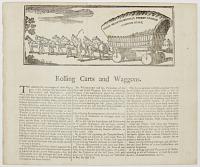
Rolling Carts and Waggons. To ascertain the Advantages of these Waggons, a few Journies have been made into Warwickshire and Staffordshire; about thirty Journies to Bedford; and, on the 3d of November last, they began going from Whittlebury Forest to Northampton, about fourteen Miles, and continued without Intermission every Day, till the latter end of March following, with such heavy Loads of Timber, that some People supposed the Road would have been destroyed by such constant Carriage in wet Weather...They are both cheaper and much lighter than common Nine-inch Broad Wheels; they are more durable, and are sure to produce a smooth Road. Great Variety of Rolling Carriages, and also Garden and Land Rollers of a new Construction, are ready for Inspection. N.B. Rolling Carts and Waggons of all Kinds, according to Act of Parliament, are built by James Sharp, of Leadenhall-Street, London.
[n.d. c.1773.]
Woodcut and letterpress. Sheet 210 x 255mm (8¼ x 10"). Folded as issued.
Letterpress handbill with a woodcut showing a large covered wagon on wide rollers rather than wheels, being pulled by a team of eight horses. The handbill extols the virtues of rolling wagons, namely that they can be used to transport heavy loads without damaging the road surface, particularly in wet conditions. It concludes by naming James Sharp of Leadenhall Street, London, as a supplier of rolling carts and wagons. James Sharp of Leadenhall Street, London, was an inventor but also a transport enthusiast. His "rolling carts and waggons" which he built in London were carried on broad rollers not conventional wheels. The obvious benefit was that they operated with advantage on muddy and poorly metalled roads, particularly of course in the winter. His advertisement catalogues the advantages, reports on road tests actually carried out, and happily names a carrier, Mr William James and Sons "Proprietors of the Bath and Bristol waggons" who had been successfully using a Sharp waggon on the Bristol road. Moreover, Sharp flags up the statutory benefits given to this form of transport by recent Acts of Parliament (heavier loads allowed, one year's toll-free travel and no limit on number of horses up front).
[Ref: 45127] £160.00
(£192.00 incl.VAT)
![[A Rolls-Royce Company Christmas Card, illustrated Airshow, with flypast of Hawker Harts?]](img-thumbnail/jpegs/37591.jpg)
[A Rolls-Royce Company Christmas Card, illustrated Airshow, with flypast of Hawker Harts?]
[by Cyril Barraud.]
[Printed by] W.F. Sedgewick Ltd. Xmas 1934.
Etching, presented as a printed christmas card. Etching 175 x 120mm (7 x 4¾") on front of a folded sheet watermarked 1934. Rare.
A christmas card with a printed greeting from A.F. Sidgreaves, managing director of Rolls Royce Ltd. It depicts an airshow with a flypast of biplanes in three ranks of three, most likely the Hawker Hart, a prominent British light bomber between the wars, powered by a Rolls-Royde engine. A Rolls Royce car is parked prominently among the spectators. Cyril Barraud (1877-1965), son of Herbert Rose Barraud and nephew of Francis Barraud. Having trained at the Brighton School of Art he emigrated to Winnepeg in 1913. He was commissioned as a lieutenant with the 43rd Battalion of the Canadian Expeditionary Forces in 1915 but transferred to the 79th Cameron Highlanders of Canada a few months later. He was wounded in the leg fighting in France in 1917, but returned to active service. Barraud was one of the first Canadian artists hired by Lord Beaverbrook for the War Records Office to sketch Canadian battle zones around Ypres and Vimy Ridge-Arras sectors. Later he was seconded to the Canadian War Memorials Fund. After demobilisation he remained in England, painting and etching landscapes, some of which were used for the LNER carriage prints, and taking commissions for christmas cards like this.
[Ref: 37591] £220.00
(£264.00 incl.VAT)
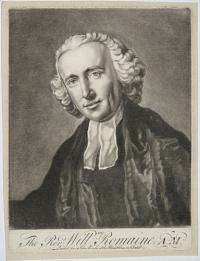
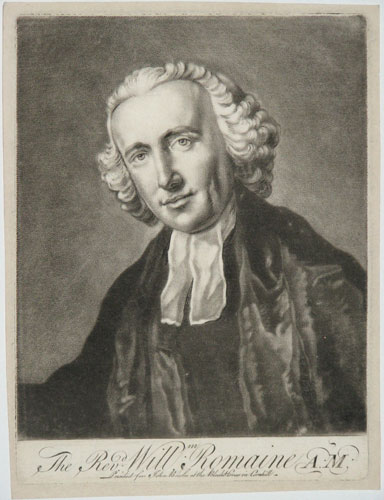
The Revd: Willm. Romaine A: M:
Printed for John Bowles at the BlackHorse in Cornhill.~ [n.d. c.1750.]
Mezzotint. Plate 153 x 115mm. 6 x 4½". Trimmed close to the platemark.
William Romaine (1714-1795), evangelical divine of the Church of England. He was ordained deacon in 1736 and became curate of the Lew-Trenchard, Devonshire until 1738 where he was ordained priest by Hoadley, probably to the curacy of Banstead, Surrey and Horton, Middlesex. He later worked as preacher at St. Dunstan's Fleet Street, then as rector of St. Anne's, Blackfriars. He was also appointed professor of astronomy at Gresham College, London. Composition cropped from a portrait by Francis Cotes. CS: undescribed by listed p.1763; for the Cotes portrait from which this derives see ref. 17007
[Ref: 14996] £95.00
(£114.00 incl.VAT)

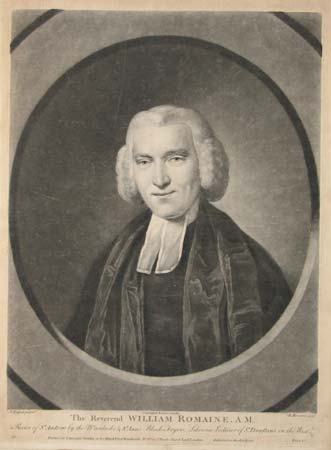
The Reverend William Romaine, A.M. Rector of St. Andrew by the Wardrobe & St. Ann's Black Fryers. Likewise Lecturer of St. Dunstan's in the West.
J. Russel pinxt. Carington Bowles excudit. R. Houston fecit.
Printed for Carington Bowles, at his Map & Print Warehouse, No. 69 in St. Pauls Church Yard, London. Published as the Act directs.
Mezzotint. 250 x 345mm. '70' inscribed lower left and 'Price 2s' bottom right. Paper browned. Some marks to mezzotint surface.
William Romaine, Evangelical divine and calvinist [1714 - 1795].
[Ref: 5301] £160.00
(£192.00 incl.VAT)
![[The Rev.d Mr William Romaine, A.M.]](img-thumbnail/jpegs/68183.jpg)
[The Rev.d Mr William Romaine, A.M.]
[F. Cotes pinx.t. R.Houston fecit.]
[Printed for Carington Bowles, Map & Printseller, at No. 69 St Pauls Church Yard, London.] [n.d., c.1760.]
Mezzotint, proof before letters, 18th century watermark. 355 x 250mm (14 x 9¾"). Small margins.
William Romaine (1714-1795), a French protestant who came to England at the revocation of the edict of Nantes. A popular preacher he was an ardent follower of Whitefield. In 1753 he published a pamphlet against the bill for naturalising the Jews. CS: 105, i of ii. Ex: Collections of The Hon. C. Lennox-Boyd and Mrs. E.M. Hamilton
[Ref: 68183] £230.00
(£276.00 incl.VAT)

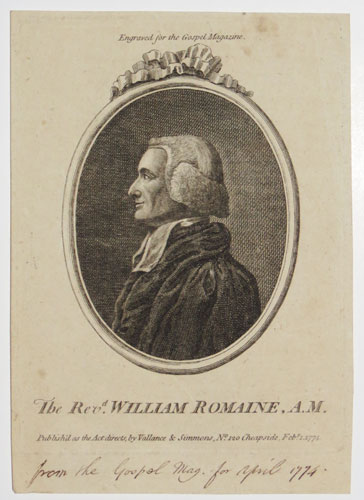
The Rev.d William Romaine, A.M. Engraved for the Gospel Magazine.
Publish'd as the Act directs, by Vallance & Simons, No 120 Cheapside, Feb.y 1 1774.
Rare engraving; platemark 140 x 105mm (5½ x 4"). Small margins.
William Romaine (1714-1795), evangelical divine of the Church of England. He was ordained deacon in 1736 and became curate of the Lew-Trenchard, Devonshire until 1738 where he was ordained priest by Hoadley, probably to the curacy of Banstead, Surrey and Horton, Middlesex. He later worked as preacher at St. Dunstan's Fleet Street, then as rector of St. Anne's, Blackfriars. He was also appointed professor of astronomy at Gresham College, London.
[Ref: 43946] £120.00
(£144.00 incl.VAT)
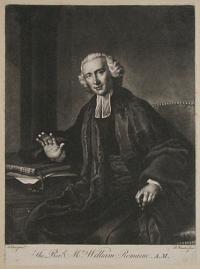
The Rev.d Mr William Romaine, A.M.
F. Cotes pinx.t. R.Houston fecit.
[Printed for Carington Bowles, Map & Printseller, at No. 69 St Pauls Church Yard, London.] [n.d., c.1760.]
Fine mezzotint. 345 x 260mm. Trimmed inside the platemark at bottom publication line missing. Laid on separate sheet.
William Romaine (1714-1795), evangelical divine of the Church of England. He was ordained deacon in 1736 and became curate of the Lew-Trenchard, Devonshire until 1738 where he was ordained priest by Hoadley, probably to the curacy of Banstead, Surrey and Horton, Middlesex. He later worked as preacher at St. Dunstan's Fleet Street, then as rector of St. Anne's, Blackfriars. He was also appointed professor of astronomy at Gresham College, London. CS: 105. Ex: Collection of The Hon. C. Lennox-Boyd.
[Ref: 17007] £420.00
![[Roman legion lamenting before a group of women and children.]](img-thumbnail/jpegs/44338.jpg)
[Roman legion lamenting before a group of women and children.]
B West 1785.
Crayon-manner stipple, proof before inscriptions. 420 x 670mm (16½ x 26½"). Large repaired tear in printed border, split in centre fold, surface soiling, creasing in margins. Damaged.
A very scarce print of a classical scene, which we have been unable to trace. After Benjamin West.
[Ref: 44338] £220.00
(£264.00 incl.VAT)
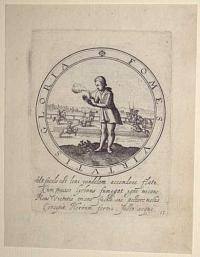
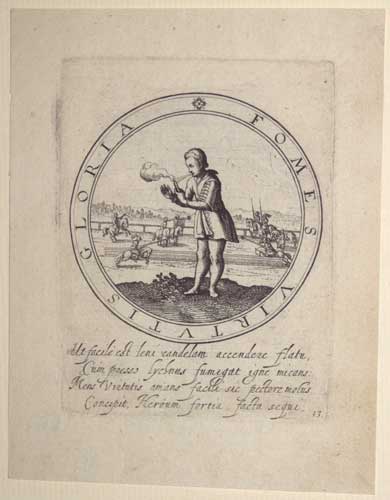
Fomes Virtutis Gloria. Ut facile est leni candelam accendeze flatu, Cum presso Lychnus fumigat ignae micans; Mens Virtutis amans facili sic pectore motus Concipit, Heroum fortia facta sequi. 13.
[n.d., c.1620]
Engraving, plate 110 x 80mm (4¼ x 3¼"), with large margins.
A man blows on a roman candle firework at a jousting tournament.
[Ref: 57297] £260.00
(£312.00 incl.VAT)
![[Roman Catholic Relief Act] The Extinguisher, or putting out the Great Law-Luminary.](img-thumbnail/jpegs/62900.jpg)
[Roman Catholic Relief Act] The Extinguisher, or putting out the Great Law-Luminary.
T. J Fec.t
London. Pub. 1829 by S.W Fores. 41. Picadilly.
Etching with fine hand colour. Sheet 340 x 245mm (13½ x 9½"). Trimmed within plate.
Satire on the Roman Catholic Relief Act 1829, Lord Chancellor John Scott, 1st Earl of Eldon was notoriously anti-catholic. Eldon's head rests on a candle-end which is in an elaborate candle-stick of gold plate, standing on the ground. Wellington, in uniform, reaches up to cover it with a huge extinguisher inscribed 'Catholic Bill Majority 168'; he says: 'Thus I obscure you, ne'er to shine again.' Eldon looks to the left, registering intensive melancholy; rays from his head, obstructed on the left by the extinguisher, strike against the profile of George IV, whose head, shoulder, and paunch project from the right margin, leaning towards the candle says 'Poor Old Bags!' BM SAtires 15718.
[Ref: 62900] £220.00
(£264.00 incl.VAT)
![[Twelve plates illustrating Paul Scarron's 'Roman Comique'].](img-thumbnail/jpegs/31476.jpg)
[Twelve plates illustrating Paul Scarron's 'Roman Comique'].
L'Bas, sculp.
[London: Robert Sayer, c.1768.]
Twelve engravings, scarce as a set. Each c. 175 x 280mm (7 x 11"), with very large margins.
English copies of Jean Baptiste Pater's illustrations for Paul Scarron's 1651 'Le Roman Comique (The Comic Romance)', a burlesque novel of a theatre troupe in Normandy. The originals were published by Pierre Louis Surugue in 1738.
[Ref: 31476] £650.00
view all images for this item
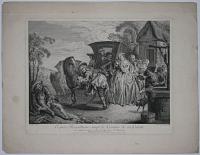
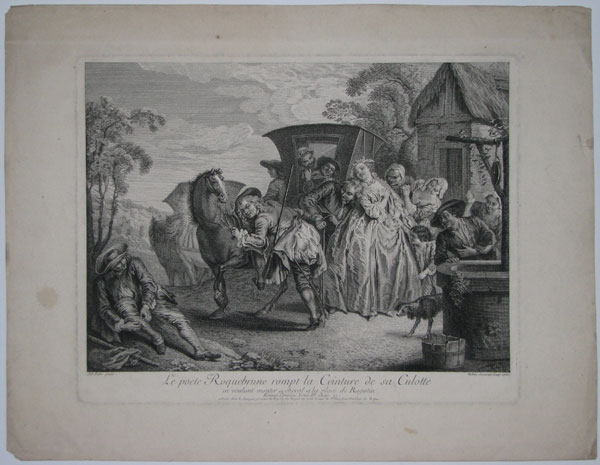
Le poëte Roquebrune rompt la Ceinture de sa Culotte en voulant monter à cheval à la place de Ragotin. Roman Comique Tome 1er chap.20.
J.B. Pater pinxit. Edme Jeaurat Sculp 1732.
a Paris chez L Surugue graveur du Roy rue des Noyers vis a vis le mur de St.Yves, Avec Privilege du Roy.
Etching on laid paper, 300 x 380mm. 11¾ x 15". A fine impression; large margins a little soiled, uncut.
Poet Roquebrune breaks the belt of his trousers in wanting to ride in place of Ragotin. Several figures in the square observe the embarrassment of the poet, whose bear behind is exposed. After Jean Baptiste Pater (1695 - 1736), pupil of Watteau. From set of sixteen plates being illustrations to the 1651 'Le Roman Comique (The Comic Romance)', by Paul Scarron the french author and poet who was a great influence on Henry Fielding with his burlesque novel of a theatre troupe in Normandy. See BNF FRBNF38444787.
[Ref: 21461] £320.00
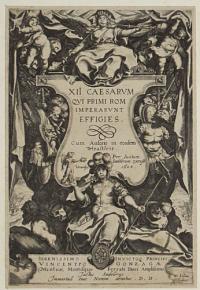
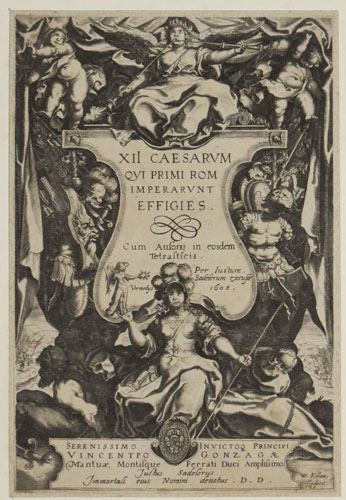
XII Caesarum Qui Primi Rom Imperarunt Effigies. Cum Ausony in eosdem Tetrasticis. Serenissimo Invictoo Principi Vicentio Gonzagae Mantuae, Montisque Ferrati Duci Amplissimo. Justus Sadelerus Immortali eius Nomini denotus D.D.
W. Kilian sculpsit.
Per Iustum Sadelerum excusae 1608 Venetys.
Engraving. Sheet: 205 x 135mm (8 x 5¼''). Trimmed and laid on album sheet.
The frontispiece to a series of thirteen busts of Roman Emperors engraved by Wolfgang Kilian (1581-1662) after Raffaello Schiaminossi.
[Ref: 49692] £120.00
(£144.00 incl.VAT)

Tesselated Pavement Found in Dyer Street Cirencester Sep: Ad. MDCCCXLIX. with Part of the Under Structure. [&] Tesselated Pavement Found in Dyer Street Cirencester August 1849.
Drawn on Stone & Printed by J. Beauchamp, Cirencester. [&] Drawn on Stone, Printed & Published by J. Beauchamp, Park S.t Cirencester. [n.d., c.1849]
Two scarce & fine coloured lithographs. Printed areas 330 x 320mm (13 x 12½) & 300 x 290mm (11¾ x 11½"), large margins.
Two rare lithographs locally published recording the 2nd century Roman mosaics dug up when excavating new sewers in Dyer Street. The first features heads representing three of the Four Seasons and an illustration of Greek hero Actaeon, transformed into a stag by Artemis and being killed by his own dogs. The second has the head of Medusa, hunting dogs, dragons and geometric patterns. Both are now in the Corinium Museum.
[Ref: 67939] £520.00
view all images for this item
![[A Roman painting of dwarfs, a hippopotamus and crocodiles.]](img-thumbnail/jpegs/67824.jpg)
[A Roman painting of dwarfs, a hippopotamus and crocodiles.]
Camillo Paderni delin. J. Mynde sculp.
[London: George Turnbull, 1740.]
Engraving, 18th century watermark. 390 x 360mm (15½ x 14¼"), large margins. Margin rebuilt lower right, just affecting plate, repair to fold.
A bizarre scene of two dwarfs guarding an island with classical temples and an altar. One raises a spear at an angry-looking hippopotamus. A plate from George Turnbull's 'A Treatise on Ancient Painting: containing observations on the rise, progress, and decline of that art amongst the Greeks and Romans''. Unfortunately the text (available on archive.org) gives no details of its origin or meaning.
[Ref: 67824] £490.00
![[Vue d'optique of a stage set.]](img-thumbnail/jpegs/16442.jpg)
[Vue d'optique of a stage set.]
[n.d., c.1760.]
Coloured engraving. Sheet 250 x 405mm, 9¾ x 16". Trimmed to image and laid on card, with cuts and perforations for use with a light box.
An interior, probably a throne room, with Roman soldiers. The back of the room has been cut away and an exterior view stuck in so that when held up to the light the windows of the buildings are lit. The spear heads of the soldiers are also cut away.
[Ref: 16442] £230.00
(£276.00 incl.VAT)
![[Set of 12 Etchings of Roman Ruins.]](img-thumbnail/jpegs/49677.jpg)
[Set of 12 Etchings of Roman Ruins.]
[After Stephano dell Bella.]
12 etchings. Plate: 135 x 130mm (5¼ x 5'').
A set of twelve etchings after a series of landscapes showing Roman ruins, including a copy of the frontispiece, by Stephano della Bella. All prints are reversed copies of Della Bella's original etchings published between 1643 and 1648, except the frontispiece which is not reversed. Reversed copies of De V 819-831.
[Ref: 49677] £600.00
view all images for this item
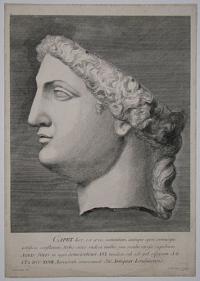
Caput hoc, ex aere inauratum, antiquo opere summoque artificio conflatum, Urbis inter rudera multis jam seculis excisae sepultum, Aquis Solis in agro Somersetensi XVI tandem sub solo ped. effossum A.D. MDCCXXVII.
A. Gordon del. G. Vertue Sculp. 1730.
Aeternitati consecravit Soc. Antiquar. Londinensis.
Engraving and etching. Plate 405 x 286mm. 16 x 11¼". Slight damage to title area.
Head and neck of a Roman sculpture found at Bath, in profile to left, with long hair; top of head missing. Alexander: 612.
[Ref: 23334] £160.00
(£192.00 incl.VAT)
![[Watercolour of a Roman Fresco?].](img-thumbnail/jpegs/50478.jpg)
[Watercolour of a Roman Fresco?].
Jessex ? pinx.t.
[n.d, c.1830.]
Watercolour. Sheet: 330 x 235mm (13 x 9¼''). Laid on album sheet.
A portrait of a serving girl in pink and yellow robes, carrying a tray of figs and a jug. Perhaps a copy of an Ancient Roman fresco?
[Ref: 50478] £180.00
(£216.00 incl.VAT)
![[An obese man courts a squat woman.]](img-thumbnail/jpegs/67170.jpg)
[An obese man courts a squat woman.]
[n.d., c.1812.]
Fine & rare coloured etching. Sheet 245 x 350mm (9¾ x 13¾"), on laid paper watermarked 'Allee 1812'. Trimmed within plate.
An untitled satire of a fat man in clerical dress kneeling before an unattractive woman with a feathered headdress and a fan, watched by a parrot and a man behind a screen. William Allee operated from Hurstbourne Priors Mill in Hampshire between 1800 and 1816. The Tate has several sketches by J.M.W. Turner on Allee paper. Not traced in BM Satire.
[Ref: 67170] £280.00
(£336.00 incl.VAT)
![The Romance. [&] The Dream.](img-thumbnail/jpegs/5623.jpg)
The Romance. [&] The Dream.
Painted by R.Westall. Engraved by J.R.Smith.
London. Published Sept.r 6, 1791 by J.R.Smith, No 31 King Street, Covent Garden.
Pair of mezzotints, proofs before lines of poetry. Each 365 x 365mm (14½ x 14½"). Folds in margins.
A woman shown reading in bed, then asleep. D'Oench 317 & 318; Frankau 118 & 293; this state not listed in either, before their state i of ii. Ex: Collection of The Hon. C. Lennox-Boyd.
[Ref: 5623] £550.00
view all images for this item
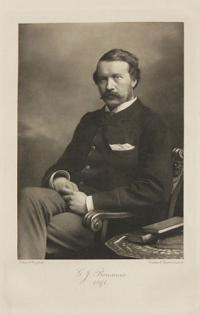
G. J. Romanes.
Elliott & Fry photo. Walker & Cockerell. ph. sc.
[c.1891.]
Photogravure with large margins. Printed area 145 x 190mm (5¾ x 7½").
George John Romanes (1848-1894), Canadian-born English evolutionary biologist and physiologist, heavily influenced by his friendship with Charles Darwin. Continuing Darwin's work on evolution he coined the expressions 'neo-Darwinism', which is still used today for any updated form of Darwinism, and 'anthropomorphism', the giving to animals of human-like qualities. A photogravure from a photographic carte-à-visite.
[Ref: 35316] £70.00
(£84.00 incl.VAT)
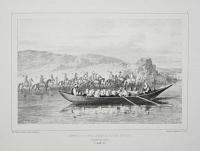
Femmes d'un Pacha Escortées par des Serviens. Danube rive droite 7 Juillet, 1837.
Raffet 1838. Imprimé par August Bry, r du Bac 134.
Chez Gihaut frères éditeurs, Boulevart des Italiens, 5. [Paris, 1838-48.]
Lithograph on chine collé, laid on original paper printed with title and inscriptions. Total printed area 220 x 300mm (8¾ x 11¾") very large margins.
A rowing boat on the Danube carrying the wives of a pacha, escorted by Serbian cavalry on the shore. Drawn by Denis Raffet for Demidov's 'Voyage dans la Russie Méridionale et la Crimée, par la Hongrie, la Valachie et la Moldavie, exécuté en 1837'. Despite being a Russian prince, Anatoly Nikolaievich Demidov, 1st Prince of San Donato (1813-70), spent much of his life in Paris, from where he financed this scientific expedition to Southern Russia, with Frenchman Denis-Auguste Raffet as the official artist.
[Ref: 48195] £140.00
(£168.00 incl.VAT)

The Hercules Baths at Mehadia.
G.Hering del_ J.B.Pyne Lith.
[Published by Thomas McLean, c.1838.]
Lithograph. 405 x 250mm (16 x 9¾"), with large margins.
View of the Hercules Baths at Mehadia, a small market town and commune in Cara?-Severin County, Banat, Romania. The 1838 floods destroyed some 2,000 houses in the valley and the 1841 floods in Mehadia were also devastating. Plate 23 from a series of 26 lithographs, titled 'Sketches on the Danube, Hungary and Transylvania' by George Hering. The views illustrate Hering's tour to Hungary and Transylvania in 1835, countries then little known to the English. It is dedicated to Count Szenchenyi, the leading Hungarian light of his day. Abbey 79.
[Ref: 65297] £140.00
(£168.00 incl.VAT)
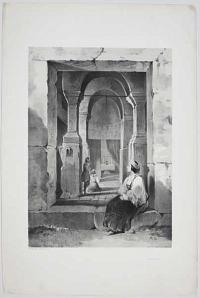
Roman Temple, Demsus.
G. Hering delt _ T. Fairland lith. Printed by Fairland.
[London: T. McLean, 1838.]
Lithograph, rare, image 370 x 270mm. 14½ x 10¾".
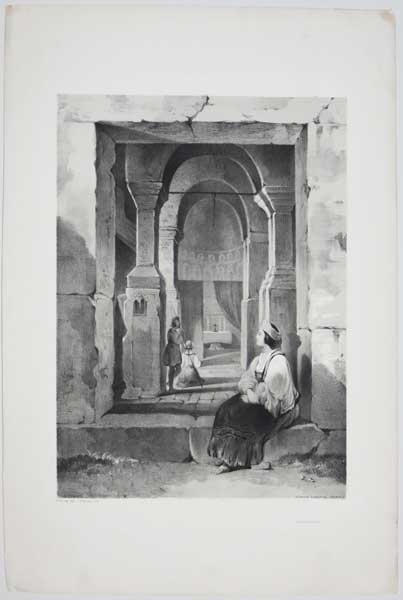
A view inside Densus Church (also known as St Nicholas' Church) in the village of Densus, Romania, one of the oldest Romanian churches still standing. It was built in the 7th century (with 13th century additions) on the site of a 2nd century Roman temple, with materials from the Dacian Sarmizegetusa fortress. From 'Sketches on the Danube, in Hungary and Transylvania' (26 plates), by George Edwards Hering (1805-1879). Abbey Travel 79, 25.
[Ref: 26805] £190.00
(£228.00 incl.VAT)
![[Russo-Turkish War.] Die Kaiserl. Russische Armee parssirt den Pruth,](img-thumbnail/jpegs/29837.jpg)
[Russo-Turkish War.] Die Kaiserl. Russische Armee parssirt den Pruth, und die Feindseligkeiten die Türken beginnen, d. 7.ten Mai 1828.
[Wunder sc.]
[Nuremberg?, c.1829.]
Etching with original hand colour. Sheet 175 x 205mm (7 x 8"). Trimmed.
A scene from Russo-Turkish War (1827-29): the Russian army using pontoon bridges to cross the Pruth river, between Romania and Moldova. The war started after the Russians helped the Greek independence movement fight the Battle of Navarino in 1827: the Turks closed the Dardanelles to Russian ships and revoked the Akkerman Convention. The war ended with the Treaty of Adrianople, which increased Russian dominance around the Black Sea area and Georgia, and, most importantly, forced the Sultan to promise autonomy for Greece.
[Ref: 29837] £140.00
(£168.00 incl.VAT)
![[Tsar Michael Fedorovich Romanov] Michel Phedorwitz Grand Duc de Moscovie de l'an 1612](img-thumbnail/jpegs/58661.jpg)
[Tsar Michael Fedorovich Romanov] Michel Phedorwitz Grand Duc de Moscovie de l'an 1612 il est de la religion des grecs Schiematiques, et grand Capitaine:
B. Moncornet ex. [n.d., c.1660.]
Engraving. 155 x 115mm (6 x 4¼") large margins. Staining in margins.
Oval portrait of Tsar Michael I (Mikhaíl Fyodorovich Románov, 1596-1645), Russia's first Romanov ruler.
[Ref: 58661] £160.00
(£192.00 incl.VAT)

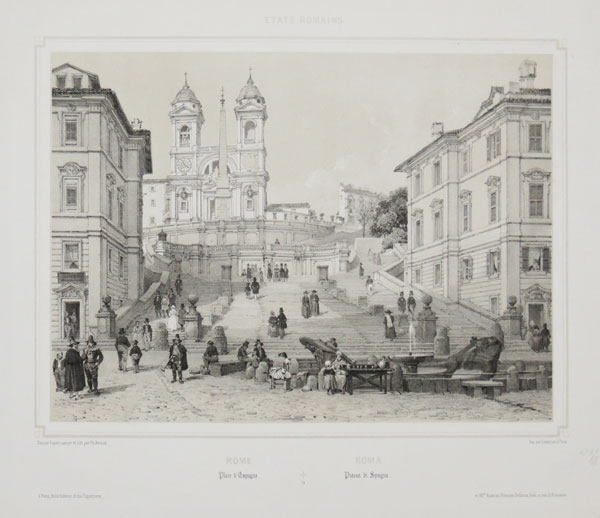
Rome. Place d'Espagne. Roma. Piazza di Spagna.
Dessiné d'après nature par Ph. Benoist. Imp par Lemercier à Paris. Lith par. Bachelier.
Paris. Bullas éditeur, 18 rue Tiquetonne et (Mon. Aumont) François Delarue, Succ. 10 rue J.J.Rousseau.
Tinted lithograph. Sheet: 460 x 320mm (18 x 12½"), with very large margins.
A view of the Spanish Steps looking towards the church of Trinita dei Monte at the top from the Piazza di Spagna. The Fontana della Barcaccia is depicted in the foreground to the right.
[Ref: 41872] £240.00
(£288.00 incl.VAT)

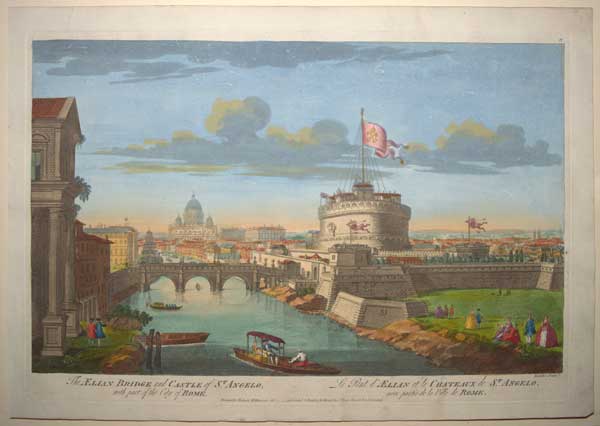
The Ælian Bridge and Castle of St. Angelo, with part of the City of Rome. Le Pont d'Ælian et le Chateaux de St. Angelo, avec partie de la Ville de Rome. No.13
Printed for Robert Wilkinson, 58 _ in Cornhill & Bowles & Carver 69, St. Pauls Church Yard, London.
Engraving with fine hand colour. 280 x 420mm (11 x 16½), with large margins. Two small tears in margins.
A general view of Rome, looking up the Tiber past the Ponte Sant'Angelo and Castel Sant'Angelo (the Mausoleum of Hadrian) to the dome of St Peter's Basilica in the distance.
[Ref: 56293] £360.00

The Church of St. Mary y.e Great at Rome With y.e additional Buildings on each side. Also y.e Antique Collumn brought hither from y.e Temple of Peace by Pope Paul V. L'Eglise de St. Marie Majeure a Rome avec les Batiments...
Piranesi Delin.t Bowles Sculp.t.
London. Printed for Robert Wilkinson, 58 Cornhill, & Bowles & Carver, 69 St. Paul's Church Yard.
Very fine hand coloured engraving on J Whatman Turkey Mill paper water marked 1819. Plate 300 x 430mm (11¾ x 17), with large margins.
A view of the Basilica of Saint Mary Major and the piazza in Rome, with the antique column from the Forum of Vespasian.
[Ref: 56295] £320.00
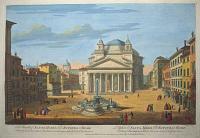
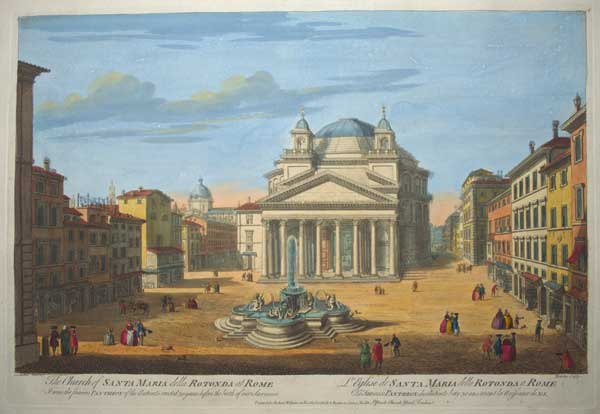
The Church of Santa Maria della Rotonda at Rome. It was the famous Pantheon of the Antients erected 30 years before the birth of our Saviour. L'Eglise de Santa Maria...
Seemond Delin.t Bowles Sculp.t.
Printed for Robert Wilkinson, 58 Cornhill, & Bowles & Carver, 69 St. Paul's Church Yard.
Very fine hand coloured engraving, plate 285 x 425mm (11¼ x 16¾), with large margins.
A view of the Catholic church Basilica of St. Mary and the Martyrs which has been there since the year 609 and the square out front with the fountain. The site used to be a Roman temple commissioned by Marcus Agrippa during the reign of Augustus (27 BC – 14 AD). It was rebuilt by the emperor Hadrian after it burnt down and probably dedicated c. 126 AD; the date of construction is unknown as Hadrian chose not to inscribe the new temple.
[Ref: 56296] £360.00
![[Ruins of Ancient Rome] Trajan's Pillar.](img-thumbnail/jpegs/67581.jpg)
[Ruins of Ancient Rome] Trajan's Pillar. The Amphitheatre of Titus. The Statue of a Fighting Gladiator in the Villa Borgese. Statue of a Dying Gladiator in the Capitol. Cestius Tomb. Temple of Janus. Temple of Jupiter Stator. The Temple of Fortuna Virilis.
Gio. P. Pannini Pinx.t. R. Houston fecit.
Printed for John Bowles and Son at the Black Horse in Cornhill.
Mezzotint and etching, 18th century watermark. 260 x 355mm (10¼ x 14"). Slight creasing.
A composite view of some of the Roman antiquities (with their former names), in the Forum and elsewhere. Ex: collection of The Hon. Christopher Lennox-Boyd.
[Ref: 67581] £260.00
(£312.00 incl.VAT)
![[A Muleteer on the Via Appia.]](img-thumbnail/jpegs/47578.jpg)
[A Muleteer on the Via Appia.]
Both fc.
[n.d., c.1655.]
Etching. Plate: 200 x 275mm (8 x 10¾"). Trimmed.
A view on the Via Appia showing a man watering his mules at the river. From a series 'Views of Rome and its Environs' by Jan Both.
[Ref: 47578] £230.00
(£276.00 incl.VAT)
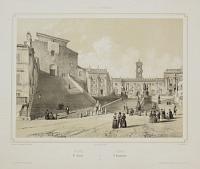
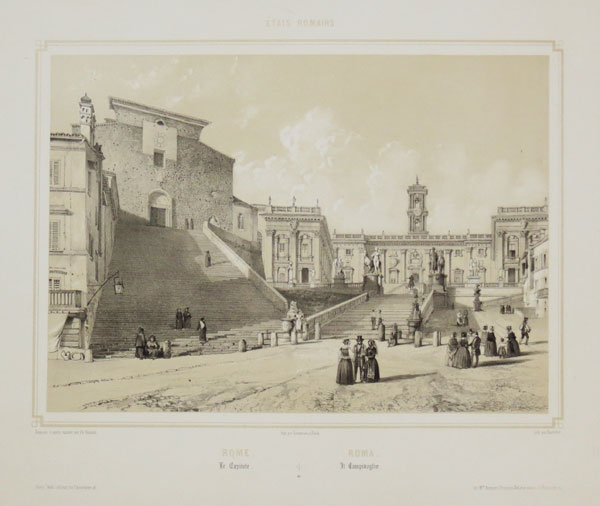
Rome. Le Capitole. Roma. Il Campidoglio.
Dessiné d'après nature par Ph. Benoist. Imp par Lemercier à Paris. Lith par. Bachelier.
Paris. Bullas éditeur, 18 rue Tiquetonne et (Mon. Aumont) François Delarue, succ. rue J.J.Rousseau 10.
Tinted lithograph. Sheet: 460 x 320mm (18 x 12½"), with very large margins.
A view of the Capitoline Hill as seen from the Via del Teatro di Marcello, in which the church of Santa Maria in Aracoeli, the Palazzo Senatore can be seen, the Piazza del Campidoglio located at the top of the steps was deisgned by Michelangelo between 1536-1546.
[Ref: 41871] £220.00
(£264.00 incl.VAT)
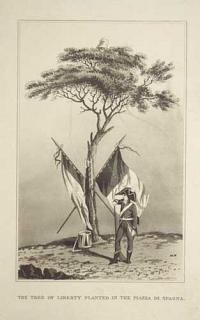
The Tree of Liberty Planted in the Piazza di Spagna.
[London: G.G. & J. Robinsson, c.1799.]
Rare aquatint, part J. Whatman watermark. Sheet 255 x 160mm (10 x 6¼"),
A French soldier stands under a pine tree topped with the Cap of Liberty and decked with the flags of Napoleon's new Roman Republic. In February 1798 the French invaded the Papal States, setting up a satellite state called the Roman Republic, led by Louis-Alexandre Berthier, one of Bonaparte's generals. Don Camillo Filippo Ludovico Borghese (who later married Napoleon's sister Pauline) cut this tree from his family's estate and had it erected in the Piazza di Spagna.
[Ref: 55616] £95.00
(£114.00 incl.VAT)
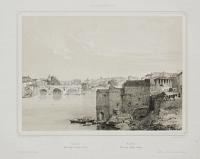
Rome. Pont-rompu et Temple de Vesta. Roma. Ponte rotto e Tempio di Vesta.
Dessiné d'après nature par Ph. Benoist. Imp par Lemercier à Paris. Lith par. Bachelier.
Paris. Bullas éditeur, 18 rue Tiquetonne et (Mon. Aumont) François Delarue, succ. rue J.J.Rousseau.
Tinted lithograph. Sheet: 460 x 320mm (18 x 12½"), with very large margins. Very slight foxing.
A view of the river Tiber in Rome showing the ruins of the ruined Ponte Rotto amd the temple of Hercules Victor, incorrectly labelled as the Temple of Vesta.
[Ref: 41870] £240.00
(£288.00 incl.VAT)
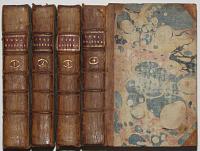
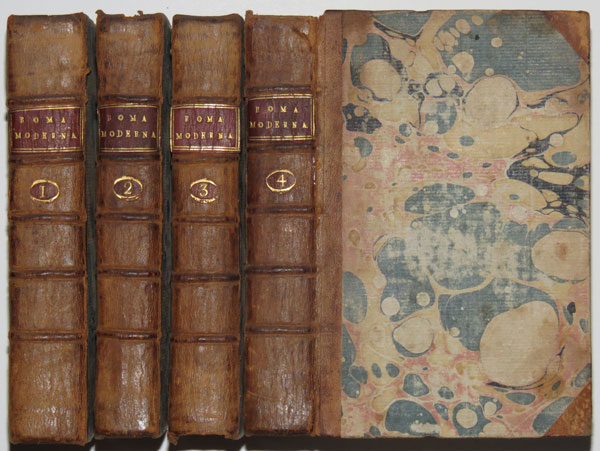
Accurata, e succinta descrizione topografica e istorica di Roma Moderna Opera Postuma dell'Abate Ridolfino Venuti Cortonese...
In Roma MDCCLXVIII. Presso Carlo Barbiellini.
4 vols, 8vo, half calf with marbled boards; pp. xii +1300 (inc. half-title and four titles), 54 folding engraved plates. Spines distressed, tear in vol. 1 x6, otherwise fine. Ownership inscription 'W. Rooker Rome 1778' on half-title.
A study of the buildings of Rome, written by abbot Ridolfino Venuti (1705-63), with several etched plates by Giovanni Battista Piranesi.
[Ref: 35768] £2,500.00
view all images for this item
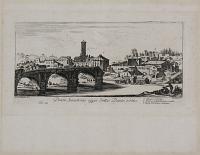
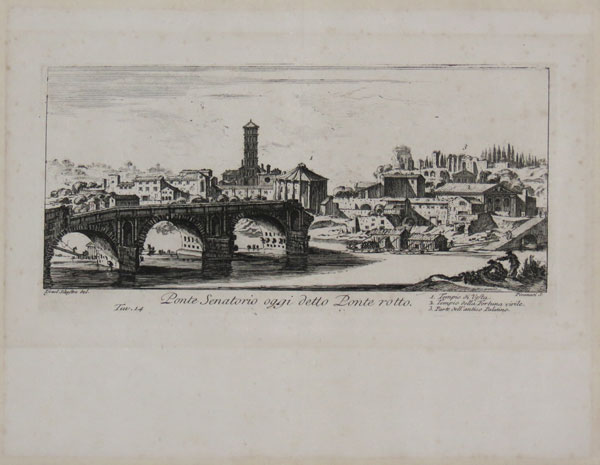
Ponte Senatorio oggi detto Ponte rotto.
Israel Silvestre del. Piranesi sc.
[n.d., c.1748.]
Etching. 130 x 255mm (5 x 10").
The Pons Aemilius, today called the Broken Bridge, with a collapsed span. The circular temple is not the Temple of Vesta but Hercules Victor, in Foro Boaro. Published in Piranesi's 'Antichità Romanae de Tempi della Repubblica, e de' primi Imperatori', after a design by the 17th century French artist Israel Silvestre.
[Ref: 36480] £220.00
(£264.00 incl.VAT)
![[Domus Aurea, Rome]](img-thumbnail/jpegs/33418.jpg)
[Domus Aurea, Rome] Domus aurea Neronis, aus welchem Herzlichen gebäü
J.B. F. v. E. delineavit
Cum Pri: Sac Caes: Majest: [Leipzig, 1725]
Engraving with very large margins, platemark 300 x 430mm (11¾ x 17"). Text in French and German; foxing to margins only. Crease.
The Domus Aurea, a large villa built by Nero after the fire in AD 64 destroyed residences on the slope of the Palatine Hill. Beneath the text are the famous verses written on the city walls or spread verbally, reported by Suetonius and Martial. Plate from Austrian architect Johann Bernard Fischer von Erlach's 'Entwurf einer historischen Architektur' ('Outline of Historical Architecture', first published 1721) , the first comparative architecture of all periods and nations. When Fischer designed Vienna's Imperial Stables, they were explicitly based upon Nero's villa. For Vienna's Imperial Stables, see ref.33399
[Ref: 33418] £350.00
![[Veduta degl'avanzi della Curia Ostilia sul Monte Celio.]](img-thumbnail/jpegs/17100.jpg)
[Veduta degl'avanzi della Curia Ostilia sul Monte Celio.]
Rossini fece Roma 1817.
Etching, proof before letters. 205 x 300mm (8 x 11¾"), with very large margins. Some rubbing.
According to Rossini these are the remains of the Curia Hostilia, an early Senate House built by Tullius Hostilius, the third king of Rome, on Monte Caelio. However it is more likely to be a substructure of the Temple of Claudius. Published as the frontispiece to Luigi Rossini's 'Antichita di Roma divise in 40 vedute'. See BM: 1935,0520.68 [lettered].
[Ref: 17100] £160.00
(£192.00 incl.VAT)
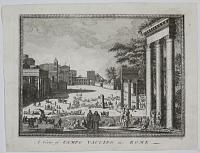
A View of Campo Vaccino at Rome.
Parr Sculp.
[London, c.1740.]
Engraving, with large margins. 205 x 260mm, 8 x 10¼". Repaired tear through title
A wiew of the Forum in Rome, here still used as a cow pasture.
[Ref: 26735] £85.00
(£102.00 incl.VAT)

![[Battle of Roliça] The Attack on the French Corps Commanded by Gen.l Laboarde, on the 17th of Aug.t 1808.](jpegs/55767.jpg)



![[France] Carolus Rollin. Ant. Univ. Paris. Rector. Natus Lut. Paris. die 30 Jan. 1661. Obiit die 14 Sept 1741.](jpegs/28629.jpg)
![[A Rolls-Royce Company Christmas Card, illustrated Airshow, with flypast of Hawker Harts?]](jpegs/37591.jpg)
![[The Rev.d Mr William Romaine, A.M.]](jpegs/68183.jpg)

![[Roman legion lamenting before a group of women and children.]](jpegs/44338.jpg)
![[Roman Catholic Relief Act] The Extinguisher, or putting out the Great Law-Luminary.](jpegs/62900.jpg)
![[Twelve plates illustrating Paul Scarron's 'Roman Comique'].](jpegs/31476.jpg)

![[A Roman painting of dwarfs, a hippopotamus and crocodiles.]](jpegs/67824.jpg)
![[Vue d'optique of a stage set.]](jpegs/16442.jpg)
![[Set of 12 Etchings of Roman Ruins.]](jpegs/49677.jpg)

![[Watercolour of a Roman Fresco?].](jpegs/50478.jpg)
![[An obese man courts a squat woman.]](jpegs/67170.jpg)
![The Romance. [&] The Dream.](jpegs/5623.jpg)


![[Russo-Turkish War.] Die Kaiserl. Russische Armee parssirt den Pruth,](jpegs/29837.jpg)
![[Tsar Michael Fedorovich Romanov] Michel Phedorwitz Grand Duc de Moscovie de l'an 1612](jpegs/58661.jpg)

![[Ruins of Ancient Rome] Trajan's Pillar.](jpegs/67581.jpg)
![[A Muleteer on the Via Appia.]](jpegs/47578.jpg)


![[Domus Aurea, Rome]](jpegs/33418.jpg)
![[Veduta degl'avanzi della Curia Ostilia sul Monte Celio.]](jpegs/17100.jpg)