![C.R. Pemberton [facsimile autograph.]](img-thumbnail/jpegs/19046.jpg)
C.R. Pemberton [facsimile autograph.]
Drawn by Oakley. Engraved by C.E. Wagstaff.
Published by John Fowler, Sheffield, 1843.
Stipple, frontispiece to Pemberton's ‘Life and Literary Remains'. Sheet 215 x 145mm, 8½ x 5¾".
Charles Reece Pemberton (1790 - 1840), actor and public lecturer. After Octavius Oakley (1800 - 1867). DNB.
[Ref: 19046] £45.00
(£54.00 incl.VAT)
![[Henry, 10th Earl of Pembroke & Mrs Kendal] No. IV. Mrs. K_dal. No. V. The Equestrian Hero.](img-thumbnail/jpegs/45426.jpg)
[Henry, 10th Earl of Pembroke & Mrs Kendal] No. IV. Mrs. K_dal. No. V. The Equestrian Hero.
[n.d., c.1772.]
Engraving. 110 x 170mm (4½ x 6¾"). Small margins.
A pair of double portraits of Henry 10th Earl of Pembroke and one of his many mistresses Mrs Kendal. From the 'Histories of the Tête à Tête annexed...' series that appeared in 'Town and Country Magazine', a monthy magazine which featured articles on the scandals and romantic affairs of the nobility. BM Satire 4974.
[Ref: 45426] £70.00
(£84.00 incl.VAT)
![[Pembroke Gardens] An Exact Survey of the Beautiful & Magnificent](img-thumbnail/jpegs/61711.jpg)
[Pembroke Gardens] An Exact Survey of the Beautiful & Magnificent House Garden & Park of the Right Hon.ble the Earl of Pembroke, With the Ancient Town of Wilton 3 Miles from Salisbury by John Rocque Chorographer to his Royal Highness The Prince of Wales.
Published according to Act of Parliament. Price 2.s 6.d. [1754]
Very rare engraved plan, 18th century watermark; plate 350 x 545mm (13¾ x 21½"), with large margins. Central fold.
Plan of the gardens and grounds at Wilton; the house towards the bottom with more formal gardens and large fish pond to the right, looking out towards the River Nader, and park land beyond; with inset views of the great bridge, the house itself, the arcade, and the porter's lodge on the left, and at top a further view of the bridge from the north. Below on left a plan of the ground floor on a scroll.
[Ref: 61711] £650.00

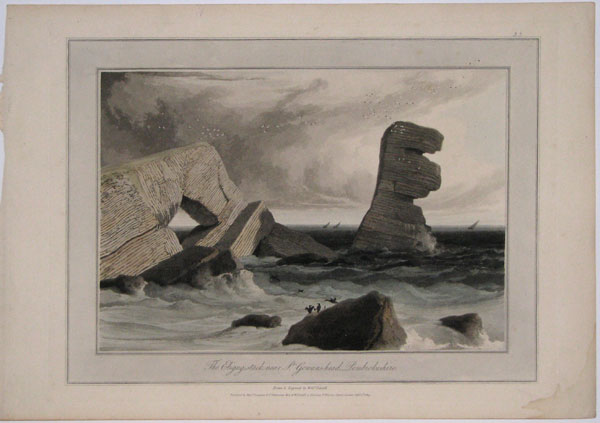
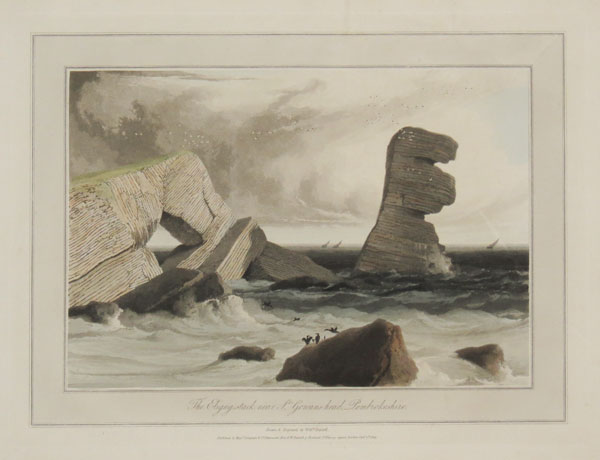
The Eligug-stack, near St. Gowans-head, Pembrokeshire.
Drawn & Engraved by Will.m Daniell.
Published by Mess.rs Longman & Co. Paternoster Row & W. Daniell 9 Cleveland St. Fitzroy Square, London, Sept.r 1.st 1814.
Coloured aquatint. Plate 222 x 298mm. 8¾ x 11¾".
A view of the Elegug Stacks at St Govan's Head, Pembrokeshire, Wales. From William Daniell's First Volume of "Voyage around Great Britain". Abbey: Scenery, 16; Tooley: Books with Coloured Plates 177.
[Ref: 18098] £120.00
(£144.00 incl.VAT)
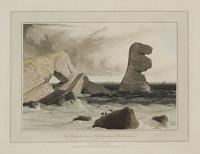
The Eligug-stack, near St. Gowans-head, Pembrokeshire.
Drawn & Engraved by Will.m Daniell.
Published by Mess.rs Longman & Co. Paternoster Row & W. Daniell 9 Cleveland St. Fitzroy Square, London, Sept.r 1.st 1814.
Hand coloured aquatint with very large margins, fine. Platemark: 230 x 300mm (9 x 12"). Uncut.
A view of the Elegug Stacks at St Govan's Head, Pembrokeshire, Wales. From William Daniell's 'A Voyage Round Great Britain', a series of 308 aquatints published in eight volumes between 1814-1825, described by R.V. Tooley as 'the most important colour plate book on British Topography'. Abbey: Scenery, 16; Tooley: Books with Coloured Plates 177.
[Ref: 36429] £120.00
(£144.00 incl.VAT)
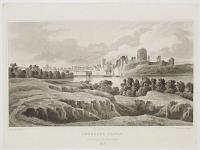
Pembroke Castle. From a Sketch taken in 1817.
Drawn by C. Norris. Engraved by D. Havell.
Published May 1, 1820, by J. Treble, Pembroke.
Aquatint. Sheet 215 x 285mm (8½ x 11¼"). Trimmed within plate,
Pembroke Castle, built between 1189–1218 and extended 1234–1241. From 'An Account of Tenby, containing an historical sketch of the place' by Charles Norris, second edition (the first, 1818, was not illustrated). Abbey: 541, describing all six plates as folded.
[Ref: 41897] £140.00
(£168.00 incl.VAT)
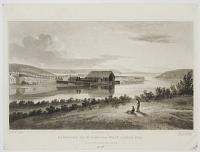
Pembroke Dock Yard from West Lanion Pill. From a Sketch taken in 1817.
Drawn by C. Norris. Engraved by D. Havell, 16 Howard Street, Strand.
Published May 1, 1820, by J. Treble, Pembroke.
Aquatint. 'J. Whatman' watermark paper; Sheet 215 x 280 (8½ x 11"). Trimmed within plate, remains of album paper glued in corners.
From 'An Account of Tenby, containing an historical sketch of the place' by Charles Norris, second edition (the first, 1818, was not iillustrated). Abbey: 541, describing all six plates as folded.
[Ref: 41898] £120.00
(£144.00 incl.VAT)
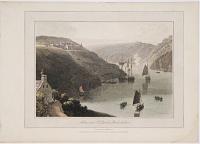
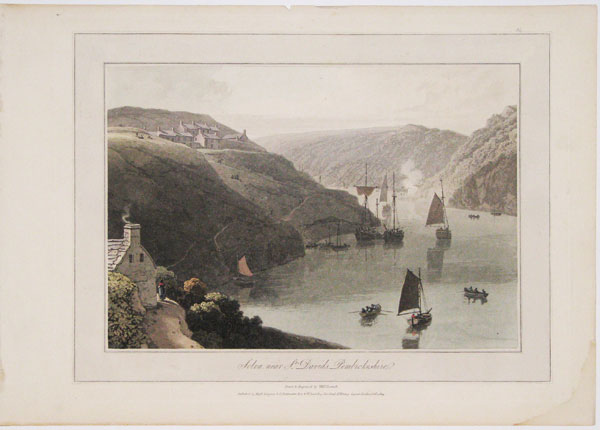
Solva, near St. Davids, Pembrokeshire.
Drawn & Engraved by Will.m Daniell.
Published by Mess.rs Longman & Co. Paternoster Row & W. Daniell 9 Cleveland St. Fitzroy Square, London Oct.r 1, 1814.
Coloured aquatint. Watermark: J Whitman 1815. Plate 228 x 298mm. 9 x 11¾".
A view in Pembrokeshire along the coast at Solva. Sailing boats and rowing boats in the harbour. The harbour is a glaciated meltwater channel known as a Ria and the rocks contain fossils from the Cambrian age. From William Daniell's First Volume of "Voyage around Great Britain". Abbey: Scenery, 16; Tooley: Books with Coloured Plates 177.
[Ref: 18077] £140.00
(£168.00 incl.VAT)
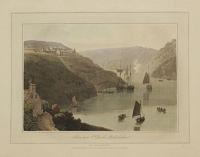
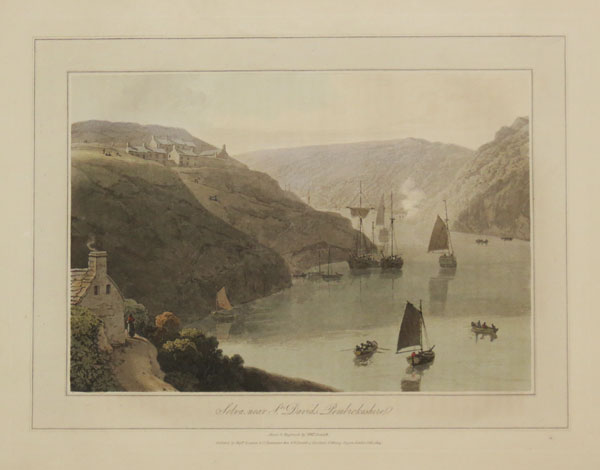
Solva, near St. Davids, Pembrokeshire.
Drawn & Engraved by Will.m Daniell.
Published by Mess.rs Longman & Co. Paternoster Row & W. Daniell 9 Cleveland St. Fitzroy Square, London Oct.r 1, 1814.
Hand coloured aquatint with very large margins, fine. Platemark: 230 x 300mm (9 x 12"). Uncut.
A view in Pembrokeshire along the coast at Solva. Sailing boats and rowing boats in the harbour. The harbour is a glaciated meltwater channel known as a Ria and the rocks contain fossils from the Cambrian age. From William Daniell's 'A Voyage Round Great Britain', a series of 308 aquatints published in eight volumes between 1814-1825, described by R.V. Tooley as 'the most important colour plate book on British Topography'. Abbey: Scenery, 16; Tooley: Books with Coloured Plates 177.
[Ref: 36426] £140.00
(£168.00 incl.VAT)
![[Manorbier Castle] Manor Bear Castle.](img-thumbnail/jpegs/41895.jpg)
[Manorbier Castle] Manor Bear Castle. From a Sketch taken in 1817.
Drawn by C. Norris. Engraved by D. Havell.
Published May 1, 1820, by J. Treble, Pembroke.
Rare aquatint. Sheet 215 x 285mm (8½ x 11¼"). Trimmed within plate,
Manorbier Castle, built c.1260. From 'An Account of Tenby, containing an historical sketch of the place' by Charles Norris, second edition (the first, 1818, was unillustrated). Abbey: 541, describing all six plates as folded.
[Ref: 41895] £110.00
(£132.00 incl.VAT)
![[A Man Mending a Pen.]](img-thumbnail/jpegs/65731.jpg)
[A Man Mending a Pen.]
[Rembrandt pinxt. R.Houston fecit.]
[n.d., c.1760.]
Mezzotint proof. Sheet 355 x 250mm (14 x 10"). Trimmed close to plate. Small hole in lower right of publication area.
Interior showing a window and a man wearing a flat cap is sat at a table mending a pen. Charrington 83 i of ii. Ex: Collection of The Hon. Christopher Lennox-Boyd.
[Ref: 65731] £290.00
(£348.00 incl.VAT)
![[A Man Mending a Pen.]](img-thumbnail/jpegs/65732.jpg)
[A Man Mending a Pen.] Done from an Original Picture in the Collection of John Blackwood Esq.r.
Rembrandt pinxt. R.Houston Fecit.
[n.d., c.1760.] Sold by Rd. Sayer at Charing Cross, London.
Mezzotint. 355 x 250mm (14 x 10"), large margins. Some time-staining and crease down centre of image.
Interior showing a window and a man wearing a flat cap is sat at a table mending a pen. Charrington 83 ii of ii. Ex: Collection of The Hon. Christopher Lennox-Boyd.
[Ref: 65732] £240.00
(£288.00 incl.VAT)
![[Two figures in a landscape]](img-thumbnail/jpegs/36939.jpg)
[Two figures in a landscape]
[Anon., c.1810]
Pen lithograph, sheet 250 x 170mm (9¾ x 6¾"). Glued to backing board at corners; surface loss on left filled in ink.
Unidentified early lithograph showing the influence of Salvator Rosa, whose landscapes were significant in shaping the concepts of sublime and romantic representations of nature in the late Georgian period. Ex: collection of the Late Hon. C. Lennox-Boyd
[Ref: 36939] £140.00
(£168.00 incl.VAT)
![[Two figures in a landscape]](img-thumbnail/jpegs/36940.jpg)
[Two figures in a landscape]
[Anon., c.1810]
Pen lithograph, J. Whatman watermark (PT) printed area 260 x 180mm (10¼ x 7").
Unidentified early lithograph showing the influence of Salvator Rosa, whose treacherous landscape were significant in shaping the concepts of sublime and romantic representations of nature in the late Georgian period. Ex: collection of the Late Hon. C. Lennox-Boyd
[Ref: 36940] £95.00
(£114.00 incl.VAT)
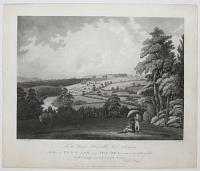
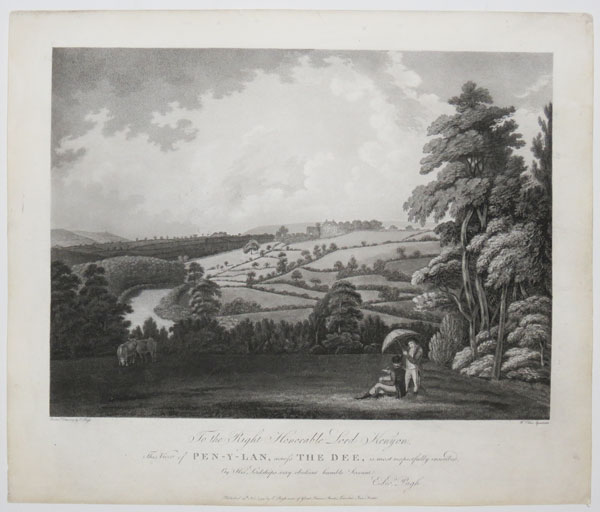
To the Right Honorable Lord Kenyon, This View of Pen-Y-Lan, across the Dee, is most respectfully inscribed by his obedient & obliged Servant. Edw.d Pugh.
From a Drawing by E. Pugh [...] W. Ellis Aquatinta
Published 24th November 1794 by E. Pugh 13 Bedford Street Covent Garden
Aquatint, sheet 300 x 355mm (11¾x 14"). Trimmed to platemark. Repaired wormholes to margins.
A fine Welsh landscape after the miniature painter and topographer Edward Pugh (c.1761-1813) shows the artist drawing.
[Ref: 47631] £160.00
(£192.00 incl.VAT)
![[Penang] Burmah temple at Prince of Wales Island.](img-thumbnail/jpegs/55660.jpg)
[Penang] Burmah temple at Prince of Wales Island. (taken January 1805.]
Drawn by E.H. Looker Esq.r F.S.A. Engraved by L. Byrne.
London: Published by Longman, Hurst, Rees, Orme & Brown, Paternoster Row, Aug. 1. 1811.
Coloured engraving. Sheet 205 x 255mm (8 x 10"). Trimmed within plate.
A view of a Buddhist temple on Penang, drawn by Edward Hawke Locker (1777-1849), Admiral Edward Pellew's civil secretary during his East Indies command. From George Cook's ''Scenery of the East India Islands".
[Ref: 55660] £190.00
(£228.00 incl.VAT)
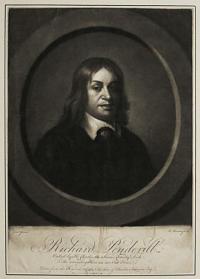
Richard Penderill. Called by K. Charles the Second Trusty Dick For concealing Him in an Oak Tree
Zoust pinxt. R. Houston fecit.
Done from the Original in the Collection of Charles Jennens Esqr.
Mezzotint. Sheet: 325 x 225mm (13 x 9''). Trimmed and laid on album sheet.
Richard Penderel (d.1672) was a yeoman and royalist sympathiser, born in Shropshire, who assisted in Charles II's escape after the battle of Worcester and was thus rewarded by the king after the Restoration. Engraved after a portrait by Gilbert Soest (1600-?1681), Dutch portrait painter and rival to Sir Peter Lely in London CS: 88.
[Ref: 48907] £180.00
(£216.00 incl.VAT)
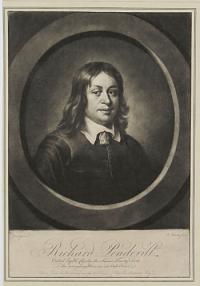
Richard Penderill. Called by K. Charles the Second Trusty Dick For concealing Him in an Oak Tree
Zoust pinxt. R. Houston fecit.
Done from the Original in the Collection of Charles Jennens Esqr.
Mezzotint, sheet 325 x 220mm (12¾ x 8½"). Trimmed; tipped into album sheet.
Richard Penderel (d.1672) was a yeoman and royalist sympathiser, born in Shropshire, who assisted in Charles II's escape after the battle of Worcester and was thus rewarded by the king after the Restoration. Engraved after a portrait by Gilbert Soest (1600-?1681), Dutch portrait painter and rival to Sir Peter Lely in London CS: 88: ii.
[Ref: 43044] £220.00
(£264.00 incl.VAT)
![[Pendley Manor] To the Honourable S.r Richard Anderson Bar:t this Plate of the Mannor House of Penley is Humbly Dedicated by John Oliver.](img-thumbnail/jpegs/62543.jpg)
[Pendley Manor] To the Honourable S.r Richard Anderson Bar:t this Plate of the Mannor House of Penley is Humbly Dedicated by John Oliver. Pag. 594.
[London: Benjamin Griffin et al, 1700.]
Engraving. 285 x 325mm (11¼ x 12¾") very large margins.
A view of the original Pendley Manor, near Tring, burned down in 1835. From Sir Henry Chauncy's 'Historical Antiquities of Hertfordshire'.
[Ref: 62543] £130.00
(£156.00 incl.VAT)

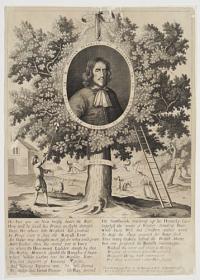
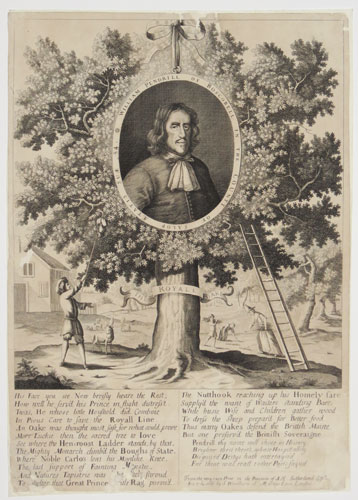
William Pendrill of Boscobell in the County of Salop Aetis Suae 84 The Royall Oake. His face you see. Now breifly heare the Rest.; How well he serv'd his Prince in flight destrest. Twas , He whose little Household did Combine In Piois Care to save : the Royall Line. An Oake was thought most safe:for what could prove More Luckie tthen the sacred tree to Love. See where the Hen=roost Ladder stands; by that, The Might Monarch climb'd the Boughs of Statem Where Noble Carlos lent his Manlike Knee, The last support of Fainting Majestie, and Natures Tapistrie was the onely Shroud To shelter that Great Prince was Rage pursu'd. The Nutthook reaching up his Honely fare supply'd the want of Waiters standing Bare; Shile busie Wife and Children gather Wood To dress the Sheep prepar'd for Better food Thus, Many Oakes defend the British Maine but one Preferr'd the Brittish Soveraigne. "Pendrill thy name will shine in History /Brighter then their's whose Hospittallity / Disguised Deitys hath entertayn'd / for thine was reall t'other Poets saynd."
From the very rare print in the possession of A H Sutherland Eq.r. Are to be sold by S. Woodburn, St. Martin's Lane, London.
Engraving, 345 x 250mm (13½ x 10"), large margins. Faint brown stain bottom left.
A portrait of William Pendrill set in an oak. Pendrill was one of five brothers: George; Richard; Humphrey; John and William who helped Charles II escape from England after his defeat at the Battle of Worcester in 1651 during his failed attempt to regain control of England from Cromwell. The Pendrills were a Royalist family who lived and worked on the estate of Boscobel House where the King sought refuge after his defeat. Having been forced to hide in an oak tree in order to escape Cromwell's troops Charles and the Royalist Colonel Carlos finally managed to escape disguised as land workers and escorted by the Pendrills. The Pendrill brothers were richly rewarded when Charles II was restored to the throne in 1660.
[Ref: 66939] £260.00
(£312.00 incl.VAT)

William Pendrill of Boscobell in the County of Salop Aetis Suae 84 The Royall Oake. His face you see. Now breifly heare the Rest.; How well he serv'd his Prince in flight destrest. Twas , He whose little Household did Combine In Piois Care to save : the Royall Line. An Oake was thought most safe:for what could prove More Luckie tthen the sacred tree to Love. See where the Hen=roost Ladder stands; by that, The Might Monarch climb'd the Boughs of Statem Where Noble Carlos lent his Manlike Knee, The last support of Fainting Majestie, and Natures Tapistrie was the onely Shroud To shelter that Great Prince was Rage pursu'd. The Nutthook reaching up his Honely fare supply'd the want of Waiters standing Bare; Shile busie Wife and Children gather Wood To dress the Sheep prepar'd for Better food Thus, Many Oakes defend the British Maine but one Preferr'd the Brittish Soveraigne. "Pendrill thy name will shine in History /Brighter then their's whose Hospittallity / Disguised Deitys hath entertayn'd / for thine was reall t'other Poets saynd."
From the very rare print in the possession of A H Sutherland Eq.r. Are to be sold by S. Woodburn, St. Martin's Lane, London. [n.d. c.1810]
Engraving. Sheet: 345 x 250mm (13¾ x 9¾" ). Trimmed within plate. Staining in corners.
A portrait of William Pendrill set in an oak. Pendrill was one of five brothers: George; Richard; Humphrey; John and William who helped Charles II escape from England after his defeat at the Battle of Worcester in 1651 during his failed attempt to regain control of England from Cromwell. The Pendrills were a Royalist family who lived and worked on the estate of Boscobel House where the King sought refuge after his defeat. Having been forced to hide in an oak tree in order to escape Cromwell's troops Charles and the Royalist Colonel Carlos finally managed to escape disguised as land workers and escorted by the Pendrills. The Pendrill brothers were richly rewarded when Charles II was restored to the throne in 1660.
[Ref: 68163] £180.00
(£216.00 incl.VAT)
William Pendrill of Boscobell in the County of Salop Aetis Suae 84 The Royall Oake. His face you see. Now breifly heare the Rest.; How well he serv'd his Prince in flight destrest. Twas , He whose little Household did Combine In Piois Care to save : the Royall Line. An Oake was thought most safe:for what could prove More Luckie tthen the sacred tree to Love. See where the Hen=roost Ladder stands; by that, The Might Monarch climb'd the Boughs of Statem Where Noble Carlos lent his Manlike Knee, The last support of Fainting Majestie, and Natures Tapistrie was the onely Shroud To shelter that Great Prince was Rage pursu'd. The Nutthook reaching up his Honely fare supply'd the want of Waiters standing Bare; Shile busie Wife and Children gather Wood To dress the Sheep prepar'd for Better food Thus, Many Oakes defend the British Maine but one Preferr'd the Brittish Soveraigne. "Pendrill thy name will shine in History /Brighter then their's whose Hospittallity / Disguised Deitys hath entertayn'd / for thine was reall t'other Poets saynd."
From the very rare print in the possession of A H Sutherland Eq.r. Are to be sold by S. Woodburn, St. Martin's Lane, London.
Engraving. Sheet: 250 x 350mm, (9¾ x 13¾). Repaired and laid on conservation paper. Damaged. Trimmed.
A portrait of William Pendrill set in an oak. Pendrill was one of five brothers: George; Richard; Humphrey; John and William who helped Charles II escape from England after his defeat at the Battle of Worcester in 1651 during his failed attempt to regain control of England from Cromwell. The Pendrills were a Royalist family who lived and worked on the estate of Boscobel House where the King sought refuge after his defeat. Having been forced to hide in an oak tree in order to escape Cromwell's troops Charles and the Royalist Colonel Carlos finally managed to escape disguised as land workers and escorted by the Pendrills. The Pendrill brothers were richly rewarded when Charles II was restored to the throne in 1660.
[Ref: 39939] £170.00
(£204.00 incl.VAT)

Perseverance
Angelica Kauffman Pinx.t. W. Wynne Ryland sculp.t
Published by the Proprietor July 9 1777 at No. 159 Strand London.
Fine stipple engraving, J. Whatman 1794 watermarked paper; platemark 380 x 295mm (15 x 11½"), with large margins.
Scene from Homer's 'Odyssey'. Penelope, the wife of Odysseus, sits at her loom awaiting the return of her husband. Engraved after 'Penelope at her Loom', 1764 (Brighton Museum and Art Gallery, Sussex), an early painting produced in Rome by the history painter Angelica Kauffman (1741-1807). Born in Switzerland, Kauffman lived in England from 1766 to 1781 and was one of only two women (the other being Mary Moser) amongst the thirty-six founding members of the Royal Academy of Arts. This print differs from the source painting by extending the composition on the right to accommodate a large bust of Odysseus not in the original painting.
[Ref: 38671] £280.00
(£336.00 incl.VAT)
![[Set of three prints in various states.] Penelope taking down the Bow of Ulysses.](img-thumbnail/jpegs/36450.jpg)
[Set of three prints in various states.] Penelope taking down the Bow of Ulysses. From the original Picture in the Collection of Lord Boringdon.
A. Kauffman, R. A. pin.t. T. Ryder Sculp.t.
Publish'd July 1st. 1791,by B. B. Evans, Poultry London.
Set of three stipple engravings. Platemark: 390 x 280mm (15¼ x 11") each. Hand lettered proof impression trimmed inside plate. Untitled proof impression has light surface marks and chips to right and top edges, cut to platemark. Titled impression has light spotting in very large margins. Foxing.
A set of three prints in various states; two proof impressions printed in brown ink. Lettered impression with full titles and publication lines. Penelope, standing in profile to left, reaches up to free the bow from the sash tying it to a column, while another woman crouches in the foreground, preparing a quiver. Published as a pair to item ref: 36444, 'Venus shewing Aeneas the Road to Carthage', by Benjamin Beale Evans, 1791. After Angelica Kauffman, RA (1741 - 1807), a Swiss-born Austrian Neoclassical painter who had a successful career in London and Rome.
[Ref: 36450] £520.00
view all images for this item

Penelope awaken'd by Euryclea, with the News of Ulysses' return, and the Death of the Suitors.
Angelica Kauffman Pinx.t. W.W. Ryland & Michel sculpserunt
Publish'd May 12 1785 by John Boydell, Engraver, in Cheapside, London
Fine stipple with etching, printed in reddish-brown. 305 x 395mm (12 x 15½"), with very large margins. Crease.
A scene from near the end of Homer's 'Odyssey', as the hero returns to Ithaca to reclaim his throne. Ex: Oettingen-Wallerstein collection. Sotheby's London / Milan Nov 1997.
[Ref: 60311] £280.00
(£336.00 incl.VAT)
![[Penelope and the suitors] Ingratam Veneri pone superbiam.](img-thumbnail/jpegs/57476.jpg)
[Penelope and the suitors] Ingratam Veneri pone superbiam. Non te Penelopem difficilem procis. Tyrrhenus genuit Parens. Horat. lib. 3.
Dom.us Magiotto pinx. Nicolaus Cavalli sculp Venetiis.
[Venice, n.d., c.1760.]
Rare engraving. 370 x 490mm (14½ x 19¼"), with very large margins. Creasing in margins.
A young man addresses a young woman in the centre who holds an apple, with an elderly bawd watching behind. The lines from Horace refers to the scene in the Oddysey in which Penelope receives unwelcome suitors. BM 1951,0714.159. From the Airlie collection, Cortachy Castle.
[Ref: 57476] £340.00
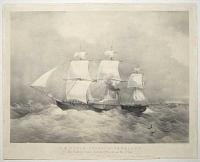
H.M. Steamship Frigate "Penelope" To Captain Jones and the Officers of the Ship. this print is repectfully dedicated by their obedient Servant.
T.G. Dutton 1843. T.G. Dutton del & lith. Day & Haghe Lith.rs to the Queen.
[London Ackermann... Strand... Fenchurch Street... Plymouth Edmund Fry]
Rare lithograph, sheet 345 x 430mm (13¼ x 17"). Some nicks and abrasions. Trimmed losing publication line and most of Dutton's signature.
A view of the steam paddle frigate HMS Penelope (1829) with her sails up on the sea. HMS Penelope was first laid down as one of the many sail frigates that England built to a French model. She was then changed to a unique steam paddle frigate. For some time she was a very famous ship, having a claim to being the first steam frigate.
[Ref: 56583] £380.00

Penha Longa.
O.R.L. WH Burnett Fect.
[British, n.d., c.1820.]
Rare lithograph, image 210 x 290mm. 8¼ x 11½". A good impression overall, with wide margins, very scarce. Slight crease.
Figures walking on a path through a wooded rocky landscape near Sintra, Portugal; artist unidentified. One of the figures appears to be a monk, presumably from the monastery depicted at right. Image touched in pencil, with ruled pencil border. Not in Abbey Scenery.
[Ref: 25589] £140.00
(£168.00 incl.VAT)

Passage of the Douro, by the Division, under the Command of L.t Gen.l Sir John Murray: [Dedication to Murray by the artist follows.]
Drawn by H. L'Eveque. Engraved by C. Heath.
London: Pub.d April 2, 1812 for the Proprietors by Mess.rs Colnaghi & Co 23, Cockspur Street.
Etching. 355 x 490mm (14 x 19¼"). Full margins, some spotting in the centre and on the right (mostly outside the image), some loss of surface in the centre and a light mark in the bottom right corner, presumably where a stamp or label has been removed.
General Sir John Murray (1768 - 1827) and his troops assembling on the bank and embarking in local boats to cross the river in Portugal; horses and artillery are manhandled into landing craft. The crossing, ordered by the Duke of Wellington, allowed the British to catch up to the retreating French under Marshal Soult. From the series 'Campaigns of the British Army in Portugal' after Henri L'Evêque (1769-1832), illustrating British Peninsula War campaign. With ink mss. label pasted over lower right corner of plate: 'Presented to the Wellington Collection by the Rt Hon: the Earl of [illegible] 1902.'
[Ref: 12630] £330.00
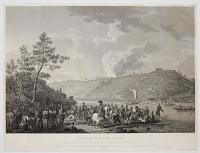
Passage of the Douro, by the Division, under the Command of L.t Gen.l the Hon.ble Edward Paget. To L.t Gen.l the Hon.ble Edward Paget this plate is respectfully inscribed by his most obedient Servant H. L'Eveque.
Drawn by H. L'Eveque. Engraved by J. Fitler.
London: Pub.d April 2, 1812 for the Proprietors by Mess.rs Colnaghi & Co 23, Cockspur Street.
Etching. Sheet 355 x 465mm (14 x 18¼"). Trimmed to plate, vertical crease at centre.
Paget (1775-1849) and his troops assembling on the bank of the Douro and embarking in wine barges to cross the river with their artillery. The crossing, ordered by the Duke of Wellington, allowed the British to catch up to the retreating French under Marshal Soult. Plate 6 of the series 'Campaigns of the British Army in Portugal' after Henri L'Evêque (1769-1832), illustrating British Peninsula War campaign.
[Ref: 40501] £220.00
(£264.00 incl.VAT)
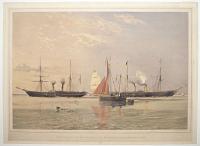
The Peninsular and Oriental Steam Navigation Company's Ships.
T.G. Dutton, Del. et Lith. Day & Son, Lith.rs to the Queen.
London. Published by T.G. Dutton, 17, Gate St, Lincoln's Inn Fields. [n.d., c.1847.]
Rare tinted lithograph, finished with hand colour. Sheet 360 x 500mm (14¼ x 19¾"). Slight mount burn.
Two of P&O's iron paddle steamers, 'Ripon' (1846) and 'Indus' (1847), built at Money Wigram's Blackwall Yard and operating the Southampton - Alexandria service. At Alexandria the passengers for India disembarked, travelled up the Nile to Cairo, then travelled overland to Port Suez. The Alexandria to Suez railway opened in 1858 and the Suez Canal in 1869. After an illustrious career, bringing to England the Prime Minister of Nepal, the first hippopotomus since Roman times and Giuseppe Garibaldi, the 'Ripon' was scuttled off Trinidad in 1880. The Indus was converted to a sailing ship in 1863 and became a coal supply ship.
[Ref: 52813] £590.00
![[Peninsular War] A bridge one mile from Celorico,](img-thumbnail/jpegs/61553.jpg)
[Peninsular War] A bridge one mile from Celorico, upon the main to Almeida, crossing the river Mondego, an attempt was made by Massena to destroy it in his retreat before the Duke of Wellington in 1811, it is made of granate [sic].
Drawn & Etched by G. Cumberland Jnr.
[n.d., c.1830.]
Coloured etching with extensive watercolour on 1830 watermarked page. Verso in ink Description of "43d or the Monmouthshire Reg of Foot". Sheet 185 x 310mm (7¼ x 12¼"). Trimmed within plate, mounted on album paper.
A view of the damaged bridge, with a British Army tent in the foreground. From the extremely rare series 'Views in Spain and Portugal taken during the campaigns of His Grace the Duke of Wellington'. According to a title-page in BM 'only 30 copies printed'. The artist's father, also George, was a lifelong friend and collaborator of William Blake. BM 1874,0509.84, described as a lithograph.
[Ref: 61553] £260.00
(£312.00 incl.VAT)
![[Peninsular War] View on the Tagus near Villa Velha.](img-thumbnail/jpegs/60740.jpg)
[Peninsular War] View on the Tagus near Villa Velha.
Rev.d. W.m Bradford del. J. Clark Sculp.
London Published by J. Booth, Duke Street, Portland Place, June 1, 1809.
Coloured aquatint. 270 x 380mm (10¾ x 15"), paper watermarked 'J Whatman 1809', very large margins. Early issue.
Sir John Moore's army crossing the Tagus. William Bradford was Chaplain to the British Army during the Peninsular War, and accompanied Sir John Moore on the retreat to Corunna, where Moore was killed. Published in his 'Sketches of the Country, Character, and Costume, in Portugal and Spain, Made During the Campaign and on the Route of the British Army, in 1808 and 1809'. Abbey: 135.
[Ref: 60740] £160.00
(£192.00 incl.VAT)
![[Peninsular War] View of the Rio Duero, at Torro,](img-thumbnail/jpegs/61552.jpg)
[Peninsular War] View of the Rio Duero, at Torro, at which place the allied armies united on the commencement of the Campaign of 1813. This Town is famous for Wine & Fruit, great quantity of the latter is sent to Madrid & produced from Standard Trees.
Drawn & Etched by G. Cumberland Jnr.
[n.d., c.1830.]
Coloured etching with extensive watercolour, on 1830 watermarked page. Verso in ink Description of "43d or the Monmouthshire Reg of Foot". Sheet 195 x 310mm (7¾ x 12¼"). Trimmed within plate at top right.
A view of British soldiers marching out of a valley. From the extremely rare series 'Views in Spain and Portugal taken during the campaigns of His Grace the Duke of Wellington'. According to a title-page in BM 'only 30 copies printed'. The artist's father, also George, was a lifelong friend and collaborator of William Blake. See BM 1852,0214.79.
[Ref: 61552] £260.00
(£312.00 incl.VAT)
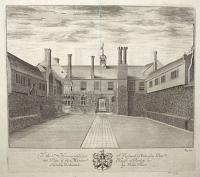
To the Honourable S.r Richard Anderson Bar;t this Plate of the Mannor House of Penley is Pa. 594
Humbly Dedicated by John Oliver
[Sir Henry Chauncy c.1700]
Engraving plate 285 x 375mm (11¼ x 14¾") Centre fold as issued. Some creasing. A few tears to marins. Slight ink offset.
Published for the first edition of Sir Henry Chauncy's (1632 - 1719) Historical Antiquities of Hertfordshire 1700. he manor of Pendley pre-dates the Norman Conquest of 1066, after which it was confiscated by William the Conqueror and passed to his brother-in-law, Robert, Count of Mortain (c. 1031-c.1095), and a later owner was John de Angle, an early Member of Parliament. In 1440 Sir Robert Whittingham (or Whytingham) and his wife Agnes received a grant of free warren from King Henry VI at Pendley manor; he enclosed 200 acres and tore down the buildings on the land, returning the estate to pasture. He built a manor house at the western end of the now-demolished town as a double cloistered courtyard as well as building a Chapel. On the accession of Edward IV (1442 -1483) he granted Pendley manor to George Neville, Bishop of Exeter in 1461 which then passed on to the Verney family through marriage. The Verney family lived at the medieval manor for the next 150 years, until it was passed on to the Anderson family. Sir Richard Anderson, 2nd Baronet (c. 1635-1699) owned the Penley estate when the print was made.
[Ref: 56224] £95.00
(£114.00 incl.VAT)
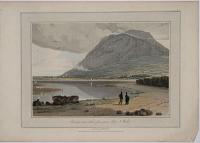
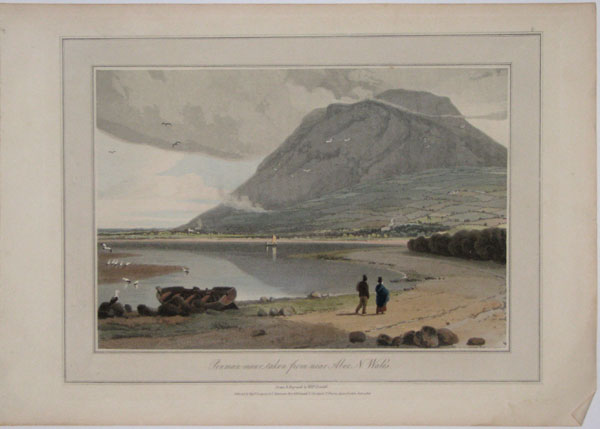
Penman-maur, taken from near Aber, N. Wales.
Drawn & Engraved by Will.m Daniell.
Published by Mess.rs Longman & Co. Paternoster Row & W. Daniell 9 Cleveland St. Fitzroy Square, London, June 1. 1815.
Coloured aquatint. Plate 222 x 298mm. 8¾ x 11¾".
A view of Penmeanmawr, a seaside quarrying town. From William Daniell's Second Volume of "Voyage around Great Britain". Abbey: Scenery, 16; Tooley: Books with Coloured Plates 177.
[Ref: 18089] £120.00
(£144.00 incl.VAT)
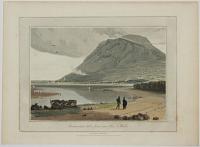
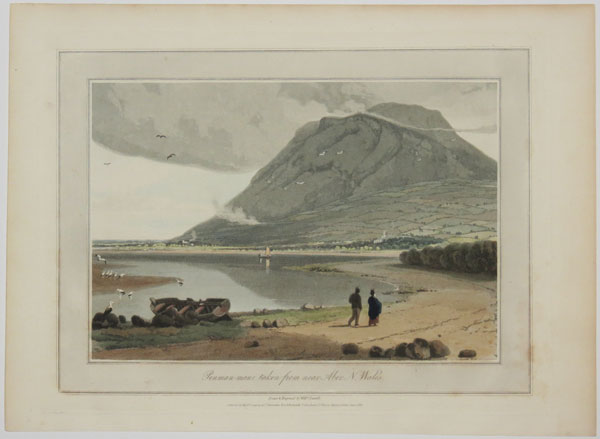
Penman-maur, taken from near Aber, N. Wales.
Drawn & Engraved by Will.m Daniell.
Published by Mess.rs. Longman & C.o. Paternoster Row & W. Daniell 9 Cleveden S.t. Fitzroy Square London, June 1. 1815.
Coloured aquatint with large margins. Plate: 300 x 230mm (12" x 9"). Very slight foxing.
View across to Penmaenmawr, a couple walk along a road in the foreground. Plate 34 from Vol II of "Voyage Round Great Britain". Abbey: Scenery, 16; Tooley: Books with Coloured Plates 177.
[Ref: 33892] £110.00
(£132.00 incl.VAT)
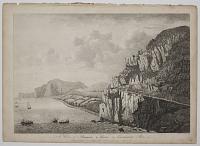
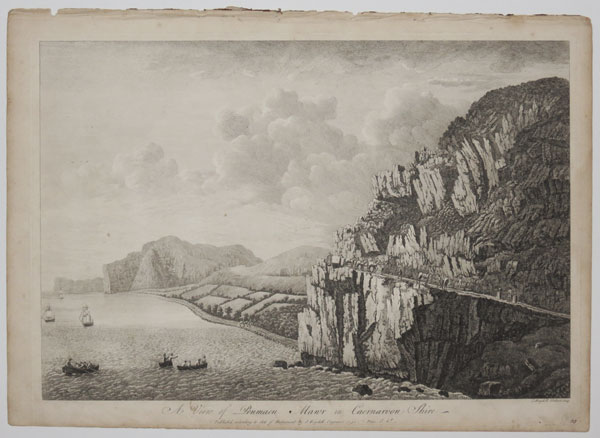
A View of Penmaen Mawr in Caernarvon Shire. [plate number scratched out, '75' in ink]
J. Boydell Delin & Sculp.
Publish'd according to Act of Parliament by J. Boydell Engraver 1750. Price 1s.6d.
Engraving, paper watermarked. Plate 344 x 481mm (13½ x 19"). Trimmed to platemark along lower edge.
A view of Penmaenmawr, Conwy, Wales. People struggle to save a carriage on the edge of a steep and precarious cliff edge; onlookers in a boat below. From "A Collection of One Hundred Views In England and Wales". John Boydell's 'Collection of Views' was made after he turned from engraver to print publisher in 1767. The first collection was issued in 1770, and included some plates by printmakers other than himself.
[Ref: 29401] £250.00
(£300.00 incl.VAT)

Druidical Circle on Penman Maior, North Wales (Seandudno in the Distance) AD XXXIX.
E.E. Wilmot. 1859.
Lithograph, scarce. 170 x 270mm, 6¾ x 10½".
Wild ponies in a desolate Welsh landscape.
[Ref: 22235] £120.00
(£144.00 incl.VAT)
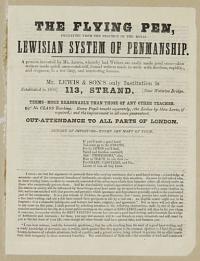
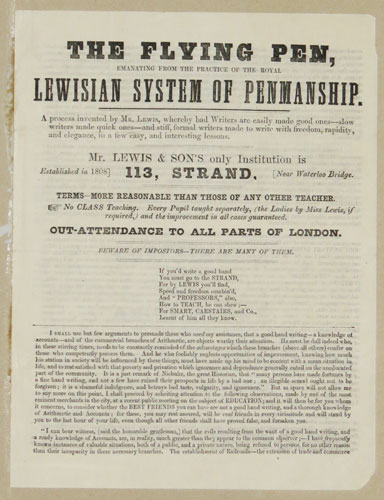
The Flying Pen, emanating from the practice of the royal Lewisian System of Penmanship. A process invented by Mr. Lewis, whereby bad Writers are easily made good ones [...]
Nichols and son, Printers, 8 & 9 Chandos Street, Strand [n.d., c.1840]
Letterpress pamphlet, 4pp, 245 x 185mm (9½ x 7¼"). Glued to backing sheet.
Prospectus for the penmanship courses of James Henry Lewis & Son on the Strand in London. Lewis (1786-1853) was a strenographer who at the age of 26 published 'The ready writer', a shorthand course, which was still in print (on its 97th edition) in the 1860s. Patronized by George IV, Lewis taught in London and toured the provinces. One of the last great writing masters, Lewis believed penmanship was a fine art. In addition to teaching writing itself, he also invented pens and wrote a book about the history of stenography.
[Ref: 37938] £160.00
(£192.00 incl.VAT)
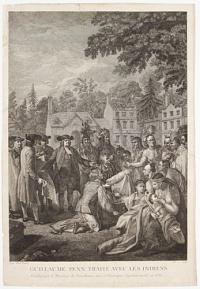
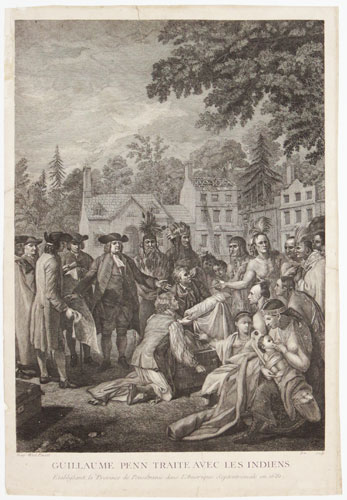
Guillaume Penn Traite avec les Indiens Etablissant la Province de Pensilvanie dans l'Amerique Septentrionale en 1681.
Benj: West Pinxit. D* sculp
[n.d., c.1780]
Engraving, rich impression; sheet 480 x 330mm (18¾ x 13"). Trimmed inside platemark; vertical crease through middle; small tears to edges; hole in centre; laid on conservation tissue.
William Penn's (1644 - 1718) 'Great Treaty' reputedly signed with Delaware Indian leaders in 1682 under an ancient elm tree at the village of Shackamaxon, located in what are now the borders of the city of Philadelphia, Pennsylvania. The event was painted by the Pennsylvania-born artist Benjamin West, a picture which was engraved in 1775. This French copy, probably made from that engraving, reverses and crops the picture to focus upon the centre of West's composition. Ex: Collection of The Hon. Christopher Lennox-Boyd.
[Ref: 31858] £360.00
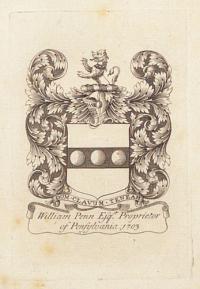
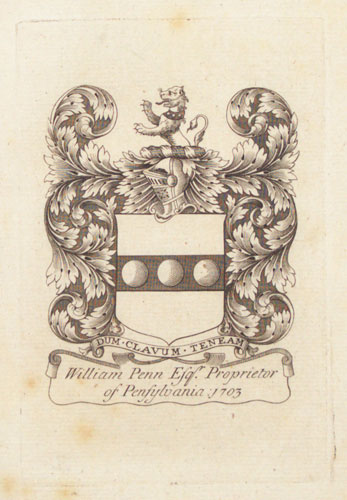
William Penn Esq.r Proprietor of Pennsylvania: 1703.
[n.d., c.1750.]
Fine engraving. 120 x 80mm (4¾" x 3?"). Worm holes in very wide margin. Some foxing.
Bookplate of William Penn (1644-1718), founder and 'Absolute Proprietor' of the Province of Pennsylvania, featuring his armorial.
[Ref: 52818] £130.00
(£156.00 incl.VAT)
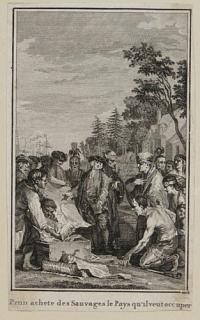
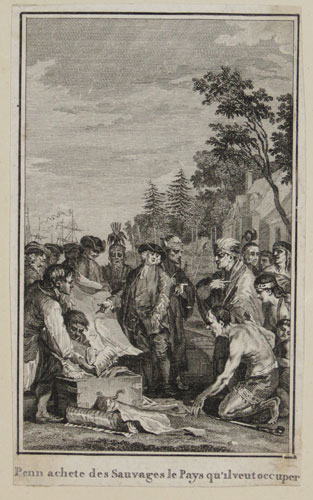
Penn achete des Sauvages le Pays qu'il veut occuper
[Anon, c.1780]
Engraving, sheet 160 x 100mm (6¼ x 4"). Trimmed close and glued to backing sheet.
French rendering of the familiar subject of William Penn's (1644 - 1718) 'Great Treaty' reputedly signed with Delaware Indian leaders in 1682 under an ancient elm tree at the village of Shackamaxon, located in what are now the borders of the city of Philadelphia, Pennsylvania. Here the legend is rather different to in British engravings: 'Penn buys from the savages the land he wants to occupy'.
[Ref: 34861] £140.00
(£168.00 incl.VAT)
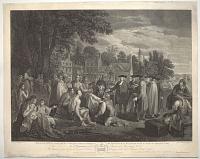
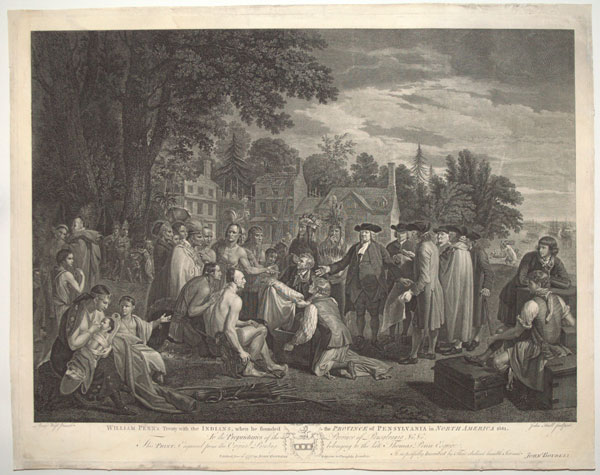
William Penn's Treaty with the Indians, when he founded the Province of Pensylvania in North America 1681. To the Proprietaries of the Province of Pensylvania, &c. &c. This Print, Engraved from the Original Painting belonging to the late Thomas Penn Esquire, Is respectfully Inscribed by Their obedient humble Servant John Boydell.
Benj: West pinxit. John Hall sculpsit.
Published, June 12th. 1775 by John Boydell Engraver in Cheapside London.
Engraving. 485 x 615mm (19 x 24¼"). Repairs to edges. Watermark in lower left of publication line.
William Penn's (1644 - 1718) 'Great Treaty' was reputedly signed with Delaware Indian leaders in 1682 under an ancient elm tree at the village of Shackamaxon, located in what are now the borders of the city of Philadelphia, Pennsylvania. This highly detailed depiction of the event, shows Penn in the centre left, with his arms open, his entourage beside him, two of his men kneeling, offering gifts to the Indians who are assembled at the right. Buildings in construction can be seen behind at the left, with boats on the sea at right. The painting by Benjamin West (1738 - 1820), who was born in Pennsylvania, is now in the Pennsylvania Academy of the Fine Arts. West was the first American-born artist to receive international recognition and remains one of the most important eighteenth-century painters of historical scenes. He enjoyed a career that endured more than half a century that included serving as president of the Royal Academy. William Penn, quaker leader and founder of Pennsylvania, was the first great hero of American liberty. During the late seventeenth century, Penn established an American sanctuary which protected freedom of conscience. Almost everywhere else, colonists stole land from the Indians, but Penn travelled unarmed among the Indians and negotiated peaceful purchases. He insisted that women deserved equal rights with men. He gave Pennsylvania a written constitution which limited the power of government, provided a humane penal code, and guaranteed many fundamental liberties. For the first time in modern history, a large society offered equal rights to people of different races and religions. Penn's dramatic example caused quite a stir in Europe. The French philosopher Voltaire, a champion of religious toleration, offered lavish praise. 'William Penn might, with reason, boast of having brought down upon earth the Golden Age, which in all probability, never had any real existence but in his dominions'.
[Ref: 54272] £690.00
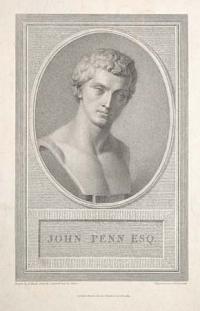
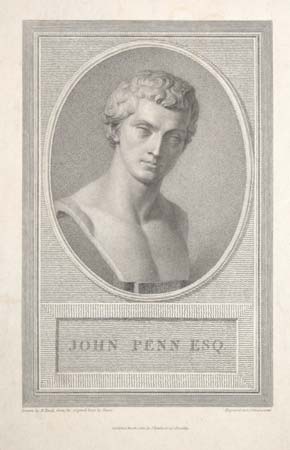
John Penn Esq.
Drawn by A. Tendi, from an original bust by Deare. Engraved by L. Schiavonetti.
Published March 1.1801, by J. Hatchard 173 Piccadilly.
Stipple and etching. Sheet size 245 x 150mm (9¾ x 6"). Cut to platemark.
Bust portrait sculpture, facing three-quarter to right, head slightly tilted towards the viewer, in an oval within rectangular frame; after Tendi's drawing of sculpture by Deare; published state. John Penn (1760-1834), grandson of William Penn, was the last proprietor of the Province of Pennsylvania, and a governor of the Isle of Portland where he built Pennsylvania Castle. Following the war of American Independence, the Penns settled in England and were granted an annuity by Parliament for their losses.
[Ref: 53548] £65.00
(£78.00 incl.VAT)
![[John Penn] Pen-etration.](img-thumbnail/jpegs/64707.jpg)
[John Penn] Pen-etration. NB: This Title has no affinity to Pen, as connected with the Goose-Quill; _ nor has it any allusion to Penguin, a stupid creature between a Fish & a Fowl; _ the word is simply derived from Pen, as the Instrument used to express the deep researches of the mind; _ see the St James's Street chit-chat _ respecting a Keen Pen; _ a Witty Pen; _ & a Pen, often Cut, but never mended.
J.s Gillray des. & f.t.
Pubd Aug.t 6th 1799 by H. Humphrey N 27 St James's Street.
Coloured etching. 260 x 200mm (10¼ x 8"), with large margins.
A full-length caricature portrait of John Penn (1760-1834), with a gaping, fish-like mouth and receding chin, standing with feet splayed, a vacant expression on his face. The grandson of William Penn, he inherited 75% of the proprietorship of the province of Pennsylvania in 1775, aged fifteen, only to be dispossessed the same year by the Revolution. The new United States Government give him £130,000 compensation for his family's 26 million acres in Pennsylvania. BM Satires 9441.
[Ref: 64707] £240.00
(£288.00 incl.VAT)
![[Thomas Penn Esq One of the first proprietors of Pennsilvania.]](img-thumbnail/jpegs/65020.jpg)
[Thomas Penn Esq One of the first proprietors of Pennsilvania.]
[Davis Pinx. 1751. Martin sc.]
[n.d., c.1766.
Mezzotint. Sheet 285 x 225mm (11¼ x 8¾"). Trimmed to image losing inscription area.
A half-length portrait of Thomas Penn (1702-75), son of William Penn, extracted from the full-length oil by Arthur Devis, painted to celebrated Penn's marriage to Lady Juliana Fermor in 1751, now in the Philadelphia Museum of Art (2004-201-1). A proof impression in the BM has 'D Martin 1766' in scratched letters (BM 1860,0728.28). CS 4, two known states. Ex: Collection of The Hon. Christopher Lennox-Boyd.
[Ref: 65020] £220.00

Penn. [William Penn, the celebrated founder of Pennsylvania, son of admiral sir William Penn, was born on Tower-hill, October 14, 1644. About the age of fifteen, he became a student of Christ-church, Oxford; but having early inbibed strong religious impressions, through the preaching of Thomas Loe, on of the people callled quakers...]
Holl. sculp.
[n.d.,c.1819.]
Stipple engraving. Sheet 220 x 130mm (8½ x 5").
Portrait of William Penn (1644 - 1718), English writer, religious thinker, and influential Quaker who founded the Province of Pennsylvania during the British colonial era. Penn, an advocate of democracy and religious freedom, was known for his amicable relations and successful treaties with the Lenape Native Americans who had resided in present-day Pennsylvania prior to European settlements in the state.
[Ref: 64110] £120.00
(£144.00 incl.VAT)
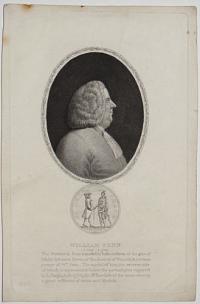
William Penn. b. 1644. d. 1718. The Portrait is from a model is basso relievo of the size of life by Sylvanus Bevan, of the Society of Friends, & a cotemporary of W.m Penn. The medal of him, the reverse side of which is represented below the portrait, was engrav'd by L. Pingo, A.D. 1770, for B.n Bartlett of the same society; a great collector of coins and medals.
[n.d., c.1800.]
Stipple. Plate: 200 x 120mm (8 x 5"). Small margins.
A bust portrait in an oval of founder of Pennsylvania and early Quaker William Penn (1644-1718).
[Ref: 45807] £120.00
(£144.00 incl.VAT)
![[William Penn on the Banks of the Delaware.]](img-thumbnail/jpegs/49069.jpg)
[William Penn on the Banks of the Delaware.]
RS. [Robert Spence.]
[n.d., c.1905.]
Etching on vellum, signed in pencil. Plate: 345 x 445mm (13½ x 17½''). Creasing.
A scene showing William Penn and a group of Europeans standing before a group of Native Americans. By artist Robert Spence (1871-1964) who was a member of the Royal Society of Painter Printmakers.
[Ref: 49069] £180.00
(£216.00 incl.VAT)
![C.R. Pemberton [facsimile autograph.]](jpegs/19046.jpg)
![[Henry, 10th Earl of Pembroke & Mrs Kendal] No. IV. Mrs. K_dal. No. V. The Equestrian Hero.](jpegs/45426.jpg)
![[Pembroke Gardens] An Exact Survey of the Beautiful & Magnificent](jpegs/61711.jpg)


![[Manorbier Castle] Manor Bear Castle.](jpegs/41895.jpg)
![[A Man Mending a Pen.]](jpegs/65731.jpg)
![[A Man Mending a Pen.]](jpegs/65732.jpg)
![[Two figures in a landscape]](jpegs/36939.jpg)
![[Two figures in a landscape]](jpegs/36940.jpg)
![[Penang] Burmah temple at Prince of Wales Island.](jpegs/55660.jpg)


![[Pendley Manor] To the Honourable S.r Richard Anderson Bar:t this Plate of the Mannor House of Penley is Humbly Dedicated by John Oliver.](jpegs/62543.jpg)



![[Set of three prints in various states.] Penelope taking down the Bow of Ulysses.](jpegs/36450.jpg)

![[Penelope and the suitors] Ingratam Veneri pone superbiam.](jpegs/57476.jpg)


![[Peninsular War] A bridge one mile from Celorico,](jpegs/61553.jpg)
![[Peninsular War] View on the Tagus near Villa Velha.](jpegs/60740.jpg)
![[Peninsular War] View of the Rio Duero, at Torro,](jpegs/61552.jpg)


![[John Penn] Pen-etration.](jpegs/64707.jpg)
![[Thomas Penn Esq One of the first proprietors of Pennsilvania.]](jpegs/65020.jpg)


![[William Penn on the Banks of the Delaware.]](jpegs/49069.jpg)