![[The Oxford Almanack for 1743, showing Lincoln College]](img-thumbnail/jpegs/43931.jpg)
[The Oxford Almanack for 1743, showing Lincoln College]
G Vertue sculp. [1742]
Etching with engraving, sheet 365 x 435mm (14½ x 17"). Trimmed, losing almanack text; glued to backing sheet.
View of Lincoln Collage, with two groups of figures above. On the extreme left is Richard Fleming, one of the founders, with behind him Thomas Beckington, John Forest, William Finderne and John Bucktot. Another founder, Thomas Rotherham, is amongst the group of the right. The engraver and antiquary George Vertue (1684-1756) succeeded Michael Burghers as engraver to Oxford University in 1727, a post which included the responsibility of engraving almanacks such as this. Alexander 852
[Ref: 43931] £220.00
(£264.00 incl.VAT)
![[Magdalen College and Bridge, Oxford.] [No.47.]](img-thumbnail/jpegs/62260.jpg)
[Magdalen College and Bridge, Oxford.] [No.47.]
Arthur Spencer [pencil signature.]
[n.d. c.1925.]
Etching. Plate 140 x 202mm (5½ x 8"), very large margins. Mint.
A view of Magdalen College and the bridge that crosses the River Cherwell. The large, square tower of the college, has a tradition that the college choir sings from the top at 6 a.m. on May Morning, a tradition carried since the days of Henry VII.
[Ref: 62260] £75.00
(£90.00 incl.VAT)
![[Magdalen Tower and Bridge, &c.]](img-thumbnail/jpegs/62280.jpg)
[Magdalen Tower and Bridge, &c.]
Drawn by E. Dayes. Engraved by James Basire.
[Oxford, 1797.]
Engraving, proof before title. 350 x 490mm (13¾ x 19¼") very large margins.
A view looking up at Magdalen Bridge and Tower from the banks of the Cherwell, published as the Oxford Almanac for 1797. The Oxford Almanack has been published annually since 1674.
[Ref: 62280] £280.00
(£336.00 incl.VAT)

The New Building, Magdalen College from the Grove.
M.A. Rooker., del & sculp.
[c.1787.]
Engraving. Sheet 350 x 495mm (15¼ x 19½"). Trimmed to plate at bottom, tears taped. Very small margins on 3 sides.
Drawn and engraved by Michael Angelo Rooker for the Oxford Almanack.
[Ref: 66866] £320.00
![[Magdalen College from the Quadrangle, Oxford.] [No.48.]](img-thumbnail/jpegs/62259.jpg)
[Magdalen College from the Quadrangle, Oxford.] [No.48.]
Arthur Spencer [pencil signature.]
[n.d. c.1925.]
Etching. Plate 202 x 140mm (8 x 5½"), very large margins. Mint.
A view of the Founders Tower from the Cloister Quadrangle, Magdalen College, Oxford University.
[Ref: 62259] £75.00
(£90.00 incl.VAT)
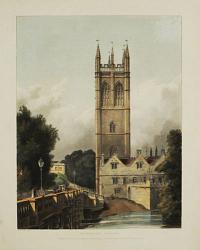
Magdalene Tower.
F. Nash del.t. G. Lewis sculp.t.
London, Pub.d Aug.t 1. 1814, at 101 Strand, for R. Ackermann's History of Oxford.
Fine coloured aquatint. 300 x 250mm (11¾ x 10"), with J. Whatman 1812 watermark.
Magdalen Tower, the bell tower of Magdalen College, completed in 1509.
[Ref: 50004] £240.00
(£288.00 incl.VAT)
![[Magdalen College] Aula B. Mariæ Magdalenæ.](img-thumbnail/jpegs/41588.jpg)
[Magdalen College] Aula B. Mariæ Magdalenæ.
Dav. Loggan Sculp. Cum Privil. S.R.M.
[Oxford, David Loggan, 1675.]
Engraving. 245 x 350mm (9 x 13¾"), with wide margins.
A view of the exterior of the Magdalen College Boys School, founded to educate the sixteen boy choristers of the college. Published in David Loggan's 'Oxonia Illustrata'.
[Ref: 41588] £320.00
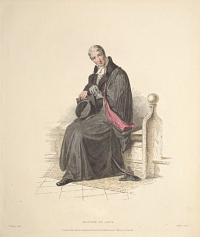
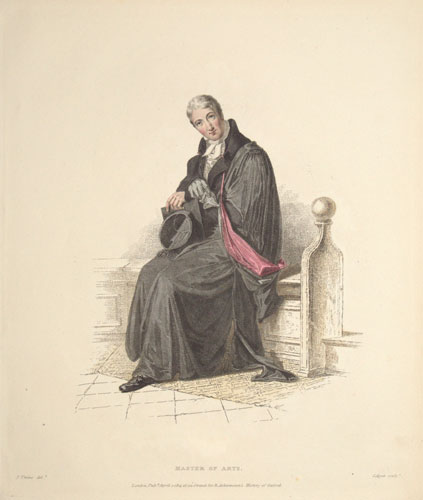
Master of Arts.
T. Uwins del.t. J. Agar sculp.t.
London Pub.d April 1 1815 at 101 Strand for R. Ackermann's History of Oxford.
Fine coloured etching. 300 x 250mm (11¾ x 9¾"), with wide margins on 3 sides.
Portrait of an Oxford scholar in his robes.
[Ref: 53447] £140.00
(£168.00 incl.VAT)

Collegium Mertonense.
D. Loggan Delin & sculp. cum privil. S.R.M.
[Oxford, David Loggan, 1675.]
Etching. Sheet 295x 405mm (11¾ x 16"). Trimmed to image, central fold as usual.
An elevated view of Merton College, with an extensive engraved text in Latin. Published in David Loggan's 'Oxonia Illustrata'.
[Ref: 59626] £260.00
(£312.00 incl.VAT)
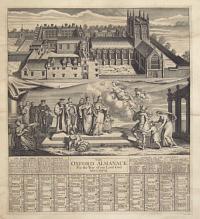
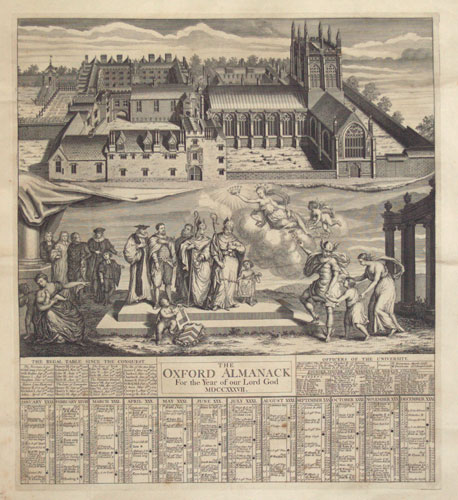
The Oxford Almanack for the Year of the our Lord God MDCCXXXVII.
Vertue Sculp.
[n.d. c.1737.]
Etching and engravin. Plate 501 x 451mm (19¾ x 17¾"). Tax stamp top left corner. Staining and creasing.
A view of Merton College. The Oxford Almanack is an annual almanac published since 1674. The stamp duty was payable to the compiler of the almanac, set at 1 shilling and threepence per year covered by Act of Parliament 55 Geo. III c. 185. The same act set the penalty for issuing an unstamped almanac as three months' imprisonment.
[Ref: 52475] £320.00
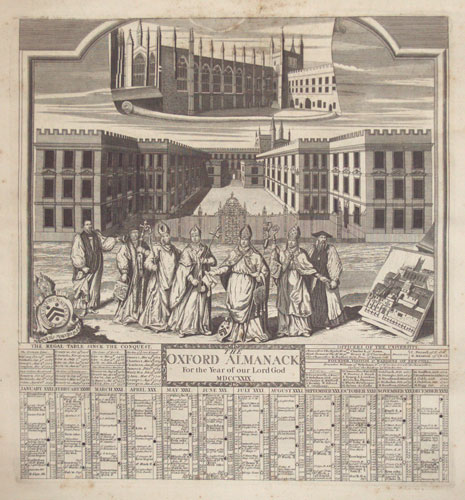
![[Merton College] The Oxford Almanack For the Year of Our Lord God MDCCXXXVII.](img-thumbnail/jpegs/43929.jpg)
[Merton College] The Oxford Almanack For the Year of Our Lord God MDCCXXXVII.
G Vertue sculp.
[1736]
Etching with engraving, sheet 490 x 440mm (19¼ x 17¼"). Glued to backing sheet; trimmed; fold on left.
A view of Merton College with a group of benefactors in the foreground, including Walter de Merton (d.1277) in the centre and to his left William Rede (d.1385), Bishop of Chichester and builder of the college library. The engraver and antiquary George Vertue (1684-1756) succeeded Michael Burghers as engraver to Oxford University in 1727, a post which included the responsibility of engraving almanacks such as this. Alexander 752
[Ref: 43929] £240.00
(£288.00 incl.VAT)
![[Oxford Movement] The Anglican Hen and Her Pusey Duckings.](img-thumbnail/jpegs/63964.jpg)
[Oxford Movement] The Anglican Hen and Her Pusey Duckings. Political Fly Leaves. _ N.º 6.
Touchstone.
Pub. by T. McLean, 26 Haymarket, Jan. 6. 1851. Printed at 70. S.t Martin's Lane.
Tinted lithograph. Sheet 290 x 390mm (11½ x 15¼"). Trimmed to printed border, bookseller's red stamp, laid on archival paper.
A hen with an anglican minister's hat watches as her congregation swims off to Edward Bouverie Pusey, a duck with s wide-brimmed hat on a lake in front of the Vatican. Pusey (1800-82) was a leader of the Oxford Movement, a group of high church members of the Church of England centred on Oriel College. 'Touchstone' was a satirist whose work was published by Thomas McLean in the early 1850s. The 'T' of Touchstone is a monogram of a jester's head with belled cap.
[Ref: 63964] £180.00
(£216.00 incl.VAT)
![[Oxford Movement] Ecclesiastical Smugglers.](img-thumbnail/jpegs/63962.jpg)
[Oxford Movement] Ecclesiastical Smugglers. Political Fly Leaves. _ N.º 5.
Touchstone.
Pub. by T. McLean, 26 Haymarket, Jan. 6 1851. Printed at 70. S.t Martin's Lane.
Tinted lithograph. Sheet 290 x 410mm (11½ x 16"). Trimmed to printed border, bookseller's red stamp, laid on archival paper.
Clerics and laymen bring ashore Catholic accoutrements, including a statue of the Virgin Mary, a reliquary and a censer, taking them into an Anglican church. A satire on the Oxford Movement, a group of high church members of the Church of England centred on Oriel College. 'Touchstone' was a satirist whose work was published by Thomas McLean in the early 1850s. The 'T' of Touchstone is a monogram of a jester's head with belled cap.
[Ref: 63962] £180.00
(£216.00 incl.VAT)
![[Oxford Movement] M.r Worldly Wseman Directing Pilgrims to the Town of Infallibility!](img-thumbnail/jpegs/63963.jpg)
[Oxford Movement] M.r Worldly Wseman Directing Pilgrims to the Town of Infallibility! See the Puseyite's Progress, (backwards.) Political Fly Leaves. _ N.º 8.
Touchstone.
Pub. by T. McLean, 26 Haymarket, Jan. 21. 1851. Printed at 70. S.t Martin's Lane.
Tinted lithograph. Sheet 280 x 355mm (11 x 14"). Trimmed to printed border, bookseller's red stamp, laid on archival paper.
A satire of Nicholas Wiseman (1802-65), the first Archbishop of Westminster upon the re-establishment of the Catholic hierarchy in England and Wales in 1850. He guides a member of the Oxford Movement (centred on Oriel College), burdened with the 'Thirty-Nine Articles' of the Church of England, towards Rome. 'Touchstone' was a satirist whose work was published by Thomas McLean in the early 1850s. The 'T' of Touchstone is a monogram of a jester's head with belled cap.
[Ref: 63963] £180.00
(£216.00 incl.VAT)
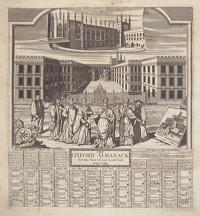
The Oxford Almanack for the Year of the our Lord God MDCCXXIX.
G. Vertue Sculp.
[n.d. c.1729.]
Etching and engraving. Plate 480 x 450mm (19 x 17¾"). Tax stamp top left corner. Staining; nicks and tears to margin edges.
A view of New College, from the garden with a view of Chapel, Hall and Winchester College. The Oxford Almanack is an annual almanac published since 1674. The stamp duty was payable to the compiler of the almanac, set at 1 shilling and threepence per year covered by Act of Parliament 55 Geo. III c. 185. The same act set the penalty for issuing an unstamped almanac as three months' imprisonment.
[Ref: 52469] £320.00
![[New College Chapel.]](img-thumbnail/jpegs/53462.jpg)
[New College Chapel.]
F.P. Barraud [in plate]. F.P. Barraud. R.W. Hester [pencil signatures].
London, Published April 2nd 1891 by Mess.rs Dickinson & Foster, Publishers to The Queen, 114, New Bond Street, W, Copyright Registered.
Coloured etching, signed by the artist and engraver. 450 x 580mm (17¾ x 22¾"), with Printsellers' Association blind stamp
A large-scale view of the chapel at New College, by Francis Philip Barraud (1824-1900). The arms of the college appear under the image.
[Ref: 53462] £260.00
(£312.00 incl.VAT)
![[New College, Oxford, rear view.]](img-thumbnail/jpegs/57376.jpg)
[New College, Oxford, rear view.]
[by William Monk.]
Pencil sketch on paper, sheet 390 x 555mm (15¼ x 21¾"), on Whatman paper watermarked with date 1901. Stitch holes around image.
A pencil sketch, probably a sketch for an etching, by British etcher William Monk (1863-1937).
[Ref: 57376] £580.00
![[New College, Oxford.] [No.51.]](img-thumbnail/jpegs/27594.jpg)
[New College, Oxford.] [No.51.]
Arthur Spencer [pencil signature.]
[n.d. c.1925.]
Etching. Plate 203 x 140mm. 8 x 5½". Mint.
The rear entrance to New College, in New College Lane, Oxford. New College is one of the oldest of the Oxford colleges, having originally been founded in 1379. The college was originally established for the education of priests, there being a shortage of properly educated clergy after the black death.
[Ref: 27594] £70.00
(£84.00 incl.VAT)
![[New College, Oxford] Collegium Novum.](img-thumbnail/jpegs/65158.jpg)
[New College, Oxford] Collegium Novum.
[by William Williams.]
[Oxford: William Williams, 1733].
Fine engraving. 435 x 575mm (17 x 22½"), with large margins.
An elevated view of New College Oxford, engraved by William Williams for his 'Oxonia depicta sive collegiorum et aularum […] delineatio', his update to David Loggan’s 'Oxonia illustrata' of (1675).
[Ref: 65158] £380.00
![[The Oxford Almanack for 1750, showing New Inn Hall]](img-thumbnail/jpegs/43932.jpg)
[The Oxford Almanack for 1750, showing New Inn Hall]
G Vertue sculp. [1749]
Etching with engraving, sheet 365 x 450mm (14½ x 17½"). Trimmed, losing almanack text; glued to backing sheet; fold on left.
Small view of New Inn Hall within elaborate design dividing image into three rococo compartments, with three groups of standing figures. The engraver and antiquary George Vertue (1684-1756) succeeded Michael Burghers as engraver to Oxford University in 1727, a post which included the responsibility of engraving almanacks such as this. Alexander 950
[Ref: 43932] £220.00
(£264.00 incl.VAT)

The Oxford Almanack for the Year of our Lord God, MDCCXCIV. A South View of the Observatory.
J. Dixon delin. W. Lowry sculp.
[n.d., 1794].
Engraving, sheet 380 x 475mm (15 x 18¾"). Trimmed within plate.
A view of the Radcliffe Observatory in Oxford, which was finished in that same year and which is now part of Green College. The Oxford Almanack is an annual almanac published by the Oxford University Press since 1674. John Dixon (c. 1740 - 1811) mezzotint engraver who had trained as a painter in Dublin then moved to London in 1765 where he married a rich widow in 1775, and henceforth only engraved for amusement.
[Ref: 56973] £160.00
(£192.00 incl.VAT)

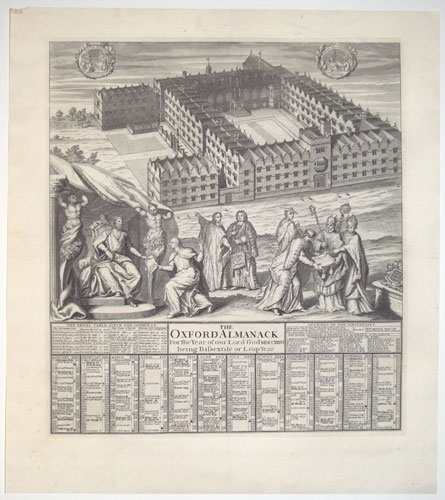
The Oxford Almanack for the Year of the our Lord God MDCCXXXVI being Bissextile or Leap Year.
G: Vertue Sculp.
[n.d. c.1736.]
Etching and engraving, partly stamped at top left corner. Plate 501 x 451mm (19¾ x 17¾") with very wide margins. Central crease.
View of Oriel College with the Robinson building, erected in 1720 and the Carter building, 1729; in the foreground, Adam de Brome, chancellor of Durham and founder of the college, receives the charter from Edward II, who sits under a canopy stretched over pillars carved into male figures, while benefactors to right, among them a chancellor and Bishops, including Bishop Robinson and Provost George Carter, examine a charter. See Helen Mary Petter, 'The Oxford Almanacks' (Oxford 1974), p. 60; Alexander. Both plates were engraved by Vertue. In the roundels above the image are Queen Anne delivering a grant of Prebend to Bishop Robinson, in 1712; to right, an allegory of the Treaty of Utrecht, negotiated by Robinson in 1713. The Oxford Almanack is an annual almanac published since 1674. The stamp duty was payable to the compiler of the almanac, set at 1 shilling and threepence per year covered by Act of Parliament 55 Geo. III c. 185. The same act set the penalty for issuing an unstamped almanac as three months' imprisonment. Alexander (2008): 719.
[Ref: 52474] £320.00
![[Oriel College.] [No.50]](img-thumbnail/jpegs/62258.jpg)
[Oriel College.] [No.50]
Arthur Spencer [pencil signature.]
[n.d. c.1920.]
Etching. Plate 201 x 140mm (8 x 5½"), very large margins. Mint.
The front entrance to Oriel College, Oxford University looking north along Oriel Stret towards the Spire of the University Church St Mary the Virgin.
[Ref: 62258] £75.00
(£90.00 incl.VAT)
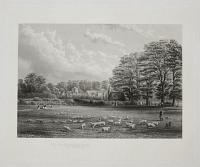
View in the Parks, Oxford, Looking South. Taken in the year, 1866.
[Le Keux.]
Mint etching, on india. Plate: 410 x 330mm (16 x 13"), with very large margins.
A view of the University Parks which lies to the northeast of the city. Groups of women and children can be seen walking and conversing while a shepherd and his dog are shown watching their sheep.
[Ref: 40619] £160.00
(£192.00 incl.VAT)

The Oxford Almanack for the Year of the our Lord God MDCCXLIV. Being Bissextile or Leap Year.
G. Vertue Sculp.
[n.d. c.1744; but later?]
Etching and engraving. Plate 510 x 463mm (20 x 18¼") with very wide margins.
View of Pembroke College, below a scene showing James I granting the charter to Lord Pembroke, watched by Thomas Tesdal and Richard Wightwick, the founders, with John Bennett, 1st Lord Ossulstone and John Hall to left, the latter holding a drawing of the Master's Lodgings, which he had built in 1695 and to right, Francis Rous, George Townsend, Juliana Stafford and Dame Holford; in pictures on the wall behind are, to left, Charles I giving the college patronage of St Aldate's church and founding a fellowship for natives of Jersey and Guernsey and to right, Queen Ann granting Chancellor Harcourt a charter for endowing the Master with a Prebend of Gloucester. See Helen Mary Petter, 'The Oxford Almanacks' (Oxford 1974), p. 63; Alexander. Both surviving plates are signed by Vertue. There is a proof without the calendar in the Ashmolean Museum and a drawing signed 'W. Greene delin.', in which the figures differ to those in the engraving. Greene was paid 5 guineas for the desihn in 1742-3. The buildings are similar to Plate lvi in W. William s 'Oxonia Depicta' (1733). The Oxford Almanack is an annual almanac published since 1674. The stamp duty was payable to the compiler of the almanac, set at 1 shilling and threepence per year covered by Act of Parliament 55 Geo. III c. 185. The same act set the penalty for issuing an unstamped almanac as three months' imprisonment. Alexander (2008): 864.
[Ref: 52481] £320.00
![A View of the Physic Gardens in the University of Oxford. [parallel text in French]](img-thumbnail/jpegs/38537.jpg)
A View of the Physic Gardens in the University of Oxford. [parallel text in French]
J. Green delin et sculp
London, Printed for Rob.t Sayer, Map & Printseller No 53 in Fleet Street, as the Act directs 10 August 1773.
Engraving with original hand-colouring, platemark 340 x 460mm (13½ x 18"). Tears; very fine and rare.
Rare view of the Oxford Physic Garden, with putti presenting plans and scroll bearing the inscription on the entrance to the garden. The view focuses on the famous gateway and entrance portico built by Nicholas Stone after designs by Inigo Jones. Founded in 1621 by Henry Danvers, Earl of Danby, its purpose was the study of medicinal plants. Building the Garden, on the site of the former medieval Jewish cemetery, cost the enormous sum of £5000. Much of that sum went on the walls which enclosed the original garden, and comparatively little was left for plants! It was renamed the Oxford Botanic Garden in 1840 and is the oldest surviving physic and botanic garden in Britain.
[Ref: 38537] £490.00
![[The entrance gate to Queen's College from the High Street.]](img-thumbnail/jpegs/57382.jpg)
[The entrance gate to Queen's College from the High Street.]
[by William Monk.]
[n.d., c.1910.]
Pencil sketch on paper, sheet 390 x 555mm (15¼ x 21¾"), on Whatman paper.
A pencil sketch, probably a design for an etching by British etcher William Monk (1863-1937).
[Ref: 57382] £490.00
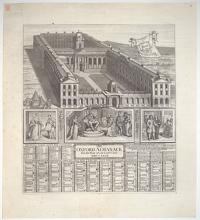
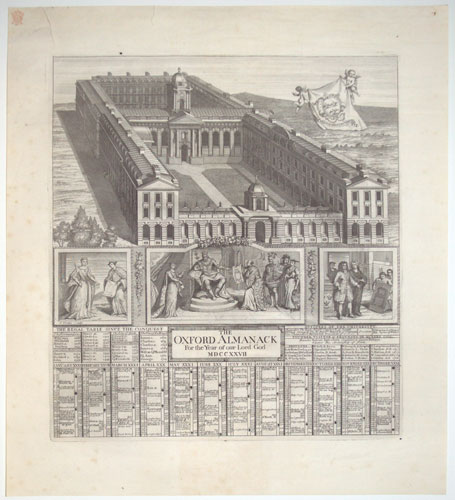
The Oxford Almanack for the Year of the our Lord God MDCCXXVII.
G. Vertue Sculp.
[n.d. c.1727.]
Etching and engraving. Plate 490 x 444mm (19¼ x 17½"). Stamped at top left corner, with very wide margins. Creasing.
View of Queen's College, showing two quadrangles and Hawksmoor's original design for the cupola, above a frame divided into three; to left, Queen Philippa and the founder, Robert Eglesfield; in the centre, Queen Philippa and Edward III, enthroned, with Eglesfield presenting the plan; to right, Sir Joseph Williamson and Dr Lancaster. See Helen Mary Petter, 'The Oxford Almanacks' (Oxford 1974), p. 56; Alexander. Both surviving plates are signed by Vertue. 'Vertue and others' were paid £76 7s. 0d. for 'engraving etc. the Almanack'; Alexander suggests that Vertue sub-contracted some of the work, probably the calendar, which had been engraved by William Hullet in the previous two years. He adds that although Vertue places this under 1727, it was presumably engraved in 1726. The Oxford Almanack is an annual almanac published since 1674. The stamp duty was payable to the compiler of the almanac, set at 1 shilling and threepence per year covered by Act of Parliament 55 Geo. III c. 185. The same act set the penalty for issuing an unstamped almanac as three months' imprisonment. Alexander (2008): 489.
[Ref: 52467] £320.00
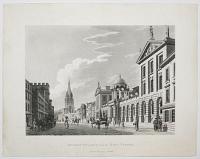
Queens College from the High Street.
Published Feb. 27th 1802 by T.Malton.
Aquatint. Sheet 315 x 400mm (12¼ x 15¾").
A good view of Oxford High Street.
[Ref: 48129] £190.00
(£228.00 incl.VAT)
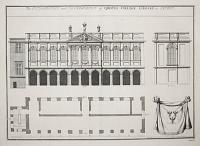
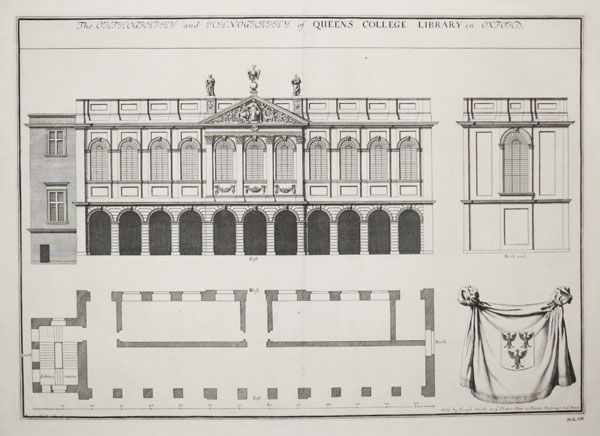
The Orthography and Ichnography of Queens College Library in Oxford.
[Engraved by Michael Burghers.]
Sold by Joseph Smith at ye Picture Shop in Exeter Exchange in ye Strand [n.d., c.1724.]
Engraving. 385 x 540mm (15¼ x 21¼"). Small tear in large margins. Crease as normal.
Elevations, floorplan and crest of Queen's College. Published in Smith's 'Britannia Illustrata', with the signature of Michael Burgher (engraver for Loggan's Oxford) hidden under the engraved border bottom left.
[Ref: 45233] £260.00
(£312.00 incl.VAT)
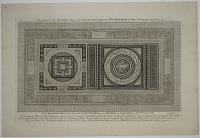
Pavimentum hoc Tessellatum Elegantiss: Stunsfeldiae prope Woodstochiam in Agro Oxoniensi repertum est. This Tessellated Pavement, discover'd at Stunsfield near Woodstock in Oxfordshire A.no D.ni MDCCXII. A most Exquisite Work of the Antient Romans, composed with great variety of Small Tesserae of Beautiful Colours & Summetry, esteem'd to be the most Elegant Piece of Antiquity of the Kind found in Great Britain. When first open'd it was seen by Multitudes of Curious Persons, and some Learned Antiquaries have employ'd their Skill to trace out its Original Use. Now only remains this Shade, preserv'd first Care of Tho. Hearne M.A. of Oxford, and lastly by G. Vertue Member of the Society of Antiquaries London. 35 feet by 20.
[T. Hearne. G. Vertue.]
[1712.]
Copper engraving. Plate 292 x 470mm. 11½ x 18½".
A drawing of the a tessellated pavement found at the Roman Villa at Stonesfield, Oxfordshire in 1712. Ex Collection: Norman Blackburn.
[Ref: 19816] £180.00
(£216.00 incl.VAT)
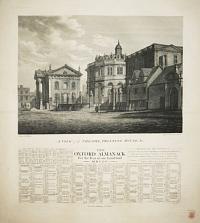
AView of the Theatre, Printing House, &c. The Oxford Almanack For the Year of our Lord God MDCCC [1800].
Drawn by E. Days. Engraved by James Basire. J. Cole, Cal, sc.
[Oxford, 1800.] Price Two Shillings and Six Pence.
Engraving. 565 x 485mm (22¼ x 19"), with very large margins, stamp duty ink stamp lower right margin. Uncut. Horizontal fold, pinholes in the margins.
The Oxford Almanack has been published annually since 1674. The stamp duty was payable to the compiler of the almanac, set at 4 pence per year.
[Ref: 51437] £230.00
(£276.00 incl.VAT)
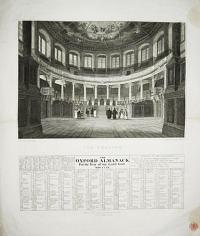
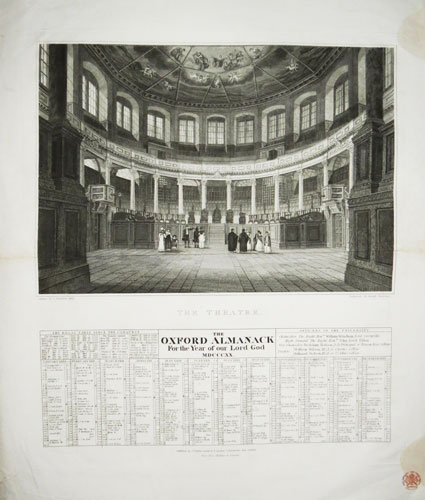
The Theatre. The Oxford Almanack For the Year of our Lord God MDCCCXX [1820].
Drawn by J. Bucker 1815. Engraved by Joseph Skelton.
Published by J. Parker, Oxford & E. Gardner No 7 Paternoster Row, London. Price 5 Shillings & Sixpence.
Engraving. 565 x 485mm (22¼ x 19"), with very large margins, stamp duty ink stamp lower right margin. Uncut. Horizontal fold, creasing in almanack, damp stains in margins.
The Oxford Almanack is an annual almanac published since 1674. The stamp duty was payable to the compiler of the almanac, set at 1 shilling and threepence per year covered by Act of Parliament 55 Geo. III c. 185. The same act set the penalty for issuing an unstamped almanac as three months' imprisonment.
[Ref: 51436] £260.00
(£312.00 incl.VAT)
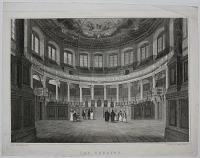
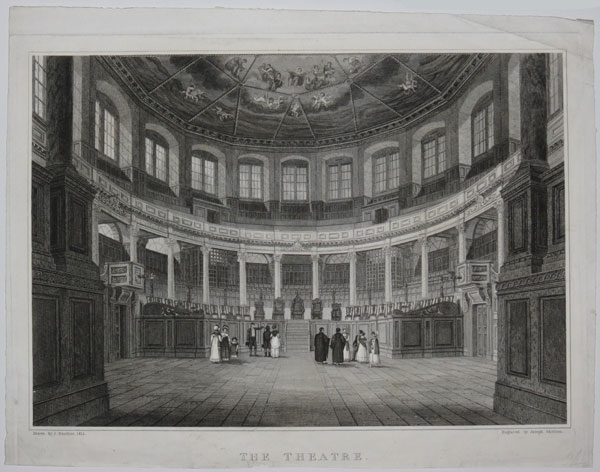
The Theatre.
Drawn by J. Buckler, 1815. Engraved by Joseph Skelton.
[n.d., c.1820].
Engraving, fine impression. Laid on India paper. Plate: 490 x 390mm (19 x 15"). Trimmed on lower margin. Tears in lower edge. Creases in top right hand corner.
Interior view of the Sheldonion Theatre in Oxford. Constructed between 1664 and 1669 it was the first major design of Sir Christopher Wren. The building was funded by Gilbert Sheldon who was later to become the Archbishop of Canterbury. From the Encombe Estate, Earl of Eldon.
[Ref: 32651] £130.00
(£156.00 incl.VAT)
![[St Marylebone New Road Portland Place] [ms.]](img-thumbnail/jpegs/32298.jpg)
[St Marylebone New Road Portland Place] [ms.]
[by William Pickett.]
[Pub.d June 4th by T. Clay, 18 Ludgate Hill.]
Aquatint with hand colouring. Sheet approx 155 x 180mm (6 x 7"). Trimmed to image; glued to album sheet.
Scene on St Marylebone New Road in London's West End. The Farthing Pie House From Pickett's 1812 book of 'Ninety-Six Speciments of Cottages-Bridges-Castles-Churches [...] Intended to facilitate the Improvement of the Student, and to aid the Practitioner, in Landscape Composition'. Aside from its function as an educational volume, the scenes in the book also provide many unusual views of London in the early 19th century. Abbey (Life in England) 168.
[Ref: 32298] £95.00
(£114.00 incl.VAT)
![[St Giles, Oxford] Hanc Ecclesiæ D. Aegidii in Suburbiis Civ. Oxon.](img-thumbnail/jpegs/42013.jpg)
[St Giles, Oxford] Hanc Ecclesiæ D. Aegidii in Suburbiis Civ. Oxon. (ut creditur Normannorum tempore) certe ante 1189 ult. R. Hen. aedificatae, faciem Austrtalem in aere excudi jussit Ric. Rawlinson LLD Oxon. R. & AT. S.S. suis sumptibus A.D> MDCCLIV.
[Engraved by George Vertue?]
[1754.]
Engraving. 210 x 250mm (8¼ x 9¾"); very large margins. Some slight soiling.
St. Giles' Church, Oxford, completed 1120 but not consecrated until 1200.
[Ref: 42013] £160.00
(£192.00 incl.VAT)

St John's College, from the Garden.
F. Mackenzie del.t. J. Hill sculp.
London Pub.d Sept.r 1st 1813 at 101 Strand for R. Ackermann's History of Oxford.
Coloured aquatint. 250 x 300mm (9¾ x 11¾"), on paper watermarked 'J Whatman 1812', with wide margins.
[Ref: 53440] £190.00
(£228.00 incl.VAT)

St John's College, from the Garden.
F. Mackenzie del.t. J. Hill sculp.
London Pub.d Sept.r 1st 1813 at 101 Strand for R. Ackermann's History of Oxford.
Coloured aquatint. 250 x 300mm (9¾ x 11¾"), large margins on 3 sides.
View of St John's College from the garden. Two ladies walk along the grounds, a dog following behind them.
[Ref: 62950] £160.00
(£192.00 incl.VAT)
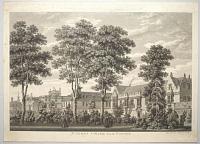
St John's College from the Garden.
M.A. Rooker., del & sculp.
[c.1787.]
Engraving, fine impression. Sheet 345 x 485mm (13½ x 19"). Trimmed to plate on three sides.
Drawn and engraved by Michael Angelo Rooker for the Oxford Almanack.
[Ref: 53453] £260.00
(£312.00 incl.VAT)
![[St John's College, Oxford.] [No.49.]](img-thumbnail/jpegs/27593.jpg)
[St John's College, Oxford.] [No.49.]
Arthur Spencer [pencil signature.]
[n.d. c.1925.]
Etching. Plate 202 x 140mm. 8 x 5½". Mint.
A view of the entrance to the Great Lawn and Groves at the Canterbury Quad at St John's College, Oxford. The quad was the first example of Italian Renaissance architecture in Oxford.
[Ref: 27593] £70.00
(£84.00 incl.VAT)
![[St Mary the Virgin, Oxford.] [No.52]](img-thumbnail/jpegs/27690.jpg)
[St Mary the Virgin, Oxford.] [No.52]
Arthur Spencer [pencil signature.]
[n.d. c.1920.]
Etching. Plate 198 x 140mm. 7¾ x 5½".
The University Church of St Mary the Virgin, Oxford. The south porch, seen here, was built in 1637 and designed by Nicholas Stone, master mason to Charles I. It is a highly eccentric baroque porch with spiral columns supporting a curly pediment framing a small niche with a statue of the Virgin and Child, underneath a gothic fan vault.
[Ref: 27690] £35.00
(£42.00 incl.VAT)
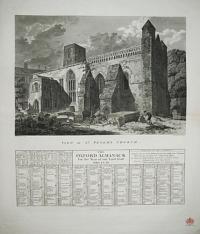
View of St Peter's Church, The Oxford Almanack For the Year of our Lord God MDCCCIX [1809].
Drawn by Thyne O'Niell. Engraved by James Basire.
Published by J. Cooke, Oxford & E. Gardner No 7 Paternoster Row, London. Price Three Shillings and Six Pence.
Engraving. 565 x 485mm (22¼ x 19"), with very large margins, stamp duty ink stamp lower right margin. Uncut. Horizontal fold, wear to the edges.
The Oxford Almanack has been published annually since 1674. The stamp duty was payable to the compiler of the almanac, set at one shilling per year.
[Ref: 51433] £150.00
(£180.00 incl.VAT)

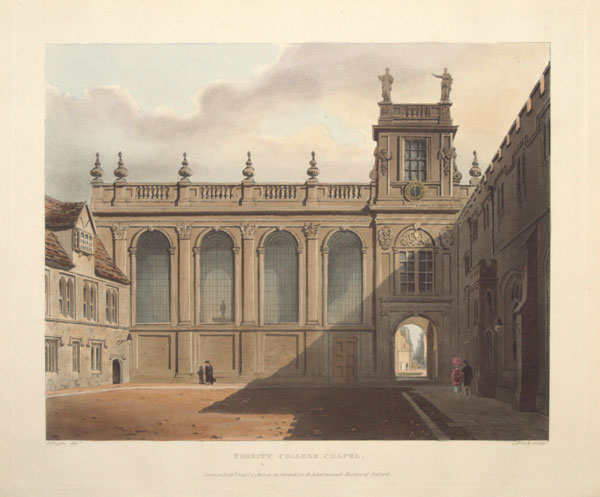
Trinity College Chapel.
A. Pugin del.t. J. Bluck sculp.t.
London Pub.d Sept.r 1 1813 at 101 Strand for R. Ackermann's History of Oxford.
Coloured aquatint. 250 x 300mm (9¾ x 11¾"), with large margins.
The exterior of the chapel from the quad.
[Ref: 62964] £160.00
(£192.00 incl.VAT)
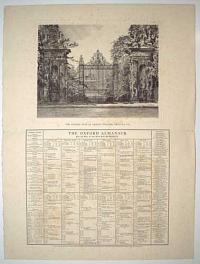
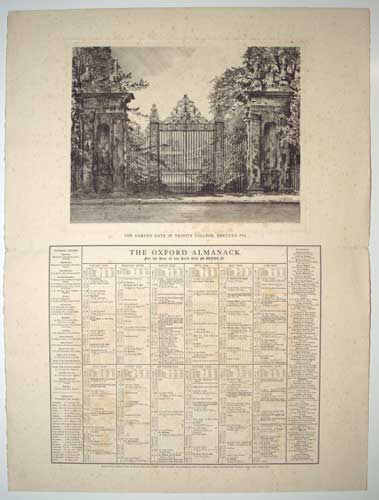
The Garden Gate of Trinity College, Erected 1713. The Oxford Almanack for the Year of our Lord God M.DCCCC.II. [1902]
[William] Monk 1901.
Printed at the Clarendon Press, by Horace Hart, M.A., Printer to the University; - and published by Henry Frowde, M.A., Oxford University Press Warehouse, Amen Corner, London, E.C.
Etching set in letterpress, sheet 760 x 560mm (30 x 22"). Central fold, spotting.
A view of the ornamental gates of the college, with an almanack and a list of the University staff.
[Ref: 57380] £95.00
(£114.00 incl.VAT)
![[The Garden Gate of Trinity College, Erected 1713.]](img-thumbnail/jpegs/57381.jpg)
[The Garden Gate of Trinity College, Erected 1713.]
[William] Monk 1901.
Etching proof 300 x 380mm (11¾ x 15"), large margins.
A view of the ornamental gates of the college, also published as 'The Oxford Almanack for the Year of our Lord God M.DCCCC.II.'
[Ref: 57381] £160.00
(£192.00 incl.VAT)
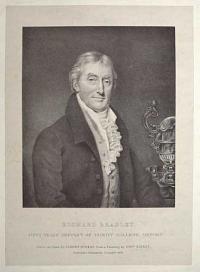
Richard Bradley. Fifty Years Servant of Trinity College, Oxford.
Drawn on Stone by Albert Hoffay, from a Painting by Tho.s Kirkby.
Printed by C. Hullmandel, December 1826.
Lithograph on chine collé. 250 x 185mm (9¾ x 7¼") very large margins.
Half-length portrait of Richard Bradley wearing open coat, waistcoat and cravat. According to Blakiston's 'Trinity College' (1898) the original painting was hanging in the Common Room stores.
[Ref: 59364] £130.00
(£156.00 incl.VAT)
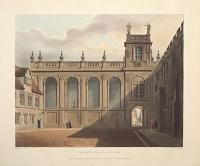
Trinity College Chapel.
A. Pugin del.t. J. Bluck sculp.t.
London Pub.d Sept.r 1 1813 at 101 Strand for R. Ackermann's History of Oxford.
Coloured aquatint. 250 x 300mm (9¾ x 11¾"), with wide margins.
The exterior of the chapel from the quad.
[Ref: 53441] £190.00
(£228.00 incl.VAT)

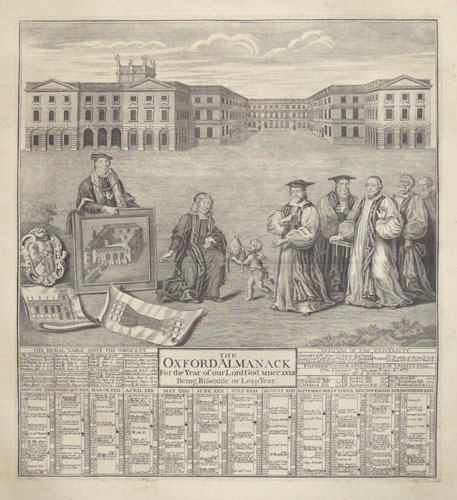
The Oxford Almanack for the Year of the our Lord God MDCCXXXII. Being Bissextile or Leap Year.
[G. Vertue Sculp.]
[n.d. c.1732.]
Etching and engraving. Plate 495 x 458mm (19½ x 18"). Tax stamp top left corner. Staining; creasing.
Trinity College, shown in the background with figures in the foreground, including the founder Sr Thomas Pope, holding a view of the college to left, Dr Bathurst in the centre, refusing the mitre which is offered by a cherub, with a view of a neo-classical façade and another showing the central section of the building shown, on the ground nearby and other figures to right, including Adams, Bishop of Limerick and Wright, Bishop of Litchfield, fellows of the college. The Oxford Almanack is an annual almanac published since 1674. The stamp duty was payable to the compiler of the almanac, set at 1 shilling and threepence per year covered by Act of Parliament 55 Geo. III c. 185. The same act set the penalty for issuing an unstamped almanac as three months' imprisonment.
[Ref: 52471] £320.00
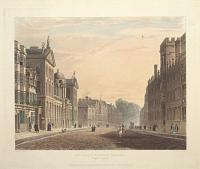
University & Queen's Colleges, High Street.
Pugin del.t. J. Hill sculp.t.
London Pub.d June 1 1813 at 101 Strand for R. Ackermann's History of Oxford.
Coloured aquatint. 250 x 300mm (9¾ x 11¾"), with wide margins.
A view looking east along Oxford's High Street.
[Ref: 53444] £240.00
(£288.00 incl.VAT)

The New Library University College, Oxford.
Drawn & Engraved by J. H. Le Keux.
[n.d., c.1861.]
Etching. Plate: 410 x 330mm (16 x 13"), with very large margins. Title area bit messy.
A view of George Gilbert Scott's library in University College, Oxford constructed between 1858 and 1861.
[Ref: 40629] £230.00
(£276.00 incl.VAT)
![[The Oxford Almanack for 1743, showing Lincoln College]](jpegs/43931.jpg)
![[Magdalen College and Bridge, Oxford.] [No.47.]](jpegs/62260.jpg)
![[Magdalen Tower and Bridge, &c.]](jpegs/62280.jpg)

![[Magdalen College from the Quadrangle, Oxford.] [No.48.]](jpegs/62259.jpg)

![[Magdalen College] Aula B. Mariæ Magdalenæ.](jpegs/41588.jpg)

![[Merton College] The Oxford Almanack For the Year of Our Lord God MDCCXXXVII.](jpegs/43929.jpg)
![[Oxford Movement] The Anglican Hen and Her Pusey Duckings.](jpegs/63964.jpg)
![[Oxford Movement] Ecclesiastical Smugglers.](jpegs/63962.jpg)
![[Oxford Movement] M.r Worldly Wseman Directing Pilgrims to the Town of Infallibility!](jpegs/63963.jpg)
![[New College Chapel.]](jpegs/53462.jpg)
![[New College, Oxford, rear view.]](jpegs/57376.jpg)
![[New College, Oxford.] [No.51.]](jpegs/27594.jpg)
![[New College, Oxford] Collegium Novum.](jpegs/65158.jpg)
![[The Oxford Almanack for 1750, showing New Inn Hall]](jpegs/43932.jpg)

![[Oriel College.] [No.50]](jpegs/62258.jpg)


![A View of the Physic Gardens in the University of Oxford. [parallel text in French]](jpegs/38537.jpg)
![[The entrance gate to Queen's College from the High Street.]](jpegs/57382.jpg)



![[St Marylebone New Road Portland Place] [ms.]](jpegs/32298.jpg)
![[St Giles, Oxford] Hanc Ecclesiæ D. Aegidii in Suburbiis Civ. Oxon.](jpegs/42013.jpg)


![[St John's College, Oxford.] [No.49.]](jpegs/27593.jpg)
![[St Mary the Virgin, Oxford.] [No.52]](jpegs/27690.jpg)


![[The Garden Gate of Trinity College, Erected 1713.]](jpegs/57381.jpg)