Sir Charles Oakeley, Bar.t, Governor of Madras 1790 - 1794.
Painted in 1816 by T. Barber. Engraved by S.W. Reynolds.
[c.1820.]
Mezzotint. 345 x 260mm (13½ x 10¼"), with large margins. Presentation copy inscribed 'A Present from Sir Charles & obtained by the kindness of the Rev.d W.m Gorsuch Rowland. 1820.' in lower margin.
Sir Charles Oakeley (1751-1826), first Baronet, appointed governor of Madras in 1790. After Thomas Barber (c.1790 - 1843), pupil of Sir Thomas Lawrence. William Gorsuch Rowland (1770-1851) was Methodist minister at St. Mary’s, Shrewsbury from 1828 until his death. Whitman: 219.
[Ref: 66083] £320.00

Sir Charles Oakeley, Bar.t, Governor of Madras 1790 - 1794.
Painted in 1816 by T. Barber. Engraved by S.W. Reynolds.
[c.1820.]
Mezzotint. 345 x 260mm (13½ x 10¼"). Small margins.
Sir Charles Oakeley (1751-1826), first Baronet, appointed governor of Madras in 1790. After Thomas Barber (1768/71 - 1843), pupil of Sir Thomas Lawrence. Whitman: 219.
[Ref: 58105] £260.00
(£312.00 incl.VAT)
![[The Oasis at Daybreak.]](img-thumbnail/jpegs/28871.jpg)
[The Oasis at Daybreak.]
E.J. Detmold [signed in pencil.]
[n.d. c.1900.]
Drypoint with pencil signature, with large margins. Plate 182 x 395mm (7¼ x 15½"). Slight ink loss top left; paper tone.
Two figures and laden camels with coconut palms beyond, by Edward Julius Detmold (1883-1957), twin brother to Charles Maurice Detmold (1883-1908). The pair were among the artists associated with the Golden Age of Illustration. They worked together making sketches at the Zoological Gardens and exhibited together from the age of fourteen. He became one of the best Edwardian animal illustrators, known for his subtle placement of animals within their natural environment. Edward expressed artistic versatility and published a number of books of fine fantasy drawings in the 1920s; they portrayed a vivid imagination and he utilised warm colouring, which suited the period. The Jungle Book (1908) was to be the last substantial commission that the brothers worked on - due to the death of Charles in that same year. The extraordinary success of their illustrations to accompany Kipling's classic tale, however, firmly established the reputation for Edward and the following year, a suite of illustrations prepared to Aesop's tales were published in The Fables of Aesop (1909).
[Ref: 28871] £220.00
(£264.00 incl.VAT)
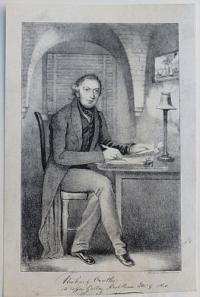
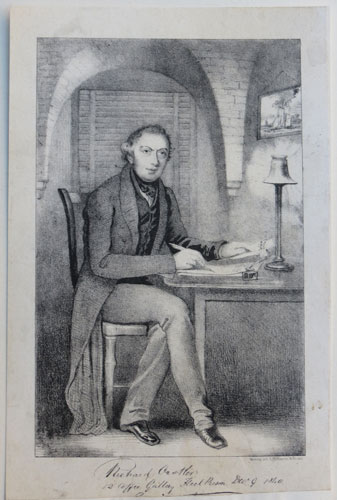
Richard Oastler, 12 Coffee Gallery, Fleet Prison Dec. 9 1840
Madeley lith. 5 Wellington St. Strand
Lithograph, rare, sheet 230 x 150mm (9 x 6"). Trimmed. Bit messy.
Richard Oastler (1789 - 1861), factory reformer. Oastler was famously 'awakened' in 1830 to the cruelties routinely practiced in English textile mills, and throughout the 1830s was an infuential advocate of factory reform, his oratorical skills earned him the sobriquet 'The factory king'. His paternalistic view of society meant that Oastler, the quintessential Tory radical, abhorred the idea of strikes, trade unions and universal suffrage. Eventually, in 1838, Thomas Thornhill, the squire of Fixby who employed Oastler as a steward on his estate, turned against Oastler, dismissing him and initiating legal proceedings against him. Unable to repay debts to Thornhill which he had accumulated, Oastler was committed to the Fleet prison for three and a half years (the date on this print is the date his sentence began). As this portrait suggests, Oastler kept busy in prison editing a weekly newspaper, and continued to edit a magazine after his release, but these had little influence. It was not as a writer but as a presence and speaker that Oastler was most influential.
[Ref: 41659] £140.00
(£168.00 incl.VAT)
![Richard Oastler [signature facsimile.]](img-thumbnail/jpegs/7998.jpg)
Richard Oastler [signature facsimile.]
Painted By B. Garside. Engraved By J. Posselwhite.
[n.d., c.1841.]
Stipple and line engraving. 430 x 330mm (17 x 13").
Richard Oastler (1789 - 1861), reformer. 'The factory king', Oastler was a Tory radical who turned factory reform into a compelling national issue. His paternalistic view of society meant that he abhorred the idea of universal suffrage. However, he was a hero without parallel within northern radicalism and his inclusion symbolically incorporated him into the Chartist movement. NP: 7845.
[Ref: 7998] £330.00
![Richard Oastler [facsimile signature].](img-thumbnail/jpegs/8478.jpg)
Richard Oastler [facsimile signature]. London Dispatch Office Catherine Street Strand.
[n.d. c.1840]
Stipple engraving. 223 x 146mm. 8¾" x 5¾".
Richard Oastler (20 December 1789 - 22 August 1861) was an English labour reformer and abolitionist. He fought for the rights of working children in the Factory Act of 1847, and was also a prominent leader of the Factory reform and anti-Poor Law movement.
[Ref: 8478] £90.00
(£108.00 incl.VAT)
![Richard Oastler [signature facsimile.]](img-thumbnail/jpegs/61551.jpg)
Richard Oastler [signature facsimile.]
Painted By B. Garside. Engraved By J. Posselwhite.
[n.d., 1840.]
Stipple and line engraving. Sheet 430 x 285mm (17 x 11¼"). Trimmed within plate, surface scuffing.
A seated portrait of Richard Oastler (1789-1861), with two books, 'White Slavery' and 'Marcus'. Ostler was Tory Radical known as 'The factory king' for his attempts to limit the factory working day to ten hours, writing a letter to the Leeds Mercury in 1830 titled ‘Yorkshire Slavery'. He was also an abolitionist, but opposed Catholic Emancipation and Parliamentary Reform. Commissioned by Irish Chartist Feargus O’Connor (1796-1855), this engraving was distributed with copies of the Northern Star, 12 December 1840. See Ref: 7998.
[Ref: 61551] £180.00
(£216.00 incl.VAT)
![[Titus Oates [?]] [16 top right]](img-thumbnail/jpegs/32746.jpg)
[Titus Oates [?]] [16 top right]
T Worlidge Fecit 1751.
Etching, 130 x 100mm (5 x 4"). Fine impression; small margins; top right missing.
Portrait supposedly representing Titus Oates, best known as an informer against Catholics, although quite different to other portraits of him. Oates was expelled from the navy for homosexual practices and the DNB notes that 'early writers were repelled as much by his homosexuality as by his personality'. Etched by Thomas Worlidge (1700-66), the 'English Rembrandt' and a pupil of Alessandro Maria Grimaldi, whose daughter Arabella he married. Lifetime impression. State ii/iv; W16; D176; Not in O'D or NPG under Oates
[Ref: 32746] £80.00
(£96.00 incl.VAT)
![[Titus Oates [?]] [16 top right & left]](img-thumbnail/jpegs/32747.jpg)
[Titus Oates [?]] [16 top right & left]
T Worlidge Fecit 1751.
Etching, 125 x 100mm (5 x 4"). Trimmed on platemark.
Portrait supposedly representing Titus Oates, best known as an informer against Catholics, although quite different to other portraits of him. Oates was expelled from the navy for homosexual practices and the DNB notes that 'early writers were repelled as much by his homosexuality as by his personality'. Etched by Thomas Worlidge (1700-66), the 'English Rembrandt' and a pupil of Alessandro Maria Grimaldi, whose daughter Arabella he married. Lifetime impression. State iii/iv; W16; D176; Not in O'D or NPG under Oates
[Ref: 32747] £80.00
(£96.00 incl.VAT)
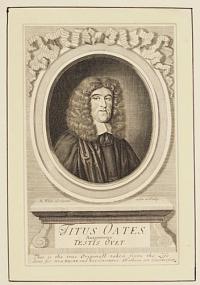
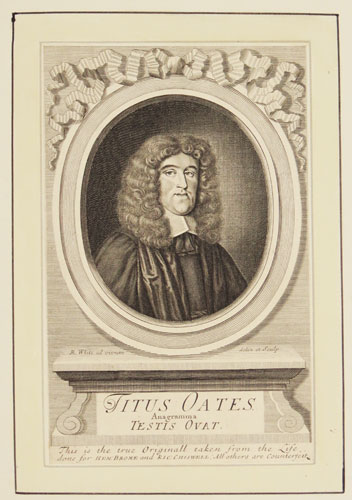
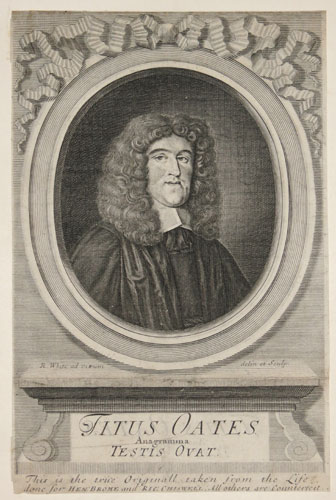
Titus Oates Anagramma Testis Ovat. This is the true Originall taken from the Life done for Hen: Brome and Ric: Chiswell: All others are Counterfeit.
R. White ad vivum delin et sculp.
[n.d., c.1679.]
Engraving. Sheet size: 240 x 150mm (9½ x 6"). Trimmed to image. Glued to album sheet at corners.
A portrait of English perjurer Titus Oates (1649 - 1705), half length in an oval frame on a pedestal, wearing wig, bands, and robe. This portrait is from a broadside entitled 'A poem upon Mt Tytus Oates, the first discoverer of the late Popish Plot', published by Henry Brome and Richard Chiswell (1679). Oates was said to have fabricated the "Popish Plot", a supposed Catholic conspiracy to kill King Charles II.
[Ref: 33846] £140.00
(£168.00 incl.VAT)

Titus Oates D.D. the first discoverer of the Plott.
[?David Loggan]
[n.d. c.1680.]
Engraving, sheet 225 x 140mm (8¾ x 5½"). Trimmed and glued to backing sheet at edges.
Titus Oates (1649-1705), perjurer who fabricated the 'Popish Plot', a supposed Catholic conspiracy to kill King Charles II and incite an insurrection. He began his career as an Anglican priest, but converted to Catholicism in 1677. This secured his admission to Jesuit college at St Omer, and this gave plausibility to his story about a Catholic plot. Oates swore his testimony to Sir Edmund Berry Godfrey in September 1678, and it was Godfrey's murder a few weeks later (a death that has never been explained) that overnight turned the plot in the public mind from allegation to certainty. Oates managed to retain a central role in the unfolding affair by continually inventing new accusations. In 1684, in the flood of the Tory reaction, he was prosecuted for perjury, and in 1685 sentenced to the pillory and public flogging. The Glorious Revolution saved him; he was pardoned, given a pension and married a wealthy widow. For similar image in reverse see ref. 25272.
[Ref: 42609] £190.00
(£228.00 incl.VAT)
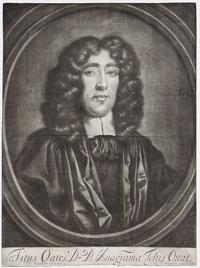
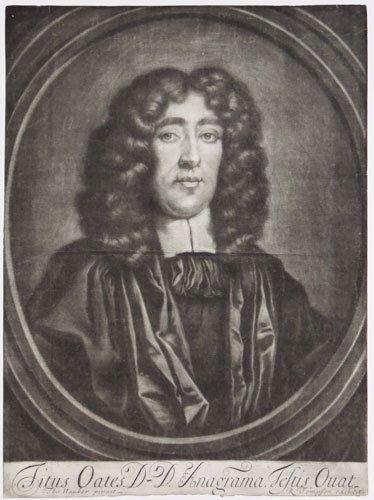
Titus Oates. D.D. Anagrama Tetis Ouat.
Tho: Hauker pinxit. R. Tompson excudit.
[n.d., c.1680.]
Mezzotint. Sheet: 345 x 255mm (13½ x 10"). Trimmed within plate, creased.
A portrait of Titus Oates in an oval. Titus Oates (1649-1705) was an English perjurer who fabricated the 'Popish Plot', a supposed Catholic conspiracy to kill King Charles II. He began his career as an Anglican priest, but converted to Catholicism in 1677. This secured his admission to Jesuit college at St Omer, and this gave him enough information to give his story about a Catholic plot to murder Charles some plausibility. Oates swore his testimony to Sir Edmund Berry Godfrey in September 1678, and it was Godfrey's murder a few weeks later (a death that has never been explained) that overnight turned the plot in the public mind from allegation to certainty. Oates managed to retain a central role in the unfolding affair by continually inventing new accusations. In 1684, in the flood of the Tory reaction, he was prosecuted for perjury, and in 1685 sentenced to the pillory and public flogging. The Glorious Revolution saved him; he was pardoned, given a pension and married a wealthy widow. CS: 32
[Ref: 43041] £230.00
(£276.00 incl.VAT)
![[Titus Oates [?]]](img-thumbnail/jpegs/32745.jpg)
[Titus Oates [?]]
T Worlidge Fecit 1751
Etching, 125 x 100mm (5 x 4"). Fine impression; trimmed inside platemark.
Portrait supposedly representing Titus Oates, best known as an informer against Catholics, although quite different to other portraits of him. Oates was expelled from the navy for homosexual practices and the DNB notes that 'early writers were repelled as much by his homosexuality as by his personality'. Etched by Thomas Worlidge (1700-66), the 'English Rembrandt' and a pupil of Alessandro Maria Grimaldi, whose daughter Arabella he married. Lifetime impression. State i/iv; W16; D176; Not in O'D or NPG under Oates
[Ref: 32745] £220.00
(£264.00 incl.VAT)
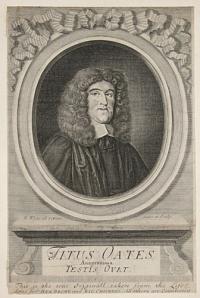
Titus Oates. Anagramma Testis Ovat.
This is the true Original taken from the Life. done for Hen: Brome and Ric: Chiswell [therefore] All others are Counterfeit. [n.d. c.1679.]
Engraving, printed on both sides. 235 x 157mm. 9¼ x 6¼". Trimmed, crease, damaged.
Curiousity. Portrait of Titus Oates, half length in an oval frame on a pedestal, wearing wig, bands, and robe. From a broadside entitled 'A poem upon Mt Tytus Oates, the first discoverer of the late Popish Plot', published by Henry Brome and Richard Chiswell (1679). Titus Oates (1649-1705) was an English perjurer who fabricated the 'Popish Plot', a supposed Catholic conspiracy to kill King Charles II. He began his career as an Anglican priest, but converted to Catholicism in 1677. This secured his admission to Jesuit college at St Omer, and this gave him enough information to give his story about a Catholic plot to murder Charles some plausibility. Oates swore his testimony to Sir Edmund Berry Godfrey in September 1678, and it was Godfrey's murder a few weeks later (a death that has never been explained) that overnight turned the plot in the public mind from allegation to certainty. Oates managed to retain a central role in the unfolding affair by continually inventing new accusations. In 1684, in the flood of the Tory reaction, he was prosecuted for perjury, and in 1685 sentenced to the pillory and public flogging. The Glorious Revolution saved him; he was pardoned, given a pension and married a wealthy widow. Ex Collection: R. Hobson of Hove.
[Ref: 25273] £160.00
(£192.00 incl.VAT)

Titus Oates D.D. the first discoverer of the Plott.
[Loggan is tentatively suggested as engraver by O'Donoghue.]
[n.d. c.1680.]
Engraving. 247 x 159mm. 9¾ x 6¼". Paper watermarked.
Portrait of Titus Oates, half length in an oval frame on a pedestal, wearing wig, bands, and robe. Titus Oates (1649-1705) was an English perjurer who fabricated the 'Popish Plot', a supposed Catholic conspiracy to kill King Charles II. He began his career as an Anglican priest, but converted to Catholicism in 1677. This secured his admission to Jesuit college at St Omer, and this gave him enough information to give his story about a Catholic plot to murder Charles some plausibility. Oates swore his testimony to Sir Edmund Berry Godfrey in September 1678, and it was Godfrey's murder a few weeks later (a death that has never been explained) that overnight turned the plot in the public mind from allegation to certainty. Oates managed to retain a central role in the unfolding affair by continually inventing new accusations. In 1684, in the flood of the Tory reaction, he was prosecuted for perjury, and in 1685 sentenced to the pillory and public flogging. The Glorious Revolution saved him; he was pardoned, given a pension and married a wealthy widow. Ex Collection: R. Hobson of Hove.
[Ref: 25272] £120.00
(£144.00 incl.VAT)
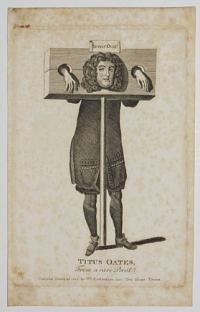
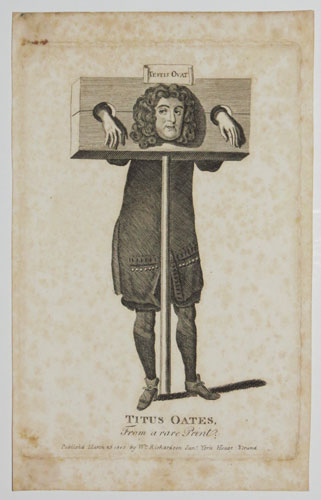
Titus Oates, from a rare Print.
Publishd March 25 1810 by W.m Richardson Jun.r York House Strand.
Engraving. Plate: 205 x 135mm (8 x 5¼''). Foxing. Small margins.
A portrait of a man in pillory. Titus Oates (1649-1705) was an English perjurer who fabricated the 'Popish Plot', a supposed Catholic conspiracy to kill King Charles II. He began his career as an Anglican priest, but converted to Catholicism in 1677. This secured his admission to Jesuit college at St Omer, and this gave him enough information to give his story about a Catholic plot to murder Charles some plausibility. Oates swore his testimony to Sir Edmund Berry Godfrey in September 1678, and it was Godfrey's murder a few weeks later (a death that has never been explained) that overnight turned the plot in the public mind from allegation to certainty. Oates managed to retain a central role in the unfolding affair by continually inventing new accusations. In 1684, in the flood of the Tory reaction, he was prosecuted for perjury, and in 1685 sentenced to the pillory and public flogging. The Glorious Revolution saved him; he was pardoned, given a pension and married a wealthy widow.
[Ref: 49031] £45.00
(£54.00 incl.VAT)

Titus Oates.
[Engraved c.1680, this impression later.]
Mezzotint. Sheet 140 x 85mm (5½ x 3¼") Trimmed to plate, mounted in album paper.
A portrait Titus Oates (1649-1705), wearing square cap, coat and holding gloves. Oates fabricated the 'Popish Plot', a supposed Catholic conspiracy to kill King Charles II. See BM for proof impression. 1902,1011.6905.
[Ref: 62412] £130.00
(£156.00 incl.VAT)

Titus Oates. D.D. Anagrama Tetis Ouat.
Tho: Hauker pinxit. R. Tompson excudit.
[n.d., c.1680.]
Mezzotint, 345 x 255mm (13½ x 10"). Thread margins. Margins reinforced. Creasing in top. Foxing in title area.
A portrait of Titus Oates in an oval. Titus Oates (1649-1705) was an English perjurer who fabricated the 'Popish Plot', a supposed Catholic conspiracy to kill King Charles II. He began his career as an Anglican priest, but converted to Catholicism in 1677. This secured his admission to Jesuit college at St Omer, and this gave him enough information to give his story about a Catholic plot to murder Charles some plausibility. Oates swore his testimony to Sir Edmund Berry Godfrey in September 1678, and it was Godfrey's murder a few weeks later (a death that has never been explained) that overnight turned the plot in the public mind from allegation to certainty. Oates managed to retain a central role in the unfolding affair by continually inventing new accusations. In 1684, in the flood of the Tory reaction, he was prosecuted for perjury, and in 1685 sentenced to the pillory and public flogging. The Glorious Revolution saved him; he was pardoned, given a pension and married a wealthy widow. CS32. Blackett-Ord T56. Ex: Collection of The Hon. Christopher Lennox-Boyd.
[Ref: 65081] £280.00
(£336.00 incl.VAT)
![[Oatlands] A Plan of the Garden & House of the R.t Honourable y.e Earl of Lincoln at Weybridge in the County of Surry.](img-thumbnail/jpegs/55116.jpg)
[Oatlands] A Plan of the Garden & House of the R.t Honourable y.e Earl of Lincoln at Weybridge in the County of Surry. Part of the Park.
Survey'd and Engrav'd by B. Rocque. 1737.
Publish'd According to the Act of Parliament 1737.
Line engraving. 465 x 640mm (18¼ x 25¼"), with 18th century watermark Trimmed. Centre fold crease. Light stain in bottom left corner. Crease in bottom right corner.
A plan of the house and gardens of the Earl of Lincoln (1720-1794), with a view of the front of the house. Included is a scale of 330 feet and a key. The estate, formerly a royal palace, situated in the non civil parish of Oatlands, passed to Henry Clinton, the seventh Earl of Lincoln, 1716. From ''Vitruvius Brittanicus, Volume the Fourth. Being A Collection of Plans, Elevations, and Perspective Views, of` the Royal Palaces, Noblemen, and Gentlemens Seats, In Great Britain, Not Exhibited in any Collection of this nature hitherto published. Design'd By J. Badeslade and J. Rocque, &c. And Engraven by the Best Hands.
[Ref: 55116] £650.00

Oban.
A. Maclure Del. Maclure & MacDonald Lith.
[n.d., 1850.]
Tinted lithograph. Sheet 135 x 220mm (5¼ x 8¾").
A view of the harbour at Oban. Probably from one of 'Maclure & Macdonald's Illustrated Guides' of the Highlands and Islands, published for tourists. Not in Abbey.
[Ref: 66727] £70.00
(£84.00 incl.VAT)

Sketch of the Obelisk, Proposed by Mr. Railton, to the Memory of, the Late Admiral Sir Harry Neale, Bart. 1840.
Day & Haghe Lithrs. to the Queen. [c.1840.]
Lithograph on india paper laid to publisher's sheet with printed title; with letterpress explanation sheet, scarce. Folio, 385 x 235mm, 15¼ x 9¼". Slightly soiled; some nicks to extremities; generally good.
Architect William Railton's (d. 1877) design for a memorial obelisk to Sir Harry Burrard Neale, 2nd Bt (1765 - 1840), naval officer and politician. The text sheet explains that the model is the Great Obelisk at Thebes, Egypt, which he visited in 1824 - 25, and gives general dimensions. Railton's best known work is the Nelson memorial in Trafalgar Square, London (referred to in the text), his design for which was accepted after two competitions in 1839, and carried out in spite of strong opposition; the column itself was completed in 1843. A handsome obelisk was indeed erected to Neale's memory on Mount Pleasant, opposite the town of Lymington, Hampshire, of which he was lord of the manor, and which he had represented in parliament for forty years.
[Ref: 16972] £190.00
(£228.00 incl.VAT)
view all images for this item
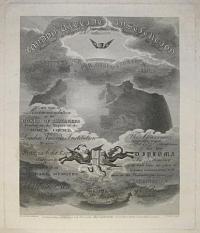
London Vaccine Institution. Founded under the Mayoralty of Sir James Shaw, Baronet, M.P. Vice President. On The Recommendation of the Board Of Managers Founded on the Report of the Medical Council the London Vaccine Institution Receives Francis Cole Esqr. Surgeon &c. into the Number of its Honorary Members London 28th June 1822....[etc.]
Jas. Geo. Oben delineavit J. Dadley sculpsit.
Corresponding Actuary & Sub-Treasurer Andw. Johnstone, No. 52, Burr Street, Tower Hill, London.
Diploma of membership, signed and dated and completed in ink, etching and engraving, 376 x 324mm. Light spotting, mostly outside image.
The London Vaccine Institution was founded in 1806 by members of the Royal Jennerian Society, which was established in 1803 following Edward Jenner’s (1749-1823) successful experiments in the 1790s, to give vaccinations on a wide scale. Vaccination is the procedure of introducing dead or inactivated disease-causing microorganisms into the body in order to promote the production of antibodies in the body, providing immunity against the disease. The first successful vaccination was carried out by Jenner in 1798, against smallpox. A highly decorative diploma by James George Oben (1779 - 1819), a strong impression on paper watermarked 'J. Whatman 1819'. For a similar diploma for 1833 see BM: 1868,1212.652.
[Ref: 7944] £180.00
(£216.00 incl.VAT)

Vallée d'Oberhasli.
a Basle chez Birmann & Fils.
Very fine aquatint with hand colour. 250 x 320mm, 9¾ x 12½", on paper watermarked 'J.Whatman'.
View of the Hasli Valley with Swiss women with their chalets, and the High Alps behind.
[Ref: 25234] £480.00
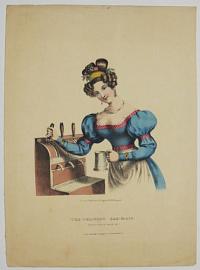
The Obliging Bar-Maid. Do you like it mild Sir?
London Published by Tregear, 123 Cheapside. Dean & Munday, Lithographers Threadneedle St. [n.d., c.1830.]
Hand-coloured lithograph. Sheet: 370 x 270mm (14½ x 10½''), with large margins. Mint.
A portrait of a young, pretty bar maid.
[Ref: 51070] £260.00
(£312.00 incl.VAT)
![[Music Lesson]](img-thumbnail/jpegs/36713.jpg)
[Music Lesson]
[n.d., c.1830.]
Tinted lithograph with large margins. Sheet: 330 x 495, (13 x 19¼). Cut and laid on sheet as issued. Some faint foxing.
An interior scene in which a seated man plays an oboe while another leans over and corrects his playing, a music book lies open between them.
[Ref: 36713] £140.00
(£168.00 incl.VAT)

Fig. 1. Observatoire portatif. Fig. 2. Maniere d'établier une Horloge Astronomique à terre.
Benard Direx.
[Paris, c.1780.]
Engraving, 18th century watermark. 280 x 400mm (11 x 15¾"). Binding folds, slight ink offset, stains.
An illustration of the portable observatory used by astronomers William Wales and William Bayly on James Cook's Second Voyage (1772-5), on which their objective was to test how effective Larcum Kendall's K1 chronometer was in measuring longitude at sea. This observatory would have been erected to compare results. Engraved by Jacques-François Benard for a French edition of Wales & Bayley's rare 'The Original Astronomical Observations, made in the course of a Voyage towards the South Pole, and Round the World, in His Majesty's Ships the Resolution and Adventure'.
[Ref: 61059] £130.00
(£156.00 incl.VAT)
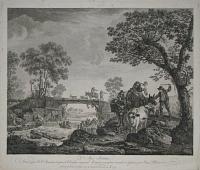
L'Ane obstiné.
Gravé par F.S. Ravenet d'aprés le Dessin original de même grandeur inventé et dessiné par Jean Pillement.
London publish'd according to act of Parliament December 26th 1759.
Engraving. 430 x 505mm, 17 x 20". Creased just inside platemark.
The obstinant ass.
[Ref: 11601] £480.00

Bataille D'Ocana, Livrée le 19 Novembre 1809.
Roéhn del. Couche fils aqua forti. Pigeot sculp.t.
[n.d., c.1840.]
Hand coloured engraving. Sheet size: 305 x 465mm (12 x 18¼"). Trimmed inside plate at top and bottom.
During the War of Independence, the battle of Ocaña, currently in the province of Toledo, Spain, was fought on 19 November 1809 and resulted in a French victory under the command of Marshal Soult against the Spanish General Juan Carlos de Aréizaga. It was the biggest defeat of the Spanish army, who lost nearly 19,000 men despite being superior in number to their French counterparts, and reinforced the Spanish throne of Joseph Bonaparte (1768 - 1844), the elder brother of Napoleon Bonaparte who had declared him King of Spain a year prior to the battle. In this scene, French troops attack the Spanish, who can be seen fleeing great numbers in the distance to the left.
[Ref: 36160] £130.00
(£156.00 incl.VAT)
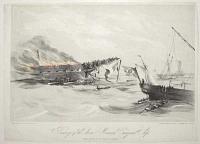
Burning of the Ocean Monarch, Emigrant Ship.
From a Sketch by the Prince de Joinville. Lithographed by A. Miller, 4 Harrington St, L'pool.
Published by W. Ellis, 21, Castle St.
Rare tinted lithograph. Sheet 285 x 400mm (11¼ x 15¾"). A little creasing.
Ocean Monarch, an American emigration barque built by Donald McKay in East Boston in 1847, left Liverpool for Boston on the morning of 24 August 1848. Just outside harbour the ship caught fire, driving the passengers to the ship's bowsprit, from which many jumped into the sea. 178 lives were recorded lost. The scene was sketched by François d'Orléans, Prince of Joinville (1818-1900) was the third son of Louis Philippe, King of the French. Leaving France in the aftermath of the 1848 Revolution, he was aboard the Brazilian frigate 'Affonso' (seen here flying the Brazilian flag).
[Ref: 56511] £280.00
(£336.00 incl.VAT)

Ocean Penny Postage. ''Uncle John! Please send my letter to Cousin Jane in America for a Penny.''
[n.d., c.1850.]
Rare steel engraving. 190 x 270mm (7½ x 10¾"). Trimmed close to plate.
Children clamber over a maritime John Bull. Elihu Burritt (1810-79), an American diplomat, suggested Britain should extend the new Penny Post and slash the cost of sending letters abroad from a shilling to threepence to promote trade and brotherhood. This satire ridicules the idea.
[Ref: 51171] £230.00
(£276.00 incl.VAT)
![[Oceania] Flicka Fran Foa.](img-thumbnail/jpegs/11395.jpg)
[Oceania] Flicka Fran Foa. (Tonga oarne)
C.S. del. Lith. Jnst. Arnz & Co. Dusseldorf.
[n.d., c.1860s.]
Chromolithograph, sheet 225 x 140mm. 8¾ x 5½". Some spotting.
A woman of Tonga in the South Pacific Ocean. Plate to a book published in Dusseldorf, Germany, by lithographic printers Lithographisches Institut von Arnz & Co.
[Ref: 11395] £70.00
(£84.00 incl.VAT)
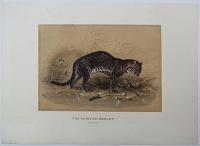
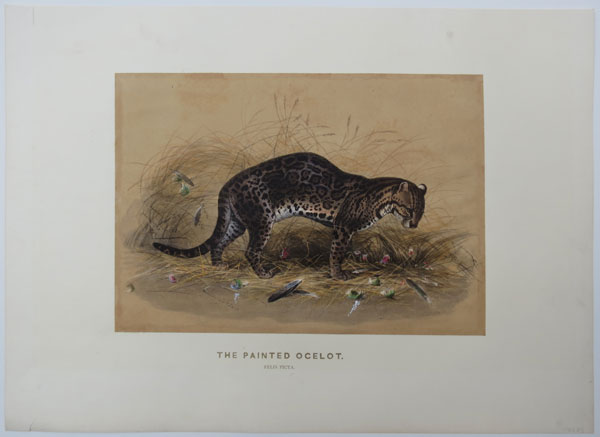
The Painted Ocelot. Felis Picta.
[Lithographed by Joseph Smit after Joseph Wolf.]
[London: Henry Graves & Company, 1861-1867.]
Coloured lithograph, trimmed to image and mounted on card with gilt title, as issued. Printed area 250 x 350mm (9¾ x 13¾").
An illustration of sub-species of ocelot, a wild cat native to South America. From 'Zoological Sketches by Joseph Wolf. Made for the Zoological Society of London, from animals in their vivarium, in the Regent's Park', issued in two parts, 1861 and 1867. Joseph Wolf (1820-99), a German artist, specialized in natural history illustration, and is considered one of the great pioneers of wildlife art, having depicted animals accurately in lifelike postures. He worked with John Gould on 'The Birds of Great Britain'. Sir Edwin Landseer considered him 'without exception, the best all-round animal artist who ever lived'.
[Ref: 45773] £240.00
(£288.00 incl.VAT)
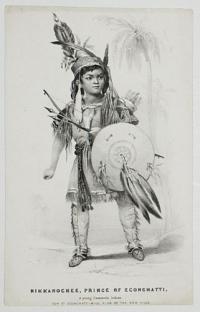
Nikkanochee, Prince of Econchatti, A young Seminole Indian,
[Day & Haghe, Lithrs,, to the Queen.]
[Published by Hatchard & Son, Piccadilly.] [London, 1841]
Rare lithograph. Sheet 190 x 120mm (7½ x 4¾"). Trimmed, losing inscriptions
A portrait of a young Amerinds boy with bow and shield, after a portrait by George Catlin. According to the text he was an orphan, presumably because of the Second Seminole War (1835-42). The frontispiece portrait of 'A Narrative of the Early Days and Remembrances of Oceola Nikkanochee, Prince of Econchatti, a young Seminole Indian; son of Econchatti-Mico, king of the Red Hills, in Florida; with a brief history of his nation, and his renowned uncle, Oceola, and his parents: and amusing tales, illustrative of Indian life in Florida... Written by his Guardian [Andrew Welch]'. Welch's text is very sympathetic to the plight of the Seminole, portraying them as victims of European greed.
[Ref: 52014] £160.00
(£192.00 incl.VAT)

Major Gen.l Sir David Ochterlony Bar.t K.C.B. From a Portrait in the possession of his Father in Law, S.r Isaac Heard, Garter, Principal King of Arms.
Engraved by Henry Meyer from a Picture by Devis.
[n.d., c.1816.]
Fine mezzotint. 370 x 265mm (14½ x 10½"), with large margins.
A half-length portrait in uniform of Sir David Ochterlony (1758-1825), the collar of the military Grand Cross and badge around his neck, star at his breast. He served as the British resident to the Mughal court at Delhi. This is an early state, before the addition of John Boydell's publication line dated 1816. A subsequent state replaces the collar with a sash. See BM 1902,1011.3479 & 1859,0709.1438 for later states,
[Ref: 66002] £380.00
![[The twelve months] [October]](img-thumbnail/jpegs/68706.jpg)
[The twelve months] [October] [Es quillet aus diesem...]
[Caspar Luyken]
[n.d. c.1700] [Christoph Weigel the Elder]
Rare engraving, sheet 255 x 190mm (10 x 7½"). Trimmed within plate losing title and text. Laid on album paper at corners.
An allegorical scene representing the month of October. A brewer inspects a glass of alcohol, barrels of alcohol are in the background. Caspar Luyken (1672 –1708) was a Dutch illustrator and engraver. He was the son of Jan Luyken (1649 – 1712), with whom he collaborated extensively. In 1699 he moved to Nuremberg to work with Christoph Weigel the Elder, and stayed there until 1705.
[Ref: 68706] £240.00
(£288.00 incl.VAT)

the Turkish Lady Presented by General Keith to his Brother after ye taking of Oczakow in 1737.
A Bell Sculpt.
Rare etching, sheet 205 x 125mm (8 x 5"). Cut to platemark top & left.
The army officer James Francis Edward Keith (1696-1758) fought in the siege of Ochakov (then part of the Ottoman Empire but now in Ukraine) in 1737, during which he was wounded. The woman portrayed here is presumably the 'young ex-Mohammedan girl' who Keith's brother George (1692/3-1778), Jacobite army officer and diplomat, bemused locals by travelling with, and who was widely believed to be George's mistress. Two pencil drawings of Jesters below bust. J. Y. T. Greig, ‘Two fragments of autobiography by George Keith, 10th Earl Marischal of Scotland’, Miscellany … V, Scottish History Society, 3rd ser., 21 (1933), 355–74
[Ref: 37352] £130.00
(£156.00 incl.VAT)
![[Odalisque.]](img-thumbnail/jpegs/66292.jpg)
[Odalisque.]
W.S. Coleman [in image].
[n.d., c.1880.]
Etching. 460 x 350mm (18 x 13¾").
A young slave girl curled up on a terrace seat, holding a tambur (a Turkish stringed instrument), a sea view behind. With a remarque of a tree branch. By William Stephen Coleman (c.1829-1904).
[Ref: 66292] £480.00
![[L'Odalisque. - L'Amusement du Sultan.]](img-thumbnail/jpegs/47211.jpg)
[L'Odalisque. - L'Amusement du Sultan.]
[Michel Honoré Bounieu.]
[n.d., c.1786.]
Fine mezzotint, proof before letters. 355 x 485mm (14 x 19"). Trimmed just within plate at bottom.
An oriental prince watching two women dancing, one of whom plays a tambourine. A black servant looks on in the background. Drawn and engraved by Michel Honoré Bounieu (1740-1814), the print was advertised in the 'Mercure' in 1786.
[Ref: 47211] £650.00
![[L'Odalisque.]](img-thumbnail/jpegs/10811.jpg)
[L'Odalisque.]
[Michel Honoré Bounieu.]
[n.d., c.1785.]
Mezzotint, proof before letters, image 355 x 485mm. 14 x 19". Some soiling; trace of water stain to lower left corner. Tear into plate at right. Trimmed into lower part of plate.
An oriental prince watching two women dancing, one of whom playing a tambourine. A black servant looks on in the background. By Michel Honoré Bounieu (1740 - 1814), painter, draughtsman and engraver. Pupil of Pierre, member of the Academy 1767, also active as a restorer. He later became professor of design at the Ecole des Ponts et Chaussées. Ex: Collection of The Hon. C. Lennox-Boyd.
[Ref: 10811] £380.00

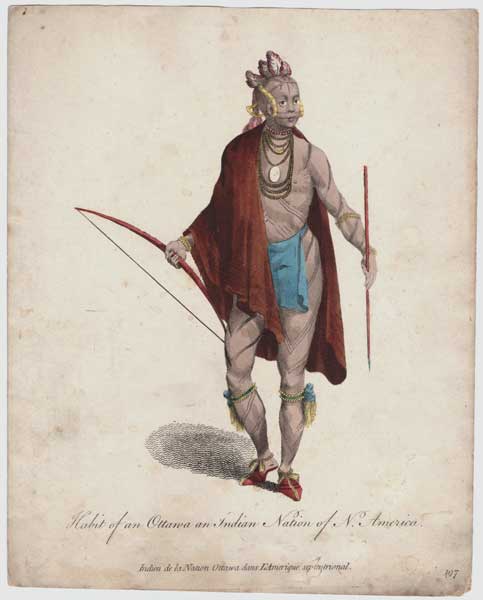
Habit of an Ottawa an Indian Nation of North America. Indien de la Nation Ottawa dans L'Amerique septentrional.
[Thomas Jefferys, n.d., c.1757.]
Hand coloured engraving. Sheet 250 x 200mm (9¾ x 8"). Trimmed within plate, slightly messy.
A full-length portrait of an Odawa warrior, with bow and arrow. Plate 197 from 'Collection of the dresses of different nations, antient [sic] and modern. Particularly old English dresses; after the designs of Holbein, Vandyke, Hollar and others, with an account of the authorities from which the figures are taken, and some short historical remarks on the subject. To which are added the habits of the principal characters on the English stage', published by Thomas Jefferys between 1757 - 1772.
[Ref: 61400] £130.00
(£156.00 incl.VAT)
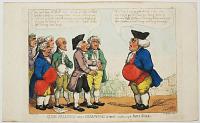
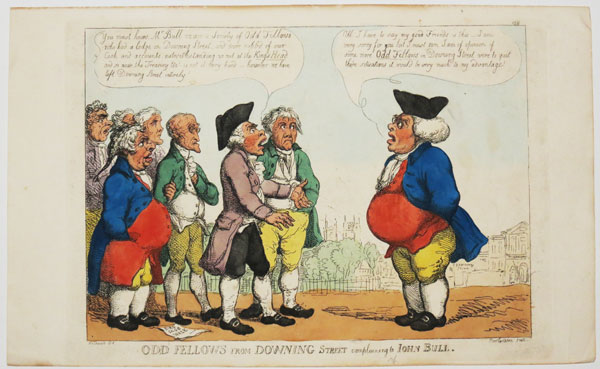
Odd Fellows from Downing Street complaining to John Bull. 168
Woodward Del. Rowlandson scul.
[n.d., c.1808.]
Hand-coloured etching. Plate: 245 x 350mm (9½ x 13¾''), with wide margins. Cut to platemark at bottom.
A scene in Westminster in which John Bull addresses a group of men. A satire on the prevailing theme that there was little to choose between the 'Ins' and the 'Outs', both parties when in office being plunderers of the public. BM Satire 10988.
[Ref: 50809] £260.00
(£312.00 incl.VAT)
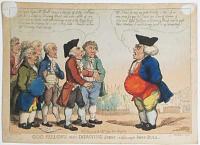
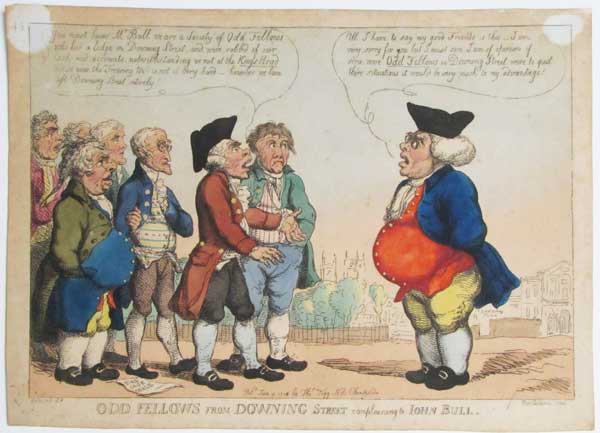
Odd Fellows from Downing Street complaining to John Bull. 168.
Woodward Del. Rowlandson scul.
[n.d., c.1808.]
Hand-coloured etching. 245 x 350mm (9½ x 13¾''). Time stained.
A satirical scene in Birdcage Walk, Westminster, with John Bull in conversation with a group of men. 'Oddfellows' were members of a society established to join 'ordinary' people together to improve their situation. This satire suggests they had little to choose between the 'Ins' and the 'Outs', parties that were plunderers of the public when in office. BM Satire 10988.
[Ref: 58484] £240.00
(£288.00 incl.VAT)
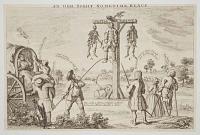
An Odd Sight Sometime Hence. Price 6
[Anon., November 1756]
Etching, 18th century watermark. 195 x 300mm (7¾ x 11¾). Trimmed with very small margins.
A crowd of spectators regard a gibbet marked 'The Tripple Alliance' from which are suspended three corpses. The British Museum catalogue of satires suggests that 'A' represents Lord Anson, 'B' Admiral Byng, and 'C' the Duke of Newcastle. At the foot of the gibbet is a fox whose speech bubble reads 'I have got my ends', representing Henry Fox, who is said to have caused the downfall of the three persons gibbeted. The British Museum's impression of the print has manuscript annotations identifying 'A' as Henry Fox, but their catalogue of satires considers this as incorrect. 'Generally, the "Triple Alliance" must refer to the defeat of Newcastle's attempts to form a composite Ministry.' BM Satires 3345.
[Ref: 53827] £180.00
(£216.00 incl.VAT)

Making a Sailor an Odd Fellow.!! 109.
Woodward del. Cruikshank sp.
[London pubd by T. Tegg Cheapside Decr 1. 1812]
Hand coloured etching, sheet 250 x 350mm (10 x 13¾"). On paper watermarked 'J Whatman 1822'. Foxing. Trimmed losing sections of platemark on all sides except right.
Ten Odd Fellows with grotesque faces watch a sailor who stands, arms akimbo, wary and pugnacious. The chairman sits in a raised armchair, smoking and drinking, behind a small table on which are two lighted candles. A man in a dressing-gown, introduces the sailor, doffing a night-cap: "Most worthy Chairman Mr Benjamin Block of Wapping Old Stairs - attends to be made a Member of the Ancient and honorable Society." The sailor with hands on hips says, "Avast my Hearties, - before I've proceeded any further on the voyage let me know what course you are steering - if you mean to frighten a British sailor with your goggle eyes, and queer faces you are d------dly mistaken - besides it appears to me that you have got masks on which is like fighting under false colours, and that wont do for an English Jack Tar!" Odd Fellows (or Oddfellows; also Odd Fellowship or Oddfellowship) is an international fraternity consisting of lodges first documented in 1730 in London. BM Satires 10899.
[Ref: 61838] £280.00
(£336.00 incl.VAT)
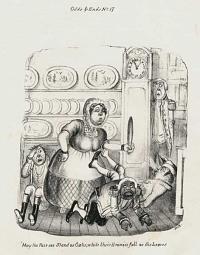
Odds & Ends N.º 17. ''May the Fair sex Stand as Oaks, while the Enimies fall as the Leaves.
W.N.
[London: T. Dawson, c. 1835.]
Lithograph. Printed area 200 x 140mm (8 x 5½") Stitch holes in left edge, pencil-ruled border, some spotting.
A hefty cook beats up the other servants, including a black man.
[Ref: 64357] £130.00
(£156.00 incl.VAT)
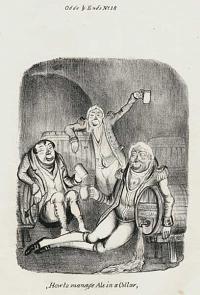
Odds & Ends N.º 18. How to manage Ale in a Cellar.
[London: T. Dawson, c. 1835.]
Lithograph. Printed area 200 x 120mm (8 x 4¼") Stitch holes in left edge, pencil-ruled border.
The servants get drunk, leaving a tap open.
[Ref: 64358] £130.00
(£156.00 incl.VAT)
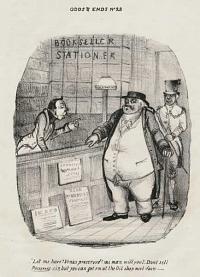
Odds & Ends N.º 28. ''Le me have ''Venice preserved'' mi man will you? - Don't sell Preserves sir, but you can get em at the Oil shop next door; -
[London: T. Dawson, c. 1835.]
Lithograph. Printed area 185 x 120mm (7¼ x 4¼") Stitch holes in left edge, some spotting.
An obese man asks for Thomas Otway's play in a bookshop.
[Ref: 64359] £90.00
(£108.00 incl.VAT)
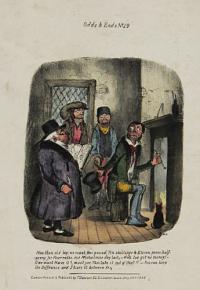
Odds & Ends No.19. Now then old boy, we want, One Pound, Ten shillings & Eleven pence half-penny, for Four rates, due Michelmas day last, [...]
W.N.
London Printed & Published by T. Dawson. 54 Leicester Square. July 22nd 1835.
Hand coloured lithograph. Sheet size: 310 x 215mm (12¼ x 8½"), with large margins. Slightly stained.
[Ref: 39289] £85.00
(£102.00 incl.VAT)

Odds & Ends No.21. "Hollo! master where are you going to? " "Vy shiver my topsails if u know's! You'd better Ax the Horse!"____
W.Newton.
London Printed & Published by T. Dawson. 54 Leicester Square. August 19th 1835.
Hand coloured lithograph. Rare. Sheet size: 310 x 215mm (12¼ x 8½"). Large margins. Slightly stained.
[Ref: 39290] £85.00
(£102.00 incl.VAT)

Odds & Ends No.3. Please yer honner youve just dropt this ere Whats-o-name.____Lord! Its one of my Whiskers!!!!!____
London Printed & Published by T. Dawson. 54 Leicester Square. June 24th 1835.
Hand coloured lithograph. Rare. Sheet size: 295 x 215mm (11¼ x 8½"). Large margins. Slightly stained.
[Ref: 39291] £85.00
(£102.00 incl.VAT)


![[The Oasis at Daybreak.]](jpegs/28871.jpg)
![Richard Oastler [signature facsimile.]](jpegs/7998.jpg)
![Richard Oastler [facsimile signature].](jpegs/8478.jpg)
![Richard Oastler [signature facsimile.]](jpegs/61551.jpg)
![[Titus Oates [?]] [16 top right]](jpegs/32746.jpg)
![[Titus Oates [?]] [16 top right & left]](jpegs/32747.jpg)

![[Titus Oates [?]]](jpegs/32745.jpg)



![[Oatlands] A Plan of the Garden & House of the R.t Honourable y.e Earl of Lincoln at Weybridge in the County of Surry.](jpegs/55116.jpg)


![[Music Lesson]](jpegs/36713.jpg)


![[Oceania] Flicka Fran Foa.](jpegs/11395.jpg)


![[The twelve months] [October]](jpegs/68706.jpg)

![[Odalisque.]](jpegs/66292.jpg)
![[L'Odalisque. - L'Amusement du Sultan.]](jpegs/47211.jpg)
![[L'Odalisque.]](jpegs/10811.jpg)