A Prospect of Newark From Lincolne Road.
R: Hall delin:
W: Hollar sculp: 1676. [c.1800?]
Etching, later impression on coarse laid paper. 150 x 295mm. (6 x 11½").
Prospect of Newark-on-Trent, Nottinghamshire; key upper left, arms and unlettered banner cartouche upper right. Etched by Wenceslaus Hollar (1607-77) and originally published in Thoroton's ''Nottinghamshire''. Pennington: 1047.
[Ref: 13865] £50.00
(£60.00 incl.VAT)
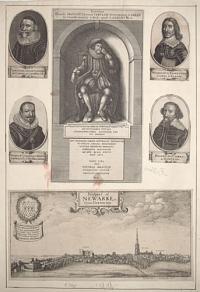
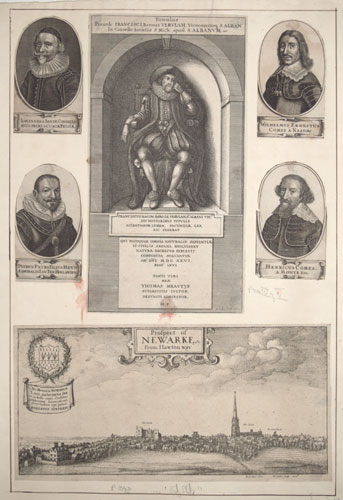
A Prospect of Newark from Hawton Way.
R: Hall delin: W: Hollar sculp: 1676.
Etching. Sheet 150 x 295mm. (6 x 11½"). Trimmed to plate and laid on album paper with five other etchings.
Prospect of Newark-on-Trent, Nottinghamshire, etched by Wenceslaus Hollar (1607-77) for Thoroton's ''Nottinghamshire''. The other prints include a view of Francis Bacon's Tomb by Hollar (Pennington 2273, state iv of v, c.1740), and four small Dutch portrait. Pennington: 1047.
[Ref: 52268] £360.00
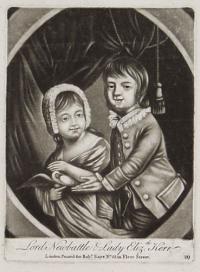
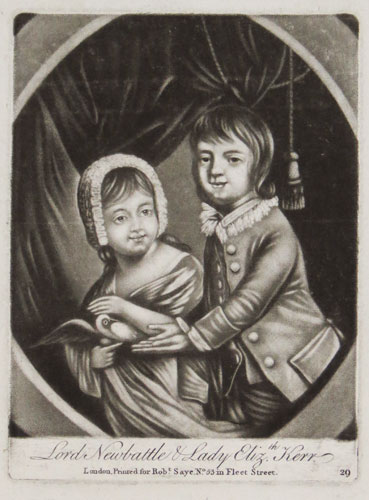
Lord Newbattle and Lady Eliz.th Kerr.
London, Printed for Rob.t Saye, No. 53 in Fleet Street.
Mezzotint with large margins, platemark 150 x 115mm (6 x 4½"). Rubbed. Slight creasing.
Double portrait of William and Elizabeth Kerr (holding a dove). Probably copied from the larger mezzotint which Valentine Green made of Catherine Read's painting. Lennox-Boyd database ii/ii; for Green's mezzotint of this portrait see ref. 25242
[Ref: 31379] £95.00
(£114.00 incl.VAT)
![[The Newbury Coat.] To Robert Throckmorton Esq.re Buckland House Farringdon This Print respresenting the beginning progress & completion of an extraordinary undertaking](img-thumbnail/jpegs/31236.jpg)
[The Newbury Coat.] To Robert Throckmorton Esq.re Buckland House Farringdon This Print respresenting the beginning progress & completion of an extraordinary undertaking to prove the possibility if Wool being manufactured into cloth and made into a coat between sunrise and sunset, which was successfully accomplished on Tuesday 25th June 1811, Is respectfully dedicated his most obliged and humble Servant John Williams Sand Steward to the late Sir John Throckmorton.
Drawn on Stone by J.W. Giles
London Published by John Mitchell, 33 Old Bond Street.
Lithograph with large margins. Printed area 540 x 740mm (21¼ x 29"). A few creases in the sky.
A composite image showing a race to create a wool hunting coat from scratch in one day, held in Newbury Berkshire. The origin of the event was a comment made by John Coxeter, owner of Greenham Mills in Newbury to Sir John Throckmorton: 'So great are the improvements in machinery I have lately introduced into my mill, that I believe that in twenty-four hours I could take the coat off your back, reduce it to wool, and turn it back into a coat again'. Throckmorton calculated the time required for the various processes, accepting it could be done. Shortly after Throckmorton made a wager a thousand guineas that at eight o'clock in the evening of June the 25th, 1811, he would sit down to dinner in a well-woven, properly-made coat, the wool of which formed the fleeces of sheep's backs at five o'clock that same morning. A holiday was declared so the town could watch (greasy-pole climbing and fencing competitions can be seen to the right), and the race was on. Starting at five in the morning, Coxeter presented the coat to Throckmorton at 6.20, who put the garment on before over five thousand people, and sat down to dinner at eight o'clock in the evening. The sheep that provided the wool were roasted for the spectators. The 'Newbury Coat' is still owned by the Throckmorton family; an identical coat, made in a 1991 re-enactment, is in the West Berkshire Museum in Newbury.
[Ref: 31236] £850.00
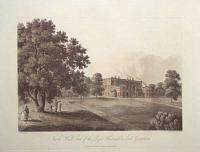
Newby Hall, Seat of the Right Honourable Lord Grantham.
R. Dunning Pinx.t. Engraved by R. & D. Havell.
Published May 1st 1813 by R. Dunning, Ripon, Yorkshire.
Coloured aquatint, printed in brown and hand finished. 260 x 350mm (10¼ x 13¾") very large margins.
A view of the exterior of Newby Hall in North Yorkshire, as remodelled by William Weddell (1736-92), including interiors by Robert Adam, to house his collection of Roman antiquities. After his death owners included Lord Grantham, his nephew, and the 2nd Earl of Ripon. The present owners are matrilineal descendants of William Weddell. The hall was used as a location for ITV's production of Jane Austen's 'Mansfield Park' in 2007. Not in Abbey.
[Ref: 59170] £280.00
(£336.00 incl.VAT)
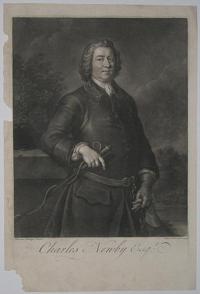
Charles Newby Esqr:
Charles Philips Pinxt. John Faber fecit 1744.
Rare Mezzotint, 360 x 250mm. 14¼ x 9¾". Missing lower left corner. Tatty and chipped left margin. Slightly soiled.
Charles Newby d.1750, sportsman of Hooton Roberts, Yorkshire. He wears a black coat with plain belt, from which hangs a chain, and holds a whip. After Charles Philips (1708 - 1747), portrait painter, and court painter to the Prince of Wales. C.S. 254 only state.
[Ref: 10014] £120.00
(£144.00 incl.VAT)

Charles Newby Esqr:
Charles Philips Pinxt. John Faber fecit 1744.
Fine mezzotint, platemark 355 x 250mm (14¼ x 9¾"). Small margins.
Charles Newby (d.1750), sportsman of Hooton Roberts, Yorkshire, wearing black coat from which hangs a chain, and holding a whip. After Charles Philips (1708 - 1747), portrait painter and court artist to the Prince of Wales. CS 254.
[Ref: 40248] £240.00
(£288.00 incl.VAT)

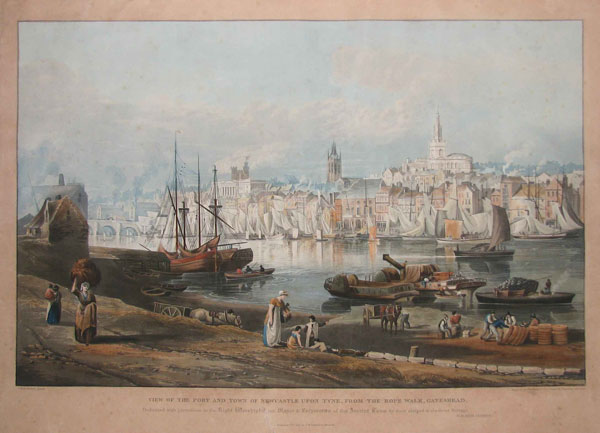
View of the Port and Town of Newcastle upon Tyne, from the Rope Walk Gateshead. Dedicated with Permission to the Right Worshipful the Mayor & Corporation of that Ancient Town by Their obliged and Obedient Servant. T.M. Richardson.
T.M.Richardson pinxit. Engraved by Rob.t Havell & Son. 3 Chapel Str. Tottenham Court Road.
Published Feb.y 1819 by T. M. Richardson, Newcastle.
Coloured aquatint with washed borders. 670 x 470mm. Two tears effecting the washed margins. Reverse has worn areas from an old card backing.
Thomas Miles Richardson, (1784-1848) Having revealed a deep love of drawing he didn't follow this passion until after his fathers death when he accepted a position as Drawing Master at a Newcastle school. In 1813, after six years as both master of St Andrew's and a private drawing master, he resigned his school position to devote his life to painting. Initially his work attracted little local interest, and he found it difficult to make a living as an artist. However, from 1814, he began to gain a wide reputation as a result of his exhibiting works in London, at the Royal Academy and the British Institution. In 1813, after six years as both master of St Andrew's and a private drawing master, he resigned his school position to devote his life to painting. Initially his work attracted little local interest, and he found it difficult to make a living as an artist. However, from 1814, he began to gain a wide reputation as a result of his exhibiting works in London, at the Royal Academy and the British Institution. Richardson continued to live in Newcastle, and so dominate the local art scene. In 1822, his own house in Brunswick Place was used as the venue for the first fine art exhibition to be staged in the North of England. The success of the exhibition led to the foundation of first the Northumberland Institution for the Promotion of Fine Arts, and later the Northern Academy of Arts. In 1831, he also helped to launch the Northern Society of Painters in Water-Colours. A leading exhibiting member of these organisations, he made a particularly notable contribution to the Northern Academy in 1830 with four large paintings. Moot Hall, the Castle Keep, the neo-Gothic spire of St. Nicholas' church ar all visible in this view. Gateshead was a prosperous settlement in the Roman Times, and during the Industrial Revolution and Victorian Era it became one of the focal points for industries in the North East due to its easily accessible port.
[Ref: 4886] £800.00
![[Eastern entrance to Newcastle.]](img-thumbnail/jpegs/8390.jpg)
[Eastern entrance to Newcastle.]
T.M. Richardson del.t S. Humble sculpt.
[n.d., c.1815.]
Engraving, 305 x 370mm. Proof before title. Uncut sheet.
The eastern entrance to Newcastle on Tyne, with a horse-drawn cart in the foreground.
[Ref: 8390] £220.00
(£264.00 incl.VAT)
![[Four Views of Newcastle.]](img-thumbnail/jpegs/57636.jpg)
[Four Views of Newcastle.]
T.M. Richardson Del.t. S. Humble Sculp.t.
[n.d., c.1815.]
Set of four engraving, proofs before titles. Printed areas 225 x 315mm (9 x 12½"). Trimmed within plates.
All four engravings from a set of view of Newcastle, showing: the city from the wharves; the eastern entrance to the city; the Assembly Rooms; and Elswick Hall. The titled versions were published by Stephen Humble in 1815. Alexander: Biographical Dictionary of British & Irish Engravers, p.488-9. Provenance: Thomas Davidson Album. See: Ref: 57646 for similar.
[Ref: 57636] £560.00
(£672.00 incl.VAT)
view all images for this item
![[High Level Bridge] To George Hudson Esquire, M.P.](img-thumbnail/jpegs/56771.jpg)
[High Level Bridge] To George Hudson Esquire, M.P. This Print Representing a View of the High-Level-Bridge, Newcastle-on-Tyne, is with Permission, Respectfully Dedicated By his Most Obedient Humble Servant, John Christie.
Newcastle, Engraved & Published by John Christie, No 3 Nelson Street [n.d., c.1850].
Rare coloured steel engraving. Sheet 290 x 380mm (11½ x 15"). Trimmed within plate, laid on card. Repaired tear in title.
The High Level Bridge, over the Tyne between Newcastle upon Tyne and Gateshead, built by Robert Stephenson, completed 1849 and opened by Queen Victoria the following year. Still in use, it is now listed Grade I.
[Ref: 56771] £260.00
(£312.00 incl.VAT)
![[Thomas Pelham-Holles, Duke of Newcastle] The Compleat Vermin-Catcher of G-B-n, or the Old Trap New Baited.](img-thumbnail/jpegs/68928.jpg)
[Thomas Pelham-Holles, Duke of Newcastle] The Compleat Vermin-Catcher of G-B-n, or the Old Trap New Baited.
Publish'd according to Act of Parliament April 18th. 1754.
Etching with engraving. 245 x 345mm (9½ x 13½"). Narrow top margin, tear in top of image taped, creasing. Small margins
A satire on parliamentary corruption. The new prime minister, the Duke of Newcastle, sits by the House of Commons, using a fishing rod to lure parliamentary candidates (all on horseback) to support him with promises of advancement. The riders all express their interests, including one saying 'Jews, & no Jews'. This image reflects popular backlash against England’s highly unpopular Jewish Naturalisation Act of 1753, often called the “Jew Bill.” The law allowed Jews to apply for naturalisation through Parliament. It passed easily in the Lords but faced strong Tory opposition in the Commons. Despite this, the Whigs, supporting broader religious tolerance, secured its passage, and it received royal assent. A surge of public antisemitism followed, prompting its repeal in 1754. BM Satires 3269.
[Ref: 68928] £690.00
(£828.00 incl.VAT)
![[Four Views in Newcastle.]](img-thumbnail/jpegs/57646.jpg)
[Four Views in Newcastle.]
T.M. Richardson Del.t. S. Humble Sculp.t.
[Published 34, Harleyford Place, Kennington Common, n.d., c.1815.]
Set of four engraving, proofs before titles. printed on chine collé. Printed areas 225 x 315mm (9 x 12½"). Two plates trimmed within plate.
All four engravings from a set of view of Newcastle, showing: the city from the wharves; the eastern entrance to the city; the Assembly Rooms; and Elswick Hall. The titled versions were published by Stephen Humble in 1815. Alexander: Biographical Dictionary of British & Irish Engravers, p.488-9. Provenance: Thomas Davidson Album. See Ref: 57636 for similar.
[Ref: 57646] £850.00
view all images for this item
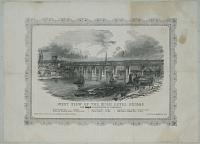
West View of the High Level Bridge Now....Constructed at Newcastle. Length of Water Way......512 Feet. Between the Triumphal Arches..137 Feet 5 Inches. Span of the Arches.. 125 Feet. Extreme Height....131 Feet. High Water ot Level of Rails..112 Feet 6 Inches. High Water to Carriage Way .. 86 Feet.
From the Sunderland and Durham County Herald.]
[of Friday, March 19, 1847.
Wood engraving. 285 x 385mm (11¼ x 15¼"). Laid down on album sheet.
The High Level Bridge is a road and railway bridge over the River Tyne. It was designed by Robert Stephenson and built between 1847 and 1849 and was the first major example of a wrought iron tied arch or bow-string girder bridge.
[Ref: 18387] £120.00
(£144.00 incl.VAT)
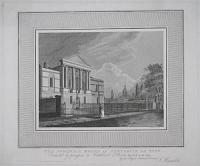
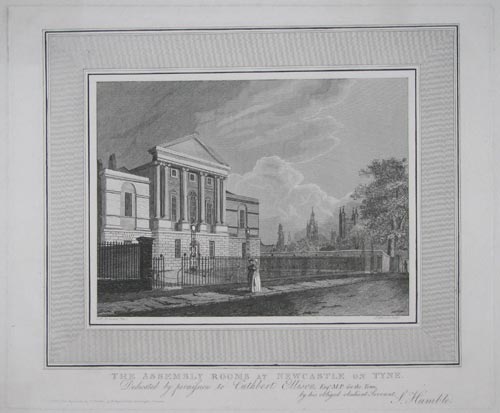
The Assembly Rooms at Newcastle on Tyne Dedicated by permission to Cuthbert Ellison, Esq.r M.P. for the Town, by his obliged obedient Servant, S. Humble.
T.M. Richardson Del.t. S. Humble Sculpt.
London, Pub. Aug. 21 1815 by S. Humble, 34 Horleyford Place, Kennington Common.
Engraving, 305 x 370mm. Uncut sheet.
Open to both men and women, Assembly Rooms held concerts, balls and other entertainments for the upper classes. The Newcastle Assembly Rooms were built in 1776 in the city's historic Grainger Town district.
[Ref: 8389] £220.00
(£264.00 incl.VAT)
![[The Assembly Rooms at Newcastle on Tyne.]](img-thumbnail/jpegs/8395.jpg)
[The Assembly Rooms at Newcastle on Tyne.]
T.M. Richardson Del.t. S. Humble Sculp.t.
[n.d., c.1815.]
Engraving, 305 x 370mm. Proof before title. Uncut sheet.
Open to both men and women, Assembly Rooms held concerts, balls and other entertainments for the upper classes. The Newcastle Assembly Rooms were built in 1776 in the city's historic Grainger Town district.
[Ref: 8395] £220.00
(£264.00 incl.VAT)
![[A Grand House, Newcastle.]](img-thumbnail/jpegs/8612.jpg)
[A Grand House, Newcastle.]
T.M. Richardson del.t S. Humble Scul.t
[n.d., c.1815.]
Proof before letters. 305 x 370mm (12 x 14½"). Uncut sheet.
A country house.
[Ref: 8612] £220.00
(£264.00 incl.VAT)
![[Elswick Hall.]](img-thumbnail/jpegs/19133.jpg)
[Elswick Hall.]
T.M. Richardson Del.t. S. Humble Sculp.t.
[n.d., c.1815.]
Engraving. Sheet 250 x 310mm (9¾ x 12¼"). Repaired tear, trimmed.
Elswick Hall. now Elswick Park, a ward of western Newcastle-upon Tyne.
[Ref: 19133] £95.00
(£114.00 incl.VAT)
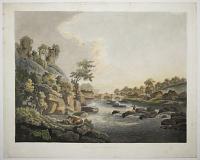
New Castle Emblyn, Cardiganshire.
Drawn & Engraved by J. Hassell.
Published April 18th 1804 by Tegg and Castleman 111 Cheapside, London.
Aquatint, printed in colours and finished by hand. 450 x 570mm (17¾ x 22½"). Repaired tears, laid on card.
Newcastle Emlyn, with the 13th-century castle overlooking the bridge. Once owned by Edward, the Black Prince, it was still occupied at the start of the Civil War, but was captured in 1645 by parliamentary troops and slighted.
[Ref: 47820] £260.00
(£312.00 incl.VAT)
![[GreyFriars or Anderson Place] This House was Originally the Monastry of Grey Friers _ New Castle upon Tyne.](img-thumbnail/jpegs/57778.jpg)
[GreyFriars or Anderson Place] This House was Originally the Monastry of Grey Friers _ New Castle upon Tyne.
G. Sonander fecit.
[n.d., c.1790.]
Scarce aquatint, printed in sepia. 380 x 505mm (15 x 20"). Trimmed to plate.
A view of GreyFriars, founded 1237, bought by a merchant Robert Anderson after the Dissolution of the Monasteries. It was here that Charles I was held after he surrendered to the Scots Army in 1646, before being handed to Parliament. This view shows the building when owned by Newcastle builder George Anderson (between 1782 and his death in 1798), who converted it into three residences. In 1835 it was demolished by another Newcastle builder, Richard Grainger, during the construction of Grey Street. Newcastle-upon-Tyne. From the Davidson album.
[Ref: 57778] £320.00
![Central Railway Station, Newcastle. (Uniform with a View of the Interior.) [&] Interior of the Central Railway Station, Newcastle. (Uniform with a View of the Exterior.)](img-thumbnail/jpegs/27411.jpg)
Central Railway Station, Newcastle. (Uniform with a View of the Interior.) [&] Interior of the Central Railway Station, Newcastle. (Uniform with a View of the Exterior.)
John Dobson, Esq. Archt.
Published by Andrew Reid, Lithographer, 117, Pilgrim Street, Newcastle.
Pair of lithographs on india paper, scarce; each sheet 280 x 380mm. 11 x 15". Margins slightly soiled and stained; generally good copies with large margins.
The interior view shows a steam locomotive at the station on the Newcastle & Carlisle Railway designed by John Dobson (1787-1865). It was opened on 29 August 1850 by Queen Victoria. Not in Abbey.
[Ref: 27411] £320.00
view all images for this item
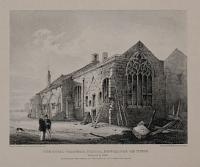
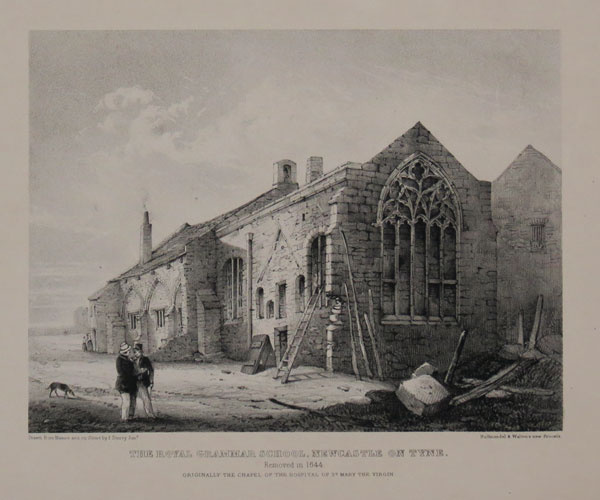
The Royal Grammar School. Newcastle on Tyne. Removed in 1844. Originally the Chapel of the Hospital of St Mary the Virgin.
Drawn from Nature and on Stone by J. Storey Jun.r. Hullmandel & Walton's new Process.
Lithograph. Printed area 185 x 220mm (7¼ x 8½").
'Hullmandel & Walton's new Process' must have been a new technique in lithography.
[Ref: 34611] £120.00
(£144.00 incl.VAT)
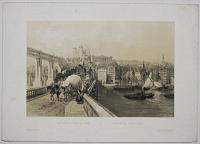
Newcastle Sur La Tyne. Newcastle upon Tyne. 34.
Dessiné et lith par J. Arnout. Imp. Lemercier, Paris.
Paris, Bulla Frères & Jouy éditeurs. Berlin, F.d Ebner, 196 Friedrichsstrasse. London, E. Gambart & Co. 25 Berners St. Oxf. St. New-York. Emile Seitz, 413 Broadway. [n.d. c.1850.]
Tinted lithograph with very large margins. 400 x 570mm (15¾ x 22½"). Some foxing off image. Uncut.
View across the Tyne towards Newcastle. A merchant with a laden carriage crosses the bridge, where the new Swing Bridge stands today; to the left stands the High Level Bridge of 1781, with the old castle keep towering in the background. Steamer and other vessels on the river.
[Ref: 29988] £260.00
(£312.00 incl.VAT)
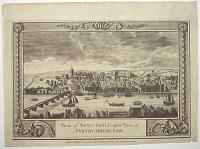
View of Newcastle, upon Tyne, in Northumberland.
London: Published as the Act directs, by Alexr. Hogg, at the Kings Arms, No.16, Paternoster Row. [n.d., c.1795.]
Engraving, sheet 240 x 330mm (9½ x 13"). Trimmed to lower platemark.
A view of the river Tyne and the city of Newcastle. From 'The New and Complete English Traveller' published by Alexander Hogg (1784 - 1794; fl).
[Ref: 56067] £60.00
(£72.00 incl.VAT)
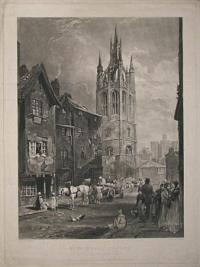
St. Nicholas' Church. Newcastle upon Tyne.
Painted by T.M. Richardson. Engraved by T. Hodgetts.
Published, Dec 15, 1828 by M.A. Richardson, Newcastle and by Moon, Boys & Greaves, Printsellers to His Majesty Pall Mall London. Proof [lower right].
Mezzotint with etching on india laid paper, 500 x 370mm. 19¾ x 14½". Two horizontal creases through image.
A very rare view in Newcastle. After Thomas Miles Richardson (1784 - 1848), locally published.
[Ref: 9176] £350.00

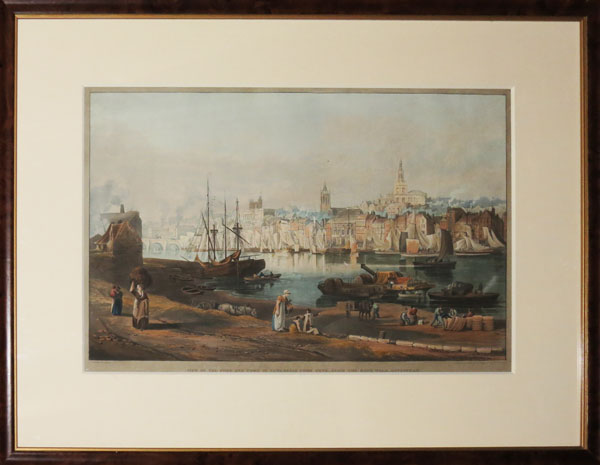
View of the Port and Town of Newcastle upon Tyne, from the Rope Walk Gateshead. Dedicated with Permission to the Right Worshipful the Mayor & Corporation of that Ancient Town by Their obliged and Obedient Servant. T. M.Richardson.
T.M.Richardson pinxit. Engraved by Robt. Havell & Son. 3 Chapel Str. Tottenham Court Road.
Published Feby. 1819 by T. M. Richardson, Newscastle.
Coloured aquatint with washed borders. 670 x 470mm, 26½ x 18½". Framed. Unexamined out of frame.
Thomas Miles Richardson, (1784-1848) Having revealed a deep love of drawing he didn't follow this passion until after his fathers death when he accepted a position as Drawing Master at a Newcastle school. In 1813, after six years as both master of St Andrew's and a private drawing master, he resigned his school position to devote his life to painting. Initially his work attracted little local interest, and he found it difficult to make a living as an artist. However, from 1814, he began to gain a wide reputation as a result of his exhibiting works in London, at the Royal Academy and the British Institution. Richardson continued to live in Newcastle, and so dominated the local art scene. In 1822, his own house in Brunswick Place was used as the venue for the first fine art exhibition to be staged in the North of England. The success of the exhibition led to the foundation of first the Northumberland Institution for the Promotion of Fine Arts, and later the Northern Academy of Arts. In 1831, he also helped to launch the Northern Society of Painters in Water-Colours. A leading exhibiting member of these organisations, he made a particularly notable contribution to the Northern Academy in 1830 with four large paintings. Moot Hall, the Castle Keep, the neo-Gothic spire of St. Nicholas' church ar all visible in this view. Gateshead was a prosperous settlement in the Roman Times, and during the Industrial Revolution and Victorian Era it became one of the focal points for industries in the North East due to its easily accessible port.
[Ref: 28107] £650.00
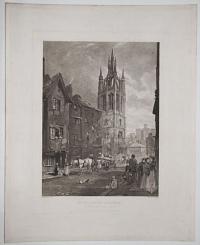
St Nicholas Church. Newcastle upon Tyne.
Painted by T.M. Richardson. Engraved by T. Hodgetts.
Published Dec.15.1828 by M.A. Richardson, Newcastle, and by Moon, Boys & Graves, Printsellers to His Majesty. Pall Mall, London.
Mezzotint and etching with very large margins, rare. Plate 495 x 374mm. 19½ x 14¾". Laid on card.
View of the church, looking diagonally from the left foreground towards the church tower, which is surmounted by an open crown turret and four pinnacles; townsfolk in the street, including a man talking to another sitting in a horse-drawn cart, and a woman who leans out of an upper window holding a large basket-cage.
[Ref: 27568] £280.00
(£336.00 incl.VAT)
![[The Duke of Newcastle's stud.]](img-thumbnail/jpegs/50352.jpg)
[The Duke of Newcastle's stud.]
Abr. à Diepenbeke delin. Petr. Clouwet Sculpsit.
[London: John Brindley, 1743.]
Engraving. 390 x 520mm (15½ x 20½"). Centre fold as usual. Narrow lateral margins.
Mares and foals in the fields of the stud of William Cavandish, 1st Duke of Newcastle, at Welbeck Abbey, Nottinghamshire. Plate 42 of the Duke of Newcastle's treatise on horsemanship, 'La Methode et Invention nouvelle de Dresser les Chevaux', first published in Antwerp by Jacob van Meurs c.1658, but this example from the first English edition, 'A General System of Horsemanship in All Its Branches'. After the defeat of the Royalist cause in the Civil War Cavendish settled in Antwerp, where this work was engraved. However his estates at Bolsover and Welbeck Abbey were often the backdrop of these famous dressage plates.
[Ref: 50352] £490.00
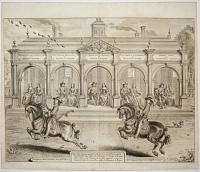
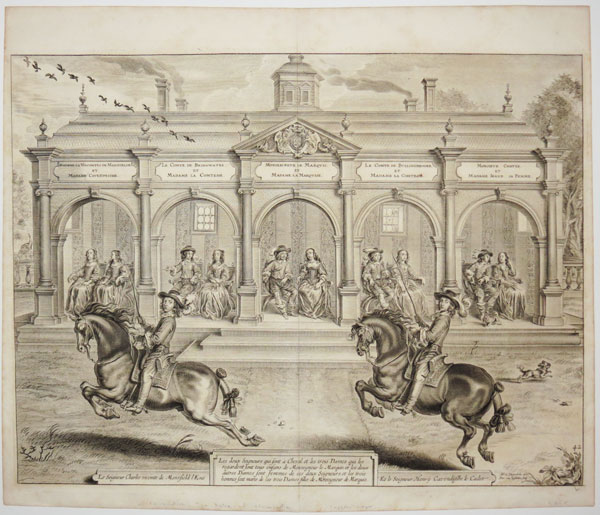
Le Seigneur Charles viscomte de Mansfield l'Ené Et le Seigneur Henrÿ Cavendÿshe le Cadet.
Abr. à Diepenbeke delin. Petr. van Lisebetten Sculp.
[London: John Brindley, 1743.]
Engraving. 385 x 510mm (15¼ x 20"). Centre fold as usual. Thread margins.
A group portrait of William Cavendish (1592-1676, later 1st Duke of Newcastle) and his wife seated watching his two sons practicing dressage. Also seated under the arcade are their four daughters and their husbands. Plate 42 of the Duke of Newcastle's treatise on horsemanship, 'La Methode et Invention nouvelle de Dresser les Chevaux', first published in Antwerp by Jacob van Meurs c.1658, but this example from the first English edition, 'A General System of Horsemanship in All Its Branches'. After the defeat of the Royalist cause in the Civil War Cavendish settled in Antwerp, where this work was engraved. However his estates at Bolsover and Welbeck Abbey were often the backdrop of these famous dressage plates.
[Ref: 48205] £360.00
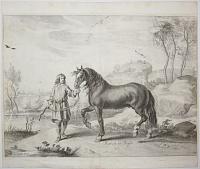
Rubecan un Rousin.
Abr. à Diepenbeke delin. Lucas Vorstermans Sculp.
[London: John Brindley, 1743.]
Engraving. 385 x 530mm (15¼ x 21"). Centre fold as usual, trimmed within plate at sides, as issued.
A portrait of a squire holding the reins of a horse, landscape behind. Plate 10 of the Duke of Newcastle's treatise on horsemanship, 'La Methode et Invention nouvelle de Dresser les Chevaux', first published in Antwerp by Jacob van Meurs c.1658, but this example from the first English edition, 'A General System of Horsemanship in All Its Branches'. After the defeat of the Royalist cause in the Civil War William Cavendish (1592-1676) settled in Antwerp, where this work was engraved. However his estates at Bolsover and Welbeck Abbey were often the backdrop of these famous dressage plates.
[Ref: 48206] £280.00
(£336.00 incl.VAT)

A View of the Entrance of S.t John's Newfoundland.
The Rev.d J. Hall del. J. Wells sculp.
Publish'd by Bunney & Gold, 1 July 1802.
Aquatint. Sheet: 140 x 250mm (5½ x 10''). Trimmed.
A view of the entrance to the harbour to St John's, capital of Newfoundland.
[Ref: 50028] £130.00
(£156.00 incl.VAT)
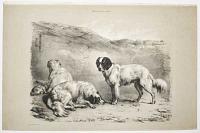
Chiens de Terre-neuve.
Eugène Verboeckhoven 1844. Imp. Lemercier, Paris.
Paris, H. Gache, 66 rue de la Victoire.
Lithograph, scarce. Sheet: 335 x 510mm (13¼ x 20").
A scene showing three Newfoundland dogs.
[Ref: 47485] £230.00
(£276.00 incl.VAT)
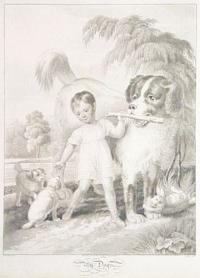
My Dogs.
W.M. Craig del. J. Godby sculp.
Published June 4th. 1806. by Edw.d Orme, London.
Stipple. 240 x 185mm .
A Newfoundland and three puppies.
[Ref: 2742] £260.00
(£312.00 incl.VAT)
![[Newfoundland.] Keeper, A Good Dog In Old Times.](img-thumbnail/jpegs/3687.jpg)
[Newfoundland.] Keeper, A Good Dog In Old Times. From the Original Picture painted by Sir Edwin Landseer, R.A. at the age of Nineteen.
Engraved by W.T. Davey.
London, Published Sept.r 15, 1853 by Thomas Boys, Printseller to the Royal Family, 467 Oxford Street.
Mezzotint on india. 450 x 620mm, 17¾ x 24½". Some spotting.
A Newfoundland, resting on a mail bag. In the background are the coach and horses.
[Ref: 3687] £550.00
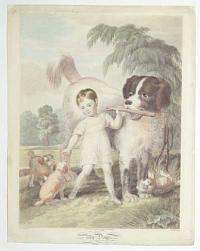
My Dogs.
W.M. Craig del. J. Godby sculp.
Published June 4th. 1806. by Edw.d Orme, London.
Rare stipple with hand colour. Sheet 275 x 215mm (10¾ x 8½"). Trimmed within plate.
A Newfoundland towering over a small boy, with three puppies.
[Ref: 58065] £260.00
(£312.00 incl.VAT)

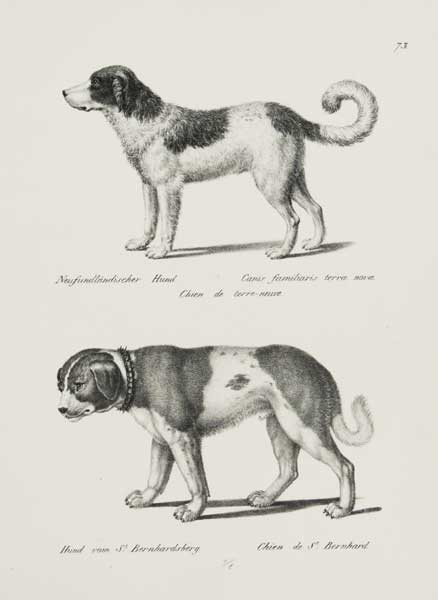
Newfundländischer Hund. Canis familiaris terrae novae. Chien de terre-neuve. Barry, Hund vom St: Bernhardsberg. Chien se St: Bernhard. 1/8. 73.
[n.d. c.1847.]
Lithograph with large margins. 350 x 240mm Small tears to upper and lower edge.
Newfoundland dog, and a St Bernard dog. From "Panorama der Saeugethiere lithographirt und herausgegeben von H. Reichert". See Ref: 29497 for version in reverse.
[Ref: 29498] £130.00
(£156.00 incl.VAT)

A View of a Stage & also of ye manner of Fishing for, Curing & Drying Cad at New Found Land.
[London: Herman Moll, c.1715.
Engraving. Sheet 175 x 210mm (6¾ x 8¼"). Trimmed from a larger sheet.
A view of the Newfoundland Cod Fishery, excised from Herman Moll's 'North America According to ye Newest and Most Exact Observations'.
[Ref: 61076] £230.00
(£276.00 incl.VAT)

Le Chien de Terre Neuve.
Beaume pixit. Marin Lavigne lith. Lith. Frick freres, Paris.
[Paris &] Londres chez V. Delarue [n.d., c.1870].
Lithograph with hand colouring and gum arabic, image 325 x 420mm. 12¾ x 16½". A few marginal spots and tears; colour very fine.
Magnificent and large image of a Newfoundland dog pulling a child out of a river; the child's mother in an agitated state in background upper right.
[Ref: 22758] £360.00

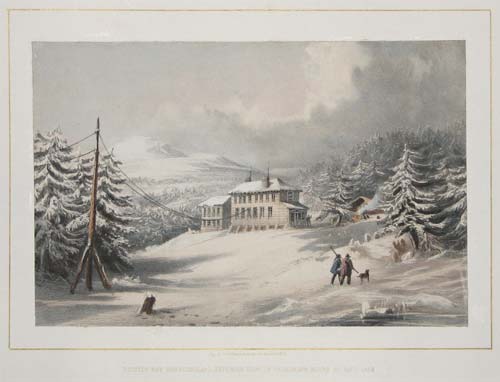
Trinity Bay, Newfoundland. Exterior of Telegraph House, in 1857-1758.
[After Robert Dudley.]
Day & Son Limited, Gate Str. London, W.C. [1866.]
Coloured lithograph, trinted to image and laid on print card, as issued.
From William Howard Russell's 'The Atlantic Telegraph', the story of the first transatlantic cable, between Trinity Bay and Valentia in Ireland, in service for three months before snapping. 1st State.
[Ref: 1918] £80.00
(£96.00 incl.VAT)
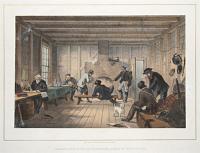
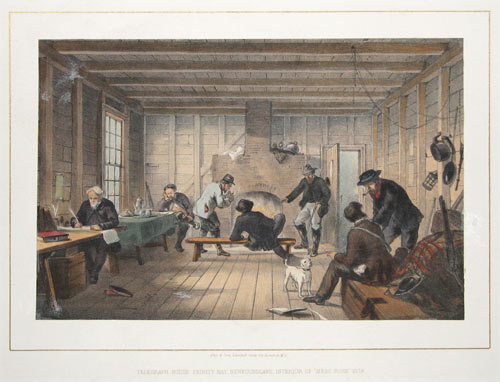
Telegraph House, Trinity Bay, Newfoundland. Interior of 'Mess Room' 1858.
[After Robert Dudley.]
Day & Son Limited, Gate Str. London, W.C. [1866.]
Coloured lithograph, trinted to image and laid on print card, as issued. Small surface scuff.
From William Howard Russell's 'The Atlantic Telegraph', the story of the first transatlantic cable, between Trinity Bay and Valentia in Ireland, in service for three months before snapping. 1st State.
[Ref: 1919] £80.00
(£96.00 incl.VAT)

Newgate Chapel. Plate 57.
Rowlandson & Pugin del. et sculpt. Stadler Aquat.
London. Pub 1.st March 1809 at R. Ackermann’s Repository of Arts 101, Strand.
Hand coloured aquatint, plate 230 x 280mm (9 x 11"), with large margins.
Interior view of the chapel, in the prison; condemned prisoners kneel and pray in the Dock, around a coffin. Published in Ackermann's famous work, the 'Microcosm of London', the figures were drawn by the famous caricaturist Thomas Rowlandson and the architecture by Augustus Pugin. Abbey, Scenery: 212.57.
[Ref: 62749] £120.00
(£144.00 incl.VAT)

Newgate Illustrated-or the Knight and the Squire. a Tale of the 19th Century.
[Charles Williams.]
Pub.d March 21st 1805 by S. Knight Lambeth.
Hand-coloured etching. Plate 248 x 349mm (9¾ x 13¾"). Paper toning.
Sir William Rawlings and Robert Albion Cox, Sheriffs of Middlesex in 1802, in prison. They were imprisoned after the Committee on the Middlesex Election of 1802 claimed they 'wilfully, knowingly, and corruptly admitted upwards of 300 persons to vote as proprietors of a mill at Isleworth', despite being supported by Fox, Sheridan and others. They were released on 10 May, a little over two months after their imprisonment began. On the floor beside the younger man is a rolled paper: 'View of the Mill at Isleworth', with a book: 'Essay on Refineing'. BM Satires: 10376.
[Ref: 30572] £240.00
(£288.00 incl.VAT)

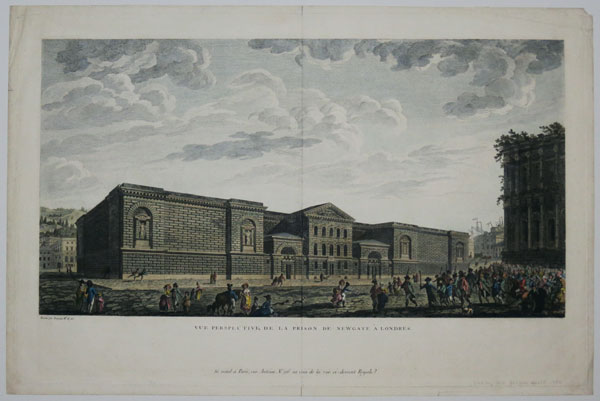
Vue Perspective de la Prison de Newgate a Londres.
Dessine par Bourjot Md. de fer.
Se vend a Paris, rue Antoine, No.216, au coin de la rue ci-devant Royale [n.d., c.1790].
Very rare double-page folding engraving with hand colouring. 375 x 580mm, 14¾ x 22¾". A good impression.
A very interesting French view of Newgate Prison, Old Bailey, City of London. Several figures in the inner court include newly-arrived prisoners being separated into male and female groups by men with cudgels (far right). Ship's masts, suggestive of the Thames, are visible in the distance at right. The view is probably imaginary, as can be determined from the hills added on the left, and overgrown classical architecture reminiscent of Piranesi's Rome views on the right. By Ferdinand Bourjot (1768-1840?). Guildhall Library Record: 4907.
[Ref: 25815] £490.00
![[Newgate Prison.]](img-thumbnail/jpegs/68939.jpg)
[Newgate Prison.] Prisoners stopping at the Baptist's Head in St.John's Lane, on the day of removal from the New-Prison to Newgate.
Dodd delin. T.Smith sculp.
[n.d., c.1780.]
Engraving. Sheet 210 x 130mm (8¼ x 5"). Small margins.
A scene depicting the Old Baptist’s Head on St John’s Lane, a notorious midway stop for prisoners being transferred from the New Prison in Clerkenwell to Newgate Prison in the late eighteenth century. At this location, prisoners, often including children convicted of offences, were permitted a final drink (a quart, two pints) or brief refreshment.
[Ref: 68939] £160.00
(£192.00 incl.VAT)
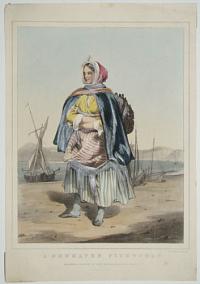
A Newhaven Fishwoman.
T.M. Richardson Junr. del.t M & N Hanhart, lith Printers.
Edinburgh: Published by John Menzies, 61, Princes Street. [n.d. c.1820.]
Fine coloured lithograph with added gum arabic. 360 x 247mm. 14¼ x 9¾".
A fisherwoman standing on the bank to the River Ouse. Fishing boats and other vessels sit calmly docked and pulled ashore. Not in Abbey.
[Ref: 16534] £140.00
(£168.00 incl.VAT)
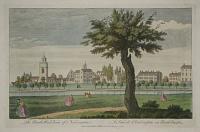
The North West View of Newington. La Veüe de Newington ou Nord Ouest. 77.
Published by Laurie & Whittle, 53. Fleet Street, London. [n.d. c.1750.]
Hand-coloured engraving. Watermark 1810, Plate 261 x 401mm. 10¼ x 15¾".
A view of Newington, London, with several groups of people in the foreground taking a walk.
[Ref: 18417] £160.00
(£192.00 incl.VAT)
![[Memorial to Sir Hugh Brawne in St Mary's Church Newington Butts]](img-thumbnail/jpegs/57363.jpg)
[Memorial to Sir Hugh Brawne in St Mary's Church Newington Butts]
Ink and wash, 18th century watermark. Sheet 315 x 200mm (12½ x 8"). A few stains.
A watercolour of the monument to Sir Hugh Brawne (d.1615), his two wives and six children, once in St Mary's Church, Newington Butts. The church was rebuilt in 1715, 1790, 1876 and after an air raid in 1941, and it is uncertain when this memorial was removed. We have found no photographic record of the monument.
[Ref: 57363] £180.00
(£216.00 incl.VAT)

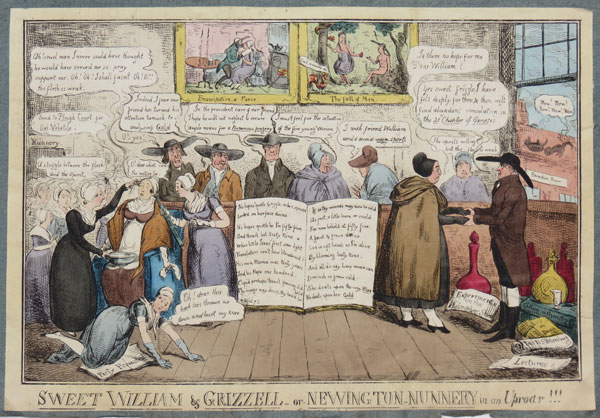
Sweet William & Grizzell _ or _ Newington_Nunnery in an uproar!!!
H.H. [Henry Heath.]
[Pub.d March. 5th 1827 by S W Fores. 42 Piccadilly London.]
Rare hand coloured etching. Printed area: 210 x 320mm (8¼ x 12½"). Trimmed, loosing publication line, and glued to scrap sheet.
An interior scene of a Quaker meeting. On the right William Allen holds the hands of a stout Quaker lady, Grizell Birkbeck, in bonnet and cloak. Against the wall is a pew in which are three women and three men, all in Quaker dress, watching Allen and Mrs. Birkbeck disapprovingly. On the left is a group of young Quaker women who crowd in from a door inscribed 'Nunnery'. In the bottom left, another young woman has fallen to her hands and knees on a book inscribed 'Piety Promoted'. A collection of alchemical apparatus, including books and documents titled 'Experiments on the Philosophers Stone', 'Lectures on Chymistry' and 'Essays on Drugs' are piled on the floor to the right of the room. Two large paintings hang on the back wall titled 'Emancipation, A Farce' and 'The Fall of Man.' A reversed copy of I. R. Cruikshank's print. See BM satire ref: 15447. BM Satires 15447.A.
[Ref: 32648] £260.00
(£312.00 incl.VAT)
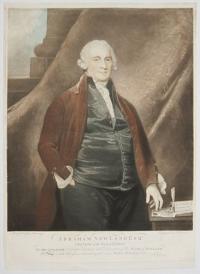
Abraham Newland Esq.r Chief Cashier of the Bank of England. To the Governor Deputy Governor and Directors of the Bank of England. This Plate is with Permission dedicated by their most Obedient Humble Servant J. Grozer.
Painted by Geo. Romney. Engraved by J. Grozer.
Pub. as the Act directs Aug.t 20.1795 by I. Grozer, No.40 Gerrard Street, Soho London.
Coloured mezzotint partly printed in colour, small margins. Plate 475 x 355mm (18¾ x 14").
Abraham Newland (1730-1807), the chief cashier at the Bank of England from 1782 to 1807. No bank note could be issued or could be claimed as genuine without his signature. He slept in the Bank itself for 25 years, so was largely a stranger to his own home adjoining Highbury Fields. CS: 18. Horne: 86.
[Ref: 31109] £230.00
(£276.00 incl.VAT)
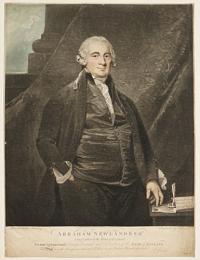
Abraham Newland Esq.r Chief Cashier of the Bank of England. To the Deputy Governor and Directors of the Bank of England. This Plate is with Permission dedicated by their most Obedient Humble Servant J. Grozer.
Painted by Geo. Romney. Engraved by J. Grozer.
Pub. as the Act directs Aug.t 20.1795 by I. Grozer, No.40 Gerrard Street, Soho: London.
Mezzotint, with Collector's mark, printed in colour. 477 x 356mm (18¾ x 14"). Trimmed. Slightly foxed.
Portrait, three-quarter length standing directed to right, wearing a dark suit and short powdered wig, ooking towards the viewer, right hand in his pocket, left hand at his side, touching a ten pound note on a table, with an inkpot and letter addressed to 'Abraham Newland Esqr. Chief Cashier of the Bank of England'. Abraham Newland (1730-1807), chief cashier at the Bank of England. Ex Collection: Earl of Bute. Horne: 86, ii/ii. CS: 18.
[Ref: 29162] £320.00

![[The Newbury Coat.] To Robert Throckmorton Esq.re Buckland House Farringdon This Print respresenting the beginning progress & completion of an extraordinary undertaking](jpegs/31236.jpg)


![[Eastern entrance to Newcastle.]](jpegs/8390.jpg)
![[Four Views of Newcastle.]](jpegs/57636.jpg)
![[High Level Bridge] To George Hudson Esquire, M.P.](jpegs/56771.jpg)
![[Thomas Pelham-Holles, Duke of Newcastle] The Compleat Vermin-Catcher of G-B-n, or the Old Trap New Baited.](jpegs/68928.jpg)
![[Four Views in Newcastle.]](jpegs/57646.jpg)

![[The Assembly Rooms at Newcastle on Tyne.]](jpegs/8395.jpg)
![[A Grand House, Newcastle.]](jpegs/8612.jpg)
![[Elswick Hall.]](jpegs/19133.jpg)

![[GreyFriars or Anderson Place] This House was Originally the Monastry of Grey Friers _ New Castle upon Tyne.](jpegs/57778.jpg)
![Central Railway Station, Newcastle. (Uniform with a View of the Interior.) [&] Interior of the Central Railway Station, Newcastle. (Uniform with a View of the Exterior.)](jpegs/27411.jpg)



![[The Duke of Newcastle's stud.]](jpegs/50352.jpg)


![[Newfoundland.] Keeper, A Good Dog In Old Times.](jpegs/3687.jpg)





![[Newgate Prison.]](jpegs/68939.jpg)


![[Memorial to Sir Hugh Brawne in St Mary's Church Newington Butts]](jpegs/57363.jpg)