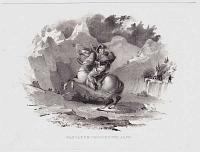
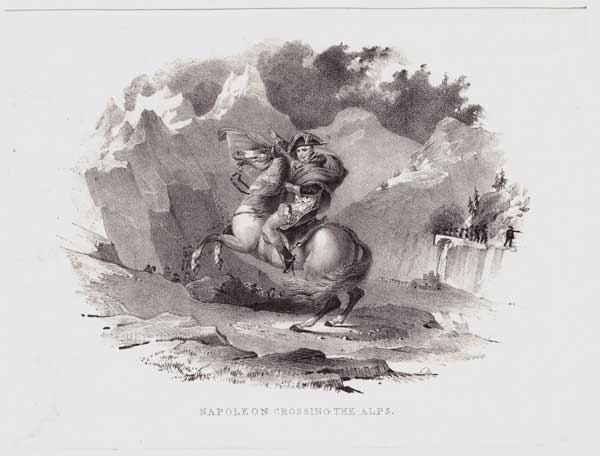
Napoleon Crossing the Alps.
A. Picken.
[n.d., c. 1840.]
Lithograph. Sheet 145 x 190mm (5¾ x 7½").
A version of Jacques-Louis David's famous painting of Napoleon on a rearing Marengo.
[Ref: 62338] £130.00
(£156.00 incl.VAT)
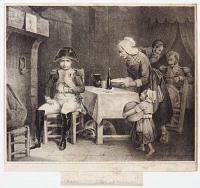
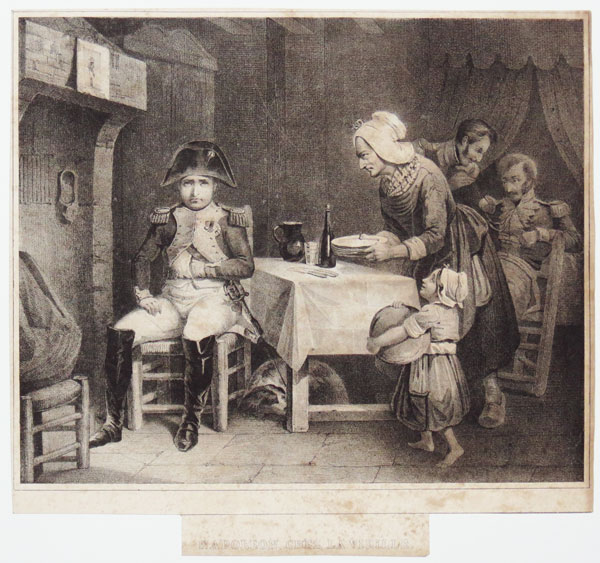
Napoléon ches la Vieille.
[n.d., c.1845.]
Lithograph. Sheet: 205 x 195mm (8 x 7¾"). Trimmed, foxing.
A scene showing Napoleon sitting in the kitchen of an old woman's home.
[Ref: 44723] £45.00
(£54.00 incl.VAT)

A Scene at Boulogna or Needs must when the Devil drives.
[Satirist 1 Nov 1811].
Etching and aquatint in sepia. Sheet 200 x 365mm (8 x 14¼"), paper watermarked 'Edmonds & Pi[ne] 1807.' Folds as issued. Trimmed on all but right side.
Plate from The Satirist, ix, p. 341. A shoreline scene shows Napoleon (1769-1821), sword drawn, forcing a marine forward by his long pigtail, commanding, ''Rascal—F—e, go fight dem dam English.'' The marine replies, ''Sire, me like fight men; dem English be Diables,'' and wears a shako, military tunic, trousers, and slippers. In the foreground, grenadiers with fixed bayonets drive a trembling naval officer and several sailors toward a ship’s boat, into which one sailor is already falling. The officer, reluctant and frightened, wears a feathered bicorne, carries a telescope, and declares, ''Allons à la Gloire!'' The sailors are rough figures in bonnets rouges, shirts, and trousers; three serve as boatmen, while two exclaim, ''Oh! by Gar! dey vill eat us all up,'' and ''Ah mon dieu.'' On the horizon, two British ships are firing, with a third standing by. BM Satires 11742.
[Ref: 67927] £140.00
(£168.00 incl.VAT)
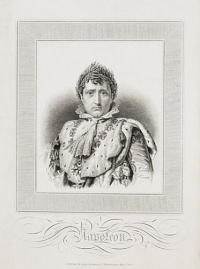
Napoleon.
W. Palmer Sculp.
Published by George Smeeton, 17, St. Martin's Lane, May 1st, 1819.
Stipple, rare. Sheet size: 395 x 270mm (15½ x 10½"). Trimmed within plate at three edges.
Emperor Napoleon Bonaparte (1769 - 1821) in full coronation robes, wearing the 'crown of Charlemagne'.
[Ref: 39048] £230.00
(£276.00 incl.VAT)

Le dernier élan d'un grand homme.
[n.d., 1815.]
Fine & scarce coloured etching, with watermark. 260 x 205mm (10¼ x 8"), large margins.
A theatrical scene of Napoleon Bonaparte leaping from the British warship Bellerophon (where he had surrendered after Waterloo) to the Northumberland (the ship that took him to St Helena. He soars over Henri Gatien, Comte Bertrand, who stands with a ladder and the accoutrements of empire, in a barge. Bertrand accompanied Napoleon into exile. BM Satires 12599, ''This print was entered in the 'dépôt légal' on 29 August 1815 and in the 'Bibliographie de France' on 2 September 1815 by Bournisien, who is yet to be identified''.
[Ref: 66178] £490.00

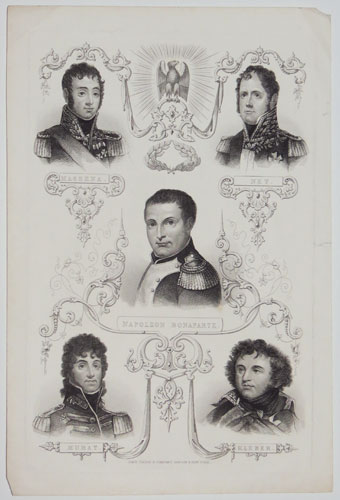
Napoleon Bonaparte. Messina. Ney. Murat. Kleber.
John Tallis & Company, London & New York. [n.d., c.1855.]
Steel engraving with small margins. 255 x 165mm (10 x 6½").
A head and shoulders portrait of Napoleon Bonaparte with four smaller portraits of his generals: Marshal André Masséna (17580817), out of favour by Napoleon's abdication, so survived the Restoration of the Bourbon monarchy; Marshal Michel Ney (17690815), executed for treason after Waterloo; Marshal Joachim-Napoléon Murat (17670815), Bonaparte's brother-in-law, executed in Italy; and General Jean Baptiste Kléber (17530800), assassinated in Cairo
[Ref: 36010] £45.00
(£54.00 incl.VAT)
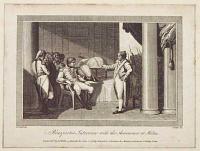
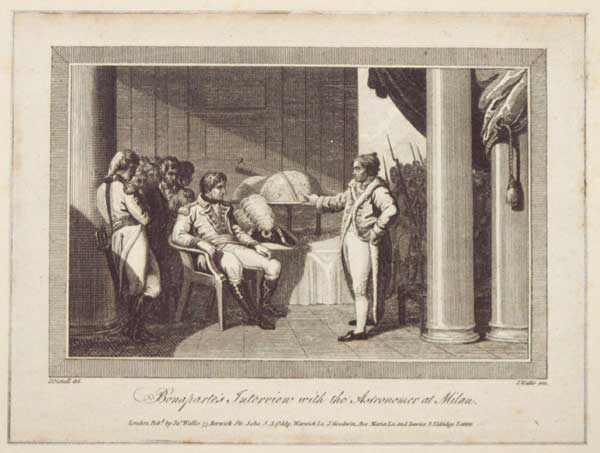
Bonaparte's Interview with the Astronomer at Milan.
J.Cristall del. J.Wallis sc.
London Pub.d by Ja.s Wallis 77 Berwick Str. Soho, S.A. Oddy, Warwick La. J.Goodwin Ave Maria La. and Davies & Eldridge Fore Street Exeter [n.d, c.1815].
Engraving with etching. Sheet 135 x 175mm (5¼ x 7"). Mounted in album paper.
Napoleon seated by a table, on which stand two globes and a telescope; listening to the astronomer who stands, pointing to a globe. The original scene was a propaganda piece, promoting Napoleon as a patron of the Sciences.
[Ref: 55740] £75.00
(£90.00 incl.VAT)
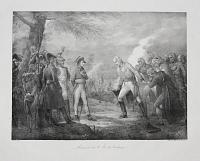
Armistice avec le Roi de Sardaigne.
Grenier del. Lith: de C. Motte. R. des marais.
[n.d. c.1826.]
Lithograph. Sheet 444 x 596mm (17½ x 23½"). Uncut.
In 1799 King Charles Emmanuel IV was ousted from his territory of Piedmont by the French army, moving his court to Cagliari. Published in A.V. Arnault's 'Vie politique et militaire de Napoléon', Paris, 1822-1826.
[Ref: 30803] £190.00
(£228.00 incl.VAT)
![[Napoleon I. A St Helene.]](img-thumbnail/jpegs/68489.jpg)
[Napoleon I. A St Helene.] [vue prise le long de la plage, au moment de sa sortie du 6 Mai 1821.]
[Lith. de Lemercier.]
[Paris, chez Jeannin rue du Croissant No.20] [London published by Ch. Tilt N.o 86 Fleet Street] [n.d. c.1829]
Very fine hand-coloured lithograph, sheet 465 x 325mm (18¼ x 13"). Trimmed losing title and publication line. Repaired tears.
Full-length portrait of Napoleon Bonaparte (1769-1821), in uniform, standing on a cliff, in exile in Saint Helena.
[Ref: 68489] £290.00
(£348.00 incl.VAT)
Unfortunately this item is either sold or reserved. If you are interested in similar items and cannot find what you're looking for on our website, please consider filling in our interests form. If you register, we can also send you items that match your interests when the website is updated.
![[Birth of Napoleon.]](img-thumbnail/jpegs/40365.jpg)
[Birth of Napoleon.] Naissance de Bonaparte [in ms below].
[Anon., c.1810]
Etching with hand-colouring, 80 x 80mm (3 x 3"). Trimmed to image and glued to backing sheet.
[Ref: 40365] £60.00
(£72.00 incl.VAT)

Bony's Visions or a great little man's night comforts.
The Caricaturist General fecit.
Published for the Satirist Sept.r 1.st 1811.
Etching, J. Whatman 1808 watermark, sheet 200 x 345mm (8 x 13½"). Trimmed within plate. Folds as issued.
Plate from the 'Satirist', ix. 165. Napoleon (1769-1821) jumps out of a canopied bed (left) while wearing a nightshirt, scared of the goblins, demons, and ghosts that loom around him. "Duroc, Savory, Roustan, aux armes aux armes," he cries in terror as he holds a dagger and has two pistols hidden beneath his pillow. Beside him, sleeping, is Marie Louise (1791-1847). Above his head, a massive imperial eagle with a crown and a sword declares, "Wretch I leave thee for ever." A demon (left) is nursing Napoleon's (1811-1832) son while perched on a stool, saying, "Dear Image of my darling Nap, / Suck milk of Hell instead of pap." The child's head resembles Napoleon's, and he is wearing the iron crown of Italy. His visions face Napoleon. Clouds sprout the heads and shoulders of ghosts, uttering phrases such as "I am D'Enghien, the blood of your King," "Remember Captain Wright," "I am Pichegru," and "I am George" in that order from left to right. Above them a Turk rides on the horizontal and elongated body of a French Grenadier, whose head is a skull, and who says: "I am one of your own Soldiers poisoned in the Hospitals of Egypt." "We are the Turkish Prisoners murdered at Jaffa the head of another Turk says, emerging from the mouth of the first one. "I am Toussaint," a monstrous bird with an African head declares driven toward Napoleon by a demoniac quasi-human being with two heads and one set of wings. Above, a head with the words "I am Palm" is framed by an open book, and two hands—palms—protrude from behind the book. A demon is sitting on the skinny man's back on the floor in front of the bed, slicing a heart with a knife, and he is holding up a placard that reads, "Morning Post—Courier [two ministerial papers]—Peltier—Ambigu Satirist—Gilray's Caricatures&c &c &c." with delight. In the centre a huge monster with a quasi-human profile above a massive, fanged mouth that is spewing demonic creatures and a leg that resembles a bird. A coffin with the letter’s "N" and a crown next to the bed has two birds—an owl and a stork—and a rat on it. Nestled on the bed curtain, an antlered imp is poised to use its wand to remove the crown atop Napoleon's nightcap. This skeleton is above. There are bones and skulls in the foreground. Napoleon is shown a vision from a flying cherub on the right, which says, "Napoleon, lo! Britannia still enjoys the blessings of the Constitution—Surrounded by Liberty, Commerce, and Plenty, supported by her heroes—and attended by public felicity, She defies thy machinations!" This allegorical group is on a dais to which lead steps inscribed 'Wellington', 'Graham', [and] 'Beresford'. This allegorical group is situated on a dais with the words "Wellington," "Graham," and "Beresford" inscribed on lead steps. Beneath an architectural canopy with the inscription 'G III Rex,' Britannia sits with her lion at her side. Wearing a Roman helmet, Liberty raises the cap of Liberty; Commerce and Plenty are symbolized by a figure holding a caduceus and cornucopia, with Public Felicity placing a protective arm around each. BM Satires 11736.
[Ref: 62418] £220.00
(£264.00 incl.VAT)
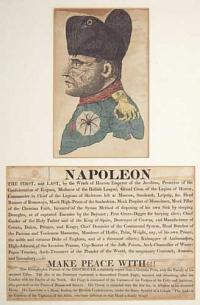
Napoleon. The First, and Last, by the Wrath of Heaven Emperor of the Jacobins, Protector of the Confederation of Rogues, Mediator of the Hellish League, Grand Cross of the Legion of Horror, Commander in Chief of the Legions of Skeletons left at Moscow, Smolensk, Leipzig, &c., Head Runner of Runaways, Mock High-Priest of the Sanhedrim, Mock Prophet of Mussulmen, Mock Pillar of the Christian Faith, Inventor of the Syrian Method of disposing of his own Sick by sleeping Draughts, or of captured Enemies by the Bayonet; First Grave-Digger for burying alive; Chief Gaoler of the Holy Father and of the King of Spain, Destroyer of Crowns, and Manufacturer of Counts, Dukes, Princes, and Kings; Chief Douanier of the Continental System, Head Butcher of the Parisian and Toulonese Massacres, Murderer of Hoffer, Palm, Wright, nay, of his own Prince the noble and virtuous Duke of Enghien, and of a Thousand others; Kidnapper of Ambassadors, High-Admiral of the Invasion Praams, Cup-bearer of the Jaffa Poison, Arch-Chancellor of Waste-Paper Treaties, Arch-Treasurer of the Plunder of the World, the Sanguinary Coxcomb, Assassin, and Incendiary......to / MAKE PEACE WITH !!! / This Hieroglyphic Portrait of the DESTROYER is faithfully copied from a German Print, with the parody of his assumed titles. The Hat of the Destroyer represents a discomfited French Eagle, maimed and crouching, after his Conflict with the Eagles of the North. His Visage is composed of the Carcases of the Victims of his Folly and Ambition, who perished on the Plains of Russia and Saxony. His Throat is encircled with the Red Sea, in Allusion to his drowned Hosts. His Epaulette is a Hand, leading the Rhenish Confederation, under the flimsy Symbol of a Cobweb. The Spider is an Emblem of the Vigilance of the Allies, who have inflicted on That Hand a deadly Sting!'
[After Johann Michael Voltz, Harrison & Leigh Printers, 375 Strand.]
Published at R. Ackermann's, 101, Strand, London [n.d., c.1811].
Rare coloured etching and letterpress. Sheet 485 x 300mm (19 x 11¾"), paper watermarked 'J Whatman 1811'. Damaged and cut with some loss.
An important piece of anti-Napoleon propaganda, featuring a composite portrait made up of details of Bonaparte's 'sins', with explanatory letterpress underneath. Based on a print by Johann Michael Voltz, it is one of the most widespread depictions of Napoleon. Versions were produced in nine European countries, twenty-three in Germany alone. BM Satires 12002. See Ref: 55852
[Ref: 55808] £350.00
![[Broadside against Napoleon]](img-thumbnail/jpegs/66444.jpg)
[Broadside against Napoleon] Second Edition. An Address To those Brave, Gallant, and Loyal Hearts, the Commanders, Officers, Seamen, and Marines, of The British Navy [...]
[c.1803] London: Printed for J. Asperne, (Successor to Mr. Sewell,) at the Bible, Crown, and Constitution, No. 32, Cornhill; by J. Gold, Shoe-Lane; Price One Penny, or 6s. the 100 and 9d. per Dozen.
Letterpress, sheet 375 x 245mm (14¾ x 9½").
Broadside published at the time when fears of an invasion of the British Isles by Napoleon were at their height, addressing sailors to prepare them for invasion: 'British Seamen! At this important crisis you have arduous duties to perform: you must submit to many privations, and encounter many hardships and dangers [...] every Tar who has a Sweetheart on shore, or a Wife, or a Daughter, or a Sister that is dear to him, must feel how much it is his interest and duty to make every exertion in his power, to defeat the infamous designs of the enemy, and to hold all danger trifling, and all labour cheap, which may conduce to place these tender and valued connections in a state of security'. Reprinted from the 'Naval Chronicle' magazine. The publisher James Asperne (1757-1820) was best-known for publishing the popular 'European Magazine'. A note at the end suggests: 'Noblemen, Magistrates, and Gentlemen, residing near the Coast, would do well by ordering a few Dozen of the above of their Booksellers, and causing them to be stuck up in their respective Vicinities, and distributed amongst the Sailors.'
[Ref: 66444] £350.00
![[Broadside against Napoleon]](img-thumbnail/jpegs/33282.jpg)
[Broadside against Napoleon] James Asperne Reprints the following Resolutions of the Inhabitants of the Parish of St. Mary Lambeth, held at the Royal Oak, Vauxhall, July 26th, 1803, Robert Slade, Esq. in the Chair, from a Conviction of their Utility at the present important Critis, and that he may have an Opportunity of dispersing them with his other loyal Papers, which he has already circulated to the amount of nearly 300,000 in Number. [...] Robert Slade, Chairman.
[c.1803] London: Printed for J. Asperne, (Successor to Mr. Sewell,) at the Bible, Crown, and Constitution, No. 32, Cornhill, by T. Maiden, Sherbourn-Lane;1 Price One Penny, or 6s the 100.
Letterpress, sheet 445 x 280mm (17½ x 11"). On laid paper watermarked 1802.
Broadside published at the time when fears of an invasion of the British Isles by Napoleon were at their height. The text publishes resolutions made at a meeting of inhabitants of St. Mary Lambeth (the parish stretching along the south of the Thames from Vauxhall to Waterloo), that in the face of possible invasion, all able-bodied residents of the parish must enrol to assist in the defence of their country. The wider application of the broadside was both to serve as an example to other parishes for increasing enrolment, and to defame Napoleon (much of the text consists of allegations of attrocities and tyrannical acts carried out by the consul). A note at the bottom of the sheet suggests 'Noblemen, Magistrates, and Gentlemen, would do well by ordering a few Dozen of the above Tracts of their different Booksellers, and causing them to be stuck up in the respective Villages where they reside, that the Inhabitants may be convinced of the Cruelty of the Corsican Usurper.' The publisher James Asperne (1757-1820) was best-known for publishing the popular 'European Magazine'.
[Ref: 33282] £250.00
(£300.00 incl.VAT)
![[Broadside against Napoleon]](img-thumbnail/jpegs/33276.jpg)
[Broadside against Napoleon] The Duke of Shoreditch, or, Barlow's Ghost. / Countrymen: After my Spirit had rested in peace more than two hundred years, I was, in a manner, called from my grave by a report in circulation, that the French intended to invade the now United Kingdoms of England and Ireland [...]
London: Printed for J. Asperne, Successor to Mr. Sewell, at the Bible, Crown, and Constitution, No. 32, Cornhill, by T. Maiden. [Price 1d. or 6s. the 100.] August 10th, 1803.
Letterpress. Sheet 445 x 270mm (17½ x 10½"), with 1802 watermark. Creasing on right.
Broadside published at the time when fears of an invasion of the British Isles by Napoleon were at their height. This broadside, essentially a call for increased participation in the volunteer corps, is voiced by the ghost of a Shoreditch shopkeeper, aroused from his peace by rumours of the planned invasion. The ghost is initially confident of the Britons' ability to repel the French, but soon finds that 'the exercise of Arms had been long laid aside, except upon particular emergencies' and fears that the country will be overrun unless military participation is strengthened. Contains references to Finsbury, Clerkenwell and Shoreditch. The publisher James Asperne (1757-1820) was best-known for publishing the popular 'European Magazine'.
[Ref: 33276] £350.00
![[Broadside against Napoleon]](img-thumbnail/jpegs/33287.jpg)
[Broadside against Napoleon] Substance of the Speech of Jacob Bosanquet, Esq. At the Royal Exchange, July the 26th, 1803
[1803] Printed for J. Asperne (Successor to Mr. Sewell,) at the Bible, Crown, and Constitution, No. 32, Cornhill; by W. Lane, Leadenhall Street. Price One Penny each, or 6s the 100 / Where may be had, at the same Price, Sheridan's Address to the People. Also a Collection of all the Loyal Papers that have been and will be Published.
Letterpress, sheet 435 x 280mm (17 x 11"). Creasing lower right.
Broadside published at the time when fears of an invasion of the British Isles by Napoleon were at their height, taken from a speech by Jacob Bosanquet (1755-1828), who was Chairman of the East India Company in 1803. This speech, made at an assembly of commercial interests, calls for the solidarity of those present with British interests, and to'unite in an unanimous declaration to stand or fall with our Country and our King'. Bosanquet compares Britain with Ancient Rome and Constantinople, and sees the Sack of those cities as examples to be avoided, of how even great cities can fall through inadequate vigilance. A note at the bottom of the sheet suggests 'Noblemen, Magistrates, and Gentlemen, would do well by ordering a few Dozen of the above Tracts of their different Booksellers, and causing them to be stuck up in the respective Villages where they reside, that the Inhabitants may be convinced of the Cruelty of the Corsican Usurper.' The publisher James Asperne (1757-1820) was best-known for publishing the popular 'European Magazine'.
[Ref: 33287] £250.00
(£300.00 incl.VAT)
![[Broadside against Napoleon]](img-thumbnail/jpegs/33281.jpg)
[Broadside against Napoleon] "Britons never will be Slaves!!!" / An Address To every Loyal Briton on the threatened Invasion of his Country. / When Rome's proud Legions fought the Albion Shore,/ To give insatiate Pow'r one Trophy more,/ The hardy Britons scorn'd to basely fly,/ Determined to repel the Foe, or die [...] W.T. Fitzgerald
[c.1803] London: Printed for J. Asperne, (Successor to Mr. Sewell,) at the Bible, Crown, and Constitution, No. 32, Cornhill, by T. Maiden, Sherbourn-Lane;1 Price One Penny, or 6s the 100.
Letterpress, sheet 370 x 250mm (14½ x 9¾"). On laid paper watermarked 1802.
Broadside published at the time when fears of an invasion of the British Isles by Napoleon were at their height, recounting British bravery in the face of invasion from the Romans and the Spanish Armada as evidence that any French invasion would inevitably fail. The poem was written by William Thomas Fitzgerald (1759-1829). Fitzgerald specialised in patriotic verses of this kind, and in 1814 published a collected edition of his many verses against Napoleon. A note at the bottom of the sheet suggests 'Noblemen, Magistrates, and Gentlemen, would do well by ordering a few Dozen of the above Tracts of their different Booksellers, and causing them to be stuck up in the respective Villages where they reside, that the Inhabitants may be convinced of the Cruelty of the Corsican Usurper.' The publisher James Asperne (1757-1820) was best-known for publishing the popular 'European Magazine'.
[Ref: 33281] £350.00
![[Broadside against Napoleon]](img-thumbnail/jpegs/33274.jpg)
[Broadside against Napoleon] Britons Triumph or Bonapartes Knell / Come, with all thy slaves around thee,/ Bonaparte! haughty foe!/ This little Island shall confound thee,/ And lay thy giant projects low [...]
[c.1803] A. Hamilton Printer 221 Piccadilly
Letterpress, sheet 395 x 250mm (15½ x 9¾"). Creasing upper left; paper watermarked 'Neckinger Mill 1800'
Broadside published at the time when fears of an invasion of the British Isles by Napoleon were at their height. This ballad lists Napoleon's triumphs and atrocities on the continent and in the Middle East, but insists that any attempted invasion of Britain would be unsuccessful.
[Ref: 33274] £300.00
![[Broadside against Napoleon]](img-thumbnail/jpegs/33292.jpg)
[Broadside against Napoleon] Countrymen! / The City of Syracuse (in Sicily) had maintained a successfull Contest with the Carthaginians; lulled into Security, however, by an advantageous Peace, she had reduced her Fleets and Armies, and the Carthaginians, who still retained their Envy and Hatred of her, seized the Opportunity to renew the War [...]
[c.1803] London: Printed for J. Hatchard, 190, Piccadilly. Price One Shilling per Dozen. [Hales, Printer, Old Boswell Court, London.
Letterpress, sheet 555 x 450mm (21¾ x 17¼"). Folds and creases; paper tone; on laid paper with fleur-de-lys watermark.
Large broadside published at the time when fears of an invasion of the British Isles by Napoleon were at their height. It reprints a passage from Act1, Scene 3 of Philip Massinger's play 'The Bondman' (c.1624), a play which concerns the siege of Syracuse by the Carthaginians. The general Timoleon's call to arms is here used to encourage Britons to show similar bravery. The text concludes 'it is needless to mention what followed this animating Debate. A Part of the Enemy fleet was sunk at Sea, those that landed were immediately put to the Sword, and their Commander slain. Published by John Hatchard (1768-1849), who founded the Piccadilly bookseller still thriving over two hundred years on.
[Ref: 33292] £450.00
![[Broadside against Napoleon]](img-thumbnail/jpegs/33288.jpg)
[Broadside against Napoleon] Address to the People of Great Britain. By W.J. Denison, Esq.
[1803] Printed for J. Asperne (Successor to Mr. Sewell,) at the Bible, Crown, and Constitution, No. 32, Cornhill; by W. Lane, Leadenhall Street. Price One Penny each, or 6s the 100 / Where may be had, at the same Price, Sheridan's Address to the People. Also a Collection of all the Loyal Papers that have been and will be Published.
Letterpress, sheet 455 x 280mm (18 x 11"). Creasing.
Patriotic poem published at the time when fears of an invasion of the British Isles by Napoleon were at their height, by William Joseph Denison (1770-1849), banker and politician, and a founder of the Reform Club. Like several other 'loyal Papers' of the time, it invokes historical precedents such as conflicts with the Romans and Spanish, as well as past and present British military and naval heroes such as Marlborough, Duncan, St. Vincent, and Nelson. A note at the bottom of the sheet suggests 'Noblemen, Magistrates, and Gentlemen, would do well by ordering a few Dozen of the above Tracts of their different Booksellers, and causing them to be stuck up in the respective Villages where they reside, that the Inhabitants may be convinced of the Cruelty of the Corsican Usurper.' The publisher James Asperne (1757-1820) was best-known for publishing the popular 'European Magazine'.
[Ref: 33288] £250.00
(£300.00 incl.VAT)

A Second Dialogue between Buonaparte and John Bull / Scene---Calais Buonaparte. How do you do, Monsieur Anglois? / John. What's that to you? / Buon. Nay, John, don't be angry. / John. Angry! I am angry, and I will be angry [...]
[c.1803] London: Printed for J. Hatchard, No. 190, Piccadilly. Price Sixpence per Dozen. [Hales, Printer, Old Boswell Court, London.
Rare letterpress with large margins, and 18th century watermark; sheet 555 x 445mm (21¾ x 17½"). Folds and creases.
Large broadside published at the time when fears of an invasion of the British Isles by Napoleon were at their height, in the form of a dialogue between Napoleon and John Bull (representing Britain). Napoleon is calm and complacent about his achievements, where John Bull angrily disputes these as a sacrifice of 6000 men (the Battle of Lodi); a massacre (the Battle of Alexandria), and poisoning the French army's injured soldiers. The 'scene' is Calais, a common point for channel crossings previously depicted in Hogarth's similarly anti-Gallican 'The Calais Gate'. Published by John Hatchard (1768-1849), who founded the Piccadilly bookseller still thriving over two hundred years on.
[Ref: 66445] £450.00
![[Broadside against Napoleon]](img-thumbnail/jpegs/33272.jpg)
[Broadside against Napoleon] A Peep into Hanover; or, A faint Description of the Atrocities committed by the French in that City. [...]
Britannicus.
[1803] Printed for J. Ginger, No. 169, Piccadilly / Price Sixpence per Dozen, for Distribution. / W. Marchant, Printer, 3, Greville-Street, Holborn.
Letterpress, sheet 435 x 280mm (17 x 11"). Creasing to edges; hole upper right.
Broadside published at the time when fears of an invasion of the British Isles by Napoleon were at their height. This one reports attrocities committed in Hanover by Napoleon's army, 'such are the Gangs of ferocious Banditti, whom the Murderer of Jaffa let loose on the civilized World! Such, and ten thousand times worse, is the Fate prepared for England, if the valour of her people do not avert it'.
[Ref: 33272] £390.00
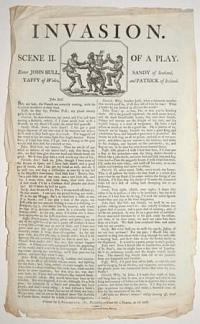
Invasion. Scene II of a Play. Enter John Bull, Sandy of Scotland, Taffy of Wales, and Patrick of Ireland.
Printed for J. Stockdale, 181, Piccadilly S. Gosnell, Printed, Little Queen Street, Holborn.
London, 1803.
Letterpress. Sheet 425 x 270mm (16¾ x 10¾"). Left, right and lower edges are folded. Slight horizontal fold across centre with small tears at either side, edges some creasing.
A broadside satirising the reactions of Great Britain to the threat of a French invasion, illustrated by characters representing Scotland, Wales, Ireland and England. The dialogue between the four characters is accompanied by a woodcut engraving by John Lee depicting four men in their respective national dress dancing in a circle. Published at a time when tensions were rising between Britain and France as Napoleon was amassing power and influence in Europe while undermining Britain. Great Britain declared war on France out of a 'mixture of economic motives and national neuroses'.
[Ref: 53949] £320.00
![[Broadside against Napoleon]](img-thumbnail/jpegs/53945.jpg)
[Broadside against Napoleon] Address to Irishmen Residing in England. / Fellow Countrymen, The Calamaties which have so lately threatened your native Country, by a few of your Bretheren being misled by the artful Designs of French Spies [...] suffer no the poisonous Language of the Enemies of their Country, however high in Rank, or the vain Promises of the designing Spies of a Corsican Usurper and Murderer [...]
An Irishman, and a Soldier. Craven Hotel, Strand, August 8, 1803.
John Ginger, No. 169, Piccadilly / W Glindon, Printer, 48, Rupert Street, Hay-Market
Letterpress, sheet 435 x 280mm (17 x 11"). Creasing and folds in each corner. Small tears along left and right margins.
Broadside published at the time when fears of an invasion of the British Isles by Napoleon were at their height. This one is specifically addressed to Irishmen resident in England, imploring them to 'be foremost on the Shores of your Island, in repelling a Barbarous and Ferocious Enemy, and save your Wives and Children from their Savage Lust and murderous Hands'. Mention of 'the patriotic Language of a Sheridan (that Ornament of his Country)' refers to Richard Brinsley Sheridan's (1751-1816) strong support of the volunteer corps in the face of Napoleon's imperial expansion. Includes a list of other 'patriotic publications' sold by John Ginger on Piccadilly, including 'Horrors upon Horrors' and 'Publicolia Addresses'. For Ginger's 'Publicolia Addresses' see refs. 10044 and 27538; for Sheridan see ref. 17993.
[Ref: 53945] £320.00
![[Broadside against Napoleon]](img-thumbnail/jpegs/33286.jpg)
[Broadside against Napoleon] The Bishop of Llandaff's Thoughts on the French Invasion, originally addressed to the Clergy of his Diocese.
[c.1803] Printed for J. Asperne, (Successor to Mr. Sewell,) at the Bible, Crown, and Constitution, No. 32, Cornhill, by S Rousseau, Wood Street, Spa Fields; Price One Penny, or 6s the 100 / Where may be had, at the same Price, Sheridan's Address to the People. Also a Collection of all the Loyal Papers that have been and will be Published.
Letterpress, sheet 390 x 255mm (15¼ x 10"). Crease top right.
Broadside published at the time when fears of an invasion of the British Isles by Napoleon were at their height, extracted from 'A Charge delivered to the Clergy of the Diocese of Llandaff, in June, 1798, by R. Watson, D.D. F.R.S. Bishop of Llandaff'. Watson's thoughts are addressed to any sympathisers with the French cause: 'I would say to the most violent Democrat in the kingdom,- Suppose the business done: after Seas of Blood have been shed, Millions of Lives lost, Towns plundered, Villages, burned, the Royal Family exterminated, and unutterable calamity has been endured by persons of all ranks:- after all this has been done, what Advantages will you have obtained beyond what you now possess [?]'. A note at the bottom of the sheet suggests 'Noblemen, Magistrates, and Gentlemen, would do well by ordering a few Dozen of the above Tracts of their different Booksellers, and causing them to be stuck up in the respective Villages where they reside, that the Inhabitants may be convinced of the Cruelty of the Corsican Usurper.' The publisher James Asperne (1757-1820) was best-known for publishing the popular 'European Magazine'.
[Ref: 33286] £220.00
(£264.00 incl.VAT)
![[Broadside against Napoleon]](img-thumbnail/jpegs/33277.jpg)
[Broadside against Napoleon] Loyal Songs. / The Voice of the British Isles [&] The True Briton.
[c.1803] London: Printed for J. Asperne, [Successor to the late Mr. Sewell], at the Bible, Crown, and Constitution, No. 32, Cornhill, by W. Lane. [Price One Penny, Ninepence per Dozen, or Six Shillings per Hundred.]
Letterpress, sheet 410 x 265mm (16 x 10½").
Broadside published at the time when fears of an invasion of the British Isles by Napoleon were at their height, consisting of two songs adapted to popular tunes, proclaiming British readiness for any invasion. The publisher James Asperne (1757-1820) was best-known for publishing the popular 'European Magazine'.
[Ref: 33277] £250.00
(£300.00 incl.VAT)
![[Broadside against Napoleon] No. 2](img-thumbnail/jpegs/33278.jpg)
[Broadside against Napoleon] No. 2 Loyal Songs. / The Briton's Song [&] Song of the Highland Armed Association.
London: Printed for J. Asperne, [Successor to the late Mr. Sewell], at the Bible, Crown, and Constitution, No. 32, Cornhill, by S. Rousseau. Price One Penny, or 6s the 100. August 12, 1803
Letterpress, sheet 385 x 270mm (15¼ x 10½"), with 1803 watermark.
Broadside published at the time when fears of an invasion of the British Isles by Napoleon were at their height, consisting of two songs adapted to popular tunes, proclaiming British readiness for any invasion. 'The Briton's Song' contrasts Revolutionary France with British rule: 'Our Forefathers bled on the Scaffold and Plain/ T'establish a Government wise, just and pure;/ We'll defend it till Death, and reject with disdain/ One that scarce for a Day or an Hour can endure./ Shall your fam'd Guillotine. In Old England be seen?/ No!- we mean to live happy, while frantic you sing/ Your fam'd 'Ca Ira',/ And Hymn 'Marsellois',/ For the true Briton's Song shall be "God save the King." The 'Song of the Highland Armed Association' is specifically Scottish in its theme and references. A note at the bottom of the sheet suggests 'Noblemen, Magistrates, and Gentlemen, would do well by ordering a few Dozen of the above Tracts of their different Booksellers, and causing them to be stuck up in the respective Villages where they reside, that the Inhabitants may be convinced of the Cruelty of the Corsican Usurper.' The publisher James Asperne (1757-1820) was best-known for publishing the popular 'European Magazine'.
[Ref: 33278] £250.00
(£300.00 incl.VAT)
![[Broadside against Napoleon]](img-thumbnail/jpegs/33285.jpg)
[Broadside against Napoleon] Proclamation, Made to every Man in the United Kingdom of Great Britain and Ireland, this First Day of August, in the Year of our Lord One Thousand Eight Hundred and Three, and in the Forty-fourth Year of the Reign of our especially dear Son King George The Third [...]
[1803] London: Printed for J. Asperne, Successor to Mr. Sewell, at the Bible, Crown, and Constitution, No. 32, Cornhill, by J. and E. Hodson. [Price 1d. each, or 6s. the 100] / Where may also had, A Collection of all the Loyal Papers that have been and will be Published.
Letterpress, sheet 310 x 195mm (12¼ x 7¾"). On laid paper watermarked 'C Badd 1799'
Broadside published at the time when fears of an invasion of the British Isles by Napoleon were at their height, stating the risk posed by Napoleon, the 'Murder, Rapine, Slavery and Death, in Cruel and horrible Wantonness' he has committed, and the duty of the British to assist in the defence of their country. The publisher James Asperne (1757-1820) was best-known for publishing the popular 'European Magazine'.
[Ref: 33285] £220.00
(£264.00 incl.VAT)
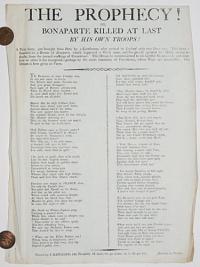
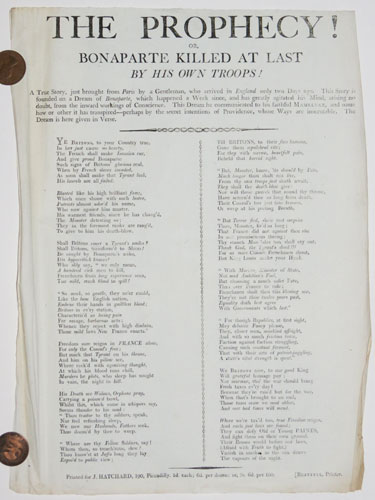
The Prophecy! or, Bonaparte Killed at Last by his Own Troops! A True Story, just brought from Paris [...] This Story is founded on a Dream of Bonaparte [...] The Dream is here given in Verse. [...]
[1803] Printed for J. Hatchard, 190, Piccadilly. 1d. each; 6d. per dozen; or, 3s. 6d. per 100. [Brettell, Printer]
Letterpress, sheet 425 x 315mm (16¼ x 12½"). Creasing on left.
Broadside published at the time when fears of an invasion of the British Isles by Napoleon were at their height. This ballad prophesises Napoleon's death in the wake of an unsuccessful invasion of Britain. As in other broadsides of the period, Napoleon's alleged killing of his own injured soldiers at Jaffa is invoked as evidence of his treachery. In the aftermath, the new rule of France is imagined: 'no more Consuls, Frenchmen shout,/ But King Louis make your Head. / With Moreau, Minister of State,/ Not made Ambition's Fool,/ But choosing a much safer Fate,/ Than over France to rule'. Victor Moreau was forced into exile in the United States by his opposition to Napoleon. The final verses defend Britain's monarchy (with a reference to the revolutionary, Thomas Paine) and the high taxes during the war as a temporary measure necessary to combat Napoleon. Published by John Hatchard (1768-1849), who founded the Piccadilly bookseller still thriving over two hundred years on. For a contemporary portrait of Moreau, see ref. 28221.
[Ref: 33275] £350.00
![[Broadside against Napoleon]](img-thumbnail/jpegs/55836.jpg)
[Broadside against Napoleon] Twenty Thousand Pounds Reward / Middlesex (to wit) / To all Constables [...] / Whereas a certain ill-disposed Vagrant, and common Disturber, commonly called or known by the Name of Napoleon Bonaparte, alias Jaffa Bonaparte, alias Opium Bonaparte [...]
[c.1803] London: Printed for S. Highley, No. 24, Fleet-Street; by B. McMillan, Bow-Street, Covent-Garden (price 1d. or 9d. per dozen). Where may be had Bonaparte; or, The Freebooter; a Patriotic Drama, price One Shilling.
Letterpress, sheet 415 x 260mm (16¼ x 10¼"). Some creasing and small tear on right.
One of many popular broadsides published at the time when fears of an invasion of Britain by Napoleon were at their height. This one offers a reward for the capture of Napoleon, with the aim being to imprison him at the Exeter Change menagerie in the Strand, 'placed in a Certain Iron Cage, with the Ouran Outang, or some other ferocious and voracious animal like himself, for the purpose of being tamed'. To facilitate identification of the French leader, a description of his appearance is provided ('...resembles a great deal in person a Bear-leader, or one of the Savoyards who play on the reeds at Vauxhall') while the stream of 'aliases' given for him (Jaffa Bonaparte, Acre Bonaparte etc) refer to earlier actions in the Napoleonic Wars. According to Ashton, this broadside was 'printed with different headings, so as to sell in different countries'. John Ashton, 'English caricature and satire on Napoleon I'
[Ref: 55836] £250.00
(£300.00 incl.VAT)
![[Broadside against Napoleon]](img-thumbnail/jpegs/53943.jpg)
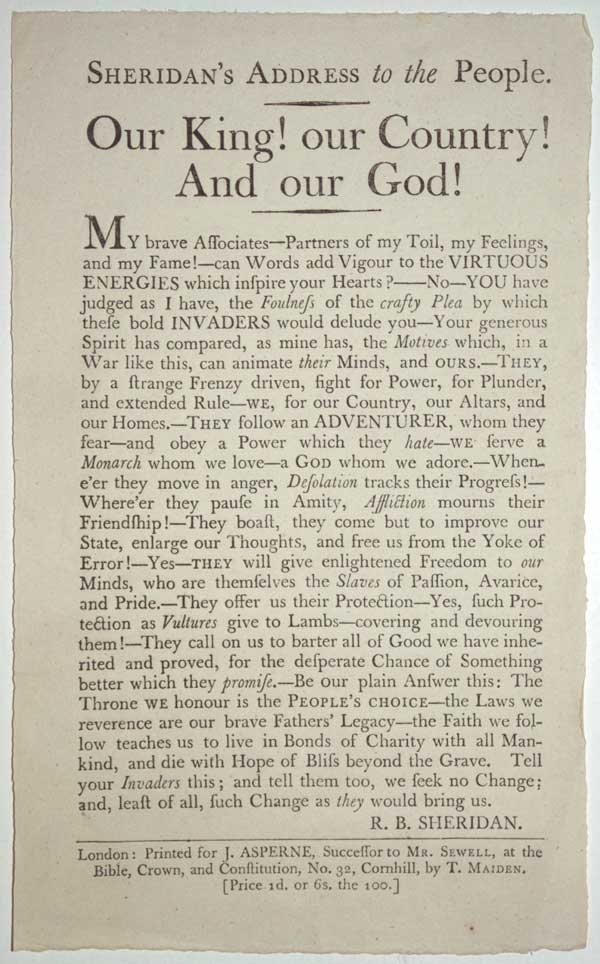
[Broadside against Napoleon] Sheridan's Address to the People. Our King! our Country! And our God!
[c.1803.] London: Printed for J. Asperne, (Successor to Mr. Sewell,) at the Bible, Crown, and Constitution, No. 32, Cornhill, by T. Maiden, Sherbourn-Lane;1 Price One Penny, or 6s the 100.
Letterpress, sheet 355 x 210mm (14 x 8¼"). Fold in both top and bottom right corners.
Broadside published at the time when fears of an invasion of the British Isles by Napoleon were at their height. Richard Brinsley Sheridan (1751-1816), Irish playwright and politician, wrote 'Pizarro', a play adapted from August von Kotzebue's 'Die Spanien in Peru', which premiered in 1799. Sheridan's play addressed both fears of French invasion and supported the revolutionary aims of the United Irishmen. This 'address to the people' is an amalgamation of several speeches from 'Pizarro', contrasting French and British principles as incompatible. The publisher James Asperne (1757-1820) was best-known for publishing the popular 'European Magazine'. Many of his other broadsides published at this time mention that Sheridan's Address can be purchased from him, demonstrating its great popularity. For 'Pizarro', see refs. 11533 and 17165; for Sheridan see ref. 17993.
[Ref: 53943] £320.00
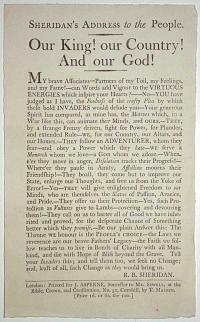
Sheridan's Address to the People. Our King! our Country! And our God!
[c.1803.] London: Printed for J. Asperne, (Successor to Mr. Sewell,) at the Bible, Crown, and Constitution, No. 32, Cornhill, by T. Maiden, Sherbourn-Lane;1 Price One Penny, or 6s the 100.
Letterpress, sheet 340 x 210mm (13½ x 8¼").
Broadside published at the time when fears of an invasion of the British Isles by Napoleon were at their height. Richard Brinsley Sheridan (1751-1816), Irish playwright and politician, wrote 'Pizarro', a play adapted from August von Kotzebue's 'Die Spanien in Peru', which premiered in 1799. Sheridan's play addressed both fears of French invasion and supported the revolutionary aims of the United Irishmen. This 'address to the people' is an amalgamation of several speeches from 'Pizarro', contrasting French and British principles as incompatible. The publisher James Asperne (1757-1820) was best-known for publishing the popular 'European Magazine'. Many of his other broadsides published at this time mention that Sheridan's Address can be purchased from him, demonstrating its great popularity. For 'Pizarro', see refs. 11533 and 17165; for Sheridan see ref. 17993.
[Ref: 55835] £320.00
![[Broadside against Napoleon]](img-thumbnail/jpegs/33279.jpg)
[Broadside against Napoleon] Song, to the Tune of Mother Casey. / The French, tis said,/ Are thieves by trade,/ And well they fill the function;/ For where they go,/ Both friend and foe,/ They rob without compunction [...]
[c.1803.] London: Printed for J. Asperne, (Successor to Mr. Sewell,) at the Bible, Crown, and Constitution, No. 32, Cornhill, by T. Maiden, Sherbourn-Lane;1 Price One Penny, or 6s the 100.
Letterpress, sheet 340 x 210mm (13½ x 8¼").
Songsheet published at the time when fears of an invasion of the British Isles by Napoleon were at their height. The song encourages strong British resistance, referencing French actions in Switzerland and Holland and their supposed plans 'to land their troops at Dover'. Napoleon is compared to Robespierre. Napoleon, it says, is praised now as Robespierre once was, but if Napoleon were to be executed, 'With general voice,/ Would France rejoice,/ And set the bells a-ringing'. A note at the bottom of the sheet suggests 'Noblemen, Magistrates, and Gentlemen, would do well by ordering a few Dozen of the above Tracts of their different Booksellers, and causing them to be stuck up in the respective Villages where they reside, that the Inhabitants may be convinced of the Cruelty of the Corsican Usurper.' The publisher James Asperne (1757-1820) was best-known for publishing the popular 'European Magazine'.
[Ref: 33279] £250.00
(£300.00 incl.VAT)
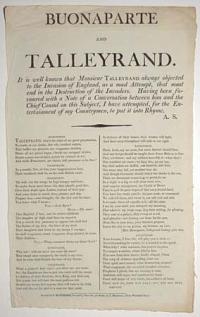
Buonaparte and Talleyrand. It is well known that Monsieur Talleyrand always objected to the Invasion of England, as a mad Attempt, that must end in the Destruction of the Invaders. Having been favoured with a Note of a Conversation between him and the Chief Consul on this Subject, I have attempted, for the Entertainment of my Countrymen, to put it into Rhyme. A.S.
[c.1803] Printed for J. Hatchard, Piccadilly, Price 6d. per dozen, by J.Brettell, Great Windmill Street.
Letterpress, sheet. 440 x 260mm (17 x 10¼"). Creasing across the sheet.
Broadside published at the time when fears of an invasion of the British Isles by Napoleon were at their height. This imagined dialogue presents the diplomat Talleyrand as opposing a planned invasion by Napoleon, who foresees that 'In a night or a fog we will silent steal over,/ And surprize unexpected, the Castle of Dover'. Talleyrand negotiated a short-lived peace in Europe, but was unable to prevent the renewal of hostilities in 1803. With his influence diminishing, and Napoleon's ambition seemingly insatiable, Talleyrand resigned from his role as grand chamberlain in 1807. Published by John Hatchard (1768-1849), who founded the Piccadilly bookseller still thriving over two hundred years on. For a contemporary portrait of Talleyrand, see ref. 28220
[Ref: 53944] £300.00
![[Broadside against Napoleon]](img-thumbnail/jpegs/33283.jpg)
[Broadside against Napoleon] Union and Watchfulness, Britain's True and Only Security. / A few words to every British Subject inculcating this very important idea.
[c.1803] London: Printed for J. Asperne, (Successor to Mr. Sewell,) at the Bible, Crown, and Constitution, No. 32, Cornhill, Price One Penny, or Six Shillings per Hundred; and may be had of the Booksellers, at the West-End of the Town, &c. &c. Page, Printer, Black Friars Road.
Letterpress, sheet 385 x 260mm (15¼ x 10¼"). On laid paper watermarked 1801.
Broadside published at the time when fears of an invasion of the British Isles by Napoleon were at their height, imploring all Britons to take up arms to defend the country, if required. 'To suffer or to die in such a cause, is our first duty, and our highest honour'. The publisher James Asperne (1757-1820) was best-known for publishing the popular 'European Magazine'.
[Ref: 33283] £250.00
(£300.00 incl.VAT)

Concordat signé avec le Légat du Pape.
Champion del. Lith: de C. Motte.
[n.d. c.1826.]
Lithograph. Sheet 444 x 595mm (17½ x 23½"), with very large margins.
The Concordat of 1801, the agreement between Napoleon and Pope Pius VII, signed on 15 July 1801. It solidified the Roman Catholic Church as the majority church of France. Published in A.V. Arnault's 'Vie politique et militaire de Napoléon', Paris, 1822-1826.
[Ref: 30785] £220.00
(£264.00 incl.VAT)
![[Napoleon escaping from either Elba or Saint Helena, with titlepage to 'Vie secrète de Napoléon Bonaparte']](img-thumbnail/jpegs/44489.jpg)
[Napoleon escaping from either Elba or Saint Helena, with titlepage to 'Vie secrète de Napoléon Bonaparte']
[Anon., 1817]
Engraving, sheet 130 x 210mm (5 x 8¼"), with separate title page.
Hyperbolic, propagandising and partly allegorical depiction of Napoleon escaping, published while Napoleon was exiled on Saint Helena in a volume about his life. Offered with title page from the book.
[Ref: 44489] £120.00
(£144.00 incl.VAT)
![[The Fall of Napoleon.]](img-thumbnail/jpegs/55754.jpg)
[The Fall of Napoleon.]
[Painted by G. Wallis. Engraved by G. Zobel.]
[London, Published Jane 18th 1837, by J. McCormick, 147, Strand.]
Scarce & eare mezzotint. Sheet 320 x 265mm (12½ x 10½"). Trimmed within image, very damage, laid on old paper.
A scene outside the 'Waterloo Tavern' in 'Wellington Street'. A soldier and black figure smile at each other as the soldier trips up an Italian boy carrying on his head a board on which is balanced a statue of Napoleon that is about to crash to the ground. A church can be seen in the background to the right, and posters on the wall of the tavern to the left advertising a gala, 'Anniversary of the Glorious Battle of Waterloo' at Vauxhall Gardens, and a performance of 'The Fall of Napoleon', or 'The Unfortunate Italian' at the Theatre Royal, in celebration of the anniversary of the battle of Waterloo. The original painting is in the Wolverhampton Art Gallery (OP486).
[Ref: 55754] £90.00
(£108.00 incl.VAT)

Introduction de l'Ambassadeur de la Porte otomane.
Norblin del. Lith.de C: Motte.
[n.d. c.1826.]
Lithograph. Sheet 444 x 596mm (17½ x 23½"). Repaired tear into title area.
The Franco-Iranian Alliance formed for a short period between Napoleon I and Fath Ali Shah against Russia and Great Britain between 1807 and 1809. The alliance was part of a grand Napoleonic scheme to cross the Middle East in order to attack British India. The alliance came to an end when France eventually allied with Russian and turned its focus to European campaigns. Published in A.V. Arnault's 'Vie politique et militaire de Napoléon', Paris, 1822-1826.
[Ref: 30833] £260.00
(£312.00 incl.VAT)
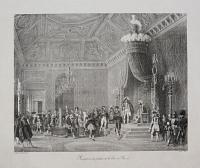
Réceptión des présens de la Cour de Russie.
Vathier et Courtin del: Litho: de C. Motte.
[n.d. c.1826.]
Lithograph, very large margins. Sheet 444 x 596mm (17½ x 23½"). Tears into lower edges.
Napoleon receiving presents from the Court of Russia. Published in A.V. Arnault's 'Vie politique et militaire de Napoléon', Paris, 1822-1826.
[Ref: 30822] £120.00
(£144.00 incl.VAT)
![[Napoleon Riding a Cockerel.]](img-thumbnail/jpegs/48557.jpg)
[Napoleon Riding a Cockerel.]
Stdr. v. A. Kneisel. L.N.
[n.d., c.1859]
Lithograph. Sheet: 315 x 380mm (12½ x 15'') very large margins.
A satirical print showing the reduced figure of Napoleon III riding on a cockerel while a river god raises his oar to strike him, on the hill a figure carrying a shield with an eagle on it. Perhaps a satire on the Second Italian War of Independence fought in 1859 between the French Empire under Napoleon III and the Kingdom of Sardinia against Habsburg Tuscany and the Austrian Empire.
[Ref: 48557] £130.00
(£156.00 incl.VAT)
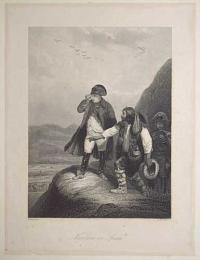
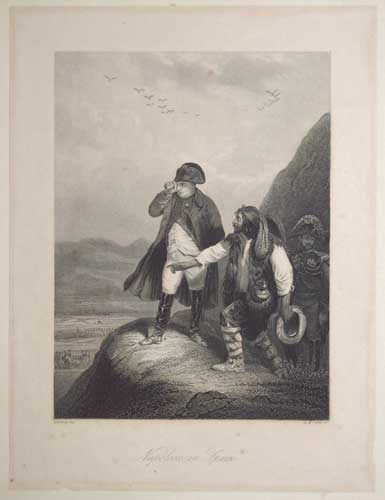
Napoleon in Spain.
Courtray del. A.H. Payne sc.
[n.d., c.1840.]
Steel engraving, sheet 290 x 220mm (11½ x 8¾"). Tipped into album sheet.
Napoleon peers into the distance on a rock in Spain with a telescope. Next to him a native of the country points and appears to show him the way.
[Ref: 55841] £45.00
(£54.00 incl.VAT)
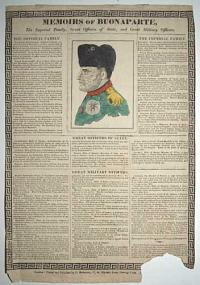
Memoirs of Buonaparte, His Imperial Family, Great Officers of State, and Great Military Officers.
London: Printed and Published by G.Smeeton, 17, St Martin's Lane, Charing Cross. Price Sixpence. [n.d., c.1814.]
Rare broadsheet, with engraved portrait 130 x 90mm, 5 x 3½", set in letterpress with printed border, sheet 425 x 275mm, 16¾ x 10¾". Some creasing and significant loss to lower right corner.
A scurrilous attack on Napoleon Bonaparte, probably published in the last days of the campaign that led to his abdication in 1814. (The last date in the text is 1813.) Apparently Napoleon's mother was a brothel keeper and at sixteen he poisoned a girl he had made pregnant. The portrait, after one by Johann Michael Voltz is a 'hieroglyphic': 'The French Eagle, crouching, forms his hat: the red collar represents the River Rhine, and the black border above it, the Rhinish Confederacy; the letters on the fingers are the initials of Austria Russia, Sweden and Prussia; and the Cuff of the Sleeve emblematic of Great Britain, by whose influence and power the Allies are bound together; the R. signifying the Regent The visage is formed of carcases of the unhappy victims to his cruel ambition; the spider is a symbolic emblem of the rancour and venon of Buonepart's heart; and the web illustrative of the flimsy tenure by which he at present holds his kingdom". His bust forms a map of Germany highlighting the battles fought there.
[Ref: 55852] £280.00

Napoleon
[After Johann Michael Voltz]
Hand coloured etching, sheet 305 x 225mm (12 x 8¾"). Cut and glued onto backing sheet, cutting the top of his hat.
A satirical bust length portrait of Napoleon based on a head engraved by Lehmann after a portrait by Dahling. 'The French Eagle, crouching, forms his hat: the red collar represents the River Rhine, and the black border above it, the Rhinish Confederacy; the letters on the fingers are the initials of Austria Russia, Sweden and Prussia; and the Cuff of the Sleeve emblematic of Great Britain, by whose influence and power the Allies are bound together; the R. signifying the Regent The visage is formed of carcases of the unhappy victims to his cruel ambition; the spider is a symbolic emblem of the rancour and venon of Buonepart's heart; and the web illustrative of the flimsy tenure by which he at present holds his kingdom". His bust forms a map of Germany highlighting the battles fought there.
[Ref: 55853] £160.00
(£192.00 incl.VAT)
![[Marriage of Napoleon]](img-thumbnail/jpegs/40366.jpg)
[Marriage of Napoleon] Mariage de Bonaparte [in ms below]
[Anon., c.1810]
Etching with hand-colouring, 80 x 80mm (3 x 3"). Trimmed to image and glued to backing sheet.
[Ref: 40366] £60.00
(£72.00 incl.VAT)
![[Russian text] Napoleon and Münchhausen.](img-thumbnail/jpegs/67732.jpg)
[Russian text] Napoleon and Münchhausen. [Russian text translates to: I sell it for what I bought it (, if you don't like it, don't listen, but don't hamper [my] lying/telling)]
[n.d. c.1800]
Scarce hand-coloured etching, sheet 305 x 405mm (12 x 16"). Trimmed within plate and laid on backing paper.
Typical Russian propaganda cartoon to mock and undermine Napoleon during the Napoleonic Wars. Bonaparte (1769-1821) sits on a throne in a grand hall, presumably exaggerating or making false claims, hence the comparison to the fictional Baron Munchhausen, known for telling outlandish tales. The text at the bottom is the English equivalent of: Don't shoot the messenger.
[Ref: 67732] £280.00
(£336.00 incl.VAT)

Napoleon Musing at S.t Helena. from the original picture in the possession of T. Kearsey Esq. to whom this Print is respectfully dedicated by his grateful Friend, B.R. Haydon.
B.R. Haydon, Pinx. J.E. Coombs, Sculp.
London, Published Aug.t 30, 1830, by B.R. Haydon, 4, Burwood Place, Connaught Terrace.
Mezzotint. 320 x 265mm (12½x 10½"). Small margins.
A portrait of Napoleon Bonaparte standing on a clifftop, looking out on a featureless sea. Benjamin Robert Haydon (1786-1846) painted the original for Thomas Kearsey in 1829, but its success meant that he was asked for more copies, including for Robert Peel and the dukes of Devonshire & Sutherland, driving him to complain about the number in his diaries. Ex: collection of The Hon. Christopher Lennox-Boyd.
[Ref: 67187] £320.00
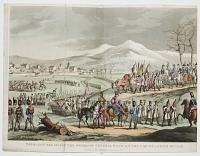
Napoleon Receiving the Sword of General Mack, on the Capitulation of Ulm.
Engraved by Mr. George Cruikshank, from the Original design of Swebach, Published at Paris.
Published Dec. 29. 1824, by John Fairburn, Broadway, Ludgate Hill.
Hand-coloured aquatint. 210 x 280mm. 8¼ x 11". Folds as published. Very cut at right.
The surrender of Karl Freiherr Mack von Leiberich (1752-1828), the Austrian soldier who capitulated to Napoleon's Grande Armee in the Battle of Ulm in 1805. From "The Life of Napoleon Bonaparte". Cohn: 435.
[Ref: 26480] £95.00
(£114.00 incl.VAT)
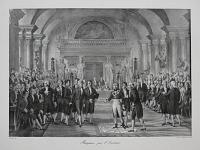
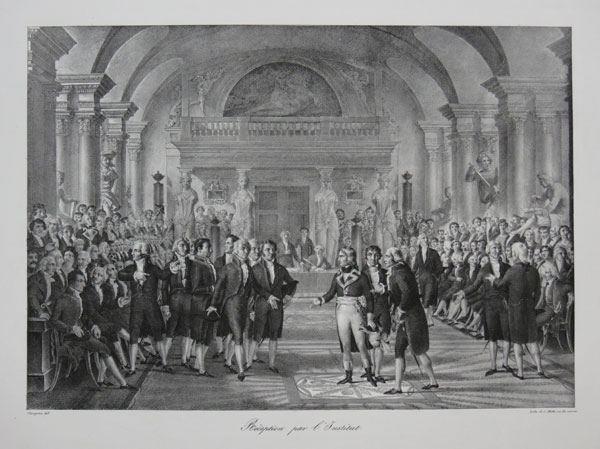
Réception par l'Institut.
Chamption del. Litho. de C. Motte rue des marais.
[n.d. c.1826.]
Lithograph. Sheet 444 x 596mm (17½ x 23½"), with very large margins. Small tear into lower edge.
A reception for the reopening of the Académie Francaise. It was officially established in 1635 by Cardinal Richelieu and suppressed in 1793 during the French Revolution. It was restored in 1803 by Napoleon. Published in A.V. Arnault's 'Vie politique et militaire de Napoléon', Paris, 1822-1826.
[Ref: 30832] £220.00
(£264.00 incl.VAT)
![Satans, return from [Egypt] Earth. Discovered in council- with Belzebub & Belial- a sketch after Fuseli- !!!](img-thumbnail/jpegs/67711.jpg)
Satans, return from [Egypt] Earth. Discovered in council- with Belzebub & Belial- a sketch after Fuseli- !!!
[Cawse] fecit.
Publish.d Nov.r 30 1799 by SW Fores Piccadilly where f[olios] of Caricatures may be had for the Evening
Hand-coloured etching, 355 x 270mm (14 x 10½"). On 18th century watermarked paper. Stamp of Samuel William Fores 'S.W.F' in brown ink in right corner. . Thread margin on left and trimmed to plate on right.
One phrase within the image, "Constitutions Ready for all Occasions", is in the typically neat hand of F. Sansom( fl. c.1797-1810); the remainder of the lettering is less carefully etched. Bonaparte (1769-1821) sits enthroned among clouds, brooding, his face in both hands. His right leg rests on a skull, his left trampling papers titled ‘Hymn Marselos’ and 'Council of Cinq Cents.’ Beneath the skull lie more papers: ‘Liste of the Judges’, ‘Myself in Egypt an Oratorio’, ‘Ca ira ira’. He wears uniform and a plumed cocked hat, framed by a radiant triangle of daggers inscribed ‘Seyes’, ‘Buonaparte’, ‘Ducos’; within it appears Abbaye. Behind him stand two attendant demons: Sieyès (1748-1836), wearing a bonnet-rouge, and Ducos (1747-1816), both emerging from clouds in long gowns, looking anxiously at their master; a label reads ‘Constitutions Ready for all Occasions’. In the air, four small, tailed demons with the heads of English Jacobins swarm around; Sheridan (1751-1816) spits fire at Bonaparte, while Fox (1749-1806) is at the right, the remaining figures likely M. A. Taylor (1757-1834) and Stanhope (1753-1816) .Along the lower edge appear rough Frenchmen cheering their new ruler, waving bonnets-rouges or daggers. One shouts "Down with the Councils up wth the Committees", another "Vive La Babouf Ca ira". BM Satires 9431. Lugt L.2384.
[Ref: 67711] £420.00



![[Napoleon I. A St Helene.]](jpegs/68489.jpg)
![[Birth of Napoleon.]](jpegs/40365.jpg)


![[Broadside against Napoleon]](jpegs/66444.jpg)
![[Broadside against Napoleon]](jpegs/33282.jpg)
![[Broadside against Napoleon]](jpegs/33276.jpg)
![[Broadside against Napoleon]](jpegs/33287.jpg)
![[Broadside against Napoleon]](jpegs/33281.jpg)
![[Broadside against Napoleon]](jpegs/33274.jpg)
![[Broadside against Napoleon]](jpegs/33292.jpg)
![[Broadside against Napoleon]](jpegs/33288.jpg)

![[Broadside against Napoleon]](jpegs/33272.jpg)

![[Broadside against Napoleon]](jpegs/53945.jpg)
![[Broadside against Napoleon]](jpegs/33286.jpg)
![[Broadside against Napoleon]](jpegs/33277.jpg)
![[Broadside against Napoleon] No. 2](jpegs/33278.jpg)
![[Broadside against Napoleon]](jpegs/33285.jpg)
![[Broadside against Napoleon]](jpegs/55836.jpg)
![[Broadside against Napoleon]](jpegs/53943.jpg)
![[Broadside against Napoleon]](jpegs/33279.jpg)

![[Broadside against Napoleon]](jpegs/33283.jpg)

![[Napoleon escaping from either Elba or Saint Helena, with titlepage to 'Vie secrète de Napoléon Bonaparte']](jpegs/44489.jpg)
![[The Fall of Napoleon.]](jpegs/55754.jpg)


![[Napoleon Riding a Cockerel.]](jpegs/48557.jpg)


![[Marriage of Napoleon]](jpegs/40366.jpg)
![[Russian text] Napoleon and Münchhausen.](jpegs/67732.jpg)


![Satans, return from [Egypt] Earth. Discovered in council- with Belzebub & Belial- a sketch after Fuseli- !!!](jpegs/67711.jpg)