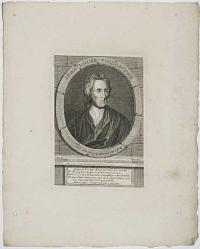
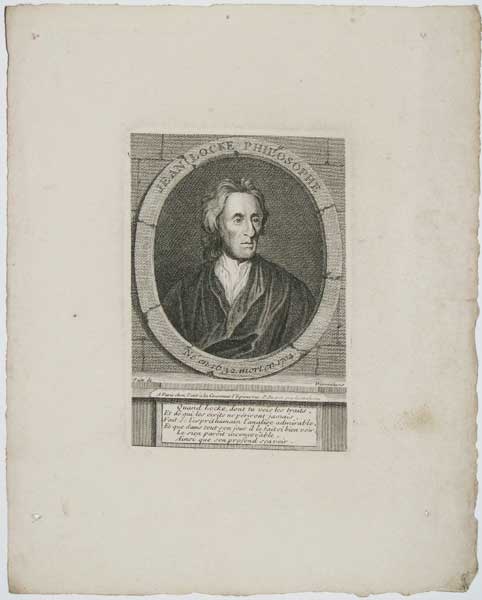
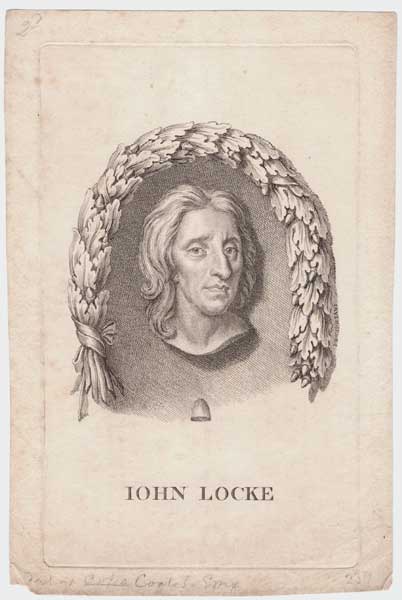
Jean Lock Philosophe. Né en 1632 mort en 1704. Quand Lock, dont tu vois les traits, Et de qui les écrits ne périront jamais, Fait de l'esprit humain l'analise admirable, Et que dans tout son jour il le fait si bien voir, Le sien parôit inconcevable, Ainsi que son profond scavoir.
Suite de Desrochers.
A Paris chez Petit à la Couronee d’Epines rue St. Jacques pres les Mathurins. [n.d. c.1770.]
Copper engraving. Plate 146 x 102mm. 5¾ x 4". Large margins.
John Locke (1632-1704) was an English philosopher and physician; one of the most influential Enlightenment thinkers. His work had a great impact upon the development of epistemology and political philosophy and upon other writers, such as Voltaire and Rousseau. W: 1796.
[Ref: 15766] £65.00
(£78.00 incl.VAT)
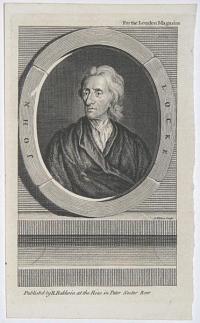
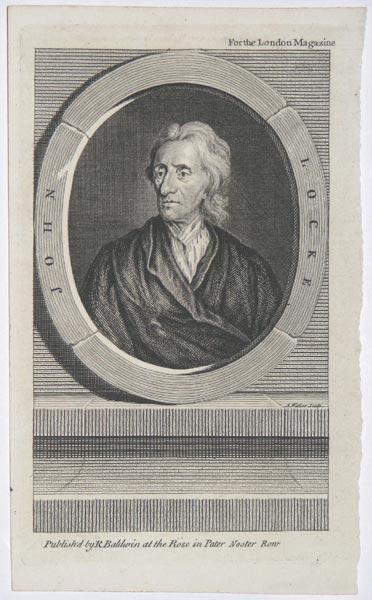
John Locke.
For the London Magazine.
Publish'd by R. Baldwin at the Rose in Pater Noster Row 1753.
Engraving, 190 x 110mm.
John Locke (1632 - 1704) was an influential English philosopher and social contract theorist. He developed an alternative to the Hobbesian state of nature and argued a government could only be legitimate if it received the consent of the governed and protected the natural rights of life, liberty, and estate. If such consent was not given, argued Locke, citizens had a right of rebellion. Locke is one of the few major philosophers who became a minister of the government. Locke's ideas had an enormous influence on the development of political philosophy, and he is widely regarded as one of the most influential Enlightenment thinkers and contributors to liberal theory. His writings influenced the American revolutionaries as reflected in the American Declaration of Independence. Not in BM.
[Ref: 10474] £85.00
(£102.00 incl.VAT)
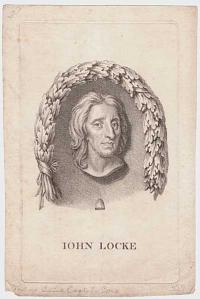
John Locke
I.B. Cipriani
[n.d. c.1765]
Engraving, plate 200 x 120mm (8 x 4¾"), with large margins. Some light foxing.
Frontispiece to 'Letters Concerning Toleration' by John Locke (1632 - 1704).
[Ref: 58637] £140.00
(£168.00 incl.VAT)
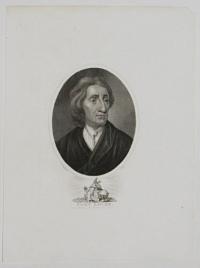
John Locke.
J. Chapman Sculp.
London Published as the Act directs Jany. 26-1811.
Stipple with large margins. Plate 165 x 114mm. 6½ x 4½".
John Locke (1632-1704) the English philosopher and physician who was regarded as one of the most influential of Enlightenment thinkers and known as the 'Father of Classical Liberalism'. One of a number of stipple heads of Kings and Queens of similar format printed on quarto sheets, by Chapman, published by J. Wilkes, 1795-1810. They probably appeared as illustrations to the 'Encyclopaedia Londinensis, Universal Dictionary of Arts, Sciences and Literature ... Embellished by ... engravings. Compiled ... by John Wilkes'. W: 1796-16.
[Ref: 27069] £70.00
(£84.00 incl.VAT)
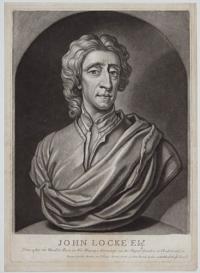
John Locke Esq.r. Done after the Marble Bust, in Her Majesty's Hermitage in the Royal Garden at Richmond.
[Drawn & engraved by John Faber.]
Printed for Tho: Bowles in St Pauls Church Yard, & John Bowles & Son, at the Black Horse, Cornhil. [n.d., c.1740.]
Mezzotint. 355 x 255mm (14 x 9¾"), with large margins.
Portrait of the philosopher John Locke (1632-1704) taken from a bust at the Royal Palace at Kew, now the Royal Botanic Gardens. In 1730 Queen Caroline commissioned a 'hermitage', decorated with a series of five marble busts by the English sculptor Michael Rysbrack to celebrate British philosphers: Locke, Isaac Newton, Robert Boyle, Samuel Clarke and William Wollaston. Unfortunately the Hermitage no longer exists. CS 125. Ex collection of the Hon. Christopher Lennox-Boyd.
[Ref: 32333] £280.00
(£336.00 incl.VAT)
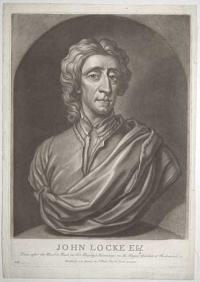
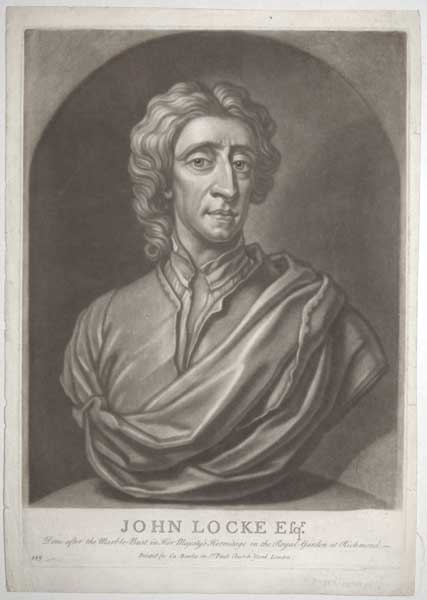
John Locke Esq.r. Done after the Marble Bust, in Her Majesty's Hermitage in the Royal Garden at Richmond. 449
[Drawn & engraved by John Faber.]
Printed for Ca: Bowles in St Pauls Church Yard, London [n.d., c.1760.]
Mezzotint, 18th century watermark. 355 x 255mm (14 x 9¾").
Portrait of the philosopher John Locke (1632-1704) taken from a bust at the Royal Palace at Kew, now the Royal Botanic Gardens. In 1730 Queen Caroline commissioned a 'hermitage', decorated with a series of five marble busts by the English sculptor Michael Rysbrack to celebrate British philosphers: Locke, Isaac Newton, Robert Boyle, Samuel Clarke and William Wollaston. Unfortunately the Hermitage no longer exists. Locke was a staunch supporter of the Williamite cause and the Glorious Revolution of 1688, which brought William III of Orange to the throne. Locke’s philosophy, particularly his ‘Two Treatises of Government’, provided the intellectual justification for the new constitutional order, asserting that government relies on the consent of the governed. CS 125, iii of iii. Ex collection of the Hon. Christopher Lennox-Boyd.
[Ref: 68789] £280.00
(£336.00 incl.VAT)
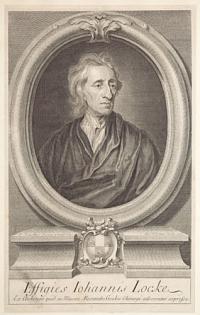
Effigies Iohannis Locke. Ex Archetypo, quod in Musæo Alexandri Geekie Chirurgi adservatur espressa.
G. Kneller Eques pinxit 1697. Geo. Vertue Sculp; 1713.
Engraving. Sheet 250 x 160mm (9¾ x 6¼"). Trimmed within plate, mounted in album paper.
The Enlightenment philosopher and physician John Locke (1632-1704), after the painting by Sir Godrey Kneller, once in the Walpole Collection at Houghton, now in the Hermitage Museum.
[Ref: 52844] £95.00
(£114.00 incl.VAT)
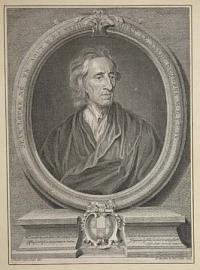
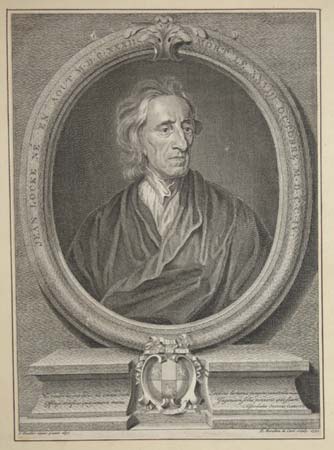
Jean Locke ne en Aout M.D.C.XXXII Mort le XXVIII. Octobre. M.D.C.C.IV. Hic oculos, hie ora vides, hic omina, docta Lockius humane pingens penetralia mentis. Effingi artificis que potuere manu. Ingenium solus pinxerit ipse fuum. Adiferibebat Johannes Clericus.
G. Kneller Eques pinxit 1697.
E. Morellon la Cave Sculp 1734.
Engraving. Sheet 225 x 160mm (9 x 6¼"). Trimmed to image and laid on album paper. Toning
John Locke (1632-1704) was an influential English philosopher and a prominent figure in the Age of Enlightment. Among many other things and schools of thought, he is credited and cited as the 'father of Liberalism'.
[Ref: 53771] £140.00
(£168.00 incl.VAT)
![[John Locke.]](img-thumbnail/jpegs/48685.jpg)
[John Locke.] Jean Locke né en Aout M.D.C. XXXII Mort le XXVIII Octobre . M.D.C.C.IV.
G. Kneller Eques pinxit 1697. P. Tanjé sculp. 1754.
J. Schreuder & P. Mortier junior excud.
Engraving. Plate: 225 x 165mm (9 x 6½''). Small margins.
A portrait of Enlightenment philosopher and physician John Locke (1632-1704). Wellcome: 1796-7
[Ref: 48685] £190.00
(£228.00 incl.VAT)
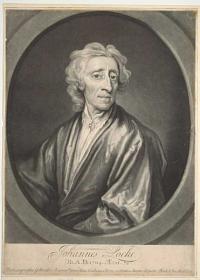
Johannes Locke. Ob. A.D. 1704. Ætat 72.
Ex autographo G. Kneller Baron.ti pro Ant. Collins Arm. oedam Anno depicto. Fecit J. Smith, A.o 1721.
Mezzotint. Sheet 350 x 250mm (13¾ x 9¾"). Trimmed to plate, repaired tears, mounted in album paper at edges.
Half-length portrait of John Locke (1632-1704), an Enlightenment philosopher and physician. CS 157, state ii of III. Wellcome 1796-24.
[Ref: 59425] £180.00
(£216.00 incl.VAT)
![[Joseph Locke, Esq.re M.P.]Joseph Locke April 1849 [facsimile signature.]](img-thumbnail/jpegs/67819.jpg)
[Joseph Locke, Esq.re M.P.]Joseph Locke April 1849 [facsimile signature.]
Painted by Francis Grant, Esq. A.R.A. Engraved by Henry Cousins.
London, Published June 1st. 1849, by Henry Graves & Comp.y Printsellers in Ordinary to Her Majesty and H.R.H. Prince Albert. 6, Pall Mall.
Mezzotint, Artist'ss proof, ltd to 100, printed on chine collé. 770 x 490mm (30¼ x 19¼"). Spotting.
A full-length portrait of civil engineer Joseph Locke (1805-1860). Apprenticed to the railway engineer George Stephenson, he was one of the major pioneers of railway development. He worked on the Liverpool & Manchester Railway, Lancaster & Carlisle Railway, the Manchester & Sheffield Railway and the London and South Western Railway, including the designs of Richmond Railway Bridge (1848) and Barnes Bridge (1849). Ex: collection of The Hon. Christopher Lennox-Boyd.
[Ref: 67819] £480.00
![[Rebecca Lockhart] Lady Boyd.](img-thumbnail/jpegs/68346.jpg)
[Rebecca Lockhart] Lady Boyd.
A. Ramsay Pinx. Ja.s M.cArdell fecit 1749.
Price 2 Shill. [n.d., c.1749.]
Mezzotint. 350 x 250mm (13¾ x 9¾"). Trimmed to plate.
A three quarter portrait of Rebecca Lockhart (d.1761) dressed as Diana, with spear and dog. She was first wife of James Boyd (son of the executed Jacobite, William Boyd, 4th Earl of Kilmarnock), who changed his surname to Hay when he became Earl of Errol. The painting was comissioned the year of their marriage. CS 28. Goodwin 9. Ex: collection of The Hon. Christopher Lennox-Boyd.
[Ref: 68346] £240.00
(£288.00 incl.VAT)

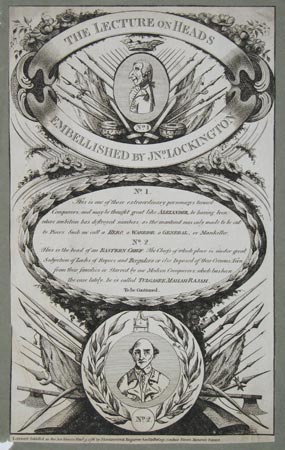
The Lecture on Heads Embellished by Jn.o Lockington. 'N° 1. This is one of those extraordinary personages termed Conquerors; and may be thought great like Alexander, he having been where ambition has destroyed numbers; as tho' mankind was only made to be cut to Pieces. Such we call a Hero, a Warrior, a General, or Mankiller. N° 2. This is the head of an Eastern Chief. The Chiefs of which place is under great Subjection of Lacks of Rupees and Berguders or else Deposed of their Crowns; Torn from their families or Starved by our Modern Conquerors: which has been the case lately, he is called Tulgagee Mahah Rajah. To be Continued.
London Published as the Act directs Mar.h 9 1786 by J.Lockington Engraver Saville Passage, Conduit Street, Hanover Square.
Engraving. Sheet 315 x 190mm. Trimmed within plate, laid on album paper.
'No 1' is either the Duke of Richmond or Lord Amherst, the commander-in-chief in Canada. 'No.2' is Warren Hastings, who had been denounced by Edmund Burke the month before. BM: 6922.
[Ref: 6877] £50.00
(£60.00 incl.VAT)
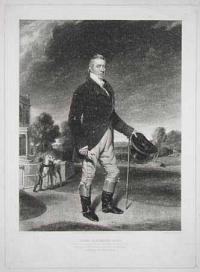
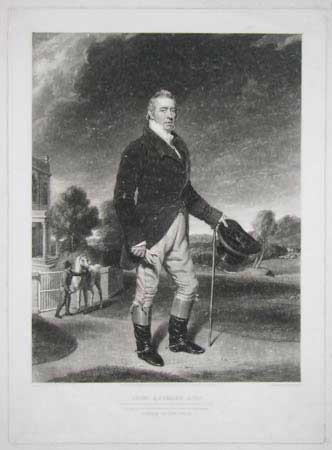
John Lockley, Esqr. Formerly of Boscobel House, in the Country of Salop, but noe of Amerie Court, Pershore, in the County of Worcester. Father of the Field.
Painted by J. Ramsay. Engraved by Tho.s Lupton.
London, Published May 10, 1825, by J. Pittman, Warwick Square, & W.B. Cooke, 9. Soho Square.
Mezzotint. 432 x 318mm (17" x 12½"). Some creasing across the image.
John Lockley (1750-1829) was born at Barton Hall, once the residence of Oliver Cromwell. He occasionally ran horses at the country races; however fox-hunting was his favourite amusement. While hunting with the fox-hounds of T. Boycott, esq. he fell from his horse but re-mounted his horse gallantly to end the chase. He was rather unwell that evening and died the following day.
[Ref: 8514] £130.00
(£156.00 incl.VAT)

John Lockley, Esqr. Formerly of Boscobel House, in the Country of Salop, but now of Amerie Court, Pershore, in the County of Worcester. Father of the Field.
Painted by J. Ramsay. Engraved by Thos. Lupton.
London, Published May 10, 1825, by J. Pittman, Warwick Square, & W.B. Cooke, 9. Soho Square.
Scarce mezzotint. 430 x 320mm (17 x 12½") very large margins.
John Lockley (1750-1829) was born at Barton Hall, once the residence of Oliver Cromwell. He occasionally ran horses at the country races; however fox-hunting was his favourite amusement. While hunting with the fox-hounds of T. Boycott, esq. he fell from his horse but re-mounted his horse gallantly to end the chase. He was rather unwell that evening and died the following day. Ex: Collection of The Hon. Christopher Lennox-Boyd.
[Ref: 64760] £360.00
![[Lionel Lockyer]](img-thumbnail/jpegs/37638.jpg)
[Lionel Lockyer] The true Effigies here you may behold, / Of him who for preventing others ill / Hath gaind a Medicine far excelling Gold. / And known to all ye world for Lockyers Pill.
J. Sturt sculp. [n.d., c.1672]
Engraving, sheet 150 x 90mm (6 x 3½"). Trimmed and glued to backing sheet.
Lionel Lockyer (1601-72), inventor who had great success marketing a 'Pill Extracted from the Rays of the Sun'. He is buried in Southwark cathedral. O'D 1 (only likeness listed) Wellcome: 1799-2
[Ref: 37638] £85.00
(£102.00 incl.VAT)

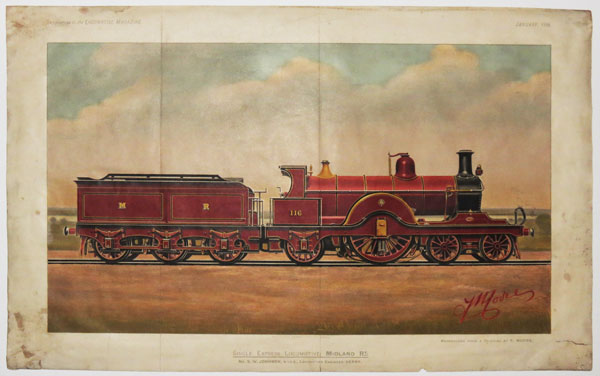
Single Express Locomotive, Midland R.y. Mr. S. W. Johnson, M.I.C.E., Locomotive Engineer Derby. Supplement to the Locomotive Magazine. January 1898.
Reproduced from a Painting by F. Moore.
Alf Cooke Queen's Printer Leeds.
Chromolithograph. Sheet: 270 x 440mm (10½ x 17½''). Marking, creases and damage.
An illustration of a steam train locomotive from the Midland Railway. Plate from 'The Locomotive Magazine Series'. 'F. Moore' was a pseudonym, believed to have been originally for Edwin Thomas Rudd but used by others at least into the 1930s.
[Ref: 48345] £85.00
(£102.00 incl.VAT)
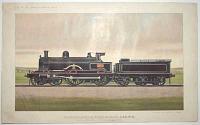
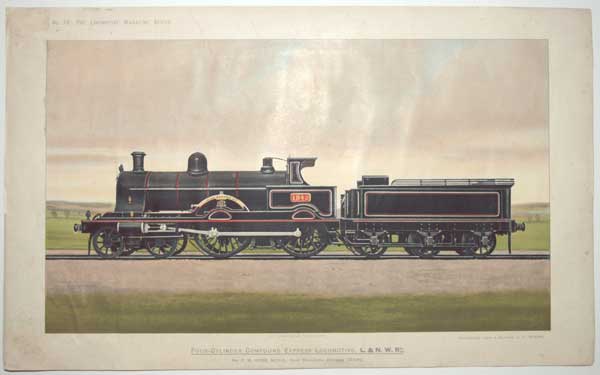
Four-Cylinder Compound Express Locomotive, L. & N.W. Ry. Mr F.W. Webb, M.I.C.E., Chief Mechanical Engineer, Crewe. No 13. The Locomotive Magazine Series.
Reproduced from a Painting by F. Moore [i.e. Edwin Thomas Rudd]. Alf Cooke, Queen's Printer, Leeds.
[n.d., September 1901.]
Chromolithograph. Sheet 270 x 440mm (10½ x 17¼"), A few stains & creases.
An illustration of the locomotive 'King Edward VII', with a tender. From No 69 of 'The Locomotive Magazine Series'. 'F. Moore' was a pseudonym, believed to have been originally for Edwin Thomas Rudd but used by others at least into the 1930s.
[Ref: 57118] £50.00
(£60.00 incl.VAT)
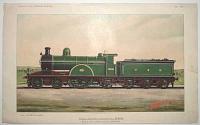
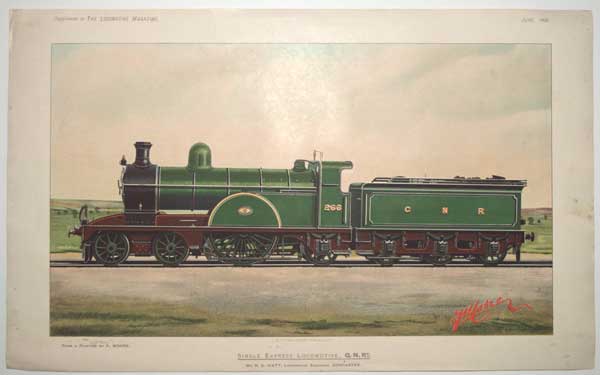
Single Express Locomotive, G.N. Ry. Supplement to The Locomotive Magazine Series.
From a Painting by F. Moore [i.e. Edwin Thomas Rudd]. Alf Cooke, Queen's Printer, Leeds.
[n.d., June 1900.]
Chromolithograph. Sheet 270 x 440mm (10½ x 17¼"), A few stains.
An illustration of a locomotive and tender. From No 54 of 'The Locomotive Magazine Series'. 'F. Moore' was a pseudonym, believed to have been originally for Edwin Thomas Rudd but used by others at least into the 1930s. See Ref: 48345
[Ref: 57121] £50.00
(£60.00 incl.VAT)

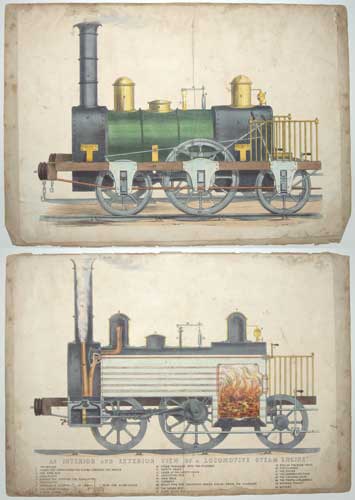
An Interior and Exterior View of a Locomotive Steam Engine. 1. The Boiler. 2. Tubes for conducting the flame through the water. 3. The Fire Box. 4. Feed Pumps. 5. Handle for turning the regulator...20. The Cylinder. 21. The Piston. 22. The Connecting Rods. 23. The Cranked Axles. 24. The Propelling Wheels. 25. Wooden Frame. 26. Buffers.
[n.d. c.1840.]
An extremely scarce pair of hand-coloured lithographs. 318 x 430mm (12½ x 17"). Some loss, damage and tears. Laid down on album sheet.
A pair of diagrams illustrating the inner and outer workings of the steam engine. Steam locomotives dominated the British railways from the start of the 19th century until the mid-20th century; at which point they were superseded by diesel and electric locomotives.
[Ref: 56995] £280.00
(£336.00 incl.VAT)
view all images for this item
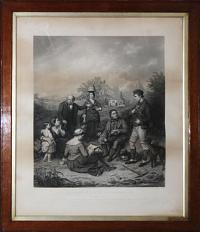
The Birth-Place of the Locomotive. Killingworth Colliery.
Painted by John Lucas. Engraved by F Holl and C Mottram.
London, Published August 30th 1862 by Henry Graves and Co, The Proprietors, Publishers to the Queen _ 6 Pall Mall.
Stipple & engraving. 780 x 650mm, 30¾ x 25½". Contemporary frame. Some burn from backboard. Unexamined out of frame.
A group of villagers outside 'Sundial Cottage', George Stephenson's home at Killingworth Colliery, where he built his first steam locomotive, the 'Blücher', in 1814. A basic locomotive can be seen outside the cottage, and a more advanced model crosses the stone bridge in the far background, representing the North-Eastern Line to Scotland. The group is discussing Stephenson: one woman reads the 'London Journal', containing Stephenson's portrait and a man holds a 'Geordie' lamp, Stephenson's safety-lamp for miners. Derived from a diminutive form of the inventor's name, it is said that the name lead to Tyneside miners also being called Geordies.
[Ref: 24864] £480.00
Unfortunately this item is either sold or reserved. If you are interested in similar items and cannot find what you're looking for on our website, please consider filling in our interests form. If you register, we can also send you items that match your interests when the website is updated.

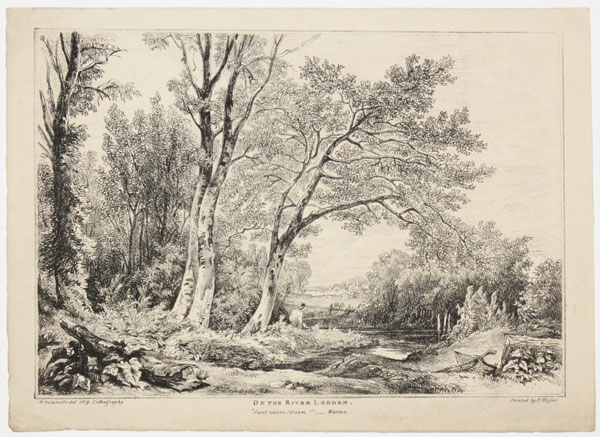
On the River Lodder. ''Sweet native Stream!'' _ Warton.
W. Delamotte del 1819. Lithography. Printed by F. Moser.
Lithograph, scarce. Sheet 280 x 385mm (11 x 15¼"). Paper toned.
A vew of a small river in a wood , a man sitting on the banks. The title contains a quote from Thomas Warton's 'To the River Loddon'.
[Ref: 44345] £140.00
(£168.00 incl.VAT)
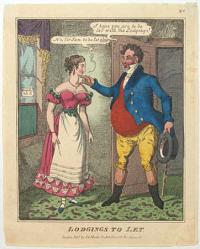
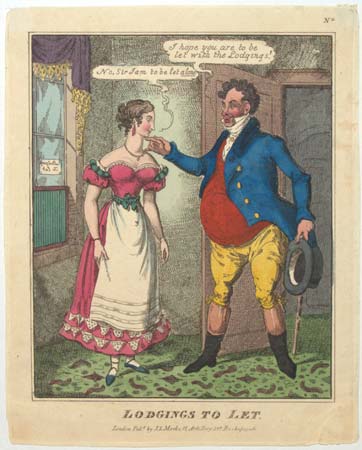
Lodgings to Let.
London, Pub.d by J.L. Marks, 17, Artillery St.t Bishopsgate.
Coloured etching. 210 x 170mm (8¼ x 6¾"). Thread margins.
A corpulant and rosiate-complexioned man strokes a pretty woman under her chin, saying 'I hope you are to be let with the Lodgings!'. She replies 'No, Sir I am to be let alone'.
[Ref: 54356] £160.00
(£192.00 incl.VAT)
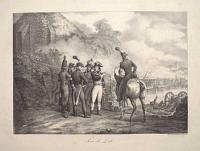
Pont de Lodi.
Litho: de C. Motte Rue des Marais.
[n.d. c.1826.]
Lithograph. Printed area 280 x 405mm (11 x 16"), with large margins. Mount stain.
The French army forcing the crossing of the bridge over the Adda, 10 May 1796, driving the Austrian army into retreat, after which Milan was occupied. Published in A.V. Arnault's 'Vie politique et militaire de Napoléon', Paris, 1822-1826.
[Ref: 55863] £160.00
(£192.00 incl.VAT)
![[Lodona.]](img-thumbnail/jpegs/44046.jpg)
[Lodona.]
[Maria Cosway Pinxt. F. Bartolozzi R.A. Sculpt.]
[London, Published March 20, 1792, by Thos. Macklin, Poets Gallery, Fleet Street.]
Stipple, proof before letters. Sheet 370 x 475mm (14½ x 18¾"). Trimmed, top right repaired tear.
A young woman in a wooded landscape leaning by a small waterfall by a river, weeping; her hair and dress begin to merge with the water. A scene from Alexander Pope's poem Windsor Forest (1713). Lodona, a nymph fond of hunting, is chased by Pan and implores Cynthia (an epithet of Diana the huntress goddess) to save her from her persecutor. No sooner had she spoken than she became ''a silver stream which ever keeps its virgin coolness''. She gives her name to The Lodden, an tributary of the Thames in Windsor Forest.
[Ref: 44046] £380.00
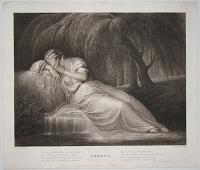
Lodona. In vain on Father Thames she calls for Aid...[etc., two stanzas from Pope either side of title.] Vide Pope's Windsor Forest.
Maria Cosway Pinxt. F. Bartolozzi R.A. Sculpt.
London, Published March 20, 1792, by Thos. Macklin, Poets Gallery, Fleet Street.
Fine stipple engraving printed in brown ink, closed letters (final state). 430 x 505mm (17 x 19¾"). Some slight creasing and soiling.
A young woman in a wooded landscape leaning by a small waterfall by a river, weeping; her hair and dress begin to merge with the water. A scene from Alexander Pope's poem Windsor Forest (1713). Lodona, a nymph fond of hunting, is chased by Pan and implores Cynthia (an epithet of Diana the huntress goddess) to save her from her persecutor. No sooner had she spoken than she became ''a silver stream which ever keeps its virgin coolness''. She gives her name to The Lodden, an tributary of the Thames in Windsor Forest. After Maria Cosway (1759 - 1838).
[Ref: 19237] £380.00
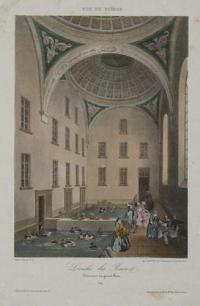
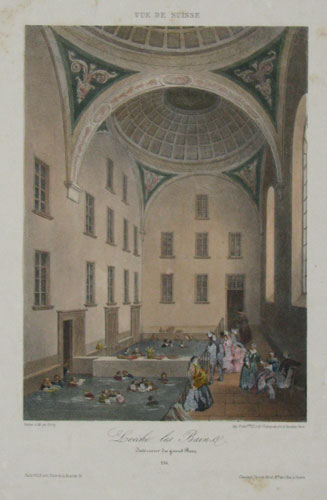
Vue de Suisse. Loëche les Baine. Intérieur de grand Bain. 236.
Desiné et lith. par Deroy. Imp. Frick fres. 17, r. de l’Estrapade, près le Panthéon, Paris.
Paris, Wild, edit. Place de la Bourse, 31. Charnaux, Place du Bel air, Mon. des 3 Rois, à Genève. [n.d. c.1860.]
Coloured lithograph. 350 x 264mm. Some creasing and spotting.
From a collection of 'Vue de Suisse 1854-1861'. A view of the interior of the 'Loëche les Baine', with people leisurely swimming whilst eating, drinking or playing games.
[Ref: 12534] £80.00
(£96.00 incl.VAT)
![Lovenstein. [Battle of Loevenstein, 19th December 1570.]](img-thumbnail/jpegs/40311.jpg)
Lovenstein. [Battle of Loevenstein, 19th December 1570.] Es seind gewest drey man allein / So ingenommen Louenstein [...]
[Hogenburg.]
Anno Dmi M.D. LXXI
Engraving. Sheet: 215 x 305mm, (8½ x 12"). Lower left corner torn and reattached.
A battle scene showing the recapture of Loevenstein Castle by Habsburg troops on 19th December 1570 during the Eighty Years War. The castle had been taken from the Spanish ten days earlier by the dutch rebels led by Herman de Ruyter. The Dutch later recaptured the castle in 1572. The image shows the Spansh troops, flying the flag of the Seventeen Provinces advancing on the castle while the Dutch fight furiously, Herman de Ruyter (labelled in image) is shown defending a breach in the wall.
[Ref: 40311] £65.00
(£78.00 incl.VAT)
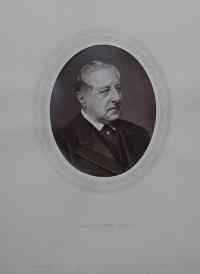
Lord Augustus Loftus.
Lock and Whitfield. Woodbury Process. [n.d., c.1880.]
Photograph set into printed frame, original presentation. Image 110 x 90mm. 4¼ x 3½". Left sheet edge tatty/chipped.
Lord Augustus William Frederick Spencer Loftus (1817 - 1904) diplomatist, appointed Governor of New South Wales in 1879. Offered with letterpress biography sheet.
[Ref: 10805] £35.00
(£42.00 incl.VAT)
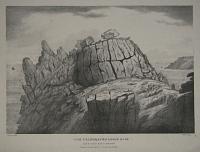
The Celebrated Logan Rock near the Land's End in Cornwall.
J. Tonkin delin: J.P. Vibert. Lithog:
Penzance. Published by Vibert & Tonkin Sep: 27. 1824.
Lithograph, sheet 345 x 470mm. 13½ x 18½". Horizontal crease.
The Logan Rock is an eighty ton granite boulder perched on the edge of a headland overlooking the Atlantic ocean one mile south of the Cornish village of Treen. It an example of a logan or rocking stone, being finely balanced due to the actions of weathering. The first plate from a set of six illustrating the events of 1824: in April Lieutenant Hugh Goldsmith (nephew of the famous poet Oliver Goldsmith) and ten or twelve of his crew of the cutter HMS Nimble rocked the huge granite boulder armed with bars and levers until it fell from its cliff-top perch. Goldsmith was apparently motivated to disprove the claim of Dr. Borlase, who wrote in 'Antiquities of Cornwall' in 1754 that "...the extremities of [the Rock's] base are at such a distance from each other, and so well secured by their nearness to the stone which it stretches itself upon, that it is morally impossible that any lever, or indeed force, however applied in a mechanical way, can remove it from its present situation". The displacement of the rock upset the local residents considerably, since Logan Rock had been used to draw tourists to the area. The Lords of the Admiralty were persuaded to lend Lieutenant Goldsmith the required apparatus for replacing it. The Admiralty sent thirteen capstans with blocks and chains from the dock yard at Plymouth, and contributed £25 towards expenses. After months of effort, at 4.20pm on Tuesday, the 2nd of November, 1824, in front of thousands of spectators and with the help of more than sixty men and block and tackle, the Logan Rock was finally repositioned and returned to "rocking condition". However, it apparently no longer vibrates or "logs" as easily as it did before the incident. Abbey Scenery: 106.
[Ref: 13518] £130.00
(£156.00 incl.VAT)
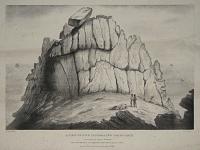
A View Of The Celebrated Logan Rock near the Land's End in Cornwall, taken after the Rock was displaced on the 8th of April, 1824.
J. Tonkin, delin. Vibert. lithog:
Penzance Pubs. by Vibert & Tonkin August 8th. 1824.
Lithograph, sheet 350 x 485mm. 13¾ x 19". Horizontal crease.
The Logan Rock is an eighty ton granite boulder perched on the edge of a headland overlooking the Atlantic ocean one mile south of the Cornish village of Treen. It an example of a logan or rocking stone, being finely balanced due to the actions of weathering. Plate 2 (numbered upper right) from a set of six illustrating the events of 1824: in April Lieutenant Hugh Goldsmith (nephew of the famous poet Oliver Goldsmith) and ten or twelve of his crew of the cutter HMS Nimble rocked the huge granite boulder armed with bars and levers until it fell from its cliff-top perch. Goldsmith was apparently motivated to disprove the claim of Dr. Borlase, who wrote in 'Antiquities of Cornwall' in 1754 that "...the extremities of [the Rock's] base are at such a distance from each other, and so well secured by their nearness to the stone which it stretches itself upon, that it is morally impossible that any lever, or indeed force, however applied in a mechanical way, can remove it from its present situation". The displacement of the rock upset the local residents considerably, since Logan Rock had been used to draw tourists to the area. The Lords of the Admiralty were persuaded to lend Lieutenant Goldsmith the required apparatus for replacing it. The Admiralty sent thirteen capstans with blocks and chains from the dock yard at Plymouth, and contributed £25 towards expenses. After months of effort, at 4.20pm on Tuesday, the 2nd of November, 1824, in front of thousands of spectators and with the help of more than sixty men and block and tackle, the Logan Rock was finally repositioned and returned to "rocking condition". However, it apparently no longer vibrates or "logs" as easily as it did before the incident. Abbey Scenery: 106.
[Ref: 13519] £130.00
(£156.00 incl.VAT)
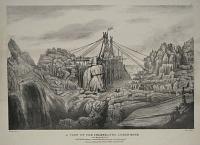
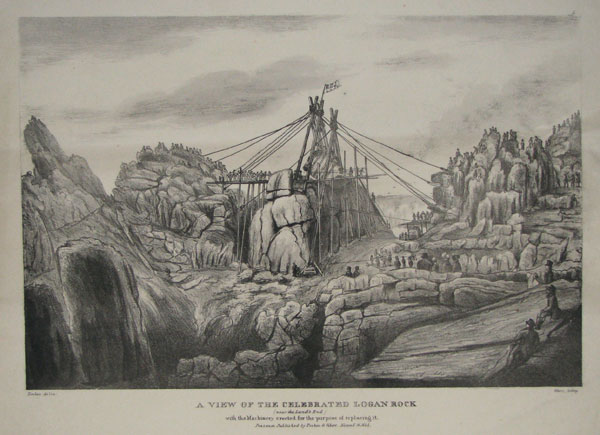
A View Of The Celebrated Logan Rock (near the Land's End) with the Machinery erected for the purpose of replacing it.
Tonkin. delin: Vibert, lithog:
Penzance. Published by Tonkin & Vibert. Novembr. 16 1824.
Lithograph, sheet 330 x 495mm. 13 x 19½". Two horizontal creases.
The Logan Rock is an eighty ton granite boulder perched on the edge of a headland overlooking the Atlantic ocean one mile south of the Cornish village of Treen. It an example of a logan or rocking stone, being finely balanced due to the actions of weathering. Plate 4 (numbered upper right) from a set of six illustrating the events of 1824: in April Lieutenant Hugh Goldsmith (nephew of the famous poet Oliver Goldsmith) and ten or twelve of his crew of the cutter HMS Nimble rocked the huge granite boulder armed with bars and levers until it fell from its cliff-top perch. Goldsmith was apparently motivated to disprove the claim of Dr. Borlase, who wrote in 'Antiquities of Cornwall' in 1754 that "...the extremities of [the Rock's] base are at such a distance from each other, and so well secured by their nearness to the stone which it stretches itself upon, that it is morally impossible that any lever, or indeed force, however applied in a mechanical way, can remove it from its present situation". The displacement of the rock upset the local residents considerably, since Logan Rock had been used to draw tourists to the area. The Lords of the Admiralty were persuaded to lend Lieutenant Goldsmith the required apparatus for replacing it. The Admiralty sent thirteen capstans with blocks and chains from the dock yard at Plymouth, and contributed £25 towards expenses. After months of effort, at 4.20pm on Tuesday, the 2nd of November, 1824, in front of thousands of spectators and with the help of more than sixty men and block and tackle, the Logan Rock was finally repositioned and returned to "rocking condition". However, it apparently no longer vibrates or "logs" as easily as it did before the incident. Abbey Scenery: 106.
[Ref: 13520] £120.00
(£144.00 incl.VAT)
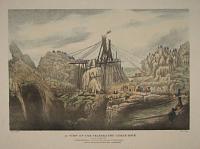
A View Of The Celebrated Logan Rock near the Land's End with the Machinery erected for the purpose of replacing it.
Tonkin. delin: Vibert, lithog:
Penzance. Published by Tonkin & Vibert. Novembr. 16 1824.
Original hand coloured lithograph, sheet 425 x 555mm. 16¾ x 21¾". Two horizontal creases.
The Logan Rock is an eighty ton granite boulder perched on the edge of a headland overlooking the Atlantic ocean one mile south of the Cornish village of Treen. It an example of a logan or rocking stone, being finely balanced due to the actions of weathering. Plate 4 (numbered upper right) from a set of six illustrating the events of 1824: in April Lieutenant Hugh Goldsmith (nephew of the famous poet Oliver Goldsmith) and ten or twelve of his crew of the cutter HMS Nimble rocked the huge granite boulder armed with bars and levers until it fell from its cliff-top perch. Goldsmith was apparently motivated to disprove the claim of Dr. Borlase, who wrote in 'Antiquities of Cornwall' in 1754 that "...the extremities of [the Rock's] base are at such a distance from each other, and so well secured by their nearness to the stone which it stretches itself upon, that it is morally impossible that any lever, or indeed force, however applied in a mechanical way, can remove it from its present situation". The displacement of the rock upset the local residents considerably, since Logan Rock had been used to draw tourists to the area. The Lords of the Admiralty were persuaded to lend Lieutenant Goldsmith the required apparatus for replacing it. The Admiralty sent thirteen capstans with blocks and chains from the dock yard at Plymouth, and contributed £25 towards expenses. After months of effort, at 4.20pm on Tuesday, the 2nd of November, 1824, in front of thousands of spectators and with the help of more than sixty men and block and tackle, the Logan Rock was finally repositioned and returned to "rocking condition". However, it apparently no longer vibrates or "logs" as easily as it did before the incident. Abbey Scenery: 106.
[Ref: 13521] £260.00
(£312.00 incl.VAT)
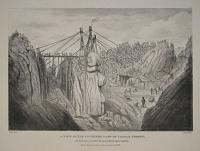
A View Of The Southern Part Of Castle Treryn, with the Machinery erected for the purpose of replacing the Logan Rock.
Tonkin, Delin: Vibert, Lithog:
Penzance, Published by Vibert & Tonkin November 16, 1824.
Lithograph, sheet 435 x 590mm. 17 x 23¼".
The Logan Rock is an eighty ton granite boulder perched on the edge of a headland overlooking the Atlantic ocean one mile south of the Cornish village of Treen. It an example of a logan or rocking stone, being finely balanced due to the actions of weathering. Plate 5 (numbered upper right) from a set of six illustrating the events of 1824: in April Lieutenant Hugh Goldsmith (nephew of the famous poet Oliver Goldsmith) and ten or twelve of his crew of the cutter HMS Nimble rocked the huge granite boulder armed with bars and levers until it fell from its cliff-top perch. Goldsmith was apparently motivated to disprove the claim of Dr. Borlase, who wrote in 'Antiquities of Cornwall' in 1754 that "...the extremities of [the Rock's] base are at such a distance from each other, and so well secured by their nearness to the stone which it stretches itself upon, that it is morally impossible that any lever, or indeed force, however applied in a mechanical way, can remove it from its present situation". The displacement of the rock upset the local residents considerably, since Logan Rock had been used to draw tourists to the area. The Lords of the Admiralty were persuaded to lend Lieutenant Goldsmith the required apparatus for replacing it. The Admiralty sent thirteen capstans with blocks and chains from the dock yard at Plymouth, and contributed £25 towards expenses. After months of effort, at 4.20pm on Tuesday, the 2nd of November, 1824, in front of thousands of spectators and with the help of more than sixty men and block and tackle, the Logan Rock was finally repositioned and returned to "rocking condition". However, it apparently no longer vibrates or "logs" as easily as it did before the incident. On J. Whatman watermarked paper 1824. Abbey Scenery: 106.
[Ref: 13522] £220.00
(£264.00 incl.VAT)
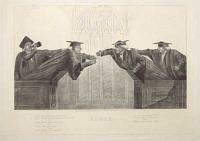
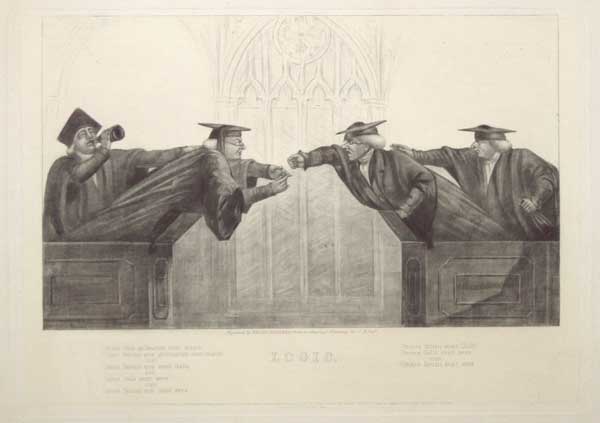
Logic
Engraved by Welby Sherman, from an Original Drawing by C.H. Esq,,r [Charles Heath?].
London, Republished Feb.y 15, 1853, by Thomas Boys, (of the Late Firm of Moon, Boys & Graves,) Printseller to the Royal Family, 467, Oxford Street. _ Paris, E. Gambart & Co. 15, Rue Charlot, Deposé. Originally Published Nov: 1836.
Fine and rare mezzotint on chine collé. 250 x 355mm (9¾ x 14"), very large margins. Publication line printed over the edge of the chine collé.
Syllogistic disputants arguing over whether or not the Parisians are birds? It is a pun on Gallus a cock or a Frenchman? Two scholars in caps and gowns, leaning out dangerously from opposing lecturns, arguing angrily and gesturing to emphasise their points, their companions holding their collars to prevent them from falling out. Both companions hold bottles, one swigging from theirs. Welby Sherman (fl.1827-36) was one of the more obscure members of the Ancients, a group of artists who formed around the visionary artist and poet William Blake. He was a cousin and pupil of Samuel Palmer, another Ancient, living with him in Shoreham; this did not stop him swindling Palmer's brother William out of £500 in wagers on games of billiards and fleeing abroad in 1836. London literary Gazette and Journal of Belles Lettres etc. vol 20, page 811 advert. BM 2010,7081.6989, suggesting Heath as the artist. Ex Collection of Hon C. Lennox-Boyd.
[Ref: 59132] £580.00
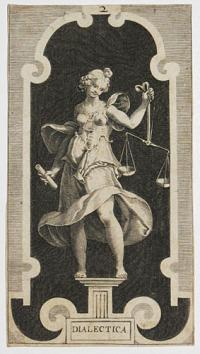
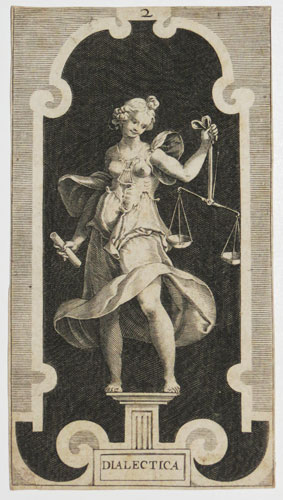
2. Dialectica.
[n.d., c.1600.]
Etching. Sheet 160 x 85mm (6¼ x 3½"). Trimmed to printed border.
A female allegorical figure representing Dialectics or Logic, one of a series of the Seven Liberal Arts. She stands on a plinth, a scroll in one hand and the scales with which she weighs arguments in the other.
[Ref: 49774] £140.00
(£168.00 incl.VAT)

The Logicians.
Suweyns pinxit. Lambert del.t. Printed by Engelmann G. C. & Co.
London: Published by R. Ackermann, 96, Strand, May 1828.
Lithograph. Sheet 245 x 370mm (9¾ x 14½"). Tear in title area taped, some spotting.
A singerie scene, with three monkeys in Dutch dress, drinking and smoking in an inn. By Antoine Suweyns (Flemish, 1720-89).
[Ref: 58359] £260.00
(£312.00 incl.VAT)
![[John Bernhard Logier.]](img-thumbnail/jpegs/64914.jpg)
[John Bernhard Logier.] Presented to J.B. Logier Esq.r by the Professors who have adopted his System of Musical Education in testimony of their personal esteem and high sense of the advantages he has conferred on the Art. Proof.
Painted by J. Lonsdale. Engraved by C. Turner.
London, Published July 20. 1819, by J. Green, 33 Soho Square.
Very rare mezzotint. 510 x 355mm (20 x 14"), with very large margins. Horizontal crease at top.
Three-quarter length portrait of German music teacher John Bernhard Logier (1777-1846), seated in an armchair, wearing a dark double-breasted coat, white neckerchief, and seals on fob. Logier invented the Chiroplast, a pedagogical device that guides the hands and fingers while playing the piano. He also developed his own teaching method, now called the 'Logier method', which he published in 'System der Musikwissenschaft' (1827), where pupils were taught with technical instruction done together with instruction in principles of harmony. Whitman: 320. Ex: Collection of The Hon. Christopher Lennox-Boyd.
[Ref: 64914] £320.00
![[J.B. Logier.]](img-thumbnail/jpegs/28047.jpg)
[J.B. Logier.] Presented to J.B. Logier Esq.r by the Professors who have adopted his System of Musical Education in testimony of their personal esteem and high sense of the advantages he has conferred on the Art.
Painted by J. Lonsdale. Engraved by C. Turner.
London, Published July 20. 1819, by J. Green, 33 Soho Square.
Very rare mezzotint with very large margins. Plate 509 x 354mm. 20 x 14". Laid on sheet, otherwise good condition.
Portrait, three-quarter length; seated in an armchair to front, facing left; wearing a dark double-breasted coat, white neckerchief, and seals on fob; his right arm resting on sheet music on a table, next to inkstand, inkwells and pen, holding a paper in his hand; curtain above on right, fluted pillar behind. John Bernhard Logier (1777-1846) the German music teacher. He invented the Chiroplast, a pedagogical device that guides the hands and fingers while playing the piano. He also developed his own teaching method, now called the 'Logier method', which he published in 'System der Musikwissenschaft' (1827), where pupils were taught with technical instruction done together with instruction in principles of harmony. Whitman: 320. NPG: D7896.
[Ref: 28047] £320.00
![John Logotheti Senator of the Executive Body of the Greek Government. [Greek facsimile signature].](img-thumbnail/jpegs/2581.jpg)
John Logotheti Senator of the Executive Body of the Greek Government. [Greek facsimile signature].
Bouvier Lithog.
This Print forms one of the Series of Greek Portaits (4.th Part) now in course of publication in London, by A. Friedel & Sold by the principal Book & Printsellers in Town & Country. June 1826.
Coloured lithograph. Sheet 486 x 350mm.
Portrait of Ionnis Logothetis, who represented Eastern Mainland Greece at the First National Assembly of 1821 during the Greek War of Independence. Provenance: Bracebridge Archive. Selina Bracebridge, maiden-name Mills, was a pupil of Samuel Prout. Her husband was the Bracebridge celebrated in Washington Irving’s Bracebridge Hall. From the mid-1830s, they settled for some years in Athens. He owned large properties in Karea and Euboca, the latter of which he sold to the Noel family; and they both lived in a large house on Adrianou Street. 1850, saw the publication of Mr. Bracebridge’s 'Letter on the Affairs of Greece'. Bracebridge was Florence Nightingale’s uncle. Their time spent in Athens and the Levant is not clear; however it seems likely that they were settled in Athens from about 1835 to 1839, with frequent trips to England. Similarly, it is most likely that on their return back to the UK, they continued to own property in Greece. A painting by Selina is in the possession of the Birmingham Museum and Art Gallery.
[Ref: 2581] £260.00
(£312.00 incl.VAT)

The Loisettian School of Physiological Memory; or, The Instantaneous Art of Never Forgetting. 37, New Oxford Street, London. [2nd June] 188[6]. Dear [Sir] I beg to acknowledge with thanks receipt by [P.P.O.] of [£1/1/-] in full for complete course of Lessons in my System of Memory by Post [...]
[1886.]
2pp. letterpress form, filled in with old ink mms and signed by Loisette, addressed to Mr. D. Cudmase. Sheet 210 x 135mm (8¼ x 5¼"). Creases, spike hole in centre.
A receipt for tuition from Professor Alphonse Loisette, who protected his memory system by forcing a gagging contract on prospective pupils. Those who signed up, including Mark Twain, found it was not only plagerised but also largely ineffective. An exposé was published reporting that Loisette's real name was Marcus Dwight Larrowe and he had no academic degree.
[Ref: 58756] £95.00
(£114.00 incl.VAT)
![Pavie. Facade de la Chartreause. [/] Pavia. Facciata della Certosa.](img-thumbnail/jpegs/33323.jpg)
Pavie. Facade de la Chartreause. [/] Pavia. Facciata della Certosa.
Desineé d'ap. nat. et lith. par Ph. Benoist.
Imp Lemercier. Paris. Paris, Bulla Editeur, Rue Tiquetonne, 18. [n.d., c.1850].
Tinted lithograph. Sheet size: 290 x 380mm (11½ x15").
A highly detailed view of the Certosa di Pavia, a monastery and complex in Lombardy, northern Italy, situated near a small town of the same name in the Province of Pavia. Certosa is the Italian name for a house of the cloistered monastic order of Carthusians founded by St. Bruno in 1044 at Grande Chartreuse. Though the Carthusians in their early centuries were known for their seclusion and asceticism and the plainness of their architecture, the Certosa is renowned for the exuberance of its architecture, in both the Gothic and Renaissance styles, and for its collection of artworks which are particularly representative of the region. After Philipe Benoist (1813-1880), with titles in French and Italian.
[Ref: 33323] £220.00
(£264.00 incl.VAT)

Vue aux Environs de Narni en Lombardie Dediée a son altesse serenissime Monseigneur le Prince d'Orange & de Nassau, Stadhouder héréditaire, Capitaine general et Amiral des Provinces unies des Pais-bas, &a &a &a. et tirée de son Cabinet par ses très-humbles et très-obéissans Serviteurs Pierre Yver & Pierre Fouquet le Jeune.
Peint par Vernet. Gravé par S. Fokke.
A Amsterdam chez Pierre Yver et Pierre Fouquet le Jeune.
Etching, 290 x 330mm. 11½ x 13". Trimmed to plate.
Dramatic view of Narni, Italy. Etched by the Amsterdam printmaker Simon Fokke (1712-84) after Joseph Vernet.
[Ref: 16275] £220.00
(£264.00 incl.VAT)
![[Henri Auguste de Loménie, Count of Brienne]](img-thumbnail/jpegs/57468.jpg)
[Henri Auguste de Loménie, Count of Brienne]
R. Nanteuil ad vivum faciebat. 1660.
Engraving in mount. 365 x 275mm (14¼ x 10¾"). Trimmed. Attached to top & bottom on left.
A bust length portrait of Henri Auguste de Loménie (1594-1666) in an oval frame of oak leaves atop a pedastel decorated with a coat of arms. Loménie was a successful French diplomat responsible for many delicate maneouvres including the marriage of Henrietta Maria of France and Charles I. PW39. i.
[Ref: 57468] £260.00
(£312.00 incl.VAT)
![Ben Lomond, from Luss. [pencil.]](img-thumbnail/jpegs/49232.jpg)
Ben Lomond, from Luss. [pencil.] ''Ben Lomond'' (From Luss). Original Etching by J. Chalmers Park. Edition Strictly Limited to 100 Signed Artist's Proofs.
J Chalmers Park [signed in pencil.]
[n.d., c.1930.]
Drypoint etching, signed by the artist. 115 x 225mm (6 x 8�") very large margins. In original mount with gallery label with title. Glue stains in outer margin.
James Chalmers Park (1858-1938) of Yorkshire.
[Ref: 49232] £65.00
(£78.00 incl.VAT)
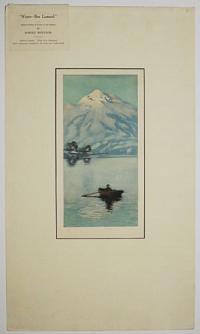
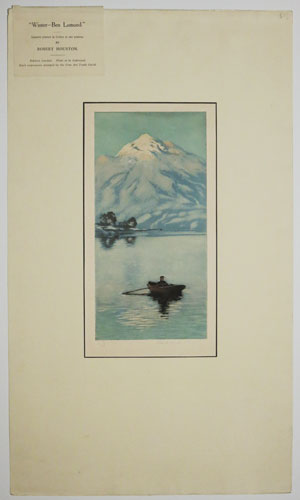
''Winter - Ben Lomond.'' Aquatint printed in Colour in one printing by Robert Houston. Edition limited, Plate to be destroyed. Each impression stamped by the Fine Art Trade Guild.
Robert Houston [pencil].
[n.d., c.1930.]
Aquatint, printed in colours, signed by the artist, Fine Art Trade Guild blind stamps. 225 x 125mm (8¾ x 5") very large margins. In original mount with printed title label of Alfred Bell & Co. Mint.
A rowing boat on the loch near Luss below Ben Lomond.
[Ref: 49245] £75.00
(£90.00 incl.VAT)
![[Catone Lonati]](img-thumbnail/jpegs/68238.jpg)
[Catone Lonati]
[A.E. Chalon, R.A. R.J. Lane A.R.A.]
[London, Published Feb,y 1837, by J. Mitchell, Library 33, Old Bond St. deposé a Paris, chez Rittner & Goupil, Boulevard Montmarte]
Lithograph. Framed, sight size 305 x 220mm (12 x 8¾"). Unexamined out of frame.
A full-length portrait of Italian tenor Catone Lonati as Nemorino in Gaetano Donizetti's opera, ''L'Elisir d'Amore''.
[Ref: 68238] £140.00
(£168.00 incl.VAT)

Ernestus Guilielmus Londicerus. Nob. Ordin. per Esthoniam Equestris Pictor.
P. Schenck fe: et exc: Amstelo: cum Privilegio [n.d., c.1675-1719]
Mezzotint. 255 x 185mm (10 x 7¼").
A three-quarter portrait of Estonian painter Ernst Wilhelm Londicer (1655-97) in lavish wig and clothes.
[Ref: 60211] £230.00
(£276.00 incl.VAT)
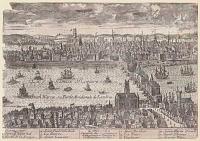
Londres.
[after Pierre Aveline.]
AParis chez Chiquet [n.d., c.1700].
Scarce engraving, some amateur colour. Sheet 150 x 215mm (6 x 8½"). Trimmed into image on three sides, into plate at bottom, affecting key, chips and surface abrasions. Loss on left especially at top corner.
A naive prospect of London before the Great Fire of 1666, taken from Southwark, with a 12-point key. In the centre is the Norman St Paul's Cathedral, depicted very much as an artist's impression, with London Bridge with houses and the heads of criminals on the gatehouse.
[Ref: 61724] £140.00
(£168.00 incl.VAT)

Prospects of the most remarkable places in and about the Citty of London, Neatly Engraved.
[London: Henry Overton, c.1724.]
Engraving. Plate: 165 x 245mm (6½ x 9¾"), with large margins. Marking in margins.
The title page to 'Prospects of the most remarkable places in and about the Citty of London, Neatly Engraved' published by Henry Overton with title in French and English.
[Ref: 45355] £280.00
(£336.00 incl.VAT)



![[John Locke.]](jpegs/48685.jpg)

![[Joseph Locke, Esq.re M.P.]Joseph Locke April 1849 [facsimile signature.]](jpegs/67819.jpg)
![[Rebecca Lockhart] Lady Boyd.](jpegs/68346.jpg)

![[Lionel Lockyer]](jpegs/37638.jpg)


![[Lodona.]](jpegs/44046.jpg)

![Lovenstein. [Battle of Loevenstein, 19th December 1570.]](jpegs/40311.jpg)





![[John Bernhard Logier.]](jpegs/64914.jpg)
![[J.B. Logier.]](jpegs/28047.jpg)
![John Logotheti Senator of the Executive Body of the Greek Government. [Greek facsimile signature].](jpegs/2581.jpg)

![Pavie. Facade de la Chartreause. [/] Pavia. Facciata della Certosa.](jpegs/33323.jpg)

![[Henri Auguste de Loménie, Count of Brienne]](jpegs/57468.jpg)
![Ben Lomond, from Luss. [pencil.]](jpegs/49232.jpg)
![[Catone Lonati]](jpegs/68238.jpg)