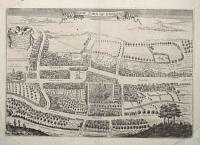
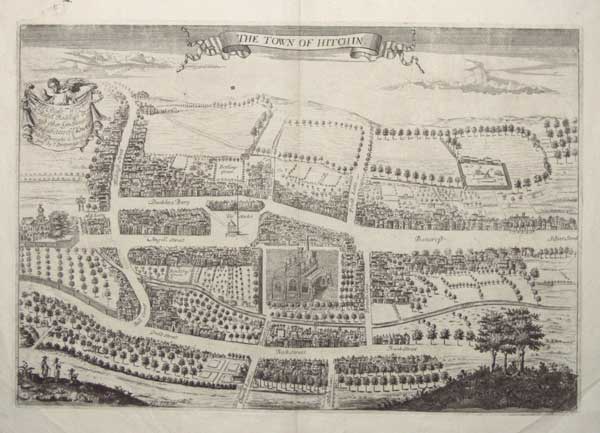
The Town of Hitchin.
[John Drapentier.]
[London: Benjamin Griffin et al, 1700.]
Engraved plan. 275 x 395mm (10¾ x 15½") very large margins. Creasing as normal.
A plan of Hitchin in the form of a bird's-eye view, published in Sir Henry Chauncy's 'Historical Antiquities of Hertfordshire'.
[Ref: 62546] £180.00

The Town of Hitchin.
[John Drapentier.]
[London: Benjamin Griffin et al, 1700.]
Engraved plan, 17th century watermark. 275 x 395mm (10¾ x 15½") very large margins.
A plan of Hitchin in the form of a bird's-eye view, published in Sir Henry Chauncy's 'Historical Antiquities of Hertfordshire'.
[Ref: 63046] £220.00
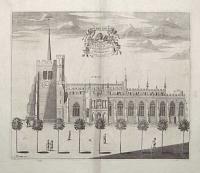
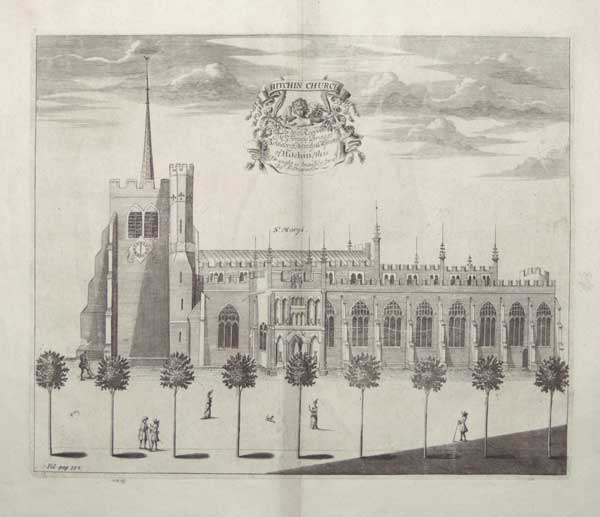
Hitchin Church. To the Reverend M.r Francis Bragge Batchelor of Divinity & Minister of Hitchin, this Draught is humbly pres'd By J Drapentier.
[London: Benjamin Griffin et al, 1700.]
Engraving. 280 x 340mm (11 x 13½") very large margins.
A view of Hitchin Church from Sir Henry Chauncy's 'Historical Antiquities of Hertfordshire'.
[Ref: 62544] £130.00
(£156.00 incl.VAT)

The Impersonator.
Wilfred Huggins [signed in pencil.]
[n.d., c.1940.]
Etching. Plate: 110 x 165mm (4¼ x 6½").
Satirical depiction of Austrian dictator Adolf Hitler (1889-1945) who stands looking in the mirror attempting to curl his fringe in a similar manner to Napoleon, a portrait of whom hangs on the wall behind. Not seen before. Privately issued as a Christmas/New Year greetings card.
[Ref: 37490] £850.00

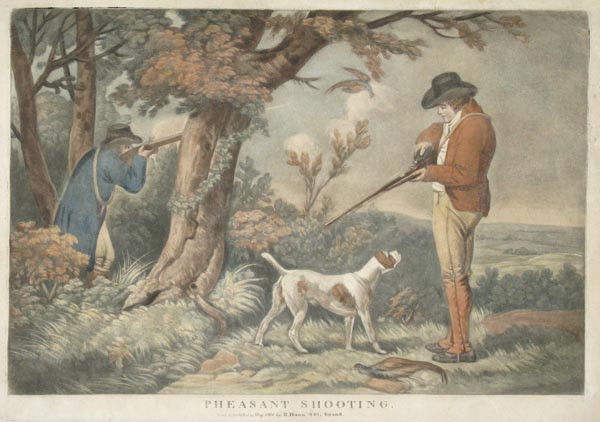
Pheasant Shooting.
London, Published 13 May 1810 by R. Hixon, 440 Strand.
Coloured mezzotint. 255 x 355mm.
[Ref: 7286] £450.00
![H.M.A.S. Australia [pencil.]](img-thumbnail/jpegs/52984.jpg)
H.M.A.S. Australia [pencil.]
Rowland Langmaid [pencil.]
[n.d. c.1945.]
Rare etching. 150 x 285mm (6 x 11¼"), with large margins.
HMAS Australia (I84/D84/C01), a heavy cruiser of the Royal Australian Navy, shown at anchor surrounded by yachts. After being damaged by kamikaze attacks in the Pacific she was sent for repairs at Portsmouth, where this scene was probably captured. A pupil of W.L Wyllie; Rowland Langmaid (1897-1956) served in the Royal Navy and attained the rank of Lt. Commander. He exhibited at the R.A.
[Ref: 52984] £260.00
(£312.00 incl.VAT)
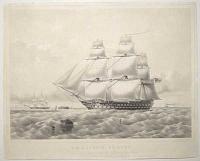
H.M.S Albion, 90 Guns. To Captain Lockyer and the Officers of the Ship this print is respectfully dedicated by their very obedient Servant.
H.A Luscombe del.t _T G. Dutton Lith.
Day & Haghe Lith.rs to the Queen.
Rare lithograph, sheet 360 x 445mm (14¼ x 17½"). A few nicks to edges. Adbrasion causing very slight obstruction to the dedication line.
Lithograph showing the H.M.S Albion from her port side. The print is dedicated to Captain Nicholas Lockyer (1781-1847), who died on 27 February, 1847, aged 65, while in command of the Albion at Malta. HMS Albion was a 90-gun second-rate ship of the line of the Royal Navy. Ordered in 1839, she was built at Plymouth Dockyard, launched on 6 September 1842, and completed on 23 January 1844. Albion was designed by Sir William Symonds (1782–1856) was the only ship of her class to ever serve as a sailing ship, and the last British two-decker to be completed and enter service without a steam engine. She was the name ship of a class of three second rates; the others being Aboukir and Exmouth.
[Ref: 56629] £260.00
(£312.00 incl.VAT)
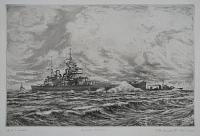
H.M S. Anson. To Comdr. Rendell [in pencil.]
C.H. Baskett del et imp. [pencil signature.]
[n.d., c.1945.]
Etching on laid paper, dedicated by the artist, 230 x 350mm. 9 x 13¾". Mild paper discoloration.
HMS Anson was a King George V-class battleship of the Royal Navy, named after Admiral George Anson. She was built by Swan Hunter and Wigham Richardson Shipyard and launched on 24 February 1940, being completed on 22 June 1942. Anson saw service in the Second World War. Charles Henry Baskett (British, 1872 - 1953).
[Ref: 20228] £220.00
(£264.00 incl.VAT)

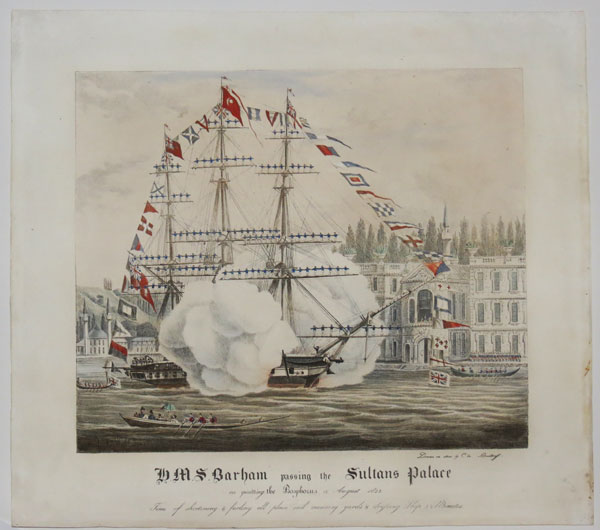
H.M.S. Barham passing the Sultans Palace on quitting the Bosphorus 2 August 1832. Time of shortening all plain sail manning yards & dressing ship 2½ Minutes.
J.K. Willson. Drawn on stone by C. Brocktorff
[n.d., c.1835.]
Coloured lithograph. Printed area 330 x 350mm, 13 x 13¾". Slight scuffing in margins.
A fantastic image. HMS Barham leaving Istanbul, firing a salute before the Sultan's Palace, with the crew filling the yards and pennants flying from bow to stern. Lithographed by the famous Maltese artist Charles Frederick de Brocktorff (1775-1850) after James Kennett Wilson. Barham was launched in 1811 as a 74-gun third rate ship of the line. However, after nearly being wrecked near Bonaire in the Antilles in 1829, it was rescued and restored with only 50 guns. This view is one from a series depicting the voyage between England and Constantinople, starting 1831, which was of particular interest because one of the passengers was Sir Walter Scott: the writer has suffered a series of debilitating strokes and had been advised to seek warmer climes to recuperate. The Barham took Scott to Gibraltar and Malta before leaving him at Naples, from where he returned to Scotland overland to die at home in Abbotsford in 1832. At Constantinople they picked up Canning, the British Ambassador to the Ottoman Empire, who spent a decade on other postings before returning to Constantinople in 1842.
[Ref: 26298] £650.00

H.M.S. Barham quitting Constantinople. With Sir Stafford Canning on b.d 12th August 1832.
C.F. Brocktorff del. Malta.
[n.d., c.1835.]
Coloured lithograph. Printed area 330 x 350mm, 13 x 13¾". Slight scuffing in margins, very scarce.
HMS Barham leaving Istanbul, lithographed after James Kennett Wilson by Charles Frederick de Brocktorff (1775-1850), the famous Maltese artist. Barham was launched in 1811 as a 74-gun third rate ship of the line. However, after nearly being wrecked near Bonaire in the Antilles in 1829, it was rescued and restored with only 50 guns. This view is one from a series depicting the voyage between England and Constantinople, starting 1831, which was of particular interest because one of the passengers was Sir Walter Scott: the writer has suffered a series of debilitating strokes and had been advised to seek warmer climes to recuperate. The Barham took Scott to Gibraltar and Malta before leaving him at Naples, from where he returned to Scotland overland to die at home in Abbotsford in 1832. At Constantinople they picked up Canning, the British Ambassador to the Ottoman Empire, who spent a decade on other postings before returning to Constantinople in 1842.
[Ref: 26297] £520.00

H.M.S. Barham. Entering the Harbour of Milo 26. Feb.y 1832.
J.K. Willson. C.F. Brocktorff, del. Malta 1833.
[n.d., c.1835.]
Coloured lithograph. Printed area 330 x 350mm, 13 x 13¾". Slight scuffing in margins.
HMS Barham entering the harbour of Milos, in the southern Aegean, after James Kennett Wilson by Charles Frederick de Brocktorff (1775-1850), the famous Maltese artist. Barham was launched in 1811 as a 74-gun third rate ship of the line. However, after nearly being wrecked near Bonaire in the Antilles in 1829, it was rescued and restored with only 50 guns. This view is one from a series depicting the voyage between England and Constantinople, starting 1831, which was of particular interest because one of the passengers was Sir Walter Scott: the writer has suffered a series of debilitating strokes and had been advised to seek warmer climes to recuperate. The Barham took Scott to Gibraltar and Malta before leaving him at Naples, from where he returned to Scotland overland to die at home in Abbotsford in 1832.
[Ref: 26296] £650.00

H.M.S. Barham in a Squall on the 21st Oct.r 1833 at 10.h 40. Am.
J.K. Willson. C.F. Brocktorff del. Malta 1833.
[n.d., c.1835.]
Coloured lithograph, very scarce. Printed area 330 x 350mm, 13 x 13¾". Slight scuffing in margins.
HMS Barham in rough seas with lightning stikes behind. Lithographed by James Kennett Wilson after the famous Maltese artist Charles Frederick de Brocktorff (1775-1850). Barham was launched in 1811 as a 74-gun third rate ship of the line. However, after nearly being wrecked near Bonaire in the Antilles in 1829, she was rescued and restored with only 50 guns. She was broken up in 1839.
[Ref: 26299] £350.00
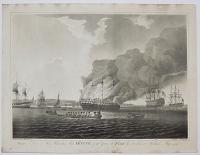
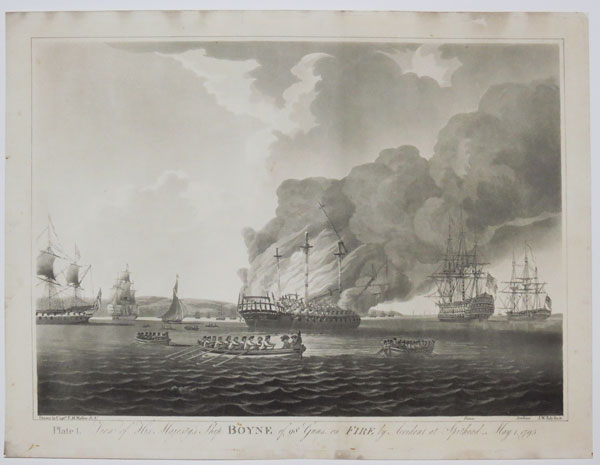
Plate 1. View of His Majesty's Ship Boyne of 98 Guns, on Fire by Accident at Spithead, May 1, 1795. Prince. Arethusa.
Drawn by Capt.n. T. M. Waller RN. J. W. Edy fecit.
[n.d., c.1797.]
Aquatint. Plate: 475 x 360mm (18¾ x 14"). Large repaired tear from top edge to centre and in title area.
A scene showing the destruction of HMS Boyne off Spithead. On the morning of May 1st 1795 it was observed that HMS Boyne was on fire so orders were made to assist the fleet, the whole crew were saved but the fire could not be put out. Eventually the cables anchoring the ship were burnt and she floated on the current. The greatest damage was done by the guns which were loaded and started firing at the crowd which had gathered to see the spectacle and three men were killed on HMS Queen Charlotte by rogue shot. HMS Boyne eventually blew up at 5.30pm. Ex: The collection of the Hon. Christopher Lennox-Boyd.
[Ref: 39421] £240.00
(£288.00 incl.VAT)
![Portraits of the Officers and Men who were preserv'd from the Wreck of the Centaure [...]](img-thumbnail/jpegs/51165.jpg)
Portraits of the Officers and Men who were preserv'd from the Wreck of the Centaure [...]
James Northcote pinx.t. T. Gaugain fecit.
Published Oct.r 1784 by T. Gaugain, No. 4 Little Compton Street, St. Ann's, London
Rare stipple engraving. Sheet 525 x 650mm (20¾ x 25½"). Trimmed within plate and laid on archival paper; top right corner reinstated to image, with small tear repaired; small area of loss in English title.
A dramatic naval scene showing the twelve members of the crew of HMS Centaur taking to one of the ship's pinnaces and attempting to push away from their ship as it founders. HMS Centaur, a French frigate captured during the Battle of Lagos in 1759, was one of a fleet escorting prizes from the Battle of the Saintes back to Britain from Jamaica when the 1782 Central Atlantic hurricane hit off Newfoundland. Captain J.N. Inglefield and eleven crewmen reached the island of Faial in the Azores after more than sixteen days in an open boat. It is believed that 3,500 lives were lost from the various ships of the fleet. The painting, now lost, was exhibited at the Royal Academyin 1784.
[Ref: 51165] £650.00

A Sloop of War Ship (new Class) 18 Guns, as Dido, &c. Hove to, making signal for a Pilot. Ensign and Pendant hoisted.
Knell, del.t N. Fielding, sc.
London, Pub.d by Ackermann & Co. Oct.r 1. 1840.
Coloued aquatint and etching. 152 x 235mm. 6 x 9¼". Minor foxing, small tears in lower edge.
The HMS Dido was an 18-gun corvette, a small, manoeuvrable, lightly armed warship, launched in 1836, used as a coal hulk after 1860 and eventually sold in 1903. NMM: PAI3090.
[Ref: 17933] £160.00
(£192.00 incl.VAT)
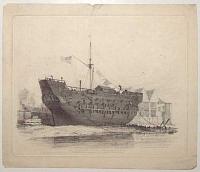
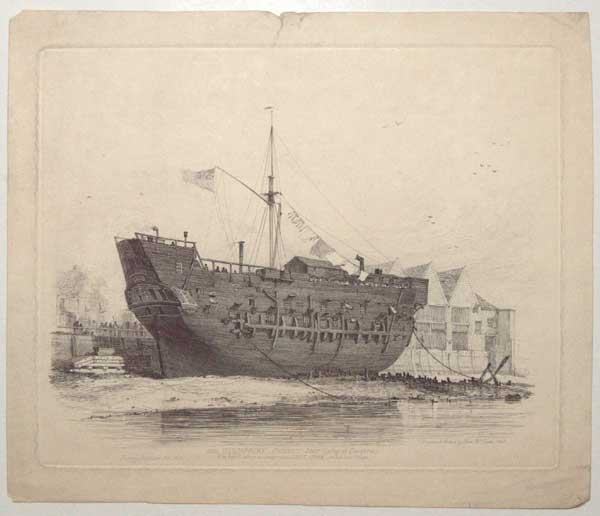
The Discovery, Convict Ship (lying at Deptford). The Vessell which accompanied Capt. Cook, on his last Voyage.
Drawn & Etched by Edw. W. Cooke, 1828.
London, Publisged Feb. 1829.
Etching. 165 x 200mm (6½ x 8"). Small margins. Tear touching plate at top taped.
This 'Discovery' was George Vancouver's lead ship in his voyages to Australia and the Pacific north-west (1791-5), not Cook's (broken up in 1797). After fighting at the Battle of Copenhagen (1801) she became a hospital ship at Sheerness (1807-15), then a convict ship, first at Woolwich (1818-24) then Deptford (1824-c.1831, before being broken up in 1834. Australian interest.
[Ref: 56036] £160.00
(£192.00 incl.VAT)
![H.M.S. Edinburgh [in pencil].](img-thumbnail/jpegs/19776.jpg)
H.M.S. Edinburgh [in pencil].
C.H. Baskett [in pencil lower right.]
[n.d. c.1940.]
A rare aquatint with etching. Signed and inscribed in pencil. 292 x 426mm. 11½ x 16¾". Some foxing.
HMS Edinburgh, the Town-class light cruiser launched in 1939. She was damaged by a torpedo and then sucttled in the Barents Sea in mid-1942, until she was sunk by a U-Boat later that year. Charles Basket was an etcher and aquatinter. He studied at the Colchester School of Art and the Lambeth School of Art. Frank Mura taught him to draw in charcoal. Almost from the start of his career he received much acclaim for his aquatint etchings. He has become famous for his beautifully rendered landscapes, marine scenes and river views.
[Ref: 19776] £260.00
(£312.00 incl.VAT)

HMS Endymion 44, Capt.n Hon.ble F.W. Grey. At the beginning of the Gale off the Cape of Good Hope___on the 17.th August 1843.
Morison Lith.
[n.d. c.1845.]
Pen lithograph and etching. 209 x 300mm (8¼ 11¾"). Very rare.
HMS Enymion, launched in 1797, seen here under the command of Captain Hon. Frederick William Grey. Endymion served in the French Revolutionary and Napoleonic Wars. In the War of 1812 she fought a duel with USS President, disabling the American ship. She became a receiving ship in 1859 and was broken up in June 1868. Under Grey's command, from 1840 to 1842, she took part in the First Opium War, including operations on the Yangtze River.
[Ref: 30697] £140.00
(£168.00 incl.VAT)
![Supplement To The Isle Of Wight Mercury, March 25, 1878. [&] March 27, 1878.](img-thumbnail/jpegs/12228.jpg)
Supplement To The Isle Of Wight Mercury, March 25, 1878. [&] March 27, 1878.
[Isle of Wight, 1878.]
Two letterpress broadsides, each c.505 x 375mm. 19¾ x 14¾". Folds, tearing in places. Staining and tatty extremities.
Two special supplements to a local newspaper describing events surrounding the loss of HMS Eurydice, a 24-gun frigate which was the victim of one of Britain's worst peace-time naval disasters when she sank in a heavy snow storm off the Isle of Wight on 24th March 1878. The first supplement, issued the following day, describes how the tragedy unfolded, lists some of the dead officers, and quotes eye-witness accounts. The second, two days later, reports on the inquest. After being recommissioned as a training ship under the command of Captain Marcus Augustus Stanley Hare (1839 – 1878), the Eurydice sailed from Portsmouth on a three month tour of the West Indies and Bermuda on 13th November 1877. On 6th March 1878 she began her return voyage from Bermuda for Portsmouth. Only two of the ship's 378 crew and trainees survived the sinking, most of those not carried down with the ship dying of exposure in the freezing waters. One of the witnesses to the disaster was a young Winston Churchill, who was living at Ventnor with his family at the time. The wreck was refloated later in the year but had been so badly damaged during her period submerged that she was then broken up. Her ship's bell is preserved in St. Paul's Church, Gatten, Shanklin, Isle of Wight. There is a memorial plaque recording the names of the officers and crew who died in the disaster in St. Ann's Church, Portsmouth.
[Ref: 12228] £120.00
(£144.00 incl.VAT)
view all images for this item

HMS "Furious" June the 19th 1916.
Harold Wyllie 1922 [etched in plate.] Harold Wyllie [pencil signature.]
Chromolithograph, signed in pencil. Image area 419 x 380mm. 16½ x 15". Sheet area 665 x 558mm. 26¼ x 22".
HMS Furious was laid down in 1915 at Armstrong Whitworth's Low Walker shipyard in Newcastle upon Tyne. She was launched on 18 August 1916. She was a modified Courageous-class battlecruiser built for the Royal Navy during the First World War. After Lt. Col. Harold Wyllie OBE, RSMA (1880-1975), the marine painter. He fought in South Africa during the Boer War and served in the Royal Flying Corps in France as a pilot in WW2. He was awared OBE in 1919, and was granted rank of Lieut-Colonel on retirement in 1920. As an artist he studied under his father W.L. Wyllie and Frank Short. In 1934 he was appointed Hon. Marine Painter to the Royal Yacht Squadron, and in 1958 he became View President of the Society of Marine Artists.
[Ref: 28048] £180.00
(£216.00 incl.VAT)
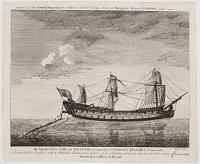
His Majesty's Ship the Grafton, Commodore Charles Holmes, Commander, As she sail'd to England with a Machine Constructed instead of her Rudder, which she lost in the last Storm off Louisbourgh.
Drawn by an Officer on Board. Boyce Sculpt.
Engrav'd for the Universal Magazine for J. Hinton at the Kings Arms in Newgate Street London. 1758.
Engraving. 209 x 254mm. 8¼ x 10". Folding and creasing. Small tears into the folds. Surface scratching.
HMS Grafton was built at Portsmouth and launched in 1750. She served during the Seven Years' War under the command of Captain Thomas Cornewall, Captain Richard Kempenfelt and Captain Robert Hughes; she was sold in 1767. In 1756 she was part of Holmes’ squadron off Louisbourg but was struck by a terrible storm during which she lost her mainmast, foretopmast, and rudder. The squadron returned to Great Britain in a very bad condition, but the Grafton was safely steered by means of a jury-rudder devised by Commodore Holmes.
[Ref: 20314] £120.00
(£144.00 incl.VAT)

H.M.S. Howe. Cap..tn R. Smart, K.H. bearing the Flag of Rear Admiral Sir F. Mason K.C.B entering Malta Harbour 1843.
[Engraved by the Schranz Brothers.]
[n.d., c.1843.]
Tinted lithograph. Sheet 345 x 450mm, 13½ x 17¾". Trimmed, losing publication line, laid on board.
HMS Howe, a 120-gun first rate ship of the line of the Royal Navy, launched on 28 March 1815 at Chatham and broken up in 1854.
[Ref: 15370] £580.00
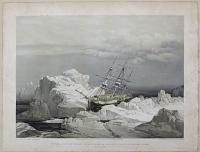
Critical Position of H.M.S Investigator on the North-Coast of Baring Island. August 20th. 1851.
Lieu. S. Gurney Creswell, Del_W.Simpson lith. Printed in Colours by Day & Son, Lith.rs to the Queen.
London Published 15.th May 1854, by Day & Son Gate St. Linc. Inn F.ds & Ackermann & Co. Strand.
. Some light foxing.
A scene showing the HMS Investigator, captained by Robert McClure, trapped in the ice on the north coast of Canada, while searching for the lost ship of Sir John Franklin. The crew were forced to abandon the ship and those who survived were eventually rescued by the Royal Navy. Plate 4 of 8 sketches in colour from Cresswell's voyage of H.M.S. Investigator 1854 to discover the North-West Passage. Abbey 644
[Ref: 41938] £900.00

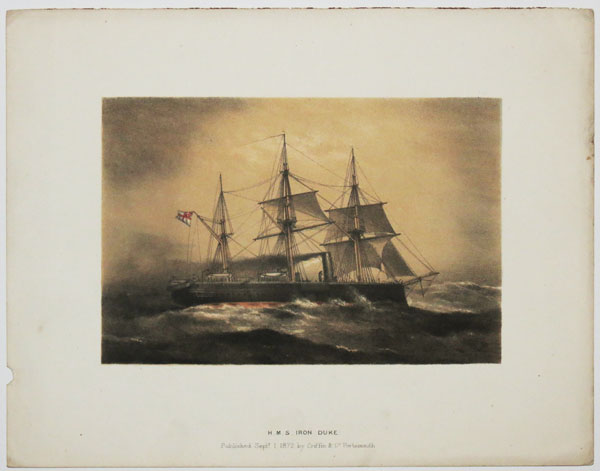
H.M.S. Iron Duke.
[after William Frederick Mitchell.]
Published Sept.r 1 1872, by Griffin & Co, Portsmouth.
Tinted lithograph. Sheet 215 x 270mm (8½ x 10¾"), with a text sheet.
HMS Iron Duke, served in the China Sea, the last of four Audacious-class central battery ironclads, built for the Royal Navy in the Pembroke Dockyard, completed in 1871. She was the first ironclad to use the Suez Canal, en route to the Far East that year, although most of her coal had to be unloaded to reduce her draught. She was converted to a coal hulk in 1900. From W.F. Mitchell's 'Royal Navy in a Series of Illustrations...'
[Ref: 45652] £95.00
(£114.00 incl.VAT)
![[HMS Java rounding the Cape of Good Hope in a storm, September 1826.]](img-thumbnail/jpegs/27919.jpg)
[HMS Java rounding the Cape of Good Hope in a storm, September 1826.] The ship Java - John Wilson Esq. Captain Rounding the Cape of Good Hope - in a- N.W- Gale - during which she sprung her main and tore [...] main sail hurt badly and the Bows hurt badly in two places - her Gangways - Biathing of [...] and biathing of lead completely - the lead was rolled up completely off her stearn - and various other minor damages. September - 1826.
[British, n.d., c.1827.]
Original watercolour drawing, the entire surface varnished, unique. Image/sheet 170 x 275mm. 6¾ x 10¾".
HMS Java was a 52-gun 4th rate ship of the Royal Navy built at Portsmouth in 1815. Annotated in pen to verso with a description of the incident, in a 19th century hand.
[Ref: 27919] £480.00

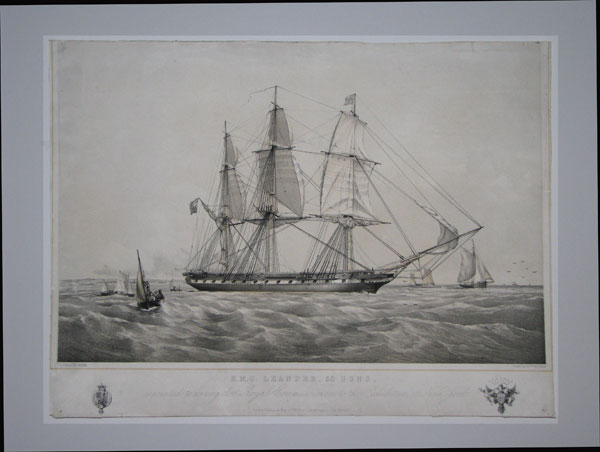
H.M.S. Leander, 50 Guns, appointed to convey the Royal Commissioners to the Exhibition at New York.
T.G.Dutton del et lith. Day & Son Lith.rs to the Queen
London Published May 25th, 1853, by Ackerman & Co, 96, Strand.
Tinted lithograph. Printed area 360 x 480mm, 14¼ x 18¾". Crease in centre, cut at top.
Launched in 1848, Leander was converted to screw propulsion in 1861 but sold in 1867. During the Crimean War, Leander served at Sebastapol. The Exhibition of the Industry of All Nations was inspired by London's Great Exhibiton of 1851, and had its own Crystal Palace. At the fair Elisha Otis showed off his design for a elevator which incorporated a failsafe: it overcame public concern regarding the safety of elevators and three years later Otis installed the first passenger elevator in the United States in a New York City shop. Parker 1802.
[Ref: 23236] £230.00
(£276.00 incl.VAT)

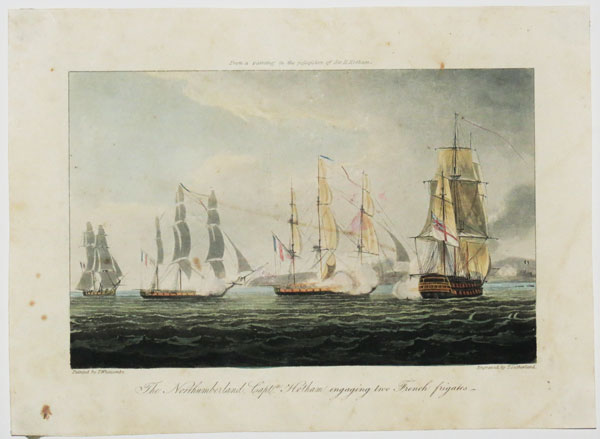
The Northumberland, Capt.n Hotham engaging two French frigates. From a painting in the possession of Sir H. Hotham.
Painted by T. Whitcombe. Engraved by T. Sutherland.
[Pub.d by Pyall & Stroud , 19 Hanway Street, Oxford Street.]
Rare hand-coloured aquatint. Sheet: 175 x 245mm (7 x 9½''). Slight staining.
A naval battle showing the battle between the French navy and HMS Northumberland under the command of Henry Hotham.
[Ref: 49945] £140.00
(£168.00 incl.VAT)

H.M.S. Pearl, commanded by Lord Clarence Paget
Engraved by C. Rosenberg.
Published by W.J. Huggins, Marine Painter to his Late Majesty Willm. 4th. [n.d., c.1830.]
Hand coloured aquatint, image 260 x 385mm. 10¼ x 15¼". Paper rather browned, so colour appears slightly faded; unexamined out of maple frame.
HMS Pearl was a sloop listed as being of 20 guns, wearing the ensign of the Red. She was built in 1828 and broken up in 1851, and was commanded by Lord Clarence Edward Paget (1811 - 1895). On 18th April 1838, when on patrol as an anti-slaver, she took the slaver Diligente as part of Britain's part of her treaty with Spain for the suppression of the slave trade. Paget joined the navy in 1827. He served as a midshipman on board the Asia at Navarino. He was captain of the Princess Royal, of 91 guns, in the expedition to the Baltic in 1854, and during the blockade and bombardment of Sebastopol in 1855; he also took part in the expedition to Kertch and Yenikalé (medals, Sebastopol clasp, and fourth class of the Medjidie). He attained flag rank in 1858, and was made a rear-admiral of the red in 1863, vice-admiral in 1865, admiral in April 1870, and was placed on the retired list in 1876. Parker: 1823. NMM: PAF8045.
[Ref: 17645] £720.00

A Sloop of War Brig (New Class) 16 Guns, as Pilot, &c. All sail set __ Wind on the quarter__Ensign and Pendant flying.
Knell, del.t N. Fielding, sc.
London, Pub.d by Ackermann & Co. Oct.r 1. 1840.
Coloued aquatint and etching. 152 x 235mm. 6 x 9¼".
HMS Pilot was a 16-gun brig-sloop launched in 1838 and sold in 1862. NMM: PAI3091.
[Ref: 17937] £140.00
(£168.00 incl.VAT)

A Fifth Rate - 36 Gun Frigate. Hove to - Larboard take - Lee bow view - Light breeze.
[J. Ward. W. Monkhouse.]
[n.d. c.1840.]
Tinted lithograph, very large margins, rare. On verso in ink "For Dearest Papa from Estilie ? Portsmouth July 19th, 1856"; 222 x 266mm (8¾ x 10½").
HMS Pique (1834), the fifth rate warship of the Royal Navy, launced at Devnoport, of 1633 tons and with 36 guns. She travelled around North America, the West Indies and Mediterranean, including operations off the coast of Syria. In 1845 she acted as cable ship for experiments in laying telegraph cable in Portsmouth Habour. In 1854 she participated in the Anglo-French squadron and was sent to the Russian War and Second Anglo-Chinese War. Here she was present at the Siege of Petropavlovsk. From 1872 she was a Receiving Ship, and ten years later she was rented as a hospital hulk to Plymouth Borough Council to quarantine sailors who fell victim to a cholera epidemic. She was broken up in 1910.
[Ref: 31303] £130.00
(£156.00 incl.VAT)
![H.M.S. Renown. [pencil.]](img-thumbnail/jpegs/16956.jpg)
H.M.S. Renown. [pencil.]
S.C. Rowles signed in pencil.
[n.d., c.1920.]
mild foxing.
HMS Renown, battlecruiser completed 1916, one of only four battlecruisers to survive the Second World War, but sold for scrap in 1948. Stanley Charles Rowles, born 1887, studied at the Royal College of Art 1905-1911, then the Putney School of Art and Battersea Polytechnic School of Art. He was headmaster of West Bromwich Municipal School of Art, begore moving to London. He exhibited at the Walker Art Gallery and Royal Academy.
[Ref: 16956] £130.00
(£156.00 incl.VAT)
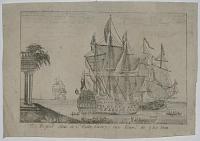
The Royal Ann, a 1st Rate, Carrys 100 Guns, & 780 Men.
[n.d., c.1760.]
Etching, sheet 120 x 170mm. 4¾ x 6¾".
HMS Royal Anne started life as HMS Royal Charles, a 100-gun first rate ship of the line of the Royal Navy, built by Sir Anthony Deane at Portsmouth Dockyard, and launched in 1673 She was rebuilt at Woolwich Dockyard in 1693, and renamed HMS Queen. She was rebuilt for a second time at Woolwich, relaunching on 20 September 1715, and renamed once more, this time to HMS Royal George. She was renamed HMS Royal Anne in 1756, and was broken up in 1767. From the Capper album.
[Ref: 10944] £130.00
(£156.00 incl.VAT)

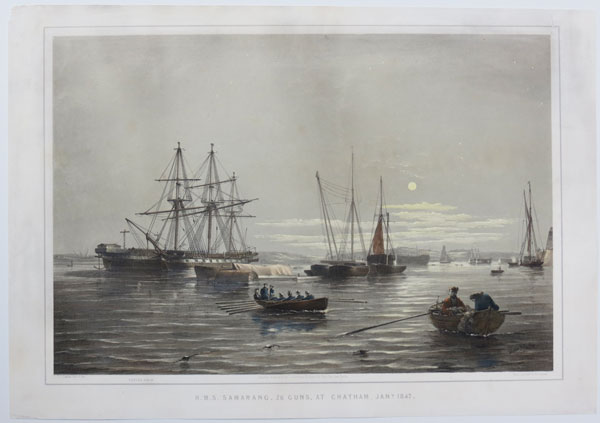
H.M.S. Samarang, 26 Guns, at Chatham, Jan.y 1847.
T.G. Dutton Del et lith. Day & Son, Lith.rs to the Queen.
London Published by T.G. Dutton 17, Gate St. Lincoln's Inn Fields.
Coloured lithograph. 370 x 532mm (14½ x 21"). Tears; and chip to corners.
A view of HMS Samarang at Chatham. She was launched at Cochin in 1822 by the East India Company and served in various stations around the world before seeing action in the First Opium War, and was then employed under Edward Belcher, in surveying the coast of Borneo from 1843-1849. She then became a guardship at Gibraltar before being sold for breaking in 1883.
[Ref: 30897] £360.00

H.M.S. Satellite, 18 Guns.
Drawn by H. John Vernon. Day & Haghe, Lith.rs to the Queen.
A. Hinton, Portsmouth,_Ackermann & Co. London. [n.d. c.1850.]
Hand-coloured lithograph. 272 x 351mm. 10¾ x 13¾". Mount staining.
HMS Satellite (1826) was an 18-gun sloop based around North and South America and the West Indies. She was broken up in 1849. NMM: PAD6137.
[Ref: 20861] £250.00
(£300.00 incl.VAT)
![H.M.S. Scylla [in pencil].](img-thumbnail/jpegs/19775.jpg)
H.M.S. Scylla [in pencil].
C.H. Baskett del et imp. [pencil lower right.]
[n.d. c.1940.]
A rare aquatint with etching. Signed and inscribed in pencil. 284 x 420mm. 11¼ x 16½". Some tape along the top margin.
HMS Scylla was a Dido-class light cruiser launched in 1940, and was seriously damaged by a mine in 1944. Charles Henry Baskett (1872-1953) was an etcher and aquatinter. He studied at the Colchester School of Art and the Lambeth School of Art. Frank Mura taught him to draw in charcoal. Almost from the start of his career he received much acclaim for his aquatint etchings. He has become famous for his beautifully rendered landscapes, marine scenes and river views.
[Ref: 19775] £260.00
(£312.00 incl.VAT)
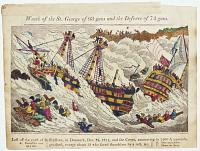
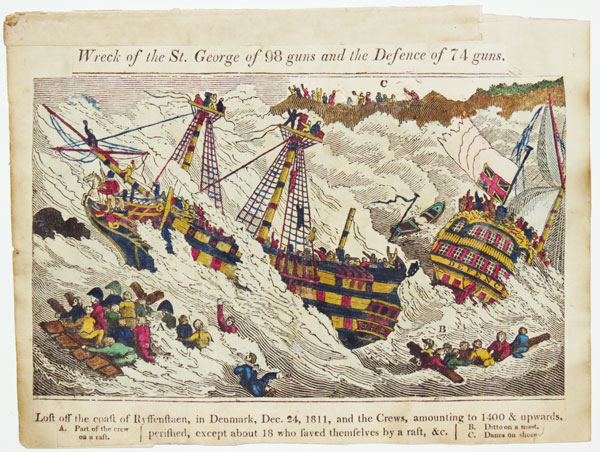
Wreck of the St. George of 98 guns and the Defence of 74 guns. Lost off the coast of Ryffestaen, in Denmark, Dec. 24, 1811 [...]
[Anon, c.1820]
Wood engraving with hand-colouring, scarce; sheet 165 x 220mm (6½ x 8¾"). Trimmed around image and text; glued to backing sheet. Interesting print of children as a 'recruiting party' verso.
The wreck of the HMS St George in 1811, near Ringkøbing on the west coast of Jutland. After narrowly escaping wrecking on a shoal, gales and heavy seas caused the eventual shipwreck, along with that of HMS Defence. In 1793 the St George captured an immensely valuable Spanish prize when seizing a French privateer. It was also involved in the Battle of Copenhagen in 1801.
[Ref: 32296] £220.00
(£264.00 incl.VAT)

Moors on board the Swiftsure.
Cooper Willyams delt. J.C. Stadler sculpt.
London: Pub. by I. White, Fleet Street, 1801.
Hand-coloured aquatint, 185 x 250mm. 7¼ x 9¾".
Arabs or Berbers drinking tea and smoking long pipes with opium, on board a Royal Navy warship; cannon to right. HMS Swiftsure, a 74-gun third rate ship of the line of the Royal Navy was lauched in 1787. After fighting at the Battle of the Nile in 1798 she was captured by the French off the coast of Libya in 1801 (one of only five Royal Navy ships to be captured in all the Napoleonic Wars), subsequently fighting for the French at the Battle of Trafalgar, in which she was recaptured, returning to Royal Navy service. After Cooper Willyams (1762 - 1816), for his 'A Voyage up the Mediterranean in His Majesty’s Ship the Swiftsure, one of the squadron under the command of Rear-Admiral Sir Horatio Nelson, K.B. ... with a description of the battle of the Nile on the first of August 1798' (1802). Willyams served as chaplain of the Swiftsure. He was present at the Battle of the Nile and according to DNB his is 'the first, the most particular, and the most authentic account of the battle'. See BL 210.i.5. Abbey Travel 196, 11.
[Ref: 22336] £75.00
(£90.00 incl.VAT)

The Exact Manner of Executing the Mutineers on Board the Temeraire Majestie and Formidable at Portsmouth in 1802. A full & Complete Account if this remarkable case will be found in this Useful & Interesting New Publication.
[n.d, c.1805.]
Engraving. Sheet 210 x 125mm (8¼ x 5"). Small margins.
A frontispiece depicting the executions of the Temeraire mutineers in 1802 shows the punishment of the ringleaders following the suppression of the brief but serious uprising at sea. On 3 December, sailors aboard Temeraire refused orders and demanded the ship return to England. They briefly dispersed but soon renewed the protest, barricading themselves below deck and refusing commands. The next day, Rear Admiral Campbell intervened, but disorder led to clashes with officers and the arrest of ringleaders, after which the mutiny collapsed. The ship returned to England, where fourteen ringleaders were court-martialled in 1802; twelve were executed, and the others received flogging or life imprisonment.
[Ref: 68994] £180.00
(£216.00 incl.VAT)

H.M.S. Thetis, 36 Guns. Constructed by the School of Naval Architecture.
N.M. Condy del.__T.G. Dutton, lith. [Signed by artist in plate.] Day & Son, lithrs. to the Queen.
London Published by Lloyd Brothers 22 Ludgate Hill_Plymouth E. & H.L. Fry Stonehouse E.W. Cole. [n.d., c.1850.]
Hand coloured lithograph, image 300 x 400mm. 11¾ x 15¾". Fine fresh colour; unexamined out of fine maple frame.
Handsome and rare lithograph of HMS Thetis, a fifth-rate frigate launched at Devonport Dockyard on 21 August 1846. She sailed to the south-east coast of America and then the Pacific. One of the two largest of the Gulf Islands in the Strait of Georgia, off the east coast of Vancouver Island, Canada, is named Thetis Island. There is also a Thetis Lake on Vancouver Island. After nearly a decade of service with the British, she was one of two frigates transferred to Prussia in exchange for two gunboats. She served with the Prussian Navy, the Norddeutsche Bundesmarine and the Kaiserliche Marine as the SMS Thetis until being decommissioned in 1874 and broken up in 1894. After Nicholas Matthew Condy (1818 - 1851). Not in NMM. Parker: undescribed.
[Ref: 17644] £690.00
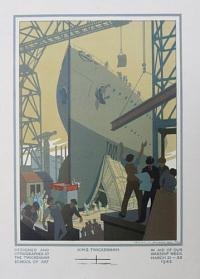
H.M.S. Twickenham Designed and Lithographed at the Twickenham School of Art in Aid of our Warship Week March 21-28 1942
Vernon P. Milner 1942 15/20
Lithograph, rare, printed area 290 x 195mm (11½ x 7¾").
Lithograph produced in aid of the war effort by a student at the Twickenham School of Art. Private Collection.
[Ref: 43675] £230.00
(£276.00 incl.VAT)
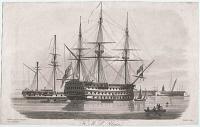
H.M.S Union P.L CCCCXCV.
Richard Speare Esq.r Inv.o. Bailey Sculp.
Published 31.st October 1817. by Joyce Gold. Naval Chronicle Office, 103, Shoe Lane, London.
Lithograph, sheet 145 x 230mm (5¾ x 9"). Trimmed close to title at bottom. Nicks to bottom edge.
A view of HMS Union (1811). She was s a 98-gun second-rate ship of the line of the Royal Navy, launched on 16 November 1811 at Plymouth. However was broken up in 1833.
[Ref: 60578] £140.00
(£168.00 incl.VAT)
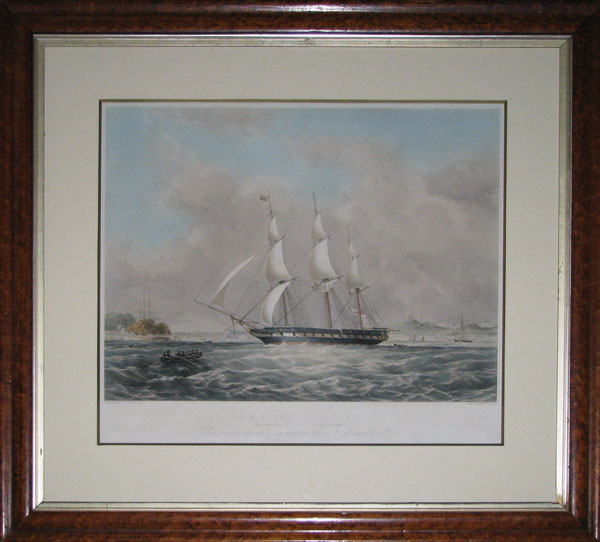
![Nelson's Flag Ship The Victory at Portsmouth [in plate; also titled 'The Victory at Portsmouth' in pencil by artist.]](img-thumbnail/jpegs/20230.jpg)
Nelson's Flag Ship The Victory at Portsmouth [in plate; also titled 'The Victory at Portsmouth' in pencil by artist.]
J. Hutchnson 1899. [Dated and signed in plate; pencil signature.]
Etching, 125 x 330mm. 5 x 13". A fine impression.
A charming etching in a naive style; HMS Victory at the centre of the composition. After the 1805 Battle of Trafalgar Victory took Nelson's body back to England where, after lying in state at Greenwich, he was buried in St. Paul's Cathedral on 6 January 1806. Her active career ended on 7 November 1812, when she was moored in Portsmouth Harbour off Gosport and used as a depot ship. In 1889, Victory was fitted up as a Naval School of Telegraphy. She soon became a proper Signal School, and signal ratings from ships paying off were sent to Victory, instead of the barracks, for a two-month training course. The School remained on Victory until 1904. Guichard: pg.72, Appendix 1 'Minor Etchers'.
[Ref: 20230] £160.00
(£192.00 incl.VAT)

His Majesty's Sloop of War Wolverine of 12 guns & 63 Men, Attacking and defeating two French Luggers, one of 14 the other of 16 Guns amd 140 Men each, off the Coast of Bolougne, on the 3.d January 1799. Her Commander Lewis Morlock after killing several of the enemy with his own hands, received a mortal Wound from the last shot fired, in consequence of which he died the week after.
W. Anderson Delin. F. Warburton Aquatinta.
Published Sept.r 12. 1799 by W. Anderson, No 46 Bell Street Paddington.
Very rare aquatint. Sheet 330 x 420mm (13 x 16½"). Trimmed within plate. Two repaired tears.
HMS Wolverine was a collier that was converted into a warship, with an experimental system in which her guns could be pivoted to be fired from either side. In this action she engaged the French luggers Furet and Rusé, the crews of which attempted to board Wolverine, as depicted here, but were beaten back. The French then threw incendiary devices though Wolverine's stern cabin windows and escaped while the British were extinguishing the fire. Commander Morlock was mortally wounded, but lasted until the ship returned to Portsmouth; every captain in the port attended his funeral two days later.
[Ref: 52704] £550.00
![[HMY Victoria and Albert.]](img-thumbnail/jpegs/15286.jpg)
[HMY Victoria and Albert.] ...Named and Launched by Lady Milford, at H.M. Yard Pembroke Dock the 16th January 1855.
[c.1860.]
Pencil and ink drawing on card, within decorative embossed frame; dimensions and caption in ink mss. Total sheet 210 x 260mm (8¼ x 10¼").
Attractive amateur sketch of HMY Victoria and Albert, a 360 foot steamer launched 1855, a Royal Yacht of the Sovereign of the United Kingdom until 1900, owned and operated by the Royal Navy. She displaced 2,470 tons, and could make 15 knots on her paddles. There were 240 crew. She was scrapped c.1904.
[Ref: 15286] £140.00
(£168.00 incl.VAT)

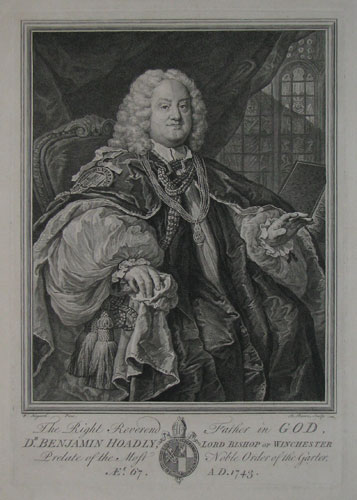
The Right Reverend Father in God, Dr Benjamin Hoadly, Lord Bishop of Winchester... Aet. 67. A.D.1743.
W Hogarth Pinx. B. Baron Sculp.
[London, 1743.]
Engraving. 425 x 295mm (16¾ x 11½"). A fine impression with full margins.
Portrait of Benjamin Hoadly (1676 - 1761), Bishop of Winchester and controversialist. His left hand is raised as if in blessing, he wears a shoulder length curly white wig and grand ecclesiastical robes; a draped curtain and stained glass in the background. Hoadly, poet, dramatist and clergyman, and son of the Bishop of Winchester, wrote texts for oratorios and musical plays. It has been argued that the plate for this portrait preceded the painting by William Hogarth (1697 - 1764), and that Baron initially copied the Huntington portrait - see Paulson, p.189. Paulson 1989: 226. NPG: D35866.
[Ref: 18337] £280.00
(£336.00 incl.VAT)
![[Ben Hoadly, D.D. Bishop of Winchester. Aged LXXX.]](img-thumbnail/jpegs/59419.jpg)
[Ben Hoadly, D.D. Bishop of Winchester. Aged LXXX.]
[Drawn by NHone, after a Wax Model by Mr Gosset, done in the year 1756, and Engrav'd by James Basire 1771.]
Engraving, proof before letters. Sheet 315 x 185mm (12½ x 7¼"). Trimmed within plate, mounted in album paper at edges.
Oval portrait of Benjamin Hoadly (1676-1761), appointed as the George I's chaplain and Bishop of Bangor in 1715, Salisbury in 1723 and finally Winchester in 1734. He is best known for speaking on behalf of the king in the 'Bangorian Controversy', arguing that there was no Biblical justification for any church government, an attack on the bishops sitting in the House of Lords. His portrait was more famously painted by William Hogarth; Hoadly's son Benjamin helped Hogarth on his 'Analysis of Beauty', 1753.
[Ref: 59419] £240.00
(£288.00 incl.VAT)
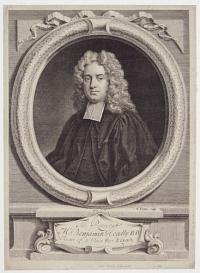
The Reverend Mr Benjamin Hoadly B.D. Rector of St Peter Poor, London.
G. Vertue Sculp.
[London, 1709.]
Engraving. 18th century watermark; 365 x 260mm (14½ x 10¼"). Narrow margins.
Portrait of Benjamin Hoadly (1676 - 1761) as a young man, prior to appointment as Bishop of Bangor in 1715, Salisbury in 1723 and finally Winchester in 1734. He was appointed Bishop of Bangor by George I on his succession, and became the king's chaplain at the same time. He repaid the largesse by speaking on behalf of the king in the 'Bangorian Controversy'; he argued that there was no Biblical justification for any church government, an attack on the bishops sitting in the House of Lords. His portrait was more famously painted by William Hogarth; Hoadly's son Benjamin helped Hogarth on his 'Analysis of Beauty', 1753. Collector's stamp of Lawson Thompson (1837-1919) on verso (Lugt L1770); collection of portraits sold in two sales at Sothebys, 1920.
[Ref: 40545] £280.00
(£336.00 incl.VAT)
![[Oceania] Hoaori](img-thumbnail/jpegs/11398.jpg)
[Oceania] Hoaori Hofding r Papituai.
C.S. del. Fargtryck af J.F. Meyer & Co. I Stockholm.
[n.d., c.1860s.]
Chromolithograph, sheet 225 x 140mm. 8¾ x 5½". Some spotting.
A man of Tahiti in the South Pacific Ocean. Plate to a book.
[Ref: 11398] £70.00
(£84.00 incl.VAT)
![[Bookplate of Charles Hoare.] Cha.s Hoare [in image].](img-thumbnail/jpegs/58774.jpg)
[Bookplate of Charles Hoare.] Cha.s Hoare [in image].
T. Holloway Sculp.t.
[n.d., c.1821.]
Rare stipple & etching. 230 x 175mm (9 x 7"), with large margins.
A female figure looking at a monument with a bust, an armorial with a double-headed eagle and star, and a Latin inscription 'Tendit in Ardua Virtus'. The bookplate of Charles Hoare (1767-1851), Senior Partner of the banking firm of C. Hoare & Co. He commissioned John Nash to design his rural retreat, Luscombe Castle near Dawlish, in 1800.
[Ref: 58774] £150.00
(£180.00 incl.VAT)
![[Peter Richard Hoare.]](img-thumbnail/jpegs/55288.jpg)
[Peter Richard Hoare.]
Painted by Catterson Smith. Engraved by William Walker.
Private Plate [n.d., c.1850].
Mezzotint on chine collé, proof before title. 530 x 405mm (20¾ x 16"), with very large margins. Small tear in india paper repaired.
Three-quarter seated portrait of Peter Richard Hoare (1803-77), a senior partner of Hoares Bank and High Sheriff of Devon in 1860 who built Stourhead.
[Ref: 55288] £280.00
(£336.00 incl.VAT)


![H.M.A.S. Australia [pencil.]](jpegs/52984.jpg)




![Portraits of the Officers and Men who were preserv'd from the Wreck of the Centaure [...]](jpegs/51165.jpg)

![H.M.S. Edinburgh [in pencil].](jpegs/19776.jpg)

![Supplement To The Isle Of Wight Mercury, March 25, 1878. [&] March 27, 1878.](jpegs/12228.jpg)


![[HMS Java rounding the Cape of Good Hope in a storm, September 1826.]](jpegs/27919.jpg)


![H.M.S. Renown. [pencil.]](jpegs/16956.jpg)


![H.M.S. Scylla [in pencil].](jpegs/19775.jpg)




![Nelson's Flag Ship The Victory at Portsmouth [in plate; also titled 'The Victory at Portsmouth' in pencil by artist.]](jpegs/20230.jpg)

![[HMY Victoria and Albert.]](jpegs/15286.jpg)
![[Ben Hoadly, D.D. Bishop of Winchester. Aged LXXX.]](jpegs/59419.jpg)

![[Oceania] Hoaori](jpegs/11398.jpg)
![[Bookplate of Charles Hoare.] Cha.s Hoare [in image].](jpegs/58774.jpg)
![[Peter Richard Hoare.]](jpegs/55288.jpg)