Le Port St. George dans l'Isle de la Grenade, Vu de côte de l'Est. Tiré d'un Recuil de différens Portes des Antilles dessinés en 1780...
N. Ozanne del. Johanna F.a Ozanne sculp.
A Paris chez le Gouas Graveur, rue St Hyacinte, la I.ere porte cochere à gauche par la Place St Michel. [n.d., c.1780.]
Engraving. 210 x 345mm (8¼ x 13½"), large margins on 3 sides. Trimmed within the plate on the left.
A distant view, with a European looking down on the port with a telescope. The view was drawn by Nicolas-Marie Ozanne during the American Revolution: the French took the island in 1779, holding it until the treaty of Versailles in 1783. The engraver, Johanna, was one of his sisters: their father died when Nicolas was only sixteen, so he taught his sisters engraving so they could earn a livelihood.
[Ref: 51254] £260.00
(£312.00 incl.VAT)

La Valeur Récompensée, A la prise de la Grenade le 4 juillet 1779.
Peint par Demarne de l'Académie Royal de Peinture. Par D**** [Devisme].
[n.d., c.1780.]
Engraving. 340 x 425mm (13½ x 16¾"), large margins.
'Valour repaid.' A French propaganda piece, suggesting that Charles Hector, comte D'Estaing, honoured the bravery of the garrison of Fort St George when they surrendered. In fact, the terms D'Estaing proposed were so harsh that the British Governor Lord Macartney preferred to surrender unconditionally, losing any protection a deal would bring.
[Ref: 51255] £450.00

Grenadier.
Alf Cooke. Leeds.
[n.d., 1887.]
Chromolithograph. Sheet 250 x 145mm (9¾ x 5¾").
A dancer in a glamourous version of the uniform of the Grenadier Guards, with bearskin. The costume was made for the Army and Navy ballet at London's Alhambra Theatre. Although the theatre 'specialized in beautiful ballets' it was notorious as a meeting place for prostitutes and their clients. Not in Ogilby.
[Ref: 16939] £120.00
(£144.00 incl.VAT)
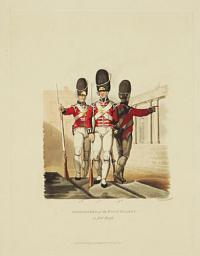
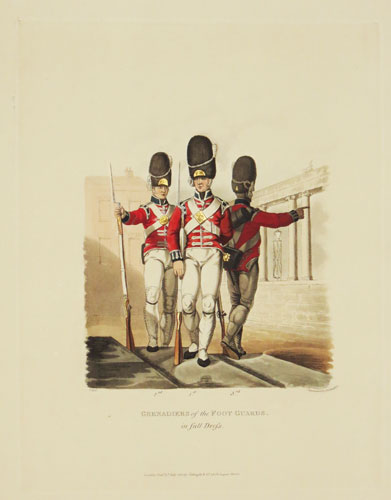
Grenadier of the Foot Guards. in full Dress.
C.H.S. Aquatinted by Stadler.
London Pub.d. 2.d. July 1812 by Colnaghi & C.o. 23 Cockspur Street.
Very fine coloured aquatint. 255 x 320mm (10 x 12½"), with good margins.
Exterior scene depicting three soldiers from the 1st, 2nd and 3rd regiments of the Foot Guards (or Grenadiers), each wearing the iconic bearskin. From "Costumes of the Army of the British Empire, according to the last regulations 1814" by Charles Hamilton Smith. Ogilvy 870.
[Ref: 33545] £260.00
(£312.00 incl.VAT)

Riversdale Grenfell. Supplement to "The World."
"EMU" [Will Dyson]
Gill.t Whitehead & C.o L.td New Eltham. S.E. [Aug 24th 1910]
Chromolithograph, sheet 380 x 270mm (15 x 10½").
Full length caricature portrait of Riversdale Nonus ‘Rivy’ Grenfell (1880-1914) wearing polo gear. All nine Grenfell brothers were accomplished polo players however 'Rivy' and his twin brother Francis (1880-1915) were regarded as the best in the family and were on the Ranelagh team that won the American Open and on the team Freebooters, alongside Leopold Christian Duncan Jenner and the Duke of Roxburghe, that won the Hurlingham Champion Cup.
[Ref: 63669] £160.00
(£192.00 incl.VAT)
![[Battle of Grengam] Zee Battaille tussen de Rubisen Generaal den Prins Galiczin en de Sweden onder het gebiet van den Vice-Adm.l [...] [parallel text in Latin]](img-thumbnail/jpegs/59151.jpg)
[Battle of Grengam] Zee Battaille tussen de Rubisen Generaal den Prins Galiczin en de Sweden onder het gebiet van den Vice-Adm.l [...] [parallel text in Latin]
Pet:Schenk Exc: Amst: C.Pr. [n.d. c.1730]
Engraving, sheet 160 x 190mm (6¼ x 7½"). Trimmed to plate, folding creases in the middle as normal.
A scene of the Battle of Grengam fought on 7 August 1720, the last major naval battle in the Great Northern War between Sweden and Russia (1700-1721). Four Swedish frigates were captured by the Russian Navy by the end of the battle.
[Ref: 59151] £85.00
(£102.00 incl.VAT)

L'Enfant Trouve. A Sample of Roman Charity! or the misfortune of not being born with Marks of "the Talents".
J.s G.y inv & fec.t.
Pub.d Feb.y 19th 1797 by H.Humphrey, Bond Street.
Coloured etching 350 x 250mm (13¾ x 9¾ "). Frame measures 475 x 380mm (18¾ x 15"). Slightly time stained. Unexamined out of frame.
A satirical scene depicting members of the Grenville family surround a table on which a black footman places a basket containing a baby. On the further side of the table two brothers, Thomas Grenville and Lord Grenville. Marchioness and Marquis are to the right of the table and on left and profile are the two sons, Lord George Grenville and Lord Temple. The Grenvilles were criticized for supporting Catholic Emancipation, for accumulating sinecures, and for their allegedly sympathetic stance toward Napoleon. Their blend of frugality and opulence is symbolized by the guttering altar candles and the choice to send the child to the workhouse. The Marchioness served as a key figure in English Catholic society, hosting religious life at Stowe, where she employed a chaplain, Dr. Charles O'Conor, possibly represented as the Jesuit in question. BM Satire 10986.
[Ref: 66031] £480.00
![[Grey wash portrait of George Nugent-Temple-Grenville, Earl Temple.]](img-thumbnail/jpegs/57519.jpg)
[Grey wash portrait of George Nugent-Temple-Grenville, Earl Temple.]
[after the engraving published by J. Walker 1782.]
Grey wash. Image 145 x 95mm (5¾ x 3¾"). With original engraving, pt 18th century watermark.
An oval portrait of George Nugent-Temple-Grenville (1753-1813), copied from a family portrait by Sir Joshua Reynolds, now in the National Gallery of Ireland. He was the son, brother and cousin of British Prime Minsters (George Grenville, William Grenville & William Pitt the Younger).
[Ref: 57519] £260.00
(£312.00 incl.VAT)
view all images for this item

The Right Honble. Lord Grenville.
Painted by T. Phillips R.A. Engraved by J. Fittler A.R.A.
London Publish'd as the Act directs by J. Fittler No 62. Upper Charlotte Street Fitzroy Square March. 1812.
Large engraving, title in open letters, 530 x 395mm. 20¾ x 15½".
Portrait of William Wyndham Grenville, 1st Baron Grenville (1759 - 1834), Prime Minister, standing to the left. Grey hair, long lace cravat and ruffles, heavy black brocaded silk Chancellor's robe with gold lace trimming on collar, facings and sleeves, over black velvet clothes; his right hand clasps an upright brass bound volume standing on a table to left, on which are also a bundle of papers tied up with tape. Curtain behind to right, to left, a view of Christ Church seen through window. Grenville, William Pitt's first cousin, served as Speaker of the House of Commons (1789) and Foreign Secretary (1791-1801). The protégé and loyal follower of his cousin, Grenville was angered by Pitt's failure to oppose Addington and broke with him to join Fox and Grey in opposition. It was as head of the 'Ministry of All the Talents' coalition government, following Pitt's death, that Grenville was Prime Minister from 1806 to 1807. A reluctant leader, he resigned over George III's refusal to agree to Catholic emancipation; his administration nevertheless saw the abolition of British participation in the slave trade.
[Ref: 24080] £220.00
(£264.00 incl.VAT)

The Right Honble. Lord Grenville.
Painted by T. Phillips R.A. Engraved by J. Fittler A.R.A.
London Publish'd as the Act directs by J. Fittler No 62. Upper Charlotte Street Fitzroy Square March. 1812.
Engraving. Platemark: 530 x 390mm (20¾ x 15"). Light foxing. Trimmed to plate at sides.
Portrait of William Wyndham Grenville, 1st Baron Grenville (1759 - 1834). He wears a long lace cravat and ruffles, and a heavy black brocaded silk Chancellor's robe with gold lace trimming on collar, facings and sleeves. His right hand clasps an upright brass bound volume standing on a table to left, on which are also a bundle of papers tied up with tape. Curtain behind to right, and to left, a view of Christ Church seen through a window. Grenville, William Pitt's first cousin, served as Speaker of the House of Commons (1789) and Foreign Secretary (1791-1801). The protégé and loyal follower of his cousin, Grenville was angered by Pitt's failure to oppose Addington and broke with him to join Fox and Grey in opposition. It was as head of the 'Ministry of All the Talents' coalition government, following Pitt's death, that Grenville was Prime Minister from 1806 to 1807. A reluctant leader, he resigned over George III's refusal to agree to Catholic emancipation. His administration nevertheless saw the abolition of British participation in the slave trade. For alternative open lettered impression, see item ref: 24080. Ex Collection: The Honourable Christopher Lennox-Boyd.
[Ref: 35136] £320.00
![[William Wyndham Grenville] The Bear and his Leader.](img-thumbnail/jpegs/66023.jpg)
[William Wyndham Grenville] The Bear and his Leader. "What tho' Iam Obligated to Dance a Bear, a Man may be a Gentleman for all that.,_ My bear ever dances to the Genteelest of Tunes."
J.Gillray fec.t.
Pub.d May 19th 1806 by H.Humphrey 27 St James Street.
Coloured etching 350 x 250mm (13¾ x 9¾ "). Frame measures 475 x 380mm (18¾ x 15"). Unexamined out of frame. Slightly time stained.
A satirical scene depicting William Wyndham Grenville displaying a dancing bear whilst exclaiming "don't be afraid of my Bear Ladies & Gentlemen! I have tamed & muzzled him, & reformed his Habits." In Grenvilles pocket is a bag of treats labelled 'Rewards for Obedient Bears' and in his right hand he holds a long staff which reads "Cudgel for Disobedient Bears". The dancing 'bear' is Charles James Fox who faces Grenville, behind him is a monkey with the head of Lord Henry Petty who wears the gown of the Chancellor of the Exchequer and holds a fools gap with bells. On the left is Henry Addington, 1st Viscount Sidmouth who plays a violin, surrounded by music sheets. He plays 'God save the King' and he is wearing a cocked hat, bag-wig, and Windsor uniform, with tattered breeches, and a foot projecting through a remnant of boot, his right knee rests on a wooden leg or stump. BM Satire 10566.
[Ref: 66023] £520.00
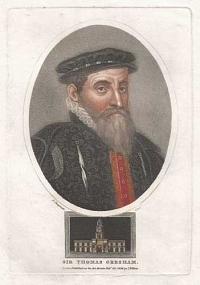
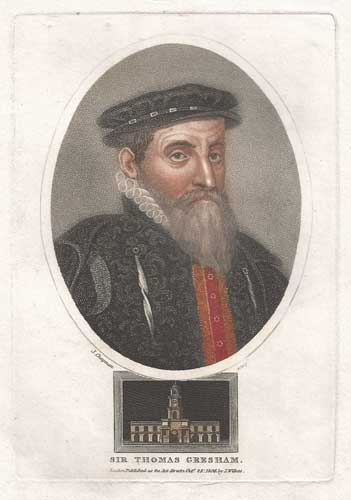
Sir Thomas Gresham.
J. Chapman sculp.t.
London, Published as the Act directs, Oct.r 25: 1806 by J. Wilkes.
Stipple, printed in colours. 165 x 115mm (6½ x 4½"), with large margins, watermarked 1804.
Sir Thomas Gresham (1519 -79), financier to monarchs Edward VI, Mary I & Elizabeth I, and founder of the Royal Exchange.
[Ref: 57959] £70.00
(£84.00 incl.VAT)

Cascade Du Gressbach.
[n.d., c.1840].
Aquatint with fine hand colour. Sheet size: 195 x 140mm (7¾ x 5½"). Trimmed to printed area and glued to backing card with modern title pasted below.
A scene depicting the Giessbach waterfall in Switzerland. A number of well dressed figures can be seen at the foot of the falls, with others on the path winding up the hillside to the left. A small viewing platform is also shown at the bottom of the waterfall with a figure pointing up towards the top.
[Ref: 31994] £90.00
(£108.00 incl.VAT)

Gretna Green, or the Red-Hot Marriage. Oh! Mr. Blacksmith ease our Pains _ and Tye us fast in Wedlocks Chains.
Published 12th May, 1794 by Laurie & Whittle, 53, Fleet Street London [but later].
Mezzotint. 350 x 250mm (13¾ x 9¾"), very large margins.
A young military officer and his partner are married by a blacksmith, surrounded by horses and apprentices at work. The tightening of marriage regulations in England in the 18th century prevented couples under the age of 21 from marrying without their parents consent. This gave rise to the phenomenon of young couples marrying over the border in Scotland. The proximity of Gretna Green to the border made it the most common location for such marriages, with the town's blacksmith (which remains a wedding venue to this day) in particular becoming synonymous with hasty, ad hoc marriages.
[Ref: 60974] £260.00
(£312.00 incl.VAT)

Gretna Green, or the Red-Hot Marriage. Oh! Mr. Blacksmith ease our Pains_ and Tye us fast in Wedlocks Chains.
Drawn & Engraved by W. Mathews, Oxford.
[n.d., c.1820.]
Stipple, printed in reddish-brown. 215 x 165mm (8½ x 6½"), Trimmed to plate at bottom, laid on card.
A blacksmith marries a well-dressed couple in his smithy.
[Ref: 66562] £160.00
(£192.00 incl.VAT)
![[Three Gretna Green-related prints]](img-thumbnail/jpegs/41649.jpg)
[Three Gretna Green-related prints] The Last House in England (Near Gretna Green) [&] Gretna Green. [&] Gretna Green (Returning).
Various engravers.
All published in Carlisle, c.1840-5.
One lithograph and two steel-engravings, sheets each approx. 100 x 150mm (4 x 6"). Trimmed.
Gretna Green, in Scotland near the border with England, became the centre of the 'marriage trade' in the 18th century because Scotland was exempt from a law forbidding under-21s in England from marrying against their parents' will.
[Ref: 41649] £80.00
(£96.00 incl.VAT)
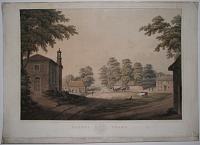
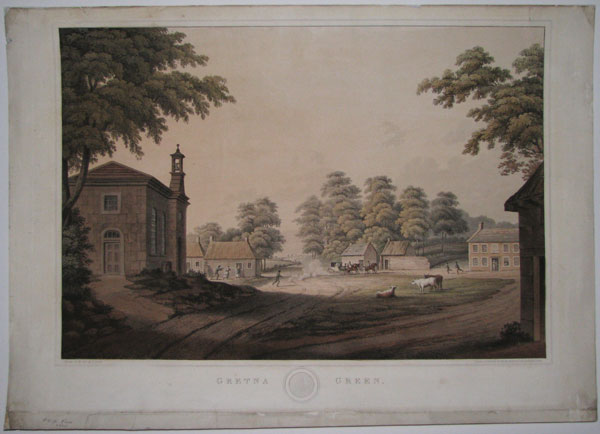
Gretna Green.
Drawn on the Spot by I. Clark.
London, Published by Smith, & Elder, Fenchurch Street, 1825.
Coloured aquatint. 475 x 625mm. 18¾ x 24¾". Some restoration.
A view of the centre of Gretna Green in Dumfriesshire, from the "Views in Scotland" series. In the C18th & C19th the village became the favourite destination of eloping couples because of disparity between marriage laws: in England brides under 21 needed parental consent, while in Scotland they could be as young as twelve. Situated just over the border it was the nearest place for elopers to marry. As long as there were at least two witnesses even the blacksmith could perform the ceremony. Although it cannot be proved it is believed that 'I. Clark" is the Scottish painter John Heaviside Clark, famed as 'Waterloo Clark' for his early sketches of the battle. He was also skilled in aquatinting, and certainly none of this series has a named engraver. This is one of the few plates in the series to feature 'action': a coach and four has just pulled up in a cloud of dust and locals are rushing out, probably to offer their services. Abbey No: 489.
[Ref: 18606] £240.00
(£288.00 incl.VAT)
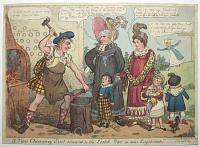
A New Chancery Suit removed to the Scotch Bar or more Legitimates.
I.R C fecit.
Pubd Feby 4th 1819 by S W Fores 50 Piccadilly & 312 Oxford Street.
Hand coloured etching, 18th century watermark;sheet 240 x 335mm (9 x 13½") with large margins, on 18th century watermarked paper. Trimmed within plate.
A satire on Thomas Erskine's, 1st Baron Erskine (1750-1823) marriage to his second wife and mistress Lady Sarah Erskine. They married Gretna Green on 12th October 1818. Erskine, in woman's dress, wearing a huge feathered bonnet over a barrister's wig, holds the right hand of a demure-looking woman, modishly dressed and apparently pregnant. He holds a paper: 'Breach of Promise'. With them are three young children. The smith, in profile to the right, wears Highland dress; he holds a red-hot bar on the anvil and raises his hammer, saying, "I shall make a good thing of this Piece at last." Erskine says: "I have bother'd the Courts in London many times, I'll now try my hand at the Scotch Bar—as to Miss C— she may do her worst since I have got my Letters back." A young woman rushes towards them shouting to stop. Gretna's "runaway marriages" began in 1754 when Lord Hardwicke's Marriage Act came into force in England. Under the Act, if a parent of a person under the age of 21 objected to the minor's marriage, the parent could legally veto the union. The Act tightened the requirements for marrying in England and Wales but did not apply in Scotland, where it was possible for boys to marry at 14 and girls at 12 with or without parental consent. It was, however, only in the 1770s, with the construction of a toll road passing through the hitherto obscure village of Graitney, that Gretna Green became the first easily reachable village over the Scottish border. Scottish law allowed for "irregular marriages", meaning that if a declaration was made before two witnesses, almost anybody had the authority to conduct the marriage ceremony. The blacksmiths in Gretna became known as "anvil priests". BM Satires 13384.
[Ref: 61830] £260.00
(£312.00 incl.VAT)
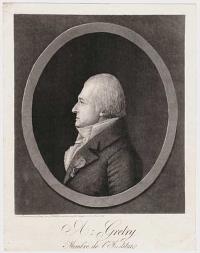
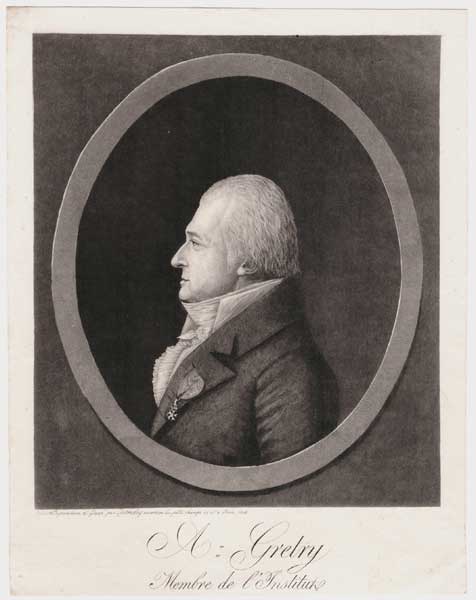
A: Gretry. Membre de l'Istitute.
Dess. au Physionotrace et Gravé par Quenedey rue neuve des petits champs no.15 à Paris 1808.
[Se vend chez Quenedey rue neuve-des-Petits-Champs No.15 à Paris'. Dep. à la Bib. Imp.]
Aquatint with etching. Sheet 225 x 175mm (8¾ x 6¾"). Trimmed within plate, losing publication line.
Profile portrait of André Grétry (1741-1813), Belgian composer of opéras comiques. Frenchman Gilles-Louis Chrétien invented the 'physionotrace' in the 1780s to draw the outlines of silhouettes, which were then completed by the artist and transferred to aquatint printing plates using another pantograph. The published of this print, Edme Quenedey, was Chrétien's first business partner: a drawing he made of the device in 1788 is now in the Bibliothèque Nationale de France..
[Ref: 62402] £220.00
(£264.00 incl.VAT)
![Donna Genovese Col Mezzo Calato Che Vende Fiori. 7 [Parallel text in French.]](img-thumbnail/jpegs/38715.jpg)
Donna Genovese Col Mezzo Calato Che Vende Fiori. 7 [Parallel text in French.]
J.B. Greuze del. Moitte Sculp.
[n.d., c.1768.]
Engraving. Platemark: 310 x 230mm (12¼ x 9"). Very large margins.
A flower seller; Plate 7 from the series 'Divers habillements suivant le costume d'Italie', a set of twenty-five plates representing figures in the costumes of different Italian cities, engraved by various member of the Moitte family. This is one of several plates in the series engraved from designs by Jean-Baptise Greuze (1725-1805), one of the most important French artists of the 18th century.
[Ref: 38715] £280.00
(£336.00 incl.VAT)
![Piemontese D'Asti. 5 [Parallel text in French.]](img-thumbnail/jpegs/38716.jpg)
Piemontese D'Asti. 5 [Parallel text in French.]
J.B. Greuze del. P.E. Moitte Sculp.
[n.d., c.1768.]
Engraving. Platemark: 300 x 230mm (12 x 9"). Very large margins.
A peasant woman from Piedmont standing whole-length in an interior, in profile to left, and looking into a small mirror hung beside a straw hat on the wall and a violin below. A landscape is seen to the right. Plate 5 from the series 'Divers habillements suivant le costume d'Italie', a set of twenty-five plates representing figures in the costumes of different Italian cities, engraved by various member of the Moitte family. This is one of several plates in the series engraved from designs by Jean-Baptise Greuze (1725-1805), one of the most important French artists of the 18th century.
[Ref: 38716] £280.00
(£336.00 incl.VAT)
![Donna Frascatana Vesitta Da Giorna Di Festa. [Parallel text in French.]](img-thumbnail/jpegs/38717.jpg)
Donna Frascatana Vesitta Da Giorna Di Festa. [Parallel text in French.]
J.B. Greuze del. F.A. Moitte Sculp.
[n.d., c.1768.]
Engraving. Platemark: 300 x 230mm (12 x 9"). Large margins. Tear into image on left bottom.
An interior of a cellar as a woman from Frascati holds a candle, watching wine pour from a barrel into a jug. Plate 24 from the series 'Divers habillements suivant le costume d'Italie', a set of twenty-five plates representing figures in the costumes of different Italian cities, engraved by various member of the Moitte family. This is one of several plates in the series engraved from designs by Jean-Baptise Greuze (1725-1805), one of the most important French artists of the 18th century.
[Ref: 38717] £280.00
(£336.00 incl.VAT)
![Donna Plebea di Napoli Riscaldono si I Piedi Ad Un Focone. 21 [Parallel text in French.]](img-thumbnail/jpegs/38718.jpg)
Donna Plebea di Napoli Riscaldono si I Piedi Ad Un Focone. 21 [Parallel text in French.]
J.B. Greuze del. Moitte Sculp.
[n.d., c.1768.]
Engraving. Platemark: 300 x 230mm (12 x 9"). Very large margins.
A rustic interior; a woman of Naples, seated, warming her feet on coals. Plate 21 from the series 'Divers habillements suivant le costume d'Italie', a set of twenty-five plates representing figures in the costumes of different Italian cities, engraved by various member of the Moitte family. This is one of several plates in the series engraved from designs by Jean-Baptise Greuze (1725-1805), one of the most important French artists of the 18th century. Duplicate see 38345 for cut version.
[Ref: 38718] £320.00
![Donna Pleabea Di Napoli Vestita Da Giorno Di Fiesta. 20 [Parallel text in French.]](img-thumbnail/jpegs/38719.jpg)
Donna Pleabea Di Napoli Vestita Da Giorno Di Fiesta. 20 [Parallel text in French.]
J.B. Greuze del. Moitte Sculp.
[n.d., c.1768.]
Engraving. Platemark: 300 x 230mm (12 x 9"). Very large margins.
A woman dressed in the peasant costume of Naples, looking down, standing in a street with a fountain behind. Plate 20 from the series 'Divers habillements suivant le costume d'Italie', a set of twenty-five plates representing figures in the costumes of different Italian cities, engraved by various member of the Moitte family. This is one of several plates in the series engraved from designs by Jean-Baptise Greuze (1725-1805), one of the most important French artists of the 18th century.
[Ref: 38719] £280.00
(£336.00 incl.VAT)
![Contadina Di Napoli Con Un Bambino. 19 [Parallel text in French.]](img-thumbnail/jpegs/38720.jpg)
Contadina Di Napoli Con Un Bambino. 19 [Parallel text in French.]
J.B. Greuze del. Moitte Sculp.
[n.d., c.1768.]
Engraving. Platemark: 300 x 230mm (12 x 9"). Very large margins.
A peasent woman of Naples standing on steps next to a port, holding a baby. Plate 19 from the series 'Divers habillements suivant le costume d'Italie', a set of twenty-five plates representing figures in the costumes of different Italian cities, engraved by various member of the Moitte family. This is one of several plates in the series engraved from designs by Jean-Baptise Greuze (1725-1805), one of the most important French artists of the 18th century.
[Ref: 38720] £320.00
![Contadina Di Bolognese. 10 [Parallel text in French.]](img-thumbnail/jpegs/38721.jpg)
Contadina Di Bolognese. 10 [Parallel text in French.]
J.B. Greuze del. Moitte Sculp.
[n.d., c.1768.]
Engraving. Platemark: 300 x 230mm (12 x 9"). Very large margins.
A rustic interior with a peasent woman of Bologna, seated, spinning yarn using a drop spindle. A bird cage hangs from the ceiling above. Plate 10 from the series 'Divers habillements suivant le costume d'Italie', a set of twenty-five plates representing figures in the costumes of different Italian cities, engraved by various member of the Moitte family. This is one of several plates in the series engraved from designs by Jean-Baptise Greuze (1725-1805), one of the most important French artists of the 18th century.
[Ref: 38721] £260.00
(£312.00 incl.VAT)
![Citadina Di Frascatana. 23 [Parallel text in French.]](img-thumbnail/jpegs/38722.jpg)
Citadina Di Frascatana. 23 [Parallel text in French.]
J.B. Greuze del. F.A Moitte Sculp.
[n.d., c.1768.]
Engraving. Platemark: 300 x 230mm (12 x 9"). Very large margins.
A woman of Frascati, Rome, holding a fan and rosery beads, within a large columned interior. Plate 23 from the series 'Divers habillements suivant le costume d'Italie', a set of twenty-five plates representing figures in the costumes of different Italian cities, engraved by various member of the Moitte family. This is one of several plates in the series engraved from designs by Jean-Baptise Greuze (1725-1805), one of the most important French artists of the 18th century.
[Ref: 38722] £260.00
(£312.00 incl.VAT)

Nuptial Blessing.
J.B. Greuze Pinx.t. S. Paul [pseudonym of Samuel De Wilde] Fecit.
London, Printed for R. Sayer and J. Bennett, Map & Printsellers N.º 53 Fleet Street, as the Act directs 10 June 1777.
Scarce mezzotint. 485 x 615mm (17¾ x 24¼"). Narrow margin at bottom, paper toned. Small paper loss at bottom.
An old man opens his arms to bless his new son-in-law, who holds a purse in right hand. A pair to 'Nuptial Felicity'. Ex: collection of The Hon. Christopher Lennox-Boyd.
[Ref: 66663] £460.00

Nuptial Felicity.
J.B. Greuze Pinx.t. S. Paul [pseudonym of Samuel De Wilde] Fecit.
London, Printed for R. Sayer and J. Bennett, Map & Printsellers N.º 53 Fleet Street, as the Act directs 10 June 1777.
Scarce mezzotint. 485 x 615mm (17¾ x 24¼"), large margins on 3 sides. Trimmed to plate at bottom, paper toned, laid on card.
Children mob an exhausted woman who has just finished breastfeeding a baby. Her husband walks through the door, returnng from hunting with his gun and dogs. A pair to 'Nuptial Blessing'. A guitar on wall at back. Ex: collection of The Hon. Christopher Lennox-Boyd.
[Ref: 66662] £490.00

Her Grace the Dutchess of Manchester.
G.Kneller pinx. J.Faber Fecit.
[n.d., c.1723.] Printed & Sold by Rob.t Sayer Near St. Dunstans Church in Fleetstreet, & John King at the Globe in the Poultrey.
Fine mezzotint, 18th century watermark. 455 x 305mm (18 x 12"), with large margins.
Portrait of Doddington Greville (1671–1720). She was a daughter of Robert Greville, 4th Baron Brooke of Beauchamps Court and Anne (née Doddington) Greville (who married Thomas Hoby after the death of Lord Brooke in 1676). From the series of thirteen plates 'Beauties at Hampton Court'. CS 28 ii of iii. Ex: Collection of The Hon. Christopher Lennox-Boyd.
[Ref: 64970] £320.00
![[Miss Greville and her Brother.]](img-thumbnail/jpegs/52491.jpg)
[Miss Greville and her Brother.]
J. Reynolds Pinx.t Js. McArdell fecit.
Publish'd according to Act of Parliament July 25th. 1792. Sold at the Golden head in Covent Garden.
Mezzotint; paper watermarked. Plate 504 x 351mm (19¾ x 13¾"), very large margins.
Portrait of Frances Greville and her brother after Reynolds (Mannings 443); as Psyche, standing whole-length to left under a tree, head turned to face front, holding up vase in both hands, her brother William (?) as Cupid stands on a stone beside her to left, grasping the scarf flowing around them with his right hand; waterfall at right. Collector's stamps on verso: L.2510 [v.D.] - Derschau, Hans Albrecht von; L.2482 - Kupferstichkabinett, Staatlichen Museen zu Berlin; L.1606 - Kupferstichkabinett, Staatlichen Museen zu Berlin. CS: 93 ii/ii. Goodwin: 90 ii/iii. Hamilton: p.103 ii.
[Ref: 52491] £380.00
![[Miss Greville].](img-thumbnail/jpegs/31674.jpg)
[Miss Greville].
J. Reynolds Pinx.t. Js. mcArdell Fecit.
Publish'd according to Act of Paliament July 25th. 1762. Sold at Golden Head in Covent Garden.
Mezzotint. Platemark: 500 x 350mm. (19½ x 13¾"). Laid on backing sheet.
Portrait of Frances Greville, represented as Hebe, the Godess of youth, and her brother, as Cupid grasping the scarf flowing around them with his right hand, standing three-quarter length to left under a tree, head turned to face front, holding up vase in both hands. CS: 93. Goodwin: 90 II; Hamilton: II.
[Ref: 31674] £450.00
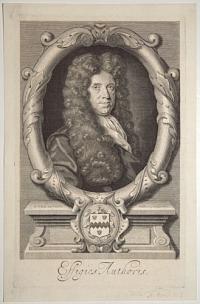
Effigies Authoris.
R. White ad Vivum delin et sculpsit.
[n.d. c.1701.]
Engraving. Plate 242 x 152mm (9½ x 6").
Portrait of Nehemiah Grew; half length, to the right, in long wig, in decorative oval frame on pedestal with coat of arms; frontispiece to his 'Cosmologia Sacra' (1701). For a note on Crowle's extra-illustrated Pennant see G,1.1. Dr Nehemiah Grew (1641-1712); MD; FRS; botanist, physician and vegetable physiologist. Wellcome: 1220.
[Ref: 52509] £230.00
(£276.00 incl.VAT)
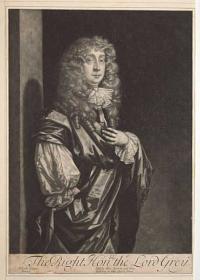
The Right Hon.ble the Lord Grey.
P. Lellij Eques Pinxit.
Sold by Alex: Browne at ye blew Ballcony in little Queen street. [n.d c.1695]
Scarce mezzotint, 335 x 235mm (13¼ x 9¼"). Trimmed and tipped into album sheet. Small loss at the bottom. Foxing.
Three-quarter length portrait of a standing figure, wearing a wig, cravat, and cloak; a square pillar on the left. The portrait seems most probably to be of Ford Grey, Earl of Tankerville (1655-1701), however various individuals have been proposed, including Thomas Lord Grey (d. 1657), the parliamentarian and regicide, Thomas Grey, 2nd Earl of Stamford (1653-1720), and Ralph, 2nd Lord Grey of Werke (d. 1675). CS 11 II. Turner B.15 II.
[Ref: 65912] £260.00
(£312.00 incl.VAT)

Inscribed to the Noble & most Hon.ble Charles Watson Wentworth, Marquiss of Rockingham; By his Lordship's most Obedient & Devoted Servant, Reginald Heber. The Pedigree and Perormances of Bay Malton.~The Pedigree & Performance of the Grey Horse Gimcrack. "Bay Malton was got by Sampson his Dam by Old Cade, his Grand Dam by Old Traveller, his Great Grand Dam..............Gimcrack was got by Cripple, a Son of Lord Godolphin's late Arabian, jis Dam by Grisewood Partner, a Son of Old-Partner, got by Jigg..."
Fra. Sartorius pinx. R. Houston del et fecit.
Publish'd according to Act of Parliament 10th March 1766, by R. Heber in Chancery Lane & Robt. Sayer, Map & Printseller, in Fleet Street. right. Price 5s.
Scarce mezzotint, 18th century watermark, 335 x 455mm (13 x 17¾"). Tears in margins, abrasions and creases in image all repaired. Small margins.
Francis Sartorius 1734-1804, John's son and pupil, was born in 1734. His first important work was a portrait of a racehorse owned by the Duke of Grafton. Other portraits followed including Bay Malton, for the Marquis of Rockingham. Sartorius was a prolific and a favourite of the racing fraternity. To various London galleries he contributed thirty-eight works, including twelve to the Royal Academy. He lived in Soho, lastly, at 17 Gerrard Street and he died on 5 March 1804, in his seventieth year. Houston, Richard 1721?-1775, mezzotint engraver, born in Dublin about 1721, became a pupil of John Brooks, who was also the master of McArdell and Spooner. Like his fellow-pupils, he possessed much natural talent, and led a dissipated life. He came to London about 1747, where he fell into debt being imprisoned in Fleet Prison. Robert Sayer paid his debts and it wasn't until after 1760 that Houston was free of his commitment to Sayer. Bay Malton:Prior to the start of his second season on the turf Bay Malton was purchased by Charles Watson-Wentworth, 2nd Marquis of Rockingham. A stout and honest runner he was started only once or twice each season and had a lengthy and lucrative career. He earned his owner and his backers huge sums of money although his finest victory was likely that at York in 1766 where he set a new course record. He lost only two races, both of them in his final two seasons. He retired to Lord Rockingham's stud at Wentworth Woodhouse, near Rotherham, Yorkshire, where he stood privately. He left no stock that bred on although he sired a few runners, including Mr. Preston's Flaunter. Bay Malton died at Wentworth in 1786. Gimcrack: Making his first start at Epsom in 1764 he won all seven of his races that year. Among his victories at Newmarket was the Whip, allegedly given by Charles 2nd and later said to include hair from the mane and tail of Eclipse. Throughout his active turf career he ran in nearly forty races, the majority of them in heats and over long distances. He was beaten only ten times in eight years. In 1766 when owned by Count Lauraguais he performed the remarkable feat of running twenty-two and a half miles in one hour in France. He is still remembered today for his racing excellence and commemorated by the Gimcrack Stakes held at York, Siltzer: 242. Ex: Collection of The Hon. C. Lennox-Boyd.
[Ref: 65880] £620.00
![[Charles Grey] Tommy Grey with the Tail of His Order!!! Lork What a Long Tail our Cat has Got.](img-thumbnail/jpegs/63658.jpg)
[Charles Grey] Tommy Grey with the Tail of His Order!!! Lork What a Long Tail our Cat has Got.
W.Heath.
Pub Feb 15 1831 by T. McLean 26 Haymarket.
Coloured etching. Sheet 240 x 345mm (9½ x 13½"). Trimmed within plate, to printed border at top. Slight loss top left corner.
Earl Grey depicted as a cat with a long tail, walking along a wall, with a fish marked 'First Lord of he Treasury 6000' in its mouth. This attacks the Prime Minister for his nepotism: along his tail are references to payments made to members of his family by the government. This satire pre-dates the Reform Act, referred to on a poster on the wall. The Duke of Wellington, an opponent of the Act, appears as a stick-figure piece of graffiti, waving a sword. BM: 16578.
[Ref: 63658] £160.00
(£192.00 incl.VAT)
![[Charles Grey] Tommy Grey with the Tail of His Order!!! Lork What a Long Tail our Cat has Got.](img-thumbnail/jpegs/63657.jpg)
[Charles Grey] Tommy Grey with the Tail of His Order!!! Lork What a Long Tail our Cat has Got.
W.Heath.
Pub Feb 15 1831 by T.McLean 26 Haymarket.
Coloured etching. Sheet 240 x 345mm (9½ x 13½"). Trimmed to printed border.
Earl Grey depicted as a cat with a long tail, walking along a wall, with a fish marked 'First Lord of he Treasury 6000' in its mouth. This attacks the Prime Minister for his nepotism: along his tail are references to payments made to members of his family by the government. This satire pre-dates the Reform Act, referred to on a poster on the wall. The Duke of Wellington, an opponent of the Act, appears as a stick-figure piece of graffiti, waving a sword. BM: 16578.
[Ref: 63657] £120.00
(£144.00 incl.VAT)
![[Charles Grey] [Shall I Resign?](img-thumbnail/jpegs/66394.jpg)
[Charles Grey] [Shall I Resign? Earl Grey Musing after a day's labour in his room, Downing Street. Sketched from Life, with the furniture and room of the First Lord of the Treasury faithfully copied.]
Painted by R. B. Haydon. Engraved by G. R. Ward.
[London, Published Feb.y. 1. 1836, by F. G. Moon, Printseller to the King, 20 Threadneedle Street.]
Mezzotint, rare proof before title and publication line. 270 x 330mm (10½ x 13"), with large margins.
An interior scene showing Prime Minister Charles Grey (1764-1845), 2nd Earl Grey, in his rooms at Downing Street. The 'Literary Gazette' 1836 stated 'A more interesting peep at a distinquished statesman, in his private moments of meditation was never produced'. Ex: collection of The Hon. Christopher Lennox-Boyd. O'd 387/2
[Ref: 66394] £260.00
(£312.00 incl.VAT)
![[Charles Grey] Tommy Grey with the Tail of His Order!!! Lork What a Long Tail our Cat has Got.](img-thumbnail/jpegs/66564.jpg)
[Charles Grey] Tommy Grey with the Tail of His Order!!! Lork What a Long Tail our Cat has Got.
[after William Heath].
Pub Feb 15 1831 by S. Gans Southampton St. Strand.
Coloured etching. Sheet 240 x 345mm (9½ x 13½"). Trimmed to printed border, bottom right corner replaced.
Earl Grey depicted as a cat with a long tail, walking along a wall, with a fish marked 'First Lord of he Treasury 6000' in its mouth. This attacks the Prime Minister for his nepotism: along his tail are references to payments made to members of his family by the government. This satire pre-dates the Reform Act, referred to on a poster on the wall. The Duke of Wellington, an opponent of the Act, appears as a stick-figure piece of graffiti, waving a sword. A copy of the Heath satire published by McLean. BM: 16578a.
[Ref: 66564] £260.00
(£312.00 incl.VAT)

The Right Hon.ble Charles Earl Grey.
T. Phillips Esq R.A. Pinx.t. C.Turner sculp.t.
London Pub.d May 28, 1811 by A. Molteno, Printseller to H.R.H. the Dutchess of York 29 Pall Mall.
Mezzotint with large margins, very fine. Platemark: 355 x 255mm (14 x 10").
Charles Grey (1764-1845), 2nd Earl Grey, Whig Prime Minister 1830-34. His political achievements included the Reform Act of 1832, and the abolition of slavery throughout the British Empire in 1833, but is still best known today for giving his name to the aromatic blend of tea. Ex Collection: The Honourable Christopher Lennox-Boyd. W: 236 I of II.
[Ref: 35134] £360.00
![[Charles Grey] Shall I Resign?](img-thumbnail/jpegs/40327.jpg)
[Charles Grey] Shall I Resign? Earl Grey Musing after a day's labour in his room, Downing Street. Sketched from Life, with the furniture and room of the First Lord of the Treasury faithfully copied.
Painted by R. B. Haydon. Engraved by G. R. Ward. printed by Ross & Dixon.
London, Published Feb.y. 1. 1836, by F. G. Moon, Printseller to the King, 20 Threadneedle Street.
Rare mezzotint. Plate: 270 x 330mm (10½ x 13"). Foxing and staining. Small margins.
An interior scene showing Charles Grey, 2nd Earl Grey (1764-1845) in his rooms at Downing Street. Grey served as Prime Minister from 1806-1807 and 1830-1834. The 'Literary Gazette' 1836 stated 'A more interesting peep at a distinquished statesman, in his private moments of meditation was never produced'.
[Ref: 40327] £180.00
(£216.00 incl.VAT)

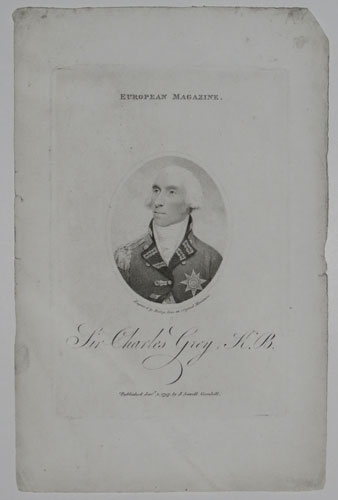
Sir Charles Grey, K.B.
Published Jan.y. 1. 1797, by J.Sewell, Cornhill.
Stipple, 9 x 6". Slight crease.
Sir Charles Grey KB (1729-1807), 1st Earl Grey. An important British general, one of the most successful leaders in the American War of Independence. He earned the nickname 'No-flint Grey' by collecting the flints from his mens' muskets before a bayonet attack, maintaining the element of surprise. Grey was appointed commander-in-chief of the British troops in America, but the war ended before he could take office.
[Ref: 5465] £30.00
(£36.00 incl.VAT)

The Right Hon.ble Charles Earl Grey.
T. Phillips Esq R.A. Pinx.t. C.Turner sculp.t.
London Pub.d May 28, 1811 by A. Molteno, Printseller to H.R.H. the Dutchess of York 29 Pall Mall.
Mezzotint. 355 x 255mm, 14 x 10". Uncut, with large margins.
Charles Grey (1764-1845), 2nd Earl Grey, Whig Prime Minister 1830-34. His political achievements included the Reform Act of 1832, and the abolition of slavery throughout the British Empire in 1833, but is still best known today for giving his name to the aromatic blend of tea.
[Ref: 21866] £230.00
(£276.00 incl.VAT)
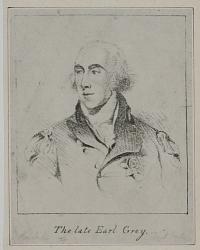
The late Earl Grey.
[After Sir Thomas Lawrence.]
[n.d. c.1795.]
Lithograph, very rare. 152 x 121mm. 6 x 4¾".
Charles Grey, 1st Earl Grey (1729-1807), one of the most important British generals of the 18th century. He served in the Seven Years' War, the American War of Indpendence and the French Revolutionary War. From 1797 until his death, and following his promotion to General, he served as Governor of Guernsey.
[Ref: 26475] £60.00
(£72.00 incl.VAT)

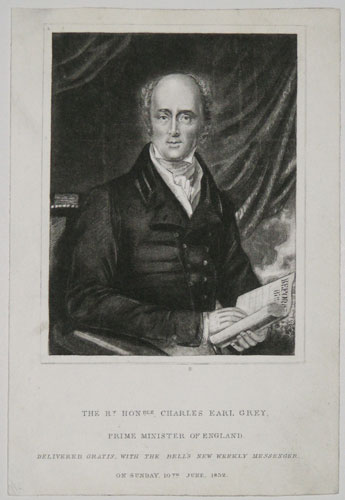
The Rt. Honble. Charles Earl Grey, Prime Minister of England. Delivered, Gratis, with the Bell's New Weekly Messenger. On Sunday, 10th. June, 1832.
[Anon, 1832.]
Mezzotint with etching, sheet 195 x 130mm. 7¾ x 5". Trimmed within plate.
Portrait of Charles Grey, 2nd Earl Grey (1764 - 1845), Prime Minister, holding his 1832 Reform Bill; supplement to a contemporary periodical. Grey was the leader of the Whigs from 1806 to 1834. He led the party through the triumph of the Reform Act which extended the vote to the middle classes and gave representation to Britain's growing industrial towns. A follower of Fox, Grey had argued for constitutional reform since entering Parliament in 1786. He was an ardent supporter of Catholic emancipation and presided over the act to abolish slavery in all British-controlled territories (1833).
[Ref: 16965] £75.00
(£90.00 incl.VAT)

Elisabeth Grey Supliant Edouard IV. Pour la Resatitution des Beins de Defunt Son Mari. Lady Elizabeth Grey imploring of Edward IV the restitution of her deceased Husbands Lands, forfeited in the dispute between the houses of York and Lancaster. Rapin's Hist. Vol V. Pag. 26. Dedicated to the Queen by her Majesty's dutiful and most obedient humble Servant W. Wynne Ryland.
d'Apres Angelique Koffman et Ryland. M.elle Bareuille Sculp.
Publish'd as the Act directs March, i. 1780 for the Proprietor W.W. Ryland No 159 Strand London. A Paris chez Chaillon Salle neuve du Palais Marchand.
Stipple, printed in brown. 345 x 405mm (13¼ x 16"). Repaired tears, one entering top printed border.
Elizabeth Woodville begs Edward IV for the return of the land of her husband, Sir John Grey, forfeited after he was killed fighting on the losing side at the Second Battle of St. Albans in 1461. Much taken by the widow, Edward pursues Elizabeth and eventually marries her, the first time a king of England married one of his subjects. Their ten children included the Princes in the Tower and Elizabeth of York, wife of Henry VII The engraver, Mademoiselle Bareuille, has slavishly copied Ryland's plate, even the English text, making it look like a re-issue of the original, but it is a different plate. See BM 1872,1012.1621 for the original.
[Ref: 54213] £320.00

Lady Elizabeth Grey, at the feet of Edward the Fourth, soliciting the restoration of her late Husband's forfeited lands, A.D. 1465. Acta Historica Reginarum Angliae. Plate V. Engraved from the Original Drawing, of the same dimensions in the Possession of Mr. V. Green. To Her Most Catholic Majesty Louisa Queen of Spain &c. &c. &c. This plate is Most Humbly Dedicated By Her Majesty's Most Devoted and Obedient humble Servant Valentine Green.
Drawn by J. Gerhard Huck. Engraved by V. Green Mezzotinto Engraver to his Majesty & the Elector Palatine.
Publish'd Oct.r 18.th 1791 by V. & R. Green Newman Street, Oxford Street, London.
Mezzotint, platemark 490 x 625mm (19¼ x 24½"). Creasing; uncut, large margins.
Elizabeth Woodville solicits the restoration of the lands of her first husband, Sir John Grey, who was killed at the Second Battle of St. Albans. After Grey's death his lands appear to have been forfeited, and in her poverty Woodville made personal suit to the king for their return. After she refused offers from Edward IV to be his paramour, the king determined to marry her. The scene depicted would have taken place in 1461, rather than 1465 as stated here. Plate five of 'Acta Historicae Reginarum Angliae' by the celebrated mezzotinter Valentine Green (1739-183) from drawings by his former student Johann Gerhard Huck (c.1759-1811), with parallel text in French. Whitman: 252 II of II; CS: 153.5 Ex Collection of Hon. Christopher Lennox-Boyd.
[Ref: 23054] £320.00
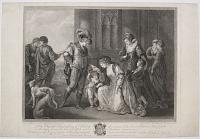
Lady Elizabeth Grey imploring of Edward IV the restitution of her deceased Husbands Lands, forfeited in the dispute between the houses of York and Lancaster. Rapin's Hist, Vol V, Page 26. Dedicated to the Queen by her Majesty's dutiful and most obedient humble Servant W.W.Ryland.
Angelica Kauffman ex academia Regali Londini pinx.t. Guliemus Wynne Ryland Chalcographus Regis Britannia sculp.t.
Publish'd as the Act directs March 1, 1780 for the Proprietor W.W.Ryland N.o.159 Strand London.
Stipple. 390 x 330mm (15½ x 13"). Trimmed to plate top and bottom.
A scene in which Lady Elizabeth Grey begs Yorkist king Edward IV for the return of the lands of her late husband Sir John Grey of Groby, who died fighting for the Lancastrians in the Second Battle of St Albans in 1641. Elizabeth kneels down before the king who takes her hand, several courtiers stand around and Elizabeth's two sons Richard and Thomas stand by her. Elizabeth Grey would go on to marry Edward in 1464.
[Ref: 36867] £260.00
(£312.00 incl.VAT)

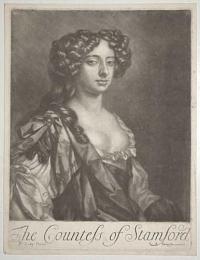
The Countess of Stamford.
P. Lelij Pinxit.
R.Tompson excudit. [n.d. c.1690.]
Mezzotint, 220 x 170mm (8¾ x 6¾"). Trimmed to plate. Paper toned. One small hole at shoulder.
A half-length portrait of Elizabeth Grey (c.1657-87) (nee Harvey/Hervey), with her hair in curls, wearing a low dress and a robe fastened at the shoulder. She was the daughter of Sir Daniel Harvey and wife of Thomas Grey 2nd Earl of Stamford. CS45. Blackett-Ord T65 III of III. Ex: Collection of The Hon. Christopher Lennox-Boyd.
[Ref: 65115] £140.00
(£168.00 incl.VAT)
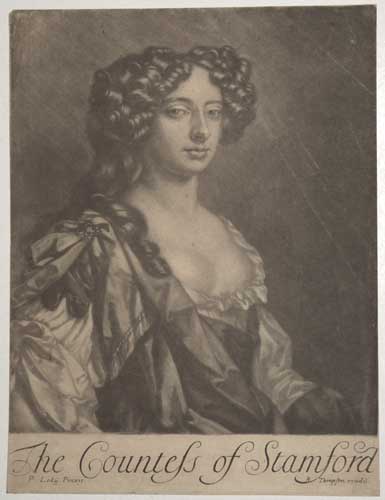
The Countess of Stamford.
P. Lelij Pinxit.
R.Tompson excudit. [n.d. c.1690.] [But later].
Mezzotint, 220 x 170mm (8¾ x 6¾"). Small margins.
A half-length portrait of Elizabeth Grey (c.1657-87) (nee Harvey/Hervey), with her hair in curls, wearing a low dress and a robe fastened at the shoulder. She was the daughter of Sir Daniel Harvey and wife of Thomas Grey 2nd Earl of Stamford. CS45. Blackett-Ord T65 III of III. Ex: Collection of The Hon. Christopher Lennox-Boyd.
[Ref: 65117] £140.00
(£168.00 incl.VAT)



![[Battle of Grengam] Zee Battaille tussen de Rubisen Generaal den Prins Galiczin en de Sweden onder het gebiet van den Vice-Adm.l [...] [parallel text in Latin]](jpegs/59151.jpg)

![[Grey wash portrait of George Nugent-Temple-Grenville, Earl Temple.]](jpegs/57519.jpg)


![[William Wyndham Grenville] The Bear and his Leader.](jpegs/66023.jpg)


![[Three Gretna Green-related prints]](jpegs/41649.jpg)

![Donna Genovese Col Mezzo Calato Che Vende Fiori. 7 [Parallel text in French.]](jpegs/38715.jpg)
![Piemontese D'Asti. 5 [Parallel text in French.]](jpegs/38716.jpg)
![Donna Frascatana Vesitta Da Giorna Di Festa. [Parallel text in French.]](jpegs/38717.jpg)
![Donna Plebea di Napoli Riscaldono si I Piedi Ad Un Focone. 21 [Parallel text in French.]](jpegs/38718.jpg)
![Donna Pleabea Di Napoli Vestita Da Giorno Di Fiesta. 20 [Parallel text in French.]](jpegs/38719.jpg)
![Contadina Di Napoli Con Un Bambino. 19 [Parallel text in French.]](jpegs/38720.jpg)
![Contadina Di Bolognese. 10 [Parallel text in French.]](jpegs/38721.jpg)
![Citadina Di Frascatana. 23 [Parallel text in French.]](jpegs/38722.jpg)


![[Miss Greville and her Brother.]](jpegs/52491.jpg)
![[Miss Greville].](jpegs/31674.jpg)


![[Charles Grey] Tommy Grey with the Tail of His Order!!! Lork What a Long Tail our Cat has Got.](jpegs/63658.jpg)
![[Charles Grey] Tommy Grey with the Tail of His Order!!! Lork What a Long Tail our Cat has Got.](jpegs/63657.jpg)
![[Charles Grey] [Shall I Resign?](jpegs/66394.jpg)
![[Charles Grey] Tommy Grey with the Tail of His Order!!! Lork What a Long Tail our Cat has Got.](jpegs/66564.jpg)

![[Charles Grey] Shall I Resign?](jpegs/40327.jpg)