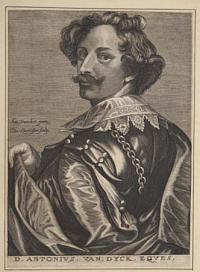
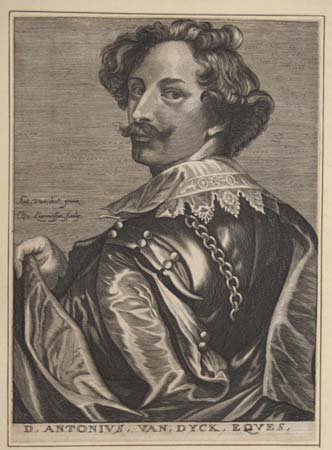
D. Antonius van Dyck Eques. [In image] Ant Van Dyck pinxit. De Larmessin Sculp.
From 'Academie des Science et des Arts', Amsterdam 1682.
Engraving. Sheet 190 x 135 (7½ x 5¼"). Trimmed to image and laid on album paper. Foxing along the left margin.
Half portrait of Sir Anthony van Dyck (1599-1641), back turned and looking over his shoulder. Van Dyck was a Flemish Baroque artist and, after artistic success in the Netherlands and Italy, was recruited as a court painter in England. He was granted a knighthood by Charles I.
[Ref: 53791] £140.00
(£168.00 incl.VAT)
![[Anti-British propaganda relating to 4th Anglo-Dutch War]](img-thumbnail/jpegs/30062.jpg)
[Anti-British propaganda relating to 4th Anglo-Dutch War] Algemeene Staatkundige Konstplaat Van't Jaar 1780 [parallel text in French below]
[Amsterdam, 1780]
Etching, sheet 485 x 455mm (19 x 18"). Trimmed inside platemark on left, folds. Very scarce.
Fifteen satirical images directed against the British preceding the outbreak of war between the English and the United Provinces in 1780, a war related to the American Revolutionary War. Most of the plate is composed of reduced of reduced versions of previously published plates. Some have explicit American content, such as 8 (which mentions Florida) and 15 (Philadelphia). In the wake of the Gordon Riots in London, 'the intention here seems to be to identify English sailors with the plundering London mob' (George). BM Satires 5728; plate also includes copies of BM Satires 5712-22
[Ref: 30062] £650.00

A charm for a democracy, reviewed, analysed & destroyed Jany 1st 1799 to the confusion of its affiliated friends.
[After Thomas Rowlandson]
Publish'd February 1st 1799 by [Wright's name erased] for the Anti Jacobin Review. by J Whittle Peterborough Court Fleet Street.
Etching with fine hand colour. Sheet 305 x 460mm (12¼ x 18"). Trimmed within plate. Vertical crease as normal in centre where previously folded.
Satirical illustration from the ‘Anti-Jacobin Review’ (vol. ii, frontispiece) depicts a chaotic, hellish scene titled the Cave of Despair, where radical political figures are shown as demonic conspirators. A divine light from above drives away evil, symbolizing divine intervention against revolution and sedition. Three robed figures (wizards) prepare a grotesque potion in a cauldron inscribed with names and symbols of rebellion, such as Kosciuszko’s blade (1746-1817) and Fox’s (1749-1806) fur, while the Devil and a monster watch approvingly. Pamphlets promoting radical ideas like atheism, sedition, and insurrection fuel the flames beneath the cauldron, added by figures like Horne Tooke (1736-1812). A grim procession of opposition politicians, including Fox, Erskine (1750-1823), Tierney (1761-1830), and Thelwall (1764-1834), file into the cave, each uttering phrases of regret or defiance. Above them, the King (1738-1820) and ministers like Pitt (1759-1806) and Grenville (1759-1834) appear in divine light, symbolizing order and justice. Meanwhile, defeated demons including Robespierre (1758-94) and Voltaire (1694-1778) flee, and an ape dressed as a newsboy (symbolizing the radical press) sounds his horn, spreading seditious ideas. The scene is a visual condemnation of revolutionary ideology, radical journalism, and political opposition, portraying them as part of a satanic conspiracy against Britain. BM Satires 9345.
[Ref: 67299] £320.00

Anticipation. hus let me wipe dishonor from my name, And hurl thee from the earth, thou stain to goodness. Perdition take thee, villain, for thy falshood! Now nothing but thy life can make atonement.
Second Sketch - Published Feby 9. 1784 as the act directs, by S. Fores No.3 Piccadilly.
Etching, printed on Portal watermarked paper. 240 x 221mm. 9½ x 8¾". Chip to upper left corner.
Fox (left) and North (right), stripped to the waist, are engaged in a pugilistic encounter. Fox's torso is so hairy that it suggests the effect of tarring and feathering. They stand in profile with clenched fists, Fox's left being near North's nose; both are fat, clumsy, and muscular. A boxing print. BM Satires: 6407.
[Ref: 25568] £230.00
(£276.00 incl.VAT)
![Anticipation - Bringing them to the Scratch, - Hercules in the Church; or, the Church [crossed out and replaced with] Tithes in Danger.](img-thumbnail/jpegs/33198.jpg)
Anticipation - Bringing them to the Scratch, - Hercules in the Church; or, the Church [crossed out and replaced with] Tithes in Danger.
[Monogram of A. Sharpshooter, probably John Phililips] fec.
Pub. By S.W. Fores 41, Piccadilly May 1829.
Coloured engraving. Sheet 235 x 350mm (9¼ x 13¾"). Timmred to printed border, laid on album paper, small tear in left edge.
Wellington forcing two fat bishops to regurgitate gold sovereigns into a vat marked ''Receptacle for the poor Curates, Repairs of Churches; and Support of Paupers'. Wellington's Ministry had been rumoured to be planning reforms of the Tithe System in England and Wales. This was untrue. 'A. Sharpshooter' was a pseudonym used by John Phillips. BM Satires 15771.
[Ref: 33198] £260.00
(£312.00 incl.VAT)
![[George Canning] Anticipation or A Peep behind the Screen.](img-thumbnail/jpegs/66565.jpg)
[George Canning] Anticipation or A Peep behind the Screen.
H.H.[Henry Heath] fecit.
Pubd April 23. 1827 by S W. Fores. Piccadilly.
Coloured etching. 240 x 335mm (9½ x 13¼"). Trimmed into coloured border.
George IV sits in a Gothic chair of state in conclave with four Tory Councillors: Canning, Peel, Eldon and Wellington. A satire on Canning's difficulty in forming a ministry. BM Satires 15376, with extensive description.
[Ref: 66565] £220.00
(£264.00 incl.VAT)

View in the Old North Sound, Antigua. From Freemans.
Drawn by J. Johnson. Engraved by E. Duncan.
[London Published Feb. 1. 1827 by T. & G. Underwood, Fleet Street.]
Very fine aquatint, printed in colours and hand finished. Sheet 340 x 480mm (13½ x 19"). Trimmed within plate.
Slaves at work on the Captain Freeman's sugar windmill. To the left is the chapel built by the Moravian missionaries on Samuel Otts' estate. From an extremely rare series 'Views of the West Indies', which was intended (according to the printed wrapper) ''to convey a faithful outline of the existing State of Slavery on the Plantations in the British Islands''. Five parts were planned, each containg four views: the first two were published by the Underwoods in 1827, with a third by Smith & Elder in 1829, before the series was wound up. Only a map of Antigua and 11 plates were issued. Abbey: 678, the premature end was ''a pity, for these plates were excellent''.
[Ref: 63004] £950.00

View of Saint John's Harbour, Antigua. From Friar's Hill. Proof
Drawn by J. Johnson.
[London Published Feb. 1. 1827 by T. & G. Underwood, Fleet Street.]
Very fine aquatint, printed in colours and hand finished. Sheet 340 x 480mm (13½ x 19"). Trimmed within plate, tear in left edge.
A distant view of the harbour, looking past a windmill of a sugar plantation. This was the first plate in the series of extremely rare 'Views of the West Indies', which was intended (according to the printed wrapper) ''to convey a faithful outline of the existing State of Slavery on the Plantations in the British Islands''. Five parts were planned, each containg four views: the first two were published by the Underwoods in 1827, with a third by Smith & Elder in 1829, before the series was wound up. Only a map of Antigua and 11 plates were issued. Abbey: 678, the premature end was ''a pity, for these plates were excellent''.
[Ref: 63005] £950.00
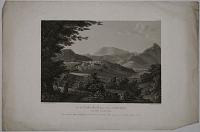
Vue de Cedarhall dans l'Isle d'Antigoa aux Indes occidentales.
Dess. d'ap. nat. par L. Stobwasser. gravé par Hurlimann.
Publié au profit des Missions Evangéliques par une Societé d'amis de l'Evangile, à Basle en Suisse, sous la direction de Birman & Fils. [n.d., 1830.]
Aquatint. 255 x 340mm (10 x 13½"). Edges of plate creased.
A very scarce view of Antigua, showing Cedar Hall, a Moravian church founded on Antigua in 1822. The view was drawn by the Rev. L. Stobwasser for his 'Vues des établissements missionnaires fondés par la communauté évangélique des Frères-Unis'. This work was commissioned by the Moravian Church to promote their work on the island, which was the education of the Negro slaves, including teaching them to read. According to Stobwasser, 'By degrees, the prejudices of the planters against the Negro children being taught to read, which in the beginning were very perceptible, wore away... [giving] the prospect of happier days for the Negros'. [Letter from Stobwasser, quoted by The Religious Intelligencer, 1825.]
[Ref: 22919] £850.00

Vue de Gracebay dans l'Isle d'Antigoa aux Indes occidentales
Dess. d'ap. nat: par L. Stobwasser. gravé par Hurlimann.
Publié au profit des Missions Evangéliques par une Societé d'amis de l'Evangile, à Basle en Suisse, sous la direction de Birman & Fils. [n.d., 1830.]
Aquatint. 255 x 340mm (10 x 13½").
A very scarce view of Antigua, showing Grace Bay, a Moravian church founded on Antigua in 1791. The view was drawn by the Rev. L. Stobwasser for his 'Vues des établissements missionnaires fondés par la communauté évangélique des Frères-Unis'. This work was commissioned by the Moravian Church to promote their work on the island, which was the education of the Negro slaves, including teaching them to read. According to Stobwasser, 'By degrees, the prejudices of the planters against the Negro children being taught to read, which in the beginning were very perceptible, wore away... [giving] the prospect of happier days for the Negros'. [Letter from Stobwasser, quoted by The Religious Intelligencer, 1825.]
[Ref: 22924] £850.00
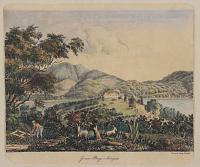
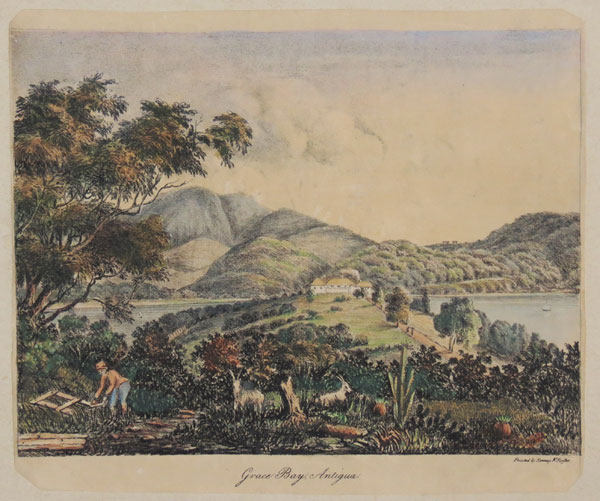
Grace Bay, Antigua.
Printed by Rowney & Forster [London, n.d., c.1820].
Very scarce hand-coloured lithograph, image 195 x 265mm. 7¾ x 10½". Margins lacking.
View on Antigua (Wadadli), an island in the West Indies, one of the Leeward Islands in the Caribbean, the main island of the country of Antigua and Barbuda. A figure working with wood and two goats to foreground, the sea and a plantation house in the landscape beyond.
[Ref: 25591] £420.00

St. John’s Harbour Antigua.
N.Pocock Del.t. T.Medland sculp.
Publish'd 30 June 1804 by J.Gold. Shoe Lane, London.
Aquatint. 130 x 220mm.
Published in the 'Naval Chronicle'.
[Ref: 4359] £90.00
(£108.00 incl.VAT)
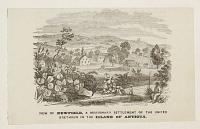
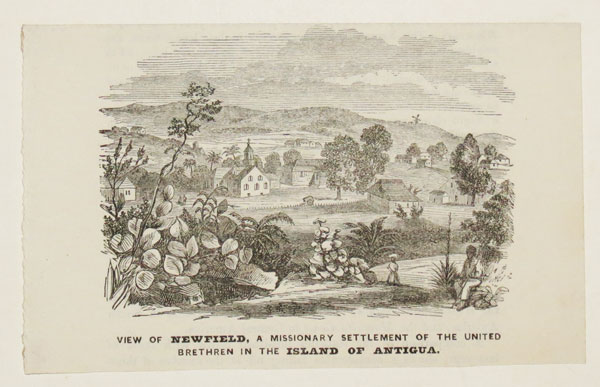
View of Newfield, a Missionary Settlement of the United Brethren in the Island of Antigua.
[Anon., c.1850]
Wood-engraving, sheet 85 x 140mm (3¼ x 5½"). Trimmed and glued to backing sheet at top.
[Ref: 44798] £50.00
(£60.00 incl.VAT)
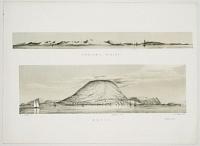
Antigua, S.Side. Nevis.
W.S. Andrews, del. H.C. Trery, Lith.
W. Spreat Exeter [c.1860.]
Tinted lithograph, sheet 270 x 370mm. 10½ x 14½". Small triangular indentation touching edge of top prospect.
Two prospects of West Indian islands: the top one shows the south coast of Antigua, the bottom Nevis, with Charlestown. From Andrews's Illustrations of the West Indies'. Rare: not listed in Abbey Travel.
[Ref: 45842] £280.00
(£336.00 incl.VAT)
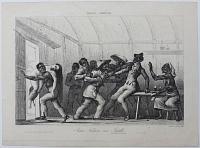
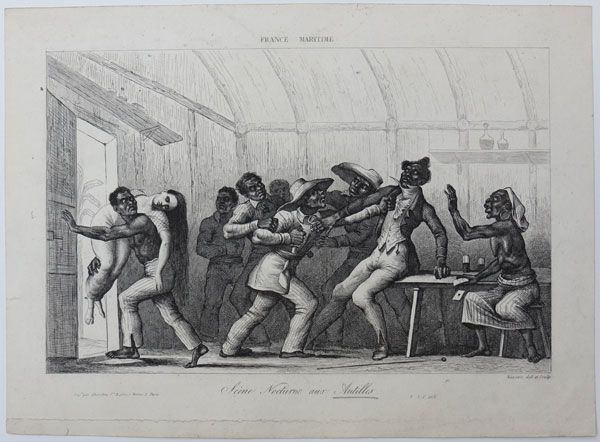
Scène Nocturne aux Antilles. France Maritime
Masson del et sculp
Imp.é par Chardon J.e & fils, r. Racine, 3, Paris [c.1840]
Engraving, sheet 190 x 260mm (7½ x 10¼"). Trimmed inside platemark three sides.
Scene intended to illustrate, in caricatures fashion, vices amongst the indigenous peoples of the Antilles: gambling and on the left a man abducts a sleeping white woman
[Ref: 33756] £130.00
(£156.00 incl.VAT)
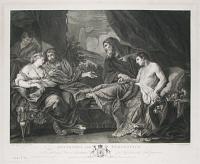
Antiochus and Stratonice. From the Original Picture; In the Collection of the Right Honourable Lord Grosvenor. Size of the Picture 3'11" by 5'5" in length.
Pietro da Cortona pinxit. W.m Wynn Ryland Sculpsit.
Published Sept.r 1.st 1772, by John Boydell, Engraver in Cheapside London.
Copper engraving, 440 x 550mm to platemark. 17¼ x 21½".
Representation of of the Greek doctor Eristatatus explaining the mysterious illness affecting Antiochus. Only Eristatus was able to understand that Antiochus was dying of love for his young stepmother Stratonice, whom his father had recently married. From volume two of "The Most Capital Paintings in England", a series of engravings in published in five volumes between the late 1760s and 1786, the first three of which (1769 to 1773) were originally published under the title Sculptura Britannica. These were a critical and financial success for the publisher John Boydell, who promoted the interests of artists, engravers and patrons, establishing a tradition in Britain for collecting prints.
[Ref: 14903] £280.00
(£336.00 incl.VAT)
![[La malade d'Antiochus.]](img-thumbnail/jpegs/60618.jpg)
[La malade d'Antiochus.]
Peint par Lairesse. Dessiné par Desenne. Gravé par Baquoy.
[n.d. c.1816.]
Proof before title & publication line, engraving, 335 x 485mm (13¼ x 19"), with very large margins. Repaired tears to margins. Some surface dirt.
Seleucus giving up his wife for his son: classic interior with prince Antiochus I Soter lying ill on a canopied bed at right, his father Seleucus I pointing in despair at the crown and sceptre on a table at centre, his father's wife Stratonice standing by, the doctor Eristratos seen standing behind. Antiochus I Soter (c. 324/3 – 261 BC) was struck down by a mysterious illness. Erasistratus (c. 304 – c. 250 BC), Greek anatomist and royal physician under Seleucus I Nicator of Syria, realised that the illness of Antiochus was lovesickness for his stepmother Stratonice (c. 320 BC - 254 BC), by observing that Antiochus's pulse rate rises when ever he sees her. Seleucus I Nicator (c. 358 – 281 BC) gave up his young wife to save his son and in 294 BC Antiochus married his stepmother.
[Ref: 60618] £180.00
(£216.00 incl.VAT)
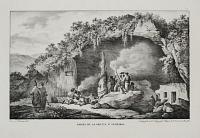
Entrée de la Grotte d'Antiparos.
Eenens et Petermanns del. Lithographié à la Calcographie Royale de J. Goubaud à Bruxelles.
[Brussels, 1822-9.]
Lithograph rare with very large margins. Printed area 240 x 350mm (9½ x 13¾").
The entrance to the cave of Antiparos, used for shelter since the Neolithic period, visited by Archilochus of Paros, the Marquis de Nointal (French ambassador in Istanbul in the 1670s), Byron and Otto, first king of Greece. The view was published in a Brussels edition of Choiseul-Gouffier's 'Voyage Pittoresque de la Grèce', but which also contained Melling's 'Voyage pittoresque de Constantinople et des rives du Bosphore'.
[Ref: 35156] £190.00
(£228.00 incl.VAT)
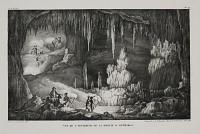
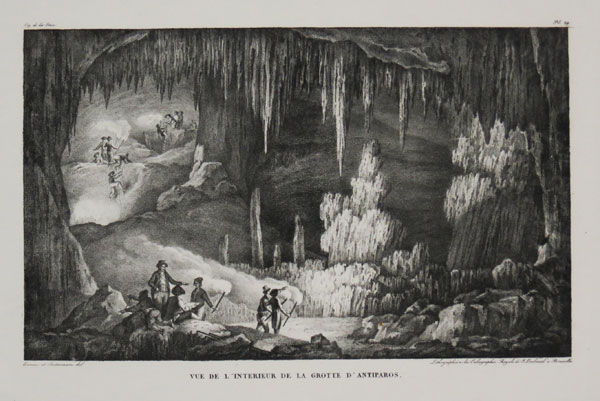
Vue de l'Interior de la Grotte d'Antiparos.
Eenens et Petermanns del. Lithographié à la Calcographie Royale de J. Goubaud à Bruxelles.
[Brussels, 1822-9.]
Lithograph rare with very large margins. Printed area 240 x 350mm (9½ x 13¾").
The interior to the cave of Antiparos, used for shelter since the Neolithic period, visited by Archilochus of Paros, the Marquis de Nointal (French ambassador in Istanbul in the 1670s), Byron and Otto, first king of Greece. Here vistors use blazing torches to view the stalactites and stalagmites. The view was published in a Brussels edition of Choiseul-Gouffier's 'Voyage Pittoresque de la Grèce', but which also contained Melling's 'Voyage pittoresque de Constantinople et des rives du Bosphore'.
[Ref: 35157] £240.00
(£288.00 incl.VAT)
![[The Antiquary.] S.t Ruth's Priory.](img-thumbnail/jpegs/60654.jpg)
[The Antiquary.] S.t Ruth's Priory.
Printed in Oil Colours by G. Baxter, the Inventor and Patentee. XI Northampton Square. Licenses Granted to work the process.
[n.d., c.1850.]
Baxter print, trimmed and laid on printed card with the red stamp, as issued. Sheet 220 x 145mm (8¾ x 5¾"). Some spotting on backing card.
A location in Sir Walter Scott's 'The Antiquary', the third of the Waverley novels and his own favourite. St Ruth's Priory is believed to have a buried treasure. It is said this is based on Arbroath Abbey in Scotland. Eleven blocks were used for this print.
[Ref: 60654] £60.00
(£72.00 incl.VAT)
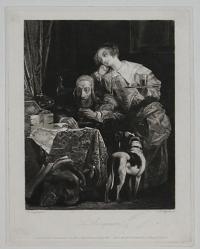
L'Antiquaire.
Bonnington pinx.t. S.W. Reynolds sc.t.
London, 1st April 1829 published by Moon, Boys & Graves, 6, Pall Mall. Paris, Giraldon-Bovinet & C.ie 26 Galerie Vivienne.
Mezzotint. 240 x 290mm (9½ x 11½"). Narrow margins.
An antiquarian, seated in an armchair, examining an object with a magnifying glass. A woman gazes over his shoulder, holding a tray with a tumbler, a dog at her feet. Jewish interest.
[Ref: 24704] £85.00
(£102.00 incl.VAT)
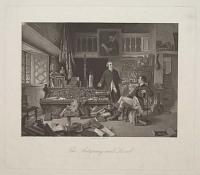
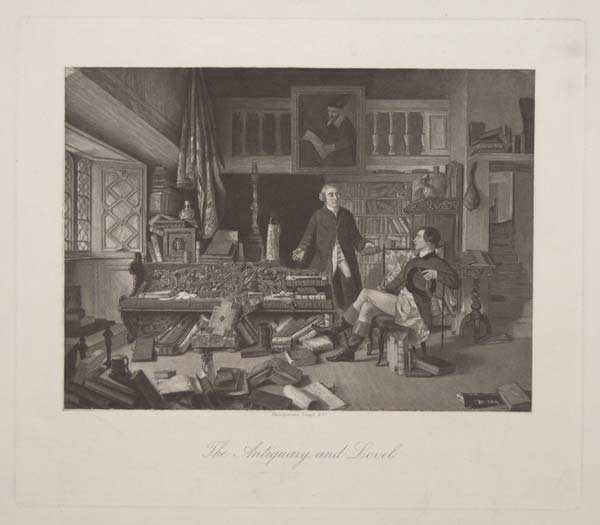
The Antiquary and Lovel.
Photogravure Goupil & C.o
Edinburgh, 1885.
Photogravure. 205 x 240mm (8 x 9½"), with wide margins. Small tears along the top and left edges.
A scene depicting two well dressed men in a study surrounded by a careless pile of books. This print is from a series of eight published in a book by Sir William Fettes Douglas (1822-1891). The Scottish painter was appointed to Director of the National Galleries of Scotland in 1877 and in 1882 became the president of the Royal Scottish Academy. The book was published for the Royal Association for Promotion of the Fine Arts in Scotland. Douglas himself was an antiquary and bibliophile as well as having an interest in astrology and alchemy.
[Ref: 53886] £85.00
(£102.00 incl.VAT)
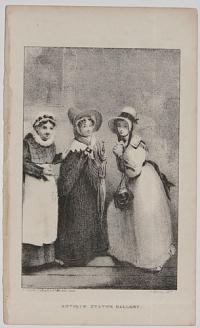
Antique Statue Gallery.
A. Ducôte's Lithogy. 70, St. Martins Lane. A. Hervieu delt.
[n.d. c.1840]
Lithograph. 190 x 114mm (7½ x 4½").
[Ref: 15108] £60.00
(£72.00 incl.VAT)
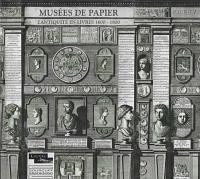
Musées de papier: L'Antiquité en livres.
Sous la direction d'Elizabeth Décultot avec la collaboration de Gabrielle Bickendorf et Valentin Kockel.
Louvre éditions, 2010.
Oblong 4to, illustrated soft covers; pp. 168, profusely illustrated.
The catalogue to an exhibition of how antiquity was depicted in print.
[Ref: 59759] £45.00
![[13 engravings from The Devil upon Two Sticks] [&]](img-thumbnail/jpegs/68177.jpg)
[13 engravings from The Devil upon Two Sticks] [&] [5 scenes of antiquity]
[Chez Pierre Van Cleef à Londres 1755 ] [&] [n.d. c.1696]
18 engravings front and back on an album sheet. Sheet size, 610 x 445mm (24 x 17½). All trimmed within plate and glued to backing sheet.
Thirteen illustrations from, 'Le diable boiteux,' written by Alain-René Lesage (1668-1747). They seem to be from the edition published by Pierre Van Cleef in 1755.? On the reverse the top engraving, 'Bacchantivm Chorvs. Bacchvs Indicvs. Dionysiaca Saltatio.' Images of drunken revelry, dancing and music making in honour of Dionysus/Bacchus and a coin image of the God to the right. The left is a medallion portrait of Midas surrounded by three coins. Central is the title page for the book, 'Q. Curtius Rufus: Historiae Alexandri Magni,' (Histories of Alexander the Great) published in 1696. The right a medallion portrait of Homer surrounded by four coins. The bottom is, 'Bacchi Et Ariadne Chorvs. Liberi Patris Trivmphvs,' a parade with Bacchus and Ariadne in a chariot being led by a procession of mythical creatures. A triumphant Bacchus (Eleutherios) returns drunk on a cow from his conquest of India, surrounded by a rowdy, celebratory procession. Two coin images.
[Ref: 68177] £360.00
view all images for this item

The Celebrated Piratical Slaver L'Antonio. With others of the Black Craft lying in the Bonny River.
N.M.Condy del_T.G.Dutton lith. Day & Haghe Lith.rs to the Queen.
[n.d., c.1850.] London. Edward Ramsden, 12 Finch Lane, Cornhill, Plymouth, Edmund Fry.
Rare coloured lithograph. 400 x 305mm (15¾ x 12").
A view of the Spanish merchant schooner 'L'Antonio' in the Bonny river in Nigeria waiting to take captured Africans on board.
[Ref: 67450] £480.00
![[Edmund Antrobus.]](img-thumbnail/jpegs/67838.jpg)
[Edmund Antrobus.]
Painted by Thos. Lawrence Esq.r R.A. Engrav'd by George Clint.
[n.d., 1803.]
Mezzotint, Proof before title. 510 x 370mm (20 x 14½"). Top left corner cut off and replaced, a few spots, laid on album paper. Small margins.
Three-quarter portrait of Sir Edmund Antrobus (died 1826, created 1st Baronet 1815), standing, letter in hand. Lawrence also painted his two nephews, one of whom, Edmund William, succeeded as 2nd baronet according to the special remainder. Ex: collection of The Hon. Christopher Lennox-Boyd. Unidentified collector's stamp 'I F P' on album sheet
[Ref: 67838] £260.00
(£312.00 incl.VAT)
![[Philip Antrobus.]](img-thumbnail/jpegs/67839.jpg)
[Philip Antrobus.]
Painted by Thos. Lawrence Esq.r R.A. Engraved by Geo. Clint, Oct.r 1.st 1803.
Untitled mezzotint, printed in colour. 480 x 355mm (19 x 14") Trimmed into plate at bottom, right platemark cracked with tear taped, paper toned.
Three-quarter portrait of Philip Antrobus (1755-1816), standing, paper in hand, inkwell on a table. Lawrence also painted his brother, Edmund (the 1st Baronet Antrobus), and Philip's two sons, one of whom, Edmund William, succeeded as 2nd baronet according to the special remainder. Ex: collection of The Hon. Christopher Lennox-Boyd.
[Ref: 67839] £280.00
(£336.00 incl.VAT)
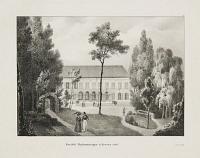
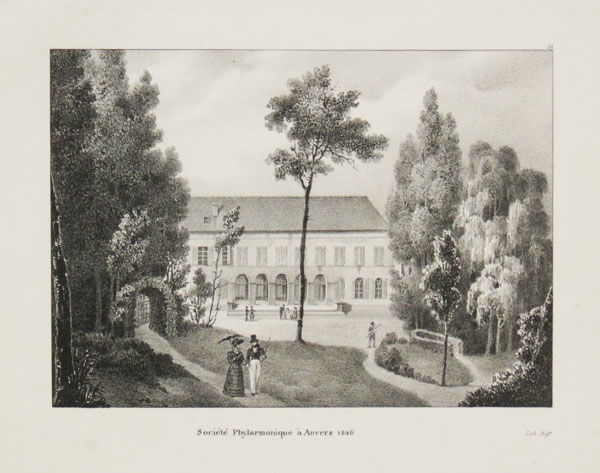
Société Phylarmonique è Anvers 1826.
Lith. Roy.
Lithograph, printed area 160 x 205mm (6¼ x 8").
Musical society in Antwerp (Anvers), Belgium
[Ref: 43440] £90.00
(£108.00 incl.VAT)
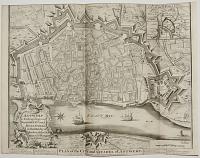
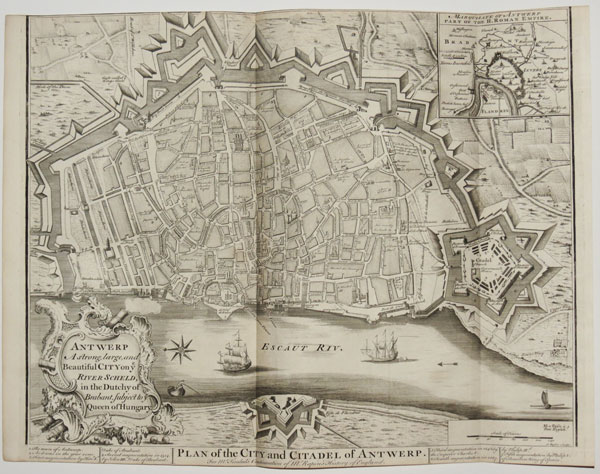
Plan of the City and Citadel of Antwerp. Antwerp A strong, large, and Beautiful City on ye River Scheld, in the Dutchy of Brabant, subject to ye Queen of Hungary.
I. Basire Sculp.
For Mr Tindal's Continuation of Mr Rapin's History of England. [London, James & Paul Knapton, 1751.]
Engraved map. 385 x 480mm (15¼ x 18¾"). Very fine impression with original binding folds, trimmed at top, as issued.
A plan of Antwerp after the War of the Spanish Succession (1701-14), when it was transferred from Spanish control to the Austrian Habsburgs. Nicholas Tindal (1687-1774), at one time Chaplain to Greenwich Hospital, first published a translation of Frenchman Paul de Rapin's 'History of England' in 1727, running to thirteen volumes; in 1732 it was enlarged with his own notes and maps. This map was published in 'A summary of Mr Rapin de Thoyras's History of England, and Mr Tindal's Continuation, from the Invasion of Julius Caesar, to the End of the Reign of King George I. Illustrated With Medals, Plans of Battles, Towns, and Sieges', 1751.
[Ref: 28249] £280.00
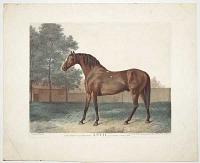
Anvil.
George Stubbs pinx.t. Geo. Townley Stubbs sculp.t Engraver to His R.H. the Prince of Wales.
London. Published Dec.r 1 1794 by Mess.rs Stubbs, Turf Gallery, Conduit Street.
Fine stipple with etching, printed in colours and hand finished. 205 x 255mm (8 x 10"), with large margins. Scarce in colours.
Anvil, foaled in 1777 and described by 'A Review of the Turf' as 'ranked amongst the best stallions of the present day'. In 1793 Anvil was in Mr O'Kelly's stud at Edgware, at 10 guineas per mare. Lennox-Boyd: 115, state II of III. See also [Ref: 54816].
[Ref: 59369] £1,250.00
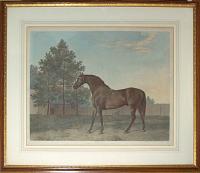
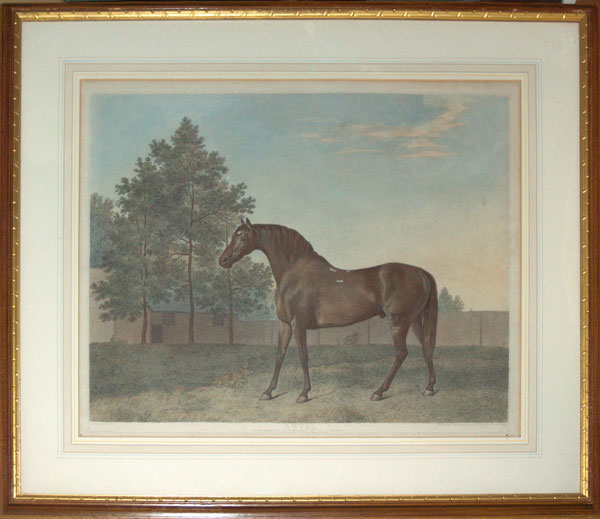
Anvil.
George Stubbs pinx.t. Geo: Townley Stubbs sculp.t Engraver to His R.H. the Prince of Wales.
London. Published Dec.r 1 1794 by Mess.rs Stubbs, Turf Gallery, Conduit Street.
Stipple and etching, open-letter finished proof, printed in colours and hand finished. 405 x 500mm (16 x 19¾"). Framed. Some spotting. Unexamined out of frame.
Anvil, foaled in 1777 and described by 'A Review of the Turf' as 'ranked amongst the best stallions of the present day'. In 1793 Anvil was in Mr O'Kelly's stud at Edgware, at 10 guineas per mare. Lennox-Boyd: 114, state I of III, ''100 proofs were issued''. See also [Ref: 59369].
[Ref: 54816] £1,850.00

La Vieille Inquiete. The Anxious Matron.
Pub.d Nov.r 1828, by A. Friedel, 34, Surrey St. Strand, from a Painting by Scallken.
Lithograph on india, rare with large margins. 406 x 266mm. 16 x 10½".
An anxious matron leans out of a window peering down waiting; she holds a candle which casts shadows in all directions. From a painting here attributed to Godfried Schalcken.
[Ref: 24886] £60.00
(£72.00 incl.VAT)

The Anxious Matron.
Ruben's, Pinxt.
Drawn, Printed & Published at Friedel's Litho Estabt. 252, Tottenham Court Road, & at the Polytechnic Institution, 309, Regent St. London. [n.d. c.1840.]
Very scarce lithograph with fine hand-colour and gum arabic highlights. Image 350 x 275mm (13¼ x 10¾") A fine impression with full, folded margins (small tears at apex of folds).
After Peter Paul Rubens (1577 - 1640) by Adam Friedel, Danish-born painter and lithographic printer, publisher of a series of coloured lithographs of the Greek Revolution under the title 'Twenty-Four Portraits of the principal leaders and personages who have made themselves most conspicuous in the Greek Revolution'.
[Ref: 21588] £160.00
(£192.00 incl.VAT)
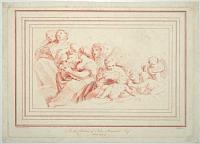
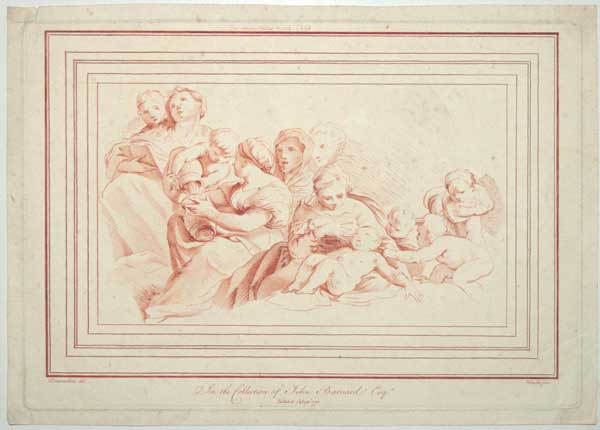
The anxious mother and sick child. In the Collection of John Barnard Esq.r
Dominichino del. WBaillie fecit.
Publish'd 1.st Sept.r 1773.
Soft ground etching, printed in sanguine, pt 18th century watermark. 230 x 330mm (9 x 13").
Stipple engraving after Domenico Zampieri (1581-1641), known as Domenichino, engraved by Captain William Baillie (1723-1810). Baillie retired from the army in 1761 with the rank of Captain and thereafter devoted himself to printmaking and dealing. He specialised in imitating old-master drawings and prints, using a variety of printmaking techniques. Ex: collection of The Hon. Christopher Lennox-Boyd. See [Ref: 12231] for one in black and white.
[Ref: 68468] £160.00
(£192.00 incl.VAT)

The anxious mother and sick child. In the Collection of John Barnard Esq.r
Dominichino del. Wbaillie fecit.
Publish'd 1.st Sept.r 1773 [but published c.1800].
Soft ground etching. 230 x 330mm (9 x 13").
Stipple engraving after Domenico Zampieri (1581-1641), known as Domenichino, engraved by Captain William Baillie (1723-1810). Baillie retired from the army in 1761 with the rank of Captain and thereafter devoted himself to printmaking and dealing. He specialised in imitating old-master drawings and prints, using a variety of printmaking techniques. Timothy Clayton and Anita McConnell, ‘Baillie, William (1723–1810)’, Oxford Dictionary of National Biography. See [Ref: 68468] for one printed in sanguine.
[Ref: 12231] £160.00
(£192.00 incl.VAT)
![[Arch of Augustus, Aosta] Veduta dell'Arco fabbricato in orore d'Augusto vicino all Città di Aosta in Piemonte, anticamente Augusta Prætoria Salassorum. [...]](img-thumbnail/jpegs/59164.jpg)
[Arch of Augustus, Aosta] Veduta dell'Arco fabbricato in orore d'Augusto vicino all Città di Aosta in Piemonte, anticamente Augusta Prætoria Salassorum. [...]
Cav. Piranesi inc.
[n.d., c.1748.]
Etching. 260 x 395mm (10¼ x 15½"), with large margins. Crease top right.
A view of a triumphal arch built in 25BC. The wooden crucifix below the vault was placed there in 1449 as a votive offering against the flooding of the river Buthier. From the Giovanni Battista Piranesi's famous 'Some Views of Triumphal Arches and Other Monuments Erected by the Romans', first published 1748.
[Ref: 59164] £280.00
(£336.00 incl.VAT)
![[Arch of Augustus, Aosta.]](img-thumbnail/jpegs/46090.jpg)
[Arch of Augustus, Aosta.] Arc de triomphe d'Auguste à Aoste.
Publié p.r J.P. Lamy à Basle, Berne, Lausanne, Genève. [c.1830]
Aquatint printed in black and sepia, platemark 180 x 200mm (7 x 8") very large margins.
The Arch of Augustus in the city of Aosta, Italy. The arch was constructed in 25 BC to commemorate the Roman victory over the Salassi, as a result of which the Romans founded Augusta Praetoria Salassorum (now Aosta) on Salassi territory.
[Ref: 46090] £140.00
(£168.00 incl.VAT)
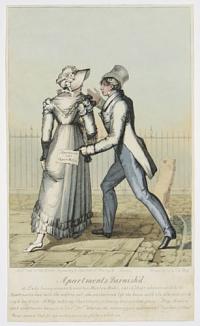
Apartments Furnish'd. A Lady having occasion to visit her Mantua Maker, sat in a chair whereon a bill to let Apartments laid with waters wet; she unobserved left the house with the placard sticking to her dress.
Designed by T. L. Busby.
Pub.d 1827 at the Artist's Depository 21 Charlotte St., Fitzroy Sq.
Coloured etching. Sheet: 235 x 140mm (9¼ x 5½"). Trimmed.
A young woman is approached by a young man who comments on a handbill accidentally stuck to her dress. Thomas Lord Busby (fl. 1804-37).
[Ref: 43785] £70.00
(£84.00 incl.VAT)
![[Vinegar Valentine.]](img-thumbnail/jpegs/43814.jpg)
[Vinegar Valentine.] In mind, in features, and in make, [/] You can't deny that you're an Ape.
[n.d., c.1850.]
Tinted lithograph. Sheet: 170 x 110mm (6¾ x 4¼").
A Victorian valentine card poking fun at a man with a top hat and dog, comparing him to a monkey.
[Ref: 43814] £35.00
(£42.00 incl.VAT)
![[Aphrodite.]](img-thumbnail/jpegs/49684.jpg)
[Aphrodite.]
H.C. [Jan Collaert I.]
[n.d., c.1577.]
Engraving. Sheet: 150 x 95mm (6 x 3¾''). Trimmed in an oval losing a decorative border, laid on album sheet.
A mythological scene showing Aphrodite, with Cupid at her feet. From a series of six engravings showing the character from the myth of the Judgement of Paris by Jan Collaert I (1525-1580).
[Ref: 49684] £180.00
(£216.00 incl.VAT)
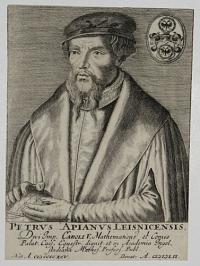
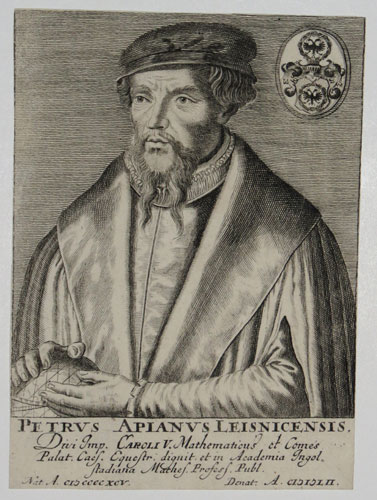
Petrus Apianus Leisnicensis. Divi Imp. Caroli V. Mathematicus et Comes Palat. Caes. Equestr. dignit. et in Academia Ingol. Stadiana Mathes. Profess. Publ. Nat. A. MCCCCXCV Denat. A. MDLII.
[by Wolfgang Philipp Kilian.]
[n.d, c.1700.]
Rare engraving. Sheet 160 x 115mm (6¼ x 4½"). Trimmed to image.
Petrus Apianus (latinized from Peter Bienewitz) (1495- 1552), German cartographer, astronomer & mathematician, holding a Globe. His most famous works were his cordiform world map 'Tipus Orbis Universalis juxta Ptolomei Cosmographi Traditionem et Americi Vespucii Aliorque Lustrationes' of 1520, the 'Cosmographicus liber' of 1524 and the 'Astronomicum Caesareum' of 1540. Wellcome: 84.
[Ref: 29653] £240.00
(£288.00 incl.VAT)
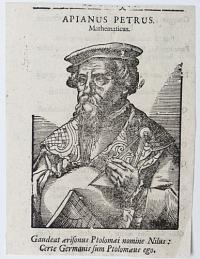
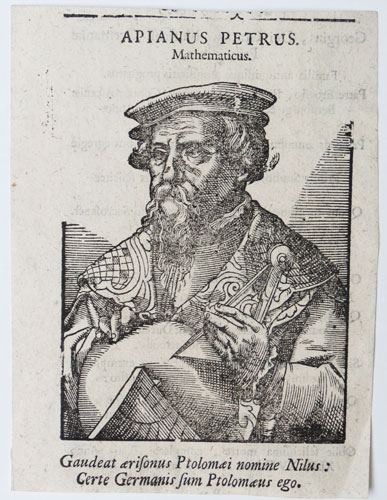
Apianus Petrus. Mathematicus.
[by Tobias Strimmer.]
[Strassburg, n.d, c.1590.]
Woodcut. Sheet 135 x 100mm (5¼ x 4"). Trimmed from a larger sheet.
Petrus Apianus (latinized from Peter Bienewitz) (1495- 1552), holding a globe & dividers, German cartographer, astronomer & mathematician. His most famous works were his cordiform world map 'Tipus Orbis Universalis juxta Ptolomei Cosmographi Traditionem et Americi Vespucii Aliorque Lustrationes' of 1520, the 'Cosmographicus liber' of 1524 and the 'Astronomicum Caesareum' of 1540. The portrait was published in Nicolaus Reusner's 'Allgemeine Geographische Ephemeriden'. Wellcome: 84.
[Ref: 29654] £240.00
(£288.00 incl.VAT)
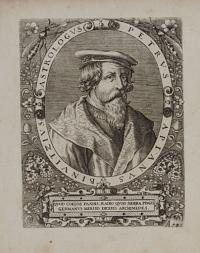
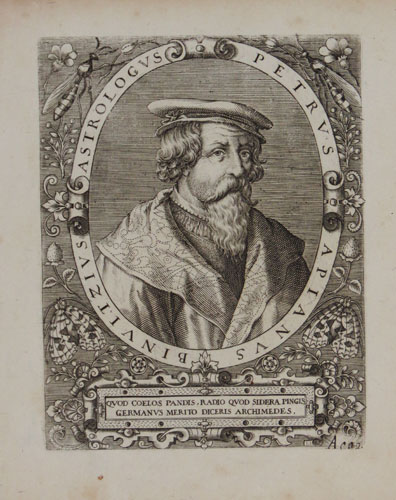
Petrus Apianus Binvitzius Astrologus.
[by Theodore de Bry.]
[n.d, c.1660.]
Engraving with very large margins, printed on 17th century watermarked paper. 140 x 110mm (5½ x 4¼".
Portrait of Petrus Apianus (latinized from Peter Bienewitz) (1495- 1552), German cartographer, astronomer & mathematician, in decorative border with insects and plants. His most famous works were his cordiform world map 'Tipus Orbis Universalis juxta Ptolomei Cosmographi Traditionem et Americi Vespucii Aliorque Lustrationes' of 1520, the 'Cosmographicus liber' of 1524 and the 'Astronomicum Caesareum' of 1540. From a later printing of Jean Jacques Boissard's 'Icones virorum illustrium’ originally published 1597-8. Wellcome: 84 - not in.
[Ref: 29655] £160.00
(£192.00 incl.VAT)

Petrus Apianus Binvitzius Astrologus.
[by Theodore de Bry.]
[n.d, c.1660.]
Engraving, printed on 17th century watermarked paper. 140 x 110mm (5½ x 4¼". Very small margins.
Portrait of Petrus Apianus (latinized from Peter Bienewitz) (1495 - 1552), German cartographer, astronomer & mathematician, in decorative border with insects and plants. His most famous works were his cordiform world map 'Tipus Orbis Universalis juxta Ptolomei Cosmographi Traditionem et Americi Vespucii Aliorque Lustrationes' of 1520, the 'Cosmographicus liber' of 1524 and the 'Astronomicum Caesareum' of 1540. From a later printing of Jean Jacques Boissard's 'Icones virorum illustrium' originally published 1597-8. Wellcome: 84 - not in.
[Ref: 64265] £160.00
(£192.00 incl.VAT)
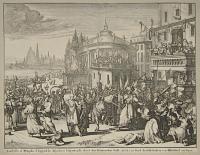
Kambyses te Memphis d'Egiptische Afgoderie bespottende, Dood den Vermaarden Godt Apis; en doed desselfs Feest in een Bloed-Bad eindigen.
[de Hooghe, Romeyn]
[n.d. c.1690.]
Etching. Image 277 x 356mm. 11 x 14". Cut and laid.
The festival of Apis, a a bull deity venerated for his excellent kindness and for his mercy towards all strangers. From a book of views of the Orient.
[Ref: 12958] £240.00
(£288.00 incl.VAT)
![[Apocrypha Combatants. Being a Series of Twelve Caricatures, Illustrative of that Controversy.]](img-thumbnail/jpegs/18281.jpg)
[Apocrypha Combatants. Being a Series of Twelve Caricatures, Illustrative of that Controversy.]
[Published by Thomas Sinclair, West Regester Street Edinburgh, n.d., 1828.]
Oblong quarto, original card covers, stitched, ink mss. title, rubbed; 16 lithographs (5 with old colour) from the two 'Apocrypha Combatants' series (1-5, 8-12 of the First Series, 1-6 of the second series; and six further lithographs in the same style. Lacking title sheets. Scarce collection. Some wear, one of the extra plates with a tear into image.
A scarce series of caricatures satirising the controversy over which of the Apocrypha should be included in the bible. Andrew Mitchell Thomson (1779–1831) resigned from the British and Foreign Bible Society in 1824, on the grounds that they had bound up the Apocrypha with the Bible. He used his ‘Christian Instructor’ to condemn them, creating this controversy, lasting until 1836. Apocrypha means 'hidden things' in Greek. The Apocryphical books of the Bible fall into two categories: texts which were included in some canonical version of the Bible at some point, and other texts of a Biblical nature which have never been canonical. Thomas Sinclair (1805-81), born in the Orkney Isles, studied lithography in Edinburgh. He had emigrated to Philadelphia by 1833, where he worked for Kennedy & Lucas before setting up his own firm in 1838. He was one of the first printers in Philadelphia to experiment with colour lithography. See BM Satire: 15573, etc. As the BM only has 1-6 of the second series it is unlikely more were published (they have only a photostat of plate 2.)
[Ref: 18281] £950.00
view all images for this item

Apollo. Appollon. 216.
[Thomas Jefferys, n.d., c.1772.]
Hand coloured engraving. Sheet 345 x 235mm (13½ x 9½"). Large margins.
A full-length portrait of a man, whole-length standing, turned slightly to the left, he holds in his left hand a golden lyre. Plate 216 from 'Collection of the dresses of different nations, antient [sic] and modern. Particularly old English dresses; after the designs of Holbein, Vandyke, Hollar and others, with an account of the authorities from which the figures are taken, and some short historical remarks on the subject. To which are added the habits of the principal characters on the English stage', published by Thomas Jefferys between 1757 - 1772.
[Ref: 62833] £120.00
(£144.00 incl.VAT)
![[Apollo.]](img-thumbnail/jpegs/20443.jpg)
[Apollo.]
G.B. Cipriani inv. F. Bartolozzi sculp.
London, Publish'd May 20th; 1783 by W. Dickinson Engraver & Printseller No.158 New Bond Street.
Stipple and etching. Plate 160 x 114mm. 6¼ x 4½". Slight damage on left.
Apollo holding a lyre under his arm, plucking a string with his right index finger. De Vesme: 356; iii/iv.
[Ref: 20443] £140.00
(£168.00 incl.VAT)
![[The Dance of Apollo with the Muses.]](img-thumbnail/jpegs/38473.jpg)
[The Dance of Apollo with the Muses.] Serenissimo et Potentissimo Principi ac Domino Domino Carolo Theodoro [...]
Julius Romanus inv et Pinxit ejusdem magnitudinis. Ferdinandus Gregorj Floren delin et Sculpxit 1770
Engraving on two plates, 18th century watermarked paper, combined platemark dimensions 370 x 765mm (14½ x 30"). Very large margins, uncut. Crease through centre as normal; slight tear to left plate. Crease to left sheet in margin.
Engraving by Florentine printmaker Ferdinando Gregori (1743?-1804), after a painting of c.1540 (Florence, Palazzo Pitti) by Giulio Romano (?1499-1546), painter and architect trained by Raphael.
[Ref: 38473] £450.00
view all images for this item
![[Anti-British propaganda relating to 4th Anglo-Dutch War]](jpegs/30062.jpg)


![Anticipation - Bringing them to the Scratch, - Hercules in the Church; or, the Church [crossed out and replaced with] Tithes in Danger.](jpegs/33198.jpg)
![[George Canning] Anticipation or A Peep behind the Screen.](jpegs/66565.jpg)





![[La malade d'Antiochus.]](jpegs/60618.jpg)

![[The Antiquary.] S.t Ruth's Priory.](jpegs/60654.jpg)



![[13 engravings from The Devil upon Two Sticks] [&]](jpegs/68177.jpg)

![[Edmund Antrobus.]](jpegs/67838.jpg)
![[Philip Antrobus.]](jpegs/67839.jpg)




![[Arch of Augustus, Aosta] Veduta dell'Arco fabbricato in orore d'Augusto vicino all Città di Aosta in Piemonte, anticamente Augusta Prætoria Salassorum. [...]](jpegs/59164.jpg)
![[Arch of Augustus, Aosta.]](jpegs/46090.jpg)

![[Vinegar Valentine.]](jpegs/43814.jpg)
![[Aphrodite.]](jpegs/49684.jpg)


![[Apocrypha Combatants. Being a Series of Twelve Caricatures, Illustrative of that Controversy.]](jpegs/18281.jpg)

![[Apollo.]](jpegs/20443.jpg)
![[The Dance of Apollo with the Muses.]](jpegs/38473.jpg)