![[Criminal.]](img-thumbnail/jpegs/68980.jpg)
[Criminal.] Scoldwell, a Sheriff's Officer, on his road to London after robbing Mr Spurling of Bedfont (in whose House he has been in posession) of his Ducks Watch Cash, &c._ Exclaiming to the Coachman. Quack! Quack! Tuck! Tuck! I have done the Baker out of Ducks, his Watch, &c.
Pub. by Alex. Hogg & Co April 30 1808.
Engraving. Sheet 210 x 125mm (8¼ x 5"). Trimmed into top of plate.
A scene depicting the travel of Charles Scoldwell, a Sheriff's Officer on his way to London after robbing Mr Spurling of Bedfont. Scoldwell was convicted of stealing Two Ducks, and sentenced on 23rd of July, 1796, to Transportation to Australia for Seven Years.
[Ref: 68980] £160.00
(£192.00 incl.VAT)

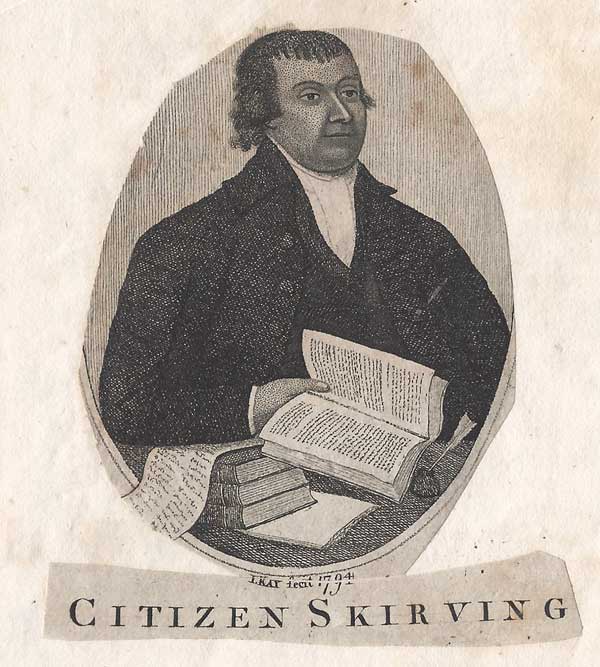
Citizen Skirving.
J.Kay fecit.
1794.
Stipple engraving. Sheet 210 x 125mm (8¼ x 5"). Very trimmed and backed onto album paper.
Portrait of William Skirving (c. 1745-1796), one of the five Scottish Martyrs for Liberty, was active in advocating universal suffrage and other reforms inspired by the French Revolution; he was convicted of sedition in 1793-94 and sentenced to transportation to New South Wales Kivell & Spence: pg 278
[Ref: 69002] £130.00
(£156.00 incl.VAT)

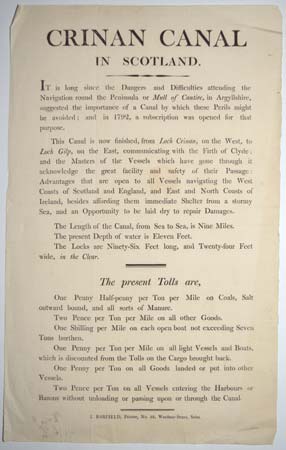
Crinan Canal in Scotland. It is long since the Dangers and Difficulties attending the Navigation round the Peninsula or Mull of Cantire, in Argyllshire, suggested the importance of a Canal by which these Perils might be avoided; and in 1792, a subscription was opened for that purpose. Thhis Canal is now finished...
J. Barfield, Printer, No. 91, Wardour-Street, Soho [n.d., c.1801].
A rare letterpress broadside, 18th century watermark. Sheet 410 x 255mm (16 x 10") Old ink mss. on reverse.
A decription of the Crinan Canal, designed to link the Clyde and the Inner Hebrides bypassing the Kintyre peninsula and opened 1801, including the tolls.
[Ref: 54177] £360.00
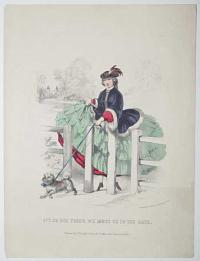
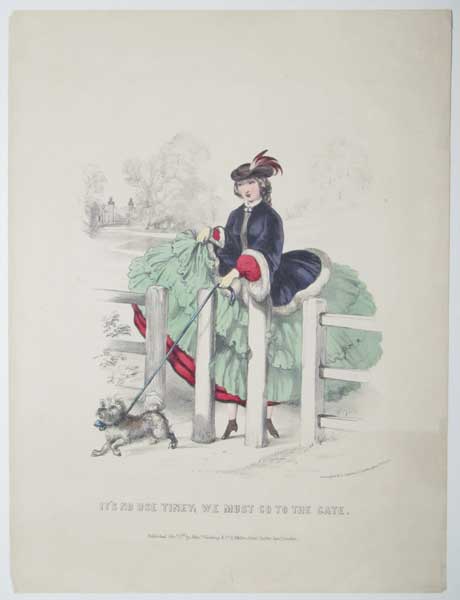
It's no use Tiney, we must go to the gate.
Lithographed by C.J. Culliford, 22, Southampton S.t Strand.
Published Nov.r 11.th by Mess.rs Fielding & C.o. 5, Melton Street, Euston Squ.e. London. [n.d. c.1858.]
Coloured lithograph, 380 x 285mm (15 x 11¼").
A satire on the mid 19th century fashion for crinolines. A woman walking her small dog is blocked by her crinoline dress going through a small passage in a fence.
[Ref: 60113] £140.00
(£168.00 incl.VAT)
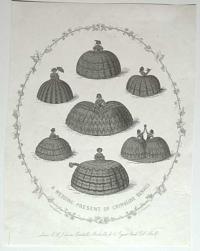
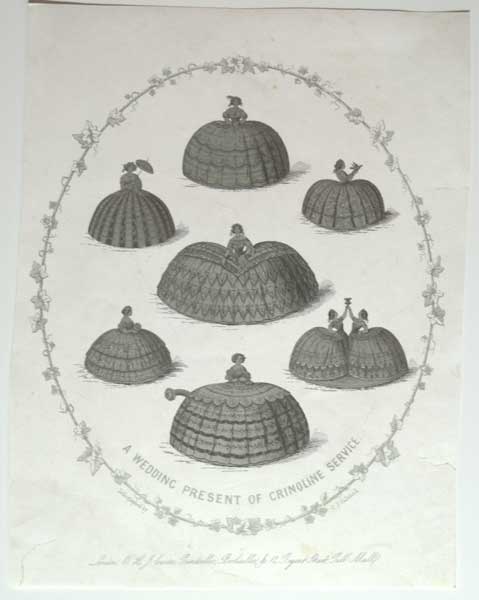
A Wedding Present Of Crinoline Service.
Lithographed by C.J. Culliford.
London, W. H. J. Carter, printseller, Bookseller, &c. 12, Regent Street, Pall Mall. [n.d. c.1850]
Very scarce lithograph, sheet 300 x 230mm (11¾ x 9"). Repaired tears.
A highly decorative satire on crinoline fashion, featuring 8 women in absolutely enormous skirts surrounded by an oval leaf border. W.H.J. Carter made a number of satires on crinoline publishing them annually. See also references 15161, 15159, 15153, 15154, 13109, 15160, 15165, 36835, 36836, 15352, 15353, 15354, 16831 & 42021.
[Ref: 61509] £180.00
(£216.00 incl.VAT)
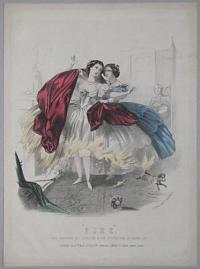
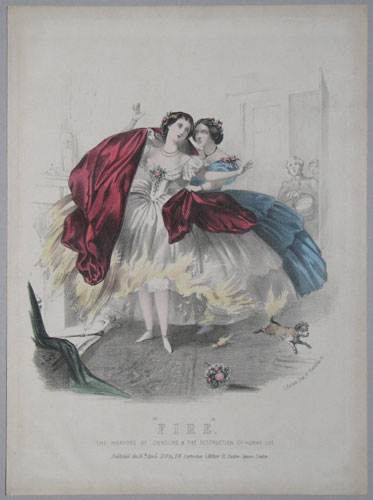
"Fire." The Horrors of Crinoline & the Destruction on Human Life.
L'Enfant, Imp, 18, Rathbone Pl.
Published the 14th. April. 1859 by, F.W. Farbrother, 5, Milton St. Euston Square, London.
Fine original hand coloured lithograph, sheet 375 x 275mm. 14¾ x 10¾".
A satire on mid 19th century female fashion; a young lady's dress has caught fire in an interior. Her terrier flees the scene with its tail on fire, an anxious servant with a bucket of water appears at a door in the background. Crinoline was originally a stiff fabric with a weft of horse-hair and a wrap of cotton or linen thread. The fabric first appeared around 1830, but by 1850 the word had come to mean a stiffened petticoat or rigid skirt-shaped structure of steel designed to support the skirts of a woman’s dress in the required shape. The crinoline was the subject of much ridicule and satire, particularly in Punch magazine. Dress reformers did not like it either — they seized upon the cage aspect of the crinoline and claimed that it effectively imprisoned women. Given that the crinoline did eventually have a maximum diameter of up to 180 centimetres (six feet), it is easy to imagine difficulties in getting through doors, in and out of carriages, and the general problems of moving in such a large structure. The second problem was the potential impropriety of the crinoline. Its lightness was a curse as well as a blessing, as a gust of wind or a knock could set it swinging and reveal the wearer's legs. Even worse, if a woman tripped or was knocked over, the crinoline would hold her skirts up.
[Ref: 13108] £130.00
(£156.00 incl.VAT)

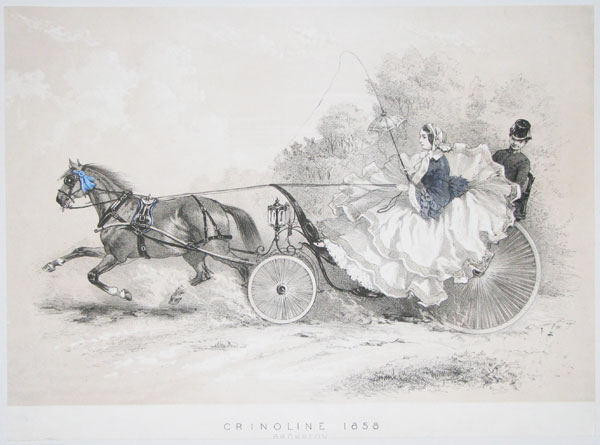
Crinoline 1858. Brompton.
[T.H. Guerin.]
[London, T. Archer.]
Sepia tinted lithograph with colour added by hand, sheet 300 x 405mm. 11¾ x 16". Trimmed to image top and sides.
A satire on mid 19th century female fashion. A male passenger enjoys the view as a female carriage driver's skirt is blown upwards.
[Ref: 8993] £180.00
(£216.00 incl.VAT)

Crinoline 1858. Belgravia.
T.H. Guerin. Del [in image lower left.]
[London, T. Archer.]
Sepia tinted lithograph with colour added by hand, sheet 315 x 415mm. 12½ x 16¼". Trimmed to image top and sides.
A satire on mid 19th century female fashion. A woman in a huge dress rather awkwardly descends from a carriage.
[Ref: 8996] £180.00
(£216.00 incl.VAT)

Crinoline 1858. Cremorne.
T.H. Guerin [in image lower right].
Published by T. Archer [damage] Mortimer Street, Regent Street.
Sepia tinted lithograph with colour added by hand, sheet 345 x 435mm. 13½ x 17". Creases; tear into publication line.
A satire on mid 19th century female fashion set in Cremorne Gardens, once a popular pleasure gardens by the side of the River Thames in Chelsea. A woman in a huge dress descends from a carriage, the driver above ensuring that his reins are well out of the way.
[Ref: 8997] £180.00
(£216.00 incl.VAT)
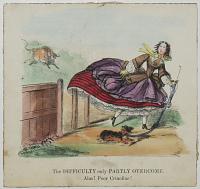
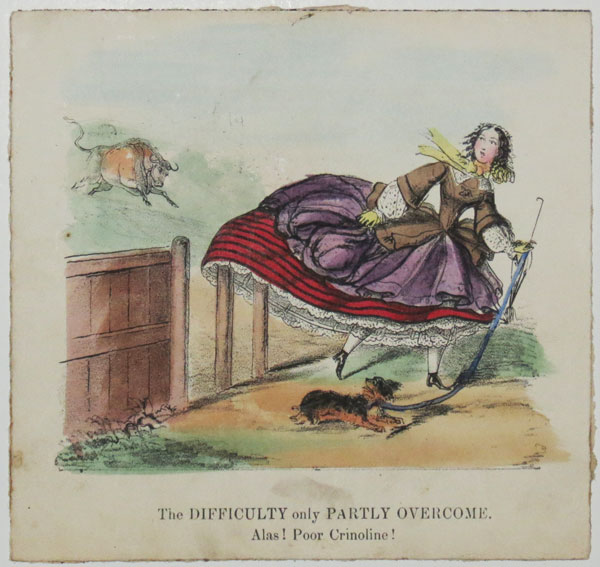
The Diddiculty only Partly Overcome. Alas! Poor Crinoline!
[n.d., c.1840.]
Lithograph with hand colour. Sheet 125 x 130mm (5 x 5¼"). Stain in title.
A woman escaping a bull catches her skirt. Her toy dog looks petrified.
[Ref: 51827] £65.00
(£78.00 incl.VAT)
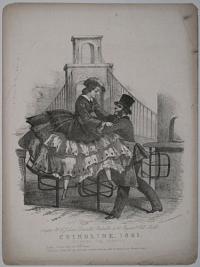
Crinoline 1861. Clearing the Barrier.
London W.H.J. Carter, Printseller, Bookseller, &c. 12, Regent St. Pall Mall. Printed at 22, Southampton St. Strand.
Lithograph, sheet 380 x 285mm. 15 x 11¼". Facsimile mss. publisher's price list to verso, for '...Prints, Illustrative of Crinoline...beautifully coloured'. Tatty extremities, creases through upper corners.
A satire on the mid 19th century fashion for crinolines, from an annual series on that theme by the same publisher. A lady is helped over turnstiles by a gentleman, a bridge, maybe Hammersmith Bridge, in the background. Crinoline was originally a stiff fabric with a weft of horse-hair and a warp of cotton or linen thread. The fabric first appeared around 1830, but by 1850 the word had come to mean a stiffened petticoat or rigid skirt-shaped structure of steel designed to support the skirts of a woman’s dress in the required shape. The crinoline was the subject of much ridicule and satire, particularly in Punch magazine. Dress reformers did not like it either — they seized upon the cage aspect of the crinoline and claimed that it effectively imprisoned women. Given that the crinoline did eventually have a maximum diameter of up to 180 centimetres (six feet), it is easy to imagine difficulties in getting through doors, in and out of carriages, and the general problems of moving in such a large structure. The second problem was the potential impropriety of the crinoline. Its lightness was a curse as well as a blessing, as a gust of wind or a knock could set it swinging and reveal the wearer's legs. Even worse, if a woman tripped or was knocked over, the crinoline would hold her skirts up.
[Ref: 15154] £180.00
(£216.00 incl.VAT)
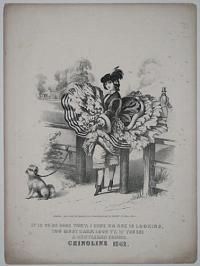
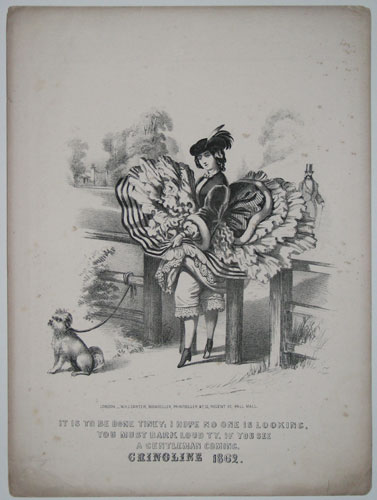
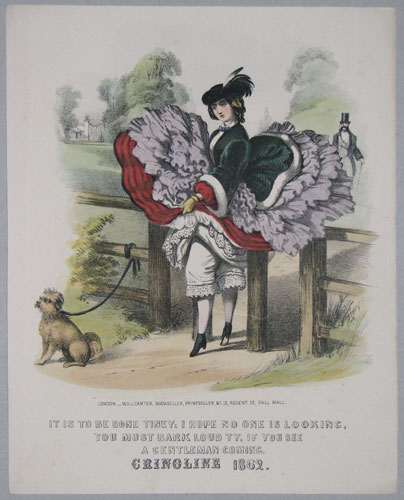
It is to be done Tiney; I hope no one is looking, You must bark loud Ty, If you see a Gentleman coming. Crinoline 1862.
London_W.H.J. Carter, Bookseller, Printseller, &c., 12, Regent St. Pall Mall.
Lithograph, sheet 380 x 280mm. 15 x 11".
A satire on the mid 19th century fashion for crinolines, from an annual series on that theme by the same publisher. A gust of wind lifts up the skirt of a young lady, revealing her underwear, to the evident delight of a gentleman on the path behind her. The lady's dog looks disgruntled, tethered to a fence. Crinoline was originally a stiff fabric with a weft of horse-hair and a warp of cotton or linen thread. The fabric first appeared around 1830, but by 1850 the word had come to mean a stiffened petticoat or rigid skirt-shaped structure of steel designed to support the skirts of a woman’s dress in the required shape. The crinoline was the subject of much ridicule and satire, particularly in Punch magazine. Dress reformers did not like it either — they seized upon the cage aspect of the crinoline and claimed that it effectively imprisoned women. Given that the crinoline did eventually have a maximum diameter of up to 180 centimetres (six feet), it is easy to imagine difficulties in getting through doors, in and out of carriages, and the general problems of moving in such a large structure. The second problem was the potential impropriety of the crinoline. Its lightness was a curse as well as a blessing, as a gust of wind or a knock could set it swinging and reveal the wearer's legs. Even worse, if a woman tripped or was knocked over, the crinoline would hold her skirts up.
[Ref: 15153] £140.00
(£168.00 incl.VAT)
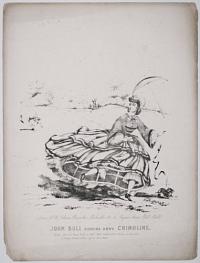
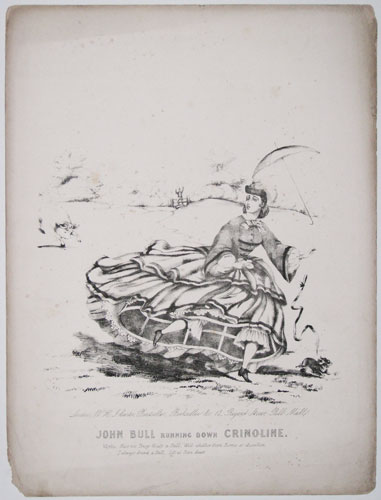
John Bull Running Down Crinoline.
London W.H.J. Carter, Printseller, Bookseller &c. 12, Regent Street Pall Mall.
Lithograph, sheet 380 x 285mm. 15 x 11¼". Tatty extremities, some spotting.
A satire on the mid 19th century fashion for crinolines, from an annual series on that theme by the same publisher. A lady and her toy spaniel (attempt to) run from a charging bull, her parasol falling from her hands. Crinoline was originally a stiff fabric with a weft of horse-hair and a warp of cotton or linen thread. The fabric first appeared around 1830, but by 1850 the word had come to mean a stiffened petticoat or rigid skirt-shaped structure of steel designed to support the skirts of a woman’s dress in the required shape. The crinoline was the subject of much ridicule and satire, particularly in Punch magazine. Dress reformers did not like it either — they seized upon the cage aspect of the crinoline and claimed that it effectively imprisoned women. Given that the crinoline did eventually have a maximum diameter of up to 180 centimetres (six feet), it is easy to imagine difficulties in getting through doors, in and out of carriages, and the general problems of moving in such a large structure. The second problem was the potential impropriety of the crinoline. Its lightness was a curse as well as a blessing, as a gust of wind or a knock could set it swinging and reveal the wearer's legs. Even worse, if a woman tripped or was knocked over, the crinoline would hold her skirts up.
[Ref: 15159] £160.00
(£192.00 incl.VAT)
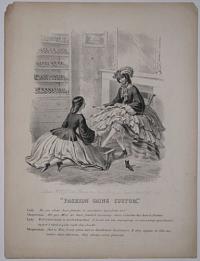
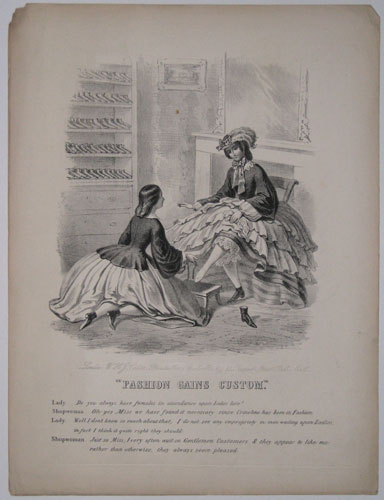
'Fashion Gains Custom.'
London W.H.J. Carter, Printseller, Bookseller &c. 12, Regent Street, Pall Mall.
Lithograph, sheet 380 x 285mm. 15 x 11¼". Facsimile mss. publisher's price list to verso, for '...Prints, Illustrative of Crinoline...beautifully coloured'.
A satire on the mid 19th century fashion for crinolines, from an annual series on that theme by the same publisher. A discussion in a shoe emporium between a fashionable young lady and the female shop assistant reveals a newly instigated policy that male assistants should not serve female customers, 'Since crinoline has been in fashion'. Crinoline was originally a stiff fabric with a weft of horse-hair and a warp of cotton or linen thread. The fabric first appeared around 1830, but by 1850 the word had come to mean a stiffened petticoat or rigid skirt-shaped structure of steel designed to support the skirts of a woman’s dress in the required shape. The crinoline was the subject of much ridicule and satire, particularly in Punch magazine. Dress reformers did not like it either — they seized upon the cage aspect of the crinoline and claimed that it effectively imprisoned women. Given that the crinoline did eventually have a maximum diameter of up to 180 centimetres (six feet), it is easy to imagine difficulties in getting through doors, in and out of carriages, and the general problems of moving in such a large structure. The second problem was the potential impropriety of the crinoline. Its lightness was a curse as well as a blessing, as a gust of wind or a knock could set it swinging and reveal the wearer's legs. Even worse, if a woman tripped or was knocked over, the crinoline would hold her skirts up.
[Ref: 15161] £180.00
(£216.00 incl.VAT)
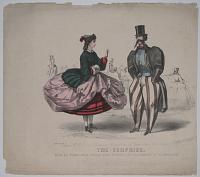
The Surprise. Dear Me Frank who would have thought of you Shewing Up in Crinoline?
Copyright. London, W.H.J. Carter, Printseller, Bookseller &c. 12, Regent Street, Pall Mall.
Hand coloured lithograph, sheet 290 x 325mm. 11½ x 12¾". Facsimile mss. publisher's price list to verso, for '...Prints, Illustrative of Crinoline...beautifully coloured'. Tatty extremities, tear from right.
A satire on the mid 19th century fashion for crinolines, from an annual series on that theme by the same publisher. Here the artist envisages a male equivalent. Crinoline was originally a stiff fabric with a weft of horse-hair and a warp of cotton or linen thread. The fabric first appeared around 1830, but by 1850 the word had come to mean a stiffened petticoat or rigid skirt-shaped structure of steel designed to support the skirts of a woman’s dress in the required shape. The crinoline was the subject of much ridicule and satire, particularly in Punch magazine. Dress reformers did not like it either — they seized upon the cage aspect of the crinoline and claimed that it effectively imprisoned women. Given that the crinoline did eventually have a maximum diameter of up to 180 centimetres (six feet), it is easy to imagine difficulties in getting through doors, in and out of carriages, and the general problems of moving in such a large structure. The second problem was the potential impropriety of the crinoline. Its lightness was a curse as well as a blessing, as a gust of wind or a knock could set it swinging and reveal the wearer's legs. Even worse, if a woman tripped or was knocked over, the crinoline would hold her skirts up.
[Ref: 15160] £190.00
(£228.00 incl.VAT)
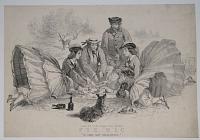
Pic Nic 'Is this not Delightful.'
London, W.H.J. Carter, 12 Regent Street_Pall Mall.
Lithograph, sheet 250 x 370mm. 9¾ x 14½". Sheet trimmed. Tear into image from right.
A satire on the mid 19th century fashion for crinolines, from a large series on that theme by the same publisher. The underwear of the three women enjoying the picnic is exposed by their rigid skirts as they lie on the grass. Crinoline was originally a stiff fabric with a weft of horse-hair and a warp of cotton or linen thread. The fabric first appeared around 1830, but by 1850 the word had come to mean a stiffened petticoat or rigid skirt-shaped structure of steel designed to support the skirts of a woman’s dress in the required shape. The crinoline was the subject of much ridicule and satire, particularly in Punch magazine. Dress reformers did not like it either — they seized upon the cage aspect of the crinoline and claimed that it effectively imprisoned women. Given that the crinoline did eventually have a maximum diameter of up to 180 centimetres (six feet), it is easy to imagine difficulties in getting through doors, in and out of carriages, and the general problems of moving in such a large structure. The second problem was the potential impropriety of the crinoline. Its lightness was a curse as well as a blessing, as a gust of wind or a knock could set it swinging and reveal the wearer's legs. Even worse, if a woman tripped or was knocked over, the crinoline would hold her skirts up.
[Ref: 15165] £140.00
(£168.00 incl.VAT)
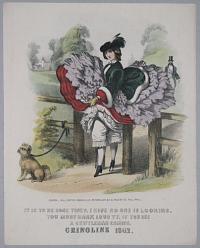
It is to be done Tiney; I hope no one is looking, You must bark loud Ty, If you see a Gentleman coming. Crinoline 1862.
London_W.H.J. Carter, Bookseller, Printseller, &c., 12, Regent St. Pall Mall.
Very fine original hand coloured lithograph, sheet 315 x 255mm. 12½ x 10". Trimmed to image top and sides.
A satire on the mid 19th century fashion for crinolines, from an annual series on that theme by the same publisher. A gust of wind lifts up the skirt of a young lady, revealing her underwear, to the evident delight of a gentleman on the path behind her. The lady's dog looks disgruntled, tethered to a fence. Crinoline was originally a stiff fabric with a weft of horse-hair and a warp of cotton or linen thread. The fabric first appeared around 1830, but by 1850 the word had come to mean a stiffened petticoat or rigid skirt-shaped structure of steel designed to support the skirts of a woman’s dress in the required shape. The crinoline was the subject of much ridicule and satire, particularly in Punch magazine. Dress reformers did not like it either — they seized upon the cage aspect of the crinoline and claimed that it effectively imprisoned women. Given that the crinoline did eventually have a maximum diameter of up to 180 centimetres (six feet), it is easy to imagine difficulties in getting through doors, in and out of carriages, and the general problems of moving in such a large structure. The second problem was the potential impropriety of the crinoline. Its lightness was a curse as well as a blessing, as a gust of wind or a knock could set it swinging and reveal the wearer's legs. Even worse, if a woman tripped or was knocked over, the crinoline would hold her skirts up.
[Ref: 13109] £180.00
(£216.00 incl.VAT)
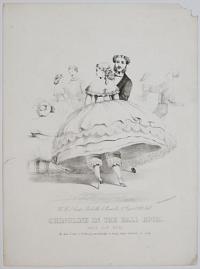
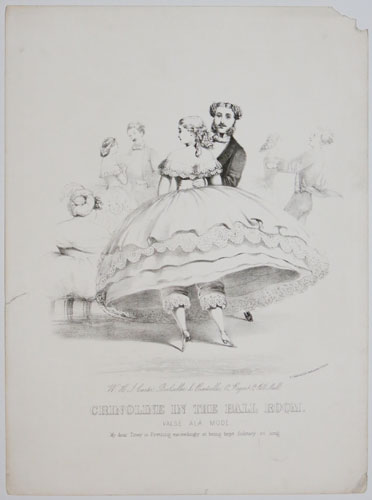
Crinoline in the Ball Room. Valse Ala Mode. My dear Tiney is Fretting exceedingly at being kept Solitary so long.
C.J. Culliford, lith. Southampton S.t. Strand.
W.H.J. Carter, Bookseller & Printseller, 12 Regent S.t. Pall Mall.
Lithograph. Sheet: 280 x 380mm, (11 x 15"). Damage to top right corner. Repaired tear in left edge. Some marks.
A scene in a ballroom depicting a young woman in an extremely large crinoline dancing with a young man, behind them are two other couples.
[Ref: 36835] £140.00
(£168.00 incl.VAT)
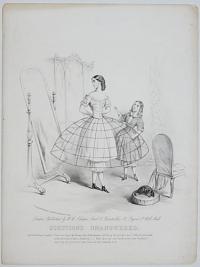
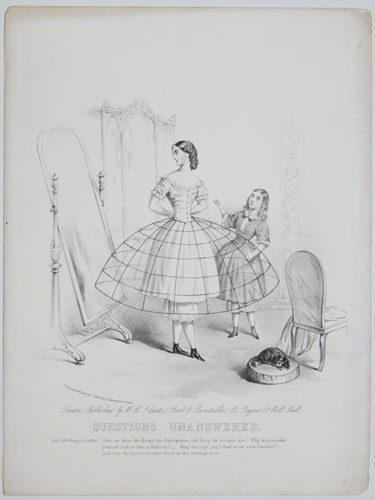
Questions Unanswered. Little Sister Fanny, (Loquitur) "Clara, are these the Hoops the Ethiopians call Hoop de dooden do."_Why do you make yourself look so like a Ballon?_Why does pa say I shall never wear Crinoline?. and why do you never take Tiney in the Carriage now.
Lithographed & Printed by C.J. Calliford, 22, Southampton S.t., Strand.
London, Published by W.H.J. Carter, Book & Printseller, 12, Regent S.t. Pall Mall.
Lithograph. Sheet: 285 x 380mm, (11¼ x 15"). Some slight damage to corners and edges.
Scene in a bedroom in which a young girl questions her older sister, who stands looking at herself in a dressing mirror, about her crinoline.
[Ref: 36836] £140.00
(£168.00 incl.VAT)
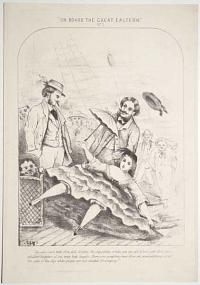
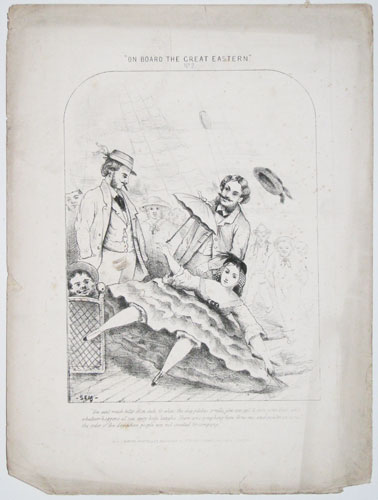
"On Board the Great Eastern" No. 2. You aint much better off on deck, for when the ship pitches or rolls, you are apt to lose your stool...
SEM-
London W.H.J. Carter, Printseller, Bookseller &c. 12, Regent Street, Pall Mall. [n.d., c.1860.]
Lithograph. Printed area 310 x 200mm (12¼ x 8"). Publication line indistinct.
A satire on crinolines on luxury passenger ships, with a woman keeling over, to the amusement of the watching men. With a catalogue of crinoline satires available from Carter on the reverse. Brunel's Great Eastern was launched in 1858, but was damaged by an explosion on her maiden voyage. After only a half-dozen years as a passenger ship she was converted to a cable-laying ship, laying the first lasting transatlantic telegraph cable in 1866.
[Ref: 64197] £160.00
(£192.00 incl.VAT)
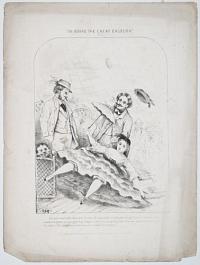
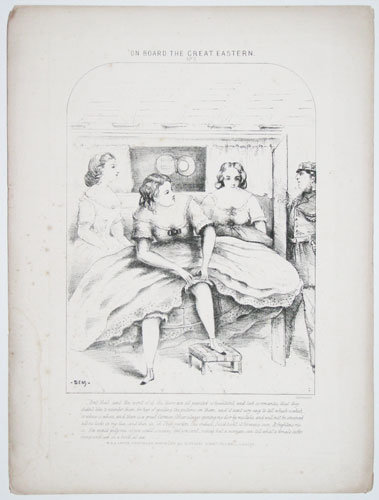
"On Board the Great Eastern" No. 2. You aint much better off on deck, for when the ship pitches or rolls, you are apt to lose your stool...
SEM-
London W.H.J. Carter, Printseller, Bookseller &c. 12, Regent Street, Pall Mall. [n.d., c.1860.]
Lithograph. Printed area 310 x 200mm (12¼ x 8"). Some wear and soiling.
A satire on crinolines on luxury passenger ships, with a woman keeling over, to the amusement of the watching men. With a catalogue of crinoline satires available from Carter on the reverse. Brunel's Great Eastern was launched in 1858, but was damaged by an explosion on her maiden voyage. After only a half-dozen years as a passenger ship she was converted to a cable-laying ship, laying the first lasting transatlantic telegraph cable in 1866.
[Ref: 15353] £180.00
(£216.00 incl.VAT)
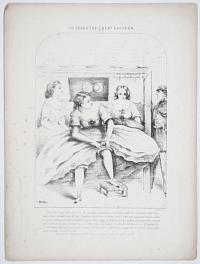
"On Board the Great Eastern" No. 3. But that aint the worst of it; the doors are all painted so beautiful, and look so romantic, that they didn't like to number them...
SEM-
London W.H.J. Carter, Printseller, Bookseller &c. 12, Regent Street, Pall Mall. [n.d., c.1860.]
Lithograph. Printed area 310 x 200mm (12¼ x 8"). Some wear and soiling.
[Ref: 15354] £180.00
(£216.00 incl.VAT)
![[M.r Frank Crisp]](img-thumbnail/jpegs/63693.jpg)
[M.r Frank Crisp]
Spy [Sir Leslie Ward]. [Vincent Brooks, Day & Son, Lith.]
[Vanity Fair. May 31, 1890]
Chromolithograph proof, wit text, sheet 405 x 275mm (16 x 10¾"), large margins.
Full length caricature portrait of English lawyer and microscopist, Frank Crisp (1843-1919), looking through a miscroscope.
[Ref: 63693] £60.00
(£72.00 incl.VAT)

South East View of Critchill House, in the County of Dorset.
Bretherton delt. Thos. Vivares Sculpt.
[n.d. c.1780.]
Engraving and etching. Plate 361 x 495mm. 14¼ x 19½". Two vertical folds.
An ancient residence of the family Napier; probably built by Nathaniel Napier, c.1640. BM: 1870,1008.35.
[Ref: 15737] £230.00
(£276.00 incl.VAT)
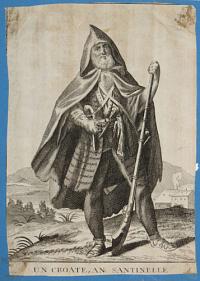
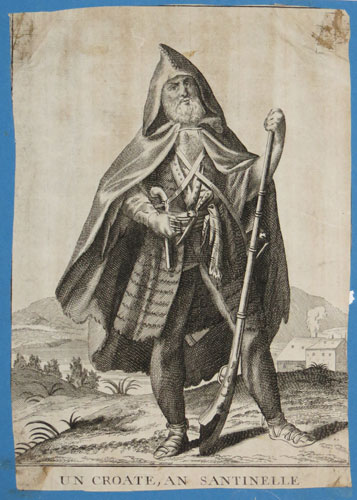
Un Croat, an Santinelle
[unsigned, c.1770]
Engraving, scarce, sheet 250 x 170mm (10 x 6¾"). Trimmed and glued to backing sheet.
[Ref: 47692] £140.00
(£168.00 incl.VAT)
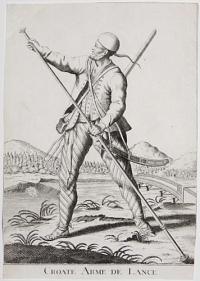
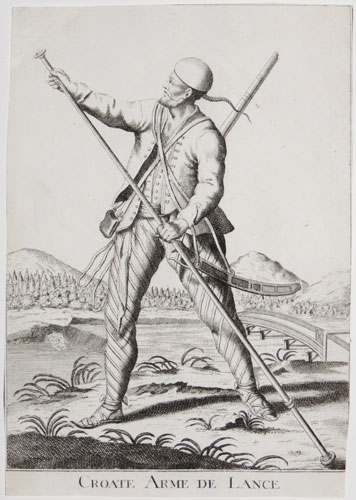
Croate Arme de Lance.
[unsigned, c.1750]
Rare engraving, sheet 260 x 180mm (10¼ x 7"). Trimmed to image; made up top right.
Plate from a volume depicting soldiers from various European countries.
[Ref: 47776] £180.00
(£216.00 incl.VAT)
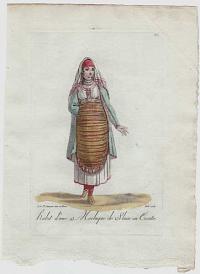
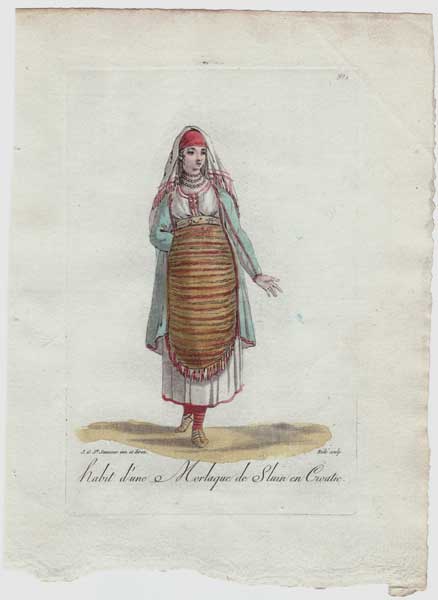
Habit d'une Morlaque de Sluin en Croatie.
J.G. S.t Sauveur inv. et direx. Ridé sculp.
[Paris, c.1800.]
Coloured etching. 170 x 110mm (6¾ c 4¼") ery large margins.
A Morlach woman from Sluin, a pastoralist community in the mountains of Croatia. From ''Costumes de Différent Pays'' by Jacques Grasset de Saint-Sauveur (1757-1810).
[Ref: 61320] £75.00
(£90.00 incl.VAT)
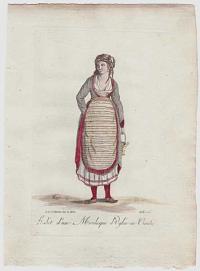
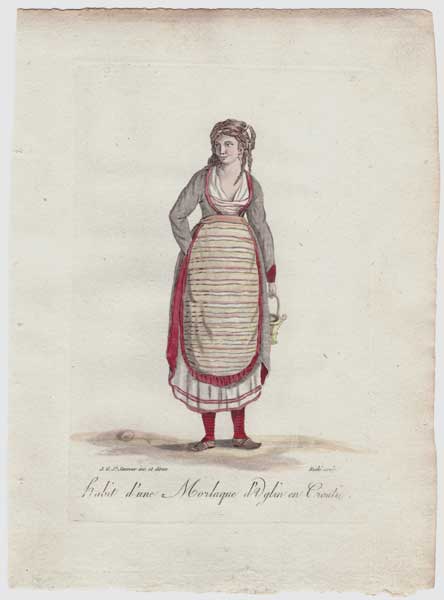
Habit d'une Morlaque d'Uglin en Croatie.
J.G. S.t Sauveur inv. et direx. Ridé sculp.
[Paris, c.1800.]
Coloured etching. 170 x 110mm (6¾ x 4¼"), with very large margins.
A Morlach woman from Sluin, a pastoralist community in the mountains of Croatia. From ''Costumes de Différent Pays'' by Jacques Grasset de Saint-Sauveur (1757-1810).
[Ref: 61321] £70.00
(£84.00 incl.VAT)
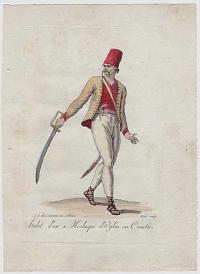
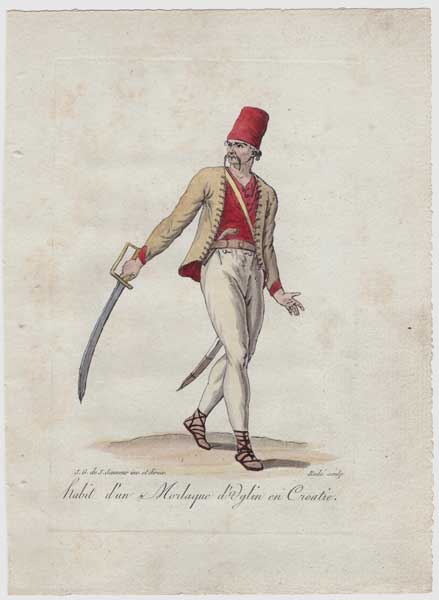
Habit d'une Morlaque d'Uglin en Croatie.
J.G. S.t Sauveur inv. et direx. Ridé sculp.
[Paris, c.1800.]
Coloured etching. 170 x 110mm (6¾ x 4¼"), with very large margins.
A Morlach man from Sluin, a pastoralist community in the mountains of Croatia. From ''Costumes de Différent Pays'' by Jacques Grasset de Saint-Sauveur (1757-1810).
[Ref: 61322] £70.00
(£84.00 incl.VAT)
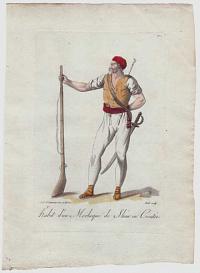
Habit d'une Morlaque de Sluin en Croatie.
J.G. S.t Sauveur inv. et direx. Ridé sculp.
[Paris, c.1800.]
Coloured etching. 170 x 110mm (6¾ c 4¼") very large margins. Light foxing.
A Morlach man from Sluin, a pastoralist community in the mountains of Croatia. From ''Costumes de Différent Pays'' by Jacques Grasset de Saint-Sauveur (1757-1810).
[Ref: 61323] £75.00
(£90.00 incl.VAT)
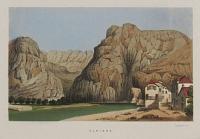
Almissa.
Hanhart lith.
[n.d., c.1870.]
Fine coloured lithograph, 120 x 170mm. 4¾ x 6¾". (printed area)
A view in what is now Croatia. Plate to a book on travelling in the Balkans.
[Ref: 26930] £70.00
(£84.00 incl.VAT)

Bei Warasdin. (Kroatien).
N. d. Nat. gez. v. Louise B. Kotz. V. Merklas sc.
[n.d., c.1800].
Aquatint. Sheet size: 165 x 115mm. (6½ x 4½"). Trimmed inside platemark.
A view of a small, rural house in the town of Warasdin (Varazdin), Croatia, with two figures in conversation to the right. The centre of Varaždin county is located near the Drava river.
[Ref: 31598] £65.00
(£78.00 incl.VAT)
![[Croatia] Iean Lovys Comte d'AbIsolani General de Croates.](img-thumbnail/jpegs/20887.jpg)
[Croatia] Iean Lovys Comte d'AbIsolani General de Croates.
B. Moncornet excu.
[n.d. c.1770.]
Etching and engraving. Plate 152 x 114mm. 6 x 4½".
Ludovic Isolani, the Croatian leader who was killed on the bridge at Spoy c.1750.
[Ref: 20887] £85.00
(£102.00 incl.VAT)
![[Croatia] A Pandour Collonel. A Pandour Ensign. A Pandour Collonel Watch Master.](img-thumbnail/jpegs/13080.jpg)
[Croatia] A Pandour Collonel. A Pandour Ensign. A Pandour Collonel Watch Master.
Joh. Sebast. Muller fec. Lond. Drawn after ye Life & design'd by Joh. Seb. Muller. Engraved by Joh. Seb. Muller.
Publish'd according to Act of Parliament, Nov. 15, 1743. London printed for John Bowles at the Black Horse in Cornhill.
Etching, sheet 195 x 245mm. 7¾ x 9¾". Foxing. Trimmed within plate and glued to album page.
Pandours were an 18th century force of Croatian soldiers in the Austrian service, notorious for their brutality. Rare. For a book, numbered '3' upper right. By Johann Sebastian Müller (1715 - 1792), engraver of historical, topographical and portrait prints; botanist. He was born in Nuremberg, where he trained, and emigrated to London in 1744.
[Ref: 13080] £160.00
(£192.00 incl.VAT)
![[Roški Slap on the Krka] Vue Particuliere de la Cascade de la Kerka,](img-thumbnail/jpegs/58040.jpg)
[Roški Slap on the Krka] Vue Particuliere de la Cascade de la Kerka, audessus de Scardona en Dalmatie.
Dessiné par Cassas. Gravé à l'Eau-forte par la C.re Chenu. Terminé par Neé.
[n.d., 1802.]
Etching. 430 x 280mm (17 x 11"), large margins.
Roški Slap, waterfalls and cascades on the Lrka River, within the Krka National Park in Croatia. From 'Voyage Pittoresque et Historique de l'Istrie et de la Dalmatie', with a text by Joseph Lavallée.
[Ref: 58040] £140.00
(£168.00 incl.VAT)
![[Porec] Parens, sive Parentium vulgo, Parenzo Histrie Opp:](img-thumbnail/jpegs/55522.jpg)
[Porec] Parens, sive Parentium vulgo, Parenzo Histrie Opp:
[Engraved by Frans Hogenberg.]
[Amsterdam, Johannes Jansson, 1657.]
Engraving. Printed area 170 x 250mm (6¾ x 9¾"). Trimmed to printed border on two sides.
A prospect of Porec, Croatia, from the sea. Originally published in the Braun & Hogenberg 'Civitates Orbis Terrarum' atlas of townplans in 1575, this example comes from Jansson's Townbooks, which utlilised many of the Hogenberg plates.
[Ref: 55522] £160.00
(£192.00 incl.VAT)
![[Sibenik] Sibinium, Ptolemeo Sicum vulgo Sibenicho, Dalmatie opp:](img-thumbnail/jpegs/55519.jpg)
[Sibenik] Sibinium, Ptolemeo Sicum vulgo Sibenicho, Dalmatie opp:
[Engraved by Frans Hogenberg.]
[Amsterdam, Johannes Jansson, 1657.]
Engraving. Printed area 135 x 175mm (5¼ x 7"). Trimmed to printed border on two sides.
A prospect of Sibenik, Croatia, with St. Nicholas Fortress in the foreground. Originally published in the Braun & Hogenberg 'Civitates Orbis Terrarum' atlas of townplans in 1575, this example comes from Jansson's Townbooks, which utlilised many of the Hogenberg plates.
[Ref: 55519] £130.00
(£156.00 incl.VAT)
![[The Aqueduct of Diolcletian] Vue de L'Aqueduct de Salones, Qui conduisoit l'Eau à Spalatre.](img-thumbnail/jpegs/58039.jpg)
[The Aqueduct of Diolcletian] Vue de L'Aqueduct de Salones, Qui conduisoit l'Eau à Spalatre.
Dessiné par Cassas. Gravé à l'Eau-forte par Charpentier. Terminé par Neé.
[n.d., 1802.]
Etching. 280 x 430mm (11 x 17"), large margins. Cracks in edges of margins.
The Roman aquaduct built to bring water to the palace of the emperor Diocletian in Croatia. From 'Voyage Pittoresque et Historique de l'Istrie et de la Dalmatie', with a text by Joseph Lavallée.
[Ref: 58039] £160.00
(£192.00 incl.VAT)
![[Crockery sellers.]](img-thumbnail/jpegs/60747.jpg)
[Crockery sellers.]
T. Orde ft 1768.
Etching. Sheet 220 x 170mm (8¾ x 6¾"). Trimmed within plate on three sides.
A portrait of a man and a woman, both carrying baskets of crockery, by Thomas Orde-Powlett (1746-1807), a politician also known for his etched caricatures (mostly of Cambridge celebrities) which were published by his drawing-master, the well-known printmaker James Bretherton. The British Museum's impression has a pencil annotation 'Mrs. Hammond Printseller & D. Randal Printman at Cambridge', which they have taken as an identification. However as they have more than one Orde caricature with 'D. Randal' on the reverse it is more likely that Randal sold the print rather that is the subject. See BM 1847,0713.61 for this print and 1847,0713.60 for the other 'Randal'. Ex. Collection N. Blackburn.
[Ref: 60747] £160.00
(£192.00 incl.VAT)

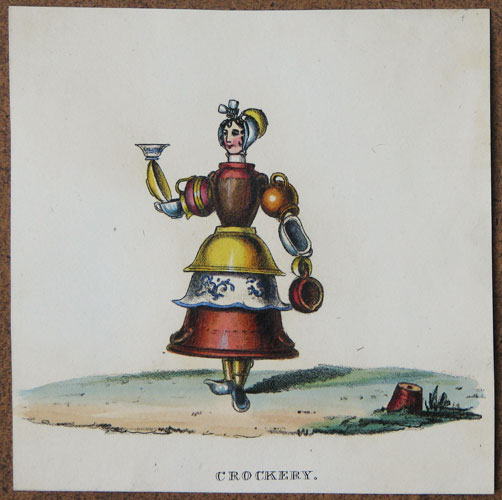
Crockery.
[n.d. c.1830.]
Handcoloured lithograph with added gum arabic. 127 x 127mm. 5 x 5".
Puzzle print; Crockery, the earthenware pot; a woman with a body of ceramic bowls, jugs, cups, containers, plates, dishes, pourers, and egg cups. In 1830, George Spratt, an English artist, and George E. Madeley, an English engraver and printmaker, produced a series of lithographed satiric designs of tradesmen composed of the objects of their profession. They were published by Charles Tilt, a London book and print seller.
[Ref: 19394] £95.00
(£114.00 incl.VAT)

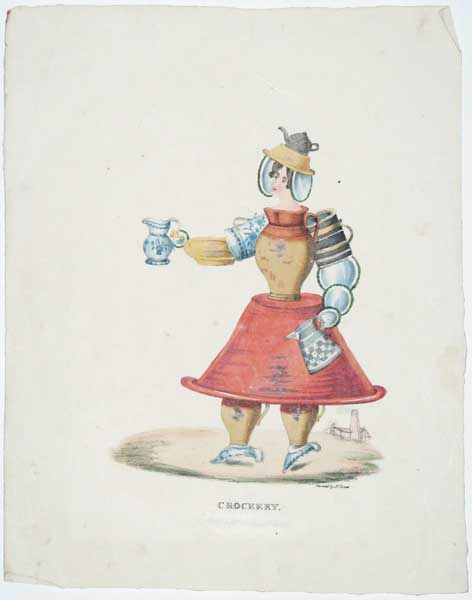
Crockery.
Printed by N.Jones.
[n.d., c.1850.]
Coloured lithograph. Printed area 190 x 120mm (7½ x 4¾").
A woman's figure made up from jugs, ewers, plates, teapot and sauce boats. A Personification print.
[Ref: 11844] £130.00
(£156.00 incl.VAT)
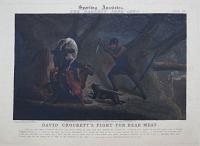
David Crockett's Fight for Bear-Meat. Sporting Anecdotes. The Hardest Fend Off!! [...]
Drawn & Engraved by H. Alken.
Published March 1st 1839 by R. Ackermann at his Eclipse, Sporting Gallery, 191, Regent St.
Aquatint printed in colour with gum arabic, platemark 280 x 380mm (11 x 15"), on Whatman paper watermarked 1837. Crease through centre.
Davy Crockett (1786-1836), American frontiersman, soldier, and politician, encountering a bear. He approaches the bear, which has one of Crockett's dogs in its clutches. Already a media star in his lifetime, this print was published three years after he was killed at the Alamo. Print made by Henry Alken (1785-1851), painter and engraver who specialised in hunting, coaching, racing and animal subjects. His work was highly sought-after in sporting circles, particularly amongst the huntsmen who gathered at Melton Mowbray.
[Ref: 39541] £450.00
![[William Crockford] W. Crockford [facsimile signature.]](img-thumbnail/jpegs/52058.jpg)
[William Crockford] W. Crockford [facsimile signature.]
R.S.
[n.d., c.1830.]
Coloured lithograph. Sheet 210 x 135mm (8¼ x 5¼"). Binding marks in left edge.
William Crockford (1775 - 1844). After working with his father as a fishmonger he won a large sum of money, which he used to found a gambling house In St James's Street, 'Crockford's', which made him one of the richest men in England.
[Ref: 52058] £60.00
(£72.00 incl.VAT)

Stephen Croft Esq.r F.AS.
J. Reynolds Equa Pinx.t. C. Carter fecit.
Published Oct.r 1.st 1787 and old by Robert Wikinson, N.º 58 Cornhill.
Scarce etching. 225 x 185mm (8¾ x 7¼"). Printer's creases in margins.
Portrait of Stephen Croft (1712-98) of Stillington, Yorkshire. His father, also Stephen, had founded a company importing wine from Portugal and helped to found the York Assembly Rooms. The younger Stephen was elected a director of the Rooms in 1752. Lawrence Sterne was vicar at Stillington (1745-68), becoming a friend of the family. Hamilton p19, iii of iii. Ex: Collection of the Hon. Christopher Lennox-Boyd.
[Ref: 67974] £240.00
(£288.00 incl.VAT)

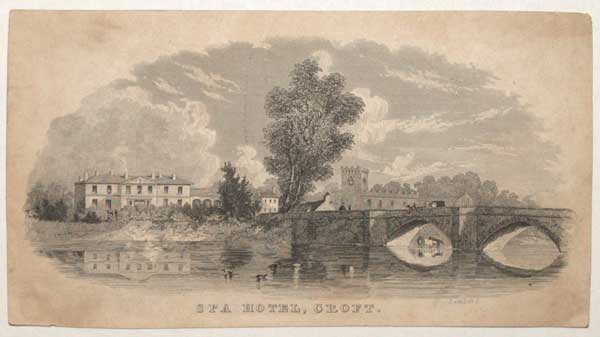
Spa Hotel, Croft.
Lambert.
[n.d., c.1835.]
Steel engraving. Sheet 90 x 160mm (3½ x 6¼"). Trimmed.
A view of the Croft Spa Hotel, Croft-on-Tees, North Yorkshire. It was built in 1835 by Ignatius Bonomi for Sir William Chaytor to cater for visitors taking the spa's sulpherous mineral waters, and is now Listed Grade II.
[Ref: 56594] £95.00
(£114.00 incl.VAT)
![[Pair] Crofton Hall, Yorkshire](img-thumbnail/jpegs/61008.jpg)
[Pair] Crofton Hall, Yorkshire To M,,rs Wilson (now) of New Miller Dam, This Plate is most respectfully Dedicated by her Ob,,t Serv,,t C. Cope. [&] To Miss Richmal Mangnall, of Crofton Hall, this Plate is most respectfully Dedicated by her Ob,,t Serv,,t C. Cope.
Drawn by C. Cope. Engraved by R. & D. Havell.
Published Dec.r 1st 1813, by Mr. Cope.
Pair of aquatints, printed in colours and hand-finished. Each sheet 335 x 250mm (13 x 10"). Trimmed to plate, laid.on board.
Crofton Hall, a school attended by the Bronte sisters, in Crofton, near Wakefield, Yorkshire, now the site of Crofton High School. In 1808 Miss Richmal Mangnall (1769-1820), a former pupil, bought Crofton Hall, running the school there until her death. She was one of the most prominent educators of girls of her time.
[Ref: 61008] £240.00
(£288.00 incl.VAT)
view all images for this item
![[9 writing sheets with vignette rustic scenes of Crofton, West Yorkshire.]](img-thumbnail/jpegs/55339.jpg)
[9 writing sheets with vignette rustic scenes of Crofton, West Yorkshire.]
Crofton. CC.
[n.d., c.1826.]
9 lithographs. Each sheet c. 230 x 190mm (9 x 7½"). Two sheets watermarked 'J Green & Son 1826'.
Writing sheets with scenes of rustic buildings in Crofton, West Yorkshire, school of Bronte sisters. Green & Son in Hayle Mill, Kent operated from 1815.
[Ref: 55339] £280.00
(£336.00 incl.VAT)
view all images for this item
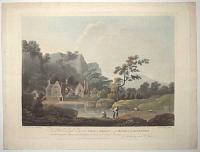
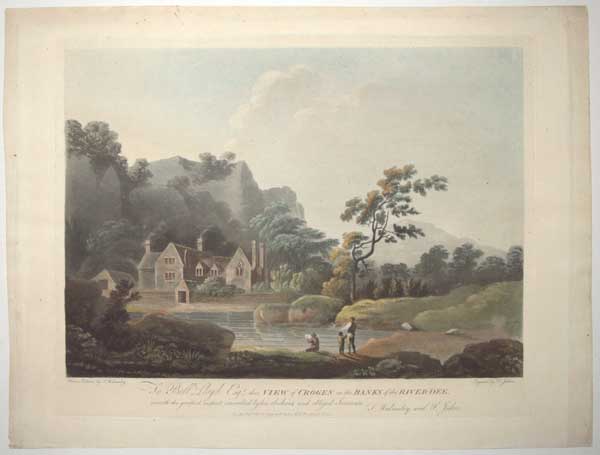
To Bell Lloyd Esq.r this View of Corwen on the River-Dee, is with the greatest respect inscribed by his obedient and obliged Servants T. Walmsley and F. Jukes.
From a Picture by T. Walmsley. Engrav'd by F. Jukes.
London Pub.d Nov.r 1 1792 by F. Jukes No.10 Howland Street.
Aquatint with fine hand colour. 350 x 445mm (13¾ x 17½"), with very large margins. Stitch markes in left margin.
A view of a manor house under mountains. By the banks of the Dee a man sits sketching, probably a self-portrait by Walmsley. From the series ''Views in North Wales''. Abbey Scenery: 512.
[Ref: 55221] £280.00
(£336.00 incl.VAT)

Vera Effigies Georgii Croke Equitis Aurati et Utriusqu Banci Iusticiar: Temp: Car: Reg: Ut Vulturs hominum, Ita Sumulacra vultus quae Marmore, aut aere finguntur Imbecilla, ac mortalia sunt: Forma mentis aeterna: quam tenera, et exprimere non per alienam maeriam, et artem, sed tuis ipse moribus possis. Tac: in vita Iulÿ Agric: Socri Sui.
Rob: Vaughan sculp:
[n.d. c.1661.]
Engraving. Plate 209 x 140mm. 8¼ x 5½", paper with 17th century watermark. Trimmed, crease through centre.
Portrait of George Croke, bust in an oval, wearing skull-cap, ruff, and robes, and holding a scroll; coat of arms below, with a row of books. Sir George Croke (1560-1642) the judge and law-reporter. NPG: D26956.
[Ref: 27337] £70.00
(£84.00 incl.VAT)

Vera Effigies Georgii Croke Equitis Aurati et Utriusqu Banci Iusticiar: Ut Vulturs hominum, Ita Sumulacra vultus quae Marmore, aut aere finguntur Imbecilla, ac mortalia sunt: Forma mentis aeterna: quam tenera, et exprimere non per alienam maeriam, et artem, sed tuis ipse moribus possis. Tac: in vita Iulÿ Agric: Socri Sui.
R. Gaywood fecit.
[n.d., 1657.]
Etching, with Collector's Mark. 205 x 135mm (8 x 5¼"). Trimmed close to plate, mounted in album sheet at edges.
Portrait of George Croke (c.1560 – 1642), bust in an oval, wearing skull-cap, ruff, and robes, and holding a scroll; coat of arms below, with a row of books. Frontispiece to 'The Reports of Sir George Croke' (1560-1642), judge and law-reporter.
[Ref: 62071] £130.00
(£156.00 incl.VAT)
![[Criminal.]](jpegs/68980.jpg)






![[M.r Frank Crisp]](jpegs/63693.jpg)



![[Croatia] Iean Lovys Comte d'AbIsolani General de Croates.](jpegs/20887.jpg)
![[Croatia] A Pandour Collonel. A Pandour Ensign. A Pandour Collonel Watch Master.](jpegs/13080.jpg)
![[Roški Slap on the Krka] Vue Particuliere de la Cascade de la Kerka,](jpegs/58040.jpg)
![[Porec] Parens, sive Parentium vulgo, Parenzo Histrie Opp:](jpegs/55522.jpg)
![[Sibenik] Sibinium, Ptolemeo Sicum vulgo Sibenicho, Dalmatie opp:](jpegs/55519.jpg)
![[The Aqueduct of Diolcletian] Vue de L'Aqueduct de Salones, Qui conduisoit l'Eau à Spalatre.](jpegs/58039.jpg)
![[Crockery sellers.]](jpegs/60747.jpg)

![[William Crockford] W. Crockford [facsimile signature.]](jpegs/52058.jpg)

![[Pair] Crofton Hall, Yorkshire](jpegs/61008.jpg)
![[9 writing sheets with vignette rustic scenes of Crofton, West Yorkshire.]](jpegs/55339.jpg)