Les Soldats en Jeu.
peint par Valentin.
à Augsbourg chez J.J. Haid et fils. [n.d., c.1770.]
A rare mezzotint with hand colour. Plate: 380 x 420mm (15 x 16½''). Very large margins on 3 sides. Trimmed to plate on lower edge, foxing.
A scene showing two soldiers playing a game of cards at a table.
[Ref: 49211] £280.00
(£336.00 incl.VAT)
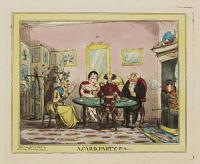
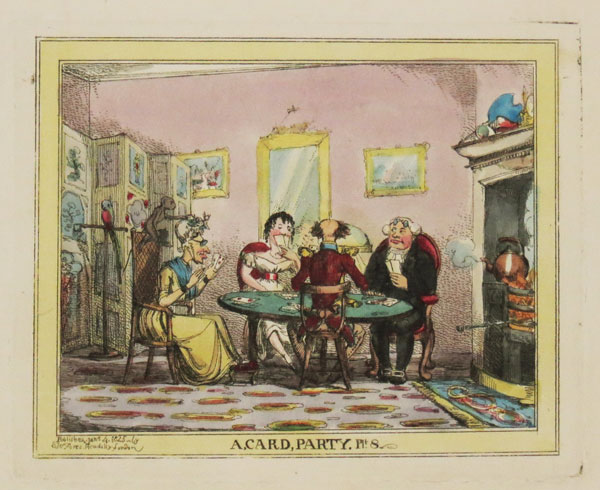
A Card Party Pl.t 8.
[Henry Heath.]
Published Nov.r 15 1824 by S.W.Fores, 41 Picadilly, London Jan.y. 1.st 1825.
Hand-coloured etching. Plate: 155 x 190mm (6 x 7½''), with large margins.
A scene in a parlour showing a group of four people at cards, an elderly woman has a monkey sitting on the chair behind her.
[Ref: 50835] £130.00
(£156.00 incl.VAT)

Pam, Flush and Loo.
Painted by J. Opie R.A. Engraved by H. Meyer, 3 Red Lion Square.
Engraved from the original Picture in the possession of W. Owen R.A. 1825.
Stipple, very rare. Sheet size: 280 x 380mm (11 x 15"). Trimmed at top and bottom inside platemarks.
A scene depicting two young women and a boy playing cards at a table, with a curtain behind to the right, and a landscape in the left background. Lanterloo or Loo is a 17th-century trick taking card game, considered a modification of the game of 'All Fours', another English game possibly of Dutch origin.
[Ref: 34612] £260.00
(£312.00 incl.VAT)
![[Three men playing cards.]](img-thumbnail/jpegs/34832.jpg)
[Three men playing cards.]
E. Van Hemskirke pinx. / J. Smith Fec. et ex. [1704]
Mezzotint with small margins, platemark 185 x 145mm (7¼ x 5¾"). Fine.
Three men gambling. Cards, dice and coins on the table, score marked in chalk. Broadside on wall behind. Engraved by the prolific early mezzotinter John Smith after Egbert van Heemskerck (1634/5-1704). Born in Haarlem, Heemskerck moved to England in the 1670s. His often satirical genre scenes (Quaker meetings were a speciality), derived from those of Ostade and Teniers, were popular with London engravers. Ex: collection of the Late Hon. C. Lennox-Boyd
[Ref: 34832] £190.00
(£228.00 incl.VAT)

The Gamesters. [&] The Fortune Tellers.
Painted by the Rev.d Mr: Peters R.A. Engraved by William Ward.
London Published May 22.nd 1786 by J.R. Smith No. 83 Oxford Street.
Pair of mezzotints. Plates: 420 x 440mm (16½ x 17¼''). Trimmed to margins or thread margins, marking and creasing.
A pair of scenes of cheating. The first shows two men playing cards as a third man pretends to help one player while holding up three fingers the other of his opponant's hand. The two players have been identified as Lord Courtenay (the mark) and Thomas Rowlandson (the cheat). The second scene shows an opulently-dressed young woman having her palm read while a young accomplice smiles over her shoulder. The artist is Matthew William Peters (1742-1814), most famous for his provocative painting of a courtesan (known as 'Lydia' in the mezzotint copy). He came to regret his choice of subject, as he was ordained in 1781, becoming the Royal Academy's chaplain (1784-8), then chaplain to the Prince of Wales. CS 97 & CS 186.
[Ref: 48974] £780.00
view all images for this item
![[All Fours.]](img-thumbnail/jpegs/59289.jpg)
[All Fours.]
[Design'd by W.H. Bunbury Esq.r.]
[Publish'd Mar.h 14th 1783 by J.R. Smith, No 83 Oxford Street, London.]
Rare coloured etching, 18th century watermark. Sheet 250 x 345mm (9¾ x 13½"). Trimmed into image area, losing title and inscriptions, but keeping the important part of the image.
A satirical scene of a pair of card players, one with a long pig-tail queue, the other in a bob-wig. D'Oench 214; BM Satire 6341.
[Ref: 59289] £260.00
(£312.00 incl.VAT)
![[Couple playing cards.]](img-thumbnail/jpegs/23339.jpg)
[Couple playing cards.]
[n.d. c.1770.]
Etching and engraving, with dutch text on verso. Plate 77 x 114mm. 3 x 4½". Trimmed to plate.
A anonymous engraving, with two people sat at a table, playing cards by candlelight; a greyhound sits to the right near a large chest.
[Ref: 23339] £70.00
(£84.00 incl.VAT)

Heath's Court Beauties N.o3. Give you the Deal eh? No, we'll cut for it to be sure!
[Henry Heath]
[London W Spooner 25 Regent S.t] [n.d. c.1835-40]
Fine coloured lithograph, sheet 200 x 220mm (8 x 8¾"). Trimmed and glued to album paper.
One from a set of twelve series of visual puns inspired by the four playing card suits, each one captioned below, it is rarely found complete. Two Jacks hold a plank of wood. The Jack of Clubs has sliced the Jack of Diamonds in half with his sword.
[Ref: 58440] £95.00
(£114.00 incl.VAT)
![[The Card-Players.]](img-thumbnail/jpegs/34835.jpg)
[The Card-Players.]
D.T.P. J.V.B.F. [ie. David Teniers pinxit. Jan van der Bruggen fecit]
Mezzotint, platemark 425 x 340mm (16¾ x 13¼). Thread margins; good impression.
Men playing cards and smoking in a tavern, after Dutch painter of genre scenes David Teniers (1610-90), and engraved during the artists' lifetime by his contemporary Jan van der Bruggen (1648/9-1690) was an early mezzotinter working in France. This same scene was later engraved by the British collector and printmaker Captain William Baillie. For Baillie's version of the scene, see ref. 12253. Ex collection of the Hon. Christopher Lennox-Boyd.
[Ref: 34835] £360.00
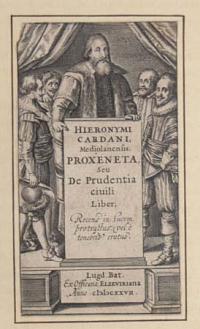
Heironymi Cardani, Mediolanensis, Proxeneta, Seu De Prudentia ciuili Liber: 'Recens in Lucem protractus: vel e tenebris erutus'.
Lugd. Bat. Ex Officina Elzeviriana Anno CIDIDCXXVII [1627].
Engraving, 100 x 55mm (4 x 2¼"). Trimmed to image and laid on album paper.
Frontispiece to the Book 'Recens in Lucem protractus: vel e tenebris erutus' by Gerolamo Cardano (1501-1576). He was an Italian polymath, credited with describing apparatus yet to be invented, such as the combination lock. He was a profoundly influential mathematician and wrote over 200 scientific works.
[Ref: 53816] £230.00
(£276.00 incl.VAT)
![[Original sketch for Dugdales' England & Wales.] Cardiff Castle. Seat of the Marquis of Bute.](img-thumbnail/jpegs/60261.jpg)
[Original sketch for Dugdales' England & Wales.] Cardiff Castle. Seat of the Marquis of Bute.
[Thomas Hosmer Shepherd]
[n.d., c.1838.]
Colour wash sketch. Sheet 135 x 190mm (5¼ x 7½"). Mounted on album paper at corners.
This is the original sketch for the engraving published in ''Curiosities of Great Britain: England and Wales Delineated'', by Thomas Dugdale, published by John Tallis in parts from 1838.
[Ref: 60261] £200.00
(£240.00 incl.VAT)
![[Black Tower, Cardiff Castle.]](img-thumbnail/jpegs/44172.jpg)
[Black Tower, Cardiff Castle.]
[n.d, c.1820.]
Working proof, outline etching. 185 x 250mm (7¼ x 9¾").
The ruins of the Black Tower near the main entrance of Cardiff Castle, built by Gilbert de Clare in the 13th century, now rebuilt. The tower was often called 'Duke Robert's Tower' because of the legend that Robert, duke of Normandy, was imprisoned there from 1108 until his death in 1134, by order of his brother Henry I. However the tower had yet to be built.
[Ref: 44172] £65.00
(£78.00 incl.VAT)

Cardiff Castle from the West. II.
P. Sandby Fecit.
Publish'd according to Act of Parliament by P Sandby St Georges Row Oxford Turnpike Sep.r 1777.
Aquatint, printed in sepia. 315 x 240mm (12½ x 9½").
In 1771 the topographical artist Paul Sandby set off with his wealthy patron, Sir Joseph Banks, for a tour of Wales, sketching the magnificent scenery. His ''Twelve Views of South Wales'' were some of the first aquatints published in England, catching the fashion for landscape as part of the Romantic movement. Two further sets of twelve were published: this view is from the third.
[Ref: 8379] £280.00
(£336.00 incl.VAT)
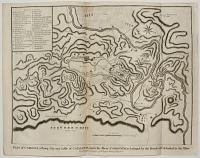
Plan of Cardona a strong City and Castle of Catalonia, upon the River Cardoner as besieged by the French and defended by the Allies.
I. Basire Sculp.
For Mr Tindal's Continuation of Mr Rapin's History of England. [London, James & Paul Knapton, 1751.]
Engraved map. 390 x 480mm (15¼ x 19"). Very fine impression, with original binding folds.
A plan of the siege of the Castle of Cardona in 1714, towards the end of the War of the Spanish Succession, after the Treaty of Utrecht had removed Britain from the hostilities. Built by Wilfred the Hairy in 886, the French bombardment destroyed much of the walls. The fall of Cardona and Barcelona soon after ended Catalan hopes for independence from Spain. Nicholas Tindal (1687-1774), at one time Chaplain to Greenwich Hospital, first published a translation of Frenchman Paul de Rapin's 'History of England' in 1727, running to thirteen volumes; in 1732 it was enlarged with his own notes and maps. This map was published in 'A summary of Mr Rapin de Thoyras's History of England, and Mr Tindal's Continuation, from the Invasion of Julius Caesar, to the End of the Reign of King George I. Illustrated With Medals, Plans of Battles, Towns, and Sieges', 1751.
[Ref: 28277] £120.00
![[Card Players]](img-thumbnail/jpegs/38324.jpg)
[Card Players] Tra i benefizi, che ci ha fatti Iddio, Non e mica il minor quello del vino.
Fran.co Maggiotto Pinx. Peregrinus de Colle sculp. ap N. Cavalli Venetys.
Engraving, platemark 235 x 300mm (9¼ x 11¾"). Very large margins.
Five men around a table, some playing cards and others smoking pipes. A fire smoulders on the left. Engraved by Pellegrino dal Colle after Venetian genre painter Francesco Maggiotto (1738-1805).
[Ref: 38324] £220.00
(£264.00 incl.VAT)
![[Cards] Recreatio juvenilis.](img-thumbnail/jpegs/68137.jpg)
[Cards] Recreatio juvenilis. Die Ergözkichkeit oder der Zeitvertreib.
Mart. Engelbrecht excud. A.V. [n.d., c.1740.]
Engraving. 210 x 305mm (8¼ x 12"), large margins on 3 sides. Foxing, narrow margin top right and slight staining.
An afternoon gathering, with a card game on one table and men smoking at another. Through arches an ornamental garden can be seen.
[Ref: 68137] £260.00
(£312.00 incl.VAT)
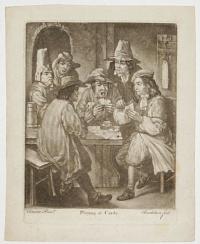
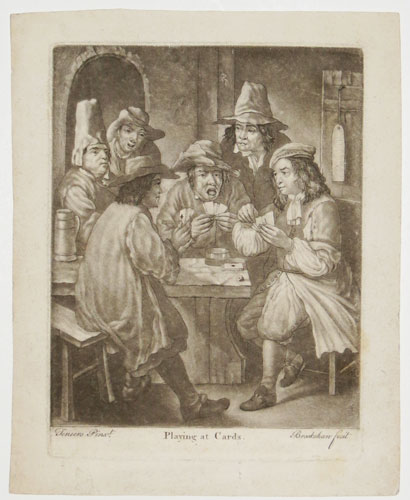
Playing at Cards.
Teniers Pinx.t. Brookshaw fecit.
[n.d., c.1780].
Mezzotint with large margins. Platemark: 153 x 112mm (6 x 4¼"). Small surface mark in upper printed area.
A rustic interior scene with three men playing cards around a wooden table. One, on the right wearing a beret, chooses a card from his hand, whilst another sits opposite him and a third faces the viewer. They are being watched by three others who stand behind them, two to the left in front of an arched niche and one to the right. A tally can be seen hanging from a wooden partition on the right. Ex CLB ii /ii. Ex: collection of the late Hon. C. Lennox-Boyd.
[Ref: 32979] £95.00
(£114.00 incl.VAT)
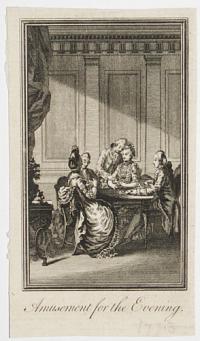
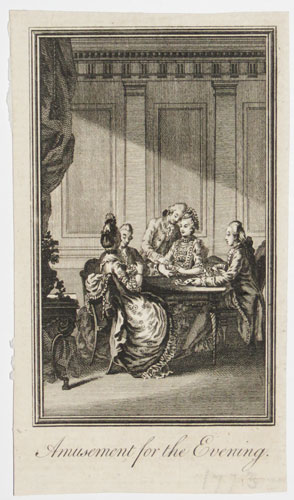
Amusement for the Evening.
[Anon., c.1773]
Engraving, sheet 175 x 100mm (7¼ x 4").
Card game, with a man caressing a woman while looking at her hand. Probably from the 'Sentimental Magazine'.
[Ref: 46563] £50.00
(£60.00 incl.VAT)
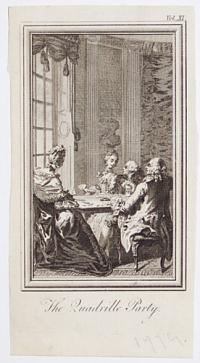
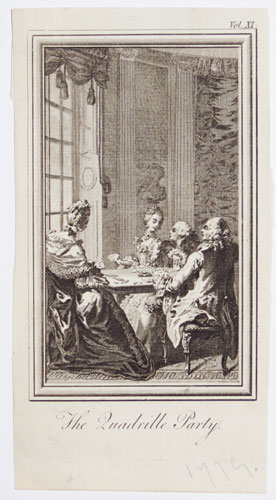
The Quadrille Party
[Anon., c.1774]
Engraving, sheet 175 x 100mm (7¼ x 4").
Four men and women playing cards. Probably published as an illustration to the 'Sentimental Magazine'.
[Ref: 46564] £50.00
(£60.00 incl.VAT)
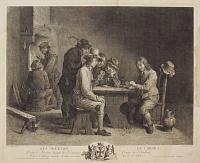
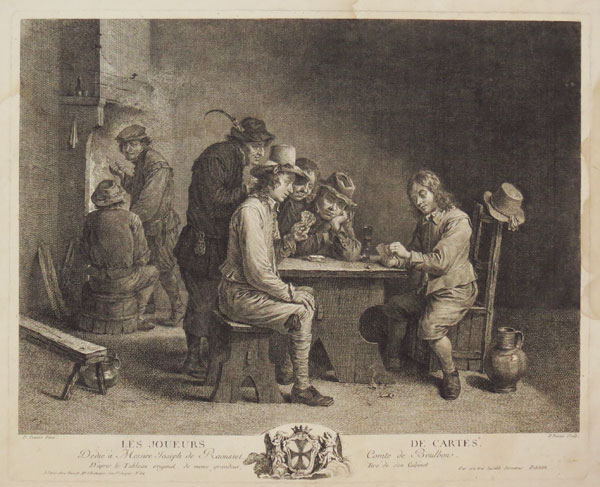
Les Joueurs de Cartes. Dedié à Messire Joseph de Raousset Comte de Boulbon / D'apres le Tableau original de meme grandeur, Tiré de son Cabinet Par son tres humble Serviteur Basan
D. Teniers Pinx. F. Basan Sculp
A Paris chez Basset, Md d'Estampes, rue St. Jacques, No 64 [c.1750]
Engraving, platemark 340 x 420mm (13½ x 16½"). Very large margins. Water staining to edges.
Men playing cards and smoking in a tavern, after the Dutch painter of genre scenes David Teniers (1610-90). Engraved by François Basan (1723-97), an engraver by training who from the mid 1750s on concentrated on publishing and dealing. He also succeeded the great Mariette as the major Parisian print expert, and authored a standard 'Dictionnaire des Graveurs anciens et modernes' (1767, 2nd ed.1789).
[Ref: 38459] £260.00
(£312.00 incl.VAT)

Des Spiel Rare.
[Nuremburg: Christoph Weigel, 1705.]
Rare engraving. Sheet 190 x 155mm (7½ x 6¼"). Trimmed within plate, worm holes.
Four men playing cards by candlelight. A plate from 'Ein Schock Phantastn in einem Kasten mit Ihrem Pourtrait gar net in Kupffer gebracht und ausgelacht : samt einer Vorred'.
[Ref: 65568] £140.00
(£168.00 incl.VAT)

The Odd Trick.
S. Straker Lithographer 80 Bishopsgate Street.
[n.d., c.1850.]
Rare coloured lithograph. Sheet 340 x 255mm (13¼ x 10"). Loss in top left corner of margin, some creasing and staining.
A young boy plays cards with a pipe-smoking dog. Ricky Jay Collection.
[Ref: 65569] £130.00
(£156.00 incl.VAT)
![[The Breland, or the Prodigal.] Pellicus hinc Modulis...](img-thumbnail/jpegs/55348.jpg)
[The Breland, or the Prodigal.] Pellicus hinc Modulis...
Jac. Callot fec.
Con: Meyer fecit et excudit. [Engraved c.1680 but much later.]
Engraving. 215 x 280mm (8½ x 11"), with very large margins. Impression weak, printer's crease centre of image.
A night scene, with the Prodigal Son playing cards by candle-light, engraved by Conrad Meyer (1618-89) after Jacques Callot (c.1592-1635) .
[Ref: 55348] £220.00
(£264.00 incl.VAT)

Les Inconvénients du Jeu.
Peint par A. Van Ostade. Dessiné par Gianni. Gravé par Dupréel.
[Musee Francais, n.d., c.1810.]
Etching with engraving. Sheet 335 x 425mm (13¼ x 16¾"). Notch in bottom edge.
''The Disadvantages of Gambling''; peasants playing cards outside a tavern, one playing a violin. Ricky Jay Collection.
[Ref: 65573] £130.00
(£156.00 incl.VAT)

The Female Coterie. Well, this is certainly one of the most useful institutions! _ Lame Lover.
T. Bonnor del et sculp.
[London Magazine, 1770.]
Engraving. Sheet 115 x 170mm (4½ x 6¾"). Trimmed within plate.
The interior of a salon, with high-stakes gambling, drinking and flirting. BM Satires 4472. Ricky Jay Collection.
[Ref: 65571] £80.00
(£96.00 incl.VAT)
![[The young man losing a game of cards.] Wat syn wy ... voord beroyd.](img-thumbnail/jpegs/55346.jpg)
[The young man losing a game of cards.] Wat syn wy ... voord beroyd.
[Engraved by Jan van de Velde II.]
[Amsterdam: Claes Janszoon Visscher, c.1633.]
Etching. 175 x 120mm (6¾ x 4¾"). Slight tape stains at corners. Small margins.
A man wearing a plumed hat, holding playing cards in his left hand. From 'The Mirror of Vanity', a series of seventeen plates with Dutch verses by Samuel Ampzing.
[Ref: 55346] £190.00
(£228.00 incl.VAT)

The Castle of Cards. Given gratis to the Purchasers of the British Magazine for Jam.y 1762.
J.B. Simeon Chardin pinx. Le pici� Sculp.
[1762.]
Line engraving. 220 x 190mm (8� x 7�"). Original folds, creasing.
A young man building a house of cards on a table. Despite the engraver's name, this is a close copy of 'Le Ch�teau de Cartes', engraved by Bernard L�pici� after Jean Baptiste Sim�on Chardin. BM 1875,0410.32; see Fitzwilliam Museum P.89-1940 for the original. Ricky Jay Collection.
[Ref: 65566] £360.00

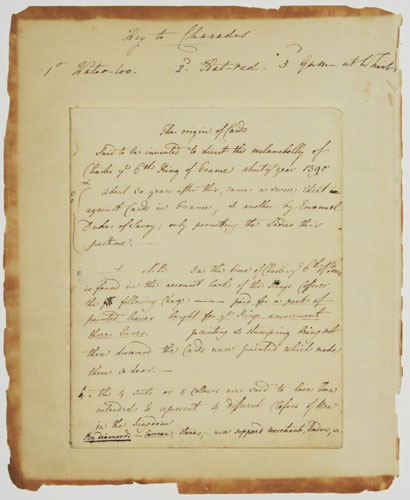
The origin of Cards Said to be invented to divert the melancholy of Charles ye 6th King of France about ye year 1390 [...]
[Anon., c.1800.]
Manuscript on laid and 18th century watermarked paper, 3pp, 205 x 160mm (8 x 6¼"). Glued to album sheet.
Manuscript account of the history of playing cards, the significance of the four suits (diamonds, hearts, spades, clubs), the possible identities of the four kings and queens, and the significance of the jacks.
[Ref: 39671] £180.00
(£216.00 incl.VAT)
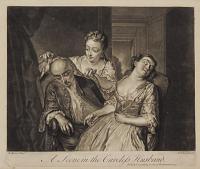
A Scene in the Careless Husband.
P. Mercier Pinx.t. J. Faber fecit 1739.
Publish'd according to Act of Parliament 1739.
Mezzotint, platemark 275 x 325mm (10¾ x 12¾"), with large margins. Slight printer's crease bottom left.
Scene from the play 'The Careless Husband' by Colley Cibber, engraved from a painting by Philip Mercier, showing a moment in Act V, Scene IV of the play with the characters Mrs Edging, Sir Charles Easy and Lady Easy; the last is supposed by some to be a portrait of Kitty Clive (1711-85). Originally a pendant to another theatrical scene after Mercier, 'A Scene from the Recruiting Officer'. Lennox-Boyd 1994 cat 2 (only state); CS 414; for the pendant see ref 7855. Ex: The Hon. Christopher Lennox-Boyd Collection.
[Ref: 38880] £380.00
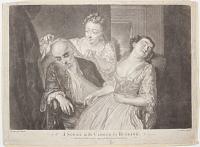
A Scene in the Careless Husband.
P. Mercier Pinx.t. J. Faber fecit 1739.
Printed for Rob.t Sayer, opposite Fetter Lane, Fleet Street [n.d., c.1760].
Mezzotint. 275 x 325mm (10¾ x 12¾"). Laid on album paper, some wear.
Act V, Scene IV of the play 'The Careless Husband' by Colley Cibber, depicting the characters Mrs Edging, Sir Charles Easy and Lady Easy; the last is supposed by some to be a portrait of Kitty Clive (1711-85). CS 414.
[Ref: 45058] £130.00
(£156.00 incl.VAT)

A Scene in the Careless Husband.
P. Mercier Pinx.t. J. Faber fecit 1739.
Publish'd according to Act of Parliament 1739.
Mezzotint. 275 x 325mm (10¾ x 12¾"), with large margins. Few miniscule wormholes.
Act V, Scene IV of the play 'The Careless Husband' by Colley Cibber, depicting the characters Mrs Edging, Sir Charles Easy and Lady Easy; the last is supposed by some to be a portrait of Kitty Clive (1711-85). A pair to ''A Scene in the Recruiting Officer''. CS 414. Ex: collection of The Hon. Christopher Lennox-Boyd. See Ref: 67263.
[Ref: 67266] £360.00

A Scene in the Careless Husband.
P. Mercier Pinx.t. J. Faber fecit 1739.
Publish'd according to Act of Parliament 1739.
Mezzotint, 18th century watermark. Sheet 275 x 325mm (10¾ x 12¾"). Trimmed into image on three sides, into plate at bottom, laid on album paper at borders. Cockling.
Act V, Scene IV of the play 'The Careless Husband' by Colley Cibber, depicting the characters Mrs Edging, Sir Charles Easy and Lady Easy; the last is supposed by some to be a portrait of Kitty Clive (1711-85). A pair to ''A Scene in the Recruiting Officer''. CS 414. Ex: collection of The Hon. Christopher Lennox-Boyd. From the Belton House Collection assembled in the 18th Century by the Rt. Hon. John Ld. Brownlow, Baron Charleville, & Viscount Tyrconnel,
[Ref: 67267] £320.00
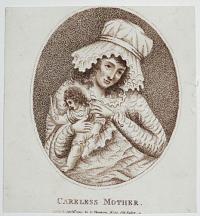
Careless Mother.
Publish'd Sept.r 10th 1795 by G. Thompson, No 50, Old Bailey.
Rare stipple. Sheet 120 x 110mm (4¾ x 4"). Trimmed within plate, into printed border at top, close to inscription at bottom.
A woman unconcerned about the child in her arms holding scissors.
[Ref: 51804] £120.00
(£144.00 incl.VAT)

Joannes Carestini.
George Knapton Pinx.t. J. Faber Fecit 1735
Sold by J. Faber at the Golden Head in Bloomsbury Square
Rare & fine mezzotint. 355 x 250mm (14 x 9¾"). Trimmed within plate, lia on album paper.
Half-lengh portrait in oval of Giovanni Carestini (c.1704-c.1760), the leading castrato in Handel's company in 1734. Described by music historian Charles Burney as 'a powerful and clear soprano', Handel's 'Alcina' and 'Ariodante' were written to take full advantage of Carestini's talents, giving the castrato arias in Italian in otherwise English performances. The painting by artist and connoisseur George Knapton (1698-1778) is only known through this engraving. CS 55. Ex: Collection of the Hon. Christopher Lennox-Boyd
[Ref: 68179] £360.00
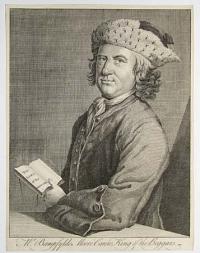
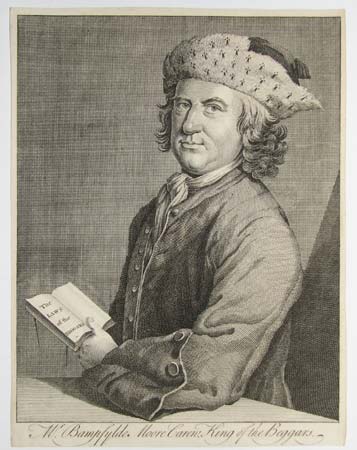
Mr. Bampfylde Moore Carew, King of the Beggars.
[n.d. c.1770].
Engraving. Sheet 280 x 215mm. Trimmed inside plate mark.
Bampfylde Moore Carew [1693 - 1759] was a rogue and imposter, who claimed to be King of the Beggars. Little is known about him other than what is in his memoirs 'The Life and Adventures of Bampfylde Moore Carew', first published 1745.
[Ref: 154] £180.00
(£216.00 incl.VAT)
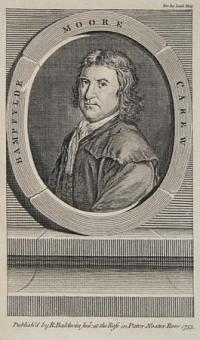
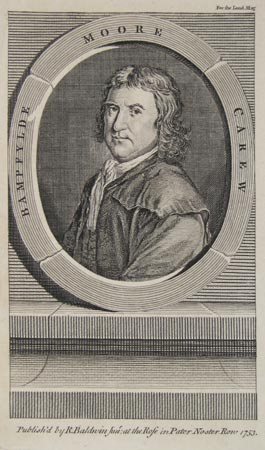
Bampfylde Moore Carew.
For the Lond. Mag.
Publish'd by R. Baldwin Junr: at the Rose in Pater Noster Row 1753.
Engraving, 195 x 120mm.
'King of the Beggars', adventurer (1693 - 1759). Copied from the mezzotint after Phelps. At the age of twelve he was sent to Tiverton school, where for some time he worked hard, but the schoolboys possessed among them a pack of hounds, and one day he, with three companions, followed a deer so far, that the neighbouring farmers came to complain of the damage done. To avoid punishment the youths ran away and joined some gipsies. After a year and a half Carew returned for a time, but soon rejoined the gipsies. His career was a long series of swindling and imposture, very ingeniously carried out, occasionally deceiving people who should have known him well. His restless nature then drove him to embark for Newfoundland, where he stopped but a short time, and on his return he pretended to be the mate of a vessel, and eloped with the daughter of a respectable apothecary of Newcastle-on-Tyne, whom he afterwards married. He continued his course of vagabond roguery for some time, and when Clause Patch, a king, or chief of the gipsies, died, Carew was elected his successor. He was convicted of being an idle vagrant, and sentenced to be transported to Maryland. On his arrival he attempted to escape, was captured, and made to wear a heavy iron collar, escaped again, and fell into the hands of some friendly Indians, who relieved him of his collar. He took an early opportunity of leaving his new friends, and got into Pennsylvania. Here he pretended to be a quaker, and as such made his way to Philadelphia, thence to New York, and afterwards to New London, where he embarked for England. He escaped impressment on board a man-of-war by pricking his hands and face, and rubbing in bay salt and gunpowder, so as to simulate small-pox. After his landing he continued his impostures, found out his wife and daughter, and seems to have wandered into Scotland about 1745, and is said to have accompanied the Pretender to Carlisle and Derby. BM: pg.337, 4.
[Ref: 7462] £45.00
(£54.00 incl.VAT)

Bampfylde Moore Carew King of the Beggars. From the Original Picture in the Possession of Tho.s Carew Esq.r of Crowcombe in Somersetshire.
Rich.d Phelps pinx. J. Faber fecit 1750.
Mezzotint. 330 x 230mm (13 x 9"). Trimmed and backed onto album paper. Very small margins.
Portrait of Bampfylde Moore Carew (1693-1759), impostor, taken from the portrait by Richard Phelps (London, National Portrait Gallery). At the age of twelve he was sent to Tiverton school, where he became involved with schoolboys who owned a pack of hounds, and one day they followed a deer so far that neighbouring farmers came to complain of the damage done. To avoid punishment the youths ran away and joined some gypsies. His career was a long series of swindling and imposture, very ingeniously carried out, occasionally deceiving people who should have known him well. His restless nature then drove him to embark for Newfoundland, where he stopped but a short time, and on his return he pretended to be the mate of a vessel, and eloped with the daughter of a respectable apothecary of Newcastle-on-Tyne, whom he afterwards married. When Clause Patch, a king, or chief of the gipsies, died, Carew was elected his successor, although he was transported to Maryland. On his arrival he escaped and met some Indians, who relieved him of his collar. He then travelled to Pennsylvania (where he pretended to be a quaker), stopping in Philadelphia, New York, and New London, from where he embarked for England. He escaped impressment on board a man-of-war by pricking his hands and face, and rubbing in bay salt and gunpowder, so as to simulate small-pox. After his landing he continued his impostures, found out his wife and daughter, and seems to have wandered into Scotland about 1745, and is said to have accompanied the Pretender to Carlisle and Derby. Ex: Collection of The Hon. C. Lennox-Boyd. CS 56. Sharpe 368.
[Ref: 64665] £220.00
(£264.00 incl.VAT)

Bampfylde Moore Carew King of the Beggars. From the Original Picture in the Possession of Tho.s Carew Esq.r of Crowcombe in Somersetshire.
Rich.d Phelps pinx. J. Faber fecit 1750.
[n.d., c.1800.]
Mezzotint. 330 x 230mm (13 x 9"), on wove paper.
Portrait of Bampfylde Moore Carew (1693-1759), impostor, taken from the portrait by Richard Phelps (London, National Portrait Gallery) At the age of twelve he was sent to Tiverton school, where he became involved with schoolboys who owned a pack of hounds, and one day they followed a deer so far that neighbouring farmers came to complain of the damage done. To avoid punishment the youths ran away and joined some gypsies. His career was a long series of swindling and imposture, very ingeniously carried out, occasionally deceiving people who should have known him well. His restless nature then drove him to embark for Newfoundland, where he stopped but a short time, and on his return he pretended to be the mate of a vessel, and eloped with the daughter of a respectable apothecary of Newcastle-on-Tyne, whom he afterwards married. When Clause Patch, a king, or chief of the gipsies, died, Carew was elected his successor, although he was transported to Maryland. On his arrival he escaped and met some Indians, who relieved him of his collar. He then travelled to Pennsylvania (where he pretended to be a quaker), stopping in Philadelphia, New York, and New London, from where he embarked for England. He escaped impressment on board a man-of-war by pricking his hands and face, and rubbing in bay salt and gunpowder, so as to simulate small-pox. After his landing he continued his impostures, found out his wife and daughter, and seems to have wandered into Scotland about 1745, and is said to have accompanied the Pretender to Carlisle and Derby. CS 56, ii of ii. Sharpe 368.
[Ref: 64670] £130.00
(£156.00 incl.VAT)

Bampfylde Moore Carew King of the Beggars. From the Original Picture in the Possession of Tho.s Carew Esq.r of Crowcombe in Somersetshire.
Rich.d Phelps pinx. J. Faber fecit 1750.
Mezzotint. 330 x 230mm (13 x 9"), with large margins.
Portrait of Bampfylde Moore Carew (1693-1759), impostor, taken from the portrait by Richard Phelps (London, National Portrait Gallery) At the age of twelve he was sent to Tiverton school, where he became involved with schoolboys who owned a pack of hounds, and one day they followed a deer so far that neighbouring farmers came to complain of the damage done. To avoid punishment the youths ran away and joined some gypsies. His career was a long series of swindling and imposture, very ingeniously carried out, occasionally deceiving people who should have known him well. His restless nature then drove him to embark for Newfoundland, where he stopped but a short time, and on his return he pretended to be the mate of a vessel, and eloped with the daughter of a respectable apothecary of Newcastle-on-Tyne, whom he afterwards married. When Clause Patch, a king, or chief of the gipsies, died, Carew was elected his successor, although he was transported to Maryland. On his arrival he escaped and met some Indians, who relieved him of his collar. He then travelled to Pennsylvania (where he pretended to be a quaker), stopping in Philadelphia, New York, and New London, from where he embarked for England. He escaped impressment on board a man-of-war by pricking his hands and face, and rubbing in bay salt and gunpowder, so as to simulate small-pox. After his landing he continued his impostures, found out his wife and daughter, and seems to have wandered into Scotland about 1745, and is said to have accompanied the Pretender to Carlisle and Derby. CS 56, i of ii. Sharpe 368.
[Ref: 64669] £320.00
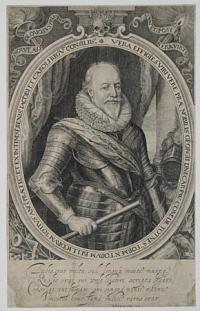
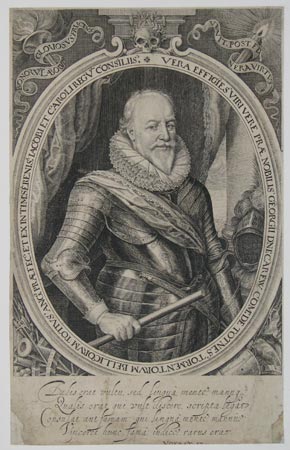
Vera Effigies Viri Vere Præ Nobilis Georgii Dni: Carew Com. de Totnes Tormentorum Bellicorum Totius Ang. Præfec: et ex in Tim: Serenis: Iacobi et Caroli Regu Consilis.
[Engraved by Robert van Voerst.
[n.d., c.1633.]
Engraving. Sheet 305 x 190mm. Trimmed within plate, losing part of text.
George Carew (1555-1629), Earl of Totnes. Appointed president of Munster, 1600, during the Pacification of Ireland. After James I came to the throne in 1603 he was appointed vice-chamberlain to the queen; in 1608 master of the ordnance, and privy councillor in 1616. On the accession of Charles I in 1626, he became treasurer to Queen Henrietta Maria. NPG: D6968.
[Ref: 7110] £160.00
(£192.00 incl.VAT)
![[Mary Carew.]](img-thumbnail/jpegs/40314.jpg)
[Mary Carew.]
Thomas Hudson Pinx: Jacobus Lovelace Sculp. An. 1744.
Etching. Sheet 370 x 300mm (14½ x 12"). Trimmed within plate, tears affacting engraver's details, paper toned.
Miss Mary Carew (circa 1722-74) dressed as a shepherdess, touching her straw hat with her left hand, her crook in her right.
[Ref: 40314] £140.00
(£168.00 incl.VAT)
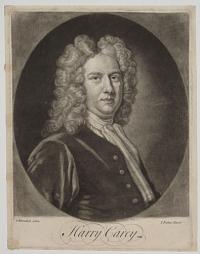
Harry Carey.
J. Worsdale pinx. J Faber Fecit [1729]
Mezzotint, platemark 190 x 150mm (7½ x 6"). Small margins. Rare.
Henry Carey (1687-1743), poet and songwriter. Allegedly the illegitimate son of the George Savile, marquess of Halifax, Carey is best known for his satires and comedies for the theatre today. He also taught music and published poetry. The great music historian Charles Burney wrote of him: 'Honest Harry Carey … invented many very pleasing and natural melodies, which neither obscured the sense of the words, nor required much science to hear'. A defender of indigenous musical traditions, Carey attacked Italian opera, and sometimes paticular continental performers, in satires like 'Faustina, or, The Roman Songstress'. Despite the great success of works such as 'the Dragon of Wantley' (1737), whose popularity eclipsed even 'The Beggar's Opera', Carey committed suicide soon after the death of his son in 1743. Ex Collection of the Late Hon. C. Lennox-Boyd; CS 58 i/ii [with 1729 date seemingly scratched out]
[Ref: 36507] £160.00
(£192.00 incl.VAT)
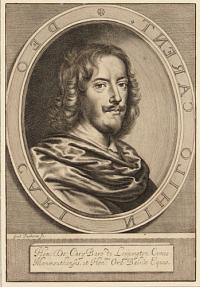
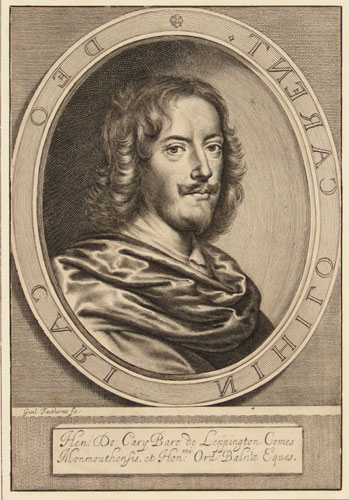
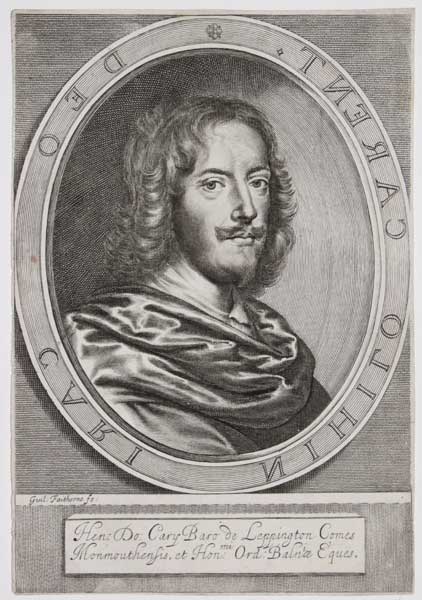
Hen: Do: Cary Baro de Leppington Comes Monmouthensis, et Hon:mi Ord: Balniae Eques.
Guil: Faithorne fe:
[n.d. c.1656.]
Engraving, fine. 220 x 150mm (8¾ x 6"). Trimmed to plate mark, mounted in album paper.
Henry Carey, 2nd Earl of Monmouth (1595-1661) was an English nobleman and translator. He served four terms as a Member of Parliament, representing Camelford, Beverley, Tregony and St Mawes between 1621 and 1626. After taking his seat in the Lords in 1639 he played little part in the upheaval of his times, although he spoke in the House of Lords in June 1641 on the bill for depriving the bishops of their seats in parliament. NPG: D29090. Fagan: p.49; ii/ii.
[Ref: 43122] £220.00
(£264.00 incl.VAT)
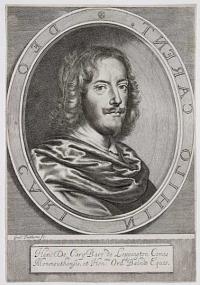
Hen: Do: Cary Baro de Leppington Comes Monmouthensis, et Hon:mi Ord: Balniae Eques.
Guil: Faithorne fe:
[n.d. c.1656.]
Engraving. 222 x 152mm (8¾ x 6"). Trimmed to plate mark.
Henry Carey, 2nd Earl of Monmouth (1595-1661) was an English nobleman and translator. He served four terms as a Member of Parliament, representing Camelford, Beverley, Tregony and St Mawes between 1621 and 1626. NPG: D29090. Fagan: p.49; ii/ii.
[Ref: 24556] £120.00
(£144.00 incl.VAT)
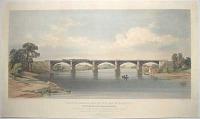
Viaduct Across the River Tay at Cargill. (Scottish Midland Junction Railway.) J. Locke and J.E. Errington Engineers. _ John Stephenson & Co.y, Contractors. Span of each arch 100 Feet _ Height above bed of River _ 60 Feet. 1847.
Sketched by Alex. Cumming. Allan & Ferguson lith. Glasgow.
Scarce tinted lithograph with hand colour. Sheet 350 x 605mm (13¾ x 23¾"). Repaired tears in edges bottom left & right; some paper cracking.
A five-arched railway bridge with a locomotive crossing, in Perthshire. The viaduct is still standing although the arches have been replaced and has been closed to all traffic since 1982.
[Ref: 57019] £420.00
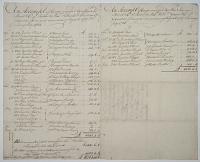
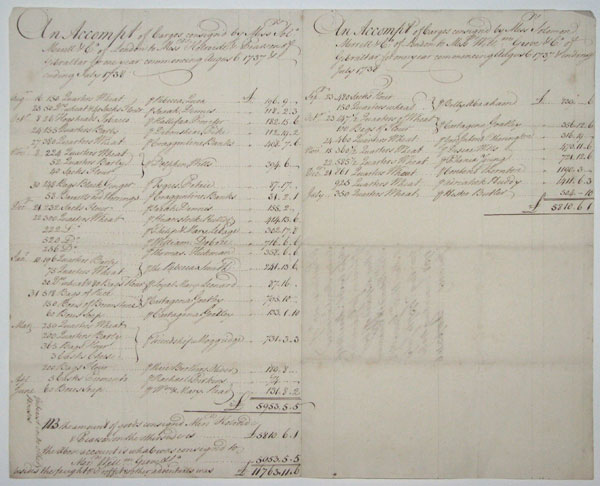
An Accompt of Cargos consign'd by Mess. Sol: Merrett & Co.: of London to Mess.rs Holroide & Pearson of Gibraltar for one year commencing August 6 1737 & ending July 1738 [&] An accompt of Cargos consign'd by Mess.rs Solomon Merrell & Co: of London to Mess.rs Will:m Grove &C: of Gibraltar for one year commencing August 1737 & ending July 1738
[c.1738]
Manuscript, 315 x 395mm. 12½ x 15½".
List of cargos from London to the British territory of Gibraltar in the 1730s, including wheat, tobacco, barley, flour. The dates, quantities, recipients and values of each cargo are listed. From: Charborough House, residence to the Erle-Drax family.
[Ref: 15598] £380.00

A Political and Satirical History of the Years 1756 and 1757. In a Series of Seventy-five Humourous and Entertaining Prints Containing All the most Remarkable Transactions, Characters and Caricaturas of those two memorable Years. To which is annexed, An Explanatory Account or Key to every Print, which renders the whole full and significant.
[by Matthew Darley.]
London, Printed for E. Morris, near St. Paul's.
16mo, original full calf gilt, rebacked with original spine laid on; pp. 15, 75 numbered engraved plates, as called for. Plates 42-47 & 64-67 misbound, 23, 39, 46 & 74 supplied from another set, bookplate on front pastedown.
An extremely rare volume of political and social caricatures regarded as the foundation work in the development of political satire and caricature. It covers the beginning of the the Seven Years War, a pivotal period in the history of Great Britain and the Americas. Subjects include Henry Fox and William Pitt's struggle for power in late 1756, Horatio Walpole (1st Baron Walpole), the Duke of Newcastle and many other prominent political figures of the day. The defeat of General Braddock at Fort Duquesne, the capture of Calcutta, the Byng disaster and British adventures in India and North America are all directly, or covertly included. Many of the caricatures include elaborate rebuses or hieroglyphics, and several have playing card motifs. The text gives a short description of each plate.
[Ref: 38743] £1,800.00
view all images for this item
![[Eight satires as playing cards.]](img-thumbnail/jpegs/53493.jpg)
[Eight satires as playing cards.] 7. The Sea Lyon. [&] 14. Mons.r Dupe. [&] 15. Mons.r Surecard. [&] 26. Null Marriage. [&] 38. Hic Higer Est ~ Acapulca. [&] 66. The Devil of a Medley. [&] 80. The Court Cards or all Trumps 1756. [&] 90. The Court Cards of 1759, or Hearts is Trump & has Won the Game.
[London, Printed for E. Morris, near St. Paul's.] [n.d., c.1760.]
Eight engravings. Each sheet c. 130 x 100mm (5¼ x 4") large margins.
Eight plates from ''A Political and Satirical History of the Years 1756 and 1757 In a Series of Seventy-five Humorous and Entertaining Prints Containing All the most Remarkable Transactions, Characters and Caricaturas of those two memorable Years''. BM Satires 3943, 3504, 3506, 3522, 3535, 3574, 3465 & 3699.
[Ref: 53493] £480.00
(£576.00 incl.VAT)
view all images for this item

Caricature. i Sensi miei placido ascolterai. I.
Joan. Bapt. Internari fecit. J. Canale Scul.
[Dresden, n.d. c.1763.]
Etching. 345 x 240mm (13½ x 9½"). Creasing through left; wormholes, stains in margins.
Two ugly men with a Prostitute beckoning them in. Giovanni Battista Internari (1671-1769) specialised in reduction drawings after old masters for engraving. Giuseppe Canale (1725-1802) was an Italian painter and engraver, when in 1751 he was invited to Dresden to assist in engraving plates for the pictures in their gallery, and was appointed engraver to the Court. From "Karikatur zweier Herren".
[Ref: 23894] £130.00
(£156.00 incl.VAT)
![[15 Caricature Plates.]](img-thumbnail/jpegs/49441.jpg)
[15 Caricature Plates.]
Ch. Varin.
[n.d., c.1800.]
Bound set of 15 etchings in original wrappers; scarce complete. 155 x 105mm (6 x 4'').
A set of fifteen etchings of caricature heads, similar to those drawn by Leonardo da Vinci. Attributed to Charles Nicolas Varin (1741-1812).
[Ref: 49441] £950.00
view all images for this item


![[Three men playing cards.]](jpegs/34832.jpg)

![[All Fours.]](jpegs/59289.jpg)
![[Couple playing cards.]](jpegs/23339.jpg)

![[The Card-Players.]](jpegs/34835.jpg)

![[Original sketch for Dugdales' England & Wales.] Cardiff Castle. Seat of the Marquis of Bute.](jpegs/60261.jpg)
![[Black Tower, Cardiff Castle.]](jpegs/44172.jpg)


![[Card Players]](jpegs/38324.jpg)
![[Cards] Recreatio juvenilis.](jpegs/68137.jpg)


![[The Breland, or the Prodigal.] Pellicus hinc Modulis...](jpegs/55348.jpg)


![[The young man losing a game of cards.] Wat syn wy ... voord beroyd.](jpegs/55346.jpg)





![[Mary Carew.]](jpegs/40314.jpg)



![[Eight satires as playing cards.]](jpegs/53493.jpg)

![[15 Caricature Plates.]](jpegs/49441.jpg)