![[Cadiz] Gades, in Beticæ chersoneso, ad Bætis amnis ostia; à Tyriis condita, Herculis delubro quondam notissima; hodie navigationis beneficio opulenta.](img-thumbnail/jpegs/33382.jpg)
[Cadiz] Gades, in Beticæ chersoneso, ad Bætis amnis ostia; à Tyriis condita, Herculis delubro quondam notissima; hodie navigationis beneficio opulenta. [Repeated in Spanish, Dutch & French.]
[P. v. d. Berge fec. et ed. cum Privil.]
[n.d., c.1690.]
Etching, rare. Sheet 170 x 260mm (6¾ x 10¼"). Trimmed within plate, laid on album paper.
Prospect Caduz from the sea, with a map of the city and bay on tromp l'oeil banner, published in 'Theatrum Hispaniæ', a series of views of Spain drawn and engraved by Pieter van den Berge (c.1670-1737). From a scrapbook compiled by Rev. Willaim Bradford (1780-1857), Chaplain and war artist during the Peninsula Wars.
[Ref: 33382] £240.00
(£288.00 incl.VAT)
![[The Cadiz Expedition.] D. Fernando Giron.](img-thumbnail/jpegs/33303.jpg)
[The Cadiz Expedition.] D. Fernando Giron. El cuadro original existe en el R.l Museo de Madrid.
Eugenio Caxés lo pintó [but Francisco de Zurbarán]. F. Decraene lo lit.o. J. de Madrazo lo dirigio.
Imp. en el R.l Est.o lit.o de Madrid. [n.d., c.1830.]
Lithograph. Sheet 430 x 380mm (17 x 15"), with blindstamp in inscription area. Laid on album paper.
A portrait of Don Fernando Girón and his commanders during the successful defence of the city during the English 'Cadiz Expedition' of 1625. The elderly Girón sits in a sedan chair with his deputy commander, Diego Ruiz, standing before him. Behind can be seen different moments in the siege, with the naval attacks and land battles, including the English being chased back to their boats. The 'Cadiz Expedition' was an ill-conceived attempt by the Duke of Buckingham to gain prestige by emulating the exploits of the Elizabethan adventurers. In the autumn of 1625 nearly 100 ships and a total of 15,000 men were sent to attack Cadiz under Sir Edward Cecil, a capable soldier, but completely inexperienced at sea. Having faced heavy storms on the way they missed their main objective, a treasure ship from the Americas; and when Cecil landed his troops he realised he didn't have the supplies to maintain them. The landed troops resorted to scavenging, and unfortunately found too many wine vats. When Cecil gave the inevitable order to withdraw over a thousand troops were left behind, so drunk that the counter-attacking Spanish could run them through where they lay (depicted by the building at the centre of the background). The expedition cost the English an estimated £250,000, and in 1626, when Parliament attempted to impeach Buckingham for the ineptitude of the planning, Charles I had to dissolve Parliament to protect his favourite. Although attributed here to Eugenio Caxés, the painting was painted by Francisco de Zurbarán in 1634 and is now in the Prado Museum. This lithograph is from the 'Colección lithographica de cuadros del rey de España el señor Fernando VII'. BM: 1858,0417.852. From a scrapbook compiled by Rev. Willaim Bradford (1780-1857), Chaplain and war artist during the Peninsula Wars.
[Ref: 33303] £280.00
(£336.00 incl.VAT)
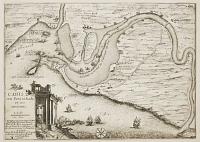
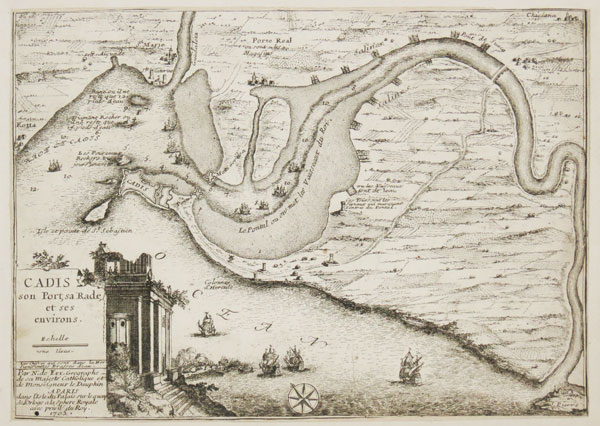
Cadis son Port, sa Rade, et ses environfs.
Par N. de Fer, Geographe de sa Majesté Catholique et de Monsieur le Dauphin A Paris dans l'Isle du Palais sur le quay de l'Orloge a la Sphere Royale avec privil du Roy 1705.
Engraved map. Sheet 250 x 340mm (9¾ x 13½"). Trimmed close to printed border and laid on album paper.
A map of the environs of Cadiz with a decorative title cartouche with an architectural caprice. From a scrapbook compiled by Rev. Willaim Bradford (1780-1857), Chaplain and war artist during the Peninsula Wars.
[Ref: 33262] £320.00

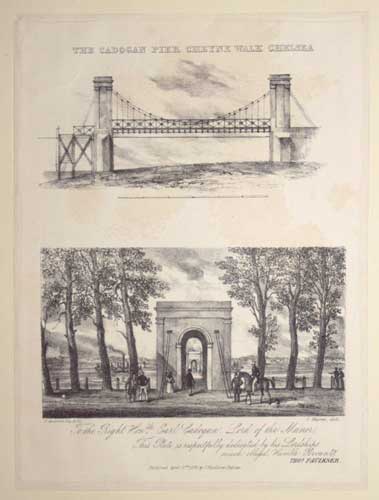
The Cadogan Pier Cheyne Walk Chelsea.
N. Handford Esq. Archt. C. Warren, delt.
Published April 17th 1841, by T. Faulkner, Chelsea.
Very scarce lithograph, two perspectives (viewed from the bank and the river) printed on a single sheet. Tipped into album page, sheet 330 x 485mm (13 x 19").
There was insufficient accommodation on the riverbank for passenger steamboats in the 1840s and piers were built into the Thames to accommodate them. Cremorne Gardens had its own landing place, with a regular service from London. In 1840 Old Swan pier and Chelsea Mall pier served the steamboats, but by 1841 Earl Cadogan had erected Cadogan pier in Cheyne Walk, designed by N. Handford, catering for a large number of summer passengers. The pier was rebuilt c. 1875 to accommodate Albert Bridge. Perhaps from the architect's prospectus. Longford Images of Chelsea: 131.
[Ref: 56073] £220.00
(£264.00 incl.VAT)

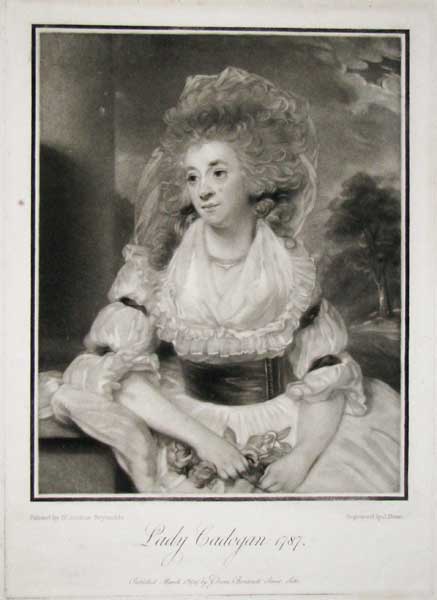
Lady Cadogan 1787.
Painted by Sr. Joshua Reynolds. Engraved by J. Dean.
Published March 1st, by J. Dean Bentinck Street, Soho.
Mezzotint, 455 x 330mm. 17¾ x 13".
Lady Mary Cadogan (1750 - active 1797), eldest daughter of Charles Churchill. 2nd wife of Charles Sloane Cadogan, 3rd Baron and 1st Earl Cadogan; divorced 1796. Chaloner Smith: 3, II of II. Hamilton: pg.87, II.
[Ref: 9563] £320.00
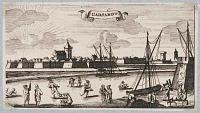
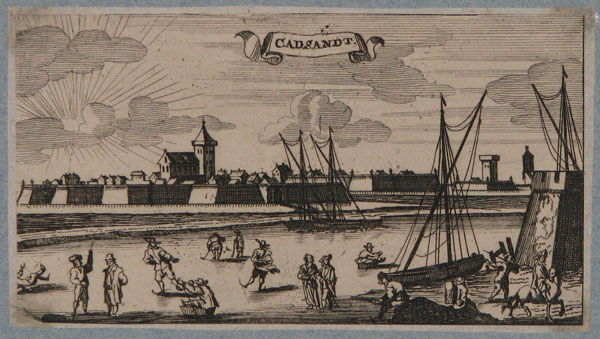
Cadsandt.
[Jan Peeters was bekend om zijn scheepstekeningen. Uitgegeven door Gaspar Bouttats te Antwerpen.]
[n.d. c.1680.]
Etching. 67 x 122mm. 2½ x 4¾". Cut. Trimmed and laid on album page.
Taken from a sheet of four views in the Netherlands. Cadzand, a town in the Dutch province of Zeeland. A scene along the coast of people fishing and playing golf and other sports on ice. Very early golf view. NMM: PAD6966.
[Ref: 19763] £220.00
(£264.00 incl.VAT)
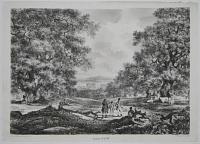
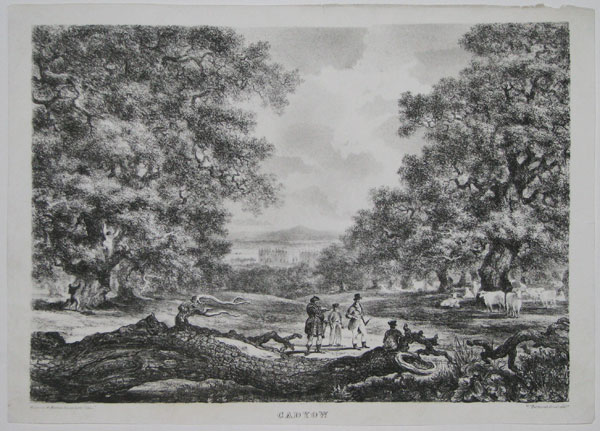
Cadyow.
[Faded] & Ballantine lithrs Edinr. W. T. de Lond: delt.
[n.d., c.1820s.]
Very rare lithograph, image 225 x 320mm. 8¾ x 12½".
Figures in a parkland landscape, one in full Highland dress, a group of cattle to right; large castle in background. Men climbing trees to left. This may be Cadzow Castle, now in ruins, in South Lanarkshire, Scotland. Probably this is from a series of views illustrating Sir Walter Scott's (1771 - 1832) 'Provincial antiquities of Scotland' - perhaps one of the men represented is the great Scottish historical novelist, playwright, and poet himself. 'Cadyow Castle' was a poem written by Scott. Not in Abbey.
[Ref: 19922] £75.00
(£90.00 incl.VAT)

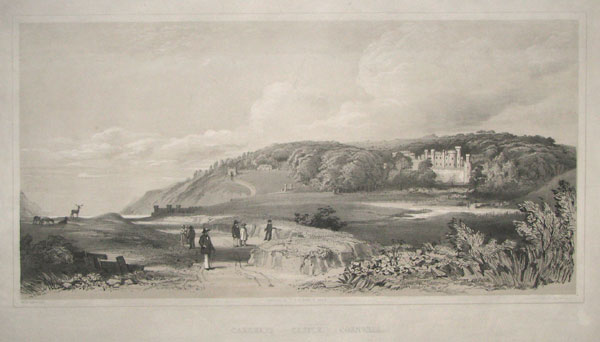
Caerhays Castle, Cornwall.
Weld Taylor, Litho. Sketched by Dr. H.H. Drake, St. Austell.
Printed by C. Moody, 257 High Holborn, London. [n.d., c.1840.]
Tinted lithograph, sheet 420 x 650mm. 16½ x 25½". Surface soiled.
A fine prospect of Caerhays Castle near St. Austell, Cornwall, a Grade I Listed Building built by the famous architect, John Nash, for the Trevanion family. Building work started in 1807 and was completed by 1810. The Trevanions must have been stretched by the construction cost of Caerhays since, by 1825, they had taken out a mortgage (incumbrance) with The Bank of England for £20,000. Further mortgages accumulated along with their gambling debts and, by 1842, the Trevanion family fled to Bruges and their estates were acquired by their creditors.
[Ref: 12957] £240.00
(£288.00 incl.VAT)
![Caernarvon Castle [in pencil]](img-thumbnail/jpegs/65921.jpg)
Caernarvon Castle [in pencil]
Cyril Anning [in pencil]
[n.d. c.1900]
Etching, 130 x 245mm (5 x 9½), with very large margins. On paper watermarked, 'F J Head & Co.'
Etching of Caernarvon Castle and part of the River Seiont in Gwynedd, North Wales.
[Ref: 65921] £90.00
(£108.00 incl.VAT)
![[Caernarvon Castle by moonlight.]](img-thumbnail/jpegs/40418.jpg)
[Caernarvon Castle by moonlight.]
[n.d., c.1820.]
Ink & watercolour, coloured on both sides as a transparency. Sheet 160 x 230mm (6¼ x 9").
Caernarvon Castle from the sea. The moon has been excised. Ex: collection of the Hon. Christopher Lennox Boyd.
[Ref: 40418] £85.00
(£102.00 incl.VAT)
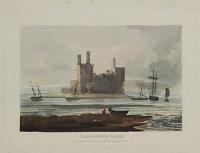
Caernarvon Castle.
London, Published by Thomas McLean, Haymarket, 1822.
Hand coloured aquatint, part J. Whatman watermark. Platemark: 160 x 228mm (6¼ x 8¾"). Fine hand colouring.
A view from the coast of Caernarvon Castle, in Caernarfon, Gwynedd, north west Wales. A number of sailing boats surround the castle, in the centre of the image, as two figures tend to a rowing boat in the foreground. From 'A Picturesque Description of North Wales: Embelished with Twenty Select Views From Nature', published in 1823 by Howlett and Brimmer, 10 Frith Street, Soho. Abbey: 525.
[Ref: 33335] £60.00
(£72.00 incl.VAT)
![[View of the Eagle Tower at Caernarvon.]](img-thumbnail/jpegs/57517.jpg)
[View of the Eagle Tower at Caernarvon.] [Twelve] Views in [North & South] Wales [No D].
[P. Sandby.]
[London Publishd by P Sandby St Georges Row Oxford Turnpike.] [n.d., c.1786.]
Fine coloured aquatint with etched line. Image size 205 x 290mm. Trimmed to image losing title, laid on card. Book title on rock partly rubbed off.
The title plate for the fourth part of Paul Sandby's series of views in Wales, published a decade after the first three parts. The figures in the foreground include a man playing a harp. The first set of twelve aquatints, published 1775, was the first British topographical book in aquatint. This Part not in Abbey, but see Scenery 511 for the first three parts.
[Ref: 57517] £180.00
(£216.00 incl.VAT)
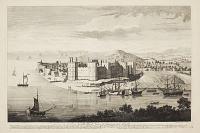
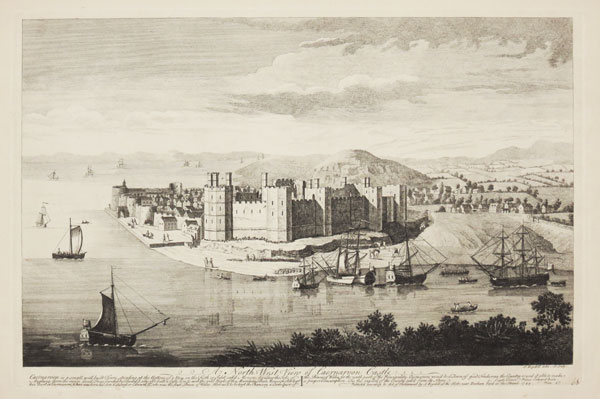
A North-West View of Caernarvon Castle. Caernarvon is a small, well built Town, standing at the Bottom of a Bay, on the Firth or Inlet call’d Meneu, dividing the Isle of Anglesea from the Main Land, Twas founded by Edward I, who also built a Castle here to curd the wild People of the Mountains. That Monarch often kept his Counrt in Caernarvon, & here was born his Son & Successor Edward II, who was the first Prince of Wales. Here us’d to be kept the Chancery & Exchequer of the Princes of Wales, for the north part of the Principality. Caernarvon wou’d be a Town of good Trade, was the Country round it able to make a proper Consumption Tis the capital of the County call’d from its Name. 68.
J. Boydell Delin. et Sculp.
Publish'd according to Act of Parliament by J. Boydell, at the Globe near Durham Yard in the Strand, 1749. Price 1.s.
Engraving, paper watermarked with very large margins. Plate 300 x 450mm (11¾ x 17¾").
A fine view of Caernarfon Castle seen from across the River Seiont, Gwynedd, north-west Wales; ships delivering their goods to the right. From "A Collection of One Hundred Views In England and Wales". John Boydell's 'Collection of Views' was made after he turned from engraver to print publisher in 1767. The first collection was issued in 1770, and included some plates by printmakers other than himself.
[Ref: 29395] £300.00
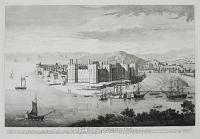
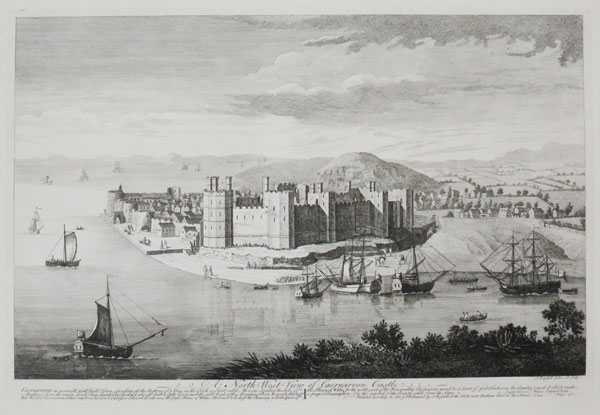
A North-West View of Caernarvon Castle. Caernarvon is a small, well built Town, standing at the Bottom of a Bay, on the Firth or Inlet call’d Meneu, dividing the Isle of Anglesea from the Main Land, Twas founded by Edward I, who also built a Castle here to curd the wild People of the Mountains. That Monarch often kept his Counrt in Caernarvon, & here was born his Son & Successor Edward II, who was the first Prince of Wales. Here us’d to be kept the Chancery & Exchequer of the Princes of Wales, for the north part of the Principality. Caernarvon wou’d be a Town of good Trade, was the Country round it able to make a proper Consumption Tis the capital of the County call’d from its Name.
J. Boydell Delin. et Sculp.
Publish'd according to Act of Parliament by J. Boydell, at the Globe near Durham Yard in the Strand, 1749. Price 1.s.
Engraving, paper with very large margins. Plate 300 x 450mm (11¾ x 17¾").
A fine view of Caernarfon Castle seen from across the River Seiont, Gwynedd, north-west Wales; ships delivering their goods to the right.
[Ref: 32453] £360.00
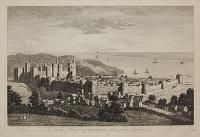
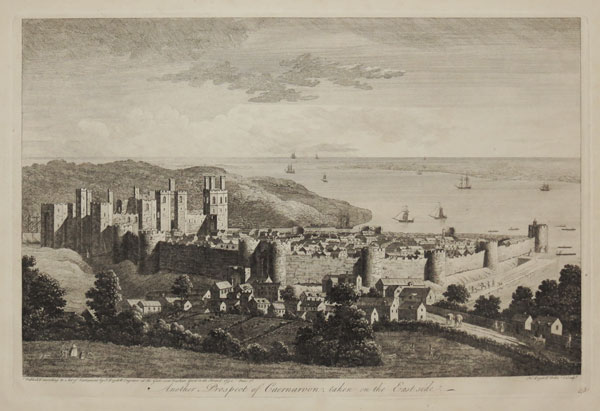
Another Prospect of Caernarvon, taken on the East side. 69.
J.no Boydell Delin. et Sculp.t
Publish'd according to Act of Parliament by J. Boydell, Engraver at the Globe near Durham Yard in the Strand 1750. Price 1s.
Engraving, Plate 300 x 446mm (11¾ x 17½"), with watermark and very large margins.
A fine view of Caernarfon Castle, Wales, with the River Seiont seen behind. From John Boydell's 'Collection of One Hundred Views In England and Wales'.
[Ref: 29396] £350.00
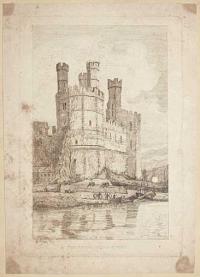
Caernarvon Castle N. Wales. N.o2
W. Yetts.
[n.d. c.1850]
Etching, 225 x 150mm (9 x 6"), with margins. Glued to backing sheet at four corners.
A view of Caernarvon Castle and part of the River Seiont in Gwynedd, North Wales.
[Ref: 62596] £85.00
(£102.00 incl.VAT)
![[Caernarfon Castle.]](img-thumbnail/jpegs/12332.jpg)
[Caernarfon Castle.]
Bernard Eyre. [Pencil signature.]
[n.d., c.1930s.]
Etching, 175 x 250mm. 7 x 9¾".
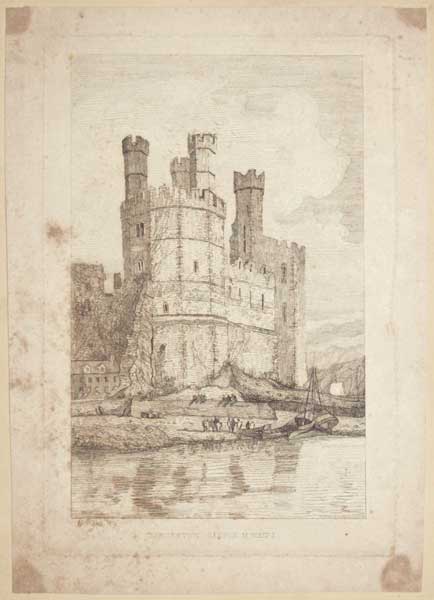
Caernarfon Castle (Welsh: Castell Caernarfon) was constructed at Caernarfon in Gwynedd, north-west Wales, by King Edward I of England, following his conquest of Gwynedd in 1283.
[Ref: 12332] £35.00
(£42.00 incl.VAT)
![Caernarvon Castle [pencil].](img-thumbnail/jpegs/64962.jpg)
Caernarvon Castle [pencil].
Francis Wells [pencil signature.]
[n.d., c.1930.]
Etching with aquatint printed in colours. 165 x 315mm (6½ x 12¼"), with large margins, blind-stamped 'Rembrandt Guild Artist's Proof'.
A view of Caernarvon Castle from the sea. Francis Wells (exh. 1897-1938), portrait and landscape painter who studied at the Slade and Royal Academy Schools; lived Milton Abbas, Dorset.
[Ref: 64962] £75.00
(£90.00 incl.VAT)
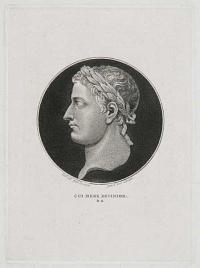
Cui mens divinior. S.G.
dessiné par Denon. gravé par I. Mitan.
[n.d. c.1835.]
Aquatint. 155 x 110mm, 6¼ x 4¼".
A portrait of one of the Roman emperors, possibly Augustus.
[Ref: 17458] £60.00
(£72.00 incl.VAT)
![[Where's Master?]](img-thumbnail/jpegs/62499.jpg)
[Where's Master?]
Published at 8 Clare Street, Bristol by Frost & Reed Printsellers of Bristol, Clifton & London January 2.nd 1911.
Etching. Sheet size 400 x 490mm (15¾ x 19¼"). Trimmed within image at sides.
'Caesar, I belong To the King', in remarque of a dog collar. Portrait of a wire fox terrier by an empty chair. Caesar (1898–1914) was a dog owned by Edward VII and was a constant companion. He achieved worldwide fame in 1910 when he joined the funeral procession of his master.
[Ref: 62499] £380.00
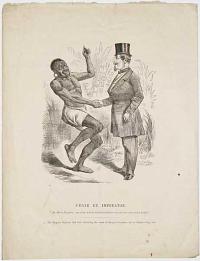
Caesar et Imperator. "Ah, Massa Napoleon! you al'ays was de friend ob freedom - now you am a'man and a broder." The Emperor Napoleon had been advocating the cause of liberty - everywhere but in France.--July, 1861.
[Punch, July, 1861.]
Etching. 362 x 280mm. 14¼ x 11".
Napoleon III (1808-1873) the President of the French Second Republic. Until about 1861, Napoleon's regime exhibited decidedly authoritarian characteristics, using press censorship to prevent the spread of opposition, manipulating elections, and depriving the Parliament of the right to free debate or any real power. He often referred to himself as Julius Caesar, drawing analogy between the politics of Caesar and his own.
[Ref: 18042] £60.00
(£72.00 incl.VAT)
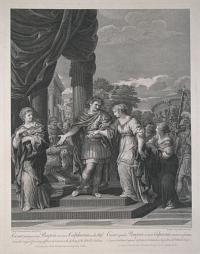
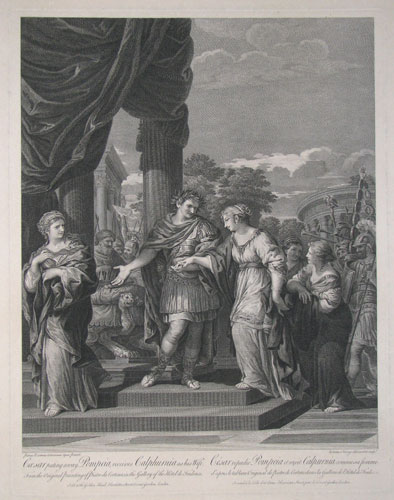
Caesar putting away Pompeia, receives Calphurnia as his Wife. César repudie Pompeia, et recoit Calpurnia coimme sa femme. From the Original Painting of Pietro da Cortona, in the Gallery of the Hotel de Toulouse.
Pietro Beretinus Cortonensis Eques Pinxit. Robertus Strange delineavit et sculpt.
Sold at the Golden Head, Henrietta Street, Covent Garden, London.
Lettered in English and French below the image. Engraving 505 x 392mm. 20 x 15½". Very large margins. Uncut
[Ref: 11332] £280.00
(£336.00 incl.VAT)
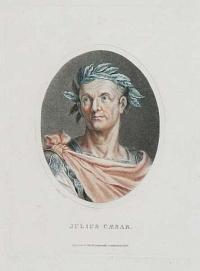
Julius Cæsar.
Titian del.t.
Engraved for the Encyclopedia Londinensis, 1826.
Colour printed stipple with engraving. 180 x 135mm, 7 x 5¾". Watermarked 1824.
An oval portrait of Gaius Julius Caesar (100-44 BC). His success as a general was responsible for the recreation of the Roman Republic as an Empire. The 'Encyclopedia Londonensis' was published from 1796 to 1829, compiled by John Wilkes, edited by John Jones.
[Ref: 18546] £80.00
(£96.00 incl.VAT)
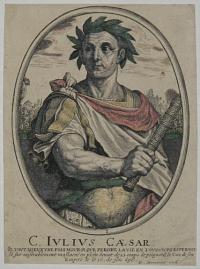
C. Iulius Caesar. Il Vaut Mieux Une Fois Mourir Que Perdre La Vie En Tousious Esperant. Il fuit miserablement massacré en plein Senat de 23.coups de poignard le V.an de son Empire & le 56. de son âgé.
B. Moncornet excu.
[n.d. c.1670.]
Hand-coloured engraving. 157 x 117mm. 6¼ x 4½". Stuck down on sheet.
Gaius Julius Caesar (100 BC-44 BC). Roman military and political leader. Standing strong holding a staff, with Rome in the background and a small fire in the far left-hand background.
[Ref: 12786] £65.00
(£78.00 incl.VAT)
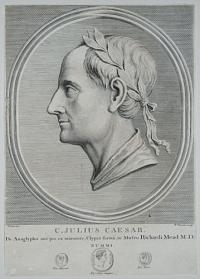
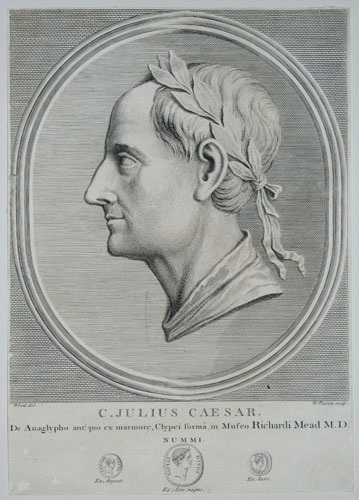
C. Julius Caesar. De Anaglypho antiquo ex marmore, Clypei forma, in Museo Richardi Mead M.D. Nummi. [Three coins marked below:] Ex Argento. Ex Aere Magno. Ex Auro.
Wood del. B. Baron sculp.
[n.d. c.1750.]
Etching. 362 x 254mm. 14½ x 10". Trimmed .
The great Gaius Julius Caesar (100BC - 44BC), Roman general and statesman. He played a fundamental role in the gradual transformation of the Roman Republic into the Roman Emperor. He was responsible for extending Rome's territory to the English Channel and the Rhine, and was the first Roman general to cross both when he built a bridge across the Rhine and conducted the first invasion of Britain.
[Ref: 22261] £120.00
(£144.00 incl.VAT)

Cæsaria.
Sketched on the Spot by F.B. Spilsbury & drawn by D.l Orme. I.C. Stadler Aquatinta.
Sold & Published Sept.r 1. 1803, by Edw.d Orme, Printseller to His Majesty & the Royal Family, 59, New Bond Street.
Fine hand-coloured aquatint. Plate: 300 x 390mm (12 x 15¼"), with very large margins.
A view of Caesarea in northern Israel taken from the sea. A scene from 'Picturesque Scenery in the Holy Land and Syria'. Abbey Scenery 383.
[Ref: 46227] £160.00
(£192.00 incl.VAT)
![[Set of 10 Caesars.]](img-thumbnail/jpegs/39298.jpg)
[Set of 10 Caesars.] 2. Augustus. 3. Tiberius. 4.Caligula. 5. Claudius. 6. Nero. 7. Galba. 8. Otho. 10. Vespasianus. 11. Titus. 12. Domitianus.
[After Jan van der Straet.]
[n.d. c.1700.]
Set of 10 of 12 fine engravings (lacking plates 1 & 9). Platemark: 330 x 220mm (13 x 8¾") each, large margins.
A set of 10 of 12 plates from 'Imperatorum XII' (The Twelve Emperors), depicting statues of Roman Emperors on horseback, with each pedestal decorated with illustrative scenes. Examples include; Tiberius, in full armour, wearing a laurel wreath and holding a spear; Caligula, in full armour, wearing the winged hat of Mercury, holding the thunderbolts of Zeus and the trident of Poseidon; Nero, in full armour, facing to the right and holding a lyre, with thepedestal decorated with a scene of his suicide; Titus, in full armour, and in the background to the right, Mount Vesuvius erupts, with troops assembling outside the gates of a city to the left. After Jan van der Straet (1523 - 1605).
[Ref: 39298] £1,500.00
view all images for this item
![[The Twelve Caesars] III. Tiberius Nero Cæsar.](img-thumbnail/jpegs/64626.jpg)
[The Twelve Caesars] III. Tiberius Nero Cæsar. Ex Marmore Antiquo.
J. Faber Fecit et Excud.t
[n.d., c.1710.]
Mezzotint, 18th century watermark. 350 x 250mm (13¾ x 9¾"), with very large margins. Tears in margins taped.
A marble bust of Tiberius Julius Caesar Augustus (42BC - 37AD), third emperor of Rome, in an oval. CS 19. Ex: Collection of The Hon. C. Lennox-Boyd.
[Ref: 64626] £280.00
(£336.00 incl.VAT)
![[The Twelve Caesars] IV. C Cæsar Caligula.](img-thumbnail/jpegs/64627.jpg)
[The Twelve Caesars] IV. C Cæsar Caligula. Ex Marmore Antiquo.
J. Faber Fecit et Excudit.
[n.d., c.1710.]
Mezzotint, 18th century watermark. 350 x 250mm (13¾ x 9¾"), with very large margins.
A marble bust of Caligula (Gaius Caesar Augustus Germanicus, 12-41AD), fourth emperor of Rome, in an oval. CS 19. Ex: Collection of The Hon. C. Lennox-Boyd.
[Ref: 64627] £280.00
(£336.00 incl.VAT)
![[The Twelve Caesars] V. Claudius Drusus Cæsar.](img-thumbnail/jpegs/64628.jpg)
[The Twelve Caesars] V. Claudius Drusus Cæsar. Ex Marmore Antiquo.
J. Faber Fecit et Excud.t.
[n.d., c.1710.]
Mezzotint, 18th century watermark. 350 x 250mm (13¾ x 9¾"), with very large margins.
A marble bust of Claudius (Tiberius Claudius Caesar Augustus Germanicus, 10BC-41AD), fifth emperor of Rome, in a niche. CS 19. Ex: Collection of The Hon. C. Lennox-Boyd.
[Ref: 64628] £280.00
(£336.00 incl.VAT)
![[The Twelve Caesars] VI. Nero Claudius Cæs.](img-thumbnail/jpegs/64629.jpg)
[The Twelve Caesars] VI. Nero Claudius Cæs. Ex Marmore Antiquo.
J. Faber fecit et excud.t.
[n.d., c.1710.]
Mezzotint 18th century watermark. 350 x 250mm (13¾ x 9¾"), with very large margins
A marble bust of Nero Claudius Caesar Augustus Germanicus (37-68AD), sixth emperor of Rome, in an oval. CS 19. Ex: Collection of The Hon. C. Lennox-Boyd.
[Ref: 64629] £280.00
(£336.00 incl.VAT)
![[The Twelve Caesars] VII. Sergius Sulpitius Galba.](img-thumbnail/jpegs/64630.jpg)
[The Twelve Caesars] VII. Sergius Sulpitius Galba. Ex Marmore Antiquo.
J. Faber Fecit et Excud.t.
[n.d., c.1710.]
Mezzotint, 18th century watermark. 350 x 250mm (13¾ x 9¾"), with large margins.
A marble bust of Galba (3BC-69AD), seventh emperor of Rome, in an oval. He ruled for only seven months. CS 19. Ex: Collection of The Hon. C. Lennox-Boyd.
[Ref: 64630] £260.00
(£312.00 incl.VAT)
![[The Twelve Caesars] IX. A. Vitellius.](img-thumbnail/jpegs/64631.jpg)
[The Twelve Caesars] IX. A. Vitellius. Ex Marmore Antiquo.
J. Faber Fecit et Excud.t.
[n.d., c.1710.]
Mezzotint, 18th century watermark. 350 x 250mm (13¾ x 9¾"), with large margins. Creased.
A marble bust of Aulus Vitellius (15-69AD), ninth emperor of Rome, although he only ruled for eight months. CS 19. Ex: Collection of The Hon. C. Lennox-Boyd.
[Ref: 64631] £220.00
(£264.00 incl.VAT)
![[The Twelve Caesars] XII. Titus Favius Domitianus.](img-thumbnail/jpegs/64632.jpg)
[The Twelve Caesars] XII. Titus Favius Domitianus. Ex Marmore Antiquo.
J. Faber Fecit et Excud.t.
[n.d., c.1710.]
Mezzotint. 350 x 250mm (13¾ x 9¾"), with very large margins.
A marble bust of Domitian (51-96AD), twelfth emperor of Rome, in an oval. CS 19. Ex: Collection of The Hon. C. Lennox-Boyd.
[Ref: 64632] £220.00
(£264.00 incl.VAT)
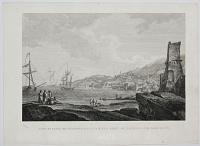
View of Caffa or the Odosia, A City & Sea Port of Tauria Chersonesus.
[London: Published by Septimus Prowett, 23, Old Bond-Street. W. Nicol, Shakespeare Press, Cleveland-Row. 1824.]
Engraving on india. Plate 252 x 330mm. 10 x 13". Overall foxing; burning to right hand edge.
Ukraine: A view of Caffa, built in the form of an amphiteatre. It has regained its ancient name of Theodosia since it has been possessed by the Russians. It was built by the Greeks in the fifth century, upon the ruins of Theodosia; the Genoese took it from the Tartars in 1226, and 71 years later the Venetians drove out the Genoese, who soon after got possession of it for the second time, and fortified it. In the year 1474, it feel into the hands of the Turks, when of course it lost both its trade and commerce, which had been considerable up until this time. In the year 1774, it was ceded by the Turks to Russia. From "Museum Worsleyanum; or a Collection of Antique Basso-Relievos, Bustos, Statues, and Gems' with Views of Places in the Levant. Taken on the Spot in the Years MDCCLXXXXV. VI. and VII." This from Volume II.
[Ref: 23617] £130.00
(£156.00 incl.VAT)
![[Cafre People.]](img-thumbnail/jpegs/30731.jpg)
[Cafre People.]
D.K. Bonatti l'acqtinta.
[Milan: Antonio Fortunato Stella, 1816-27.]
Coloured aquatint with very large margins. Plate 190 x 240mm (7½ x 9½").
Cafre people, or kaffir, a word used in South Africa to refer to a black person; people sat in the centre, one smoking. Village behind on a hill. Published in Giulio Ferrario's 'Le Costume Ancien et Moderne ou Histoire du gouvernement, de la milice, de la religion, des arts, sciences et usages de tous les peuples anciens et modernes d'après les monuments de l'antiquité et accompagné de dessins analogues au sujet par le Docteur Jules Ferrario'.
[Ref: 30731] £140.00
(£168.00 incl.VAT)
![[The Mineral Water lunch of Count Cagliostro]](img-thumbnail/jpegs/36927.jpg)
[The Mineral Water lunch of Count Cagliostro] Le Dejeune avec les Eau Minerale du Comte Cagliastro
[anon., c.1790]
Etching with large margins, platemark 140 x 180mm (5½ x 7"). Folds, rust spot lower right.
Satire on the infamous Count Alessandro di Cagliostro (1743-95), adventurer, freemason, charlatan, radical politician and occultist. Cagliostro sits at ease while numerous figures around him sleep or vomit. Cagliostro's life is shrouded in mystery but involved forging and swindling of various kinds (and alleged involvement in the 'Affair of the Diamond Necklace' in which Marie Antoinette was thought to have defrauded the crown jewellers of the cost of an expensive necklace). He travelled around Europe, including time spent in London, and died in prison in Rome after he had been sentenced to life for being a Freemason. The error-strewn French and style of this print suggests it may have been made in Italy. Since his death, Cagliostro has been of tremendous cultural interest. He has been the subject of literary works by Goethe and Tolstoy amongst others.
[Ref: 36927] £120.00
(£144.00 incl.VAT)
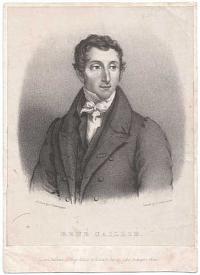
René Caillié.
On Stone by C. Hamburger. Printed by C. Hullmandel.
London Published by Henry Colburn & Richard Bentley, New Burkington Street [n.d., c.1830].
Rare lithograph on chine collé, with printed backing sheet. Sheet 160 x 115mm (6¼ x 4½"). Some spotting.
Auguste René Caillié (1799-1838), a French explorer who was the first European to return alive from Timbuktu, claiming a 10,000 franc prize offered by the Société de Géographie. The partnership of Henry Colburn and Richard Bentley lasted only three years, 1829-32.
[Ref: 57958] £160.00
(£192.00 incl.VAT)
![[Adam and Eve Mourning Abel.]](img-thumbnail/jpegs/49734.jpg)
[Adam and Eve Mourning Abel.] Hornâ fruge Cain lectoque aram imbuit agno...
A. Blomaert inv.
[n.d, c.1605.]
Engraving. Sheet: 265 x 195mm (10½ x 7¾''). Trimmed.
A biblical scene showing Adam and Eve mourning over the body of Abel, in the background Cain is shown killing Abel amd in the far right Cain is shown running away. A reverse copy of an 1604 Jan Saenredam engraving after Abraham Bloemaert (1564-1651).
[Ref: 49734] £75.00
(£90.00 incl.VAT)
![[Wasp.]](img-thumbnail/jpegs/23440.jpg)
[Wasp.]
Rosa Bonheur 1856 [signed and dated in plate.]
London Published 17th April 1900, by L.H. Lefevre & Son, 1a King Street St. James's S.W.
Mixed method engraving on india paper, artist's proof from an edition limited to 100, very large margins. 625 x 450mm. 24½ x 17¾".
Charming portrait of a Cairn terrier in a landscape, after Rosa Bonheur (1822 - 1899).
[Ref: 23440] £380.00
![[Cairn Terriers.]](img-thumbnail/jpegs/47913.jpg)
[Cairn Terriers.]
Henry Wilkinson.
Etching signed by the artist. 240 x 295mm (9½ x 11¾"). Limited edition: 124/150.
An etching by artist Henry Wilkinson (1921-2011) who specialised in sporting dogs and scenes.
[Ref: 47913] £220.00
(£264.00 incl.VAT)
![[Cairn terrier and rat.]](img-thumbnail/jpegs/19488.jpg)
[Cairn terrier and rat.]
[Anon., British, c.1860s.]
Fine pen and ink and watercolour, pencil and grey wash landscape background. Sheet 225 x 300mm. 9 x 11¾".
A lively depiction of a Scottish terrier in vivid colour.
[Ref: 19488] £130.00
(£156.00 incl.VAT)
![[Hope.] [Cairn Terriers]](img-thumbnail/jpegs/57225.jpg)
[Hope.] [Cairn Terriers]
Herbert Dicksee [pencil signature.]
Published at 10 Clare Street, Bristol, By Frost & Reed Ltd. of Bristol, & London, 1929. Copyright. Copyright 1929 by Frost & Reed Ltd. (of Bristol, England) in the United States of America.
Etching, signed by the artist. 290 x 420mm (11½ x 16½"). Framed, with printed title label pasted on backboard. Unexamined out of original frame.
The image shows the black terrier laid down with the white terrier sat in front of him. The label reads: '''Hope'' (Cairn Terriers). A New Original Etching by Herbert Dicksee R.E.'. Herbert Dicksee and his family owned a variety of different breeds of dogs which enabled him to paint them from life, such as “Hope”. The Cairn is one of the native Scottish Breeds and from the 17th century had been used in the Western Highlands and the Isle of Skye to keep down vermin which were a threat to game. They often worked in small packs and they take their name from the Cairn - small outcrop of stones, common in the highland moors.
[Ref: 57225] £1,450.00
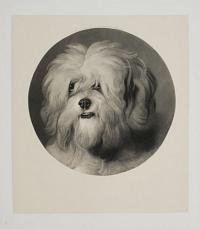
[Cairnach. The picture painted in 1842 is in the possession of Her Majesty the Queen.]
[Sir E. Landseer, R.A. W.J. Josey.]
London, Henry Graves & Co. Dec.r 1.st 1891, Copyright.
Mixed-method engraving on chine collé. 230 x 200mm (9 x 8"), with large margins. Printsellers's Association blind stamp. With printed title sheet.
Circular portrait of the head of Cairnach, Queen Victoria's Skye Terrier, painted by Landseer on Prince Albert's commission as a Christmas present for Victoria in 1842. This engraving was published in the Library Edition of Landseer's work. The original oil is still part of the Royal Collection.
[Ref: 52557] £130.00
(£156.00 incl.VAT)
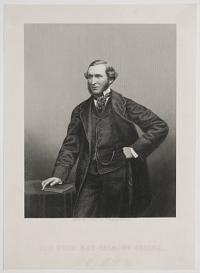
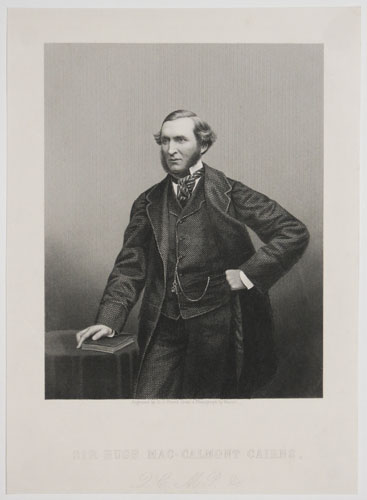
Sir High Mac-Calmomont Cairns. D.C.P.M. &c.
Engraved by D.J. Pound from a Photograph by Mayall.
[n.d., 1859.]
Stipple. Sheet 295 x 215mm (11½ x 8½").
Hugh McCalmont Cairns, 1st Earl Cairns (1819-85) was a British statesman, Lord Chancellor under Benjamin Disraeli. This portrait, from a photograph by John Jabez Edwin Mayall, was taken for a carte-de-visite; this print was published for the 'Illustrated News of the World'.
[Ref: 33297] £60.00
(£72.00 incl.VAT)
![[Cairo.]](img-thumbnail/jpegs/26409.jpg)
[Cairo.]
C.Werner f. 1873.
[London, Hildesheimer & Faulkner, 1875.]
Chromolithograph. Trimmed to image, laid on board, as issued, Image 270 x 385mm, 10¾ x 15¼". Board damaged, some spotting.
A scarce view of Cairo, lithographed by Gustave W. Seitz for 'Carl Werner's Nile Sketches', 1875. Carl Friedrich Heinrich Werner (1808-94), a German watercolourist, traveled through Spain in 1856-7 and visited Egypt and the Holy Land in 1862-4 (publishing his book 'Jerusalem, Bethlehem and the Holy Places' in 1865). He was one of the few non-Muslims able to gain access to paint the interior of the Dome of the Rock.
[Ref: 26409] £130.00
(£156.00 incl.VAT)
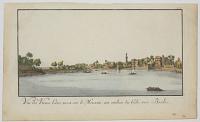
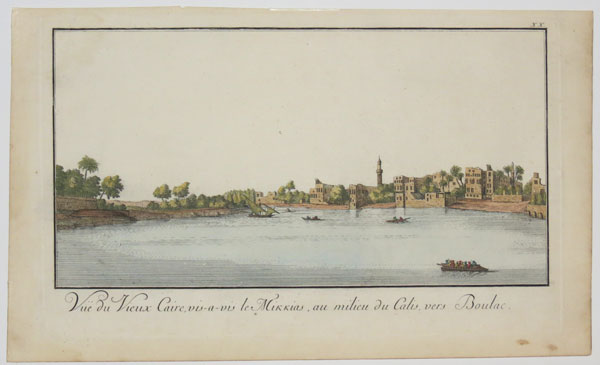
Vuë du Vieux Caire, vis-a-vis le Mikkias, au milieu du Calis, vers Boulac.
[Etched by Carl Marcus Tuscher after Frederick Ludvig Norden.]
[Copenhagen, 1755.]
Coloured etching. 225 x 415mm, 9 x 16¼".
A view of Cairo from the Nile, from Frederik Ludvig Norden's 'Voyage d'Égypte et de Nubie', with the Mokkias, a nilometer built by the Saracens. Norden, a Danish captain, travelled down the Nile through Egypt to Sudan in 1737-8; his account was published over a decade after his death with engravings after his drawings made during the tour.
[Ref: 23663] £140.00
(£168.00 incl.VAT)
The Aquaduct of Cairo and part of Masr-el-Atee Kah from the Island of Er-Rodah.
On stone by J.C. Bourne from a Drawing by Rob.t Hay Esq.r
Printed by C. Hullmandel. [1840.]
Tinted lithograph. 388 x 565mm. 15¼ x 22¼".
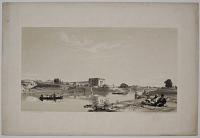
A view of the Cairo aqueduct which extends from the banks of the Nile in the area of Fum al-Khalij, to Sayyida Aisha Square close to the Citadel of Salah al-Din. Plate to Robert Hay's 'Views in Kairo [sic]' (1840), published a few years before David Roberts' lithographs of many of the same locations. Abbey: 270.2
[Ref: 26990] £140.00
(£168.00 incl.VAT)
Cairo. Caire.
A. Schranz del. Deroy lith.
Imp Lemercier a Paris. [n.d,. c.1835]
Coloured lithograph, sheet 290 x 380mm (11½ x 15"), large margins. Crease, tear and some surface dirt in right margin. Abrasion in image top right.
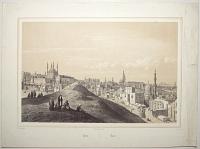
A view of Cairo, the capital of Egypt. Seems to be from an a set of prints from an unidentified series. See 56088. Not in Abbey.
[Ref: 56089] £160.00
(£192.00 incl.VAT)
Grand Cairo; - the Metropolis of Africa.
Published 12 Nov.r 1810 by Rob.t Laurie and Ja.s Whittle, 53, Fleet Street, London.
Coloured engraving, rare. 295 x 440mm, 11½ x 17¼". Trimmed to plate on right, very minor soiling in sky.
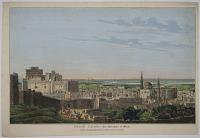
A view looking across Cairo to the Nile and the Pyramids of Giza. The original hand colour is particularly fine.
[Ref: 20703] £490.00
![[Cadiz] Gades, in Beticæ chersoneso, ad Bætis amnis ostia; à Tyriis condita, Herculis delubro quondam notissima; hodie navigationis beneficio opulenta.](jpegs/33382.jpg)
![[The Cadiz Expedition.] D. Fernando Giron.](jpegs/33303.jpg)
![Caernarvon Castle [in pencil]](jpegs/65921.jpg)
![[Caernarvon Castle by moonlight.]](jpegs/40418.jpg)

![[View of the Eagle Tower at Caernarvon.]](jpegs/57517.jpg)
![[Caernarfon Castle.]](jpegs/12332.jpg)
![Caernarvon Castle [pencil].](jpegs/64962.jpg)

![[Where's Master?]](jpegs/62499.jpg)




![[Set of 10 Caesars.]](jpegs/39298.jpg)
![[The Twelve Caesars] III. Tiberius Nero Cæsar.](jpegs/64626.jpg)
![[The Twelve Caesars] IV. C Cæsar Caligula.](jpegs/64627.jpg)
![[The Twelve Caesars] V. Claudius Drusus Cæsar.](jpegs/64628.jpg)
![[The Twelve Caesars] VI. Nero Claudius Cæs.](jpegs/64629.jpg)
![[The Twelve Caesars] VII. Sergius Sulpitius Galba.](jpegs/64630.jpg)
![[The Twelve Caesars] IX. A. Vitellius.](jpegs/64631.jpg)
![[The Twelve Caesars] XII. Titus Favius Domitianus.](jpegs/64632.jpg)

![[Cafre People.]](jpegs/30731.jpg)
![[The Mineral Water lunch of Count Cagliostro]](jpegs/36927.jpg)

![[Adam and Eve Mourning Abel.]](jpegs/49734.jpg)
![[Wasp.]](jpegs/23440.jpg)
![[Cairn Terriers.]](jpegs/47913.jpg)
![[Cairn terrier and rat.]](jpegs/19488.jpg)
![[Hope.] [Cairn Terriers]](jpegs/57225.jpg)

![[Cairo.]](jpegs/26409.jpg)