![[Entrance to the Harbour Of Balaklava.]](img-thumbnail/jpegs/17071.jpg)
[Entrance to the Harbour Of Balaklava.]
[Lithographed by Day & Son from a painting by Carlo Bossoli.]
[London: Day & Son, 1856.]
Subscription edition tinted lithograph, mounted on card and hand coloured. Image 185 x 280mm, 7¼ x 11". Fine colour.
A view of the south coast of the Crimea. From the subscription edition of Bossoli's "Beautiful Scenery and Chief Places of Interest throughout the Crimea", a work with considerable ethnographic and geographic interest, especially in their depictions of Tartar life. Carlo Bossoli (1815-84) visited the Crimea several times between 1828 and 1843, most extensively from 1840 to 1842. When the Crimean War started Bossoli moved to London to capitalise on the heightened interest in his work, even selling paintings to Queen Victoria. Abbey Travel 239.
[Ref: 17071] £180.00
(£216.00 incl.VAT)
![[The Peaks of Mount St Peter.]](img-thumbnail/jpegs/17072.jpg)
[The Peaks of Mount St Peter.]
[Lithographed by Day & Son from a painting by Carlo Bossoli.]
[London: Day & Son, 1856.]
Subscription edition tinted lithograph, mounted on card and hand coloured. Image 185 x 280mm, 7¼ x 11". Fine colour.
Ai-Petri, near Yatla, greek meaning `sacred Peter' or `sacred rock', and derives from the christian monastery which stood on the plateau behind the peak until it was destroyed in the middle ages. Precipitous crags swathed in cloud, a sparkling white limestone peak. From the subscription edition of Bossoli's "Beautiful Scenery and Chief Places of Interest throughout the Crimea", a work with considerable ethnographic and geographic interest, especially in their depictions of Tartar life. Carlo Bossoli (1815-84) visited the Crimea several times between 1828 and 1843, most extensively from 1840 to 1842. When the Crimean War started Bossoli moved to London to capitalise on the heightened interest in his work, even selling paintings to Queen Victoria. Abbey Travel 239.
[Ref: 17072] £140.00
(£168.00 incl.VAT)
![[The Island of Serpents.]](img-thumbnail/jpegs/17073.jpg)
[The Island of Serpents.]
[Lithographed by Day & Son from a painting by Carlo Bossoli.]
[London: Day & Son, 1856.]
Subscription edition tinted lithograph, mounted on card and hand coloured. Image 185 x 280mm, 7¼ x 11". Fine colour. Repaired hole.
Ships in a gale off Ostriv Zmiinyi or Snake Island, a tiny Ukranian possession in the Black Sea near the Danube Delta. From the subscription edition of Bossoli's "Beautiful Scenery and Chief Places of Interest throughout the Crimea", a work with considerable ethnographic and geographic interest, especially in their depictions of Tartar life. Carlo Bossoli (1815-84) visited the Crimea several times between 1828 and 1843, most extensively from 1840 to 1842. When the Crimean War started Bossoli moved to London to capitalise on the heightened interest in his work, even selling paintings to Queen Victoria. Abbey Travel 239.
[Ref: 17073] £160.00
(£192.00 incl.VAT)

Panoramic View of the Southern Coast of the Crimea From Cape Maganom to Kaffa.
Capt.n W.H. Parker Del.t.
Lithographed and Published by Dickinson Bro.s New Bond S.t.
Chromolithograph on four sheets, conjoined. Printed area 230 x 1915mm, 9 x 75½". Some spotting.
A monumental prospect of the south-east coast of the Crimea near Koktebel & Feodosiya, with a key naming the prominent landmarks, including Mount Chernai, the St Elias Monastery, with a smattering of ships. NMM: PAH2659.
[Ref: 16980] £520.00
view all images for this item
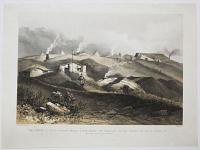
Head Quarters of Second Battalion Brigade of Royal Marines - The Orderley Hut - The Leiu.t Colonel's Hut and the Adjutant's Hut. Above are the mud huts of the men.
H. Bradley Roberts, Lieu.t R.M.A. Dickinson, lith.
[n.d., c.1855.]
Rare tinted lithograph. Sheet 330 x 450mm (13 x 17¾"), with large margins.
A view of the rudimentary lodgings of the Royal Marines in the Crimea. Having served with distinction in the Royal Marines Artillery in the Crimea, Roberts was promoted to colonel and appointed Inspector of Fortifications at the Royal Naval College, Portsmouth, 1862-73. He died in 1891. We have been unable to trace the publication this print appeared in.
[Ref: 49794] £260.00
(£312.00 incl.VAT)
![[Sheep.]](img-thumbnail/jpegs/31034.jpg)
[Sheep.] Vol.2.Pl.26
Geisler del.t Medland Sculp.
[John Stockdale.] [n.d. c.1812.]
Hand-coloured engraving, offset. Plate 159 x 196mm (6¼ x 7¾").
Plate 26: A lamb of the Crimean Sheep breed, having curled wool of a silver-grey tint. In the background is a Tartar village. From Volume 2 of "Travels Through the Southern Provinces of the Russian Empire, in the Years 1793 and 1794".
[Ref: 31034] £60.00
(£72.00 incl.VAT)
![[Fortress of Soldaya.]](img-thumbnail/jpegs/31040.jpg)
[Fortress of Soldaya.] Vol.2.Pl.16.
Geisler del.t Medland Sculp.
[John Stockdale.] [n.d. c.1812.]
Hand-coloured engraving; Stamp: Stamford Library. Plate 197 x 336mm (7¾ x 13¼"). Trimmed along right edge; folds as normal.
Plate 16: view of the ancient Genoese Fortress of Soldaya or Sudagh, drawn from the eastern side of the vale; as well as the Kush-kaya, which lies behind; and being composed of the marmoraceous limestone rock, may afford some ideas of this species of mountains in Taurida. The ascent to the tower is via a wall which is provided with several turrets. From Volume 2 of "Travels Through the Southern Provinces of the Russian Empire, in the Years 1793 and 1794".
[Ref: 31040] £120.00
(£144.00 incl.VAT)
![[St George Monastery.]](img-thumbnail/jpegs/31055.jpg)
[St George Monastery.] Vig.5. Journey Through The South-Western Quarter.
Geisler del. Medland sc.
[John Stockdale.] [n.d. c.1812.]
Hand-coloured engraving with letterpress printed page; stamp: Stamford Library. Sheet 266 x 203mm (10½ x 8").
Vignette 5: a more accurate view of the Greek Monastery of St George. From Volume 2 of "Travels Through the Southern Provinces of the Russian Empire, in the Years 1793 and 1794". See Ref: 31041 for a prospect view of the Monastery.
[Ref: 31055] £65.00
(£78.00 incl.VAT)
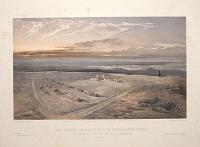
The Graves in the Fort on Cathcart Hill, of the Officers 4th Division who fell at Inkermann, Plate XLV. Colnaghi's Authentic Series.
W. Simpson, del. _ C. Haghe, lith. Day & Son, Lith.rs to the Queen.
Published March 1st 1854, by Paul & Dominic Colnaghi & Co. 13 & 14, Pall Mall East. _Publishers to Her Majesty. Deposé Paris _ Goupil & Cie.
Tinted lithograph. Printed area 240 x 350mm (9½ x 13¾), with large margins. Some spotting.
A graveyard on a hill overlooking Sevastapol, named after one of the officers buried there, General The Honourable Sir George Cathcart. By William Simpson (1823-99) for his 'The Seat of War in the East'. Abbey Travel 237.
[Ref: 53113] £45.00
(£54.00 incl.VAT)
![[Crimean War] Congres de Paris.](img-thumbnail/jpegs/57603.jpg)
[Crimean War] Congres de Paris. La Paix a été signée, aujourn'hui, à l'heure, à l'hôtel des Affaires Etrangères. Le Plénipotentairies de la France, de l'Austriche, de la Grande-Bretagne, de la Prusse, de la Russie, de la Sardaigne et de la Turquie, on aposé leurs signatures au traité qui met fin à la guerre actuelle, et qui, en réglant la question d'Orient, asseoit le repos de l'Europe sur des bases solides et durables.
[n.d., 30th March, 1856.]
Scarce letterpress broadside with woodcut armorial. Sheet 370 x 210mm (14½ x 8¼"). Some creasing, laid on album paper.
A broadside announcing the signing of the peace treaty to end the Crimean War, with the arms of Napoleon III. On the reverse are news clipping relating to the war, including an account of Inkermann.
[Ref: 57603] £160.00
(£192.00 incl.VAT)
![[Akhtiar.]](img-thumbnail/jpegs/31054.jpg)
[Akhtiar.] Vol.2.Pl.4.
Geisler del.t Medland sculp.
[London: John Stockdale, n.d. c.1812.]
Hand-coloured engraving; slight offsetting; stamp: Stamford Library. Plate 197 x 615mm (3¾ x 13¾"). Folds; trimmed to side edges.
Plate 4: view of the port and town of Akhtiar, formerly called Sevastopol; drawn from the Severnaya-Koffa. To the far right can be seen the ruins of the ancient Chersonsus. On the shore in front are the barracks and entrance to a small harbour; a flotilla on the water. From Volume 2 of "Travels Through the Southern Provinces of the Russian Empire, in the Years 1793 and 1794".
[Ref: 31054] £220.00
(£264.00 incl.VAT)
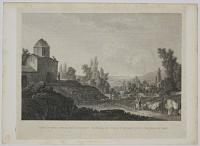
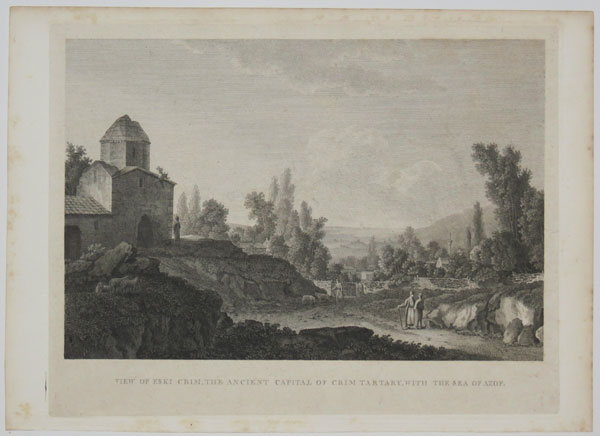
View of Eski Crim, The Ancient Capital of Crim Tartary, with the Sea of Azof.
[London: Published by Septimus Prowett, 23, Old Bond-Street. W. Nicol, Shakespeare Press, Cleveland-Row. 1824.]
Engraving on india. Plate 254 x 324mm. 10 x 12¾".
A view of Eski Crim, the ancient capital of Taurica, with the Sea of Azof in the distance; Crimea. From "Museum Worsleyanum; or a Collection of Antique Basso-Relievos, Bustos, Statues, and Gems' with Views of Places in the Levant. Taken on the Spot in the Years MDCCLXXXXV. VI. and VII." This from Volume II.
[Ref: 23615] £130.00
(£156.00 incl.VAT)
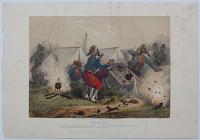
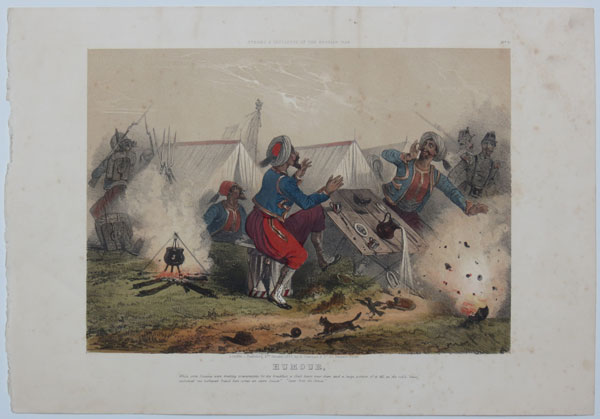
Scenes and Incidents in the Russian War. No. 2. Humour, 'While some Zouaves were making preparations for the breakfast a Shell burst near them and a large portion of it fell on the table 'hallo' exclaimed our turbaned friend here comes an extra saucer.' 'Letter from the Crimea.'
[Painted by Tho.s Barker?]
London _ Published 2nd January 1855 by E. Gambart & Co., 25 Berniers Street.
Coloured lithograph with very large margins. Printed area 290 x 340mm (11½ x 13½"). Slightly foxed.
Turkish troops having their meal interrupted. An illustration probably inspired by William Henry Stowe's column from 'The Times', 'Letter from the Crimea'.
[Ref: 32171] £230.00
(£276.00 incl.VAT)
![[Pair of Prospectuses] Gratis! Gratis!! Gratis!!! The Siege of Sebastopol. A Large and Splendid Engraving,](img-thumbnail/jpegs/37387.jpg)
[Pair of Prospectuses] Gratis! Gratis!! Gratis!!! The Siege of Sebastopol. A Large and Splendid Engraving, Representing this Great Military Event, with be presented - Gratis - to every Subscriber to the undermentioned Work on its completion... The History of England... [&] Premium Plate - Gratis!! On the Completion of the undermentioned Work, every Subscriber will be presented with A Large and Splendid Engraving, exhibiting the Siege Operations of the Allied Armies before Sebastopol... The History of the Present War with Russia... by Henry Tyrell...
Printed and Published by the London Printing and Publishing Company, 97 & 100, St John Street, 1 & 2. Bluecoat Buildings, Christ's Hospital, London; and 55, Dey Street, New York.
Pair letterpress adverts, printed on blue paper. Sheets 285 x 185mm (11¼ x 7¼") & 285 x 180mm (11¼ x 7"), with steel engravings of Florence Nightingale and the Battle of Inkermann on the reverse. Laid on album paper, worm holes.
[Ref: 37387] £140.00
(£168.00 incl.VAT)
view all images for this item
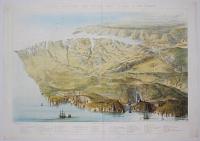
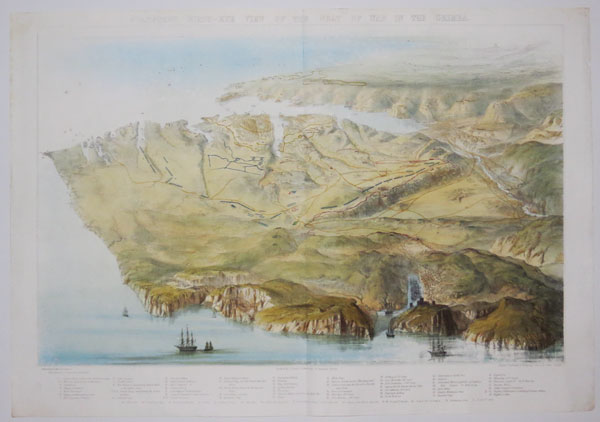
Stanford's Bird's-Eye View of the Seat of War in the Crimea.
Projected and Lithd. by A. Maclure. Maclure, Macdonald, & Macgregor Lith. to the Queen, London.
London,_ Edward Stanford, 6, Charing Cross [c.1854].
Hand-coloured lithograph, large and impressive folding battle plan, with key below. Sheet 525 x 760mm. 20¾ x 30". Very scarce, slight discolouration.
The Crimean peninsula on the northern coast of the Black Sea, as seen from the air, during the Crimean War (October 1853 - February 1856). Showing the positions of troops, gun batteries, fortifications and relevant topographical features. With 'Ackermann & Co' printseller's blindstamp to lower margin. See NM PAH6343.
[Ref: 26456] £280.00
(£336.00 incl.VAT)
![[Birds-eye view of the island of Kronstadt, Russia, with harbours and fortifications.]](img-thumbnail/jpegs/26458.jpg)
[Birds-eye view of the island of Kronstadt, Russia, with harbours and fortifications.] Vue Prise a Vol d'Oiseaux. De L'iIe de Cronstadt avec ses Ports et ses Fortificatons...
Depose [French, n.d., c.1855.]
Large folding tinted lithograph, with key below, with very large margins. Sheet 545 x 740mm, 21½ x 29". creases in middle, as normal.
Kronstadt, on the Baltic island of Kotlin, was fortified by Peter the Great to protect the approaches to his new city of St Petersburg. This impressive prospect was published during the Crimean War, when an Anglo-French fleet opened a second front in the Baltic, with very little success.
[Ref: 26458] £380.00
![[Crimean Sheep.]](img-thumbnail/jpegs/31038.jpg)
[Crimean Sheep.] Vol.2.Pl.25.
Geisler del.t Medland Sculp.
[John Stockdale.] [n.d. c.1812.]
Hand-coloured engraving, offset with large margins; Stamp: Stamford Library. Plate 160 x 196mm (6¼ x 7¾").
Plate 25: a full-grown grey Crimean Sheep belonging to a breed with diminutive fat tails; and which affords the valuable lambskins, by pasturing on the Takhanskoi-Kut. At a distance there is a prospect of the sea; upon which sails a ship. From Volume 2 of "Travels Through the Southern Provinces of the Russian Empire, in the Years 1793 and 1794".
[Ref: 31038] £60.00
(£72.00 incl.VAT)

Kaart van het Toonell des Oorlogs in Turkijë.
Steendr. v. J. Vietheim.
te Rotterdam, bÿ H.V. von Gogh 1853.
Wood-engraved map. Printed area 240 x 230mm, 9½ x 9". Folds.
Map of the countries bordering the western coasts of the Black Sea, including Romania and Bulgaria down to Constantinople. It shows the Danube Campaign, at the beginning of the Crimean War (1853-56), when Russia occupied parts of Moldavia and Wallchia, threatening to seize control of the strategically-vital mouth of the Danube.
[Ref: 26312] £85.00
![[Crimean War] An Episode at the Battle of the Alma, 20 Sep.r 1854.](img-thumbnail/jpegs/63276.jpg)
[Crimean War] An Episode at the Battle of the Alma, 20 Sep.r 1854. Lieutenants Lindsay and Thistlethwaite of the Scots Fusileer Guards, Having with their Sergeants become separated from their Battalion, bravely defended their Colours from an attack by a body of Russians, But being ably assisted by Captain Drummond, whose horse was at that moment shot under him, the gallant bearers of the Standards succeeded in planting their Colours on the Heights of Alma.
Painted by A.F. De Prades Esq. Lithographed by A. Laby Esq.
London, Jan.y 23.rd 1855 Published by J.S. Welsh 24, S.t James's Street.
Tinted lithograph with fine hand colour. Sheet 410 x 575mm (16 x 22¾"). Repaired tear.
Fighting between allied expeditionary forces and Russian forces defending the Crimean Peninsula on 20th September 1854.
[Ref: 63276] £280.00
(£336.00 incl.VAT)

Plan of the attacks and positions of the Allied Armies before Sebastapol in 1854-5. Plate III (To accompany the Report on the Siege of Sebastapol.)
Surveyed and Drawn by Capt.n Cooke, Lieut.s Brine, Fisher, Elphinstone, Cumberland, Anderson, James, C.G.Gordon, Scratchley & Donelly, of the Royal Engineers.. The Outline by F.Boyce, Writing by J.Hutchinson, Hills by G.de Garlieb.
Engraved at the Ordnance Survey Office Southampton in 1858, under the direction of L.t Col.l Cameron, R.E.
Engraved map. 660 x 940mm (26 x 37"). Wear and spotting to edges.
A detailed military map of the focus of the Allied effort in the Crimean War, with Sevastapol and Inkermann in the north and Balaklava in the south. It shows the outline of the town and its harbour, the position of the French military camps encircling the town to the south, the British headquarters further south of the city and the British camp, as well as a couple of Sardinian camps. It also marks the site of the Charge of the Light Brigade at the Battle of Balaclava on Oct. 25, 1854: the use of hachures for relief emphasises the bottleneck into which they rode.
[Ref: 10749] £260.00
![[Crimean War] Bataille d'Inkerman. 5 Novembre 1854.](img-thumbnail/jpegs/63275.jpg)
[Crimean War] Bataille d'Inkerman. 5 Novembre 1854. Guerre d'Orient.
Dessiné et lith. par Guerard, Imp. Lemercier, Paris.
[Goupil et C.ie Paris, Berlin, New York. Publié le 15 X.bre 1854.]
Tinted lithograph with fine hand colour. Sheet 405 x 570mm (16 x 22½"). Trimmed at bottom, losing publication line.
Hand to hand fighting between the British, French and Ottoman infantry and the Russians.
[Ref: 63275] £280.00
(£336.00 incl.VAT)
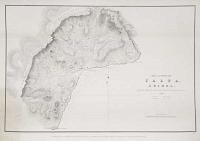
Bay and Fort of Yalta, Crimea; from the Survey by Capt.n E. Manganari, of the Russian Imp.l Navy. 1836.
Engraved & Printed at the Topographical and Statistical Depôt, War Department, 17th Sept.r 1855.
Published by Authority of H.M. Principal Secretary for War and Sold by Mess.rs Williams & Norgate, 14 Henrietta S.t Covent Garden & 20 South Frederick St Edinburgh.
Engraving, with a publisher's blind stamp. Printed area 320 x 460mm, 12½ x 16". Laid on linen.
The Bay of Yalta on the Crimea, important to the Allies as a deep-water bay.
[Ref: 10761] £160.00

Bay of Alushta, Crimea, from the Survey by Capt.n E. Manganari of the Russian Imp.l Navy. 1836.
Engraved and Printed at the Depôt.
Topographical and Statistical Depôt, War Department, 10th Sept.r 1855.
Engraving printed in black and brown, with a publisher's blind stamp. Printed area 300 x 460mm, 12 x 16". Laid on linen.
The Bay of Yalta on the Crimea, important to the Allies as a deep-water bay.
[Ref: 10759] £160.00

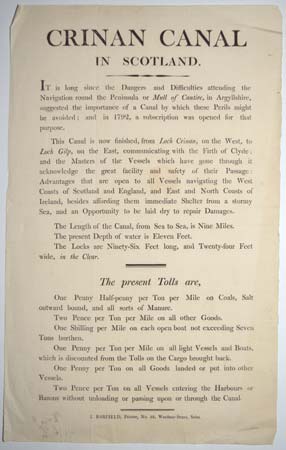
Crinan Canal in Scotland. It is long since the Dangers and Difficulties attending the Navigation round the Peninsula or Mull of Cantire, in Argyllshire, suggested the importance of a Canal by which these Perils might be avoided; and in 1792, a subscription was opened for that purpose. Thhis Canal is now finished...
J. Barfield, Printer, No. 91, Wardour-Street, Soho [n.d., c.1801].
A rare letterpress broadside, 18th century watermark. Sheet 410 x 255mm (16 x 10") Old ink mss. on reverse.
A decription of the Crinan Canal, designed to link the Clyde and the Inner Hebrides bypassing the Kintyre peninsula and opened 1801, including the tolls.
[Ref: 54177] £360.00
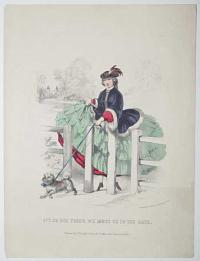
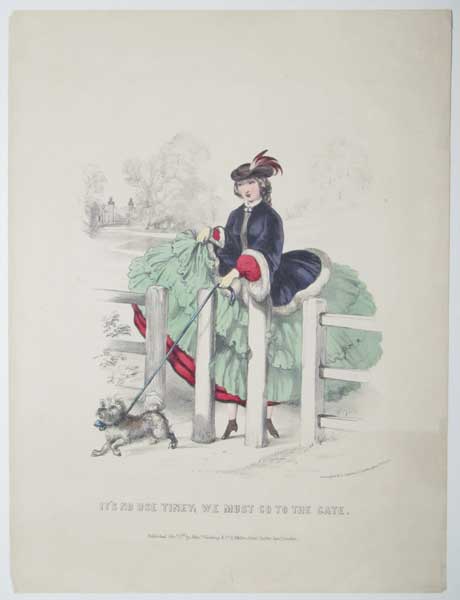
It's no use Tiney, we must go to the gate.
Lithographed by C.J. Culliford, 22, Southampton S.t Strand.
Published Nov.r 11.th by Mess.rs Fielding & C.o. 5, Melton Street, Euston Squ.e. London. [n.d. c.1858.]
Coloured lithograph, 380 x 285mm (15 x 11¼").
A satire on the mid 19th century fashion for crinolines. A woman walking her small dog is blocked by her crinoline dress going through a small passage in a fence.
[Ref: 60113] £140.00
(£168.00 incl.VAT)
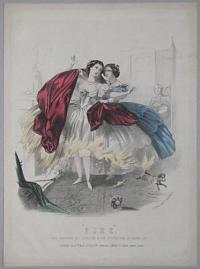
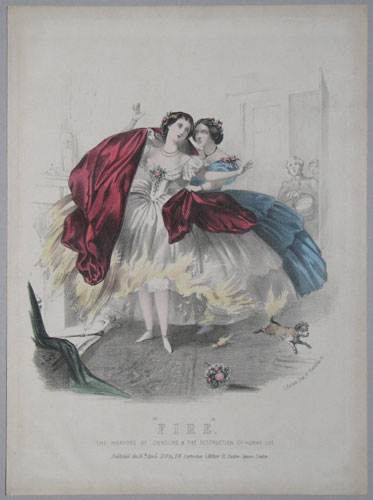
"Fire." The Horrors of Crinoline & the Destruction on Human Life.
L'Enfant, Imp, 18, Rathbone Pl.
Published the 14th. April. 1859 by, F.W. Farbrother, 5, Milton St. Euston Square, London.
Fine original hand coloured lithograph, sheet 375 x 275mm. 14¾ x 10¾".
A satire on mid 19th century female fashion; a young lady's dress has caught fire in an interior. Her terrier flees the scene with its tail on fire, an anxious servant with a bucket of water appears at a door in the background. Crinoline was originally a stiff fabric with a weft of horse-hair and a wrap of cotton or linen thread. The fabric first appeared around 1830, but by 1850 the word had come to mean a stiffened petticoat or rigid skirt-shaped structure of steel designed to support the skirts of a woman’s dress in the required shape. The crinoline was the subject of much ridicule and satire, particularly in Punch magazine. Dress reformers did not like it either — they seized upon the cage aspect of the crinoline and claimed that it effectively imprisoned women. Given that the crinoline did eventually have a maximum diameter of up to 180 centimetres (six feet), it is easy to imagine difficulties in getting through doors, in and out of carriages, and the general problems of moving in such a large structure. The second problem was the potential impropriety of the crinoline. Its lightness was a curse as well as a blessing, as a gust of wind or a knock could set it swinging and reveal the wearer's legs. Even worse, if a woman tripped or was knocked over, the crinoline would hold her skirts up.
[Ref: 13108] £130.00
(£156.00 incl.VAT)
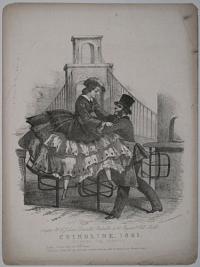
Crinoline 1861. Clearing the Barrier.
London W.H.J. Carter, Printseller, Bookseller, &c. 12, Regent St. Pall Mall. Printed at 22, Southampton St. Strand.
Lithograph, sheet 380 x 285mm. 15 x 11¼". Facsimile mss. publisher's price list to verso, for '...Prints, Illustrative of Crinoline...beautifully coloured'. Tatty extremities, creases through upper corners.
A satire on the mid 19th century fashion for crinolines, from an annual series on that theme by the same publisher. A lady is helped over turnstiles by a gentleman, a bridge, maybe Hammersmith Bridge, in the background. Crinoline was originally a stiff fabric with a weft of horse-hair and a warp of cotton or linen thread. The fabric first appeared around 1830, but by 1850 the word had come to mean a stiffened petticoat or rigid skirt-shaped structure of steel designed to support the skirts of a woman’s dress in the required shape. The crinoline was the subject of much ridicule and satire, particularly in Punch magazine. Dress reformers did not like it either — they seized upon the cage aspect of the crinoline and claimed that it effectively imprisoned women. Given that the crinoline did eventually have a maximum diameter of up to 180 centimetres (six feet), it is easy to imagine difficulties in getting through doors, in and out of carriages, and the general problems of moving in such a large structure. The second problem was the potential impropriety of the crinoline. Its lightness was a curse as well as a blessing, as a gust of wind or a knock could set it swinging and reveal the wearer's legs. Even worse, if a woman tripped or was knocked over, the crinoline would hold her skirts up.
[Ref: 15154] £180.00
(£216.00 incl.VAT)
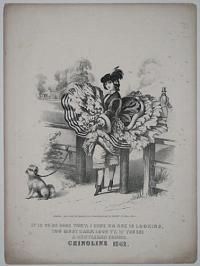
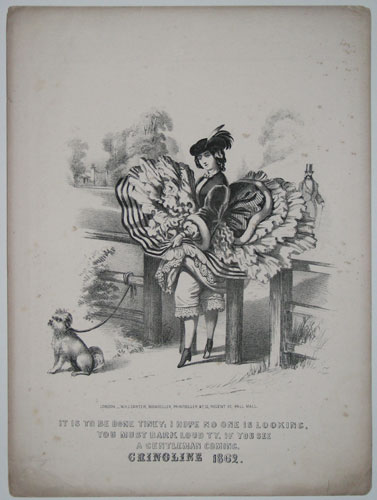
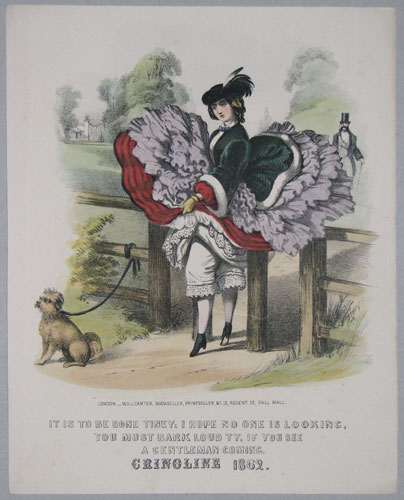
It is to be done Tiney; I hope no one is looking, You must bark loud Ty, If you see a Gentleman coming. Crinoline 1862.
London_W.H.J. Carter, Bookseller, Printseller, &c., 12, Regent St. Pall Mall.
Lithograph, sheet 380 x 280mm. 15 x 11".
A satire on the mid 19th century fashion for crinolines, from an annual series on that theme by the same publisher. A gust of wind lifts up the skirt of a young lady, revealing her underwear, to the evident delight of a gentleman on the path behind her. The lady's dog looks disgruntled, tethered to a fence. Crinoline was originally a stiff fabric with a weft of horse-hair and a warp of cotton or linen thread. The fabric first appeared around 1830, but by 1850 the word had come to mean a stiffened petticoat or rigid skirt-shaped structure of steel designed to support the skirts of a woman’s dress in the required shape. The crinoline was the subject of much ridicule and satire, particularly in Punch magazine. Dress reformers did not like it either — they seized upon the cage aspect of the crinoline and claimed that it effectively imprisoned women. Given that the crinoline did eventually have a maximum diameter of up to 180 centimetres (six feet), it is easy to imagine difficulties in getting through doors, in and out of carriages, and the general problems of moving in such a large structure. The second problem was the potential impropriety of the crinoline. Its lightness was a curse as well as a blessing, as a gust of wind or a knock could set it swinging and reveal the wearer's legs. Even worse, if a woman tripped or was knocked over, the crinoline would hold her skirts up.
[Ref: 15153] £140.00
(£168.00 incl.VAT)
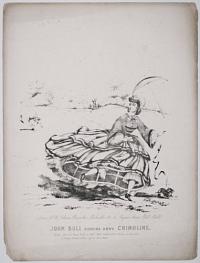
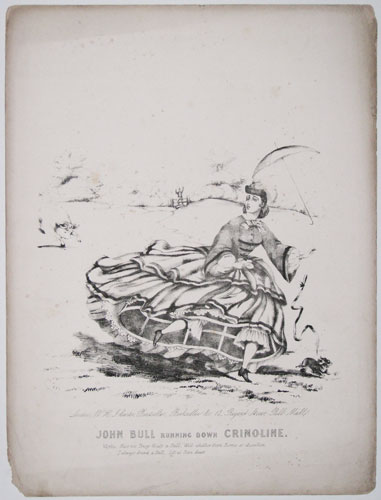
John Bull Running Down Crinoline.
London W.H.J. Carter, Printseller, Bookseller &c. 12, Regent Street Pall Mall.
Lithograph, sheet 380 x 285mm. 15 x 11¼". Tatty extremities, some spotting.
A satire on the mid 19th century fashion for crinolines, from an annual series on that theme by the same publisher. A lady and her toy spaniel (attempt to) run from a charging bull, her parasol falling from her hands. Crinoline was originally a stiff fabric with a weft of horse-hair and a warp of cotton or linen thread. The fabric first appeared around 1830, but by 1850 the word had come to mean a stiffened petticoat or rigid skirt-shaped structure of steel designed to support the skirts of a woman’s dress in the required shape. The crinoline was the subject of much ridicule and satire, particularly in Punch magazine. Dress reformers did not like it either — they seized upon the cage aspect of the crinoline and claimed that it effectively imprisoned women. Given that the crinoline did eventually have a maximum diameter of up to 180 centimetres (six feet), it is easy to imagine difficulties in getting through doors, in and out of carriages, and the general problems of moving in such a large structure. The second problem was the potential impropriety of the crinoline. Its lightness was a curse as well as a blessing, as a gust of wind or a knock could set it swinging and reveal the wearer's legs. Even worse, if a woman tripped or was knocked over, the crinoline would hold her skirts up.
[Ref: 15159] £160.00
(£192.00 incl.VAT)
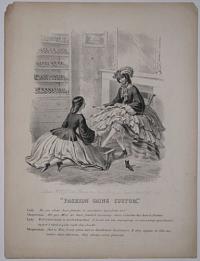
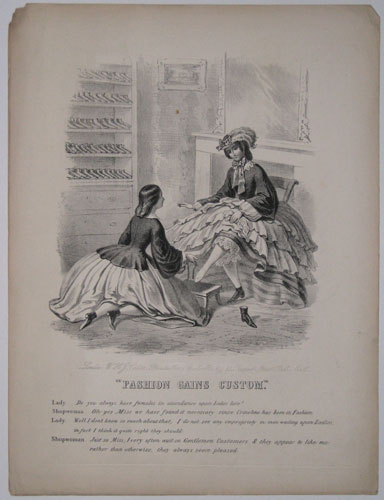
'Fashion Gains Custom.'
London W.H.J. Carter, Printseller, Bookseller &c. 12, Regent Street, Pall Mall.
Lithograph, sheet 380 x 285mm. 15 x 11¼". Facsimile mss. publisher's price list to verso, for '...Prints, Illustrative of Crinoline...beautifully coloured'.
A satire on the mid 19th century fashion for crinolines, from an annual series on that theme by the same publisher. A discussion in a shoe emporium between a fashionable young lady and the female shop assistant reveals a newly instigated policy that male assistants should not serve female customers, 'Since crinoline has been in fashion'. Crinoline was originally a stiff fabric with a weft of horse-hair and a warp of cotton or linen thread. The fabric first appeared around 1830, but by 1850 the word had come to mean a stiffened petticoat or rigid skirt-shaped structure of steel designed to support the skirts of a woman’s dress in the required shape. The crinoline was the subject of much ridicule and satire, particularly in Punch magazine. Dress reformers did not like it either — they seized upon the cage aspect of the crinoline and claimed that it effectively imprisoned women. Given that the crinoline did eventually have a maximum diameter of up to 180 centimetres (six feet), it is easy to imagine difficulties in getting through doors, in and out of carriages, and the general problems of moving in such a large structure. The second problem was the potential impropriety of the crinoline. Its lightness was a curse as well as a blessing, as a gust of wind or a knock could set it swinging and reveal the wearer's legs. Even worse, if a woman tripped or was knocked over, the crinoline would hold her skirts up.
[Ref: 15161] £180.00
(£216.00 incl.VAT)

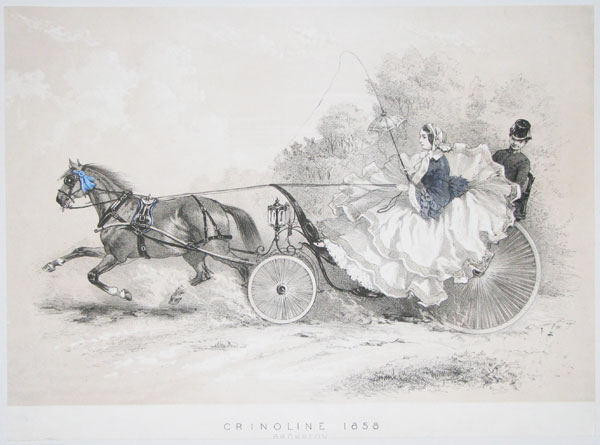
Crinoline 1858. Brompton.
[T.H. Guerin.]
[London, T. Archer.]
Sepia tinted lithograph with colour added by hand, sheet 300 x 405mm. 11¾ x 16". Trimmed to image top and sides.
A satire on mid 19th century female fashion. A male passenger enjoys the view as a female carriage driver's skirt is blown upwards.
[Ref: 8993] £180.00
(£216.00 incl.VAT)

Crinoline 1858. Belgravia.
T.H. Guerin. Del [in image lower left.]
[London, T. Archer.]
Sepia tinted lithograph with colour added by hand, sheet 315 x 415mm. 12½ x 16¼". Trimmed to image top and sides.
A satire on mid 19th century female fashion. A woman in a huge dress rather awkwardly descends from a carriage.
[Ref: 8996] £180.00
(£216.00 incl.VAT)

Crinoline 1858. Cremorne.
T.H. Guerin [in image lower right].
Published by T. Archer [damage] Mortimer Street, Regent Street.
Sepia tinted lithograph with colour added by hand, sheet 345 x 435mm. 13½ x 17". Creases; tear into publication line.
A satire on mid 19th century female fashion set in Cremorne Gardens, once a popular pleasure gardens by the side of the River Thames in Chelsea. A woman in a huge dress descends from a carriage, the driver above ensuring that his reins are well out of the way.
[Ref: 8997] £180.00
(£216.00 incl.VAT)
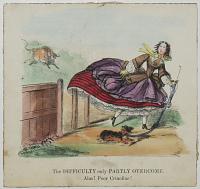
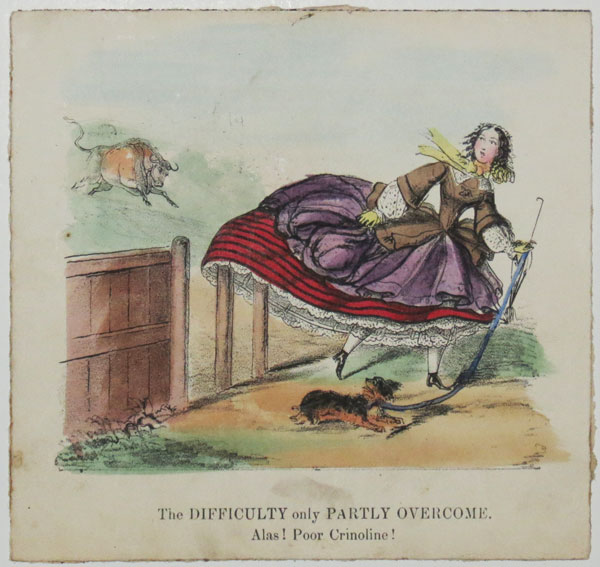
The Diddiculty only Partly Overcome. Alas! Poor Crinoline!
[n.d., c.1840.]
Lithograph with hand colour. Sheet 125 x 130mm (5 x 5¼"). Stain in title.
A woman escaping a bull catches her skirt. Her toy dog looks petrified.
[Ref: 51827] £65.00
(£78.00 incl.VAT)
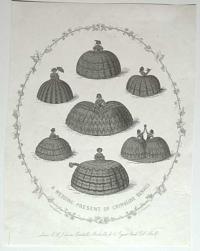
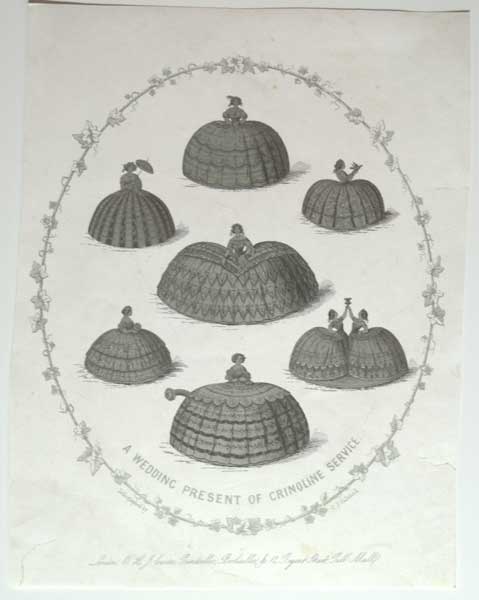
A Wedding Present Of Crinoline Service.
Lithographed by C.J. Culliford.
London, W. H. J. Carter, printseller, Bookseller, &c. 12, Regent Street, Pall Mall. [n.d. c.1850]
Very scarce lithograph, sheet 300 x 230mm (11¾ x 9"). Repaired tears.
A highly decorative satire on crinoline fashion, featuring 8 women in absolutely enormous skirts surrounded by an oval leaf border. W.H.J. Carter made a number of satires on crinoline publishing them annually. See also references 15161, 15159, 15153, 15154, 13109, 15160, 15165, 36835, 36836, 15352, 15353, 15354, 16831 & 42021.
[Ref: 61509] £180.00
(£216.00 incl.VAT)
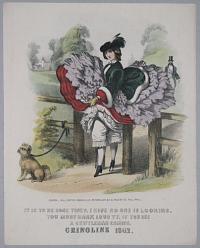
It is to be done Tiney; I hope no one is looking, You must bark loud Ty, If you see a Gentleman coming. Crinoline 1862.
London_W.H.J. Carter, Bookseller, Printseller, &c., 12, Regent St. Pall Mall.
Very fine original hand coloured lithograph, sheet 315 x 255mm. 12½ x 10". Trimmed to image top and sides.
A satire on the mid 19th century fashion for crinolines, from an annual series on that theme by the same publisher. A gust of wind lifts up the skirt of a young lady, revealing her underwear, to the evident delight of a gentleman on the path behind her. The lady's dog looks disgruntled, tethered to a fence. Crinoline was originally a stiff fabric with a weft of horse-hair and a warp of cotton or linen thread. The fabric first appeared around 1830, but by 1850 the word had come to mean a stiffened petticoat or rigid skirt-shaped structure of steel designed to support the skirts of a woman’s dress in the required shape. The crinoline was the subject of much ridicule and satire, particularly in Punch magazine. Dress reformers did not like it either — they seized upon the cage aspect of the crinoline and claimed that it effectively imprisoned women. Given that the crinoline did eventually have a maximum diameter of up to 180 centimetres (six feet), it is easy to imagine difficulties in getting through doors, in and out of carriages, and the general problems of moving in such a large structure. The second problem was the potential impropriety of the crinoline. Its lightness was a curse as well as a blessing, as a gust of wind or a knock could set it swinging and reveal the wearer's legs. Even worse, if a woman tripped or was knocked over, the crinoline would hold her skirts up.
[Ref: 13109] £180.00
(£216.00 incl.VAT)
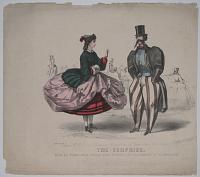
The Surprise. Dear Me Frank who would have thought of you Shewing Up in Crinoline?
Copyright. London, W.H.J. Carter, Printseller, Bookseller &c. 12, Regent Street, Pall Mall.
Hand coloured lithograph, sheet 290 x 325mm. 11½ x 12¾". Facsimile mss. publisher's price list to verso, for '...Prints, Illustrative of Crinoline...beautifully coloured'. Tatty extremities, tear from right.
A satire on the mid 19th century fashion for crinolines, from an annual series on that theme by the same publisher. Here the artist envisages a male equivalent. Crinoline was originally a stiff fabric with a weft of horse-hair and a warp of cotton or linen thread. The fabric first appeared around 1830, but by 1850 the word had come to mean a stiffened petticoat or rigid skirt-shaped structure of steel designed to support the skirts of a woman’s dress in the required shape. The crinoline was the subject of much ridicule and satire, particularly in Punch magazine. Dress reformers did not like it either — they seized upon the cage aspect of the crinoline and claimed that it effectively imprisoned women. Given that the crinoline did eventually have a maximum diameter of up to 180 centimetres (six feet), it is easy to imagine difficulties in getting through doors, in and out of carriages, and the general problems of moving in such a large structure. The second problem was the potential impropriety of the crinoline. Its lightness was a curse as well as a blessing, as a gust of wind or a knock could set it swinging and reveal the wearer's legs. Even worse, if a woman tripped or was knocked over, the crinoline would hold her skirts up.
[Ref: 15160] £190.00
(£228.00 incl.VAT)
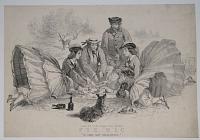
Pic Nic 'Is this not Delightful.'
London, W.H.J. Carter, 12 Regent Street_Pall Mall.
Lithograph, sheet 250 x 370mm. 9¾ x 14½". Sheet trimmed. Tear into image from right.
A satire on the mid 19th century fashion for crinolines, from a large series on that theme by the same publisher. The underwear of the three women enjoying the picnic is exposed by their rigid skirts as they lie on the grass. Crinoline was originally a stiff fabric with a weft of horse-hair and a warp of cotton or linen thread. The fabric first appeared around 1830, but by 1850 the word had come to mean a stiffened petticoat or rigid skirt-shaped structure of steel designed to support the skirts of a woman’s dress in the required shape. The crinoline was the subject of much ridicule and satire, particularly in Punch magazine. Dress reformers did not like it either — they seized upon the cage aspect of the crinoline and claimed that it effectively imprisoned women. Given that the crinoline did eventually have a maximum diameter of up to 180 centimetres (six feet), it is easy to imagine difficulties in getting through doors, in and out of carriages, and the general problems of moving in such a large structure. The second problem was the potential impropriety of the crinoline. Its lightness was a curse as well as a blessing, as a gust of wind or a knock could set it swinging and reveal the wearer's legs. Even worse, if a woman tripped or was knocked over, the crinoline would hold her skirts up.
[Ref: 15165] £140.00
(£168.00 incl.VAT)
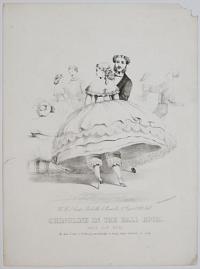
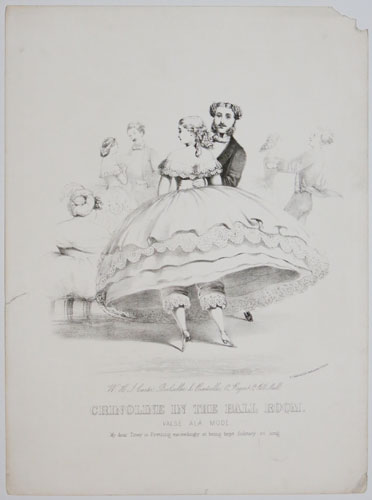
Crinoline in the Ball Room. Valse Ala Mode. My dear Tiney is Fretting exceedingly at being kept Solitary so long.
C.J. Culliford, lith. Southampton S.t. Strand.
W.H.J. Carter, Bookseller & Printseller, 12 Regent S.t. Pall Mall.
Lithograph. Sheet: 280 x 380mm, (11 x 15"). Damage to top right corner. Repaired tear in left edge. Some marks.
A scene in a ballroom depicting a young woman in an extremely large crinoline dancing with a young man, behind them are two other couples.
[Ref: 36835] £140.00
(£168.00 incl.VAT)
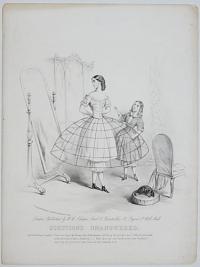
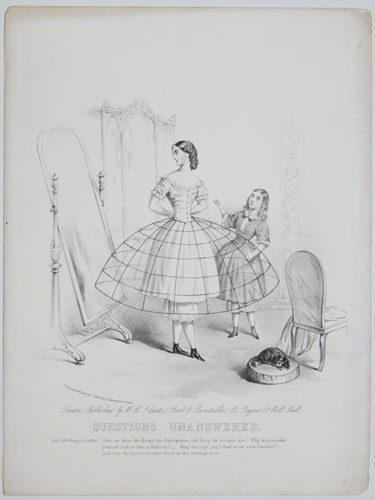
Questions Unanswered. Little Sister Fanny, (Loquitur) "Clara, are these the Hoops the Ethiopians call Hoop de dooden do."_Why do you make yourself look so like a Ballon?_Why does pa say I shall never wear Crinoline?. and why do you never take Tiney in the Carriage now.
Lithographed & Printed by C.J. Calliford, 22, Southampton S.t., Strand.
London, Published by W.H.J. Carter, Book & Printseller, 12, Regent S.t. Pall Mall.
Lithograph. Sheet: 285 x 380mm, (11¼ x 15"). Some slight damage to corners and edges.
Scene in a bedroom in which a young girl questions her older sister, who stands looking at herself in a dressing mirror, about her crinoline.
[Ref: 36836] £140.00
(£168.00 incl.VAT)
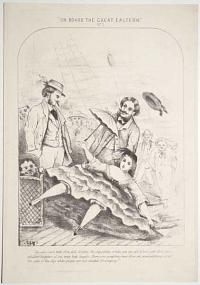
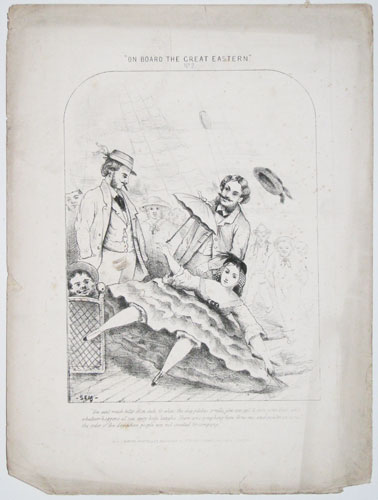
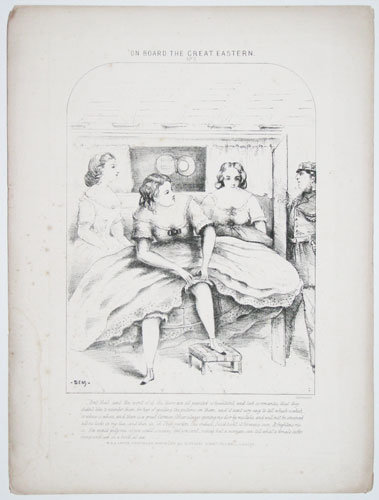
"On Board the Great Eastern" No. 2. You aint much better off on deck, for when the ship pitches or rolls, you are apt to lose your stool...
SEM-
London W.H.J. Carter, Printseller, Bookseller &c. 12, Regent Street, Pall Mall. [n.d., c.1860.]
Lithograph. Printed area 310 x 200mm (12¼ x 8"). Publication line indistinct.
A satire on crinolines on luxury passenger ships, with a woman keeling over, to the amusement of the watching men. With a catalogue of crinoline satires available from Carter on the reverse. Brunel's Great Eastern was launched in 1858, but was damaged by an explosion on her maiden voyage. After only a half-dozen years as a passenger ship she was converted to a cable-laying ship, laying the first lasting transatlantic telegraph cable in 1866.
[Ref: 64197] £160.00
(£192.00 incl.VAT)
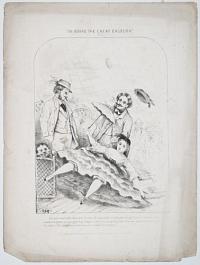
"On Board the Great Eastern" No. 2. You aint much better off on deck, for when the ship pitches or rolls, you are apt to lose your stool...
SEM-
London W.H.J. Carter, Printseller, Bookseller &c. 12, Regent Street, Pall Mall. [n.d., c.1860.]
Lithograph. Printed area 310 x 200mm (12¼ x 8"). Some wear and soiling.
A satire on crinolines on luxury passenger ships, with a woman keeling over, to the amusement of the watching men. With a catalogue of crinoline satires available from Carter on the reverse. Brunel's Great Eastern was launched in 1858, but was damaged by an explosion on her maiden voyage. After only a half-dozen years as a passenger ship she was converted to a cable-laying ship, laying the first lasting transatlantic telegraph cable in 1866.
[Ref: 15353] £180.00
(£216.00 incl.VAT)
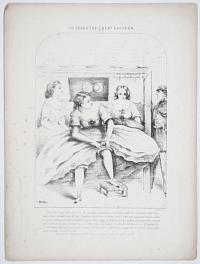
"On Board the Great Eastern" No. 3. But that aint the worst of it; the doors are all painted so beautiful, and look so romantic, that they didn't like to number them...
SEM-
London W.H.J. Carter, Printseller, Bookseller &c. 12, Regent Street, Pall Mall. [n.d., c.1860.]
Lithograph. Printed area 310 x 200mm (12¼ x 8"). Some wear and soiling.
[Ref: 15354] £180.00
(£216.00 incl.VAT)
![[M.r Frank Crisp]](img-thumbnail/jpegs/63693.jpg)
[M.r Frank Crisp]
Spy [Sir Leslie Ward]. [Vincent Brooks, Day & Son, Lith.]
[Vanity Fair. May 31, 1890]
Chromolithograph proof, wit text, sheet 405 x 275mm (16 x 10¾"), large margins.
Full length caricature portrait of English lawyer and microscopist, Frank Crisp (1843-1919), looking through a miscroscope.
[Ref: 63693] £60.00
(£72.00 incl.VAT)

South East View of Critchill House, in the County of Dorset.
Bretherton delt. Thos. Vivares Sculpt.
[n.d. c.1780.]
Engraving and etching. Plate 361 x 495mm. 14¼ x 19½". Two vertical folds.
An ancient residence of the family Napier; probably built by Nathaniel Napier, c.1640. BM: 1870,1008.35.
[Ref: 15737] £230.00
(£276.00 incl.VAT)
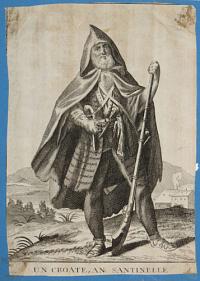
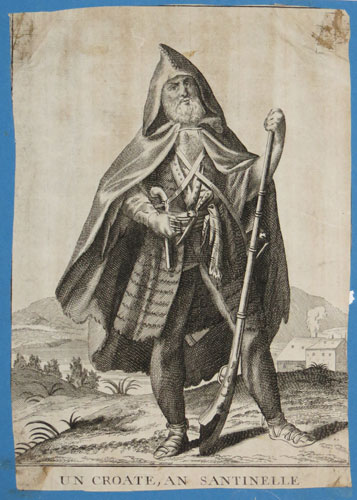
Un Croat, an Santinelle
[unsigned, c.1770]
Engraving, scarce, sheet 250 x 170mm (10 x 6¾"). Trimmed and glued to backing sheet.
[Ref: 47692] £140.00
(£168.00 incl.VAT)
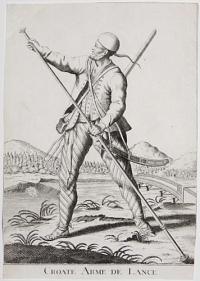
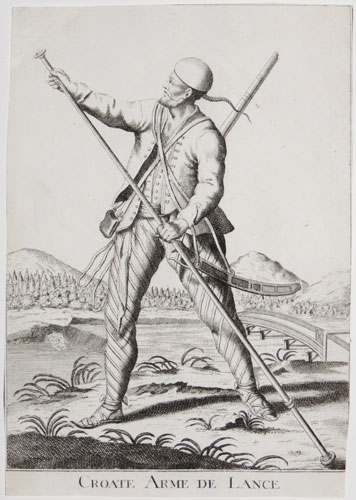
Croate Arme de Lance.
[unsigned, c.1750]
Rare engraving, sheet 260 x 180mm (10¼ x 7"). Trimmed to image; made up top right.
Plate from a volume depicting soldiers from various European countries.
[Ref: 47776] £180.00
(£216.00 incl.VAT)
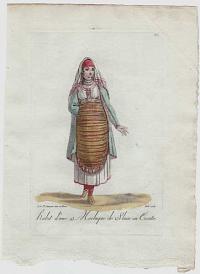
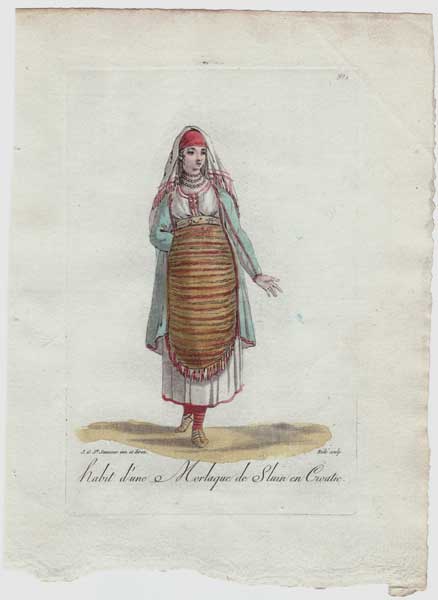
Habit d'une Morlaque de Sluin en Croatie.
J.G. S.t Sauveur inv. et direx. Ridé sculp.
[Paris, c.1800.]
Coloured etching. 170 x 110mm (6¾ c 4¼") ery large margins.
A Morlach woman from Sluin, a pastoralist community in the mountains of Croatia. From ''Costumes de Différent Pays'' by Jacques Grasset de Saint-Sauveur (1757-1810).
[Ref: 61320] £75.00
(£90.00 incl.VAT)
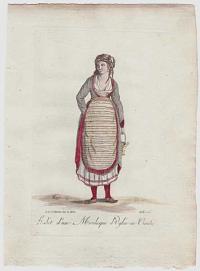
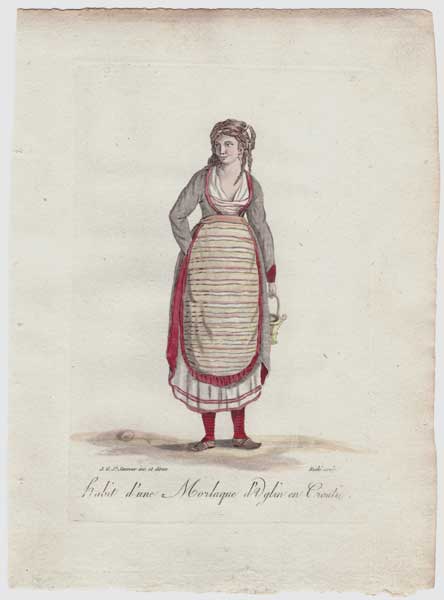
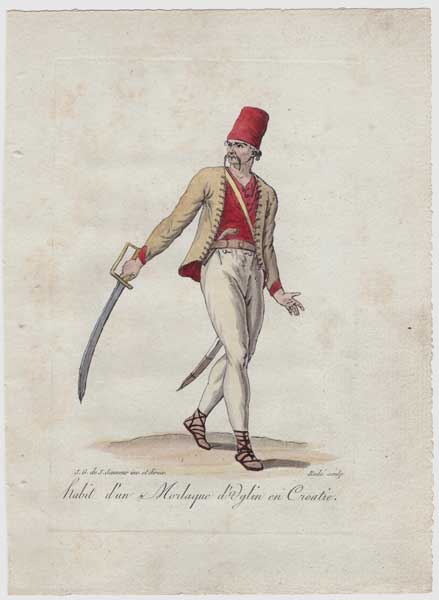
Habit d'une Morlaque d'Uglin en Croatie.
J.G. S.t Sauveur inv. et direx. Ridé sculp.
[Paris, c.1800.]
Coloured etching. 170 x 110mm (6¾ x 4¼"), with very large margins.
A Morlach woman from Sluin, a pastoralist community in the mountains of Croatia. From ''Costumes de Différent Pays'' by Jacques Grasset de Saint-Sauveur (1757-1810).
[Ref: 61321] £70.00
(£84.00 incl.VAT)
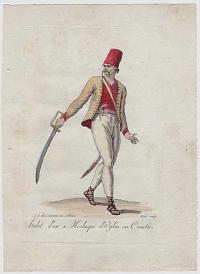
Habit d'une Morlaque d'Uglin en Croatie.
J.G. S.t Sauveur inv. et direx. Ridé sculp.
[Paris, c.1800.]
Coloured etching. 170 x 110mm (6¾ x 4¼"), with very large margins.
A Morlach man from Sluin, a pastoralist community in the mountains of Croatia. From ''Costumes de Différent Pays'' by Jacques Grasset de Saint-Sauveur (1757-1810).
[Ref: 61322] £70.00
(£84.00 incl.VAT)
![[Entrance to the Harbour Of Balaklava.]](jpegs/17071.jpg)
![[The Peaks of Mount St Peter.]](jpegs/17072.jpg)
![[The Island of Serpents.]](jpegs/17073.jpg)


![[Sheep.]](jpegs/31034.jpg)
![[Fortress of Soldaya.]](jpegs/31040.jpg)
![[St George Monastery.]](jpegs/31055.jpg)

![[Crimean War] Congres de Paris.](jpegs/57603.jpg)
![[Akhtiar.]](jpegs/31054.jpg)
![[Pair of Prospectuses] Gratis! Gratis!! Gratis!!! The Siege of Sebastopol. A Large and Splendid Engraving,](jpegs/37387.jpg)
![[Birds-eye view of the island of Kronstadt, Russia, with harbours and fortifications.]](jpegs/26458.jpg)
![[Crimean Sheep.]](jpegs/31038.jpg)

![[Crimean War] An Episode at the Battle of the Alma, 20 Sep.r 1854.](jpegs/63276.jpg)

![[Crimean War] Bataille d'Inkerman. 5 Novembre 1854.](jpegs/63275.jpg)








![[M.r Frank Crisp]](jpegs/63693.jpg)