![[General George Pollock.]](img-thumbnail/jpegs/66160.jpg)
[General George Pollock.]
[Painted by F. Grant R.A. Engraved by J.J. Chant.]
[London, Published by Henry Graves & Comp.y May 1.st 1857, Printsellers to the Queen_ 6 Pall Mall.]
Mezzotint, proof before letters, printed on chine collé. 550 x 420mm (21½ x 16½"), PSA blindstamp, large margins. Backing sheet toned.
A three-quarter portrait of Sir George Pollock (1786-1872), in uniform. An officer of the Indian Army, he was a hero of the First Afghan War, relieving Sale at Jalalabad and capturing Kabul. Ex: collection of The Hon. Christopher Lennox-Boyd. PSA Proof of 200.
[Ref: 66160] £380.00
![[General George Pollock.] Geo. Pollock [facsimile signature].](img-thumbnail/jpegs/66161.jpg)
[General George Pollock.] Geo. Pollock [facsimile signature].
Painted by F. Grant R.A. Engraved by J.J. Chant.
London, Published by Henry Graves & Comp.y May 1.st 1857, Printsellers to the Queen_ 6 Pall Mall.
Mezzotint, proof before title. 550 x 420mm (21½ x 16½"), PSA blindstamp, large margins. Damps stains on left.
A three-quarter portrait of Sir George Pollock (1786-1872), in uniform. An officer of the Indian Army, he was a hero of the First Afghan War, relieving Sale at Jalalabad and capturing Kabul. Ex: collection of The Hon. Christopher Lennox-Boyd. PSA Proof of 200.
[Ref: 66161] £360.00
![[General George Pollock.]](img-thumbnail/jpegs/66104.jpg)
[General George Pollock.]
[Painted by F. Grant R.A. Engraved by J.J. Chant.]
[London, Published by Henry Graves & Comp.y May 1.st 1857, Printsellers to the Queen_ 6 Pall Mall.]
Mezzotint, proof before letters, printed on chine collé. 550 x 420mm (21½ x 16½"), very large margins. Edges of backing sheet toned.
A three-quarter portrait of Sir George Pollock (1786-1872), in uniform. An officer of the Indian Army, he was a hero of the First Afghan War, relieving Sale at Jalalabad and capturing Kabul. Ex: collection of The Hon. Christopher Lennox-Boyd. Printsellers' Association Proof of 200.
[Ref: 66104] £380.00
![[Polo Match.]](img-thumbnail/jpegs/15941.jpg)
[Polo Match.]
Jeanniot 1911 [facsimile in bottom left-hand corner.]
[Imprimé pour M.Maurice Lonquety.]
Etching. 395 x 560mm (15½ x 22"), wide margins.
Pierre Georges Jeanniot (1848-1934) was a French painter, designer, watercolourist, and engraver; born in Geneva, Switzerland, and died in France. Leipnik: A History of French Etching, pp. 184 & 185.
[Ref: 15941] £480.00
![Naar Stal Toe [on publisher's label on reverse].](img-thumbnail/jpegs/52108.jpg)
Naar Stal Toe [on publisher's label on reverse].
René Vincent.
Uitgave: N.V. Uitgeversvennootschap v.h. Erven Martin G. Cohen 's-Gravenhage. [n.d. c.1925.]
Rare chromolithograph. Sheet 415 x 480mm (16¼ x 19") very large margins. Slight crease in image.
'To the Stables.' An Art Deco scene of a female groom leading a prancing polo pony ridden by another woman. Both women have china-doll faces. René Vincent (1879-1936) is famous for his Art Deco posters for Bugatti, Peugeot, Michelin and Shell Oil Company.
[Ref: 52108] £280.00
(£336.00 incl.VAT)
![[Polo in India.]](img-thumbnail/jpegs/67930.jpg)
[Polo in India.]
[Photographed c.1880.]
Photograph. Sheet 185 x 235mm (7¼ x 9¼"). Small crease bottom right.
Four European polo players on horses posing with their mallets, probably in India.
[Ref: 67930] £130.00
(£156.00 incl.VAT)
![[Polo Match.]](img-thumbnail/jpegs/45013.jpg)
[Polo Match.]
Jeanniot. 15/100.
[Printed by M.Maurice Lonquety, c.1911.]
Etching, signed in pencil. 395 x 560mm (15½ x 22") very large margins.
Pierre Georges Jeanniot (1848-1934) was a French painter, designer, watercolourist, and engraver; born in Geneva, Switzerland, and died in France. Leipnik: A History of French Etching, pp. 184 & 185.
[Ref: 45013] £450.00
![[Two mounted polo players in conversation.]](img-thumbnail/jpegs/11004.jpg)
[Two mounted polo players in conversation.]
Andre Mare [signed in pencil lower right.]
Epreuve d'artiste 15/15 [in pencil lower left.] [n.d., c.1940s.]
Lithograph, signed artist's proof from an edition limited to 15. Image 290 x 340mm, 11½ x 13½". A fine proof impression with full margins.
By André Mare (1885 - 1932), French painter and printmaker.
[Ref: 11004] £480.00
![[Le Polo (Spectateurs au Polo).]](img-thumbnail/jpegs/3441.jpg)
[Le Polo (Spectateurs au Polo).]
Jeanniot. [Signed in pencil.]
[n.d., 1911.]
Etching, 330 x 430mm.
Leipnik: A History of French Etching, pp. 184 & 185.
[Ref: 3441] £420.00
![[Le Polo (Spectateurs au Polo).]](img-thumbnail/jpegs/14205.jpg)
[Le Polo (Spectateurs au Polo).]
[Jeanniot.]
[n.d., 1911.]
Trial proof. Etching. Plate 400 x 527mm. 15¾ x 20¾".
Leipnik: A History of French Etching, pp. 184 & 185.
[Ref: 14205] £420.00
![[Landscape with large trees.]](img-thumbnail/jpegs/35463.jpg)
[Landscape with large trees.]
Ric. Cooper del. 1802
Pen lithograph, rare; sheet 235 x 325mm (9¼ x 12¾"). Glued to backing sheet at corners; unidentified collector's stamp verso. Trimmed to image as usual.
One of the twelve pen lithographs from 'Specimens of Polyauthography', the first set of artist's lithographs ever published (by Philipp André in 1803). The new medium allowed artists to draw directly onto a prepared stone, allowing artists to make prints which arguably resembled drawings more than any earlier printmaking technique. Unlike many printmaking techniques, lithography required no special training as artists could work directly onto the plate and leave specialist printers to actually make the prints. For this reason many artists who were not trained printmakers (such as Géricault and Delacroix) often worked in lithography. Cooper (1740-1814) had studied in Paris with the famous engraver J.-P. Le Bas and earned the nickname 'the English Poussin' for his depictions of Rome and its surroundings. After succeeding Alexander Cozens as drawing master at Eton in 1768, in later life he became drawing master to Princess Charlotte (1796-1814). For a print by Princess Charlotte, see ref. 23168; Ex: Collection of the Late Hon. C. Lennox-Boyd.
[Ref: 35463] £240.00
(£288.00 incl.VAT)
![[Woman wearing gown and holding torch]](img-thumbnail/jpegs/35481.jpg)
[Woman wearing gown and holding torch]
Mr Downman del. [1806]
Pen lithograph, sheet 320x 235mm (12½ x 9¼").
Early pen lithograph from the second issue of 'Specimens of Polyautography' (1807), the first (1803) issue of which was the first set of artist's lithographs ever published. 'Specimens' showcased the new medium of lithography, which allowed artists to make prints arguably resembling drawings more than any earlier technique. Unlike most printmaking techniques, lithography required no special training as artists could work directly onto the plate and leave specialist printers to actually make the prints. For this reason many artists who were not trained printmakers (such as Géricault and Delacroix) often worked in lithography. By John Downman (1750-1824), portrait and subject painter. During the 1780s Downman gained a reputation as one of the most fashionable portrait painters in London, but his popularity declined in the 1790s. For much of his career Downman preferred to work in chalk rather than oil, with a large collection of his chalk portraits now in the British Museum. This may be the only print he ever made. For a book on Downman's life and work, see ref. 10198.
[Ref: 35481] £290.00
(£348.00 incl.VAT)
![[Thatched cottage in a landscape]](img-thumbnail/jpegs/35466.jpg)
[Thatched cottage in a landscape]
H Ker 1807 [top left]. 1807 [lower left]
Rare pen lithograph. printed area 225 x 310mm (8¾ x 12¼"). Slight creasing; on cream wove paper.
Early lithograph by Charles Henry Bellenden Ker (c.1785-1871), whose work was included in the second issue of 'Specimens of Polyautography' issued in 1807. The first part of 'Specimens' (1803) was the first set of artist's lithographs ever published, showcasing the new medium which allowed artists to make prints arguably resembling drawings more than any earlier technique. Unlike most printmaking techniques, lithography required no special training as artists could work directly onto the plate and leave specialist printers to actually make the prints. For this reason many artists who were not trained printmakers (such as Géricault and Delacroix) often worked in lithography. Ker was a law reformer, particularly in the area of statue law, but he also had a lifelong interest in art and science, as this early print demonstrates. Ker's father was a prominent botanist and he inherited this interest, becoming one of the first private growers of orchids in Britain, and providing the sketches for an important book on chinese plants. Ex: Collection of the Late Hon. C. Lennox-Boyd.
[Ref: 35466] £220.00
(£264.00 incl.VAT)
![[Thatched cottage in a landscape]](img-thumbnail/jpegs/35467.jpg)
[Thatched cottage in a landscape]
H Ker 1807 [top left]. 1807 [lower left]
Pen lithograph with large margins, rare, printed area 225 x 310mm (8¾ x 12¼"). On white wove paper; watermarked 'C 1806'; crease lower right. Fine impression.
Early lithograph by Charles Henry Bellenden Ker (c.1785-1871), whose work was included in the second issue of 'Specimens of Polyautography' issued in 1807. The first part of 'Specimens' (1803) was the first set of artist's lithographs ever published, showcasing the new medium which allowed artists to make prints arguably resembling drawings more than any earlier technique. Unlike most printmaking techniques, lithography required no special training as artists could work directly onto the plate and leave specialist printers to actually make the prints. For this reason many artists who were not trained printmakers (such as Géricault and Delacroix) often worked in lithography. Ker was a law reformer, particularly in the area of statue law, but he also had a lifelong interest in art and science, as this early print demonstrates. Ker's father was a prominent botanist and he inherited this interest, becoming one of the first private growers of orchids in Britain, and providing the sketches for an important book on chinese plants. Ex: Collection of the Late Hon. C. Lennox-Boyd.
[Ref: 35467] £260.00
(£312.00 incl.VAT)
![[Landscape with deer under tree.]](img-thumbnail/jpegs/35470.jpg)
[Landscape with deer under tree.]
J Laporte.
[London printed from stone at the polyautographic office, No 9 Buckingham Place, Fitzroy Square.]
Pen lithograph, sheet 200 x 305mm (8 x 12"). Trimmed, losing publication line.
Early pen lithograph first published in 'Specimens of Polyautography' (1807), although probably a later impression. The first (1803) issue of 'Specimens' was the first set of artist's lithographs ever published. 'Specimens' showcased the new medium of lithography, which allowed artists to make prints arguably resembling drawings more than any earlier technique. Unlike most printmaking techniques, lithography required no special training as artists could work directly onto the plate and leave specialist printers to actually make the prints. For this reason many artists who were not trained printmakers (such as Géricault and Delacroix) often worked in lithography. By John Peter Laporte (1761-1839), watercolour painter in the tradition of Paul Sandby. Laporte built up a considerable practice as a drawing master, and his methods can be seen in his 1812 lesson book 'The Progress of a Water-Coloured Drawing'. Ex: Collection of the Late Hon. C. Lennox-Boyd.
[Ref: 35470] £120.00
(£144.00 incl.VAT)
![[Knight on horseback in a rocky landscape]](img-thumbnail/jpegs/35474.jpg)
[Knight on horseback in a rocky landscape]
E.V. Utterson 1806 [in image lower left]
London printed from stone at the polyautographic office, No 9 Buckingham Place, Fitzroy Square
Pen lithograph, very rare, sheet 320x 235mm (12½ x 9¼"). Glued at corners to original aquatint mount watermarked 'J[oseph] Ruse 1804' (platemark 425 x 330mm, 16¾ x 13"); slight creasing and glue residue at corners; slight foxing.
Early pen lithograph from the second issue of 'Specimens of Polyautography' (1807), the first (1803) issue of which was the first set of artist's lithographs ever published. 'Specimens' showcased the new medium of lithography, which allowed artists to make prints arguably resembling drawings more than any earlier technique. Unlike most printmaking techniques, lithography required no special training as artists could work directly onto the plate and leave specialist printers to actually make the prints. For this reason many artists who were not trained printmakers (such as Géricault and Delacroix) often worked in lithography. One of only a handful of prints made by Edward Vernon Utterson (bap.1777, d.1856), antiquary and literary editor. Utterson reprinted or edited a large number of early works of English literature, most notably those of Samuel Rowlands. He was a founding member of the Roxburghe Club, 'the oldest society of bibliophiles in the world', in 1812, along with fellow collectors such as Sir Francis Freeling. For Freeling, see ref. 21624; Ex: Collection of the Late Hon. C. Lennox-Boyd.
[Ref: 35474] £290.00
(£348.00 incl.VAT)
![[Houses by a stream, with a bridge.]](img-thumbnail/jpegs/26890.jpg)
[Houses by a stream, with a bridge.]
W.H. Pyne 1806 [in image].
London, printed from stone at the polyautographic office, No. 9 Buckingham-Place, Fitzroy-Square.
Pen lithograph (polyautograph), rare, sheet 255 x 330mm. 10 x 13". Tape residue to upper corners; laid on conservation tissue.
This print appeared in the first published portfolio of drawings made by artists specifically for multiplication by lithography. Entitled 'Specimens of Polyautography', the collection was brought out by Philippe André in London in 1803 and consisted solely of pen lithographs. Contributors included Thomas Stothard R.A. and Richard Corbould. Six parts of six prints were planned but in the event only two parts appeared. The portfolio was re-issued in 1806 by G J Vollweiler, with additions. William Henry Pyne (1769-1843) was an English writer, painter and illustrator, who first exhibited at the Royal Academy in 1790. He specialized in picturesque settings including groups of people rendered in pen, ink and watercolour. Pyne was one of the founders of Royal Watercolour Society in 1804. Not in Abbey. See V&A E.1136-1899.
[Ref: 26890] £85.00
(£102.00 incl.VAT)
Unfortunately this item is either sold or reserved. If you are interested in similar items and cannot find what you're looking for on our website, please consider filling in our interests form. If you register, we can also send you items that match your interests when the website is updated.
![[Shepherd resting in a field.]](img-thumbnail/jpegs/39429.jpg)
[Shepherd resting in a field.]
Boyne [by John Boyne, 1806]
Pen lithograph, sheet 225 x 310mm (8¾ x 12½"). Glued to original backing sheet at top corners with printed border. Foxing.
Early lithograph by John Boyne (1750s-1810), Irish watercolour painter and engraver who lived a colourful and varied life. After moving to England at 9 years old and serving an apprenticeship to engraver William Byrne, Boyne soon gave up printmaking to join a company of strolling actors in Essex. He later took to the pearl-setting trade and worked as a drawing-master. Nonetheless he exhibited regularly at the Royal Academy in his later years, with works including Shakespearean heads reminiscent of J.H. Mortimer, and busy Rowlandsonesque social scenes. This print was included in the 1806 edition of the first portfolio of artists' lithographs, 'Specimens of Polyauthography', showing that even towards the end of his life Boyne was involved in new technical developments in printmaking. The new medium allowed artists to draw directly onto a prepared stone, allowing artists to make prints which arguably resembled drawings more than any earlier printmaking technique. Unlike many printmaking techniques, lithography required no special training as artists could work directly onto the plate and leave specialist printers to actually make the prints. For this reason many artists who were not trained printmakers (such as Géricault and Delacroix) often worked in lithography. Ex: The collection of the Hon. Christopher Lennox-Boyd.
[Ref: 39429] £450.00
Unfortunately this item is either sold or reserved. If you are interested in similar items and cannot find what you're looking for on our website, please consider filling in our interests form. If you register, we can also send you items that match your interests when the website is updated.
![[Blasted tree with pensive traveller.]](img-thumbnail/jpegs/36947.jpg)
[Blasted tree with pensive traveller.]
Ric. Cooper del. 1802
Pen lithograph, scarce; sheet 230 x 320mm (9¼ x 12½"). Nicks and tears to edges; hole middle right, losses on left & right bottom, trimmed.
Early lithograph by Richard Cooper (1740-1814). The son of another engraver, Cooper worked for a time in Italy, where he befriended Alexander Runciman and developed a style of landscape painting similar to that of Runciman (he became known as the 'English Poussin'). After marrying in Edinburgh in 1777, Cooper settled in London around 1787, where he dedicated himself to drawing (he became drawing master at Eton) and printmaking. This lithograph was included in the first portfolio of artists' lithographs, 'Specimens of Polyauthography'. The new medium allowed artists to draw directly onto a prepared stone, allowing artists to make prints which arguably resembled drawings more than any earlier printmaking technique. Unlike many printmaking techniques, lithography required no special training as artists could work directly onto the plate and leave specialist printers to actually make the prints. For this reason many artists who were not trained printmakers (such as Géricault and Delacroix) often worked in lithography. Ex: collection of the Late Hon. C. Lennox-Boyd.
[Ref: 36947] £140.00
(£168.00 incl.VAT)
![[Ruined abbey among trees]](img-thumbnail/jpegs/36948.jpg)
[Ruined abbey among trees]
[by Richard Cooper, 1802]
Pen lithograph, sheet 220 x 325mm (9 x 12½"). Glued to backing sheet. Trimmed to subject.
Early lithograph by Richard Cooper (1740-1814). The son of another engraver, Cooper worked for a time in Italy, where he befriended Alexander Runciman and developed a style of landscape painting similar to that of Runciman (he became known as the 'English Poussin'). After marrying in Edinburgh in 1777, Cooper settled in London around 1787, where he dedicated himself to drawing (he became drawing master at Eton) and occasionally printmaking. This lithograph was included in the 1807 edition of the first portfolio of artists' lithographs, 'Specimens of Polyauthography'. The new medium allowed artists to draw directly onto a prepared stone, allowing artists to make prints which arguably resembled drawings more than any earlier printmaking technique. Unlike many printmaking techniques, lithography required no special training as artists could work directly onto the plate and leave specialist printers to actually make the prints. For this reason many artists who were not trained printmakers (such as Géricault and Delacroix) often worked in lithography. Ex: collection of the Late Hon. C. Lennox-Boyd.
[Ref: 36948] £240.00
(£288.00 incl.VAT)
![[Cavalry Charge.]](img-thumbnail/jpegs/36701.jpg)
[Cavalry Charge.]
[Conrad Gessner, 1801.]
Pen lithograph, sheet 230 x 315mm (9 x 12½"). Good impression; pinhole top centre.
Pen lithograph, probably taken from 'Specimens of Polyautography', the first set of artist's lithographs ever published (by Philipp André in 1803). The new medium allowed artists to draw directly onto a prepared stone, allowing artists to make prints which arguably resembled drawings more than any earlier printmaking technique. Unlike many printmaking techniques, lithography required no special training as artists could work directly onto the plate and leave specialist printers to actually make the prints. For this reason many painters who were not trained printmakers (such as Géricault and Delacroix) produced lithographs. Made by Conrad Gessner (1764-1826), Swiss artist working in England 1796-1804. Ex: collection of the late Hon. C. Lennox-Boyd.
[Ref: 36701] £450.00
![[Landscape with old trees by water.]](img-thumbnail/jpegs/36937.jpg)
[Landscape with old trees by water.]
[by Henry Richard Greville, c.1804.]
Pen lithograph, sheet 305 x 220mm (12 x 8¾"). Trimmed.
Early lithograph by Henry Richard Greville, Lord Brooke, 3rd Earl of Warwick (1779-1853) and included in the first portfolio of artists' lithographs, 'Specimens of Polyauthography'. The new medium allowed artists to draw directly onto a prepared stone, allowing artists to make prints which arguably resembled drawings more than any earlier printmaking technique. Unlike many printmaking techniques, lithography required no special training as artists could work directly onto the plate and leave specialist printers to actually make the prints. For this reason many artists who were not trained printmakers (such as Géricault and Delacroix) often worked in lithography. Ex: collection of the Late Hon. C. Lennox-Boyd.
[Ref: 36937] £260.00
(£312.00 incl.VAT)
![[Landscape with old trees by water.]](img-thumbnail/jpegs/36938.jpg)
[Landscape with old trees by water.]
[by Henry Richard Greville, c.1804]
Pen lithograph, very rare; sheet 305 x 220mm (12 x 8¾"). Fine impression; very slight hole. Trimmed.
Early lithograph by Henry Richard Greville, Lord Brooke, 3rd Earl of Warwick (1779-1853) and included in the first portfolio of artists' lithographs, 'Specimens of Polyauthography'. The new medium allowed artists to draw directly onto a prepared stone, allowing artists to make prints which arguably resembled drawings more than any earlier printmaking technique. Unlike many printmaking techniques, lithography required no special training as artists could work directly onto the plate and leave specialist printers to actually make the prints. For this reason many artists who were not trained printmakers (such as Géricault and Delacroix) often worked in lithography. Ex: collection of the Late Hon. C. Lennox-Boyd.
[Ref: 36938] £260.00
(£312.00 incl.VAT)
![[Apollo as a winged warrior.]](img-thumbnail/jpegs/36934.jpg)
[Apollo as a winged warrior.]
C Heath del.
Pen lithograph, rare & trimmed; sheet 320 x 235mm (12½ x 9¼"). Vertical crease; nicks to edges.
Early lithograph by Charles Heath (1785-1830), landscape and figure engraver. A precocious talent and part of a family of printmakers, Heath was early to experiment with new techniques. He exhibited lithographs such as this at Somerset House from 1802 to 1806, and this print was included in the 1806 edition of the first portfolio of artists' lithographs, 'Specimens of Polyauthography' (first edition published by Philipp André in 1803). The new medium allowed artists to draw directly onto a prepared stone, allowing artists to make prints which arguably resembled drawings more than any earlier printmaking technique. Unlike many printmaking techniques, lithography required no special training as artists could work directly onto the plate and leave specialist printers to actually make the prints. For this reason many artists who were not trained printmakers (such as Géricault and Delacroix) often worked in lithography. Ex: collection of the Late Hon. C. Lennox-Boyd
[Ref: 36934] £260.00
(£312.00 incl.VAT)
![[Rural landscape with horse and cart]](img-thumbnail/jpegs/36942.jpg)
[Rural landscape with horse and cart]
F.J. Man[skirsch del.]
Pen lithograph, sheet 220 x 300mm (8¾ x 11¾"). Glued to thick card; trimmed inside image on right; paper tone and damage upper left. Damaged.
Early lithograph by Franz Joseph Manskirsch (1768-1830), who spent most of his career in London before moving to Danzig, Poland by 1822. This lithograph was included in the 1806 edition of the first portfolio of artists' lithographs, 'Specimens of Polyauthography'. The new medium allowed artists to draw directly onto a prepared stone, allowing artists to make prints which arguably resembled drawings more than any earlier printmaking technique. Unlike many printmaking techniques, lithography required no special training as artists could work directly onto the plate and leave specialist printers to actually make the prints. For this reason many artists who were not trained printmakers (such as Géricault and Delacroix) often worked in lithography. Ex: collection of the Late Hon. C. Lennox-Boyd.
[Ref: 36942] £130.00
(£156.00 incl.VAT)
![[Oriental man reading a large book]](img-thumbnail/jpegs/36943.jpg)
[Oriental man reading a large book]
[by Henry Singleton, 1803]
Pen lithograph, sheet 225 x 315mm (8¾ x 12½"). Very damaged; losses.
Early lithograph by Henry Singleton (1766-1839), painter. A professional portrait painter from the age of sixteen, Singleton was commissioned by Benjamin West to paint a large group portrait of the Royal Academicians in 1796, but Singleton never became an academician himself. He was known for his history paintings initially, but later moved into decorative and pastoral subject matter, often designed with a view to engraving. This print, a rare excursion into printmaking for Singleton, was included in the 1806 edition of the first portfolio of artists' lithographs, 'Specimens of Polyauthography'. The new medium allowed artists to draw directly onto a prepared stone, allowing artists to make prints which arguably resembled drawings more than any earlier printmaking technique. Unlike many printmaking techniques, lithography required no special training as artists could work directly onto the plate and leave specialist printers to actually make the prints. For this reason many artists who were not trained printmakers (such as Géricault and Delacroix) often worked in lithography. Ex: collection of the Late Hon. C. Lennox-Boyd.
[Ref: 36943] £90.00
(£108.00 incl.VAT)
![[The Angel]](img-thumbnail/jpegs/36698.jpg)
[The Angel] [He is not here: for he is risen. &c.]
B. West 1801.
[first published 1803]
Pen lithograph, sheet 315 x 225mm (12½ x 9"). Glued to backing sheet; trimmed, losing text below image. Unidentified collector's stamp verso.
Text from Matthew 28:6, in which the angel of the resurrection directs women looking for the crucified Jesus to 'see the place where He was lying'. A landmark in the history of lithography, this original print by Benjamin West has been described as 'the first lithograph of artistic merit ever done in any country' (Felix Man). It was published as one of the twelve pen lithographs from 'Specimens of Polyautography', the first set of artist's lithographs ever published (by Philipp André in 1803). The new medium allowed artists to draw directly onto a prepared stone, allowing artists to make prints which arguably resembled drawings more than any earlier printmaking technique. Unlike many printmaking techniques, lithography required no special training as artists could work directly onto the plate and leave specialist printers to actually make the prints. For this reason many painters who were not trained printmakers (such as Géricault and Delacroix) produced lithographs. West (1738-1820) was an Anglo-American painter of historical scenes around and after the time of the American War of Independence. He was the second president of the Royal Academy in London, serving from 1792 to 1805 and again from 1806 until his death. Ex: collection of the late Hon. C. Lennox-Boyd; Man, '150 Years of Artists' Lithographs', cat. 1.
[Ref: 36698] £2,200.00
view all images for this item
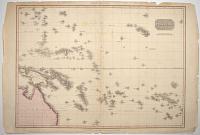
Polynesia.
Drawn under the direction of Mr. Pinkerton by L. Hebert. Neele sculp.t. 352 Strand.
London: published Jan.r 1st 1813, by Cadell & Davies, Strand & Longman, Hurst, Rees, Orme, & Brown, Paternoster Row.
Engraved with original colour. Printed ares 530 x 700mm (21 x 27½") Edges brittle, with chips and tears. Fold in center as normal.
A detailed map of the South Pacific, covering the north east Coast of Australia, the Mariana Islands, the Marquesas and Hawaii.
[Ref: 52895] £360.00
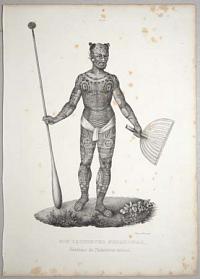
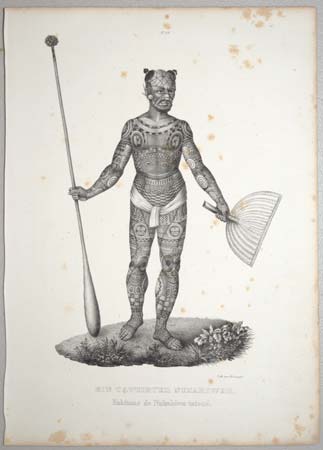
Ein Tatuirter Nukahiwer. Habitans de Nakahiwa tatoué. No.27.
Lith. von Honegger.
[Schinz, c.1845.]
Lithograph. 355 x 266mm (14 x 10½"). Foxing
A tattooed man of Nuku Hiva, French Polynesia. From Heinrich Rudolf Schinz's "Naturgeschichte und Abbildungen des Menschen".
[Ref: 53512] £75.00
(£90.00 incl.VAT)
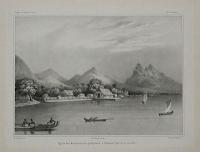
Eglise des Missionnaires protestants à Huaheiné. (Iles de la Société). Voyage de la frigate Vénus. Atlas Pittoresque.
Moerenhout del. Lith. Thierry frères. Lith. par Bichebois.
[n.d., c.1841.]
Lithograph, printed on chine collé. Printed area: 210 x 275mm (8¼ x 11''), with very large margins.
A view of Huahine, one of the Society Islands in French Polynesia from the sea. A plate from 'Atlas Pittoresque of du Petit-Thouars' Voyage Autour du Monde sur La Fregate La Venus'.
[Ref: 50934] £230.00
(£276.00 incl.VAT)
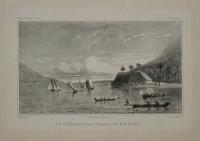
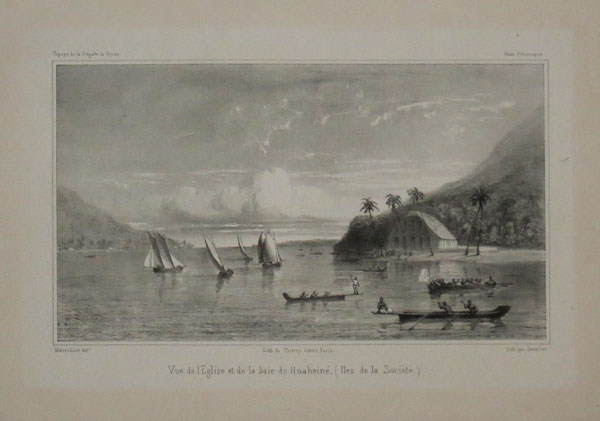
Vue de l'Eglise et de la baie de Huaheiné. (Iles de la Société). Voyage de la frigate Vénus. Atlas Pittoresque.
Moerenhout del.t. Lith. Thierry frères, Paris. Lith. par Sabatier.
[n.d., c.1841.]
Lithograph, printed on chine collé. Printed area: 210 x 275mm (8¼ x 11''), with very large margins.
A view of Huahine, one of the Society Islands in French Polynesia looking out to the bay. A plate from 'Atlas Pittoresque of du Petit-Thouars' Voyage Autour du Monde sur La Fregate La Venus'.
[Ref: 50935] £230.00
(£276.00 incl.VAT)
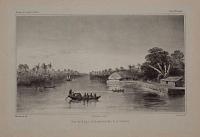
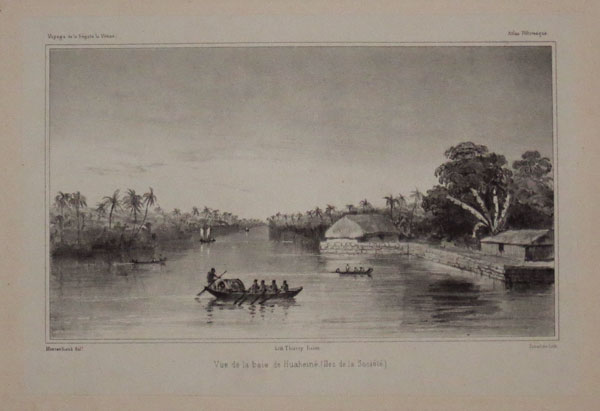
Vue de la baie de Huaheiné. (Illes de la Societé.). Voyage de la frigate Vénus. Atlas Pittoresque.
Moerenhout del.t. Lith. Thierry frères. Sebatier Lith.
[n.d., c.1841.]
Lithograph, printed on chine collé. Printed area: 210 x 275mm (8¼ x 11''), with large margins.
A view of the bay of Huahine, one of the Society Islands in French Polynesia. A plate from 'Atlas Pittoresque of du Petit-Thouars' Voyage Autour du Monde sur La Fregate La Venus'.
[Ref: 50936] £230.00
(£276.00 incl.VAT)
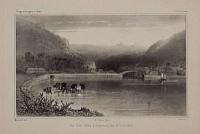
Vue d'unw Vallée à Huaheiné. (Illes de la Societé.). Voyage de la frigate Vénus. Atlas Pittoresque.
Moerenhout del. Lith. Thierry frères. Sebatier Lith.
[n.d., c.1841.]
Lithograph, printed on chine collé. Printed area: 210 x 275mm (8¼ x 11''), with very large margins.
A view of a valley and bay in Huahine, one of the Society Islands in French Polynesia. A plate from 'Atlas Pittoresque of du Petit-Thouars' Voyage Autour du Monde sur La Fregate La Venus'.
[Ref: 50939] £190.00
(£228.00 incl.VAT)
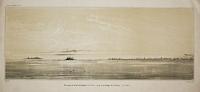
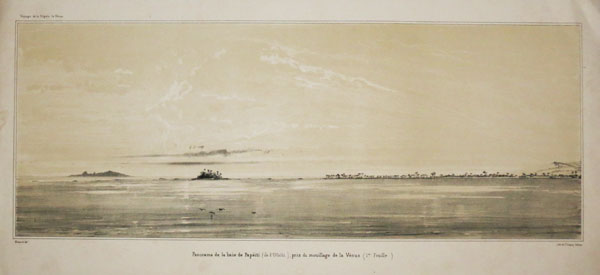
Panorama de la baie de Papéiti (ile d'O-Taiti), pris du mouillage de la Vénus (1.re Feuille).
Ménard del.t. Lith. de Thierry frères.
Tinted lithograph. Sheet: 360 x 550mm (14 x 21¾''), with large margins.
A view of the Tahiti in French Polynesia. A plate from 'Atlas Pittoresque of du Petit-Thouars' Voyage Autour du Monde sur La Fregate La Venus'.
[Ref: 50942] £140.00
(£168.00 incl.VAT)
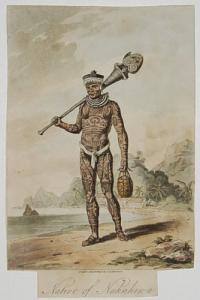
Native of Nukahiwa.
Drawn and Etched by J. A. Atkinson.
[n.d., c.1805].
Hand coloured aquatint and etching, rare. Sheet size: 180 x 118mm (7¼ x 4½"). Cut to image and around title.
A tattooed Polynesian man, drawn and etched by J. A. Atkinson. Nukahiwa is now called Nuku Hiva, and is the largest of the Iles Marquises (Marquesas Islands), in French Polynesia. Ivan Fedorovich Kruzenshtern (1770-1846) arrived there in May 1804 and traded with it's inhabitants. Kruzenshtern was a German who commanded the first Russian circumnavigation of the world. This is the frontispiece from volume one of his ‘Voyage around the world, in the years 1803, 1804, 1805 & 1806’. Abbey Travel 1.
[Ref: 32408] £130.00
(£156.00 incl.VAT)
![[Galatea]](img-thumbnail/jpegs/28321.jpg)
[Galatea] [Galat. 'Ah taci, Acide amato,/ Taci...' La Galatea, Parte Prima]
[G.B. Cipriani inv.- F. Bartolozzi sculps. 1783]
Engraving printed in brown ink. Sheet 215 x 175mm (8½ x 6¾"). Trimmed inside platemark.
Polyphemus seated on a rock, playing a pan flute. Below, Acis and Galatea embracing each other on a beach; the sea behind them. One of three vignettes engraved by Bartolozzi for the 'Opere' of Pietro Metastasio. Calabi & De Vesme: 1747.ii
[Ref: 28321] £160.00
(£192.00 incl.VAT)
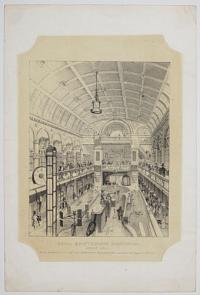
Royal Polytechnic Institution. Great Hall.
Printed & Published at G.J. Cox's Litho. Establishment Royal Polytechnic Institution 309, Regent S.t London.
A rare lithograph. Printed area: 200 x 145mm (8 x 5¾") large margins.
A view in the Great Hall of the Royal Polytechnic Instituition on Regent Street. The Royal Polytechnic was the first polytechnic institution in Britain and is now the University of Westminster.
[Ref: 46305] £80.00
(£96.00 incl.VAT)

Pomarre ceding Matavai to the English.
CJW (?) sc.
[published 1805]
Engraving, rare, sheet 105 x 160mm (4¼ x 6¼"). Trimmed inside platemark.
Pomare I of Tahiti ceding Matavai to the English Missionaries who had arrived in Tahiti to attempt to convert the population to Christianity. Plate from William and James Wilson's 'First Missionary Voyage to the South-Sea Islands, Performed in the Years 1796, 1797, and 1798, in the ship Duff, Commanded by Captain James Wilson, Under the Direction of the Missionary Society'.
[Ref: 31849] £180.00
(£216.00 incl.VAT)
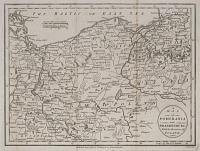
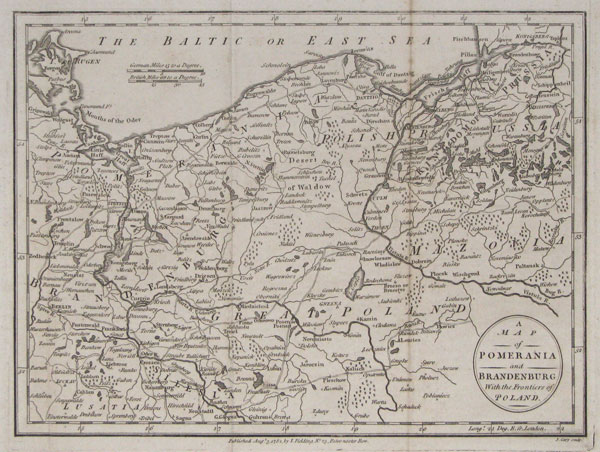
A Map of Pomerania and Brandenburg with the Frontiers of Poland.
J.Cary sculp.
Published Aug.t 3 1782 by I.Fielding No 23 Pater-noster Row.
Engraving. 200 x 260mm, 8 x 10¼". Folded, some toning.
Northern Poland, with Gdansk. At the time of publication these areas were part of Germany. From the 'Complete Geographical Dictionary' by John Seally.
[Ref: 13227] £65.00
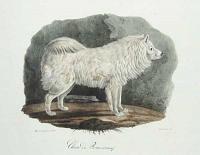
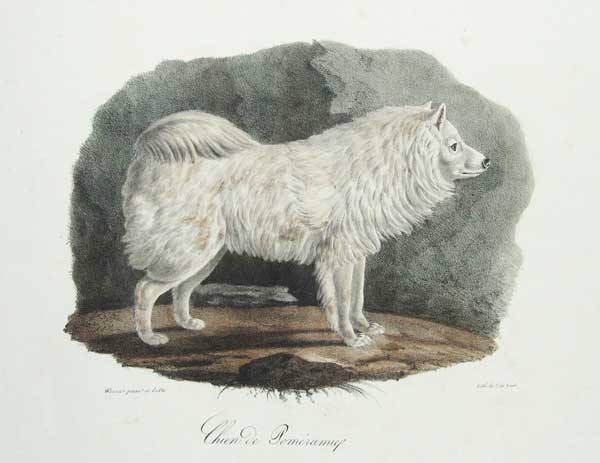
Chein de Pomeramie.
Werner pinxt et Lith .
Lith de Cide Lust.
Coloured lithograph. 220 x 180mm [lithographed area], 520x 330mm [sheet].
[Ref: 6510] £160.00
(£192.00 incl.VAT)
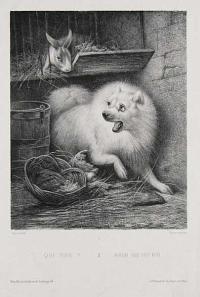
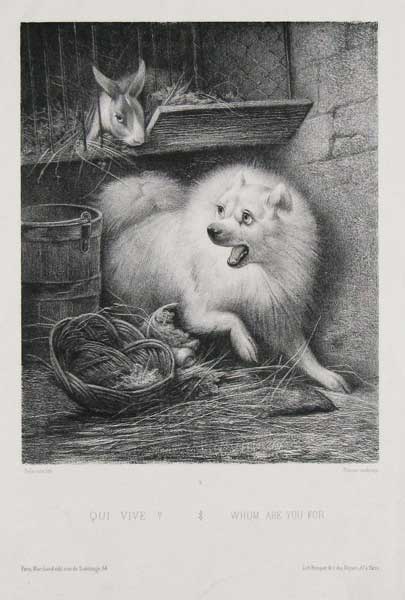
Qui Vive? Whom Are You For.
Delacroix lith. Ronner neckiny. Lith. Becquet fr. R. des Noyers, 37, a Paris.
Paris, Marchand, edit. Rue de Saintonge, 64. [n.d., c.1850.]
Lithograph, sheet 450 x 315mm. 17¾ x 12½". Surface soiling.
A rabbit looking down from its cage at an excited Pomeranian dog.
[Ref: 19428] £130.00
(£156.00 incl.VAT)

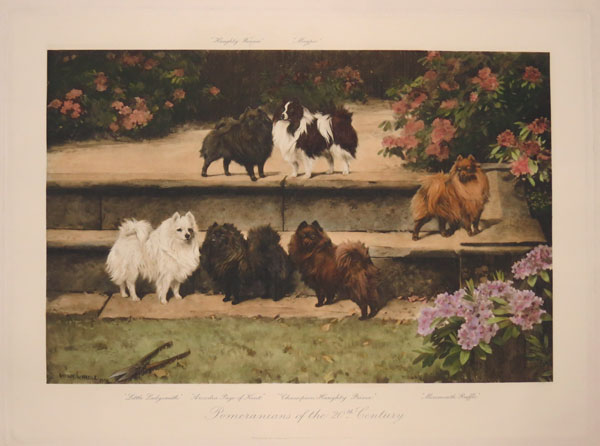
Pomeranians of the 20th Century.
Arthur Wardle 1904 [signed and dated in plate.]
Published by Art Engraving Department, Spratt's Patent Limited, London, E.C.3 1924.
Large photogravure on india paper, printed in colours. 525 x 710mm. 20¾ x 28". A fine impression with wide margins. Mint.
Six Pomeranian dogs, each animal named above and below the image, posed on stone steps in a garden. Arthur Wardle (British, 1864 -1949) was a prolific and very talented late nineteenth century artist who created an extraordinary body of work, yet surprisingly little has been written about him. Known by some as a painter of big game and wildlife, he is for dog lovers one of the pre-eminent painters of pure bred dogs that England has produced.
[Ref: 23445] £480.00

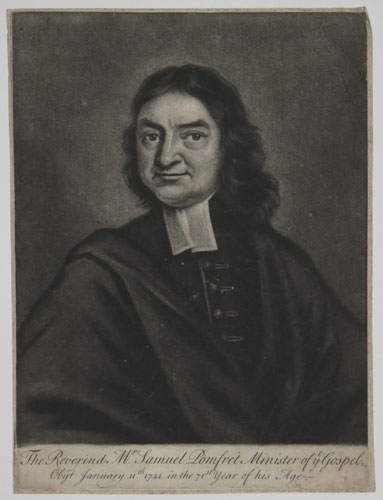
The Reverend Mr. Samuel Pomfret Minister of ye Gospel. Obijt January 11.th 1721 in the 71st Year of his Age.
[n.d. c.1721.]
Very scarce mezzotint. Plate 268 x 197mm. 10½ x 7¾". Trimmed close to plate, small crease to upper right corner.
Samuel Pomfret (1650-1722) was a nonconformist and Presbyterian minister. CS: 82, iii.
[Ref: 24381] £140.00
(£168.00 incl.VAT)
![[Cicero.] De Mamore Pomfret, apud Oxons.](img-thumbnail/jpegs/24749.jpg)
[Cicero.] De Mamore Pomfret, apud Oxons.
Drawn & Engrav'd by J.K. Sherwin Engraver to His Majesty & His Royal Highness the Prince of Wales.
[London: Richard Bentley, 1866.]
Engraving, with large margins. Plate 323 x 260mm. 12¾ x 10¼". Slight crease on left.
A statue of Cicero (106BC-43BC), the Roman orator who was made consul in 63 BC. Standing here holding a scroll in his left hand at waist level and another object is his right. Published in John Timbs's "Club Life of London; with anecdotes of the clubs, coffee houses, and taverns of the metropolis, during thr 17th, 18th, and 19th centuries". One of the ancient Greek and Roman statues from the collection of the Countess of Pomfret in 1755. The statues formerly belonged to the Earl of Arundel before later being passed to the University of Oxford.
[Ref: 24749] £160.00
(£192.00 incl.VAT)
![[Pomona.]](img-thumbnail/jpegs/29288.jpg)
[Pomona.]
Painted by J.E. Millais, R.A. Engraved by S. Cousins, R.A. [also signed in pencil by both.]
London, Published Oct. 2.nd 1882 by Arthur Tooth & Sons, 5 & 6 Haymarket, S.W. & The Fine Art Society, New Bond Street. Copyright Registered. Entered according to Act of Congress in the Year 1882 by Mess.rs Knoedler & Co. in the Office of the Librarian of Congress at Washington.
Mixed method on chine collé. Signed in pencil by artist and engraver, Printseller's Association stamp. Plate 540 x 400mm (21¼ x 15¾"). Mint.
A little girl standing in profile beside an apple barrow, holding an apple in one hand, gathering her apron in the other, turning her head to look slightly towards the viewer, in an orchard. Whitman: 220.
[Ref: 29288] £280.00
(£336.00 incl.VAT)
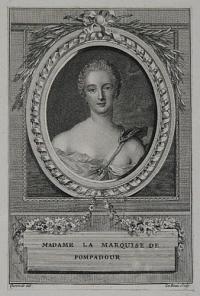
Madame La Marquise de Pompadour.
Queverdo del. Le Beau Sculp.
[Paris, c.1780.]
Etching, sheet 160 x 105mm. 6¼ x 4¼". Trimmed within plate.
Jeanne-Antoinette Poisson, Marquise de Pompadour, also known as Madame de Pompadour (1721 - 1764), bust-length to front within ornamental oval frame. She was the official maîtresse-en-titre (mistress) of Louis XV from 1745 to 1750.
[Ref: 14042] £65.00
(£78.00 incl.VAT)
Unfortunately this item is either sold or reserved. If you are interested in similar items and cannot find what you're looking for on our website, please consider filling in our interests form. If you register, we can also send you items that match your interests when the website is updated.

Pompei. Maison de Diomede.
Dessine d'apres nature et lith par Ph Benoist. Imp Lemercier a Paris.
[c.1850.] Paris, Bulla Editeur 18, rue Tiquetonne et (Mon.Aumont) Francois Delarue, Succ rue JJ Rousseau, 10.
Coloured lithograph. Sheet 375 x 290mm (14¾ x 11½").
A view of the Villa of Diomedes, an ancient Roman villa near Pompeii, Italy. The villa is located just outside the city walls of Pompei, at the Via dei Sepolcri to the Gate of Herculaneum. It was excavated by Francesco La Vega from 1771 to 1774 and named after Marcus Arrius Diomedes, whose grave is opposite the entrance to the villa, though it is not clear that it was his villa
[Ref: 66692] £90.00
(£108.00 incl.VAT)
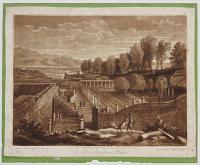
The Soldiers Quarters at Pompeii. Pl.1.
Drawn & Etched by G. Townley Esq.r Engraved by F. Whessell, Oxford.
London Pub. Feb.1. 1818 by Mess.rs Carpenter & Son Old Bond Street.
Mezzotint and etching printed in brown ink, very scarce and fine. Plate 209 x 255mm (8¼ x 10"). Laid on album scrap. Slight foxing.
View of the remains of Pompeii, showing an area with rows of pillars on three sides, to the right, people walking along a road beside it in the centre, and a series of rooms to left; with three goats and fallen masonry in the right foreground, mountains, trees and a lake in the background. Plate 1 of a series etched by the collector George Townley, who may have been inspired by JMW Turner's 'Liber Studiorum' with which this series bears several similarities.
[Ref: 29465] £220.00
(£264.00 incl.VAT)
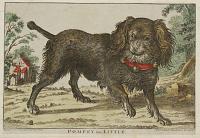
Pompey the Little.
Printed and Sold by Carington Bowles, No 69 in St Pauls Church Yard, London. [n.d., c.1785.]
Engraving with original hand colour, rare. Sheet 165 x 245mm (6¾ x 9½"). Trimmed within plate, laid on album paper.
A small spaniel, the main character in Francis Coventry's hugely-successful satirical novel, 'The History of Pompey the Little; or, The Life and Adventures of a Lap-Dog', first published 1751. Pompey, born in Bologna ('a place famous for lap-dogs and sausages') describes society as he passes from owner to owner, exchanged for sexual favours, a gold watch and a pint of porter. Many of the human characters are thinly-veiled versions of society figures. The last edition was published in 1924.
[Ref: 32952] £220.00
(£264.00 incl.VAT)
![[Pierre Poncet maître des requêtes et conseiller d’état.]](img-thumbnail/jpegs/50069.jpg)
[Pierre Poncet maître des requêtes et conseiller d’état.]
Joan L'enfant ad vivum faciebat 1658.
Engraving. Sheet 335 x 250mm (13¼ x 9¾"). Trimmed into image.
Portrait of magistrate and politician Pierre Poncet (1600-1681). Advocate at the Parliament 1619, maître des requêtes (Master of Requests) in 1642, councillor of state and member of the Royal council of finances 1673. Drawn and engraved by Jean Lenfant (1615-74), who would make preliminary studies in pastel.
[Ref: 50069] £80.00
(£96.00 incl.VAT)
![[General George Pollock.]](jpegs/66160.jpg)
![[General George Pollock.] Geo. Pollock [facsimile signature].](jpegs/66161.jpg)
![[General George Pollock.]](jpegs/66104.jpg)
![[Polo Match.]](jpegs/15941.jpg)
![Naar Stal Toe [on publisher's label on reverse].](jpegs/52108.jpg)
![[Polo in India.]](jpegs/67930.jpg)
![[Polo Match.]](jpegs/45013.jpg)
![[Two mounted polo players in conversation.]](jpegs/11004.jpg)
![[Le Polo (Spectateurs au Polo).]](jpegs/3441.jpg)
![[Le Polo (Spectateurs au Polo).]](jpegs/14205.jpg)
![[Landscape with large trees.]](jpegs/35463.jpg)
![[Woman wearing gown and holding torch]](jpegs/35481.jpg)
![[Thatched cottage in a landscape]](jpegs/35466.jpg)
![[Thatched cottage in a landscape]](jpegs/35467.jpg)
![[Landscape with deer under tree.]](jpegs/35470.jpg)
![[Knight on horseback in a rocky landscape]](jpegs/35474.jpg)
![[Houses by a stream, with a bridge.]](jpegs/26890.jpg)
![[Shepherd resting in a field.]](jpegs/39429.jpg)
![[Blasted tree with pensive traveller.]](jpegs/36947.jpg)
![[Ruined abbey among trees]](jpegs/36948.jpg)
![[Cavalry Charge.]](jpegs/36701.jpg)
![[Landscape with old trees by water.]](jpegs/36937.jpg)
![[Landscape with old trees by water.]](jpegs/36938.jpg)
![[Apollo as a winged warrior.]](jpegs/36934.jpg)
![[Rural landscape with horse and cart]](jpegs/36942.jpg)
![[Oriental man reading a large book]](jpegs/36943.jpg)
![[The Angel]](jpegs/36698.jpg)




![[Galatea]](jpegs/28321.jpg)


![[Cicero.] De Mamore Pomfret, apud Oxons.](jpegs/24749.jpg)
![[Pomona.]](jpegs/29288.jpg)


![[Pierre Poncet maître des requêtes et conseiller d’état.]](jpegs/50069.jpg)