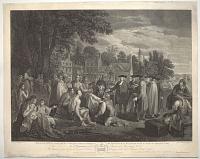
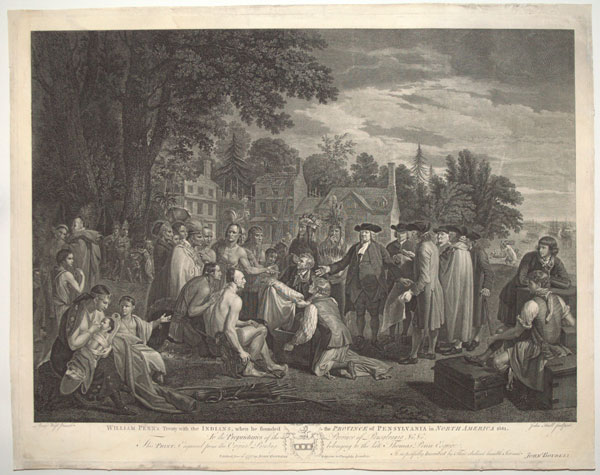
William Penn's Treaty with the Indians, when he founded the Province of Pensylvania in North America 1681. To the Proprietaries of the Province of Pensylvania, &c. &c. This Print, Engraved from the Original Painting belonging to the late Thomas Penn Esquire, Is respectfully Inscribed by Their obedient humble Servant John Boydell.
Benj: West pinxit. John Hall sculpsit.
Published, June 12th. 1775 by John Boydell Engraver in Cheapside London.
Engraving. 485 x 615mm (19 x 24¼"). Repairs to edges. Watermark in lower left of publication line.
William Penn's (1644 - 1718) 'Great Treaty' was reputedly signed with Delaware Indian leaders in 1682 under an ancient elm tree at the village of Shackamaxon, located in what are now the borders of the city of Philadelphia, Pennsylvania. This highly detailed depiction of the event, shows Penn in the centre left, with his arms open, his entourage beside him, two of his men kneeling, offering gifts to the Indians who are assembled at the right. Buildings in construction can be seen behind at the left, with boats on the sea at right. The painting by Benjamin West (1738 - 1820), who was born in Pennsylvania, is now in the Pennsylvania Academy of the Fine Arts. West was the first American-born artist to receive international recognition and remains one of the most important eighteenth-century painters of historical scenes. He enjoyed a career that endured more than half a century that included serving as president of the Royal Academy. William Penn, quaker leader and founder of Pennsylvania, was the first great hero of American liberty. During the late seventeenth century, Penn established an American sanctuary which protected freedom of conscience. Almost everywhere else, colonists stole land from the Indians, but Penn travelled unarmed among the Indians and negotiated peaceful purchases. He insisted that women deserved equal rights with men. He gave Pennsylvania a written constitution which limited the power of government, provided a humane penal code, and guaranteed many fundamental liberties. For the first time in modern history, a large society offered equal rights to people of different races and religions. Penn's dramatic example caused quite a stir in Europe. The French philosopher Voltaire, a champion of religious toleration, offered lavish praise. 'William Penn might, with reason, boast of having brought down upon earth the Golden Age, which in all probability, never had any real existence but in his dominions'.
[Ref: 54272] £690.00
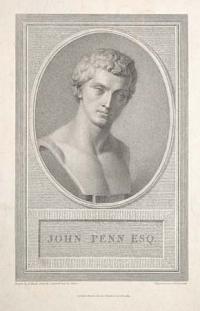
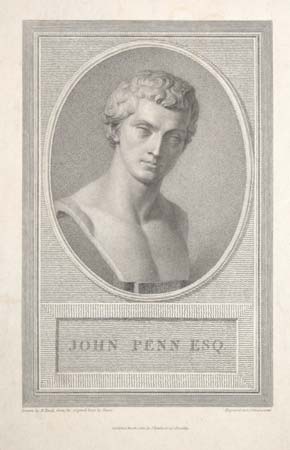
John Penn Esq.
Drawn by A. Tendi, from an original bust by Deare. Engraved by L. Schiavonetti.
Published March 1.1801, by J. Hatchard 173 Piccadilly.
Stipple and etching. Sheet size 245 x 150mm (9¾ x 6"). Cut to platemark.
Bust portrait sculpture, facing three-quarter to right, head slightly tilted towards the viewer, in an oval within rectangular frame; after Tendi's drawing of sculpture by Deare; published state. John Penn (1760-1834), grandson of William Penn, was the last proprietor of the Province of Pennsylvania, and a governor of the Isle of Portland where he built Pennsylvania Castle. Following the war of American Independence, the Penns settled in England and were granted an annuity by Parliament for their losses.
[Ref: 53548] £65.00
(£78.00 incl.VAT)
![[John Penn] Pen-etration.](img-thumbnail/jpegs/64707.jpg)
[John Penn] Pen-etration. NB: This Title has no affinity to Pen, as connected with the Goose-Quill; _ nor has it any allusion to Penguin, a stupid creature between a Fish & a Fowl; _ the word is simply derived from Pen, as the Instrument used to express the deep researches of the mind; _ see the St James's Street chit-chat _ respecting a Keen Pen; _ a Witty Pen; _ & a Pen, often Cut, but never mended.
J.s Gillray des. & f.t.
Pubd Aug.t 6th 1799 by H. Humphrey N 27 St James's Street.
Coloured etching. 260 x 200mm (10¼ x 8"), with large margins.
A full-length caricature portrait of John Penn (1760-1834), with a gaping, fish-like mouth and receding chin, standing with feet splayed, a vacant expression on his face. The grandson of William Penn, he inherited 75% of the proprietorship of the province of Pennsylvania in 1775, aged fifteen, only to be dispossessed the same year by the Revolution. The new United States Government give him £130,000 compensation for his family's 26 million acres in Pennsylvania. BM Satires 9441.
[Ref: 64707] £240.00
(£288.00 incl.VAT)
![[Thomas Penn Esq One of the first proprietors of Pennsilvania.]](img-thumbnail/jpegs/65020.jpg)
[Thomas Penn Esq One of the first proprietors of Pennsilvania.]
[Davis Pinx. 1751. Martin sc.]
[n.d., c.1766.
Mezzotint. Sheet 285 x 225mm (11¼ x 8¾"). Trimmed to image losing inscription area.
A half-length portrait of Thomas Penn (1702-75), son of William Penn, extracted from the full-length oil by Arthur Devis, painted to celebrated Penn's marriage to Lady Juliana Fermor in 1751, now in the Philadelphia Museum of Art (2004-201-1). A proof impression in the BM has 'D Martin 1766' in scratched letters (BM 1860,0728.28). CS 4, two known states. Ex: Collection of The Hon. Christopher Lennox-Boyd.
[Ref: 65020] £220.00

Penn. [William Penn, the celebrated founder of Pennsylvania, son of admiral sir William Penn, was born on Tower-hill, October 14, 1644. About the age of fifteen, he became a student of Christ-church, Oxford; but having early inbibed strong religious impressions, through the preaching of Thomas Loe, on of the people callled quakers...]
Holl. sculp.
[n.d.,c.1819.]
Stipple engraving. Sheet 220 x 130mm (8½ x 5").
Portrait of William Penn (1644 - 1718), English writer, religious thinker, and influential Quaker who founded the Province of Pennsylvania during the British colonial era. Penn, an advocate of democracy and religious freedom, was known for his amicable relations and successful treaties with the Lenape Native Americans who had resided in present-day Pennsylvania prior to European settlements in the state.
[Ref: 64110] £120.00
(£144.00 incl.VAT)
![[William Penn on the Banks of the Delaware.]](img-thumbnail/jpegs/49069.jpg)
[William Penn on the Banks of the Delaware.]
RS. [Robert Spence.]
[n.d., c.1905.]
Etching on vellum, signed in pencil. Plate: 345 x 445mm (13½ x 17½''). Creasing.
A scene showing William Penn and a group of Europeans standing before a group of Native Americans. By artist Robert Spence (1871-1964) who was a member of the Royal Society of Painter Printmakers.
[Ref: 49069] £180.00
(£216.00 incl.VAT)
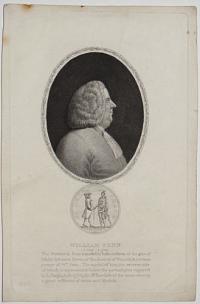
William Penn. b. 1644. d. 1718. The Portrait is from a model is basso relievo of the size of life by Sylvanus Bevan, of the Society of Friends, & a cotemporary of W.m Penn. The medal of him, the reverse side of which is represented below the portrait, was engrav'd by L. Pingo, A.D. 1770, for B.n Bartlett of the same society; a great collector of coins and medals.
[n.d., c.1800.]
Stipple. Plate: 200 x 120mm (8 x 5"). Small margins.
A bust portrait in an oval of founder of Pennsylvania and early Quaker William Penn (1644-1718).
[Ref: 45807] £120.00
(£144.00 incl.VAT)
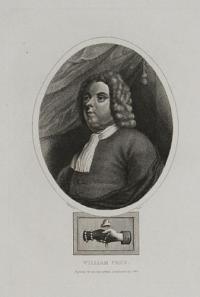
William Penn.
Chapman sculp.
Engraved for the Encyclopedia Londinensis July 1823.
Engraving, with large margins; platemark 18 x 13cm (7 x 5").
William Penn (1644-1718), founder of Pennsylvania.
[Ref: 27193] £75.00
(£90.00 incl.VAT)
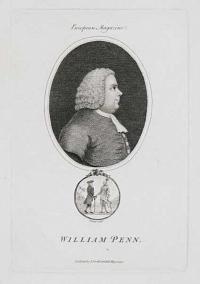
William Penn. European Magazine.
Stanier sculp.t.
Published by J. Sewell, Cornhill May 1. 1790.
Engraving and stipple. 190 x 130mm (8¾ x 4¾"), with wide margins.
Half-length portrait, with a roundel scene of Penn shaking hands with a native American, reresenting his treaty with them.
[Ref: 23131] £95.00
(£114.00 incl.VAT)

William Penn.
Chapman sculp.
Engraved for the Encyclopedia Londinensis July 1823.
Engraving. 7 x 5".
[Ref: 1231] £45.00
(£54.00 incl.VAT)
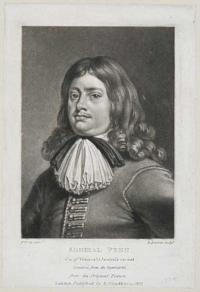
Admiral Penn. One of Cromwell's Admiral's who took Jamaica from the Spaniards from the Original Picture.
Sr. P. Lely pinxt. R. Earlom sculpt.
London Published by S. Woodburn, 1811.
A fine mezzotint impression. Image 158 x 108mm. Cut to the image and surrounded by an extra paper sheet.
Sir William Penn (1621-1670) was an English admiral, and the father of William Penn, founder of the colony of Pennsylvania. He served his apprenticeship at sea with his father. In the first Civil War he fought on the side of the parliament, and was in command of a ship in the squadron maintained against the king in the Irish seas. The service was arduous and called for both energy and good seamanship. In 1648 he was arrested and sent to London, but was soon released, and sent back as rear admiral in the Assurance. The exact cause of the arrest is unknown, but it may be presumed to have been that he was suspected of being in correspondence with the king's supporters. In the First Anglo-Dutch War, he served in the navy of the Commonwealth of England, commanding squadrons at the battles of the Kentish Knock (1652), Portland, the Gabbard and Scheveningen (1653). In 1654 he accepted the naval command in the expedition to the West Indies sent out by Cromwell. In 1655 he commanded the fleet that launched a bungled attack on La Hispaniola. Afterwards the less desirable island of Jamaica was seized for the Commonwealth regime. On their return he and his military colleague Venables were sent to the Tower. He made humble submission, and when released retired to the estate he had received from confiscated land in Ireland. In the Second Anglo-Dutch War he was captain of the fleet at the Battle of Lowestoft in 1665 under James Stuart, Duke of York.
[Ref: 12693] £75.00
(£90.00 incl.VAT)
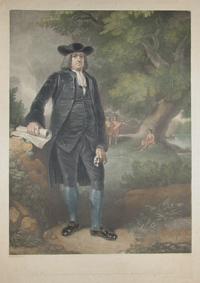
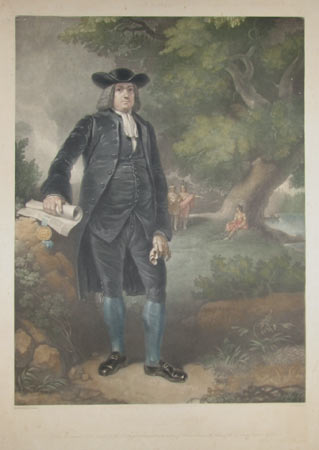
William Penn. From the Original Picture painted for the Society for commemorating the landing of William Penn on the shores of the Delaware, October 1682.
Painted by H.Inman. [***] by J.Sartain.
[Publication line erased. n.d., c. 1860 ]
Colour mezzotint, later printing of Sartain's very rare engraving. 660 x 500mm. Some damage to edges, well outside image.
William Penn (1644-1718), Quaker and founder of Pennsylvania. Henry Inman (1801-46), American portrait painter. John Sartain (1808-1897), American engraver. Penn was born October 14, 1644 to Anglican parents, Admiral Sir William Penn and Margaret Jasper. For much of his young life he knocked about, getting expelled from Oxford, learning law at Lincoln's Inn, studying in the Huguenot Academy at Saumer, and managing his father's estates in Ireland. Soon after hearing the famous apostle Thomas Loe, he converted to Quakerism. Then in his mid twenties, he quickly involved himself in the Quaker cause, landing in prison several times for his 'radical' preaching for personal, property, and religious rights. In 1672 he married Gulielma Maria Springett, and five years later traveled in the company of George Fox to Holland. Penn, though wealthy and though a Quaker, lived beyond his means. In order to raise some funds he called in a debt owed his father by Charles II. On March 4, 1681 he obtained the charter for Pennsylvania, [and in August 1682 he gained the rights to Delaware from his friend James, the Duke of York.] Penn planned to make money by selling tracts of land, and although he was able to attract a good number of investors he never realized the profit he imagined. However, he saw this venture as more than a money-making exercise; it was, in his famous words to his friend and land agent for Pennsylvania, James Harrison, a "holy experiment." This experiment would become, as he confidently predicted, "the seed of a nation.". Penn imagined a "free. .sober and industrious people" living by their own laws. In 1682 he sought to delineate these laws in the First Frame of government; and though somewhat less liberal than his New Jersey bill, it provided many of the same rights. Penn first arrived at his new colony in the fall of 1682 and stayed only until August of 1684. It was at this time that he supposedly signed his famous treaty with the Delaware (Leni Lenape) at Shackamaxon. And though no copy of such an agreement exists, we do have a wampum belt allegedly given to Penn by the Indians. The first treaty document in existence is one dated July 15, 1682 in which Penn obtains land from Idquahon and several other Leni Lenape leaders. In the next year Penn would broker at least eight other land transactions with the Delaware. He was busy with man other tasks as well. During his first stay, Penn began building his mansion and attending to numerous details of colony building, including a border dispute with Lord Baltimore, who controlled the territory south of Pennsylvania. He returned to England to continue his dispute with Baltimore, not to return to Pennsylvania until 1699. The England in the 1690s was a tumultuous place, especially for an outspoken, liberal Quaker. Penn never shirked from the political fray, as did many of his fellow Quakers, though his forthrightness proved dangerous. He supported James II, though in the Glorious Revolution of 1688 William and Mary bested James. Later, under suspicion of treason, Penn briefly lost control of his colony from 1692 to 1694. He received another setback when his wife died in 1694, though he rebounded by remarrying a year and a half later to Hannah Callowhill. Back in Pennsylvania, political squabbling had set in and various leadership changes took place. In 1691 George Keith led a religious schism, and Pennsylvania and Delaware separated into two provinces. And in 1696, William Markham's (Penn's secretary and then governor of Delaware) charter replaced the earlier 'Frame', though when Penn returned in 1701 he would again revise this version. By the time he left for good in November of that year, the colony's Assembly was elected yearly and enjoyed a more powerful position than the governor, who despite his veto power, was secondary to the legislative body. Though Penn planned to stay in the New World, settling at his manor Pennsbury, (up the Delaware from Philadelphia) but further political troubles in England forced his return, and in 1712 suffered an attack of apoplexy which disabled him. His wife Hannah managed his affairs until Penn died in 1718, and after her death ion 1727 the proprietorship of Pennsylvania passed to their sons, John, Thomas, and Richard. Ex: Collection of The Hon. C. Lennox-Boyd.
[Ref: 3400] £240.00
(£288.00 incl.VAT)
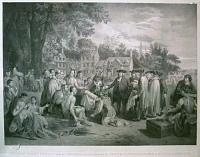
William Penn's Treaty with the Indians, when he founded the Province of Pensylvania in North America.
[after Benjamin West.]
[n.d., c.1840.]`
Lithograph, 13½ x 17".
Penn was born October 14, 1644 to Anglican parents, Admiral Sir William Penn and Margaret Jasper. For much of his young life he knocked about, getting expelled from Oxford, learning law at Lincoln's Inn, studying in the Huguenot Academy at Saumer, and managing his father's estates in Ireland. Soon after hearing the famous apostle Thomas Loe, he converted to Quakerism. Then in his mid twenties, he quickly involved himself in the Quaker cause, landing in prison several times for his 'radical' preaching for personal, property, and religious rights. In 1672 he married Gulielma Maria Springett, and five years later traveled in the company of George Fox to Holland. Penn, though wealthy and though a Quaker, lived beyond his means. In order to raise some funds he called in a debt owed his father by Charles II. On March 4, 1681 he obtained the charter for Pennsylvania, [and in August 1682 he gained the rights to Delaware from his friend James, the Duke of York.] Penn planned to make money by selling tracts of land, and although he was able to attract a good number of investors he never realized the profit he imagined. However, he saw this venture as more than a money-making exercise; it was, in his famous words to his friend and land agent for Pennsylvania, James Harrison, a "holy experiment." This experiment would become, as he confidently predicted, "the seed of a nation.". Penn imagined a "free. .sober and industrious people" living by their own laws. In 1682 he sought to delineate these laws in the First Frame of government; and though somewhat less liberal than his New Jersey bill, it provided many of the same rights. Penn first arrived at his new colony in the fall of 1682 and stayed only until August of 1684. It was at this time that he supposedly signed his famous treaty with the Delaware (Leni Lenape) at Shackamaxon. And though no copy of such an agreement exists, we do have a wampum belt allegedly given to Penn by the Indians. The first treaty document in existence is one dated July 15, 1682 in which Penn obtains land from Idquahon and several other Leni Lenape leaders. In the next year Penn would broker at least eight other land transactions with the Delaware. He was busy with man other tasks as well. During his first stay, Penn began building his mansion and attending to numerous details of colony building, including a border dispute with Lord Baltimore, who controlled the territory south of Pennsylvania. He returned to England to continue his dispute with Baltimore, not to return to Pennsylvania until 1699. The England in the 1690s was a tumultuous place, especially for an outspoken, liberal Quaker. Penn never shirked from the political fray, as did many of his fellow Quakers, though his forthrightness proved dangerous. He supported James II, though in the Glorious Revolution of 1688 William and Mary bested James. Later, under suspicion of treason, Penn briefly lost control of his colony from 1692 to 1694. He received another setback when his wife died in 1694, though he rebounded by remarrying a year and a half later to Hannah Callowhill. Back in Pennsylvania, political squabbling had set in and various leadership changes took place. In 1691 George Keith led a religious schism, and Pennsylvania and Delaware separated into two provinces. And in 1696, William Markham's (Penn's secretary and then governor of Delaware) charter replaced the earlier 'Frame', though when Penn returned in 1701 he would again revise this version. By the time he left for good in November of that year, the colony's Assembly was elected yearly and enjoyed a more powerful position than the governor, who despite his veto power, was secondary to the legislative body. Though Penn planned to stay in the New World, settling at his manor Pennsbury, (up the Delaware from Philadelphia) but further political troubles in England forced his return, and in 1712 suffered an attack of apoplexy which disabled him. His wife Hannah managed his affairs until Penn died in 1718, and after her death ion 1727 the proprietorship of Pennsylvania passed to their sons, John, Thomas, and Richard.
[Ref: 6523] £420.00
![Tho Pennant [facsimile signature].](img-thumbnail/jpegs/26343.jpg)
Tho Pennant [facsimile signature].
Chapman sculp.
Engraved for the Encyclopaedia Londinensis May 1823.
Hand-coloured stipple, with large margins; 175 x 125mm. 7 x 5".
Portrait of Thomas Pennant (1726 - 1798), naturalist and topographer; in profile in oval. One of a number of stipple heads for the 'Encyclopaedia Londinensis, Universal Dictionary of Arts, Sciences and Literature' originally published by J. Wilkes, 1795-1810. Wellcome 2267-11.
[Ref: 26343] £65.00
(£78.00 incl.VAT)
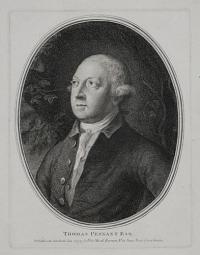
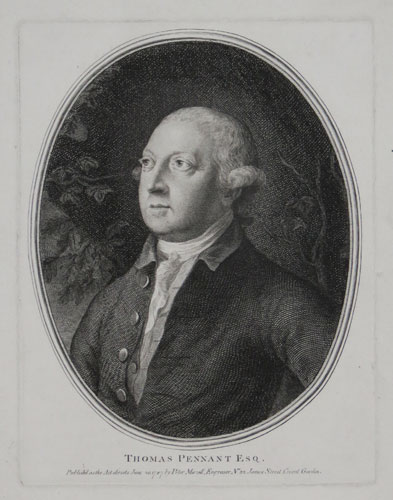
Thomas Pennant Esq.
Publish'd as the Act directs June 20, 1787 by Peter Mazell, Engraver No. 32 James Street, Covent Garden.
Etching, 215 x 170mm (8½ x 6¾"). Foxed.
Thomas Pennant (1726 - 1798), naturalist and topographer. Detail from the painting by Thomas Gainsborough (1727 - 1788) in the collection of the National Museum of Wales, engraved by John Keyse Sherwin (1751? - 1790). Not in BM. NPG: D14536. From the collection of Cecil Bisshopp Harmsworth, 1st Baron Harmsworth; for another engraving from the same picture (also by Sherwin) see ref. 19819.
[Ref: 9637] £120.00
(£144.00 incl.VAT)
![Tho Pennant [facsimile signature].](img-thumbnail/jpegs/27066.jpg)
Tho Pennant [facsimile signature].
Chapman sculp.
Engraved for the Encyclopaedia Londinensis May 1823.
Stipple with very large margins. Plate 178 x 128mm. 7 x 5".
Thomas Pennant (1726-1798), the Welsh naturalist, antiquary and topographer. One of a number of stipple heads of Kings and Queens of similar format printed on quarto sheets, by Chapman, published by J. Wilkes, 1795-1810. They probably appeared as illustrations to the 'Encyclopaedia Londinensis, Universal Dictionary of Arts, Sciences and Literature ... Embellished by ... engravings. Compiled ... by John Wilkes'. Wellcome 2267-11. See Ref: 26343 for coloured version.
[Ref: 27066] £50.00
(£60.00 incl.VAT)
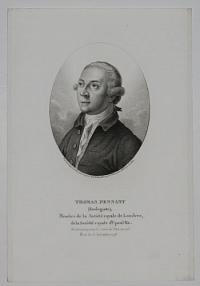
Thomas Pennant (Zoologiste), Membre de la Société royale de Londres, de la société royale d'Upsal &a. Né à Downing dans le Comté de Flint en 1726 Mort le 16 Décembre 1798.
Dessiné d'apres le Portrait original de T. Gaisnborough, et Gravé par Ambroise Tardieu.
[n.d. c.1830.]
Stipple. 210 x 145mm (8¼ x 5¾"). Cut to platemark top & bottom.
Thomas Pennant (1726-1798) the Welsh naturalist, traveller, writer and antiquarian. He wrote acclaimed books including 'British Zoology', the 'History of Quadrupeds., 'Arctic Zoology' and 'Indian Zoology', although he never travelled further afield than continental Europe. His first scientific papers focused on his own experiences, geological subjects and palaeontology. One of these so impressed Carl Linnaeus, that in 1757, he put Pennant's name forward and he was duly elected a member of Royal Swedish Society of Sciences. W: 2267.
[Ref: 29631] £60.00
(£72.00 incl.VAT)
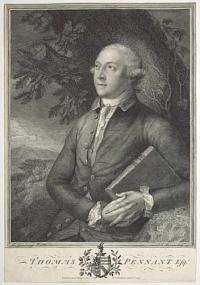
Thomas Pennant Esqr.
Thos. Gainsborough Pinxt. J.K. Sherwin Sculpt. 1778.
Publish'd according to Act of Parliament Jany. 1st. 1779.
Rare copper engraving, fine impression, sheet 315 x 215mm (12½ x 18½"). Trimmed within plate.
Thomas Pennant (1726-98), Welsh naturalist and antiquary, famed for his 'History of Quadrupeds'. For another engraving from the same painting (also by Sherwin) see ref. 9637.
[Ref: 59559] £280.00
(£336.00 incl.VAT)
![[Josslyn Francis Pennington, 5th Baron Muncaster.]](img-thumbnail/jpegs/48501.jpg)
[Josslyn Francis Pennington, 5th Baron Muncaster.]
Painted by George Richmond R.A. D.C.L. Engraved by Richardson Jackson.
[n.d., c.1860.]
Mezzotint on chine collé. 440 x 330mm (17¼ x 13") very large margins.
Josslyn Francis Pennington (1834-1917), 5th and final Baron Muncaster, MP for for Cumberland West 1872-80 then Egremont from 1885-92, most famous for his involvement in the 'Dilessi Murders'. In 1870 Pennington was sightseeing near Marathon in Greece when he and his companions were abducted by brigands. He was released in order to negotiate for the others, but a bungled rescue attempt by the Greek army led to the deaths of the hostages, causing a crisis between Greece and Great Britain. Pennington's journal of the misadventure was first published in 1989, with Richmond's portrait on the cover.
[Ref: 48501] £230.00
(£276.00 incl.VAT)
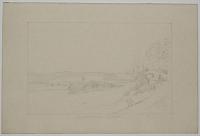
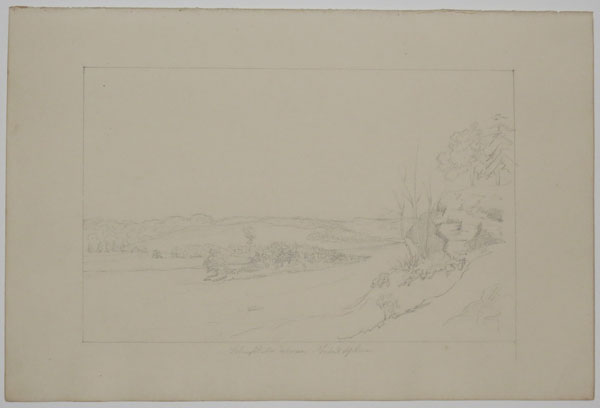
Schuylkill above Philadelphia.
[Anon., British, n.d., c.1820s.]
Original pencil drawing, ruled border with pencil title below. Image 195 x 305mm, 7¾ x 12".
A landscape sketch of the Schuylkill River in Pennsylvania, USA; on the spot by a military or naval amateur draughtsman. One candidate is perhaps Frederick Fitzgerald De Roos (1804 - 1861), an officer in the Royal Navy who wrote 'Personal narrative of travels in the United States and Canada in 1826... With remarks on the present state of the American Navy', illustrated with plates after his drawings.
[Ref: 25129] £150.00
(£180.00 incl.VAT)

Custom House. Late U.S. Bank. Pl.2.
Published by J.T. Bowen at his Lithographic & Print Colouring Establishm.t 94, Walnut S.t Philadelphia. Entered according to act of Congress in the year 1840 by J.T. Bowen in the Cl.s Off.e of the D.t C.r of the D. of P.a
Coloured lithograph. 222 x 160mm. 8¾ x 6¼".
The old Custom House, Philadelphia, Pennsylvania, United States of America.
[Ref: 23255] £65.00
(£78.00 incl.VAT)
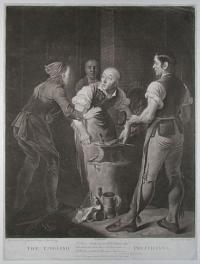
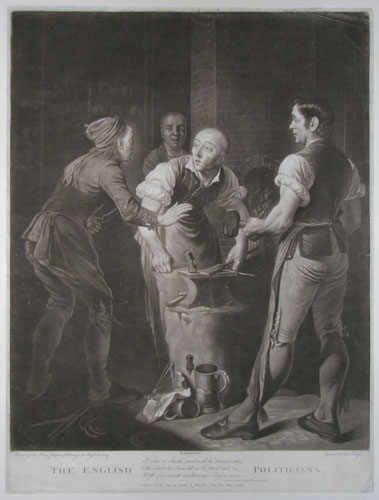
The English Politicians. I Saw a Smith stand with his Hammer, thus, The whilst his Iron did on th'Anvil cool, With open mouth swallowing a Taylor's news. Act IV. Scene IV. in the Hist.l Play of King John.
Painted by Edw.d Penny, Professor of Painting to the Royal Academy. R. Sayer Perfecit. Engraved by Rich.d Houston.
Published 12.th May 1794, by Laurie & Whittle, No.53, Fleet Street. London.
Mezzotint. Plate 609 x 458mm. 24 x 18".
Scene inside a blacksmith's workshop; the smith at his anvil raising his head to listen to a tailor on the left. The smith's assistant to the right, holding a hammer and another man seen in the background, leaning against a chimney. See 4605 for earlier state.
[Ref: 20723] £480.00
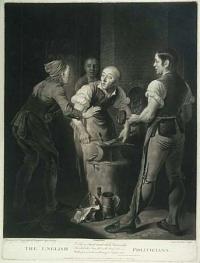
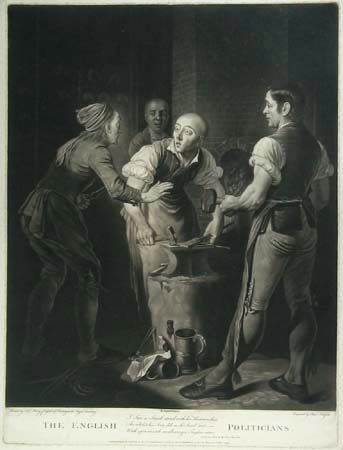
The English Politicians.
Painted by Edw.d Penny, Professor of Painting to the Royal Academy. Engraved by Richd. Houston. R.Sayer Perfecit.
London, Printed for Robt. Sayer & Co., Printsellers No. 53 Fleet Street, Published as the Act Directs 1t. Jan. 1791.
Mezzotint. 610 x 460mm. Faint surface crease.
'I saw a Smith stand with his Hammer, thus. / The whilst his Iron did on th' Anvil cool, / With open mouth swallowing a Taylor's news.' A more modern interpretation of lines from Shakespeare's 'King John'. A re-issue of 'The Newsmongers', first published 1771. CS: Houston 142, this state not listed.
[Ref: 4605] £750.00
![[Man riding a penny farthing.]](img-thumbnail/jpegs/8925.jpg)
[Man riding a penny farthing.]
Frank Allport [signed in ink lower left.]
[n.d., c.1880.]
Pen and ink and watercolour, sheet 255 x 205mm. 10 x 8".
An original caricature sketch of a man with a demonic beard, moustache and extraordinarily shaped hair with pony tail riding a penny farthing bicycle. The ordinary, high wheel or penny-farthing was the first true bicycle with which actual speed and distance could be achieved in a practical manner. Based on the original French Boneshaker, James Starley and others produced bicycles with front wheels of ever increasing size, starting about 1870.
[Ref: 8925] £320.00
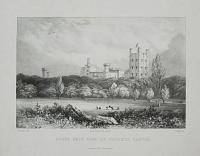
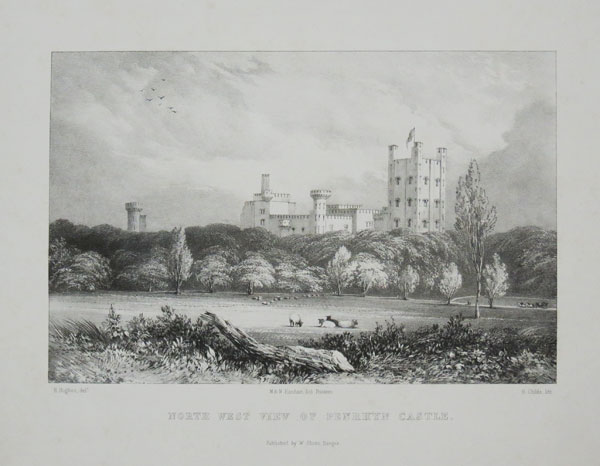
North West View of Penrhyn Castle.
H. Hughes, del.t. G. Childs, lith.
M. & N. Hanhart, lith. Printers. Published by W. Shone, Bangor. [n.d., c.1845.]
Rare lithograph. Sheet: 280 x 380mm (11 x 15''), with very large margins. Tear in edge.
A view of Penrhyn Castle in Llandygai, Wales.
[Ref: 50563] £120.00
(£144.00 incl.VAT)
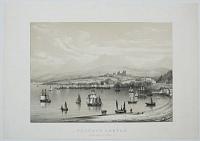
Penrhyn Castle from Garth Point.
[n.d., c.1845.]
Rare tinted lithograph. Sheet: 250 x 360mm (9¾ x 14''), with large margins. Tears in edges.
A view of Penrhyn Castle from the harbour at Bangor, Wales.
[Ref: 50564] £110.00
(£132.00 incl.VAT)
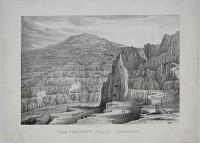
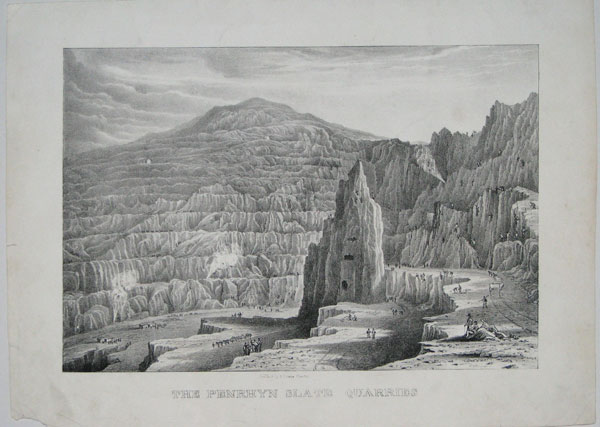
The Penrhyn Slate Quarries.
Lithog. by W Crane Chester.
[n.d. c.1830.]
Lithograph. 248 x 335mm. Some nicks to the egdes. Small tear bottom left-hand corner.
The Penrhyn Slate Quarry is located near Bethesda in north Wales. It is known as the world's largest slate quarry. First developed in 1770 by Richard Pennanr, later Baron Penrhyn. This quarry holds a significant place in the history of the British Labour Movement as the site of two prolonged strikes by workers demanding better pay and safer conditions. It is still a working quarry.
[Ref: 14973] £80.00
(£96.00 incl.VAT)

[Richard Penrose. of Huntington near York Aged 94 Years, Very remarkable for his abilities in catching Vipers, Snakes, Addres, &c, which he used frequently to carry about with him in his Bosom - and he is not less celebrated for destroying of Rats, Moles and every other Species of Vermin of the Quadrupede as well as of the Reptile Race.]
[Painted by S. Hewson. Engraved by J. Jones Engraver Extraordinary to His R.H. the Prince of Wales and Principal Engraver ro His R.H. the Duke of York.]
[London. Pub.d as the Act directs. Aug.t 10th 1792 by S. Hewson. No. 48 Frith Street, Soho.]
Rare mezzotint. Sheet 360 x 265mm (14¼ x 10½"). Trimmed well into image, losing all inscriptions, hole, old ink mss. verso 'A Hvine'
A portrait of famed vermin catcher Richard Penrose, three-quarter length standing three-quarter to the left, in a low landscape dotted with trees, looking towards the viewer. With both hands in front of him he holds a snake. He is wearing a plain coat buttoned at the waist, with a broad belt, spotted neckerchief and wide-brimmed round hat. CS: 61. Ex: Collection of Christopher Lennox-Boyd.
[Ref: 67626] £90.00
(£108.00 incl.VAT)
![[Penshurst.]](img-thumbnail/jpegs/18622.jpg)
[Penshurst.]
Cecil Aldin [pencil signature.]
[n.d., c.1910.]
Etching, signed, from a limited edition numbered '91/100' in pencil lower left. 300 x 210mm, 11¾ x 8¼". A fine impression.
A scene at Penshurst, a village in the Sevenoaks district of Kent: an elderly woman and terrier dog approaching a gatehouse walkway with a distant view of a church. The village grew up around Penshurst Place, the ancestral home of the Sidney family. Cecil Charles Windsor Aldin (1870 - 1935), artist and illustrator, was born in Slough, the son of a builder, and studied at the South Kensington school of Art. He worked as a comic illustrator in the 1890's before achieving great success as a sporting artist. He retired to Majorca in 1930.
[Ref: 18622] £380.00
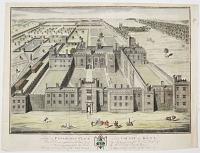
A View of Penshurst Place in the County of Kent. This plate was engraved in the Year 1747, ny Mr George Vertue, for Will.m Perry, Esq. And is now presented to this work by Mrs Elizabeth Perry his Widow, The only remaining Heir of the Noble Family of Sidney, & the Present Owner of this Seat.
[after Benjamin Dry.]
[London: c.1760.]
Coloured engraving with small margins. 440 x 560mm (17¼ x 22"). Binding folds flattened.
A bird's-eye view of the fortified Penshurst Place near Tonbridge in Kent, the ancestral home of the Sidney family (their etched crest is at centre of the inscription). Originally published in 1747 this example was published after William Perry's death in 1757, with the title re-engraved and Dry's inscription dropped.
[Ref: 30839] £290.00
(£348.00 incl.VAT)
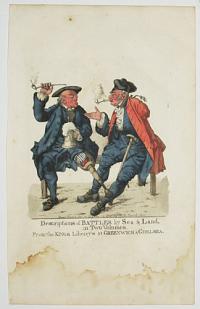
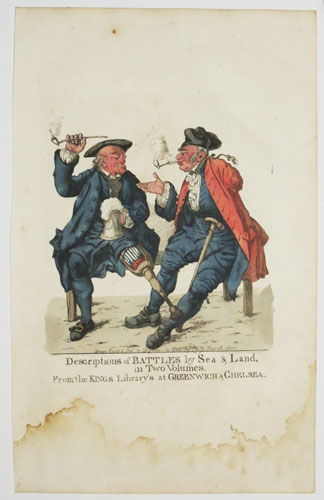
Descriptions of Battes by Sea & Land, in Two Volumes, From the Kings Library's at Greenwich & Chelsea.
Drawn, Etch'd & Pub. by Dighton, 12 Charing Cross, March 1801.
Hand-coloured etching. Plate: 220 x 175mm (8¾ x 7''), with large margins. Staining at bottom margin.
A scene showing two pensioners, a naval pensioner from Greenwich Hospital and a military pensioner from Chelsea Hospital in deep conversation over pipes and beer. BM Satire 9746.
[Ref: 50998] £140.00
(£168.00 incl.VAT)
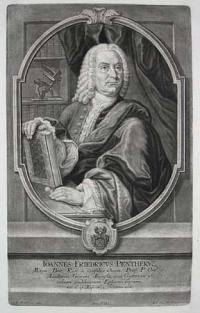
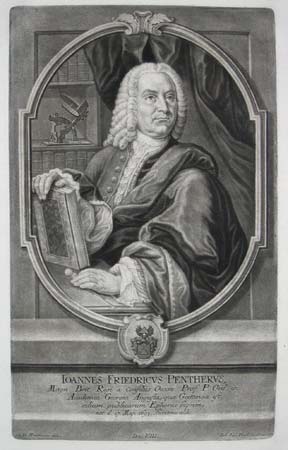
Iohannes Friedricus Pentherus, Magn. Brit. Regi a consiliis Oecon. Prof. P. Ord. in Academia Georgia Augusta, quae Goettingae est, aedium publicarum Ephorus suprem. Nat. d. 17. Maii 1693. Furstenwalde. Dec. VIII.
G.D. Heumann del. I.I. Haid scul. et exc. A. v.
[n.d. c.1750].
Mezzotint. 200 x 320mm.
Johann Friedrich Penther (16931749) was a German mathematician and architect based at Gottingen. W 2270.
[Ref: 3179] £220.00
(£264.00 incl.VAT)
![Off Penzance [pencil]](img-thumbnail/jpegs/58079.jpg)
Off Penzance [pencil]
J Lewis Stant [pencil]
[n.d., c.1950.]
Etching, printed in colours and hand finished, proof, titled and signed in pencil by the artist. 190 x 300mm (7½ x 11¾"), very large margins; on hand-made paper, 'Rembrandt Guild' blind stamp.
A sailing ship, off Cornwall. John Lewis Stant (1905-64), born in Dudley, Staffordshire, settled in St Ives, Cornwall, in 1935.
[Ref: 58079] £160.00
(£192.00 incl.VAT)

Penzance, Cornwall.
Drawn & Engraved by Will.m Daniell.
Published by W. Daniell, Russell Place, Fitzroy Square, London May 20. 1825.
Aquatint with fine original hand colour. 230 x 300mm (9 x 12"), with large margins.
A view of the port town of Penzance. From William Daniell's 'A Voyage Round Great Britain', a series of 308 aquatints published in eight volumes between 1814-1825, described by R.V. Tooley as 'the most important colour plate book on British Topography'. Abbey: Scenery, 16; Tooley: Books with Coloured Plates 177.
[Ref: 47144] £240.00
(£288.00 incl.VAT)
![[People sitting with their feet in the Stream.]](img-thumbnail/jpegs/23857.jpg)
[People sitting with their feet in the Stream.] 18.
TB [monogram lower left: Thomas Barker of Bath.]
[Bath, D. Redman, 1814.]
Pen lithograph. 310 x 240mm. 12¼ x 9½".
Two people sitting on a branch collapsed over the rushing water of the stream, dangling their legs and feet into the water; jagged rocks and woodland surround. From "Thirty Two Lithographic Impression from Pen Drawings of Landscape Scenery", 1814. Views around Bath, Wales, the Lake District and elsewhere.
[Ref: 23857] £140.00
(£168.00 incl.VAT)
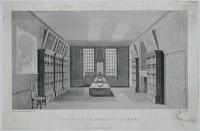
Interior of Mr. Pepys' Library. [Ink above image:] Pepys' Diary.
Lady Charlotte Neville, del. J. Saddler sculp.
London, Henry Colburn, 1854.
Engraving. 121 x 190mm. 4¾ x 7½". Tear and damage to lower right-hand corner. Trimmed.
The library of the diarist and Naval administrator Samuel Pepys, for whom the first free-standing bookcase was supposedly built in 1666. A view of the his library here at the Yorks Buildings, Westminster, London.
[Ref: 21428] £65.00
(£78.00 incl.VAT)
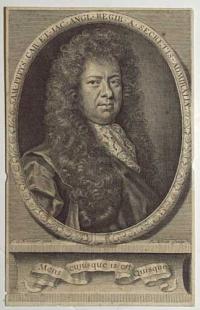
Sam. Pepys. Car. et. Iac. Angl. Regib. A. Secretis. Admiraliae. Mens cujus que is est Quisque.
G: Kneller pinx: R: White Sculp:
[n.d. c.1690.]
Engraving. Sheet: 145 x 90mm (5¾ x 3½"). Trimmed to image.
Portrait of Samuel Pepys, bust length in an oval frame on a pedestal, wearing long wig, lace cravat, and gown. Frontispiece to his 'Naval memoirs' (1690). Samuel Pepys FRS (1633-1703) was an English naval administrator and Member of Parliament who is now most famous for the diary he kept for a decade while still a relatively young man. He rose to be Chief Secretary to the Admiralty under both King Charles II and subsequently King James II.
[Ref: 55265] £240.00
(£288.00 incl.VAT)

Samuel Pepys Esq.r. Autograph of Secretary Pepys. From an original letter in the Possession of John Thane.
[after Sir Godfrey Kneller]
[n.d., c.1850.]
Etching with very large margins. 175 x 95mm (7 x 3¾")
Samuel Pepys [1633 - 1703], an important naval administrator, is famous for the diaries that he wrote in shorthand between 1660 and 1669. His skill lay in his close observation and total recall of the details of his private life and thoughts on social and political life in London. A passionate man, his great loves were his library, the theatre and 'music and women'. His professional preoccupations were with economics and politics but he retired following the Revolution of 1688 after refusing to swear an oath of allegiance to William and Mary. Nevertheless, he remained a key figure in social, intellectual and naval circles.
[Ref: 35322] £60.00
(£72.00 incl.VAT)
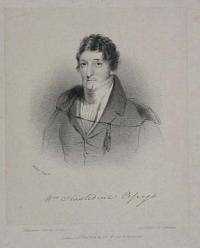
Wm. Hasledine Pepys. Athenaeum Portraits No. 34.
Walter Pinxt. Day & Haghe Lithrs. to the King.
London Pubd. May 1836, by Thos. McLean 26 Haymarket.
Lithograph. 170 x 145mm.
Member of the Philosophical Institute. Very rare.
[Ref: 6419] £90.00
(£108.00 incl.VAT)
![[Set of 18 portraits of the Perceval family]](img-thumbnail/jpegs/66553.jpg)
[Set of 18 portraits of the Perceval family]
[engraved by John Faber Jnr 1743-4.]
18 mezzotints. Each 150 x 110mm (6 x 4"), 16 on laid paper, two on wove, large margins. Time staining.
A complete set of 18 busts portrait in oval from 'A Genealogical History of the House of Yvery in its Different Branches of Yvery, Luvel, Perceval, and Gournay', a history of the family of John Perceval, 1st Earl of Egmont. Faber's mezzotints were only completed after the first two volumes were published in 1742; the proposed third volume was never published, possibly because Lord Egmont was offended when Robert Walpole called the publication 'ridiculous'. CS: 400, states ii of ii. Ex collection of the Hon. Christopher Lennox-Boyd.
[Ref: 66553] £850.00
![[Alice Perceval] Alice daughter of Jn.º Sheeman Esq.r of Ottery S.t Mary in the County of Devon](img-thumbnail/jpegs/66552.jpg)
[Alice Perceval] Alice daughter of Jn.º Sheeman Esq.r of Ottery S.t Mary in the County of Devon Wife to Rich.d Perceval Esq.r Secretary &c. of Court of Wards. Living AD 1599.
J. Faber Fecit. 1743.
Mezzotint. 150 x 110mm (6 x 4"), large margins.
A bust portrait in oval of Catherine Parker (1689-1749), wife of John Perceval, 1st Earl Edgmont. A portrait from 'A Genealogical History of the House of Yvery in its Different Branches of Yvery, Luvel, Perceval, and Gournay'. Faber's mezzotints were only completed after the first two volumes were published in 1742; the proposed third volume was never published, possibly because Lord Egmont was offended when Robert Walpole called the publication 'ridiculous'. CS: 400 i of ii. Ex collection of the Hon. Christopher Lennox-Boyd.
[Ref: 66552] £120.00
(£144.00 incl.VAT)
![[Catherine Perceval] Catherine only Daughter of Rob.t & Sister of S.r Rob.t Southwell of Kings weston in Com: Glou: K.t,](img-thumbnail/jpegs/66544.jpg)
[Catherine Perceval] Catherine only Daughter of Rob.t & Sister of S.r Rob.t Southwell of Kings weston in Com: Glou: K.t, Wife to S.r John Perceval Bar.t (7th of that name) Born 1.st Sep.r 1637. Married 14 Feb.y 1655. Died 17 Aug: 1679.
J. Faber Fecit. 1743.
Mezzotint. 150 x 110mm (6 x 4"). Narrow margins.
A bust portrait in oval of Catherine Perceval (1637-79), wife of John Perceval (1629-65), member of the Council of Trade and Privy Council (see Item 66545). A portrait from 'A Genealogical History of the House of Yvery in its Different Branches of Yvery, Luvel, Perceval, and Gournay'. Faber's mezzotints were only completed after the first two volumes were published in 1742; the proposed third volume was never published, possibly because Lord Egmont was offended when Robert Walpole called the publication 'ridiculous'. CS: 400 ii of ii. Ex collection of the Hon. Christopher Lennox-Boyd.
[Ref: 66544] £120.00
(£144.00 incl.VAT)
![[Catherine Perceval] Catherine Dau.ter of S.r Edw.d Dering of Surrenden in Kent Bar.t Southwell of Kings weston in Com: Glou: K.t,](img-thumbnail/jpegs/66550.jpg)
[Catherine Perceval] Catherine Dau.ter of S.r Edw.d Dering of Surrenden in Kent Bar.t Southwell of Kings weston in Com: Glou: K.t, Wife to S.r Jn.º Perceval Bar.t (8th of that name) Born _ Married Feb.y 1680-1. Died 2.d Feb:ry 1691-2.
J. Faber Fecit. 1743.
Mezzotint. 150 x 110mm (6 x 4"). Old ink mss. in bottom margin. Small margins.
A bust portrait in oval of Catherine Perceval (1681-1692), wife of John Perceval (1629-65), 3rd baronet, mother of the 1st Earl Edgmont. A portrait from 'A Genealogical History of the House of Yvery in its Different Branches of Yvery, Luvel, Perceval, and Gournay'. Faber's mezzotints were only completed after the first two volumes were published in 1742; the proposed third volume was never published, possibly because Lord Egmont was offended when Robert Walpole called the publication 'ridiculous'. CS: 400 ii of ii. Ex collection of the Hon. Christopher Lennox-Boyd.
[Ref: 66550] £120.00
(£144.00 incl.VAT)
![[Catherine Perceval] The R.t Hon.ble Catherine, Wife to John Perceval Earl of Egmont,](img-thumbnail/jpegs/66551.jpg)
[Catherine Perceval] The R.t Hon.ble Catherine, Wife to John Perceval Earl of Egmont, Eldest Daughter to S.r Philip, & Sister to S.r Philip Parker a-Morley-LOng of Erwarton in Com: Suffolk Bar.t the last of that Family, born 1689 marr.d 20 Jun. 1710 now living 1744.
J. Faber Fecit. 1743.
Mezzotint. 150 x 110mm (6 x 4"), large margins.
A bust portrait in oval of Catherine Parker (1689-1749), wife of John Perceval, 1st Earl Edgmont. A portrait from 'A Genealogical History of the House of Yvery in its Different Branches of Yvery, Luvel, Perceval, and Gournay'. Faber's mezzotints were only completed after the first two volumes were published in 1742; the proposed third volume was never published, possibly because Lord Egmont was offended when Robert Walpole called the publication 'ridiculous'. CS: 400 i of ii. Ex collection of the Hon. Christopher Lennox-Boyd.
[Ref: 66551] £120.00
(£144.00 incl.VAT)
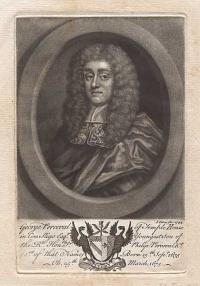
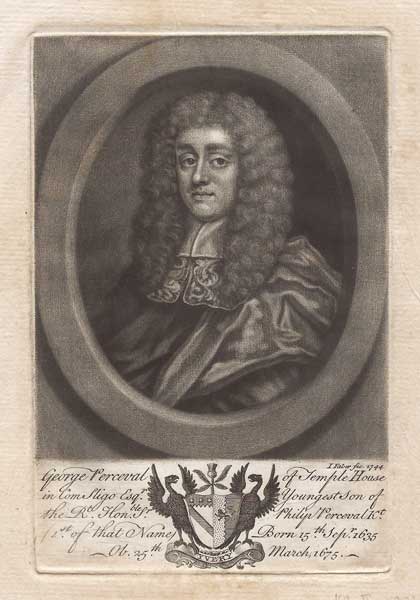
George Perceval of Temple House in Com Sligo Esq.r, Youngest Son of the R.t. Hon.ble Philip Perceval K.t (1.st of that Name) Born 15.th Sep.r 1635. Ob. 25.th March. 1675.
J. Faber fec. 1744.
Mezzotint. 150 x 110mm (6 x 4"), with large margins. Damp stains.
A bust portrait in oval of George Perceval (1635-1675), Registrar of the Prerogative Court, Dublin. He drowned near Holyhead, crossing to England with the Earl of Meath. A portrait from 'A Genealogical History of the House of Yvery in its Different Branches of Yvery, Luvel, Perceval, and Gournay'. Faber's mezzotints were only completed after the first two volumes were published in 1742; the proposed third volume was never published, possibly because Lord Egmont was offended when Robert Walpole called the publication 'ridiculous'. CS: 400 i of ii. Ex collection of the Hon. Christopher Lennox-Boyd.
[Ref: 66542] £120.00
(£144.00 incl.VAT)
![[John Perceval] The Right Honourable John Earl of Egmont.](img-thumbnail/jpegs/68586.jpg)
[John Perceval] The Right Honourable John Earl of Egmont. Visccount Percival of Canturk Baron Percival of Burton & one of his Majesty's most Hon.ble Privy Councel in ye Kingdom of Ireland.
H. Hysing Pinx.t. J. Faber fecit. 1734.
Sold by J. Faber, at ye Golden head ye South side of Bloomsbury Square.
Mezzotint. 350 x 250mm (13¾ x 9¾"). Trimmed to plate.
A portrait of Anglo-Irish politician, John Perceval (1683-1748), 1st Earl of Egmont, wearing peer's robes. In 1728 he became a member of the committee of Parliament investigating prison conditions and a friend of James Oglethorpe, who chaired the committee. In 1730 he joined Oglethorpe in an association that later became the Trustees for the Establishment of the Colony of Georgia in America. George II approved a charter for the colony in 1732, making Egmont president of the Georgia Trustees. CS 122, ii of ii. Ex collection of the Hon. Christopher Lennox-Boyd.
[Ref: 68586] £260.00
(£312.00 incl.VAT)
![[John Perceval] The Right Honourable John Earl of Egmont.](img-thumbnail/jpegs/68585.jpg)
[John Perceval] The Right Honourable John Earl of Egmont. Visccount Percival of Canturk Baron Percival of Burton & one of his Majesty's most Hon.ble Privy Councel in ye Kingdom of Ireland.
H. Hysing Pinx.t. J. Faber fecit. 1734.
Mezzotint, 18th century watermark. 350 x 250mm (13¾ x 9¾"). Trimmed to plate, creases,
A portrait of Anglo-Irish politician, John Perceval (1683-1748), 1st Earl of Egmont, wearing peer's robes. In 1728 he became a member of the committee of Parliament investigating prison conditions and a friend of James Oglethorpe, who chaired the committee. In 1730 he joined Oglethorpe in an association that later became the Trustees for the Establishment of the Colony of Georgia in America. George II approved a charter for the colony in 1732, making Egmont president of the Georgia Trustees. CS 122, i of ii. Ex collection of the Hon. Christopher Lennox-Boyd.
[Ref: 68585] £260.00
(£312.00 incl.VAT)
![[John Perceval] The Right Honourable John Earl of Egmont.](img-thumbnail/jpegs/68584.jpg)
[John Perceval] The Right Honourable John Earl of Egmont. Visccount Percival of Canturk Baron Percival of Burton & one of his Majesty's most Hon.ble Privy Councel in ye Kingdom of Ireland.
H. Hysing Pinx.t. J. Faber fecit. 1734.
Mezzotint, 18th century watermark 350 x 250mm (13¾ x 9¾"). Trimmed to image on three sides, into plate at bottom.
A portrait of Anglo-Irish politician, John Perceval (1683-1748), 1st Earl of Egmont, wearing peer's robes. In 1728 he became a member of the committee of Parliament investigating prison conditions and a friend of James Oglethorpe, who chaired the committee. In 1730 he joined Oglethorpe in an association that later became the Trustees for the Establishment of the Colony of Georgia in America. George II approved a charter for the colony in 1732, making Egmont president of the Georgia Trustees. American interest. CS 122, i of ii. Ex collection of the Hon. Christopher Lennox-Boyd.
[Ref: 68584] £260.00
(£312.00 incl.VAT)
![[John Perceval] The Right Honourable John Earl of Egmont.](img-thumbnail/jpegs/37705.jpg)
[John Perceval] The Right Honourable John Earl of Egmont. Visccount Percival of Canturk Baron Percival of Burton & one of his Majesty's most Hon.ble Privy Councel in ye Kingdom of Ireland.
H. Hysing Pinx.t. J. Faber fecit. 1734.
Sold by J. Faber, at ye Golden head ye South side of Bloomsbury Square.
Mezzotint. 350 x 250mm (13¾ x 9¾"). Small margins. Right vertical crease along left edge of sheet.
A portrait of Anglo-Irish politician. John Perceval, 1st Earl of Egmont, (1683 - 1748), known as Sir John Perceval from 1691 to 1715, as The Lord Perceval from 1715 to 1722 and as The Viscount Perceval from 1722 to 1733. In 1728 he became a member of the committee of Parliament investigating prison conditions. He soon became a close associate of James Oglethorpe, who chaired the committee. In 1730, the two men were among those who formed an association that later became the Trustees for the Establishment of the Colony of Georgia in America. George II approved a charter for the colony in 1732, making Egmont president of the Georgia Trustees. CS 122, ii of ii. Ex collection of the Hon. Christopher Lennox-Boyd.
[Ref: 37705] £650.00

George Perceval of Temple House in Com Sligo Esq.r, Youngest Son of the R.t. Hon.ble Philip Perceval K.t (1.st of that Name) Born 15.th Sep.r 1635. Ob. 25.th March. 1675.
J. Faber fec. 1744.
Mezzotint. 150 x 110mm (6 x 4"), large margins. Paper toned.
A bust portrait in oval of George Perceval (1635-1675), Registrar of the Prerogative Court, Dublin. He drowned near Holyhead, crossing to England with the Earl of Meath. A portrait from 'A Genealogical History of the House of Yvery in its Different Branches of Yvery, Luvel, Perceval, and Gournay'. Faber's mezzotints were only completed after the first two volumes were published in 1742; the proposed third volume was never published, possibly because Lord Egmont was offended when Robert Walpole called the publication 'ridiculous'. CS: 400 i of ii. Ex collection of the Hon. Christopher Lennox-Boyd.
[Ref: 66543] £120.00
(£144.00 incl.VAT)
![[John Penn] Pen-etration.](jpegs/64707.jpg)
![[Thomas Penn Esq One of the first proprietors of Pennsilvania.]](jpegs/65020.jpg)

![[William Penn on the Banks of the Delaware.]](jpegs/49069.jpg)


![Tho Pennant [facsimile signature].](jpegs/26343.jpg)
![Tho Pennant [facsimile signature].](jpegs/27066.jpg)


![[Josslyn Francis Pennington, 5th Baron Muncaster.]](jpegs/48501.jpg)

![[Man riding a penny farthing.]](jpegs/8925.jpg)


![[Penshurst.]](jpegs/18622.jpg)

![Off Penzance [pencil]](jpegs/58079.jpg)

![[People sitting with their feet in the Stream.]](jpegs/23857.jpg)


![[Set of 18 portraits of the Perceval family]](jpegs/66553.jpg)
![[Alice Perceval] Alice daughter of Jn.º Sheeman Esq.r of Ottery S.t Mary in the County of Devon](jpegs/66552.jpg)
![[Catherine Perceval] Catherine only Daughter of Rob.t & Sister of S.r Rob.t Southwell of Kings weston in Com: Glou: K.t,](jpegs/66544.jpg)
![[Catherine Perceval] Catherine Dau.ter of S.r Edw.d Dering of Surrenden in Kent Bar.t Southwell of Kings weston in Com: Glou: K.t,](jpegs/66550.jpg)
![[Catherine Perceval] The R.t Hon.ble Catherine, Wife to John Perceval Earl of Egmont,](jpegs/66551.jpg)
![[John Perceval] The Right Honourable John Earl of Egmont.](jpegs/68586.jpg)
![[John Perceval] The Right Honourable John Earl of Egmont.](jpegs/68585.jpg)
![[John Perceval] The Right Honourable John Earl of Egmont.](jpegs/68584.jpg)
![[John Perceval] The Right Honourable John Earl of Egmont.](jpegs/37705.jpg)