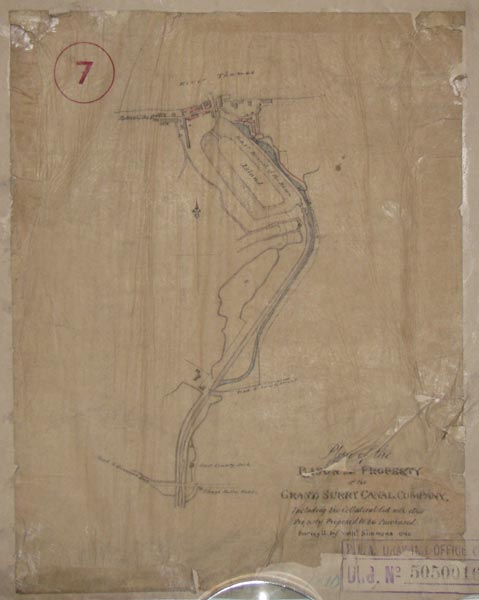
Plan of the Bason and Property of the Grand Surry Canal Company, Including the collateral cut with other Property Proposed to be Purchased.
Survey'd by Nath.l Simmons 1810.
Very scarce map, red and black ink on india. Sheet 330 x 260mm (13 x 10¼"). With P.L.A. Drawing Office ink stamp dated 1925 and manuscript indexing. Laid on linen, some wear and damage.
A plan of the terminus of the Grand Surrey Canal at the Surrey Commercial Docks in Rotherhithe. An overly-ambitious plan to join the docks with to Mitcham, Kingston & Epsom, with a junction with the Croydon Canal at New Cross, authorised by Act of Parliament in 1801. The first stretch of canal opened in 1809, but only 3½ miles of canal were completed. After WWII bombing destroyed most of the docks the canal fell into decline and it closed in 1971. From the Port of London Authority archives.
[Ref: 10305] £220.00
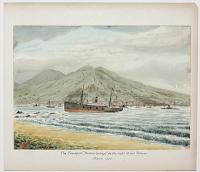
The Transport ''Denton Grange'' on the rocks at Las Palmas. March 1900.
AHT. 1900. [Astley Herbert Terry.]
Signed watercolour. Sheet: 175 x 250mm (7 x 9¾''). Mounted on board.
"Denton Grange" ran aground before Christmas 1899. A watercolour by Lieutenant Astley Herbert Terry (1866 - after 1937). The son of Major General Astley Fellows Terry, the artist served with both the Army Service Corps and the 60th Rifles. His posting to Sierra Leone coincides with the Second Boer War, so his duties would have been to provide for the troops en route to South Africa. He was promoted to major at the time of his departure, which was probably to the Cape: a 'Major Terry' of the 60th Rifles is recorded as participating in the war. In the 1911 census Terry was recorded as living in Kensington. In 1937 Colonel Astley Herbert Terry was installed as Commander of the Venerable Order of the Hospital of St John of Jerusalem, which is the last reference to him we can trace.
[Ref: 48112] £120.00
(£144.00 incl.VAT)
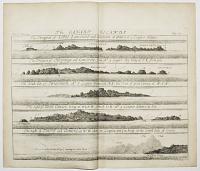
The Canary Islands.
J. Kip fecit.
[London: Lintot and Osborn, 1746.]
Engraving. 350 x 260mm (13¾ x 10¼") large margins. Folded as issued, toning to edges.
Five coastal profiles, including Lazerote, Tenerife and Grand Canaria, illustrations from Jean Barbot's 'A Description of the Coasts of North and South Guinea; and of Ethiopia Inferior, vulgarly Angola...', as published in Volume V of 'Churchill's Voyages and Travels'. A French explorer, Barbot made two voyages to West Africa in 1678 and 1681 but, after the Edict of Nantes was revoked in 1685, he sought sanctuary in England from anti-protestant persecution.
[Ref: 45658] £140.00
(£168.00 incl.VAT)
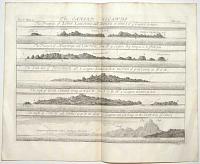
The Canary Islands.
[London: Awnsham and John Churchill, 1704.]
Engraving, 18th century watermark. 255 x 355mm (10 x 14") very large margins.
Five coastal profiles, including Lanzerote, Fuerteventura, Gran Canaria, La Gomera From 'A Collection of Voyages and Travels'.
[Ref: 59924] £90.00
(£108.00 incl.VAT)
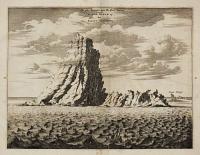
The pike Mountaine upon The Island Tenerieto. De Piek-Bergh op het Eilant Tenerifto.
[London: John Ogilby, 1670.]
Engraving. 245 x 325mm (9¾ x 12¾"). Central fold as normal. Tears taped, holes.
The volcanic Mount Teide on Tenerife. The view was first published in Dapper's 'Beschrijvinge der Afrikaanse Gewesten', but this example comes from the English edition, published by John Ogilby as 'Africa: being, An Accurate Description of the Regions of Egypt, Barbary, Lybia, and Billedulgerid, the Land of Negroes, Guinee, Aethiopia, and the Abysinnes, with All the Adjacente Islands'.
[Ref: 51991] £130.00
(£156.00 incl.VAT)
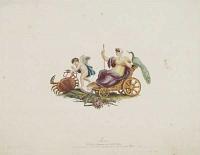
June. June Drawn by Cancer.
Burney delt. E. Scriven Sc.
Pub. June 1. 1807 by R. Ackermann at his Repository of Arts 101 Strand, London [but c.1815].
Hand-coloured stipple and etching, reissue on Whatman paper, partly printed in colour. 195 x 260mm, 7¾ x 10¼". Some spotting.
Juno, chief goddess of the Greek and Roman pantheon, in a carriage pulled by cancer, represented by a crab, and a winged putto; a peacock perched behind her. No trace of price upper right. After Edward Francis Burney (1760 - 1848), from a series of allegories of the months.
[Ref: 22584] £230.00
(£276.00 incl.VAT)
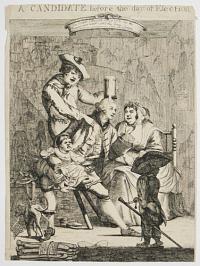
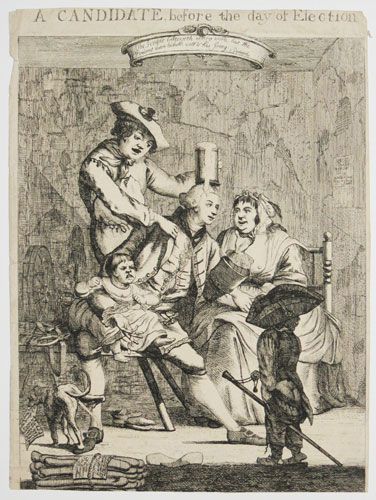
A Candidate, before the day of Election. The simple beliveth every word but the Prudent man looketh well to his Going. Proverbs.
A rare etching. Sheet: 340 x 255mm (13¼ x 10''). Trimmed into image at bottom and creasing. Small tears.
A scene showing a political candiation sitting in the room of a house, he sits with a child on his knee while a dog urinates on his foot.
[Ref: 50734] £260.00
(£312.00 incl.VAT)
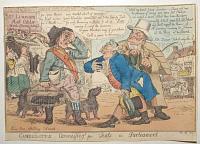
Candidates Canvasing'' for Seats in Parliament.
W. E S.t [William Elmes].
[London, Thomas Tegg, n.d., c.1812.]
Hand coloured etching. Sheet size: 235 x 330mm (9¼ x 13"). Trimmed within plate.
A candidate, on the right, bows low, top-hat in hand, right hand pointing to his breast, before a sturdy and ragged rat catcher, who stands facing him, scratching his forehead. Close behind the candidate is his agent, holding a purse from which he is about to take a coin. Both wear spurred boots. To the left is a cottage with a sign above reading 'Gs Lurcher Rat Catcher All sorts of Vermin destroyed'. In the background to the right is a country inn with a sign on which a fat pig is depicted. BM Satires 11923.
[Ref: 56025] £260.00
(£312.00 incl.VAT)
![[Wax and Candle Invoice.] Bo.t of W. & J. Barton, Wax & Tallow Chandlers, No. 26 Bishopsgate with opposite Threadneedle Street.](img-thumbnail/jpegs/43660.jpg)
[Wax and Candle Invoice.] Bo.t of W. & J. Barton, Wax & Tallow Chandlers, No. 26 Bishopsgate with opposite Threadneedle Street.
[1834.]
Engraved invoice with manuscript; pt watermark (18)32. Sheet: 125 x 200mm (5 x 8"). Folds and creasing.
An invoice for candles and soap from chandlers W. & J. Barton based in Bishopsgate.
[Ref: 43660] £75.00
(£90.00 incl.VAT)
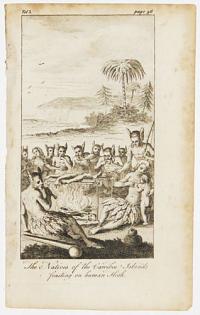
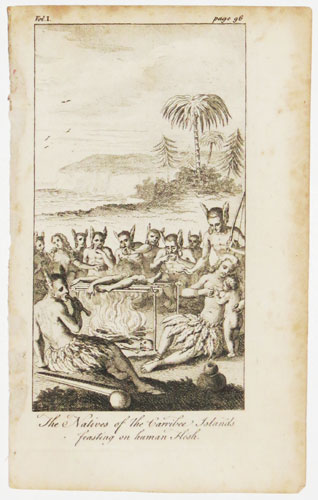
The Natives of the Carribee Islands feasting on human Flesh.
[London: William Strahan et al, c.1766.]
Engraving. Sheet 165 x 100mmm (6½ x 4"). Some toning.
A group of natives with feathers on their ears roasting limbs, a suitably graphic illustration for Smollett's 'Compendium of Authentic and Entertaining Voyages'.
[Ref: 44639] £120.00
(£144.00 incl.VAT)
![[Canning Town.] London. Sheet LXVI.](img-thumbnail/jpegs/10986.jpg)
[Canning Town.] London. Sheet LXVI. Edition of 1894-96.
Photozincographed and Published by the Director General at the Ordnance Survey Office, Southampton, 1897.
Zincograph with hand colour, sheet 700 x 990mm, 27½ x 39". With stenciled sheet number and mss. notes. Laid on linen, some surface soiling, tears, edges chipped.
A large-scale plan (1/2500) of Canning Town with the northern part of the Royal Victoria Docks. This sheet has been used to record the property of the Port of London Authority, noting sales. From the Port of London Authority archives.
[Ref: 10986] £80.00
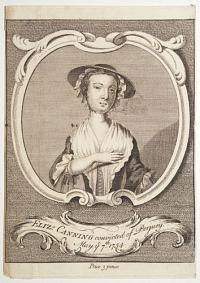
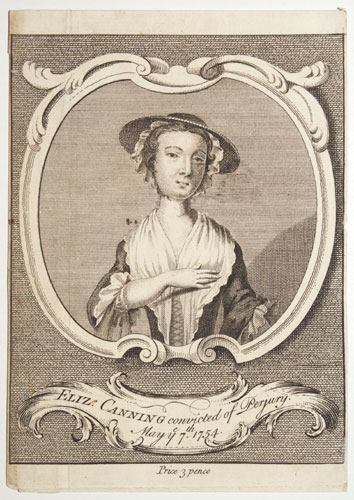
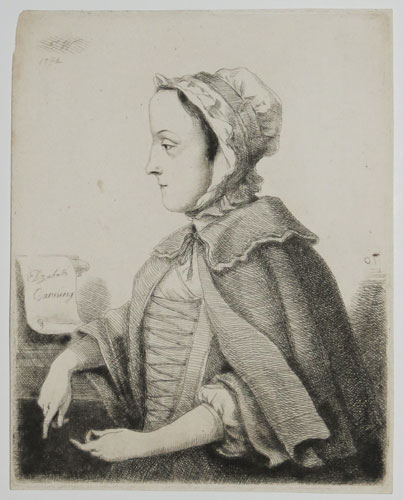
Elizabeth Canning convicted of Perjury. May ye 7th 1754. Price 3 pence.
[n.d. c.1754.]
Engraving. Sheet 175 x 120mm (6¾ x 4¾"). Trimmed. Vertical crease.
Elizabeth Canning (1734-73), an 18-year-old London maidservant, claimed to have been kidnapped on New Year's Day and held for a month in a brothel in Enfield. She accused `Mother Wells', the madam of the establishment, of trying to force her to become a prostitute. A hideous gypsy crone staying in the house, Mary Squires, cut off the girl's stays (worth 10 shillings), and Elizabeth was imprisoned in an attic with only a few crusts of bread and a jug of water to live on. On January 29th she escaped through a window and walked all the way back to her mother's house in the City. Squires and Wells were apprehended, and tried at the Old Bailey; the former was condemned to be hanged, and the latter was burned in the hand and imprisoned. However opinion turned against Canning and new evidence led her to be charged with perjury and transported for seven years. CS 36.ii.
[Ref: 53153] £160.00
(£192.00 incl.VAT)

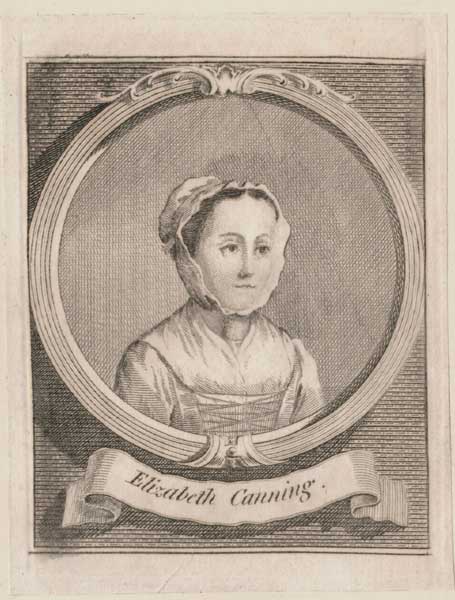
Elizabeth Canning.
[n.d. c.1755.]
Engraving. Sheet 130 x 100mm (5 x 4"). Trimmed, mounted in album paper.
Elizabeth Canning (1734-73), an 18-year-old London maidservant, claimed to have been kidnapped on New Year's Day 1753 and held for a month in a brothel in Enfield. She accused `Mother Wells', the madam of the establishment, of trying to force her to become a prostitute. A hideous gypsy crone staying in the house, Mary Squires, cut off the girl's stays (worth 10 shillings), and Elizabeth was imprisoned in an attic with only a few crusts of bread and a jug of water to live on. On January 29th she escaped through a window and walked all the way back to her mother's house in the City. Squires and Wells were apprehended, and tried at the Old Bailey; the former was condemned to be hanged, and the latter was burned in the hand and imprisoned. However opinion turned against Canning and new evidence led her to be charged with perjury and transported for seven years.
[Ref: 58657] £120.00
(£144.00 incl.VAT)
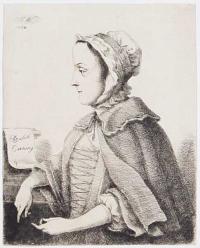
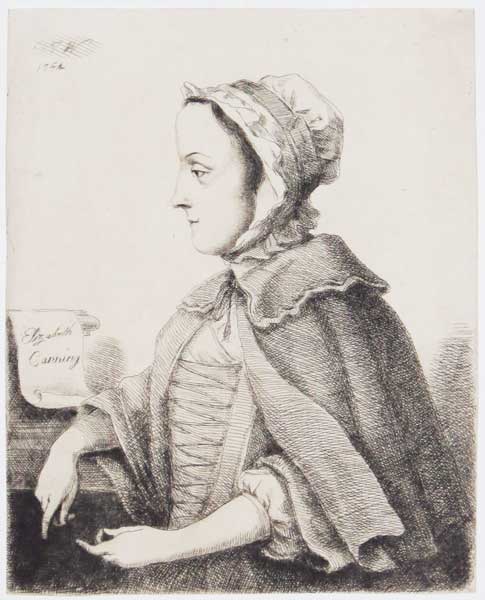
Elizabeth Canning.
TW [Thomas Worlidge] 1754.
Etching, sheet 190 x 150mm (7½ x 6"). Trimmed on platemark; good impression on laid paper.
Elizabeth Canning (1734-1773) in the witness box, portrayed here by Thomas Worlidge, the 'English Rembrandt'. Canning was a London scullerymaid whose alleged kidnapping caused a sensation in 1753. She disappeared for a month before returning to her mother's home. Susannah Wells and Mary Squires, Canning's alleged captors, were tried and found guilty. However, Crisp Gascoyne, trial judge and Lord Mayor of London, was unhappy with the verdict and began his own investigation which led to information proving Squires and her family to be innocent. Several of the prosecution witnesses recanted their earlier testimonies and Canning was tried and found guilty of perjury. She was sentenced to one month's imprisonment and seven years of transportation. First state before the number '70' added on the right side. State i/ii; D41; W69; Ex collection of the Late Hon. C. Lennox-Boyd.
[Ref: 33024] £140.00
(£168.00 incl.VAT)

Elizabeth Canning.
TW [Thomas Worlidge] 1754.
Etching, sheet 190 x 150mm (7½ x 6"). Trimmed on platemark; good impression on laid paper; glued to backing sheet at corners.
Elizabeth Canning (1734-1773) in the witness box, portrayed here by Thomas Worlidge, the 'English Rembrandt'. Canning was a London scullerymaid whose alleged kidnapping caused a sensation in 1753. She disappeared for a month before returning to her mother's home. Susannah Wells and Mary Squires, Canning's alleged captors, were tried and found guilty. However, Crisp Gascoyne, trial judge and Lord Mayor of London, was unhappy with the verdict and began his own investigation which led to information proving Squires and her family to be innocent. Several of the prosecution witnesses recanted their earlier testimonies and Canning was tried and found guilty of perjury. She was sentenced to one month's imprisonment and seven years of transportation. First state before the number '70' added on the right side. State i/ii; D41; W69; Ex collection of the Late Hon. C. Lennox-Boyd.
[Ref: 33025] £140.00
(£168.00 incl.VAT)
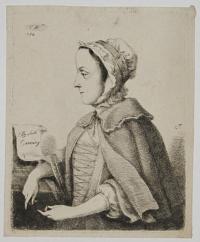
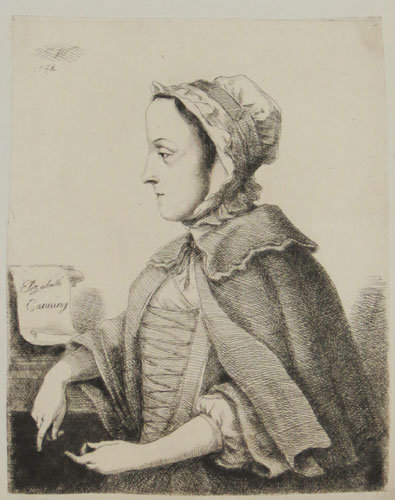
Elizabeth Canning.
TW [Thomas Worlidge] 1754.
Etching, sheet 190 x 150mm (7½ x 6"). Small margins; good impression on laid paper; soiling at top.
Elizabeth Canning (1734-1773) in the witness box, portrayed here by Thomas Worlidge, the 'English Rembrandt'. Canning was a London scullerymaid whose alleged kidnapping caused a sensation in 1753. She disappeared for a month before returning to her mother's home. Susannah Wells and Mary Squires, Canning's alleged captors, were tried and found guilty. However, Crisp Gascoyne, trial judge and Lord Mayor of London, was unhappy with the verdict and began his own investigation which led to information proving Squires and her family to be innocent. Several of the prosecution witnesses recanted their earlier testimonies and Canning was tried and found guilty of perjury. She was sentenced to one month's imprisonment and seven years of transportation. Second state after the number '70' added (in reverse) on the right side. State ii/ii; D41; W69; Ex collection of the Late Hon. C. Lennox-Boyd.
[Ref: 33026] £160.00
(£192.00 incl.VAT)
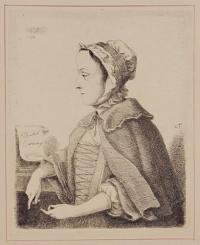
Elizabeth Canning.
TW [Thomas Worlidge] 1754.
Etching, sheet 190 x 150mm (7½ x 6"). Small margins; tipped into album sheet; worn later impression.
Elizabeth Canning (1734-1773) in the witness box, portrayed here by Thomas Worlidge, the 'English Rembrandt'. Canning was a London scullerymaid whose alleged kidnapping caused a sensation in 1753. She disappeared for a month before returning to her mother's home. Susannah Wells and Mary Squires, Canning's alleged captors, were tried and found guilty. However, Crisp Gascoyne, trial judge and Lord Mayor of London, was unhappy with the verdict and began his own investigation which led to information proving Squires and her family to be innocent. Several of the prosecution witnesses recanted their earlier testimonies and Canning was tried and found guilty of perjury. She was sentenced to one month's imprisonment and seven years of transportation. Second state after the number '70' added (in reverse) on the right side. State ii/ii; D41; W69; Ex collection of the Late Hon. C. Lennox-Boyd.
[Ref: 33027] £90.00
(£108.00 incl.VAT)
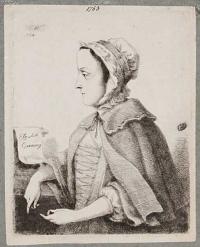
Elizabeth Canning.
TW [Thomas Worlidge] 1754.
Etching with drypoint, small margins, paper watermarked. Plate 184 x 147mm (7¼ x 5¾"). Slight stain on right; glued to backing sheet at top corners.
Elizabeth Canning (1734-1773) in the witness box, portrayed here by Thomas Worlidge, the 'English Rembrandt'. Canning was a London scullerymaid whose alleged kidnapping caused a sensation in 1753. She disappeared for a month before returning to her mother's home. Susannah Wells and Mary Squires, Canning's alleged captors, were tried and found guilty. However, Crisp Gascoyne, trial judge and Lord Mayor of London, was unhappy with the verdict and began his own investigation which led to information proving Squires and her family to be innocent. Several of the prosecution witnesses recanted their earlier testimonies and Canning was tried and found guilty of perjury. She was sentenced to one month's imprisonment and seven years of transportation.
[Ref: 28956] £180.00
(£216.00 incl.VAT)
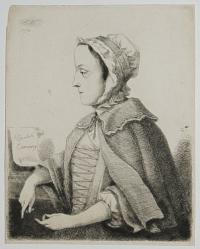
Elizabeth Canning.
TW [Thomas Worlidge] 1754.
Etching. Plate: 190 x 150mm (7½ x 6''). Damage in top left corner.
Elizabeth Canning (1734-1773) in the witness box, portrayed here by Thomas Worlidge, the 'English Rembrandt'. Canning was a London scullerymaid whose alleged kidnapping caused a sensation in 1753. She disappeared for a month before returning to her mother's home. Susannah Wells and Mary Squires, Canning's alleged captors, were tried and found guilty. However, Crisp Gascoyne, trial judge and Lord Mayor of London, was unhappy with the verdict and began his own investigation which led to information proving Squires and her family to be innocent. Several of the prosecution witnesses recanted their earlier testimonies and Canning was tried and found guilty of perjury. She was sentenced to one month's imprisonment and seven years of transportation.
[Ref: 48672] £140.00
(£168.00 incl.VAT)

The Right Hon.ble George Canning M.P. His Majesty's Secretary of State Foreign Affairs.
M. Gauci del. N. Chater & Co. Lithog.
London, Printed & Published by N. Chater & Co. 33 Fleet St. Oct. 28, 1822.
Hand-coloured lithograph, printed on india paper. Printed area: 280 x 210mm (11 x 8¼"). Slight staining below image.
A half-length portrait of Tory politician George Canning (1770-1827) who served as Prime Minister for the final four months of his life.
[Ref: 46150] £95.00
(£114.00 incl.VAT)

The Population of the British Empire 1821.
H. Adlard Sculp.
[n.d., c.1821.]
Etching on paper watermarked 1825. Plate 165 x 125mm (6½ x 5"), with margins.
A portrait of Prime Minister George Canning surrounded by rings giving the population statistics of London, Edinburgh and Dublin, the Home Countries and counties. Around the outer ring is a text 'India and other Foreign Possessions upwards of 82 Millions'.
[Ref: 60236] £95.00
(£114.00 incl.VAT)

The Right Honourable George Canning. First Lord of the Treasury and Chancellor of the Exchequer. Proof
Engraved by William Brett, from a Painting by T. Stewardson Esq.re.
London, Published June 20, 1827, by W.m Sams, Royal Library, 1, St James's Street.
Mezzotint. 440 x 320mm (17¼ x 12½") very large margins. Dusty in margins.
A three quarter portrait of George Canning (1770-1827), published two months after he became Prime Minister and less than two months before his death from tuberculosis. He helped the South American countries in independence from Spain and Portugal. Ex: collection of The Hon. Christopher Lennox-Boyd.
[Ref: 67843] £260.00
(£312.00 incl.VAT)
![[George Canning] [To His Most Excellent Majesty This Portrait of The Right Honorable George Canning, M.P.](img-thumbnail/jpegs/41874.jpg)
[George Canning] [To His Most Excellent Majesty This Portrait of The Right Honorable George Canning, M.P. First Lord of the Treasury &c.&c.&c. is by His Gracious Permission Dedicated By His Majesty's very humble subjects and obliged servants, Colnaghi, Sons & Co.]
[Engraved by Charles Turner after Sir Thomas Lawrence]
[Pall Mall East, London, Pub.d July 20th 1827, by Messrs. Colnaghi Son & Co, Printsellers to His Majesty.]
Mezzotint on india, proof before letters. 375 x 290mm (14¾ x 11½"). Some spotting.
Fine half-length portrait of statesman George Canning (1770 - 1827), published during his term as Prime Minister which, at 119 days, was the shortest ever. After Sir Thomas Lawrence (1769 - 1830). The original oil is in Attingham Park, a National Trust property. Whitman 96, predating the state I.
[Ref: 41874] £240.00
(£288.00 incl.VAT)
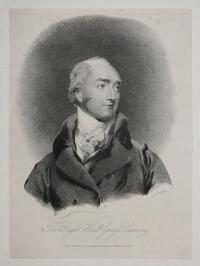
The Right Hon.ble George Canning.
Drawn on Stone by F.R. Say from a Print after Sir Tho.s Lawrence P.R.A. Printed by Hullmandel
London Published by J. Dickinson, 114, New Bond Street, June 1st 1827.
Lithograph on india, india dimensions 270 x 205mm (10½ x 8"), with large margins. Uncut.
George Canning (1770-1827), prime minister and parodist. This portrait, after a painting by Sir Thomas Lawrence, was published during Canning's term as prime minister which, at 119 days, was the shortest ever.
[Ref: 46512] £140.00
(£168.00 incl.VAT)
![[George Canning & John Scott] The Struggle, or a long Pull, a strong Pull, and a Pull_All'together.](img-thumbnail/jpegs/63406.jpg)
[George Canning & John Scott] The Struggle, or a long Pull, a strong Pull, and a Pull_All'together. When two row in the same Boat, they may pull different ways; but when two ride on one Horse, one must ride behind. A House divided itself cannot stand!!!
H.H. fec.[Henry Heath]
Pub.d March 16 1827 by SW Fores Piccadilly London.
Coloured etching. Sheet 235 x 335mm (9¼ x 13¼"). Trimmed within plate, mounted in album paper at edges.
George Canning and John Scott, Earl of Eldon, row against each other in the 'Cabinet Cock Boat', Canning using an oar of 'Deplomatic Sagacity', Eldon the mace, which is inscribed Pelf Patronage Parsimony. Behind Canning is the Unicorn; his flag Catholic Supremacy. The Lion is behind Eldon, with the flag of Protestant Ascendancy. A satire on the division in the Cabinet between Catholics and Protestants and between Canning and Eldon. After the debate on Burdett's motion for Catholic Relief, there was a great expectation that Canning would resign. BM Satires: 15366.
[Ref: 63406] £260.00
(£312.00 incl.VAT)
![George Canning [facsimile signature].](img-thumbnail/jpegs/16703.jpg)
George Canning [facsimile signature].
[n.d., c.1827.
Blind-embossed card. Sheet 280 x 220mm (11 x 8½"). Some spotting.
An blind-embossed (i.e. no ink) portrait of George Canning (1770-1827), prime minister for only 119 days in 1827, dying in office. The decorative border (also embossed, as is the signature), suggests this is a posthumous memorial. See ref: 11932
[Ref: 16703] £180.00
(£216.00 incl.VAT)
![[John Canning?] Dr. Loll Tongue, the Filching Conosieur.](img-thumbnail/jpegs/38248.jpg)
[John Canning?] Dr. Loll Tongue, the Filching Conosieur. V.6. 14.
Pubd accor to Act by MDarly (39) Strand Aug. 1st. 1773.
Etching. Plate 173 x 126mm (6¾ x 5").
Portrait of a man standing in profile to left. He wears a bag wife, a long coat with large cuffs, and a frilled shirt. His tongue protrudes. His hat is under his left arm. He holds a walking-stick in his left hand, and in his right a print which appears to represent a fight between boxers in a room. Possible representation of John Canning (1703-1775), the apothecary and Arabist in London. He translated two medieval Arabic texts which were some of the earliest Arabic texts printed in England. BM Satires: 5159.
[Ref: 38248] £220.00
(£264.00 incl.VAT)
![[Stratford Canning] Canning de Radcliffe [facsimile signature].](img-thumbnail/jpegs/48507.jpg)
[Stratford Canning] Canning de Radcliffe [facsimile signature].
[after George Richmond.]
[1853.]
Stipple on chine collé, with Printsellers' Association blindstamp. 560 x 430mm (22 x 17") very large margins. Some spotting.
Stratford Canning (1786-1880), 1st Viscount Stratford de Redcliffe, Ambassador to the Ottoman Empire 1842-58, during which he was involved with the dispute between the Ottomans and Russia that led to the Crimean War.
[Ref: 48507] £70.00
(£84.00 incl.VAT)
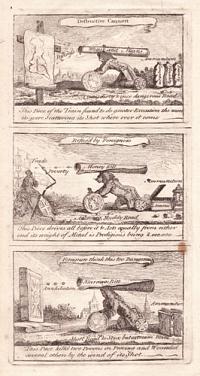
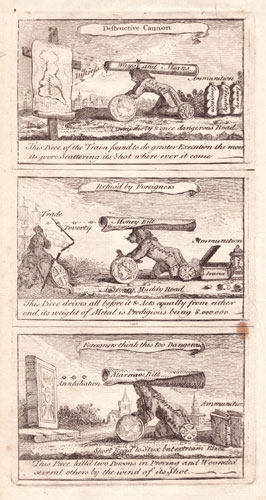
Destructive Cannon. Refus'd by Foreigners. Foreigners think this too Dangerous.
[n.d., 1756.]
Etching. 195 x 100mm (7¾ x 4"). Printer's crease.
Three sections each showing a cannon made from a crouching figure and a scroll, with wheels made of gold coins . The first is 'Liberty' supporting 'Ways and Means' firing at a map of the British Isles; the second 'Property' and 'Money Bill'; and the last a 'Heterodox' clergyman and the 'Marriage Bill'. A copy of BM 3490, issued in 'England's Rememberancer'. BM Satires 3491.
[Ref: 57909] £230.00
(£276.00 incl.VAT)
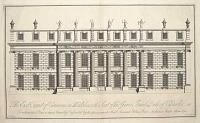
The East Front of Cannons in Middlesex, the Seat of his Grace, James Duke of Chandos, &c. To whom the Plate is most Humbly Inscrib'd by his Graces most Obed.t Servant John Price. Architect. Built, Anno 1720.
J. Price Delin. H. Hulsbergh Sculp.t.
[London: Thomas Badeslade & John Rocque, 1739.]
Engraving. 390 x 645mm (15¼ x 25½") very large margins. Splits in centre fold taped.
An elevation of 'Cannons', a stately home in Little Stanmore, Middlesex, named for the Augustinian canons of St Bartholomew's Hospital who owned the estate before the Reformation. Built by James Brydges (1673-1744) and completed in 1720, the building lastest less than 30 years. His expenditure and losses from the South Sea Bubble meant that his heir was left with such debts that he held demolition auction in 1747, in which the contents and architectural features were sold. The Palladian columns now form the portico of the National Gallery in Tragalgar Square.
[Ref: 56259] £480.00
(£576.00 incl.VAT)
![[Canoes in the Ice.]](img-thumbnail/jpegs/42725.jpg)
[Canoes in the Ice.]
Ferugio?
[n.d., 1860.]
Lithograph. Rare. Sheet: 510 x 330mm (20 x 13"), large margins. Light foxing around edges.
An atmospheric scene showing figures in native American costume canoeing through the ice in a fog in North America.
[Ref: 42725] £280.00
(£336.00 incl.VAT)

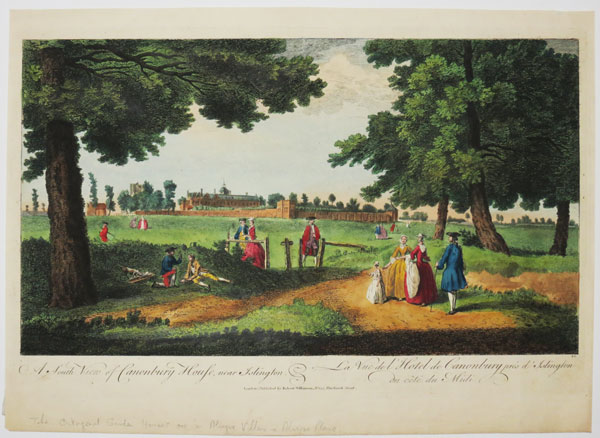
A South View of Canonbury House, near Islington.
London: Published by Robert Wilkinson, No. 125, Fenchurch Street [n.d., c.1816.]
Scarce engraving with very fine hand colour. 260 x 420mm (10¼ x 16½").
A fine & decorative view looking across fields to Canonbury House.
[Ref: 51447] £320.00
![[Canongate Tolbooth.] 68.](img-thumbnail/jpegs/14640.jpg)
[Canongate Tolbooth.] 68. [Canongate Tolbooth, which stands amongst a number of other fine old buildings, built in 1591, when this was a separate burgh with it own magistrate. It is a good example of the French style of architecture, with its tower and corbelled turrets, forestair, and high dormer heads. Over the archway of the door are the words "Pro patria et posteris, 1591." The building contained a jail on the ground floor, and the Countil Chambers, or Court Room, on the first floor, where the Bailies of the Canongate gave their decisions, and where the councillors of the burgh met. The building ceased to have a separate municipal existence in 1856. The projecting clock was added in the last century.]
Arthur Spencer [pencil signature to the bottom left-hand side outside the image]
[n.d. c.1920.] Copyright. F. & M. Ltd., Bedford, Eng.
Etching. 284 x 255mm. 11¼ x 10".
[Ref: 14640] £35.00
(£42.00 incl.VAT)
![372 Canongate Tolbooth Edinburgh [pencil on mount.]](img-thumbnail/jpegs/49239.jpg)
372 Canongate Tolbooth Edinburgh [pencil on mount.]
[Monogram in plate] H Wardel Bly [pencil.]
[n.d., c.1930.]
Drypoint, signed by the artist. 250 x 105mm (9¾ x 4¼") very large margins. In original mount. Mint.
Canongate Tolbooth, built in 1591 when Canongate was outside Edinburgh's walls. The building is now occupied by The People's Story Museum.
[Ref: 49239] £45.00
(£54.00 incl.VAT)
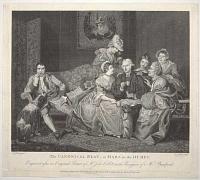
The Canonical Beau, or Mars in the Dumps. Engraved after an Original Picture of Mr John Collett, in the Possession of Mr. Bradford.
J. Collett pinx.t. J. Goldar sculps.t.
Published by T.Bradford, No.132 Fleet Street, & H.Parker, No 82 Cornhill, as the Act directs, 25th Oct.r 1768.
Engraving with etching, fine impression. 335 x 375mm (13½ x 14¾"). Folds around image within platemark.
Three young ladies, two elderly women and a pug dog are clustered fawning around a clergyman, to the dismay of a young ex-soldier with a wooden leg who sits disgruntled at the other end of the sofa with the head of a hound in his lap. An open book is titled 'The Church triumphant'. BM 1954,1103.397.
[Ref: 56162] £360.00

Canova.
Maurin. Imp. lithog. de Chambert, rue Cassette Nº 2.
[n.d., c.1830.]
Tinted lithograph. Printed area 290 x 240mm (11½ x 9½"), with large margins. Slight foxing in margins.
Antonio Canova (1757-1822), Italian sculptor who was the most innovative and widely-acclaimed practitioner of the neo-classical style. He was made famous by his marble sculptures rendering the delicate touch of the nude flesh. Being neo-classical, his work marked a return to the classical perfection and fine art after the excessive extravagance of the Baroque era.
[Ref: 63182] £180.00
(£216.00 incl.VAT)
![Antonio Canova. [Facsimile signature.]](img-thumbnail/jpegs/13593.jpg)
Antonio Canova. [Facsimile signature.]
F.X. Fabre pinxit. W.H. Worthington sculp.
Published by Septimus Prowett, 269 Strand. [n.d., c.1830.]
Engraving on india laid paper, 340 x 230mm. 13½ x 9". Slightly foxed.
Antonio Canova (1757 - 1822) admiring one of his creations in his studio. Canova was an Italian sculptor who became famous for his marble sculptures that delicately rendered nude flesh. The epitome of the neoclassical sculptor, his work marked a return to classical refinement after the theatrical excesses of Baroque art. After François Xavier Fabre (1766 - 1837).
[Ref: 13593] £160.00
(£192.00 incl.VAT)
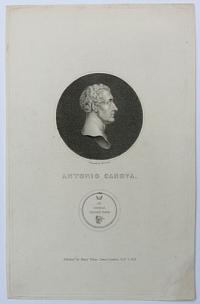
Antonio Canova.
Engraved by Thomson
Published by Henry Fisher, Caxton, London, Oct.r 1 1823.
Stipple, platemark 220 x 135mm (8½ x 5¾"). Small margins.
Antonio Canova (1757-1822), Italian sculptor who was the most innovative and widely-acclaimed practitioner of the neo-classical style. He was made famous by his marble sculptures rendering the delicate touch of the nude flesh. Being neo-classical, his work marked a return to the classical perfection and fine art after the excessive extravagance of the Baroque era.
[Ref: 41416] £65.00
(£78.00 incl.VAT)
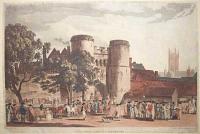
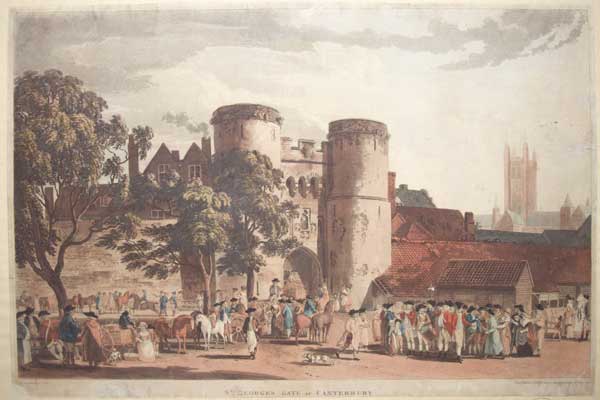
St Georges Gate, at Canterbury.
Paul Sandby Fecit 1782.
Published by T. Palser, Surrey side, Westminster Bridge 1812.
Rare coloured aquatint. Sheet 340 x 515mm (13¼ x 20¼"). Trimmed to plate, some restoration, laid on album sheet. Damaged. Album sheet slightly cockled. Repairs.
A view of the Norman gatway of Canterbury on market day, with people milling around outside the city. First published by Paul Sandby c.1789.
[Ref: 56059] £280.00
(£336.00 incl.VAT)
![Mercery Lane, Canterbury [pencil].](img-thumbnail/jpegs/62558.jpg)
Mercery Lane, Canterbury [pencil].
W.m P. Robins [pencil].
[n.d. c.1920.]
Etching, titled and signed by the artist. 235 x 165mm (9¼ x 6½"), very large margins. Faint mount burn.
A view of the medieval lane, looking towards Canterbury Cathedral. William Palmer Robins (1882-1959), member of the Royal Society of Painters, Etchers and Engravers, and the Chicago Society of Etchers.
[Ref: 62558] £95.00
(£114.00 incl.VAT)
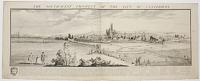
The South-West Prospect of the City of Canterbury.
Sam.l and Nath.l Buck delin. et Sculp.
Publish'd according to Act of Parliament Mar. 25th 1738. Garden Court, No 1. Middle Temple, London.
Engraving. Sheet 310 x 780mm (12¼ x 30¾"). Central vertical fold as normal, small margins.
A detailed view of Canterbury, with a descriptive text below and a key to the right, indicating various landmarks and buildings. From the series 'Buck's Perspective Views of Cities and Chief Towns in England and Wales', before the addition of a plate number top right.
[Ref: 42779] £380.00
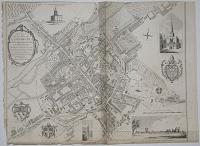
A Plan of the City of Canterbury, & the Adjoining Suburbs: A.D. MDCCCXXV.
Fenner sc. London.
Rare engraved map. Sheet 350 x 420mm. Trimmed top and bottom.
Decorated with costs of arms of the City, the Archbishopric and the Dean & Chapter; and four vignette views of the churches and the Augustine monastery.
[Ref: 17724] £180.00
![Canterbury [pencil].](img-thumbnail/jpegs/62561.jpg)
Canterbury [pencil].
W.P. Robins 1921 [pencil].
Etching, titled and signed by the artist. 230 x 380mm (9 x 15") very large margins.
A view looking down on Canterbury Cathedral from woodland. William Palmer Robins (1882-1959), member of the Royal Society of Painters, Etchers and Engravers, and the Chicago Society of Etchers.
[Ref: 62561] £160.00
(£192.00 incl.VAT)

The North Prospect of Canterbury.
Tho: Johnson delineavit. W: Hollar fecit.
[n.d. c.1670] But later.
Etching, watermark J. Whatman c. 1795; sheet 180 x 550mm (7 x 21¾"). Trimmed to plate and glued to backing sheet at edges. Right third folded. Time staining. Ink transfer from cartouche dedication to the middle.
A long view of the city in the middle distance, with the cathedral in the left to the centre, seen across a field in the foreground. A coat-of-arms with mitre crest and two fields at top left and an ornamental cartouche at top right containing dedication to Gilbert by Ogilby. Pennington 961 iii.
[Ref: 62706] £320.00
![[Canterbury Cathedral] Cantuariensis Ecclesiæ Cath: facies aquilonalis.](img-thumbnail/jpegs/61223.jpg)
[Canterbury Cathedral] Cantuariensis Ecclesiæ Cath: facies aquilonalis.
Tho. Johnson delin: Dan: King sculp.
[n.d., 1655.]
Etching on 17th century watermarked paper. 270 x 290mm (10½ x 11½"), with margins. Some creasing and spotting.
A view of Canterbury Cathedral from the north, with a dedication to Edward Darrel. An illustration from William Dugdale's 'Monasticon Anglicanum'. According to Pennington, Wenceslaus Hollar etched the cartouche with the St George's Cross in the bottom centre.
[Ref: 61223] £160.00
(£192.00 incl.VAT)
![[Canterbury Cathedral] Dean Fotherby.](img-thumbnail/jpegs/44155.jpg)
[Canterbury Cathedral] Dean Fotherby.
[n.d., 1726.]
Mezzotint with line engraving, rare & fine. 210 x 350mm (8¼ x 13¾).
The tomb of Charles Fotherby (c. 1549-1619), Dean of Canterbury (1615-1619), in the Lady Chapel in the cathedral, published in John Dart's 'The History and Antiquities of the Cathedral Church of Canterbury'. A more recent history described it as 'a bone-encrusted tomb-chest [which] is a fine example of that obsessive early seventeenth-century morbidity which repelled later, more squeamish observers'. Ex Collection of the Hon. Christopher Lennox-Boyd. Collinson, Ramsay & Sparks 'A History of Canterbury Cathedral'.
[Ref: 44155] £280.00
(£336.00 incl.VAT)
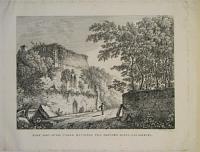
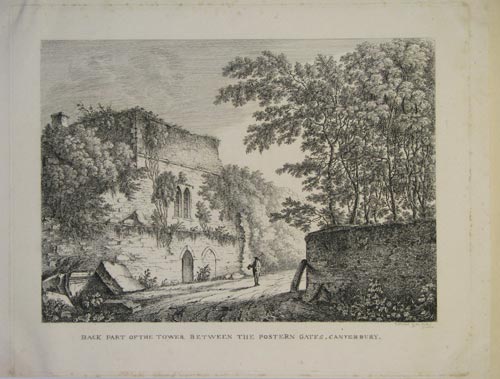
Back Part Of The Tower Between The Postern Gates, Canterbury.
T. Hasting [etched in image lower left.]
Published by the Author London [n.d., 1813].
Etching, 265 x 330mm. Light spotting, mostly to margins. Laid to album page.
Thomas Hastings (fl.1813 - 1831), amateur etcher, was collector of customs at Liverpool, and is known as Captain Hastings. He did some good work as an etcher, and was an associate of the Liverpool Academy. This a scarce plate from his ‘Vestiges of Antiquity, or a Series of Etchings of Canterbury'. He also published the following works, illustrated by himself: ‘Etchings (39) from the Works of Richard Wilson,' 1825, ‘The British Archer, or Tracts on Archery,' Newport, 1831. He also engraved the plates to Woolnoth's ‘Canterbury Cathedral,' 1816. Ex: collection of the Hon. Christopher Lennox-Boyd.
[Ref: 7982] £160.00
(£192.00 incl.VAT)
![[The Canterbury Tales] Griselda.](img-thumbnail/jpegs/60306.jpg)
[The Canterbury Tales] Griselda. There, lowly seated on the dewey ground, she feeds her little charge that bleats around.
Angelica Kauffman del.t. Fran. Bartolozzi sculp.t.
London Publish'd March 35, 1784 by Sus,a Vivares, No 13 Great Newport Street.
Fine stipple with etching, printed in colours. 385 x 290mm (15¼ x 11½"). Thread margins, repair to bottom left corner of plate.
Griselda sitting in a landscape with sheep, holding a spindle under her left arm and a shuttle in her right hand. From Chaucer's 'Clerk of Oxford's Tale'. De Vesme 1369. Ex: Oettingen-Wallerstein collection. Sotheby's London / Milan Nov 1997.
[Ref: 60306] £480.00
![[Canterbury Tales] Departure of the Canterbury Pilgrimes.](img-thumbnail/jpegs/60342.jpg)
[Canterbury Tales] Departure of the Canterbury Pilgrimes. Prologue, Canterbury Tale Chaucer.
Drawn by Mortimer. Engraved by J Hogg.
London Publish'd Feb.y 12.th 1787 by J. R. Smith No. 31 King Street Covent Garden.
Etching with engraving. 260 x 190mm (10¼ x 7½"), with large margins. Single spot in unprinted area of plate.
The pilgrims and their horses gather in a square outside the Tabard Inn, Southwark. One of nine plates after John Hamilton Mortimer, probably prepared for an edition of Chaucer's 'Canterbury Tales' that was abandoned before publication. Ex: Oettingen-Wallerstein collection. Sotheby's London / Milan Nov 1997.
[Ref: 60342] £160.00
(£192.00 incl.VAT)
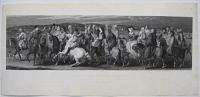
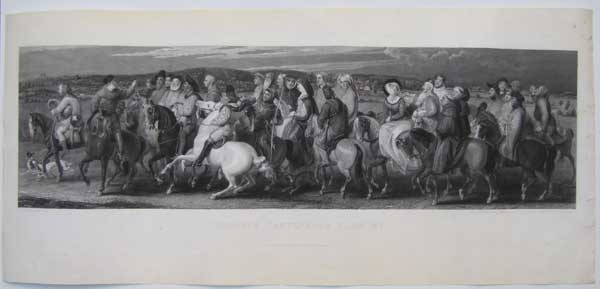
The Canterbury Pilgrims.
Painted by Thomas Stothard Esq.r R.A. Etched by Lewis Schiavonetti, V.A. and Finished by James Heath A.R.A. Historical Engraver to His Majesty, and to H.R.H. the Prince Regent, &c.
London: Published for the Proprietors by R. Cribb, N.º 288 Holborn, October 1, 1817.
Etching, state before key. 360 x 995mm (14¼ x 39¼"). Some restoration.
A procession of the pilgrims immortalised by Geoffrey Chaucer's 'Canterbury Tales', on horseback, led by a piper, based on the painting on oak by Thomas Stothard (1806-7, now in the Tate Gallery, N01163). Robert Cromek commissioned the painting, putting it on show at a shilling per visitor. He also asked Italian stipple engraver Luigi Schiavonetti (1765-1810) to make a plate, but Schiavonetti only completed the outline etching. As a tribute to the engraver, Cromek published the incomplete print in 1810. The incomplete plate was then given to Francis Engleheart to complete, but Cromek’s death in 1812 stalled the project. Cromek’s widow, Elizabeth, gave the plate to Niccolo Schiavonetti, Louis's younger brother, but he too died. The plate was finally completed by James Heath and was published for Elizabeth, on 1st October 1817. A later state, with a full key identifying each pilgrim, was printed by W.H. Worthington, also for Elizabeth. The print also caused a rift between Stothard and his friend William Blake: Blake claimed that Cromek had commissioned a painting of the Canterbury Pilgrims from him first, but Cromek had not liked the design and so took the commission to Stothard. Blake accused Cromek and, through him, Stothard, of copying his long, frieze-like composition
[Ref: 61951] £750.00



![[Wax and Candle Invoice.] Bo.t of W. & J. Barton, Wax & Tallow Chandlers, No. 26 Bishopsgate with opposite Threadneedle Street.](jpegs/43660.jpg)
![[Canning Town.] London. Sheet LXVI.](jpegs/10986.jpg)




![[George Canning] [To His Most Excellent Majesty This Portrait of The Right Honorable George Canning, M.P.](jpegs/41874.jpg)

![[George Canning & John Scott] The Struggle, or a long Pull, a strong Pull, and a Pull_All'together.](jpegs/63406.jpg)
![George Canning [facsimile signature].](jpegs/16703.jpg)
![[John Canning?] Dr. Loll Tongue, the Filching Conosieur.](jpegs/38248.jpg)
![[Stratford Canning] Canning de Radcliffe [facsimile signature].](jpegs/48507.jpg)

![[Canoes in the Ice.]](jpegs/42725.jpg)
![[Canongate Tolbooth.] 68.](jpegs/14640.jpg)
![372 Canongate Tolbooth Edinburgh [pencil on mount.]](jpegs/49239.jpg)


![Antonio Canova. [Facsimile signature.]](jpegs/13593.jpg)

![Mercery Lane, Canterbury [pencil].](jpegs/62558.jpg)


![Canterbury [pencil].](jpegs/62561.jpg)

![[Canterbury Cathedral] Cantuariensis Ecclesiæ Cath: facies aquilonalis.](jpegs/61223.jpg)
![[Canterbury Cathedral] Dean Fotherby.](jpegs/44155.jpg)
![[The Canterbury Tales] Griselda.](jpegs/60306.jpg)
![[Canterbury Tales] Departure of the Canterbury Pilgrimes.](jpegs/60342.jpg)