Richard Smith [facsimile signature] Deputy Provincial Grand Master of the Freemasons of the Province of Bristol.
N.C. Branwhite, delt. Edwd. Morton, lith.
[n.d. c.1800.]
Lithograph. 317 x 240mm. 12½" x 9½". A small mark in the title area
Richard Smith (1772 - 1843). Surgeon of the Bristol Royal Infirmary, established in 1826. Wrote 'Biographical Memoirs of the Bristol Infirmary'. Not in Wellcome.
[Ref: 8288] £130.00
(£156.00 incl.VAT)

[Dr Samuel Smith] Mastigeus [in Greek letters.] V.1. 13.
Pubd. according to Act of Parlt. July 1st. 1771 by MDarly 39 Strand.
Etching. 146 x 109mm (5¾ x 4¼").
A cleric seated at a round table with papers and quill. Representation of Dr Samuel Smith (d.1808), headmaster of Westminster School. BM Satires: 4680.
[Ref: 38251] £190.00
(£228.00 incl.VAT)
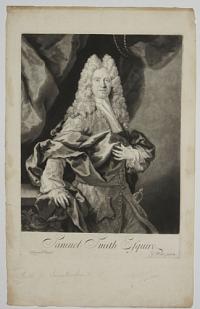
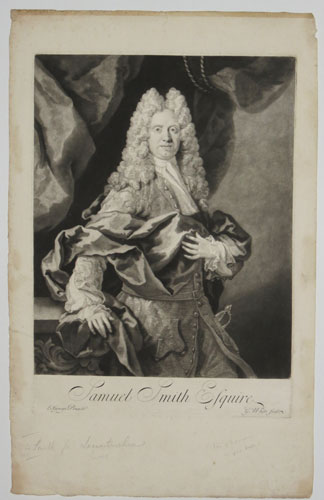
Samuel Smith Esquire.
E. Gouge Pinxit. G. White fecit.
[n.d. c.1740.]
Mezzotint with very large margins. Plate 345 x 247mm. 13½ x 9¾".
Portrait, three-quarter length standing directed to left, looking towards the viewer, right hand on the corner of a stone table to left, left hand at his breast, wearing a long coat, belt, sword, cravat, long white wig and a cloak around his back and drawn under left arm across his chest with one end held under right hand. Samuel Smith (d.1732), of Weald Hall, son of Erasmus Smith. See NPG: D9152. CS: 46.
[Ref: 28101] £230.00
(£276.00 incl.VAT)
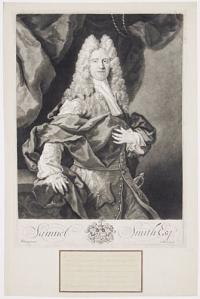
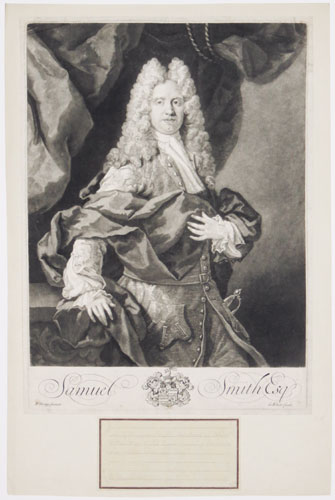
Samuel Smith Esquire.
E. Gouge Pinxit. G. White fecit.
[n.d. c.1740.]
Mezzotint, fine & rare; platemark 345 x 247mm (13½ x 9¾"). Glued to backing sheet in corners. Small margins.
Samuel Smith (d.1732), of Weald Hall, son of Erasmus Smith. Portrayed three-quarter length, wearing a long coat, belt, sword, cravat, long white wig and a cloak around his back and drawn under left arm across his chest with one end held under right hand. NPG D9152; CS 46; for a different state see ref. 28101.
[Ref: 43707] £170.00
(£204.00 incl.VAT)

Sir Sidney Smith.
Robert Ker Porter pinxt. W.Say sculpt.
London Published as the Act directs, June 19, 1802, John P. Thompson, Printseller to his Majesty and their Royal Highness's the Duke & Duchess of York. Gt.Newport Street, and No.51 Dean Street, Soho.
Coloured mezzotint. 630 x 440mm (24¾ x 17¼") Slight repair in image.
Sir William Sidney Smith KCB (21 June 1764 - 26 May 1840) fought in the American Revolutionary War, where he saw action in 1778 against the American frigate Raleigh. He also distinguished himself in the Battle of Cape St Vincent (1780), Battle of the Chesapeake (1781) and the Battle of the Saintes (1782). His subsequent career included important service during the Napoleonic Wars, notably in the defence and relief of Acre. Napoleon said of him "That man made me miss my destiny" concerning his defence of Acre.
[Ref: 4705] £850.00
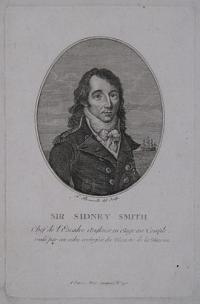
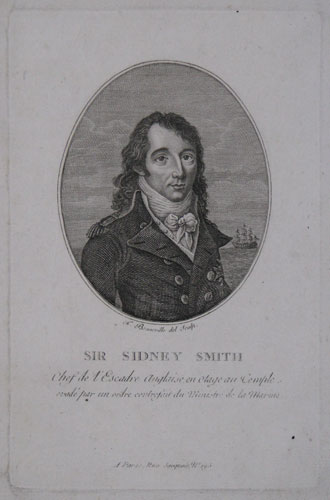
Sir Sidney Smith. Chef de l'Escadre Anglaise...[etc.]
F. Bonneville del Sculp.
A Paris, Rue Jacques, No.195. [n.d., c.1800.]
Stipple with etching, 200 x 130mm. 8 x 5".
Sir William Sidney Smith KCB (1764 - 1840), the British admiral of whom Napoleon Bonaparte said 'That man made me miss my destiny', having aided the Turks in their resistance to Napoleon in Egypt and the Levant. Quite an uncommon portrait.
[Ref: 13113] £85.00
(£102.00 incl.VAT)
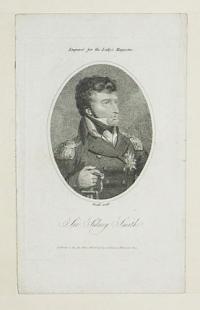
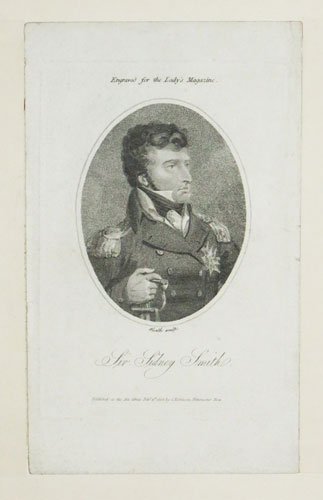
Sir Sidney Smith. Engraved for the Lady's Magazine.
Heath sculp.
Published as the Act directs Feb.y 1.st 1803, by G. Robinson, Paternoster Row.
Stipple. Plate: 160 x 110mm (6¼ x 4¼''). Tipped into album sheet; verso invite from Duke of Wellington to dinner.
A portrait of naval officer Sir Sidney Smith (1764-1840) who served in the American and French Revolutionary wars. Napoleon reminiscing later in his life, said of him: "That man made me miss my destiny".
[Ref: 49387] £75.00
(£90.00 incl.VAT)
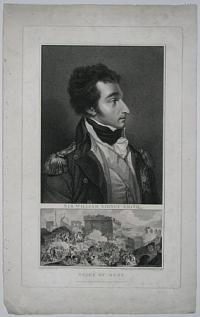
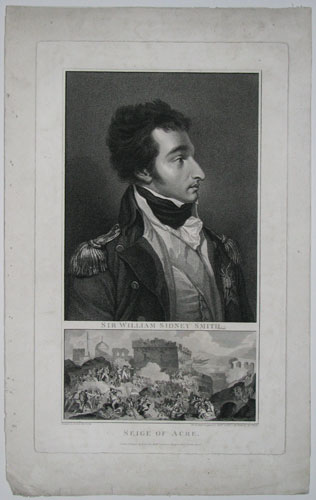
Sir William Sidney Smith. Seige Of Acre.
Painted by Robert Ker Porter. The Portrait Engraved by Anth.y Cardon__the Battle by Ja.s Mitan.
London, Published April 1804, by Anth.y Cardon, 31, Clipstone Street, Fitzroy Square.
Portrait, stipple with etching, and engraved battle scene from one plate. 439 x 266mm (17¼ x 10½"), with wide margins. Slight soiling.
Sir William Sidney Smith KCB (1764-1840), the admiral of whom Napoleon Bonaparte said 'That man made me miss my destiny', having aided the Turks in their resistance to Napoleon in Egypt and the Levant. The Siege of Acre of 1799 was an unsuccessful French siege of the Ottoman-defended, walled city of Acre (now Akko in modern Israel) and was the turning point of Napoleon's invasion of Egypt and Syria. A Royal Navy flotilla under Commodore William Sidney Smith helped to reinforce the Turkish defences and supplied the city with additional cannon manned by sailors and marines. The seige was eventually raised and Napoleon withdrew to Egypt.
[Ref: 21291] £110.00
(£132.00 incl.VAT)

[Sir Sidney Smith.]
[Robert Ker Porter pinxt. W. Say sculpt.]
[London Published as the Act directs, June 19, 1802, John P. Thompson, Printseller to his Majesty and their Royal Highness's the Duke & Duchess of York. Gt.Newport Street, and No.51 Dean Street, Soho.]
Mezzotint, rare proof before letters. 630 x 440mm (24¾ x 17¼"). Trimmed into plate at bottom, repaired tears in margins. Top margin messy.
A full-length portrait of Sir William Sidney Smith (1764-1840), in uniform, with a turk, flag and broken sword behind. A naval officer, Smith fought in the American Revolutionary War, where he saw action in 1778 against the American frigate Raleigh. He also distinguished himself in the Battle of Cape St Vincent (1780), Battle of the Chesapeake (1781) and the Battle of the Saintes (1782). His subsequent career included important service during the Napoleonic Wars, notably in the defence and relief of Acre. Napoleon said of him "That man made me miss my destiny", concerning his defence of Acre. Ex: collection of The Hon. Christopher Lennox-Boyd.
[Ref: 68216] £850.00

Very truly yours Southwood Smith [facsimile handwriting].
Miss M. Gillies. J.C. Armytage.
Published by Smith, Elder & Co., 65, Cornhill.
Stipple engraving on india. 210 x 130mm (8¼ x 5¼") very large margins. Backing paper spotted.
Thomas Southwood Smith (1788-1861), physician and sanitary reformer. Despite his belief in the miasma theory his reports on quarantine (1845), cholera (1850), yellow fever (1852), and on the results of sanitary improvement (1854) were of international importance. However he is best known for his highly controversial public dissection of Jeremy Bentham in 1832 and his correspondence with Charles Dickens.
[Ref: 43392] £60.00
(£72.00 incl.VAT)

Very truly yours Southwood Smith [facsimile handwriting].
Miss M. Gillies. J.C. Armytage.
Published by Smith, Elder & Co., 65, Cornhill.
Fine stipple engraving on steel. 210 x 130mm (8¼ x 5¼") large margins.
Thomas Southwood Smith (1788-1861), physician and sanitary reformer. Despite his belief in the miasma theory his reports on quarantine (1845), cholera (1850), yellow fever (1852), and on the results of sanitary improvement (1854) were of international importance. However he is best known for his highly controversial public dissection of Jeremy Bentham in 1832 and his correspondence with Charles Dickens, wrote the life & letters of Dickens.
[Ref: 43393] £60.00
(£72.00 incl.VAT)
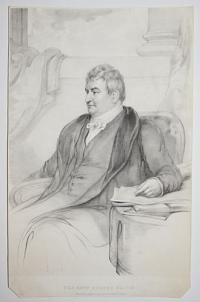
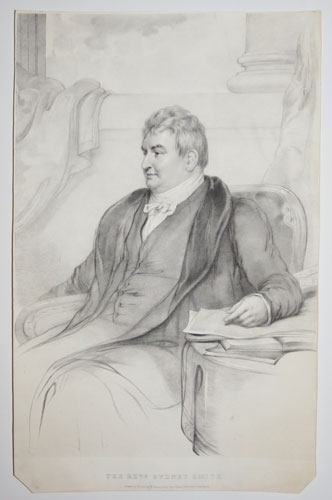
The Rev.d Sydney Smith.
Drawn on Stone by W. Sharp from the original Drawing by John Hayter [c.1830]
Lithograph on india, sheet 495 x 310mm (19½ x 12¼") Trimmed;
Sydney Smith (1771-1845), author and wit, an important contributor to the growth of libertarian thought in England, and (as G.K. Chesterton pointed out) the inventor of nonsense. O'D 2
[Ref: 46509] £180.00
(£216.00 incl.VAT)
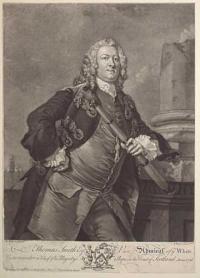
Thomas Smith Esq. Vice Admiral of ye White Commander in Chief to his Majesty's Ships on the Coast of Scotland. Anno 1746.
R. Wilson pinx.t. J. Faber fecit.
Price 2.s Sold by Faber at the Golden Head in Bloomsbury Square. [n.d. c.1750.]
Rare mezzotint. Sheet 355 x 255mm (14 x 10"). Trimmed to plate, tipped on album paper at corners on left. Damaged in title.
Thomas Smith (1707-1762), commodore governor of Newfoundland 1741/3 and admiral credited with the invention of the divisional system that remains in use on ships today. CS: 333 i of v.
[Ref: 56431] £220.00
(£264.00 incl.VAT)

Effigies Reverendi admodum Viri, Thomæ Smith Episcopi Carliolensis. Anno Christi 1701. Ætatis Suæ 87.
Timo: Stephenson pinx: J: Smith fec: et ex:
[n.d., c.1701.]
Mezzotint, 18th century watermark. 325 x 235mm (12¾ x 9¼"). Narrow margins, nick lower left, creasing in corners.
A half-length portrait of Thomas Smith (1615-1702), who served as chaplain to Charles II before becoming Bishop of Carlile in 1684. CS 233. Ex: collection of The Hon. Christopher Lennox-Boyd.
[Ref: 68657] £130.00
(£156.00 incl.VAT)
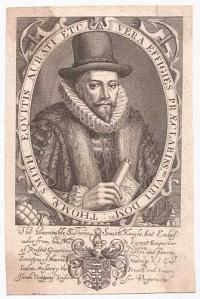
Thomae Smith equitis aurati etc. vera effigies Praeclariss.mi Viri Dom.ni. The honourable Sr Thomas Smith Knight, late Embasador from his Ma.stie to ye great Emperour of Russie, Gouernour of ye Hon:ble and famous Societyes of Marchanes tradinge to ye East- Indies, Mosscovy, the French and Somer Ilands Company, Tresurer for Virginia etc.
[After Simon de Pass.]
[n.d., c.1800.]
Engraving. Sheet 170 x 110mm (6¾ x 4¼"), on wove paper. Trimmed within plate, losing publication line?
Oval portrait of Sir Thomas Smythe or Smith (1558-1625), holding a map of Russia, sailing motifs in the borders. He was the first governor of the East India Company (1600) and was treasurer of the Virginia Company from 1609 to 1620. First published c.1617.
[Ref: 57650] £160.00
(£192.00 incl.VAT)

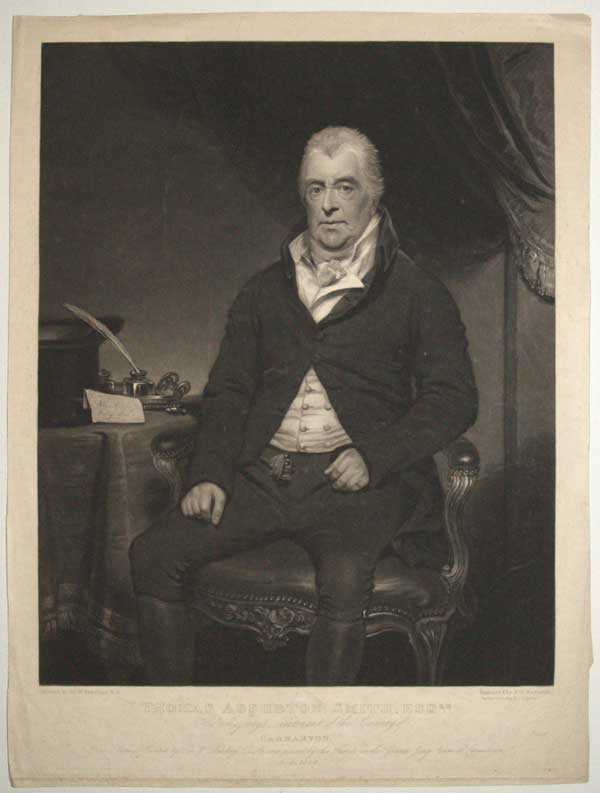
Thomas Assheton Smith, Esq.re His Majesty's Lieutenant of the County of Carnavon. From a Portrait Painted by Sir William Beechey, R.A. and placed by his Friends in the Grand Jury Room at Carnarvon. A.D. 1826. Proof.
Painted by Sir W. Beechey R.A. Engraved by S.W. Reynolds. Engraver to the King (and J.P. Quilley.)
[c.1826.]
Proof mezzotint. 520 x 400mm (20½ x 15¾"). Trimmed to plate on three sides.
Thomas Assheton Smith (the elder) (1752 -1828), landowner who induced Parliament to pass an act enclosing the common land of Llanddeiniolen parish, adding over 2,600 acres to his land holdings, from which he mined slate. Subsequent rioting was put down by a cavalry unit. A close friend of George Finch, 9th Earl of Winchilsea, Smith became one of cricket's main patrons following the establishment of Marylebone Cricket Club in 1787. This portrait was commissioned by Caernarfon Corporation, who paid Beechey £157.10s. It is now in National Museum Cardiff. Whitman: 268
[Ref: 56518] £260.00
(£312.00 incl.VAT)

Thomas Assheton Smith, Esq.re His Majesty's Lieutenant of the County of Carnavon. From a Portrait Painted by Sir William Beechey, R.A. and placed by his Friends in the Grand Jury Room at Carnarvon. A.D. 1826. Proof.
Painted by Sir W. Beechey R.A. Engraved by S.W. Reynolds. Engraver to the King (and J.P. Quilley.)
[c.1826.]
Proof mezzotint. 520 x 400mm (20½ x 15¾"), large margins. Tears and creasing in margins.
Thomas Assheton Smith (the elder, 1752 -1828), a landowner who induced Parliament to pass an act enclosing the common land of Llanddeiniolen parish, adding over 2,600 acres to his land holdings, from which he mined slate. Subsequent rioting was put down by a cavalry unit. A close friend of George Finch, 9th Earl of Winchilsea, Smith became one of cricket's main patrons following the establishment of Marylebone Cricket Club in 1787. This portrait was commissioned by Caernarfon Corporation, who paid Beechey £157.10s. It is now in National Museum Cardiff. Cricket interest. Whitman: 268. Ex: collection of The Hon. Christopher Lennox-Boyd.
[Ref: 66627] £260.00
(£312.00 incl.VAT)
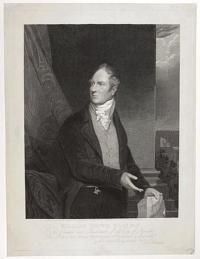
William Smith Esq.r M.P. To the Electors and Inhabitants of the City of Norwich This Plate of their Worthy Representative in Parliament is Inscribed by their obliged & very humble Serv.t W.C. Edwards.
Drawn and Engraved by W.C. Edwards, from a whole length picture painted by H. Thomson ESQ. R.A. in the Guildhall Norwich.
[n.d., c.1833.]
Engraving. Platemark: 430 x 330mm (17 x 13"). Small margins. Repaired damage to revese in left margin.
William Smith (1756-1835) was a politician of great power and change. He was a friend and close associate of William Wilberforce and was at the forefront of many campaigns for social justice and prison reform but most notably was his campaign for the abolition of slavery. He was Member of Parliament for Suffolk and Norwich for some years but it was in 1787 that he acted as the first to campaign for the abolition for the slave trade. In 1790 he supported Wilberforce in the slave trade debate and once the trade had been halted he helped Zachary Macaulay in 1823 found the ‘London Society for the Abolition of Slavery in our Colonies', thereby launching the next phase of the campaign to eradicate slavery. His involvement in the French Revolution was controversial, and he swiftly gained a reputation as a radical. He secretly arranged several meetings between William Pitt and Maret, Napoleon's foreign minister, in a desperate attempt to avoid war.
[Ref: 38732] £290.00
(£348.00 incl.VAT)
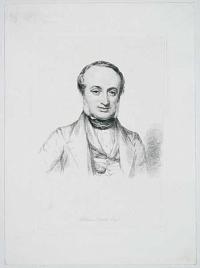
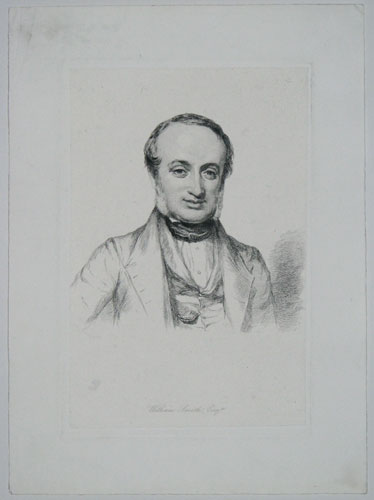
William Smith Esq.re
[n.d. c.1830.]
Etching on india. Plate 229 x 152mm. 9 x 6". Staining and foxing into the upper half of the paper.
William Smith (1808-1876) was a print-seller and antiquary. He started at Cambridge University but following his father's death, he and his brother succeeded to the business and he was obliged to abandon his studies. A year later in 1836 he purchased the collection of engravings formed by John Sheepshanks which were considered to be the most perfect in Europe, which he later sold to the British Museum. Among the collections which reached the Museum through his exertions were those of ‘Mr. Harding of Finchley’ in 1841, of Coningham in 1844 and 1845, selections from the Aylesford and Woodburn collections in 1847, and some etchings of the utmost rarity by Rembrandt, procured at Baron Verstolk's sale at Amsterdam in 1847. He took a prominent part in establishing the National Portrait Gallery, being appointed an original trustee, and chosen deputy chairman in 1858. He was also actively engaged in the management of the Art Union of London. He was elected a fellow of the Society of Antiquaries in 1852. His collections, which included many rare catalogues of galleries and exhibitions, with copious manuscript notes, he bequeathed to the library of the South Kensington Museum.
[Ref: 21478] £75.00
(£90.00 incl.VAT)

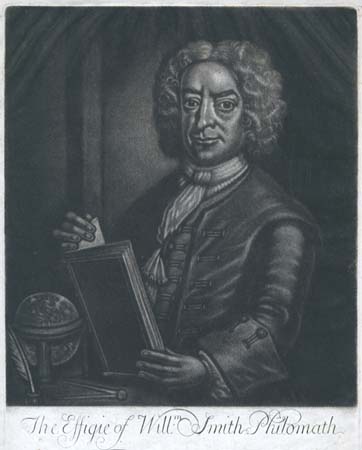
The Effigie of Will.m Smith Philomath. Observe the Man of Astrologic Skill who by his art turns Fortune at his wil ye tender fair, who would know fates decree, Inspect the Print, you'l know as well as he.
[n.d., c.1740.]
Mezzotint. 275 x 195mm (10¾ x 8½"). Slight cockling at the top of image.
A fortune-teller based in Coventry who lost his dog and, by offering a reward, made himself a laughing stock. CS: Unascribed II. 96.
[Ref: 368] £330.00
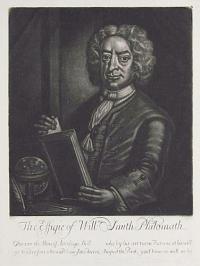
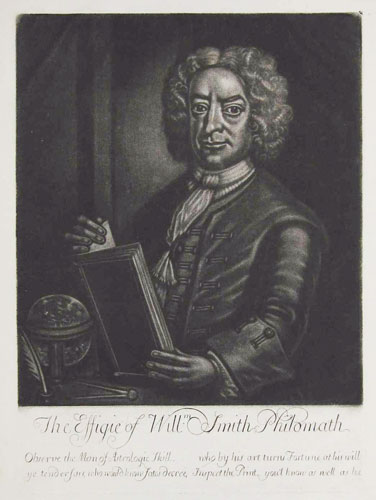
The Effigie of Will.m Smith Philomath. Observe the Man of Astrologic Skill who by his art turns Fortune at his will ye tender fair, who would know fates decree, Inspect the Print, you'l know as well as he.
[n.d., c.1740.]
Mezzotint. 275 x 195mm.
A fortune-teller based in Coventry who lost his dog and, by offering a reward, made himself a laughing stock. CS: Unascribed II 96. Ex: Collection of The Hon. C. Lennox-Boyd.
[Ref: 369] £350.00

[William Smith.]
Drawn and Engraved by W.C. Edwards from a whole length picture painted by H. Thompson, Esq. R.A. in the Guildhall, Norwich.
[n.d. c.1833.]
Engraving. Proof before letters. Plate 432 x 325mm. 17 x 12¾". Slight scratch in left margin just inside plate mark.
William Smith (1756-1835) was a politician of great power and change. He was a friend and close associate of William Wilberforce and was at the forefront of many campaigns for social justice and prison reform but most notably was his campaign for the abolition of slavery. He was Member of Parliament for Suffolk and Norwich for some years but it was in 1787 that he acted as the first to campaign for the abolition for the slave trade. In 1790 he supported Wilberforce in the slave trade debate and once the trade had been halted he helped Zachary Macaulay in 1823 found the ‘London Society for the Abolition of Slavery in our Colonies’, thereby launching the next phase of the campaign to eradicate slavery. His involvement in the French Revolution was controversial, and he swiftly gained a reputation as a radical. He secretly arranged several meetings between William Pitt and Maret, Napoleon’s foreign minister, in a desperate attempt to avoid war.
[Ref: 20317] £360.00

The Right Hon. W.H. Smith. M.P.
Painted by George Richmond, R.A. D.C.L. Engraved by John D. Miller.
London: Published April 25th. 1883, by P & D. Colnaghi & Co. 13 & 14 Pall Mall East.
Mezzotint. Plate 503 x 380mm. 19¾ x 15". Trimmed just outside the platemark.
William Henry Smith (1825-1891) was an English bookseller and newsagent of the family firm W H Smith. He implemented the sale of books and newspapers at railway stations. Elected MP for Westminster in 1868 he progressed his political career and eventually rose to the position of First Lord of the Admirality. He also stood twice as Secretary of State for War, and later First Lord of the Treasury and Leader of the House of Commons, amongst many other posts. NPG: D20314.
[Ref: 17306] £320.00

[Scrap album sheets relating to Edward George Smith-Stanley, 14th Earl of Derby.]
[Items dated 1833 - 1869.]
4pp. scrap album pages, containing; envelope addessed to Coutts & Co, signed; printed sheet reading 'I have the honour to be, Sir, your most obedient humble servant' signed 'Governor of [?] 'Stanley'; wood-engraved portrait; newspaper obituary; wood-engraved portrait of his son and succesor as Earl of Derby, E.H. Stanley.
Edward George Geoffrey Smith-Stanley (1799-1869), 14th Earl of Derby, three-times Prime Minister and the longest-serving party leader in modern British politics. Unveiling his statue on Parliament Square in 1874, Disraeli summarised his achievement: 'he abolished slavery, he educated Ireland, he reformed parliament', however, as later historians of Conservatism have focussed on Peel and Disraeli, Derby has been comparatively neglected. DNB
[Ref: 31987] £140.00
(£168.00 incl.VAT)
view all images for this item

The Right Hon.ble the Earl of Derby.
Painted by Thos Gainsborough Esqr. R.A. Engraved by Geo.e Keating.
London, Publish'd May 20; 1785 by W.Austin, Drawing Master, at the Patriotic Printrooms No.41 St James's Street.
Mezzotint. 505 x 350mm (20 x 13¾"). Small crease in corner of title area.
Edward Smith-Stanley (1752-1834), 12th Earl of Derby. The Epsom Oaks is named after a horse race held on his estate, 'The Oaks', in 1779. The Derby Stakes is also named for him. CS: Keating 2.
[Ref: 2609] £450.00

Pye Corner Smithfield. The Fire of London 1666 began in Pudding Lane and ended at Pye Corner, Smithfield Where this boy was put up as a memorial of that dreadful calamity.
Pub.d Jan 11, 1791, by T.Smith G.t Mays Buildings.
Aquatint with line engraving. 230 x 180mm, 9 x 7".
A statue of a boy, with 'This Boy is in Memory Put up for the late Fire of London Occasion'd by the Sin of Gluttony 1666' written on his body and arms. Known as 'The Golden Boy of Pye Corner', it is now located on the corner of Giltspur Street and Cock Lane. From 'Smith's Antiquities of London'.
[Ref: 11558] £60.00
(£72.00 incl.VAT)

Isometric View Of Proposed Improvements In The Neighbourhood Of Smithfield. [&] Ground Plan Of Proposed Improvements In The Neighbourhood Of Smithfield.
B. Bunning, Archt. To The Corporation Of London, 1851. G. Hawkins, Lith.
King, Litho: College Hill, City.
Pair of chromolithographs, sheets c.445 x 640mm. Repaired tear into title area of each.
Artist's impression and plan of proposed improvements to the area around Smithfield Market, the plan including three vignette views of proposed features. James Bunston Bunning's (1802 - 1863) designs were not in the end adopted. The present Smithfield meat market on Charterhouse Street was established by an Act of Parliament: the 1860 Metropolitan Meat and Poultry Market Act. It is a large market with permanent buildings, designed by City architect Sir Horace Jones, who was also responsible for Billingsgate and Leadenhall Markets. Meat has been traded at Smithfield Market for over 800 years, making it one of the oldest markets in London. A livestock market occupied the site as early as the 10th century. The lithography by George Hawkins (1819 - 1852). From the Blackburn Collection.
[Ref: 7990] £850.00
view all images for this item

[A Bird's Eye View of Smithfield Market taken from the Bear & Ragged Staff.]
Pugin & Rowlandson delt. Bluck sculpt.
[London published 1st Jany. 1811, at R. Ackermann's Repository of Arts, 101, Strand.]
Coloured aquatint. Sheet 370 x 505mm (14½ x 19¾"). Trimmed close to image on all sides.
A large & scarce colourful scene of a busy Smithfield Market.
[Ref: 64153] £420.00

Smithfield ''Used Up''. One Hundred Shillings. Also, now ready, The Companion Print, Tattersall's "Quite Fresh".
S. Alken Del. Read & C.º, Litho.
London: Published Nov.r 15.th 1855, by Read & C.º, 10, Johnson's C.t, Fleet St.
Rare tinted lithograph, finished by hand. Sheet 580 x 770mm (22¾ x 30¼"). Some surface wear, laid on canvas.
A horse auction at Smithfield Market, with a broken-down horse for sale. The second of two rare plates, contrasting the sale of the young horse at upmarket Tattersall's and its disposal at Smithfield.
[Ref: 63928] £380.00

The Bargain _ A Specimen of Smithfield Eloquence.
[n.d., etched c. 1770]
Etching, 18th century watermark. 280 x 205mm (11 x 8"), with large margins. Mint.
A scene of a group of men examining a broken-down old nag, with a horse trader with a speech bubble with 17 lines of praise for the beast. A veterinary image. BM Satires 4809. Ex Collection Hon. C. Lennox-Boyd.
[Ref: 54510] £260.00
(£312.00 incl.VAT)

A Bird's Eye View of Smithfield Market, Taken from the Bear & Ragged Staff.
Pugin & Rowlandson del.t Bluck sculp.t
London: Published 1.st Jan.y 1811, at R. Ackermann's Repository of Arts, 101, Strand.
Hand-coloured aquatint and etching. 420 x 514mm. 16½ x 20¼". Chips and nicks around edges; damage to upper left; paper tone to title area from previous mounting
Famous view of Smithfields, the famous meat market in London. Although it was used as an animal market and a place for public executions for hundreds of years previously, in 1638 the City of London Corporation established a cattle market here. At the time it was just outside the City Walls, but as can be seen in this view of 1811, over time the city spread up around it. It was a smelly, noisy place and there were frequent complaints of drunken herdsmen and unruly cattle on the way to Smithfields. In the British Library.
[Ref: 26989] £750.00

View Of Old Smithfield Market, June 1855.
Entered at Stationer's Hall. Published by W. Hodsdon, 68, St John St. Smithfield.
Lithograph, image 285 x 440mm. 11¼ x 17¼". Trimmed and laid on board with excised title below.
View of old Smithfield Market, with pigs and sheep in pens and figures, cattle and horses. The present Smithfield meat market on Charterhouse Street was established by an Act of Parliament: the 1860 Metropolitan Meat and Poultry Market Act. It is a large market with permanent buildings, designed by City architect Sir Horace Jones, who was also responsible for Billingsgate and Leadenhall Markets. Meat has been traded at Smithfield Market for over 800 years, making it one of the oldest markets in London. A livestock market occupied the site as early as the 10th century. For hand coloured impression see Ref: 33906 See Guildhall Library Record: 6893 for a coloured impression.
[Ref: 8786] £280.00
(£336.00 incl.VAT)

Smithfield Market. (Death of) This print is pub.d in Commemoration of Smithfield Market & Dedicated to the Rt. Hon. the Lord Mayor & Corporation of the City of London. With my best wishes to the inhabitance of Copenhagen-fields & Islington. N.B. The highest Police court Clarkenwell!!!
J.L.Marks Long Lane Smithfield [n.d., c.1852].
Coloured etching. Sheet 210 x 310mm (8¼ x 12¼"). Trimmed within plate, tear repaired, laid on album paper at edges with a song sheet, 'Exibitions, or John Lumps Ramble to Somerset House'.
A chaotic scene in Smithfield cattle market, with people fighting the bulls stampeding through the crowds. A policeman is being tossed through the air. A satire on the closure of the livestock market after an Act of Parliament called for a new cattle market to be constructed at Copenhagen Fields, Islington. The song sheet, 2 holes at bottom, features Bartholomew Fair, with a scene of another cattle market. BM 1927,1126.1.5.12.
[Ref: 64204] £320.00

[Der Tabackraucher (The Smoker).]
Simon von der Does pinx N: Strixner fecit.
[Munich, Germany, n.d., c.1820s.]
Rare lithograph, heightened in white, proof? before title. Image 220 x 175mm. 8¾ x 7". Printed border. A little age-toned; horizontal crease through upper and lower margin.
A bearded man seated at a table, smoking a pipe; despite the printed attribution to Simon van der Does, the painting is by Ariy de Vois. From a folio of fine prints after paintings and drawings by German masters, by Johann Nepomuk Strixner (1782 - 1855), lithographer in Munich. See 'Curator's comments', BM 1973,U.1171.
[Ref: 26895] £160.00
(£192.00 incl.VAT)

[The Smoker.]
[after Adriaen van Ostade.]
[London: Friedel's Lithographic Establishment, c.1838.]
Lithograph, proof before letters. Printed area 220 x 185mm (8¾ x 7¼"), with large margins.
A Dutchman in rustic dress, sitting in a window, glancing over his shoulder while holding a pipe and tankard, after Adriaen van Ostade (1610-85). Adam Friedel (1780- death date unknown) was a Danish artist, printmaker and publisher who, after serving in the Napoleonic wars, voluntarily joined the Greek army at the start of the Greek War of Independence, fashioning himself as Danish nobility. He was exposed by a real noble who proved his backstory to be a lie. After spending a year in Egypt he took refuge in London in 1824 where he opened a lithographer's shop. Between 1825 and 1826 Friedel printed and published, both in Paris and London, twenty-four lithographs with portraits of politicians and prominent military figures of the Greek War of Independence. He had drawn the portraits himself, in most cases from nature, while J. Bouvier coloured and lithographed these images. The series was a success and he was awarded for his contributions to the Greek Struggle for Independence with two decorations. For health reasons he travelled around a lot. He travelled to Smyrna and taught at a Greek school. He stayed at the Ottoman Capital during the Crimean War and painted several portraits of various politicians. In 1865 he asked for a pension for his services to Greece however little is known about what happened to him after that and his place and date of death is unknown.
[Ref: 52133] £130.00
(£156.00 incl.VAT)

[Turkish smokers.]
Franc.us Magiotto Pinx. Franc.us Petro inc.
apud Nic.us Cavalli Venetus. [n.d., c.1780.]
Engraving. Sheet 325 x 425mm (12¾ x 16¾"). Trimmed to plate at top and into inscription area, losing title. Paper scrape in upper centre.
A genre scenes of turbaned Turks smoking, engraved by Francesco del Pedro after Francesco Maggiotto.
[Ref: 44977] £240.00
(£288.00 incl.VAT)

A Cure for a Smoky Chimney! 36. Price one Shilling.
Woodward del.
London Published by Th.s Tegg 111 Cheapside Jan.ry 1.6 1808.
Etching with fine hand colour, sheet 260 x 335mm (10¼ x 13¼"). On J Whatman watermarked paper. Trimmed within plate on three sides.
A well-dressed woman complains to a 'Doctor' that she has paid him two guineas "for curing my Chimney and the moment I put a bit of fire in the grate, I am half suffocated!!"; he replies in an Irish accent, "... you never once mention'd the fire - depend upon it if you put no fire in the grate the Devil a bit of smoke will come from the Chimney!!" Undescribed in BM Satires.
[Ref: 60041] £230.00
(£276.00 incl.VAT)

[Woman Smoking a Pipe.]
[n.d., c.1780.]
Rare Dutch mezzotint. Plate: 240 x 185mm (9½ x 7¼''). Creasing and rubbed.
An interior scene showing a woman sitting by the fire, smoking a pipe, her King Charles Cavalier Spaniel pulls at her skirt revealing her legs.
[Ref: 48841] £95.00
(£114.00 incl.VAT)

[Two portraits of men smoking.]
W. French 1842.
Watercolour with fine hand colour. Each c. 150 x 130mm (6 x 5"). Corners snipped, laid on album paper.
Two smoking scenes: in the first a man reclines with the pipe of a hookah, with a glass and claret jug; in the second a man sits smoking a cheroot, a coffe cup by his side.
[Ref: 66260] £320.00
view all images for this item

X. A Gentleman with his Hookah Burdar, or Pipe Bearer.
[by Sir Charles D'Oyly.]
London, Published & Sold by Edw.d Orme, March 1.st 1813 [but c.1824].
Aquatint. 210 x 175mm (8¼ x 7"). Small margins.
Drawn by Sir Charles D'Oyly for Captain Thomas Williamson's 'The Costume and Customs of Modern India'. The work was first published as 'The European in India' in 1813 (Abbey 435), as plate 'X'; this issue has the title (as given in the original list of plates) engraved outside the printed border. Abbey 440.
[Ref: 62068] £140.00
(£168.00 incl.VAT)

A Smoking Party.
Drawn & Etch'd by H.Heath.
Published Nov.r 15 1824 by S.W.Fores 41 Piccadilly London.
Coloured etching. Sheet 130 x 170mm (5¼ x 6¾"). Trimmed to printed border.
Four men sit smoking long pipes around a table, enveloping themselves in smoke. BM Satires 14737.
[Ref: 58305] £85.00
(£102.00 incl.VAT)

A Kalmuck Smoking Party.
Burney del. Thornthwaite sculp.
Published as the Act directs by Dr. J. Trusler, Octo.r. 1788.
Engraving. 190 x 130mm (7½ x 5"). Trimmed to platemark.
View of a Kalmuck smoking party. The Kalmucks, or Kalmyks were a western Mongol people who migrated to Russia in the seventeenth century. They lived a nomadic life travelling around the lands between the Don and the Volga Rivers. Illustration from Dr John Trusler's 'The Habitable World Described' (c1788-1806).
[Ref: 32139] £60.00
(£72.00 incl.VAT)

[Smoking Pipes.]
[n.d. c.1780.]
Etching. Plate 120 x 76mm (4¾ x 3"), with very large margins.
Man in profile, facing right, with stick under his arm; he smokes one pipe, whilst another sticks out the top of his hat.
[Ref: 52462] £120.00
(£144.00 incl.VAT)

[Two smoking soldiers]
[Anon., c.1880]
Chromolithograph, printed area approx. 230 x 200mm (9 x 8").
Cigar image.
[Ref: 44010] £50.00
(£60.00 incl.VAT)

[Turkish Woman Smoking on a Sofa.] Femme Turque qui fume sur le Sopha.
JB. G. Scotin maj. sculp.
Avec Privil. du Roi. [n.d. c.1714.]
Engraving. Platemark 360 x 250mm (13¾ x 9¾") mint with very large margins.
A Turkish woman in a suggestive mode. Plate from 'Recueil de cent estampes représentant différentes nations du Levant', a set of one hundred plates depicting the costume of the Levant, based on paintings in the collection of the Marquis Charles de Ferriol, ambassador from the court of Versailles to the Sublime Porte from 1699 to 1710. The work had a profound effect on how the European conception of Turkey. After Jean-Baptiste Vanmour (1671-1737), the Flemish-French painter, who Ferriol brought with him to Istanbul at the age of eighteen. Ferriol commissioned at least a hundred paintings from Vanmour, which served as the source for the engravings in the 'Recueil' and are now in the Rijksmuseum in Amsterdam.
[Ref: 47014] £330.00

Prise de Smolensk.
Champion del. Lith de C. Motte.
[n.d. c.1826.]
Lithograph. Sheet 444 x 596mm (17½ x 23½"), with very large margins. Tear into lower edge.
The Battle of Smolensk, the first major battle of the French invasion of Russia, which took place on August 16-18, 1812. Napoleon led the Grande Armee against the strong Russian force under Barclay de Tolly; it was a decisive French victory. Published in A.V. Arnault's 'Vie politique et militaire de Napoléon', Paris, 1822-1826.
[Ref: 30795] £220.00
(£264.00 incl.VAT)

How Smooth Brother, Feel Again.
W. Hamilton R.A. del. T. Gauguin sculp.
London Publish'd May 1789, by J. Brydon, Charing Cross.
Stipple. Plate: 200 x 240mm (8 x 9½''). Trimmed to plate.
A scene showing children playing together.
[Ref: 48072] £160.00
(£192.00 incl.VAT)

Entrance to the Cave of Smowe.
Drawn & Engraved by Will.m Daniell.
Published by Mess.rs Longman, & Co. Paternoster Row, & W. Daniell, 9 Cleveland St. Fitzroy Square, London. March, 1, 1820.
Aquatint with fine original hand colour. 230 x 300mm (9 x 12"). Mint, with large margins, uncut.
The entrance of Smoo Cave, located at the eastern edge of the village of Durness, on Scotland's most northerly coastline. From William Daniell's 'A Voyage Round Great Britain', a series of 308 aquatints published in eight volumes between 1814-1825, described by R.V. Tooley as 'the most important colour plate book on British Topography'. Abbey: Scenery, 16; Tooley: Books with Coloured Plates 177.
[Ref: 36074] £160.00
(£192.00 incl.VAT)

The Wounded Smuggler.
Madeley lith.
Pub.d by J. Williams, 129, Strand. [n.d., c.1835.]
Rare lithograph. Sheet: 255 x 180mm (10 x 7''). Trimmed.
A scene in front of a fire in which several figures including a black man crowd around a wounded smuggler, sitting in a chair.
[Ref: 50029] £140.00
(£168.00 incl.VAT)

[Singerie] The Smuggler.
Drawn & etched by H. Heath.
Published by Charles Tilt, 86 Fleet St, May 1828.
Etching, printed in sepia. 230 x 190mm (9 x 7½"), large margins.
A monkey dressed as a smuggler, guarding a cave full of contraband.
[Ref: 56021] £160.00
(£192.00 incl.VAT)