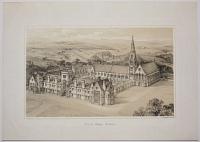
Trinity College, Scotland.
G. Hawkins, lith. Day & Haghe Lith.rs to the Queen.
[n.d., c.1845.]
Tinted lithograph, fine & scarce. Printed area: 250 x 365mm (10 x 14½"), with very large margins.
A view of Glenalmond College, formerly Trinity College Scotland. The school was founded in 1847 for boys destined for the Scottish Episcopal Church by William Gladstone and James Hope-Scott. The building was designed by John Henderson and built on the land of George Patton, Lord Glenalmond.
[Ref: 46901] £280.00
(£336.00 incl.VAT)

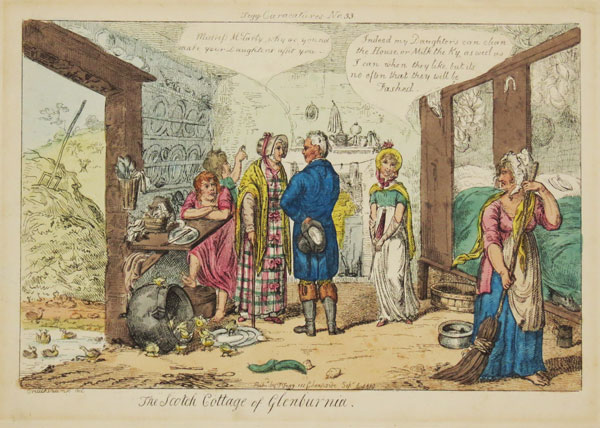
The Scotch Cottage of Glenburnia. Teggs Caracatures No.33.
Cruikshank del.
Pub.d by T. Tegg. 111 Cheapside Sep.r 6 1810.
Hand-coloured etching, sheet 250 x 355mm (10 x 14"). Trimmed within plate on three sides. Crease where previously folded on right.
The interior of a cottage. Three visitors, a well-dressed man in top-boots (Mr. Stewart), a comely woman (Mrs. Mason), and a fashionably dressed young girl (Mary Mason), stand before the fire. Two box-beds are seen on the right with household items hanging over them, including twists of yarn, with a large cobweb against the wall. Small chickens peck at the contents of a large pot (a whey-pot) and plates on the floor. A cat laps from a bowl on a rough dresser above which plates and spoons are ranged. Through the doorway to the left is duck pond, beside which is a tall manure heap. An illustration to Elizabeth Hamilton's popular novel 'The Cottagers of Glenburnie', 1798. BM Satires 11651.
[Ref: 66865] £160.00
(£192.00 incl.VAT)
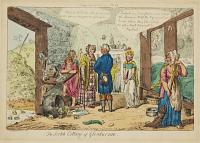
The Scotch Cottage of Glenburnia. Teggs Caracatures No.33.
Cruikshank del.
Pub.d by T. Tegg. 111 Cheapside Sep.r 6 1810.
Hand coloured etching. Platemark: 245 x 345mm (9½ x 13½"), with wide margins. Small tears in left and right margins, mount stain.
The interior of a cottage. Three visitors, a well-dressed man in top-boots (Mr. Stewart), a comely woman (Mrs. Mason), and a fashionably dressed young girl (Mary Mason), stand before the fire. Two box-beds are seen on the right with household items hanging over them, including twists of yarn, with a large cobweb against the wall. Small chickens peck at the contents of a large pot (a whey-pot) and plates on the floor. A cat laps from a bowl on a rough dresser above which plates and spoons are ranged. Through the doorway to the left is duck pond, beside which is a tall manure heap. An illustration to Elizabeth Hamilton's popular novel 'The Cottagers of Glenburnie', 1798.
[Ref: 38797] £240.00
(£288.00 incl.VAT)

Iacobus Glentnerus Consul Reipublicae Tigurinae. Ao.1424. No.11.
I.C. Fuessli delineavit. S. Walch fecit.
[Swiss, n.d., c.1750s.]
Fine mezzotint, 310 x 210mm. 12¼ x 8¼". A fine impression with full margins, uncut.
The sitter in rectangular frame, coat of arms to cartouche below. From a series of portraits of Consuls or Burgomasters of the Canton of Zurich, Switzerland 1336-1678, after Swiss painter and author Johann Caspar Füssli (1706 - 1782). See BNF FRBNF40355659.
[Ref: 19826] £120.00
(£144.00 incl.VAT)

Gli Argonauti
[by Vincenzo Coronelli.]
[Venice, c.1691.]
Engraved frontispiece. 390 x 255mm (15½ x 10"), very large margins.
A decorative half-title from Coronelli's 'Corso Geographico', an allegory of seamanship. A world with an oversized ship balanced on top is surrounded by surveying instruments, with an angel blowing a trumpet. Vincenzo Coronelli (1650-1718) was official cartographer of the Republic of Venice, and many of his publications glorified their achievements.
[Ref: 48181] £450.00

[Francis Glisson.] Fransisci Glissoni. Med, Dris Effigies. Ætat suæ 80.
[n.d., c.1690.]
Engraving. Sheet 110 x 60mm (4¼ x 2¼"). Trimmed and backed onto album paper at borders.
Portrait of Francis Glisson (1597 - 1677), English physician, anatomist, and writer on medical subjects. He did important work on the anatomy of the liver, and he wrote an early pediatric text on rickets. An experiment he performed helped debunk the balloonist theory of muscle contraction by showing that when a muscle contracted under water, the water level did not rise, and thus no air or fluid could be entering the muscle. Not in Wellcome 1139.
[Ref: 68016] £130.00
(£156.00 incl.VAT)

The Globe on the Banke Side, where Shakspere acted. From the long Antwerp view of London in the Pepsyian Library...[&] William Kempe the original Performer of Dogberry in Much ado about Nothing. From a Wooden cut Prefixed to Kempes Nine Daies Wonder 4.to. 1600.
[n.d., c.1813.]
Two engravings on one sheet, with large margins. J. Whatman watermark 1813. Sheet: 275 x 450mm (10¾ x 17¾").
Two nineteenth century engraved copies of early seventeenth century woodcuts, one showing the famous Globe Theatre, the second showing Elizabethan actor William Kempe (d.1603) in the role of Dogberry.
[Ref: 42038] £65.00
(£78.00 incl.VAT)

Globe Terrestre.
[Paris? n.d., c.1700.]
Engraving. 185 x 130mm (7¼ x 5"), large margins.
An illustration of a terrestrial globe, showing Europe and Asia, with a classical architectural background.
[Ref: 56829] £160.00
(£192.00 incl.VAT)
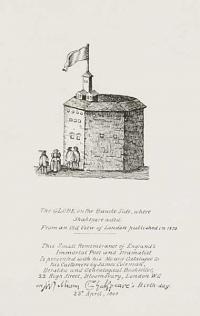
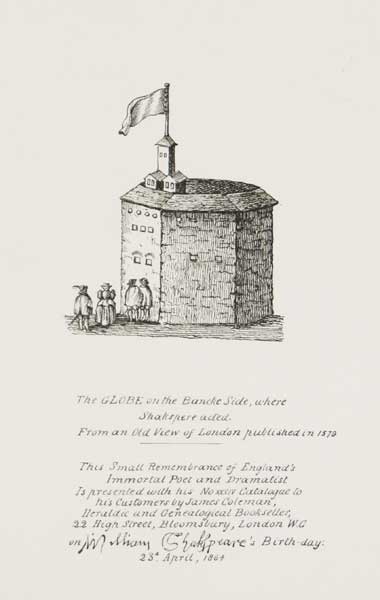
The Globe on the Bancke Side, where Shakspere acted. From an Old View of London published in 1579.
James Coleman, Heraldic and Genealogical Bookseller. 22 High Street, Bloomsbury, London W.C. on William Shakspeare's Birth-day: 23rd April 1864.
Woodblock. Sheet size: 215 x 135mm (8½ x 5¼").
A commemorative etching celebrating the birth of William Shakespeare, depicting the Globe Theatre, published as part of catalogue XXXIV by James Coleman, 1864.
[Ref: 37824] £95.00
(£114.00 incl.VAT)
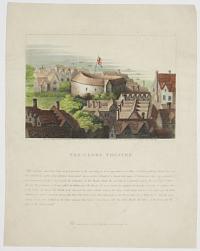
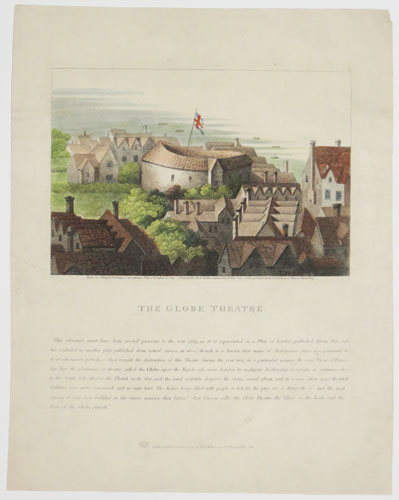
The Globe Theatre. From an enlarged Drawing of an extensive View of London, in 1647. - 7 Feet 9 Inches, by 18 Inches, engraved by Hollar; very scarce, and now in the possession of Thomas Lloyd Esq.r.
[after Wenceslaus Hollar.]
London, Published Oct.r 11th 1810, By Rob.t Wilkinson, No 58, Cornhill, 170.
Coloured etching. Sheet 305 x 240mm (12 x 9½"). Slight surface soiling.
Despite being named on Hollar's famous 'Long View' as 'The Globe', this is in fact the Hope Theatre (built where the Bear Baiting ring had been). The real Globe was named 'Beere bayting' and is not shown here. Hollar's mistake can be accounted for by the fact that both had been shut down by the Puritans in 1642, and the Globe had been demolished the year before his view was published.
[Ref: 41447] £95.00
(£114.00 incl.VAT)

Terrestrial Globe. Celestial Globe. Engraved for Middleton's Complete System of Geography.
[London: J. Cooke, 1777-8.]
Engraving. 190 x 290mm (7½ x 11½"), with margins.
An illustration of a pair of globes with rococo stands. From Charles Theodore Middleton's 'A new and complete system of Geography'.
[Ref: 57129] £70.00
(£84.00 incl.VAT)
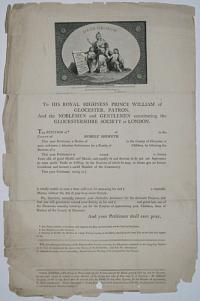
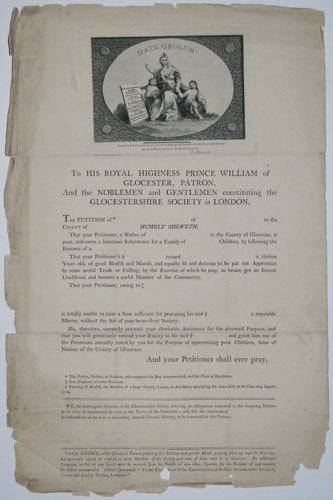
To His Royal Highness Prince William of Glocester, Patron, And the Noblemen and Gentlemen constituting the Glocestershire Society in London. The Petition of... fit and desirous to be put out Apprentice to some useful Trade or Calling, by the Exercise of which he may, in future, get an honest Livelihood... He entreats your charitable Assistance for the aforesaid Purpose... and grant him one of the Premiums annually voted by you for the Purpose of apprenticing poor Children, Sons of Natives of the County of Glocester.
[London, c.1800.]
Illustrated letterpress diploma/application form for a charitable grant from the Glocestershire Society, with 18th century watermark, unfilled; engraved allegorical vignette by T. Bonnor dated 1796 to upper part. Sheet c.420 x 280mm, 16½ x 11". Folds; tatty and chipped extremities.
Poor families would take advantage of Indentured Apprenticeships to provide a future for their children. This is the legal certificate that would accompany the legal agreement.
[Ref: 16854] £110.00
(£132.00 incl.VAT)

A Glorious Day! Not a Cloud to be seen!!
M.E. [Egerton] Eng.d by C. Hunt.
London, Pub. by C. Hunt [n.d., c.1825.]
Aquatint with fine hand colour. Sheet 300 x 230mm (11¾ x 9"). Trimmed within plate.
An obese, bottle-nosed man stands in his garden on a hot day, in slippers and ungartered stockings, a swarm of flies around his head. A spaniel watches him, panting; a parrot sits on its cage; tulips line the fence. The first state: Thomas Mclean reissued this plate in 1827. BM Satires 15002. Hickman p.57.
[Ref: 59447] £280.00
(£336.00 incl.VAT)

[Fourth Battle of Ushant] To the Lords Commissioners of the Admiralty, This Print of the Celebrated Victory obtained by The British Fleet under the Command of Earl Howe, over The French Fleet on the Glorious First of June 1794, Is by Permission humbly Dedicated by their Lordships most obed.t Serv.t Dan.l Orme.
M. Brown Pinx.t Historical Painter to their H.R. the Duke & Duchess of York. D. Orme Sculp.t Historical Engraver to his Majesty & his R.H. the Prince of Wales.
[Sold & Published Oct.r 1. 1795, by Dan.l Orme, N.º 14, Old Bond Street, London.]
Stipple. Sheet 475 x 600mm (14¾ x 23½"). Trimmed to plate, some light loss of print surface.
Earl Howe on the quarter-deck of HMS Queen Charlotte during the action off Ushant. The dying soldier is Lieutenant Nevile of the Queen's Regiment, wounded when a cannon ball from the 'Jacobin' struck the sword he was holding, shattering it and dring part of the hilt into his side. The original painting is in the National Maratime Museum, BHC2740.
[Ref: 63913] £420.00

To Admiral Earl Howe Commander in Chief; Admirals Lord Graves, and Lord Bridport, Commanders in the Van and the Rear_ The Vice Admirals, Sir George Bowyer Bart. Benj.n. Caldwell Esqr. Sir. Allan Gardner Bart. and Rear Admiral Sir Thomas Pasley Bart. The several Captains and Officers, This view of their gaining the Wind of the Enemy's Fleet on the Evening of the 29th of May 1791 which led to their Splendid Victory on the 1st of June following_Is most respectfully inscribed_By their Obedient Servants_R. Dodd & B.B. Evans. This point of Time represents the Queen after having led the Van along the whole of the Enemy's Line to leeward being so much disabled in her Sails & Rigging, and at some distance from the body of the British Fleet, that the French Van bore up in a Formed Line with the intent to cut her off; which was prevented by the Royal Sovereign leading the Van of the British down to her Assistance which caused to French to ware and bear away to leeward.
Painted by R. Dodd 1794.
Pub. by B.B. Evans, London 1795.
Rare aquatint. 487 x 709mm. 19¼ x 28".
The Glorious First of June (Third Battle of Ushant) of 1794 was the first and the largest fleet action of the naval conflict between Great Britain and the French Republic during the French Revolutionary Wars. Lord Howe led the Britich Fleet against the French Atlantic Fleet, commanded by Vice-Admiral Louis Thomas Villaret de Joyeuse.
[Ref: 16028] £680.00

[The Leviathan & L'Amerique.]
N. Pocock del.t. W.Ellis sculp.t.
[Published by Burney and Gold Nov.r 1. 1799.]
Aquatint., proof before title and publication line. Sheet 140 x 225mm, 5 x 9". Binding stitch marks just under title.
A scene from the 'Glorious First of June' sea-battle between the British and French off Ushant. L'Amerique was dismasted and captured, joining the Royal Navy as HMS Impétueux. The Leviathan also fought at Trafalgar. Published in the Naval Chronicle. Parker: 102.
[Ref: 15901] £60.00
(£72.00 incl.VAT)

The Leviathan & L'Amerique.
N. Pocock del.t. W.Ellis sculp.t.
Published by Burney and Gold Nov.r 1. 1799.
Aquatint. Sheet 140 x 225mm, 5 x 9".
A scene from the 'Glorious First of June' sea-battle between the British and French off Ushant. L'Amerique was dismasted and captured, joining the Royal Navy as HMS Impétueux. The Leviathan also fought at Trafalgar. Published in the Naval Chronicle. Parker: 102.
[Ref: 15900] £70.00
(£84.00 incl.VAT)

[Glorious First of June] To Admiral Earl Howe Commander in Chief, Admirals Lord Graves, and Lord Bridport, Commanders in the Van and the Rear _ The Vice Admirals, Sir George Bowyer Bar.t _ Benj.n Caldwell Esq.r _ Sir Allan Gardner Bar.t and Rear Admiral Sir Thomas Pasley Bar.t _ The several Captains and Officers. This View of their gaining the Wind of the Enemy's Fleet on the Evening of the 29th of May 1797 which led to their Splendid Victory on the 1.st of June following _ Is most respectfully Inscribed _ By their Obedient Servants _ R. Dodd & B.B. Evans.
Painted by Robert Dodd, 1794. Pub. by B.B. Evans, London, 1795.
Published January the 25. 1795, by B.B. Evans Poultry London.
Aquatint. 503 x 736mm (19¾ x 29"). Some wear, laid on archival paper. Few repairs.
The Glorious First of June (Third Battle of Ushant) of 1794 was the first and the largest fleet action of the naval conflict between Great Britain and the French Republic during the French Revolutionary Wars.. Lord Howe led the British Fleet against the French Atlantic Fleet, commanded by Vice-Admiral Louis Thomas Villaret de Joyeuse.
[Ref: 31233] £650.00

The Leviathan & L'Amerique.
N. Pocock del.t. W. Ellis Sculp.t.
Published Nov.r 1799 by Binney & Gold.
Aquatint. 125 x 215mm (5 x 8½"). Trimmed for binding.
A scene from the 'Glorious First of June' sea-battle between the British and French off Ushant. L'Amerique was dismasted and captured, joining the Royal Navy as HMS Impétueux. The Leviathan later fought at Trafalgar. Published in the 'Naval Chronicle'. Parker: 102
[Ref: 37122] £120.00
(£144.00 incl.VAT)
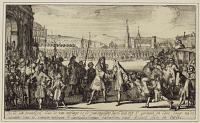
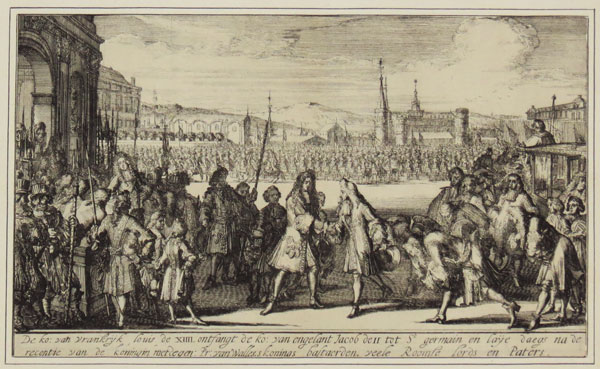
[Louis XIV welcomes James to his Paris at St Germain-en-Laye] De ko: van vrankryk, louis de XIIII, ontfangt de ko: van engelant Jacob de II [...]
[Anon., c.1688]
Etching, sheet 170 x 280mm (6¾ x 11"). Trimmed. Tipped into backing sheet.
After William of Orange landed in England in November 1688, James decided to flee to France, where Louis XIV gave him the chateau of St Germain-en-Laye. Louis XIV had handsomely refurbished the chateau for James and his court. Copied from one of a set of twenty-five prints by Adriaan Schoonebeek depicting events in the struggle for the British crown from the civil war to the coronation of William III and Mary II.
[Ref: 42560] £350.00

[Arrival in England of the Princess of Orange, 12 February 1689] Aankomst van Haar Koninglyke Hooghesse in Engeland den 22 Februar 1689.
J. van den Avele fecit.
Carolus Allard Excudit Cum Privilegio [1691]
Etching, sheet 250 x 295mm 9¾ x 11½"). Trimmed. Tipped into backing sheet; hole top left.
Mary. princess of Orange, arrives in England, some three months after her husband William. In April 1689 their coronation took place at Westminster Abbey. Etched by Johannes van den Avelen (1655-1727), designer of historical and satirical subjects who also worked for several years in Stockholm.
[Ref: 42561] £380.00

[The arrival of William of Orange in London, 28 January 1689] Intreede van Zyn Koninglyke Hoogheid, Willem de Derde, binnen Londen, den 28 January, 1689
Hugo Allard f.
Etching, sheet 255 x 295mm (10 x 11½"). Trimmed. Tipped into album sheet.
Good view of London showing William of Orange (soon to become William III) arriving in London in January 1689, having landed on the south coast of England in November 1688. James II had already left England for France by this time, leaving the way clear for William's wife Mary to join him in February. They were crowned king and queen at Westminster Abbey in April 1689.
[Ref: 42564] £520.00

[The Glorious Revolution] Vertrek van S.K.H. Na Engeland, den 11. Nov. 1688. Depart de S.A.R. Pour Angleterre, Le 11. No. 1688. Aenkomst van S.K.H.D.P. van Orangie in Engeland,m den 15. en 16. Nov. Nov. 1688. Arrivement de S.A.R. en Angleterre, le 15. et 16. No. 1688.
R. de Hooge f.
Edit. à J. Covens et C. Mortier [n.d., c.1728].
Etching. 450 x 550mm (16¾ x 21¾"). Laid on card.
Two scenes of the Glorious Revolution of 1688, titled vertically, divided by a medallion portrait of William of Orange and keys in Dutch and French. Above is William and Mary's departure with a large Dutch fleet; below is their arrival at Brixham. Dutch painter and etcher Romeyn de Hoohe (1645-1708) was employed by William III as a propagandist during the Glorious Revolution, producing elaborate scenes of William's triumphant arrival in England such as this, as well as satires attacking James II and Louis XIV. First published in 1688, this example comes from Isaac De Larrey's 'Geschiedenis van Engelandt, Schotlandt en Ierlandt'. Landwehr 14, state ii.
[Ref: 62651] £650.00
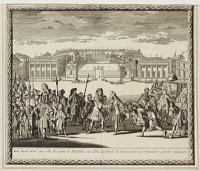
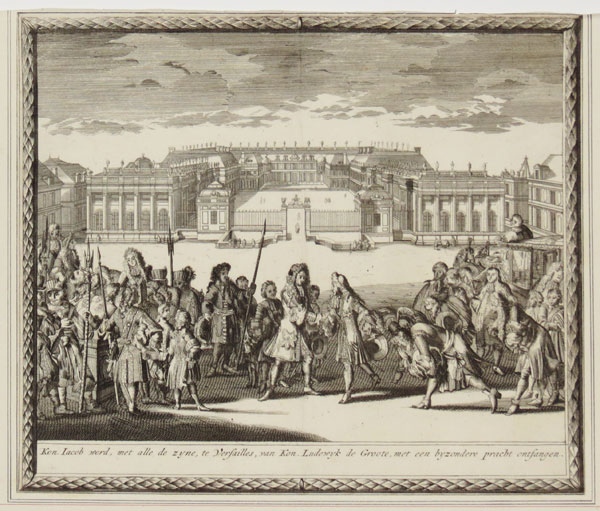
[James II visits Louis XIV at Versailles] Kon. Jacob word, met alle de zyne, te Versailles, van Kon. Ludewyk de Groote [...]
[Anon., c.1690]
Etching, sheet 250 x 295mm (9¾ x 11½"). Trimmed. Tipped into album sheet; tear from top.
After William of Orange landed in England in November 1688, James II decided to flee to France, where Louis XIV gave him the chateau of St Germain-en-Laye. Louis XIV had handsomely refurbished the chateau for James and his court. Here he visits Louis XIV at nearby Versailles.
[Ref: 42562] £360.00
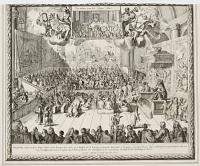
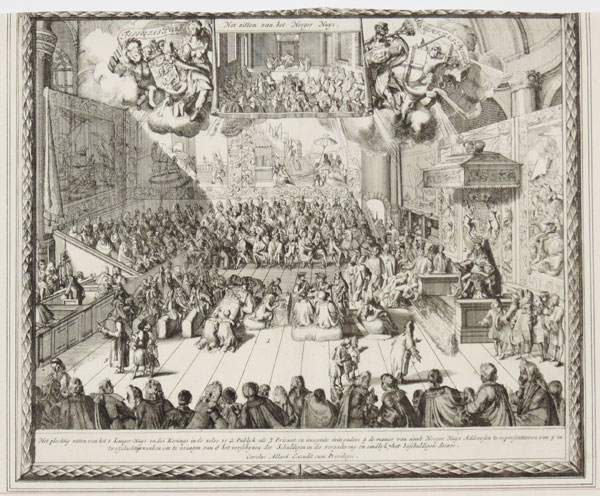
[Assembly presided over by William III, with vignette of the House of Lords top centre] Het plechtig zitten van het 1 Laager-Huys en des Konings in de zelve zo 2 Publiyk als [...]
Carolus Allard Excudit cum Privilegie
Etching, sheet 245 x 295mm (9¾ x 11½"). Tipped into album sheet; fold through centre. Trimmed to border especially at top.
Plate from a Dutch publication comprising twenty plates depicting key episodes from the Glorious Revolution.
[Ref: 42800] £260.00
(£312.00 incl.VAT)

[William of Orange embarking for England] Vertreck van syn K. Hoogheyt nae Engelant.
[Bastiaen] Stoopenda[el] [in image]
Etching, sheet 180 x 255mm (7 x 10"). Glued to backing sheet.
William of Orange and his fleet at Hellevoetsluis, embarking for England in 1688, in what would become known as the Glorious Revolution of 1688. William became king, deposing James II. Illustration to 'Engelands gods-dienst en vryheid hersteldt' (Amsterdam: Marcus Willemsz. Doornik, 1689).
[Ref: 42552] £260.00
(£312.00 incl.VAT)

[William of Orange landing at Torbay] Het Lande van syn K Hoogh in Engelant
[Bastiaen] Stoopendal [in image]
Etching, sheet 180 x 260mm (7 x 10"). Glued to backing sheet.
William of Orange after landing at Torbay on the south coast of England. After landing unopposed on 15 November 1688, William quickly travelled to Exeter where he set up a command centre and a printing press. This was the beginning of the Glorious Revolution which led to William becoming William III of England, Scotland and Ireland, deposing James II. Illustration to 'Engelands gods-dienst en vryheid hersteldt' (Amsterdam: Marcus Willemsz. Doornik, 1689).
[Ref: 42554] £260.00
(£312.00 incl.VAT)
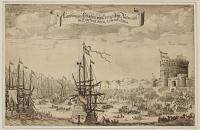
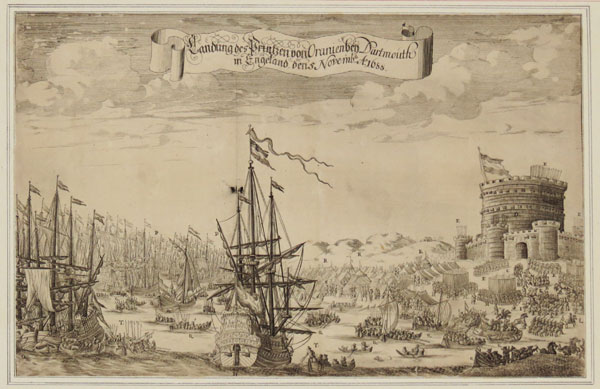
[William of Orange landing at Torbay] Landing des Prinzen von Oranien bei Dartmouth in Engeland den 5 Novembe A.o 1688
[Anon., c.1688]
Etching, sheet 220 x 345mm (8½ x 13½"). Tear and creases; glued to backing sheet.
William of Orange after landing at Torbay on the south coast of England. After landing unopposed on 15 November (5 November old style) 1688, William quickly travelled to Exeter where he set up a command centre and a printing press. This was the beginning of the Glorious Revolution which led to William becoming William III of England, Scotland and Ireland, deposing James II.
[Ref: 42555] £280.00
(£336.00 incl.VAT)
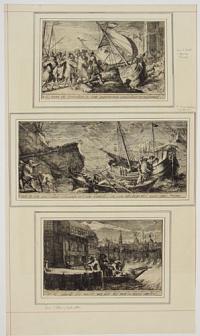
[James II fleeing London; stranded at Faversham; and leaving Rochester] de k: wert by feversham in kent ongeworpen, gensundert en mishandelt [...]
[Anon., c.1688]
Three etchings dimensions between 100 x 160mm (4 x 6¼") and 105 x 225mm (4 x 8¾"). All glued to one backing sheet.
Three etchings depicting James II's departure from England in 1688. After William of Orange landed in England in November 1688, James decided to flee. Leaving London, he got as far as Faversham in Kent before his boat was intercepted and he needed a company of guards to rescue him. James then briefly attempted resume government before receiving a request from William to remove himself. This he did, travelling to Rochester in Kent and from there on to France. These etchings are all copied from prints in a set of twenty-five by Adriaan Schoonebeek depicting events in the struggle for the British crown from the civil war to the coronation of William III and Mary II.
[Ref: 42556] £220.00
(£264.00 incl.VAT)
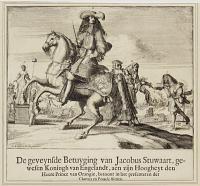
[William of Orange on horseback, pursued on foot by James II] De geveynsde Betuyging van Jacobus Stuwaart, gewesen Koningh van Engelandt [...]
Na de Copyse te Londen gedrukt [1688]
Etching with letterpress, rare, sheet 240 x 260mm (9½ x 10¼"). Trimmed, losing additional letterpress; tipped into backing sheet.
One of many Dutch broadsides published following the Glorious Revolution in which William of Orange became king of Britain. Here James II pursues William, waving documents in an attempt to dissuade William from invading. Copied from an etching by the leading Dutch exponent of pro-William propaganda, Romeyn de Hooghe. BM Satires 1055
[Ref: 42557] £420.00

[Glorious Revolution] De Koningin en Prins van Walles, landen te Calais, en worden van d'Governeur ontfangen.
[Amsterdam, Marcus Doornik, 1689.]
Engraving. Sheet 175 x 135mm (7 x 5¼"). Trimmed to border and laid on album paper. Small stain in upper left corner of image.
Mary of Modena and James, Prince of Wales (the Old Pretender), arriving in Calais having fled the Glorious Revolution. A plate from Abraham van Poot's history of the Revolution, 'Engelands gods-dienst en vryheid hersteld, door syn hoogheid den heere prince van Oranjen'.
[Ref: 53743] £130.00
(£156.00 incl.VAT)
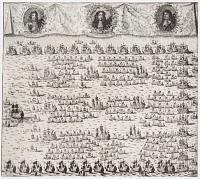
[William of Orange's Invasion of England.]
[n.d., c.1688.]
Engraving. Sheet: 335 x 380mm (13¼ x 15"). Trimmed, creases; not visible from front.
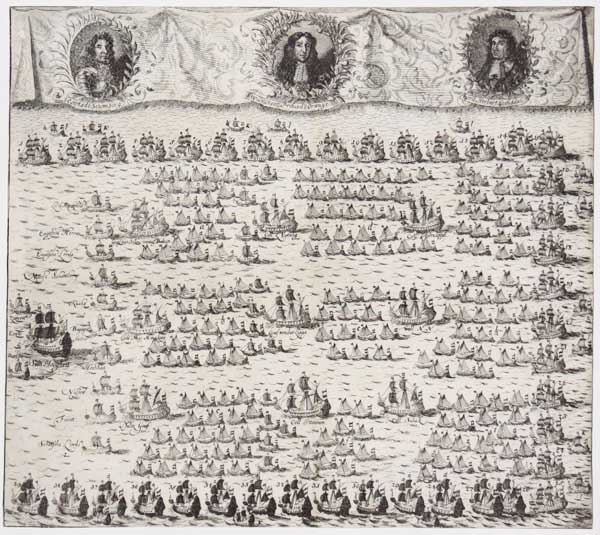
A naval scene depicting William of Orange's fleet which invaded England in November 1688, the fleet was twice the size of the Spanish Armada and consisted of about 463 ships. The portraits of William of Orange's military and naval leaders Count von Schomberg and Lord Herbert flank his own at the top of the print.
[Ref: 42976] £680.00

Gloster VI. Calshot 1929.
Geoffrey Watson 1931 [signed in pencil and etched in plate.]
Etching with pencil signature, limited edition 18/25. Plate 240 x 299mm. 9½ x 11¾".
The Gloster IV was a racing seaplane developed as a contestant for the 1929 Schneider Trophy. By Geoffrey Watson (d.1937), known for his images of plans and aircraft. Original oil held in the Royal Air Force Museum.
[Ref: 26664] £460.00
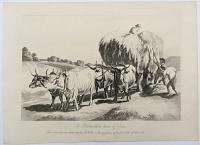
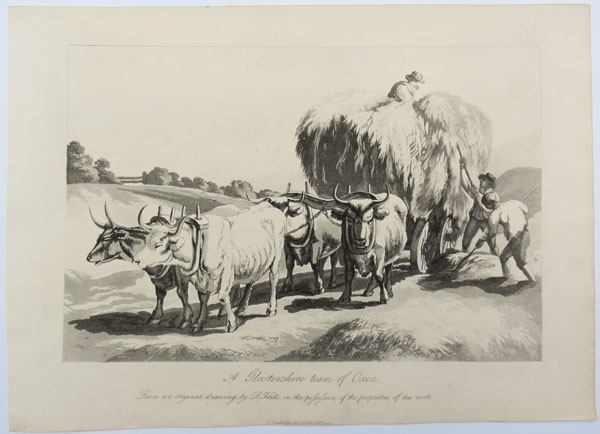
A Glostershire team of Oxen. From an original drawing by R. Hills, in the possession of the proprietors of this work.
London. Pub. July 1. 1818 by T. McLean.
Aquatint. Sheet 325 x 445mm (12¾ x 17½"), watermarked 'J Whatman Turkey Mills 1817' Trimmed within plate.
A team of oxen yoked to a haycart, with workers forking hay up. This plate comes from McLean's edition of John Hassell's 'Aqua Pictura', a work illustrating the progressive stages of each painting. See Abbey Life 140 for the 1813 first edition.
[Ref: 43467] £140.00

The White Fryers in Gloucester. Aug 24. 1721. Browne Willys Ar. Reliquias sacras d.d. W.s Stukeley.
Stukeley delin. E. Kirkall sculp.
[n.d., 1724.]
Engraving, plate 175 x 280mm (7 x 11"), with very large margins.
A view of the Carmelite Friary once situated outside the north gate of the city, with gentlemen playing bowls in the foreground. Published in Stukeley's 'Itinerarium Curiosum'. Very early image of Bowling.
[Ref: 62043] £180.00
(£216.00 incl.VAT)

The White Fryers in Gloucester. Aug 24. 1721. Browne Willys Ar. Reliquias sacras d.d. W.s Stukeley.
Stukeley delin. E. Kirkall sculp.
[n.d., 1724.]
Engraving. 175 x 280mm (7 x 11").
A view of the Carmelite Friary once situated outside the north gate of the city, with gentlemen playing bowls in the foreground. Published in Stukeley's 'Itinerarium Curiosum'. Very early image of Bowling.
[Ref: 56609] £160.00
(£192.00 incl.VAT)

The West Prospect of Gloucester City. To The Mayor and Aldermen. 21.
J Kip Delin et Sculp.
Sold by Ios. Smith in London. [n.d. c.1724.]
Engraving. Plate 349 x 425mm. 13¾ x 16¾". Fold down centre as published.
View of the city of Gloucester, from a hill in foreground; the River Severn running past city, with some shipping; the road approaching the city running from right foreground.
[Ref: 26356] £180.00
(£216.00 incl.VAT)
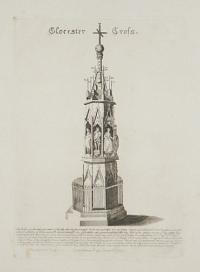
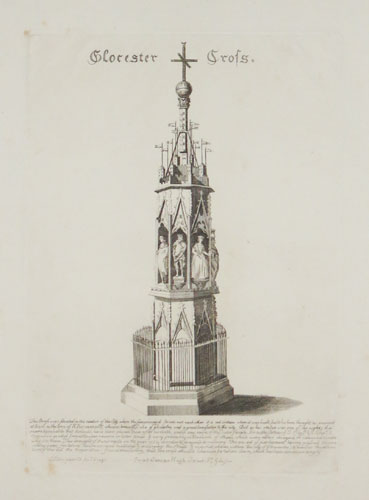
Glocester Cross.
London printed for I. Seago Print Seller High Street St Giles's.
Engraving. Plate: 260 x 185mm (10¼ x 7¼"), with large margins.
A view of the cross which once stood in the centre of Gloucester, it was built in the mid 13th century and was variously repaired throughout the centuries until it was demolished in 1751.
[Ref: 45407] £70.00
(£84.00 incl.VAT)

Denmark Hill Grammar School.
[n.d., c.1855]
Rare hand coloured lithograph, sheet 270 x 345mm (10½ x 13½). Margins messy. Time stained and tears to edges.
A view of what is now Denmark Road High School, Gloucester, from the east showing the extensive grounds. Boys play cricket in the foreground.
[Ref: 56011] £190.00
(£228.00 incl.VAT)

[Courtyard of the New Inn, Gloucester.] 79. [The New Inn at Gloucester is amoung the dozen oldest hostels in England, having been built about 1455 by John Twining, a monk of the Abbey. It was the intention to give hospitality to the pilgrims to the shrine of Edward II., who was buried in the Abbey after being murdered (1327). People flocked to his tomb, miracles were reported, and the New Inn was built to accomodate the crowds. This ancient inn undoubtedly was the halting-place for countless pilgrims, and it remains a striking timbered building with a fine galleried courtyard. It was near here that Robert Raikes, the Father of Sunday Schools, was born.]
Arthur Spencer [pencil signature to the bottom left-hand side outside the image]
[n.d. c.1920.] Copyright. F. & M. Ltd., Bedford, Eng.
Etching. 285 x 255mm. 11¼ x 10".
[Ref: 14651] £35.00
(£42.00 incl.VAT)

''Gloucester'' (The ''New Inn'') [pencil]. Original Etching by J. Alphege Brewer. Etched and Printed in Colour by the Artist. (Limited Edition).
J. Alphege Brewer [pencil].
[n.d., c.1930.]
Etching, printed in colour. 130 x 205mm (5¼ x 8") very large margins. In original mount with printed gallery label. Mint.
The New Inn, 16 Northgate Street, Gloucester, the most complete surviving example of a medieval courtyard inn with galleries in the UK. In 1553 the Abbott of Gloucester proclaimed Lady Jane Grey Queen from the first floor gallery.
[Ref: 49243] £50.00
(£60.00 incl.VAT)

Gloucester Old Bank. The Residence of the late James Wood Esq.re.
[Drawn & Printed by G. Rowe Exeter House Cheltenham.]
[Published by T. Jew, Bookseller & Printer 1839.]
Lithograph. Sheet 210 x 160mm. 8¼ x 6¼". Trimmed at bottom, losing publication line
The Gloucester Old Bank was established in 1716, making it one of the earliest private banks in England. In 1802 it was inherited by James (Jemmy) Wood (1756 - 1836), shown here standing in the doorway. He was famed as a miser and even had a toby jug modelled on him. He was said to walk around the docks collecting dropped coal in his pockets, and once travelled back to Gloucester from Tewkesbury in the back of a passing hearse, laid out in the space usually reserved for the body. After his death, the Gloucester Old Bank was absorbed by the County of Gloucestershire Banking Company in 1838, which is turn was taken over by Lloyds Bank in 1897. Notice the publisher Thomas Jew's premises are immediately adjacent, to left. By George Rowe, artist and lithographer (1796 - 1864).
[Ref: 17546] £160.00
(£192.00 incl.VAT)

College School, Gloucester.
J. H. Brown del on stone by G. Hawkins Jun.r
Day & Haghe lith.rs to the Queen
Rare lithograph, sheet 165 x 230mm (6½ x 9").
View of the outside of a school in Gloucester. The pupils amuse themselves with games of cricket and hoop trundling.
[Ref: 56009] £90.00
(£108.00 incl.VAT)

The White Fryers in Glocester. Aug. 24. 1721.
Stukeley delin. Browne Willys Ar. Reiquias sacras d.d. W.s Stukeley. E. Kirkall sculp.
1721.
Engraving. Platemark: 170 x 275mm (6¾ x 10¾"), with large margins. Slightly foxed.
A view of the Whitefriars buildings, also known as The College of Carmelites, Gloucester, England, once a Carmelite friary. The bowling green is seen in the foreground, with four figures playing bowls. An illustration from 'Itinerarium curiosum; or, An account of the antiquities, and remarkable curiosities in nature or art, observed in travels through Great Britain', by William Stukeley.
[Ref: 39357] £130.00
(£156.00 incl.VAT)

A Gloucestershire team of Oxen.
From an original drawing by R Hills in the possession of the proproeters of this work.
London, Pub. March 1. 1813, by Hassell & C.o 11. Clements inn.
Aquatint, plate 330 x 425mm (13 x 16½"). On paper watermarked 'J Whatman 1811'. Thread margins on top and bottom. Taped tear in right side that goes into the plate mark but not the image. Some creasing.
A farming scene in Gloucestershire. Men pile hay onto a cart pulled by a team of four oxen. Robert Hills (1769–1844) was an English painter and etcher who primarily focused on rural scenes, particularly farm animals. See Abbey Life 140
[Ref: 56030] £165.00
(£198.00 incl.VAT)

Phillips Glover Esqr. of Wispington in Lincolnshire. a steady disinterested Friend who never courted popularity but was ever deserving of it.
J. Russel pinxt. Crayon Painter to his Royal Highness the Prince of Wales. James Watson fecit. from the original Picture in the Possession of George Stacpoole Esqr. at Grosvenor Place.
[British, n.d., c.1790s.]
Mezzotint, with small margins, private plate. 430 x 280mm, 17 x 11". Slight surface damage top.
Memorial portrait of Phillips Glover (d.1796), a Quaker of Wispington Lincolnshire; the sitter in middle age, facing slightly left, in a plain oval border, his hair curled and wearing a brimmed hat. Goodwin 150. Chaloner Smith 62.
[Ref: 26801] £240.00
(£288.00 incl.VAT)

Nalders & Co's. Glove Factory, Shacklewell.
Eastman & Yeo, Cheapside. [n.d. c.1815.]
Engraving. 102 x 210mm. 4 x 8¼". Laid on album scrap.
A glove factory owned by Nalders & Co, in Shackewell, Hackney, London.
[Ref: 24111] £90.00
(£108.00 incl.VAT)

D. Christian Friedrich Glück. geb. 1755.
[n.d., c.1800.]
Engraving. Sheet 135 x 90mm (5¼ x 3½"). Trimmed into plate top and bottom.
A profile portrait of Christian Friedrich von Glück (1755-1831), German jurist, the frontispiece to his 'Ausführliche Erläuterung der Pandecten nach Hellfeld ein Commentar'.
[Ref: 58256] £60.00
(£72.00 incl.VAT)

Gluck.
C. Jager pinx. G. Goldberg sculps.
Friedr. Bruckmann's Verlag in Munchen, Berlin & London [n.d., c.1840s].
Engraving, 285 x 230mm (11¼ x 9"). Full margins.
Christoph Willibald Gluck (1714-87) was a German opera composer of the early classical period. He spent many years at the Habsburg court in Vienna, until he left to bring about practical reform in opera. He wanted to leave opera buffa and opera seria by returning the focus to the human drama and passions and making words and music of equal importance.
[Ref: 22442] £130.00
(£156.00 incl.VAT)

Gluck.
L.C. Rousseau, Sculpsit. anno 1806.
Etching. Plate 108 x 102mm. 4¼ x 4".
Christoph Willibald Gluck (1714-1787) was a German opera composer of the early classical period. He spent many years at the Habsburg court in Vienna, until he left to bring about practical reform in opera. He wanted to leave opera buffa and opera seria by returning the focus to the human drama and passions and making words and music of equal importance. From the Collection of J.S. Bumpus.
[Ref: 17266] £130.00
(£156.00 incl.VAT)