![[Vorstellung und Beschreibung derer Schul und Campagne Pferden nach ihren Lectionen.]](img-thumbnail/jpegs/31717.jpg)
[Vorstellung und Beschreibung derer Schul und Campagne Pferden nach ihren Lectionen.]
Joh. El. Ridinger del. sc. et excud. A.V.
[Augsburg, 1760.]
4to, original half calf gilt; pp. 35, 46 numbered engraved plates (complete) + pp. 8 + engraved plan + 10 plates (numbered 4-15) Both boards detached, spine very worn, lacking title. The text block in good condition, no sign of rear plates 1-3 ever being present.
A guide to the training of cavalry horses, with the plates titles in German and French, the text describing the plates and a leter 'from a squire to a prince', again in German and French. The lessons are a mixture of dressage and training the horse to the sounds of battle. The rear section concerns a 'Carousel', an inside cavalry obstacle course, with the plan of the course. Johann Elias Ridinger (1698-1767) is regarded as one of the best German engravers of animals, especially horses, hounds and hunting scenes
[Ref: 31717] £2,000.00
view all images for this item
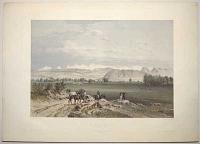
Les Alpes Bernoises. (Canton de Berne.) La Suisse et la Savoie. 47.
Photographié par Martens. Lithographié par Eug. Cicéri. Imp. Lemercier, Paris.
Publié par Goupil et C.e le 1.r Avril 1861. Paris, London. Berlin. Verlag von Goupil & C.e. New York. Published by M. Knoedler.
Tinted lithograph. Sheet 400 x 570mm (15¾ x 22½"), with Goupil's blind stamp, very large margins. Small tears and creases on margins, some spots on image.
A view of the Bernese Alps, in the Canton of Berne, with people riding horses in the foreground and cattle in the middle ground. Plate 47 of 'La Suisse et la Savoie par Eugène Ciceri d'après les vues photographiées par Martens, photographe de S.M. l'Empereur' (1859-65), which recorded 'numerous locations still unknown or little known in topographical illustration' (Gattlen). In 1844 Frédéric Martens (1809-75) had been sent to Chamonix by the French government to experiment with photography in extreme conditions, producing some of the first photographs of the high alps. In the early 1850s he exhibited panoramic views in London and Paris, fuelling interest in the scenery of the region, so returned for this series. As his medium, daguerreotype, prevented easy reproduction, his images had to be lithographed (by Étienne Eugène Cicéri) for publication. Anton Gattlen, 'L'Estampe topographique ou valais 1850-1899 et supplement 1600-1849', p.86.
[Ref: 59057] £260.00
(£312.00 incl.VAT)
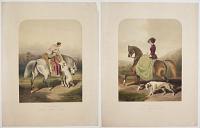
Lez Amazones D'après Alfred de Dreux. I. [&] 2.
Lith Par Eug. Ciceri et Ach. Giroux. [&] Lith Par Ach. Giroux et Eug. Ciceri.
Paris. Goupil & Vibert, Éditeurs. London P.d 15 Ap.l /45 by E. Gambard Junin & Co 25 Berniers S.t. Oxf.d S.t. Berlin. Verlag von L Sachsé & C.te Imp. Lith de Cattier à Paris.
Pair of lithographs with fine hand colour. Printed areas 535 x 380mm (21 x 15"), with very large margins. Some spotting to margins.
A pair of equestrian portraits, with women riding side-saddle, accompanied by a hound. Plate 1 has the woman in medieval dress, plate 2 in contemporary riding outfit. Alfred de Dreux (1810-60) painted portraits of both people and horses, often together. In 1848 he followed King Louis-Philippe into exile in Surrey, but returned to France in 1852, taking commissions from Napoleon III. He died on a visit to England.
[Ref: 46252] £750.00
view all images for this item
![[John Xavier Malevolti Tremamondo. Riding Master.]](img-thumbnail/jpegs/35663.jpg)
[John Xavier Malevolti Tremamondo. Riding Master.]
J. Kay Del.t Sculp.q.
1788.
Etching. Platemark: 195 x 185mm (7¾ x 7¼").
A portrait of fencing master Domenico Angelo (1716–1802) on horseback. Angelo was born in Leghorn, Italy, as Angelo Domenico Malevolti Tremamondo and was the first to emphasize fencing as a means of developing health, poise, and grace. As a result of his insight and influence, fencing changed from an art of war to a sport. Soon after arriving in England he established 'Angelo's School of Arms' in Carlisle House, Soho, London. There he taught the aristocracy the fashionable art of Swordsmanship which they had previously had to go the continent to learn, and also set up a riding school in the former rear garden of the house. He was also a fencing instructor to the Royal Family.
[Ref: 35663] £95.00
(£114.00 incl.VAT)
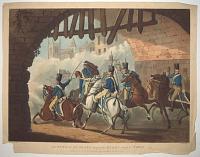
Austrian Hussars Charging the Enemy though a Town.
C. Gessner Delin. J. Bluck sculp.
London Pub 15 Oct by R. Ackermann at his Repository of the Arts 101 Strand.
Rare & fine aquatint, printed in colours and hand-finished. Sheet 455 x 585mm (18 x 23"). Trimmed to plate on three sides, loss in bottom left of inscription area, not affecting text, chips in edges. Paper slightly cockled.
Cavalry riding through a gateway towards French soldiers obscured in gun smoke. A plate from Gessner's 'Military Evolutions', which contained 20 pates by John Bluck and Conrad Ziegler
[Ref: 54047] £320.00
![[Balinese slave in riding costume]](img-thumbnail/jpegs/41203.jpg)
[Balinese slave in riding costume] Une esclave balienne
[after Cornelis de Bruyn, published c.1737]
Engraving, platemark 310 x 200mm (11½ x 7¾").
Plate from the Dutch artist and writer Cornelis de Bruyn's (1652-1727) 'Travels into Muscovy, Persia, and part of the East-Indies', as the 1737 English translation was titled. Visiting an estate near Batavia (modern Jakarta), de Bruyn writes: 'I drew two Baliers, who were slaves to Mr. Kastelein, with the dress they wore in this as well as in their own country ... the 203d plate represents them in the habit they wear on horseback; a black mantle being cast over their body, and their head covered with flowered linnen, and a red hat. They have likewise a handkerchief in their hand, on this as well as on other occasions'.
[Ref: 41203] £120.00
(£144.00 incl.VAT)
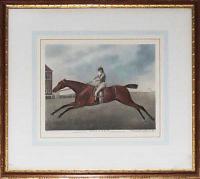
Baronet.
G. Stubbs Pinx.t. G.T. Stubbs Sculp. Engraver to his Royal Highness the Prince of Wales.
London Republished June 4.th 1817. by Edw.d Orme Bond Street.
Stipple, printed in colour and hand finished. Plate 200 x 250mm (7¾ x 9¾"). Unexamined out of frame, platemark cracked on right.
The Prince of Wales's horse Baronet, being ridden by Samuel Chifney. In 1791 the pair won the Oatland Stakes, winning the Prince over £17,000 from wagers. However controversy over Chifney's riding technique led the Prince to withdraw from the Turf. A fine coloured impression. After George Stubbs (1724 - 1806). Lennox-Boyd: 101, state III of III. Ex Ackermanns.
[Ref: 60721] £1,200.00
![[Indian Mountains.] [In pencil beneath image.]](img-thumbnail/jpegs/37840.jpg)
[Indian Mountains.] [In pencil beneath image.]
[Marius Bauer.] [Monogram in pencil beneath image.]
[n.d., c.1920.]
Etching. Plate: 175 x 110mm (7 x 4¼"), very large margins.
A large landscape with mountains towering above a band of figures riding on horses and camels with spears and lances. Marius A. J. Bauer (1867-1932) was a Dutch etcher whose work, influenced by his travels in the Orient, inspired his British contempories to explore the East. Wisselingh: 74
[Ref: 37840] £140.00
(£168.00 incl.VAT)
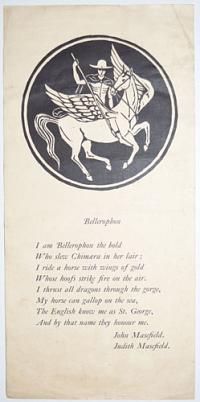
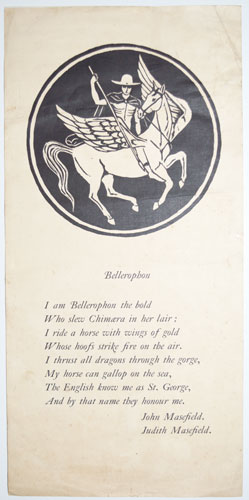
Bellerophon. I am Bellerophon the bold / Who slew Chimæra in her lair; [...]
John Masefield. Judith Masefield.
[n.d., c.1950.]
Broadside, linocut roundel with letterpress verse. Sheet 450 x 215mm (17¾ x 8½"). Crease through image, surface soiling.
A stark black and white image of the Greek hero Bellerophon riding the winged horse Pegasus, illustrating a poem by John Masefield (1878-1967), Poet Laureate 1930-67. The illustration was drawn (and probably cut) by his daughter Judith (1904-88).
[Ref: 52837] £180.00
(£216.00 incl.VAT)
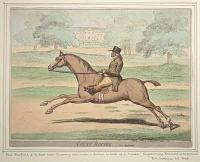
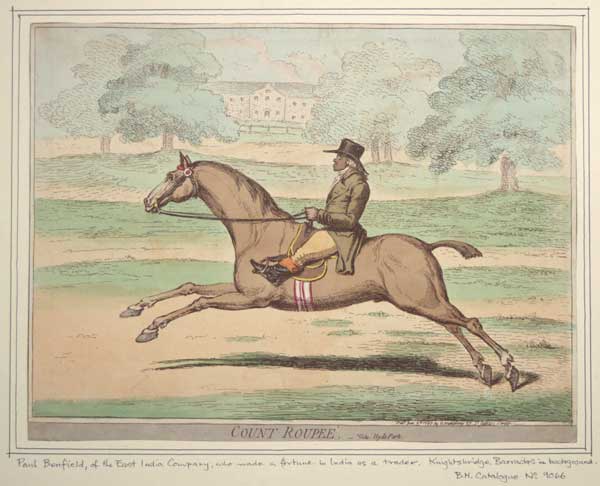
Count Roupee. - Vide. Hyde Park.
[James Gillray]
Pub.d June 5.th 1797. by H. Humphrey 27. S.t James's Street
Very rare hand-coloured etching, sheet 385 x 540mm (15¼ x 21"). Trimmed within plate and glued to backing card.
Caricature of Paul Benfield (1741-1810), of the East India Company, who made a fortune in India as a trader, banker, and contractor, and was notorous through Burke's (published) speech on the debts of the Nabob of Arcot oppresser. He lost his fortune establishing a mercantile firm in London, called Boyd, Benfield, & Co which engaged in speculations which turned out badly, and Benfield's fortune collapsed rapidly. He died in Paris in poverty. A small dark-complexioned man wearing spectacles rides a galloping horse through Hyde Park. There is a background of grass and trees, and in the distance a building with a pediment, evidently the new Knightsbridge Barracks. BM Satires 9066.
[Ref: 61958] £780.00
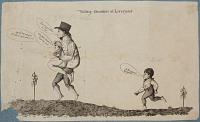
Military Amusement at Liverpool
[n.d., c.1800.]
Etching. Sheet: 195 x 325mm (7¾ x 12¾"). Trimmed, paper loss in bottom left corner. Laid on an album sheet. Creasing.
A comic scene showing General Godfrey Bosville (later 3rd Baron Macdonald of Sleat)(1775-1832) riding on the back of another man running a race against a smaller figure who runs behind. Bosville was a successful race horse breeder.
[Ref: 46201] £140.00
(£168.00 incl.VAT)
![[Perspective View of the Stable Building.]](img-thumbnail/jpegs/21558.jpg)
[Perspective View of the Stable Building.]
[A. Pugin, Del.t. T.Sutherland Aqua.t.
[John Nash Esq.r and Sold by Ackermann, 101, Strand, London, 1824.]
Aquatint printed in colours and hand finished, trimmed and mounted on brown card, as issued. Image 190 x 330mm, 7½ x 13". Card spotted.
The Stables as seen from the Royal Pavilion at Brighton, built 1803-8 to provided stabling for sixty horses, completed before the main buildings of the Pavilion were re-designed by John Nash between 1815-1822. Designed by William Porden in an Indian style, the main feature was a vast 24-metre glass dome which many detractors predicted would collapse as soon as the scaffolding was removed. It survived and is now part of the Dome arts venue. From John Nash's 'The Royal Pavilion at Brighton', published by Nash at the command of George IV. The title in square brackets above is taken from the Index of Subjects. Abbey: Scenery, 62; Ford: Images of Brighton, 458.
[Ref: 21558] £280.00
(£336.00 incl.VAT)
![Brighton Pavilion. North Front of the Stables. Brighton Pavilion. The Riding Stables [Old ink mss.]](img-thumbnail/jpegs/21556.jpg)
Brighton Pavilion. North Front of the Stables. Brighton Pavilion. The Riding Stables [Old ink mss.] [Stables towards Church Street. Riding House]
[A. Pugin, Del.t. T.Sutherland Aqua.t. [&] Augs. Pugin Del.t. M.Dubourg Sculp.t ]
[John Nash Esq.r and Sold by Ackermann, 101, Strand, London, March 1, [& July 1] 1824 ]
Two aquatints printed in colours and hand finished, trimmed and mounted on brown card together, as issued, again laid on later board. Images 110 x 180mm, 4¼ x 7" & 110 x 190, 4¼ x 7½". Pinholes in card corners, soiling of card edges, number label bottom right.
The exterior of the Stables from Church Street and the interior of the Riding House of the Royal Pavilion at Brighton, built 1803-8, before the main buildings were re-designed by John Nash between 1815-1822. Designed by William Porden in an Indian style, the building provided stabling for sixty horses. The Stables now form part of the Dome arts venue; the Riding School became the Brighton Corn Exchange. From John Nash's 'The Royal Pavilion at Brighton', published by Nash at the command of George IV. The title in square brackets above is taken from the Index of Subjects. Abbey: Scenery, 62; Ford: Images of Brighton, 460 & 461.
[Ref: 21556] £250.00
(£300.00 incl.VAT)
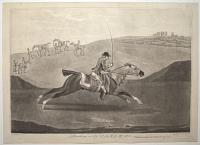
Brushing In, To Catch others.
J. Seymour inv.t. T. Burford delin et fecit.
Published according to Act of Parliament June 1755.
Mezzotint, 18th century watermark. 250 x 350mm (9¾ x 13¾"), with very large margins.
A Jockey on horseback galloping to right, the horse wearing a head-cover. Siltzer: 247.
[Ref: 54673] £360.00
![[John Smith, alias Buckhorse.]](img-thumbnail/jpegs/50610.jpg)
[John Smith, alias Buckhorse.]
[after Daniel Dodd.]
Published by J. McGowan, Great Windmill Street, 1825 [but 1826].
Stipple. 160 x 100mm (6¼ x 4"), with large margins.
Half-length portrait of John Smith, a.k.a. Buckhorse (boxer, fl.1720-50), adapted from the portrait by Daniel Dodd. He earned his nickname riding for the Duke of Queensberry, the inveterate gambler. In later life, for a few shillings Buckhorse would allow people to punch him in the head as hard as they could, so such a blow became known as a 'Buckhorse'. Probably as a result of these blows, a common expression of the period was 'as ugly as Buckhorse'. From John Badcock's 'The Fancy; or The True Sportsman's Guide: Being Authentic Memoirs of the Lives, Actions, Prowess, and Battles of the Leading Pugilists, from the Days of Figg and Broughton, to the Championship of Ward. By an Operator'.
[Ref: 50610] £130.00
(£156.00 incl.VAT)
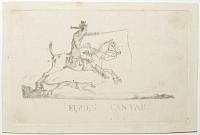
Eques Cantab.
[after Henry Bunbury.]
[n.d., c.1769.]
Etching with drypoint. 105 x 165mm (4¼ x 6½"). Album stains at corners. Small margins.
A Cambridge student with a macaroni queue holding out his driving whip as if it is a lance, riding a defecating horse. King's College Chapel can be seen in the distance. BM Satire 4724.
[Ref: 54592] £90.00
(£108.00 incl.VAT)

Cambridge.
Drawn by R. B. Harraden Jun.r. Etched by Letitia Byrne.
Published Jan.y 20 1809 by R. Harraden & Son, Cambridge, and by R. Cribb & Son, 288, Holborn, London.
Etching, sheet 175 x 245mm (7 x 9¾"). Trimmed to platemark.
Exterior view from afar of Cambridge University. In the foreground there are a flock of sheep, a man riding horseback and students walking.
[Ref: 62990] £130.00
(£156.00 incl.VAT)

The Cambridge Jockey. Eques Cantab.
HWB [Bunbury] Invt.
Pubd. according to Act of Parlt. by MDarly Engraver No.(39) Strand.
Etching, 250 x 350mm. 9¾ x 13¾".
A young thin Cambridge student in hunting dress riding rapidly across a heath holding out a whip in front of his horse's nose. A lurcher-type dog runs alongside. Racing interest. After Henry William Bunbury (1750 - 1811). From an album of caricatures published by Mary Darly dated January 1776. It seems that her husband Matthew made the plates. See BM Satires: 4724.
[Ref: 14114] £380.00
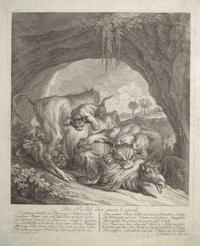
Der Pardel über einem Cameel.
Joh. El. Ridinger inv. et del. M. El. Ridinger sculps. Aug Vin.
[Augsburg, c.1760.]
Engraving, watermark M. Heusler, 350 x 290mm (13¾ x 11½"). Some wear to margins.
A family of big cats bringing down a camel in a cave. Despite being described as leopards, the cats look more like a lioness and her cubs. Johann Elias Ridinger (1698-1767) is regarded as one of the best German engravers of animals, especially horses, hounds and hunting scenes
[Ref: 55342] £160.00
(£192.00 incl.VAT)

Canadian Calash.
J. Weld del.t. Smith sculp.t.
London, Published by Jones & Co. 1824.
Engraving. Sheet: 210 x 130mm (8¼ x 5'').
A scene showing two men riding in a Canadian calash, a light carriage with two wheels as opposed to four, and pulled by a single horse.
[Ref: 49587] £60.00
(£72.00 incl.VAT)
![Verduero. [&] Huaso. [&] Panadero.](img-thumbnail/jpegs/49508.jpg)
Verduero. [&] Huaso. [&] Panadero.
Inez Buchanan.
[Active 1903-19.]
Set of 3 watercolours signed in pencil. Sheets: 200 x 145mm (7¾ x 5¾''). Foxing on verso.
Three watercolours depicting Chilean tradesmen including a Huaso, or horseman, a Verdulero, or greengrocer riding a donkey laden with bags of vegetables and a baker, also riding a donkey.
[Ref: 49508] £360.00
view all images for this item
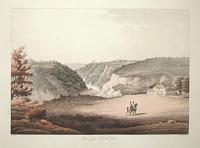
View from Clifton Down.
[London, Published May 1 1810.]
Fine & rare coloured aquatint. Sheet 375 x 475mm (14¾ x 18¾").
Two figures riding horses on grassland; a ships on a body of water to the left; a house with a smoking chimney and a horse and carriage to the right. In the British Library online catalogue: BLL01004821562.
[Ref: 52393] £320.00
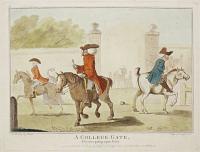
A College Gate. Divines going upon Duty.
H Bunbury Esq.r Delin.t. Watson & Dickinson Excud.t.
London Publish'd Nov.r 15th 1780, by Watson & Dickinson No.158 New Bond Street. & No 33, Strand.
Coloured stipple, printed on 18th century watermarked paper; 300 x 395mm (11¾ x 15½").
Social satire, on Cambridge 'types': three men riding in different directions, having come through a large gateway. The rider in the centre on a clumsy horse wears a clerical wig, broad-brimmed hat, and gaiters. On the right is a man on a stout cob, wearing boots and a bob-wig. Behind him is a fat old woman with outstretched arms shouting in alarm. On the left a thin man is riding a more spirited horse, and dressed like a layman. Behind him walks a fat divine wearing an academic cap, bands, and a long gown. Through the gateway in the distance a short fat man in a clerical wig stands on a mounting block, a groom beside him holding his horse. With him are two men wearing mortar-boards and long gowns. Behind a large rectangular building is indicated and behind it a church steeple. Numbered '5' upper left, from a series of Cambridge caricatures by Henry William Bunbury (1750 - 1811). BM Satires 5804.
[Ref: 40626] £190.00
(£228.00 incl.VAT)
![[A Country Race Course with Horses Racing.]](img-thumbnail/jpegs/54700.jpg)
[A Country Race Course with Horses Racing.]
[W. Mason Esq. delin.t. Aquatinta by F.Jukes. Engrav'd by J.Jenkins.]
Pub.h.d June 20th [no year] W.m Mason Esq.r. [c.1786.]
Aquatint with engraving, proof before title, scratched publication line. Sheet 465 x 650mm (14¼ x 17¾"). Trimmed within plate, small tears repaired. Some creasing in sky.
A chaotic scene at a racecourse, Newmarket Heath or probably York as the artist, William Mason (1724 -97), was Canon Residentiary of York. The horses pass the finish post, through spectators who wander close to the course. On the left is a high phaeton carriage, in the right foreground a woman pie-seller falls to the ground, spilling her wares. A pair to ''A Country Race Course with Horses Preparing to Start''. The BM's example was published by James Phillips in 1786. BM Satires 8256. Not in Siltzer.
[Ref: 54700] £690.00

Scene in a Country Town at the Time of a Race.
Drawn by W. Mason Esq.r. Engrav'd by V Green.
Publish'd March 27th 1789 by F. Brydon, Printseller & Framemaker, opposite Northumberland House, Charing Cross, London.
A very large & rare etching, with hand colour. Sheet 445 x 600mm (17½ x 23¾"). Trimmed to plate; worm holes filled, mainly in title area.
A chaotic scene in a High Street, probably York as the artist William Mason was Canon Residentiary of York and Rector of Aston. A stagecoach and personal carriages crash into each other, much to the amusement of spectators looking from the windows of the Red Lion coaching inn. Adding to the noise are coach passengers beating a drum and blowing a trumpet, a fiddler and a ballad singer. Other figures include a gipsy woman sitting on the pavement, a Jewish pedlar clutching his box on the roof of the stagecoach and a man riding a racehorse through the melée. The BM's example is trimmed to the image, but has a 1908 report that gives the title and describes an earlier state, ''Publish'd July 26th 1783 by V. Green, N°29 Newman Street, Oxford Street & Sold by F Brydon, Printseller, N° 7, opposite Northumberland House, Charing Cross, London''. See Ref: 31344 for Frank Paton's Christmas Card design. BM Satires 8243; Siltzer p.360; Not in Whitman list of Green's non-mezzotints.
[Ref: 54616] £950.00

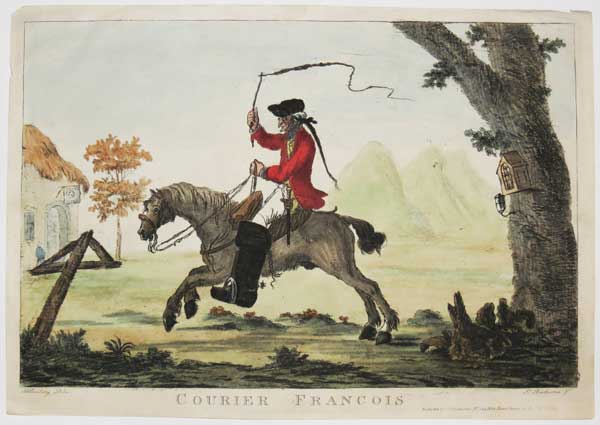
Courier Francois.
H.W.Bunbury Delin. Js.Bretherton f.
Publish'd by Js.Bretherton No.134 New Bond Street as the Act directs. [n.d., c.1774.]
Coloured etching. 420 x 280mm. Small tear.
A rider in oversized boots, riding a shaggy horse. BM Satire 4737.
[Ref: 36056] £160.00
(£192.00 incl.VAT)

The Curate on a Visit.
G.T. Inv. I. Roe sc.
Pub by MDarly Strand April 4th 1772 accor to Act.
Etching, 175 x 250mm. 7 x 9¾".
A couple with their small child riding on a horse in a landscape; a woman under tree to left and a large house in the distance to right. From an album of caricatures published by Mary Darly dated January 1776. It seems that her husband Matthew made the plates. Numbered '7' upper right.
[Ref: 14127] £220.00
(£264.00 incl.VAT)

The Female Turf Macaroni. 4.
[by Matthew Darly.]
Pub.d by M Darly Decem.r 24th 1771 accor.g to Act.
Etching. 150 x 105mm (6 x 4¼") large margins.
A whole length figure in profile of a lady in a riding-habit holding a riding-whip in her right hand. Her hair, without powder, is tied up in a club. She wears a cravat and a cap with a plume of feathers. Probably the Duchess of Grafton, the Duke being the Turf Macaroni in this series. Plate 4 from the publication, '24 Caricatures by several ladies, gentlemen, artists, etc. (Vol.1)'. Published by caricaturist, printseller and ornamental engraver Matthew Darly (1720 - 1781). BM Satires ref: 4989.
[Ref: 55582] £220.00
(£264.00 incl.VAT)
![[Mrs Davenport.]](img-thumbnail/jpegs/68596.jpg)
[Mrs Davenport.]
B. Dandridge Pinx. J. Faber Fecit 1730.
Mezzotint. 350 x 250mm (13¾ x 9¾"). Laid on album sheet in left margin.
A full-length portrait of a woman in riding attire, holding a crop, a groom and horse behind. The National Portrait Gallery has a mezzotint portrait of the same period after Joseph van Aken (NPG D34810) of a woman, also holding a riding crop, who they identify as possibly Gratiana Davenport (née Rodd) (1710-73), wife of Sharington Davenport. CS 109, i of ii. Ex: collections of The Hon. Christopher Lennox-Boyd & Oettingen-Wallerstein.
[Ref: 68596] £320.00
![[Mrs Davenport.]](img-thumbnail/jpegs/68595.jpg)
[Mrs Davenport.]
B. Dandridge Pinx. J. Faber Fecit 1730.
Fine & rare mezzotint. 350 x 250mm (13¾ x 9¾"), large margins. Holes, tear, spotting and old ink mss, all in margins.
A full-length portrait of a woman in riding attire, holding a crop, a groom and horse behind. The National Portrait Gallery has a mezzotint portrait of the same period after Joseph van Aken (NPG D34810) of a woman, also holding a riding crop, who they identify as possibly Gratiana Davenport (née Rodd) (1710-73), wife of Sharington Davenport. CS 109, i of ii. Ex: collection of The Hon. Christopher Lennox-Boyd.
[Ref: 68595] £320.00
![[Christiaan de Wet] De Wet, Br Horse 5 yr. By, Darling - Not Caught Yet.](img-thumbnail/jpegs/60715.jpg)
[Christiaan de Wet] De Wet, Br Horse 5 yr. By, Darling - Not Caught Yet.
Nap.
[n.d. c.1900.]
Watercolour and gouache, sheet 290 x 360mm (11½ x 14"). Creases and small tears.
A caricature of a Boer general Christiaan de Wet (1854-1922), one of their best guerrilla leaders.
[Ref: 60715] £280.00
(£336.00 incl.VAT)
![[Frederick Peter Delmé-Radcliffe] A Dalme_Tian. Booking the Colonel. This Sketch is dedicated to the Greeks.](img-thumbnail/jpegs/55401.jpg)
[Frederick Peter Delmé-Radcliffe] A Dalme_Tian. Booking the Colonel. This Sketch is dedicated to the Greeks. No.1 Turf Characters____"Quoth Hudibrass I smell a Rat.....
[Monogram of Paul Pry - William Heath] Esq.r del..
Pub June 26 1829 by T. McLean 26 Haymarket Sold Publisher of P. Prys Caricatures.
Hand-coloured etching. 370 x 260mm (14½ x 10¼"), on paper watermarked 'J Whatman Turkey Mill 1828', with large margins.
Frederick Peter Delmé-Radcliffe (1804-1871), the noted gentleman jockey in charge of the King's Stud, depicted as a thin man in riding dress with top-hat and top-boots, holding out a betting-book. The performance of the king's horse 'The Colonel' at the Ascot Gold Cup on June 18th disappointed William IV; a letter appeared in the 'Sporting Magazine', signed by 'Independence', claiming the horse had been seen being hacked by a drunken rider only four days before the race. Delmé-Radcliffe issued a denial, but had difficulty getting it published. Heath gives a nod to the author of the letter by referencing the Greek struggle for independence. 'Paul Pry' was the pseudonym of William Heath. BM Satires: 15932.
[Ref: 55401] £280.00
(£336.00 incl.VAT)
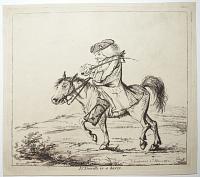
D.r Dawdle in a hurry.
M.r Bunbury del. J.s Bretherton f.
1st March 1782.
Etching, 18th century watermark. 225 x 260mm (8¾ x 10¼"). Narrow margins.
An elderly doctor on a wretched cob, threatening it with a whip. BM Satires 6142.
[Ref: 54591] £140.00
(£168.00 incl.VAT)

Plan and Survey of Doncaster Race Course; in the West Riding of Yorkshire; including the Rises and Fall; with Notes Referring to an Appendix; by W.m Kemp. To The Mayor and Corporation of The Town of Doncaster; This Plate, being No.5, of a Series of Surveys, of the Principal Race Courses in England; is most Respectfully Dedicated by Their most obed.t and very humble Servant, W.m Kemp [facsimile signature.]
Davies sculp. 34 Compton St. Brunsw.k Sq.
London, Published by Sherwood, Jones & Co. Paternoster Row. [n.d., 1824.]
Engraved map with hand colour, J. Whatman 1824 watermark; 215 x 280mm (8½ x 11"). Trimmed within plate, two vertical binding folds, as normal..
Doncaster Racecourse, South Yorkshire. It is one of the oldest establised centres for horse racing in Great Britain, with records of regular racing meetings going back to the 16th Century.
[Ref: 63729] £95.00
![[Louis XIII watching a horse being trained.]](img-thumbnail/jpegs/57451.jpg)
[Louis XIII watching a horse being trained.] Figure 47. CCC. Seconde partie.
[drawn and engraved by Crispijn de Passe the younger.]
[Paris, c.1623.]
Engraving on two plates. Outer plate 315 x 410mm (12½ x 16"), very large margins. Creasing at top.
A scene in the riding yard of the Tuileries, with Louis XIII watching a horse being trained to leap a barrier, watched by a dozen named courtiers. Around the image is a separately-printed architectural border. A plate from Antoine de Pluvinel's important work on dressage, published first in 1623 as 'Le Maneige Royal' and secondly as 'L'instrvction du Roy, en L'exercice de Monter a Cheval' in 1625. Pluvinel (1562-1620), the first French riding master, taught Louis XIII to ride, and the king often takes centre stage in the plates from this work.
[Ref: 57451] £320.00
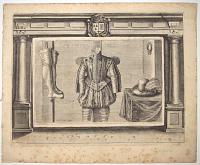
Figure de l'habit de Chevallier a la Pluvinelle. Figure 2. B. 1 partie.
[drawn and engraved by Crispijn de Passe the younger.]
[Paris, c.1623.]
Engraving on two plates. Outer plate 315 x 410mm (12½ x 16"), very large margins. Spotting and creasing at top.
An engraving of the doublet, hat and boots of a dressage rider, within a separately-printed architectural border. A plate from Antoine de Pluvinel's important work on dressage, published first in 1623 as 'Le Maneige Royal' and secondly as 'L'instrvction du Roy, en L'exercice de Monter a Cheval' in 1625. Pluvinel (1562-1620), the first French riding master, taught Louis XIII to ride, and the king often takes centre stage in the plates from this work.
[Ref: 57448] £220.00
(£264.00 incl.VAT)
![[Dressage.] Courbetten in einenn Circel Rechts.](img-thumbnail/jpegs/49175.jpg)
[Dressage.] Courbetten in einenn Circel Rechts. Courbettes sur les voltes, à Droite. Pl.210. Num. 3.
[1700.]
Rare engraving, early 18th century watermark. Plate: 245 x 315mm (9¾ x 12½'') very large margins. Marking, central fold as normal.
A plate from 'La Mode et Invention Nouvelle de Dresser les Chevaux' 1700 by William Cavendish (1592-1676). Cavendish was an influential and staunch Royalist who fought for Charles I during the Civil War, after Charles's execution he moved to Paris and then Antwerp where he set up a riding school. In 1657 he published the first edition of 'La Mode et Invention Nouvelle de Dresser les Chevaux', the illustrations were engraved after designs by Abraham van Diepenbeeck and engraved by Cornelis van Caukercken, Peter Clouet, Pieter de Jode II, Theodoor van Kessel, Peeter van Lisebetten, Adriaen Lommelin and Lucas Vorsterman the Younger.
[Ref: 49175] £240.00
(£288.00 incl.VAT)
![[Dressage.] Courbetten auf einer Stelle Lincks.](img-thumbnail/jpegs/49177.jpg)
[Dressage.] Courbetten auf einer Stelle Lincks. Courbettes de ferme à ferme à Gauche. Pag: 210. Num: 2.
[1700.]
Engraving, early 18th century watermark. Plate: 240 x 330mm (9½ x 13'') very large margins. Marking, central fold as normal.
A plate from 'La Mode et Invention Nouvelle de Dresser les Chevaux' 1700 by William Cavendish (1592-1676). Cavendish was an influential and staunch Royalist who fought for Charles I during the Civil War, after Charles's execution he moved to Paris and then Antwerp where he set up a riding school. In 1657 he published the first edition of 'La Mode et Invention Nouvelle de Dresser les Chevaux', the illustrations were engraved after designs by Abraham van Diepenbeeck and engraved by Cornelis van Caukercken, Peter Clouet, Pieter de Jode II, Theodoor van Kessel, Peeter van Lisebetten, Adriaen Lommelin and Lucas Vorsterman the Younger.
[Ref: 49177] £240.00
(£288.00 incl.VAT)
![[Dressage.] Courbetten Durüct in einem Circtel Rechts.](img-thumbnail/jpegs/49176.jpg)
[Dressage.] Courbetten Durüct in einem Circtel Rechts. Courbettes en arriere sur les votles à Droite. Pag: 210. Num: 7.
[1700.]
Engraving, early 18th century watermark. Plate: 245 x 315mm (9¾ x 12½'') very large margins. Marking, central fold as normal.
A plate from 'La Mode et Invention Nouvelle de Dresser les Chevaux' 1700 by William Cavendish (1592-1676). Cavendish was an influential and staunch Royalist who fought for Charles I during the Civil War, after Charles's execution he moved to Paris and then Antwerp where he set up a riding school. In 1657 he published the first edition of 'La Mode et Invention Nouvelle de Dresser les Chevaux', the illustrations were engraved after designs by Abraham van Diepenbeeck and engraved by Cornelis van Caukercken, Peter Clouet, Pieter de Jode II, Theodoor van Kessel, Peeter van Lisebetten, Adriaen Lommelin and Lucas Vorsterman the Younger.
[Ref: 49176] £240.00
(£288.00 incl.VAT)
![[Dressage.] Courbetten in einem Circel Lincks.](img-thumbnail/jpegs/49178.jpg)
[Dressage.] Courbetten in einem Circel Lincks. Courbettes sur Les voltes à Gauche. P: 210. Num: 4.
[1700.]
Engraving, early 18th century watermark. Plate: 240 x 330mm (9½ x 13'') very large margins Marking, central fold as normal.
A plate from 'La Mode et Invention Nouvelle de Dresser les Chevaux' 1700 by William Cavendish (1592-1676). Cavendish was an influential and staunch Royalist who fought for Charles I during the Civil War, after Charles's execution he moved to Paris and then Antwerp where he set up a riding school. In 1657 he published the first edition of 'La Mode et Invention Nouvelle de Dresser les Chevaux', the illustrations were engraved after designs by Abraham van Diepenbeeck and engraved by Cornelis van Caukercken, Peter Clouet, Pieter de Jode II, Theodoor van Kessel, Peeter van Lisebetten, Adriaen Lommelin and Lucas Vorsterman the Younger.
[Ref: 49178] £240.00
(£288.00 incl.VAT)
![[Dressage.] Crupaden Lincks.](img-thumbnail/jpegs/49179.jpg)
[Dressage.] Crupaden Lincks.
[1700.]
Engraving. Plate: 215 x 345mm (8½ x 13½''). Foxing and marking.
A plate from 'La Mode et Invention Nouvelle de Dresser les Chevaux' 1700 by William Cavendish (1592-1676). Cavendish was an influential and staunch Royalist who fought for Charles I during the Civil War, after Charles's execution he moved to Paris and then Antwerp where he set up a riding school. In 1657 he published the first edition of 'La Mode et Invention Nouvelle de Dresser les Chevaux', the illustrations were engraved after designs by Abraham van Diepenbeeck and engraved by Cornelis van Caukercken, Peter Clouet, Pieter de Jode II, Theodoor van Kessel, Peeter van Lisebetten, Adriaen Lommelin and Lucas Vorsterman the Younger.
[Ref: 49179] £240.00
(£288.00 incl.VAT)
![[Horse training.]](img-thumbnail/jpegs/57461.jpg)
[Horse training.] Figure 5. 1 partie.
[drawn and engraved by Crispijn de Passe the younger.]
[Paris, c.1623.]
Engraving on two plates. Outer plate 315 x 410mm (12½ x 16"), with very large margins. Tears taped. Creasing on top.
A scene in the courtyard of the Louvre, with Louis XIII watching a horse being trained at a pillar, with two named courtiers. Around the image is a separately-printed architectural border. A plate from Antoine de Pluvinel's important work on dressage, published first in 1623 as 'Le Maneige Royal' and secondly as 'L'instrvction du Roy, en L'exercice de Monter a Cheval' in 1625. Pluvinel (1562-1620), the first French riding master, taught Louis XIII to ride, and the king often takes centre stage in the plates from this work.
[Ref: 57461] £320.00
![[Dressage.]](img-thumbnail/jpegs/48191.jpg)
[Dressage.]
Cornelis Nicolai Schurtz Sculp. Norinburg.
[Nuremberg: Wolfgang Moritz Endter, 1678.]
Engraving with hand colour. 205 x 295mm (8 x 11½"). Top edge worn, affecting platemark. Trimmed.
Three equestrian women in elaborate costume riding side saddle, accompanied by a male rider and two equerries. From Georg Simon Winter von Adlers Flügel's 'Bellerophon, sive Eques peritus'. Winter (1629-1701), a veterinarian and the director of several German stud farms, published a number of important early treatises on raising horses, equestrian art and veterinary medicine.
[Ref: 48191] £190.00
(£228.00 incl.VAT)
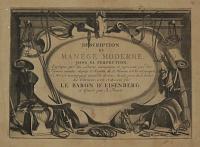
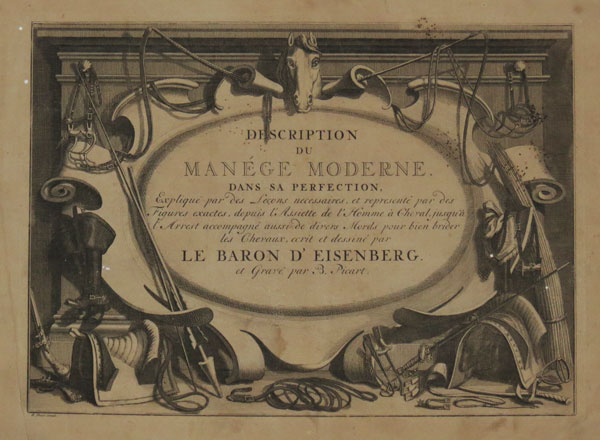
Description du Manège Moderne. Dans sa Perfection. Expliqué par des Leçons necessaires, et representé par des Fifures exactes [...]
B. Picart inventit [1727]
Engraving, platemark 225 x 310mm (9 x 12¼") very large margins. Few wormholes. Time stained.
Frontispiece to Baron d'Eisenberg's horseriding manual, 'Description du Manège Moderne' (1727), featuring various pieces of equipment used in horseriding (stirrups, saddle, bridle etc).
[Ref: 40089] £75.00
(£90.00 incl.VAT)
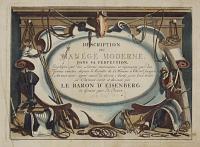
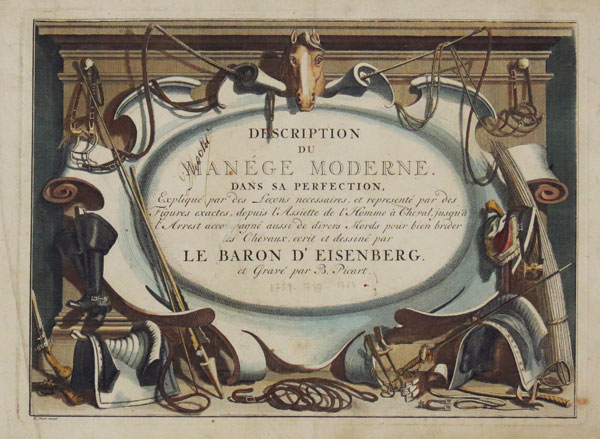
Description du Manège Moderne. Dans sa Perfection. Expliqué par des Leçons necessaires, et representé par des Fifures exactes [...]
B. Picart inventit [1727]
Engraving with hand-colouring and ms, platemark 225 x 310mm (9 x 12¼") very large margins.
Frontispiece to Baron d'Eisenberg's horseriding manual, 'Description du Manège Moderne' (1727), featuring various pieces of equipment used in horseriding (stirrups, saddle, bridle etc).
[Ref: 40090] £75.00
(£90.00 incl.VAT)

To the Electors of the County of Huntingdon. Gentlemen...[eight paragraphs]... Yours Faithfully, H.W. Fitzwilliam. Milton, Peterborough, June 13th, 1877.
[Anon., 1877.]
Letterpress broadside, campaign flyer/handbill in form of an open letter; issued by the Liberal Party on behalf of their local candidate, Henry Wentworth-FitzWilliam. Sheet 225 x 180mm, 9 x 7".
Consisting of a serious of suitably vague pledges on the issues of the day, local and national concerns including the 'Eastern Question', i.e. Russia's policy towards the Ottoman Empire. The Hon. (William) Henry Wentworth-FitzWilliam (1840 - 1920), was a Liberal, and later Liberal Unionist politician. He entered Parliament for Wicklow in 1868, a seat he held until 1874. He later represented the West Riding of Yorkshire South between 1880 and 1885 and Doncaster between 1888 and 1892. Initially a Liberal, he disagreed with William Ewart Gladstone over Irish Home Rule and sat as a Liberal Unionist between 1888 and 1892. Provenance: from a scrap album compiled c.1840 - 1880 by Alfred Towgood of Riverside, a paper mill owner at St. Neots, Huntingdon. He was also a Lieutenant in the Duke of Manchester's Light Horse.
[Ref: 16458] £60.00
(£72.00 incl.VAT)
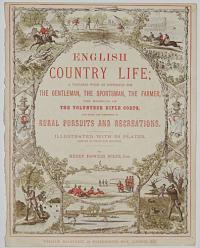
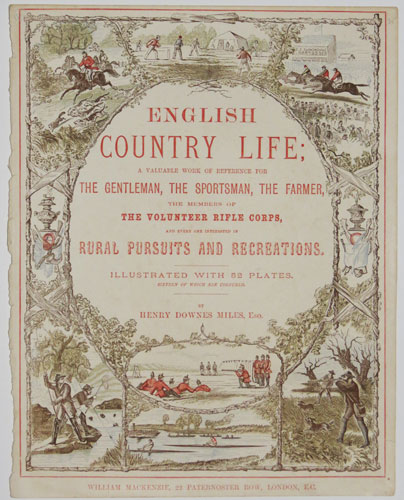
English Country Life; A Valuable Work of Reference for The Gentleman, the Sportsman, the Farmer [...]
William Mackenzie, 22 Paternoster Row, London, E.C. [c.1880]
Wood engraving printed in colour, sheet 300 x 240mm (11¾ x 9½").
Frontispiece with vignettes of various sports including a cricket match, angling, shooting, rowing, horseriding and hunting.
[Ref: 40092] £120.00
(£144.00 incl.VAT)

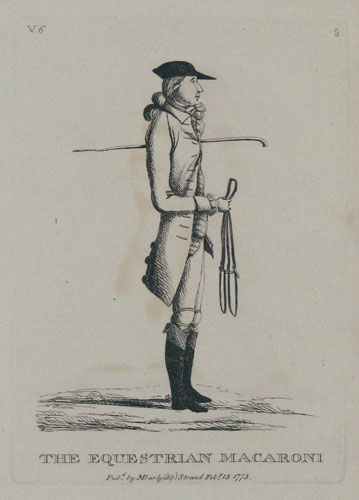
The Equestrian Macaroni.
Pubd by MDarly (39) Strand Feby 13 1773.
Etching, 175 x 125mm. 7 x 5".
A man in riding costume in profile, holding a bridle, a crop under his left arm. He wears a small looped club, a low hat, plain coat, striped waistcoat, and spurred riding boots. Racing interest. From 'Characters, Macaronies & Caricatures, by MDarly', in an album of caricatures published by Mary Darly dated January 1776. It seems that her husband Matthew made the plates. Numbered 'V.6' upper left and '3' upper right. BM Satires: 5150.
[Ref: 14493] £170.00
(£204.00 incl.VAT)
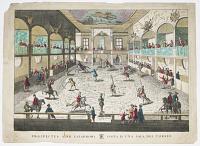
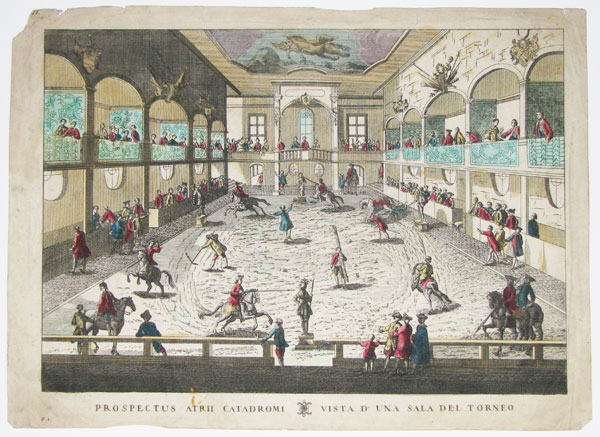
Prospectus Atrii Catadromi. Vista D'Una Sala Del Torneo.
[Published in Venice by Raimondini, n.d., c.1760.]
Hand coloured etching, image 290 x 410mm. 11½ x 16¼". Trimmed at lower platemark. Tatty extremities with tears, one just into image upper right. Scarce.
Spectators watch an exhibition of horsemanship or jousting tournament from the galleries of an decorated interior. A vue d'optique intended to be viewed through a convex lens. The devices, known variously as zograscopes, optiques, optical machines and peepshows, were an optical entertainment of the late 18th and early 19th centuries. Vues d'optiques were rendered in high-key color and dramatic linear perspective, which enhanced the illusion of three-dimensionality when viewed through the lens. Possibly after Johann Elias Ridinger (1698 - 1767). Numbered 'P I.' lower left.
[Ref: 9601] £290.00
(£348.00 incl.VAT)
![[Three designs for fans or candle sconces.]](img-thumbnail/jpegs/10695.jpg)
[Three designs for fans or candle sconces.]
[Continental, possibly French, n.d., c.1860.]
Three fan leaves on one sheet, lithographs, sheet 550 x 370, 21¾ x 14½". Tatty and stained extremities, three tears at right, crease through upper left edge of top image.
In the top design, devil-like characters and malevolent monkeys burn an artist's canvasses as he lies helplessly pinned to the floor. The middle image shows men and women in a wintry landscape riding horse-drawn sleighs. The lowest design is divided into three sections; an apparently Turkish or middle-eastern battle scene in the centre is flanked by a carriage and another horse-drawn sleigh.
[Ref: 10695] £220.00
(£264.00 incl.VAT)
![[Vorstellung und Beschreibung derer Schul und Campagne Pferden nach ihren Lectionen.]](jpegs/31717.jpg)


![[John Xavier Malevolti Tremamondo. Riding Master.]](jpegs/35663.jpg)

![[Balinese slave in riding costume]](jpegs/41203.jpg)

![[Indian Mountains.] [In pencil beneath image.]](jpegs/37840.jpg)

![[Perspective View of the Stable Building.]](jpegs/21558.jpg)
![Brighton Pavilion. North Front of the Stables. Brighton Pavilion. The Riding Stables [Old ink mss.]](jpegs/21556.jpg)

![[John Smith, alias Buckhorse.]](jpegs/50610.jpg)


![Verduero. [&] Huaso. [&] Panadero.](jpegs/49508.jpg)


![[A Country Race Course with Horses Racing.]](jpegs/54700.jpg)



![[Mrs Davenport.]](jpegs/68596.jpg)
![[Mrs Davenport.]](jpegs/68595.jpg)
![[Christiaan de Wet] De Wet, Br Horse 5 yr. By, Darling - Not Caught Yet.](jpegs/60715.jpg)
![[Frederick Peter Delmé-Radcliffe] A Dalme_Tian. Booking the Colonel. This Sketch is dedicated to the Greeks.](jpegs/55401.jpg)


![[Louis XIII watching a horse being trained.]](jpegs/57451.jpg)

![[Dressage.] Courbetten in einenn Circel Rechts.](jpegs/49175.jpg)
![[Dressage.] Courbetten auf einer Stelle Lincks.](jpegs/49177.jpg)
![[Dressage.] Courbetten Durüct in einem Circtel Rechts.](jpegs/49176.jpg)
![[Dressage.] Courbetten in einem Circel Lincks.](jpegs/49178.jpg)
![[Dressage.] Crupaden Lincks.](jpegs/49179.jpg)
![[Horse training.]](jpegs/57461.jpg)
![[Dressage.]](jpegs/48191.jpg)

![[Three designs for fans or candle sconces.]](jpegs/10695.jpg)