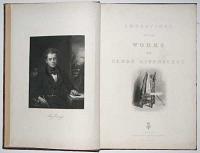
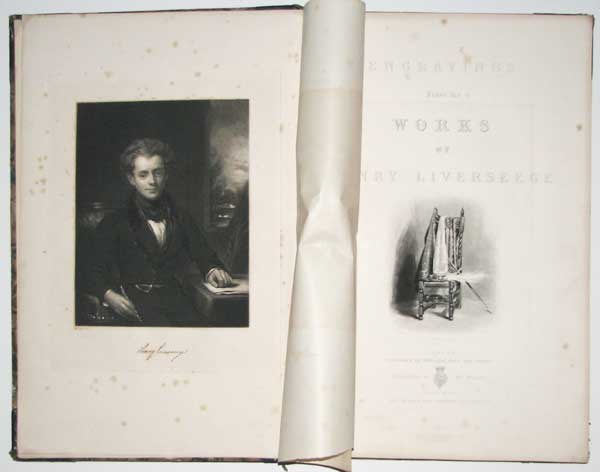
Engravings fron the Works of Henry Liverseege. With a Memoir by George Richardson, author of 'Patriotism,' 'Miscellaneous Poems,' &c.
London: George Routledge and Sons, and L.C. Gent. 1875
Folio, cloth binding with gilt embellishment. 440 x 310mm. 17¼ x 12¼".
Containing 38 engravings from paintings by Henry Liverseege (1803-32). Also contains an engraving of William Bradley's portrait of him. Liverseege was born, and died, in Manchester. He exhibited at the Royal Academy and Royal Manchester Institution amongst other institutions. Many of his works are now in Manchester City Galleries. Ex: Collection of the Hon. Christopher Lennox-Boyd
[Ref: 12086] £150.00
view all images for this item
![[Collection of Prints by Elias Martin.]](img-thumbnail/jpegs/4104.jpg)
[Collection of Prints by Elias Martin.]
[Drawn by Elias Martin, engraved by Elias Martin or Johan Frederick Martin.]
[No 1. Leicester Street, London: Elias Martin, c.1778.]
Small folio, contemporary boards rebacked with morocco; 25 stipple plate, most printed in sanguine, many interleaved with the original tissue. Mint.
Elias Martin, A.R.A. Swedish, born Stockholm in 1739, died Stockholm 1818. He came to London in 1768, becoming a Royal Academy student the next year and was elected A.R.A in 1770. He returned to Stocholm in 1780. This collection of fine stipples, etchings and engravings after Elias Martin's drawings were engraved by him and his younger brother, Johann Frederick, and were published by Elias, most dated 1778, the others undated.
[Ref: 4104] £5,500.00
view all images for this item

Engravings from the Works of Henry Liverseege.
London. Published by Hodgson, Boys and Graves. Printsellers to his Majesty. Pall Mall. And Grundy and Goadsby, Manchester.
Folio, marble cover, spine in compartment with decorative gilt. 430 x 290mm. 17 x 11½". Some plates foxed. Ex libris plate of John Hall inside cover.
Containing 35 engravings from paintings by Henry Liverseege (1803-32). Also contains an engraving of William Bradley's portrait of him. Liverseege was born, and died, in Manchester. He exhibited at the Royal Academy and Royal Manchester Institution amongst other institutions. Many of his works are now in Manchester City Galleries.
[Ref: 12090] £160.00
view all images for this item
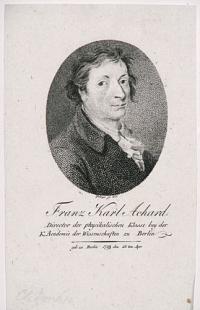
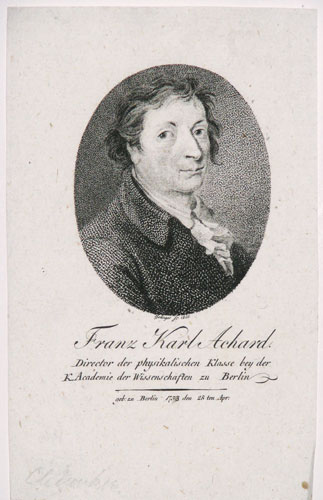
Franz Karl Achard. Director der physikalischen Klasse bey der K. Academie der Wissenschaften zu Berlin. geb: zu Berlin 1753 den 28 ten Apr:
Bollinger Sc. 1800.
Stipple. 145 x 90mm (5¾ x 3½").
Franz Karl Achard (1753-1821) was a German chemist, physicist and biologist. His principal discovery was the production of sugar from sugar beets. He was favoured by King Frederck II of Prussia, and thus had to report twice a week on his research and any new developments. In 1776 he was elected to the Royal Academy of Sciences at Berlin.
[Ref: 16199] £130.00
(£156.00 incl.VAT)
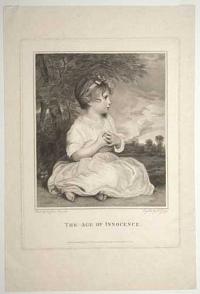
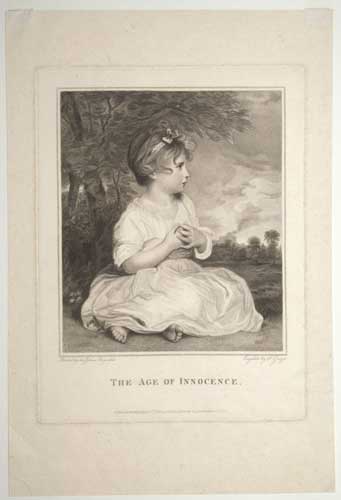
The Age of Innocence.
Painted by Sir Joshua Reyolds Engrv'd by J Grozer.
London, Published Feb.y 10th 1788 by W. Dickinson Engraver Bond Street.
Stipple with etching. 280 x 215mm (11 x 8½"), very large margins.
A bare-footed young girl sitting under a tree, hands together on her chest, staring to the right, after a painting in the Tate since 1847 (N00307). The Tate records that ''it is very probably identifiable with a work exhibited by Reynolds at the Royal Academy in 1785, and entitled simply 'a little girl''' and that Sir Robert Edgcumbe, a Victorian descendant of Reynolds, identified her as the artist's great-niece Theophila Gwatkin (1782-1844). Hamilton: pg. 141. Ex: Oettingen-Wallerstein collection. Sotheby's London / Milan Nov 1997.
[Ref: 60317] £280.00
(£336.00 incl.VAT)
![[King Ahasuerus & Queen Esther]](img-thumbnail/jpegs/44148.jpg)
[King Ahasuerus & Queen Esther]
Guercino inv. Bartolozzi Sculp. [c.1790]
Etching printed in brown ink, platemark 235 x 310mm (9¼ x 12¼"), with very large margins.
Two of the main personalities in the Book of Esther, one of the books of the Ketuvim ('Writings') of the Tanakh (the Hebrew Bible) and of the Historical Books of the Old Testament. Etching after a drawing by Guercino, by Francesco Bartolozzi (1725-1815), Florentine engraver and founding member of the Royal Academy in 1768. After meeting George III's librarian Richard Dalton in Italy in 1763, Dalton invited Bartolozzi to London with a promise of an appointment as engraver to the king. In England he became the most celebrated exponent of the 'stipple' technique whereby he produced prints using dots rather than lines. From a portfolio of eighty-two prints by Bartolozzi after drawings by Guercino in the Royal Collection. Calabi and De Vesme 2143; for later state see ref. 21218.
[Ref: 44148] £160.00
(£192.00 incl.VAT)
![[L'Allegro]](img-thumbnail/jpegs/35900.jpg)
[L'Allegro]
Tho.s Creswick
[Published for the Etching Club by Joseph Cundall, 12, Old Bond Street, 1849]
Etching on india, letterpress printed in red, sheet 150 x 165mm (6 x 6½"). Trimmed.
Scene illustrating John Milton's poem 'L'Allegro' by landscape painter Thomas Creswick (1811-69). From an edition of the poem (which had long been a popular subject for visual artists) with twenty illustrations by members of the Etching Club, published in 1849. Creswick exhibited prolifically and successfully at the Royal Academy throughout his career (he became an R.A. in 1851) and his etchings 'demonstrate a sure grasp of the technique and conventions of etching (DNB). Ray 217
[Ref: 35900] £75.00
(£90.00 incl.VAT)
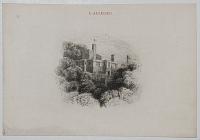
L'Allegro Towers + Battlements it sees [ms]
[by Thomas Creswick]
[Published for the Etching Club by Joseph Cundall, 12, Old Bond Street, 1849]
Etching on india, letterpress printed in red, sheet 110 x 165mm (4¼ x 6¼"). Trimmed; very slight foxing.
Scene illustrating John Milton's poem 'L'Allegro', by landscape painter Thomas Creswick (1811-69). From an edition of the poem with twenty illustrations by members of the Etching Club published in 1849. Creswick exhibited prolifically and successfully at the Royal Academy throughout his career (he became an R.A. in 1851) and his etchings 'demonstrate a sure grasp of the technique and conventions of etching (DNB). Ray 217
[Ref: 35897] £75.00
(£90.00 incl.VAT)
![[L'Allegro]](img-thumbnail/jpegs/35898.jpg)
[L'Allegro] Tower'd cities please us then [ms]
[by Thomas Creswick]
[Published for the Etching Club by Joseph Cundall, 12, Old Bond Street, 1849]
Etching on india, letterpress printed in red, sheet 110 x 165mm (4¼ x 6¼"). Trimmed; slightly dusty.
Scene illustrating John Milton's poem 'L'Allegro' by landscape painter Thomas Creswick (1811-69). From an edition of the poem (which had long been a popular subject for visual artists) with twenty illustrations by members of the Etching Club, published in 1849. Creswick exhibited prolifically and successfully at the Royal Academy throughout his career (he became an R.A. in 1851) and his etchings 'demonstrate a sure grasp of the technique and conventions of etching (DNB). Ray 217
[Ref: 35898] £75.00
(£90.00 incl.VAT)
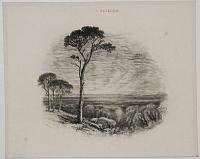
L'Allegro
T. Creswick
[Published for the Etching Club by Joseph Cundall, 12, Old Bond Street, 1849]
Etching on india, letterpress printed in red, sheet 135 x 165mm (6½ x 6¼"). Trimmed.
Scene illustrating John Milton's poem 'L'Allegro' by landscape painter Thomas Creswick (1811-69). From an edition of the poem (which had long been a popular subject for visual artists) with twenty illustrations by members of the Etching Club, published in 1849. Creswick exhibited prolifically and successfully at the Royal Academy throughout his career (he became an R.A. in 1851) and his etchings 'demonstrate a sure grasp of the technique and conventions of etching (DNB). Ray 217
[Ref: 35899] £75.00
(£90.00 incl.VAT)
![[Lawrence Alma-Tadema, R.A., in his studio]](img-thumbnail/jpegs/36360.jpg)
[Lawrence Alma-Tadema, R.A., in his studio]
[T.L. Atkinson after John Collyer, pencil signatures]
[Published by T.H. Lefèvre, June 1 1885]
Mezzotint on india, very large margins; platemark 550 x 420mm (21½ x 16½"). Printsellers' Association blindstamp. Very scarce.
Lawrence Alma-Tadema (1836-1912), London painter of Greek and Roman settings, etcher, stage designer and decorative artist was born in January 1836. Shown in his studio holding palette and brushes, an unfinished canvas behind him. After training in Antwerp, Alma-Tadema moved to London in 1870 and became a member of the Royal Academy in 1879. He was knighted in 1899. After the portrait by John Collier (1850-1934), portrait painter who received guidance and encouragement from Alma-Tadema as a young artist. The print was originally sold as a companion to a portrait of another 19th century artist, Rosa Bonheur. PSA limited to 275 artist's proofs (plate destroyed); ex: collection of the Late Hon C. Lennox-Boyd.
[Ref: 36360] £520.00
![Alsatian [pencil]](img-thumbnail/jpegs/4784.jpg)
Alsatian [pencil]
H.Rayner.
[n.d., c.1939]
Drypoint etching, signed in pencil. 180 x 140mm.
Limited to 15 impressions, 'Exhibited London 1939' [pencil] Rayner (1902-1957) worked in the Antipodes before studying at the Royal Academy. He was a friend of Sickert.
[Ref: 4784] £160.00
(£192.00 incl.VAT)
![[Christoph Friedrich von Ammon]](img-thumbnail/jpegs/35844.jpg)
[Christoph Friedrich von Ammon]
F. Bartolozzi R.A. fecit
London Published as the Act directs Nov.12 1791
Stipple printed in brown, sheet 180 x 130mm (5 x 7"). Trimmed to platemark. Rare.
Christoph Friedrich von Ammon (1877-1850), German theological writer and preacher. Engraved by Francesco Bartlozzi (1725-1815), Florentine engraver elected a founding member of the Royal Academy in 1768 (the RA did not admit engravers at this time but made an exception in his case). He was already hailed as the best engraver in Italy when he met George III's librarian Richard Dalton in 1763. Dalton invited Bartolozzi to London with a promise of an appointment as engraver to the king. In England he became the most celebrated exponent of the 'stipple' technique whereby he produced prints using dots rather than lines. In 1801 Bartolozzi was invited to Lisbon to reform the royal printing press, and he spent his final years in Portugal. This portrait was published after Bartolozzi had left England for the continent. Not in De Vesme.
[Ref: 35844] £160.00
(£192.00 incl.VAT)
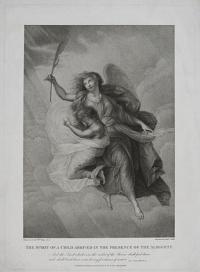
The Spirit of A Child Arrived In The Presence Of The Almighty. And the Lamb which is in the midst of the Throne shall feed them/ and shall lead them unto living fountains of waters Rev. Chap. VII. Ver: 17.
Painted by the Revd. Wm. Peters R.A. Engraved by Benjn. Smith.
London. Publishd by Boydell & Co. Cheapside [n.d., c.1800].
Stipple and etching, 440 x 315mm (17¼ x 12½"). Slightly soiled; water stain to upper right, crease through lower left..
An angel, clothed in swirling draperies with a palm in its right hand, ascends upwards with a child at its side. After Rev Matthew William Peters (1742 - 1814), partner to 'Of such is the kingdom of God'. The artist is Matthew William Peters (1742-1814), most famous for his provocative painting of a courtesan (known as 'Lydia' in the mezzotint copy). He came to regret his choice of subject, as he was ordained in 1781, becoming the Royal Academy's chaplain (1784-8), then chaplain to the Prince of Wales. For a coloured impression see ref. 27565; Lady Victoria Manners' 'Matthew William Peters, R.A.' p.65
[Ref: 10375] £140.00
(£168.00 incl.VAT)
![Miraculous Escape of S.r Brook Watson. [&]](img-thumbnail/jpegs/49584.jpg)
Miraculous Escape of S.r Brook Watson. [&] Extraordinary Voracity of an Alligator.
[n.d., c.1820.]
Engraving. Sheet: 210 x 130mm (8¼ x 5'').
Two scenes showing men being rescued from animal attacks. The top scene shows the rescue of Sir Brook Watson (1735-1807) from a shark in Havana Harbour as a 14 year old boy. The scene was painted by John Singleton Copley and exhibited at the Royal Academy in 1778 where it caused a sensation. The second image shows an man being pulled onto a boat after being attacked by an alligator.
[Ref: 49584] £90.00
(£108.00 incl.VAT)
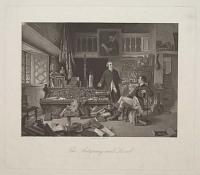
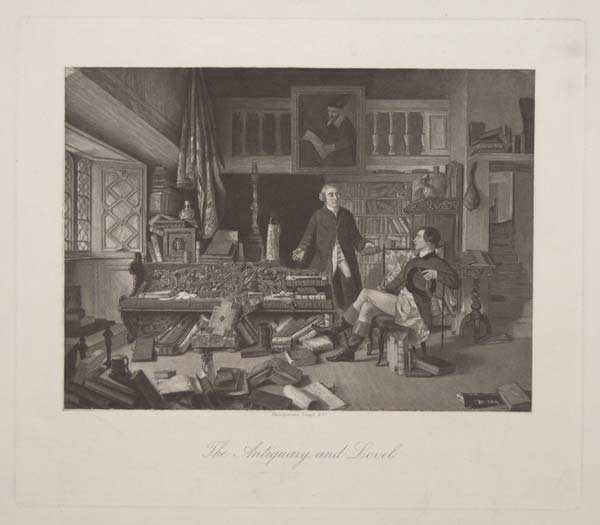
The Antiquary and Lovel.
Photogravure Goupil & C.o
Edinburgh, 1885.
Photogravure. 205 x 240mm (8 x 9½"), with wide margins. Small tears along the top and left edges.
A scene depicting two well dressed men in a study surrounded by a careless pile of books. This print is from a series of eight published in a book by Sir William Fettes Douglas (1822-1891). The Scottish painter was appointed to Director of the National Galleries of Scotland in 1877 and in 1882 became the president of the Royal Scottish Academy. The book was published for the Royal Association for Promotion of the Fine Arts in Scotland. Douglas himself was an antiquary and bibliophile as well as having an interest in astrology and alchemy.
[Ref: 53886] £85.00
(£102.00 incl.VAT)
![Apparent Dissolution. [&] Returning Animation.](img-thumbnail/jpegs/27130.jpg)
Apparent Dissolution. [&] Returning Animation.
E. Penny Pinxit. W.m Sedgewick, Sculpsit.
Publish'd Sep.r 10th 1784, by John Boydell, Engraver in Cheapside, London.
Pair of stipple engravings, with large margins. Each c. 355 x 280mm, 14 x 11".
A woman faints on seeing her apparently-lifeless husband in the fields; when he revives she clasps her hands in prayer. Pair of stipples after Edward Penny (1714-91), a founder member of the Royal Academy. ex: Oettingen-Wallerstein Collection.
[Ref: 27130] £420.00
view all images for this item
![[An Arab and his camel in the desert.]](img-thumbnail/jpegs/64345.jpg)
[An Arab and his camel in the desert.]
[Edward Julius Detmold.]
[n.d., c.1925.]
Etching. 205 x 430mm (8 x 17"). Platemark cracked, reinforced on reverse.
An Arab stands before this camel, rifle over his shoulder, looking down at something coming out of the ground. Edward Julius Detmold (1883-1957) began etching with his twin, Maurice, and exhibited at The Royal Academy aged 13. In 1908 Maurice committed suicide and Edward, traumatised, stopped etching. In 1922 an appreciative article about the Detmolds in the Print Collector's Quarterly inspiring Edward to return to printmaking. An edition of 'The Arabian Nights' illustrated by Detmold was published in 1924. See V&A SP.215 for a reversed colour etching of the same subject.
[Ref: 64345] £260.00
(£312.00 incl.VAT)
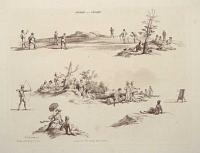
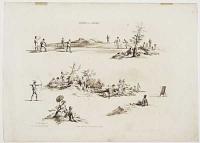
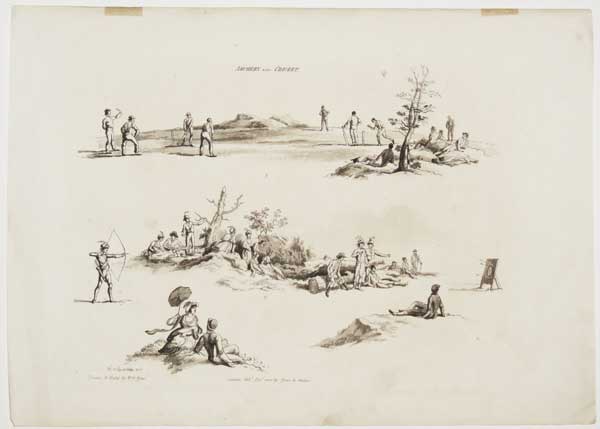
Archery and Cricket.
Drawn & Etch'd by W.H. Pyne.
Pub. by Pyne & Nattes 1805. London, Pub.d Oct.r 1805 by Pyne & Nattes.
Aquatint. 230 x 305mm (9 x 12") very large margins.
From Pyne's ‘Microcosm: or, a picturesque delineation of the arts, agriculture, manufacturers, &c. of Great Britain…'. William Henry Pyne was an English writer, painter and illustrator. He trained at a drawing academy in London. He first exhibited at the Royal Academy in 1790. He specialized in picturesque settings including groups of people rendered in pen, ink and watercolour. Pyne was one of the founders of Royal Watercolour Society in 1804.
[Ref: 62454] £180.00
(£216.00 incl.VAT)
Archery and Cricket.
Drawn & Etch'd by W.H. Pyne.
Pub. by Pyne & Nattes 1805. London, Pub.d Oct.r 1805 by Pyne & Nattes.
Aquatint. 228 x 305mm (9 x 12"). Very slight crease.
From Pyne's ‘Microcosm: or, a picturesque delineation of the arts, agriculture, manufacturers, &c. of Great Britain…'. William Henry Pyne was an English writer, painter and illustrator. He trained at a drawing academy in London. He first exhibited at the Royal Academy in 1790. He specialized in picturesque settings including groups of people rendered in pen, ink and watercolour. Pyne was one of the founders of Royal Watercolour Society in 1804.
[Ref: 24934] £180.00
(£216.00 incl.VAT)

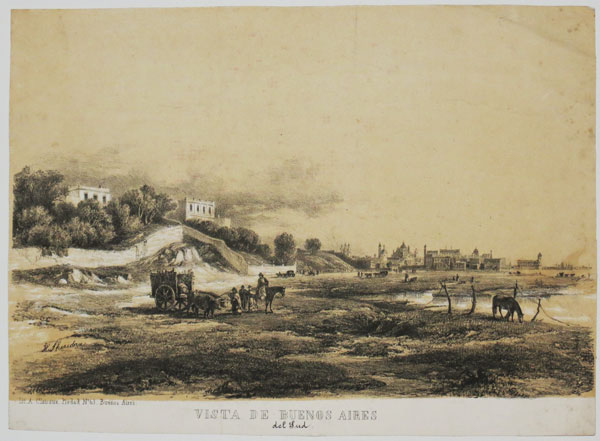
Vista de Buenos Aires del Sud.
H. Sheridan. Lit. A. Claireaux. Piedad No 63, Buenos Aires.
[n.d., c.1860.]
Scarce tinted lithograph. Sheet 220 x 305mm (8¾ x 12"). Trimmed, creasing and spotting.
A view of the south edge of Buenos Aires by Enrique (Henry) Sheridan. The son of Irish immigrants, he was born on his parent's ranch in 1833, but was sent back to England two years later to be educated. In 1857 he exhibited a painting at the Royal Academy, and returned to Argentina later in the year. In 1858 he exhibited paintings alongside Léon Pallière, during a time the art market in Argentina favoured European scenery rather than local, making this scene more unusual. He died young, in 1860.
[Ref: 52042] £230.00
(£276.00 incl.VAT)
![Loch Fyne Argylshire - 1855. [ink outside image.]](img-thumbnail/jpegs/19635.jpg)
Loch Fyne Argylshire - 1855. [ink outside image.] 1814 - John Henry Mole - 1886. [ink outside image.]
J.H. Mole 1855. [In ink underneath:] J.H. Mole. V.P.R.I. 1855.
Fine coloured lithograph. Image 405 x 610mm. 16 x 24".
Loch Fyne is notable for its oyster fishery, and its herring fishing industry. Here a lady returns with some herring, caught by the man who stands in his boat to the right; a small girl and child walk out of a thatched cottage to greet the woman. John Henry Mole (1814-1886) was a landscape and figure painter in oil and watercolour. He exhibited at Newcastle, the Royal Academy, the Suffolk Street Gallery, the Grosvenor and other London galleries.
[Ref: 19635] £320.00

Attilius Ariosti Bononiensis.
E. Seeman Jun.r pinx. ISimon fecit 1719.
Scarce mezzotint. 355 x 255mm (14 x 10"). Trimmed to plate. Creasing.
A three-quarter portrait of composer Attilio Ariosti (1666-1729), seated with his elbow resting on a harpsichord and his left hand on a viola d'amore. Ariosti was born in Bologna, but worked all over Europe, including Berlin, Venice, Paris & London, where he shared the directorship of the Royal Academy of Music with Handel and Bononcini. This portrait stresses that his favorite instrument was the viola d'amore. CS 18. Ex: collection of The Hon. Christopher Lennox-Boyd.
[Ref: 67446] £380.00
![[Attention]](img-thumbnail/jpegs/36633.jpg)
[Attention]
G.B. Cipriani inv. F. Bartolozzi Sculp.
[London Publish'd March 6th. 1782 by Sus. Vivares]
Stipple printed in colours, sheet 125 x 90mm (5 x 3½"). Trimmed inside platemark, possibly losing text.
Attention: woman sat at desk, writing. Engraved by Francesco Bartolozzi (1725-1815), Florentine engraver and founding member of the Royal Academy in 1768. After meeting George III's librarian Richard Dalton in Italy in 1763, Dalton invited Bartolozzi to London with a promise of an appointment as engraver to the king. In England he became the most celebrated exponent of the 'stipple' technique whereby he produced prints using dots rather than lines. This is the medium employed here, one of many prints he made from designs by his fellow Italian, G.B. Cipriani. De Vesme 575 iii[?]/v
[Ref: 36633] £130.00
(£156.00 incl.VAT)
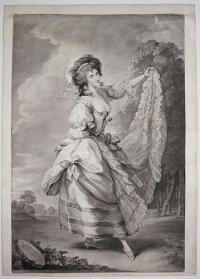
Signora Baccelli.
Painted by T. Gainsborough R.A. Engraved by John Jones.
London Pub.d Feb.y 5th 1784 by J. Jones No. 63 Great Portland Street Marylebone.
Rare mezzotint. 535 x 350mm (21 x 13¾"), with largemargins on three sides. Slight mark centre top. Top area slightly rubbed.
Giovanna Baccelli (1774, fl.- d.1801), dancer. Baccelli, first appeared at the King's Theatre, Haymarket in 1774. She reached the peak of her career during the 1780-1 season when she appeared with Gaetan Vestris and his son Auguste in several important ballets devised by Noverre. She also danced in Venice in 1783-4, and at the Paris Opéra as late as 1788. Baccelli was equally known as a mistress of John Frederick Sackville, 3rd Duke of Dorset (1745-99), who had set up Baccelli in a suite of rooms at Knole by October 1779. Baccelli accompanied him to Paris in 1783 when he was appointed Ambassador to France. They entertained lavishly, patronising the Paris Opéra, and were admitted to the friendship of Queen Marie-Antoinette. Horace Walpole records that when the Duke was awarded the Order of the Garter in 1788, Baccelli danced at the Opéra wearing the blue Garter ribbon around her head. As the events of the French Revolution unfolded, the pair returned to Knole, where Baccelli remained until their amicable parting in 1789. Engraved by John Jones after the portrait by Thomas Gainsborough (exhibited 1782) which hangs in Tate Britain. Gainsborough was well-acquainted with many theatre people, including Richard Brinsley Sheridan, the famous dramatist and part-owner of the King's Theatre. When this portrait was exhibited at the Royal Academy in 1782, Gainsborough's portrait of the Duke of Dorset was withdrawn, presumably for reasons of decorum. As well as commissioning this portrait, the Duke also patronised Gainsborough's great rival Joshua Reynolds, who painted Baccelli in 1783. Horne: 7 II of III; CS 3 II of III.
[Ref: 47602] £1,500.00

John Bacon Esq. R.A.
Published by J.Sewell, Cornhill, 1 Sep. 1790.
Engraving, 120 x 185mm (4¾ x 7¼"). Foxing; torn along left side of platemark
Portrait from the 'European Magazine', of John Bacon (1740-1799), sculptor. Born in Southwark, Bacon was apprenticed to a porcelain manufacturer before becoming a sculptor. He won the first gold medal awarded for sculpture by the Royal Academy of Arts in 1769 and was later engaged to execute a bust of King George III. His work can be seen in St. Paul's Cathedral, Westminster Abbey, Christ Church and Pembroke College, Oxford, and Bristol Cathedral.
[Ref: 8781] £65.00
(£78.00 incl.VAT)

John Bacon Esq.r R.A.
Painted by I. Russell R.A. Crayong Painter to His Majesty. Engraved by I. Collyer A.R.A. Engraver to Her Majesty.
[n.d. c.1815.]
Engraving on india. Plate 202 x 127mm. 8 x 5".
John Bacon the Elder (1740-1799), was a sculptor, responsible for some important monuments, and a variety of statues in London and elsewhere. He was born in Southwark, son of a clothworker, learnt modelling under a porcelain maker in Lambeth, and by 1867 had become a modeller for Mrs Coade's Lambeth factory, while studying at the Royal Academy Schools. He later also worked for Wedgewood. He was elected an Associate of the Royal Academy in 1770, and full Academician in 1777, and it was from around this time that he began to win major commissions for sculptural works, including in 1779 the monument to Chatham in Westminster Abbey. NPG: D16070.
[Ref: 18954] £65.00
(£78.00 incl.VAT)
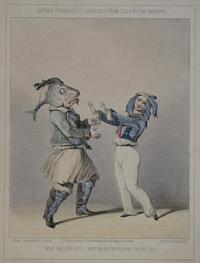
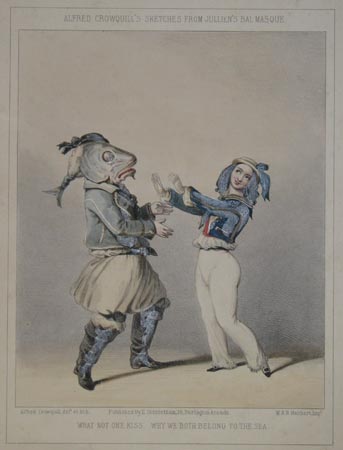
Alfred Crowquill's Sketches From Jullien's Bal Masque. What Not One Kiss. Why We Both Belong To The Sea.
Alfred Crowquill, delt. et lith. M & N. Hanhart, Impt.
Published by E. Sidebetham, 38, Burlington Arcade [n.d., c.1850].
Coloured lithograph, sheet 384 x 281mm. Light foxing to margins.
Illustrations to Jullien's Bal Masque quadrille, by Alfred Henry Forrester, best known under the name of Alfred Crowquill (1804 - 1872). Louis Antoine Jullien (1812 -1860) conducted a series of winter season promenade concerts at the Covent Garden Theatre, which were highly successful; and on March 4th, 1844, the first bal-masqué given in England in the 19th century took place at Covent Garden under his auspices. In 1822 Forrester wrote for the Hive and in 1823 for the Mirror. He next applied himself to the study of drawing and modelling, as well as to wood and steel engraving. He was also the writer of burlesques, drew pantomimic extravaganzas for the pictorial papers, and exhibited pen-and-ink sketches in the miniature room of the Royal Academy in 1845 and 1846. For a time he contributed sketches to ‘Punch,' where his work will be found in vols. ii. iii. and iv., and then went over to the ‘Illustrated London News' as a member of the literary and pictorial staff. As a writer and illustrator of his own writings he was very popular; upwards of twenty works came from his pen, many of them being children's books. For some years the London pantomimes were indebted to him for designs, devices, and effects. In 1851 he modelled a statuette of the Duke of Wellington, which he produced a fortnight before the duke's death and presented to Queen Victoria and the allied sovereigns. At the time when he originally started as an artist there was not much competition, and he consequently found constant work. His works have enjoyed a considerable amount of popularity. Ex: Collection of Alec Clunes.
[Ref: 7812] £230.00
(£276.00 incl.VAT)

Alfred Crowquill's Sketches From Jullien's Bal Masque. The Lion & The Lamb. Perhaps You'd Like To Take The Lady From Me Sir?
Alfred Crowquill, delt. et lith. M & N. Hanhart, Impt.
Published by E. Sidebetham, 38, Burlington Arcade [n.d., c.1850].
Coloured lithograph, sheet 380 x 280mm. Light foxing to margins, some spotting to image.
Illustrations to Jullien's Bal Masque quadrille, by Alfred Henry Forrester, best known under the name of Alfred Crowquill (1804 - 1872). Louis Antoine Jullien (1812 -1860) conducted a series of winter season promenade concerts at the Covent Garden Theatre, which were highly successful; and on March 4th, 1844, the first bal-masqué given in England in the 19th century took place at Covent Garden under his auspices. In 1822 Forrester wrote for the Hive and in 1823 for the Mirror. He next applied himself to the study of drawing and modelling, as well as to wood and steel engraving. He was also the writer of burlesques, drew pantomimic extravaganzas for the pictorial papers, and exhibited pen-and-ink sketches in the miniature room of the Royal Academy in 1845 and 1846. For a time he contributed sketches to ‘Punch,' where his work will be found in vols. ii. iii. and iv., and then went over to the ‘Illustrated London News' as a member of the literary and pictorial staff. As a writer and illustrator of his own writings he was very popular; upwards of twenty works came from his pen, many of them being children's books. For some years the London pantomimes were indebted to him for designs, devices, and effects. In 1851 he modelled a statuette of the Duke of Wellington, which he produced a fortnight before the duke's death and presented to Queen Victoria and the allied sovereigns. At the time when he originally started as an artist there was not much competition, and he consequently found constant work. His works have enjoyed a considerable amount of popularity. Ex: Collection of Alec Clunes.
[Ref: 7818] £230.00
(£276.00 incl.VAT)
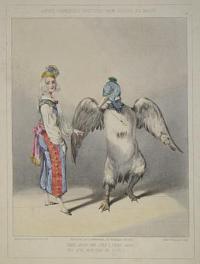
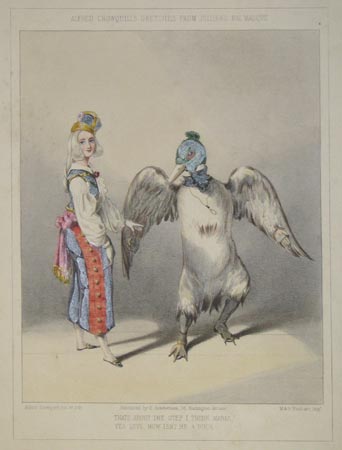
Alfred Crowquill's Sketches From Jullien's Bal Masque. That's About The Step I Think Maria? Yes Love, Now Isn't He A Duck!
Alfred Crowquill, delt. et lith. M & N. Hanhart, Impt.
Published by E. Sidebetham, 38, Burlington Arcade [n.d., c.1850].
Coloured lithograph, sheet 379 x 279mm. Light foxing to margins.
Illustrations to Jullien's Bal Masque quadrille, by Alfred Henry Forrester, best known under the name of Alfred Crowquill (1804 - 1872). Louis Antoine Jullien (1812 -1860) conducted a series of winter season promenade concerts at the Covent Garden Theatre, which were highly successful; and on March 4th, 1844, the first bal-masqué given in England in the 19th century took place at Covent Garden under his auspices. In 1822 Forrester wrote for the Hive and in 1823 for the Mirror. He next applied himself to the study of drawing and modelling, as well as to wood and steel engraving. He was also the writer of burlesques, drew pantomimic extravaganzas for the pictorial papers, and exhibited pen-and-ink sketches in the miniature room of the Royal Academy in 1845 and 1846. For a time he contributed sketches to ‘Punch,' where his work will be found in vols. ii. iii. and iv., and then went over to the ‘Illustrated London News' as a member of the literary and pictorial staff. As a writer and illustrator of his own writings he was very popular; upwards of twenty works came from his pen, many of them being children's books. For some years the London pantomimes were indebted to him for designs, devices, and effects. In 1851 he modelled a statuette of the Duke of Wellington, which he produced a fortnight before the duke's death and presented to Queen Victoria and the allied sovereigns. At the time when he originally started as an artist there was not much competition, and he consequently found constant work. His works have enjoyed a considerable amount of popularity. Ex: Collection of Alec Clunes.
[Ref: 7813] £230.00
(£276.00 incl.VAT)
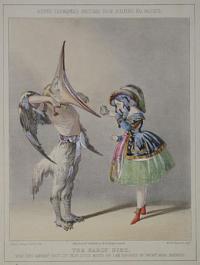
Alfred Crowquill's Sketches From Jullien's Bal Masque. The Early Bird. What Tired Already? Shut Its Dear Little Mouth, For I Am Engaged By Twenty More Partners!
Alfred Crowquill, delt. et lith. M & N. Hanhart, Impt.
Published by E. Sidebetham, 38, Burlington Arcade [n.d., c.1850].
Coloured lithograph, sheet 381 x 279mm. Light foxing to margins.
Illustrations to Jullien's Bal Masque quadrille, by Alfred Henry Forrester, best known under the name of Alfred Crowquill (1804 - 1872). Louis Antoine Jullien (1812 -1860) conducted a series of winter season promenade concerts at the Covent Garden Theatre, which were highly successful; and on March 4th, 1844, the first bal-masqué given in England in the 19th century took place at Covent Garden under his auspices. In 1822 Forrester wrote for the Hive and in 1823 for the Mirror. He next applied himself to the study of drawing and modelling, as well as to wood and steel engraving. He was also the writer of burlesques, drew pantomimic extravaganzas for the pictorial papers, and exhibited pen-and-ink sketches in the miniature room of the Royal Academy in 1845 and 1846. For a time he contributed sketches to ‘Punch,' where his work will be found in vols. ii. iii. and iv., and then went over to the ‘Illustrated London News' as a member of the literary and pictorial staff. As a writer and illustrator of his own writings he was very popular; upwards of twenty works came from his pen, many of them being children's books. For some years the London pantomimes were indebted to him for designs, devices, and effects. In 1851 he modelled a statuette of the Duke of Wellington, which he produced a fortnight before the duke's death and presented to Queen Victoria and the allied sovereigns. At the time when he originally started as an artist there was not much competition, and he consequently found constant work. His works have enjoyed a considerable amount of popularity. Ex: Collection of Alec Clunes.
[Ref: 7814] £260.00
(£312.00 incl.VAT)
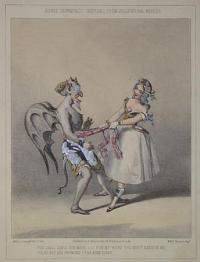
Alfred Crowquill's Sketches From Jullien's Bal Masque. You Shall Dance One More __ Pon My Word You Must Excuse Me Ive. No Key And Promised To Be Home Early.
Alfred Crowquill, delt. et lith. M & N. Hanhart, Impt.
Published by E. Sidebetham, 38, Burlington Arcade [n.d., c.1850].
Coloured lithograph, sheet 378 x 279mm. Light foxing to margins.
Illustrations to Jullien's Bal Masque quadrille, by Alfred Henry Forrester, best known under the name of Alfred Crowquill (1804 - 1872). Louis Antoine Jullien (1812 -1860) conducted a series of winter season promenade concerts at the Covent Garden Theatre, which were highly successful; and on March 4th, 1844, the first bal-masqué given in England in the 19th century took place at Covent Garden under his auspices. In 1822 Forrester wrote for the Hive and in 1823 for the Mirror. He next applied himself to the study of drawing and modelling, as well as to wood and steel engraving. He was also the writer of burlesques, drew pantomimic extravaganzas for the pictorial papers, and exhibited pen-and-ink sketches in the miniature room of the Royal Academy in 1845 and 1846. For a time he contributed sketches to ‘Punch,' where his work will be found in vols. ii. iii. and iv., and then went over to the ‘Illustrated London News' as a member of the literary and pictorial staff. As a writer and illustrator of his own writings he was very popular; upwards of twenty works came from his pen, many of them being children's books. For some years the London pantomimes were indebted to him for designs, devices, and effects. In 1851 he modelled a statuette of the Duke of Wellington, which he produced a fortnight before the duke's death and presented to Queen Victoria and the allied sovereigns. At the time when he originally started as an artist there was not much competition, and he consequently found constant work. His works have enjoyed a considerable amount of popularity. Ex: Collection of Alec Clunes.
[Ref: 7815] £260.00
(£312.00 incl.VAT)
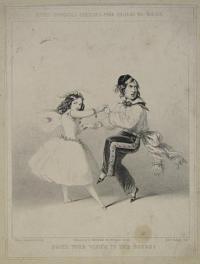
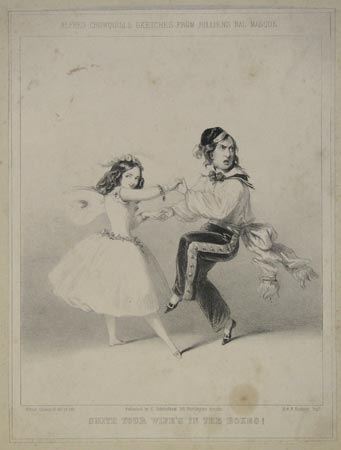
Alfred Crowquill's Sketches From Jullien's Bal Masque. Smith Your Wife's In The Boxes!
Alfred Crowquill, delt. et lith. M & N. Hanhart, Impt.
Published by E. Sidebetham, 38, Burlington Arcade [n.d., c.1850].
Lithograph, sheet 266 x 203mm. Foxing and staining, trimmed to printed border.
Illustrations to Jullien's Bal Masque quadrille, by Alfred Henry Forrester, best known under the name of Alfred Crowquill (1804 - 1872). Louis Antoine Jullien (1812 -1860) conducted a series of winter season promenade concerts at the Covent Garden Theatre, which were highly successful; and on March 4th, 1844, the first bal-masqué given in England in the 19th century took place at Covent Garden under his auspices. In 1822 Forrester wrote for the Hive and in 1823 for the Mirror. He next applied himself to the study of drawing and modelling, as well as to wood and steel engraving. He was also the writer of burlesques, drew pantomimic extravaganzas for the pictorial papers, and exhibited pen-and-ink sketches in the miniature room of the Royal Academy in 1845 and 1846. For a time he contributed sketches to ‘Punch,' where his work will be found in vols. ii. iii. and iv., and then went over to the ‘Illustrated London News' as a member of the literary and pictorial staff. As a writer and illustrator of his own writings he was very popular; upwards of twenty works came from his pen, many of them being children's books. For some years the London pantomimes were indebted to him for designs, devices, and effects. In 1851 he modelled a statuette of the Duke of Wellington, which he produced a fortnight before the duke's death and presented to Queen Victoria and the allied sovereigns. At the time when he originally started as an artist there was not much competition, and he consequently found constant work. His works have enjoyed a considerable amount of popularity. Ex: Collection of Alec Clunes.
[Ref: 7819] £90.00
(£108.00 incl.VAT)

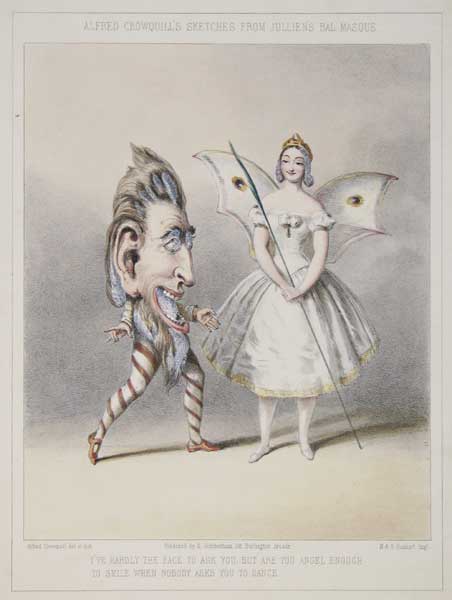
Alfred Crowquill's Sketches From Jullien's Bal Masque. I've Hardly The Face To Ask You: But Are You Angel Enough. To Smile When Nobody Asks You To Dance.
Alfred Crowquill, delt. et lith. M & N. Hanhart, Impt.
Published by E. Sidebetham, 38, Burlington Arcade [n.d., c.1850].
Coloured lithograph, sheet 379 x 279mm. Light foxing to margins.
Illustrations to Jullien's Bal Masque quadrille, by Alfred Henry Forrester, best known under the name of Alfred Crowquill (1804 - 1872). Louis Antoine Jullien (1812 -1860) conducted a series of winter season promenade concerts at the Covent Garden Theatre, which were highly successful; and on March 4th, 1844, the first bal-masqué given in England in the 19th century took place at Covent Garden under his auspices. In 1822 Forrester wrote for the Hive and in 1823 for the Mirror. He next applied himself to the study of drawing and modelling, as well as to wood and steel engraving. He was also the writer of burlesques, drew pantomimic extravaganzas for the pictorial papers, and exhibited pen-and-ink sketches in the miniature room of the Royal Academy in 1845 and 1846. For a time he contributed sketches to ‘Punch,' where his work will be found in vols. ii. iii. and iv., and then went over to the ‘Illustrated London News' as a member of the literary and pictorial staff. As a writer and illustrator of his own writings he was very popular; upwards of twenty works came from his pen, many of them being children's books. For some years the London pantomimes were indebted to him for designs, devices, and effects. In 1851 he modelled a statuette of the Duke of Wellington, which he produced a fortnight before the duke's death and presented to Queen Victoria and the allied sovereigns. At the time when he originally started as an artist there was not much competition, and he consequently found constant work. His works have enjoyed a considerable amount of popularity. Ex: Collection of Alec Clunes.
[Ref: 7816] £230.00
(£276.00 incl.VAT)
![[Bamburgh Castle.]](img-thumbnail/jpegs/14883.jpg)
[Bamburgh Castle.]
Marion Rhodes [pencil signature outside image.]
[n.d. c.1920.]
Etching. 298 x 468mm (11¾ x 18½").
Marion Rhodes, English artist. (1907 - 1998). Rhodes studied at Huddersfield School of Art, Leeds School of Art (1925-1929) and the Central School of Art and Design, London (1934-39). She taught art before moving to London. Rhodes went on to teach in the city and in the south of England for most of her life though she exhibited her etchings and drawings at the Royal Academy, the Royal Scottish Academy and the Paris Salon.
[Ref: 14883] £140.00
(£168.00 incl.VAT)

The Right Hon: Sir Joseph Banks, Bart. K.B. President of the Royal Society. From an original Picture by T. Lawrence, Esq. R.A. in the Possession of Samuel Lysons, Esq.
Drawn by W. Evans. Engraved by A. Cardon.
Published Jan. 1 1810, by T. Cadell & W. Davies, Strand, London.
Stipple. 395 x 305mm (15½ x 12"). Trimmed to plate on right. Bit dusty.
A portrait of Sir Joseph Banks (1743-1820) after Sir Thomas Lawrence (1769-1830), seated with left arm resting on a volume labelled 'Royal Society', to which he was elected in 1766. Banks, a botanist, naturalist and patron of the natural sciences, took part in Captain James Cook's first Circumnavigation (1768-71). He was the leading founder of the African Association, the British organization dedicated to the exploration of Africa, and a member of the Society of Dilettanti, which helped to establish the Royal Academy.
[Ref: 63180] £190.00
(£228.00 incl.VAT)

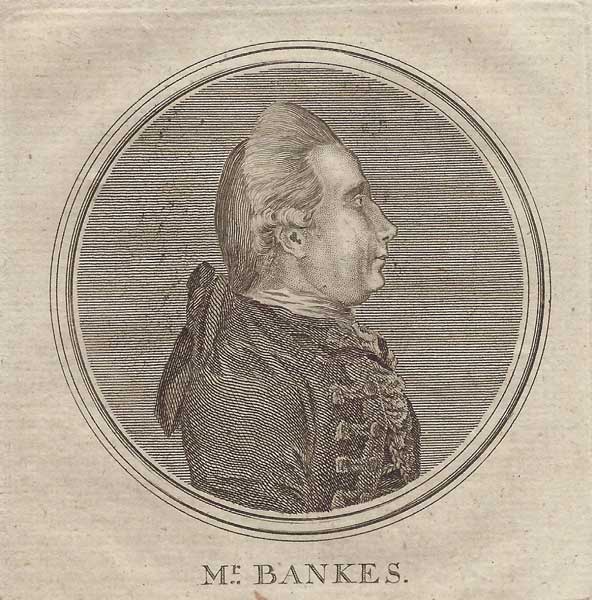
Mr.Bankes. [Sir Joseph Banks.]
[n.d., c.1780.]
Engraving. 100 x 100mm (4 x 4").
Portrait of Sir Joseph Banks (1743 - 1820), botanist and explorer. Banks was a patron of the natural sciences and made his name on the 1766 natural-history expedition to Newfoundland and Labrador. He took part in Captain James Cook's first great voyage (1768 - 1771), visiting Brazil, Tahiti, and after 6 months in New Zealand, Australia, returning to immediate fame. Banks actively promoted British settlement in New South Wales and supported the broader colonisation of Australia. He also endorsed the establishment of Botany Bay as a penal settlement for the transportation of convicts and served as a principal adviser to the British government on matters relating to Australia. He is credited with introducing eucalyptus, acacia, and the genus later named in his honour, Banksia, to the Western world. Approximately eighty plant species bear his name in recognition of his contributions to botany. In addition, he was a principal founder of the African Association and a member of the Society of Dilettanti, which played a significant role in the establishment of the Royal Academy. Author of 'Modern, authentic and com[plete] system of universal geography. Including all the late important discoveries made by the English, and other celebrated. Navigators of various nations, in the different hemispheres; and containing a genuine history and des', 1790. W164-6. Kivell & Spence page 20.
[Ref: 68300] £160.00
(£192.00 incl.VAT)
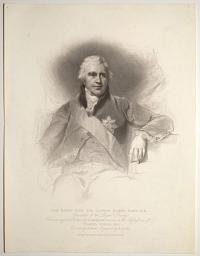
The Right Hon: Sir Joseph Banks, Bart. K.B. President of the Royal Society. From an original Picture by T. Lawrence, Esq. R.A. in the Possession of Samuel Lysons, Esq.
Drawn by W. Evans. Engraved by A. Cardon.
Published Jan. 1 1810, by T. Cadell & W. Davies, Strand, London.
Stipple. 395 x 305mm (15½ x 12"). Trimmed to plate.
A portrait of Sir Joseph Banks (1743-1820) after Sir Thomas Lawrence (1769-1830), seated with left arm resting on a volume labelled 'Royal Society', to which he was elected in 1766. Banks, a botanist, naturalist and patron of the natural sciences, took part in Captain James Cook's first Circumnavigation (1768-71). He was the leading founder of the African Association, the British organization dedicated to the exploration of Africa, and a member of the Society of Dilettanti, which helped to establish the Royal Academy. NLA 2183997.
[Ref: 53620] £220.00
(£264.00 incl.VAT)
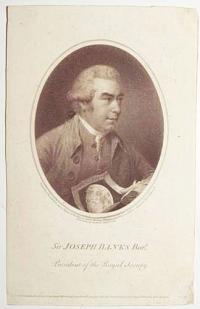
Sir Joseph Banks Bar.t President of the Royal Society.
Painted by J. Russell R.A. Crayon Painter to His Majesty, and to His Royal Highness the Prince of Wales_ Engraved by J. Collyer A._
Published as the Act directs May 16th 1789. Sold by W. Dickenson, Bond Stre. J. Cary, Strand, W. DArling, Newport Str. T. Simpson St Pauls Church Yard, and J. Collyer White Lion Row, Islington. Price 3s.
Stipple, sheet 175 x 110mm (7 x 4¼"). Trimmed within plate mark.
Sir Joseph Banks (1743-1820), English naturalist, botanist and patron of the natural sciences holding a 'Carte de la Lune par J. Russell' (map of the moon by J. Russell). Banks was leading founder of the African Association, a British organisation dedicated to the exploration of Africa, and a member of the Society of Dilettanti, which helped to establish the Royal Academy. He joined James Cook on his first voyage around the Pacific, and they came across New Zealand and Australia, where Cook mapped the coastline and made landfall at Botany Bay and at Endeavour River. Banks took a great interest in the British colonisation of the continent and was to be the greatest proponent of settlement of New South Wales. He was in fact the general advisor to the government on all Australian interests.
[Ref: 55263] £140.00
(£168.00 incl.VAT)

Rt. Hon.ble Sr. Joseph Banks K.B. European Magazine.
Engraved by Ridley.
Pub by J Sewell Cornhill Oct 1 1802 [but later].
Stipple. 165 x 115mm (6½ x 4½").
Sir Joseph Banks (1743-1820), the English botanist, naturalist and patron of the natural sciences. Banks took part in Captain James Cook's first great voyage (1768-1771). He was the leading founder of the African Association, the British organization dedicated to the exploration of Africa, and a member of the Society of Dilettanti, which helped to establish the Royal Academy.
[Ref: 58704] £80.00
(£96.00 incl.VAT)
![[Joseph Banks.]](img-thumbnail/jpegs/36826.jpg)
[Joseph Banks.]
H. Gievedon. 1826.
Lith de C. Motte. [Stampted:] Contemporains Estrangers. [n.d. c.1830.]
Lithograph. Sheet size: 500 x 325mm (19¾ x 12¾"). Crease to upper right corner. Small stain in lower left.
Sir Joseph Banks (1743-1820), the English botanist, naturalist and patron of the natural sciences. Banks took part in Captain James Cook's first great voyage (1768-1771). He was the leading founder of the African Association, the British organization dedicated to the exploration of Africa, a member of the Society of Dilettanti, which helped to establish the Royal Academy.
[Ref: 36826] £300.00
![To the King's most excellent Majesty, This Print of Sir Joseph Banks, Bar.t [...]](img-thumbnail/jpegs/59636.jpg)
To the King's most excellent Majesty, This Print of Sir Joseph Banks, Bar.t [...]
Painted by Tho.s Phillips, R.A. Engraved by N. Schiavonetti.
London, Published 1812, by N. Schiavonetti. N.o 12, Michael's Place, Brompton.
Etching on chine collé, 515 x 390mm (20¼ x 15¼"), with large margins. Slightly foxed.
Three-quarter length portrait of Sir Joseph Banks (1743-1820), naturalist and patron of science, sitting at a desk and holding a paper on a cushion in front of him with his right hand. The chair is decorated with a coat of arms bearing the Royal Society motto 'Nullius in Verba'. Banks took part in Captain James Cook's first great voyage (1768-1771). He was the leading founder of the African Association, the British organization dedicated to the exploration of Africa, and a member of the Society of Dilettanti, which helped to establish the Royal Academy. Provenance: G. Usslub Lugt 1221.
[Ref: 59636] £1,250.00

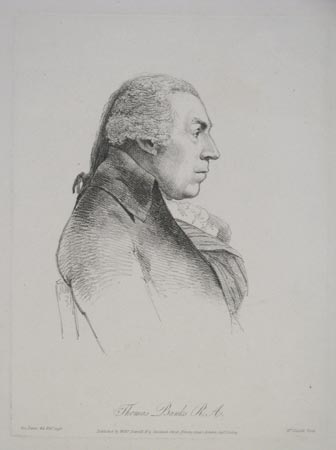
Thomas Banks R.A.
Geo. Dance del. Feby. 1793. Wm. Daniell Fecit.
Published by Willm. Daniell No. 9 Cleveland Street, Fitzroy Square London, Septr. 15, 1809.
Soft-ground etching. 268 x 197mm. 10½" x 7¾".
Thomas Banks (1735 - 1805), English sculptor. He was taught drawing by his father, and in 1750 was apprenticed to a woodcarver. In his spare time he worked at sculpture, spending his evenings in the studio of the Flemish émigré sculptor Peter Scheemakers. Before 1772, when he obtained a travelling studentship given by the Royal Academy and proceeded to Rome, he had already exhibited several fine works. Banks was paid 500 guineas for the group which depicts Shakespeare, reclining against a rock, between the Dramatic Muse and the Genius of Painting.
[Ref: 8426] £130.00
(£156.00 incl.VAT)
![[Giuseppe Marc'Antonio Baretti] Joseph Baretti.](img-thumbnail/jpegs/67965.jpg)
[Giuseppe Marc'Antonio Baretti] Joseph Baretti. Secretary for Foreign Correspondence to the Royal Academy.
Sir J. Reynolds pinx.t. J. Hardy sculp.t.
[n.d., c.1794.]
Stipple, scratched letters, printed in brown. Sheet 270 x 185mm (10½ x 7¼"). Trimmed to image on three sides
A half-length seated portait of Turinese writer Giuseppe Marc'Antonio Baretti (1719-89), reading a book held close to his face. After leaving Italy after facing censorship, he moved to London where he was welcomed by the literati: when he was tried for murder in 1769, character witnesses included Joshua Reynolds, Samuel Johnson, Edmund Burke and David Garrick. He was acquitted and soon after became Secretary to the Royal Academy of Arts, as referenced here. Hamilton p.5.
[Ref: 67965] £130.00
(£156.00 incl.VAT)
![[Giuseppe Marc'Antonio Baretti] Joseph Baretti.](img-thumbnail/jpegs/67964.jpg)
[Giuseppe Marc'Antonio Baretti] Joseph Baretti. Secretary for Foreign Correspondence to the Royal Academy.
Sir J. Reynolds pinx.t. J. Hardy sculp.t.
Pub.d March 6th 1794 by W. Richardson Castle S.t Leicester Square.
Stipple. 270 x 195mm (10½ x 7¾"). Narrow margins, top left corner lost.
A half-length seated portait of Turinese writer Giuseppe Marc'Antonio Baretti (1719-89), reading a book held close to his face. After leaving Italy after facing censorship, he moved to London where he was welcomed by the literati: when he was tried for murder in 1769, character witnesses included Joshua Reynolds, Samuel Johnson, Edmund Burke and David Garrick. He was acquitted and soon after became Secretary to the Royal Academy of Arts, as referenced here. Hamilton p.5. Ex: collection of The Hon. Christopher Lennox-Boyd.
[Ref: 67964] £180.00
(£216.00 incl.VAT)

Barnes Terrace.
Drawn by W. Westall ARA. Printed by C. Hullmandel.
London: Pub: by Rodwell and Martin: New Bond St.t Jan: 1. 1823.
Coloured lithograph on india paper, rare. India 210 x 325mm (8¼ x 12¾"). Some surface soiling.
Before the building of Barnes Bridge, with cows wandering along the road. A plate from 'Thirty five Views on the Thames, at Richmond, Eton, Windsor and Oxford', published December 1823. William Westall (1781 - 1850) was a British topographical draughtsman and engraver. He became an Associate Member of the Royal Academy in 1812. He was the younger brother of the painter and illustrator Richard Westall.
[Ref: 39007] £260.00
(£312.00 incl.VAT)

James Barry Esq. Professor of Painting at the Royal Academy. From an original Cast, taken a short time before his Death.
Drawn by W.Evans, Engraved by C. Picart.
Published Feb. 11, 1811, by T. Cadell & W. Davies, Strand London.
Stipple. Sheet 380 x 330mm, 15 x 13". Slight creasing top left.
James Barry (1741-1806), historical painter and first Royal Academician to have been expelled from the Academy. Barry decorated the great room of the Society of Arts with 'The Progress of Human Culture', 1777-83, a work was described by critic Andrew Graham-Dixon as 'Britain's late, great answer to the Sistine Chapel'. See NPG 441 for Evans's original black crayon and wash on paper, circa 1805
[Ref: 27023] £95.00
(£114.00 incl.VAT)
![[Shepherdess sitting with sheep outside a cottage, spinning wool]](img-thumbnail/jpegs/43124.jpg)
[Shepherdess sitting with sheep outside a cottage, spinning wool] Guidata ch'a la Greggia Irminda poi / S'asside e sta filando i Lini suio
Francesco Bartolozzi scolp. Appo Teodoro Viero Ven.d 1774
Etching, fine impression; scarce; platemark 235 x 175mm (9¼ x 7"). Thread margins.
One a series of six pastoral subjects etched after designs by the Venice-based publisher and artist Teodoro Viero (1740-95) by Francesco Bartolozzi (1725-1815). Bartlozzi was a Florentine engraver who in 1768 was elected as a founding member of the Royal Academy in London (the RA did not admit engravers at this time but made an exception in his case). He was already hailed as the best engraver in Italy when he met George III's librarian Richard Dalton in 1763. Dalton invited Bartolozzi to London with a promise of an appointment as engraver to the king. In England he became the most celebrated exponent of the 'stipple' technique whereby he produced prints using dots rather than lines. In 1801 Bartolozzi was invited to Lisbon to reform the royal printing press, and he spent his final years in Portugal. Fine impression from the collection of Dr. Augusto Calabi of Milan, art historian who co-authored (with A.B. de Vesme) the authoritative catalogue raisonné of Bartolozzi's work. Inscription 'Solo all'Albertine' verso suggests the only other impression known to Calabi was in the Albertine Museum, Vienna. Calabi & de Vesme 1342
[Ref: 43124] £220.00
(£264.00 incl.VAT)
![[Young man fishing, with a woman and small boy nearby]](img-thumbnail/jpegs/43125.jpg)
[Young man fishing, with a woman and small boy nearby] Osservato da Fille il Pesce piglia / Per sostentar la debil sua Famiglia
Francesco Bartolozzi scolp. Appo Teodoro Viero Ven.d 1774
Etching, fine impression; scarce; platemark 235 x 175mm (9¼ x 7"). Thread margins.
One a series of six pastoral subjects etched after designs by the Venice-based publisher and artist Teodoro Viero (1740-95) by Francesco Bartolozzi (1725-1815). Bartlozzi was a Florentine engraver who in 1768 was elected as a founding member of the Royal Academy in London (the RA did not admit engravers at this time but made an exception in his case). He was already hailed as the best engraver in Italy when he met George III's librarian Richard Dalton in 1763. Dalton invited Bartolozzi to London with a promise of an appointment as engraver to the king. In England he became the most celebrated exponent of the 'stipple' technique whereby he produced prints using dots rather than lines. In 1801 Bartolozzi was invited to Lisbon to reform the royal printing press, and he spent his final years in Portugal. Fine impression from the collection of Dr. Augusto Calabi of Milan, art historian who co-authored (with A.B. de Vesme) the authoritative catalogue raisonné of Bartolozzi's work. Inscription 'Solo all'Albertine' verso suggests the only other impression known to Calabi was in the Albertine Museum, Vienna. Calabi & de Vesme 1343
[Ref: 43125] £220.00
(£264.00 incl.VAT)
![[Young couple embracing; young woman and sheep on right]](img-thumbnail/jpegs/43126.jpg)
[Young couple embracing; young woman and sheep on right] Soglion gli Amanti coltivar non poco / Le lusinghe, gli scherzi il riso, e il gioco
Francesco Bartolozzi scolp. Appo Teodoro Viero Ven.d 1774
Etching, fine impression; scarce; platemark 235 x 175mm (9¼ x 7"). Thread margins.
One a series of six pastoral subjects etched after designs by the Venice-based publisher and artist Teodoro Viero (1740-95) by Francesco Bartolozzi (1725-1815). Bartlozzi was a Florentine engraver who in 1768 was elected as a founding member of the Royal Academy in London (the RA did not admit engravers at this time but made an exception in his case). He was already hailed as the best engraver in Italy when he met George III's librarian Richard Dalton in 1763. Dalton invited Bartolozzi to London with a promise of an appointment as engraver to the king. In England he became the most celebrated exponent of the 'stipple' technique whereby he produced prints using dots rather than lines. In 1801 Bartolozzi was invited to Lisbon to reform the royal printing press, and he spent his final years in Portugal. Fine impression from the collection of Dr. Augusto Calabi of Milan, art historian who co-authored (with A.B. de Vesme) the authoritative catalogue raisonné of Bartolozzi's work. Inscription 'Solo all'Albertine' verso suggests the only other impression known to Calabi was in the Albertine Museum, Vienna. Calabi & de Vesme 1345
[Ref: 43126] £220.00
(£264.00 incl.VAT)

![[Collection of Prints by Elias Martin.]](jpegs/4104.jpg)
![[King Ahasuerus & Queen Esther]](jpegs/44148.jpg)
![[L'Allegro]](jpegs/35900.jpg)

![[L'Allegro]](jpegs/35898.jpg)

![[Lawrence Alma-Tadema, R.A., in his studio]](jpegs/36360.jpg)
![Alsatian [pencil]](jpegs/4784.jpg)
![[Christoph Friedrich von Ammon]](jpegs/35844.jpg)

![Miraculous Escape of S.r Brook Watson. [&]](jpegs/49584.jpg)
![Apparent Dissolution. [&] Returning Animation.](jpegs/27130.jpg)
![[An Arab and his camel in the desert.]](jpegs/64345.jpg)

![Loch Fyne Argylshire - 1855. [ink outside image.]](jpegs/19635.jpg)

![[Attention]](jpegs/36633.jpg)





![[Bamburgh Castle.]](jpegs/14883.jpg)



![[Joseph Banks.]](jpegs/36826.jpg)
![To the King's most excellent Majesty, This Print of Sir Joseph Banks, Bar.t [...]](jpegs/59636.jpg)
![[Giuseppe Marc'Antonio Baretti] Joseph Baretti.](jpegs/67965.jpg)
![[Giuseppe Marc'Antonio Baretti] Joseph Baretti.](jpegs/67964.jpg)


![[Shepherdess sitting with sheep outside a cottage, spinning wool]](jpegs/43124.jpg)
![[Young man fishing, with a woman and small boy nearby]](jpegs/43125.jpg)
![[Young couple embracing; young woman and sheep on right]](jpegs/43126.jpg)