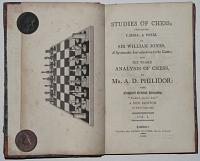
Studies of Chess; Containing Caissa, a Poem, by Sir William Jones, A Systematic Introduction to the Game; and the Whole Analysis of Chess, By Mr. A. D. Philidor: with Original Critical Remarks "Ludimus effigiem belli." A New Edition. In Two Volumes.
London: Printed for Samuel Bagster, No. 81, Strand, 1808.
Book in two 8vo vols., 271 and 267 pp., half-title, engraved frontispiece of a chessboard with pieces arranged for the start of a game. Preface misbound in reverse order, 3 pages of publisher's advertisements at end. Contemporary half calf over marble boards, gilt spines with red morocco lettering pieces. Bindings slightly scuffed and rubbed, spines rebacked. Contents clean; complete with publisher's advertisements to end.
Includes Sir William Jones's poem 'Caissa', while the introductory part is from Peter Pratt's 'Theory of Chess'. By Francois-Andre Danican Philidor (1726 - 1795). Philidor was a French composer, also regarded as the best chess player of his age. He started playing regularly around 1740 at the chess Mecca of France, the Café de la Régence. It was also there that he famously played with a friend from 'New England', Benjamin Franklin. The best player in France at the time, Legall de Kermeur, taught him. In 1774 the Parloe's chess club, on St James Street in London, was created, and Philidor obtained a remuneration as a chess master every year, for a regular season from February to June. Philidor stayed faithful to this agreement until the end of his life and he was replaced by Verdoni only after his death. In December 1792 he had to leave France permanently for England, fleeing the French Revolution, because his name figured on the banishment list established by the Convention nationale. His admirers and friends included the French philosophers Voltaire, Rousseau and the famous actor David Garrick. Ink ownership inscriptions to front free-endpapers.
[Ref: 19554] £390.00

Mrs Abington
Sr. Jos. Reynolds Pinx J. Wilson fec
[n.d., c.1770]
Mezzotint, platemark 150 x 115mm (6 x 4½").
Frances Abington (1737-1815), actress. Born in lowly circumstances, Abington grew up in the slums around Drury Lane, and sold flowers and sang in Covent Garden as a girl. Along with other jobs she did when young (kitchenmaid, milliner's assistant), various accounts of her life hint at prostitution during her early years. After making a start as an actress in London her first professional success came while working in Dublin, rejoining Garrick's Drury Lane company where she established herself as one of the leading comedy actresses of her generation. She was also the mistress of at least two prominent figures. Engraving after the several portrait 'Mrs Abington as the Comic Muse' by Sir Joshua Reynolds (1764-8, hair and dress repainted 1772-3) now in Waddesdon Manor, Buckinghamshire. This was one of several portraits that Reynolds painted of Abington- he was an admirer and purchased twelve tickets for her benefit performance in 1772. Reynolds' portrait was a companion to his portrait of Sarah Siddons as 'the Tragic Muse'. CS: 2. Not in Hamilton.
[Ref: 42094] £160.00
(£192.00 incl.VAT)
![[Giuseppe Marc'Antonio Baretti] Joseph Baretti.](img-thumbnail/jpegs/67964.jpg)
[Giuseppe Marc'Antonio Baretti] Joseph Baretti. Secretary for Foreign Correspondence to the Royal Academy.
Sir J. Reynolds pinx.t. J. Hardy sculp.t.
Pub.d March 6th 1794 by W. Richardson Castle S.t Leicester Square.
Stipple. 270 x 195mm (10½ x 7¾"). Narrow margins, top left corner lost.
A half-length seated portait of Turinese writer Giuseppe Marc'Antonio Baretti (1719-89), reading a book held close to his face. After leaving Italy after facing censorship, he moved to London where he was welcomed by the literati: when he was tried for murder in 1769, character witnesses included Joshua Reynolds, Samuel Johnson, Edmund Burke and David Garrick. He was acquitted and soon after became Secretary to the Royal Academy of Arts, as referenced here. Hamilton p.5. Ex: collection of The Hon. Christopher Lennox-Boyd.
[Ref: 67964] £180.00
(£216.00 incl.VAT)
![[Spranger Barry] M.r Barry in the Character of Macbeth.](img-thumbnail/jpegs/66076.jpg)
[Spranger Barry] M.r Barry in the Character of Macbeth. Axt 2.d Scene 3.
Ja.s Gwim. [engraved by Michael Jackson.]
Printed for Rob.t Sayer, Map & Printseller in Fleet Str.t. Publish'd according to Act of Parliament
Scarce mezzotint. 345 x 240mm (13½ x 9½"), large margins. Edges rubbed. Messy.
A full-length portrait of Irish actor Spranger Barry (1719-77), a daggar in each hand. He was a rival of David Garrick: in 1750 the Theatre Royal in Drury Lane and the Covent Garden Theatre put on competing performances of 'Romeo and Juliet', and the critics preferred Barry's Romeo to Garrick's. CS I, ii of ii. Ex: Collection of The Hon. Christopher Lennox-Boyd.
[Ref: 66076] £290.00
(£348.00 incl.VAT)
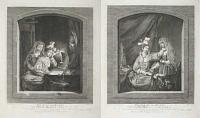
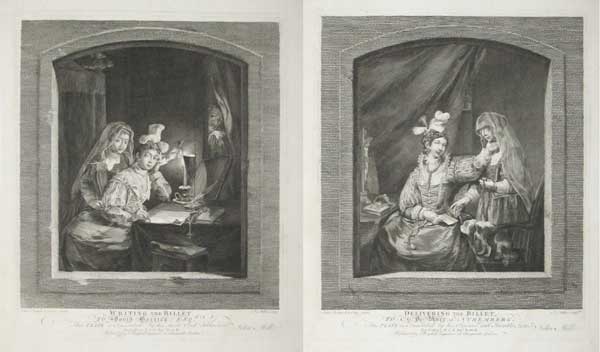
Writing the Billet. To David Garrick Esq.r This Plate is Inscribed by his most Obed.t Hble Serv.t John Miller. [&] Delivering the Billet. To C.G. de Murr of Nuremburg, This Plate is Inscribed by his sincere and Humble Serv.t John Miller.
Juan Pantoja de la Cruz pinxt. J. Miller Sculp.t.
Publish'd by J. Boydell Engraver in Cheapside, London [n.d., c.1773 but later.]
Pair of engravings. 375 x 330mm (14¾ x 13"), with large margins.
Two scenes: a woman writes a love letter by candlelight; and another woman receives a love letter. The painter was Juan Pantoja de La Cruz (1553-1608), court painter to Philip II and Philip III of Spain. The engraver was German Johann Sebastian Müller (1715-92), who emigrated to England in 1744, anglicising his name to John Miller.
[Ref: 63522] £180.00
(£216.00 incl.VAT)
view all images for this item
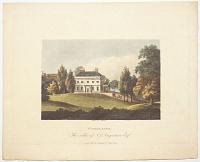
Woodlands. The villa of J.J. Angerstein Esq.r.
Drawn by J. Hassell.
London Pub.d by J. Hassell 1st Aug.t 1804.
Aquatint with fine hand colour. 195 x 275mm (7¾ x 10¾"), very large margins.
Woodlands House, a Grade II* listed Georgian villa, in Westcombe Park, Greenwich, described in Daniel Lysons' The Environs of London (1796) as occupying 'a situation uncommonly beautiful'. John Julius Angerstein, chairman of Lloyd's from 1790-6, was a friend of George III, Pitt the Younger and Sir Thomas Lawrence. His art collection, which included 'The Rape of the Sabines' by Rubens and Sir Joshua Reynolds's portrait of Garrick between Tragedy and Comedy, was bought by the government for £60,000 to form the nucleus of the National Gallery's collection. Until the Trafalgar Square site was opened the 38 works from Angerstein's collection were displayed in Angerstein's town house in Pall Mall.
[Ref: 58207] £160.00
(£192.00 incl.VAT)
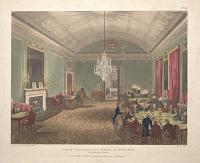
Great Subscription Room at Brooks's, St. James's Street.
Rowlandson & Pugin Delt. et Sculpt. J. Bluck Aquat.
London. Pub.1st Octr, 1808 at R. Ackermann’s Repository of Arts 101, Strand.
Coloured aquatint. 230 x 280mm, 9 x 11", paper watermarked "1808" large margins.
The gaming room at Brooks's, a gentlemen's club founded in 1764, with a barrel-vault ceiling designed by John Adam. Notable members of the club include David Garrick, Herbert Walpole, Joshua Reynolds, William Pitt the Younger, William Wilberforce, George IV and William IV. Abbey, Scenery: 212.
[Ref: 53543] £260.00
(£312.00 incl.VAT)

Lord Byron
Painted by T. Phillips, R.A. Engraved by Edw.d Finden
London, Published by John Murray, 1827
Line engraving on india with very large margins, platemark 190 x 115mm (7½ x 6"). Tipped into album sheet.
George Gordon Noel Byron (1788-1824), British poet and archetypal Romantic figure. Byron was celebrated in life for aristocratic excesses including huge debts, numerous love affairs, rumours of a scandalous incestuous liaison with his half-sister, and self-imposed exile. He travelled to fight against the Ottoman Empire in the Greek War of Independence, for which Greeks revere him as a national hero. He died at 36 years old from a fever contracted while in Missolonghi, Greece. Engraved from the portrait by Thomas Phillips, which was undertaken as part of a commission by the publisher William Miller to paint the portraits of several poets whose works he published, the intention being to hang them together at Miller's house at 50 Albemarle Street, London. Annette Peach writes of the commission: "In 1813 Murray commissioned from Phillips a portrait of Byron (who brought the publisher more commercial success than any other of his writers), which still hangs over the drawing-room fireplace in Albemarle Street. The half-length view famously shows a pale-complexioned Byron in a white shirt with a large turned-down ‘Byronic' collar open at the neck to reveal his throat, and wrapped in a dark cloak. The dress and pose are identical to that of Charles Mayne Young in his portrait by G. H. Harlow (1809; Garrick Club, London), where the actor is portrayed as Hamlet, and it is possible that Byron saw Young perform this role. As in his portrait of Blake, Phillips's ability to convey the Romantic (and here self-dramatizing) cast of his sitter's imagination indicates that, although his œuvre is less flamboyant than that of his contemporary Sir Thomas Lawrence, he, too, was quintessentially a Romantic painter." One of several engravings made from Phillips' portrait. Not in O'D; For a larger version of the same image see ref. 34943.
[Ref: 34949] £120.00
(£144.00 incl.VAT)
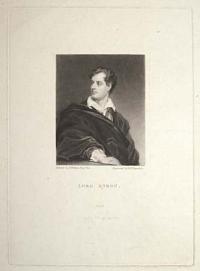
Lord Byron. Proof.
Painted by T. Phillips, engraved by S. W. Reynolds.
Pub.d by T. Phillips, Feb.y 1822.
Fine mezzotint. 230 x 165mm (9 x 6½"), with large margins.
George Gordon Noel Byron (1788-1824), a British poet and a leading figure in the Romantic movement. He was celebrated in life for aristocratic excesses including huge debts, numerous love affairs, rumours of a scandalous incestuous liaison with his half-sister, and self-imposed exile. He travelled to fight against the Ottoman Empire in the Greek War of Independence, for which Greeks revere him as a national hero. He died at 36 years old from a fever contracted while in Missolonghi, Greece. Engraved from the portrait by Thomas Phillips, which was undertaken as part of a commission by the publisher William Miller to paint the portraits of several poets whose works he published, the intention being to hang them together at Miller's house at 50 Albemarle Street, London. Annette Peach writes of the commission: "In 1813 Murray commissioned from Phillips a portrait of Byron (who brought the publisher more commercial success than any other of his writers), which still hangs over the drawing-room fireplace in Albemarle Street. The half-length view famously shows a pale-complexioned Byron in a white shirt with a large turned-down ‘Byronic' collar open at the neck to reveal his throat, and wrapped in a dark cloak. The dress and pose are identical to that of Charles Mayne Young in his portrait by G. H. Harlow (1809; Garrick Club, London), where the actor is portrayed as Hamlet, and it is possible that Byron saw Young perform this role. As in his portrait of Blake, Phillips's ability to convey the Romantic (and here self-dramatizing) cast of his sitter's imagination indicates that, although his œuvre is less flamboyant than that of his contemporary Sir Thomas Lawrence, he, too, was quintessentially a Romantic painter." One of several engravings made from Phillips' portrait. Whitman: 45
[Ref: 53855] £260.00
(£312.00 incl.VAT)
![[George, Lord Byron]](img-thumbnail/jpegs/34944.jpg)
[George, Lord Byron]
T. Phillips R.A. pinxit. C. Warren sculpsit.
[c.1824]
Line engraving on india with very large margins, proof before title; 270 x 170mm (10½ x 6¾"). Tipped into album sheet.
George Gordon Noel Byron (1788-1824), British poet and archetypal Romantic figure. Byron was celebrated in life for aristocratic excesses including huge debts, numerous love affairs, rumours of a scandalous incestuous liaison with his half-sister, and self-imposed exile. He travelled to fight against the Ottoman Empire in the Greek War of Independence, for which Greeks revere him as a national hero. He died at 36 years old from a fever contracted while in Missolonghi, Greece. Engraved from the portrait by Thomas Phillips, which was undertaken as part of a commission by the publisher William Miller to paint the portraits of several poets whose works he published, the intention being to hang them together at Miller's house at 50 Albemarle Street, London. Annette Peach writes of the commission: "In 1813 Murray commissioned from Phillips a portrait of Byron (who brought the publisher more commercial success than any other of his writers), which still hangs over the drawing-room fireplace in Albemarle Street. The half-length view famously shows a pale-complexioned Byron in a white shirt with a large turned-down ‘Byronic' collar open at the neck to reveal his throat, and wrapped in a dark cloak. The dress and pose are identical to that of Charles Mayne Young in his portrait by G. H. Harlow (1809; Garrick Club, London), where the actor is portrayed as Hamlet, and it is possible that Byron saw Young perform this role. As in his portrait of Blake, Phillips's ability to convey the Romantic (and here self-dramatizing) cast of his sitter's imagination indicates that, although his œuvre is less flamboyant than that of his contemporary Sir Thomas Lawrence, he, too, was quintessentially a Romantic painter." Not in O'D; For a larger version of the same image see ref. 34943.
[Ref: 34944] £120.00
(£144.00 incl.VAT)
![Lord Byron after Phillips, 1831 [ms in lower margin]](img-thumbnail/jpegs/34947.jpg)
Lord Byron after Phillips, 1831 [ms in lower margin]
[possibly by R. Woodman]
Line engraving on india with very large margins, platemark 210 x 150mm (8¼ x 6"). Proof before letters; tipped into album sheet.
George Gordon Noel Byron (1788-1824), British poet and archetypal Romantic figure. Byron was celebrated in life for aristocratic excesses including huge debts, numerous love affairs, rumours of a scandalous incestuous liaison with his half-sister, and self-imposed exile. He travelled to fight against the Ottoman Empire in the Greek War of Independence, for which Greeks revere him as a national hero. He died at 36 years old from a fever contracted while in Missolonghi, Greece. Engraved from the portrait by Thomas Phillips, which was undertaken as part of a commission by the publisher William Miller to paint the portraits of several poets whose works he published, the intention being to hang them together at Miller's house at 50 Albemarle Street, London. Annette Peach writes of the commission: "In 1813 Murray commissioned from Phillips a portrait of Byron (who brought the publisher more commercial success than any other of his writers), which still hangs over the drawing-room fireplace in Albemarle Street. The half-length view famously shows a pale-complexioned Byron in a white shirt with a large turned-down ‘Byronic' collar open at the neck to reveal his throat, and wrapped in a dark cloak. The dress and pose are identical to that of Charles Mayne Young in his portrait by G. H. Harlow (1809; Garrick Club, London), where the actor is portrayed as Hamlet, and it is possible that Byron saw Young perform this role. As in his portrait of Blake, Phillips's ability to convey the Romantic (and here self-dramatizing) cast of his sitter's imagination indicates that, although his œuvre is less flamboyant than that of his contemporary Sir Thomas Lawrence, he, too, was quintessentially a Romantic painter." One of several engravings made from Phillips' portrait. O'D 28?; For a larger version of the same image see ref. 34943.
[Ref: 34947] £120.00
(£144.00 incl.VAT)
![Lord Byron [ms]](img-thumbnail/jpegs/34946.jpg)
Lord Byron [ms]
[possibly by J.S. Agar, 1814]
Line engraving on india, proof before letters, with very large margins; platemark 220 x 180mm (8¾ x 7"). Tipped into album sheet.
George Gordon Noel Byron (1788-1824), British poet and archetypal Romantic figure. Byron was celebrated in life for aristocratic excesses including huge debts, numerous love affairs, rumours of a scandalous incestuous liaison with his half-sister, and self-imposed exile. He travelled to fight against the Ottoman Empire in the Greek War of Independence, for which Greeks revere him as a national hero. He died at 36 years old from a fever contracted while in Missolonghi, Greece. Engraved from the portrait by Thomas Phillips, which was undertaken as part of a commission by the publisher William Miller to paint the portraits of several poets whose works he published, the intention being to hang them together at Miller's house at 50 Albemarle Street, London. Annette Peach writes of the commission: "In 1813 Murray commissioned from Phillips a portrait of Byron (who brought the publisher more commercial success than any other of his writers), which still hangs over the drawing-room fireplace in Albemarle Street. The half-length view famously shows a pale-complexioned Byron in a white shirt with a large turned-down ‘Byronic' collar open at the neck to reveal his throat, and wrapped in a dark cloak. The dress and pose are identical to that of Charles Mayne Young in his portrait by G. H. Harlow (1809; Garrick Club, London), where the actor is portrayed as Hamlet, and it is possible that Byron saw Young perform this role. As in his portrait of Blake, Phillips's ability to convey the Romantic (and here self-dramatizing) cast of his sitter's imagination indicates that, although his œuvre is less flamboyant than that of his contemporary Sir Thomas Lawrence, he, too, was quintessentially a Romantic painter." One of several engravings made from Phillips' portrait. O'D 27?; For a larger version of the same image see ref. 34943.
[Ref: 34946] £120.00
(£144.00 incl.VAT)
![[George, Lord Byron]](img-thumbnail/jpegs/34945.jpg)
[George, Lord Byron]
Armstrong sc. [ms]
[Pub. by J. Murray, 1819]
Line engraving on india with very large margins, 235 x 165mm (9¼ x 6¾"). Tipped into album sheet. Manuscript in lower margin: in pencil "Unpublished print by Armstrong only 20 impressions from this plate which was then destroyed".
George Gordon Noel Byron (1788-1824), British poet and archetypal Romantic figure. Byron was celebrated in life for aristocratic excesses including huge debts, numerous love affairs, rumours of a scandalous incestuous liaison with his half-sister, and self-imposed exile. He travelled to fight against the Ottoman Empire in the Greek War of Independence, for which Greeks revere him as a national hero. He died at 36 years old from a fever contracted while in Missolonghi, Greece. Engraved from the portrait by Thomas Phillips, which was undertaken as part of a commission by the publisher William Miller to paint the portraits of several poets whose works he published, the intention being to hang them together at Miller's house at 50 Albemarle Street, London. Annette Peach writes of the commission: "In 1813 Murray commissioned from Phillips a portrait of Byron (who brought the publisher more commercial success than any other of his writers), which still hangs over the drawing-room fireplace in Albemarle Street. The half-length view famously shows a pale-complexioned Byron in a white shirt with a large turned-down ‘Byronic' collar open at the neck to reveal his throat, and wrapped in a dark cloak. The dress and pose are identical to that of Charles Mayne Young in his portrait by G. H. Harlow (1809; Garrick Club, London), where the actor is portrayed as Hamlet, and it is possible that Byron saw Young perform this role. As in his portrait of Blake, Phillips's ability to convey the Romantic (and here self-dramatizing) cast of his sitter's imagination indicates that, although his œuvre is less flamboyant than that of his contemporary Sir Thomas Lawrence, he, too, was quintessentially a Romantic painter." One of several engravings made from Phillips' portrait. O'D 27; For a larger version of the same image see ref. 34943.
[Ref: 34945] £180.00
(£216.00 incl.VAT)

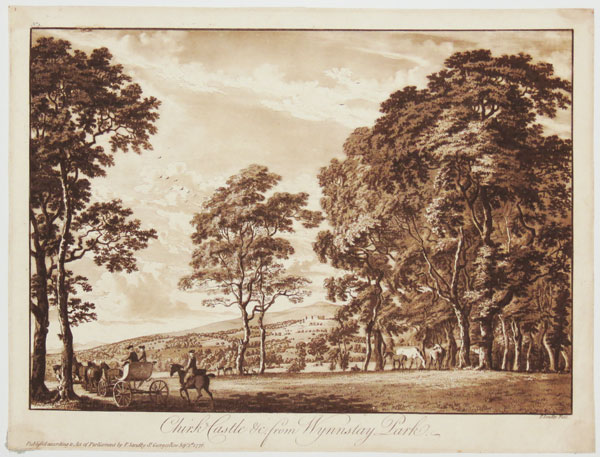
No 3. Chirk Castle &c. from Wynnstay Park.
P. Sandby Fecit.
Publish'd according to Act of Parliament by P. Sandby St. Georges Row, Sep.r 1st 1776.
Aquatint with etching, printed in brown. Sheet 240 x 315mm (9½ x 12½"). Trimmed to plate.
A distant view of Chirk Castle, now a National Trust property, published in Part II of Sandby's 'Views in Wales', the first series of aquatints published in Britain. Wynnstay was the estate of Sir Watkin Williams Wynn (1749-89), patron of the arts and friend of Handel and Garrick, who commissioned Robert Adam to design his house at 20 St James's Square in London. Abbey Scenery: 511.
[Ref: 31548] £260.00
(£312.00 incl.VAT)

Mr. Charles Churchill.
[after Hamett Jefferyes.]
[n.d., c.1765.]
Etching with engraving. Sheet 160 x 95mm (6¼ x 3¾").
Oval portrait of satirist Charles Churchill (1732-1764), thinking with a quill in his hand. Under the oval are books including 'The North Briton' and 'Prophecy of Famine', and a pole holding a cap of liberty. Churchill was an ally of John Wilkes and an adversary of William Hogarth. In response to Churchill's 'An Epistle to William Hogarth' (described by Garrick as shocking and barbarous), Hogarth published 'The Bruiser', which caricatured Churchill as a bear with a tankard of porter and a club of lies, with Hogarth's pug urinating on the 'Epistle'.
[Ref: 63365] £320.00
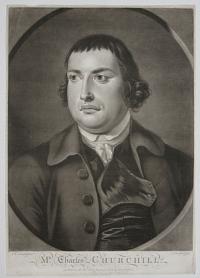
Mr. Charles Churchill.
J.H. Schaak pinx.t T. Burford fecit.
Publish'd as the Act Directs January 1.st 1765 by Tho.s Burford.
Mezzotint, fine with small margins; paper watermarked. Plate 504 x 355mm. 19¾ x 14".
Portrait, bust in an oval facing front, looking away to left, wearing waistcoat with a high sheen under a plain coat, the lapel of the waistcoat open to show white cravat, with brown hair curled over the ears and a short fringe. Charles Churchill (1732-1764) the satirist and author of 'The Rosciad', 1761, a satire on contemporary actors; although David Garrick was the only one to escape his vitriol. Churchill's other targets included Lord Bute, Tobias Smollett and William Hogarth. NPG: D1446. CS: 3.
[Ref: 27339] £320.00
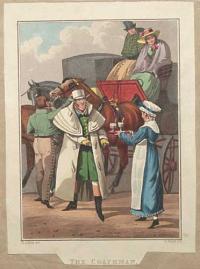
The Coachman.
H. Alken del. G. Hunt sc.
[London, Published by Thomas McLean, Haymarket, 1822.]
Fine coloured aquatint. Sheet 180 x 130mm (7 x 5"). Trimmed within plate and around title, losing publisher's address, laid on album paper.
A coachman, wearing a 'garrick' greatcoat, is offered a tray of drinks by a maidservant. Behind a groom attends to the horses and two well-wrapped passengers look down from the coach. Hickman p259.
[Ref: 56630] £120.00
(£144.00 incl.VAT)

Mr. Dodd.
R. Dighton Pinx.t. R. Laurie Sculp
Published as the act Directs July 10th 1779 by W.m Richardson No.68 High Holborn
Mezzotint. 155 x 115mm (6 x 4½"). Thread margins.
James William Dodd (c.1740-1796), actor. Dodd became a strolling player aged sixteen, and acted in Sheffield, Norfolk and Bath before Garrick recruited him for his Drury Lane company in 1765. Dodd was to remain at Drury Lane for the next thirty years, and while he never challenged Tom King as the principal comedian of the company, he was respected by audiences and colleagues. More problematic was his private life: his indiscretions with Covent Garden actress Mary Bulkley caused scandal and his fledgling attempts at management were jeopardised by his rudeness and attempts to seduce young actresses. Physically Dodd was very small, and described as having a 'white, calf-like stupid face'. Engraved after a painting by draughtsman and singer Robert Dighton (1751-1814) by the mezzotint engraver and printseller Robert Laurie (1755?-1836). Music, instruments and mask (representing theatre) in title area. Ex: collection of the late Hon. C. Lennox-Boyd; CS 1 iii/iii.
[Ref: 36694] £160.00
(£192.00 incl.VAT)
![John Freeth [facsimile signature.]](img-thumbnail/jpegs/23372.jpg)
John Freeth [facsimile signature.]
Painted by E.W. Coleman. Engraved by Ja.s Scott.
[n.d. c.1800.]
Mezzotint on india. Plate 546 x 394mm. 21½ x 15½". Rare.
John Freeth (1731-1808), was an English inkeeper, poet and songwriter; he published work under the pseudonym John Free. As the owner of Freeth's Coffee House between 1768 and 1808, he was a major figure in the political and cultural life of Birmingham during the Midlands Enlightenment. He composed the song "Birmingham Lads" for the opening of the Birmingham Canal in 1769 using Charles Dibdin's tune for 'The Warwickshire Lads' which had been composed earlier that year by David Garrick for the Shakespeare Jubilee celebrations. The canal halved the price of coal in Birmingham.
[Ref: 23372] £280.00
(£336.00 incl.VAT)

M.r Garrick reciting the Ode, in honor of Shakespeare, at the Jubillee at Stratford, with the Musical Performers, & c. N.º XXVII.
[n.d., c.1770.]
Engraving. Sheet 125 x 175mm (5 x 6¾"). Trimmed within plate, original folds.
David Garrick reciting his Ode to Shakespeare at the 1769 Jubilee in Stratford-upon-Avon. He stands at the centre, his right hand raised, surrounded by orchestral musicians and singers, who listen to his speech. At the centre is a statue of Shakespeare.
[Ref: 64350] £85.00
(£102.00 incl.VAT)
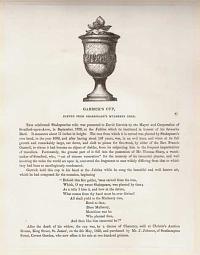
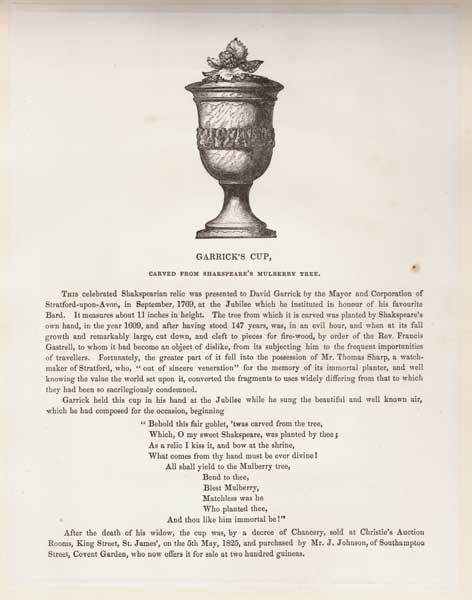
Garrick's Cup, Carved from Shakspeare's Mulberry Tree.
[Engraved by Charles John Smith.]
[London: Henry Bohn, 1852.]
Wood engraving set in letterpress. Sheet 240 x 185mm (9½ x 7¼"). Mounted in album paper.
'Garrick's Cup' was presented to David Garrick by the Mayor and Corporation of Stratford during Garrick's 'Shakespeare Jubilee' in 1769. According to the letterpress it was carved from the wood of a Mulberry tree that Shakespeare planted in 1609 and felled by the Reverend Francis Gastrell to stop sightseers. It was sold by Christies in 1825 (after the death of Garrick's widow), and offered for sale by J. Johnston in Covent Garden for 200 guineas. There are several Garrick's Cups in existence. From Charles John Smith's 'Historical and Literary Curiosities' (scarce).
[Ref: 61959] £190.00
(£228.00 incl.VAT)
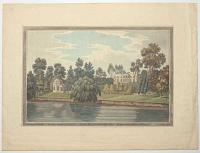
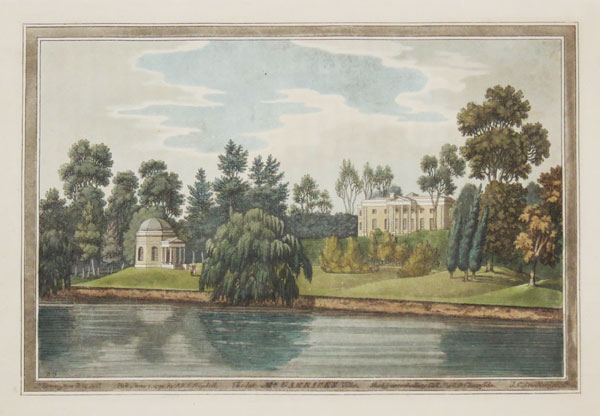
The late Mr. Garrick's Villa.
J. Farington R.A. delt. J. C. Stadler Sculpt.
Pub. June 1, 1793, by J. & J. Boydell, Shakespeare Gallery, Pall Mall, & No. 90, Cheapside.
Aquatint with fine hand colour. Printed area 215 x 320mm (8½ x 12½"), with wide margins. Slight creasing in right margin.
A view of Garrick's Villa on the River Thames at Hampton, with the house and a Palladian folly, 'Garrick’s Temple to Shakespeare'. The hugely influential actor and playwright, David Garrick (1717 - 1779), bought Hampton House in 1754, at employed Robert Adam to make numerous alterations. Plate 45 from Joseph Farington's (1747 - 1821) 'History of the River Thames', 1794, a two-volume publication including 76 aquatints. Abbey: 432. Gascoigne, Twickenham 658.
[Ref: 61682] £220.00
(£264.00 incl.VAT)

The late Mr. Garrick's Villa.
J. Farington R.A. delt. J. C. Stadler Sculpt.
Pub. June 1, 1793, by J. & J. Boydell, Shakespeare Gallery, Pall Mall, & No. 90, Cheapside.
Aquatint with fine hand colour. Printed area: 215 x 320mm (8½ x 12½"), with wide margins. Slight staining in margin.
A view of Garrick's Villa on the River Thames at Hampton, with the house and a Palladian folly, 'Garrick’s Temple to Shakespeare'. The hugely influential actor and playwright, David Garrick (1717 - 1779), bought Hampton House in 1754, at employed Robert Adam to make numerous alterations. Plate 45 from Joseph Farington's (1747 - 1821) 'History of the River Thames', 1794, a two-volume publication including 76 aquatints. Abbey: 432. Gascoigne 658.
[Ref: 33479] £220.00
(£264.00 incl.VAT)
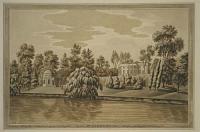
The late Mr. Garrick's Villa.
J. Farington R.A. delt. J. C. Stadler Sculpt.
Pub. June 1, 1793, by J. & J. Boydell, Shakespeare Gallery, Pall Mall, & No. 90, Cheapside.
Sepia aquatint. Printed area: 215 x 320mm (8½ x 12½") Stain top right hand corner.
A view of Garrick's Villa on the River Thames at Hampton, with the house and a Palladian folly, 'Garrick’s Temple to Shakespeare'. The hugely influential actor and playwright, David Garrick (1717 - 1779), bought Hampton House in 1754, at employed Robert Adam to make numerous alterations. Plate 45 from Joseph Farington's (1747 - 1821) 'History of the River Thames', 1794, a two-volume publication including 76 aquatints. The series is well-known for the quality of the hand colour of most examples. However a few of the earliest impressions were printed in sepia for print connoisseurs. Abbey: 432. Gascoigne 658.
[Ref: 2407] £160.00
(£192.00 incl.VAT)
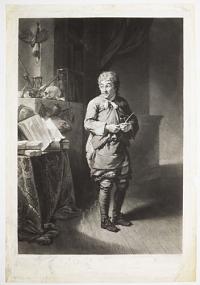
[Garrick, in the character of Abel Drugger.
Painted by Sir Joshua Reynolds Engraved by S.W. Reynolds. Engraver to the King.
Mess.rs Colnaghi & Co,, Pall Mall, East, March 3rd 1825.]
Mezzotint, proof before letters. 530 x 355mm (21 x 14"). Wear and soiling of inscription area and margins, lacking pasted label correcting astist's name. Small margins.
The actor stands, pipe in hand, before a table of alchemist's books and paraphernalia. The plate has the name of Reynolds as painter instead of the Johann Zoffany; this proof was issued with a pasted correction label, resulting in a clean area around the name as in this example. Whitman 98 state I.
[Ref: 48980] £230.00
(£276.00 incl.VAT)
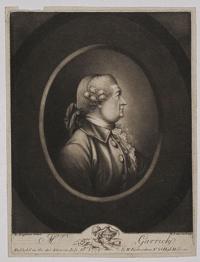
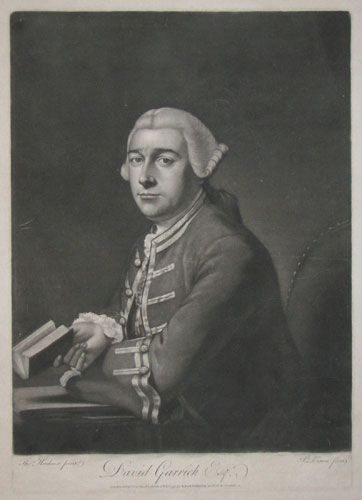
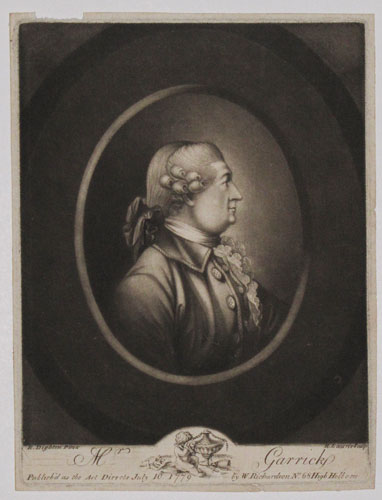
Mr. Garrick.
R. Dighton Pinx.t. R. Laurie Sculp.
Pub.d as the Act Directs July 10. 1779 by W. Richardson No. 68 High Holborn
Mezzotint, platemark 155 x 115mm (6 x 4½"). Thread (partly damaged) margins; water staining not showing on front.
David Garrick (1717-1779), English actor and theatrical manager. The most celebrated actor of his day, he did more than anyone else to change the British acting style, which prioritised energy and engagement above accuracy and control. As a manager (primarily of the Drury Lane Theatre, Covent Garden) he presided over the creation of Shakespeare as national poet and icon, while shaping the texts to suit the demands of his patrons. The supremacy of Drury Lane during Garrick's management was not to be matched until Irving's reign at the Lyceum in the following century, and in the names of pubs and streets, and the famous Garrick Club, Covent Garden is filled with echoes of one of the greatest men to have occupied the area. From a set of small mezzotint portraits of actors published by the printseller William Richardson in 1779. Garrick had died a few months before the print was published. Engraved after a painting by draughtsman and singer Robert Dighton (1751-1814) by the mezzotint engraver and printseller Robert Laurie (1755?-1836). Music, instruments and mask (representing theatre) in title area. Ex: collection of the late Hon. C. Lennox-Boyd; CS 1 iii/iii.
[Ref: 36674] £220.00
(£264.00 incl.VAT)
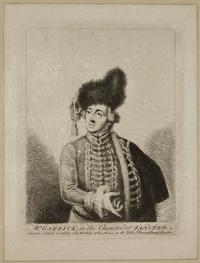
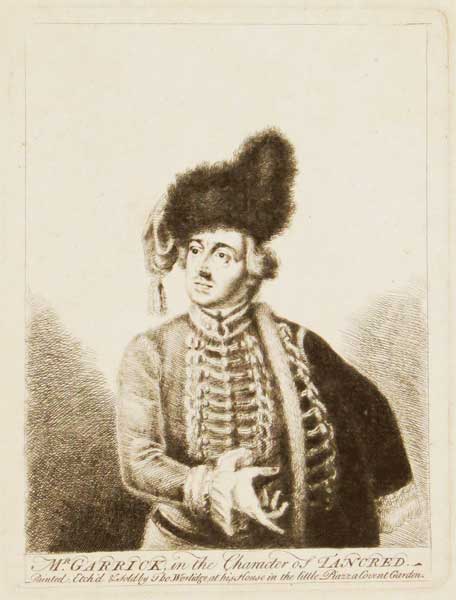
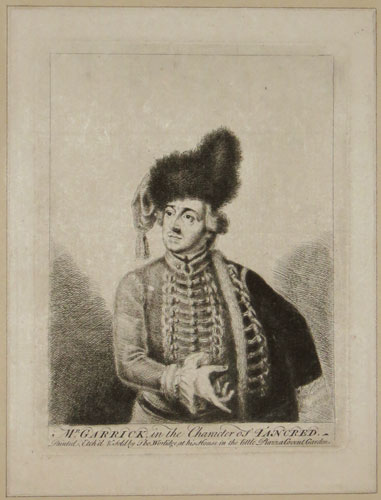
Mr Garrick in the Character of Tancred.
Painted, Etch'd & Sold by Tho. Worlidge, at his House in the little Piazza Covent Garden.
[1752]
Etching, platemark 165 x 125mm (6½ x 5"). Margins; good impression; tipped into album page.
David Garrick in James Thomson's play 'Tancred and Sigismunda', which he acted at Drury Lane in 1752. The painter and printmaker Thomas Worlidge, who lived in Covent Garden and painted several portraits of the actors working in the nearby theatres, painted at least three of Garrick in this role (Garrick Club, Victoria & Albert Museum, and a private collection). Worlidge also made another, full-length etching of Garrick in a different pose. Posthumous impression after numbers erased. W79; D80; for Worlidge's other etching of Garrick see ref. 7478. Information from V&A website. Ex collection of the Late Hon. C. Lennox-Boyd.
[Ref: 32882] £95.00
(£114.00 incl.VAT)
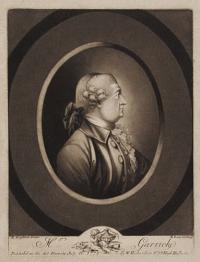
Mr. Garrick.
R. Dighton Pinx.t. R. Laurie Sculp.
Pub.d as the Act Directs July 10. 1779 by W. Richardson No. 68 High Holborn
Mezzotint. 155 x 115mm (6 x 4½"), a good impression, uncut.
David Garrick (1717-1779), English actor and theatrical manager. The most celebrated actor of his day, he did more than anyone else to change the British acting style, which prioritised energy and engagement above accuracy and control. As a manager (primarily of the Drury Lane Theatre, Covent Garden) he presided over the creation of Shakespeare as national poet and icon, while shaping the texts to suit the demands of his patrons. The supremacy of Drury Lane during Garrick's management was not to be matched until Irving's reign at the Lyceum in the following century, and in the names of pubs and streets, and the famous Garrick Club, Covent Garden is filled with echoes of one of the greatest men to have occupied the area. From a set of small mezzotint portraits of actors published by the printseller William Richardson in 1779. Garrick had died a few months before the print was published. Engraved after a painting by draughtsman and singer Robert Dighton (1751-1814) by the mezzotint engraver and printseller Robert Laurie (1755?-1836). Music, instruments and mask (representing theatre) in title area. Ex: Oettingen-Wallenstein collection and collection of the late Hon. C. Lennox-Boyd; CS 1 iii/iii.
[Ref: 36675] £330.00
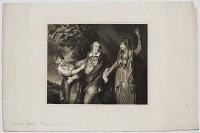
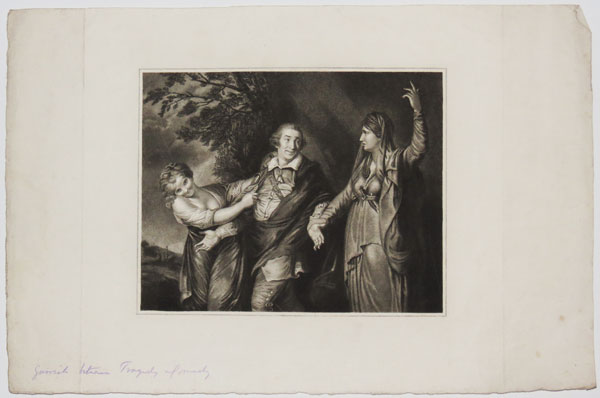
[Garrick, Between Tragedy & Comedy. Engraved by Anthony Cardon from a Picture by Sir Joshua Reynolds, in the Collection of John Julius Angerstein, Esq. To John Philip Kemble Esq. who from a laudable regard to Historical propriety & to the merits of our great national Dramatist, has revived many of his admirable Plays, in a style honourable to himself and to the character of the British Stage, with the annexed Essay, are inscribed by J. Britton.]
[Class I. Painting for the Fine Arts of the English School. London: Pub'd Decr. 1. 1811 by Longman & Co. Paternoster Row, J. Taylor, High Holborn, & Wm. Bond, Newman Street.]
Stipple and etching, proof before all letters. 290 x 315mm (11½ x 12¼"). Ink mss. in margin and inscription area.
David Garrick standing between Comedy and Tragedy, smiling towards the latter, but allowing the former to tug him towards her. Illustration to "The Fine Arts of the English School" [ed. John Britton, London: 1811.]
[Ref: 41251] £95.00
(£114.00 incl.VAT)
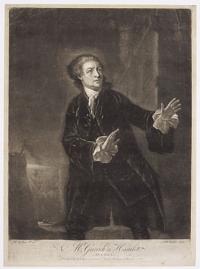
Mr Garrick in Hamlet. Act 1 Scene 4
B. Wilson Pinx.t J. McArdell Fecit
Publish'd by B. Wilson according to Act of Parliament Novem.r 1754.
Mezzotint, platemark 455 x 330mm (18 x 13"). Creases at top, small margins.
David Garrick (1717-1779), English actor and theatrical manage, in the role of Hamlet. The most celebrated actor of his day, he did more than anyone else to change the British acting style, which prioritised energy and engagement above accuracy and control. As a manager (primarily of the Drury Lane Theatre, Covent Garden) he presided over the creation of Shakespeare as national poet and icon, while shaping the texts to suit the demands of his patrons. The supremacy of Drury Lane during Garrick's management was not to be matched until Irving's reign at the Lyceum in the following century, and in the names of pubs and streets, and the famous Garrick Club, Covent Garden is filled with echoes of one of the greatest men to have occupied the area. This print illustrates the moment when Hamlet is confronted by the ghost of his dead father, the king of Denmark, who was murdered by his brother Claudius. Engraved after a portrait by Benjamin Wilson (1721 - 1788), portrait painter and scientist, etcher, occasional mezzotinter and collector of Rembrandt who was appointed Hogarth's successor as Serjeant-Painter to the King. Lennox-Boyd. 'Theatre: The Age of Garrick' 22 iii/iv.
[Ref: 43747] £450.00
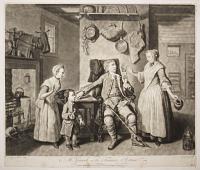
M.r Garrick in the Farmer's Return.
Zoffany Pinxit. J. Boydell excudit. J. G. Haid fecit.
Published according to Act of Parliament March 1st. 1766, by J. Boydell Engraver, in Cheapside London.
Mezzotint. Plate: 430 x 500mm (17 x 19¾"). Trimmed to plate on lower edge. Creasing in corners where glued to a backing sheet at corners. Slight staining in title area. Thread margins.
A theatrical scene showing David Garrick and Mary Bradshaw in Garrick's play 'The Farmer's Return from London' as performed at the Drury Lane Theatre. The farmer sits in the centre of the image recounting a tale to a woman and two children, the woman almost drops a jug in alarm and the young boy tips his candle dangerously. CS: 3 II of II.
[Ref: 46179] £580.00
![[Mr Garrick in Richard the Third.]](img-thumbnail/jpegs/36616.jpg)
[Mr Garrick in Richard the Third.]
N. Dance pinx.t. J. Dixon Fecit.
Published according to Act of Parliament April 28 1772 by John Boydell Engraver, Cheapside, London
Mezzotint, platemark 635 x 395mm (25 x 15½"). Finished proof with scratched inscription; small margins; slight foxing.
David Garrick (1717-1779), English actor and theatrical manager, in the role of Richard III. By the time this print was published Garrick was particularly associated with this role. Hogarth also painted Garrick in the same role. Engraved from the painting by Nathaniel Dance shortly after it was exhibited at the Royal Academy in 1771. The painting is owned by Stratford-upon-Avon Town Council. It was acquired by Sir Watkin Williams Wynne, who reputedly outbidded Garrick himself (who had promised to buy the painting for his wife!). Garrick is known to have admired this print and sent impressions to his friends with complimentary lines printed and pasted on the back. It was also used as the model for Derby porcelain statuettes. Lennox-Boyd 28 i/ii; CS 15 i/ii; for other prints of Garrick as Richard III see refs. 12907 and 20562.
[Ref: 36616] £620.00
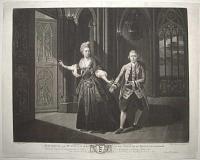
Mr Garrick and Mrs Pritchard in the Tragedy of Macbeth. Act II Scene III. From the Original Picture painted by J. Zoffany, in the possession of George Keate Esq.r. To Whom this Plate is Inscribed, by his Most Humble Servant, John Boydell.
J. Zoffany Pinxit. V. Green Engraver to his Majesty fecit.
Published March 30th 1776 by J. Boydell Engraver in Cheapside London.
Mezzotint, 18th century watermark. 460 x 555mm (18 x 21¾"), with large margins. Central vertical crease.
Double portrait of two actors in character, in Shakespeare's 'Macbeth': Hannah Pritchard (1711-68) as Lady Macbeth holding dagger and indicating towards an open door, and David Garrick (1717-79) as Macbeth, hesitating. The original painting, at the time owned by poet and artist George Keate (1729-97), is now in the Garrick Club. Painted in 1768 it is said to show Hannah Prichard's last performance: she retired the same year and died shortly afterwards.
[Ref: 55678] £360.00
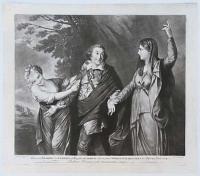
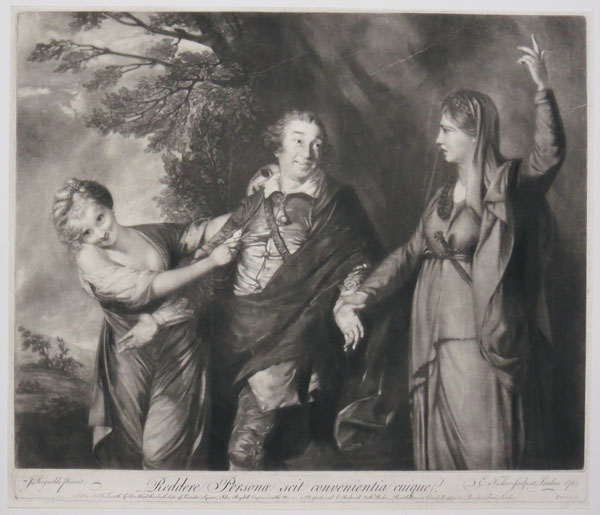
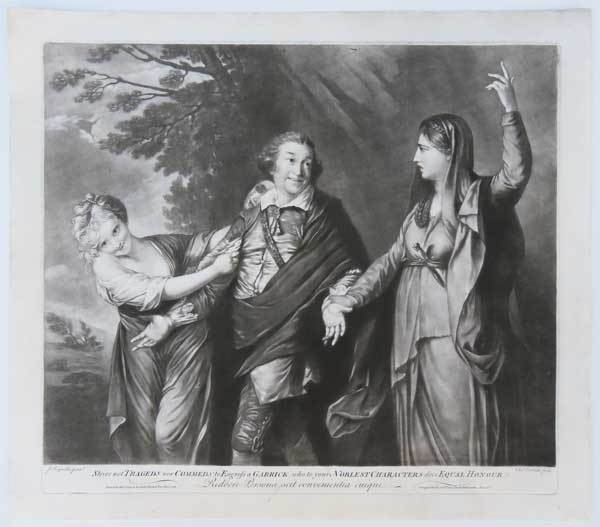
Strive not Tragedy nor Comedy to Engross a Garrick, who to Your Noblest Characters does Equal Honour. Reddere Persona scit convenientia cuique.
J. Reynolds pinx.t. C. Corbutt fecit.
London, Printed for Rob.t Sayer Map & Printseller at the Golden Buck near Serjeants Inn, Fleet Street [n.d. c.1765].
Fine mezzotint. 255 x 355mm (10 x 14"), large margins.
David Garrick (1717-1779) caught between the Muses of Tragedy (Melpomene) and Comedy (Thalia). The original painting (now in Waddesdon Manor, owned by the National Trust and managed by the Rothschild Foundation) was completed in 1761 and first engraved by Edward Fisher in mezzotint the following year. This version, engraved by Richard Purcell under his pseudonym of Charles Corbutt, was one of at least fourteen mezzotint copies and pirates. Purcell was a native of Dublin and learned engraving from Brooks and Miller. He followed in the footsteps of McArdell and went to London, where he worked with Sayer copying the works of McArdell, Watson and others. CS: 31 (only state.) Hamilton: p.29.
[Ref: 60870] £420.00

David Garrick Esq.r. From the Latest Picture.
S.r Jos,a Reynolds Pinxt. R.Laurie Fecit.
London, Printed for & Publish'd as the Act Directs Jan.y 30th, 1779 by J.Stevens opposite Hatton Garden Holborn.
Rare mezzotint. Sheet 360 x 255mm (14 x 10"). Trimmed to plate.
Portrait of David Garrick (1717 - 1779), English actor, playwright, theatre manager and producer who influenced nearly all aspects of European theatrical practice throughout the 18th century, and was a pupil and friend of Samuel Johnson. CS21.
[Ref: 65204] £160.00
(£192.00 incl.VAT)
![[Garrick between Tragedy and Comedy.]](img-thumbnail/jpegs/67822.jpg)
[Garrick between Tragedy and Comedy.]
[J. Reynolds Pinxit. E. Fisher sculpsit Londini 1762]
[Sold by Edw.d Fisher, at the Golden Head the South Side of Leicester Square, John Boydell Engraver, at the Unicorn, in Cheapside, and E. Bakewell, & H. Parker, _PrintSellers in Cornhill, opposite Birchin Lane, London.]
Mezzotint, without the title printed from a separate plate, 18th century watermark. 410 x 505mm (16 x 20"). Tear entering plate at top, two tears and rubbing in margin.
A portrait of actor David Garrick (1717-1779), showing him torn between the female figures of Comedy and Tragedy. Although he looks at Tragedy he is allowing Comedy to pull him away. The scene is a parody of the Choice of Hercules, in which the hero was asked to choose between Pleasure and Virtue, choosing the more difficult but more honourable path of Virtue. Walpole notes that the idea for the painting was Garrick's. The picture was one of Garrick's favourites: in 1764 he wrote from Paris, ''I am so plagu'd here for my prints or rather prints of me - that I must desire you to send me by the first opportunity six prints from Reynolds' picture, you may apply to the engraver he lives in Leicester Fields, and his name is Fisher, he will give you good ones, if he knows they are for me''. A separate plate was used to print the title, with a Latin title (''Reddere Personæ scit convenientia cuique''). CS 20, iii of iii. Hamilton p.29.
[Ref: 67822] £260.00
(£312.00 incl.VAT)

M.r Garrick in the character of Kitely; Every Man in his Humour. Act 2,d Scene 1,st.
J. Reynolds pinx.t. J. Finlayson fec.t.
Publish'd Feb.y 1.st 1769. Sold by M.r Parker, N.º 82 Cornhill, & M.r Finlayson in Berwick Street Soho.
Mezzotint. 380 x 275mm (15 x 10¾"). Trimmed to plate at bottom, creased horizontal centre, laid on album paper at edges.
A half-length portrait of David Garrick, leaning on a balustrade, in costume in Ben Jonson's 1598 play, 'Every Man in his Humour'. Garrick revived and revised the play in 1751, playing the part of Thomas Kitely, a man comsumed by the paranoid belief that his wife was cuckolding him. It became one of his signature roles. CS 7, iii of iv. Ex: collection of The Hon. Christopher Lennox-Boyd.
[Ref: 67992] £240.00
(£288.00 incl.VAT)

M.r Garrick in the character of Kitely; Every Man in his Humour. Act 2,d Scene 1,st.
J. Reynolds pinx.t. J. Finlayson fec.t.
Publish'd Feb.y 1.st 1769. [Sold by M.r Parker, N.º 82 Cornhill, & M.r Finlayson in Berwick Street Soho.]
Mezzotint, proof before title and publication line. 380 x 275mm (15 x 10¾"), with large margins. Crack in top platemark taped, nicks in edges.
A half-length portrait of David Garrick, leaning on a balustrade, in costume in Ben Jonson's 1598 play, 'Every Man in his Humour'. Garrick revived and revised the play in 1751, playing the part of Thomas Kitely, a man comsumed by the paranoid belief that his wife was cuckolding him. It became one of his signature roles. CS 7, ii of iv.
[Ref: 67993] £260.00
(£312.00 incl.VAT)
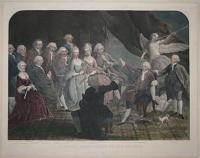
Garrick Surrounded by His Friends. [Names listed underneath each sitter.]
Painted by W. Hogarth. Engraved by G.S. Shury.
London: Published Aug.t 20.th 1866, by A.J. Isaac, 56, Bishopsgate St.
Fine hand-coloured mezzotint and stipple. Plate 470 x 604mm. 18½ x 23¾". Mount stain.
Group portrait of Mr. Garrick surrounded by his friends (from left to right) John Beard, Robert Baddeley, Eva Maria Garrick, Henry Woodward, Unknown man, Francis or James Aickin, Charles Macklin, William 'Gentleman' Smith, Mary Ann Yates, Frances Abington, William Hogarth, William O'Brien, David Garrick and Peter Garrick. NPG: D34380. V & A: S.499-2009.
[Ref: 20918] £260.00
(£312.00 incl.VAT)
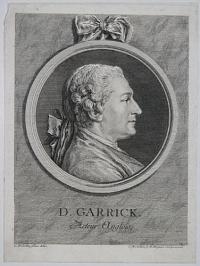
D. Garrick. Acteur Anglois.
C.N. Cochin filius delin. C.N. Cochin, et N. Dupuis Sculpserunt.
[n.d. c.1780.]
Copper engraving, rare. 198 x 146mm. 7¾ x 5¾".
David Garrick (1717-1779), the English actor, playwright, theatre manager and producer who influenced nearly all aspects of theatricl practice throughout the 18th century. He was a pupil and friend of Dr Samuel Johnson. Harvard Voume II. p.84: 1.
[Ref: 20978] £180.00
(£216.00 incl.VAT)
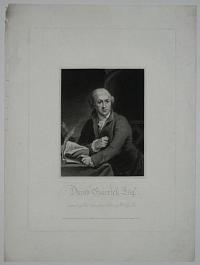
David Garrick Esq.r
Engraved by Rob.t Cooper from a Picture by Rob.t Edge Pine.
Published May 8. 1815, fro the Proprietor by E. Baldwyn, Catherine Street, London, and R. Cooper, Mornington Place, Hampstead Road.
A rare stipple and etching, with large margins. Plate 375 x 273mm. 14¾ x 10¾".
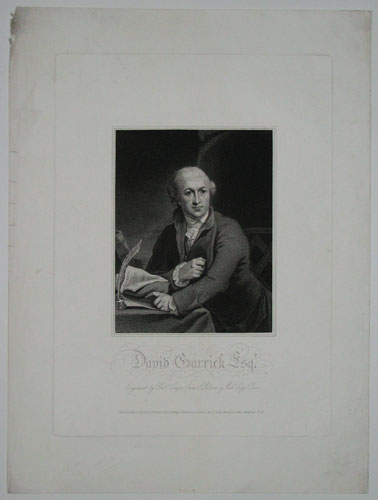
David Garrick (1717-1779), the English actor, playwright, theatre manager and producer who influenced nearly all aspects of theatrical practice. He was a friend and one-time pupil of Dr Samuel Johnson. Here seated, leaning with his elbows on a table to left, left hand on a script labelled 'Macbeth', near an ink-pot and book, looking towards the viewer, wearing a wig with a queue, plain coat and lace cravat and collars. Harvard Volume II. p.87: 41.
[Ref: 20989] £220.00
(£264.00 incl.VAT)
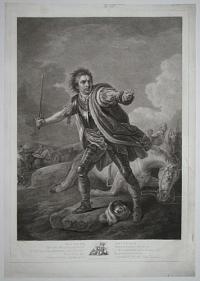
Richard The Third, To the right hon.ble Baroness Howe, This print representing Garrick in the character of Richard the III, in the memorable Battle of Bosworth Field, Is dedicated by her ladyships most obedient humble Servant, John Boultbee.
Hayman & Boultbee pinx.t. W. Bromley sculp.t.
Chester, Published by John Boultbee, Jany, 21st 1811.
Stipple with etching, open letter state, 565 x 405mm (22¼ x 16"). Repaired small tear into upper margin and on right.
David Garrick (1717 - 1779), the greatest actor of his age, in a dramatic scene in the title role of William Shakespeare's history play Richard III. His costume is a suit of armour and robe, his sword is drawn and his helmet lies on the ground as he is surrounded by hostile forces; dying horse behind him. The painting by Hayman was probably prompted by Garrick's revival of the play at Drury Lane in 1759, although the attempts at historical veracity in evidence here owe more to history painting than the conventions of theatrical portraiture. The painting is in the collection of London's National Theatre. Harvard p.104, 278; Brian Allen, 'Francis Hayman'
[Ref: 20562] £350.00
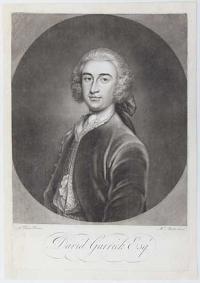
David Garrick Esq.r.
A. Pond Pinxit. M.cArdell Fecit.
[n.d. c.1750.]
Fine mezzotint, 18th century watermark. 330 x 225mm (13 x 9") with large margins.
Half-length portrait of David Garrick (1717-1779), the English actor, playwright, theatre manager and producer who influenced nearly all aspects of theatrical practice. He was a friend and one-time pupil of Dr Samuel Johnson. Goodwin 185.II. CS 77.II.
[Ref: 60331] £360.00
(£432.00 incl.VAT)
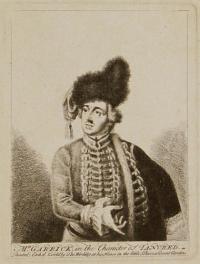
Mr Garrick in the Character of Tancred.
Painted, Etch'd & Sold by Tho. Worlidge, at his House in the little Piazza Covent Garden.
[1752]
Etching, platemark 165 x 125mm (6½ x 5"). Large margins; good impression.
David Garrick in James Thomson's play 'Tancred and Sigismunda', which he acted at Drury Lane in 1752. The painter and printmaker Thomas Worlidge, who lived in Covent Garden and painted several portraits of the actors working in the nearby theatres, painted at least three of Garrick in this role (Garrick Club, Victoria & Albert Museum, and a private collection). Worlidge also made another, full-length etching of Garrick in a different pose. Posthumous impression after numbers erased. W79; D80; for Worlidge's other etching of Garrick see ref. 7478. Information from V&A website. Ex collection of the Late Hon. C. Lennox-Boyd.
[Ref: 32881] £220.00
(£264.00 incl.VAT)
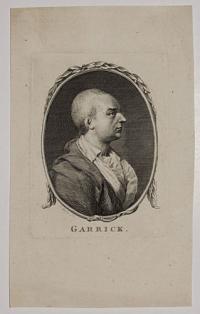
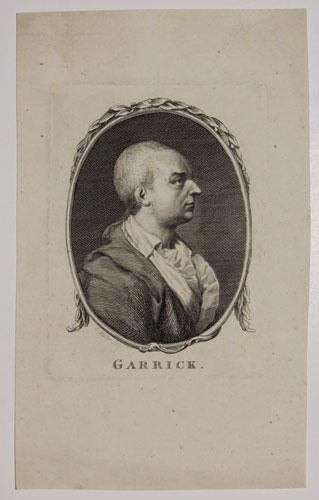
Garrick.
J. Miller. sc:
[n.d. c.1780.]
Stipple and engraving, with large margins. Plate 121 x 95mm. 4¾ x 3¾". A fine impression.
David Garrick (1717-1779), the English actor, playwright, theatre manager and producer who influenced nearly all aspects of theatrical practice throughout the 18th century. He was a pupil and friend of Dr Samuel Johnson. Ex Collection: R. Hobson of Hove. See NPG: D20571.
[Ref: 25328] £120.00
(£144.00 incl.VAT)

David Garrick Esqr
Thos. Hudson pinxt. J. Dixon fecit.
London, Publish'd as the Act directs 11th. Octr. 1779, by Robert Wilkinson, at No. 58 in Cornhill.
Mezzoint 278 x 385mm, 11 x 15¼inches. Large margins, faint stain from old mount, slight band of rubbing in centre.
David Garrick (1717-1779), English actor and theatrical manager, was descended from a good French Protestant family named Garric or Garrique of Bordeaux, which had settled in England on the revocation of the Edict of Nantes. His passion for the stage completely engrossed him; he tried his hand both at dramatic criticism and at dramatic authorship. His first appearance on the stage was made in March 1741, incognito, as Harlequin at Goodman's Fields. In person, Garrick was a little below middle height; in his later years he seems to have inclined to stoutness. The extraordinary mobility of his whole person, and his power of as it were transforming himself at will, are attested to by many anecdotes and descriptions, but the piercing power of his eye is said to have been his most irresistable feature. CS:16 [only state]
[Ref: 12899] £360.00
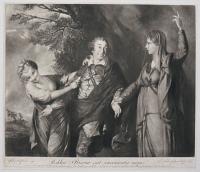
Reddere Persona scit convenientia cuique.
J. Reynolds pinxit. E: Fisher Sculpsit Londini 1762.
Sold by Edw.d Fisher, at the Golden Head the South Side of Leicester Square, John Boydell Engraver, at the Unicorn, in Cheapside, and E: Bakewell, & H: Parke, Printsellers in Cornhill, opposite, Birchin Lane, London. Price 10/6.
Mezzotint, split plate for image and title area, small margins. Image plate 400 x 501mm (15¾ x 19¾"). Text area 24 x 501mm (1 x 19¾"). Some creasing.
David Garrick (1717-1779) between Comedy and Tragedy, smiling towards the latter on the right, but allowing the former to tug him towards her. CS: 20, ii. Hamilton: p.29, ii.; for proof impression see ref. 25245
[Ref: 29963] £380.00
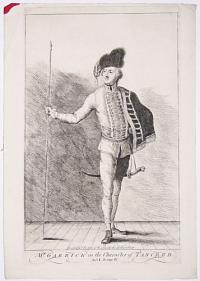
Mr Garrick in the Character of Tancred. Act 1. Scene IV.
[Drawn and engraved by T.Worlidge, 1752.]
Printed for E.Jackson at Rembrandt's head Fleet Street. [n.d., c.1760.
Etching. 320 x 200mm.
David Garrick in James Thompson's 'Tancred and Sigismunda'. Harvard: Garrick 302, state ii of iii, with Worlidge's name removed.
[Ref: 7478] £230.00
(£276.00 incl.VAT)

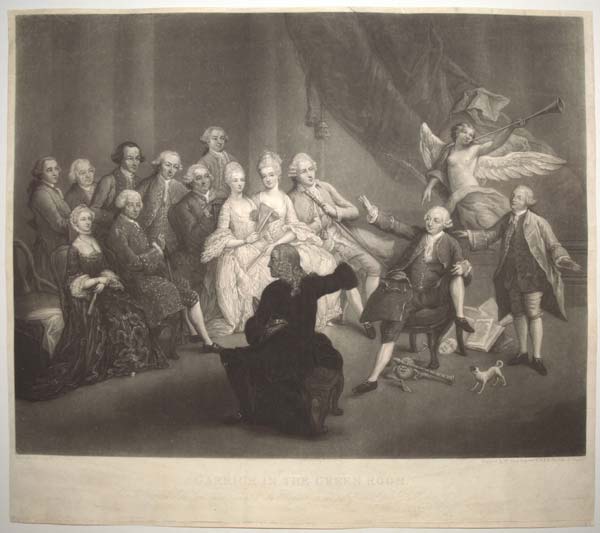
Garrick in the Green Room. From the original of the same size Painted by Hogarth in the Possession of the Publisher, J.W. Southgate, 22 Fleet Street.
Painted by W.m Hogarth [but Pietro Longhi]. Engraved by William Ward, Engraver to H.R.H. The Duke of Clarence. Printed by J. Lahee.
[n.d., c.1829.]
Scarce mezzotint. Sheet 560 x 740mm (22 x 29"). Trimmed within plate on three sides. Few minor repairs. Repaired tear top centre.
David Garrick lounging in a chair, arm raised to an informal audience. Behind the actor is the winged figure of Fame. According to a key in G. Daniel's "A Biographical and Critical Analysis of a Picture' (published in 1829, probably to coincide with the publication of this print), the audience consists of other English actors and Garrick's family, with William Hogarth at the front, back to the audience, head turned, gesturing at Garrick. These attributions were made by the owner of the painting and publisher of the print, James Webb Southgate, who, as an auctioneer and art dealer, had a vested interest in improving the attribution. The BM now attributes the painting to Pietro Longhi (1701-85) and describes the scene as Garrick in a Venetian salon in front of the Duke of Parma; The Lady Lever Art Gallery, where the painting currently resides, titles it merely 'A Poet Declaiming His Verses', despite the masks of comedy and tragedy under the seat suggesting a more theatrical theme. BM 1856,0308.1322; Lady Lever Art Gallery LL 3526; Highfill, 'A Biographical Dictionary of Actors, Actresses, Musicians, Dancers, Managers', vol 6, p.84.
[Ref: 53917] £480.00
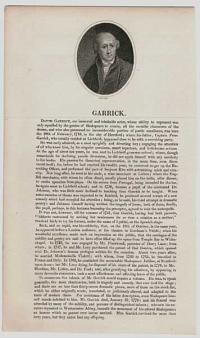
Garrick.
Holl sculp [after Robert Edge Pine].
[n.d., 1819.]
Stipple set in letterpress. Sheet 220 x 130mm (8¾ x 5¼").
An oval miniature portrait of the actor, published in the 'Biographical Magazine containing portraits and characters of eminent and ingenious persons'.
[Ref: 58654] £95.00
(£114.00 incl.VAT)


![[Giuseppe Marc'Antonio Baretti] Joseph Baretti.](jpegs/67964.jpg)
![[Spranger Barry] M.r Barry in the Character of Macbeth.](jpegs/66076.jpg)


![[George, Lord Byron]](jpegs/34944.jpg)
![Lord Byron after Phillips, 1831 [ms in lower margin]](jpegs/34947.jpg)
![Lord Byron [ms]](jpegs/34946.jpg)
![[George, Lord Byron]](jpegs/34945.jpg)


![John Freeth [facsimile signature.]](jpegs/23372.jpg)







![[Mr Garrick in Richard the Third.]](jpegs/36616.jpg)


![[Garrick between Tragedy and Comedy.]](jpegs/67822.jpg)