Results 1-7 of 7
<<< Previous 1 Next >>>
![[Chatham]](img-thumbnail/jpegs/27938.jpg)
[Chatham]
E. Duncan pinx. J. Godfrey sculp.
[n.d., c.1860.]
Engraving. Plate size: 255 x 450mm. 10 x 17½".
A view of the Dockyard at Chatham from the opposite bank of the River Medway. Naval cadets are pictured rowing longboats across the river in the foreground as hulks lay at anchor in the mid-ground next to a finished Man-of-War, with the Dockyard and town beyond.
[Ref: 27938] £160.00
(£192.00 incl.VAT)
![[This View of the Royal Dock Yard at Chatham...PROOF . ]](img-thumbnail/jpegs/21365.jpg)
[This View of the Royal Dock Yard at Chatham...PROOF . ]
[Painted by R. Paton, the Figures by J. Mortimer. [right] Engraved by P.C. Canot.]
[R. Paton, Wardour Street., Soho, London, 14 February 1775. ]
Rare etching, working proof from the unfinished plate, laid paper. Image 450 x 650mm (17¾ x 25½"). Trimmed within plate, and to image on three sides. Centrefold crease and nicks to extremities.
An interesting progress proof impression, before the plate was engraved with fine detail. The published state carries the following full title and inscription "TO THE King's most Excellent Majesty, This View of the Royal Dock Yard at CHATHAM. / Is by PERMISSION and with all Humility, Inscribed By His MAJESTY's most dutiful Subject and Servant, / Rich.d Paton. / [far left] Printed by Hocquet. Size of the Picture 4. ft 10. in by 3. ft 4. in / Publish'd by Royal Authority & as the Law directs London Feb.y 14.th 1775. To be had of R. Paton Wardour Street, Soho. " A fine prospect of Chatham dockyard, Kent, bustling with activity: ships on the water, some in in dry-dock on the far shore, a skeleton of a ship being built to the right of them; carpenters and blacksmiths working on the near bank in the foreground. Two men try to drag a pig across a plank over a gully (lower left) to where people are loading food and drink onto a small ship. The busy docks stretch along the river bend witht he infantry barracks and the Commissioner's House centre right. Richard Paton (1717 - 1791) painted five views of the royal dockyards, in the Royal Collection, in all of which the figures were painted by John Hamilton Mortimer. In 1776 he exhibited at the Royal Academy the views of Rochester and of Deptford docks. See NMM PAH9712. See BL Maps K.Top.16.42.c. DNB.
[Ref: 21365] £680.00
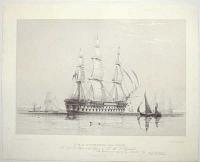
H.M.S. Powerful, 84 Guns. To Captn. C. Napier, & the Officers of H.M.S. Powerful. This print is most respectfully dedicated by The Publisher.
Drawn by H. John Vernon, del. et lith. Day & Hague, Lithrs. to the Queen.
A.Hinton, Portsmouth. [n.d., c.1840.]
Lithograph, sheet 360 x 450mm (14¼ x 17¾"), with large margins.. Repaired tear centre top in margins.
HMS Powerful was an 84-gun second rate ship of the line of the Royal Navy, launched on 21 June 1826 at Chatham Dockyard. From 1 January 1839 to the end of 1840 she was commanded by Captain Charles Napier, mainly in the Mediterranean and for much of the time as lead ship of a detached squadron under Napier's orders. Parker: 1839.
[Ref: 55596] £390.00
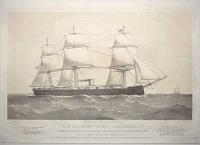
H.M. Sea-Going Turret Ship. ''Monarch'', Conveying the Remains of the Late M.r George Peabody to the United States, December, 1869. Under the Command of Captain John E. Comerell, RN, VB, VC. Built in H.M. Dockyard, Chatham, from the Designs of E.J. Reed Esq. C.B. Chief Constructor of the Navy, by P. Thornton, Esq. Master Shipwright.
T.G. Dutton. Del. et Lith. John B. Day, Lith, 3, Savoy Street, Strand.
London, Published December 6th 1869 by John B. Day, 3, Savoy Street, Strand.
Tinted lithograph. Sheet 465 x 570mm (18½ x 22½"). Some restoration.
A portrait of HMS Monarch, designed by Sir Edward Reed and launched 1868 as the first seagoing British warship to carry her guns in turrets. The ship is shown taking leave of the Channel fleet to cross the Atlantic with the remains of George Peabody (1795-1869, American merchant regarded as the father of modern philanthropy) to the United States for burial, with USS Plymouth (seen to the right). It was Prime Minister William Ewart Gladstone who assigned Monarch, the newest and largest warship of the Royal Navy, demonstrating British respect for Peabody. In 1862 George Peabody creates the Peabody Trust. He donates £150,000 increasing to £500,000 to build affordable houses for the "artisan and labouring poor of London". The Peabody Estates still exist and have over 220,000 members.
[Ref: 61260] £480.00
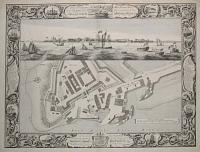
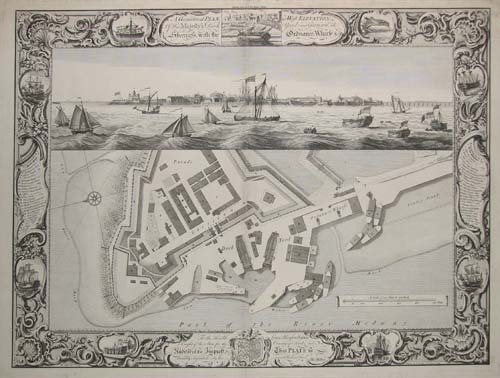
A Geometrical Plan, & West Elevation Of His Majesty's Dock-Yard, and Garrison at Sheerness, with the Ordanance , Warfe, &. C. To the Honourable Lewis Monson Watson Knight of the Shire for the County of Kent, and Auditor of the Imprest, This plate is humbly inscribed by his most Obedient Servt. Thos. Milton.
Thos. Milton Surv:etdelin: Shipping by T.Cleveley P.C.Canot Sculpt.
Publsih'd according to Act of Parliament Thos. Milton. 14 April 1755.
Engraving 495 x 660mm. Trimmed to plate, centre fold, minor nicks and scratches
Explanation and Key to plan and elevation left and right. Sheerness was the focus of an attack by the Dutch navy in June 1667, when 72 hostile ships during the Raid on the Medway compelled the little 'sandspit fort', to surrender and landed a force which for a short while occupied the town. Impressed by the civil behaviour of the Dutch marines - they paid for their dinner - the town reinvited the Dutch Marine Corps for the third centennial of the raid. Pepys at Gravesend remarked in his diary 'we do plainly at this time hear the guns play' and in fear departed to Brampton in Huntingdonshire. Sheerness was also the site of a Royal Dockyard which, although not as large as those at Chatham and Deptford was still of some importance in Tudor and Stuart England. During the Victorian age a warship was built which still exists - HMS Gannet (an 'Osprey' class Sloop) which was launched on 31 August 1878.
[Ref: 4258] £650.00
![[Sheerness Dockyard.]](img-thumbnail/jpegs/9085.jpg)
[Sheerness Dockyard.]
R. Paton pinxt. 1778. C Canot aqua fortis. W. Watts sculp.
London Published 1 March 1803 by B. B. Evans in the Poultry.
Etching and engraving, scratched letter proof before title, 510 x 690mm. 20 x 27¼". Laid on card; two vertical creases through centre.
Sheerness, beside the mouth of the River Medway on the northwest corner of the Isle of Sheppey in north Kent. Sheerness began as a fort built in the 16th century to protect the River Medway from naval invasion. In 1665, plans were first laid by the Navy Board for a Royal Navy dockyard where warships might be provisioned and repaired, a site favored by Samuel Pepys, then Clerk of the Acts of the navy, for shipbuilding over Chatham. After the raid on the Medway in 1667, the older fortification was strengthened; in 1669 the Royal Navy dockyard was established, where warships were stocked and repaired until its closure in 1960. An impressive scene after Richard Paton (1717 - 1791), painter of marine subjects. With an etched crest below image.
[Ref: 9085] £480.00

H.M.S. Vernon, 50 Guns
Drawn by H. John Vernon, Day & Hague, Lith.rs to the Queen.
A.Hinton, Portsmouth. ___Ackermann & Co. London
Tinted lithograph. Printed area 415 x 290mm. Small nicks in margins.
HMS Vernon was a fifty gun frigate,designed by Sir William Symonds, that saw active service in home waters, under Captain Sir F. A. Collier in the Dutch blockade 1832, the Americas and the East Indies between 1832 and 1848. She was then laid up in Chatham Dockyard, becoming a topledo school at Portsmouth 1876. Parker:1918.pg.91
[Ref: 6320] £260.00
(£312.00 incl.VAT)
<<< Previous 1 Next >>>
![[Chatham]](jpegs/27938.jpg)
![[This View of the Royal Dock Yard at Chatham...PROOF . ]](jpegs/21365.jpg)


![[Sheerness Dockyard.]](jpegs/9085.jpg)