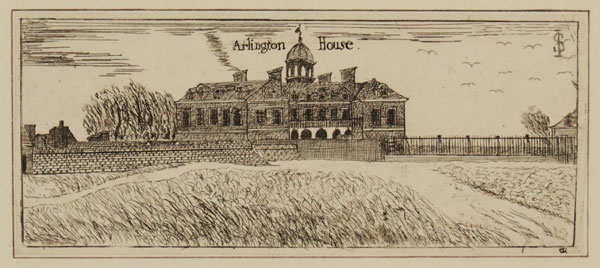
Arlington House.
['IS' monogram in image upper right.]
[British, n.d., originally c.1680.]
Etching, image 70 x 180mm. 2¾ x 7". Laid on a scrap sheet.
View of Arlington House in Green Park, Westminster. Originally called Goring House, Arlington House was the residence of Henry Bennet, Earl of Arlington, a minister under Charles II. On the demolition of the house, in 1703, the site was purchased by John Sheffield, Duke of Buckingham, who built on it a mansion of red brick which was eventually to become Buckingham Palace. Possibly this is a copy of a 17th century print. Guildhall Library Record: 20799. Collage: p5415527.
[Ref: 26444] £60.00
(£72.00 incl.VAT)
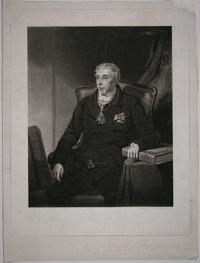
Fred. Aug. Barnard. Ord. Reg. Hanov. Guelf. Eques. Bibliothecae a Georgio III. Institutae Praefectus.
Painted by John Knight. Engraved by S.W. Reynolds, Engraver to the King.
[n.d. c.1820.]
Mezzotint on india. Plate 424 x 337mm. 16¾ x 13¼". Some tearing around the platemark.
Sir Frederck Augusta Barnard (1743-1830) was the principal librarian to George III throughout much of his reign. He sought assistance and guidance from writers and lexicographer Dr Samuel Johnson. Barnard compiled and published a catalogue of the collection 'Bibliothecae Regiae Catalogus' between 1820 and 1829 in five folio volumes. Whitman: 17. BM: 1878,0511.1072.
[Ref: 16771] £180.00
(£216.00 incl.VAT)
![[The Tomb of Edmund Waller, St Mary and All Saints Church, Beaconsfield.]](img-thumbnail/jpegs/26445.jpg)
[The Tomb of Edmund Waller, St Mary and All Saints Church, Beaconsfield.] To Harry Edmund Waller Esq. of Farmington in Gloucestershire, the Lineal Descendant of the Poet... E.& R. King.
From a Sketch by J. Smith. S. Straker, Litho., George Yard, London.
Published by E. & R. King, Beaconsfield, and E. King, Wycombe [n.d., c.1845].
Sepia-tinted lithograph, rare, image 270 x 250mm. 10½ x 9¾". One tear into image at right. Tatty margins folded.
Edmund Waller (1606-1687) was a poet and wit of wavering political allegiance. He died at Hall Barn, the house he had designed and owned in Beaconsfield, Buckinghamshire. In the Civil War, Waller first supported Parliament and then led a plot ('Waller Plot') to seize London for Charles I. He was sentenced to death, but the sentence was commuted to a fine of £10,000 and exile in 1644; was pardoned by Cromwell's influence; praised Cromwell in verse, but later rejoiced in his death.
[Ref: 26445] £130.00
(£156.00 incl.VAT)
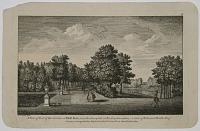
A View of Part of the Garden at Hall-Barn, near Beckonsfield, in Buckinhamshire; a Seat of Edmund Waller Esq.r.
W.m Woollett delin.
Printed by Carington Bowles, Map & Printseller, No. 69 in St Pauls Church Yard, London. [n.d., c.1770.]
Engraving. 175 x 270mm (7 x 10¾").
Hall Barn Manor House was built by Edmund Waller (1606-1687), poet and politician. The Edmund named here was a descendent. From "Twelve Views of Gentlemens Seats and Gardens by Woollett &c.".
[Ref: 16933] £150.00
(£180.00 incl.VAT)
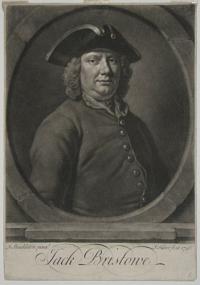
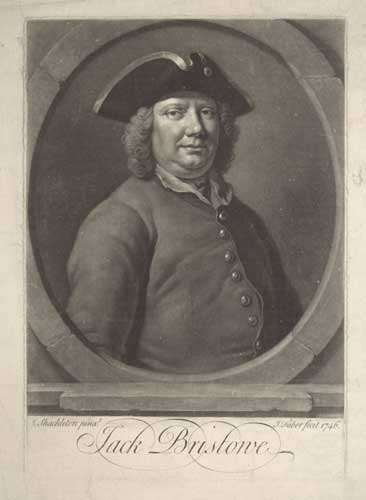
Jack Bristowe.
J. Shackleton pinxt. I. Faber fecit 1746.
Mezzotint. 225 x 330mm. Thread like margins outside the platemark
John Faber the Younger [c.1695 - 1756]. In pencil on the reverse is a claim that the sitter is Colonel in the Guards, while the British Museum supports the suggestion he is Robert Bristowe, a clerk comptroller in the royal household whose sister married John 1st Earl of Buckingham, and also keeper of the Punch House on London Bridge. CS:46:ii
[Ref: 13870] £130.00
(£156.00 incl.VAT)
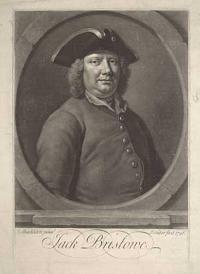
Jack Bristowe.
J. Shackleton pinx.t. J. Faber fecit 1746.
Mezzotint. 330 x 225mm (13 x 8¾"), large margins. Crack in plate mark repaired. Bit messy.
A half-length portrait of a portly man in a plain jacket and tricorn hat. The British Museum suggests he is Robert Bristowe, a clerk comptroller in the royal household whose sister married John 1st Earl of Buckingham, and also keeper of the Punch House on London Bridge. However the will of the artist, John Shackleton (d. 1767) included a bequest of two paintings ''to John Bristow Esqr Keeper of His Majesties Lions in the Tower'', who was also steward to the Duke of Newcastle. CS:46:ii
[Ref: 68533] £160.00
(£192.00 incl.VAT)
![[Buckingham House in St Iames Park]](img-thumbnail/jpegs/38463.jpg)
[Buckingham House in St Iames Park]
[Sutton Nicholls sculp]
[c.1728]
Engraving, sheet 300 x 470mm (11¾ x 18½"). Trimmed inside platemark, losing text and coat of arms; creasing; border drawn by hand at edges; label with ms identifying location pasted verso. Very rare and scarce.
Buckingham House in Westminster, London, built in 1703 as a townhouse for the Duke of Buckingham. It was acquired by George III in 1761 as a private residence for Queen Charlotte. During the 19th century considerable alterations and enlargements were made to the residence by George IV, and in 1837 it became the official royal residence of Queen Victoria, now known as Buckingham Palace. Early view of the residence, engraved by Sutton Nicholls. While the plate is best-known for its appearance in the famous 1754 volume of Stowe's Survey of London, it had been sold individually by the publisher John Bowles since 1728. For uncut later impression see ref. 26386.
[Ref: 38463] £450.00
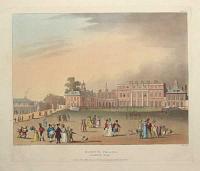
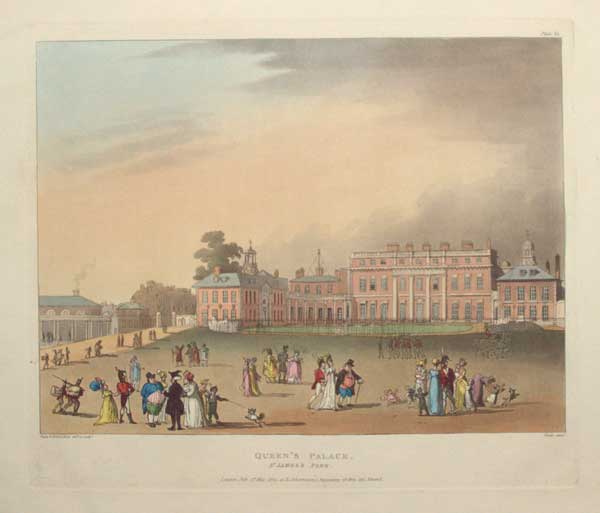
Queen's Palace, St. James's Park.
Rowlandson & Pugin delt. et sculpt. Bluck, aquat.
London Pub. 1st. May 1809, at R. Ackermann’s Repository of Arts 101, Strand.
Fine hand coloured aquatint, plate 230 x 275mm (9 x 10¾"), with large margins.
Buckingham House, the building which forms the core of today's Buckingham Palace, was a large townhouse built for the Duke of Buckingham in 1703 and acquired by George III in 1761as a private residence, known as "The Queen's House". It was enlarged over the next 75 years, principally by architects John Nash and Edward Blore, forming three wings around a central courtyard. Buckingham Palace finally became the official royal palace of the British monarch on the accession of Queen Victoria in 1837. Plate to Volume III of Rudolph Ackermann's 'Microcosm of London', 3 vols., 1808-10. Numbered 'Plate 65.' upper right. Abbey, Scenery: 212, 65.
[Ref: 58326] £260.00
(£312.00 incl.VAT)
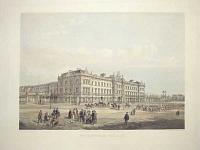
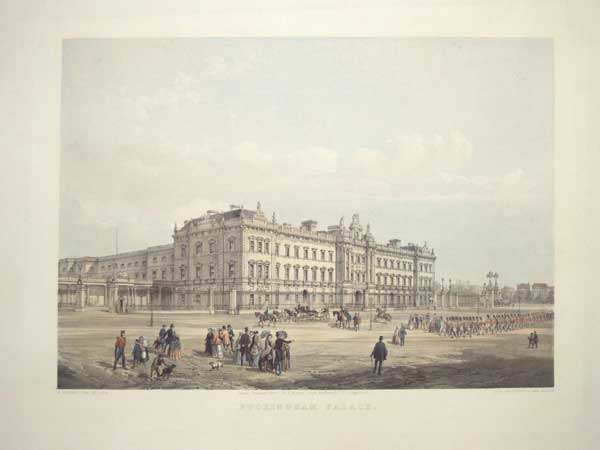
Buckingham Palace.
E. Walker, Del et Lith. Day & Son, Lithrs. to the Queen.
London, Published May 1st 1852, by Mess.rs Lloyd Brothers & Co., 22 Ludgate Hill.
Fine hand coloured lithograph, sheet 425 x 585mm (16¾ x 23"), very large margins.
The principal façade, the East Front, of Buckingham Palace, figures watching the guard marching in foreground. The palace was designed by Edward Blore and built by Thomas Cubitt, completed in 1850. Buckingham House, the building which forms the core of today's Buckingham Palace, was a large townhouse built for the Duke of Buckingham in 1703 and acquired by George III in 1761 as a private residence, known as "The Queen's House". It was enlarged over the next 75 years, and Buckingham Palace finally became the official royal palace of the British monarch on the accession of Queen Victoria in 1837. From a series of 12 views of famous London buildings by Edmund Walker (1850 - 1856; fl.); Abbey describes the folio as 'Views of the Principal Buildings in London'. Abbey Scenery 247, 1.
[Ref: 68983] £550.00

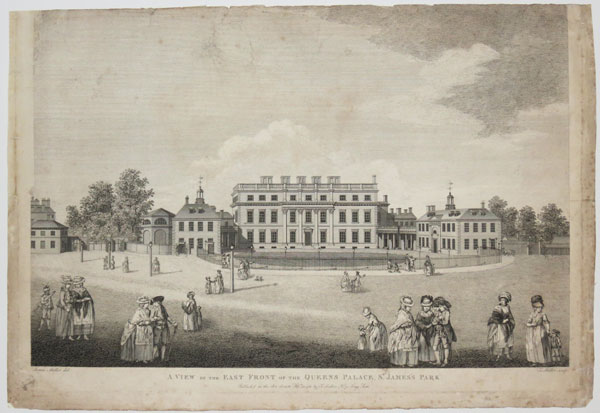
A View of the East Front of the Queens Palace, St James's Park.
James Miller del. T. Miller sculp.
Publish'd as the Act directs Feby. 15 1783 by T. Miller No.72 Long Acre.
Copper engraving, rare early issue. Image 355 x 535mm, 14 x 21". Extremities frayed and chipped; lacking upper margin. Damaged but very rare.
Scarce view of the east front of Buckingham House, Westminster, with figures strolling in the Park, dressed in the fashions of the day. This building formed the core of today's Buckingham Palace, a large townhouse built for the Duke of Buckingham in 1703 and acquired by George III in 1761as a private residence. It was known as "The Queen's House". It was enlarged over the next 75 years, principally by architects John Nash and Edward Blore, forming three wings around a central courtyard. Buckingham Palace finally became the official royal palace of the British monarch on the accession of Queen Victoria in 1837. James Miller (fl.1773 - 1814). The plate was reissued by Thomas Simpson in 1796. Guildhall Library Record 20562. Crace XIII, 17.
[Ref: 23523] £220.00
(£264.00 incl.VAT)

The Queen's Palace, from Green Park, in 1836.
Drawn by T. Maisey. On Stone by W. Gauci. Printed by W. Gauci, 9 North Cres.t Bedf.d Sq.
[n.d., 1836-40.]
Tinted lithograph. Printed area 405 x 270mm (16 x 10½"). Repaird tear entering inscription area, margins creased.
Buckingham Palace from a lost pond in Green Park, with the Marble Arch still in position as the gatehouse, prior to the construction of the East Wing (1847-50). From 'Landscape and Architecture in a Series of Picturesque Views'
[Ref: 39301] £320.00
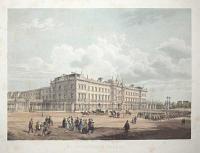
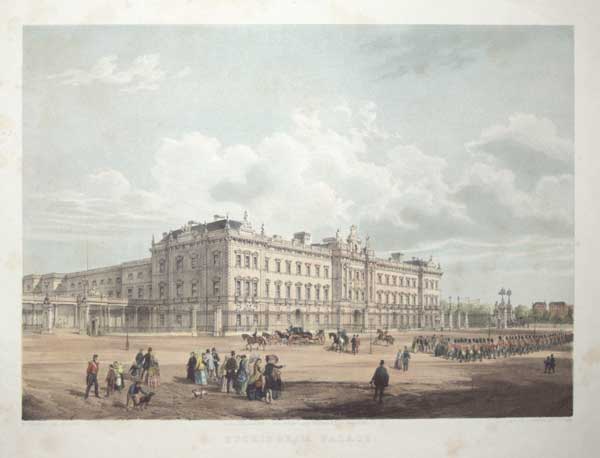
Buckingham Palace.
E. Walker, Del et Lith. Day & Son, Lithrs. to the Queen.
London, Published May 1st 1852, by Mess.rs Lloyd Brothers & Co., 22 Ludgate Hill.
Hand-coloured lithograph, sheet 385 x 495mm (15 x 19½"). Foxing. Repaired tears to edges.
The principal façade, the East Front, of Buckingham Palace, figures watching the guard marching in foreground. The palace was designed by Edward Blore and built by Thomas Cubitt, completed in 1850. Buckingham House, the building which forms the core of today's Buckingham Palace, was a large townhouse built for the Duke of Buckingham in 1703 and acquired by George III in 1761 as a private residence, known as "The Queen's House". It was enlarged over the next 75 years, and Buckingham Palace finally became the official royal palace of the British monarch on the accession of Queen Victoria in 1837. From a series of 12 views of famous London buildings by Edmund Walker (1850 - 1856; fl.); Abbey describes the folio as 'Views of the Principal Buildings in London'. Abbey Scenery 247, 1.
[Ref: 68804] £360.00
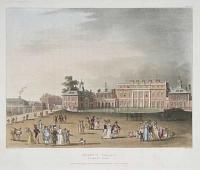
Queen's Palace, St. James's Park.
Rowlandson & Pugin delt. et sculpt. Bluck, aquat.
London Pub. 1st. May 1809, at R. Ackermann’s Repository of Arts 101, Strand.
Hand coloured aquatint, 230 x 275mm. 9 x 10¾".
Buckingham House, the building which forms the core of today's Buckingham Palace, was a large townhouse built for the Duke of Buckingham in 1703 and acquired by George III in 1761as a private residence, known as "The Queen's House". It was enlarged over the next 75 years, principally by architects John Nash and Edward Blore, forming three wings around a central courtyard. Buckingham Palace finally became the official royal palace of the British monarch on the accession of Queen Victoria in 1837. Plate to Volume III of Rudolph Ackermann's 'Microcosm of London', 3 vols., 1808-10. Numbered 'Plate 65.' upper right. Abbey, Scenery: 212, 65.
[Ref: 9879] £260.00
(£312.00 incl.VAT)
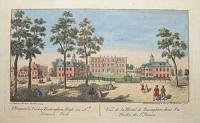
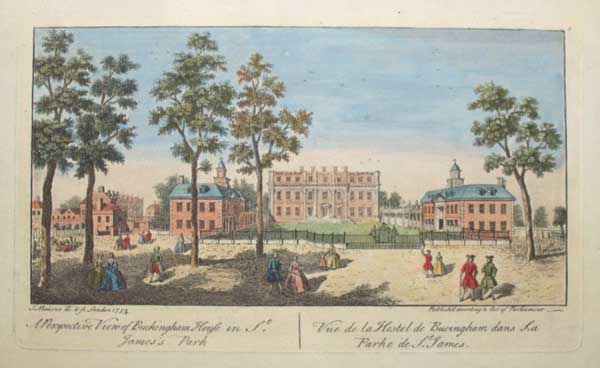
A Perspective View of Buckingham House in St James's Park.
J. Maurer de. et sc. London 1753.
Coloured engraving. 175 x 290mm (7 x 11½"), very large margins.
A view of the original Buckingham House, built 1703, before the 1850 addition of the East front, the public face of what is now Buckingham Palace.
[Ref: 56331] £190.00
(£228.00 incl.VAT)
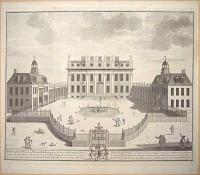
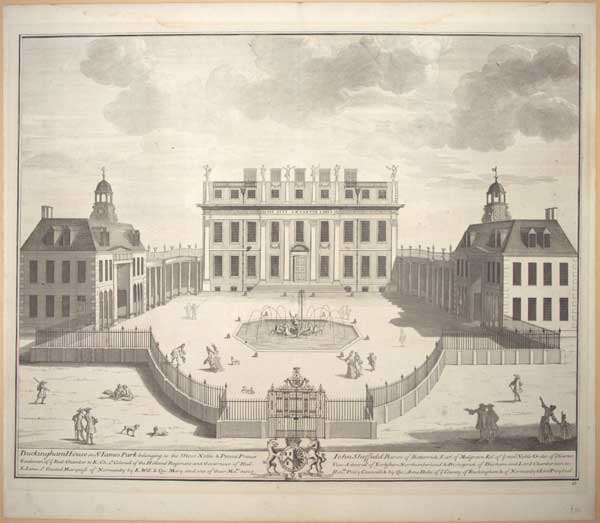
Buckingham House in St James Park belonging to the Most Noble & Potent Prince Iohn Sheffield Baron of Botterwick, Earl of Mulgrave, Kn.t of ye most Noble Order of ye Garter, Gentleman of ye Bed-Chamber to K: Ch. 2d. Colonell of the Holland Regiment and Governour of Hull, Vice-Admirall of Yorkshire Northumberland & Bishoprick of Durham and Lord Chamberlain to K. Iames 2.d Created Marquess of Normanby by K. Will. & Qu: Mary, and one of their Ma.ties most Hon:ble Privy Councell, & by Qu: Anne Duke of ye County of Buckingham & of Normanby & Lord Privy Seal.
[London: David Mortier, n.d. c.1724.]
Engraving. 475 x 595mm (18¾ x 23½"), very large margins. Laid on board.
A view of Buckingham House as built by John Sheffield, 1st Duke of Buckingham and Normanby, in 1703. His illegitimate son, Sir Charles Sheffield, sold the house to George III for £21,000 in 1763 for use by Queen Charlotte. The east wing, today's public façade, was built in 1850.
[Ref: 56357] £450.00
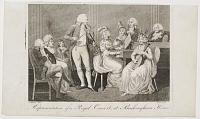
Rrepresentation of a Royal Concert, at Buckingham House.
Cruikshanks delin. Barlow sculp. [c.1790]
Engraving, platemark 120 x 155mm (4¾ x 6"), with accompanying letterpress. Trimmed to platemark top edge;
Published in the Carlton House Magazine or a similar periodical.
[Ref: 45718] £95.00
(£114.00 incl.VAT)

The King's Libary Buckingham House. Plate II.
J. Stephanoff del.t R Reeves sculp.t.
Pub. Dec.r 1.1817, by W.H. Pyne, 9 Nassau Street, Soho.
Fine aquatint, plate 272 x 322mm (10¾ x 12¾"). On paper watermarked '1818. J Whatman Turkey Mills.'
A view of the King's Library in Buckingham House; books lining all the walls; and a large globe surmounted on the wall above the vast fireplace. Published in William Henry Pyne's "History of the Royal Residences". Abbey Scenery: 396.48.
[Ref: 62688] £180.00
(£216.00 incl.VAT)

The King's Libary Buckingham House.
J.P. Stephanoff del.t J. Baily sculp.t
Pub. Dec.r 1.1817, by W.H. Pyne, 9 Nassau Street, Soho.
Aquatint with hand colour, large margins and very fine; paper watermarked:1816. Plate 272 x 322mm (10¾ x 12¾").
A view of the King's Library in Buckingham House; books lining all the walls; and a large globe surmounted on the wall above the vast fireplace. Published in William Henry Pyne's "History of the Royal Residences". Abbey Scenery: 396.48.
[Ref: 30971] £180.00
(£216.00 incl.VAT)

Carlton House.
Published Novr. 29, 1800 by T. Malton.
Hand-coloured aquatint with etching; wide margins, image 210 x 300mm. 8¼" x 11¾".
From 1783 to 1826, Carlton House, in St James's between Pall Mall and The Mall, served as the palatial London residence of the Prince of Wales. There, as Prince and later Prince Regent, George IV lived and entertained lavishly. The Prince decorated Carlton House sparing no expense. 'How sick one shall be, after this chaste palace, of Mr Adam's gingerbread and snippets of embroidery.' Thus wrote Horace Walpole to Lady Ossory in 1785 describing a visit. Carlton House was demolished in 1825 and replaced with two grand white stuccoed terraces of expensive houses known as Carlton House Terrace. The proceeds of the leases were put towards the cost of Buckingham Palace. From 'A Picturesque Tour Through the Cities of London and Westminster, illustrated With the most interesting Views, accurately delineated And executed in Aquatinta by Thomas Malton', 1792 - 1801. Thomas Malton (1748 - 1804) was an architectural watercolourist and teacher of Thomas Girtin and Joseph Mallord William Turner; also an aquatinter, notably after his own designs of London views. Abbey Scenery: 204, 99.
[Ref: 26225] £260.00
(£312.00 incl.VAT)

John Sheffield Earle of Mulgrave Ld Chamberlain of his Ma.ties Household Gentleman of his Bedchamber, Collonell of the Holland Regiment
Gouernour of Hull - Lord Lieutenant for the East Rideing of Yorkshire, Vice Admiral of Yorkshire, Northumberland and Bishoprick of Durham; Knight of the Most Noble Order of the Garter, and One of his Ma.ties most Hon.ble Privy Council. Created Marquess of Normandy 1694. Duke & Marquess of Buckingham-Shire 1703. Dyed Feb 24, 1721.
G. Kneller Eques pinx. J. Smith Fecit et excud. [c.1721]
Mezzotint. Sheet 335 x 245mm (13¼ x 9½").
Trimmed into image on three sides; laid on album sheet. A half-length portrait in oval of John Sheffield (1647-1721), first duke of Buckingham and Normandy, and third earl of Mulgrave, wearing long black wig, lace cravat, chain and George, and robes of off
[Ref: 68600] £220.00
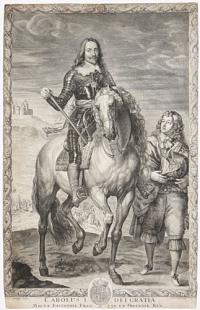
Carolus I. dei Gratia Magnæ Britanniæ rt Hiberniæ Rex.
Wandeck Pinxit. P. Lombart Sculp.
[n.d., c.1655.]
Engraving. Sheet 540 x 350mm (21¼ x 13¾"). Trimmed into image, damaged, tears to folds bottom right.
An equestrian portrait of Charles I in armour, battle scene behind, an impression from the famous 'headless horseman' plate. The king has a distinct 'halo' from obvious re-engraving. Although the original oil (attributed to van Dyck, with one copy now in Buckingham Palace, the other in Petworth House) depicted Charles I, the earliest known impression of this plate shows Cromwell, although even that example had been re-engraved. The next state is also Cromwell, followed by one headless, two of Louis XIV, a Cromwell, a Charles I and finally Cromwell again. BM: 1935,0413.52.
[Ref: 42855] £450.00
![[Carolus I. dei Gratia Magnæ Britanniæ et Hiberniæ Rex.]](img-thumbnail/jpegs/42856.jpg)
[Carolus I. dei Gratia Magnæ Britanniæ et Hiberniæ Rex.]
[Wandeck Pinxit. P. Lombart Sculp.]
[n.d., c.1655.]
Engraving. Sheet 445 x 310mm (17½ x 12¼") Trimmed into image, losing title and frame-like border. Cut.
An equestrian portrait of Charles I in armour, battle scene behind, an impression from the famous 'headless horseman' plate. The king has a distinct 'halo' from obvious re-engraving. Although the picture is attributed to van Dyck, the original oil (one copy now in Buckingham Palace, the other in Petworth House) depicted Charles I. The earliest known impression of this plate shows Cromwell, although even that example had been re-engraved. The next state is also Cromwell, followed by one headless, two of Louis XIV, a Cromwell, a Charles I and finally Cromwell again. BM: 1935,0413.52.
[Ref: 42856] £360.00

Chequers Court, Bucks. Restored.
E.B.Lamb, Arch.t del. E.Bedford, Litho.
Published by John Weale, 59, High Holborn, London, 1846.
Lithograph. Sheet 370 x 255mm (14½ x 10").
A view of Chequers House, Buckinghamshire. The house, originally built in the mid-16th century, was Gothicised in the early 19th century before being restored to its Elizabethan appearance between 1892 and 1901. Chequers House has served as the country home for the serving Prime Minister of the United Kingdom, since 1921. The estate was given to the nation by Arthur Lee, 1st Viscount Lee of Fareham, by a Deed of Settlement, given full effect in the Chequers Estate Act 1917.
[Ref: 67678] £140.00
(£168.00 incl.VAT)

Chequers Court, Bucks. Restored.
E.B.Lamb, Arch.t del. E.Bedford, Litho.
Published by John Weale, 59, High Holborn, London, 1846.
Tinted lithograph. Sheet 370 x 255mm (14½ x 10").
A view of Chequers House, Buckinghamshire. The house, originally built in the mid-16th century, was Gothicised in the early 19th century before being restored to its Elizabethan appearance between 1892 and 1901. Chequers House has served as the country home for the serving Prime Minister of the United Kingdom, since 1921. The estate was given to the nation by Arthur Lee, 1st Viscount Lee of Fareham, by a Deed of Settlement, given full effect in the Chequers Estate Act 1917.
[Ref: 66524] £95.00
(£114.00 incl.VAT)

To His Royal Highness, George, Prince of Wales, this Prospect of Cliefden-House taken from Maidenhead Bridge is most humbly Inscribed by His Royal Highness's most Dutiful and obedient Serv.t Iohn Ryall.
G. Granville Sc.
London Printed for I. Ryall At Hogarth's Head in Fleet. Street. [n.d. c.1780.]
Copper engraving, very scarce. Plate 355 x 502mm. 14 x 19¾".
A view of the Cliveden, the Italianate mansion and estate at Taplow, Buckinghamshire. The house was first built in 1666 by William Winde as the home for George Villiers, 2nd Duke of Buckingham, however the house burned down in 1795. The house depicted here is that which was leased to Frederick Prince of Wales from 1737-1751. Thomas Arne's "Rule Britania" was first performed. The present house designed by Sir Charles Barry, as a blend of the English Palladian and Roman Cinquecento was built for George Sutherland-Leveson-Gower, 2nd Duke of Sutherland. In 1893 the estate was purchased by the American billionaire William Waldorf Astor. In 1942, the Astors gave Cliveden to the National Trust but lived there until 1968.
[Ref: 23062] £420.00
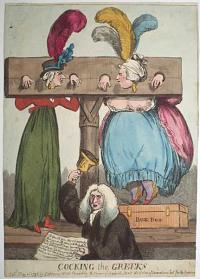
Cocking the Greeks.
Pub.d May 16th 1796 by S.W.Fores, No 50 the Corner of Sackville Street. NB Folios of caractures lent for the Evening.
Fine hand-coloured etching. Sheet: 385 x 290mm (15¼ x 11½"). Trimmed within plate. Taped tear top left in sky.
Lady Archer and Lady Buckinghamshire in the pillory, Lady Buckinghamshire standing on her Faro bank box with her breasts bare. Lord Kenyon stands beneath, ringing a bell and declaiming against illegal gambling. Aristocratic women were unable to gamble in public houses so often set up their own private tables, however, following the start of the French Revolution any behaviour by the aristocratic classes which might cause the working and middle to react was stongly clamped down on. Chief Justaice Lord Kenyon, while judging a case about gambling debts, suggested the pillory as punishment for gamblers, 'whatever may be their rank. or station in the country'. The ladies here ran a notorious faro-bank. BM 8878.
[Ref: 61897] £280.00
(£336.00 incl.VAT)
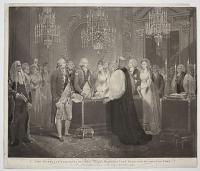
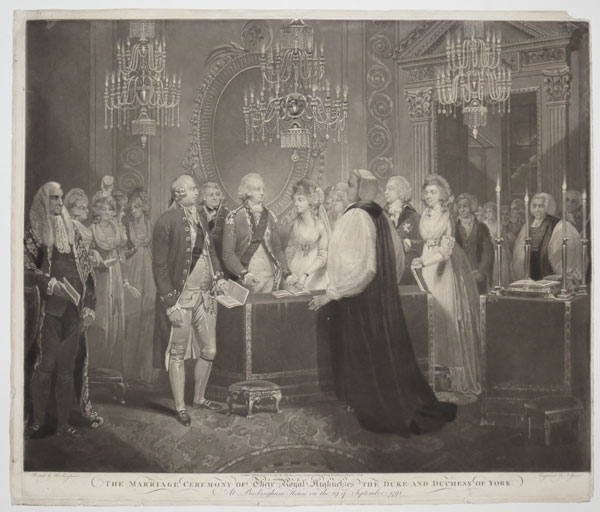
The Marriage Ceremony of their Royal Highnesses, The Duke and Duchess of York At Buckingham House on the 29th of September.
Painted by H. Singleton. Engraved by J. Grozer.
London, Published Jan.y 4, 1797, by I. Brydon at his Looking Glass & Print Warehouse Charing Cross.
Mezzotint, very scarce. 535 x 630mm (21 x 24¾"). Repaired tear in title, narrow right margin.Damage in border.
The marriage of Prince Frederick, Duke of York and Albany, and his cousin Princess Frederica Charlotte of Prussia, the daughter of King Frederick William II of Prussia. The couple soon started living apart. CS: 22 only state.
[Ref: 31148] £420.00
![[Classical Scenes after Princess Elizabeth] This Work is By Permission Dedicated to her Most Gracious Majesty the Queen.](img-thumbnail/jpegs/63271.jpg)
[Classical Scenes after Princess Elizabeth] This Work is By Permission Dedicated to her Most Gracious Majesty the Queen. By Her Majesty's Most Dutiful most Grateful & Most Humble Subject H.D. Thielcke.
Published Dec.r 1.st 1816 by H. Thielcke, Queens House.
Oblong folio, original blue wrappers, engraved dedication and six stipple plates, tissue guards, stitched on left edge, one plate marked 'proof', two plates watermarked 'J Whatman 1816', very large margins. In ink on front wrapper Major G. Taylor £1.11.6 Wrappers worn, dedication stained in edges.
An album of classical scenes after Princess Elizabeth (1770-1840), the seventh child George III and Queen Charlotte, published by Henry Daniel Thielke at what became Buckingham Palace. It was one of several works by Elizabeth to be published in aid of charities. See BM 1873,0809.1417 for the dedication.
[Ref: 63271] £580.00
view all images for this item
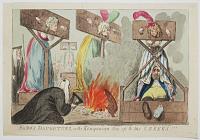
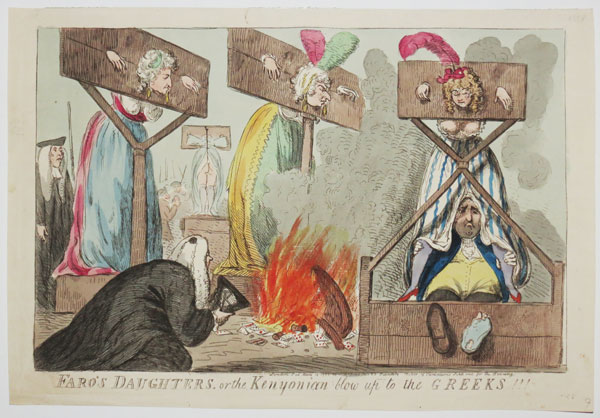
Faro's Daughters, or the Kenyonian blow up to the Greeks!!!
[Isaac Cruikshank.]
London Pub May 16 1796 by SW Fores No.50 Piccadilly Folios of Caraicatures Lent out for the Evening.
Hand-coloured etching, 18th century watermark. Plate: 270 x 400mm (10¾ x 15¾''). Small margins.
A political satire showing four women, Mrs Sturt, Mrs Concannon, Lady Sarah Archer and the Countess of Buckinghamshire in pillory, Charles James Fox sits between the legs of one of the women. Lord Kenyon, kneels in the foreground fanning a fire of games tables, dice and cards. Mrs Concannon ran a popular gaming house in Grafton Street. BM Satire 8879.A.
[Ref: 51087] £480.00
![[Family of Balthazar Gerbier.]](img-thumbnail/jpegs/68460.jpg)
[Family of Balthazar Gerbier.] The Original Picture iby S.r Peter Paul Reubens in the Collection of Samson Gideon Esq.r at Belvedere, in Kent. To whom this Print is Humbly Dedicated By His most Obedient and Devoted Servane, William Jett.
Will.m Jett Delineavit. J.s M.cArdell Fecit.
Publish'd according to Act of Parliament 1755, and Sold by Will.m Jett Painter, next Door to Mounts Coffee-house, Grovesnor Street, London.
Fine mezzotint, 455 x 455mm (18 x 18"), on 18th century watermarked paper. Small tear touching plate at bottom, creasing. Small margin top and bottom, very large margins left & right.
A portrait of the wife and four children of Anglo-Dutch art advisor, architect and artist Balthazar Gerbier (1592-1663). Gerbier came to London in 1616 and gained the patronage of the Duke of Buckingham, buying paintings and remodelling York House (thus making Gerbier a candidate for the designing of the York Watergate, still in Embankment Gardens). He also participtated in diplomatic missions, accompanying Buckingham and Prince Charles to Madrid for the 'Spanish Match'. He was a friend of Rubens, with the artist staying at Gerbier's house during his visit to London in 1629. Gerbier was in Antwerp when Rubens died in 1640, compiling an inventory of his art collection for Charles I. CS 86. Russell ii of iii. Goodwin: 42, ii of iii. Ex: collection of The Hon. Christopher Lennox-Boyd.
[Ref: 68460] £580.00

Court Garden and Great Marlow.
J. Farington R.A. del.t J.C. Stadler fct.
Pub: June 1. 1793, by J. & J. Boydell. Cheapside, & Shakspeare Gallery Pall Mall.
Hand-coloured etching and aquatint. Image with border 207 x 316mm. 8¼ x 12½". Sheet 311 x 406mm. 12¼ x 16". Trimmed and laid on card. few repaired nicks.
View with the Thames in the middle distance, across a field with four cows, a bridge on the right to the town of Marlow on the other side of the river, the Court Garden House on the left, three figures in the right foreground resting at an elevated ground surrounded by trees. Plate 34 to the first volume of "A History of the River Thames" within 'A History of the Principal Rivers of Great Britain' (1794). Abbey Scenery: 432.34.
[Ref: 25861] £90.00
(£108.00 incl.VAT)

A Peachery & Green House. Executed for The Rev.d Primatt Knapp, Shenley End, Bucks. Plate 26.
London Published Sept.r 1.st 1806 by J. Taylor 59 High Holburn.
Etching with aquatint hand colour, sheet 345 x 240mm (13½ x 9½"), large margins on 2 sides. Trimmed to plate on left.
A plan and views of a Greenhouse. From surveyor and builder George Tod's 'Plans, elevations and sections, of hot-houses, green-houses, an aquarium, conservatories, &c. Recently built in different parts of England, for various noblemen and gentlemen.' Primatt Knapp, rector of Shenley (1730-93) was father of botanist John Leonard Knapp (1767–1845).
[Ref: 61125] £130.00
(£156.00 incl.VAT)

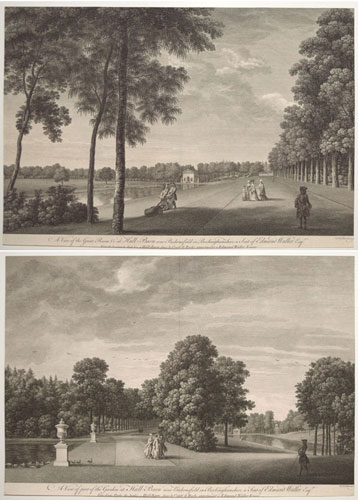
A View of part of the Garden at Hall-Barn near Beckonsfield in Buckinghamshire, a Seat of Edmund Waller Esq.r. [&] A View of the Great Room etc. at Hall-Barn near Beckonsfield in Buckinghamshire, a Seat of Edmund Waller Esq.r.
W. Woollett del. [et sculp.]
[London: John Tinney et al., c.1760.]
Matching pair of etchings with engraving. Sheets c. 340 x 495mm (13½ x 19½"). Slight central crease. Trimmed into images and inscriptions, losing publication lines.
Hall Barn, a listed Grade II* country house near Beaconsfield, built by Edmund Waller (1606-1687), poet and MP. Fagan 36 & 37
[Ref: 54710] £480.00
view all images for this item
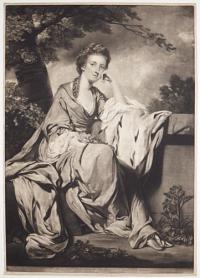
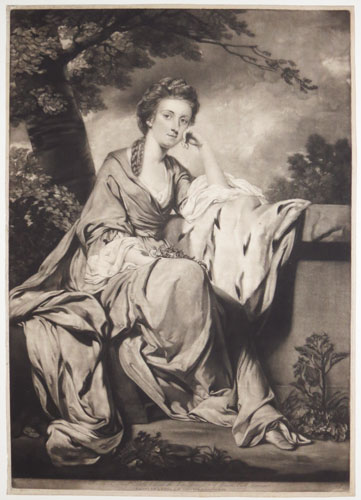
The Right Hon.ble Lady Elizabeth Lee, Daughter of Simon Earl Harcourt.
J. Reynolds pinx.t. Engrav'd & Sold by E. Fisher, at the Golden Head in Leicester Fields [c.1770].
Mezzotint. 505 x 355mm (19¾ x 14"). Thread margins.
Lady Elizabeth Harcourt, Lady Lee (1739-1811), engraved after the portrait by Sir Joshua Reynolds now at Hartwell House, Buckinghamshire, a property managed by the National Trust. Hamilton p.114 ii/iii; CS 37 ii/iii.
[Ref: 46867] £480.00
![[Albina Hobart, Countess of Buckinghamshire.] Enter Cowslip, with a bowl of Cream.](img-thumbnail/jpegs/58405.jpg)
[Albina Hobart, Countess of Buckinghamshire.] Enter Cowslip, with a bowl of Cream. _ Vide Brandenburg Theatricals.
J.s G.y des.n et fec.t.
Pub.d June 13th 1795 by H. Humphrey No 37 New Bond Street.
Coloured etching. Stuck on verso in ink, a description of an oak tree from Bassaleg Monmouth, 10' in width and 470' high, cut down 1810; Sheet 330 x 220mm (13 x 8¾"). Trimmed to printed border. Some toning.
A caricature of Albina Hobart (c.1737-1816., Countess of Buckinghamshire, almost spherical, holding a bowl. Albinia was famed for her society parties at Hobart House in Ham, which involved illegal high stake gambling on the faro card game. She also performed at the private theatre of the Margravine of Anspach at Brandenburg House, Hammersmith. Her size, lifestyle and love of extravagant fashion aimed at her daughters' generation made her a target for caricatures: over 50 satirical prints of her were made. A rare Gillray image. BM Satires 8721. From the Collection of Miss Harriet Robinson.
[Ref: 58405] £420.00
Unfortunately this item is either sold or reserved. If you are interested in similar items and cannot find what you're looking for on our website, please consider filling in our interests form. If you register, we can also send you items that match your interests when the website is updated.

The Loss of the Faro Bank! Or The Rook's Pigeon'd_ "When Greek meets Greek, then comes the tag of War!"
J.s Gillray inv & fec.t.
Pub'd Feb.y 2nd 1797 by H.Humphrey New Bond Street.
Coloured etching 350 x 250mm (13¾ x 9¾ "). Frame measures 475 x 380mm (18¾ x 15"). Slightly time stained. Unexamined out of frame.
A satirical scene depicting Lady Buckinghamshire is shocked at her gambling table as her husband bursts in, shouting that the bank has been robbed and they're ruined. He rushes off to report it, vowing to catch the thief. She’s stunned, saying she locked the money up herself and blames the loss on allowing suspicious guests into the house. She laments the loss of £700 without even getting to deal a hand. Around her, the guests react in alarm. Mrs. Concannon says her gold snuffbox was stolen the night before. Lady Archer angrily adds that someone was pickpocketed at her house recently. Charles James Fox, trying to stay unnoticed, and Richard Brinsley Sheridan does the same. Behind them, George Hanger threatens to fight anyone who dares come near him. The scene ends with the line: “When Greek meets Greek, then comes the tug of war!” BM Satire 9078.
[Ref: 66036] £320.00
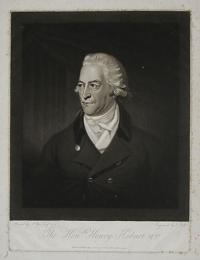
The Hon.ble Henry Hobart. M.P.
Painted by J. Opie Esq.r R.A. Engraved by E. Bell.
Norwich: Published July 30.th 1804, by J. Freeman. No.2 London Lane.
Mezzotint, with very large margins. Platemark: 370 x 280mm (14½ x 11"). Foxing in margins. Rubbing to and creasing to sheet. Uncut.
A portrait of British politician Henry Hobart (1738 - 1799). Head and shoulders within a square frame, looking towards the left, with powdered hair and cravat. The family home of Blickling Hall, is one of England's finest houses. Hobart in Tasmania is named after this sitter's brother, George, 3rd Earl of Buckingham. Hobart, who was an MP for Norwich between 1786 and 1799, was a reliable supporter of William Pitt's administration as Prime Minister. Hobart's main passion however, shared with his elder brothers, was the promotion of the Italian opera in England. The new 'Hamarket Opera House' of 1790 was surmounted with the Hobart family motto. Chaloner Smith: 9.
[Ref: 35400] £230.00
(£276.00 incl.VAT)

Robert Earl of Buckinghamshire.
Painted by T. Lawrence R.A. Engraved by R. Dunkarton.
Published Feb.y 20th. 1808, by W.m Richardson York House 31, Strand.
Rare mezzotint. 495 x 355mm (19½ x 14"). Trimmed to plate.
A three-quarter portrait of Tory politician Robert Hobart (1760-1816), 4th Earl of Buckinghamshire. In 1794 he was appointed Governor of Madras, in which post he remained until 1798. He later served as Secretary of State for War and the Colonies from 1801-4, as Chancellor of the Duchy of Lancaster in 1805 and 1812, Postmaster General 1806-7 and as President of the Board of Control from 1812 until his death in 1816. Because he gave Governor King instructions to found a settlement at Port Dalrymple, North Tasmania, the town was given the name Hobart. The plate was originally engraved by Joseph Grozer, but was reworked by Dunkarton when Hobart became earl. CS Grozer 13, ii of ii. Ex Collection: Norman Blackburn.
[Ref: 66080] £380.00

The Celebrated Dwarf in the reigns of Charles the first & second. Jeffrey Hudson Died in 1682. From the original by D. Mytens in the collection of Sir Ralph Woodford Bart. Born at Ockham, in Rutlandshire in 1619. Taken into the Service of the Duchess of Buckingham, at Burleigh between the age of 7 & 9, and served up in a Cold Pye, at an Entertainment given to Charles, the First, and his Queen. Sent to France for the Queen's Midwife in 1630, and made prisoner by a Flemish Pirate. Made a Captain of Horse in the Civil Wars; & fights a Duel on Horse back with Mr. Crofts, whom he kills with the first fire: Again made captive at Sea, by a Turkish Rover, & carried into Slavery where he remains some years. Redeemed: settles for a time in his native country, & afterwards removes to London. Committed to the Gate House as a Papist, & dies soon after his release in his Sixty-Third Year.
G.P. Harding delin.t James Stow sculp.t
Published Dec.r 1.st 1810.
Engraving. 260 x 202mm (10¼ x 8").
Jeffrey Hudson (1619-1682) was a dwarf who belonged to the court of Queen Henrietta Maria of England in the years before King Charles I was deposed. He was considered one of the wonders of the age. He fought for the royalists in the civil wars and fled with the queen to France in 1644. Some years later, he was captured by some Barbary pirates and spent twenty-five years as a slave in North Africa before being ransomed back to England to live the rest of his life in poverty. See NPG: D28510.
[Ref: 17574] £70.00
(£84.00 incl.VAT)
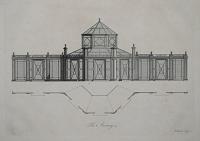
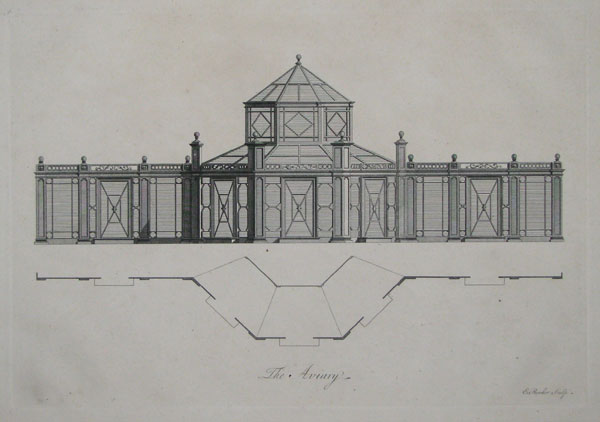
The Aviary.
E. Rooker Sculp.
[London, 1763.]
Copper engraving. Plate 292 x 427mm. 11½ x 16¾". Large margins. Time staining outside the platemark.
A plan of the Aviary in Kew Gardens, as designed by the Scottish architect Sir William Chambers (1723-1796). His contribution to architectural design in London surpasses that of many other architects of the time. He was responsible for many of Kew Gardens' temples, Carlton House, north and south wings of Buckingham Palace, Richmond Palace, Sir Joshua Reynolds house, internal decorations of St James's Palace, Somerset House and many others. He was appointed tutor in architecture to the future George III. From William Chamber's 1763 publication of the 'Plans, Elevations, Sections and Perspective Views of the Gardens and Buildings at Kew in Surrey'. See Ref: 16627 for a perspective view of the Aviary and Flower Garden from the same publication.
[Ref: 19904] £180.00
(£216.00 incl.VAT)
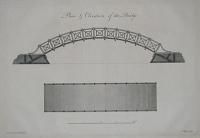
Plan & Elevation of the Bridge.
W. Chambers Architectus. T. Miller sculp.
[London, 1763.]
Copper engraving. Plate 298 x 439mm. 11¾ x 17¼". Large margins. Time staining outside platemark.
A plan for a bridge constucted at Kew Gardens, by the Scottish architect Sir William Chambers (1723-1796). His contribution to architectural design in London surpasses that of many other architects of the time. He was responsible for many of Kew Gardens' temples, Carlton House, north and south wings of Buckingham Palace, Richmond Palace, Sir Joshua Reynolds house, internal decorations of St James's Palace, Somerset House and many others. He was appointed tutor in architecture to the future George III. From William Chamber's 1763 publication of the 'Plans, Elevations, Sections and Perspective Views of the Gardens and Buildings at Kew in Surrey'.
[Ref: 19901] £150.00
(£180.00 incl.VAT)
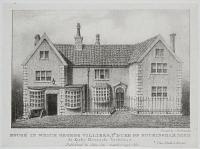
House in which George Villiers, 2d. Duke of Buckingham Died, At Kirkby Moorside Yorkshire.
Printed by C. Hullmandel.
Published by John Cole,_Scarborough, 1824.
Lithograph, scarce, image 180 x 125mm. 7 x 5". Lacking some margin.
George Villiers, 2nd Duke of Buckingham (1628-1687), statesman and dramatist. The son of James I's favourite, Buckingham fought for the royalist side during the Civil War and was exiled, but he later returned to England and married the daughter of the parliamentarian General Fairfax, in the hope of regaining his lands. At the Restoration he was favoured by Charles II, helped to engineer the downfall of Clarendon and became a member of the Cabal. Famous for his intrigues and immorality, he seduced the Countess of Shrewsbury and killed her husband in a duel in 1668. Described as 'one of the worst men alive', he was eventually dismissed from office in 1674. He wrote a number of witty satirical comedies.
[Ref: 26821] £85.00
(£102.00 incl.VAT)
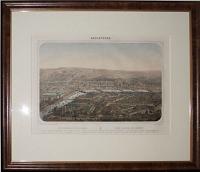
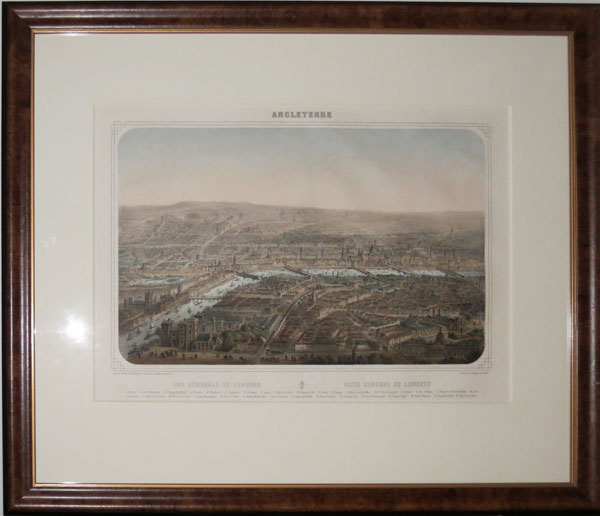
Angleterre. Vue Générale de Londres. Vista General de Londres.
Dessiné et Lithog par Ch. Rivière.
Paris, L. Turgis J.ne Imp.r Editeur, r. des Ecoles, 60_ Maison à New-York. [c.1865.]
Tinted lithograph. Printed area 390 x 495mm, 15½ x 19½". Framed. Unexamined out of frame.
A balloon-view of London taken from above Vauxhall, with a 32-point key. The Houses of Parliament and Lambeth Palace are lower left, St George's Circus and Bethlehem Hospital (now the Imperial War Museum) lower right. Other landmarks in the key are Buckingham Palace, Regents Park, St Paul's, Monument and London Bridge. We have assigned the date of 1865 because of the Hungerford Railway Bridge of John Hawkshaw which opened in 1864 and a cursory depiction of Joseph Bazalgette's Victoria Embankent, started 1865 and not finished until 1870. Little is known about the artist, Charles François de Riffardeau, Duc de Rivière (1848-1920). He produced a volume 'Vues de Londres dessinées d'après nature et lithographiées' in 1862 (not including this prospect). His father (with the same name) was French ambassador to the Ottoman Empire, during which time he helped purchase the Venus de Milo for the Louvre.
[Ref: 27778] £1,250.00
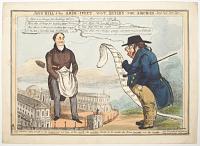
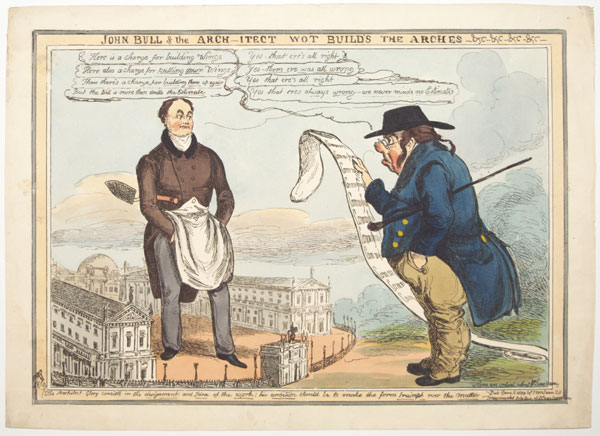
John Bull & the Archi_tect Wot Build's the Arches_ &c_ &c_ &c_ &c_ (The Architect Glory consists in the designment and Idea of the work; his ambition should be to make the form triumph over the matter.
[Paul Pry] Esq.
Pub June 5 1829 by T McLean 26 Haymarket Sold Pub. of P Prys caricatures None are original without Mc Lean's Name.
Fine hand-coloured etching. 260 x 360mm (10¼ x 14¼"). Trimmed to plate.
Satire on the cost of John Nash's reconstruction of Buckingham House (now Palace) with perhaps the only contemporary printed likeness of the architect. Nash stands between the two wings of the house, confronted by John Bull who scrutinises a scroll on which the word 'Commission' is many times repeated. By this time more than double the original estimate had already been spent and an alteration to the wings had cost £50,000 (both issues alluded to in the speech between Nash and John Bull). Nash admitted that he had profited by exchanging his salary for a percentage commission on expenditure (hence the scroll). During 1829 a thousand men were toiling to finish the Palace by the King's birthday (August 12) in 1830, making the publication of this print particularly timely. BM Satires: 15794.
[Ref: 52761] £420.00
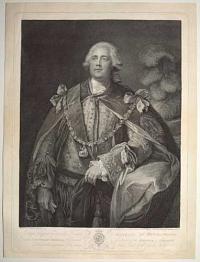
George-Nugent-Temple-Grenville, Marquis of Buckingham. Lord Lieutenant General & General Governor of the Kingdom of Ireland; Knigh Companion of the most Nobles Order of the Garter, &c. &c.
Painted by T. Gainsborough R:A: 1787. Engraved by J.K. Sherwin Historical Engraver to His Majesty, & to His Royal Highness the Prince of Wales.
London Published 20 March 1788 by I.K. Sherwin No. 67 New Bond Street, & R. Wilkinson No. 58 Cornhill.
Very fine engraving. 495 x 361mm (19½ x 14¼"), large margins. Faint crease outside image.
Three-quarter length portrait of George Nugent-Temple-Grenville (1753-1813), 1st Marquess of Buckingham. As Lord Lieutenant of Ireland under Pitt, he was denounced by Grattan for extravagance and was censured by the Irish Houses of Parliament for refusing to transmit to England an address calling upon the Prince of Wales to assume the regency. He maintained his position by bribery for a time but resigned his office in September 1789. The engraver, John Keyes Sherwin (1751-1790), was a painter and engraver who succeeded Woollett as engraver to the king in 1785. Despite an income of more that £12,000 a year he died in penury in 1790 because, as the Encyclopedia Britannia describes him, he was "shiftless, indolent, and without method" and a reckless gambler. However the Encyclopedia also states that his portraits of Buckingham and Pitt (both after Gainsborough) "occupy a high place among the productions of the English school of line-engravers". Horne: 33, ii of ii.
[Ref: 57672] £290.00
(£348.00 incl.VAT)
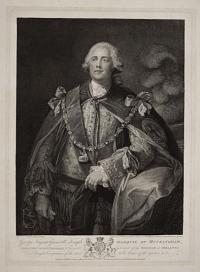
George-Nugent-Temple-Grenville, Marquis of Buckingham, Lord Lieutenant General & General Governor of the Kingdom of Ireland; Knigh Companion of the most Nobles Order of the Garter, &c. &c.
Painted by T. Gainsborough R:A: 1787. Engraved by J.K. Sherwin Historical Engraver to His Majesty, & to His Royal Highness the Prince of Wales.
London Published 20 March 1788 by I.K. Sherwin No. 67 New Bond Street, & R. Wilkinson No. 58 Cornhill.
Very fine engraving, with large margins. Plate 495 x 361mm. 19½ x 14¼". Uncut.
Three-quarter portrait of George Nugent-Temple-Grenville (1753-1813), 1st Marquess of Buckingham. As Lord Lieutenant of Ireland under Pitt, he was denounced by Grattan for extravagance and was censured by the Irish Houses of Parliament for refusing to transmit to England an address calling upon the Prince of Wales to assume the regency. He maintained his position by bribery for a time but resigned his office in September 1789. The engraver, John Keyes Sherwin (1751-1790), was a painter and engraver who succeeded Woollett as engraver to the king in 1785. Despite an income of more that £12,000 a year he died in penury in 1790 because, as the Encyclopedia Britannia describes him, he was "shiftless, indolent, and without method" and a reckless gambler. However the Encyclopedia also states that his portraits of Buckingham and Pitt (both after Gainsborough) "occupy a high place among the productions of the English school of line-engravers". Horne: 33, ii of ii; Encyclopedia Britannica, 11th edition (1911); NPG D32297.
[Ref: 24808] £360.00
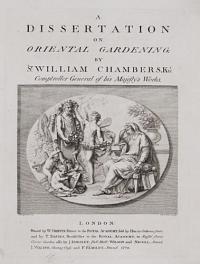
A Dissertation on Oriental Gardening; by Sr: William Chambers, Knt: Comptroller General of his Majesty's Works.
G.B. Cipriani inv. F. Bartolozzi sculp.
[London] Printed by W. Griffin, Printer to the Royal Academy [also Davies, Dodsley, Wilson, Nicoll, Walter and Elmsley]. 1772.
Engraved illustrated titlepage to the first (4to) edition, with large margins, rare. 230 x 170mm, 9 x 6¾".
According to Colvin, the book was “primarily an attack on the bare style of landscape gardening associated with Capability Brown, and the oriental dress was merely a literary camouflage. To Chamber’s embarrassment his supposed championship of the Chinese garden as a model for imitation was taken seriously by the public, obliging him in 1773 to publish a second edition with an “Explanatory Discourse.’ Scottish architect Sir William Chambers (1723-1796) was responsible for many of Kew Gardens' temples, Carlton House, the north and south wings of Buckingham Palace, Richmond Palace, Sir Joshua Reynolds house, internal decorations of St James's Palace, Somerset House and many others. He was appointed tutor in architecture to the future George III. The classical design in an oval after Giovanni Battista Cipriani (1727 - 1785) shows a spirit with butterfly wings decorating a statue with flower garlands; on the right, a woman seated on a chair, and on the left, three naked putti, one drawing. See BL L.32/58. Colvin p. 205. De Vesme 1693.
[Ref: 26329] £220.00
(£264.00 incl.VAT)
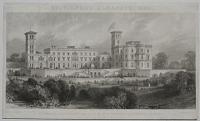
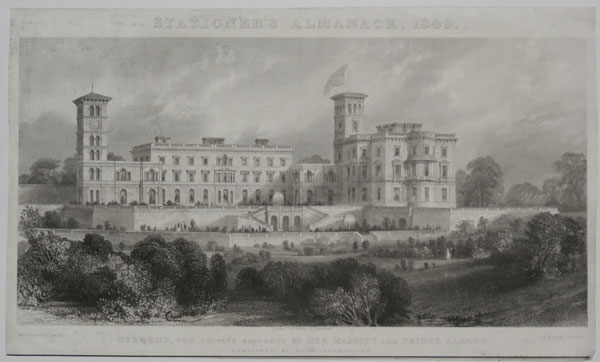
Stationer's Almanack, 1849. Osborne, The Private Property of Her Majesty and Prince Albert.
Thos. Cubitt, Archt. T.A. Prior, Sculpt.
London: J. & W. Robins 57 Tooley Street. Published by Royal Permission [1848].
Steel engraving, headpiece illustration (lacking calendar text), image 205 x 405mm. 8 x 16". Vertical centrefold; slightly soiled.
View of the Royal residence Osborne House on the Isle of Wight. The new Osborne House was built in the style of the Italian Renaissance complete with two pseudo campanile towers between 1845 and 1851. Prince Albert designed the house himself in conjunction with Thomas Cubitt, the London architect and builder whose company also built the main façade of Buckingham Palace. The sale of the Royal Pavilion at Brighton paid for much of the new house's furnishings. The Stationers' Company had published the Stationers' Almanack since 1747, a single-sheet illustrated calendar that recorded significant events of the preceding year.
[Ref: 24617] £140.00
(£168.00 incl.VAT)
![[Houses by a stream, with a bridge.]](img-thumbnail/jpegs/26890.jpg)
[Houses by a stream, with a bridge.]
W.H. Pyne 1806 [in image].
London, printed from stone at the polyautographic office, No. 9 Buckingham-Place, Fitzroy-Square.
Pen lithograph (polyautograph), rare, sheet 255 x 330mm. 10 x 13". Tape residue to upper corners; laid on conservation tissue.
This print appeared in the first published portfolio of drawings made by artists specifically for multiplication by lithography. Entitled 'Specimens of Polyautography', the collection was brought out by Philippe André in London in 1803 and consisted solely of pen lithographs. Contributors included Thomas Stothard R.A. and Richard Corbould. Six parts of six prints were planned but in the event only two parts appeared. The portfolio was re-issued in 1806 by G J Vollweiler, with additions. William Henry Pyne (1769-1843) was an English writer, painter and illustrator, who first exhibited at the Royal Academy in 1790. He specialized in picturesque settings including groups of people rendered in pen, ink and watercolour. Pyne was one of the founders of Royal Watercolour Society in 1804. Not in Abbey. See V&A E.1136-1899.
[Ref: 26890] £85.00
(£102.00 incl.VAT)
Unfortunately this item is either sold or reserved. If you are interested in similar items and cannot find what you're looking for on our website, please consider filling in our interests form. If you register, we can also send you items that match your interests when the website is updated.

John Sheffield Earle of Mulgrave Ld Chamberlain of his Ma.ties Household Gentleman of his Bedchamber, Collonell of the Holland Regiment Gouvernour of Hull - Lord Lieutenant for the East Rideing of Yorkshire, Vice Admiral of Yorkshire, Northumberland and Bishoprick of Durham; Knight of the Most Noble Order of the Garter, and One of his Ma.ties most Hon.ble Privy Council. Created Marquess of Normandy 1694. Duke & MArquess of Buckingham-Shire 1703. Dyed Feb 24, 1721.
G. Kneller Eques pinx. J. Smith Fecit et excud. [c.1721]
Mezzotint. Sheet 335 x 245mm (13¼ x 9½"). Trimmed into image on three sides; laid on album sheet at edges.
A half-length portrait in oval of John Sheffield (1647-1721), first duke of Buckingham and Normandy, and third earl of Mulgrave, wearing long black wig, lace cravat, chain and George, and robes of office, holding a wand. Sheffield was stripped of his offices by Charles II after he suggested marriage to the duke of York's daughter Anne (later queen). The accession of James II brought him back into royal favour, and he was by the king's side until he fled London in 1688. Although he soon switched allegiance to William and Mary, he joined other Tory peers in refusing to sign a 1696 agreement to support William III as their "rightful and lawful king" against Jacobite attempts, again losing his offices. He became a favourite of Queen Anne, who gave his the title Duke of Buckingham and Normanby the year after her accession. CS 186, iv of v.
[Ref: 68601] £240.00
(£288.00 incl.VAT)

![[The Tomb of Edmund Waller, St Mary and All Saints Church, Beaconsfield.]](jpegs/26445.jpg)


![[Buckingham House in St Iames Park]](jpegs/38463.jpg)




![[Carolus I. dei Gratia Magnæ Britanniæ et Hiberniæ Rex.]](jpegs/42856.jpg)


![[Classical Scenes after Princess Elizabeth] This Work is By Permission Dedicated to her Most Gracious Majesty the Queen.](jpegs/63271.jpg)
![[Family of Balthazar Gerbier.]](jpegs/68460.jpg)


![[Albina Hobart, Countess of Buckinghamshire.] Enter Cowslip, with a bowl of Cream.](jpegs/58405.jpg)






![[Houses by a stream, with a bridge.]](jpegs/26890.jpg)