Results 1-5 of 5
<<< Previous 1 Next >>>
![[Two letters from William Armytage, Mate, RN to his mother and a third from William's friend to his mother.]](img-thumbnail/jpegs/53195.jpg)
[Two letters from William Armytage, Mate, RN to his mother and a third from William's friend to his mother.]
[Two letters dated 1841, the other undated.]
Three a.l.s., one on two sheets. One letter torn and taped, all with folds.
William Armytage was a Mate on the East India Station, serving on HMS Samarang, Dido (under Henry Kepple) and Cornwallis (flagship of Sir William Parker. In 1841, on Samarang during the First Opium War, he won praise during his actions helping the steamer Nemesis force the passage from Macao to Whampoa, the first time that a European vessel had done so. His letters relate to his return to England on the Sarmarang and his attempts to win promotion; the letter from his friend (William 'Shell'?) also relates to his promotion efforts. Armytage became a lieutenant in 1845, after which he served on the Vesuvius steam sloop in the South America and West Indian Stations. During the Crimean War he server on HMS Viper in the Black Sea; after being promoted to Commander in 1855 he returned to England. He was promoted to Captain in 1860.
[Ref: 53195] £280.00
(£336.00 incl.VAT)
view all images for this item
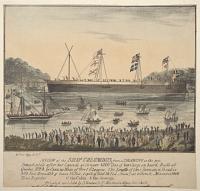
A View of the Ship Columbus, from a Drawing on the Spot Immediately after her launch, with near 4000 Tons of her cargo on board, Built at Quebec, 1824, by Charles Wood of Port Glasgow. The Length of this Immense Vessel is 300 Feet, Breadth of beam 50 Feet; depth of Hold 30 Feet, She is flat bottom'd, Measures 3900 Tons Register.
M. van Ogg Lith.o.
Printed and Sold by S. Vowles, 3 St Michael's Abbey, Cornhill [n.d., c.1824].
Rare coloured lithograph. Sheet 235 x 245mm (9¼ x 9¾"). Trimmed and mounted in album paper.
A depiction of the Columbus, a four-masted barque which was the largest ship ever built at the time. Built by Charles Wood, it was basically a raft, designed to carry large tree trunks for use as masts across the Atlantic, and to be dismantled after one voyage and its timbers sold for reuse. Her first crossing took three months, but instead of being dismantled her owners sent her back, but she was wrecked in the English Channel on 17 May 1825. An even larger version, 'The Baron of Renfrew' was wrecked the following year, making such vessels uninsurable. See 53089 for similar item.
[Ref: 52925] £360.00
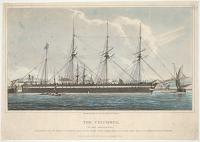
The Columbus, (or Great American Raft). Commanded by Cap.t M.cKellar. R.N. Dimensions_ length 301 Feet. breadth 50 Feet 6 Inches; depth of hold 30 Feet. 3690 Register Tons. built at Quebec 1824 by Charles Wood.
Engraved by Permission from an Accurate drawing made on the Spot.
Published for the Proprietors Nov.r 1824 by Lamb, Gracechurch St. London.
Coloured lithograph. Sheet 270 x 385mm (10½ x 15¼") Slight damage in corners. Blotchy colour in sky.
A depiction of the Columbus, a four-masted barque which was the largest ship ever built at the time of launch. It was basically a raft, designed to carry large tree trunks for use as masts across the Atlantic, and to be dismantled after one voyage and its timbers sold for reuse. Her first crossing took three months, but instead of being dismantled her owners sent her back, but she was wrecked in the English Channel on 17 May 1825. An even larger version, 'The Baron of Renfrew' was wrecked the following year, making such vessels uninsurable. See 52925 for similar item.
[Ref: 53089] £280.00
(£336.00 incl.VAT)
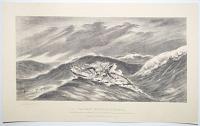
The Great Western Steamer, In the Hurricane in the Atlantic Ocean, Sept 9th 1846 in the outward passage to America.
Henry Melling Invenit et Lithog.
Liverpool: Dec 10th 1846 Published by the Artist. Slater St.
Lithograph. Printed area 265 x 445mm (10½ x 17½") large margins. Repaired tear on left, laid on restorer's paper.
Isambard Kingdom Brunel's SS Great Western, launched in 1837, was the first steamship purpose-built for the Atlantic crossing. Her maiden voyage, completed on 23 April 1838, was the fastest crossing up to that time. On this 1846 Liverpool to New York run she ran into bad weather. On the 19th (not the 9th) September the sails had to be pulled in but were lost anyway. Water got into the engine room and had to be pumped out. Waves broke the ice house (containing about eight tons of ice) from its deck fastenings, along with two lifeboats. The port paddle box (covering the upper half of the paddle wheel) was smashed and a splinter struck the captain in the head. A wave crashed over the ship and drenched the passengers sheltering in the saloon. Captain Mathews said to a passenger afterwards that ''Thrice on deck I thought destruction inevitable'' but because the engines never failed the Great Western survived the storm.
[Ref: 53085] £260.00
(£312.00 incl.VAT)
![H.M.A.S. Australia [pencil.]](img-thumbnail/jpegs/52984.jpg)
H.M.A.S. Australia [pencil.]
Rowland Langmaid [pencil.]
[n.d. c.1945.]
Rare etching. 150 x 285mm (6 x 11¼"), with large margins.
HMAS Australia (I84/D84/C01), a heavy cruiser of the Royal Australian Navy, shown at anchor surrounded by yachts. After being damaged by kamikaze attacks in the Pacific she was sent for repairs at Portsmouth, where this scene was probably captured. A pupil of W.L Wyllie; Rowland Langmaid (1897-1956) served in the Royal Navy and attained the rank of Lt. Commander. He exhibited at the R.A.
[Ref: 52984] £260.00
(£312.00 incl.VAT)
<<< Previous 1 Next >>>
![[Two letters from William Armytage, Mate, RN to his mother and a third from William's friend to his mother.]](jpegs/53195.jpg)


![H.M.A.S. Australia [pencil.]](jpegs/52984.jpg)