Results 1-34 of 34
<<< Previous 1 Next >>>

[A Midsummer Night's Dream] Titania. Puck. What Hempen Home-Spuns Have We Swaggering Here... From the original picture in the possession of William Chamberlayne Esq.r to whom this print is respectfully inscribed by His most obliged & obedient humble Servant, Henry Thompson.
Painted by Henry Thomson R.A. Engraved by W. Say, Engraver to H.R.H. the Duke of Gloucester.
London Published March 21, 1814 by T. MacDonald, 39 Fleet Street.
Colour-printed mezzotint. 620 x 415mm. Framed. Trimmed within platemark at bottom.
A scene from 'A Midsummer's Night Dream', with Titania asleep, watched by Puck. In the background is Bottom with an ass's head. Ex: Collection of the Hon. C. Lennox-Boyd.
[Ref: 7112] £520.00

Helena and Hermia. From A Midsummer Night's Dream. Premium Plate to Subscribers to "The Art Journal'', 1899.
EJP 1899. Painted by Sir Edward John Poynter, P.R.A. Etched by W. Heydemann.
Copyright 1898. Published by H. Virtue & Co. Limited, London.
Etching. 450 x 510mm (17¾ x 20"), with large margins. Foxing.
The two female romantic leads from Shakespeare's 'A Midsummer Night's Dream', seated together discussing an embroidery. This etching is taken from the first of two versions in oil by Edward John Poynter (1836-1919); the second, dated 1901, is in the Art Gallery of South Australia.
[Ref: 52195] £190.00
(£228.00 incl.VAT)

[Helena and Hermia. From A Midsummer Night's Dream.]
EJP 1899. Edward John Poynter. W. Heydemann [pencil signatures.]
Copyright 1898. Published by H. Virtue & Co. Limited, London.
Etching on vellum, artist's proof before title. 450 x 510mm (17¾ x 20"), with large margins. Mint.
The two female romantic leads from Shakespeare's 'A Midsummer Night's Dream', seated together discussing an embroidery. This etching is taken from the first of two versions in oil by Edward John Poynter (1836-1919); the second, dated 1901, is in the Art Gallery of South Australia.
[Ref: 52194] £490.00
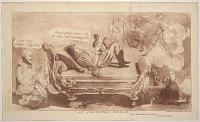
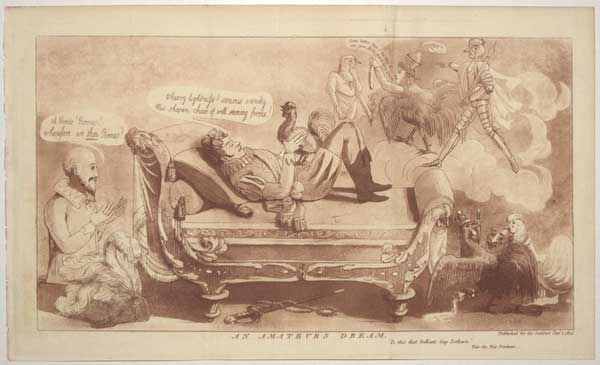
An Amateurs Dream. "Is this that Gallant Gay Lothario". Vide the Fair Penitent
Published for the Satirist Jan.y 1, 1812.
Etching and aquatint, sheet 205 x 345mm (8¼ x 13½"). On paper watermarked 'J Whatman 1810.' Folds as issued. Trimmed losing plate mark on right.
Plate from the 'Satirist', x. 1. Robert (‘Romeo’) Coates lies with closed eyes on an ornate sofa, holding a cock standing on his stomach. He wears the quasi-Spanish or sixteenth-century costume conventional in the theatre, with tasselled Hessian boots; the sofa is decorated with cocks’ heads. Visions of his dramatic ambitions surround him. Coates repeats Romeo’s words from Shakespeare: “O heavy lightness! serious vanity. Mis-shapen chaos of well seeming forms!” Behind him, Shakespeare rises from the floor, asking, “Oh Romeo! Romeo! wherefore art thou Romeo?” To the right, a cock with Coates’s head and arm stands on clouds, offering his purse to the Apothecary, who has a cock’s head, and declaring, “Come hither Man I see that thou are poor. Hold, there's forty Ducats.” A further vision shows Coates in armour, with a cock’s head, striding across the clouds and pointing ahead. On the floor lie symbols of his theatrical aspirations: his feathered, jewelled hat, sword with a cock-shaped hilt, and a jewel on a chain. Tragedy and Comedy appear as two cocks: Tragedy is crowned, holding a dagger in its beak and a cup of poison in its claw, while Comedy carries a comic mask. The print refers to Coates’s appearance as Lothario in Nicholas Rowe’s The Fair Penitent at the Haymarket, a subject discussed in a review of Antony Pasquin’s, 'The Dramatic Censor' in the 'Satirist'. Bm Satires 11934.
[Ref: 70145] £140.00
(£168.00 incl.VAT)

The Origin of the Gout.
Etch'd from an Original Sketch, by W. H. Bunbury Esqr.
Publish'd as the Act directs, April 20th. 1785, by J. Jones, Great Portland Street.
Etching with some stippling, small margins; published state. 220 x 260mm, 8¾ x 10¼". Two faint printer's creases.
A gouty and obese man (right) seated in a chair playing the cello. Both legs are padded, the feet wrapped in slashed coverings; the right leg rests on a stool. The Devil (left), hat in hand, holds a hot coal against the right knee with a pair of tongs. Bottles and glasses stand on a table. A pair of crutches lean against the chair. The hands of a clock on the wall behind point to 1.25. After Henry William Bunbury (1750 - 1811). BM Satires 6881.
[Ref: 26253] £220.00
(£264.00 incl.VAT)

[Emma Hamilton] Titania, Puck, the Changeling, &c. (From Shakespear's Play of "Midsummer Night's Dream"). Engraved by Edward Scriven, Historical Engraver to the Prince of Wales from an unfinished Picture by George Romney, Esq. in the Posession of Sir John Fleming Leicesyer, Bar.t. Who by appropriating a Gallery exclusively to English Pictures has evinced a patriotic love for the Fine Arts of his Country, & to whom this plate is most respectfully inscribed.
Class 1. Painting for ''the Fine Arts of the English School''.
London: Published December 1, 1810 by Longman & Co. Paternoster Row: J Taylor, High Holborn & W. Bond 87 Newman St.
Stipple. Sheet: 270 x 320mm (10¾ x 12½''). Crease in top left corner. Trimmed to platemark.
Portrait of Emma Hamilton as Titania after Romney, lying at right, leaning on her elbows and resting her hands on her chin, looking to front with a smile, Puck tying a ribbon around the ankle of baby lying at left, fairies in the sky behind. Lady Emma Hamilton (c.1765-1815), was the famous wife of Sir William Hamilton, and mistress of Nelson. A changeling, also historically referred to as an auf or oaf, is a mythical substitute left in a human infant's cradle after a supernatural creature, such as a fairy, elf, or troll, abducted the real child. The left-behind creature often looked like a sickly baby or sometimes an old, dying fairy wanting a comfortable retirement. A major source of tension between the fairy king Oberon and queen Titania is a silent, unnamed human child known as the "changeling boy". Oberon claims the boy was stolen from an Indian king. Titania claims she is raising him out of love because his mortal mother (her votaress) died during childbirth. Oberon wants the boy to be his knight or attendant, driven largely by jealousy over the time and affection Titania lavishes on the child. This conflict leads Oberon to cast a love-in-idleness spell on Titania, setting off the play's central magical chaos. Horne: 56. II. Ex Collection: Earl of Bute.
[Ref: 50251] £130.00
(£156.00 incl.VAT)

Mr Henderson in the Character of Macbeth.
Painted by George Romney. Engraved by John Jones.
Publish'd as the Act directs Decr. 1st. 1787, by J. Jones, Engraver No. 75, Great Portland Street.
Mezzotint, 455 x 540mm. Trimmed to platemark lower left.
Portrait of John Henderson (1747 - 1785) as Macbeth, looking over his left shoulder at the Three Witches. A procession passes across the landscape in the distance. Chaloner Smith: 37, II.
[Ref: 8339] £420.00

[Jerusalem Delivered] A Moon Light Scene of a Forest where Ismen the Magician is sacrificing to Demons and invoking them to rise. [&] The Magicians marching off after the success of their Incantations. [&] A Turkish Mosque lighted after the Mahometan Manner where Aladine the Emperor is seated on a Throne Surrounded by his Divan. [&] The Forest as Enchanted, where Alcast General of Swiss is stopp'd by a firy Castle, defended by Daemons. [&] The Christian Army under the Command of Godfrey of Bulloigne encamped before the Walls of Jerusalem. [&] A Morning Scene of the Forest with Rinaldo, on the Bank of the Enchanted River.
[Various engravers, including Edward Rooker and Paul Sandby after John Collins.]
[Published by Elizabeth Jane Collins, n.d., c.1763.]
Complete set of six etchings, each c.460 x 540mm (18 x 21¼"), stitched. With two end papers in disbound contemporary marbled boards, with large folio, 575 x 480mm. (22½ x 19"). Boards scuffed and rubbed, with chips and tears to extremities. Some spotting to plates, some cut very close to or along lower platemark.
A fine set of prints based on John Collins' stage sets for a performance of Torquato Tasso's 'Jerusalem Delivered' at the Royal Theatre in the Tuileries in Paris in 1754. Tasso's epic poem, first published 1581, tells the story of the First Crusade mixed with heroic myth featuring magic and monsters, based on the styles of Homer and Virgil. John Collins (c.1725-58/9) was a London-born set designer who had studied in Italy. This series was published by his widow.
[Ref: 9494] £1,800.00
view all images for this item

[Jerusalem Delivered] A Moon Light Scene of a Forest where Ismen the Magician is sacrificing to Demons and invoking them to rise. Plate 1st. Page 393. To the right honourable Lord Visc.t Charlemont this plate is inscribed by his Lordship's most obliged humble Servant. Eliz.th Jane Collins.
J. Collins Pinx.t from Tasso's Jerusalem deliver'd. J. Wood Sculp.t.
[Published by Elizabeth Jane Collins, first published c.1763 but later.]
Etching. Sheet 460 x 540mm (18 x 21¼"). Trimmed to plate, a few nicks, small stains, dedication weakly inked on left. Slight staining.
The Muslim sorcerer Ismen casts a spell to protect the forest with enchantments to stop the Crusaders cutting wood for engines for the siege of Jerusalem. It is the first of a set of six prints based on John Collins' stage sets for a performance of Torquato Tasso's 'Jerusalem Delivered' at the Royal Theatre in the Tuileries in Paris in 1754. Tasso's epic poem, first published 1581, tells the story of the First Crusade mixed with heroic myth featuring magic and monsters, based on the styles of Homer and Virgil. John Collins (c.1725-58/9) was a London-born set designer who had studied in Italy. This series was published by his widow. See Ref: 9494 for complete set.
[Ref: 53228] £280.00
(£336.00 incl.VAT)

[Jerusalem Delivered] The Forest as Enchanted, where Alcast General of Swiss is stopp'd by a firy Castle, defended by Daemons. Plate 4. Page 400. To the most Noble Peregrine Bertie, Duke of Ancaster & Kesteven, Lord Lord great Chamberlain of England &c, &c., This Plate is most humbly Inscrib'd by his Grace's most Devoted and Obedient Serv.t Eliz.th Jane Collins.
J. Collins Pinx.t from Tasso's Jerusalem deliver'd. P. Sandby & E. Rooker sculp.
[Published by Elizabeth Jane Collins, c.1763.]
Etching. Sheet 460 x 545mm (18 x 21¾"). Trimmed to plate, a few nicks, small stains, dedication weakly inked on left.
A knight walks through a forest during the siege of Jerusalem and is confronted by a castle surrounded by fire-breathing demons and dragons. From a set of six prints based on John Collins' stage sets for a performance of Torquato Tasso's 'Jerusalem Delivered' at the Royal Theatre in the Tuileries in Paris in 1754. Tasso's epic poem, first published 1581, tells the story of the First Crusade mixed with heroic myth featuring magic and monsters, based on the styles of Homer and Virgil. John Collins (c.1725-58/9) was a London-born set designer who had studied in Italy. This series was published by his widow. See Ref: 9494 for complete set.
[Ref: 53229] £380.00
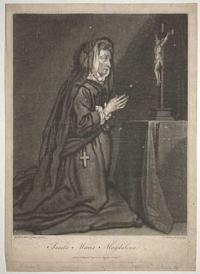
Sancta Maria Magdalena.
G. Kneller Eques, pinx. J. Faber fecit, 1755.
Sold by J. Boydell Engraver in Cheapside London.
Rare mezzotint 350 x 250mm (13¾ x 9¾"), with large margins. Nicks to margins. Creasing and abrasions.
A portrait of singer Mary Knight, a well known singer and mistress of Charles II, shown kneeling before a crucifix. CS 210.
[Ref: 70080] £90.00
(£108.00 incl.VAT)

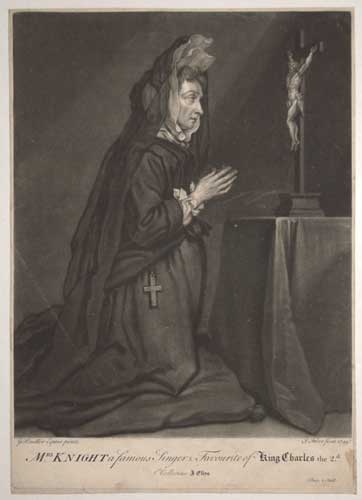
M.rs Knight a famous Singer & Favourite of King Charles the 2d. L'Collectione J. Ellys. Price 2 Shill.
G. Kneller Eques, pinx. J. Faber fecit, 1749.
Rare mezzotint 350 x 250mm (13¾ x 9¾"). Thread margins. Nicks to bottom margin. Light staining.
A portrait of singer Mary Knight, a well known singer and mistress of Charles II, shown kneeling before a crucifix. CS 210 i of ii. Ex: Collection of the Hon. Christopher Lennox-Boyd.
[Ref: 70079] £230.00
(£276.00 incl.VAT)

[Songsheet.] Macbeth. Transposed by C.W.Glover.
J.Brandard, del et lith. M&N.Hanhart Chromo Lith.
[n.d., c.1850.] London; Leoni Lee & Coxhead, Music Sellers to her Majesty, Queen Victoria, 48, Albemarle St.
Coloured lithograph. Sheet 355 x 260mm (14 x 10¼").
Songsheet for Macbeth, depicting various scenes in the play in vignettes in each corner. The centre image shows Act 3, scene 4 of the play, in which Macbeth is horrifed as he sees Banquo's ghost, while Lady Macbeth stands by him before she sends the guests away. Transposed by Charles W.Glover (1806-1863), English violinist and composer.
[Ref: 68713] £130.00
(£156.00 incl.VAT)

Macbeth.
Sir Joshua Reynolds Pinxt. S.W. Reynolds Sculpt.
[n.d., c.1825.]
Mixed media, 230 x 260mm. 9 x 10¼".
William Shakespeare's Macbeth, seen from the back, faces the witches and the apparitions. By his feet, inside a coiled snake, stand a small bloody child and a child wearing a crown and holding a tree. Behind them are the kings, one holding a mirror, and a large figure of a soldier, pointing; the witches sit on the far right, Hecate in the middle, with her forefinger pointing upwards. For Samuel William Reynold's (1774 - 1835) 'Engravings from the Works of Sir Joshua Reynolds'. Whitman: Appendix, pg. 149, 56.
[Ref: 9567] £140.00
(£168.00 incl.VAT)

[Grotesque Masks] Serie di Mascheroni Cavati dall'antico che per la prima volta escono in luce intagliati in rame opera utile a professori ed amatori delle belle arti.
[by Aloisio Giovannoli.]
In Roma MDCCLXXXI [1781] Presso Venanzio Monaldini al Corso.
Folio, rebound in half treed calf with marbled boards, morocco title label, marbled endpapers; 33 of 38 etched plates. Scarce, but incomplete.
A fine collection of etchings of classical Roman theatrical masks etched by Aloisio Giovannoli (ca.1550-1618), and originally published c.1600 with book and plate numbers under the image, here cut from the plate. Giovannoli has copied prints designed by Cornelis Floris, engraved by Frans Huys and published by Hans Liefrinck I between 1539-1560. See BM 1932,0217.37 for the original issue and description.
[Ref: 59203] £4,000.00
view all images for this item
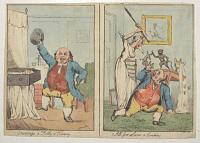
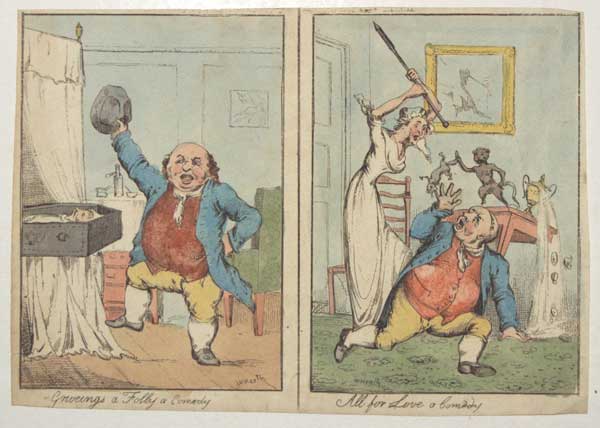
[Modern Plays.] Grivings a Folly a Comedy. All for Love a Comedy.
[William Heath]
[n.d., c.1815.]
Coloured etchings. Sheet 160 x 225mm (6¼ x 9"). Trimmed from a larger sheet.
Two scenes (of four) with scenes from comic plays. On the left a man celebrates his wife's death; on the right a similar man (the same actor?) is being beaten with a poker by his wife, falling against a table, upsetting a cat, monkey and teapot. Richard Leigh's 'Grieving's a Folly' premiered in 1809.
[Ref: 70174] £45.00
(£54.00 incl.VAT)
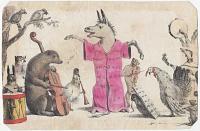
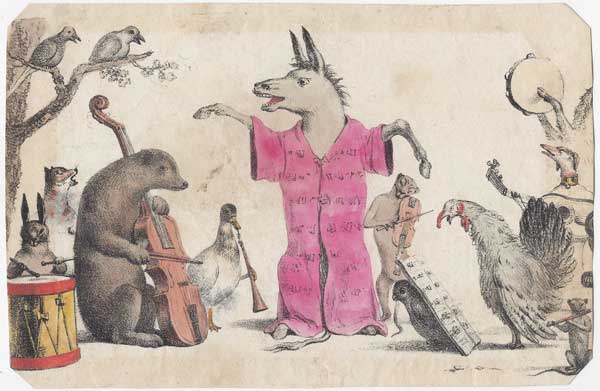
[Suite et progrès de l'enseignement mutuel de Musique.]
[CM]
[Chez Martinet.] [Paris, n.d., 1819.]
Coloured lithograph. Sheet 170 x 260mm (6¾ x 10¼"). Trimmed into image, losing title and inscriptions, stains.
A donkey conductor leads an orchestra of other birds and animals. Musée Carnavalet G.43457.
[Ref: 70159] £50.00
(£60.00 incl.VAT)
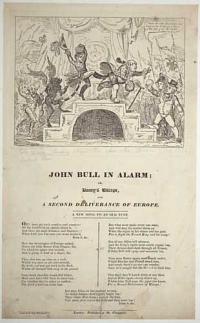
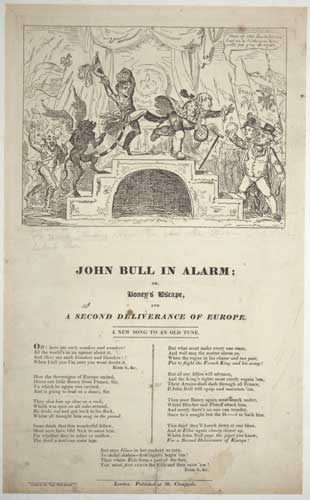
John Bull in Alarm; or, Boney's escape, and A Second Deliverance of Europe. A New Song to an Old Tune.
[George Cruikshank]
London: Published at 98, Cheapside [by John Jones, n.d., 1815].
Etching with letterpress, watermark J. Whatman 1811. Sheet 415 x 255mm (16¼ x 10"). Stains, repaired tear, mounted in album paper at edges.
A Broadside satire of Napoleon's return from Elba. Supported by troops and a demon, he kicks Louis XVIII from the ceremonial dais and exchanges his hat for the crown. Taking a bag of loot, Louis runs to the ranks of the Allied armies for help. BM Satires 12534. Provenance: Alfred Brewis, Newcastle ship owner, 1912.
[Ref: 70120] £490.00
Unfortunately this item is either sold or reserved. If you are interested in similar items and cannot find what you're looking for on our website, please consider filling in our interests form. If you register, we can also send you items that match your interests when the website is updated.

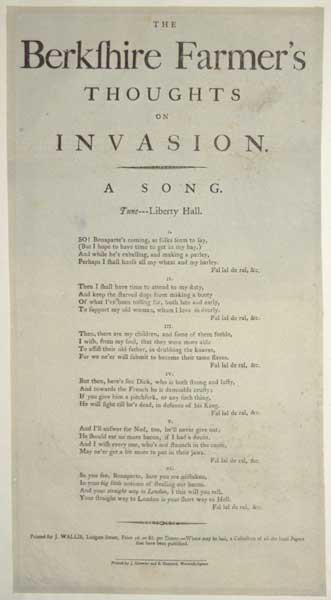
The Berkshire Farmer's Thoughts on Invasion. A Song. Tune --- Liberty Hall.
Printed for J. Wallis, Ludgate Street, Price 1d. or 8d. per Dozen. _ Where may be hand all the Loyal Papers that have been published [n.d., c.1803].
Rare letterpress, watermark 1801. Sheet 405 x 215mm (16 x 8½"). Repairs, printer's crease, mounted in album paper.
A broadside published when Britain was under threat of invasion by Napoleon Bonaparte. The song warns him that the 'straight way to London is your short way to Hell'. Provenance: Alfred Brewis, Newcastle ship owner, 1912.
[Ref: 70281] £450.00

[Broadside against Napoleon] Loyal Songs. / The Voice of the British Isles [&] The True Briton.
[c.1803] London: Printed for J. Asperne, [Successor to the late Mr. Sewell], at the Bible, Crown, and Constitution, No. 32, Cornhill, by W. Lane. [Price One Penny, Ninepence per Dozen, or Six Shillings per Hundred.]
Letterpress, sheet 410 x 265mm (16 x 10½").
Broadside published at the time when fears of an invasion of the British Isles by Napoleon were at their height, consisting of two songs adapted to popular tunes, proclaiming British readiness for any invasion. The publisher James Asperne (1757-1820) was best-known for publishing the popular 'European Magazine'.
[Ref: 33277] £250.00
(£300.00 incl.VAT)

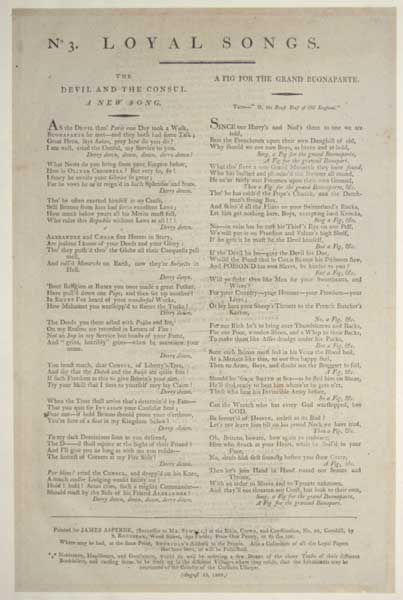
Nº 3. Loyal Songs. The Devil and the Consul. A New Song... A Fig for the Grand Buonaparte.
Printed for James Asperne (Successor to Mr. Sewell) at the Bible, Crown, and Constitution, No. 32, Cornhill, by S. Rousseau, Wood Street, Spa Fields; Prince One Penny, or 6s the 100... (Augsut 12, 1803.)
Letterpress, watermark 1801, Sheet 375 x 245mm (14¾ x 9½"), printed on both sides. Mounted in album paper.
Two comic songs attacking Napoleon. On the reverse is a list of other broadsides published by Asperne. Provenance: Alfred Brewis, Newcastle ship owner, 1912.
[Ref: 70256] £380.00
view all images for this item

[Broadside against Napoleon] No. 2 Loyal Songs. / The Briton's Song [&] Song of the Highland Armed Association.
London: Printed for J. Asperne, [Successor to the late Mr. Sewell], at the Bible, Crown, and Constitution, No. 32, Cornhill, by S. Rousseau. Price One Penny, or 6s the 100. August 12, 1803
Letterpress, sheet 385 x 270mm (15¼ x 10½"), with 1803 watermark.
Broadside published at the time when fears of an invasion of the British Isles by Napoleon were at their height, consisting of two songs adapted to popular tunes, proclaiming British readiness for any invasion. 'The Briton's Song' contrasts Revolutionary France with British rule: 'Our Forefathers bled on the Scaffold and Plain/ T'establish a Government wise, just and pure;/ We'll defend it till Death, and reject with disdain/ One that scarce for a Day or an Hour can endure./ Shall your fam'd Guillotine. In Old England be seen?/ No!- we mean to live happy, while frantic you sing/ Your fam'd 'Ca Ira',/ And Hymn 'Marsellois',/ For the true Briton's Song shall be "God save the King." The 'Song of the Highland Armed Association' is specifically Scottish in its theme and references. A note at the bottom of the sheet suggests 'Noblemen, Magistrates, and Gentlemen, would do well by ordering a few Dozen of the above Tracts of their different Booksellers, and causing them to be stuck up in the respective Villages where they reside, that the Inhabitants may be convinced of the Cruelty of the Corsican Usurper.' The publisher James Asperne (1757-1820) was best-known for publishing the popular 'European Magazine'.
[Ref: 33278] £250.00
(£300.00 incl.VAT)
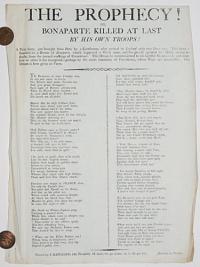
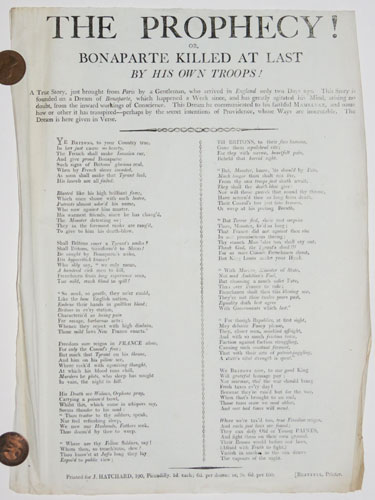
The Prophecy! or, Bonaparte Killed at Last by his Own Troops! A True Story, just brought from Paris [...] This Story is founded on a Dream of Bonaparte [...] The Dream is here given in Verse. [...]
[1803] Printed for J. Hatchard, 190, Piccadilly. 1d. each; 6d. per dozen; or, 3s. 6d. per 100. [Brettell, Printer]
Letterpress, sheet 425 x 315mm (16¼ x 12½"). Creasing on left.
Broadside published at the time when fears of an invasion of the British Isles by Napoleon were at their height. This ballad prophesises Napoleon's death in the wake of an unsuccessful invasion of Britain. As in other broadsides of the period, Napoleon's alleged killing of his own injured soldiers at Jaffa is invoked as evidence of his treachery. In the aftermath, the new rule of France is imagined: 'no more Consuls, Frenchmen shout,/ But King Louis make your Head. / With Moreau, Minister of State,/ Not made Ambition's Fool,/ But choosing a much safer Fate,/ Than over France to rule'. Victor Moreau was forced into exile in the United States by his opposition to Napoleon. The final verses defend Britain's monarchy (with a reference to the revolutionary, Thomas Paine) and the high taxes during the war as a temporary measure necessary to combat Napoleon. Published by John Hatchard (1768-1849), who founded the Piccadilly bookseller still thriving over two hundred years on. For a contemporary portrait of Moreau, see ref. 28221.
[Ref: 33275] £350.00
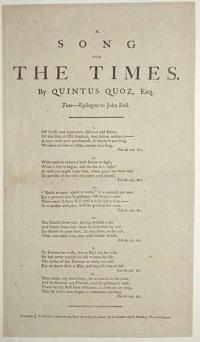
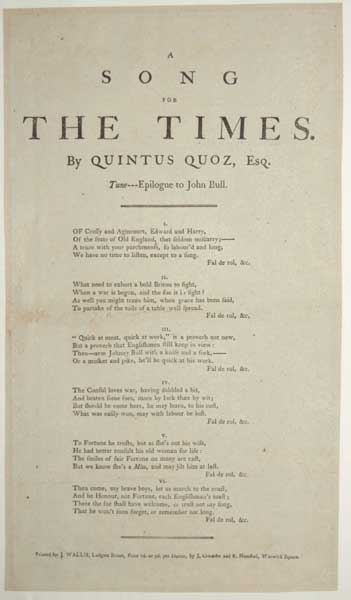
A Song for the Times. By Quintus Quoz, Esq. Tune --- Epilogue to John Bull.
Printed for J. Wallis, Ludgate Street, Price 1d. or 9d. per Dozen, by J. Crowder and E. Hemstead, Warwick Square [n.d., c.1803].
Rare letterpress, 18th century watermark. Sheet 400 x 225mm (15¾ x 9"). Tears, some repaired, mounted in album paper.
A broadside with a patriotic song, published when Britain was under threat of invasion by Napoleon Bonaparte. Provenance: Alfred Brewis, Newcastle ship owner, 1912.
[Ref: 70282] £450.00

[Broadside against Napoleon] Song, to the Tune of Mother Casey. / The French, tis said,/ Are thieves by trade,/ And well they fill the function;/ For where they go,/ Both friend and foe,/ They rob without compunction [...]
[c.1803.] London: Printed for J. Asperne, (Successor to Mr. Sewell,) at the Bible, Crown, and Constitution, No. 32, Cornhill, by T. Maiden, Sherbourn-Lane;1 Price One Penny, or 6s the 100.
Letterpress, sheet 340 x 210mm (13½ x 8¼").
Songsheet published at the time when fears of an invasion of the British Isles by Napoleon were at their height. The song encourages strong British resistance, referencing French actions in Switzerland and Holland and their supposed plans 'to land their troops at Dover'. Napoleon is compared to Robespierre. Napoleon, it says, is praised now as Robespierre once was, but if Napoleon were to be executed, 'With general voice,/ Would France rejoice,/ And set the bells a-ringing'. A note at the bottom of the sheet suggests 'Noblemen, Magistrates, and Gentlemen, would do well by ordering a few Dozen of the above Tracts of their different Booksellers, and causing them to be stuck up in the respective Villages where they reside, that the Inhabitants may be convinced of the Cruelty of the Corsican Usurper.' The publisher James Asperne (1757-1820) was best-known for publishing the popular 'European Magazine'.
[Ref: 33279] £250.00
(£300.00 incl.VAT)
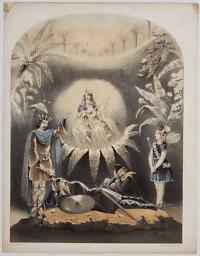
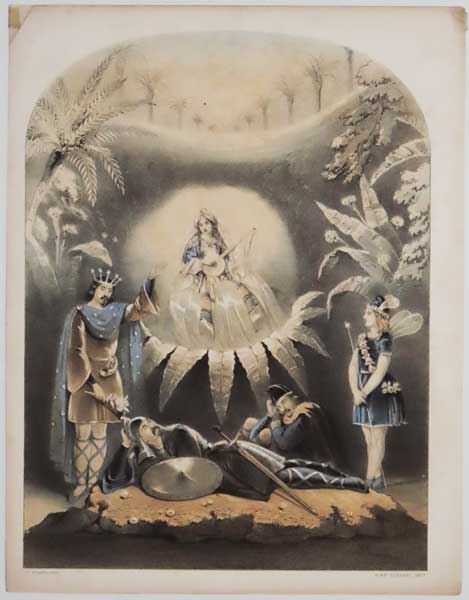
[Music cover for the 'Oberon Quadrille']
J. Brandard.
M. & N. Brandart, Imp.t. [n.d. c.1843.]
Tinted lithograph. Sheet 305 x 235mm (12 x 9¼").
Oberon stands above two sleeping soldiers, with Titania playing a lute in a bubble behind. To the right is a butterfly-winged fairy.
[Ref: 70246] £160.00
(£192.00 incl.VAT)
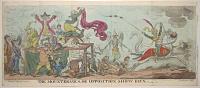
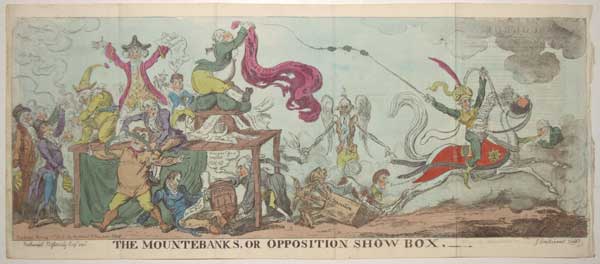
The Mountebanks, Or Opposition Show Box.
Nathaniel NoParty Esq.r inv.t G Cruickshank Sculp.t.
Published Febury 1.st 1812 by M Jones 5 Newgate Street.
Etching, with hand-colour., watermark 1809; Sheet 210 x 490mm (8¼ x 19¼"). Trimmed within plate on all sides except left. Folds as issued. Holes in right where previously bound.
Plate to the 'Scourge', iii, before p. 87. The show-box is a little platform with four legs that resembles a tall table and has draperies partially covering its front. Opposition members are performing on this. 'Avarice—Treason' (left) and 'Impudence Apostacy' (right) are inscribed on the front legs. A lively thoroughbred horse with the Regent's head, with enormous facial heair, was attached to the platform by means of lead strings or bands that were fastened to the legs on the right and bare the words "Restrictions." Father Time, however, has just sheared these, and the horse gallops off to the right. Richard Colley Wellesley, Marquess Wellesley (1760-1842) clad in an oriental ensemble and a jewelled turban, rides the horse. He holds the reins triumphantly above his head and waves the long, knotted lash of his whip in the direction of the stage he is leaving behind. He thrusts his left leg forward to allow George Canning (1770-1827) (right) to lick his toe obediently. Charles Grey, 2nd Earl Grey (1764-1845) is seated on the edge of the platform, leaning forward to cover the eyes of a startled John Bull, who is standing below with his back to Grey, with a bandage bearing the words "Catholic Emancipation." John is a countryman wearing knee-high gaiters and a short smock. There's a dagger against his breast, maybe dropped from Grey's hand. Standing behind Grey is Samuel Whitbread II (1764-1815), a quack physician dressed in period attire, holding a sign that reads, "Infallible Panacea—Reform." He has medicine bottles in his coat pockets, one of which is marked, "Whitbreads intire." Behind him, a small Henry Petty Fitzmaurice, 3rd Marquess of Lansdowne (1780-1863) dances a Highland fling. Richard Brinsley Sheridan (1751-1816) dressed like a clown, kneels on the left side of the platform. He holds a tumbler and uses a pipe to blow froth out of it, which rises as smoke with the words "Drury Lane Promises, Old Drury Promises" written on it instead of bubbles. With their 'Token of English Credulity' pouches in hand, two vulgar would-be fashionables come forward to the platform to empty their coins into Sheridan's tumbler. A box labelled "State Box" sits to the right of the platform. Papers with the words "Corruption," "Reform," "Abuses," and "Catholic Bill" are projected from beneath the lid. William Wyndham Grenville, Baron Grenville (1759-1834), is seated atop a pile of coins and money bags bearing the inscription "16000 Sinecure." His massive rear is marked "Modesty," and he waves a large, heavily frayed piece of swirling drapery in the direction of the departing Regent. A dog with Sir Francis Burdett’s (1770-1844) head jumps towards the horse and starts barking, "Bow woo woo woo," upending an overturned box that is lying on the ground between the platform and the horse's heels. The heads of a dog, a fox, and an ass protrude from the box on short posts. The Right Hon Spencer Perceval (1762-1812), wearing his gown bends beneath the platform to light a barrel bearing the words "Stephens's Inflammable." "Here goes! for a Complete blow up.'' he declares. George Ponsonby (1755-1817) is reclining on the ground between John Bull and Perceval, clutching an upside-down bottle marked "Compassion for the Irish." BM Satires 11846.
[Ref: 70086] £240.00
(£288.00 incl.VAT)
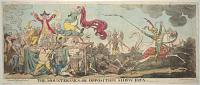
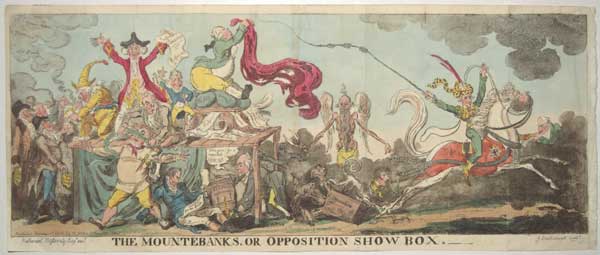
The Mountebanks, Or Opposition Show Box.
Nathaniel NoParty Esq.r inv.t G Cruickshank Sculp.t.
Published Febury 1.st 1812 by M Jones 5 Newgate Street.
Etching, with hand-colour. Sheet 210 x 490mm (8¼ x 19¼"). Trimmed within plate on all sides. Folds as issued. Small tears to edges repaired with acid-free tape.
Plate to the 'Scourge', iii, before p. 87. The show-box is a little platform with four legs that resembles a tall table and has draperies partially covering its front. Opposition members are performing on this. 'Avarice—Treason' (left) and 'Impudence Apostacy' (right) are inscribed on the front legs. A lively thoroughbred horse with the Regent's head, with enormous facial heair, was attached to the platform by means of lead strings or bands that were fastened to the legs on the right and bare the words "Restrictions." Father Time, however, has just sheared these, and the horse gallops off to the right. Richard Colley Wellesley, Marquess Wellesley (1760-1842) clad in an oriental ensemble and a jewelled turban, rides the horse. He holds the reins triumphantly above his head and waves the long, knotted lash of his whip in the direction of the stage he is leaving behind. He thrusts his left leg forward to allow George Canning (1770-1827) (right) to lick his toe obediently. Charles Grey, 2nd Earl Grey (1764-1845) is seated on the edge of the platform, leaning forward to cover the eyes of a startled John Bull, who is standing below with his back to Grey, with a bandage bearing the words "Catholic Emancipation." John is a countryman wearing knee-high gaiters and a short smock. There's a dagger against his breast, maybe dropped from Grey's hand. Standing behind Grey is Samuel Whitbread II (1764-1815), a quack physician dressed in period attire, holding a sign that reads, "Infallible Panacea—Reform." He has medicine bottles in his coat pockets, one of which is marked, "Whitbreads intire." Behind him, a small Henry Petty Fitzmaurice, 3rd Marquess of Lansdowne (1780-1863) dances a Highland fling. Richard Brinsley Sheridan (1751-1816) dressed like a clown, kneels on the left side of the platform. He holds a tumbler and uses a pipe to blow froth out of it, which rises as smoke with the words "Drury Lane Promises, Old Drury Promises" written on it instead of bubbles. With their 'Token of English Credulity' pouches in hand, two vulgar would-be fashionables come forward to the platform to empty their coins into Sheridan's tumbler. A box labelled "State Box" sits to the right of the platform. Papers with the words "Corruption," "Reform," "Abuses," and "Catholic Bill" are projected from beneath the lid. William Wyndham Grenville, Baron Grenville (1759-1834), is seated atop a pile of coins and money bags bearing the inscription "16000 Sinecure." His massive rear is marked "Modesty," and he waves a large, heavily frayed piece of swirling drapery in the direction of the departing Regent. A dog with Sir Francis Burdett’s (1770-1844) head jumps towards the horse and starts barking, "Bow woo woo woo," upending an overturned box that is lying on the ground between the platform and the horse's heels. The heads of a dog, a fox, and an ass protrude from the box on short posts. The Right Hon Spencer Perceval (1762-1812), wearing his gown bends beneath the platform to light a barrel bearing the words "Stephens's Inflammable." "Here goes! for a Complete blow up.'' he declares. George Ponsonby (1755-1817) is reclining on the ground between John Bull and Perceval, clutching an upside-down bottle marked "Compassion for the Irish." BM Satires 11846.
[Ref: 70087] £280.00
(£336.00 incl.VAT)

Pollock's Characters & Scenes in the Silver Palace or The Golden Poppy.
London. Published by B. Pollock, 73, Hoxton Street [n.d., c..1880].
Six coloured etchings. Each 170 x 210 (6¾ x 8¼"). Laid on card.
A set of six numbered plates of characters in 'The Silver Palace or The Golden Poppy' an act spectacle originally described as a 'masque or water pageant' with water nymphs etc. First published c.1834; Pollock took over the business of his father-in-law John Redington in 1876. See V&A E.2449-1924.
[Ref: 70245] £320.00
view all images for this item

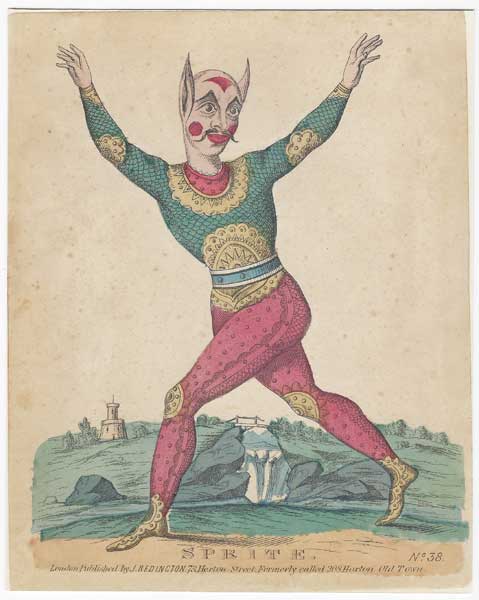
Sprite. N.º 38.
London Published by J. Redington, 73, Hoxton Street, Formerly called 208 Hoxton Old Town. [n.d., c.1849.]
Coloured etching. Sheet 215 x 175mm (8½ x 7").
A fantastical character with pointed ears. John Redington published toy theatres; this seems to be a figure to be cut out and mounted on board for use with the theatre.
[Ref: 70244] £70.00
(£84.00 incl.VAT)
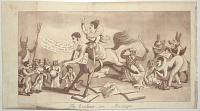
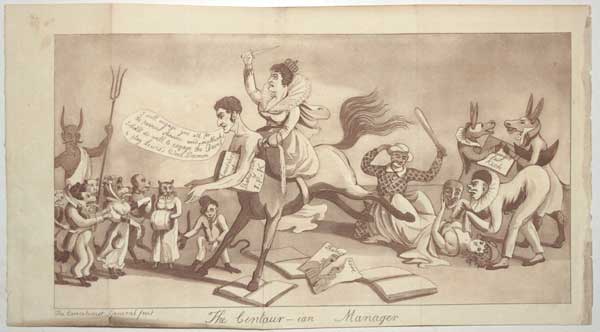
The Centaur-ian Manager.
The Caricaturist General fecit.
[The Satirist] [n.d. c.1811]
Etching and aquatint, sheet 205 x 345mm (8¼ x 13½"). Trimmed to plate at bottom. Staining. Folds as issued. Rough right edge.
Plate from the 'Satirist', ix. 253. A satire on the equestrian performances introduced at Covent Garden with the revival of ‘Blue Beard’ on 18 February 1811, featuring sixteen horses ridden by Spahis storming a castle. Though popular, the spectacle was condemned as a commercial degradation of the theatre, leading to horses also being introduced in ‘Timour the Tartar’. The vogue for equestrian displays and neglect of the great dramatists were further mocked in ‘The Manager’s Last Kick’. John Philip Kemble, who published adaptations of Shakespeare’s ‘Hamlet’, ‘Lear’ and ‘Macbeth’, was criticised for “mercilessly mangling” ‘Henry V’ in his production of 25 March 1811. Kemble appears as a centaur, serving as a mount for Mrs. Siddons, depicted as a tragedy queen with a small crown, raising a dagger and spilling a goblet. He addresses a troupe of fashionably dressed performing dogs and cats: ‘I will engage you all for the present Season and—methinks I shall do well, to engage the Devil to play Lewis's Wood Daemon.’ An ape dressed as a man squats beside them, while a satyr-like Devil holding a trident stands behind. Under Kemble’s arm is ‘Emendations of Shakespeare by I. P. K.’; beneath his hooves lie open books and a bust of Shakespeare, whose face has been torn in half. Behind his kicking hind-legs, Comedy lies on her back holding a smiling mask. Harlequin kneels at her feet with his wooden sword, while Pierrot stoops over her head. At the extreme right, two asses stand on their hind-legs, conferring over ‘The Manager’s Last Kick’; one wears fashionable clothes and carries an opera-hat. BM Satires 11773.
[Ref: 70147] £190.00
(£228.00 incl.VAT)
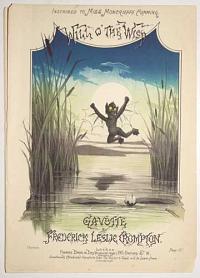
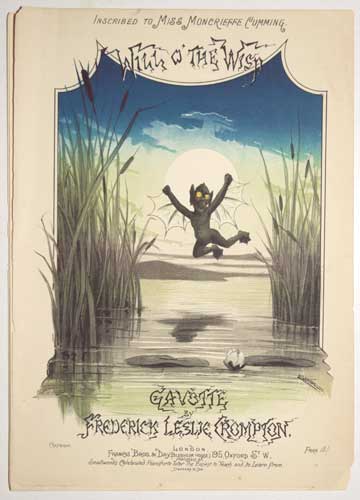
Will o' the Wisp. Gavotte by Frederick Leslie Crompton. Inscribed to Miss Moncrieffe Cumming
H.G. Banks. Lith.
London; Francis Bros, & Day (Blenheim House,) 196, Oxford S.t. W. [n.d., c.1860.]
Very scarce music book, pp. 8, with chromolithograph cover. Cover 350 x 250mm (13¾ x 9¾"). Cover separated and loose, chips and tears in edges.
The cover illustration depicts a winged demon flying above a pond with bullrushes and water lilies.
[Ref: 70178] £45.00

[Joseph Wilton] Bless Thee Bottom, bless Thee__Thou art translated. Shakespere. W - hen Phidias or Raph'el shall chuse to repair, / I - ncog to our fine modern Artists' fam'd School, / L - ost in wonder to see stuck in Genius's Chair / T - he Block which now fills it) a formal old Fool - / O - ff again with this sneering Remark they will go / N - o marvel your Pupils old Friend are so so''. JP.
[Isaac Cruikshank.]
Pub Jany 1 1794 by S W Fores No 3 Piccadilly.
Etching, 18th century watermark. Sheet 300 x 215mm (11¾ x 8½"). Trimmed close to image.
Joseph Wilton (1722–1803), Keeper of the Royal Academy, as Bottom, sitting in an arm-chair, wearing spectacles on his ass's forehead. In his right hand is a stick of charcoal, in his left is a paper, which he is studying. Above his head is etched 'Apollo'. The man looking over Bottom's shoulder, his fists clenched, is John Inigo Richards (1731–1810), secretary of the R.A. In the background two students draw a nude male statue on a pedestal. BM Satires 8519.
[Ref: 54456] £140.00
(£168.00 incl.VAT)
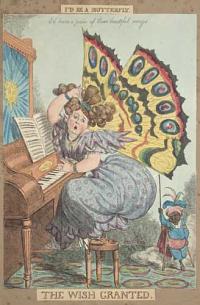
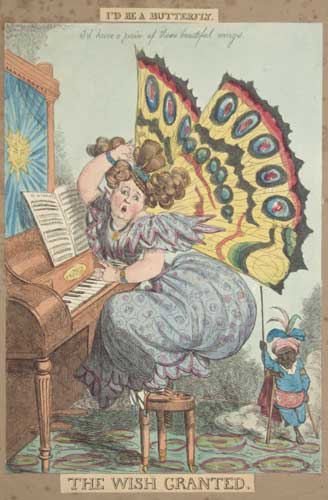
I'd Be a Butterfly. The Wish Granted.
[by William Heath.]
Published by Tho.s McLean 26. Haymarket [n.d., c.1929].
Etching with hand colour. Album sheet 365 x 245mm (14¼ x 9½''). Trimmed inside plate and laid on album paper..
A large woman seated at a piano sings 'I'd be a Butterfly' by Thomas Haynes Bayly. As she sings the words 'I'd have a pair of those beautiful wings', a cloven-hooved, dark-skinned, impish figure waves a wand and large butterfly wings sprout from her back, much to her surprise. Not in BM Satires.
[Ref: 70088] £70.00
(£84.00 incl.VAT)
<<< Previous 1 Next >>>