Results 1-22 of 22
<<< Previous 1 Next >>>
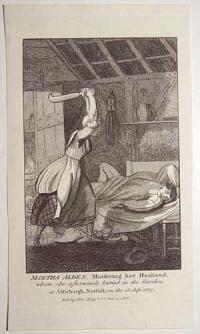
Martha Alden, Murdering her Husband. Whom she afterwards buried in the Garden, at Attleburgh, Norfolk, on the 18, July, 1807.
Pub. by Alex. Hog & Co, Jan, 23, 1808.
Engraving. Sheet 185 x 120mm (7¼ x 4¾"). Trimmed into plate left & right
Portrait of Martha Alden who was executed on the 31st of July, 1807, for murdering her Husband in a Cottage near Attleborough, Norfolk on the 18th July 1807. A witness Sarah Leeder, was asked by Alden to borrow a spade following the murder. On the 22nd July Leeder went to Alden's house and saw a large pit in the garden, to her horror she noticed two hands of a man, with the arms of a shirt stained with blood. Alarmed, she returned to her home and after a quarter of an hour she returned again to the Alden's garden, and found that in her absence the body had been taken out. She knew it to be the body of Samuel Alden. His face was dreadfully chopped, and his head cut very nearly off. The body was put into a cart and carried to the house of the deceased.
[Ref: 68728] £130.00
(£156.00 incl.VAT)

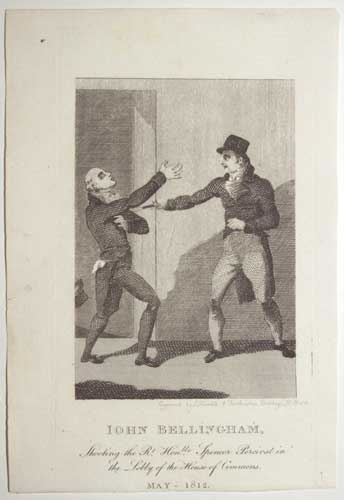
John Bellingham. Shooting the R.t Hon.ble Spencer Percival in the Lobby of the House of Commons. May 1812.
Engraved by S.Humble, 1 Featherstone Buildings Holborn.
[n.d., c.1800.]
Engraving. 165 x 110mm (6½ x 4¼"), with large margins on 3 sides. Trimmed to plate at bottom.
A scene depicting the moment in which John Bellingham (c. 1769 - 1812), English merchant, murdered Spencer Perceval (1762 - 1812), British statesman and barrister who was Prime Minister of the United Kingdom from October 1809.
[Ref: 68776] £90.00
(£108.00 incl.VAT)

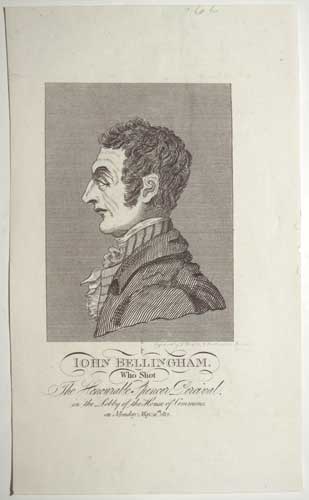
John Bellingham. Who Shot The Honourable Spencer Percival in the Lobby of the House of Commons on Monday May 11th 1812.
Engraved by S.Humble, 1 Featherstone Buildings Holborn.
[n.d., c.1800.]
Engraving. 165 x 110mm (6½ x 4¼"), large margins on 3 sides. Trimmed into left of plate.
Portrait of John Bellingham (c. 1769 - 1812), English merchant and perpetrator of the 1812 murder of Spencer Perceval, the only British prime minister to be assassinated.
[Ref: 68772] £95.00
(£114.00 incl.VAT)
![[Coldbath Fields Prison.] The House of Correction, Cold Bath Fields.](img-thumbnail/jpegs/68764.jpg)
[Coldbath Fields Prison.] The House of Correction, Cold Bath Fields. The View taken near Grays Inn Road.
J.King del. J.Mills sculp.
[n.d., c.1800.]
Engraving. 180 x 115mm (7 x 4½"). Trimmed.
A view of Coldbath Fields Prison formerly known as the Middlesex House of Correction and Clerkenwell Gaol. a prison in the Mount Pleasant area of Clerkenwell, London. Founded in the reign of James I (1603 - 1625) it was completely rebuilt in 1794 and extended in 1850. It housed prisoners on short sentences of up to two years. Blocks emerged to segregate felons, misdemeanants and vagrants. The prison closed in 1885.
[Ref: 68764] £60.00
(£72.00 incl.VAT)

The Bell-Man of St.Sepulchre's speaking the admonitory Words to the Malefactor's going to Execution.
Dodd delin. Pollard sculp.
[n.d., c.1800.]
Engraving. Sheet 175 x 110mm (7 x 4¼"), large margins on 3 sides.
A scene depicting The Bell-man of St. Sepulchre’s Church in London who historically rang a handbell and recited an admonitory exhortation to condemned prisoners passing from Newgate Prison to execution at Tyburn.
[Ref: 68732] £90.00
(£108.00 incl.VAT)

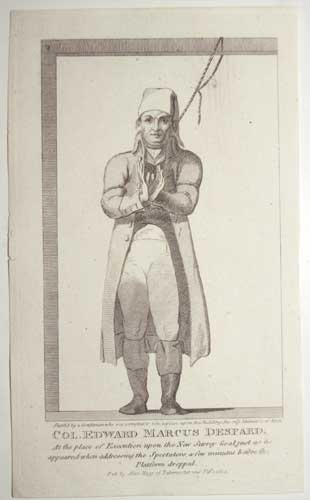
Co. Edward Marcus Despard. At the place of Execution upon the New Surrey Goal, just as he appeared when addressing the Spectators, a few minuted before the Platform dropped.
Sketch'd by a Gentleman who was permitted to take a place upon the Building_ the only likeness over taken.
Pub by Alex Hogg 16 Paternoster row Feb.y. 1 1804.
Engraving. Sheet 210 x 125mm (8¼ x 5"). Trimmed.
Portrait of Co. Edward Marcus Despard (1751-1803), at his execution. Despard was an Irish officer of French descent in the service of the British Crown, gained notoriety as a colonial administrator for refusing to recognise race as a distinction in English law and, following his recall to London, as a republican conspirator. Despard's associations with the London Corresponding Society, the United Irishmen and United Britons led to his trial and execution in 1803 as the alleged ringleader of a plot to assassinate the King.
[Ref: 68740] £160.00
(£192.00 incl.VAT)

The Smuglers breaking open the Custom House at Poole, Oct.r. 7th 1747.
[n.d., c.1800.]
Engraving. Sheet 180 x 110mm (7 x 4¼"), large margins on 3 sides
A scene depicting the events on the night of October 6th to 7th, 1747, where members of the notorious Hawkhurst Gang broke into the King's Custom House at Poole, Dorset, in a daring raid to recover a massive shipment of confiscated tea. Led by Thomas Kingsmill, the smugglers successfully stole back two tons of tea and 39 barrels of rum that had been seized from them by custom officers in September 1747, bringing them to the Custom House at Poole See Ref 68783
[Ref: 68741] £130.00
(£156.00 incl.VAT)
![The Smugglers torturing Chater the Custom house Officer. [Poole]](img-thumbnail/jpegs/68783.jpg)
The Smugglers torturing Chater the Custom house Officer. [Poole]
Valois sc.
[n.d., c.1760.]
Engraving. 175 x 110mm (7 x 4¼"), large margins on 3 sides.
A scene depicting the torture. See Ref 68741
[Ref: 68783] £130.00
(£156.00 incl.VAT)

Catherine Hayes burnt for the murder of her husband.
Valois sculp.
[n.d, c.1750.]
Engraving. Sheet 110 x 174mm (41/2 x 6 3/4"), large margins on 3 sides.
Scene depicting Catherine Hayes (1690 - 1726) being burnt for the murder of her husband. John Hayes was murdered with an axe by Thomas Wood & Thomas Billings (Billing's being Catherine & John's son). On 1 March 1726, they persuaded Hayes to partake in a drinking contest, then killed him once he was intoxicated. The trio then dismembered Hayes' body To make identification more difficult, they decided to cut off his head, wrap it in a cloth and place it in a bucket, which they later threw into the Thames at Millbank, from where it was soon recovered lying on a sandbank near the Horse-Ferry at Westminster. Wood, being a butcher, dismembered the rest of John's body, the pieces of which they threw into a pond in Marylebone Fields. The recovered head was examined and the scull found to be severely fractured in two places and the face lacerated. Catherine Hayes was tried alongside Wood & Billings and, although she claimed to have only held a candle as Billings and Wood murdered her husband she was found guilty of Petty Treason was sentenced to be drawn to Tyburn on a hurdle and there to be burned alive at the stake. Wood & Billings were sentenced to be hanged at Tyburn and afterwards be hanged in chains. Wood died in prison of fever before the sentence was carried out. At Tyburn Catherine was secured to a stake, set in the ground a few yards from the gallows, by an iron chain around her body. A cord was put round her neck and passed through a hole bored in the stake, for the purpose of strangling her to ease her death. Two cartloads of dry brushwood were piled around her and at the signal the fire was lit. She begged Arnet to strangle her before the fire reached her and he took the end of the cord and began to pull on it, but the flames blew in his direction burning his hands so he had to let go. She reportedly gave three dreadful shrieks before she was engulfed by the fierce fire and fell silent. She was seen trying to push away the burning faggots with her free hands but to no avail.
[Ref: 68730] £130.00
(£156.00 incl.VAT)

John Hayes's head exposed in St.Margarets church yard.
[n.d., c.1800.]
Engraving. 180 x 115mm (7 x 4½"), large margins on 3 sides.
A scene depicting John Hayes's head displayed in St.Margarets church yard. John Hayes was murdered with an axe by Thomas Wood & Thomas Billings (Billing's being Catherine & John's son). On 1 March 1726, they persuaded Hayes to partake in a drinking contest, then killed him once he was intoxicated. The trio then dismembered Hayes' body To make identification more difficult, they decided to cut off his head, wrap it in a cloth and place it in a bucket, which they later threw into the Thames at Millbank, from where it was soon recovered lying on a sandbank near the Horse-Ferry at Westminster. Wood, being a butcher, dismembered the rest of John's body, the pieces of which they threw into a pond in Marylebone Fields. The recovered head was examined and the scull found to be severely fractured in two places and the face lacerated. Catherine Hayes was tried alongside Wood & Billings and, although she claimed to have only held a candle as Billings and Wood murdered her husband she was found guilty of Petty Treason was sentenced to be drawn to Tyburn on a hurdle and there to be burned alive at the stake. Wood & Billings were sentenced to be hanged at Tyburn and afterwards be hanged in chains. Wood died in prison of fever before the sentence was carried out.
[Ref: 68780] £130.00
(£156.00 incl.VAT)

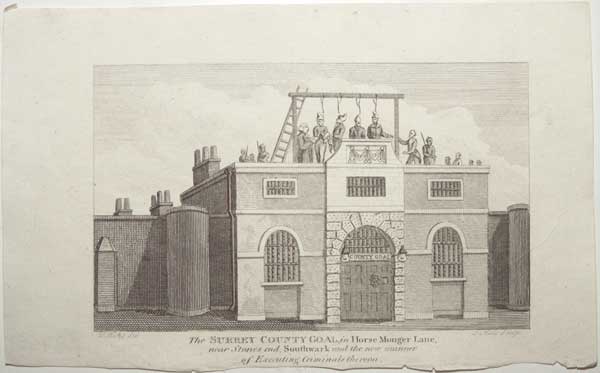
The Surrey County Goal, in Horse Monger Lane. Near Stones end Southwark and the new manner of Executing Criminals thereon.
J.King del. J.Mills sculp.
[n.d, c.1800.]
Engraving. 210 x 130mm (8¼ x 5"). Damaged, right centre border.
A view of Horsemonger Lane Gaol, a prison close to present-day Newington Causeway in Southwark, south London. Built at the end of the 18th century, it was in use until 1878.
[Ref: 68766] £60.00
(£72.00 incl.VAT)
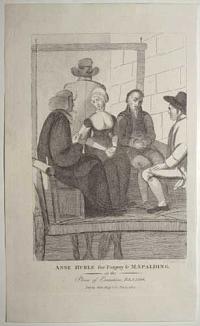
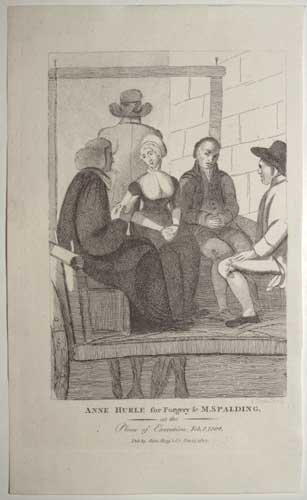
Anne Hurle for Forgery & M.Spalding. At the Place of Execution, Feb 8, 1804.
Doyle sculp.
Pub. by Alex.Hogg & Co, Oct 17, 1807.
Engraving. 185 x 120mm (7¼ x 4¾"), large margins on 3 sides. Trimmed into right side of plate.
Portrait of Anne Hurle, hanged for forgery in 1804, and Methuselah Spalding who had been convicted of sodomy at the previous Sessions held on the 30th of November 1803. On the morning of execution, Ann and Spalding were brought from their cells and pinioned in the Press Room. They were then taken out into the yard and loaded into a horse drawn cart covered in a black cloth which emerged from the prison at about 8.10 a.m. for the short ride to the gallows.
[Ref: 68785] £130.00
(£156.00 incl.VAT)

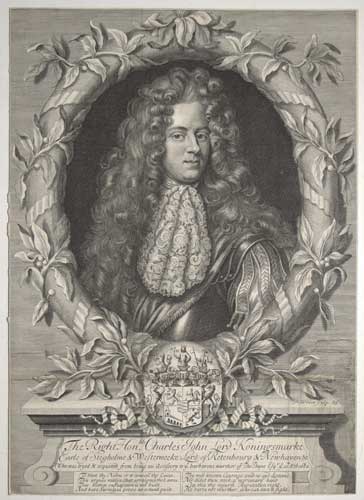
The Right Hon.ble Charles John Lord Koningsmarke, Earle of Stegholme & Westerweeks, Lord of Retenbourg & Newhaven &c, Who was tryed & acquitted from being an Accessory to y.e barbarous murther of Tho: Thyne Esq.r y.e 21.th Feb. 1682.
R. White sculp. 82.
Rare engraving. Sheet 380 x 270mm (15 x 10½"). Trimmed close to image, tears, laid on card. Damaged.
A half-length portrait in oval of Swedish soldier Carl Johann von Königsmarck (1659-86). He was accused of hiring three assassins to kill Thomas Thynne in order to have an affair with Thynne's rich wife, Elizabeth Seymour. Thynne was shot in Pall Pall, and the three killers and Königsmarck were soon rounded up and put on trial. Königsmark was acquitted of the charge of being an accessory before the fact (jury corruption according to diarist John Evelyn), but was banished. He joined the army of his uncle Otto Wilhelm von Königsmarck in Greece, where he died of wounds during the Morean War.
[Ref: 69429] £260.00
(£312.00 incl.VAT)
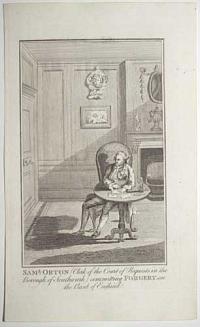
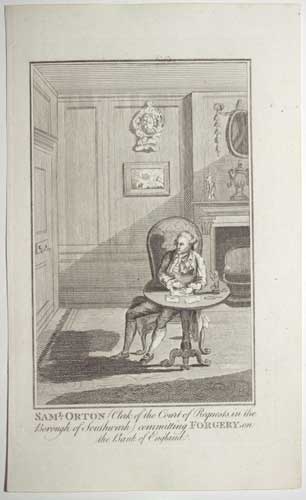
Sam.l. Orton. (Clerk of the Court of Requests in the Borough of Southwark) committing Forgery, on the Bank of England.
[n.d., c.1800.]
Engraving. 175 x 110 (7 x 4¼"), large margins on 3 sides.
Portrait of Samuel Orton, a Clerk to the Court of Requests, who was executed on the 14th January 1767 for forging Two Letters of Attorney, in the Name of Captain Bishop, by means of which he received One Thousand Pounds from the Bank of England.
[Ref: 68763] £90.00
(£108.00 incl.VAT)

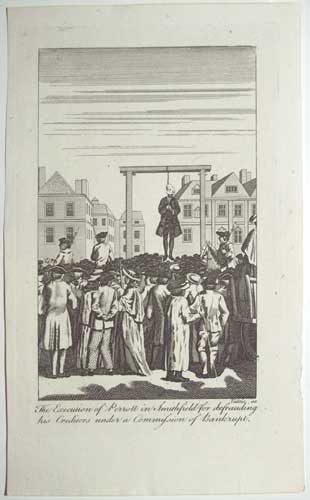
The Execution of Perrott in Smithfield for defrauding his Creditors under a Commision of Bankrupt.
Valois sc.
[n.d., c.1760.]
Engraving. 175 x 110mm (7 x 4¼"), large margins on 3 sides.
A scene depicting the execution of John Perrott, a Bankrupt, who refused to make Full Disclosures of his Effects, and was executed in Smithfield, 11th of November, 1761.
[Ref: 68755] £130.00
(£156.00 incl.VAT)
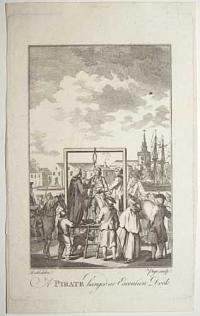
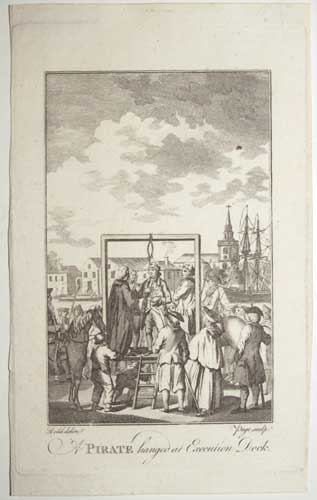
A Pirate hanged at Execution Dock.
Dodd delin. Page sculp.
[n.d., c.1800.]
Engraving. Sheet 190 x 120mm (7½ x 4¾"). Thread margins.
A scene depicting the hanging of a pirate at the Execution Dock in Wapping. It has been suggested that the pirate is Captain James Lowry, hanged in 1762. The man on horseback to the left holds the silver oar-mace of the Court of Admiralty, under whose jurisdiction the crime of piracy was tried and those convicted usually hanged. In London this was traditionally at Execution Dock, Wapping, where the gallows stood between the high and low watermarks on the Thames foreshore and the body was left hanging until three tides had at least partially submerged it. The corpse was then either often sent for anatomical dissection (ostensibly for medical training purposes) or in the case of notorious pirates coated in tar to preserve it as long as possible and hung in an iron gibbet framework at a prominent point on the Thames as a warning to others, until it rotted away.
[Ref: 68746] £160.00
(£192.00 incl.VAT)

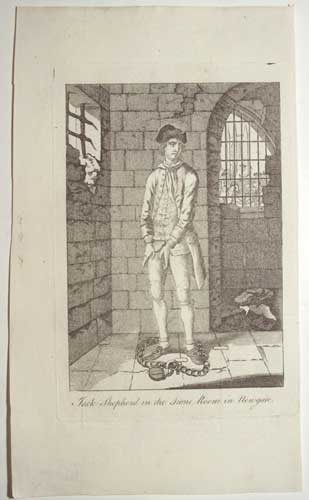
Jack Shepherd in the Stone Room in Newgate.
[n.d., c.1800.]
Engraving. 150 x 105mm (6 x 4"), with large margins on 3 sides
Portrait of Jack Sheppard (1702 - 1724), nicknamed "Honest Jack", "Gentleman Jack" or "Jack the Lad" (the origin of the phrase). Sheppard was arrested and imprisoned five times in 1724, but escaped four times from prison, making him notorious, though popular with the poorer classes. Ultimately, he was caught, convicted, and hanged at Tyburn, ending his brief criminal career after less than two years.
[Ref: 68734] £160.00
(£192.00 incl.VAT)
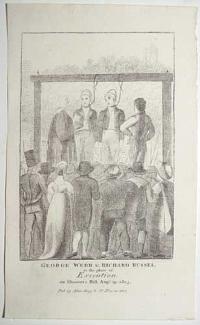
George Webb & Richard Russel. At the place of Execution on Shooter's Hill, Aug.t. 19, 1805.
Pub. by Alex.Hogg & Co, Nov, 14, 1807.
Engraving. Sheet 210 x 130mm (8¼ x 5"), large margins on 3 sides
A scene depicting the execution at Shooters Hill of George Webb & Richard Russel on the 19th August 1805. P IV 90.
[Ref: 68739] £140.00
(£168.00 incl.VAT)
![[John Tucker.]](img-thumbnail/jpegs/68742.jpg)
[John Tucker.] I.Tuck. The Mock Parson.
Engraved by S.Humble, 1 Featherstone Buildings Holborn.
[n.d., c.1800.]
Engraving. 185 x 115mm (7¼ x 4½"), large margins on 3 sides Trimmed to plate on left.
Portrait of John Tucker, convicted at the Middlesex Sessions, 2nd of November, 1811, for swindling a victualler of his wine, and transported to Australia for seven years. Kivell & Spence page 301.
[Ref: 68742] £140.00
(£168.00 incl.VAT)
![[Joseph Wall.]](img-thumbnail/jpegs/68753.jpg)
[Joseph Wall.] The Execution of Governor Wall. The Cruelty of Governor Wall at Goree.
[n.d., c.1802.]
Engraving. 180 x 110mm (7 x 4¼"), large margins on 3 sides.
Scene depicting the execution of Joseph Wall (1737 - 1802), British Army officer and Lieutenant Governor of Gorée, an island near Dakar, Senegal, who was executed in London for the fatal flogging of one of his soldiers. The former colonial administrator, who had previously been arrested for cruelty, was hanged outside Newgate Prison eight days after a one-day trial at the Old Bailey. Thousands of people came to watch the execution because of the notoriety of the case See also [Ref: 41609].
[Ref: 68753] £140.00
(£168.00 incl.VAT)
![[Joseph Wall.]](img-thumbnail/jpegs/68750.jpg)
[Joseph Wall.] Governor Wall contemplating on his unhappy Fate, in the condemned Cell.
Sketch'd from Life.
[n.d., c.1802.]
Engraving. 180 x 110mm (7 x 4¼"), large margins on 3 sides.
Portrait of Joseph Wall (1737 - 1802), British Army officer and Lieutenant Governor of Gorée, an island near Dakar, Senegal, who was executed in London for the fatal flogging of one of his soldiers. The former colonial administrator, who had previously been arrested for cruelty, was hanged outside Newgate Prison eight days after a one-day trial at the Old Bailey. Thousands of people came to watch the execution because of the notoriety of the case See also [Ref: 41609].
[Ref: 68750] £140.00
(£168.00 incl.VAT)

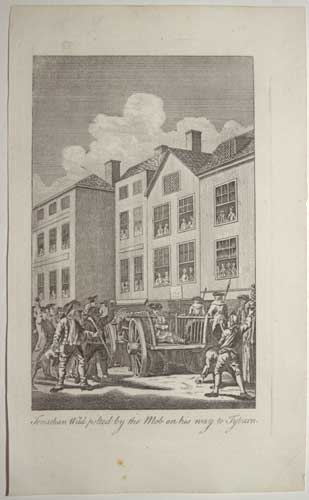
Jonathan Wild pelted by the Mob on his way to Tyburn.
[Valois sc.]
[n.d., c.1760.]
Engraving. 170 x 110mm (6¾ x 4¼"), large margins on 3 sides.
A scene depicting Jonathan Wild (or Wilde) (c.1683–1725), who was executed at Tyburn in 1725, being pelted by the mob on his way to the prison. Self-proclaimed "Thief-Taker General" he simultaneously ran a significant criminal empire, and used his crimefighting role to remove rivals and launder the proceeds of his own crimes.
[Ref: 68778] £130.00
(£156.00 incl.VAT)
<<< Previous 1 Next >>>

![[Coldbath Fields Prison.] The House of Correction, Cold Bath Fields.](jpegs/68764.jpg)


![The Smugglers torturing Chater the Custom house Officer. [Poole]](jpegs/68783.jpg)



![[John Tucker.]](jpegs/68742.jpg)
![[Joseph Wall.]](jpegs/68753.jpg)
![[Joseph Wall.]](jpegs/68750.jpg)