Results 1-11 of 11
<<< Previous 1 Next >>>
![[Bolivia] View of Potosi in the Kingdom of Peru in South America.](img-thumbnail/jpegs/64009.jpg)
[Bolivia] View of Potosi in the Kingdom of Peru in South America. Engraved for Bankes's New System of Geography Published by Royal Authority.
[n.d., c.1790.]
Engraving. 170 x 210mm (6¾ x 8½"). Trimmed at bottom, losing second image.
A view of Potosi and Cerro Potosí, the mountain that produced 80% of the world's silver between the 16th & 19th centuries. To the right is a windmill.
[Ref: 64009] £80.00
(£96.00 incl.VAT)

Laplanders, English, Americans. Africans, Chinese, Hottentots. 36.
Printed and Published by W.Davison Alnwick.
Very rare etching. 235 x 170mm (9¼ x 6¾"). Backed onto album paper at corners.
Six small scenes showing families from different places in the world.
[Ref: 64568] £160.00
(£192.00 incl.VAT)
![[Will.m. Penn's Treaty with the Indians.]](img-thumbnail/jpegs/64517.jpg)
[Will.m. Penn's Treaty with the Indians.]
[After Benjamin West. H.Dawe sculp.]
[n.d., c.1825.]
Very fine coloured mezzotint. 180 x 135mm (7 x 5¼"). Trimmed into image.
Coloured mezzotint after Benjamin West's impression of the 1681 peace treaty rendered between William Penn and the Delaware Indians. Ex: Collection of The Hon. C. Lennox-Boyd.
[Ref: 64517] £130.00
(£156.00 incl.VAT)

Will.m. Penn's Treaty with the Indians.
[After] B.West. H.Dawe sculp.
[n.d., c.1825.]
Coloured mezzotint. 195 x 150mm (7¾ x 6"), with very large margins. Some time-staining. Messy.
Coloured mezzotint after Benjamin West's impression of the 1681 peace treaty rendered between William Penn and the Delaware Indians. Ex: Collection of The Hon. C. Lennox-Boyd.
[Ref: 64518] £60.00
(£72.00 incl.VAT)

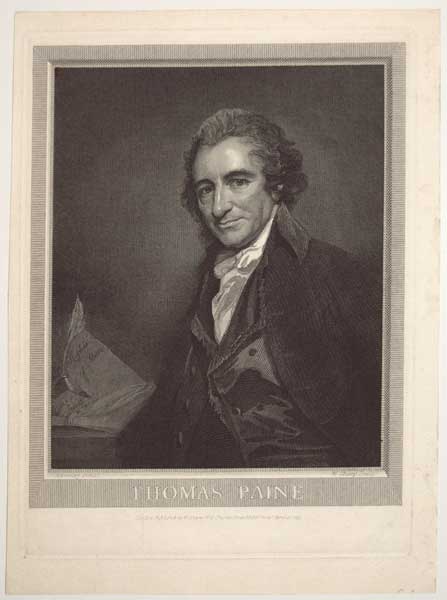
Thomas Paine.
Romney Pinx.t. W.Sharp Sculp.t.
London Published by W.Sharp No.8 Charles Street Middx. Hosp.l. April 20, 1793.
Rare and fine engraving. 305 x 230mm (12 x 9"). Small crease on bottom centre.
Portrait of Thomas Paine (1737 - 1809), English-born American Founding Father, French Revolutionary, inventor, and political philosopher. He authored Common Sense (1776) and The American Crisis (1776-1783), two of the most influential pamphlets at the start of the American Revolution, and he helped to inspire the colonial era patriots in 1776 to declare independence from Great Britain.
[Ref: 64206] £420.00
![[John Penn] Pen-etration.](img-thumbnail/jpegs/64707.jpg)
[John Penn] Pen-etration. NB: This Title has no affinity to Pen, as connected with the Goose-Quill; _ nor has it any allusion to Penguin, a stupid creature between a Fish & a Fowl; _ the word is simply derived from Pen, as the Instrument used to express the deep researches of the mind; _ see the St James's Street chit-chat _ respecting a Keen Pen; _ a Witty Pen; _ & a Pen, often Cut, but never mended.
J.s Gillray des. & f.t.
Pubd Aug.t 6th 1799 by H. Humphrey N 27 St James's Street.
Coloured etching. 260 x 200mm (10¼ x 8"), with large margins.
A full-length caricature portrait of John Penn (1760-1834), with a gaping, fish-like mouth and receding chin, standing with feet splayed, a vacant expression on his face. The grandson of William Penn, he inherited 75% of the proprietorship of the province of Pennsylvania in 1775, aged fifteen, only to be dispossessed the same year by the Revolution. The new United States Government give him £130,000 compensation for his family's 26 million acres in Pennsylvania. BM Satires 9441.
[Ref: 64707] £240.00
(£288.00 incl.VAT)

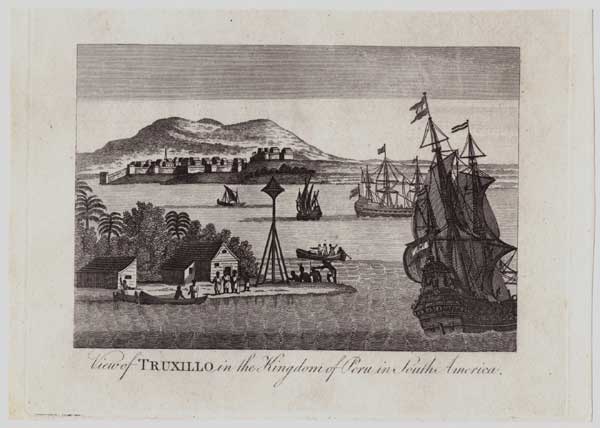
View of Truxillo in the Kingdom of Peru in South America.
[engraved by Thomas Bowen?]
[London: C. Cooke, c.1789.]
Engraving. 160 x 215mm (6¼ x 8½"). Trimmed into plate at top.
A view of the coastal city of Trujillo in northwestern Peru. From 'A New Royal Authentic and Complete System of Universal Geography', by Thomas Bankes et al, with many plates engraved by Thomas Bowen.
[Ref: 64001] £80.00
(£96.00 incl.VAT)

Joseph Priestley, L.L.D. F.R.S.
W. Artaud pinx.t. T. Holloway sculp.t.
[Published as the Act directs, July 15. 1795 & sold by T. Holloway, Newington Green, Middlx. R. Wilkinson, Cornhill, & Messr.s Darling & Thompson, Great Newington Street, Leicester Fields.]
Engraving. Sheet 340 x 265mm (13¼ x 10½. Trimmed into plate, close to image at top and losing publication line at bottom.
A half-length portrait of Joseph Priestley (1733-1804), theologian, Dissenting clergyman and scientist, renowned for his discovery of oxygen and carbon monoxide. He sits, quill in hand and boiling flask at his elbow. A close friend of Benjamin Franklin, he was an avid supporter of the American and French Revolutions, resulting in him leaving for the USA as the British government cracked down on radicals. Wellcome Library 2385-9.
[Ref: 64367] £290.00
(£348.00 incl.VAT)

The Widow of an Indian Chief Watching the Arms of Her Deceased Husband.
Painted by J. Wright. Engravd by J R Smith, Mezzotinto Engraver to his Royal Highn.s the Prince of Wales; & his Serene Highn.s the Duke of Orleans.
Published March, 2. 1812, by Tho. Palser, Surry-side of Westminster Bridge.
Mezzotint, very fine printing in colours and hand finished. 460 x 560mm. (18 x 22"). Thread margins.
A Native American woman sitting beneath a tree stump on which her dead husband's quiver, bow, knife and axe are hung. Below is choppy water, above a stormy sky. Engraved by John Raphael Smith after Joseph Wright of Derby (1734-97). The painting, now in the Derby Museum and Art Gallery, was first exhibited in Wright's one-man show of 1785, following his break from the Royal Academy. In the catalogue that accompanied the first showing of the painting in London in 1785, Wright explained that it depicts the custom whereby the widow of a great Native American warrior would sit all day for a month beneath a memorial in the form of a tree on which were hung his weapons. Wright, as always, strove for accuracy in depicting his subject: here his source was James Adair's 'History of the American Indians' (1775), an important record of mid 18th-century life in America. J. Egerton p.144; Frankau 375, iii of iii; D'Oench 301. Ex: Collection of The Hon. C. Lennox-Boyd.
[Ref: 64544] £1,350.00

The Widow of an Indian Chief Watching the Arms of Her Deceased Husband.
Painted by J. Wright. Engravd by J R Smith, Mezzotinto Engraver to his Royal Highn.s the Prince of Wales; & his Serene Highn.s the Duke of Orleans.
London, Pub.d Jan.y 29, 1789 by I.R.Smith N.31 King Street, Cov.t Garden.
Mezzotint, very fine printing in colours and hand-finished. 460 x 560mm. (18 x 22"). Edges damaged and browned. Small margins.
A Native American woman sitting beneath a tree stump on which her dead husband's quiver, bow, knife and axe are hung. Below is choppy water, above a stormy sky. Engraved by John Raphael Smith after Joseph Wright of Derby (1734-97). The painting, now in the Derby Museum and Art Gallery, was first exhibited in Wright's one-man show of 1785, following his break from the Royal Academy. In the catalogue that accompanied the first showing of the painting in London in 1785, Wright explained that it depicts the custom whereby the widow of a great Native American warrior would sit all day for a month beneath a memorial in the form of a tree on which were hung his weapons. Wright, as always, strove for accuracy in depicting his subject: here his source was James Adair's 'History of the American Indians' (1775), an important record of mid 18th-century life in America. J. Egerton p.144; Frankau 375, ii of iii; D'Oench 301. Ex: Collection of The Hon. C. Lennox-Boyd.
[Ref: 64545] £1,350.00

The Widow of an Indian Chief Watching the Arms of Her Deceas'd Husband.
Painted by J. Wright. Engravd by J R Smith, Mezzotinto Engraver to his Royal Highn.s the Prince of Wales & his Serene Highn.s the Duke of Orleans.
London, Pub.d Jan.y 29, 1789 by I.R.Smith N.31 King Street, Cov.t Garden.
Fine mezzotint, etched letter proof. 460 x 560mm. (18 x 22"). Some restoration to edges.
A Native American woman sitting beneath a tree stump on which her dead husband's quiver, bow, knife and axe are hung. Below is choppy water, above a stormy sky. Engraved by John Raphael Smith after Joseph Wright of Derby (1734-97). In this early state the 't' of 'the Arms' is not crossed. The painting, now in the Derby Museum and Art Gallery, was first exhibited in Wright's one-man show of 1785, following his break from the Royal Academy. In the catalogue that accompanied the first showing of the painting in London in 1785, Wright explained that it depicts the custom whereby the widow of a great Native American warrior would sit all day for a month beneath a memorial in the form of a tree on which were hung his weapons. Wright, as always, strove for accuracy in depicting his subject: here his source was James Adair's 'History of the American Indians' (1775), an important record of mid 18th-century life in America. J. Egerton p.144; Frankau 375, i of iii; D'Oench 301. Ex: Collection of The Hon. C. Lennox-Boyd.
[Ref: 64548] £1,350.00
<<< Previous 1 Next >>>
![[Bolivia] View of Potosi in the Kingdom of Peru in South America.](jpegs/64009.jpg)

![[Will.m. Penn's Treaty with the Indians.]](jpegs/64517.jpg)

![[John Penn] Pen-etration.](jpegs/64707.jpg)