Results 1-12 of 12
<<< Previous 1 Next >>>

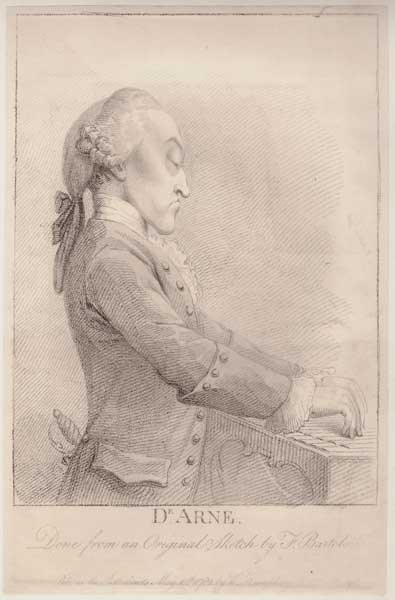
D.r Arne. Done from an Original Sketch by F. Bartolozzi.
Pub.'d as the Act directs, May, 10th, 1782. by W.m Humphrey, No. 227 Strand [but later?].
Scarce chalk manner stipple. Sheet 260 x 170mm (10¼ x 6¾"), on wove paper. Trimmed within plate, mounted in album paper at edges.
A caricature portrait of composer Thomas Augustine Arne (1710 - 1778), wearing a bag-wig and sword, playing a harpsicord. Arne's most famous work is the patriotic song, 'Rule, Britannia!'. BM Satires 8240; De Vesme 750.
[Ref: 61953] £240.00
(£288.00 incl.VAT)

Concerto Spirituale.
Bretherton f
Publis'd 23d March 1773
Scarce etching, 18th century watermark; sheet 275 x 210mm (10¾ x 8¼"). Partially trimmed to plate on left. Tear repaired with tape.
Three men playing a viol da gamba, flute and horn. Etching after Henry Bunbury (1750-1811), amateur artist who enjoyed a successful career as a designer for printsellers. Tim Clayton writes: 'Prints by Bunbury and his imitators were conspicuously 'polite' and appealed, like novels, 'To the Fashionable World and Polite circles'. Of good family, amply endowed with social skills, a beautiful wife and connections in high society, Bunbury's appeal was not solely aesthetic' and his admirers 'recognized his comic talent, his informed enthusiasm for literature, and his ability to draw a momentary pang with something of the sensitivity with which Sterne could write it.' He designed many prints of rural life such as this, which always remained attactive and picturesque. BM Satires 5217.
[Ref: 61925] £260.00
(£312.00 incl.VAT)
![[Charles Dibdin] The Chaunting Orator.](img-thumbnail/jpegs/62059.jpg)
[Charles Dibdin] The Chaunting Orator.
[n.d., c.1790.]
Etching with engraving. Sheet 150 x 190mm (5¾ x 7½. Trimmed, mounted in album paper at edges.
Charles Dibdin (c.1745 – 1814), composer and actor, stands at a harpsichord, holding a paper inscribed 'Oddities Wags'. See 59564 for a different version of the same caricature attributed to the pseudonymical 'Annabal Scratch'. BM K,59.72; see BM Satires 7953.
[Ref: 62059] £130.00
(£156.00 incl.VAT)

England's Lamentation for the loss of Farinelli. (178) [On Reverse] The Thirsty Topper (177).
H Roberts Sculp.
Publish'd accord.g to Act of Parliamen.t 1739.
Engraving, sheet 230 x 135mm (9 x 5¼"). Trimmed within plate top and right.
From Henry Robert's, 'Calliope or English Harmony, A Collection of the most Celebrated English and Scots Songs Neatly Engrav'd and Embelish'd with designs adapted to the Subject of each Song, taken from the Compositions of the Best Masters, in the most Correct Manner, with the thorough Bass and Transpositions for the Flute [recorder] (proper for all Teachers, Scholars and Lovers of Musick), Printed on a fine Paper, on each side which renders the Undertaking more compleat than any other thing of the kind ever Publish'd.' Music, words and flute accompaniment. Headpiece illustration of a woman sitting in a room with two men in frockcoats, one addressing her, the other standing nearby. Farinelli (1705 –82) was the stage name of Carlo Maria Michelangelo Nicola Broschi; a celebrated Italian castrato singer of the 18th century and one of the greatest singers in the history of opera. He was persuaded to move to Spain and only sang for the Spanish Royal Family.
[Ref: 61935] £140.00
(£168.00 incl.VAT)
view all images for this item
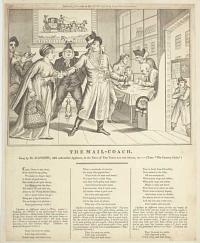
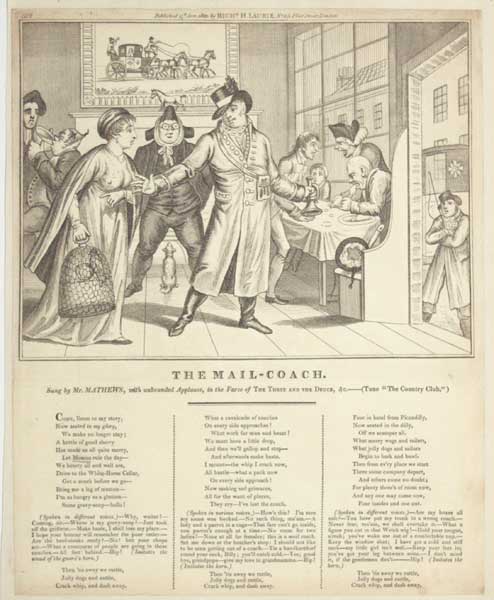
The Mail-Coach. Sung by Mr. Mathews, with unbound Applause, in the Frace of The Three And The Deuce, & c.- (Tune "The Country Club.")
Published 15.th Jan. 1821. by Rich.d H. Laurie, N.o 53 Fleet Street, London.
Etching with letterpress. Sheet 330 x 255mm (13 x 10"). Trimmed and glued to backing sheet.
Passengers on the mail coach snatch a quick lunch in a room at the White Horse Cellar (Piccadilly) that opens onto the street where the coach's side is visible. With a coach horn in hand, the guard stands in the center of the room and speaks imperiously to a woman holding a caged parrot. On the left, a man is sipping from a bowl. A man leans against the fire to warm himself, his hat tied. The coachman stands by the entrance. A framed painting of a mail coach hangs above the fireplace, and a model of a horse—the emblem of the well-known coaching inn—is displayed on the chimneypiece. Bm Satires 11698.
[Ref: 61966] £140.00
(£168.00 incl.VAT)
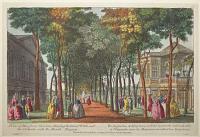
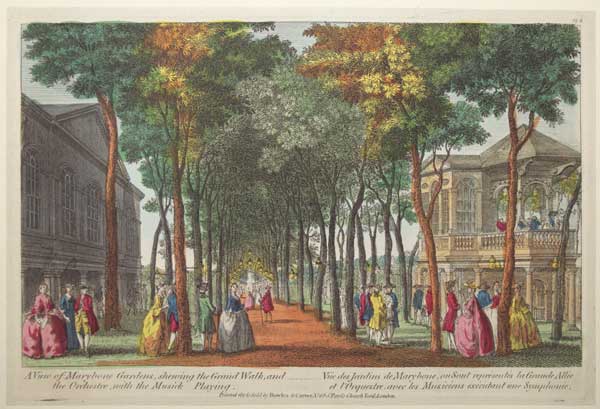
A View of Marybone Gardens, shewing the Grand Walk, and the Orchestra, with the Musick a Playing. [French translation to right.]
Printed for & Sold by Bowles & Carver, N.o 69 S.t Paul's Church Yard London. [n.d. c.1780.]
Coloured etching, 175 x 270mm (7 x 10½"). Tipped into album sheet.
Marylebone or Marybone Gardens was a London pleasure garden, officially opened as a venue for concerts and other entertainments in 1738 by Daniel Gough, the proprietor of the Rose of Normandy tavern on the east side of Marylebone High Street. Originally consisting of two bowling greens adjoining the tavern, its size was increased by acquisition of land from Marylebone Manor House. The Gardens were mentioned by John Gay in "The Beggar's Opera" as a haunt of its 'hero', MacHeath and were used for, amongst other entertainments, gambling, cock-fighting, bull-baiting and boxing matches (with both male and female contestants). From a series of reduced views in London, numbered '12a' upper right. After John Donowell (1753 - 1786; fl.).
[Ref: 61998] £140.00
(£168.00 incl.VAT)

English Minstrels.
Miss L. Adams delt. Engelmann, Graf, Coindet & Co. lithog. On Stone by W.P. Sherlock
London: Published for H. Woods, by Engelmann, Graf, Coindet & Co. 14, Newman St Aug 1829.
Hand coloured lithograph, sheet 245 x 190mm (9¾ x 7½"). Some surface dust.
A musical family, with mouth organ, drum, tambourines and guitar. See reference 45762 for uncoloured pair.
[Ref: 61995] £140.00
(£168.00 incl.VAT)
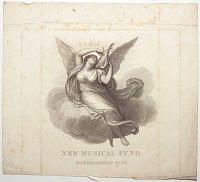
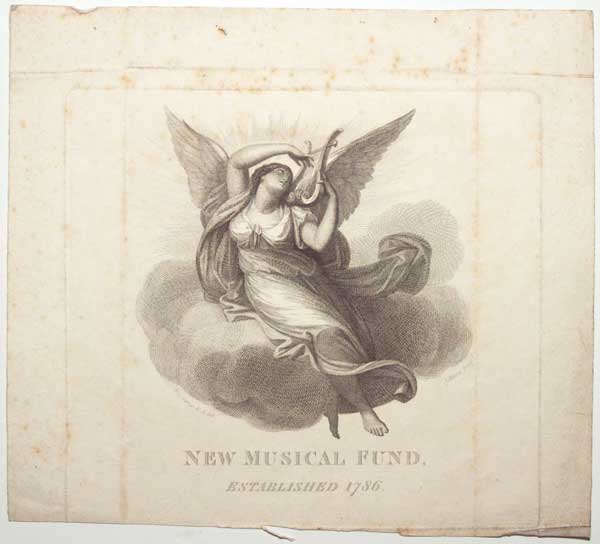
New Musical Fund, Established 1786.
R. Cosway R.A. del.t J.Mitan sculp.t
Very rare engraving, sheet 195 x 220mm (7¾ x 8½"). Slightly trimmed to plate at bottom slightly. Foxed.
Ticket for the New Musical Fund. An angel is seated on a cloud, playing a lyre. Performance by C. B. Incledod. The New Musical Fund was established 16 April 1786 and consisted of numerous concerts all held at the King's Theatre in the Haymarket. Daniell: 206. BM: 1981 ,U.475.
[Ref: 61993] £260.00
(£312.00 incl.VAT)
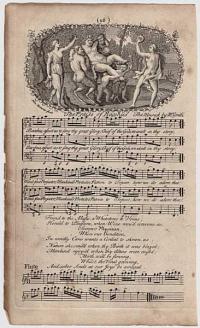
The Praise of Bacchus. The Musick by M.r Corelli. (16) [On Reverse] The Lovers first Address (15).
Hen: Roberts fecit.
[1739]
Engraving, sheet 230 x 135mm (9 x 5¼"). Trimmed within plate top and right.
From Henry Robert's, 'Calliope or English Harmony, A Collection of the most Celebrated English and Scots Songs Neatly Engrav'd and Embelish'd with designs adapted to the Subject of each Song, taken from the Compositions of the Best Masters, in the most Correct Manner, with the thorough Bass and Transpositions for the Flute [recorder] (proper for all Teachers, Scholars and Lovers of Musick), Printed on a fine Paper, on each side which renders the Undertaking more compleat than any other thing of the kind ever Publish'd.' Music, words and flute accompaniment. Headpiece illustration of Bacchus being held in the air by two satyrs with two children and an adult couple standing round them.
[Ref: 61936] £140.00
(£168.00 incl.VAT)
view all images for this item
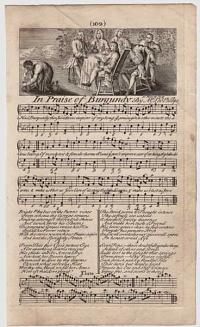
In Praise of Burgundy. By M.r Tho.s Phillips. (109) [On Reverse] The Miller of Mansfield. (110)
H. Roberts Sculp.
[1739]
Engraving, sheet 230 x 135mm (9 x 5¼"). Trimmed within plate top and left.
From Henry Robert's, 'Calliope or English Harmony, A Collection of the most Celebrated English and Scots Songs Neatly Engrav'd and Embelish'd with designs adapted to the Subject of each Song, taken from the Compositions of the Best Masters, in the most Correct Manner, with the thorough Bass and Transpositions for the Flute [recorder] (proper for all Teachers, Scholars and Lovers of Musick), Printed on a fine Paper, on each side which renders the Undertaking more compleat than any other thing of the kind ever Publish'd.' Music, words and flute accompaniment. Headpiece illustration of a group of six men sitting in the countryside round a table drinking wine with a servant kneeling on the ground filling a carafe. An extremely rare image of Burgundian drinking
[Ref: 61937] £160.00
(£192.00 incl.VAT)
view all images for this item
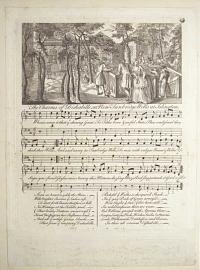
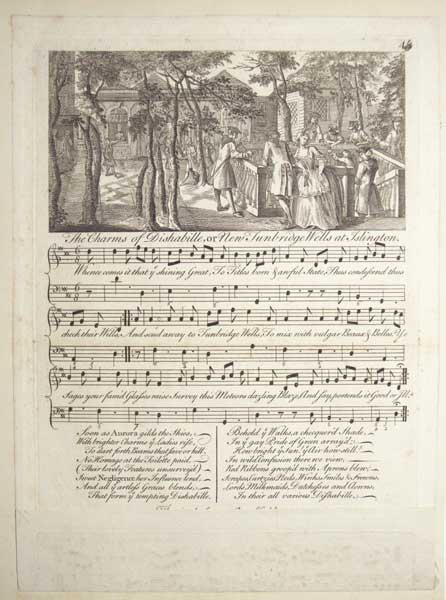
The Charms of Dishabille, or New Tunbridge Wells at Islington.
For the Flute. The Words by Mr. Lockman, Written in 1733. To ye Tune of ye Black Joke. G. Bickham junr. Sculp.
[n.d., c.1745.]
Engraved musical score lettered with lyrics, three verses of lyrics below, etched illustration above, plate 320 x 200mm (12¾ x 7¾"), with margins. Glued to backing sheet on borders at edges. Fold. Some light foxing.
An ode to sartorial variety at the pleasure gardens at Sadler's Wells (sometimes called 'New Tunbridge Wells') in Islington, London. The author of the lyrics remarks upon the array of fashions sported by a socially mixed clientele. During the 18th century the initial exclusiveness of Sadler's Wells declined along with the quality of the clientele, who were described as 'vermin trained up to the gallows' by a contemporary, while, by 1711, Sadler's Wells was characterized as 'a nursery of debauchery'. By George Bickham the Younger (c. 1706 - 1771), printmaker and publisher, and son of George Bickham the Elder. From a book of sheet music. Plate inscribed '42' upper right.
[Ref: 62004] £130.00
(£156.00 incl.VAT)
![[John Stewart, 7th Earl of Galloway] An Old Encore, at the Opera.](img-thumbnail/jpegs/61794.jpg)
[John Stewart, 7th Earl of Galloway] An Old Encore, at the Opera.
I.L.R. pinx [James Gillray].
Pub.d April 1st 1803 by H. Humphrey, 27, St. James's Street.
Scarce coloured etching. Sheet 245 x 195mm (9½ x 7¾"). Trimmed into printed border.
Galloway (1736-1806) 'was long remarkable for his attendance at the Opera, where he was generally to be found... in the pit, close to the orchestra, loud in applause of any favourite performer' (Gentleman's Magazine, 1806 p.1086). Robert Burns attacked Galloway, a Tory peer, in his poem 'On the Earl of Galloway'; James Boswell wrote that he had "a petulant forwardness that cannot fail to disgust people of sense and delicacy". BM Satires 10159. Grego p.307.
[Ref: 61794] £450.00
<<< Previous 1 Next >>>

![[Charles Dibdin] The Chaunting Orator.](jpegs/62059.jpg)




![[John Stewart, 7th Earl of Galloway] An Old Encore, at the Opera.](jpegs/61794.jpg)