Results 1-15 of 15
<<< Previous 1 Next >>>
![[Carnations] 3.eme Feuille de 4.eme Cahier.](img-thumbnail/jpegs/58813.jpg)
[Carnations] 3.eme Feuille de 4.eme Cahier.
Carle delin. Bonnet direx.
A Paris, Chez Bonnet, rue St Jacques, au coin de celle de la Parcheminerie [n.d., c.1780].
Fine crayon-manner etching, printed in colours. 260 x 205mm (10¼ x 8"), large margins.
A fine example of colour printing, with the colour printed from separate plates, with no hand retouching. The publisher, Louis Marin Bonnet, was the inventor of crayon manner. He operated from the above address between 1776 and 1789. See Dunthorne 211 for a print probably from the same series. See Ref: 58812, 58814
[Ref: 58813] £280.00
(£336.00 incl.VAT)
![[Natural History of Carolina, Florida and the Bahama Islands] Rana Terrestris. Sarraccena flava. T.69.](img-thumbnail/jpegs/58764.jpg)
[Natural History of Carolina, Florida and the Bahama Islands] Rana Terrestris. Sarraccena flava. T.69.
MC [monogram of Mark Catesby].
[Printed at the expence of the author, and sold by W. Innys and R. Manby, at the West End of St. Paul's, by Mr. Hauksbee, at the Royal Society House, and by the author, at Mr. Bacon's in Hoxton, MDCCXXXI-MDCCXLIII [1729-47].
Etching. 355 x 265mm (14 x 10½"), with large margins. Edges chipped and stained, old ink mss. by the titles.
Illustrations of a Southern Toad (Anaxyrus terrestris), a Yellow Pitcher Plant (Sarracenia flava) and a Hooded Pitcher Plant, all native to the south-east USA. The plate was drawn and engraved by Mark Catesby (1683-1749) for his 'Natural History of Carolina, Florida and the Bahama Islands', the first published account of the flora and fauna of North America. Catesby learned to etch so that he had control over the creation of the plates, signing them with a monogram 'MC' with an inverted C for the left sweep of the M. Mark Catesby (24 March 1683 – 23 December 1749) was an English naturalist who studied the flora and fauna of the New World.
[Ref: 58764] £260.00
(£312.00 incl.VAT)
![[Chimpanzee.]](img-thumbnail/jpegs/59038.jpg)
[Chimpanzee.] To S.r Hans Sloane Bar.t President of the Royal Society [This Plate is humbly Inscribed.]
[H.] Gravelot ad Vivum delt. [Scotin sculp. A. D. 1738.]
Publish'd Nov. 27 1738 according to the late Act.
Scarce etching with engraving, sheet 320 x 195mm (12½ x 7¾"). Trimmed within image losing part of the dedication. Cut and glued back together losing title and engraver's name. One horizontal crease.
A chimpanzee stands in landscape, holding a bowl. In the background a man shoots arrows at two chimpanzees climbing a palm tree on the left, with three more chimpanzees on the right. Bought by Capt. Flower of the "Speaker" from Angola to London.
[Ref: 59038] £380.00
![[Hungarian Horseman.]](img-thumbnail/jpegs/59003.jpg)
[Hungarian Horseman.]
S.D. Bella.
[n.d. c.1651.]
Etching, plate 190 x 180mm (7½ x 7") with small margins. Some horizontal creases.
A round composition of a Hungarian horseman, with a horseman behind on each side and two men on foot behind at centre. From a series of eleven etchings of cavaliers by Stefano Della Bella (1610-64), none of which carry a publication line. De Vesme/Massar: 279.
[Ref: 59003] £180.00
(£216.00 incl.VAT)

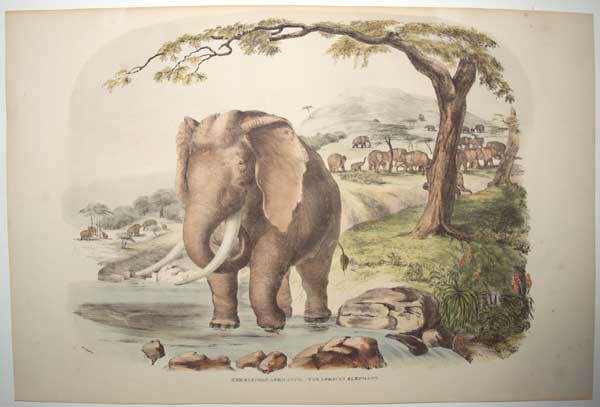
XXII. Elephas Africanus. - The African Elephant.
W. C. Harris del.t
[London, John Murray, n.d., c.1840-3.]
Tinted lithograph with fine hand colour. Printed area 330 x 450mm. (13 x 17¾").
A study of a African Elephant in its natural habitat, with a herd of elephants in the background, from Captain William Cornwallis Harris's 'Portraits of Game and Wild Animals of Southern Africa'. Harris (1807 - 1848), an English military engineer, artist and hunter, joined the East India Company in December 1823. In their employ he was able to pursue his taste for field sports and the depiction of wildlife. One of the more notable of the early Victorian travellers, Harris's illustrations of the large African fauna were the first to have any claim to accuracy. They were originally issued in parts 1840-2 and as a volume in 1843. Abbey Travel 335.
[Ref: 58821] £520.00
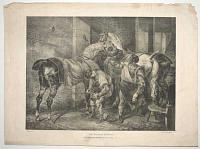
The English Farrier.
J. Gericault del. C. Hullmandel's Lithography.
London. Published by Rodwell & Martin New Bond St. May. 1821.
Lithograph, sheet 350 x 480mm (13¾ x 19"), large margins. Several creases, nicks and stains on top margin, slightly stained on publication line.
Scene in a forge with three horses, tethered to a wall-ring. A farrier hammers nails into the hoof of one of the horses, which attempts to bite another horse but it is fended off with a pair of tongs by a second farrier. After Jean Louis André Théodore Géricault (1791-1824). From the only edition of Rodwell and Martin's 'Various Subjects drawn from life on Stone', known as the 'English Series'. Despite its commercial failure at the time, Gericault's 'English Series' is now considered to have been of the greatest importance in the development of lithography as an art form during the first half of the nineteenth century. Due to the comparitively small number of impressions printed before the stones were effaced, exampes of Gericault's lithographs from this series are now exteremelty rare and have always been amongst the most sought after of his original printed works. See Refs: 31254, 58709 & 58710
[Ref: 58910] £850.00
![[Bunch of Flowers] Quatriéme Cahier de Principes de Fleurs coloriées.](img-thumbnail/jpegs/58814.jpg)
[Bunch of Flowers] Quatriéme Cahier de Principes de Fleurs coloriées. La Girofflée set fait de Laque pure [...]
Carle delin. Bonnet direx.
[Paris: Louis Marin Bonnet, c.1780.]
Crayon-manner etching, printed in colours. 260 x 205mm (10¼ x 8"), very large margins.
A fine example of colour printing, with the colour printed from separate plates, with no hand retouching. The publisher, Louis Marin Bonnet, was the inventor of crayon manner. He operated from the above address between 1776 and 1789. See Dunthorne 211 for a print probably from the same series. See Ref: 58812, 58813
[Ref: 58814] £280.00
(£336.00 incl.VAT)
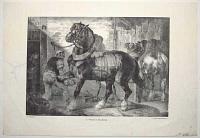
A French Farrier.
J Gericault inv.t. C. Hullmandel's Lithography.
[London. Published by Rodwell & Martin New Bond St. Feb. 1. 1821]
Scarce lithograph. watermark 1820. Printed area 260 x 360mm (10¼ x 14¼"). Repaired tear touching image on left.
Two farriers and horses, by Jean Louis André Théodore Géricault (1791-1824). From the only edition of Rodwell and Martin's 'Various Subjects drawn from life on Stone', known as the 'English Series'. Despite its commercial failure at the time, Gericault's 'English Series' is now considered to have been of the greatest importance in the development of lithography as an art form during the first half of the nineteenth century. Due to the comparitively small number of impressions printed before the stones were effaced, exampes of Gericault's lithographs from this series are now exteremelty rare and have always been amongst the most sought after of his original printed works. Delteil: 41.ii. See Refs: 58910 & 58709.
[Ref: 58710] £280.00
(£336.00 incl.VAT)
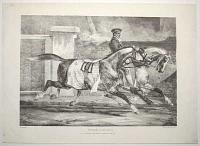
Horses Exercising.
T. Gericault inv.t. C. Hullmandel's Lithography.
London, Published by Rodwell & Martin New Bond Street. Feb. 1. 1821.
Fine lithograph, watermark 1820. Printed area: 285 x 405mm (11¼ x 16"). Tear to left edge.
Two horses wearing saddlecloths canter on a path towards the right, the one in the foreground is unmounted, held by the reins of the rider on the other horse. After Jean Louis André Théodore Géricault (1791-1824). From the only edition of Rodwell and Martin's 'Various Subjects drawn from life on Stone', known as the 'English Series'. Despite its commercial failure at the time, Gericault's 'English Series' is now considered to have been of the greatest importance in the development of lithography as an art form during the first half of the nineteenth century. Due to the comparitively small number of impressions printed before the stones were effaced, exampes of Gericault's lithographs from this series are now extremely rare and have always been amongst the most sought after of his original printed works. See Refs: 35439, 58910 & 58710
[Ref: 58709] £850.00

A Singular Animal called Kangaroo found ont the Coast of New Holland.
[after George Stubbs.]
[n.d., c.1810.]
Engraving. 170 x 215mm (6¾ x 8¾"). Trimmed to image.
A copy of the famous portrait of a kangaroo by George Stubbs, here published in Cooke's 'A Modern and Authentic System of Universal Geography'. CLB 375 V.
[Ref: 58733] £130.00
(£156.00 incl.VAT)

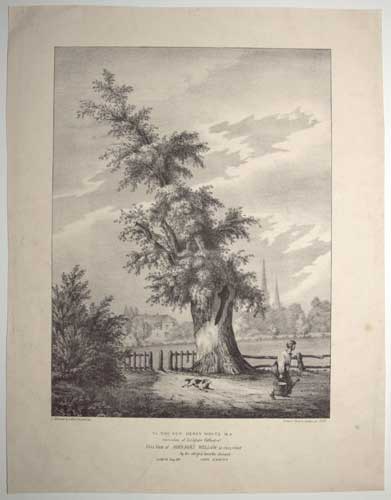
To the Rev. Henry White M.A. Sacristan of Litchfield Cathedral, This View of Johnson's Willow is inscribed by his obliged humble Servant John Hewitt.
Printed by C. Hullmandel. From a Sketch made in 1828.
Lichfield Aug. 1829.
Scarce lithograph. Sheet 365 x 280mm (14¼ x 11").
A view of an elderly willow by Stowe Pool, with the spire of Lichfield Cathedral behind. Planted c.1700, the willow was a favourite of Samuel Johnson, who described it as ''the delight of his early and waning life''. This print was published the year that it blew down, after which it was replaced by a cutting. In November 2021 a fifth replacement tree, all from cuttings, was planted.
[Ref: 58835] £230.00
(£276.00 incl.VAT)

Le Lis. le 10 Mai, 1815.
Dédié aux Amis de Louis Dix huit.
[n.d. c.1815.]
Hand-coloured engraving. 140 x 90mm (5½ x 3½"). Trimmed and laid on album paper at corners, glue stains.
A puzzle print, with three heads hidden in a bouquet of lilies: Louis XVIII, his younger brother Charles, Duke of Angouleme (later Charles X) and his wife Marie Thérèse of Savoy. It was published during the Hundred Days in response to the 'Corporal Violet' portraits of Napoleon.
[Ref: 58950] £240.00
(£288.00 incl.VAT)
![[Rose] Onzieme Bouquet de Fleurs varieés.](img-thumbnail/jpegs/58812.jpg)
[Rose] Onzieme Bouquet de Fleurs varieés.
Carle delin. Bonnet direx.
A Paris, Chez Bonnet, rue St Jacques, au coin de celle de la Parcheminerie [n.d., c.1780].
Scarce crayon-manner etching, printed in colours. Sheet 255 x 195mm (10 x 7¾"). Trimmed within plate, a few spots.
A fine example of colour printing, with the colour printed from separate plates, with no hand retouching. The publisher, Louis Marin Bonnet, was the inventor of crayon manner. He operated from the above address between 1776 and 1789. See Dunthorne 211 for a print probably from the same series. See Ref: 58813, 58814
[Ref: 58812] £280.00
(£336.00 incl.VAT)
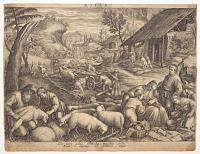
Aestas. Sole niter tellus, formosa messibus aestas ridet, et algentes ore petuntur acquae.
Cum privileg. Bassan pinx. IS scalp.
[n.d. c.1580.]
Engraving, watermark, sheet 215 x 280mm (8½ x 11"). Trimmed to plate. Central tears on top and bottom edge going into image, stains on inscription area.
A summer landscape with a shepherd and a boy shearing lambs and a woman and three children eating in the foreground, harvest scene in the middle ground with farmers cutting wheat on the left, while others load a bull-driven cart with sheaves in the centre, and three farmers threshing the cereals next to a barn at right. A village and hills are visible in the background. This is one of ‘Four Seasons’, a series of four allegorical plates showing the seasons after Bassano, engraved by Jan Sadeler c.1580. Hollstein: 507.
[Ref: 58985] £280.00
(£336.00 incl.VAT)
![[The Joyless Winter Day]](img-thumbnail/jpegs/58782.jpg)
[The Joyless Winter Day]
Fred Slocombe After J. Farquharson. [Signed in pencil]
London Published Feb. 14. 1884 by the Fine Art Soceity. 148 New Bond Street, New York, M. Knoedler & Co.
Copperplate etching, plate 305 x 475mm (12 x 18¾"), with very large margins. Some discolouration. Repairs made leaving a bit of cockling within the image, however largely unnoticeable and textured effect in the margins.
A shepherd and his dogs watch over his sheep during a snowstorm. A copperplate etching by Frederick Slocombe (1847-1920) from an original painting by Joseph Farquharson (1846-1935). The picture has been signed by both men. Farquharson has captured the remarkably realistic effects of a snow storm by painting the original painting in the open air albeit from the relative comfort of the artist's specially constructed mobile painting hut, which contained a stove. The sheep, however, were false, fabricated in plaster by a local sculptor.
[Ref: 58782] £260.00
(£312.00 incl.VAT)
<<< Previous 1 Next >>>
![[Carnations] 3.eme Feuille de 4.eme Cahier.](jpegs/58813.jpg)
![[Natural History of Carolina, Florida and the Bahama Islands] Rana Terrestris. Sarraccena flava. T.69.](jpegs/58764.jpg)
![[Chimpanzee.]](jpegs/59038.jpg)
![[Hungarian Horseman.]](jpegs/59003.jpg)

![[Bunch of Flowers] Quatriéme Cahier de Principes de Fleurs coloriées.](jpegs/58814.jpg)



![[Rose] Onzieme Bouquet de Fleurs varieés.](jpegs/58812.jpg)

![[The Joyless Winter Day]](jpegs/58782.jpg)