Results 1-4 of 4
<<< Previous 1 Next >>>
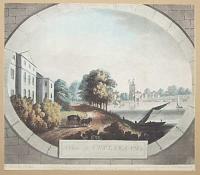
View at Chelsea 1784.
W. Beilby Pinx.t. F Jukes fecit.
London Published Nov. 10.th [1784] by F. Jukes at N.o 16 Howland S.t
Fine coloured aquatint, sheet 230 x 260mm (9 x 10¼"). Trimmed within plate and glued to backing sheet at top. In mount.
Attractive view from the bank of the Thames at Chelsea, London, oval in aquatint masonry frame; with a distant view of All Saints Church, and Battersea Bridge. A carriage travelling down road in foreground, a barge is moored to the right. William Beilby (1740-1819) was a British glassworker known to have produced eminent enamelled glass during the later half of the 18th century. He was brought up in Durham and then later sent as an apprentice to Birmingham until his father's business failed forcing the family to move in 1757 to Newcastle-upon-Tyne to start again. The family then moved again in 1778 to London, then to Scotland. During this period, the family produced no more glass, but Beilby painted more of his exquisite water colours. The engraver, Francis Jukes (1745-1812) was a very early specialist in aquatint, which he learnt from Paul Sandby (1731-1809).
[Ref: 58162] £360.00
![[Keyplate] Chelsea Pensioners reading the Gazette of the Battle of Waterloo.](img-thumbnail/jpegs/58217.jpg)
[Keyplate] Chelsea Pensioners reading the Gazette of the Battle of Waterloo.
[after David Wilkie, R.A.] J. Moyes, Castle Street, Leicester Square.
[London; Moon, Boys, & Graves, c.1831.]
Rare letterpress broadside with woodcut vignette. Sheet 880 x 570mm (34½ x 22½"). Creases and tears.
The keyplate to Sir David Wilkie's painting of a group of Chelsea pensioners sitting round a wooden table outside the Duke of York inn, with one reading aloud the news of Waterloo, highlighting 16 points of interest including variant uniforms of the old soldiers. Below is an extensive list of subscribers, noting whether they bought proofs or prints, including Wilkie himself, the Duke of Wellington (to whom the print was dedicated) and F.G. Moon, one of the publishers. See: 36975 for keyplate & Ref: 32632 for print.
[Ref: 58217] £260.00
(£312.00 incl.VAT)

The Royall Hospitall at Chelsey To the Right Hon.ble S.r Stephen Fox Kn.t Soley Employ'd by King Charles the Second to take care and build the Royal Hospital at Chelsea for y.e Superanuated. and Indigent Officers & Soldiers towards which, he gave the Ground and a third part of his Office of paymaster to the Army which he then Enjoyed and Carryed on the Work with Constant Payments.
[Engraved by Johannes Kip after Leonard Knyff.]
[London: David Mortier, n.d., c.1715.]
Engraving with etching on two sheets conjoined. Total platemark 560 x 895mm (22 x 35¼"). Original binding folds, as normal; old ink pagination.
A bird's eye view of the Royal Hospital at Chelsea, with the river in the foreground and the formal gardens between the river and the hospital. The Westbourne can be seen entering the Thames. This is an early example, before the addition of Joseph Smith's publication line in 1724. The hospital was founded by King Charles II in 1682, however Sir Stephen Fox (1627-1716), to whom this print is dedicated, was the inspiration for its foundation. Fox was a royal administrator and courtier to Charles II and a politician who rose from humble origins, so much so that he became known as 'the richest commoner in the three kingdoms'.
[Ref: 57876] £990.00
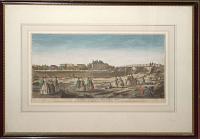
A Prosepect of Chelsea-Bridge Water Works.
Sold by A. Benoist, at M.r Masons next door to the Golden Ball in the Hay Market, over against the Opera House. According to Act of Parliament. [n.d., c.1760]
Hand coloured engraving, frame 435 x 560mm (17¼ x 22"). Unexamined out of frame. Some paper toning
The Chelsea Waterworks Company was formed in 1723 and supplied water to Westminster and adjacent parts. It introduced the first iron main in London in 1746. The company held water in reservoirs in Hyde Park and Green Park and pumped water through an elaborate sysstems of canals which covered a large area of today's Pimlico. As the years marched by the water was becoming more and more contaminated and the Company installed the first Sand filtration operation to purify the water. Eventurally in the late nineteenth century the company became part of the Metropolitan Water Board. Longford: 645. the location of the water works is shown in Rocque's map of Chelsea, ref. 18215. See also 26908 for black and white version.
[Ref: 58158] £260.00
(£312.00 incl.VAT)
<<< Previous 1 Next >>>

![[Keyplate] Chelsea Pensioners reading the Gazette of the Battle of Waterloo.](jpegs/58217.jpg)