Results 1-16 of 16
<<< Previous 1 Next >>>
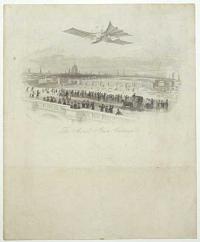
The Aerial Steam Carriage.
Rock & Co. London [n.d., c.1808.]
Rare steel engraving, letter sheet 225 x 185mm (9 x 7½"). Some creasing and surface dirt.
A fictitious flight of the Aerial Steam Carriage over the Thames. The Aerial Steam Carriage was patented in 1842 by William Samuel Henson and John Stringfellow. Henson and Stringfellow only produced scale models, none of which were capable of flying more than a short distance inside a hanger, but the invention marks an important development in the history of powered flying machines.
[Ref: 56976] £280.00
(£336.00 incl.VAT)
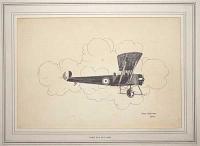
Avro 504 BIPLANE.
Phil Britton.
1924.
Pen and ink drawing, mount 375 x 485mm (14¾ x 19). Taped within mount. Some time staining.
The Avro 504 was a biplane aircraft made by the Avro aircraft company and under licence by others. It was the most-produced aircraft of any kind that served in any military capacity during the First World War; more than 10,000 were built from 1913 until production ended in 1932. Ex Parker Gallery.
[Ref: 57023] £290.00
(£348.00 incl.VAT)
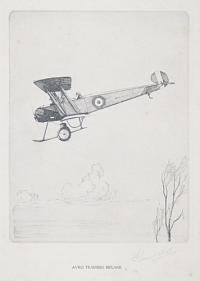
Avro Training Biplane.
Signed in pencil Howard Leigh.
Etching 250 x 190mm, 7½ x 9¾". Light spotting.
Howard Leigh, American 1896-1981.
[Ref: 10908] £220.00
(£264.00 incl.VAT)
![[Biplane dogfight] S.E.5a.](img-thumbnail/jpegs/10907.jpg)
[Biplane dogfight] S.E.5a.
Howard Leigh [pencil signature].
Etching 250 x 190mm (7½ x 9¾"). Light spotting.
A First World War dogfight between a German and a British Royal Aircraft Factory S.E.5, the fastest aircraft in the war. Howard Leigh (1896-1981), an American etcher.
[Ref: 10907] £220.00
(£264.00 incl.VAT)

"Aviation." Louis Bleriot. (The First to Fly the Chanel.)
F.W.
Supplement to "The Throne and Country." August 7, 1909.
Chromolithograph, sheet 360 x 250mm (14¼ x 9¾"), large margins. Tears to edges, some creasing and surface dirt. Messy.
Full length portrait of Louis Charles Joseph Bleriot (1872 – 1936) French aviator, inventor and engineer. In 1909 he became world-famous for making the first airplane flight across the English Channel, winning the prize of £1,000 offered by the Daily Mail newspaper.
[Ref: 56967] £75.00
(£90.00 incl.VAT)
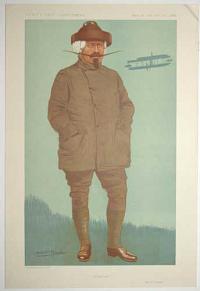
"Vanity Fair" Supplement Men of the Day No. 1303. "All British" (M.r S F. Cody)
Alick. P.F. Ritchie. Vincent Brooks, Day & Son Lt.d lith.
[n.d., 1 Nov 1911]
Chromolithograph with supplementary text, sheet 380 x 260mm (15 x 10¼"), large margins. Crease top right corner.
Full length portrait of Samuel Franklin Cowdery (1867 – 1913), known as Samuel Franklin Cody, USA born Wild West showman, early pioneer of manned flight and inventor of the Cody kite used by the British military. He was also the first man to fly an aeroplane built in Britain. His flight of 16 October 1908 is recognised as the first official flight of a piloted heavier-than-air machine in Great Britain. He set various British flight distance and endurance records and won prizes in flight competitions such as the Michelin Cup in 1911.
[Ref: 56968] £110.00
(£132.00 incl.VAT)
![[Joseph Kaufmann's flying machine] Mechanische Technik. Taf. 34.](img-thumbnail/jpegs/56956.jpg)
[Joseph Kaufmann's flying machine] Mechanische Technik. Taf. 34.
Druck und Verlag von F.A. Brockhaus in Leipzig [n.d., c.1870].
Wood engraving. Sheet 270 x 345mm (10½ x 13½"). Small tear repaired, some foxing.
A sheet of 15 numbered vignette illustrations, of which 14 show designs and uses of balloons. The exception is the most interesting, '14 Flugmachine von Kaufmann'. This was a steam-powered flying machine designed in 1867 by Joseph Kaufmann, a mechanical engineer from Glasgow, with a 40-horsepower steam engine weighing over 5,000 pounds, driving a pair of flapping 35 feet long wings. A large ball was suspended below the aerial machine for stability. He presented a lecture on his experiments to the Glasgow Mechanics Institute in 1869, with a working model. After the wings of the model broke off, the lecture ended and no further reports of Kaufmann's machine exist.
[Ref: 56956] £260.00
(£312.00 incl.VAT)
![Vanity Fair Supplement. [Men of the Day No. 2219.]](img-thumbnail/jpegs/56969.jpg)
Vanity Fair Supplement. [Men of the Day No. 2219.] "Claudie." (C. Graham. White.)
Tec. Hentschel- Colourtype London
[n.d., 10 May 1911.]
Chromolithograph with supplementary text, sheet 380 x 260mm (15 x 10¼"), large margins.
Full length portrait of Claude Grahame-White (1879 – 1959) English pioneer of aviation, and the first to make a night flight, during the Daily Mail-sponsored 1910 London to Manchester air race. Grahame-White's interest in aviation was sparked by Louis Blériot's crossing of the English Channel in 1909. This prompted him to go to France, where he attended the Reims aviation meeting, at which he met Blériot and subsequently enrolled at his flying school. He was one of the first people to qualify as pilot in England. He reached celebrity status in April 1910 when he competed with the French pilot Louis Paulhan for the £10,000 prize offered by the Daily Mail newspaper for the first flight between London and Manchester in under 24 hours. Although Paulhan won the prize, Grahame White's achievement was widely praised.
[Ref: 56969] £130.00
(£156.00 incl.VAT)
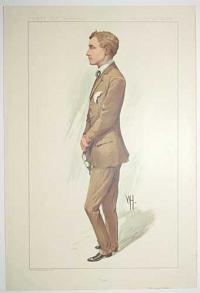
Vanity Fair Supplement. Men of the Day No. 2284. "Flight" (M.r Gustave Hamel).
WH [Wallace Hester]. Vincent Brooks, Day & Son Lt.d lith.
[n.d., 31 Jul 1912].
Chromolithograph with supplementary text, sheet 380 x 260mm (15 x 10¼"), large margins.
Full length portrait of the British aviator Gustav Wilhelm Hamel (1889 - 1914). He learned to fly at the Blériot school at Pau, France in 1910; after observing his first flight Louis Blériot commented that he had never seen a pilot with such natural ability. He paricipated in various competitions, flying displays and a pioneer in aviation; Hamel made the first cross-channel flight with a woman as passenger on 2nd April 1912, when he flew Eleanor Trehawke Davies from Hendon to Paris, he also enabled her to be the first woman to experience looping the loop on 2nd January 1914. Hamel disapeared over the English Channel on 23rd May 1914, it was speculated that this was sabotage but there was no trace of the aircraft and a fishing vessel on 6th July 1914 found a body that matched the description of Hamel.
[Ref: 56970] £120.00
(£144.00 incl.VAT)
![[The Eagle] Das erste Luft-Post-Schiff; genannt der Addler.](img-thumbnail/jpegs/56931.jpg)
[The Eagle] Das erste Luft-Post-Schiff; genannt der Addler.
[n.d., c.1834].
Engraving, sheet 140 x 200mm (5½ x 8"). Cut and glued to backing sheet on top two corners. Some time staining.
A German diagram of one of the airships built by Count Lennox, a French colonel of infantry. He built one in France "constructed for establishing direct communication between the capitals of Europe," however before its first flight from the Champ de Mars in August 1834 the netting broke, the inflated balloon burst and spectators trampled the remains. Count Lennox built a second ship in London and exhibited it at the European Aeronautical Soceity which ran from June to August 1835 and later moved to Vauxhall gardens. No ascent in this balloon was ever made.
[Ref: 56931] £160.00
(£192.00 incl.VAT)
![[Straw-burning ploughing engine.]](img-thumbnail/jpegs/20902.jpg)
[Straw-burning ploughing engine.] [Written on the engine:] Ransomes Sims & Head Ipswich England. Head & Schemioths Patent.
[In ink underneath the image:] Engraved with instruments on waxed plate.
[n.d. c.1848.]
Engraving, scarce. 228 x 342mm. 9 x 13½". Folds and creasing.
Ransomes, Sims & Head, established 1789, was a major British agricultural machinery maker, and also manufactured aeroplanes during the First World War. In 1848, John Head joined the firm as an apprentice and invented an apparatus which enabled straw to be burnt as fuel in the firebox of portable and traction engines. This development, made in collaboration with a Russian engineer named Schemioth, proved a very useful one in countries where there was no wood available for fuel and where coal had to be imported at great expense. The Head-Schemioth system involved the provision of extra-large fireboxes and an apparatus, driven from the crankshaft by a strap, for feeding the straw into the firebox.
[Ref: 20902] £140.00
(£168.00 incl.VAT)
![[A Rolls-Royce Company Christmas Card, illustrated Airshow, with flypast of Hawker Harts?]](img-thumbnail/jpegs/37591.jpg)
[A Rolls-Royce Company Christmas Card, illustrated Airshow, with flypast of Hawker Harts?]
[by Cyril Barraud.]
[Printed by] W.F. Sedgewick Ltd. Xmas 1934.
Etching, presented as a printed christmas card. Etching 175 x 120mm (7 x 4¾") on front of a folded sheet watermarked 1934. Rare.
A christmas card with a printed greeting from A.F. Sidgreaves, managing director of Rolls Royce Ltd. It depicts an airshow with a flypast of biplanes in three ranks of three, most likely the Hawker Hart, a prominent British light bomber between the wars, powered by a Rolls-Royde engine. A Rolls Royce car is parked prominently among the spectators. Cyril Barraud (1877-1965), son of Herbert Rose Barraud and nephew of Francis Barraud. Having trained at the Brighton School of Art he emigrated to Winnepeg in 1913. He was commissioned as a lieutenant with the 43rd Battalion of the Canadian Expeditionary Forces in 1915 but transferred to the 79th Cameron Highlanders of Canada a few months later. He was wounded in the leg fighting in France in 1917, but returned to active service. Barraud was one of the first Canadian artists hired by Lord Beaverbrook for the War Records Office to sketch Canadian battle zones around Ypres and Vimy Ridge-Arras sectors. Later he was seconded to the Canadian War Memorials Fund. After demobilisation he remained in England, painting and etching landscapes, some of which were used for the LNER carriage prints, and taking commissions for christmas cards like this.
[Ref: 37591] £220.00
(£264.00 incl.VAT)
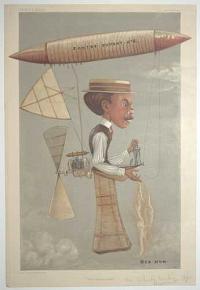
"the Deutsch Prize" Santos. Dumont. N.o 6.
Geo. Hum. Vincent Brooks Day & Son Lt.d lith.
Vanity Fair Nov.r 14th 1901.
Chromolithograph, sheet 380 x 260mm (15 x 10¼").
Caricature of Alberto Santos Dumont (1873 - 1932), Brazillian aeronaut, sportsman and inventor, in a flying machine. The Deutsch de la Meurthe prize, simply known as the Deutsch prize, of 100,000 francs was offered by Henri Deutsch de la Meurthe (born Salomon Henry Deutsch 1846–1919) to the first machine capable of flying a round trip from the Parc Saint Cloud to the Eiffel Tower in Paris and back in less than 30 minutes. On October 19, 1901, Santos-Dumont launched his Number 6 airship at 2:30 pm. After only nine minutes of flight, Santos-Dumont had rounded the Eiffel Tower, but then suffered an engine failure. To restart the engine, he had to climb back over the gondola rail without a safety harness. The attempt was successful, and he crossed the finish line in 29 minutes 30 seconds. However, a short delay arose before his mooring line was secured, and at first the adjudicating committee refused him the prize, despite de la Meurthe, who was present, declaring himself satisfied. This caused a public outcry from the crowds watching the flight, as well as comment in the press. However a face-saving compromise was reached, and Santos-Dumont was awarded the prize. In a charitable gesture, he gave half the prize to his crew and then donated the other half to the poor of Paris.
[Ref: 56945] £85.00
(£102.00 incl.VAT)
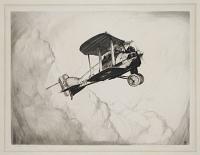
Gloster "Gamecock"
Geoffrey Watson [signed in pencil]
Numbered 16/30 [c.1931]
Etching, 260 x 340mm. 10¼ x 13¼".
Etching by Geoffrey Watson, who produced a series of prints showing aircraft in flight. The Gloster Gamecock, an RAF biplane, first flew in 1925. It was also used by the Finnish air force.
[Ref: 14906] £480.00

Gloster SS19
Geoffrey Watson [signed in pencil]
1931. Numbered 16/30
Etching, 260 x 340mm. 10¼ x 13¼".
Etching by Geoffrey Watson, who produced a series of prints showing aircraft in flight. The Gloster SS. 19, also known as the Gauntlet, entered RAF service in the 1930s and saw combat in Finland in 1939-40.
[Ref: 14905] £480.00
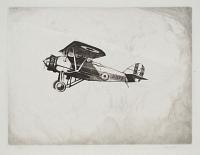
Siskin IIIa.
Geoffrey Watson [signed in pencil]
Etching, 260 x 340mm. 10¼ x 13¼". Slight line across sky.
Etching by Geoffrey Watson, who produced a series of prints showing aircraft in flight. The Armstrong Whitworth Siskin, one of the first RAF fighters designed after World War I. They were used by RAF squadrons between 1924 and 1932. First RAF air display took place at Hendon in July 1920.
[Ref: 14828] £350.00
<<< Previous 1 Next >>>


![[Biplane dogfight] S.E.5a.](jpegs/10907.jpg)


![[Joseph Kaufmann's flying machine] Mechanische Technik. Taf. 34.](jpegs/56956.jpg)
![Vanity Fair Supplement. [Men of the Day No. 2219.]](jpegs/56969.jpg)

![[The Eagle] Das erste Luft-Post-Schiff; genannt der Addler.](jpegs/56931.jpg)
![[Straw-burning ploughing engine.]](jpegs/20902.jpg)
![[A Rolls-Royce Company Christmas Card, illustrated Airshow, with flypast of Hawker Harts?]](jpegs/37591.jpg)