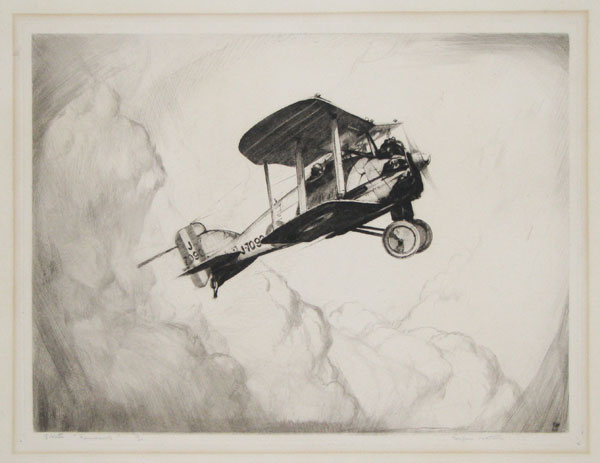
Results 1-47 of 47
<<< Previous 1 Next >>>
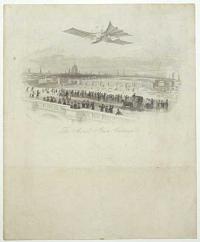
The Aerial Steam Carriage.
Rock & Co. London [n.d., c.1808.]
Rare steel engraving, letter sheet 225 x 185mm (9 x 7½"). Some creasing and surface dirt.
A fictitious flight of the Aerial Steam Carriage over the Thames. The Aerial Steam Carriage was patented in 1842 by William Samuel Henson and John Stringfellow. Henson and Stringfellow only produced scale models, none of which were capable of flying more than a short distance inside a hanger, but the invention marks an important development in the history of powered flying machines.
[Ref: 56976] £280.00
(£336.00 incl.VAT)
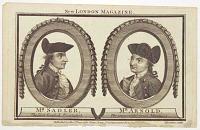
New London Magazine. M.r Sadler, The first English Ærostatist. M.r Arnold, The first unsuccessful Aerial Adventurer.
Thornton sculp.
Published by Alex..r Hogg at the kings Arms N.o16 Paternoster Row, De[c. 31. 1785.]
Engraving, plate 125 x 200mm (5 x 7¾"). Publication line partially obscured.
Oval portraits of James Sadler (1753 – 1828) and Stuart Amos Arnold. Sadler was the first English balloonist and the second person, after Vincenzo Lunardi (1754 – 1806), to make a balloon ascent in England. He was an eminent scientist and made a number of important discoveries; notably that hot air, rather than smoke, as the Montgolfiers had wrongly concluded, was required for airborne propulsion, managed tomanufacture hydrogen at a time when the element was so new it hadn’t even been named and was the first to create an adjustable fire in the basket to manipulate the balloon’s altitude. Arnold is most famous for his balloon that launched 31 August 1785 from St George's Fields, London, which ended in disaster after it got caught on some railings.
[Ref: 56930] £140.00
(£168.00 incl.VAT)
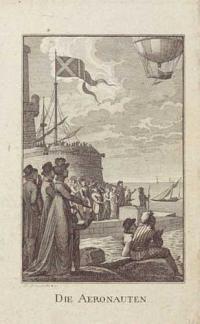
Die Aeronauten.
J: Blaschke sc.
[n.d., c.1840].
Engraving, sheet 135 x 85mm (5¼ x 3¼"). Cut to plate on threee sides.
A german print depicting a hot air ballon manned by a single person flies above a sea port watched by huge crowds. A unidentified swallow tailed flag waves in the wind above a battlement and a ships mast can be seen behind.
[Ref: 56937] £130.00
(£156.00 incl.VAT)
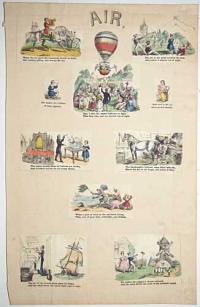
Air.
[n.d., c.1800].
Scrap sheet with ten hand coloured etchings glued to it. Sheet 480 x 305mm (19 x 12"). Some creasing, glue stains, surface dirt and ageing of the paper.
A rare set of scenes with rhyming couplets explaining the usefulness of air in motion, featuring a hot air balloon, instruments, kites, bubbles, fans, bellows, wind, glassblowing, a popgun and a windmill. Game of cricket in background.
[Ref: 56972] £160.00
(£192.00 incl.VAT)
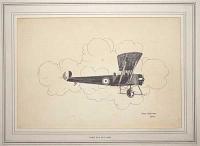
Avro 504 BIPLANE.
Phil Britton.
1924.
Pen and ink drawing, mount 375 x 485mm (14¾ x 19). Taped within mount. Some time staining.
The Avro 504 was a biplane aircraft made by the Avro aircraft company and under licence by others. It was the most-produced aircraft of any kind that served in any military capacity during the First World War; more than 10,000 were built from 1913 until production ended in 1932. Ex Parker Gallery.
[Ref: 57023] £290.00
(£348.00 incl.VAT)
![[A hot air balloon taking off.]](img-thumbnail/jpegs/57135.jpg)
[A hot air balloon taking off.]
C. H[*****] 1880.
Photogravure, printed in colours. 585 x 345mm (23 x 13½"), on thick paper, very large margins.. Repaired tear entering plate but not image.
A post-Revolutionary scene of a hot air balloon lifting off from a crowded area, carrying a couple, with a woman waving a tricolour. Two of the spectators tumble over.
[Ref: 57135] £230.00
(£276.00 incl.VAT)

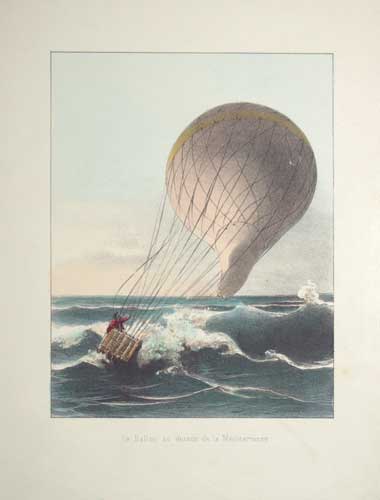
Le Ballon au dessus de la Méditerranée.
[after Jules Marie Desandré.]
[n.d., c.1880.]
Lithograph with hand colour. Printed area 220 x 160mm (8¾ x 6¼"), very large margins.
A balloon ditching in the Mediterranean sea. From the novel "Aventures de Paul enlevé par un ballon" by Jean Bruno.
[Ref: 57030] £130.00
(£156.00 incl.VAT)

Balloon.
[n.d., c.1810.]
Engraving. Sheet 265 x 210mm (10½ x 8¼"). Wormholes in unprinted area.
Two men in balloon take off from the grounds of a factory or mill, in Coventry, watched by a crowd.
[Ref: 56872] £160.00
(£192.00 incl.VAT)

Ascent of M.r Sadler and Miss Thompson from Burlington House July 29 1814.
I.G.
[c.1814]
Etching, sheet 235 x 320mm (9¼ x 12½"). Glued to board and varnished, with title in ink glued to back. Some surface marks. Corners of board exposed.
A view of Burlington House courtyard, showing a balloon on the ground, still being inflated. A large crowd has gathered in the courtyard and on the surrounding buildings to watch. James Sadler (1753 –1828) was the first English balloonist, as well as a chemist and pastry chef.
[Ref: 57020] £160.00
(£192.00 incl.VAT)

Les Amusements de Paris, annee 1783, Hoec omina in irritum cadent,
[c.1783].
Engraving with hand colour, sheet 165 x 210mm (6½ x 8¼"). Trimmed within plate. Some time staining.
A small ballooning display within a grandstand. A crowd gathers to watch the rise and fall of the objects. A man on the right guts pigs for their innards to be used as balloons.
[Ref: 56939] £180.00
(£216.00 incl.VAT)
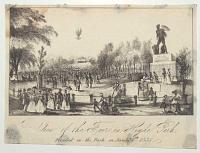
View of the Fair in Hyde Park,
Printed in the Park on June, 28.th 1838.
Very rare lithograph, sheet 140 x 190mm (5½ x 7½"). Brown stain top left and further glue stains on edges where it was once put into a scrapbook.
A view near the Queen Elizabeth Gate at Hyde Park Corner with the statue of Achilles. A large crowd gathers and a hot air balloon floats across the sky.
[Ref: 56940] £260.00
(£312.00 incl.VAT)

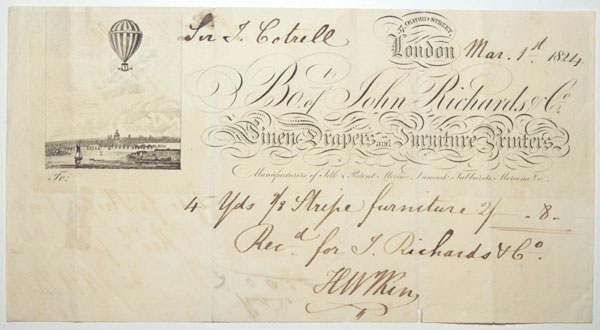
Bo.t of John Richards & C.o. Linen Drapers and Furniture Printers. Manufacture of Silk & Patent... [for Sir J. Cotrell in ink]
[Mar. 1st 1824] [in ink].
Engraving and ink mss, sheet 120 x 235mm (5 x 9¾"). Creases where previously folded. Small tear.
Receipt for an order. A small image of a hot air balloon above a river with ships, in London. Ex collection of Norman Blackburn.
[Ref: 57117] £130.00
(£156.00 incl.VAT)
![[Five comic scenes]](img-thumbnail/jpegs/57072.jpg)
[Five comic scenes] Plate 15.
Designed and Drawn on Zine by A.I. Molinari. Printed by J. Grieve. Nicholas Lane London.
London: Charles Tilt, Fleet Street. [n.d.,c.1820].
Very rare zincograph, sheet 220 x 275mm (8¾ x 10¾").
Five comic scenes with one line of text; A man being handed a piece of paper, 'Hope I don't Intrude?', two men dragging a hot air balloon out of the water, 'Cloud's Omnibus arrival at the bank,' dance partners with the woman's feather accessory attaching itself to the man's hair, 'Miss Huggins, M.r Huggins,' a man sliding down a ladder from a gas lamp post,'More speed than pleasure,' and two gentleman leaning, 'a pair of Cross-grained fellows'.
[Ref: 57072] £160.00
(£192.00 incl.VAT)
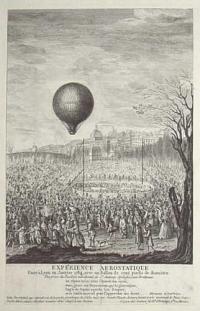
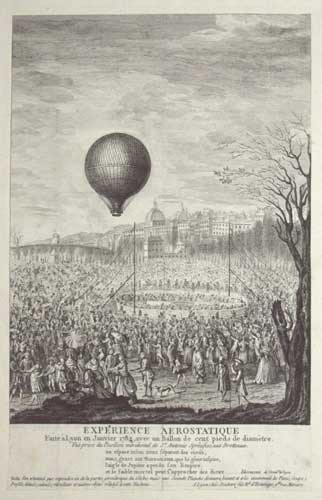
Expérience Aerostatique. Faite à Lyon en Janvier 1784, avec un Ballon de cent pieds de diamètre. Vuë prise du Pavillon meridional de Sr. Antonio Spréafico, aux Brotteaux.
A Lyon chés Joubert fils Md. D'Estampes g.de Rue Merciere [n.d. c.1784].
Fine engraving with etching. Sheet 480 x 340mm (19 x 13½"). Trimmed to image on three sides, laid on sheet.
The 'Aerostatic Experience', 19th January 1784. The only recorded flight by Joseph Michel Montgolfier (1740-1810). After the first ascent in a hydrogen balloon by Charles (1746-1823) on 1 December 1783, the Montgolfier brothers, determined not to be outdone, returned to the South of France where they constructed a balloon of staggering proportions. Named ‘Le Flesselle’ in honour of the Governor of Lyons who sponsored the project, this giant balloon was 131 feet high and 104 feet in diameter, with a capacity of more than 700,000 cubic feet. The ascent from Brotteaux, Lyon on the 19 January 1784 was watched by over 100,000 people. The balloon reached a height of 3000 feet before a large tear in the fabric caused it to descend rapidly, leaving the seven aeronauts shaken but otherwise unhurt.
[Ref: 56953] £380.00
![[The first hydrogen balloon] Allarme générale des habitants de Gonesse occasionée par la chûte du ballon aréostatique de Mr. de Mongolfier.](img-thumbnail/jpegs/56954.jpg)
[The first hydrogen balloon] Allarme générale des habitants de Gonesse occasionée par la chûte du ballon aréostatique de Mr. de Mongolfier.
Se vend à Augsbourg dans le Negoce com¯un de l'Academie Imperiale d'Empire des Arts libér aux avec privilège de sa Majesté Imperiale et avec Defense de n'en fairem'd' vendre de copies [n.d., c.1783].
Coloured etching. 280 x 405mm (11½ x 16"), very large margins. A few foxing spots.
Jacques Charles and brothers Anne-Jean and Nicolas-Louis Robert designed and built the world's first hydrogen-filled balloon, using rubberised silk. It was launched (unmanned) on 27th August 1783 from the Champ-de-Mars in Paris, watched by Benjamin Frankin. It landed 21 kilometres away in the village of Gonesse where the reportedly terrified local peasants attacked it with pitchforks, as depicted here. This print is a vüe-d'optique, designed to be viewed through an optical viewer so the title, which incorrectly draws on Montgolfier's name, is reversed above the image.
[Ref: 56954] £690.00
![[The first hydrogen balloon] Expérience de la Machine Aréostatique de M.rs de Montgolfier d'Anonai eb Vivaris,](img-thumbnail/jpegs/56955.jpg)
[The first hydrogen balloon] Expérience de la Machine Aréostatique de M.rs de Montgolfier d'Anonai eb Vivaris, Reppetée à Paris le 27 Aoust 1783 au Champ de Mars, avec un Bolon de Taffetas enduit de Gomme élastique, de 30 pieds 6 ponces de circonference Ce Balon plein d'Air Inflamable a été éxécuté par Mrs. Robert en vertu d'une Souscription Nationale sous le direction de Mr Faujas de Saint Fond.
[Paris, c.1785]
Engraving with original hand colour. 295 x 410mm (11½ x 16"). Spotting and creasing.
Jacques Charles and brothers Anne-Jean and Nicolas-Louis Robert designed and built the world's first hydrogen-filled balloon, using rubberised silk. It was launched (unmanned) on 27th August 1783 from the Champ-de-Mars in Paris, as depicted here, watched by Benjamin Frankin. It landed 21 kilometres away in the village of Gonesse where the reportedly terrified local peasants attacked it with pitchforks. The use of Montgolfier's name is incorrect. This print is a vüe-d'optique, designed to be viewed through an optical viewer so the title is reversed above the image.
[Ref: 56955] £690.00
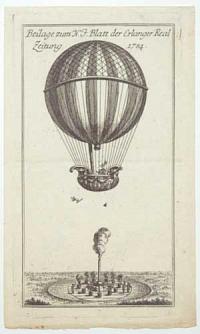
Beilage zum N.J Blatt der Erlanger Real. Zeitung 1784.
Rare engraving, plate 175 x 100mm (7 x 4"). A few age spots mostly in margins. Centre horizontal crease.
Supplement to the German newspaper 'Erlanger Real' published in 1784. Three men on the ground man the instrument providing the hot air to push the balloon upwards. Two men stand in the basket: one waving a flag the other having dropped his. The date, number of passengers and the balloon being unteathered suggests that this depicts the November 21st, 1783 Parisian flight of Pilatre de Rozier and French military official, the Marquis d’Arlandes in a balloon set up by the Montgolfier brothers. The pair flew from the center of Paris to the suburbs, about 5.5 miles (9 km), in 25 minutes. Benjamin Franklin witnessed the flight and wrote about it in his journal.
[Ref: 56928] £130.00
(£156.00 incl.VAT)
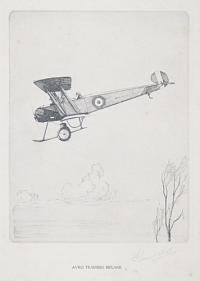
Avro Training Biplane.
Signed in pencil Howard Leigh.
Etching 250 x 190mm, 7½ x 9¾". Light spotting.
Howard Leigh, American 1896-1981.
[Ref: 10908] £220.00
(£264.00 incl.VAT)
![[Biplane dogfight] S.E.5a.](img-thumbnail/jpegs/10907.jpg)
[Biplane dogfight] S.E.5a.
Howard Leigh [pencil signature].
Etching 250 x 190mm (7½ x 9¾"). Light spotting.
A First World War dogfight between a German and a British Royal Aircraft Factory S.E.5, the fastest aircraft in the war. Howard Leigh (1896-1981), an American etcher.
[Ref: 10907] £220.00
(£264.00 incl.VAT)

Jean Pierre Blanchard. The first Aerial Mariner, Citizen of Calais...
R. Livesay pinxit. J. Newton sculpsit.
March 24 Pub. for the Proprietor by S. Hooper No 212, High-Holborn, London.
Stipple with etching and engraving. Sheet 230 x 205mm (9 x 8"). Trimmed within plate. Slight vertical crease.
A half-length portrait of Jean-Pierre Blanchard, published shortly after he and American doctor John Jefferies made the first balloon flight across the English Channel when they travelled from Dover to Calais, January 7th 1785.
[Ref: 56777] £280.00
(£336.00 incl.VAT)

"Aviation." Louis Bleriot. (The First to Fly the Chanel.)
F.W.
Supplement to "The Throne and Country." August 7, 1909.
Chromolithograph, sheet 360 x 250mm (14¼ x 9¾"), large margins. Tears to edges, some creasing and surface dirt. Messy.
Full length portrait of Louis Charles Joseph Bleriot (1872 – 1936) French aviator, inventor and engineer. In 1909 he became world-famous for making the first airplane flight across the English Channel, winning the prize of £1,000 offered by the Daily Mail newspaper.
[Ref: 56967] £75.00
(£90.00 incl.VAT)
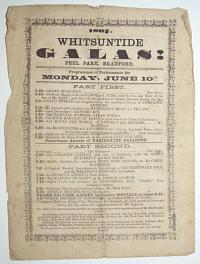
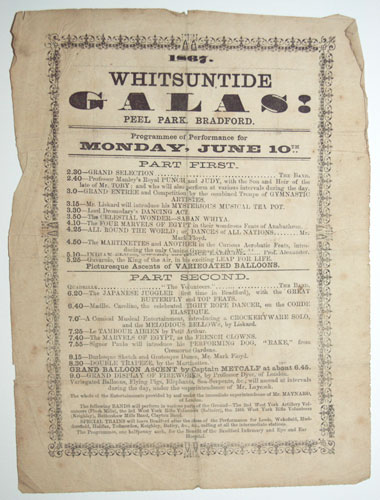
1867. Whitsuntide Galas! Peel Park, Bradford. Programme of Performance for Monday, June 10th.
[1867.]
Scarce letterpress handbill. Sheet 250 x 190mm (9¾ x 7½"). Creasing.
Attractions include Mr Liskard's 'Mysterious Musical Teapot', a 'Grand Balloon Ascent by Captain Metcalf', and 'A Grand Display of Fireworks by Professor Dyer, of London'.
[Ref: 57185] £230.00
(£276.00 incl.VAT)
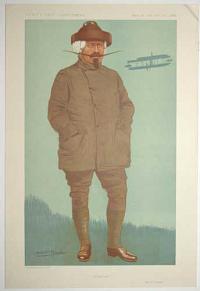
"Vanity Fair" Supplement Men of the Day No. 1303. "All British" (M.r S F. Cody)
Alick. P.F. Ritchie. Vincent Brooks, Day & Son Lt.d lith.
[n.d., 1 Nov 1911]
Chromolithograph with supplementary text, sheet 380 x 260mm (15 x 10¼"), large margins. Crease top right corner.
Full length portrait of Samuel Franklin Cowdery (1867 – 1913), known as Samuel Franklin Cody, USA born Wild West showman, early pioneer of manned flight and inventor of the Cody kite used by the British military. He was also the first man to fly an aeroplane built in Britain. His flight of 16 October 1908 is recognised as the first official flight of a piloted heavier-than-air machine in Great Britain. He set various British flight distance and endurance records and won prizes in flight competitions such as the Michelin Cup in 1911.
[Ref: 56968] £110.00
(£132.00 incl.VAT)

An exact representation of the first Aerial Ship the Eagle. Now exhibiting publickly at the Grounds of the Aeronautical Society Victoria Road opposite Kensington Gardens at 1s Each.
London. Published for the Proprietor by Mes Ackermann Strand, C Tilt Fleet St, Reeve & Sons Cheapside, Riddle & Meymott P.N.Row. [n.d., c.1834.]
Fine lithograph. Sheet 230 x 310mm (9 x 12"). Creased on right bottom.
The Eagle was a paddle-driven balloon designed by the Comte de Lennox in 1834 to provide transport between the capitals of Europe. However, the ship was too heavy to fly and was destroyed by spectators at the Champ de Mars in Paris after a failed take-off in August 1834. A detailed description of the machine's weight, dimensions and parts below the image.
[Ref: 57002] £320.00
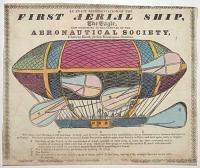
An Exact Representation of the First Aerial Ship, the Eagle. Now exhibiting in the Grounds of the Aeronautical Society, Victoria Road, opposite Kensington Gardens.
[n.d., c.1834.]
Scarce wood engraving with hand colour. Sheet 205 x 245mm (8 x 10"). Restoration to bottom edge with loss to letterpress key.
The Eagle was a paddle-driven balloon designed by the Comte de Lennox in 1834 to provide transport between the capitals of Europe. However, the ship was too heavy to fly and was destroyed by spectators at the Champ de Mars in Paris after a failed take-off in August 1834. A detailed description of the machine's weight, dimensions and parts below the image.
[Ref: 57003] £450.00
![[Joseph Kaufmann's flying machine] Mechanische Technik. Taf. 34.](img-thumbnail/jpegs/56956.jpg)
[Joseph Kaufmann's flying machine] Mechanische Technik. Taf. 34.
Druck und Verlag von F.A. Brockhaus in Leipzig [n.d., c.1870].
Wood engraving. Sheet 270 x 345mm (10½ x 13½"). Small tear repaired, some foxing.
A sheet of 15 numbered vignette illustrations, of which 14 show designs and uses of balloons. The exception is the most interesting, '14 Flugmachine von Kaufmann'. This was a steam-powered flying machine designed in 1867 by Joseph Kaufmann, a mechanical engineer from Glasgow, with a 40-horsepower steam engine weighing over 5,000 pounds, driving a pair of flapping 35 feet long wings. A large ball was suspended below the aerial machine for stability. He presented a lecture on his experiments to the Glasgow Mechanics Institute in 1869, with a working model. After the wings of the model broke off, the lecture ended and no further reports of Kaufmann's machine exist.
[Ref: 56956] £260.00
(£312.00 incl.VAT)
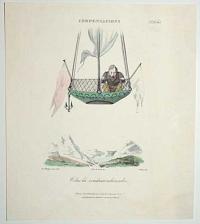
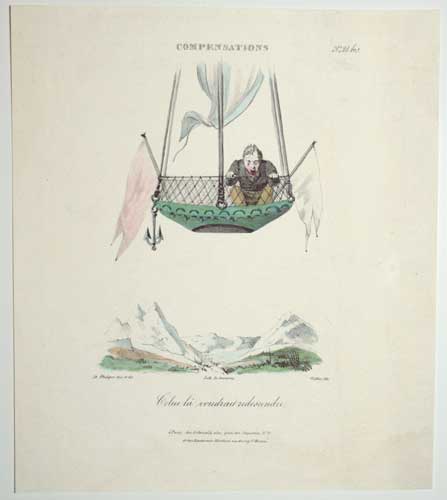
Compensations N.o11 bis. Celui la voudrait zedescendre.
Ch. Philpon inv et del. Lith de Ducarme. Wattier, lith.
a Paris, chez Ostervald aine, Quai des Augustins, N.o 37 etched Hautecoeur Martinet rue du coq S.t Honore.
Very rare lithograph, sheet 325 x 225mm (12¾ x 8¾").
A man in the basket of a hot air balloon crouches, mouth agape in terror looking down at the mountainous scenery. Text in French captures his sentiment 'He would like her to come down.'
[Ref: 57081] £240.00
(£288.00 incl.VAT)

Paris L'Ete. N.o 12
Henry. Emy. Imp. d'Aubert & C.ie
Chez Aubert Pl. de la Bourse, 29.
Lithograph, sheet 340 x 260mm (13½ x 10¼").
Four comic scenes of Paris in the summer; A crowd gathering to depart on a coach,' D'epart pour une petite partie de campagne,' a woman with a huge hat carrying a parasol, 'Une dame qui veut se conserver le teint,' a woman in a hot air balloon, 'M.lle Garnerin repondant aux acclamations d'un public idolatre,' and a man in hunting gear stalking in an unsuitable enviroment, 'Etudes de chasse avant l'ouverture.' Elisa Garnerin (1791-1853) was a French balloonist and parachutist. She was the niece of the pioneer parachutist André-Jacques Garnerin, and took advantage of his name and of the novelty of a woman performing what were at the time extremely daring feats.
[Ref: 57078] £190.00
(£228.00 incl.VAT)
![Vanity Fair Supplement. [Men of the Day No. 2219.]](img-thumbnail/jpegs/56969.jpg)
Vanity Fair Supplement. [Men of the Day No. 2219.] "Claudie." (C. Graham. White.)
Tec. Hentschel- Colourtype London
[n.d., 10 May 1911.]
Chromolithograph with supplementary text, sheet 380 x 260mm (15 x 10¼"), large margins.
Full length portrait of Claude Grahame-White (1879 – 1959) English pioneer of aviation, and the first to make a night flight, during the Daily Mail-sponsored 1910 London to Manchester air race. Grahame-White's interest in aviation was sparked by Louis Blériot's crossing of the English Channel in 1909. This prompted him to go to France, where he attended the Reims aviation meeting, at which he met Blériot and subsequently enrolled at his flying school. He was one of the first people to qualify as pilot in England. He reached celebrity status in April 1910 when he competed with the French pilot Louis Paulhan for the £10,000 prize offered by the Daily Mail newspaper for the first flight between London and Manchester in under 24 hours. Although Paulhan won the prize, Grahame White's achievement was widely praised.
[Ref: 56969] £130.00
(£156.00 incl.VAT)
![[The Grand Jubilee Celebrations in London's Parks.]](img-thumbnail/jpegs/49810.jpg)
[The Grand Jubilee Celebrations in London's Parks.] View of the Bridge and Pagoda, from the Canal, St James's Park.[&] The Chinese Pagoda and Bridge in St James's Park (previous to the Fire.) [&] The Fortress (which inclosed the Grand Pavillion.) in the Green Park; with the ascent of the Balloon. [&] The Grand Pavillion in Green Park. [&] The View in Hyde Park, with the Fleet at Anchor, on the Serpentine River. [&] The Jubilee Naval Action on the Serpentine in Commemoration of the Battle of the Nile. [&] The Action between the British & American Frigates on the Serpentine, Hyde Park, 1st August, 1814. [&] Scene on the Serpentine, Hyde Park, on the Night of the Grand Jubilee, Aug.t 1. 1814.
Published Aug.t 12 [& 24th], 1814, by Tho. Palser, Surry Side, West.r Bridge.
Eight etchings with hand colour. Each c. 245 x 345mm (9¾ x 13½"). Each plate trimmed to plate top and bottom.
On 1st August 1814 a series of events celebrating both the end of the Napoleonic Wars and the centenary of Hanoverian rule in England. In St James's Park a Chinese bridge with a pagoda was built over the lake; in Green Park a revolving Temple of Concord was constructed by Sir William Congreve (of rocket fame); and in Hyde Park naval battles with miniature frigates were fought (the 'Nile' and 'Trafalgar' against the French and a third against the Americans, a reminder that Britain was still fighting the War of 1812). The battles were successful events: however the pagoda in St James's Park was set alight by fireworks, killing one and injuring another; and the balloon ascent, by James Sadler (1753-1828, the first English balloonist) did not go as planned and he had to make an emergency landing.
[Ref: 49810] £2,500.00
view all images for this item
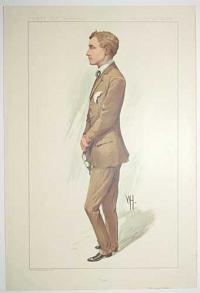
Vanity Fair Supplement. Men of the Day No. 2284. "Flight" (M.r Gustave Hamel).
WH [Wallace Hester]. Vincent Brooks, Day & Son Lt.d lith.
[n.d., 31 Jul 1912].
Chromolithograph with supplementary text, sheet 380 x 260mm (15 x 10¼"), large margins.
Full length portrait of the British aviator Gustav Wilhelm Hamel (1889 - 1914). He learned to fly at the Blériot school at Pau, France in 1910; after observing his first flight Louis Blériot commented that he had never seen a pilot with such natural ability. He paricipated in various competitions, flying displays and a pioneer in aviation; Hamel made the first cross-channel flight with a woman as passenger on 2nd April 1912, when he flew Eleanor Trehawke Davies from Hendon to Paris, he also enabled her to be the first woman to experience looping the loop on 2nd January 1914. Hamel disapeared over the English Channel on 23rd May 1914, it was speculated that this was sabotage but there was no trace of the aircraft and a fishing vessel on 6th July 1914 found a body that matched the description of Hamel.
[Ref: 56970] £120.00
(£144.00 incl.VAT)
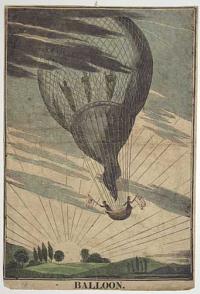
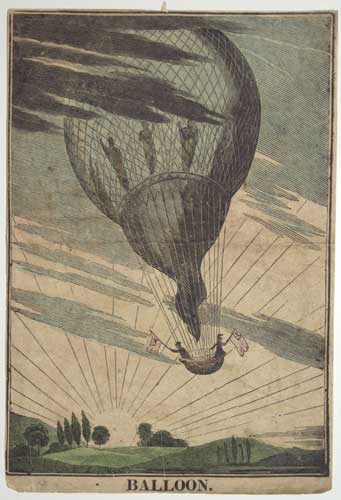
Balloon.
[n.d., c.1820].
Engraving with hand colour, sheet 235 x 155mm (9¼ x 6¼"). Cut. Creased. Some surface dirt.
A blue hot air balloon decorated with people floats above the green countryside towards a beaming sun. Two people wave flags from within the basket. Possibly depicting James Sadler (1753 – 1828) and Captain Paget's flight that took off from Mermaid Gardens, Hackney and descended near Tilbury Fort, Essex 12th August 1811.
[Ref: 56933] £95.00
(£114.00 incl.VAT)
![[The Eagle] Das erste Luft-Post-Schiff; genannt der Addler.](img-thumbnail/jpegs/56931.jpg)
[The Eagle] Das erste Luft-Post-Schiff; genannt der Addler.
[n.d., c.1834].
Engraving, sheet 140 x 200mm (5½ x 8"). Cut and glued to backing sheet on top two corners. Some time staining.
A German diagram of one of the airships built by Count Lennox, a French colonel of infantry. He built one in France "constructed for establishing direct communication between the capitals of Europe," however before its first flight from the Champ de Mars in August 1834 the netting broke, the inflated balloon burst and spectators trampled the remains. Count Lennox built a second ship in London and exhibited it at the European Aeronautical Soceity which ran from June to August 1835 and later moved to Vauxhall gardens. No ascent in this balloon was ever made.
[Ref: 56931] £160.00
(£192.00 incl.VAT)
![[Balloon Ascent from the Gas Works, Lewes.]](img-thumbnail/jpegs/57071.jpg)
[Balloon Ascent from the Gas Works, Lewes.]
T. Henwood del.t. C. Hullmandel lithog.
[n.d.c., 1828].
Lithograph, sheet 200 x 280mm (7¾ x 11). Trimmed. Repaired tears in edges.
A view of a hot air balloon Cuilfail, Lewes, from School Hill with Baxter’s printing office on the right. Charles Green (1785 –1870) and W.H. Gardiner, Esq made an ascent from Lewes gas works Monday 22nd September 1828.
[Ref: 57071] £130.00
(£156.00 incl.VAT)
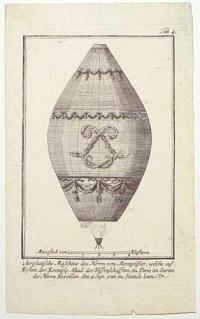
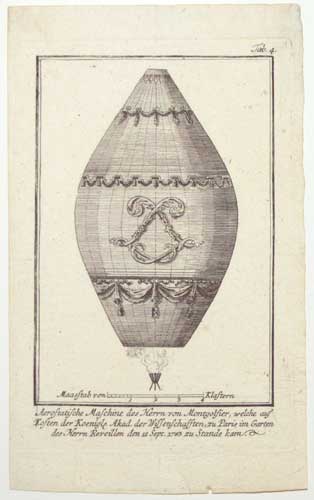
Aerostatische Maschine des Herrn von Montgolfier, welche auf Kosten der Koenigle. Akad der Wissenschafften, zu Paris im Garten des Herrn Reveillon den 12 Sept. 1783 zu Stande kam. Tab 4.
[c.1783].
Rare engraving, plate 180 x 120mm (7 x 4¾"), with small margins.
A diagram of a Montgolfier (the brothers Joseph-Michel (1740–1810) and Jacques-Étienne (1745–1799)) hot air ballon which was financed by the Royal Prussian Academy of Sciences (Königlich-Preußische Akademie der Wissenschaften) and launched from Jean-Baptiste Réveillon's (1725–1811) garden at Folie Titon on 12th September 1783.
[Ref: 57028] £190.00
(£228.00 incl.VAT)
![[Royal Gardens, Vauxhall. Grand day and evening fete, next Tuesday, August 7, 1838.] Ascent of the [N]assau Balloon.](img-thumbnail/jpegs/56935.jpg)
[Royal Gardens, Vauxhall. Grand day and evening fete, next Tuesday, August 7, 1838.] Ascent of the [N]assau Balloon. Combined with the Evening Entertainments. The Ascent Conducted by Mr. Green. Places in the Car for Ten Persons.
[Balne, Printer, 38, Gracechurch Street.] [c.1838].
Cut and glued to backing sheet. Damage losing some of the text.
A scarce advert for one of Charles Green's (1785-1870) ascensions in the balloon "Nassau" from Vauxhall Gardens. Charles Green was the first man to ascend in a balloon filled with coal-generated hydrogen gas in 1821. He made over 500 ascents and airborne excursions between 1821 and 1852, one of which was a record journey of about five hundred miles from Vauxhall Gardens in London to Weilburg in Germany. He regularly ascended a balloon above Vauxhall Gardens.
[Ref: 56935] £160.00
(£192.00 incl.VAT)
![The Parachute [in old ink mss.]](img-thumbnail/jpegs/57029.jpg)
The Parachute [in old ink mss.]
A.L.
[n.d., c.1780.]
Rare oval stipple. Sheet 125 x 90mm (5 x 3½"). Trimmed to image, laid on album paper with ink mss. border and title.
A young boy playing with a toy parachute.
[Ref: 57029] £140.00
(£168.00 incl.VAT)
![[Wonderful Museum] Mons: Garnerin's Wonderful Airial Flight of 8000 feet high.](img-thumbnail/jpegs/56938.jpg)
[Wonderful Museum] Mons: Garnerin's Wonderful Airial Flight of 8000 feet high. from S.t George's Parade, North Audley Street; the Parashute descending after being seperated from the Balloon.
[Pub. June 1-1803 by Alex Hogg 16 Paternoster-row.]
Engraving, sheet 140 x 105mm (5½ x 4"). Trimmed within plate losing publication line and part of the image. Glued to backing sheet. Some time staining and surface dirt.
Diagram of André-Jacques Garnerin's (1769 – 1823) parachute descent from his hot air balloon flight from St. George's Parade (the Volunteeer Ground, Grosvenor Square) on the evening of 21 September 1802. The parachute descended in a field near St Pancras. This trip gave rise to the English ballad, "Bold Garnerin went up, Which increased his Repute, And came safe to earth, In his Grand Parachute." The image is labeled with letters, suggesting that there was an associated key French balloonist Garnerin was appointed Official Aeronaut of France and visited England with his wife Jeanne Geneviève Garnerin (née Labrosse, 1775–1847) in 1802 during the Peace of Amiens. He was also the inventor of the frameless parachute.
[Ref: 56938] £110.00
(£132.00 incl.VAT)
![[Robert Cocking's parachute]. The Ascent of the Royal Nassau Balloon from Vauxhall, with the Parachute attached.](img-thumbnail/jpegs/57018.jpg)
[Robert Cocking's parachute]. The Ascent of the Royal Nassau Balloon from Vauxhall, with the Parachute attached. [&] The fatal Descent of the Parachute by which Mr Cocking lost his life.
W. Lake litho 50 Old Bailey.
[n.d., c.1837.]
Two coloured lithographs. Sheets (at most) 230 x 165mm (9 x 6½"). Trimmed as scraps. Fine repairs in ascent.
Two scenes of Robert Cocking's attempt at a parachute descent from a balloon on 24th July 1837: the successful ascent in the Royal Nassau, piloted by Charles Green and Edward Spencer; and the disastrous descent, in which the flimsy design broke up before it even hit the ground.
[Ref: 57018] £380.00
![[Straw-burning ploughing engine.]](img-thumbnail/jpegs/20902.jpg)
[Straw-burning ploughing engine.] [Written on the engine:] Ransomes Sims & Head Ipswich England. Head & Schemioths Patent.
[In ink underneath the image:] Engraved with instruments on waxed plate.
[n.d. c.1848.]
Engraving, scarce. 228 x 342mm. 9 x 13½". Folds and creasing.
Ransomes, Sims & Head, established 1789, was a major British agricultural machinery maker, and also manufactured aeroplanes during the First World War. In 1848, John Head joined the firm as an apprentice and invented an apparatus which enabled straw to be burnt as fuel in the firebox of portable and traction engines. This development, made in collaboration with a Russian engineer named Schemioth, proved a very useful one in countries where there was no wood available for fuel and where coal had to be imported at great expense. The Head-Schemioth system involved the provision of extra-large fireboxes and an apparatus, driven from the crankshaft by a strap, for feeding the straw into the firebox.
[Ref: 20902] £140.00
(£168.00 incl.VAT)
![[A Rolls-Royce Company Christmas Card, illustrated Airshow, with flypast of Hawker Harts?]](img-thumbnail/jpegs/37591.jpg)
[A Rolls-Royce Company Christmas Card, illustrated Airshow, with flypast of Hawker Harts?]
[by Cyril Barraud.]
[Printed by] W.F. Sedgewick Ltd. Xmas 1934.
Etching, presented as a printed christmas card. Etching 175 x 120mm (7 x 4¾") on front of a folded sheet watermarked 1934. Rare.
A christmas card with a printed greeting from A.F. Sidgreaves, managing director of Rolls Royce Ltd. It depicts an airshow with a flypast of biplanes in three ranks of three, most likely the Hawker Hart, a prominent British light bomber between the wars, powered by a Rolls-Royde engine. A Rolls Royce car is parked prominently among the spectators. Cyril Barraud (1877-1965), son of Herbert Rose Barraud and nephew of Francis Barraud. Having trained at the Brighton School of Art he emigrated to Winnepeg in 1913. He was commissioned as a lieutenant with the 43rd Battalion of the Canadian Expeditionary Forces in 1915 but transferred to the 79th Cameron Highlanders of Canada a few months later. He was wounded in the leg fighting in France in 1917, but returned to active service. Barraud was one of the first Canadian artists hired by Lord Beaverbrook for the War Records Office to sketch Canadian battle zones around Ypres and Vimy Ridge-Arras sectors. Later he was seconded to the Canadian War Memorials Fund. After demobilisation he remained in England, painting and etching landscapes, some of which were used for the LNER carriage prints, and taking commissions for christmas cards like this.
[Ref: 37591] £220.00
(£264.00 incl.VAT)

M.rs Sage. [The first English Female Aerial Traveller, who ascended with Mr. Biggin, in Mr. Lunardi's Balloon, from St. George's Fields June 29th 1785; at 25 Minutes after one oClock, and descended a few Miles beyond Harrow in Middlesex, at three oClock, after traversing upwards of Thirty Miles on the Atmosphere.]
Tburke fecit. S. Shelley del.
[n.d., c.1790.]
Rare stipple, printed in sepia. Sheet: 130 x 140mm (5 x 5½"). Trimmed.
A portrait of Letitia Ann Sage (1750-1817) an actress who was the first woman to fly, riding in Vincenzo Lunardi's balloon. See ref: 50053 for another version.
[Ref: 56977] £180.00
(£216.00 incl.VAT)
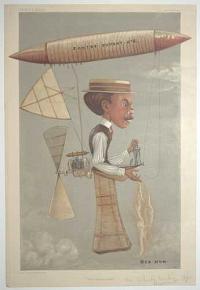
"the Deutsch Prize" Santos. Dumont. N.o 6.
Geo. Hum. Vincent Brooks Day & Son Lt.d lith.
Vanity Fair Nov.r 14th 1901.
Chromolithograph, sheet 380 x 260mm (15 x 10¼").
Caricature of Alberto Santos Dumont (1873 - 1932), Brazillian aeronaut, sportsman and inventor, in a flying machine. The Deutsch de la Meurthe prize, simply known as the Deutsch prize, of 100,000 francs was offered by Henri Deutsch de la Meurthe (born Salomon Henry Deutsch 1846–1919) to the first machine capable of flying a round trip from the Parc Saint Cloud to the Eiffel Tower in Paris and back in less than 30 minutes. On October 19, 1901, Santos-Dumont launched his Number 6 airship at 2:30 pm. After only nine minutes of flight, Santos-Dumont had rounded the Eiffel Tower, but then suffered an engine failure. To restart the engine, he had to climb back over the gondola rail without a safety harness. The attempt was successful, and he crossed the finish line in 29 minutes 30 seconds. However, a short delay arose before his mooring line was secured, and at first the adjudicating committee refused him the prize, despite de la Meurthe, who was present, declaring himself satisfied. This caused a public outcry from the crowds watching the flight, as well as comment in the press. However a face-saving compromise was reached, and Santos-Dumont was awarded the prize. In a charitable gesture, he gave half the prize to his crew and then donated the other half to the poor of Paris.
[Ref: 56945] £85.00
(£102.00 incl.VAT)
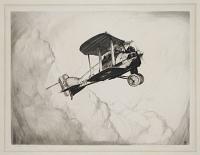
Gloster "Gamecock"
Geoffrey Watson [signed in pencil]
Numbered 16/30 [c.1931]
Etching, 260 x 340mm. 10¼ x 13¼".
Etching by Geoffrey Watson, who produced a series of prints showing aircraft in flight. The Gloster Gamecock, an RAF biplane, first flew in 1925. It was also used by the Finnish air force.
[Ref: 14906] £480.00

Gloster SS19
Geoffrey Watson [signed in pencil]
1931. Numbered 16/30
Etching, 260 x 340mm. 10¼ x 13¼".
Etching by Geoffrey Watson, who produced a series of prints showing aircraft in flight. The Gloster SS. 19, also known as the Gauntlet, entered RAF service in the 1930s and saw combat in Finland in 1939-40.
[Ref: 14905] £480.00
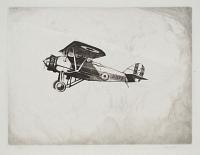
Siskin IIIa.
Geoffrey Watson [signed in pencil]
Etching, 260 x 340mm. 10¼ x 13¼". Slight line across sky.
Etching by Geoffrey Watson, who produced a series of prints showing aircraft in flight. The Armstrong Whitworth Siskin, one of the first RAF fighters designed after World War I. They were used by RAF squadrons between 1924 and 1932. First RAF air display took place at Hendon in July 1920.
[Ref: 14828] £350.00
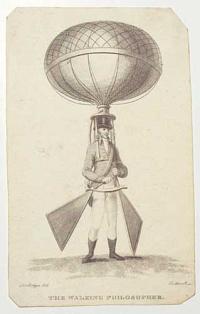
The Walking Philosopher.
DeBruyn del. Rothwell sc.
[Published by Harrison & Co 1/8/1802]
Rare engraving, sheet 140 x 85mm (5½ x 3½"). Trimmed within plate.
A man with a balloon strapped to his body and paddle-shaped wings in each hand.
[Ref: 57061] £140.00
(£168.00 incl.VAT)
<<< Previous 1 Next >>>


![[A hot air balloon taking off.]](jpegs/57135.jpg)


![[Five comic scenes]](jpegs/57072.jpg)
![[The first hydrogen balloon] Allarme générale des habitants de Gonesse occasionée par la chûte du ballon aréostatique de Mr. de Mongolfier.](jpegs/56954.jpg)
![[The first hydrogen balloon] Expérience de la Machine Aréostatique de M.rs de Montgolfier d'Anonai eb Vivaris,](jpegs/56955.jpg)


![[Biplane dogfight] S.E.5a.](jpegs/10907.jpg)




![[Joseph Kaufmann's flying machine] Mechanische Technik. Taf. 34.](jpegs/56956.jpg)

![Vanity Fair Supplement. [Men of the Day No. 2219.]](jpegs/56969.jpg)
![[The Grand Jubilee Celebrations in London's Parks.]](jpegs/49810.jpg)

![[The Eagle] Das erste Luft-Post-Schiff; genannt der Addler.](jpegs/56931.jpg)
![[Balloon Ascent from the Gas Works, Lewes.]](jpegs/57071.jpg)
![[Royal Gardens, Vauxhall. Grand day and evening fete, next Tuesday, August 7, 1838.] Ascent of the [N]assau Balloon.](jpegs/56935.jpg)
![The Parachute [in old ink mss.]](jpegs/57029.jpg)
![[Wonderful Museum] Mons: Garnerin's Wonderful Airial Flight of 8000 feet high.](jpegs/56938.jpg)
![[Robert Cocking's parachute]. The Ascent of the Royal Nassau Balloon from Vauxhall, with the Parachute attached.](jpegs/57018.jpg)
![[Straw-burning ploughing engine.]](jpegs/20902.jpg)
![[A Rolls-Royce Company Christmas Card, illustrated Airshow, with flypast of Hawker Harts?]](jpegs/37591.jpg)