Results 1-10 of 10
<<< Previous 1 Next >>>
![[S.S. Britannic.] White Star Lines.](img-thumbnail/jpegs/56337.jpg)
[S.S. Britannic.] White Star Lines.
Printers, Sir Joseph Cuaton & Sons, London. Entered at Stationers Hall.
[n.d., c.1880.]
Chromolithograph on card, printed on both sides. Sheet 100 x 160mm (4 x 6¼"). Glue stain on front, remains of album sheet on reverse.
An advertisment for the White Star Line, showing S.S. Britannic (1874-1903) steaming from Liverpool harbour for New York. The details of the route are printed on the reverse, including ''Steerage Fare only £3 to New York, Boston or Philadelphia''.
[Ref: 56337] £230.00
(£276.00 incl.VAT)

Capt.n Tho.s Coram who after 17 Years unwearied application, obtained the Charter of the Foundling Hospital, To the Governors & Guardians of the Hospital, this Print is humbly dedicated by their obedient humble Servt. R. Cribb.
W. Hogarth Pinx.t. W. Nutter sculpt..
London, Published Dec. 1. 1796, by R. Cribb, No.288 Holborn.
Stipple, title in open letters. 580 x 405mm (22¾ x 16"), very large margins. Some foxing, very fine impression.
The philanthropic sea captain Thomas Coram (c.1668 - 1751), who in 1742 founded the Foundling Hospital in Guildford Street, London. It was a children's home established for the 'education and maintenance of exposed and deserted young children.' The artist William Hogarth was a friend of Coram's and later a governor of the institution. Handel donated an organ to the chapel and gave performances of the 'Messiah' on it, raising £7,000. Coram sits surrounded by emblems representing his mercantilist and philanthropic activities, including a scroll lettered "The Royal Charter" for the hospital. The charter was signed in 1739, and the hospital started receiving children at the end of 1745. After William Hogarth (1697 - 1764).
[Ref: 56430] £380.00
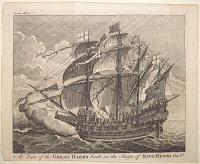
A View of the Great Harry built in the Reign of King Henry the 8.th. London Mag:
Engraving. 190 x 235mm (7½ x 9¼"). Bottom margin trimmed to plate mark. Three vertical creases as usual.
A side view of the Henry Grace a Dieu or Great Harry flagship of the King's Fleet. At the time it was the largest warship in the world, surpassing even the Mary Rose.
[Ref: 56312] £160.00
(£192.00 incl.VAT)
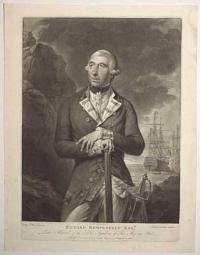
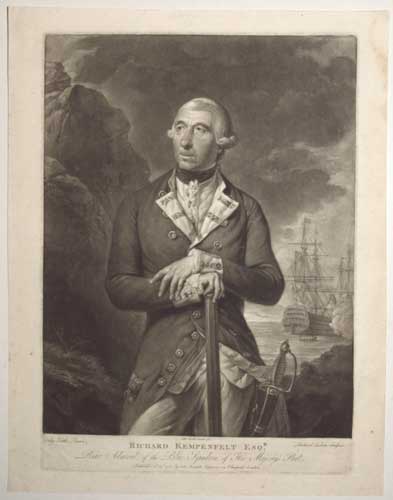
Richard Kempenfelt Esq.r Rear Admiral of the Blue Squadron of His Majesty's Fleet.
Tilly Kettle Pinxit. Richard Earlom Sculpsit. John Boydell excudit 1782.
Publish'd Oct.r 22.d 1782 by John Boydell, Engraver in Cheapside London.
Fine mezzotint. 390 x 280mm (15¼ x 11") very large margins. Mint.
Richard Kempenfelt (1718-1782) saw service in the West Indies during the War of Jenkins' Ear (1739-48), including the capture of Portobello. In 1757 he joined the East Indies fleet, taking part in the capture of Pondicherry, 1761, and Manila. In 1781 he won the Battle of Ushant, with a vastly inferior force, defeating the French fleet under De Guichen and capturing twenty ships. Kempenfelt drowned in 1782 when the Royal George keeled over while at anchor off Spithead, drawing attention to the poor state of many British ships. The toll was over 900 lives. Tilly Kettle (1735-86) was a portrait painter and the first English painter to work in India, 1768-1776. CS: 25, ii of ii.
[Ref: 56434] £360.00
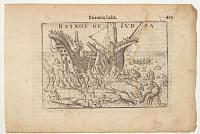
Baixos de Iudia. 669.
P.K.
Barent Langenes [Amsterdam, 1612].
Engraving with letterpress on reverse. 80 x 115mm (3 x 4½"). Toning and water stain. Small hole in bottom left margin.
A scene depicting the shipwreck of the Portuguese ship 'Santiago' between Mozambique and Madagascar in 1585. Giant lobsters can be seen attacking the shipwrecked sailors while some can be seen escaping in life boats in the background. Fifty survivors reached Mozambique. The plate was engraved by Pieter van den Keere for the 1598 'Caert-Thresoor', published by Barent Langenes with a text by an unknown author.
[Ref: 56425] £190.00
(£228.00 incl.VAT)
![[Battle of Plymouth] Zee-Slagh Tusschen de M.r Miciel de Ruiter en de H.r Georg Ascue by Plymurden op den 26 Augusti 1652.](img-thumbnail/jpegs/56266.jpg)
[Battle of Plymouth] Zee-Slagh Tusschen de M.r Miciel de Ruiter en de H.r Georg Ascue by Plymurden op den 26 Augusti 1652.
Stoopendael sculp.
[Amsterdam, c.1686.]
Etching. Sheet 265 x 350mm (10½ x 13¾"). Slight central crease. Trimmed to printed border.
A view of the Battle of Plymouth, 16 August 1652 (26th in the Gregorian calendar), in which personal friends General-at-Sea George Ayscue and Vice-Commodore Michiel de Ruyter led English and Dutch fleets into battle. Despite having the smaller fleet, de Ruyter succeeded in getting the Dutch merchant convoy to safety, an action that brought him to prominence as a commander. An illustration from G. Brandt's account of de Ruyter's life 'Het leven en bedryt van der heere Michiel de Ruiter'
[Ref: 56266] £230.00
(£276.00 incl.VAT)
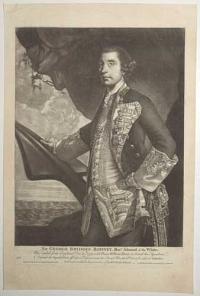
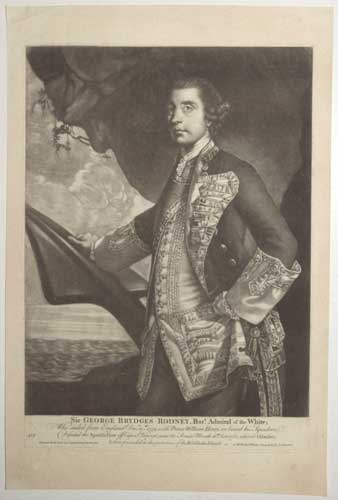
Sir George Brydges Rodney, Bar.t Admiral of the White; Who sailed fro England Dec.r 27th 1779 with Prince William Henry, on board his Squadron: Defeated the Sapnish Fleet of Cape St Vincent, near the Straits Mouth 16th Jan 1780; relieved Gibraltar, & then proceeded to the protection of the West Indian Islands.
[after Sir Joshua Reynolds.]
Printed for & Sold by Carington Bowles, No. 69 in St. Pauls Church Yard, London [n.d., c.1782].
Fine mezzotint. 350 x 250mm (13¾ x 9¾") very large margins Mint.
Three-quarter length portrait of George Brydges Rodney (1718-92), 1st Baron Rodney, in uniform, leaning on an anchor. Joshua Reynolds painted with portrait in 1759, celebrating Rodney being appointed a rear admiral. Later Carington Bowles published a version of the portrait altered to show Rodney as an older man, wearing his order of the Bath.
[Ref: 56435] £360.00
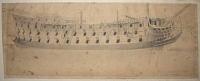
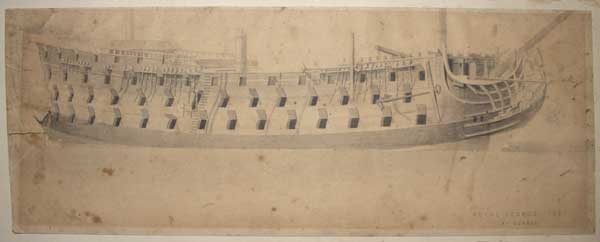
Royal George 1759 by Serres.
[Dominic Serres]
Ink and grey wash. Sheet 170 x 450mm (6¾ x 17¾"). 'Royal George' in same grey wash on reverse, title on front (as above) in later hand. Tears, stains, mounted on card.
The starboard side of the 'Royal George', a first-rate with 100 guns on three decks, the largest warship in the world when launched in 1756. The year of this sketch she was Admiral Sir Edward Hawke's flagship at the Battle of Quiberon Bay, where she sank 'Superbe'. Royal George sank in August 1782 at Spithead off Portsmouth while she was rolled for maintenance, with the loss of more than 900 lives. The wreck was a major hazard in the Solent until 1840, when gunpowder was used to destroy it. We believe this sketch shows the Royal George with damage after the Battle of Quiberon Bay. Dominic Serres (1722-93) was a French-born maritime painter who documented the events of the Seven Years' War, including Quiberon Bay and the Capture of Havana in 1762.
[Ref: 56382] £590.00
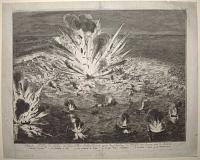
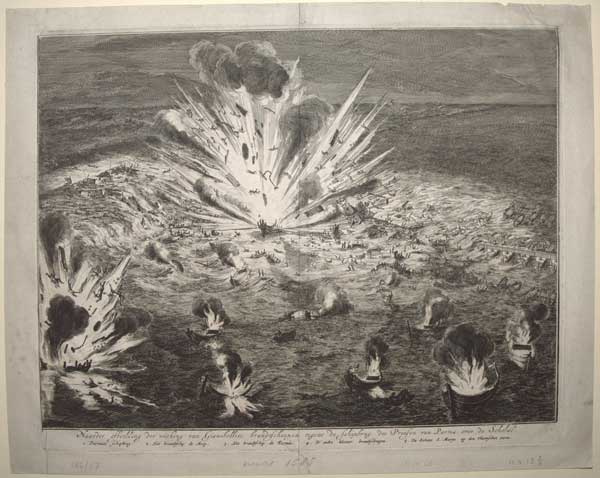
Naarder afbeelding der werking van Gianibellies brandtscheenen tegen de Schinbrug des Prinsen van Parma over de de Schelde. 1. Parmaas Schipbrug. 2. Het brandtschip de Hoop. 3. Het brandship de Fortuin. 4. D.andre kleener brandtscheepen. 5. De Schans S. Marye op den Vlaamschen oever.
[Pieter Bor.]
[Antwerp, n.d. c.1585].
Rare etching. 280 x 345mm 11 x 13½"), large margins Central crease as normal. Two repaired tears in lower margin and title area.
The explosive 'hellburners' or fireships used to destroy the pontoon bridge constructed by the army of Alexander Farnese, Duke of Parma, during the seige of Antwerp. Supported and subsidised by Elizabeth I, Italian engineer Federigo Giambelli developed perhaps the earliest example of weapons of mass destruction, two unmanned ships packed with gunpowder, schrapnel and fitted with a sophisticated timer mechanism set to detonate at the ideal moment. It is recorded that over one thousand Spanish troops were killed instantly at the moment of detonation, and the seige on Antwerp was lifted for a time.
[Ref: 56315] £260.00
(£312.00 incl.VAT)
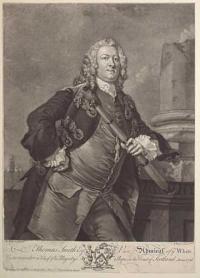
Thomas Smith Esq. Vice Admiral of ye White Commander in Chief to his Majesty's Ships on the Coast of Scotland. Anno 1746.
R. Wilson pinx.t. J. Faber fecit.
Price 2.s Sold by Faber at the Golden Head in Bloomsbury Square. [n.d. c.1750.]
Rare mezzotint. Sheet 355 x 255mm (14 x 10"). Trimmed to plate, tipped on album paper at corners on left. Damaged in title.
Thomas Smith (1707-1762), commodore governor of Newfoundland 1741/3 and admiral credited with the invention of the divisional system that remains in use on ships today. CS: 333 i of v.
[Ref: 56431] £220.00
(£264.00 incl.VAT)
<<< Previous 1 Next >>>
![[S.S. Britannic.] White Star Lines.](jpegs/56337.jpg)



![[Battle of Plymouth] Zee-Slagh Tusschen de M.r Miciel de Ruiter en de H.r Georg Ascue by Plymurden op den 26 Augusti 1652.](jpegs/56266.jpg)