Results 1-8 of 8
<<< Previous 1 Next >>>
![[Bail form] Public Office, Bow Street.](img-thumbnail/jpegs/54219.jpg)
[Bail form] Public Office, Bow Street. Taske Notice that you [ __ ] of [ __ ] aare bound in the Sum of Forty Pounds, to appear at the Session of the Peace, to be holden for the County of Middlesex, at the Session House, Clerkenwell Greem, on the [ __ ] Day of [ __ ] next, to prefer as Bill of Indictment, and prosecute the Law with effect against [ __ ] for Felony [...]
[n.d., c.1820.]
Letterpress form, part 18th century watermark. Sheet 240 x 190mm (9½ x 7½").
An unused bail form, to be filled in and signed by a Justice of the Peace.
[Ref: 54219] £190.00
(£228.00 incl.VAT)
![Plan of the Columbia's Accommodations, [***] Commander.](img-thumbnail/jpegs/54175.jpg)
Plan of the Columbia's Accommodations, [***] Commander. For [***] direct. Burthen per register 510 tons, has elegant and spacious accommodations, fitted up in a superior style for passengers, and carries an experienced Surgeon. To sail [***]. For tems of Freight or Passage apply to the Commander on board or to Mess.rs [***].
R. Perera. Lithog Bombay.
[n.d., c.1845.]
Extremely rare lithograph. Sheet 330 x 210mm (13 x 8¼"). Stains, chips to edges.
A diagram of the layout of the passenger accomodation of a ship on the India line, with gaps for added manuscript details.
[Ref: 54175] £480.00

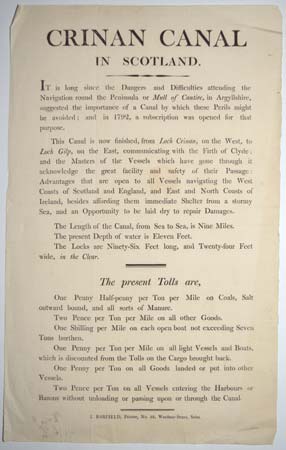
Crinan Canal in Scotland. It is long since the Dangers and Difficulties attending the Navigation round the Peninsula or Mull of Cantire, in Argyllshire, suggested the importance of a Canal by which these Perils might be avoided; and in 1792, a subscription was opened for that purpose. Thhis Canal is now finished...
J. Barfield, Printer, No. 91, Wardour-Street, Soho [n.d., c.1801].
A rare letterpress broadside, 18th century watermark. Sheet 410 x 255mm (16 x 10") Old ink mss. on reverse.
A decription of the Crinan Canal, designed to link the Clyde and the Inner Hebrides bypassing the Kintyre peninsula and opened 1801, including the tolls.
[Ref: 54177] £360.00
![[Forth & Clyde Navigation] By Virtue of several Acts of Parliament, passed in the Reign of His present Majesty,](img-thumbnail/jpegs/54173.jpg)
[Forth & Clyde Navigation] By Virtue of several Acts of Parliament, passed in the Reign of His present Majesty, the Company of Proprietors of the Forth and Clyde Navigation, have made and established the following Rules, Regulations and Bye-Laws, to be observed and obeyed by all Persons, resorting to the Harbours, Basons, Wharfs, and Landing Places of the Canal from and after the 1st Day of July 1794, and to continue in Force till altered by the Said Company. [...] Thomas Dundas Governor. John Seton, Secretary.
[c.1794.]
Letterpress, scarce. Sheet 550 x 370mm (21¾ x 14½"). Folded, wear to edges, damp stains, old ink mss addenda.
A list of 12 regulations for using the Forth and Clyde Canal, a 35-mile canal from the River Carron at Grangemouth to the Clyde at Bowling, opened in 1790. The addenda to the text raises the harbour duty; on the back is a calculation of cost of a vessel's use of the canal. Port Dundas, the terminus of the canal in the centre of Glasgow, was named after a major backer of the canal, Sir Lawrence Dundas (1710-81); his son, Thomas Dundas (1741-20, 1st Baron Dundas), was the governor of the company mentioned on this broadside.
[Ref: 54173] £390.00
![[Forth & Clyde Navigation] By Virtue of several Acts of Parliament, passed in the Reign of his present Majesty,](img-thumbnail/jpegs/54172.jpg)
[Forth & Clyde Navigation] By Virtue of several Acts of Parliament, passed in the Reign of his present Majesty, the Company of Proprietors of the Forth and Clyde Navigation have made and established the following Rules, Regulations and Bye-Laws, to be obeyed and observed by all Masters of Vessels and other persons, resorting to and using the said Navigation. [... ] Dundas Governor. John Seton, Secretary.
[c.1799.]
Letterpress, scarce. Sheet 455 x 370mm (18 x 14½"). Folded, wear to edges, top margin narrow, as issued, damp stain in inprinted area.
A list of 22 regulations for using the Forth and Clyde Canal, a 35-mile canal from the River Carron at Grangemouth to the Clyde at Bowling, opened in 1790. Port Dundas, the terminus of the canal in the centre of Glasgow, was named a major backer of the canal, Sir Lawrence Dundas (1710-81); his son, Thomas Dundas (1741-20, 1st Baron Dundas), was the governor of the company mentioned on this broadside.
[Ref: 54172] £260.00
(£312.00 incl.VAT)
![[Forth & Clyde Navigation] By Virtue of several Acts of Parliament, passed in the Reign of His present Majesty,](img-thumbnail/jpegs/54178.jpg)
[Forth & Clyde Navigation] By Virtue of several Acts of Parliament, passed in the Reign of His present Majesty, The Governor and Council of the Company of Proprietors of the Forth and Clyde Navigation have ordered the following Rates and Duties on all Vessels, Goods, Commodities, navigated or conveyed on the said Navigation and Collateral Cut to the West End of the Monkland Canal, and lying in the Harbours and Basins, and on the Quays, Wharfs, and Landing Places belonging thereto, to be levied agreeably to the Rules and Regulations herein-after mentioned; and to commence from the 31st Day of March 1818, and continue in force till altered by the said Governor and Council.
[c.1818.]
4pp. letterpress, scarce. 445 x 270mm (17½ x 10¾"). With three a.l.s. from the company secretary, David Caldwell to Graham Hamond. Creasing.
A list of tolls and dues for the Forth & Clyde canal, including fines for not returning ice-fenders. The letters are addressed to Sir Graham Hamond (1779-1862) (mis-spelt Hammond), a Royal Naval officer who appears in Mather Brown's painting of the Battle of the Glorious First of June (1794), at which he served as a young midshipman. He continued to serve throughout the Napoleonic wars, including the Battle of Copenhagen and the siege of French-held Malta. These letters, giving details taking his yacht through the Forth & Clyde Navigation, are dated 1818, three years before he was made a Deputy Lieutenant of the Isle of Wight. The address is Norton Lodge (now Norton Grange), where Hamond died in 1862, less than a month after being promoted full admiral.
[Ref: 54178] £350.00
(£420.00 incl.VAT)
view all images for this item
![[WITH SIGNATURE OF THE FIRST GOVERNOR OF NEW ZEALAND] A Daily Report of the Progress made in the Equipment of His Majesty's [Ship Rattlesnake, Rio de Janeiro]](img-thumbnail/jpegs/54176.jpg)
[WITH SIGNATURE OF THE FIRST GOVERNOR OF NEW ZEALAND] A Daily Report of the Progress made in the Equipment of His Majesty's [Ship Rattlesnake, Rio de Janeiro] Captain [William Hobson] the [15th] of [May] 18[35]. [W.Hobson Captain].
[1835.]
Letterpress form with ink mss, scarce. Sheet 170 x 410mm (6¾ x 16"). Creases.
A daily ship's report form signed by the captain of HMS Rattlesnake (1822), William Hobson (1792-1842), during its voyage to join the Far East squadron in Australia. Arriving in Australia in August 1836, Hobson and his officers thoroughly surveyed Port Phillip as part of the founding of the colony that is now Melbourne. In May 1837 the Rattlesnake sailed to the Bay of Islands, New Zealand, to help the British Resident deal with a Maori tribal war. Back in England in 1838 Hobson proposed establishing British sovereignty in New Zealand; returning in 1840 he drafted the Treaty of Waitangi and became first governor of the British colony 1841. He died of a stroke the following year.
[Ref: 54176] £650.00
view all images for this item
![[Collection of four ink mss. sailing directions, three ink sketches and a pencil sketch, from the collection of Sir Graham Hamond.]](img-thumbnail/jpegs/54217.jpg)
[Collection of four ink mss. sailing directions, three ink sketches and a pencil sketch, from the collection of Sir Graham Hamond.]
[Various dates, 1815-1854.]
8 sheets, various hands, largest 325 x 200mm (12¾ x 8"). Some staining.
The sailing directions relate to the work of Trinity House (the institution in charge of Britain's lighthouses) on navigational buoys. One sheet, bearing their address as sender and dated 28th August 1815, describes two buoys near Selsey Bill; the same text was published by Trinity House on 23rd May 1818 and recorded in Norie's 'New and complete sailing directions for the east coast of England'. The ink sketches (in the same hand) detail parts of a wooden ship. The pencil sketch, signed '[**] Hammond Dec. 30 /54', depicts two ships under sail with a town in the background. From the collection of Sir Graham Hamond (1779-1862), a Royal Naval officer who appears in Mather Brown's painting of the Battle of the Glorious First of June (1794), at which he served as a young midshipman. He continued to serve throughout the Napoleonic wars, including the Battle of Copenhagen and the siege of French-held Malta. He died less than a month after being promoted to full admiral.
[Ref: 54217] £280.00
(£336.00 incl.VAT)
view all images for this item
<<< Previous 1 Next >>>
![[Bail form] Public Office, Bow Street.](jpegs/54219.jpg)
![Plan of the Columbia's Accommodations, [***] Commander.](jpegs/54175.jpg)
![[Forth & Clyde Navigation] By Virtue of several Acts of Parliament, passed in the Reign of His present Majesty,](jpegs/54173.jpg)
![[Forth & Clyde Navigation] By Virtue of several Acts of Parliament, passed in the Reign of his present Majesty,](jpegs/54172.jpg)
![[Forth & Clyde Navigation] By Virtue of several Acts of Parliament, passed in the Reign of His present Majesty,](jpegs/54178.jpg)
![[WITH SIGNATURE OF THE FIRST GOVERNOR OF NEW ZEALAND] A Daily Report of the Progress made in the Equipment of His Majesty's [Ship Rattlesnake, Rio de Janeiro]](jpegs/54176.jpg)
![[Collection of four ink mss. sailing directions, three ink sketches and a pencil sketch, from the collection of Sir Graham Hamond.]](jpegs/54217.jpg)