![[William IV when Duke of Clarence] Nauticus.](img-thumbnail/jpegs/64180.jpg)
[William IV when Duke of Clarence] Nauticus. ''Those Lips were made for Kissing Ladies!''.
[by James Gillray.]
London - Pub.d Oct.r 11the 1791. by H. Humphrey, No 18 Old Bond Street.
Etching. 185 x 160mm (7¼ x 6¼"). Thread margins, notch in right edge.
A caricature portrait of William, Duke of Clarence, smiling with bulbous lips, hair is shaggy and uncurled under a large round hat, wearing his naval uniform with star. It was published the year he started his long affair with actress Mrs Jordan. BM Satires 7964.
[Ref: 64180] £180.00
(£216.00 incl.VAT)
![[Charter segment from the reign of William IV.]](img-thumbnail/jpegs/27847.jpg)
[Charter segment from the reign of William IV.]
[n.d., c.1830.]
Lithograph on vellum with rubrication. Sheet 180 x 170mm, 7 x 6¾". Excised from a larger sheet, mounted on album paper.
Oval portrait of William IV surrounded by a garland of rose and thistle. His reign lasted 1830-36. See Ref: 27840, 27843 & 27846
[Ref: 27847] £220.00
(£264.00 incl.VAT)
![King William The 4th. [&] Queen Adelaide.](img-thumbnail/jpegs/25434.jpg)
King William The 4th. [&] Queen Adelaide.
Pub. March, 22. 1831, by O. Hodgson, 10, Cloth Fair. No.1.
A pair of hand-coloured mixed-method prints. 190 x 126mm. 7½ x 5". Cut, some creasing and toning.
King William IV (1765-1837) the last king and penultimate monarch of Britain's House of Hanover. In 1818, at Kew Palace, William married Princess Adelaide of Saxe-Meiningen (1792-1849) who stood as queen consort of the United Kingdom. Ex Collection: R. Hobson of Hove.
[Ref: 25434] £95.00
(£114.00 incl.VAT)
![[William IV as Lord High Admiral & the Duke of Wellington] The Navy! [&] The Army!](img-thumbnail/jpegs/58712.jpg)
[William IV as Lord High Admiral & the Duke of Wellington] The Navy! [&] The Army!
Painted by M.W. Sharpe. Engraved by W. Say, Engraver to T.R.H. The Duke & Duchess of Gloucester, 9, Mortimer Street.
London, Published April 23 1828, by Wm.Sams Book & Printseller to the Royal Family, 1, St James's Street.
Very scarce pair of mezzotints. Each 495 x 390mm (19½ x 15¼"). Small margins.
A pair of portraits of the heads of the armed services. 'The Navy' depicts William, Duke of Clarence, during his short term as Lord High Admiral (1827-8, a post he was sacked from two years before becoming William IV). He stands aboard, raising his tricorn, using a capstan as a drinks table. 'The Army' is a portrait of Arthur Wellesley, 1st Duke of Wellington as Commander in Chief of the British Army. He stands in uniform and chain of office, standing beside a table and toasting a glass to the viewer. A view of London from Apsley House, his London residence at Hyde Park Corner, can be seen through the window on the left. This print was also published with the title 'Health! And Long Life To The King!' with the same publication date. After Michael William Sharp (1776/7-1840).
[Ref: 58712] £790.00
view all images for this item

Their Serene & Royal Highnesses William & Ann Prince & Princess of Orange & Nassau &c. &c. &c. Done from ye Original Painting which their Highnesses presented to ye Right Honble Algernon Seymour Earl of Hartford &c. To whom this PLATE is most humbly Dedicated by his Lordships most obedient servant John Faber.
Philip van dyk pinx.t. J. Faber fecit.
[n.d., c.1734.]
Mezzotint. Sheet size: 355 x 425mm Cut to image on 3 sides. Repaired tear.
A double portrait of William IV, Prince of Orange and Nassau (1711 - 1751) and Anne, Princess Royal (1709 - 1759), three-quarter length, within a lavish architectural setting, with a curtain behind. The princess is seated to front at left, with the prince standing beside her on the right, looking to her, with dog at the bottom right. CS: 267. Ex: Collection of the Hon. C. Lennox-Boyd.
[Ref: 35767] £360.00
![[William & Anne, Prince and Princess of Orange and Nassau]](img-thumbnail/jpegs/41194.jpg)
[William & Anne, Prince and Princess of Orange and Nassau] Willhelmus et Anna, Princeps et Principissa Aurelianensi Nassoviensis.
Philip van dyk pinx Gabriel Bodenehr sc et exc a.v.
[n.d., c.1734.]
Mezzotint, scarce, platemark 280 x 415mm (11 x 16¼"), with very large margins. Slight crease through middle; unidentified collector's stamp verso.
Double portrait of William IV, Prince of Orange and Nassau (1711 - 1751) and Anne, Princess Royal (1709 - 1759), three-quarter length, within a lavish architectural setting, with a curtain behind. The same portrait by Philip van Dyck was also engraved by John Faber in London (for which see ref. 35767). The collector's stamp verso is unidentified, although the corresponding Fondation Custodia entry lists several instances where the same stamp has been found. L.2732.
[Ref: 41194] £360.00

The Homage. [During the above Ceremony, the Treasurer of His Majesty's Household threw about the Medals of the Coronation.]
[Published by Tho.s M.cLean 26, Haymarket Sep.r 23.rd 1831]
Rare lithograph. Sheet 270 x 355mm (10½ x 14). Trimmed losing subtitle. Tear and abrasion losing 'h' in title.
Scene in Westminster Abbey, realistically depicted, the peers doing homage by touching the King's crown; Brougham (1778-1868) stands on the King's (1765-1837) left. In the foreground, in front of the Transept, a scramble is taking place for medals which are being scattered from a gallery. Life Guards and judges and a page scramble for them. On the extreme left, facing the King, stands Wellington (1769-1852) ; his page, still holding his robe, makes a dive towards a medal. BM Satires 16778.
[Ref: 60474] £160.00
(£192.00 incl.VAT)
![[William IV] The evil Counsellor.](img-thumbnail/jpegs/30661.jpg)
[William IV] The evil Counsellor.
HB [John Doyle.]
[I.B. Brookes.] [n.d. c.1831.]
Lithograph. 254 x 345mm (10 x 13½").
Satire on the creation of Peers: William IV sits with both hands on the crown. Brougham, the 'evil Counsellor' in the guise of the devil, leans over his shoulder to whisper 'you can make a New Batch ofthe young Fitz's...' (referring to the Earl of Munster and the other FitzClarences). Outside Cumberland and Eldon discuss the King, Eldon saying 'mind he'll play with that thing [his crown] until he lets it fall'. BM Satires: 16936.
[Ref: 30661] £80.00
(£96.00 incl.VAT)
![[William IV] The Jolly Waterman and his Fare!!!](img-thumbnail/jpegs/30480.jpg)
[William IV] The Jolly Waterman and his Fare!!!
William Heath.
Pub June 11 1830 by T. McLean 26 Haymarket London.
Hand-coloured etching with large margins on 3 sides. Plate 260 x 372mm (10¼ x 14¾"). Stain to right by Wellington. Cut to plate at top.
Satire, published weeks before George IV's death, focussing on the Duke of Wellington's hostility towards the Duke of Clarence (subsequently William IV) and supposed autocratic intentions. Clarence rows a Thames wherry (oars inscribed 'William 4') towards the 'Crown Stairs' which Wellington guards, insisting 'come keep off- you are not coming in here'. Clarence's "Fare" is his Duchess, Adelaide, who holds the rudder-lines. BM Satires: 16137.
[Ref: 30480] £260.00
(£312.00 incl.VAT)
![[William IV] The new Master of the Crown Inn discharging Betty the head Chambermaid.](img-thumbnail/jpegs/30461.jpg)
[William IV] The new Master of the Crown Inn discharging Betty the head Chambermaid.
H. Heath fect.
Published 1830, by S.W. Fores, Picadilly.
Hand-coloured etching. 235 x 330mm (9¼ x 13"). Cut.
Satire on Lady Conyngham's departure from Windsor following the death of George IV, and William IV's accession to the throne. William ushers Conyngham away- she (and her husband) carry a huge amount of money and valuables (she was believed to have plundered Windsor following George's death). BM Satires: 16178.
[Ref: 30461] £220.00
(£264.00 incl.VAT)
![[William IV] The new Master of the Crown Inn discharging Betty the head Chambermaid.](img-thumbnail/jpegs/66870.jpg)
[William IV] The new Master of the Crown Inn discharging Betty the head Chambermaid.
H. Heath fect.
Published 1830, by S.W. Fores, Picadilly.
Hand-coloured etching, sheet 220 x 320mm (8¾ x 12½"). On paper watermarked, 'J Whatman Turkey Mill.' Trimmed within plate.
Satire on Lady Conyngham's (1769-1861) departure from Windsor following the death of George IV, and William IV's (1765-1837) accession to the throne. William ushers Conyngham away- she (and her husband (1766-1832)) carry a huge amount of money and valuables (she was believed to have plundered Windsor following George's death). BM Satires: 16178.
[Ref: 66870] £180.00
(£216.00 incl.VAT)
![[His Serene Highness William Charles Henry Friso Prince of Orange, and Nassau, Stadtholder, Admiral, & Captain General, of ye Seven Provinces, &c.&c.&c.]](img-thumbnail/jpegs/68665.jpg)
[His Serene Highness William Charles Henry Friso Prince of Orange, and Nassau, Stadtholder, Admiral, & Captain General, of ye Seven Provinces, &c.&c.&c.]
[probably by John Smith]
[Printed for & Sold by M. Overton opposite Fetter Lane end in Fleetstreet.]
Scarce mezzotint. Sheet 315 x 250mm (12½ x 9¾"). Trimmed into image, losing inscription area, laid on album paper, ink collector's stamp lower right of image and on reverse.
An equestrian portrait of William IV of Orange (1711-51), before a battlefield. It is based on Godfrey Kneller's portrait of Frederick de Schomberg as engraved by John Smith, with the same horse and background, but without the black pageboy. Because of the similarity of the plates there was some confusion as to states, with Chaloner Smith listing an example as a possible first state of his Smith 227 as well as ENA 75. Russell writes that this plate was originally Schomberg but was changed to portray William III, the Duke of Marlborough, William IV and, finally Marshall Keith. CS ENA 75, i of ii (and see 227); Russell 227, second plate, state iv of v. Ex: collections of The Hon. Christopher Lennox-Boyd & the Marquess of Sligo (Lugt 2353a).
[Ref: 68665] £260.00
(£312.00 incl.VAT)
![[William IV] Billy's Birth Day!](img-thumbnail/jpegs/50174.jpg)
[William IV] Billy's Birth Day! The Political Drama No.36.
[Charles Jameson Grant.]
[G. Drake., n.d., c.1833.]
Wood engraving. Sheet: 380 x 250mm (15 x 9¾''). Trimmed, slight staining. Loss in top centre title.
A satirical print showing Queen Adelaide with a child-like William IV on her knee, a group of politicians and courtiers approach with toys and presents. By Charles Jameson Grant (fl. 1830-1852). BM Satire Undescribed.
[Ref: 50174] £75.00
(£90.00 incl.VAT)
![[William IV] You Never Ketches Me a Woyaging No More. I've Had a Nuf Of It.](img-thumbnail/jpegs/30530.jpg)
[William IV] You Never Ketches Me a Woyaging No More. I've Had a Nuf Of It. Sketches of Character No.
[Paul Pry] Esq.
Pub by T McLean 26 Haymarket where political and other Caricatures are daily Pub_ [n.d. c.1829.]
Hand-coloured etching. Plate 372 x 260mm (14¾ x 10¼"). Narrow margins.
Plate 4 of a series: a grotesque William IV on shore addressing the viewer. William was Lord High Admiral before becoming King. BM Satires: undescribed.
[Ref: 30530] £260.00
(£312.00 incl.VAT)

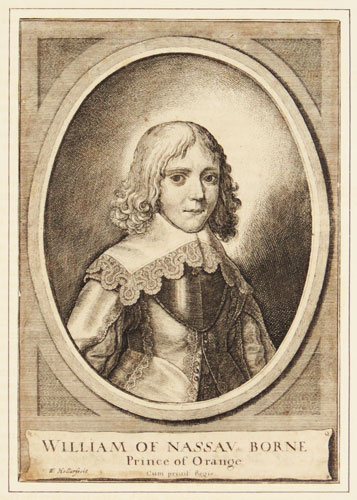
William of Nassau, borne Prince of Orange.
W. Hollar fecit [1641]
Cum privil: Regis
Etching, sheet 215 x 145mm (8½ x 5¾").
William II, Prince of Orange (1626-50), etched by Wenceslaus Hollar in 1641, the year that the fifteen year-old William married Princess Mary, daughter of Charles I. In 1647 William succeeded his father as Prince of Orange; his son became William III. Hollar (1607-77) was a printmaker from Bohemia who spent most of his career working in England after meeting Thomas Howard, second earl of Arundel, in Cologne in 1636. Pennington 1324 (unlisted state before the year 1641 added after Hollar's name but after state in BM which is before Hollar's name added).
[Ref: 42230] £240.00
(£288.00 incl.VAT)
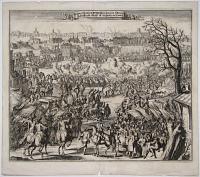
Einzug Wilhemi Henrici Prinzen von Orange zukunfftigen königs in England etc. in Londen.
[Merians Theatrum Europaeum, 1698.]
Fine etching. Plate 309 x 375mm. 12¼ x 14¾". Vertical fold down the centre. Some small nicks and tears.
The arrival of William of Orange in London; large crowds and cannon fire marks his arrival. London and the Thames can be seen in the background. William III (1650-1702) was a dutch Royal who won English, Scottish and Irish crowns following the Glorious Revolution. He ruled jointly with his wife, Mary II, and were always referred to during their joint reign as "William and Mary". A rare image. See BM: 1912,1025.1.
[Ref: 17545] £330.00
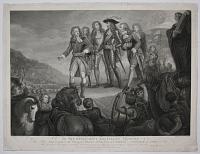
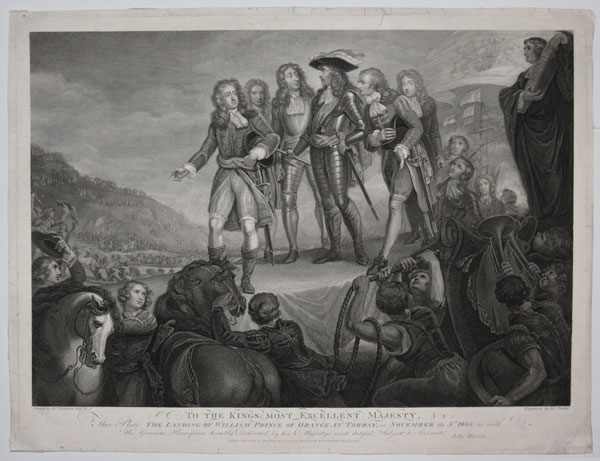
To the Kings most Excellent Majesty, This Plate the Landing of William Prince of Orange, in Torbay, on November the 5th 1688 is with His Gracious Permission humbly Dedicated, by his Majesty's most dutiful Subject & Servant, John Harris.
Painted by Ja.s Northcote Esq.r R.A. Engraved by Ja.s Parker.
Published Nov.r 5 1801 by John Harris No. 3 Sweetings Alley, Cornhill & 8 Old Broad Street London.
Line engraving, platemark 495 x 640mm (19½ x 25¼"). Small repaired tears; strong impression; collector's stamp verso.
Impressive scene after a work by history painter James Northcote depicting the arrival of William, Prince of Orange,in England in 1688, following which he replaced James II to be crowned William III in the 'Glorious Revolution' of that year. A banner in the upper right proclaims 'for the Protestant religion and liberty of England'. This print was published on November 5th 1801, the anniversary of the event it commemorates.
[Ref: 26209] £250.00
(£300.00 incl.VAT)
![[Dutch title; William of Orange taking the oath as the new stadtholder of the Netherlands.]](img-thumbnail/jpegs/16697.jpg)
[Dutch title; William of Orange taking the oath as the new stadtholder of the Netherlands.]
B. Picart sculp. dir. 1728.
[Amsterdam, c.1737.]
Engraving, sheet 270 x 345mm. 10½ x 13½". Trimmed within plate and laid to album page; closed tears into upper left corner. Folds creases.
The future King William III (1650 - 1702) behind a table in an interior of room, surrounded by officials, taking oath as the new stadtholder; four portraits on the wall behind. From Jean Le Clerc's 'Histoire des Provinces Unies des Pays Bas', 3 vols.
[Ref: 16697] £160.00
(£192.00 incl.VAT)
![Syn Koninckl: Hoogheit, de Heer Prince van Orangjen,wert Capite in Generael gemaeckt den 25 Febr: 1672. [Dutch title to banner cartouche; William of Orange taking the oath as the new stadtholder of the Netherlands.]](img-thumbnail/jpegs/17211.jpg)
Syn Koninckl: Hoogheit, de Heer Prince van Orangjen,wert Capite in Generael gemaeckt den 25 Febr: 1672. [Dutch title to banner cartouche; William of Orange taking the oath as the new stadtholder of the Netherlands.]
R. De Hooghe, Amsterdam, n.d. 1675.]
Etching, 180 x 300mm (7 x 11¾"). Vertical fold (as normal).
The future King William III (1650 - 1702) behind a table in an interior of room, surrounded by officials, taking oath as the new Captain-General of the Dutch States Army, beneath a royal coat of arms. In view of the threat of an Anglo-French attack, the States of Gelderland wanted William to be appointed Captain-General as soon as possible, despite his youth and inexperience. On 15 December 1671 the States of Utrecht made this their official policy. On 19 January 1672 the States of Holland made a counterproposal: to appoint William for just a single campaign. The prince refused this and on 25 February a compromise was reached: an appointment by the States-General of the Netherlands for one summer, followed by a permanent appointment on his twenty-second birthday. Maurice of Nassau received the title of "Captain General of the Union" and "Admiral General" in 1587, which became hereditary - like the Stadtholder title, to the Orange-Nassau family, until taken away by the States General in 1786. The relationship between this print and an almost identical composition of a similar date (with different background) by Bernard Picart (item 16697, showing William taking the oath as stadtholder) is unclear; the one presumably copied and adapted from the other. Landwehr: 41.
[Ref: 17211] £160.00
(£192.00 incl.VAT)
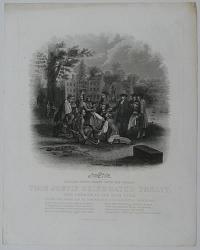
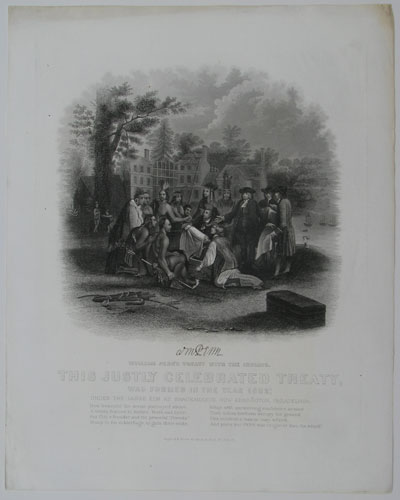
William Penn's Treaty with the Indians. This Justly Celebrated Treaty, was formed in the year 1682; Under the Large Elm at Shackamaxon, Now Kensington, Philadelphia. How beautiful the scene portrayed above, A treaty, framed in Justice, Truth and Love! Our City's Founder and the peaceful "Friends" Stoop to no subterfuge, to gain their ends; While with unswerving confidence, around Their Indian brethren occupy the ground. This incident, a maxim may afford, And prove our PENN was "mightier than the sword".
Engraved & Printed by Illman & Sons, 211 Arch St. [n.d. c.1857.]
Engraving. Plate 356 x 280mm. 14 x 11".
Historical print depicting a seaside encounter between American colonists and Native Americans. A group of natives crowds around two young colonists, who kneel at the center of the image with a roll of cloth. Behind them, William Penn stands with a large sheet of paper in his left hand. In the right foreground is a large wooden chest; in the left, a bow and quiver of arrows. Sailors unload cargo from ships on the sea in the right background. Behind the central figures, the main street of a colonial town rise up beside Indian tents.
[Ref: 23249] £160.00
(£192.00 incl.VAT)
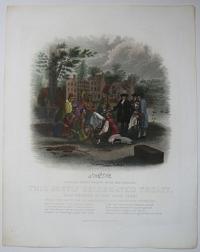
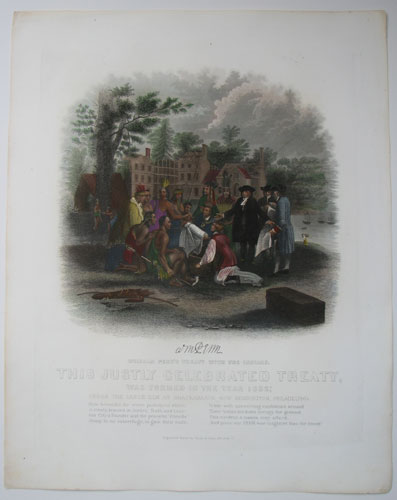
William Penn's Treaty with the Indians. This Justly Celebrated Treaty, was formed in the year 1682; Under the Large Elm at Shackamaxon, Now Kensington, Philadelphia. How beautiful the scene portrayed above, A treaty, framed in Justice, Truth and Love! Our City's Founder and the peaceful "Friends" Stoop to no subterfuge, to gain their ends; While with unswerving confidence, around Their Indian brethren occupy the ground. This incident, a maxim may afford, And prove our PENN was "mightier than the sword".
Engraved & Printed by Illman & Sons, 211 Arch St. [n.d. c.1857.]
Coloured engraving. Plate 362 x 280mm. 14¼ x 11".
Historical print depicting a seaside encounter between American colonists and Native Americans. A group of natives crowds around two young colonists, who kneel at the center of the image with a roll of cloth. Behind them, William Penn stands with a large sheet of paper in his left hand. In the right foreground is a large wooden chest; in the left, a bow and quiver of arrows. Sailors unload cargo from ships on the sea in the right background. Behind the central figures, the main street of a colonial town rise up beside Indian tents. Crace: XXIX.72.
[Ref: 23250] £160.00
(£192.00 incl.VAT)
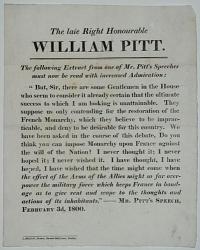
The late Right Honourable William Pitt. The following Extract from one of Mr. Pitt's Speeches must now be read with increased Admiration: "But, Sir, there are some Gentlemen in the House who seem to consider it already certain that the ultimate success to which I am looking is unattainable. They suppose us only contending for the restoration of the French Monarchy, which they believe to be impracticable, and deny to be desirable for this country. We have been asked in the course of this debate, Do you think you can impose Monarchy upon France against the will of the Nation? I never thought it; I never hoped it; I never wished it. I have thought, I have hoped, I have wished that the time might come when the effect of the Arms of the Allies might so far over-power the military force which keeps France in bondage as to give vent and scope to the thoughts and actions of its inhabitants." - Mr. Pitt's Speech, February 3d, 1800.
J. Bryan, Printer, Grocers Hall Court, Poultry. [n.d. c.1806.]
Letterpress. 272 x 216mm. 10¾ x 8½".
William Pitt the Younger (1759-1806) the youngest prime minister at the age of 24 in 1783 until 1801. He secured the union of Ireland with Great Britain in 1800 and formed the coalition with Russia and Austria against Napoleon, which was wrecked in 1815 at Austerlitz. He was elected Prime Minister again in 1804. These words from his speech in 1800 on the Refusal to Negotiate with France.
[Ref: 23434] £160.00
(£192.00 incl.VAT)
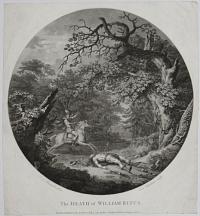
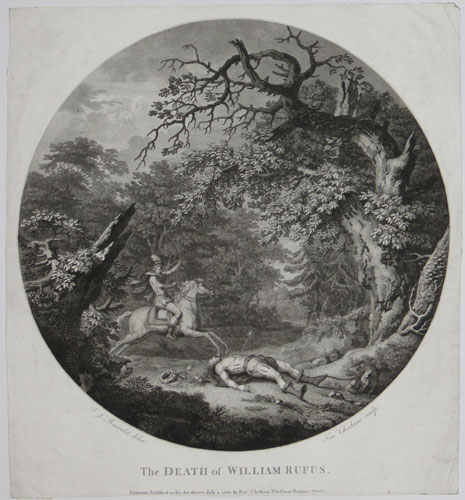
The Death of William Rufus.
J. Js. Barralet delin. Fras. Chesham sculp.
London, Published as the Act directs July 1 1783 by Fras. Chesham No.11 Great Poultney Street.
Etching and engravin, rare. 376 x 342mm (14¾ x 13½"). Surface rubbing, trimmed.
William Rufus lying on the ground in a clearing in the New Forest, an arrow through his chest, his plumed hat and quiver beside him, with another man riding past behind him, holding up his bow and looking down at the body; in an oval. William Rufus, also known as William II (c.1056-1100) the third son of William I of England, and king of England from 1087 until his death. He was shot by an arrow by an nobleman named Walter Tirel, and was apparently then abandoned by the nobles at the place where he fell.
[Ref: 28980] £190.00
(£228.00 incl.VAT)
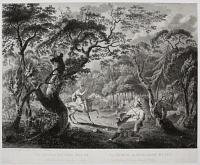
The Death of William Rufus. La Morte de Guillaume Rufus.
Design'd Painted & Engrav'd by Fras. Chesham.
Publish'd as the Act directs Oct. 15 1789 by F. Chesham No.8 Terrace Walworth Surry.
Engraving, very fine impression. 391 x 475mm (15½ x 18¾"). One fold and trimmed.
William Rufus falling to the ground after being hit by an arrow; deer seen running to the right. Other riders seen around the trees; the rider who shot him approaches utterly shocked. William Rufus, also known as William II (c.1056-1100) the third son of William I of England, and king of England from 1087 until his death. He was shot by an arrow by an nobleman named Walter Tirel, and was apparently then abandoned by the nobles at the place where he fell.
[Ref: 28982] £160.00
(£192.00 incl.VAT)
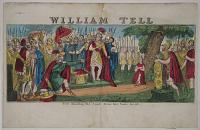
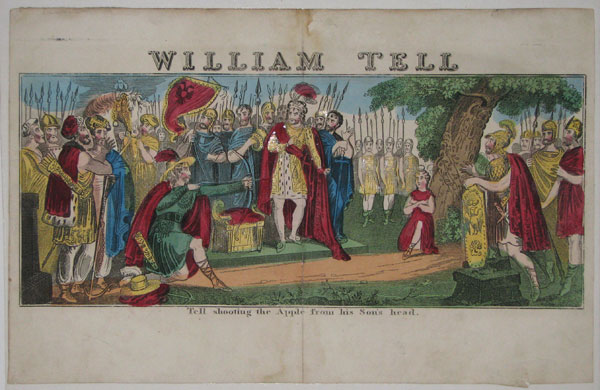
William Tell. Tell shooting the Apple from his Son's head.
[n.d. c.1840.]
Hand-coloured wood engraving. Image 235 x 368mm. 9¼ x 14½". Laid down.
William Tell is folk hero of Switzerland. In Altdorf, the newly appointed Austrian Vogt hung his hat in the central square demanding that all bow before it. William Tell passed by without bowing so was arrested. As his punishment, and as an expert shot with the crossbow, he was forced to shoot an apple off the head of his son to avoid execution for the both of them. Controversy over Tell's shooting led to him being bound for angering Gessler, however Tell won in the end by shooting Gessler.
[Ref: 15512] £130.00
(£156.00 incl.VAT)

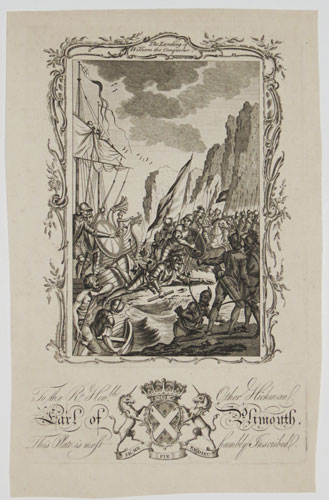
The Landing of William the Conqueror. To the Rt. Hon.ble Other Hickman, Earl of Plimouth. This Plate is most humbly Inscribed.
[n.d. c.1800.]
Engraving with small margins. Image and inscription plate separate; total plate area 249 x 158mm (9¾ x 6¼").
Soldiers disembarking from boats, where a knight has fallen on the ground.
[Ref: 34692] £65.00
(£78.00 incl.VAT)
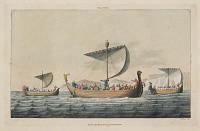
Angleterre Flotte de Guillaume-le=Conquérant [ms]
V. Raineri inc.
[Milan: Antonio Fortunato Stella, 1816-27.]
Hand-coloured aquatint; plate 200 x 310mm (8 x 12¼"). Proof before title.
William the Conqueror, the first Norman King of England, sailing across the Channel in September 1066. Published in Giulio Ferrario's 'Le Costume Ancien et Moderne ou Histoire du gouvernement, de la milice, de la religion, des arts, sciences et usages de tous les peuples anciens et modernes d'après les monuments de l'antiquité et accompagné de dessins analogues au sujet par le Docteur Jules Ferrario'.
[Ref: 34533] £140.00
(£168.00 incl.VAT)
![[The Birth of William V Prince of Orange and Nassau.]](img-thumbnail/jpegs/48461.jpg)
[The Birth of William V Prince of Orange and Nassau.] Zinnebeeldig Tafereel, Op de lang gewenschte en blyde Geboorte van den Erfprinsse van Oranje en Nassau, Hoop der Vereenigde Nederlanden. Den VIII. van Lentemaand, MDCCXLVIII.
M. Verheyden inv. et del. J. L. la Fargue sculp.
In's Gravenhage by Pieter Gerard van Balen, Boek-Kaert- en Kunstverkooper in de Spuistraet, op den Koek van't Gortstraetje, 1748.
A very fine impression of a rare broadside. Sheet: 575 x 410mm (22¾ x 16''), 18th century watermark. Trimmed.
An allegorical print published at the end of the Wars of Austrian Succession showing the birth of William V (1748-1806) son of William VI of Orange and Nassau who had just led the Netherlands to victory. William is shown in the arms of his mother Princess Anne and surrounded by allegorical classical figures.
[Ref: 48461] £650.00
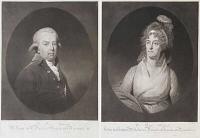
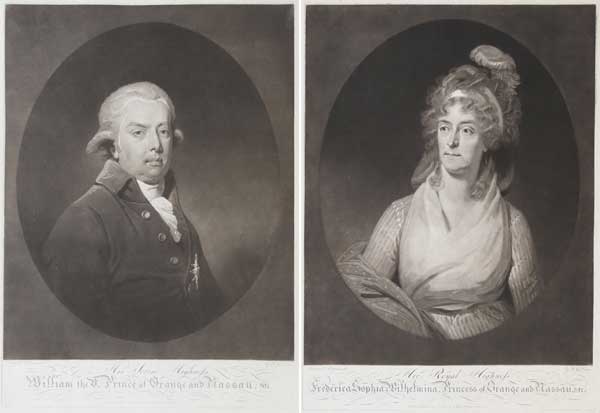
His Serene Highness, William V, Prince of Orange and Nassau, etc. [&] Her Royal Highness Frederica Sophia Wilhelmina, Princess of Orange and Nassau, etc.
Painted & Engraved by H.G Does.
London, Published June 12. 1799 by A. Milne Tottenham court road.
A pair of mezzotints, 18th century watermark, 465 x 340mm (18¼ x 13½"), with very large margins. Repaired tear going into the image slightly in Frederica at top.
Half length portraits in ovals of William V, Prince of Orange (1748-1806), and Frederica Sophia Wilhelmina of Prussia (1751-1820). They married on 4th October 1767.
[Ref: 60428] £520.00
view all images for this item
![[William V, Prince of Orange] [Guillaume V.]](img-thumbnail/jpegs/65850.jpg)
[William V, Prince of Orange] [Guillaume V.]
[engraved by James Watson.]
[n.d., c.1770.]
Mezzotint, rare proof before title, inscription area uncleaned. Fine working proof. 405 x 305mm (16 x 12"). A few small tears in margins. Small margins.
A three quarter portrait of Prince William V of Orange (1748-1806), with his left hand on his hip, wearing embroidered coat, star and sash, his hair powdered. The first lettered state was the last, published by Robert Sayer in 1772. Goodwin 87, state i of iii. CS 110. Ex: Collection of The Hon. Christopher Lennox-Boyd.
[Ref: 65850] £320.00

Robert William Wynne Esq.re of Gathewin (late Lieutenant Colonel of the Royal Denbighshire Militia) From the Portrait presented to him by his Friends and well wishers on the 12th. July 1836. For subscribers only.
Painted by R. Rothell. Engraved by H. Cousins.
London, Published June 1st. 1837, by M.M. Holloway, 22, King William St. Strand.
Mezzotint. Plate 520 x 388mm. 20½ x 15¼". Tear into upper margin and into image.
Robert William Wynne (1766-1842).
[Ref: 17074] £140.00
(£168.00 incl.VAT)
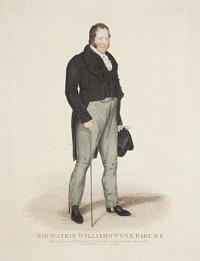
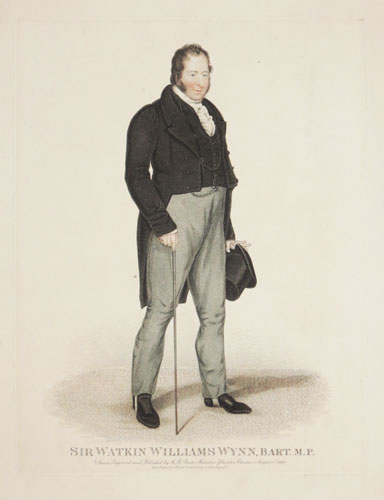
Sir Watkin Williams Wynn, Bart. M.P.
A.R. Burt.
Drawn, Engraved and Published by A. R. Burt, Miniature Painter, Chester, August 1st. 1820.
Fine coloured stipple, printed in colours. 230 x 305mm (9 x 12"), very large margins.
Sir Watkin Williams-Wynn, 5th Baronet (1772 - 1840), was a Welsh M.P. from 1794 to 1840: for Beaumaris 1794-6, then for Denbighshire until his death. He was referred to as the 'Prince of Wales' and had a keen interest in military affairs. In 1794 he raised a cavalry regiment called the "Ancient British Fencibles" and took part in the suppression of the Irish rebellion of 1798. After Albin Roberts Burt (1783-1842)
[Ref: 48137] £190.00
(£228.00 incl.VAT)

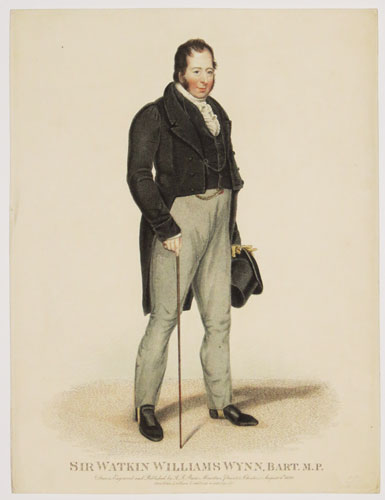
Sir Watkin Williams Wynn, Bart. M.P.
A.R. Burt.
Drawn, Engraved and Published by A. R. Burt, Miniature Painter, Chester, August 1st. 1820.
Coloured stipple; part printed in colours. 230 x 305mm (9 x 12"). Trimmed to platemark.
Sir Watkin Williams-Wynn, 5th Baronet (1772 - 1840), was a Welsh M.P. from 1794 to 1840. Williams-Wynn was elected Member of Parliament for Beaumaris in 1794 and held the seat to 1796. In 1796 he was elected MP for Denbighshire and held the seat until his death in 1840. He was referred to as the 'Prince of Wales' and had a keen interest in military affairs. In 1794 he raised a cavalry regiment called the "Ancient British Fencibles" and took part in the suppression of the Irish rebellion of 1798. After Albin Roberts Burt (1783-1842)
[Ref: 31563] £230.00
(£276.00 incl.VAT)

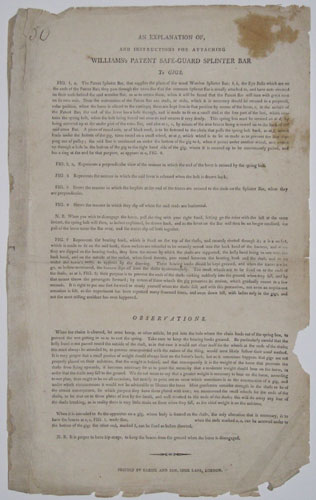
An Explanation of, an Instructions for Attaching Williams's Patent Safe-Guard Splinter Bar To Gigs.
Printed by Sabine and Son, Shoe Lane, London. [n.d., c.1800.]
Promotional letterpress broadside on watermarked laid paper; explanation to a diagram (missing), probably issued in a pamphlet. Sheet c.365 x 225mm. 14¼ x 9". Staining; tatty and chipped extremities.
Manufacturer's remarks concerning a bar for attaching horses to a carriage. "Mr. W.'s invention consists chiefly in the addition of a rolling splinter-bar, affixed to the usual or main splinter-bar, in such a way as will suffer it to turn on its axis when needful, and also in the means of fastening the traces to the said rolling-bar.—The method of disengaging the horses is very simple : a person in the carriage has need only, by means ofa cord, to pull back a bolt, when a lever immediately rises; in consequence of the action on the traces, the studs by which the traces are fastened to the rolling splinter-bar change their position, and the traces are instantly set at liberty. The patentee extends his invention to all kinds of carriages. Those that have shafts are to have a socket fixed to the end of each; and those which have shafts, or a-pole, which, from its construction, would fall ro the ground as soon as the horse or horses are disengaged, are to have a piece of iron with a broad bottom, or a wheel affixecd to each Shaft, or the pole, to prevent the motion being checked to suddenly by the fall.—Mr. W.. does not claim the method of disengaging the harness from the ends of the pole or shafts, as part of his invention. He observes, that the operation of disengageing the horse or horses is performed with as much facility it the pulling of a check-string; and not withstanding the simplicity of the process, it will be found that the horses are as securely attached to the carriage as upon the common construction.—The exclusive right of manufacturing these safeguard splinter-bars has been assigned to Andrew Leith and Co. of Shoe Lane, Flcct Street." extract William Cobbett's Politcal Register Vol. II. July to December 'List of Patent's Registered 1802'.
[Ref: 16858] £120.00
(£144.00 incl.VAT)
![[Erasmus Williams]](img-thumbnail/jpegs/43762.jpg)
[Erasmus Williams] This dooth Erasmus William respresent, / Whome living all did love, deade all lament. / His humane Artes behind his backe atttende, / Whereon spare bowers he wisely chose to spende[...]
[Anon., c.1608 or later]
Engraving, sheet 485 x 285mm (19 x 11¼"). Trimmed. Creases.
Large and unusual portrait of Erasmus Williams (c.1552-1608) 'of the line of Sr. Jo. Williams of Dorsetshire', from a memorial brass. O'D 1; NPG states this is Richard Haydock.
[Ref: 43762] £650.00
![Hugh Williams [facsimile signature.]](img-thumbnail/jpegs/24644.jpg)
Hugh Williams [facsimile signature.]
From the Picture by A.R. Venables. Drawn on stone by R.J. Lane A.R.A.
[British, n.d., c.1840.]
Large lithograph on india paper, india 600 x 465mm. 23½ x 18¼". A little scuffed and soiled; margins (roughly) trimmed. Small closed tear lower right.
Society portrait, of an unidentified gentleman. By Richard James Lane, after Adolphus Robert Venables (born 1817 - active 1863).
[Ref: 24644] £130.00
(£156.00 incl.VAT)
![yours aff.y J Williams [facsimile.]](img-thumbnail/jpegs/28619.jpg)
yours aff.y J Williams [facsimile.]
Painted by H. Room. Engraved by J. Cochran.
[n.d. c.1830.]
Stipple and engraving. 160 x 107mm (6¼ x 4¼"). Trimmed.
John Williams (1796-1839), the English missionary who was active in the South Pacific. In November 1839, while visiting a part of the New Hebrides where John Williams was unknown, he and fellow missionary James Harris were killed and eaten by cannibals on the island of Erromango during an attempt to bring them the Gospel. NPG: D8603. See Ref: 559 & 15648 for coloured Baxter images.
[Ref: 28619] £50.00
(£60.00 incl.VAT)

[The Lamented Missionary. The Rev.d John Williams, who was cruelly Massacred at Erromanga. Seated in his Study composing his celebrated Missionary Enterprises; which have been aptly designed as a Supplement to the Acts of Apostles. Designed and Printed in Oil Colours by Patentee George Baxter.]
[London. Published by G. Baxter, 3, Charter House Square, April 1st. 1843. & Sold by Mssrs. Hamilton & Co. Ward & Co. Whittaker & Co. & by the Country Agents.]
Proof. Vivid oil colouring, heightened with gum arabic. Sheet 270 x 225mm (10½ x 9"). Trimmed into image, losing all inscriptions.
John Williams [1796 – 1839], missionary active in the South Pacific until he was killed and eaten on Erromango in the Vanutu archipelago. George Baxter (1804 - 1867) is regarded as the 'Inventor' of colour printing. The Baxter process, which he patented in 1835, involved an initial metal keyplate and up to 20 wood or metal blocks to apply each individual colour. Baxter had published quite a few prints of Williams including his murder on the island of Erromanga a few days after landing. For a proof example see Ref: 559.
[Ref: 38826] £140.00
(£168.00 incl.VAT)

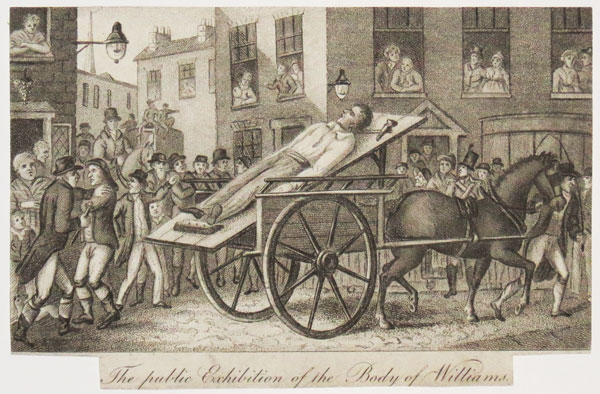
The public Exhibition of the Body of Williams.
[Anon, c.1811.]
Stipple, sheet 105 x 160mm (4 x 6¼"). Trimmed around image and title.
The body of John Williams, the principal suspect in the 'Ratcliff Highway Murders', a series of murders in East London in December 1811. Williams was arrested and imprisoned but before the case went to trial he used his scarf to hang himself in his cell at Coldbath Fields. The court declared Williams guilty of the crimes, taking his suicide as an admission of his guilt. Following this decision, Williams' corpse was paraded through the streets of East London, past the locations of the murders, in a procession supposedly seen by 180,000 people. Thomas De Quincey witnessed the event and wrote of it: 'When the cart came opposite the late Mr Marr's [one of the victims] house a halt was made for nearly a quarter of an hour. ... The procession then advanced to St George's Turnpike, where the New Road [now Commercial Road] is intersected by Cannon Street Road. Those who accompanied the procession arrived at a grave already dug six feet down. The remains of John Williams were tumbled out of the cart and lowered into this hole, and then someone hammered a stake through his heart.'
[Ref: 39205] £80.00
(£96.00 incl.VAT)
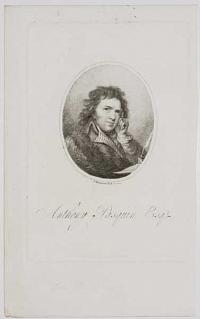
Anthony Pasquin Esq.r
F. Bartolozzi R:A: sc.
[n.d. c.1790]
Stipple with large margins. Plate 171 x 114mm (6¾ x 4½").
John Williams (1761-1818), English poet, satirist, jounalist and miscellaneous writer who worked under the pseudonym of Anthony Pasquin. As a satirical writer and illustrator he studied engraving under Matthew Darly and exhibited prints and drawings at the Society of Arts and the Royal Academy. De Vesme: 927.
[Ref: 28936] £95.00
(£114.00 incl.VAT)
![yours after J. Williams [facsimile.]](img-thumbnail/jpegs/15648.jpg)
yours after J. Williams [facsimile.]
[Henry Room.] Printed in Oil Colours by G. Baxter, (Patentee, 3.Charterhouse Square.)
Published, by J. Snow, 26. Paternoster Row. [n.d. c.1843.]
Bright and vivid oil colouring. 222 x 140mm. 8¾ x 5½".
John Williams (1796 -1839), missionary active in the South Pacific. George Baxter (1804 - 1867) is regarded as the 'Inventor' of colour printing. The Baxter process, which he patented in 1835, involved an initial metal keyplate and up to 20 wood or metal blocks to apply each individual colour. Baxter had published quite a few prints of Williams including his massacre on the island of Erromanga a few days after landing.
[Ref: 15648] £180.00
(£216.00 incl.VAT)
![J. Williams [facsimile signature].](img-thumbnail/jpegs/16658.jpg)
J. Williams [facsimile signature].
[London: Thomas & William Boone, 480 Strand. 1823.]
Coloured engraving. Printed area 100 x 80mm, 4 x 3¼".
A half-length portrait of Sir John Williams (1777-1846), in wig and gown. As an M.P. he participated in the trial of Queen Caroline in 1820. Published in "Portraits of the Worthies of Westminster-Hall, with their Autographs; being Fac-Similies of Original Sketches, Found in the Note-Book of a Briefless Barrister". Only Part I of this work was published: an attempt to fund Part II by subscription failed.
[Ref: 16658] £65.00
(£78.00 incl.VAT)
!['For my own part I cannot content myself within the narrow limits of a single reef' J. Williams [facsimile manuscript]. See page 189.](img-thumbnail/jpegs/558.jpg)
'For my own part I cannot content myself within the narrow limits of a single reef' J. Williams [facsimile manuscript]. See page 189.
Drawn & Engraved By G. Baxter, 3, Charter House Square.
London, John Snow, Paternoster Row [n.d. c.
Steel engraving. Sheet 219 x 130mm (8¾ x 5"). Foxing and age toning.
John Williams [1796 – 1839], missionary active in the South Pacific.
[Ref: 558] £120.00
(£144.00 incl.VAT)

The Lamented Missionary. The Rev.d John Williams, who was cruelly Massacred at Erromanga. Seated in his Study composing his celebrated Missionary Enterprises; which have been aptly designed as a Supplement to the Acts of Apostles. Designed and Printed in Oil Colours by Patentee George Baxter.
London. Published by G. Baxter, 3, Charter House Square, April 1st. 1843. & Sold by Mssrs. Hamilton & Co. Ward & Co. Whittaker & Co. & by the Country Agents.
Proof Baxter print. Bright and vivid oil colouring. 391 x 293mm.
John Williams [1796 – 1839], missionary active in the South Pacific until he was killed and eaten on Erromango in the Vanutu archipelago. George Baxter (1804 - 1867) is regarded as the 'Inventor' of colour printing. The Baxter process, which he patented in 1835, involved an initial metal keyplate and up to 20 wood or metal blocks to apply each individual colour. Baxter had published quite a few prints of Williams including his murder on the island of Erromanga a few days after landing.
[Ref: 559] £320.00
![[John Williams] Anthony Pasquin Esq.r.](img-thumbnail/jpegs/64746.jpg)
[John Williams] Anthony Pasquin Esq.r.
M. Shee Pinxt. I. Wright Sculp.t.
London, Publish'd MArch 20, 1794 by Freeman, Printseller to his Majesty, 95 Strand.
Stipple. 335 x 240mm (13¼ x 9½"). Trimmed into plate bottom and right, to plate at top.
Seated portrait of John Williams (1761-1818), English poet, satirist, jounalist and miscellaneous writer who worked under the pseudonym of Anthony Pasquin, quill in hand. As a satirical writer and illustrator he studied engraving under Matthew Darly and exhibited prints and drawings at the Society of Arts and the Royal Academy.
[Ref: 64746] £180.00
(£216.00 incl.VAT)

John Williams Esq.r. One of Her Majesty's Counsel.
Engraved by T. Wright from a Drawing by A. Wivell.
London, Pub.d Dec.r 16, 1820 by A. Wivell, 105 G.t Tichfield Street.
Stipple and etching with large margins, fine. 180 x 125mm (7 x 5"). Uncut.
Sir John Williams (1777-1846). This portrait is from a series made of the legal teams representing George IV and Queen Caroline during the House of Lords' debates of the 'Pains and Penalties Bill' in 1820, by which George sought a divorce.
[Ref: 35329] £95.00
(£114.00 incl.VAT)
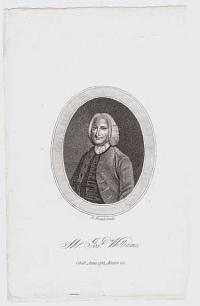
M.r Jos.h Williams. Obiit Anno. 1755, Ætatis 64.
D. Read, Sculp.
[n.d., c.1800.]
Stipple. 195 x 135mm (7¾ x 5¼"). Trimmed into plate on right.
Joseph Williams (1692-1755), evangelical dissenter and journal writer of Kidderminster.
[Ref: 60726] £65.00
(£78.00 incl.VAT)
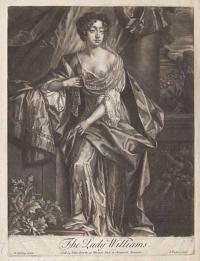
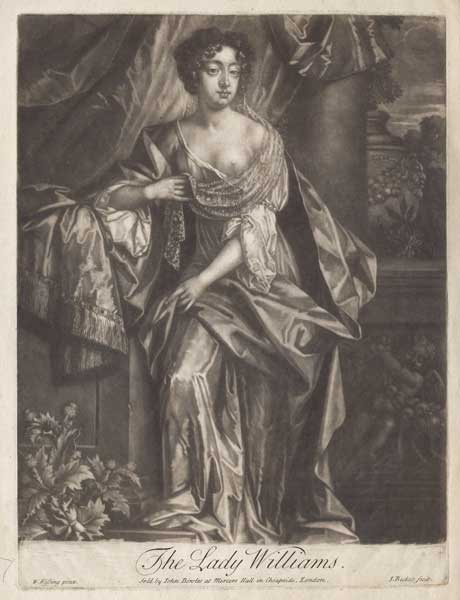
The Lady Williams.
W.Wissing pinx. I. Becket fecit.
Sold by John Bowles at Mercers Hall in Cheapside, London. [n.d., c.1730.]
Mezzotint. 330 x 250mm (13 x 9¾"). Tear in right margin.
A full-length portrait of a woman in a loose dress with one breast exposed, with drape and ornamental vase and frieze behind. Chaloner Smith quotes Granger's identification of a mistress of the Duke of York. Walpole supposes her to be Margaret Kyffin, wife of Sir William Williams, Solicitor-General at the trial of the Seven Bishops in 1688. CS: 97: iv of iv. Ex: Collection of The Hon. Christopher Lennox-Boyd.
[Ref: 65485] £280.00
(£336.00 incl.VAT)

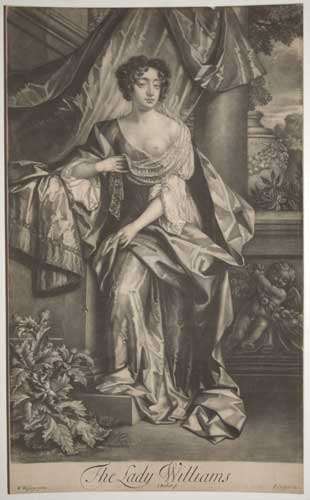
The Lady Williams.
W.Wissing pinx. I. Becket fecit.
E. Cooper ex: [n.d., c.1700.]
Mezzotint, 17th century watermark. 330 x 250mm (13 x 9¾"). Trimmed within plate, backed with album paper.
A full-length portrait of a woman in a loose dress with one breast exposed, with drape and ornamental vase and frieze behind. Chaloner Smith quotes Granger's identification of a mistress of the Duke of York. Walpole supposes her to be Margaret Kyffin, wife of Sir William Williams, Solicitor-General at the trial of the Seven Bishops in 1688. CS: 97: ii of iv, 'Two known'. Ex: Collection of The Hon. Christopher Lennox-Boyd.
[Ref: 65488] £360.00
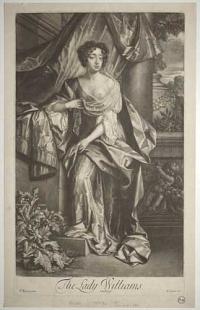
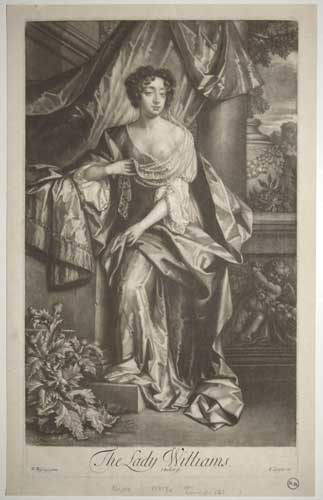
The Lady Williams.
W.Wissing pinx. I. Becket fecit.
E. Cooper ex: [n.d., c.1700.]
Mezzotint, 17th century watermark. 330 x 250mm (13 x 9¾"), large margins. With ink stamp of R. Brandt (Lugt 2191). Tear in bottom margin.
A full-length portrait of a woman in a loose dress with one breast exposed, with drape and ornamental vase and frieze behind. Chaloner Smith quotes Granger's identification of a mistress of the Duke of York. Walpole supposes her to be Margaret Kyffin, wife of Sir William Williams, Solicitor-General at the trial of the Seven Bishops in 1688. CS: 97: ii of iv, 'Two known'. Ex: Collection of The Hon. Christopher Lennox-Boyd.
[Ref: 65489] £360.00
![[William IV when Duke of Clarence] Nauticus.](jpegs/64180.jpg)
![[Charter segment from the reign of William IV.]](jpegs/27847.jpg)
![King William The 4th. [&] Queen Adelaide.](jpegs/25434.jpg)
![[William IV as Lord High Admiral & the Duke of Wellington] The Navy! [&] The Army!](jpegs/58712.jpg)

![[William & Anne, Prince and Princess of Orange and Nassau]](jpegs/41194.jpg)

![[William IV] The evil Counsellor.](jpegs/30661.jpg)
![[William IV] The Jolly Waterman and his Fare!!!](jpegs/30480.jpg)
![[William IV] The new Master of the Crown Inn discharging Betty the head Chambermaid.](jpegs/30461.jpg)
![[William IV] The new Master of the Crown Inn discharging Betty the head Chambermaid.](jpegs/66870.jpg)
![[His Serene Highness William Charles Henry Friso Prince of Orange, and Nassau, Stadtholder, Admiral, & Captain General, of ye Seven Provinces, &c.&c.&c.]](jpegs/68665.jpg)
![[William IV] Billy's Birth Day!](jpegs/50174.jpg)
![[William IV] You Never Ketches Me a Woyaging No More. I've Had a Nuf Of It.](jpegs/30530.jpg)

![[Dutch title; William of Orange taking the oath as the new stadtholder of the Netherlands.]](jpegs/16697.jpg)
![Syn Koninckl: Hoogheit, de Heer Prince van Orangjen,wert Capite in Generael gemaeckt den 25 Febr: 1672. [Dutch title to banner cartouche; William of Orange taking the oath as the new stadtholder of the Netherlands.]](jpegs/17211.jpg)



![[The Birth of William V Prince of Orange and Nassau.]](jpegs/48461.jpg)
![[William V, Prince of Orange] [Guillaume V.]](jpegs/65850.jpg)

![[Erasmus Williams]](jpegs/43762.jpg)
![Hugh Williams [facsimile signature.]](jpegs/24644.jpg)
![yours aff.y J Williams [facsimile.]](jpegs/28619.jpg)


![yours after J. Williams [facsimile.]](jpegs/15648.jpg)
![J. Williams [facsimile signature].](jpegs/16658.jpg)
!['For my own part I cannot content myself within the narrow limits of a single reef' J. Williams [facsimile manuscript]. See page 189.](jpegs/558.jpg)

![[John Williams] Anthony Pasquin Esq.r.](jpegs/64746.jpg)