Results 1-2 of 2
<<< Previous 1 Next >>>
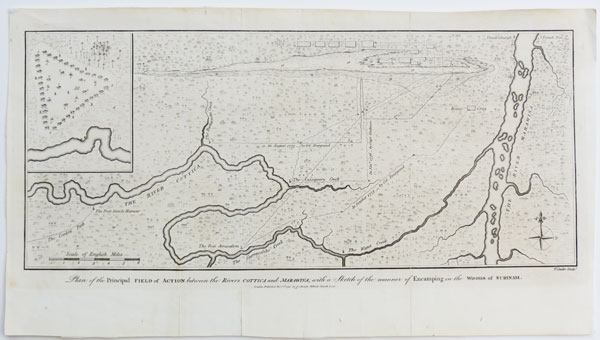
Plan of the Principal Field of Action between the Rivers Cottica and Marawina; with a Sketch of the Manner of Encamping in the Woods of Surinam.
London, Published Dec.r 1.st 1791, by J. Johnson, St. Paul's Church Yard.
Engraving. Plate 210 x 451mm. 8¼ x 17¾". Slight offsetting; folds as issued, with tears into lower edges of fold.
A map showing the action against the rebellious slaves; the insert map shows how the camp was designed so that the match was somewhat against surprise attacks. Nr. 1 is the cabin of Colonel Fourgeaud; 2. The huts of the officers; 3. The huts of the other men in a large triangle; 4. Ammunition, provisions, medicines, etc; 5. Campfires at each angle; 6. Trees or barns to cabins to build; 7. A creek to the camp of fresh water supply; and 8. The surrounding forest. Published in "Narrative, of a Five Years’ Expedition, Against the Revolted Negroes of Surinam, in Guiana, on the Wild Coast of South America", by Captain John Gabriel Stedman. The Dutch captured the British colony of Suriname during the Second Anglo-Dutch War (1667). Under the West India Company it was developed as a plantation slave society and became a primary destination for the Dutch slave trade. The brutal regime caused high mortality; despite the import of 300,000 slaves between 1668 and 1823, the population never grew beyond 50,000. ‘Maroonage’ became the major form of resistance. Fugitive slaves, or ‘maroons’, escaped inland to form permanent communities from where they waged a campaign of guerrilla warfare against the Dutch. In 1774 the Scottish-Dutch soldier John Gabriel Stedman witnessed the brutal oppression of slaves during a campaign against the maroons, which he described in this book. The work contained 80 engravings by various hands which are generally acknowledged to have been based on drawings made by Captain J.G. Stedman, although only two of the plates bear his name. Stedman was a personal friend of William Blake’s and it is likely that William Blake modified Stedman’s designs, being those of an amateur artist. From the sole surviving watercolour by Stedman for this work, it is known that the engravers involved were allowed considerable liberty in adapting Stedman’s designs. The book was adopted by those who advocated the abolition of the slave trade, though Stedman was thought to support reform rather than abolition.
[Ref: 26028] £160.00
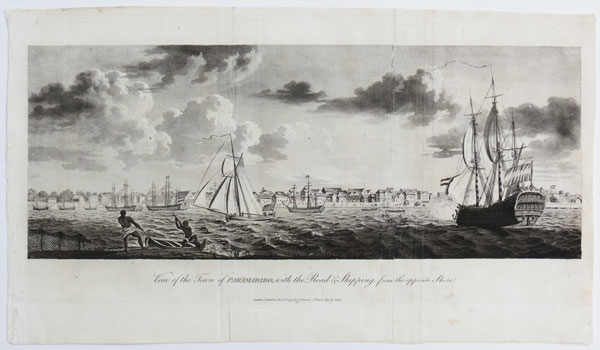
View of the Town of Paramaribo, with the Road & Shipping; from the opposite Shore.
London, Published Dec.r 1.st 1794, by J.Johnson, St. Paul's Yard.
Aquatint, paper watermarked: Bottansh 1802. Plate 210 x 438mm. 8¼ x 17¼". Toning, folds as issued, wormholes in image area and repaired tear in lower right third of the image.
View of Paramaribo across a river. A British and Dutch ship are under sail in the harbour, other ships are at anchor. In the foreground two black slaves pull a canoe to shore. Built environment includes dwellings and Dutch fortifications. Published in "Narrative, of a Five Years’ Expedition, Against the Revolted Negroes of Surinam, in Guiana, on the Wild Coast of South America", by Captain John Gabriel Stedman. The Dutch captured the British colony of Suriname during the Second Anglo-Dutch War (1667). Under the West India Company it was developed as a plantation slave society and became a primary destination for the Dutch slave trade. The brutal regime caused high mortality; despite the import of 300,000 slaves between 1668 and 1823, the population never grew beyond 50,000. ‘Maroonage’ became the major form of resistance. Fugitive slaves, or ‘maroons’, escaped inland to form permanent communities from where they waged a campaign of guerrilla warfare against the Dutch. In 1774 the Scottish-Dutch soldier John Gabriel Stedman witnessed the brutal oppression of slaves during a campaign against the maroons, which he described in this book. The work contained 80 engravings by various hands which are generally acknowledged to have been based on drawings made by Captain J.G. Stedman, although only two of the plates bear his name. Stedman was a personal friend of William Blake’s and it is likely that William Blake modified Stedman’s designs, being those of an amateur artist. From the sole surviving watercolour by Stedman for this work, it is known that the engravers involved were allowed considerable liberty in adapting Stedman’s designs. The book was adopted by those who advocated the abolition of the slave trade, though Stedman was thought to support reform rather than abolition.
[Ref: 26029] £160.00
(£192.00 incl.VAT)
<<< Previous 1 Next >>>