Results 1-8 of 8
<<< Previous 1 Next >>>

General Arnold.
April 10 1783 by William Richardson No 174 Strand.
Stipple, very scarce proof. Sheet 155 x 110mm (6¼ x 4¼"). Trimmed within plate, crease on left.
Benedict Arnold (1741-1801), the American general whose traitorous plan to to surrender West Point to the British was foiled. The portrait was engraved by Burnet Reading after the original painting by Pierre Eugene Du Simetiere. The completed print was published May 10th, a month after this proof.
[Ref: 23129] £260.00
(£312.00 incl.VAT)

Sir Alan Gardner Bart. Admiral of the Blue, & M.P. for the City of Westminster.
T. Clarke pinxt. B. Reading sculpt.
[19 Dec 1799]
Fine line engraving. Sheet 335 x 275mm (13¼ x 10¾"). Cut. Some spotting to the right hand side of the sheet.
Alan Gardner, First Baron (1742-1809) Admiral; present at Quiberon Bay in the Dorsetshire. He carried to Howe the first news of the French approach. In 1778 he captured a large French merchantman off Sandy Hook; he commanded the Sultan at Grenada in 1779 and the Duke in Rodney's action in 1782. In Jamaica he was made Commander-in-Chief 1786-9 and Lord of the Admiralty 1790-5. In 1794 he was created a Baronet for services in Earl Howe's victory. 1790-6 he was M.P. for Plymouth and for Westminster 1796-1806. Parker: 355. From the Collection of Viscount Hood.
[Ref: 12415] £160.00
(£192.00 incl.VAT)

John Harrison Esq.r. Inventor of the Time Keeper.
Engrav'd by Burnet Reading.
[London, 1776.]
Engraving. Sheet size: 145 x 95mm (5¾ x 3¾"). Trimmed to image. Glued to backing sheet.
A portrait of John Harrison (c.1693 - 1776) bust, in profile to the left, wearing short wig curled over side of head. In oval frame. An illustration to the 'European Magazine'. Harrison, an English carpenter and clockmaker who invented the marine chronometer, finally solving the Logitude question; how to establish the East-West position or longitude of a ship at sea, thus revolutionising and extending the possibility of safe long-distance sea travel. The problem was considered so intractable and, following the Scilly naval disaster of 1707, so important that the British Parliament offered the Longitude prize of £20,000.
[Ref: 34340] £120.00
(£144.00 incl.VAT)
![[Hans Holbein.]](img-thumbnail/jpegs/67646.jpg)
[Hans Holbein.]
Holebon Pinx. Engrav'd by B.Reading.
[n.d., c.1800.]
Rare proof engraving. 150 x 130mm (6 x 5"). Trimmed into left of plate.
Portrait of Hans Holbein (c.1497 - 1543), German-Swiss painter and printmaker.
[Ref: 67646] £130.00
(£156.00 incl.VAT)
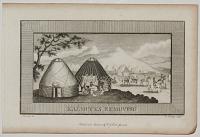
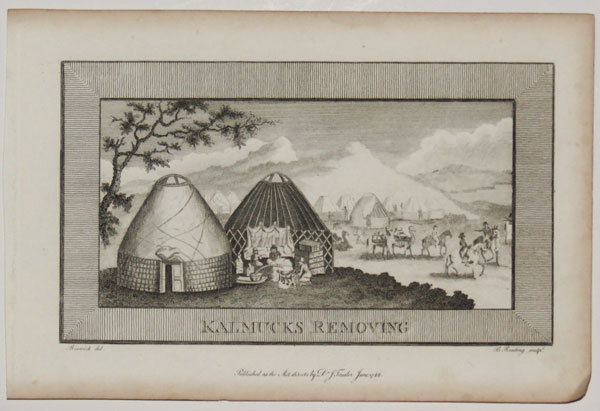
Kalmacks Removing.
Beswick del. B. Reading sculp.t.
Published as the Act directs by Dr. J. Trusler June 1788.
Engraving. 190 x 130mm (7½ x 5"). Trimmed to platemark.
A view of a Kalmuck camp occupied by horsemen, camels and figures. The Kalmucks, or Kalmyks were a western Mongol people who migrated to Russia in the seventeenth century. They lived a nomadic life travelling around the lands between the Don and the Volga Rivers. Illustration from Dr John Trusler's 'The Habitable World Described' (c1788-1806).
[Ref: 32136] £60.00
(£72.00 incl.VAT)

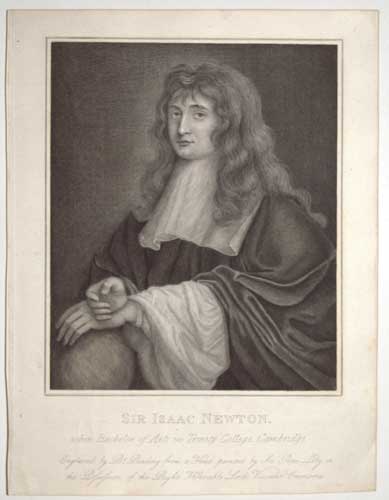
Sir Isaac Newton when Bachelor of Arts in Trinity College, Cambridge. Engraved by B.t Reading from a Head painted by Sir Peter Lely in the Possession of the Right Honorable Lord Viscount Cremorne.
[n.d., 1799.]
Engraving on chine collé. Sheet 340 x 260mm (13½ x 10¼").
Half-length portrait of Sir Isaac Newton as a young man, hands resting on a globe.
[Ref: 64376] £260.00
(£312.00 incl.VAT)
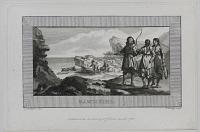
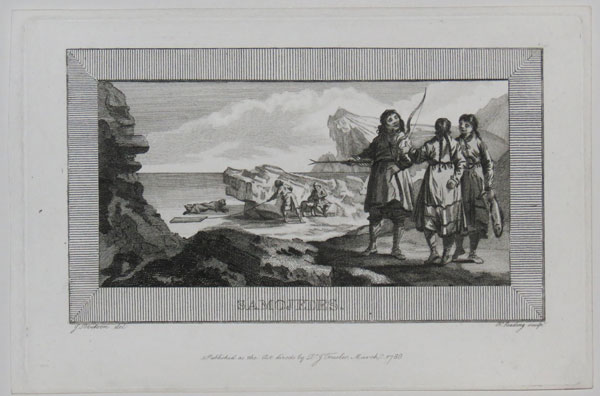
Samojedes.
J. Ibbetson del. B. Reading sculp.t.
Published as the Act directs by Dr. J. Trusler, March. 1789.
Engraving. 190 x 130mm (7½ x 5"). Trimmed to platemark.
Depiction of the Samojedes or Samoyedic peoples of Northern Russia. Figures hold bows, arrows and fish. In the distance two figures pull a sledge accompanied by dogs.
[Ref: 32100] £120.00
(£144.00 incl.VAT)

G. Stubbs, Animalium Pictor.
From an Original Drawing by P. Falconet. B. Reading Sc,,t.
Pub.d. by E. Jeffery, Pall Mall, 1792.
Stipple. 180 x 130mm (7 x 5"). Trimmed into plate, laid on album paper at edges.
George Stubbs (1724-1806), the British painter of portraits, animal pictures, heroic animal histories and poetical scenes of rural life. He is known primarily for his images of horses and in 1758 he began his dissections of horses, which lead to the engraved work 'The Anatomy of the Horse' in 1766. Ref: Christopher Lennox-Boyd pg. 379 ii of ii.
[Ref: 63198] £160.00
(£192.00 incl.VAT)
<<< Previous 1 Next >>>


![[Hans Holbein.]](jpegs/67646.jpg)