Results 1-17 of 17
<<< Previous 1 Next >>>

Boieldieu. Maitre de chapelle de S. M. l'Empereur de Russie et membre du Conservatoire de France.
Se vend chez Quenedey rue Neuve-des-Petits-Champs No15 à Paris / Dép. à la Bib. Imp.
Dess. au Physionotrace en 1811 et Gravé par Quenedey a Paris.
Aquatint. Sheet 240 x 155mm (9½ x 6"). Trimmed slightly into plate.
Portrait of François-Adrien Boieldieu (1775 - 1834), French composer, mainly of operas, often called "the French Mozart". In 1825, he produced his operatic masterpiece, La dame blanche (revived in the Salle Favart in 1997 and recorded by the conductor Marc Minkowski). Unusual for the time, La dame blanche was based on episodes from two novels by Walter Scott. The libretto by Eugène Scribe is built around the theme of the long-lost child fortunately recognized at a moment of peril. The style of the opera influenced Lucia di Lammermoor, I puritani, and La jolie fille de Perth. La dame blanche was one of the early attempts to introduce the fantastic into opera.
[Ref: 63304] £140.00
(£168.00 incl.VAT)
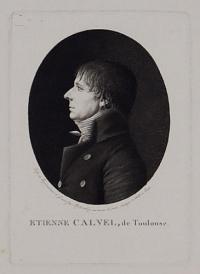
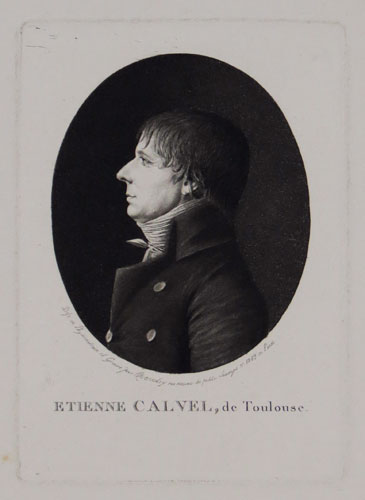
Etienne Calvel, de Toulouse.
Dess au Physionotrace et gravé par Quenedey rue des petits Champs No.1284 a Paris
Etching and aquatint with large margins, platemark 130 x 90mm (5 x 3¾"). Good impression.
French author Etienne Calvel, made by Edme Quénedey (1756 - 1830), a miniature painter and engraver, who made much use of the physionotrace. This was a mechanised drawing instrument that could reproduce the outline profile of a portrait. It was invented by Gilles-Louis Chretien, who engraved Quenedey's portraits from 1787 to 1789, in 1786. Chretien and Quenedey founded a very successful portrait studio in Paris together in 1788. Between 1786 - c.1810 there were only two studios in Paris which produced a relatively small number of physionotrace engravings. Consequently very few of these intriguing portraits are preserved today. Because of their origins and the realism physionotrace portraits have, they can be seen as true photo-graphic objects and are therefore classified as a forerunner of photography.
[Ref: 35222] £180.00
(£216.00 incl.VAT)
![[Maria Luigi Carlo Zenobio Salvatore Cherubini.] L. Cherubini.](img-thumbnail/jpegs/63315.jpg)
[Maria Luigi Carlo Zenobio Salvatore Cherubini.] L. Cherubini.
Se vend chez Quenedey rue Neuve-des-Petits-Champs No15 à Paris / Dép. à la Bib. Imp.
Dess: au Physionotrace et Gravé par Quenedey rue neuve des petits champs No15 à Paris 1809.
Aquatint. Sheet 240 x 155mm (9½ x 6"). Trimmed slightly into plate.
Portrait of Maria Luigi Carlo Zenobio Salvatore Cherubini (1760 -1842), Italian Classical and Romantic composer. His most significant compositions are operas and sacred music. Beethoven regarded Cherubini as the greatest living composer of his era. Cherubini's operas were heavily praised and interpreted by Rossini.
[Ref: 63315] £160.00
(£192.00 incl.VAT)

Dalayrac.
Dess: au Physionotrace et Gravé par Quenedey rue neuve des petit-champs no.15 à Paris, 1809.
Se vend chez Quenedey rue neuve des Petits Champs No.15 a Paris. Dep. a la Bib Imp.
Etching and aquatint with small margins, platemark 250 x 195mm (9¾ x 7¾"). On watermarked laid paper; creases.
Portrait of French composer Nicolas-Marie d'Alayrac, known as Nicolas Dalayrac (1753 - 1809), best known for his opéras-comiques; bust-length, turned to right, with short grey hair, earring, and decoration pinned to jacket. By Edme Quénedey (1756 - 1830), miniature painter and engraver, who made much use of the physionotrace, a mechanised drawing instrument that could reproduce the outline profile of a portrait. It was invented by Gilles-Louis Chretien, who engraved Quenedey's portraits from 1787 to 1789, in 1786. Chretien and Quenedey founded a very successful portrait studio in Paris together in 1788. Between 1786 - c.1810 there were only two studios in Paris which produced a relatively small number of physionotrace engravings. Consequently very few of these intriguing portraits are preserved today. Because of their origins and the realism physionotrace portraits have, they can be seen as true photo-graphic objects and are therefore classified as a forerunner of photography. See BNF FRBNF39603944.
[Ref: 35219] £340.00
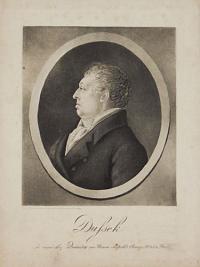
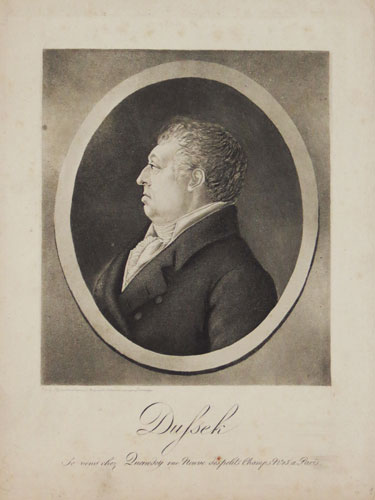
Dussek
Dess au Physionotrace d'après le Buste de feu Callamard et grave par Quenedey.
Se vend chez Quenedey rue neuve des Petits Champs No.15 a Paris.
Etching and aquatint with small margins, platemark 250 x 195mm (9¾ x 7¾"). Slightly stained.
Jan Ladislav Dussek (1760-1812), pianist and composer. Born in Cáslav (now part of the Czech Republic), Dussek travelled widely across Europe as a young man. In Paris, he performed before Marie Antoinette and made the acquaintance of Napoleon, before fleeing to England at the time of the French Revolution. He spent eleven years in London working as a piano teacher and giving concerts, appearing with Haydn when the latter visited London. He then lived in Prussia before accepting a position with the politician Talleyrand to spend his final years in France. By Edme Quénedey (1756 - 1830), miniature painter and engraver, who made much use of the physionotrace, a mechanised drawing instrument that could reproduce the outline profile of a portrait. It was invented by Gilles-Louis Chretien, who engraved Quenedey's portraits from 1787 to 1789, in 1786. Chretien and Quenedey founded a very successful portrait studio in Paris together in 1788. Between 1786 - c.1810 there were only two studios in Paris which produced a relatively small number of physionotrace engravings. Consequently very few of these intriguing portraits are preserved today. Because of their origins and the realism physionotrace portraits have, they can be seen as true photo-graphic objects and are therefore classified as a forerunner of photography.
[Ref: 35220] £260.00
(£312.00 incl.VAT)
![[Christoph Willibald Gluck.] Gluck.](img-thumbnail/jpegs/63316.jpg)
[Christoph Willibald Gluck.] Gluck.
Se vend chez Quenedey rue Neuve-des-Petits-Champs No15 à Paris / Dép. à la Bib. Imp.
Dess: au Physionotrace et Gravé par Quenedey d'apres Le buste de.
Aquatint. Sheet 240 x 155mm (9½ x 6"). Trimmed slightly into plate.
Portrait of Christoph Willibald Gluck (1714 - 87), composer of Italian and French opera in the early classical period. Born in the Upper Palatinate and raised in Bohemia, both part of the Holy Roman Empire, he gained prominence at the Habsburg court at Vienna.
[Ref: 63316] £180.00
(£216.00 incl.VAT)

F. J. Gossec. Membre de L'Institut.
Dess: au Physionotrace et Gravé par Quenedey rue neuve des petits champs No15 à Paris 1813.
Aquatint. Sheet 240 x 155mm (9½ x 6"). Trimmed slightly into plate.
Portrait of François-Joseph Gossec (1734 -1829), French composer of operas, string quartets, symphonies, and choral works. Bust in profile to left, with powdered hair and jacket with medal at lapel; in oval.
[Ref: 63303] £140.00
(£168.00 incl.VAT)
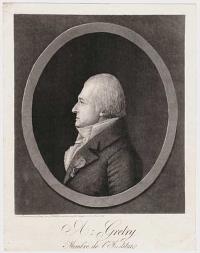
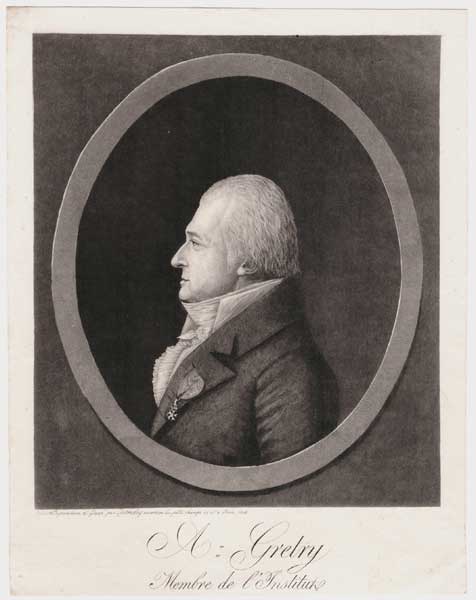
A: Gretry. Membre de l'Istitute.
Dess. au Physionotrace et Gravé par Quenedey rue neuve des petits champs no.15 à Paris 1808.
[Se vend chez Quenedey rue neuve-des-Petits-Champs No.15 à Paris'. Dep. à la Bib. Imp.]
Aquatint with etching. Sheet 225 x 175mm (8¾ x 6¾"). Trimmed within plate, losing publication line.
Profile portrait of André Grétry (1741-1813), Belgian composer of opéras comiques. Frenchman Gilles-Louis Chrétien invented the 'physionotrace' in the 1780s to draw the outlines of silhouettes, which were then completed by the artist and transferred to aquatint printing plates using another pantograph. The published of this print, Edme Quenedey, was Chrétien's first business partner: a drawing he made of the device in 1788 is now in the Bibliothèque Nationale de France..
[Ref: 62402] £220.00
(£264.00 incl.VAT)

Nicolò Isouard de Malte. Dernier Maitre de Chapelle de L'ordre.
Se vend chez Quenedey rue Neuve-des-Petits-Champs No15 à Paris / Dép. à la Bib. Imp.
[n.d., c.1810.]
Aquatint. Sheet 240 x 155mm (9½ x 6"). Trimmed slightly into plate.
Portrait of Nicolas Isouard (1773 - 1818), Maltese-born French composer. He moved to Paris, where he worked as a free composer and became friends with Rodolphe Kreutzer. The pair worked together on several operas, including Le Petit page, ou La Prison d'état (1800) and Flaminius à Corinthe (1801). Isouard adopted the pseudonym Nicolò (or Nicolò de Malte) and found rapid success in the field of opéra comique with Michel-Ange (1802) and L'Intrigue aux fenêtres (1805). He composed regularly for the Théâtre de l'Opéra-Comique, writing some thirty works for it. He composed masses, motets, cantatas, romances, and duos, along with over 45 operas.
[Ref: 63305] £160.00
(£192.00 incl.VAT)
![[Rodolphe Kreutzer.] Kreutzer.](img-thumbnail/jpegs/63310.jpg)
[Rodolphe Kreutzer.] Kreutzer.
Se vend chez Quenedey rue Neuve-des-Petits-Champs No15 à Paris / Dép. à la Bib. Imp.
Dess: au Physionotrace et Gravé par Quenedey rue neuve des petits champs No15 à Paris 1809.
Aquatint. Sheet 240 x 155mm (9½ x 6"). Trimmed slightly into plate.
Portrait of Rodolphe Kreutzer (1766 - 1831), French violinist, teacher, conductor, and composer of forty French operas, including La mort d'Abel. He is probably best known as the dedicatee of Beethoven's Violin Sonata No. 9, Op. 47, known as the Kreutzer Sonata, though he never played the work.
[Ref: 63310] £140.00
(£168.00 incl.VAT)
![[Jean-François Le Sueur.] J. F. Le Sueur.](img-thumbnail/jpegs/63313.jpg)
[Jean-François Le Sueur.] J. F. Le Sueur. Membre de L'Institut, Surintendant de la Musique du Roi.
Se vend chez Quenedey rue Neuve-des-Petits-Champs No15 à Paris / Dép. à la Bib. Imp.
Dess: au Physionotrace et Gravé par Quenedey rue neuve des petits champs No15 à Paris 1818.
Aquatint. Sheet 240 x 155mm (9½ x 6"). Trimmed slightly into plate.
Portrait of Jean-François Le Sueur (1760 - 1837), French composer, best known for his oratorios and operas. He spent some time in London, 1788–92, then returned to revolutionary Paris and gave three successful operas at the Théâtre Feydeau: La Caverne, ou le Repentir (1793), Paul et Virginie, ou le Triomphe de la vertu (1794), which was inspired by the hugely popular novel by Jacques-Henri Bernardin de Saint-Pierre, and the classical Télémaque dans l'île de Calypso, ou le Triomphe de la sagesse (1796).
[Ref: 63313] £140.00
(£168.00 incl.VAT)
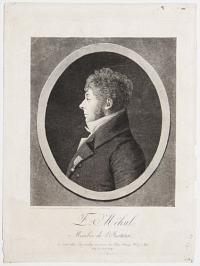
E: Méhul. Membre de l'Institute.
Dess. au Physionotrace et Gravé par Quenedey rue neuve-des-petits-champs no.15 à Paris 1808.
Se vend chez Quenedey rue neuve-des-Petits-Champs No 15 à Paris / Dép. à la Bib. Imp.
Aquatint. 245 x 190mm (9½ x 7½"). Some minor staining.
Étienne Nicolas Méhul (1763-1817), composer influential in the development of French opera. A physionotrace is an instrument designed to trace a person's profile, invented by a Frenchman named Gilles-Louis Chrétien in 1783-84. Chrétien's device transmitted the tracing of the silhouette, whilst crucially also including details such as clothing, to an engraving needle via an eyepiece. Enabling the production of multiple and therefore cheap copies, the physionotrace represented a precursor to photography in making portraiture a mass phenomenon.
[Ref: 46257] £190.00
(£228.00 incl.VAT)
![[Pierre-Alexandre Monsigny.] Monsigny.](img-thumbnail/jpegs/63311.jpg)
[Pierre-Alexandre Monsigny.] Monsigny.
Se vend chez Quenedey rue Neuve-des-Petits-Champs No15 à Paris / Dép. à la Bib. Imp.
Dess: au Physionotrace et Gravé par Quenedey rue neuve des petits champs No15 à Paris 1809.
Aquatint. Sheet 240 x 155mm (9½ x 6"). Trimmed slightly into plate.
Portrait of Pierre-Alexandre Monsigny (1729 - 1817), French composer and a member of the French Académie des Beaux-Arts.
[Ref: 63311] £140.00
(£168.00 incl.VAT)
![[Ferdinando Paer.] F. Paer.](img-thumbnail/jpegs/63308.jpg)
[Ferdinando Paer.] F. Paer.
Se vend chez Quenedey rue Neuve-des-Petits-Champs No15 à Paris / Dép. à la Bib. Imp.
Dess: au Physionotrace et Gravé par Quenedey rue neuve des petits champs No15 à Paris 1809.
Aquatint. Sheet 240 x 155mm (9½ x 6"). Trimmed slightly into plate. Damage on left margin.
Portrait of Ferdinando Paer (1771 - 1839), Italian composer known for his operas. Paer wrote a total of 55 operas, in the Italian Classical styles of Paisiello and Cimarosa. His other works, including several religious compositions, cantatas, many songs and a short list of orchestral chamber pieces
[Ref: 63308] £120.00
(£144.00 incl.VAT)
![[Antonio] Sacchini.](img-thumbnail/jpegs/62403.jpg)
[Antonio] Sacchini.
Dess. au Physionotrace d'ap. le buste et Gravé par Quenedey rue neuve des petits champs no.15 à Paris [n.d., c.1808].
Se vend chez Quenedey rue neuve-des-Petits-Champs N.º 15 à Paris'. Dép. à la Bib. Imp.]
Aquatint with etching. 250 x 190mm (9¾ x 7½"), with very large margins.
Profile portrait of Antonio Maria Gasparo Gioacchino Sacchini (1730-1786), Italian composer of operas. Frenchman Gilles-Louis Chrétien invented the 'physionotrace' in the 1780s to draw the outlines of silhouettes, which were then completed by the artist and transferred to aquatint printing plates using another pantograph. The published of this print, Edme Quenedey, was Chrétien's first business partner: a drawing he made of the device in 1788 is now in the Bibliothèque Nationale de France..
[Ref: 62403] £180.00
(£216.00 incl.VAT)
![[Gaspare Luigi Pacifico Spontini.] G. Spontini.](img-thumbnail/jpegs/63307.jpg)
[Gaspare Luigi Pacifico Spontini.] G. Spontini.
Se vend chez Quenedey rue Neuve-des-Petits-Champs No15 à Paris / Dép. à la Bib. Imp.
Dess: au Physionotrace et Gravé par Quenedey rue neuve des petits champs No15 à Paris 1810.
Aquatint. Sheet 240 x 155mm (9½ x 6"). Trimmed slightly into plate.
Portrait of Gaspare Luigi Pacifico Spontini (1774 - 1851) was an Italian opera composer and conductor from the classical era. During the first two decades of the 19th century, Spontini was an important figure in French opera, and composed over twenty works.
[Ref: 63307] £160.00
(£192.00 incl.VAT)
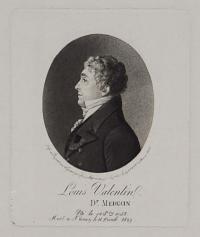
Louis Valentin. Dr. Medecin / Né le 14 8bre 1758 / Mort a Nancy le 11 Fevrier 1829
Dess au Physionotrace et gravé par Quenedey rue des petits Champs No.15 a Paris 1816
Etching and aquatint with large margins, platemark 115 x 95mm (4½ x 3¾"). Late impression.
French doctor Louis Valentin. This print was made by Edme Quénedey (1756 - 1830) during the sitter's lifetime and reissued with addition text after his death. Quenedey, a miniature painter and engraver, made much use of the physionotrace, a mechanised drawing instrument that could reproduce the outline profile of a portrait. It was invented by Gilles-Louis Chretien, who engraved Quenedey’s portraits from 1787 to 1789, in 1786. Chretien and Quenedey founded a very successful portrait studio in Paris together in 1788. Between 1786 – c.1810 there were only two studios in Paris which produced a relatively small number of physionotrace engravings. Consequently very few of these intriguing portraits are preserved today. Because of their origins and the realism physionotrace portraits have, they can be seen as true photo-graphic objects and are therefore classified as a forerunner of photography.
[Ref: 35221] £120.00
(£144.00 incl.VAT)
<<< Previous 1 Next >>>

![[Maria Luigi Carlo Zenobio Salvatore Cherubini.] L. Cherubini.](jpegs/63315.jpg)

![[Christoph Willibald Gluck.] Gluck.](jpegs/63316.jpg)


![[Rodolphe Kreutzer.] Kreutzer.](jpegs/63310.jpg)
![[Jean-François Le Sueur.] J. F. Le Sueur.](jpegs/63313.jpg)

![[Pierre-Alexandre Monsigny.] Monsigny.](jpegs/63311.jpg)
![[Ferdinando Paer.] F. Paer.](jpegs/63308.jpg)
![[Antonio] Sacchini.](jpegs/62403.jpg)
![[Gaspare Luigi Pacifico Spontini.] G. Spontini.](jpegs/63307.jpg)