Results 1-3 of 3
<<< Previous 1 Next >>>

M.r Holman and Miss Brunton in the Characters of Romeo and Juliet. Act 5. scene last.
Painted by M. Brown. Engraved by T. Park.
London Published by T. Park, No 106 Pall Mall, Jan.y 1st 1787.
Mezzotint, very fine impression, 655 x 450mm (25¾ x 17¾"), with title on separate plate, 40 x 450 (1¼ x 17¾"). Small tear entering inscription plate. Slight repair bottom right.
Portraits of Joseph George Holman (1764-1817) and Ann Brunton Merry (1769-1808) as Romeo and Juliet, by the American painter Mather Brown (1761-1831). Exhibited at the Royal Academy in 1786 it shows a happy ending to Romeo and Juliet, with the lovers emerging from the tomb. CS II of II. The original oil is in the University of Bristol Theatre Collection.
[Ref: 63266] £480.00
![[The penitent Mary Magdalene.]](img-thumbnail/jpegs/60144.jpg)
[The penitent Mary Magdalene.]
[Engraved by Thomas Park after Gaetano Gandolfi.]
[n.d., c.1800.]
Mezzotint, proof before all letters. Sheet 210 x 170mm (8¼ x 6¾"). Trimmed within plate at bottom. Small margins.
The penitent Magdalene as a woman with loose dark hair lying on a cloak, gazing down sorrowfully at a skull, scourge and wooden cross.
[Ref: 60144] £180.00
(£216.00 incl.VAT)
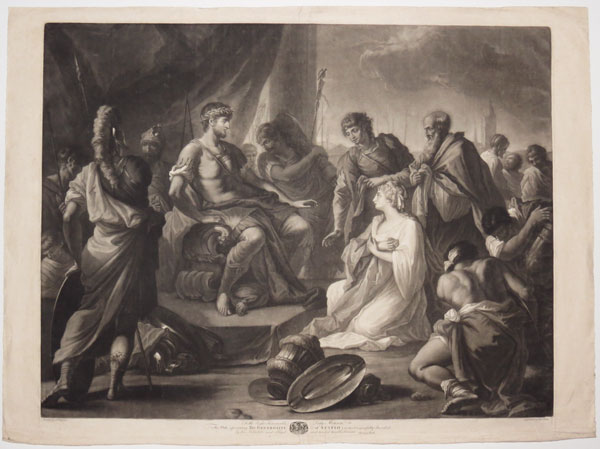
To the Right Honourable Lady Monson ~ This Plate representing the Generosity of Scipio; is most respectfully Inscribed, by her Ladyship's most obliged and devoted humble Servant, Thomas Park.
Painted by A. Pellegrini. Engraved by Tho.s Park.
[Publish'd as the Act directs, 7 June 1785, by T Park & Sold by W Dickinson, No. 158 New Bond Street.]
A large mezzotint, proof before publisher's inscription?, rare. 535 x 660mm (21 x 26"), large margins on 3 sides. Creasing and several small tears in inscription area.
A scene from the Second Punic War (218-201 BC). In 209 BC a Roman expeditionary army under Publius Cornelius Scipio captured Carthago Nova, Carthage's capital city in Iberia. Among the captives was the beautiful fiancée of the prince Allucius. Scipio summoned her family, who arrived with a ransom of treasure. Scipio refused this and returned her to them, asking only that they be friends to Rome. When they offered the ransom as a present, he accepted it, only to return it immediately as a wedding gift from himself. Allucius then brought over his tribe to support the Roman armies in gratitude. Gian Antonio Pellegrini's original painting of c.1719 is now in the Kunsthistorisches Museum, Vienna.
[Ref: 47700] £420.00
<<< Previous 1 Next >>>

![[The penitent Mary Magdalene.]](jpegs/60144.jpg)